Dispatches From Munich Security Conference with General David H. Petraeus, US Army (Ret.)
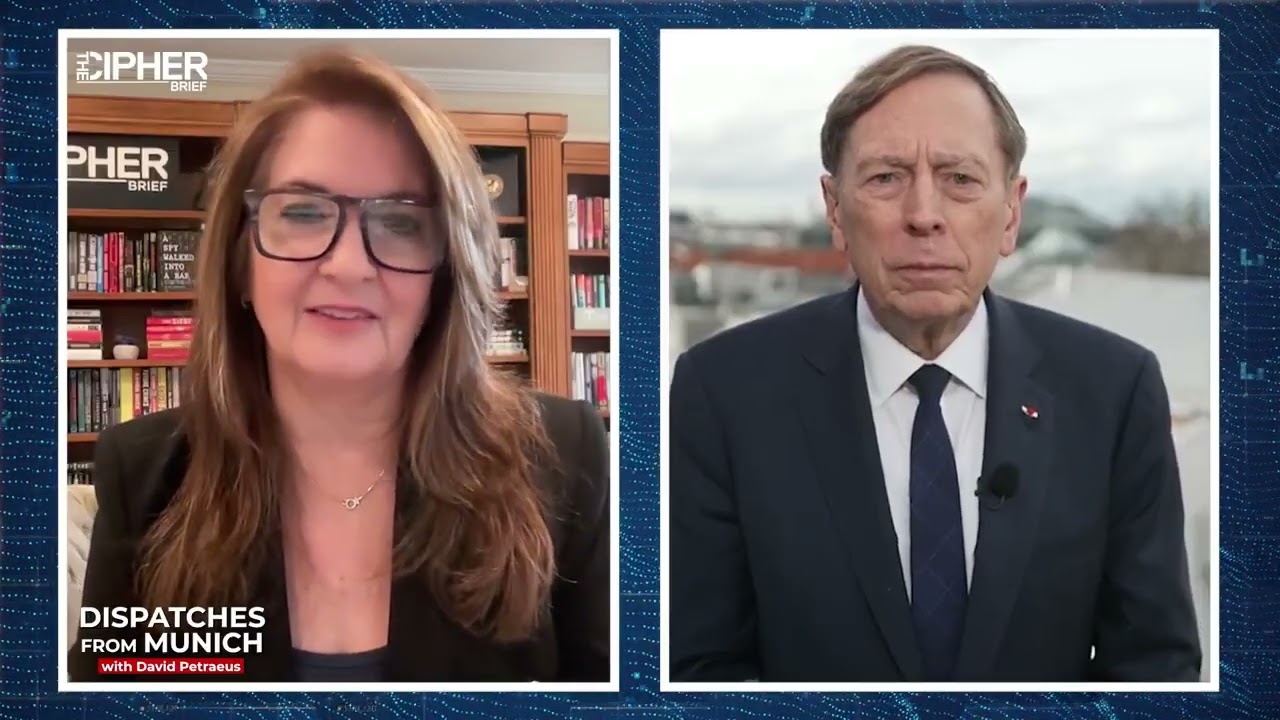
General David Petraeus reports from Munich on Ukraine's winter war: Russian forces destroyed heating infrastructure across Kyiv, yet Ukrainian morale holds while inflicting 1.2 million Russian casualties. Ukraine now produces 7 million drones yearly and has sunk 35 percent of Russia's Black Sea Fleet with maritime drones. Petraeus argues sustained sanctions and cutting Chinese component supplies could force a cease-fire.
General David Petraeus joining us from the Munich Security Conference in Germany. General, thank you so much for being here.
Good to be with you once again.
You've been busy. I want to get to what's happening on the ground there in Munich, but I first want to know, you just came out of Ukraine where you had a number of meetings with senior leaders there. Can you kind of give us a sense of your impression of what's happening on the ground and where things are headed with these talks?
Sure. And also actually visiting many of the same units that you've been with us on in past times. Well, first of all, the situation in Ukraine is very challenging right now. They're in the midst of a winter that is as brutal as anyone can remember. And the Russians are trying essentially to turn off the lights and shut off the heat. There are over 2,400 large, tall apartment buildings in Kyiv alone that have no heat. And the possibility is they may not have it for a number of weeks, if not months, because the Russians continue to go after that system as they are also going after the electrical generation capacity and transmission as well. So it's very, very challenging in that regard. But as we've always seen, the resilience, the The sense of determination, the will is very much still present for the Ukrainians. It's hard, but they're hard as well, and they're showing that once again. And then on the battlefield, the Ukrainians are very much making the Russians pay enormously for the incremental gains that they have been able to achieve. They report that they killed or wounded as many Russian soldiers last month as Russia recruited. So the toll is, is climbing very rapidly. The Russians have now taken well over 1.2 million killed and wounded since 2022. That, to put in perspective, is more than the United States sustained in all of World War II. So again, the cost to Russia is mounting and Candidly, I hope that there becomes a point where they literally cannot recruit soldiers in the numbers that are required. And also that if we support what the Europeans are doing, they just— they have their 19th round of sanctions already imposed. They're already talking about a 20th round. And they just agreed to provide €90 billion, about $105, $110 billion for Ukraine. No-interest loan that they only have to pay back once the Russians actually give reparations to them, which is going to be a long time off. So it's essentially a gift and it will enable them to solve their fiscal and economic problems for at least 18 months and also increase the production of various of their weapons systems. On the drone front, 7 million drones will be made this year by Ukraine. They're now even starting to look at how they can begin to export, how they can have joint ventures. In European countries and in the United States. So on that front, the innovation that you and I have seen in the past, and which we have marveled, it has taken another step, turn above. It just keeps expanding. And that is what's making the difference on the battlefield. Still the tough infantrymen living in many cases in holes in the ground in a brutal winter., with overhead cover on it getting hammered by glide bombs and artillery and constantly being surveilled by drones. Uh, but more and more and more, it's unmanned systems that are taking on the tasks that used to be performed by drivers of vehicles. Now they have remotely driven vehicles, operators of machine guns. They even have remotely operated machine guns, grenade launchers, mine layers, uh, all of that in addition to this enormous increase in the number of aerial drones and also, of course, maritime drones, which have forced the Russian Black Sea Fleet essentially to tie up at a port as far from Ukraine as they can get in the southeastern part of the Black Sea, because, of course, about 35% of their vessels have been sunk and are on the bottom of the Black Sea Fleet. All of that without the kind of traditional navy that we know. It's aerial drones that find those ships, pinpoint them, and then maritime drones that sink them. And now the Ukrainians are bringing online their own cruise missile that they designed, manufacture, and are now employing, which has a range of 3,000 kilometers and a larger warhead, as well as a longer range than our Tomahawk cruise missile. So on all of these fronts, there is really, again, I think breathtaking is the accurate description. And you'll recall having seen the software platform that pulls all this together, that provides the common operational picture. That gives the air and ballistic missile defense picture. We went, by the way, the brand new headquarters that has that its first day in operation. We'll take you next time to see that. Went to drone manufacturing facilities, one of which is making over 5,000 drones per day, 3 8-hour shifts, 24 hours a day. The most advanced robotics and additive manufacturing, 3D printing, all of this that I've ever actually seen. All of this is just— it gives you a degree of, I think, a degree of hope. If we can now pile on joining the Europeans with sanctions, you'll recall that Senator Lindsey Graham has a sanctions package in the Senate. Reportedly, 90 of 100 support it. Needs to work it with the White House and get that imposed. And my sense is that with the negotiations not really going anywhere, yes, there seem to be positive discussions. It's a breakthrough that the Russians, Ukrainians, or Americans are all in the same room. But after each one of these rounds of negotiations, some Russian leader comes out and essentially reiterates the demands that they have held all along, none of which can be acceptable to the Ukrainian people or their leaders. So that's where we are. You heard me, I think, back last fall when I said if if we can crush the Russian war economy with the additional sanctions, if we can support the Ukrainians with the additional funding, that has now happened, if we can help them with air and ballistic missile defense, that's the one area where they can't make their own interceptors or the overall radar systems and so forth. If they can do all that and then reduce the revenue that the Russians are getting, that's ongoing. The package that the president negotiated with India includes an Indian commitment that they will not buy as much gas and oil. So you reduce the revenue they have, you add to their economic challenges of high inflation, very high interest rates and a declining ruble. And what you heard when we were last with the intelligence chief, that they are running out of the National Welfare Fund, that money is running out this year in Russia, and that's what's been diverted to fuel their military-industrial complex. And then if there can be something done to reduce very dramatically all the components that China is providing to them to enable them to continue to make weapons systems and communication systems and so forth, if all that can be done, I think there's actually a prospect that President Putin will need a cessation of hostilities, not just the Ukrainians. And then and only then might you have serious discussions about some cessation that could actually be enduring, durable, and adequate for the Ukrainian people.
You're absolutely right. I think breathtaking is the word for all of this. It's fascinating that the Ukrainians have done— now they've moved closer to something you've been advocating for for a long time, which is allowing— having President Zelensky allow to export a lot of these drones, this technology. And that's going to make a difference far beyond even the borders of Ukraine. Can you talk to us a little bit about that?
Well, to make a difference for us, again, Recall, I just said that they believe they'll make 7 million drones this year alone. By the way, that's double what they did last year. So exponential increase. We will produce maybe 300,000, 400,000. That's what we've been producing. So this would be enormous for the US and by the way, of course, for European countries. And as you'll recall, I've urged a number of European countries to much more assiduously learn from what it is the Ukrainians are doing, not just go to Kyiv and visit the president and the ministers and all that, but visit the, the Nemesis, now brigade by the way, it was a regiment the last time we were with them, this great unmanned services force, another one that we went to, which is equally good. They're all competing for the top tier in rankings on the Brave One system, which is publicly available by the way. You can actually go into that from the internet, see how the the different companies, the different units rank because they have point scales and they can redeem that on their essentially Amazon-like Brave One weapon system website. All of this is really extraordinary. But if European countries can latch on to some of this, have joint production in their countries on their soil, this would be very, very important because my fear is that yes, all these NATO nations have committed to spend a lot more on defense, and that's a huge success, and that'll be celebrated here this year because of course it took place between last year's Munich Security Conference and this year's. So take the win, continue to push, but what they've gotta do is not fall into the trap that you often see, which is that you buy more of the legacy systems, maybe a product improvement, rather than buying what is the future of warfare. And the place to see that, of course, is in Ukraine. And we've got to go to school, all of us, on how it is that they are carrying out this campaign, how they have shortened the kill chain, if you will, the time from a sensor identifying a Russian action to the launch and operation of a suicide drone or another bomber drone or surveillance teams or what have you. But we've got to learn. And this starts, as you'll recall, Suzanne, not with immediately purchasing something. It starts with new concepts for operations that turn into doctrine, organizational change. Keep in mind that the Ukrainians now have not just an army, navy, air force, but an unmanned services force. By the way, now they've added a cyber force as yet another service equivalent to the army, navy, air force. You have to change how you train, how you operate. Needless to say, your leaders have to be educated—commissioned, noncommissioned, warrant officer, leader development. Above all, the materiel requirements have to dramatically change because, of course, you want stuff that is very different from what we've used on the European continent for many, many decades during the Cold War and then beyond. And even changes with respect to personnel, facilities, and all the rest of that. That's how you institutionalize change rather than just changing the items that you're gonna buy. It all has to be part of a new operational concept that reflects the reality of war, the reality of the future of war, which we see right now in Ukraine. And keep in mind that, you know, they threw out all the rules as they're fighting for their very survival. This is their war of independence. And that enables them to have a partnership between those who design the drones, those who manufacture them and those who operate them that is like this, as opposed to the system that we have with a request for proposal, the proposals, the down select, the tweaks, sue each other and, you know, on and on. And every change order is a major deal. We've got to get much, much more rapidly operating than has been the case. They are producing tomorrow's technology for today's war. You've heard people say about the US and Western systems that too often they produce yesterday's technology for tomorrow's wars. That's got to be changed very, very dramatically. And I think by having these companies locate in European countries and having them purchase these systems, but after overhauling their concept of operations, and that really includes starting with the Allied Command Europe, the Supreme Allied Command Europe, the US four-star who is the NATO commander on European soil. They've got to overhaul that, bring it more up to date. They did it just a couple of years ago in a very impressive way. Now they've got to make the changes to reflect how warfare is evolving on the ground, in the air, and on the sea in Ukraine.
More from Bob

S250:E4🎙️LIVE 🇺🇸America 250: President Barack Obama Leadership, Service, and the Power of Hope






S5:E157🎙️ LIVE with CMD CMSgt Dennis L. Fritz, USAF (Ret.)(Multi Tracks Audio)



S5:E156🎙️ LIVE 🇪🇸 Leadership Lessons from the FIFA World Cup 2026 Champions (Multi Tracks Audio)

S250:E3🎙️ LIVE Leadership Lessons from America’s First Documented Family of African Descent 🇺🇸📖