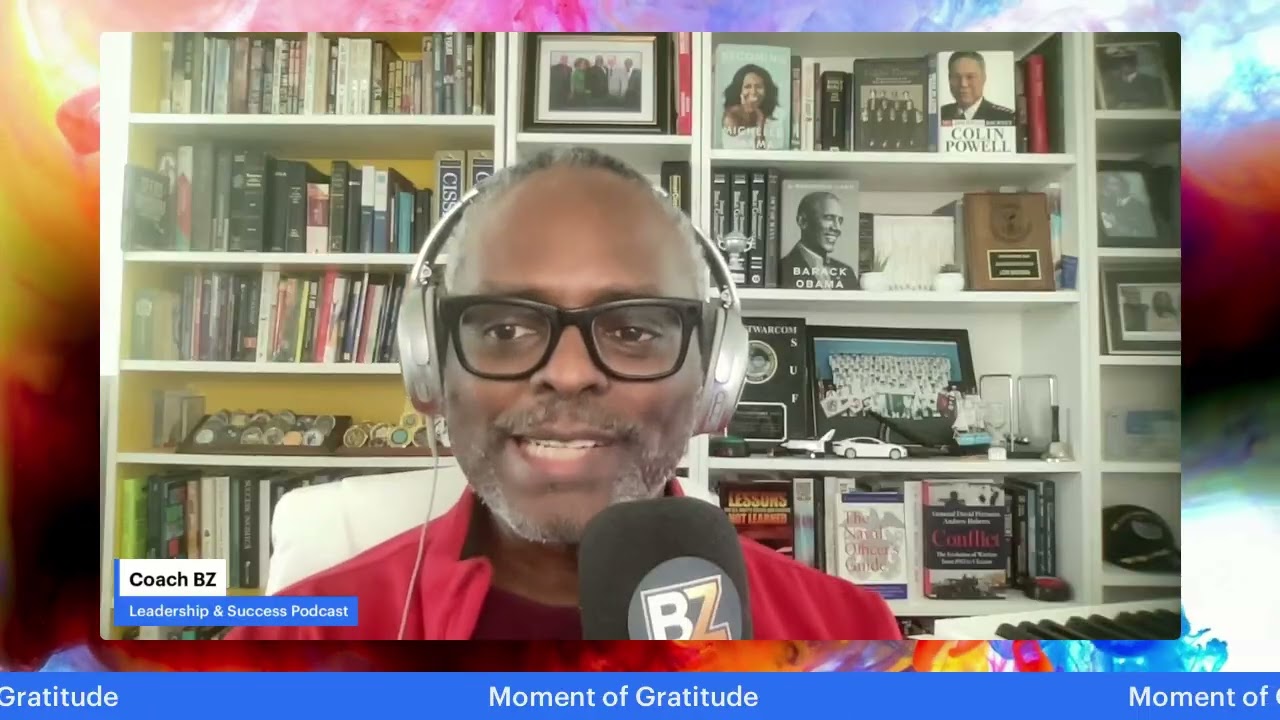
On MLK Day, the host reflects on leadership rooted in moral responsibility, not rank. He quotes King on injustice and non-violence, then challenges naval officers and engineers to confront unfairness within their teams. Silence in the face of injustice, he argues, is itself a form of leadership.
Chapters
Alright everyone, welcome to this special edition of the Leadership and Success Podcast. Today we are going to be covering Proverbs chapter 19. Today is January 19th, 2026. We're gonna be talking about ancient wisdom and leadership lesson from the book of Proverbs. But today is also a very special day. It is the Martin Luther King Day. Alright, so happy King's Day everyone. First, to get started, I'm reminded of our moment of gratitude. This is a part of the show where we take just a moment to be grateful for something because it's not possible to be depressed and to be grateful all at the very same time. So maybe if you would close your eyes, take a deep breath, put yourself in your happy place, calm your nervous system, and think about one thing you are grateful for today. I think today more than any other day, I am really grateful for the great heritage we have here in this country, in the United States of America. Those great people who have come before me, on whose shoulders I stand today. My story definitely wouldn't be possible without them. Those people who stood for justice, for equity, and for freedom. And I think that's really the spirit of America, who we are as a country. That's part of the reason why I joined the U.S. Navy, the U.S. Armed Forces, and part of the reason why I am willing to give my life for this nation because of our Constitution, our founding document, what it means, what it represents, and also for the hope we have, right? America, again, not the perfect country, but it seems like with time we've been trying time and time again to live out our foundational aspiration. All men being created equal. Wow, that is quite a revolutionary idea, isn't it? And again, that's not how America started, but that's definitely what we want— a multiracial, multinational, democratic republic based on the rule of law and the Constitution of the United States with justice for all. Wow. That's the country I want. That's the country I'm fighting for. And that's who I am as an American. And I'm very grateful for that today. All right, if you would, uh, type in the comment what you are grateful for today. And again, Happy King's Day. Let me, uh, read an article. Actually, it's a post I wrote about, uh, today, again giving, uh, honor and remembering Reverend Dr. Martin Luther King. One of his best quotes for me is when he says, injustice Injustice anywhere is a threat to justice everywhere. Wow, that is so powerful. Are you going to make yourself known? Are you going to count for history? Are you going to count for when things actually matter? Reverend Dr. Martin Luther King Jr. said that in the letter he wrote from a Birmingham jail, That was April 16th, 1963, in the civil rights struggle. All they wanted was for Black people to have the same civil rights as everybody else, to be full citizens of America. It's not asking too much, is it? And I especially love that Martin Luther King stood for nonviolence. Wow. Would you stand up with Dr. King for what is right? This quote really has followed me from the deck plates in the Navy to the boardrooms of Silicon Valley, because leadership is not just about authority, rank, or technical mastery. It's really about moral responsibility. Martin Luther King reminded us that we are caught in an inescapable network of mutuality. That truth applies just as much to a ship's watch team or a cyber defense squad in Silicon Valley as it does to a nation. What we tolerate in one corner of our organization will eventually shape the whole culture. And I've learned this the hard way. Early in my career, it was quite tempting to focus narrowly just on my mission, my system, my deliverable. But over time, I realized something critical: silence in the face of unfairness is still a form of leadership, and not the kind of leadership we want. For naval junior officers listening to me right now who aspire to command one day, what injustices, small or large, are you seeing on your watch, in your division, or on your ship? What are you going to do about that? And are you building trust by protecting your people, or eroding it by avoiding hard conversations? "Command is not conferred by rank alone. It is earned daily through courage and character." And for senior security engineers or analysts here in Silicon Valley aspiring to lead, when a teammate is marginalized, overworked, or unheard, do you step in or do you step back? Are you going to make yourself count? Do your design and decision reflect fairness? Inclusion, accountability, or just speed and efficiency? Technical excellence opens doors, but moral clarity will keep those doors open. So history reminds us over and over again that progress is never finished. Lincoln spoke of the unfinished work left to the living. Dr. King echoed that call generations later. Leadership today still demands the same thing. Increased devotion to the cause of justice, freedom, equality. So speak up early. Small injustices become systemic failures if they are ignored. Defend people with the same intensity you defend mission, especially those who cannot defend themselves. Measure success not just by the outcome, but by how those outcomes were achieved. And remember, culture is shaped more by what leaders tolerate than what they announce. When you see injustice and you just ignore it, act as if you didn't see anything, well, that becomes your new standard. Are you going to say something? Are you going to stand for justice? Where do you see injustice right now, subtle or overt, in your organization or your industry today? What is one action you can take this week to model the kind of leadership you want to serve under? Because leadership, my friend, is not neutral. Every decision either strengthens the fabric of trust or it frays it. So let's finish the work we inherited. I think if nothing else, what Dr. Martin Luther King's legacy is all about, in my opinion, is not just being Being aware of what's going on around you, but taking a stand. These are my core value. This is what I stand on. And Dr. Martin Luther King was willing to die for his belief. And again, this one is from the I Have a Dream speech, probably one of the most popular speeches in history. Dr. King says, now is the time to make real the promise of democracy. Now is the time to rise from the dark and desolate valley of segregation to the sunlit path of racial justice. Now is the time to lift our nation from the quicksands of racial injustice to the solid rock of brotherhood. Now is the time to make justice a reality for all of God's children. All of them. Nobody left out. Doesn't matter if you are white, black, male, female, gay, straight, All of them. Now is the time to make justice a reality for all of God's children in this country. He says, "I have a dream that one day even the state of Mississippi, a state sweltering with the heat of injustice, sweltering with the heat of oppression, will be transformed into an oasis of freedom and justice. Let freedom ring. Let freedom ring. Let freedom ring." Wow, that's powerful. Words are powerful. And Abraham Lincoln said, this was during the Gettysburg Address. I highly recommend everybody watch the movie, especially read the book about Gettysburg, but very, very powerful word. Abraham Lincoln, the one who emancipated the slave, he said during that address, This nation under God shall have a new birth of freedom, and that government of the people, by the people, and for the people shall not perish from earth. That is what America is to me, and that's why, or partly the reason why, I joined the U.S. Navy, the U.S. military, the best military in the world. And I think our armed forces really make our country great, because those young men and women who answer the call, they'll raise their hand and they make an oath to the Constitution of the United States of America to support and defend that Constitution against all enemies, foreign and domestic, and they are willing to give their life for the freedom of their brother and their sister, of their fellow citizen. That is powerful. Yesterday when we did Lessons 18, right, Proverbs chapter 18, one of the bonus lessons I gave was the leadership ultimate sacrifice. Again, I've never seen anything like that, only in the US military. Where someone, a friend who sticks closer than a brother, a friend who's willing to give his life or her life for a friend. There is no greater love than that. And every day in our armed forces, our men and women in uniform are willing to do that. Wow. And I'm going to end with an extract of another speech by President Barack Obama. This remark by the president at the 50th anniversary of the Selma to Montgomery marches. That was March 7th, 2015. So 11 years ago now. President Obama says, "50 years from Bloody Sunday, our march is not yet finished, but we are getting closer. 239 years after this nation's founding, our union is not yet perfect, but we are getting closer. Our job's easier because somebody already got us through that first mile. Somebody already got us over that bridge. When it feels the road is too hard, when the torch we've been passed feels too heavy, We will remember these early travellers and draw strength from their example and hold firmly the words of the prophet Isaiah: Those who hope in the Lord will renew their strength. They will soar on the wings like eagles. They will run and not grow weary. They will walk and not faint. We honour those who walked so we could run. We must run so our children soar, and we will not grow weary. For we believe in the power of an awesome God, and we believe in this country's sacred promise. Free at last, free at last, thank God Almighty, we are free at last. Let freedom ring, let freedom ring. Yes, we can. Alright, happy King's Day. Now let's get into today's study. So again, we're supposed to study today on January 19th, Martin Luther King's Day. Ancient Wisdom Mentoring from the Book of Proverbs. We're going to be studying Proverbs chapter 19. This is not a religious study, but we're going to be focusing on the leadership lesson and the ancient wisdom from this book written more than 2,000 years ago, but those leadership principles still apply today.
More from Bob

S250:E4🎙️LIVE 🇺🇸America 250: President Barack Obama Leadership, Service, and the Power of Hope






S5:E157🎙️ LIVE with CMD CMSgt Dennis L. Fritz, USAF (Ret.)(Multi Tracks Audio)



S5:E156🎙️ LIVE 🇪🇸 Leadership Lessons from the FIFA World Cup 2026 Champions (Multi Tracks Audio)

S250:E3🎙️ LIVE Leadership Lessons from America’s First Documented Family of African Descent 🇺🇸📖