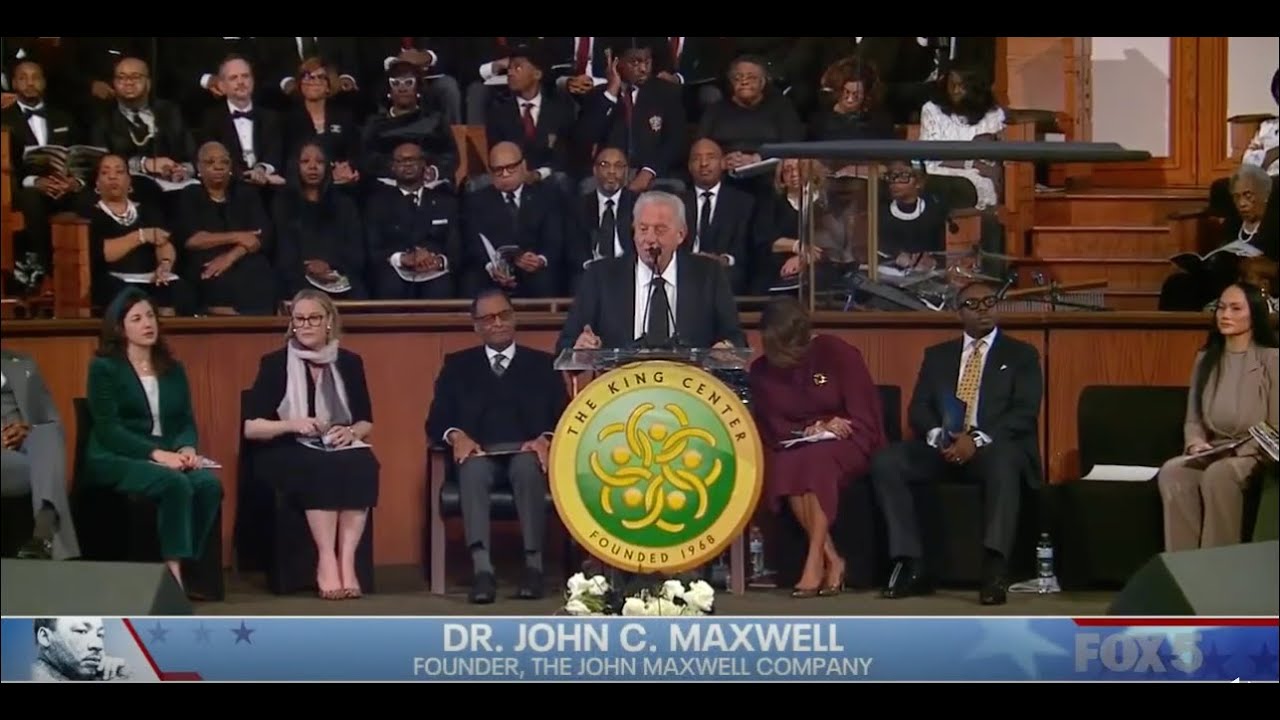
In a commemorative speech delivered on Martin Luther King Jr. Day 2026, Dr. John C. Maxwell honors Dr. King by framing him as the quintessential "high‑road leader." Maxwell draws on his own book The High Road Leader to define this leadership style as one rooted in biblical principles, moral motives, and a commitment to serving others. He cites numerous MLK quotations—on non‑violence, sacrifice, forgiveness, and the power of light over darkness—to illustrate core characteristics such as valuing all people, giving more than one takes, and prioritizing the greater good over personal ambition. Maxwell also references Coretta Scott King’s observations of MLK’s self‑critique and relentless self‑improvement, underscoring the leader’s humility and awareness of his own fallibility. The speech contrasts "success" (personal achievement) with "significance" (impact on others), arguing that true fulfillment comes from serving humanity. Maxwell concludes by urging listeners to emulate MLK’s legacy of service, love, and justice, emphasizing that MLK wanted to be remembered for trying to give his life for others rather than for accolades.
Chapters
In American history, there have been great speeches. Perhaps in the 1700s, the greatest speech would have been Patrick Henry's, "Give us liberty or give us death." In the 1800s, Abraham Lincoln, The Gettysburg Address. In the 1900s, "I have a dream." As I travel internationally, all I have to do to any audience at any time is start with the words, "I have a dream," and they know that those are the words that were birthed from the heart of Martin Luther King Jr. Why is he still so influential? Because he was a leader that sees more than others see. He was the leader that sees before others see. He was what I call a high road leader. Last summer I wrote a book entitled The High Road Leader with the subtitle Bringing people together in a world that divides, because that is a high road leader, one who brings them together based on biblical principles and good morality. In fact, when I think of my book on High Road Leader, I could have literally just put the picture of Martin Luther King Jr. on the page. And people would have known that's a high road leader. I talk in the book about characteristics, what makes a man, a woman, someone that travels the high road, and you want to travel that road because there's less traffic there. High road leaders value all people. Martin Luther King Jr. said, I hereby pledge myself, my person, and my body to nonviolent movement. Therefore, I will keep the following Ten Commandments, which he said, I will pray daily to be used by God in order that all men might be free. That word all is very God-like. For God so loved the world. You see, Martin Luther King Jr. was a man of value who valued people and intentionally, consistently added value to them. A high road leader. Gives more than they take. Martin Luther King Jr. said, "I will sacrifice personal wishes in order that all men might be free." You see, the great high road leaders, they know they have to give up before they can go up. They realize that there's two kinds of people on earth. I mean, just two kinds of people. The people who lift and the people who lean. Today we honor a man, high road leader, who continually, intentionally lifted people. High road leaders do what is right for the right reasons. Martin Luther King Jr. said, the time is always right to do what is right. Why did he say that? Because motives matter. Because people matter. And right matters because right matters. High road leaders live by a bigger picture. Again, our leader Martin Luther King Jr. said, darkness cannot drive out darkness, only light can do that, and hate cannot drive out darkness. Only light can do that. What did Jesus say? We're to be salt and light. Salt makes things better. Light makes things brighter. High road leaders acknowledge their humanness. Donald Phillips, in his book Martin Luther King Jr. On Leadership, gave us these words. The people closest to him often noted Martin's personal quest to do better and to be better. Coretta Scott King, for instance, mentioned that he criticized himself more severely than anyone else did, that he was the first to say, "Maybe I made a mistake." She also noted that he worried so much and worked so hard and studied constantly long after he had become a world figure. Why? Because he sensed the load the leader carries. And he also was in touch with his humanness, understanding that when we do our very best, we are all fallible. And yet God makes the difference. Hyrule leaders place people above their own personal agenda. That's why Martin Luther King Jr. asked the question and asked all of us to ask the same thing. Life's most persistent and urgent question is, what are we doing for others? You see, success is what we do for ourselves. Significance is what we do for others. I've known a lot of unhappy successful people in life. But I've never known an unhappy significant person. High road leaders don't keep score. Martin Luther King Jr.: Forgiveness is not an occasional act, it's a permanent one. My friends, keeping score is good for games, but it's not good for life. High road leaders desire the best for others. I close with this thought: Martin Luther King Jr. didn't want a long funeral, not even a eulogy of more than 1 or 2 minutes, and on that day, He wanted no mention of his Nobel Peace Prize or the hundreds of other awards that he had received. Rather, he said, "I'd like somebody to mention that Martin Luther King Jr. tried to give his life by serving others." Yeah. Tried to love somebody. Tried to feed the hungry. Tried to clothe those who were naked. To visit those who were in prison, tried to love and serve humanity. Say that I was a drum major for justice, a drum major for peace, a drum major for righteousness. Through his words and action, it is clear that Dr. King wanted people to remember him in the fact that I did try. I did try. I did try. And today we honor a man who not only tried, but did. God bless the memory of Dr. Martin Luther King Jr.