PORTRAIT: S5:E85🎙️ LIVE with Brig Gen Geoffrey F. Weiss, USAF (Ret.)
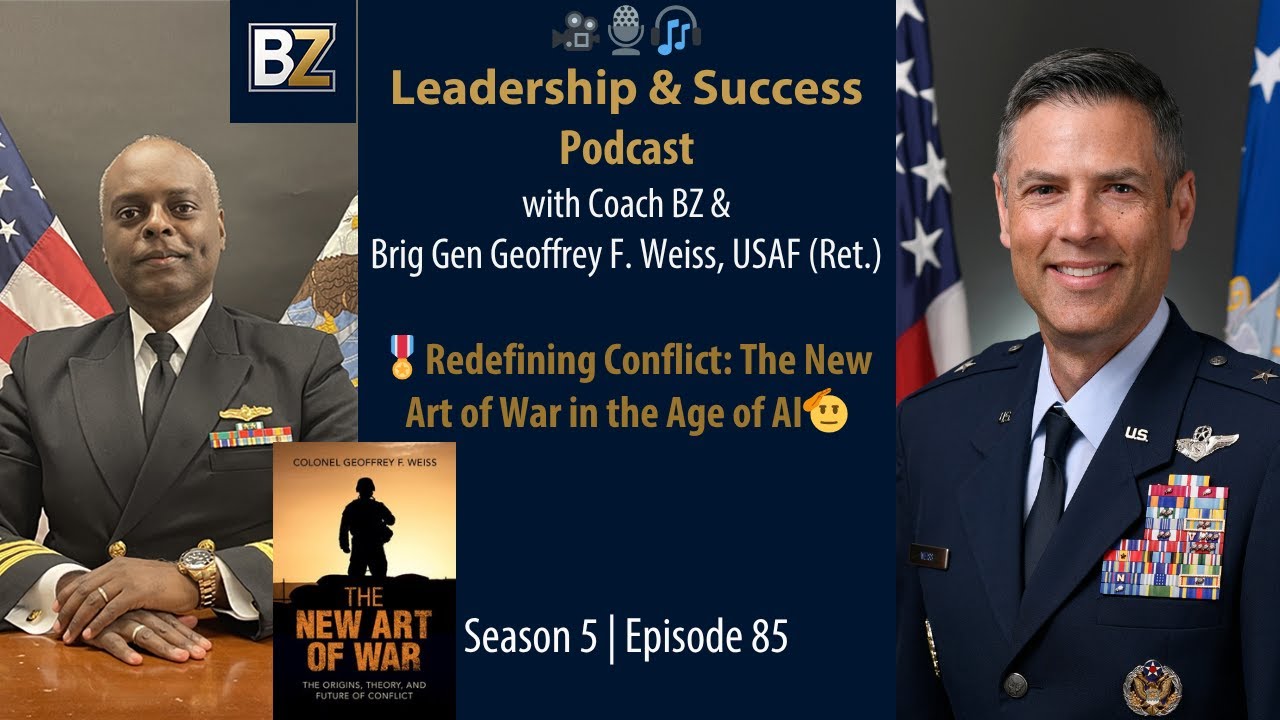
Retired Air Force Brigadier General Geoffrey F. Weiss discusses leadership forged in crisis, decision-making under uncertainty, and his book The New Art of War, which synthesizes Sun Tzu, Clausewitz, and Machiavelli into a unified theory of conflict. He worked in the National Military Command Center and credits mentors like Colin Powell and his father with shaping his approach to ethics and faith.
Chapters
Hi, I'm John Maxwell. When the top companies in the world are looking for trainers, speakers, and coaches, there's one name that stands above the rest, and that's Maxwell Leadership. Our certified team members have gotten proven results for companies all over the globe, and our reputation, I'm proud to say, is second to none. Some of our members have risen to the top of their profession, including the one you're going to meet today. I proudly introduce you to my friend Bob Fabien Zinga.
Welcome to the Leadership and Success Podcast with your host, Coach BZ, where we help you lead with purpose and succeed with impact. If you're ready to grow into the kind of leader others want to follow, this podcast is for you. If you're determined to elevate your success and leave a lasting legacy, this podcast is for you. As my mentor, Dr. John C. Maxwell, reminds us, everything rises and falls on leadership. Our goal is simple, to inspire you, challenge you, and equip you with insights that can transform the trajectory of your leadership journey. Welcome aboard to another episode of the Leadership and Success Podcast with Coach Easy.
Thanks to the AFA and the Mitchell Institute. I really appreciate the opportunity to be here and contribute some ideas on this topic today. It's an important topic, and to begin with, I'd like to say that time is right for us to be having this discussion, but frankly, I think we're about a decade and a half overdue. As we're in various stages of developing, fielding, and operating a number of advanced generation weapon systems like the F-22, the RQ-4, KC-46, F-35, and B-21, the Iron Triad, the E-3 AWACS, the E-8 JSTARS, and the RC-135 Rivet Joint is really showing its age. Nominal investments in upgrading processing, man-machine interfaces, sensors, and networking capabilities are maintaining the relevancy of these platforms for today's operations in mainly permissive environments. But until we put some analytical rigor into platform agnostic assessments of the future operational environment and the role tactical command and control and battle management will play within it, we'll lack what I call institutional certainty, which is what we need to clearly define the requirements that will drive programming and acquisition decisions and actions that help us answer what the question of where our Iron Triad capabilities need to go from here. Here. Today, the complexity of multi-domain warfare and a variety of contingencies, including humanitarian relief, defense support to civil authorities, law enforcement, asymmetric combat operations such as those in Afghanistan and Iraq, has placed the Iron Triad weapon systems in greater demand than ever. Combatant commanders rely on the Iron Triad to acquire and process information required to build not just awareness but understanding of the operational environment. Detecting and identifying what's out there, then managing resources to create effects that support their intent. But does today's demand necessarily mean we need similar capabilities 25 years from now, especially given the amount of data and situational awareness that the latest technologies can provide, for example, to an F-35 pilot? But while advances in data acquisition and fusion and advanced generation systems will enable greater autonomy for various elements of the operational environment, it's unlikely that our ability to fly, fight, and win will improve with a drastic scaling back or elimination of tactical C2 and battle management capabilities going forward, particularly because no technological advancements can adequately substitute for what I call the 3 Ps: perspective, persistence, and processing. Whether we're talking about today's fight or one in the distance.
All right, uh, welcome to another episode of the Leadership and Success Podcast. I am, uh, really privileged and overjoyed today to be speaking to a very special guest. But before I introduce our guest today, like is our tradition, we are going to start with what we call a moment of gratitude. This is where we just take A Moment every time we meet, and we just want to be grateful for one thing every single day. And for those who've been following the show, you know, we do this because in the military, it's about 22 veterans and service members who commit suicide every single day. And we believe you cannot be suicidal and grateful at the same time. So if you would maybe close your eyes, put yourself in your happy place, and Maybe take a deep breath and calm down your nervous system and think about one thing you are grateful for right now. I know there is a lot of things happening around the world, chaos and rumors of war and bad things happening everywhere. But what is that one thing you are grateful for? What gives you hope right now? And for me today, I am really grateful that I stand on the shoulders of giants, even people I don't even know, I have never met, but I have been able to have a career I've had in the Navy because of their example. And the other thing that really keeps me fulfilled, especially maybe the last 5 or 10 years in my career, is all of the other junior officers and enlisted members who now look up to me the way I looked up to so many people. I think it is really great when you've received so much help from so many people and that you pass it forward, right? You turn it around and you help the next generation of information warfare commanders, senior enlisted leader, or cybersecurity executive, which is part of my mission now with this podcast. So I am just so, so grateful for that opportunity. Alright, so let me see if I can properly introduce our guest today. Again, it is a great honor and privilege to be speaking today to Brigadier General Jeffrey Weiss, a retired US Air Force general officer, is the former director of regional affairs for the Deputy Undersecretary of the Air Force for International Affairs and a trusted advisor on global operations, nuclear deterrence, and strategic security. General Weiss has led global operations from the National Military Command Center, commanded thousands of personnel and multi-billion-dollar missions, advised senior US leaders during moments of global crises, and also authored the bestselling book, The New Art of War: The Origin, Theory, and Future of Conflict. And today, he will continue to shape the next generation of leaders as a strategist, a speaker, and a founder. So without any further ado, please help me welcome to the Leadership Success Podcast, the one and only General Jeffrey West. Good morning, General. How are you doing today, sir?
Hey, good morning, BZ. Can you hear me well enough and everything? Okay, great. Hey, first of all, I want to say, I want to say I'm grateful for being on your show, and I'm grateful for your service too. Thank you, thank you for your uniform service, and thank you for what you do and trying to help us all be better with your show here.
Thank you, thank you so much, sir. And is there something about you that most people may not know when they first meet you?
Yeah, I mean, I was telling you a little bit beforehand, I was involved in martial arts for a while. It's kind of an episode of my life when I was working with my kids, and I had so many kids in martial arts that the instructor said, well, I'll train you for free. So I thought it was a good deal. You know, a broken nose and broken foot and a lot of sweat and things after later, I achieved my black belt. So it's something that I'm proud of and from a physical standpoint.
So that is amazing. What did martial art teach you about leadership, sir?
Well, that's a great question. I mean, it's one of those things where I think leadership by example is huge. So my sensei, if you will, was a very passionate man, a very compassionate man. And also, it wasn't about fighting, even though it was a fighting school. He really taught about leadership and character. And that was very important to follow his example. And when you're raising young kids, you know, that you lose your credibility as a parent sometimes, right? Because they only hear from you, right?
Yes.
So bringing them into that environment and then them seeing that individual who's saying the same things their dad I was telling him at home, and then backing it up, you know, with the character and the capability that he demonstrated every day. And then, and then seeing their dad kind of step into the same gauntlet they did, it taught me a lot. And it helped me throughout all my years leading as a father for them to have that respect for me that I was able to take on that challenge. And they saw my, my perseverance through that, through that challenge.
That is, that is really insightful. Of course, my number one martial artist is Bruce Lee, but it seems to me like when we talk about martial art, it's really about strength under control, isn't it?
Absolutely. Control is one of the, the most important aspects of, of learning the martial art. It's not, uh, you cannot attain the highest levels without, without being able to. What our instructor would tell us, and this is the truth about the difference between a black belt and a lower level belt, is A black belt can successfully spar against any level because they have control. If you can't successfully spar because you're, you're beating up some little kid or someone who's a lower, lower belt, etc., then you're not ready for that, that next level. So the ability to control your emotions, the ability to rapidly learn techniques and even do some things that you have not learned but are able to extrapolate from throughout your training is very important.
Wow, that is, that is really, really, really great. So why did you serve in the Air Force? What inspired you to join the fight?
Well, that's a great question. I think we all have our different routes, right? I mean, there's kind of the traditional route where your family all served, and so I thought I would serve, or, you know, I wanted an education and those kind of things. And I think we all come, uh, through, through different paths. And in my path, I had military, uh, service in my family, but indirectly. Not my father, not my mother. Um, my, my grandfather was in service, but I didn't know him that well. I had some uncles. Um, but I was drawn to, uh, that, that kind of conservative military culture early on, just sort of indirectly through the culture, through our, through our family culture. And I sort of had an aptitude without really— when you're a kid, you don't know, you just do the things you do, right? And you go out and you may want to organize things and you may want to be more directive with other folks. And that's just kind of a natural thing. So I sort of had those inclinations early on. But I wanted to be an engineer. And so that's what I was pursuing. I didn't go ROTC or didn't even look at an academy. And I regret that, frankly. I actually told my kids, I said, look, don't do what I did and not even consider a military career when you're younger. Don't have to do it. I mean, I ended up having 3 of my older kids all followed me into the service. But a lot of that was because I said, look, you don't have to do it. I don't expect it. That's totally your choice. But for me, it was what I found myself as a young engineer craving more leadership and interpersonal engagement. And so I applied for the Air Force Officer Training School as an aerospace engineer. Air Force seemed natural. There was no Space Force at that time. And interestingly enough, my initial duty description was going to be a space systems officer. They changed that around. I guess I scored too high on some of the operational aptitudes. They changed that around and becoming a battle manager. But so I guess when I went to Officer Training School, I kind of put all my eggs in that basket. With a desire to learn more about leadership and maybe do it for a few years. And while there, I was, I was very successful. And as a leadership laboratory, it kind of showed me that this may, in fact, be what I'm called to do. And then, of course, there's this, the other, the added aspect of it's something you can get behind, because it's service, and it's service to your country. And that's something I was, I grew up with, and I believed in strongly. So It's very— I think it's much easier, uh, I think, for military people to, to, to be excited, enthusiastic about serving the great United States of America than, than maybe, you know, Walmart or something like that.
Not to take anything away from Walmart, but yes, sir, definitely, um, a big, big difference. And, uh, it, it really makes sense. Now, my, my own journey, I kind of knew it would be either the Navy or the Air Force For one thing, you guys in the Air Force, looks like you, uh, always, uh, go ahead and build out a wonderful golf course and then everything else around that, right? And you seem to have a good question too.
Quite a few of those golf courses actually closed during COVID actually.
Oh no. Yeah, but you definitely have the best food of all of the branches. I, I, I can testify to, to that.
Yes.
Well, so when, when did you feel that calling for leadership, like that would be your life calling? Was there might be a specific incident or something that happened where you knew for sure that would be what you would do?
Yeah, I think it was officer training school, to be honest with you. I mean, as I said, I had other— I was a sports captain in high school. I was in college, I took on several leadership roles. For example, we had a senior project and I took on the role of the briefer to brief our— interestingly enough, it was a design for a follow-on to the A-10 Thunderbolt II. And so we ended up designing an aircraft that looked kind of like something between an F-35 and an F-117 in college. So I sort of had these inklings, inklings that, that's what I want to do. But it was really in Officer Training School where I was put into that crucible, that pressure cooker of a leadership laboratory for 13 and a half weeks was how long it was when I was there at the time. And I realized this is— that I had that capability. And I thought— and that's where I was really inspired to say, you know, this leadership thing in the military, this opportunity to lead or early on and then continue to develop that this, this is where I need to be.
And also, so you did graduate top of your class from Officer Training School. What do you think, what mindset made the difference, you think?
I think mindset is extremely important, right? Anytime you enter a challenging environment, it sets the stage for, for what you're going to do and what you can kind of endure and, and what levels you can attain. So for me, I had come out of a very prestigious university, so I was confident that my academic credentials were going to hold me in good stead when I got there. But I had a lot to learn, honestly, about the military, about military culture and leadership. And so having the mindset to sort of be comfortable being uncomfortable, understand that there's going to be a lot of stuff I don't understand, don't know. And just honestly to get after it every day, BZ. So, uh, no matter what comes my way, you're going to have ups, you're going to have downs, you're going to have people criticizing you. That's part of the whole thing. You have to accept that, uh, you have to internalize that, take the good, reject the bad, and, and then the next day get after it and get after it better. Uh, and you have to be a good teammate as well. So, so being a great teammate and understanding that leadership is also about followership. It's also about supporting your wingman versus being out for yourself. I think a lot of people, they look at someone and they say, well, they finished first. They must have like stepped over top of everybody else, you know, to get there. And I think there are some people that try to do that. But I think in a lot of these settings, it becomes apparent that people are trying to do that sort of thing. So my thing was always, I'm going to apply myself 100% every day. I don't know which way it's going to go. I'm going to be the best leader when I have that opportunity, the best follower and teammate when I have that opportunity. And at the end of the day, regardless of where I finish, I will just be confident that I did the best I could and I didn't leave anything on the table. And so that, that was my mindset going in. And honestly, that mindset has followed me throughout my entire career. And I would say that along with a lot of good luck and things like that, of course, it happens to everybody. I was responsible for a lot of the successes I've had.
Well, that is definitely worth the price of admission, especially for my junior officers who are listening right now, because I do think it makes a very, very big difference. And I have, I have seen the, the Navy specifically— that's what I know— change over, over time. 21 years ago when I first joined, I think there was a little bit too much testosterone and alpha male people trying to compete against each other, but especially after I became an officer, it wasn't about competition, it was about collaboration, working together to really accomplish the mission and also helping the next generation who would be following right behind us. And I think that makes a very, very big difference.
I absolutely agree 100% with that. I can tell that you know what you're talking about over there, DZ.
Excellent. Let me ask you this. First, I went to boot camp because I was enlisted, but then after that, officer school, when I was so lucky to be selected for a commission in the information professional community, but it seems to me like bootcamp or after school is really all about leadership and they put you in situation where you absolutely have to face your own fear and kind of step up. And I know for me, I did the gas chamber, that was pretty challenging, but the swim was where I really had to find myself. First time I did that, I completely failed and I was like, okay, if I don't pass this, I am done. And I really, really had to dig deep, very deep. I had to confront some of the things that happened to me when I was, I don't know, maybe 5 or 6 years old, I almost drowned. And then I eventually overcame that. But—
Yes, you did. I mean, you served in the United States Navy. I'm sure your life preserver wasn't far from when you were at sea.
But just jumping off that plank, like 20 feet down into the pool of men, I felt like I was going to die. But I really learned a lot about leadership, life, and most importantly, myself. Throughout your training, sir, was there maybe a great fear that you had to overcome or something you had to do you felt like wouldn't be easy or not even possible, but then you surprised yourself and learned more about who you are?
Yes, absolutely. So like a lot of people, I had anxiety about public speaking. Yes. Right? Yeah.
Taxis are even deaf at times.
That's right. That's right. It's, uh, it's one of the things that is almost universal across humans is like, I've got to get up in front. It's got public math, right? You know, I, you know, 7 times, 7 times 6 seems easy in class, but I'd have to do it in front of people. I have no idea what it is. Um, but, but yeah, so that was a big part of it. And, and, uh, and, and just, I mean, honestly coming into this military environment and when you're in officer training school, a lot of those people are prior enlisted. They're enlisted individuals. Some cases, they're Master Sergeants, so they're, they're E7s and things like that. And so like, they have a lot more knowledge, and so it can be intimidating. So one of the things I did is, at one point, they asked, do you want, you know, you need to go and decide what role you want to have in the organization as you transition from lower class to upper class. And you actually run the student organization, you run the school actually as a student leader, and they have all the way up to the person who runs the whole place as the, what they call the OT Wing Commander. Um, and, and I thought, well, what would be the most scary thing for me to do? And, and I was like, well, I think it would be to try to become the, the OT Wing Commander. And, and so, and, and the guy who was in that job at the time was a, was a, uh, was a, um, a crew chief from, from A-10s who, who was I, he had, he seemed like he was 100 years old. I mean, but he was also a bodybuilder and this guy was massive and just absolutely intimidating as can possibly be. And so I, I said, I was like, well, if you're going to want to, if you want to be the OT wing commander, then you need to go talk to this guy. You need to, you know, get, go down and have an interview with him and find out what it's about and everything else. And so I did that, that took a tremendous amount of courage for someone who Uh, you know, this guy seemed like it was a whole nother plane. He was chewing me out and everyone else out every day. You know, he looked like, you know, he looked like Arnold Schwarzenegger, you know. And I had to knock on his door and report to him and start talking to him, things like that. So, so things like that where I, I was like, this is going to be intensely uncomfortable, but I'm going to make myself do it.
Yes.
By the way, I did not, I did not get that job. Um, but, but I, but I, but those, that was an example of kind of me pushing myself through this sort of barrier of anxiety and getting, you know, going to talk to this individual. And then later on, putting myself in circumstances where I had to, I had to, I had to do a briefing during the school on a topic. And I got up there and did all the preparation and briefed the entire school on F-22s or something like that. So I, you know, I didn't, you don't, the thing is, and I think most people know this, but maybe they don't, like the butterflies don't go away, you know, you don't, you're not cured. I think what, what happens is you just learn to deal with it, and you learn to be excited about this opportunity over what you feel like is the anxiety about potential failure. So I think that, that gives you an example of like something from my experience where I, where I pushed through that. And then, and of course, in my whole career, I had many, many opportunities to to continue to develop my confidence in those circumstances.
That is really amazing. And of course, when I was enlisted, I always felt like anybody who had 1, 2, 3, 4 stars, they were like demigods, you know? It's like, oh my goodness, you are talking to me. But yeah, the more senior you become, you understand everybody is just human. But I think it takes a special kind of people to be leading at those highest level. And what I've seen is for almost everybody I have met, O-6 and above, they really tend to care a lot about their people. And of course, they do have to accomplish the mission, but they really make you feel like you are important and that you have something to contribute to the big mission. And I think that makes such a big difference, doesn't it?
I completely agree with that, that balance between people and mission. It's very important. And it's something that there's always tension, and you have to think about it. And you have to make, leaders have to make difficult decisions, right? Sometimes you can't do everything for your people because the mission demands it. And that's where I think communication and trust that is built over time keeps the bonds of connectivity with your organization together, even in those difficult times.
So If I may ask, who are some of the leaders who have shaped you the most, and what did they teach you about life, leadership, or command?
Yeah, this is a really good question, and it's hard to narrow it down. And one point I want to make right off the bat on this question is I think we have something to learn. This is an emphasis item that I made when I was a commander. I think we have something to learn from just about everyone we interact with.
With.
True.
And, and that includes leadership. So we have, as you come up through your career, or whether you're in business or whether you're in the military, you have examples all around you. And so I think a lot of us have a tendency, well, I'm not going to pay attention to this person because they're not famous or they're not the highest level of the organization. But someday they may be. Or even if they're a poor leader, we have something to take away and say, these are not the things that I want to emulate. Way. So I just want to emphasize that off the bat. And we can study great leaders, right, that we don't personally know. I mean, of course, I have tremendous respect for George Washington and Abraham Lincoln and MacArthur and things like that. But so I think, I think who we have close to us, so I would say the first example I'd say is my father. And I think that for most kids and people, that individual And it can be a mother too, a grandfather or whatever. But for me, it was my father's very domineering personality, for good and bad. And so I learned a lot about from him about what was good in terms of caring for people, in terms of being able to identify problems and establish a vision and be directive and things like that. And then there were other things that he wasn't so good at in his interpersonal relations and empathy and things like that, for example. And I was able to see a contrast between him and my mother. So I saw, I learned a lot from my parents, both my mother and my father. And so they were tremendous examples to me. And I mean, again, emotion can be a powerful tool as a leader when it's used judiciously, but it can overshadow things if you don't also have sort of empathy in the building of trust in there. One leader, one leader I'd like to highlight in particular was General Laurie Robinson, a professional leader that I had throughout my career. And you may or may not know that name. At one point, she was the highest-ranking female officer in U.S. military history.
She—
wow. She was an air battle manager from my, from my career field in the Air Force. She rose to become the NORAD NORTHCOM commander, was her final assignment. And so having someone like that, you know, I knew— I've known her since she was a Colonel. She was a group commander in my wing. And so I learned a lot from her because she really understood how to do that balance that we talked about between mission and people. She understood human nature. She inspired her people to go that extra mile for her because they knew that not only did she care about them, but she was going to make the best possible decision they may not agree with, but they trusted her because they knew that ultimately, they, that she was working for them and for the mission at the same time. So on the other side, I've had commanders that have burned themselves out and their people out through toxicity. And those have been examples, you know, where they're, where they're what I would say, worshiping at the altar of results and just leaving a broken trail of people and organizations behind them. And unfortunately, some people are able to rise through the ranks, and I've seen a few of those, but I'm praying every day that that becomes less and less over time.
Wow, that is really something. And I believe you said General Laurie J. Robinson, right?
Yeah, there she is.
Yeah, she is definitely a legend. And also, in my own experience, I think the great majority of commanding officers I've had have been really, really great, but Women have been some of the best skippers I've ever had in my career. I don't know why that is the fact. I don't know, maybe because of my relationship with my mother, but they tend to care just a little bit more in general. Not always, but in any way, it is really amazing to see how our Navy really has been integrated, right? Regardless of your race, your background, your nationality, male, female. Or whatever, you really see a very diverse force, and I think it really shows the strength of America. It's, it is, it is quite, uh, amazing to see.
Um, yeah, my wife's actually in the Army Reserve, so, uh, she gets to practice her leadership as well. And, uh, and, you know, I, I learned things from her and she learns things from me, and it's, it's great. She's, and she's very, very good. Balancing those things.
That is amazing. Actually, my wife was an Air Force brat. Her dad retired as a tech sergeant, and she told herself she would never, never marry a military man. She didn't like having to travel every 3 to 5 years and all of that. But I wasn't in the military when we got married, but after 9/11, I felt like I absolutely had to join the fight. But, uh, uh, wow, that is, that is quite powerful. So let's, let's talk about leadership under pressures. Because, sir, you have operated at the highest level, like for example in the National Military Command Center, advising senior leaders during global crisis, right? And, uh, one of the question I have is, how do you make decision when the stakes are not just high but existential?
Yes, I mean, uh, let's just say, uh, this environment is very challenging. Um, especially at the highest levels where you're working directly for the chairman, uh, you're working for the Secretary of Defense at the time, um, you're just— you're, you're one or two levels removed from the President of the United States who's making major policy decisions. And I've seen that, uh, I was, I was on— I was in the National Military Command Center from, uh, 2019 until about 2023, um, and working crisis management for the chairman and it can really seem like Mission Impossible every minute of every day for months on end. And if you went into the Pentagon now and you talk to the people that are dealing with the Iran— the US-Iran-Israel war right now, I mean, I can— I don't even have to imagine. I know how difficult that is. So the question is, how do you make decisions in that environment? And The key to this thing really is you have to get, number one, you have to have a clear vision policy-wise of what we're doing. And so we may get to this later when we talk about the difference between tactical and strategic leaders. But when you're at the strategic level like that, you are, you are making decisions about what information, because there's a lot of information out there. I mean, AI can't sort through it all. Humans have to sort through some of that, in particular, when it's very time-critical, like these crises are. And so you've got to know what information your senior decision-makers— and here I'm talking about the president, talking about the chairman, talking about the secretary. So when they— what information do they need? Because they are going to tell you, to some extent, what they need. But they they're not going to have time to tell you everything, first of all.
Yes.
And, and, and, and, and second of all, um, these things are changing and they're very busy and they're, and they're running back and forth to the White House and, and things like that. So, so to make the decision in that environment, number one, you need to decide what that information is, essential information, and then you need to get that information to where it goes, and you need to make sure that information is actionable and verifiable.. And that's not just intelligence, it's operations, it's all kinds of things like that. Yes. And so that when the chairman who is a decision maker, and honestly in those environments a lot of times isn't even the decision maker, you have maybe a combatant commander that's actually working with, you know, with the secretary and so forth. So in that environment, number one, like I said, information, you must understand, you must understand what information is going to support the decisions that are required to make the policy decisions at the highest level. And then when that turns over to execution, then you have to be prepared to make that happen in a relevant amount of time to generate the effects that are required. And when you talk about things like the Afghanistan withdrawal, when you talk about things like COVID and things like that, that we work through. So this is the challenge. And so if you have a clear vision, if you are the decision maker, you have a clear vision. Look, we need to do this. We need to get everyone out of Afghanistan by this date. We need to— and then what are all the different ways we can do that? And what are all the second and third order effects of that? What countries do we need to bring on board? What agencies do we need to coordinate with? What's the medical component to it in a COVID environment? All these different sorts of things. So it's very complicated, it's very challenging, but without a clear vision, everyone's going to run around like a chicken with their head cut off and you're not going to get anything done. And so I think it's having, as that decision maker, as that leader, it's having a clear vision and articulating that clear vision and clear orders. Napoleon was very successful as a general, one of the most successful ever, and one of the reasons he was is he established a system for developing a strategy and clearly passing his orders to subordinate leaders and allowing them to execute. So I think an iron will, a relentless effort to go along with that vision.
Yes, and you made me think of something that General Rumsfeld made pretty famous. How did you deal, sir, with known, unknown, and especially unknown unknown, right? Because especially when you are dealing at that space, there's just a lot of things you just do not know, and you, you have to make a lot of assumptions, don't you, sir?
Yeah, absolutely. And one of the things I talk about in my book is that I talk about these dialectics, and one of the dialectics of war is certainty and uncertainty, right? We have a quest for certainty, but if we do nothing but quest for certainty, we're going to fail because we're never going to have it. On the other hand, we have uncertainty, and if we just give up and say everything's going to be uncertain, we will also fail. So there's, there's both sides of that have to be balanced. And, um, and as we look at what we try to do, first of all, is, is, is find as many known knowns as we can, and then as many, and then identify, and then solve as many known unknowns as we can. So we know we don't know these things. I need to get the information. If I can't get the information in time, I've got to make an assumption because something has to happen in a certain timeline. So, so that's how you deal with those. Of course, you can't deal with the unknown unknowns.
Yes.
The best you can do is make that category as small as it can be. And that's, again, by cultivating multiple sources of information. And a lot of times that's outside of the military. It may— you may have to go outside of government. You may have to go to another country, to an ally or partner to try to reduce those things. They may know something that you don't even know that you don't know.
So, yes.
So, so that, that's how I would describe that is you just have to try to get as much certainty as you can, realizing that, uh, you will fail in paralysis by analysis.
Yes.
And that's where the decision maker has to decide, look, I, I need the, uh, I need to go now with the 70% solution. I can't wait for the 90% solution.
That is so true. I definitely learned that from one of my dearest mentors, General Colin Powell, who I met once. But he talked about the P-45-70 rule, right? Don't wait, because if you do, it might be too late by the time you make the decision. And that is so applicable, no matter which industry you are in. And I know in Silicon Valley, where I live, it's always first to go to market. They want to be the very first one, make as much money as they can, because if they're the second one, No, nobody's going to be talking about the money investing as much.
Unfortunately, in an industry, you know, an industry, like, if they do that and they fail, you know, maybe they lose some business or something. In our business, people die, right? Um, and, you know, when Apple or someone rolls out the latest version and they need to beat their competitor and they have an 80% solution, then that's when you and I are trying to use our phone or something like, what is going on here? And then, oh, don't worry, they'll push a patch soon and solve it for us. Those things can be maddening for sure.
But so you just made me think, I wonder, is there maybe an element of luck? I know like me, you are a person of faith, but how has maybe faith kind of informed some of your decision, especially at the highest level? Because it seems to me like Sometimes even when I look now throughout my career, if somebody else was looking at the things I was able to accomplish, they would say, "BZ is probably just the luckiest man I know." But I feel like there is an element that is just beyond your own intellect and beyond what you can do as a human being. Have you felt that way, sir?
I've 100%, uh, BZ, uh, There's, of course, a saying where successful people make their own luck, right?
Yes.
But there's always, you know, and Clausewitz is one of my favorite theorists, and he always said there's chance and uncertainty, there's chaos, you know, German romanticist view of the nature of war, and he was very much right.
Yes.
And the thing is, like, A lot of stuff we do is subject to chance and circumstances and things like that, and we can't control those things. And we talk about the prayer, you know, to deal with the things that you— to know which things you can deal with and deal with them. And then, you know, just pray for that you can handle those things that are outside your control. Know the difference. Yeah, right, exactly. To have the wisdom to know the difference between what you can and can't control. So For me personally, absolutely. I think it hasn't— I think you're going to fail if you go too far to the belief that you can make all your own luck.
Yes.
And then you try to control every variable, and when things don't go your way, you're devastated. You have to understand the way I've looked at it is to say, look, do the best that you can do, be the best that you can be, and when you ask for for help from, from the Almighty, uh, according to your faith, uh, I think that's what you should ask for. You should say, you know, Lord, help me be the best that I can be today. And, and if you have faith that that's happening, when, uh, when things happen to you, you understand, uh, that, that you've done the best you can. So don't, don't leave anything behind and then get down on yourself when, when things don't go well. And that's the other thing. I think the big thing about faith, BZ, is, is we are going to be put through difficult times. Every single one of us, every one of us, you, me, someone else has a, has something going on, uh, somewhere, or will, that's going to try us down to the very limits of our endurance. And instead of saying, woe is me, why is this horrible stuff happening to me, understand that those are the crucibles sometimes that we must go through to become out better versions of ourselves. And this is shown over and over again. Again, if, you know, for people, and again, as I said, I'm Christian, I'm Catholic, you know, we have a very long tradition of understanding that the great, the greatest, most holy people have been put through tremendous suffering. And, and, and it was— and that's because they could handle it, and they— and that made them better at the end. So I think knowing that we're not alone, knowing that we are, um, knowing that, that we are, are praying and working the best we can to be ourselves for those things that we can control, I think that will help you and has certainly helped me get through, uh, through every day of my life. So I would say that's how I kind of look at it. Look at it.
That is really powerful. I can't believe we only have about 15 minutes left. I need to get to your book, but I have so many questions for you, sir.
Sorry, I'm talking too long.
No, no, no, this is great. I wish I could be mentored by an admiral for like an entire week. Let's talk about your book. Everybody knows about The Art of War. So this is The New Art of War: The Origin Theory and Future of Complexity. Why did this book have to be written, sir? Why did you write it?
Well, if you, if you read the, and I'm not, I'm not taking you to task for not reading it, but I'm just telling the audience, if you read the preface, I, cause, cause, cause I, I thought that'd be the first thing anyone would ask. Well, why, you know, why is this guy even writing this? So in the preface, I talk about exactly why I'm writing it and why no one else has written it. Um, and so all the detail is there, but the bottom line is, I, my, my academic training was in engineering. So I am by nature kind of a problem solver and having spent a lot of time in professional military education, deep study of the nature and character of war, strategy, planning, all those things. What I noticed in looking through the arc of history was how often we get this wrong. And then I thought to myself, why are we always getting it wrong?
Yes.
And what, what stood out to me is that number one, we're ignoring theory. And so, uh, and, and that's because the theory is just— it's old, it's controversial. And so what I wanted to do is, is number one, I want to go through all the theory, all the existing theory, all of it, and, and bring it and make it accessible to readers so they can really understand what's important. Number one.
Yes.
Number two, I think there's too much confusion that comes from the fact that we don't have authoritative theory. And so we have all these terms and terminologies that float around and they change every couple of years, like what is a hybrid war? What's asymmetric? And what is insurgency? And all these things. And we have definitions that are built on words that don't have underlying theory to support them. So I wanted to create a theory that solves that taxonomy problem of our language for war. And ties it to some authoritative bedrock of theoretical principles. One of the other big problems we had is we really struggled to understand how and why war changes form, in particular, if we're going to be facing a conventional regular threat or an— what we call irregular unconventional threat. Like, are we in a Vietnam? Are we in a World War II? That kind of thing. And we always got it wrong. And I was like, why hasn't theory Yeah, in physics, we have— we're in— and we're in— we're chasing after a unified theory that unifies, uh, you know, quantum mechanics with general relativity, right? And we're not there, but that would solve a lot of our problems. With, with war, we're trying— we need a unified theory that, that reconciles regular and irregular forms of war, explains how and why they change, uh, and, and so that we have— so that we can be more accurate with a higher probability of predicting what kind of war we're going to face. So that was, that was the third thing. And then finally taking that unified theory and then saying, uh, okay, I have a theory now. It's authoritative. It's comprehensive. And how does that help me predict the future character of war, which is really what we're all about.
Yeah.
Uh, because as we're looking across the horizon, how do I know what I'm going to face? And then even when I'm in a war, how do I know how this war is going to change depending on how things are going? And that's where I, that's what I think. So these are the problems that I saw. That we really needed, and underlying it all was we needed a better articulation of the fundamental truths of the phenomenon of war.
Yes. And of course, in military, across all branches, we are required to go through JPME, Joint Professional Military Education, at least as a lieutenant in the Navy, although I think the Coast Guard sometimes allow the lieutenant to take the class. But anyway, one of the best portions of the class for me when I was a lieutenant, was really learning about Sun Tzu and Clausewitz. Uh, we're going to talk about your unified theory of war, but if, if you are to choose, which, which one do you prefer and why?
Well, one of the things I do in, in my book, uh, is I, is I chart the, uh, all the theorists, uh, based on, uh, on this axis that's created from the dialectics war. So if you think of on the top part of the axis, we have enlightenment, we have certainty, we have reason, we have science. On the bottom part, we have uncertainty, we have emotion, uh, and things, and chaos and things like that. On the right hand, we have this, the idea of it's always better to attack and be direct and be overwhelming. On the left-hand side, we have no, we need to be defensive, we need to be prudent and things like that. And so if you I found this very useful to take a look at all these theorists and chart them on here. And, and Sun Tzu comes very close to the middle because Sun Tzu is all about know the enemy, know yourself, and based on those characteristics, I can know what form war will take. And if the enemy is strong, I need to be weak. If the enemy— so Sun Tzu understood the dialectics, though he didn't systematically develop them. Clausewitz understood the dialectics as well, um, but he favored more of the romanticist view that war is uncertain. Uh, he's not wrong, and he's almost in the quadrant all by himself because on the one hand, he was in favor of attack, the offensive concentration, and things like that. But on the other hand, he realized that the nature of war itself is uncertain, complex. There's emotion, chance, friction, all those things. So these are two very powerful influences on me. Picking one or the other is difficult. I think, I think Sun Tzu is actually the most balanced, and he's also one of the most understood— misunderstood, I'm sorry, misunderstood— because people are just like, this is like kindergarten stuff, whatever, it doesn't help me. Meanwhile, Clausewitz, well, he's just all about land warfare, didn't know anything about nuclear weapons or airplanes or ships or anything else. So they all, they all have their detractors, but a lot of what they said is absolutely right. And so in my book, I take what they have to say, and many others like Machiavelli, for example, or even Zhou Enlì, Mao Zedong, others, you know, T.E. Lawrence, uh, the air power, naval theorist, Mahan, Corbett, things like that, and synthesize those, those elements into a unified theory that then, uh, we can, we can apply today, and hopefully we can apply 1,000 years from now if we need to.
Wow. So throughout all of your research, sir, anything surprise you the most?
Um, one of the biggest surprises— again, like, I guess it should— I shouldn't be surprised based on what I said, but probably the, uh, the biggest surprise is how often we make terrible decisions, uh, regarding both starting wars and how we conduct them. Because I think that, uh, strategy, rather than being a well-honed art, I think is often overwhelmed by political expediency and wishful thinking. And like Sun Tzu said, know the enemy, know yourself, and in 100 battles you'll never be in peril. But so very few leaders who actually start or conduct wars really follow that advice. So I think that that's been surprising. The other thing, honestly, that frankly was surprising is the ideas that I— one is surprising in a positive way, was how much the great theorists agree on on, on many points. And so the reason I was able to identify that is because that's ultimately where I was going in my research, was I had a concept for, for what we needed to do. And so when I went in and, and looked at the theorist, I was— I, I would keep reading, I'd be like, aha, that's perfect, that's exactly— and so when you go into my book, you'll find many, many quotes from many, many, uh, theorists and commentators, some even contemporary that completely reinforced my point. And those were the checks that told me, yes, you're on the right track because these things you can say are true because there's so much consensus about them.
So, wow. So for people listening there, of course, I want everybody to consider getting a copy. I've added it to our digital bookshelf of the podcast, The New Art of War: The Origin, Theory, and Future of Conflict. If there was one thing you wanted our listener to get out of this book, what would that be, sir?
Well, if there's one thing I think you need to understand, that war is a human phenomenon and it's a multi-leveled phenomenon. So you have humanity at the basis of it, politics are a key element, and combat are a key element. One of the things I do is I define what war is. Many, most theorists don't do that. It's hard to do. It's one of the things I point out in the book. So I think you need to understand human— war is a human phenomenon. I think you need to understand that it has a dialectic nature, which includes things like attack and defense, concentration, dispersal, directness and indirectness, movement and rest. And when we understand, if you take away that you understand that it has this dialectic nature, irregular and regular, for example, then understand that if you are choosing a course of action based on one or other extremes of the dialectic, you're probably going wrong, unless you can say, yes, I understand it's not always best to be bold, but given the certain circumstances I'm in right now, that is the appropriate way to, to do the strategy. So there's many, many other things in the book, but I think that human, the nature of it being grounded in human nature, that dialectic nature, and the fact that, the fact that we can, that war changes form and there's things we can know about what we're seeing that will help tell us how and why that occurs.
Wow. Really insightful. Now, what about emerging technologies? Now, I guess this really started, I guess it was in Estonia, I think, was the first time really in the world where cyber warfare really became a thing. But of course, we know about what's happening with Russia and Ukraine, even what is happening in Iran right now with drones and artificial intelligence and all of that. I guess my question for you, sir, is how does your theory help us predict or even prepare for future conflict involving artificial intelligence, drones, and information warfare?
Yes. So, so that's ultimately what it's designed to do is help us predict the future character of war without getting too bogged down into specific technologies because those are always changing. Although if you read my book, you'll, you'll read a little bit about artificial intelligence and automation, information warfare, uh, even, even crazy things like teleportation and antimatter if you want. Again, I'm trying to like cover everything we could even think of. In there. But the fundamental element again, in this theory is really the assessment. And this goes always back to Sun Tzu, assessing relative capacity. So when you're, when you're trying to con— contemplate what the future character of war is gonna look like, and you put in advanced technologies like automation, AI, machine learning, information warfare, drones, and those kinds of things, which are applications of that in, in the multi-domain nature of it. So space and cyber and all these things that Sun Tzu and Clausewitz didn't have access to, understand that these, uh, attached to these are that they're instruments of power, uh, and they're instruments that can be used for influence in one way or another. And so we can expect adversaries to leverage these if they exist. We can expect them to leverage them. I mean, look at what Ukraine did to Russia's strategic aircraft with, with their, with their asymmetric drone attack, right, on trucks. They infiltrated all that, Operation Spiderweb, I think. Um, so things like that, things like the, the, um, the, uh, the Israelis' use of pagers, okay. Uh, and so we know these things are going to be used. So as we're looking to the future, the theory says we should look at, uh, the philoso— the, uh, the political context, we should look at the technological context, and we should look at things like doctrine. And get as much information on how those are being used. Right now we have laboratories, right, in Ukraine and with the US and Israel, and we're seeing some of these happening. Other ways we can determine this is through wargaming simulations and things like that. So as we see these technologies, as we anticipate them, how they might be used, and then understand that some of these give countries or adversaries an advantage because they're cheap, they can be used without attribution. And that is, it gives an asymmetric, what we call an asymmetric, what I would call from my language of my book, an inviscous capability. So it's more rapid, more agile, less restricted by things like laws of war and rules of engagement. It's less concentrated in those kind of things. And so if I'm dealing with an adversary with lower kind of traditional military capacity than myself, I can anticipate more of this use of non-attributable autonomous systems. And that's exactly what we're seeing occurring in warfare. And information warfare, of course, is used all over the place. I can be some dude in a coffee shop with his iPhone, and he's sending an AI picture out there of atrocities committed by one country against another. And that's driving the political commentary for weeks as they try to sort out what's true and isn't true. And so, uh, it, it, it, we're gonna see this sort of thing in the character of war, but at the end of it, the, the motivation to use these kind of techniques are, is gonna be higher in those countries that have less traditional military capability like the US. So you're gonna see, uh, the, the Irans, you're gonna see the North Koreas, you're gonna see others leveraging cyber, leveraging, uh, information warfare, AI and things like that in, in novel and interesting ways. Like Ukraine against Russia. So that is going to happen, uh, and we need to pay attention to it. And it's not easy to counter. We're having a devil of a time figuring out how to stop these drones and, and, and stopping cyber attacks and things like that are— yes, it's extremely difficult. So the, the theory will help you understand why these things are being used and who is likely to use them, and then we just have to dope out, uh, what kind of capabilities they're giving them., and, and we need to leverage that as well. If we're a high-capacity country, it's what I call, uh, we need to be able to contain the other side when they're lower capacity. Uh, we can use some of these same techniques, uh, against them. But the nature of, say, a liberal democracy— talk a little bit about this in my book as well— a liberal democracy has a little bit of a different political environment than a totalitarian regime. And, uh, and that creates restraint, which makes, uh, makes us what I say more viscous, more traditional, and that cedes some advantage to other sides, which is exactly why they do it.
Yes.
Wow.
Okay, you don't have to answer this question, sir. When I speak to chaplains, I always do, because as a Christian, sometimes you have the impression that you should become a pacifist, no war at any cost. It looks like our Pope is speaking that way now. I guess one question I have for you as a believer in the most powerful military in the world, as a person, even myself, okay, I am a warrior. That is a fact. However, I mean, it may feel strange, but I feel like war absolutely has to be the last, last, last resort. I want to talk, I want to use diplomacy and all of the other tools of our national power. But then, of course, if everything breaks down, then war is the last resort. It is what it is. But then I am thinking as a Christian, first it has to be legal, right? That's like the lowest, uh, uh, requirement in my mind, right? According to the Constitution, because as, as, as, as you know, sir, as officers, our oath is really not to a man or even a, uh, an institution, but to support and defend the Constitution of the United States. When Congress do what they're supposed to do and everything is legal, okay, that's great. And then for the legality, I'm thinking about not only our own laws, but international laws as well, human rights and all of that. And then there are the laws of armed conflict as well. But I don't know, I'm saying a lot of things, but basically what I'm saying is as a Christian, I feel like if it's legal, if it's moral, if it's ethical, and again, it's the last resort, and some people talk about the just war theory, then I really feel confident about doing my job as a citizen of this country. I don't know if you want to talk a little bit about the tension about thinking, because your enemies, if you're a believer, you believe they are made in the image of God as well. So you don't treat them like animals or subhuman or anything like that. So there is respect, and you also want to make sure you minimize collateral damage as much as possible. Innocent children and women, you don't want to kill. And also, We're just suffering, right? But anyway, so I have said a lot of things, but I feel like as a believer or a spiritual man, you don't have to be a Christian, but at some point you're going to have to kind of face what you believe and what you kind of have to do as a member of the military of your country. How do you feel about that, sir?
Yeah, I mean, that's a great point. I do have an entire section in my book on ethics and how war theory applies to that, several different parts related to that. And as a believer, as someone who, you know, and again, like the Roman Catholic Pope has been very vocal about this, I think you have to examine your conscience. I think conversations with the chaplains, I think understanding the just war theory, both jus ad bellum, which talks about is this a just war? There's a lot of debate about that right now. Some people seem very certain that they know what the right answer for that is, but I don't think it's that. I personally don't think it's that certain. And there's a lot of people that are expressing opinions that just don't have the intelligence. They just don't have the knowledge. They're not under the same threat level. I mean, when you're sitting on the sideline and you're making judgments about what one person is doing or what one leader is doing to try to protect themselves and others through action, in some cases, destructive action. That's a tough situation to be in because you're not in that same situation. If the blade is at your throat, you may be thinking very differently. And this is something I talk about in my book is like when you are under an existential threat, you find yourself willing to do all sorts of things that you might not have done. But all the things you said are perfectly valid. You know, was this a last resort? Well, in my book, I actually says there's no such thing as a real last resort. So that's always gonna be debatable. I mean, even if my country's invaded and they're killing my women and children, I can just capitulate and, and the war will be over at that point. And I just fall underneath their, you know, totalitarian aims or whatever, what have you. And so the question is, even for self-defense, like, do I have the right, right to self-defense? Most people would agree that I have that, but what about preemptive self-defense?
Self-defense.
I mean, how much, how much pain and suffering has to be inflicted by my enemy before I'm justified in acting? And you could make a huge case in, in the current conflicts that, that there's plenty of evidence. When you look at the October attacks, uh, that were sponsored by Iran, uh, when you look at the, the global sponsorship of terrorist activity, when you look at the wholesale slaughter of citizens, uh, within countries and stuff, how long do we stand by and let things like this happen? That's debatable again, and like theologians can debate it. There isn't any open and closed answer, and that's where again it comes back, BZ, to faith and having a— and trying to do the best you can in those circumstances.
Yes, and I guess in my lifetime, like I say, one of the primary reasons I joined the Navy was after 9/11. So the war in Afghanistan, I have absolutely no qualms about it, but Iraq I was selected twice to go, first as enlisted and later as a junior officer. But thank God my orders were canceled because I did have a lot of conscious objections about that specific war. Eventually we found that it was really based on, well, at least partially on a lie. There was no weapon of mass destruction and really the Iraqis didn't do anything to us. But, but yeah, I guess if you are a soldier, an airman, a sailor, and your faith No, I guess that's at an individual level. You just feel like, no, I don't feel right about this. In the military, you do have the opportunity to become a conscious objector and I guess say no to war. Now, you might be court-martialed. There might be some definite impact on your career, but if that's who you are, that's what you believe, I think you should definitely stand by it.
Well, I think before— BZ, in all fairness, before you sign up and swear the oath, you need to understand what it is that we're in the business of doing. So if you find yourself wearing the uniform and going to war and saying, I don't agree with war, like you've set yourself up, you know, for that circumstance. So that's where you have to understand your own motives. Hey, I just wanted to get in and get a college degree and, you know, get free healthcare. Well, that's not what the military is for. Like the military, you know, when I was a water commander, I had people come in, they tell me, I want to do this, I want to get a master's degree, I want— and I was like, hey, that's great, but what we do is we, what we do is we deploy downrange and we conduct combat operations. So, you know, in the, in the moments when we're not doing that, absolutely, I'm going to support you. But when I ask you to do that, you need to step up and do that because that's what we do. And if you have a problem with that, I'm okay with that, but like, just transition yourself out. You know, like, because that's what we do, BZ. So like, so yes, that, that, that's one thing I would say. We need to understand what it is that we do, and we may find ourselves in that circumstance. And, and so hopefully there's not too many people that, that are shocked by the idea that, you know, yes, we have to actually go and blow things up and kill people sometimes for— yes, for, for, you know, hopefully what our leaders have decided is, is a just and, and legal cause.
Yes. Wow. All right, we, we are going, going to leave that there. That gives us a lot to think about. We have about 5 minutes left, sir.
Uh, ah, darn.
Go quickly through, uh, the last segment. Let me ask you one of the most important questions for the last segment. Uh, what do you believe, sir, is one of the greatest lessons you've ever learned about life, leadership, and just like in general?
Greatest lesson I've ever— wow, that's, uh, one of them.
One of them, right?
So, so I mean, one of the greatest lessons, and I kind of hinted at it before. So there's a lot of things that we can control, and there's a lot of things we can't control.
Yes.
And so I think probably the greatest lesson is to understand what we can control and what we can't. And when it comes to ourselves, to be the best version of ourselves that we can be. Because at the end of the day, you know, whether we pass away today or, you know, 50 years from now, how do we want to have lived our life. And, and if you say, well, I wish I had done that, I wish I had not done that, I, you know, should have got that degree, I shouldn't have married that person— we're all going to make mistakes, uh, but, but, but on our journey, we need to try to find ways to be better, whether that's morally better, intellectually better, physically better. And we just always need to be working to that. Don't lose hope, you know, don't, don't give up. When things get tough, you know, that's where faith will pull you through. And I know many people who don't have faith and they really struggle. I mean, I've, I've very close relatives that are in, have no reason to be struggling. They are successful family, successful everything else, and they are really struggling because they have no, no faith in something bigger than themselves. So I think having that faith in something bigger than yourself, I'm not going to tell anyone what to believe, but like There is plenty out there to prove that there's more than, than just us around here, uh, that world, that invisible world. And then embrace that and embrace being the best you can be and make other people's lives better. You know, when you make other people's lives— your family, invest in your family, invest in, in your, in your job— and, and you'll find out that those things come back to you double versus trying to just do everything for yourself.
That is so true. So has your definition of success kind of changed throughout your career, sir?
Has my definition for success changed?
Yes, sir.
Well, I think, I don't know that I ever had a definition. This is something I've talked to people about and I've said like, you need to decide for you what success means. Yes. And I said what success should not be. Is what my dad told me I need to do. Success should not be what your neighbor did. Success should not be what other people have defined for themselves or what society has defined for you. So, so for me, every day I recheck my ideas of success against, again, first of all, my faith, because I think, you know, eternal life is something worth wanting to pursue and as, as your prime, as your primary, primary goal. So are you doing the things there that you need to be doing to secure your eternal life and your moral center. And again, there's plenty of guidance out there and thought and so forth. So it's there to be had for people that are willing to kind of have to humble yourself, right? Humility is a very underrated trait. And you have to say, look, I don't have all the answers. I need to go. I need to just get down on my knees and I need to and I need to thank God for all the blessings that I have and then put things in his hands and, and, and, you know, and then work to be the best person I can be based on, on, you know, what my faith is telling me. So that doesn't have anything to do with anybody else, right?
Yes, yes.
That's, you know, look in the mirror. And we say that, but we have a hard time. Social media is killing this country, BZ. It really is. Uh, people just, they're seeing things out there and it's, and it's clouding their their vision about who they need to be and what they need to do. And so, yeah, so I think it's just, it's evolved for me to understand that it's really about, you know, take care about being the best you can be, be able to define what success looks like. And for me, it's, it's every day getting the most I can out of myself. And a lot of that has to do with, you know, how I interact with my family and, and who I support and the things I'm able to do to help them be successful.
Wow, really insightful. Okay, we only have 1 minute left, so let me ask you, sir, how can we add value back to you? Thanks so much for spending the hour with us, and being mentored by a flag really means a lot, especially to my JOs. How can we add value back to you, sir?
Well, it's been my honor to be on your show. This show has added value back to me because it's made me think about a lot of things that are related to my life and career and success. I don't really need anything added back. I mean, I would love for people, of course, to read the book, come back to me with any comments or anything else like that, you know, have conversations. I do seminars on it. There's a lot of great debate and discussion. I wish it would be implemented across all the military services in the study programs because we need an authoritative guide that helps us understand how and why war changes form and those kind of things. That's why I wrote it. But ultimately, I'm just honored to be here. I'm happy to be here for another day and get to interact and work with wonderful people like yourself and be with my family and look forward to the future. So that's really all I need, my friend.
Very good. And we do talk about some heavy subjects at times. I like to end with an optimistic note. So what is something you are feeling optimistic about, sir? These days?
Well, I mean, you know, I was thinking about what are the things that keep me up at night, right? You know, and there's, there's a lot of those. But, um, you know, ultimately, if you read my book, it has an optimistic tone, which is to say we have the ability to be peaceful. We have the ability to work through our differences. So I'm optimistic that, that we can— we as a people, and particularly in our country here, which is so important to the rest of the world, that we can get our act together to become more unified politically, that we'll focus on the things that really matter, like human dignity and promoting peace and ending wars and being strong and supporting our allies and friends that are facing threats. So I think we're going to get better. I think we're going to work through all that. So I am optimistic about that and praying for it every day.
Yes, I guess we're kind of going back 360. We talked about martial art when I mentioned strength under control, but I, I feel like we should have the most powerful military, which we do, but not so that we can use it and brag all around the world, but so that we never have to use, you know, lethal force and, uh, really prevent war. And, uh, like, you know, the last 80 years since World War II, I think we've really promoted peace and prosperity all around the in the world. And I really, really want that to continue for the sake of my two daughters. But yes, thank you so much for your time, your wisdom. And one thing you said about our country being united too, 9/11, definitely people from my generation, it absolutely impacted us a lot. That and COVID, I guess. But 9/11 was so bad, but 9/12 was one of the best days of my life. I wasn't even a US citizen yet, but that's So the law of the unity didn't matter if you were Black, white, male, female, Democrat, Republican. We are one, one country under God. And I really pray and hope we get— we find our way back there. But thanks. Thanks again, sir. Oh, before I end, is there a question I should have asked you, sir, that I didn't get a chance to ask? Anything else you wanted to share today?
Well, I think I just want to say that I recommend that people read Colin Powell's book on leadership. I don't know if you've read it. You mentioned him before. So, uh, It Worked for Me. He's written a number of books, but I really enjoyed It Worked for Me. I think, uh, I think a lot of his personality, humility, um, comes through in that. And I, and I actually consulted Colin Powell, uh, when I was writing the book, uh, and he was, um, sort of toward the end of his life there. But, but just to show you what an amazing guy he was, he personally responded to me and, uh, you know, wished me the best on that project. And, and I just think he's a, a really great, uh, role model in many ways professionally. Yeah, absolutely. It's a great book. Uh, great, great leader, went through some very difficult times in numerous parts of his life. And, um, and I think he's one to be emulated.
Absolutely. I think it's one of those few people when he enters the room, there's almost like a molecular change in the atmosphere. So much charisma, but also so humble. It's like he always knew that he was frail. He wasn't a superhuman being, but he could relate to pretty much anyone from the president all the way down to the farmer. It's just amazing. You know when you are in the presence of greatness. But thank you. Thanks so much because we do read a lot of you. So the very last question I'm going to ask you, one word that represents our shared experience on this podcast, and this is the end of it. And thanks again for your time. Gratitude. Gratitude. Yeah, that's my word. Such a great privilege and honor, sir. Thank you for your service and continuing to serve outside of the uniform. Thank you again for sharing your wisdom with us, sir. Really appreciate that.
Thank you so much, BZ. Really appreciate it.
Okay.
All right, everybody, this is one for the book. And I think one big thing I've got from this interview is you becoming the very best you can. There are things you can control, there are things that you cannot control, and if you can't control it, don't worry about it. Focus on what you can and be the very, very best version of yourself. And then also trying to help as many people as you can. Okay, this is it for today. Later on today, I will have the great pleasure of—
Thank you for tuning in to the Leadership and Success Podcast with your host, Coach BZ. If today's episode added value to your leadership journey, Be sure to subscribe, share, and join us again for more wisdom nuggets on how to lead better and achieve greater success. Remember, leadership is the most critical skill of our time. The world will always need leaders to inspire others, drive innovation, and execute meaningful strategy. So why not count yourself among the bold leaders shaping the 21st century? Until next time, stay inspired, stay committed, and keep leading with excellence.
More from Bob

S250:E4🎙️LIVE 🇺🇸America 250: President Barack Obama Leadership, Service, and the Power of Hope






S5:E157🎙️ LIVE with CMD CMSgt Dennis L. Fritz, USAF (Ret.)(Multi Tracks Audio)



S5:E156🎙️ LIVE 🇪🇸 Leadership Lessons from the FIFA World Cup 2026 Champions (Multi Tracks Audio)

S250:E3🎙️ LIVE Leadership Lessons from America’s First Documented Family of African Descent 🇺🇸📖