S250:E2 🎙️ LIVE Building America’s Black History Bookshelf
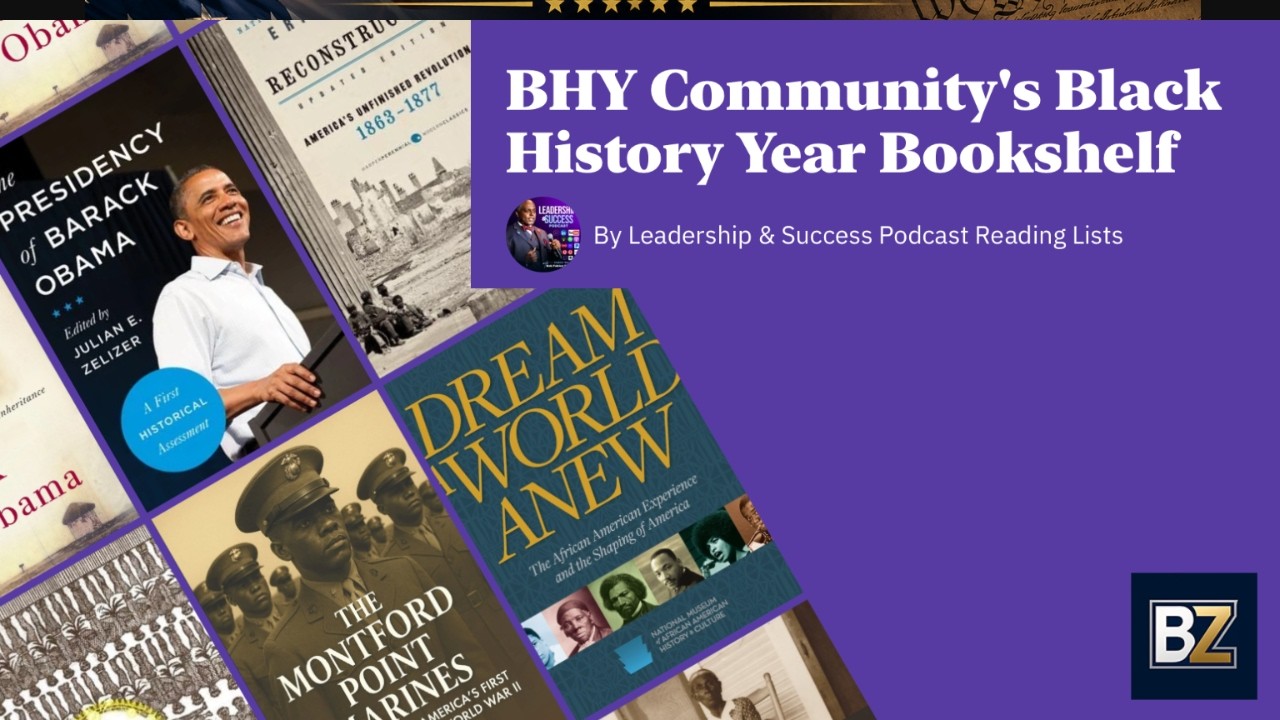
Coach BZ presents a curated collection of over 125 books on Black American history organized by U.S. institutional eras, not chronological events. He uses the WWII Golden 13 officer program, the Reconstruction Amendments, and the Great Migration as case studies to show how history shapes leadership and institutions.
Chapters
Hi, I'm John Maxwell. When the top companies in the world are looking for trainers, speakers, and coaches, there's one name that stands above the rest, and that's Maxwell Leadership. Our certified team members have gotten proven results for companies all over the globe, and our reputation, I'm proud to say, is second to none. Some of our members have risen to the top of their profession including the one you're going to meet today. I proudly introduce you to my friend Bob Fabien Zinga.
Welcome to the Leadership Success Podcast with your host, Coach BZ, where we help you lead with purpose and succeed with impact. If you're ready to grow into the kind of leader others want to follow, this podcast is for you. If you're determined to elevate your success and leave a lasting legacy, this podcast is for you. As my mentor, Dr. John C. Maxwell, reminds us, everything rises and falls on leadership. Our goal is simple: to inspire you, challenge you, and equip you with insights that can transform the trajectory of your leadership journey. Welcome aboard to another episode of the Leadership and Success Podcast with Coach BZ.
All right, welcome to our very last episode of today. This is going to be a special edition of the Leadership and Success Podcast. This is season 250. That's because America is now 250 years old. So happy birthday, America! And since July 4th, 1776, our Declaration of Independence. And I want us to really think deeply about American history, and Black history is American history. What can we learn from it? So it's going to be based on the article I wrote about Black History Year Community's Black History Year Bookshelf. So we're going to be talking about literature, uh, some books that everybody, every American should read to better understand our story. So I'm going to play the podcast in just a minute. It's going to be about 30 minutes or so, uh, and while you guys are watching, please let me know where are you guys joining us from, what city, uh, what state within the US, and if outside of the US, uh, which country. And also what you are grateful for today. And, uh, after you listen to the podcast, please type in the comment 3 to 5 takeaways from today's episode. All right, um, I should be finishing up another article for Black History Year, which is going to be about the very first African American born in the United States, American colony, in 1623. December 1623 is when we believe he was born, but we definitely know for sure he was baptized on January 3rd, uh, 1624, which is pretty, uh, amazing. So we are going to be talking, uh, about that, and I'm gonna publish the article right after this podcast is over. All right. Take notes and let me know your thoughts. Here we go.
So I want you to picture this. It's 1944.
Right in the thick of World War II.
Exactly. The absolute peak of the war. And at the Great Lakes Naval Training Station in Illinois, the US Navy decides to launch this— this totally radical, incredibly high-stakes experiment.
Yeah, high-stakes doesn't even begin to cover it.
Right. So they select 16 Black enlisted men for officer training. But the parameters of this program, I mean, they were just unforgiving.
Completely brutal.
Yeah. These men, they weren't just expected to pass the coursework, which was grueling enough on its own. They were expected to be, like, completely flawless.
Because the unwritten rule hanging over the whole thing was that if even one of them failed, the Navy might just scrap the entire program.
Exactly. Like, the door to naval leadership could just slam shut for an entire generation.
And You know, the pressure on those men is just— it's almost incomprehensible to us today. I mean, they were crammed into segregated barracks. They were forced to cover this massive curriculum in a super compressed time frame. And they were actually deliberately subjected to a grading curve that was designed to wash them out.
Wait, really? Designed to make them fail?
Oh, absolutely. The system was rigged.
Huh.
But they responded by creating this really intense internal tutoring system.
Oh, wow.
Yeah. So the guys who were strong in navigation, they taught the others. The men strong in engineering did the same thing. And eventually 13 of those men passed.
That's incredible.
And not just passed, they got some of the highest marks ever recorded in Navy history.
Wow.
Yeah. They became known as the Golden 13.
Okay. So I wanted to start our deep dive today with that story, the story of the Golden 13, because I think it perfectly captures the immense this just complicated weight of the subject we're wading into today.
It really thinks it's a perfect microcosm, right?
Because when you decide, hey, I want to genuinely understand American history and specifically Black history, you rarely find a neat linear starting line.
No, definitely not. There's no clear page one.
Exactly. You don't just pick up a standard textbook and start reading. You find yourself staring at this incredibly vast —decentralized library of struggle and constitutional law and just raw human endurance.
And for a lot of people, you know, that sheer volume of information is just paralyzing. Oh, totally paralyzing.
Because people, you know, they want to be well-informed. They want to understand the deep mechanics of how our society was built. But the landscape is just too sprawling.
Like, where do you even begin?
Right. Right. Do you focus on the Civil War? Do you start with the Harlem Renaissance? Mm-hmm. Supreme Court decisions?
Yeah, there's just so much.
And that lack of a clear entry point causes a lot of curious people to just kind of freeze up and walk away.
Which is exactly why today's deep dive is designed to act as your compass. We are answering that one singular question: where should I start?
It's a million-dollar question. Right.
And our source material today is this remarkable, highly curated digital archive called the Black History Yearbook Shelf.
Yes, and it's important to note this isn't just like a random Amazon wishlist.
Oh, not at all. It's a very specific collection of over 125 books, and it was painstakingly assembled by Bob Fabien Zinga, who goes by BZ.
And to really understand this bookshelf, you have to understand the architect behind it.
Right, right. Because Commander Zinga is a United States Navy officer, right?
Yep, a Navy officer, a cybersecurity executive, and a leadership coach.
And that background, I mean, it completely changes the utility of this reading list, doesn't it?
It really does. He isn't filtering these books through the lens of, like, a detached academic historian. Right. He's analyzing centuries of history through a very pragmatic, operational lens, the lens of military leadership and executive management.
So he looks at something like The Training of the Golden Thirteen and asks a totally different kind question.
Exactly, he asks a mechanical question. Like, how does the pressure these men faced, and the systems they overcame, provide actionable data for leaders trying to build resilient teams today?
That's such a fascinating way to frame it. But, uh, before we really start dissecting his top recommendations, I feel like we need to explicitly establish the ground rules for this deep dive. Definitely, I think that's crucial. Because Commander Zinga states very clearly in the source material that this Bookshelf is not a political project, right?
It's an educational baseline meant for all Americans.
Exactly. And our goal today is not to, you know, hand you a predefined worldview or tell you what your politics should be.
No, not at all. The mission here is to expose you to the primary sources, lay out the historical arguments, and just challenge you to think critically.
And that neutrality, it's just so vital, right?
It really is because it serves the central thesis of his entire project, which is that Black history cannot be segmented into this, like, niche subcategory.
Right. It's not a sidebar. Yeah, exactly.
It is the main current of American history. You cannot separate the two without fundamentally breaking the chronological and legal narrative of the entire United States. Yeah.
And to prove that, Zinga actually structured this massive library not by, you know, racial milestones, but by the foundational architectural eras of the American Republic itself. Which is such a brilliant way to organize it. It is. So let's test that thesis. He starts at the very beginning with Module 1, right? The literal blueprints of the country. The founding documents. Right. He points readers straight to the primary sources, the Declaration of Independence, the Constitution, the Federalist Papers, the Three-Fifths Clause, and the Northwest Ordinance. All the heavy hitters. But, okay, let me push back on this right out of the gate. Sure, go for it. If someone comes to this bookshelf specifically because they want to learn about the Black experience in America, Why force them to read the Federalist Papers? Right. Why study the founders, the very men who, you know, in a lot of cases literally designed the systems of enslavement? Doesn't that just center the traditional standard narrative all over again?
I mean, it is a very fair critique, but you have to think about it this way. You cannot dismantle or even really understand a machine if you refuse to look at the original schematics. Okay. That makes sense. The founders essentially wrote the operating system for the United States.
I love that analogy.
The operating system. Right.
So you have the Declaration of Independence, which introduces this incredibly high radical ideal for the 18th century. Right. The idea that all men are created equal with unalienable rights.
The lofty vision statement.
Exactly. But then you look at the actual legal framework of the Constitution, specifically the Three-Fifths Clause.
Right. And that's where the ideals hit reality.
Yeah.
And this wasn't just some philosophical contradiction. It was a highly specific mechanical compromise. How so?
Like mechanically?
Well, it granted Southern states disproportionate representation in the House of Representatives and in the Electoral College by counting 3/5 of the enslaved population.
Wait, so it mathematically hardwired the institution of slavery right into the federal power structure? Precisely.
It gave slaveholding states this artificial political majority. And that allowed them to dominate the presidency and the Supreme Court for decades. Wow. So Zinga's argument is that you cannot understand the abolitionist movement or the Civil War or the civil rights era if you don't first understand the precise legal container those movements were fighting against.
Okay.
Keeping with the software development analogy, studying the founding documents is basically like reading the pristine idealized version 1.0 code of a massive software program. Yes, exactly. It looks beautiful on paper, but then the subsequent 2.5 centuries, the era spanning from 1619 through the Civil War. Yeah. Those are the bug reports.
Like, the system crashing. Yeah. Those are the fatal errors.
So people like Frederick Douglass, Harriet Tubman, the abolitionists, they weren't just activists, they were system auditors.
Oh, I love that framing.
System auditors. Right.
They were pointing out that the program was fundamentally failing to execute its own core commands.
That is so accurate. Because it really highlights the agency of those historical figures. They weren't just passive victims; they were actively hacking the system using its own logic.
Yes, hacking the system. Give me an example of that.
Well, think about when Frederick Douglass delivers his famous 1852 speech, "What to the Slave is the Fourth of July?" Right, an incredible piece of writing. He isn't rejecting the American system in that speech. He is literally holding the Declaration of Independence up to the light and brutally cross-examining the nation for failing to run the very code it wrote.
He's saying, look at your own rule book.
Exactly. He is demanding a system update.
And unfortunately, the cost of forcing that system update was the American Civil War.
Yeah, the system completely crashed.
It crashed hard, requiring a total rewrite. Which brings us to the era Zinga focuses heavily on: Module 3, Reconstruction and the trio of constitutional amendments that followed the war.
The 13th, 14th, and 15th Amendments. Right.
And we hear these referenced in history class all the time, but functionally and mechanically, what did they actually do? Like, why do scholars call this America's second founding?
Because they completely reinvented the relationship between the citizen, the state, and the federal government.
Okay, unpack that for me. Let's start with the 13th.
So the 13th Amendment mechanically abolished the institution of slavery, tearing out the economic engine of the South.
Right. It made it illegal.
Yes. Yeah. But the 14th Amendment is the true structural earthquake here. Really? More than the 13th? Structurally, yes. Because before the 14th Amendment, the Bill of Rights generally only protected you from abuses by the federal government. Oh, interesting.
So the states could do whatever they wanted.
Pretty much. A state government could still run roughshod over your rights. But the 14th Amendment introduced birthright citizenship.
Meaning if you're born here—
You are a citizen, period. No state can say otherwise. Wow.
So it completely removed the state's ability to arbitrarily define who belonged in this country.
Yes.
But even more importantly, it introduced the Equal Protection and Due Process Clauses and it applied them directly to the states.
Okay, so what does that mean in plain English?
It essentially said to state governments, You are now bound by federal civil rights standards, and the federal government has the authority to step in and stop you if you violate them.
That is a massive shift in power.
Huge. It was a massive centralization of power designed specifically to protect newly freed Black Americans from vindictive Southern legislatures.
And then the 15th Amendment rounds it out.
Right. The 15th Amendment barred racial discrimination in voting. So together, These three didn't just patch the Constitution, they fundamentally rebuilt the republic around the concept of national protected citizenship.
Which makes it all the more tragic when you realize how quickly those newly minted legal protections were just, well, violently dismantled.
Yeah, the backlash was immediate and severe.
And this is where the bookshelf introduces some heavy historiography. Book number 2 on Zinga's top 10 list is Black Reconstruction in America by W.E.B. Du Bois.
A monumental book. It really is.
And I wanna talk about why this specific book is so critical because it really reveals how history itself can be weaponized.
Oh, absolutely. So when Du Bois published that book in 1935, the dominant academic narrative in the United States, I mean, the stuff being taught in Ivy League universities and standard high schools alike, right?
The mainstream consensus. Exactly.
It was known as the Dunning School, and this was a school of thought that argued Reconstruction was a disastrous, corrupt mistake.
Wait, they taught that it was a mistake to try and rebuild the South fairly? Yes.
The Dunning School argued that formerly enslaved people were intellectually incapable of participating in democracy and that the federal government was acting tyrannically by trying to force integration. That is wild.
It sounds like a highly coordinated academic myth. It was. And it was designed to provide intellectual cover for Jim Crow laws, right? Yeah. Because if you can convince the public that Black political participation inherently leads to ruin, then disenfranchising Black voters suddenly looks like, I don't know, a public service.
Exactly. You hit the nail on the head. Du Bois recognized that the historical narrative had been hijacked. So what did he do? She went back to the raw primary data. He actually looked at the legislative records from the Reconstruction era. And what he proved was that Black Americans didn't ruin the South. They democratized it. Oh wow. Yeah, they established the first public school systems in the South that served both poor white and Black children.
I had no idea about that.
They rebuilt infrastructure. Du Bois showed that the failure of Reconstruction wasn't due to Black incompetence, but rather a violent white supremacist counterrevolution that the federal government eventually just lost the political will to fight. Man.
He essentially proved that history is a battlefield. It really is. And Eric Foner's book Reconstruction, which is also highly recommended on this list, it serves as the modern synthesis of Du Bois' work, right? Right.
Foner meticulously details how the foundations of modern civil rights were laid in the 1860s and '70s, which completely transformed our modern understanding of the era.
And then Zinga pairs those big, broad national histories with Kate Masur's book an example for All the Land, which takes a very different approach.
Yeah, it's a brilliant tactical look at this era because Massur focuses almost entirely on Washington, D.C. Why D.C.? Because D.C. is a federal district, not a state. Congress had direct control over it. So Massur shows how D.C. became this sort of legislative laboratory. Oh, that makes sense. Yeah, they experimented with emancipation, voting rights, and integration in D.C. Before attempting to roll them out nationally.
And the mechanism Masur highlights here, and I think this is a key takeaway for any leader listening, is that constitutional change on paper means absolutely nothing without the brutal daily friction of enforcement. Exactly. Like, you can pass the 14th Amendment all day long, but if the local sheriff refuses to enforce it and the local judge refuses to hear the case, the law is just ink on a page, right?
The reality of freedom requires persistent civic machinery. It requires courthouses, compliant police, and honestly, most importantly, it requires education.
Which transitions us perfectly into one of the most vital themes in the entire library, the mechanics of intellectual liberation.
Yes, because if the constitutional amendments were the legal scaffolding, education was the actual mortar used to build freedom on the ground.
Let's look at Self-Taught by Heather Andrea Williams. Now, Zinga notes this is one of the most inspiring books he has ever read.
I can see why. It documents exactly how formerly enslaved people pursued education.
Right, because we often think of education as a service provided by a government, like you just go to the local public school.
But Williams details how enslaved people secretly taught themselves to read in the woods at night.
Which is just mind-blowing when you think about the risk. The stakes were ultimate.
Knowing the penalty for being caught could be mutilation or even death.
And then following emancipation, before the Freedmen's Bureau even arrived in many of these places, you had destitute communities pooling their meager resources.
Right. Buying land, cutting timber, and physically constructing schools from the ground up.
And they hired teachers from their own ranks. Yes, they did. So instead of a generic metaphor about willpower, let's look at what they were actually doing here. They were constructing an intellectual Underground Railroad.
Oh, that's a great way to put it.
Because they recognized that the physical chains of slavery had just been replaced by structural economic chains.
Exactly. Sharecropping. Yeah. Debt peonage.
Right. And the only way to navigate complex labor contracts or to vote intelligently or to run for office was to achieve literacy. It was a survival skill. Building a school wasn't just about self-improvement. It was a highly strategic offensive maneuver against a society that required their ignorance to maintain its cheap labor force.
That is the precise mechanic. They understood that knowledge is leverage. Yes. But the author also challenges us to look at the darker side of that mechanic. What is the what? What happens when the education system itself is designed to neutralize you? Oh, wow.
Okay. And this is where Carter G.
Woodson's classic, The Miseducation of the Negro, becomes essential reading.
Woodson is known as the father of Black history. Right? He is.
And he asks a terrifyingly simple question in this book: who designs the curriculum? Ah. Because if a school system only teaches a Black student about the subjugation of their ancestors, and never about their triumphs, their science, or their civilizations, that student will eventually internalize an artificial sense of inferiority.
So the system won't even need to use physical force to hold them back.
Exactly. Because the psychological boundaries have already been installed in their minds.
That is so insidious. He's really outlining the mechanics of systemic control.
He argued that if you can control a person's thinking, you do not have to worry about their actions.
And, you know, this concept is incredibly relevant to modern leadership. How so? Well, think about corporate culture. How does the culture and the implicit messaging of your organization dictate what your employees believe is possible for themselves?
Oh, that's a brilliant connection. If the culture constantly signals that certain people don't get promoted, they stop trying. Exactly.
It's systemic control on a corporate level. And speaking of systemic control, we have to tackle two of the most heavily debated contemporary books on Zinga's list.
Ah, yes. Stamped from the Beginning by Ibram X. Kendi and Caste by Isabel Wilkerson.
Now, listener, sticking strictly to the rules of engagement Commander Zinga established at the start, our job here is not to litigate modern politics.
Right. We are not here to tell you that you must adopt these authors' specific worldviews. Exactly.
But the value of these books from a leadership perspective lies in their analytical frameworks. Zinga includes them because great leaders do not shy away from confronting highly technical, deeply challenging arguments about how society functions.
Precisely. You have to be able to engage with complex models.
So let's break down the mechanics of those arguments, starting with Wilkerson. What is the functional difference between a traditional class system and the caste system she argues exists in America?
Okay, so a class system is primarily economic.
It is fluid. Right, mobility. Yes.
You can be born poor, invent something brilliant, make a fortune, and move into the upper class.
Wealth changes your status. Okay, so what's a caste system?
Wilkerson argues that America operates on a hidden caste system similar to India or even Nazi Germany. A caste system is a rigid artificial hierarchy determined entirely by birth. In America's case, determined by race.
But it's not fluid at all.
No. The mechanic of a caste system is that it seeks to maintain the dominant group's supremacy, regardless of individual merit.
Wait, so even if someone achieves great success?
Exactly. Even if a Black American achieves massive wealth or high military rank, the underlying societal programming will still attempt to subordinate them, just to maintain the hierarchy. Got it.
So it's a structural argument rather than a behavioral one.
Very much so.
And Kendi takes a similar structural approach in Stamped from the Beginning, right? Mm-hmm. Because the standard historical narrative usually says people had racist beliefs, and because of those hateful beliefs, they enacted racist policies like slavery or segregation.
Yes, that's the standard view. And Kendi flips that causality completely backward.
Really? How does that work?
He argues that the policies actually come first, and they're usually driven by pure economic greed, or the desire for political power. Okay, gimme an example. Well, European powers wanted free labor to harvest tobacco and sugar. They enacted the policy of the transatlantic slave trade because it was immensely profitable.
Right, follow the money. Exactly. Yeah.
Then, after the fact, they funded the creation of racist ideologies—things like fake science or corrupted theology—to justify the brutally greedy policy they had already implemented.
So the idea is the product, not the catalyst. Exactly. And again, whether a listener completely agrees with Wilkerson's caste comparison or Kendi's timeline of causality isn't really the point here.
No, not at all.
The point is the intellectual exercise. Grappling with these models forces you to examine the unseen architecture of the organizations and societies you operate within.
It builds intellectual resilience.
And that resilience is tested nowhere more fiercely than in the physical institutions that shape American power. Which brings us to Module 4 of the library: Military Leadership.
And given Commander Zinga's background, this section is extensive. I'd bet. But he emphasizes that these aren't just combat narratives; they are case studies in institutional change.
Let's walk through that timeline, because the history of Black military service is incredibly comprehensive.
It really is.
It goes back to the very beginning. You have Crispus Attucks, A Black man of Native American descent who was the first casualty of the American Revolution at the Boston Massacre. Right.
And then you have the United States Colored Troops turning the tide of the Civil War.
The Buffalo Soldiers securing the Western frontier.
And the Tuskegee Airmen. I mean, they completely defied the pseudoscience of the time that claimed Black men lacked the spatial awareness to fly complex aircraft.
And what is fascinating from an organizational standpoint is how the United States military has historically acted as this massive forcing function for societal integration.
Oh, that's an interesting point. How so?
Well, the military operates on a ruthless logic of efficiency and survival.
Right. You just need things to work.
Exactly. In a foxhole, artificial hierarchies like Wilkerson's caste system, they get people killed.
Discompetence overrides everything else. Precisely.
When President Harry Truman issued Executive Order 9981 in 1948, which completely integrated the armed forces, it wasn't just a moral gesture. It was an operational necessity.
But the ripple effect of that must have been huge. Monumental.
It proved to the civilian world that large-scale institutional integration was functionally possible.
Let's loop back to the story we opened with, the Golden 13, which is detailed in Paul Stilwell's book. Yes. I have to play devil's advocate here for a second. Go for it. I understand the heroism of these men. I really do. But isn't there a massive danger in the way this experiment was designed? What do you mean? By forcing 13 men to carry the burden of an entire race's reputation, isn't the Navy just reinforcing the prejudiced idea that Black excellence is this, like, anomaly that requires extraordinary proof rather than just the baseline expectation?
You know, you have correctly identified the fundamental injustice of the entire situation. It is an entirely unfair burden. Right. But historically, this has been the specific mechanic of pioneer leadership for marginalized groups.
Having to be twice as good just to get a seat at the table.
Exactly.
They are forced to overperform simply to achieve baseline acceptance. The Golden 13 knew the test was rigged. They knew they were being held to an impossible standard. But they did it anyway. Because they recognized the strategic reality. The door was cracked open a millimeter. If they failed, it would be slammed shut for decades. Wow. So their flawless performance dismantled the institutional excuse that Black men couldn't handle command. They absorbed that unfair burden so that the officers who came after them, officers like Commander Zinga, would be judged by their merit, not their race.
It is the ultimate display of character. Just absorbing the shockwaves of a flawed system. Perfectly said. And that drive to prove baseline competence, to innovate despite the barriers, it wasn't limited to the military. Zinga makes sure to include a massive section on American innovation. Yes, Module 5.
And this is crucial for breaking the narrow, often trauma-focused boxes that Black history is sometimes relegated to.
Right, because there's so much more to the story than just struggle.
Exactly.
For instance, he highlights Dr. Charles Drew.
The blood bank pioneer.
Yes. He pioneered the techniques for storing blood plasma. His work basically created the modern blood bank system, which saved countless lives during World War II.
And the bitter irony there, I mean, It's just staggering. The very armed forces whose lives he was saving initially insisted on segregating the blood of white and Black donors.
Which is a medically absurd policy. Totally absurd. And he fiercely opposed it. Rightly so.
And you also have the mathematical genius of the Black women at NASA, right? Right.
The hidden figures who calculated orbital mechanics for the space race. Yeah, we've got innovators in computing, cybersecurity, entrepreneurship.
And these aren't just tangential sidebars to American progress. They are the core engines of it.
Which perfectly sets the stage for what might be the most massive, mechanically complex historical event on this entire bookshelf.
The Great Migration. Yes.
We've talked about military deployments, we've talked about constitutional amendments, but now we really need to talk about human geography. Let's look at The Warmth of Other Suns by Isabel Wilkerson.
An absolute masterpiece of a book. The Great Migration is arguably the most significant demographic event in modern American history. Give me the timeline on that. When are we talking? Between roughly 1915 and 1970.
Okay, so a huge chunk of the 20th century.
Yes. And during that time, nearly 6 million African Americans fled the Jim Crow South, migrating to industrial cities in the North, the Midwest, and the West.
6 million people. 6 million. That is basically an internal refugee crisis and a massive labor shift happening simultaneously. Mechanically, how did this happen and how did it alter the country?
Well, it was driven by a convergence of forces. Yeah. In the South, you had racial terror, you had lynching, and you had the economic dead end of sharecropping. So massive push factors forcing them out. Exactly. But in the North, you had these huge pull factors. Mm-hmm. Because of World War I and later World War II, European immigration had essentially stopped.
Ah. So the factories needed workers. Desperately.
They were desperate for labor to build munitions, steel, and automobiles. This created a massive economic vacuum that just pulled Black laborers out of the South.
And Wilkerson tells this epic sweeping story through the micro-narratives of just 3 individuals, right? People making the terrifying decision to leave everything they knew.
Yeah, she humanizes this massive statistical movement.
But the macro effects of those individual choices, I mean, they are staggering. By moving out of the South, these millions of people fundamentally remapped American politics.
They absolutely did, because in the South, they were almost entirely disenfranchised by poll taxes and literacy tests.
Right. They couldn't vote.
But when they arrived in cities like Chicago or Detroit or Philadelphia, they could suddenly vote.
Oh, wow.
I never thought about the electoral math of that.
It was huge. This created massive new voting blocs that altered mayoral races, congressional seats, and eventually presidential elections. It also created the modern American cultural landscape.
I mean, you don't get the Harlem Renaissance, you don't get Chicago Blues, you don't get Motown without the Great Migration bringing that Southern cultural DNA into Northern urban centers.
Exactly. But Wilkerson also highlights the friction of this movement. The pushback. Yes. The arrival of millions of Black citizens in Northern cities sparked severe backlash from the white populations already there. Right. And that led to the creation of redlining, which is systematic housing discrimination, and that physically segregated northern cities and created wealth gaps that persist entirely to this day.
It really touches every single aspect of the modern American experience. It really does. And if there is one book on this list that acts as the grand unified theory, like a text that connects the constitutional mechanics of the 14th Amendment, the military pressure of the Golden Thirteen, and the demographic shifts of the Great Migration, it would have to be the final bedrock text on Zinga's top 10 list. Right. From Slavery to Freedom: A History of African Americans by John Hope Franklin and Evelyn Brooks Higginbotham.
Yes. First published in 1947 and continuously updated since then, it is the definitive, comprehensive survey.
The ultimate starting point.
It really is. It proves, without a shadow of a doubt, that you cannot weave the tapestry of the United States without the central thread of the African American experience.
And what I love is that the source material extracts 5 specific, actionable leadership lessons from this monumental history. I wanna dive deep into the mechanics of these lessons because this is where all this historical theory becomes practical tools for the listener. Absolutely. Let's do it. So, lesson 1: Know your history. The premise here is that historical literacy provides the context for better decision-making.
Right.
History is essentially the diagnostic tool for the present.
Give me a real-world application for that.
Okay. Imagine a CEO taking over a struggling corporation. If they try to implement new strategies without understanding the legacy systems, the past management failures, and the ingrained culture of the workforce—
Their new strategies are going to fail.
Violently rejected by the organizational immune system. Wow. Yes. And the same applies to civic leadership. You cannot fix a housing crisis or an education gap in a city if you don't understand the historical mechanics of redlining or school funding that created the gap in the first place.
It's diagnosing the root cause instead of just treating the symptom.
Exactly.
Okay, lesson 2: Character outlasts circumstances. We talked about this with the Golden 13 and the people building schools from scrap wood in Self-Taught.
Yeah, leadership is fundamentally measured by character under duress. Not by the titles granted by a system.
Right. Those individuals had no systemic power. They had no wealth.
But they exhibited a resilience that outlasted the horrific circumstances engineered to break them.
So for modern leaders, what's the takeaway?
The lesson is that operational conditions will always fluctuate. Markets crash, budgets get slashed. But the integrity and endurance you model for your team is the only variable entirely within your control. That's powerful.
Alright, Lesson 3: Institutions matter. We touched on this with Kate Messer's book about Washington, D.C.
Yes, and it is a critical point. A charismatic leader can inspire a movement, sure, but only a resilient institution can sustain the progress.
Because leaders eventually leave. Exactly.
The courts, the schools, the legislatures—these are the gears that translate ideals into reality. A leader's job isn't just to be a visionary; It is to engage in the tedious, vital work of building, reforming, and protecting institutions.
So they function fairly long after the visionary is gone. Precisely. Okay. Lesson 4: Education creates opportunity. But as we learned from Carter G. Woodson, it's not just about acquiring degrees, right?
No, it is about the nature of the education. Are you learning just to maintain the status quo, or are you learning to critically dismantle assumptions? Right?
Are you challenging yourself?
A true leader must be a lifelong learner who aggressively seeks out data that challenges their preconceptions. If you only read history that flatters you, you are engaging in vanity, not education.
Oof, that is a hard truth. Vanity, not education.
It's easy to fall into that trap. It really is.
And finally, Lesson 5: Progress requires participation. Democracy is not a spectator sport.
Every generation inherits the triumphs and the catastrophic failures of the past.
Right. The Great Migration was millions of people voting with their feet.
And the Civil Rights Movement was citizens putting their physical bodies into the gears of the machine to force it to stop. Progress is an active, daily choice.
So after wading through this massive library, all these books and eras, what is the ultimate takeaway for you, the listener? Why invest the time to understand the deep mechanics of the 14th Amendment or the operational pressures of the Tuskegee Airmen?
Because avoiding this history leaves you with massive blind spots.
Exactly. You cannot effectively lead a diverse workforce, you cannot pass effective legislation, and you cannot be a fully engaged citizen if you only understand a sanitized, fragmented version of how your society was actually built.
Commander Zinga's library proves that understanding this history doesn't diminish the American story. It makes it infinitely more complex, resilient, and profound.
And the final call to action is simple: bypass the noise and go straight to the source. Don't just take our synthesis of this material. Dive into the primary documents yourself.
Read the actual Freedmen's Bureau records in the National Archives.
Listen to the WPA slave narratives digitized in the Library of Congress.
Read the operational reports of the Naval History and Heritage Command.
Because as Abraham Lincoln noted, we are engaged in an unfinished work.
Which leaves us with a final question to consider. Right. If a deep, unflinching understanding of history is the ultimate tool for building effective leadership today, what missing pieces of history are currently shaping your own blind spots?
That's a great question.
And what institution could you begin to transform tomorrow simply by choosing to become a more rigorously informed citizen today? The library is open.
The documents are waiting. The only thing left is for you to step inside and start reading.
Okay, this is it, uh, for now. This is the end of the second episode of the Black History Year special podcast series of the Leadership A Success Podcast Season 250, Season 250. And tomorrow we are going to— I'm gonna finish writing the third article and we are going to play the podcast for talking about the first African American born in the American colony. So that's, that's going to be pretty powerful. And there seems to be a direct connection between that person and my On Direct Ancestors. So we're going to be talking about that tomorrow. Again, if you have any recommendations for what should be a part of the Black History Year bookshelf, please let me know and I would be glad to add those. Thanks again for watching and bye for now.
Ooh, freedom. Oh freedom, oh freedom over me. And before I'll be a slave, I'll be buried in my grave and go home to my Lord and be free. Oh, freedom! Oh, freedom! Freedom! Oh, freedom! Oh, freedom! Over me, over me. And before I fall asleep, I'll be buried in my grave and go home to my Lord and be free. No, no more weekend No more weeping. No more weeping over me. And before I'll be afraid, I'll be buried in my own grave. And go home to my Lord and be free.
Thank you for tuning in to the Leadership and Success Podcast with your host, Coach Beezy. If today's episode added value to your leadership journey, be sure to subscribe, share, and join us again for more wisdom nuggets on how to lead better and achieve greater success. Remember, leadership Leadership is the most critical skill of our time. The world will always need leaders to inspire others, drive innovation, and execute meaningful strategy. So why not count yourself among the bold leaders shaping the 21st century? Until next time, stay inspired, stay committed, and keep leading with excellence.
More from Bob

S250:E4🎙️LIVE 🇺🇸America 250: President Barack Obama Leadership, Service, and the Power of Hope






S5:E157🎙️ LIVE with CMD CMSgt Dennis L. Fritz, USAF (Ret.)(Multi Tracks Audio)



S5:E156🎙️ LIVE 🇪🇸 Leadership Lessons from the FIFA World Cup 2026 Champions (Multi Tracks Audio)

S250:E3🎙️ LIVE Leadership Lessons from America’s First Documented Family of African Descent 🇺🇸📖