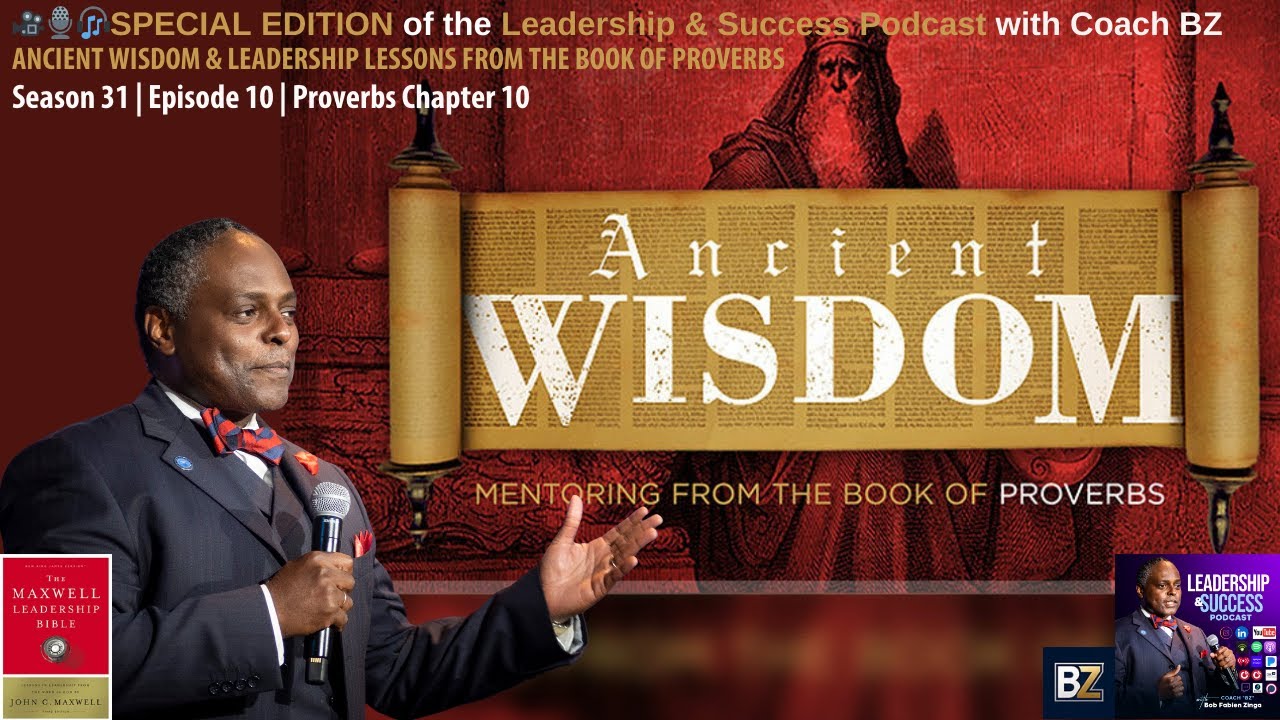
Coach BZ breaks down Proverbs Chapter 10 into seven leadership lessons: character shapes consequences, diligence sustains influence, words multiply impact, integrity protects stability, emotional discipline guards authority, work ethics signal values, and righteous leadership endures. He ties each to modern frameworks like the Compound Effect and Eisenhower Matrix.
Chapters
Hi, I'm John Maxwell. When the top companies in the world are looking for trainers, speakers, and coaches, there's one name that stands above the rest, and that's Maxwell Leadership. Our certified team members have gotten proven results for companies all over the globe, and our reputation, I'm proud to say, is second to none. Some of our members have risen to the top of their profession, including the one you're going to meet today.
I proudly introduce you to my friend Bob Fabien Zinga.
Welcome to the Leadership and Success Podcast with your host, Coach BZ, where we help you lead with purpose and succeed with impact. If you're ready to grow into the kind of leader others want to follow, this podcast is for you. If you're determined to elevate your success and leave a lasting legacy, this podcast is for you. As my mentor, Dr. John C. Maxwell, reminds us, everything rises and falls on leadership. Our goal is simple, to inspire you, challenge you, and equip you with insights that can transform the trajectory of your leadership journey. Welcome aboard to another episode of the Leadership and Success Podcast, where with Coach BZ.
Hello everyone, welcome to another special edition of the Leadership and Success Podcast. This is your host, Coach BZ. And let's start with our custom, which is a moment of gratitude. This is where we take just a moment to be grateful for something every time we meet every single day. So maybe you want to close your eyes, take a deep breath, put yourself in your happy place, and think about one thing you are grateful for today. I still can't believe it's the new year, 2026. It looks like 2025 was just yesterday. Time really, really flies by, and I am so grateful to still be alive, to be counted among those who are in the land of the living. As long as I have breath, there is hope for me, and I am so grateful for that. All of the young people I'm going to meet this year, and I believe I've never met a stranger, and all of the connection I am going to set this year, and I am just grateful to be alive, to still have goals, and still moving forward towards the fulfillment of my purpose. And hopefully along the way, I am helping a lot of other people find their own purpose as well. So, uh, again, welcome to the Leadership and Success Podcast. So today, um, being January 10th, right, so we are going to be studying from the book of Proverbs, Proverbs chapter 10. Again, this is not a religious study, it's about ancient wisdom being mentored from the book of Proverbs. We're focusing on ancient wisdom and leadership lesson. From the book of Proverbs today, Proverbs chapter 10, tomorrow chapter 11, and by the end of the month we're gonna do all 31 chapters of the book of Proverbs, ending with Proverbs 31 on January 31st. All right, so if you would, let's start with a quick review. So let me ask Ron Carpenter AI to catch us up from Proverbs chapter 1 through chapter 9. And remember, I interviewed Ron Carpenter AI, I believe it was season 4, episode 15. So you may want to go back there and see that. It's really amazing today with the technology, how you can actually speak to the AI twin of someone or a chat like ChatGPT, which I also interviewed for season 4 around, I think it was July 4th, Independence Day, 2025. It's— we just live in a very exciting world with technology, things we can do. All right, Ron Carpenter AI, catch us up on Proverbs chapter 1 through chapter 9.
Hi, this is Pastor Ron Carpenter. How can I help? All right, listen closely. Proverbs chapter 1 is all about the beginning of wisdom, and that start is the fear of the Lord. It's about getting wisdom, getting instruction, a spirit of wisdom and revelation, so you can see life clearly and make choices that don't mess you up. The whole thing points to the fact that wisdom is, isn't just a heart posture, a way of living that sets you apart. That's the big idea right there. Chapter 2 picks up from that foundation in Chapter 1 and digs into why wisdom is like your best friend, your protector. It shows how wisdom saves you from the fools and the You see, it's about hearing God's voice early, before trouble hits, so you can live long, peaceful days. The fear of the Lord keeps you safe and gives you the wisdom to avoid all kinds of foolishness. That's the big deal there. Alright, chapter 3 is like wisdom's personal invitation. It tells us to trust the Lord with all our heart and not our own understanding. Come on, that's powerful. When you do that, he'll make your paths straight, guiding you through life with success and peace. It's about leaning in, not just knowing you're in God's favor daily. That's a dang good life lesson right there. All right, chapter 4 is like the pep talk from your wise, loving dad telling you to grab hold of wisdom and never forget about guarding your heart because everything you do flows from it and you gotta stay clear of folly that leads to destruction. It's a strong call to action. Your best friend and companion and your priority, period. That's the heart of it. Alright, Chapter 5 is a warning about the dangers of temptation, especially the seductive traps that can wreck your life and your future. It's got rules about staying faithful and wise, not falling for foolish shortcuts or lies that seem sweet and bitter. The message is, keep your eyes locked on what's righteous and don't let yourself get fooled. That's the big point right there. All right, Proverbs chapter 6 is packed with tough love. It warns about foolish promises, laziness, and how God hates those who— among brothers. But the star of the show is that little ant, man. That ant shows us what diligence and foresight look like— working steady and preparing ahead. That's the kind of wisdom God wants us to get— practical, real, and hard-earned. All right, chapter 7 is like this desperate shout from wisdom warning you about getting caught up in temptation, especially that sneaky kind that looks good but Rex— wisdom screaming for you to wake up, guard your heart, and choose the right way before it's too late. That's the big idea right there. Third is wisdom personified like a woman calling out in the streets, inviting folks to live life the right way. It's about how wisdom was with God before creation, showing— wisdom is divine order and foundation for everything. The big idea: listen to wisdom's call and you'll walk in safety and honor. Chapter 9, knocking on the door, y'all. It's calling us to come on in, choose life, and leave the life of fools behind. Who's the blessing and safety if we listen? It's an invitation, plain and simple.
All right, so this should catch us up, uh, to, uh, uh, Proverbs chapter 9, which we did yesterday on January 9th. So today we're going to start with Proverbs, uh, chapter 10. And I'd like to acknowledge, looks like we have Emilio who is watching from Panama City, Florida. Thank you so much for watching, Emilio. Also, let us know what you are grateful for today. And while I go through the lesson for chapter 10, if there is any verses I don't highlight and you have an inspiration or insight or feedback on that, please let us know as well. And as you listen to me going through my 7 lessons for Proverbs chapter 10. If you have any comments or questions, just let us know. Thanks again for watching. All right, so chapter 10. Um, actually, before I go to chapter 10, let me just review quickly the 7 lessons from yesterday. Again, you can watch the podcast, it's on LinkedIn, on YouTube, and all of the major podcast platforms. But I'm going to give you a quick summary. So lesson 1 for chapter 9 was, uh, You have to build before you lead. That was from verses 1 and 2, Proverbs 9:1-2. So wisdom is portrayed as a builder, establishing foundation, preparing a table, and planning with intention. So strong leadership is constructed long before authority is exercised. You have to plan before you execute. Alright, lesson number 2, verses 3, 4, 5, and 6: Extend clear open invitation. So wisdom calls openly and inclusively, offering clarity, not confusion. Effective leaders, they communicate purpose plainly and invite others into growth. So that's lesson number 2. Lesson number 3: Correction reveals character, verses 7, 8, and 9. So how someone responds to correction will reveal whether they are teachable or threatened. So wise leaders, they grow stronger through feedback. Then lesson number 4, reverence will anchor wisdom. That's verse 10. The fear of the Lord represents reverence, accountability, moral grounding. So leadership without reverence will drift into ego. All right, lesson number 5, we talked about choices which compound over time. So verses 11 and 12, wisdom will extend life and influence, but folly will accelerate self-destruction. So leaders live with the long-term consequences of their choices today. Alright, lesson number 6 was about loud confidence is not competence. Just because you are loud doesn't mean that you are competent or you know what you're talking about. So verses 13, 14, and 15: Folly is loud, simplistic, seductive, offering ease without effort. Poor leadership often masquerades as bold certainty. So don't follow that. And finally, lesson 7. Yesterday we talked about short-term pleasure has long-term cost. That's verses 16, 17, and 18, right? So folly hides consequences, offering secrecy and speed, and leaders fall when they ignore unseen cost. All right, so today we're going to start Proverbs chapter 10. So what's the big idea with chapter 10? This chapter really marks a decisive shift in the book of Proverbs, right? From extended instruction, which we've seen from chapter 1 through 9, and now we are going to short, sharp contrast that reveal our leadership is shaped daily, not dramatically. Okay, so this chapter shows that influence is built or eroded through ordinary choices, your words, work ethics, integrity upheld, and responses given under pressure. So leadership here is not theoretical. It is visible, measurable, and consequential. How do you actually put it in practice? That's really one thing I love about the book of Proverbs, just how practical it is. That is pretty amazing to me. A book written more than 2,000 years ago, but you can still apply its lesson today in 2025. 21st century. That's quite amazing. Okay. The theme for the entire chapter from my viewpoint is really about daily discipline. What you do every single day, not dramatic moment, determine a leader's legacy. And again, one book I've been plugging in is this one by my mentor of The Compound Effect, Darren Hardy. I think it's a really great book, Jumpstart Your Income, Your Life, and Your Success. It really shows how The daily decision you make will have a huge impact on your legacy or your outcome. Now, things don't just happen overnight. You have to be doing the right thing for a long time before you start seeing the result of it and do not give up, right? You don't know, it may have taken you a couple of years to gain on extra weight, like 20 pounds or something. You're not gonna lose it overnight, right? You, once you start eating right and exercising, it is going to take a while, but you should not stop. You should need to continue doing it and eventually you got to get to the point where you're going to start seeing result, right? It compounds. Same thing when you do good thing, it compounds. When you do bad thing, it compounds too. The way you, for example, you gain an extra 20, 25 pounds over 3, 4, 5 years, it didn't happen overnight. It really would be something if someone ate junk food, whatever it is, maybe a Big Mac burger or whatever it is, candy, and then the moment you eat that junk food, you gain 5 pounds, people would stop doing that because the result would be immediate. But the truth is you don't see any changes. You look exactly the same and you keep doing it over and over again. And before you know it, with time, then that's when you start seeing the consequences for your action again, good or bad. All right. So daily discipline is not dramatic, but it will determine your legacy. So our first lesson is going to be Character Will Shape Consequences. So we're gonna read verses 1 and 2, Proverbs chapter 10, verses 1 and 2. Character shapes consequences. Okay, let me share my screen. Character shapes consequences. Here we go. The Proverbs of Solomon.
A wise son makes a glad father, but a foolish son is the grief of his mother. Treasures of wickedness profit nothing, but righteousness delivers from death.
Wow. Treasures of wickedness profit nothing, but righteousness delivers from death. So wise leadership brings joy, trust, and stability. Foolish leadership, on the other hand, creates grief, instability, and moral debt. So character is never private. It affects families, teams, institutions. And whatever you do in the secret eventually will be brought into the light. So how do you apply this? Assess how your decisions affect those closest to you. Leadership maturity considers second and third order consequences. That's really what strategy is all about, right? When you think about making a decision, it's not just what the effect is going to be right here and right now, but what are gonna be the secondary effect or the third order effect from your decision, who else is going to be impacted. So how do we apply this? Assess how Your decision affects those closest to you, and then also consider second and third order consequences. So who bears the cost of your poor decision? Who is going to be affected by the decision you make today? And where might your success be masking character gaps? So the anchor reflection for this lesson: leadership joy flows from integrity. So leadership sorrows flows from shortcut. So choose integrity over shortcut, joy over sorrow. All right, lesson number 2: Diligence sustains influence. Verses 4 and 5. Diligence sustains influence.
The Lord will not allow the righteous soul to famish, but he casts away the desire of the wicked. He who has a slack hand becomes poor, but the hand of the diligent makes rich. He who gathers in summer is a wise son. He who sleeps in harvest is a son who causes shame.
He who sleeps in the harvest causes shame. So laziness will drain credibility, but diligence will build momentum, trust, and readiness. And again, that's what in this book, The Compound Effect, Darren Hardy called the Big Mo. Big momentum because you keep doing something over and over again and eventually you're gonna gain momentum and you're gonna see a lot of results. But it takes a little bit of work, so you have to be patient and you have to keep doing the right thing even when you don't see anything yet. It needs to become like a second habit to you. It's better to improve like 1% every single day than it is to try to do something dramatic and, and, and, uh, try to improve by 50% or something and then do absolutely nothing for the next, uh, 7 weeks. So being very consistent will provide the outcome you want when you are faithful and you keep doing it, whether you feel like it or not, eventually you will see a result. All right. So again, diligence will build that momentum, trust and readiness. So leaders who fail to act on time create avoidable crisis because I think sometimes it's not just making the right decision, but making the right decision at the right time and being able to move, to take action, whether you feel like it or not. Darren Hardy, again, one of my primary mentors, he used to say all the time, successful people are just as lazy as people who are not so successful, but the difference between the two groups is those who are successful, they do what they need to do when they need to do it whether they feel like it or not. Okay? It doesn't matter how they feel. If they need to go to the gym and work out, that's exactly what they're gonna do even though they don't wanna do that. If they need to write an article, they're gonna do that whether they feel like it or not. So they just get started. Once you get started, usually you will build that momentum and then you are going to enjoy what you are doing. Sometimes the challenge is just being present, right? Getting started, start writing, start exercising, start swimming, whatever it is that you plan to do, just get started and then start building that momentum and eventually you will see the positive result of your action. All right, so don't fail to act on time, okay? This way you would really— if you don't do that, you will create avoidable crisis. All right, how do we apply that? So you have to create rhythm of execution, not urgency-driven reaction, but rhythm of execution. So We have to remember, right? There is a big difference between what is important and what is urgent. So I'm thinking about the Eisenhower Matrix. Most people, they really focus their time on things that are urgent, but not important, like people calling them, answering emails and stuff, just doing a bunch of things. They're like, oh, I just got the message. I need to reply to it. Is it important? Is it something that you prioritize for today? Maybe, maybe not. So maybe is that that can wait. So I think in life you really have to focus first and foremost on what is important and urgent. It's something that you plan to do, it's your priority, and it is urgent, you have to do it now. You have to focus on that. Now, if something is urgent but it's not important, maybe you need to delegate that to somebody else. Someone who works for you can take care of that, like answer the phone or things like that. Because if something is important, someone can always call and we have the technology now, they can just leave you a voicemail and you will get back to them. But you focus on what's important and urgent. And then the next thing is what is important but it is not urgent. That's really what you need to focus on next in my opinion. Things like maybe working out or maybe you are writing a book and you need to write a chapter every day or whatever it might be. Something that's a priority to you but it's not urgent. You don't have to do it now but it is important. That's what you need. To do. That's what you need to focus on. And then the last category is it's not important and it's not urgent. So those things, I think you need to get rid of them. Just remove them from your list. Don't delegate, just erase that because it's not important, it's not urgent, therefore nobody needs to get it done. All right. So look at all of the things you have planned to do or that you're going to be doing today. And again, focus on what's important, not urgent, delegate what is urgent but not important. And next you work on what is important, but not urgent, and then get rid of what is not important and not urgent. All right. So I believe that is really something we need to focus on when it comes to application, right? Create rhythm of execution, not urgency-driven reaction. Another thing that my mentor here, Darren Hardy, recommends that we do is You need to set up times, maybe an hour, an hour and 30 minutes, maybe 2 hours throughout the day where you will absolutely not be interrupted. That's where you are going to be focusing on your number one priority for the day. No phone call, no messages, no internet. You just focus on whatever work you believe is important. And you set that time, you shut off all communication, put your phone on do not disturb. You can do that on your phone now. We have the technology where you will absolutely and totally not be interrupted. You get into that zone, that genius zone where you focus on whatever task it is. 1 hour, 90 minutes, 2 hours, every single day you work on your most important task. So you have to have that rhythm of execution. And I think by doing so, you are going to accomplish so much more than the average person. For example, when I used to work in San Francisco, most engineers there, they usually come around 9:30, 10 o'clock, but I would be at the office around 7 AM, 7:30. So usually I would have at least 2 hours where I am all by myself in the office. Nobody else is there and I can really focus and I accomplish a lot more during those 2 hours than I would once people start coming and they come to your desk, they interrupt you and things like that. No, whatever works for you. Decide each day, okay, this is the priority for me. These are my goals and I'm going to work on this and then you just focus on whatever your goal is. Now create those rhythms of execution, not urgency-driven reaction, because you don't want to react, you really want to respond. So preparation is leadership stewardship. So that's how you succeed, you prepare. So where are you procrastinating instead of preparing? Another thing I'm reminded of, Oprah used to say, I think she got that from her mentor Maya Angelou, Success is when preparation meets opportunity. If you try to prepare when the opportunity shows up, you are too late. So preparation, long-term thinking. Okay, so what discipline would most strengthen your leadership capacity right now? What do you need to start? What do you need to start doing differently? So the anchor reflection for lesson number 2 is opportunity favors leaders who are already prepared. All right, so next lesson: Words Multiply Impact, verses 10, 11, and 13 and 14. Words Multiply Impact.
He who winks with the eye causes trouble, but a prating fool will fall. The mouth of the righteous is a well of life, but violence covers the mouth of the wicked. Hatred stirs up strife, but love covers all sins. Wisdom is found on the lips of him who has understanding, but a rod is for the back of him who is devoid of understanding. Wise people store up knowledge, but the mouth of the foolish is near destruction.
Wise people store up knowledge, but the mouth of the foolish is near destruction. Words multiply impact, good or bad. Words multiply impact. So wise leaders, they use words to give life, clarity, direction. Whereas foolish people weaponize speech and create confusion and fear. So how do we apply this? Audit your communication. Are your words building confidence or draining confidence? So do people feel safer or smaller after conversation with you? Another thing Oprah used to say, right? People will forget everything you tell them, but they will never, never forget the way you make them feel. How do you make people feel when they come into your presence, when you speak to them? Do you encourage them? Do you make them feel safe? So how often do you listen compared to speaking? And I'm always reminded something my mother taught me. She used to tell me when I was a kid, But God gave you one mouth and two ears, and she expected me to use those in that proportion. Listen twice as much as I speak. Do you like hearing yourself speak? And when you are with people, do you allow them to speak to you and you just listen? So the anchor reflection here is a leader's mouth will reveal the condition of their mind, of their heart. Alright, lesson number 4: Integrity protects stability. That's going to be back on verse 9. Integrity protects stability.
Hatred stirs up strife. He who winks with the eye— he who walks with integrity walks securely. But he who perverts his ways will become known.
He who perverts his way will become known. Integrity protects stability. So integrity creates predictability. And I think as a leader, you have to be predictable. People need to know exactly where you stand, and they need to know what to expect, right? And I think you should have high standards. I always have had high standards, and people need to know what your standards are, but then they need to know exactly what you will do, how you are going to react, what is expected of them. You have to be predictable. I think that's really a foundation of leadership because when you have a leader, you don't know how they are going to act. When they have policies but they don't follow them and you don't know where you stand, I think that is wrong. For example, in the Navy, we have once a year a fitness report or annual eval. I think if you are a good commanding officer, your people should know exactly where they are. It shouldn't be a surprise if they get a good report or a bad report. They should know when it's that time of the year where they stand based on their performance and your standard. If they met or exceeded the standard, they should get a good report. And if they didn't, then they should expect a bad report. So I think that's important for leaders. So people know where you stand always. So compromise invites exposure, instability, and erosion of trust. So that's really how you build trust, right? You are reliable, you are predictable, and people know exactly where you stand. So how do we apply this? Choose consistency over convenience, and ethical shortcuts always cost more later. So where are you rationalizing behavior that you would not defend publicly? And what boundary must you reinforce immediately? So the anchor reflection is: Integrity may slow progress, but it secures permanence. All right, so lesson number 5: Emotional discipline guards authority. That's going to be verse 12. Emotional discipline will guard your authority.
The hatred stirs up strife, but love covers all sins.
Love covers all sin. Wow, that's quite powerful. Emotional discipline will guard your authority. Uncontrolled emotion fuels conflict. Love and discipline will preserve unity. So leaders must regulate themselves before attempting to regulate others. One great advice I got from one of my mentors was, no, we are all human and sometimes our emotions run high. If you are upset or highly emotional, don't respond to that email because if you do, you are going to regret it. No, calm yourself down, okay? Do the breathing exercise that Terry Maxwell taught us for Success Switch. That was season 5, episode 3. Where she asks you to just take a moment. You may state how you're feeling right now. You might be angry or whatever the case might be. And then you take 3 to 4 deep breaths, slow down your nervous system, and do it again until you feel calm. And then you can claim it. So A is A, you're aware of your emotional state, and B, you breathe, and then C, you are going to claim what are you going to do now, what is your new truth. So you need to be in a good emotional space before you start writing email or calling people or setting up a meeting where you're going to be speaking about things that are difficult. Control your emotion. All right. So regulate yourself before attempting to regulate others. So how do you apply this? So you have to respond thoughtfully, not reactively, especially under stress. So another thing I have also learned in life is, again, most people, they tend to just react. Something happens and they react to it. It's like automatic. They don't even think about it. And as a leader, you really should stop doing that. You need to create a space where you can listen to what people are saying and then you need to think about your response, not a reaction, but a response. And then you need to provide the response or think about potential solutions. So be deliberate in what you say. Don't just respond or react automatically. Okay, create the space to think, control your emotion, and then come up with a sound response. All right, so what situation kind of triggered defensive reaction in you right now? And how can you model calm under pressure? Self-control is silent leadership strength. And definitely in the military, you see that a lot. When there is chaos, there is a whole lot of pressure. Sometimes it's a matter of life and death. And as a commanding officer or one of the leaders in your organization, your command, you really have to be thoughtful, deliberate, and calm under pressure. Because if the boss isn't calm, he's agitated and afraid, guess what? Everybody, the troops, everybody is going to feel the same way. So you have to model that. All right, all right. Lesson number 6: work ethics signal values. We're gonna read Proverbs chapter 10, verse 16 and 26. So that's about work ethics, signal values. All right, 16 and 26.
The labor of the righteous leads to life, the wages of the wicked to sin.
Labor of righteous lead to life. Okay, let's go to 26.
As vinegar to the teeth and smoke to the eyes, so is the lazy man to those who send him.
Wow.
Work ethics signal value. So results do matter, but so does how they are achieved. It's not just what but how I think is even more important. So poor effort or careless leadership demoralizes teams and undermines mission success. Sometimes for those who are just looking for a specific outcome, no matter how they get there. So that's why as a leader, Brian Tracy is the one who taught me that first you have to ask, is it legal? That's like a low bar to pass. Okay, it's legal, we can do it. Then you have to ask, is it moral? And then you have to ask, is it ethical? Is this the right thing to do? Maybe the best thing to do is going to take a little bit longer, and that's what you should do instead of using a shortcut and doing something illegal, immoral, or unethical, right? So think about how you do it, because work ethics will signal value. All right, so poor effort or careless leadership will demoralize teams and undermine the success of your mission. Even though apparently, right, using that shortcut is going to allow you to get there sooner, you have to think about what is the right thing to do. All right, how do we apply this? You have to model excellence, visibility. Standards are caught more than taught, right? And that's again another thing I have learned. I think that's really the way most children learn. I'm father of two young ladies now, but when they were kids, many times my kids wouldn't just, you know, listen to me and do what I say, but they would always do what I do, right? They always watch their parents. And, uh, some things are just, you know, caught. You have to be in the environment and you have to catch it, and you, you can't really teach it. So you have to be a model. And if you are a leader, you are a model whether you like it or not, and people are watching you and they will do exactly what you do. So that's how you lead. All right. So what behavior are you unintentionally normalizing right now? And does your pace inspire or exhaust others? Even when you are the leader, and I know many times when people who end up being in position of leadership, they work very hard and they have very high standard. But if you come to the office, let's say at 6:00 AM and you don't leave until 6:00 PM or 7:00 PM, some people who work for you may feel bad that you are going over and above every single time, right? So sometimes when I was talking to General VanHerck, for example, last season, he was a commanding officer for NORAD. He was saying how many times, even though he really enjoyed working late, he wouldn't stay in the office because if he did, many office of, of, of members of his troop will stay late too because they don't want to go home before the boss, which is not right. No, they need to work their 8-hour shift and do what they need to do, and then they need to go home. So what he would do is he would go home and work from home. This way, people who work for him didn't have this pressure to stick and work longer, because especially in the military, many sailors, they would like to get to work before the boss and then leave after the boss as well. They're not going to let their boss outwork them. So it's very important that you are aware of how your behavior affects members of your team. Okay, so what behavior are you right now unintentionally normalizing? Okay, so make sure that your pace inspires your people. So the anchor reflection is on leaders: set the cultural speed limit. Of the organization, and your people will follow. Alright, we are now at our very last lesson, lesson number 7: Righteous leadership endures. And that's going to be Proverbs 10:25-30. Righteousness— Righteous leadership will endure. 25 and 30. Here we go.
When, when the whirlwind passes by, the wicked is no more, but the righteous has an everlasting foundation. The righteous will never be removed, but the wicked will not inhabit the earth.
The righteous will never, never be removed. Righteous leadership will endure. So storms reveal the foundation. Leaders grounded in wisdom endure disruption. Reckless leaders, they will collapse under pressure. So you have to have a strong foundation. So how do you apply this? Invest in inner resilience, ethical clarity, and spiritual grounding before the storms arrive. Again, you are preparing before the execution because once the storm is there, time to prepare is no more, right? So you have to prepare before the storm. All right, so what anchors you when pressure increases? And would your leadership endure prolonged adversity? I think it's really in moments of adversity that we really reveal our character. That's when people really show you who they truly are. Because when things are rosy, if everything is going well, we are making money, huge profit, lots of clients, and everything is good. People can pretty much pretend to be anything, right? They can— they won't show you their true color. But it's when there is pressure, when there is stress, that's when you are going to see who they truly are. They will reveal themselves. I've heard so many stories of people who felt like they really had some true friends, and then they got into trouble and their true friend abandoned them. They wouldn't take their call, they wouldn't talk to them, they completely abandoned them as though they didn't exist. So that's when they, again, people reveal themselves when you go through the storm, but hopefully you have prepared for that time. So our anchor reflection for the last lesson, which is righteous leadership endures, longevity in leadership is built long before crisis arrive. All right. The closing statement for Proverbs chapter 10, what I get out of this is this chapter teaches that leadership success is not determined by a single bold act, but by faithful consistency over time. So every word spoken, task completed, and value honored contributes to the architecture of influence. Every time you act according to your core values, you feel better. Your integrity increases, right? And when you keep doing that over and over again, that's how you become a person of integrity. Just start with one decision. Okay, this is what my value is. Is this decision aligned or disaligned with my value? If it is, then you do it even if it costs you. You are going to feel better because you did the right thing. You are being true to yourself and you will continue doing that over and over again. You're going to build momentum doing so. Just start with one decision every day and continue making the right decision. I promise you, you will feel so much better and you will accomplish so much more. Okay, so, uh, leaders who master the ordinary will build legacies that withstand the extraordinary. So it's really about the foundation, doing the right thing at the right time when you need to do it, whether you feel like it or not, and being consistent. Every word spoken, every task completed, every value honored will contribute to that architecture of influence. Okay, that's all I have. I don't see any other comments in LinkedIn or YouTube. All right, thank you so much for being with me today. And if you watch the replay, I still want to get your thoughts Let me know what you think about the 7 lessons I've just given you, and also if you have any insight on any of the verses I didn't highlight today. So I am going to be back tomorrow for Proverbs chapter 11. That's gonna be January 11th. I think I will do that tomorrow morning. Again, Ancient Wisdom Mentoring from the Book of Proverbs. This is not a religious podcast, but we're gonna be focusing on ancient wisdom and leadership lesson from the Book of Proverbs. Tomorrow we're gonna do Proverbs chapter 11. And then tomorrow also Sunday in the afternoon, I believe 4:00 PM my time, so 7:00 PM Eastern. I'm gonna be speaking with Daya Ramesh, cybersecurity leader, founder, operator, and a mentor. We're gonna be talking about cybersecurity being existential. And then it's gonna be on Wednesday, I will have the pleasure of speaking with Commander Erika Dobbs. I'm so excited to speak to her. We have so much in common. We both joined the Navy as seaman recruit, which is the lowest rank in the military, and she retired as a commander, a senior officer. Only 4% of sailors end up in that rank or above. And I am a commander myself today. It's just amazing. And since she retired, she turned into a tech CEO. So we're gonna be having a wonderful leadership conversation. And then Wednesday afternoon, I will be speaking with the one and only Lisa Fan. She's a mentoring architect. She's written two bestselling books on mentorship, The Mentor's Guide and Breaching Differences for Better Mentoring. And she also has a fabulous TEDx talk about mentorship. So that's going to be on Wednesday. All right, until tomorrow when we study Proverbs chapter 11, this is Coach Bizzy. Thank you so much for being with us today and see you tomorrow. Bye for now.
Thank you for tuning in to the Leadership and Success Podcast with your host, Coach BZ. If today's episode added value to your leadership journey, be sure to subscribe, share, and join us again for more wisdom nuggets on how to lead better and achieve greater success. Remember, leadership is the most critical skill of our time. The world will always need leaders to inspire others, drive innovation, and execute meaningful strategy. So why not count yourself among the bold leaders shaping 21st century. Until next time, stay inspired, stay committed, and keep leading with excellence.
More from Bob

S250:E4🎙️LIVE 🇺🇸America 250: President Barack Obama Leadership, Service, and the Power of Hope






S5:E157🎙️ LIVE with CMD CMSgt Dennis L. Fritz, USAF (Ret.)(Multi Tracks Audio)



S5:E156🎙️ LIVE 🇪🇸 Leadership Lessons from the FIFA World Cup 2026 Champions (Multi Tracks Audio)

S250:E3🎙️ LIVE Leadership Lessons from America’s First Documented Family of African Descent 🇺🇸📖