S31:E11🎙️ LIVE AWLL From Proverbs — Chapter 11 (Multi Tracks Audio)
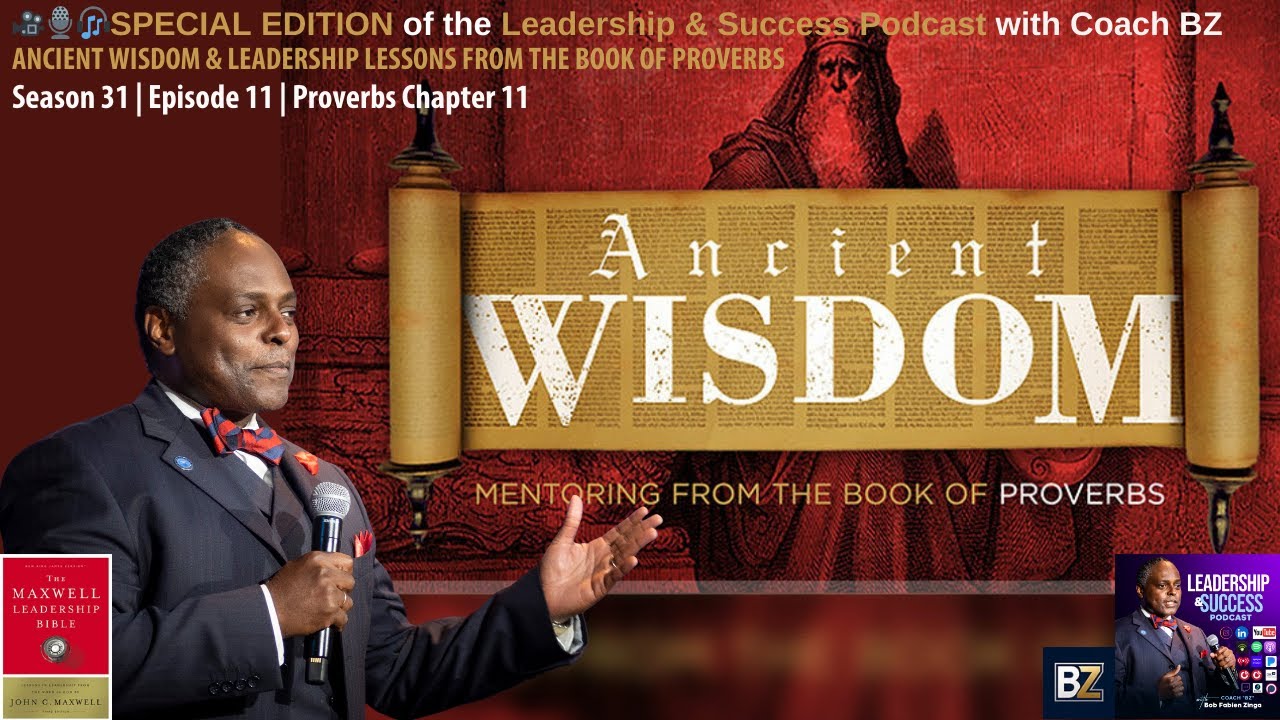
Coach BZ extracts seven leadership lessons from Proverbs Chapter 11: integrity, pride's dangers, character under pressure, influence through impact, knowing when to speak, counsel as a multiplier, and legacy. He draws on military experience and previews guests including cybersecurity leader Daya Ramesh and retired Navy commander Erika Dobbs.
Chapters
Hi, I'm John Maxwell.
When the top companies in the world are looking for trainers, speakers, and coaches, there's one name that stands above the rest, and that's Maxwell Leadership.
Our certified team members have gotten proven results for companies all over the globe, and our reputation, I'm proud to say, is second to none. Some of our members have risen to the top of their profession, including the the one you're going to meet today.
I proudly introduce you to my friend, Bob Fabien Zinga.
Welcome to the Leadership Success Podcast with your host, Coach BZ, where we help you lead with purpose and succeed with impact. If you're ready to grow into the kind of leader others want to follow, this podcast is for you. If you're determined to elevate your success and leave a lasting legacy, this podcast is for you. As my mentor, Dr. John C. Maxwell, reminds us, everything rises and falls on leadership. Our goal is simple: to inspire you, challenge you, and equip you with insights that can transform the trajectory of your leadership journey. Welcome aboard to another episode of the Leadership and Success Podcast with Coach BZ.
Hello everyone, welcome to a very special edition of the Leadership and Success podcast. This is your host Bob Fabien Zinga, Coach Bizzy, and thank you so much for being with us today, Sunday, January 11th. So we are going to be studying the 11th chapter of the Book of Proverbs today. This is about ancient wisdom and being mentored from the Book of Proverbs, right? This is not a religious podcast, but we're going to be focusing on ancient wisdom and also leadership lesson from the Book of Proverbs, a book written more than 2,000 years ago. And I do believe that this book wisdom still applies today. All right, before we do, um, Our custom is to go through what we call our moment of gratitude. This is where we take just a moment, many times less than a minute, we just want to be grateful. We want to be grateful every single day. And part of the reason why we do this is because in the military, about 21 service members commit suicide every single day. So I never want to start a day without being grateful because you cannot be grateful and suicidal at the same time. So if you would, maybe close your eyes, put yourself in your happy place. For me, it's probably by the beach. It's sunny, I feel the breeze and the waves of the ocean, the white sand, and I feel at peace. And in that state, I am so grateful. Grateful to be alive. Grateful to be here. So today I am really thankful that I am still here. Regardless of all of the challenges I've had to go through in my life, I am still here. And as long as I am alive, as long as I have breath in my lungs, there is hope for me. I can influence someone. Nobody may know my name, but I may be— I may have the opportunity to influence the person to my right and the person to my left. We can still do a lot of good in this world. So that's really what I am grateful for today. All right, let me know what you are grateful for, uh, type it, uh, in, uh, the comment. And also where you are joining us from, what city, what state, and if outside of the US since we've gone global now, which country. And also if you have any insight for the Book of Proverbs chapter 11, please type them in the comment as well. All right, I'm gonna start with a review. So, uh, again, this is a very special edition of the Leadership and Success Podcast. We are going through the entire book of Proverbs this month, from chapter 1 through chapter 31. So we are doing this, uh, every single day. Today is the 11th, so we're going to study chapter 11, and tomorrow we're going to study chapter 12 until we finish the book on the last day of January 2026. All right, let's review what we've learned so far from chapter 1 through um, chapter 10.
Hi, this is Pastor Ron Carpenter. How can I help? All right, listen closely. Proverbs chapter 1 is all about the beginning of wisdom, and that start is the fear of the Lord. It's about getting wisdom, getting instruction, and the spirit of wisdom and revelation so you can see life clearly and make choices that don't mess you up. The whole thing points to the fact that wisdom is isn't just a heart posture, a way of living that sets you apart. That's the big idea right there. Chapter 2 picks up from that foundation in Chapter 1 and digs into why wisdom is like your best friend, your protector. It shows how wisdom saves you from the fools and the— you see, it's about hearing God's voice early before trouble hits so you can live long, peaceful days. The fear of the Lord keeps you safe and gives Avoid all kinds of foolishness. That's the big deal there. All right, chapter 3 is like wisdom's personal invitation. It tells us to trust the Lord with all our heart and not our own understanding. Come on, that's powerful. When you do that, he'll make your path straight, guiding you through life with success and peace. It's about leaning in, not just knowing God's favor daily. That's a dang good life lesson right there. All right, chapter 4 is like the pep talk from your wise, loving dad telling you to grab hold of wisdom and never forget about guarding your heart, because everything you do flows from it, and you gotta stay clear of folly that leads to destruction. It's a strong, cold, and companion, and your priority, period. That's the heart of it. All right, chapter 5 is a warning about the dangers of temptation, especially the seductive traps that can wreck your life and your future. It's got rules about staying faithful and wise, not falling for foolish shortcuts or lies that seem sweet and bitter. The message is clear: keep your eyes locked on what's righteous and don't let yourself get fooled. That's the big point right there. Alright, Proverbs chapter 6 is packed with tough love. It warns about foolish promises, laziness, and how God hates those who— among brothers. But the star of the show is that little ant, man. That ant shows us what diligence and foresight look like. Working steady, and preparing ahead. That's the kind of wisdom God wants us to get—practical, real, and hard-earned. Alright, Chapter 7 is like this desperate shout from wisdom warning you about getting caught up in temptation, especially that sneaky kind that looks good but wrecks your life. Wisdom screaming for you to wake up, guard your heart, and choose the right way before it's too late. That's the big idea right there. Chapter 8 is wisdom personified, like a woman calling out in the streets, inviting folks to live life the right way. It's about how wisdom Wisdom was with God before creation, showing— wisdom is divine order and foundation for everything. The big idea: listen to wisdom's call, and you'll walk in safety and honor. Chapter 9, wisdom's knocking on the door, y'all. It's calling us to come on in, choose life, and leave the life of fools behind. Wisdom promises us blessings and safety if we listen. It's an invitation, plain and simple. Alright now, Chapter 10 is like a packed toolbox of wisdom. Short, punchy sayings, like "wise choices make life better and foolish ones mess it up." It covers everything from how your words can heal or hurt to hard work versus laziness and honesty and integrity. Bottom line, every choice matters, and your life reflects what you plant with your decisions.
All right, so that was the review from chapter 1 through chapter 10. So let's do a quick review of the lesson we did yesterday. And again, all of these episodes are available everywhere podcasts are found. You can find them on Apple Podcast or Spotify or whatever your favorite podcast platforms, including YouTube and LinkedIn. All right, so yesterday for Proverbs chapter 10, the first lesson we went through was Character Shapes Consequences. That was verses 1 and 2. Wise leadership brings joy, trust, and stability. Foolish leadership creates grief, instability, and moral debt. So character is never private, but it affects family, teams, and institutions. So that was the first lesson. Lesson number 2 yesterday was about diligence. Diligence will sustain influence, verses 4 and 5. Laziness drains credibility, whereas diligence builds momentum, the big mo, trust, and readiness. So leaders who fail to act on time will create avoidable crisis. All right, lesson 3 yesterday was on words multiply impact, verses 11, and then 13 and 14. Wise leaders use words to give life, clarity, and direction. Foolish leaders, on the other hand, they weaponize speech, creating confusion and fear. Lesson number 4: Integrity protects stability. Verse 9. So integrity will create predictability and people know where you stand, whereas compromise invites exposure instability and erosion of trust. Lesson 5 yesterday was about emotional discipline, which guards authority. Verse 12: Uncontrolled emotion fuels conflict; love and discipline preserve unity. So leaders must regulate themselves before attempting to regulate others. Lesson 6 was about work ethic signals value, verses 16 and 26. So results do matter, but so does how they are achieved, not just what you do, but how you do it. So poor effort or careless leadership will demoralize teams and undermine mission success. And finally, the last lesson we did yesterday, lesson 7, righteous leadership endures, verses 25 and 30. Storms will reveal your foundation. So leaders grounded in wisdom endure disruption. Reckless leaders, on the other hand, will collapse under pressure. So that is what we studied for Proverbs chapter 10. So today we're going to do chapter 11. All right, so the big idea for Proverbs 11 is, uh, this chapter teaches us that leadership is measured not by visibility or power, but by integrity, humility, and the outcomes our decision produce in the lives of other people. So this chapter kind of contrasts righteous leadership with self-serving ambition, showing that ethical choices will create stability, trust, and long-term influence. So while pride and dishonesty will quietly erode credibility and community. So the theme is integrity multiplies influence, whereas pride and self-interest will fracture influence. All right, so our first lesson, Proverbs 11. Integrity is the leader's measuring stick. That's Proverbs 11:1. So let's listen to that.
Dishonest scales are an abomination to the Lord, but a just weight is his delight. A just weight is his delight.
So integrity is not situational. It is foundational. So leaders are constantly weighed by how fairly they make decision, allocate resources, and treat people. So you have to be impartial to everyone, treat everybody the same, be fair. People need to be able to predict what you are going to do, your action. You have to be predictable, trustworthy, impartial. So small ethical shortcut will eventually distort the entire system. So how do we apply this? So you have to audit your decision for fairness, transparency, and consistency. I think consistency is so important, being consistent. Some of the best bosses I've had, especially in the Navy throughout my career, they've really had high, high standards, but they were very consistent and fair. You knew exactly where they stood. So there would be no surprises when it's time for your fitness report or your annual eval. You knew exactly where you stood. Did you meet or exceed the standard or did you fall below it? Did you meet or exceed the requirement or did you fall below it? And if you did, you're gonna have a great time and your fitness report will be outstanding. But if you didn't, then expect it not to be aligned with what you were able to accomplish for your unit or your command. I think those are the people who really get respected because people know exactly who they are and where they stand all the time. So, and I think it's really important again to be fair, transparent, and consistent, especially, especially when nobody is watching, when you think no one is watching, because people are always watching. So, where might you be tempted to justify minor compromises? And do your processes reward truth or speed at any cost? And I've seen that, especially in Silicon Valley, in the startup world, where they really have to be first to go to market. Sometimes companies will use shortcuts to do this, and sometimes they may even act unethical. But that shouldn't be you. Okay, you have to preserve your honor, do things the right way. It's not just important what you do, but also how you do it. So the anchor reflection for this lesson is: a leader's credibility rises or falls on whether their standards stay constant under pressure. And in most organizations, it's very easy for the standard to be constant when everything is going so well, when life is rosy, you're making a lot of money, very, very profitable, a lot of clients. But when there are economic storms, when there are changes, when there is a lot of pressure, what do you do with your standard? Are you still constant even under the great pressure or stress? That's really the key. All right, lesson number 2: Pride is a silent leadership killer. That's going to be verse 2. Let's listen to that. Pride is a silent killer.
When pride comes, then comes shame, but with the humble is wisdom.
With humble is wisdom. I really believe that great leadership is really leading from a place of humility. I was kind of joking with some fellow senior officers in the military, because it seems to me like, you know, I have worked for a lot of people since I was a seaman recruit in the Navy. That's starting 21 years ago. I've had some commanding officers, uh, who were really great and outstanding, but a few that were kind of arrogant and proud. But I must tell you, I have never, never seen a single flag officer, whether it's in the Army, the Navy, the Marine, or the Coast Guard, I guess Space Force now, never seen a flag officer, a general or an admiral who was arrogant and full of himself. Not in my experience. I have never, never seen it. And it seems to me like when you are an 06, a colonel or a captain, before they give you that one star, it looks like they send you to some type of flag school where they teach you to be humble because some of the most remarkable people in the world, really some 4-star generals and admirals who have, in my opinion, changed the course of history. When you get to know them and talk to them, they are so humble. And I believe leading from a place of humility is extremely effective because it shows that you don't know everything, you don't have all of the answers, and you have to rely on your team. You are really showing respect to other people, and you are also leading in such a way that your people can actually relate to you. And that really builds a lot of trust. Maybe that's the reason why they made General or Admiral. But pride is a silent leadership killer and we have to lead with humility. So when pride comes, then comes disgrace, right? It's not far after that. So the leadership insight, pride will isolate leaders from feedback, and blinds them to risk. Humility, on the other hand, will invite learning, correction, and growth. And I think it doesn't matter how high you get within your organization, it really will be in your own best interest to remain humble. Never be in a place where you feel like, I know everything there is to know. There is nothing for me to learn from my people because there is always something to learn. Always have an open mind. It's going to serve you well. So how do we apply this? Create feedback loops that welcome dissent and challenge assumptions. As a commanding officer or the boss, the person who is in charge, I think before you make a major decision, it's very wise to at least hear from 2 or 3 witnesses. Get your department head, your direct report, and get feedback from them. And again, welcome dissent and challenges to whatever assumption you might have. But of course, you are the boss, you are going to make the final decision. But once you make up your mind and you decide what the organization is going to do, what the vision is going to be, then everybody who reports under you has to be aligned with what you are saying, even though they really, really strongly disagree with that vision and that direction. The time for providing feedback is over. Now the decision has been made and they have to get on board with you. And if you are one of those department heads and you just cannot get on board with your boss, then I suggest that you get another job, right? Because you shouldn't be staying in an organization where you are fighting against the direction of your boss. You have to support your boss no matter what decision they make. But anyway, feedback loop is is important. So when was the last time you changed your mind publicly? And I also think now back to humility, it is okay for the boss to say, I am sorry. I was born in Central Africa, the Republic of the Congo, and my father was a very strong African, so much so that in his culture, really, a man, never had to say he was sorry, ever. Whenever he did something wrong, he knew, okay, I've messed up with my wife or my kids or whatever. The way he would ask for forgiveness is not telling you, oh, I was wrong, please forgive me, but he's going to be extra nice to you. He just couldn't bring himself, and many men in Africa are like that, to say, I am sorry. I think I'm becoming a father myself has really humbled me. It's not going to take me very long to tell to my daughters, okay, Daddy messed up here, please forgive your dad. I am truly sorry. I think that that's really powerful. Right? Again, it goes back to humility. And when you see your boss who says, okay, I did make this decision and it didn't go very well. Okay, now we are going to change, we are going to make a different decision based on the data we are receiving. I think that's really, really powerful. It shows to your teams that you can be trusted. You are a human being, you make mistakes just like everybody else, and they can relate to you. And I think it really makes them even more loyal to you and your vision. So when was the last time you changed your mind publicly? And do people feel safe to disagree with you? Do you provide that psychological safety? Do you create a culture where people feel safe enough to tell you the truth and not feel like there's going to be a reprisal? So the anchor reflection is here is humility does not weaken authority, it sharpens judgment. And for those who just joined us, again, please let us know where you are joining us from, which city and state, and which country if outside of the US, and also what you are grateful for today. I also would like to know what your insights are on Proverbs chapter 11 or your feedback from what I am sharing. So let's go to our lesson number 4. No, sorry, lesson number 3. So, character sustains leaders under pressure. So that's going to be verse 3. Let's listen to that. Character sustains leaders under pressure.
The integrity of the upright will guide them, but the perversity of the unfaithful will destroy them.
Character will sustain you. Wow. When circumstances are complex, character becomes your compass, your true north. Leaders without integrity rely on tactics, but leaders with integrity rely on principle. What are your core values? What do you believe? What do you stand on? It is really amazing to me when a leader has been one way for the entire life and then all of a sudden, They become opportunistic. They change their entire core belief, who they are and what they stand for, just so that they can take advantage of an opportunity. That is not wisdom. You have to be who you are, even if it costs you. That's integrity. And that's leadership. So how do you apply this? Clarify your non-negotiable before crisis arrive. This is who I am. And this is what I stand for. And it's absolutely non-negotiable. Wow. It doesn't matter what the trend is in the country or in the industry. I know who I am and I stand firm on who I am and what I believe. Non-negotiable. You have to know what your non-negotiables are. Okay. And also, what values guide you when options are unclear? Because in time of uncertainty, that's really where your true nature is revealed. And have you articulated your ethical boundaries to your team? Living within guardrails. This is where I am willing to move and operate, and I will not go beyond these lines. So the anchor reflection here is integrity reduces decision fatigue because values decide in advance what you are going to decide. Wow, that's pretty powerful. You lead by your values. Again, one of the best examples for this season already, Season 5, Episode 3, Terry Maxwell. I just wrote an article about that yesterday. I think everybody should read that article and listen to the podcast. It's very, very powerful. I really love the way she succeeded on purpose. She lives by her core value. She's the CEO of like 3, 4 different companies and she helps a lot of businesses scale and grow, but she would not take a client unless they are aligned by her value. And that's very, very powerful. All right. Okay. So the anchor reflection, again, integrity will reduce decision fatigue because your decisions are pretty much made by your core value, by what you believe, by your principle. All right, lesson number 4: Influence is proven by impact, not by position. Verses 10 and 11: Impact, not position.
When it goes well with the righteous, the city rejoices, and when the wicked perish, there is jubilation. By the blessing of the upright, the city is exalted. But it is overthrown by the mouth of the wicked.
Righteousness, integrity, influence is proven by impact, not by position. So healthy leadership produces collective benefit. Organizational and communities thrive when leaders prioritize the common good. Well, it's not just about me, myself, and I, but it's about us? How can we make it better for everyone, or at least for the majority of us? How can we make it better for the organization? Even when you look at statesmen and people who are in politics, I know people have different parties. Like in the US, we have two main parties, the Republican and the Democrat. But I feel like as a statesman, before you are a Republican or a Democrat or independent, right, it should be country first, your country, the United States. What can you do as a statesman, as a congressman, as a senator, as a member of the executive team that is going to benefit the entire United States, even people who didn't vote for you? Right? That is very, very powerful. And that is leadership. Even if it doesn't benefit you, or even if it doesn't benefit your own party, what can you do for your country? That's what JFK said it was. So powerful. Ask not what your country can do for you, but ask what can you do for your country? That's a call to service. Part of the reason why I joined the US Navy when I was a permanent resident of the United States, what can I do? How can I add value? Selfish, I would say selfless, selfless service, selfless leadership. Thinking about others and trying to add value to your organization, to your people, to your country, to your nation. Powerful. All right. Insight. We're thinking about collective benefit. That is so important. That's really how you add value. So how do we apply that? So measure success by how many others grow, not just by personal wins. It's not just about you. Once you become a leader, it's no longer about you. It's about your team. So your job is to make sure to remove all of the obstacles and help members of your team to successfully go through challenges and win. So a win is not just for you, but it's for people who work for you because when they win, you win. That's the way to look at that. So who is better because you led? Wow. Who is better because you led? And does your leadership elevate the whole organization? That's really what servant leadership, I believe, is all about. So our anchor reflection is true leadership is validated by the flourishing of others. Alright, lesson number 5: Wisdom knows when to speak and when not to speak. Verses 12 and 13.
He who is devoid of wisdom despises his neighbor, but a man of understanding holds his peace. A talebearer reveals secrets, but he who is of a faithful spirit conceals a matter.
So you've got to learn how to conceal a matter, how to hold your tongue if you are going to be successful. That's one thing I learned from my mother. She was extremely discreet. She would do things and nobody would know what she's doing until it was fait accompli, until it was already done. Then everybody would find out. She really knew how to keep a secret and I've learned that from my mom. You shouldn't be talking about everything. You have to qualify people first before they know. What you are talking about, right? You need to be able to hold your mouth and only speak when you need to, when you have to add value and it is going to edify or help somebody or there is a need for you to. But if not, wise people would keep their mouth shut. All right, in the Navy we say, "Loose lips sink ships." That's about operational security. Because sometimes you may be divulging information that may not be classified, or may not be extremely important by itself, but when your enemy picks up part of what you say and what some other people are saying, then they can kind of get the big picture about what your mission might be. So just be careful. So loose words will destroy trust faster than poor strategy. So discretion is a leadership skill that protects relationships and reputation. You have to be trustworthy. People need to be able to tell you secrets, and they should know that if they share that with you, you are not going to go around and telling everybody in town what their secret is, but you will stand with them and keep it in confidence. As a leader, you have to be trustworthy to that level. People need to be able to trust you with matters that you and only you can handle, and they need to trust that you are not going to share it all around social media or your town. So how do we apply this? Guard confidential information and resist reactive communication. So do you speak to solve problems or to vent frustration? Now, as a leader, sometimes you may need to vent frustration, but again, you have to qualify the people you are going to be venting to. For example, for me sometimes, I may want to vent to my wife, it's just my wife and I, nobody else. And I can tell her what I think and some of the things I'm going through. Sometimes I may want to vent with my mentor. I may want to call one of my mentors and say, okay, I just want to vent right now, just let me get this out of my chest. And then they just let me speak. If you go back, I believe on season 5, episode Episode 5, I talked with Coach Dena Brown, Dr. Dena Brown. She said she mentors a lot of ladies and when she talks to them or they have a code, I think it's 911 text. When she gets that, no matter what she's doing, she's going to stop and she's going to call her mentee. And then she needs to know one of three things. Okay, are you just going to vent and I just need to listen? Or do you want me to solve your problem? And I can't remember what the third option is. But basically sometimes people just need to vent and that's perfectly fine. And they can just vent and just say what they have in their heart. And that's really a great release when that happens. But you have to do it in a safe place, in a space where you have trust that whatever you are sharing is not going to get outside of that space. Some people have a mastermind group. That is perfectly fine. Again, people you trust, you can share with and they are not going to tell everybody else what you told them. So sometimes when your mentee want to talk to you, they just want to vent and that's fine. And sometimes they want you to help solve the problem. Now I am a father of two daughters and that's one thing I really had to learn as a dad. My daughters, when they talk to me, they don't want me to solve their problems. So sometimes they just want me to listen and sometimes they just want me to show empathy. Yes, I understand what you are going through, baby. Yes, yes, yes. That is really, really bad. I'm not going to solve your problem, but I'm going to agree with you. Okay, so as a leader, you kind of need to know when you can do that and when you should not. But so when to solve problem and when to just vent in frustration, who is qualified to hear that. All right, and can your team trust you with sensitive information? So trust grows in the silence of restraint. That's a powerful, uh, leadership lesson. Okay, leadership lesson number 6: Counsel is a force multiplier. Proverbs 11:14.
Where there is no counsel, the people fall, but in the multitude of counselors there is safety.
In the multitude of counselors, there is safety. When I make very important decisions, I like to have at least 2 or 3 advice, good people I trust, and I want to get their feedback. And then I make up my own decision. Because everybody has a blind spot, right? There is something you may not be considering and you need somebody to tell you, hey, Busy, have you considered this? Okay, so that's important. All right, I want to acknowledge Transit Hospitalisation is a player on Twitch. People at Twitch will listen to me, but I don't think they're paying any attention. They're playing games, but at least he's saying hi. So welcome to the special edition of the Leadership and Success podcast. So counsel is a force multiplier. So isolation is dangerous at every level of leadership. I know they say that it's lonely at the top, but it doesn't really have to. As you are climbing up your corporate ladder, as you become a leader, like especially when I became a commanding officer in the US Navy, that is an awesome, awesome responsibility. You are responsible for the mission and the people of your command. The buck stops with you. You are it, right? But the thing is, you don't have to be lonely making all of those decisions. Again, you have mentors, people you can reach out to, former chiefs who mentored you when you were a junior officer, you can reach out to, right? Your ISIC, immediate superior in charge. I used to meet with my ISIC at least once a quarter because he's a very, very busy man. Basically, he told me exactly what he wanted to do. With the command, what his vision and direction was, and then I will decide how we are going to make it happen. So once a quarter, I would make time, meet with him for at least 30 minutes or an hour just to make sure we are making progress on this vision and everything is working well. And if I needed help, I would ask that, right? And then if he had any further direction or advice to give me, then I was open to it. I guess what I'm saying is even if you are at the very top of your organization, the CEO, the chairman of the board, or whatever your job is, commanding officer or commanding general, you should always have a group of people you can reach out to in order to make better decision. All right, it doesn't have to be lonely at the top. So surround yourself with diverse, courageous advisors. So how do you apply this? I think you need to build a personal advisory board that challenges blind spots. I think everybody should have a personal board of directors. Again, people you can go to and ask for help or advice and who can speak into you. You give them permission to be frank with you and tell you the truth. And if you are, for example, a commanding officer like I was, then your XO, your number 2, needs to have the freedom to tell you, hey boss, you are messing up. So should your SEL, the senior enlisted leader, the most senior enlisted member of your team. He's like, sir, no, no, what you're doing, that's not good for the white hat, it's not good for the troop. And this is why I think you need to reconsider. And when they do that, stop in your tracks, listen, and really, really think about it. Now, ultimately, you are the boss, you're gonna make whatever decision you need to make. But always, always, always listen. Okay, very, very important. Alright, so whose perspective are you missing before you make a critical decision? That's a good question to ask. And do you seek advice or do you just seek validation? Are you seeking for yes men and women? Or do you really want to be challenged and make sure you are making the best decision for your organization? So the anchor reflection here is strength is multiplied when wisdom is shared. Okay, our final lesson today, lesson number 7, legacy is the final leadership scorecard. We're gonna read verses 24, 25, and 30. Legacy, the final leadership scorecard.
There is one who scatters yet increases more, and there is one who withholds more than is right, but it leads to poverty. The generous soul will be made rich, and he who waters will also be watered himself.
He who waters will also be watered himself.
Okay. If the righteous will be recompensed, the fruit of the righteous is a tree of life, and he who wins souls is wise.
He who wins souls is wise. Legacy is the final leadership scorecard. Leaders who give, they give time, they give credit, they give opportunity, will create enduring influence. Legacy is formed by what continues to grow after you move on. If you move on from your organization, even like you go on vacation for a week or two, and when you come back, everything is just chaos and everything falls apart, you are a bad leader. But if you can step out of your office, of your position, and everything keeps going the way it is supposed to, people still meet or exceed the standard and the operation continues, then you are a good leader because what you're doing is you don't just have followers, but you are building other leaders, people who can step into your shoes and continue the work for your organization. And that is very, very powerful. Wow. So give time, give credit, give opportunity, and create that enduring influence. So legacy again is formed by what continues to grow after you move on. Because another one of my mentors now, General Biggs, says, "Rank is rented, but trust is earned." Whatever your rank, whatever your position, you will not always be there forever. At some point you're gonna have to retire or resign or get another job or something is going to happen. You will not always be the CEO or the commanding officer of your command. Your time is kind of limited in that position. At some time, you are going to have to vacate the position. Somebody else is going to step into that office. So rank is rented, but trust is earned. And, uh, you really need to think about your legacy is really the final leadership scorecard, being able to develop other leaders, people who are competent, people who connect with other members of the team, and people who can do the jobs that you are doing at the same standard or higher. That's really your job as the leader, to build other people. Okay, so how do you apply this? So you have to invest intentionally in people who will outlast your role. And one thing to think about is what are you building that will remain after you? And who are you developing right now to lead beyond your tenure? That's really true success. Another thing Papa John, my primary mentor, told us is, There is no success without a successor. Who is going to take over your position when you leave, when you retire? That's your legacy. Papa John also says, once you test significance, success will no longer satisfy. Because success is really about me, myself, and I. But once you reach a certain level of success, it no longer satisfies you. You really have to step into significance where you start helping other people. Again, I think season 5, episode 5 with Dr. Dina Brown, we talked about that. I should finish up the article about the conversation we had. I believe it was on January 2nd today, but go to whatever podcast platform you have, Leadership and Success Podcast, season 5, episode 5, and listen to it. To that. She really gave us a lot to think about. So our anchor reflection is leadership that gives life will create leaders who do the same. All right, closing statement. Proverbs chapter 11 reminds us that leadership is never neutral. Every decision either builds trust or it erodes trust, strengthens community or fractures community. So integrity, humility, humility, be humble, and generosity, are not soft virtues, they are strategic advantages that sustain influence and shape legacy. All right, that's all I have for today. Thank you so much for watching the Leadership and Success Podcast, the special edition about the book of Proverbs. Wisdom, ancient wisdom, mentoring from the book of Proverbs, ancient wisdom and leadership lesson from Proverbs chapter 11. All right, when you guys replay this and listen to it on whatever podcast platform you use. Please leave comments and let me know your thoughts. Provide feedback on what I have shared and also whatever insight I may not have shared or any verses that really spoke to you that you would like to highlight. I am open to hearing from you. Okay, thank you so much for watching. And I want to remind you that today I will have the pleasure of speaking with Daya Ramesh. She's a cybersecurity leader. She's a founder and operator and a mentor. We're going to be talking about cybersecurity being existential. That's going to be today at 4:00 PM California time. So 7:00 PM on the East Coast. And then on Wednesday, I will have the pleasure of speaking with Commander Erika Dobbs, US Navy retired like me. She retired as a commander and she joined the Navy just like me as an A1, seaman recruit, the lowest rank in the military. And she ended up in the 4th of the top 4% of the US Navy. And since her retirement, she turned into a tech CEO. So I can't wait to talk to her. I'm gonna be talking from seaman recruit to Navy commander turned CEO. And on the same day on Wednesday, I will also be speaking to the one and only Lisa Fan. She really doesn't need to be introduced. She's a mentoring architect. She's written two bestselling books on mentorship, "The Mentor's Guide" and "Bridging Differences for Better Mentoring." She also has a fabulous son. TEDx talk about mentorship. So she will be here on Wednesday. So thank you so much for watching the special edition of the Leadership Success podcast. And if you wanted to watch the special podcast, I believe it was season 4, episode 15, where I interviewed Apostle Laurent Carpenter's AI twin. It's pretty exciting today how we can use technology and speak with an AI chatbot who is the twin of a real person. I also have an interview for season 4, actually my second interview interviewing ChatGPT. That was on July 4th, 2025. And the first time I interviewed ChatGPT was a couple of years prior to that. But anyway, you're going to be able to find it on whatever your favorite podcast platform is. All right. So I hope to see you at 4:00 PM Pacific time, 7:00 PM today, with Daya Ramesh, cybersecurity leader. All right, bye for now.
Thank you for tuning in to the Leadership and Success Podcast with your host, Coach BZ. If today's episode added value to your leadership journey, be sure to subscribe, share, and join us again for more wisdom nuggets on how to lead better and achieve greater success. Remember, Leadership is the most critical skill of our time. The world will always need leaders to inspire others, drive innovation, and execute meaningful strategy. So why not count yourself among the bold leaders shaping the 21st century? Until next time, stay inspired, stay committed, and keep leading with excellence.
More from Bob

S250:E4🎙️LIVE 🇺🇸America 250: President Barack Obama Leadership, Service, and the Power of Hope






S5:E157🎙️ LIVE with CMD CMSgt Dennis L. Fritz, USAF (Ret.)(Multi Tracks Audio)



S5:E156🎙️ LIVE 🇪🇸 Leadership Lessons from the FIFA World Cup 2026 Champions (Multi Tracks Audio)

S250:E3🎙️ LIVE Leadership Lessons from America’s First Documented Family of African Descent 🇺🇸📖