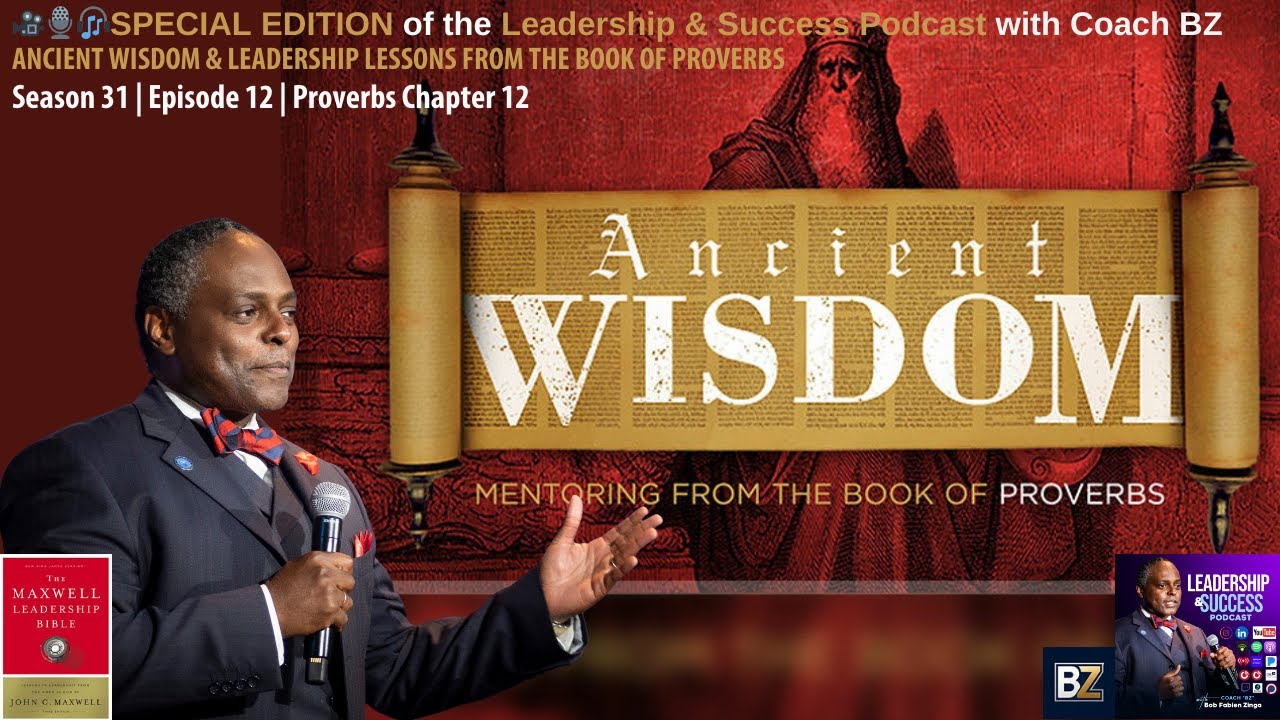
Coach BZ explores leadership lessons from Proverbs, emphasizing integrity and humility as cornerstones of trust. He weaves in Black History Month stories: an 1826 slave auction ad showing family separation, and Eugene "Jack" Bullard, the first African-American fighter pilot honored in Paris.
Chapters
Hi, I'm John Maxwell. When the top companies in the world are looking for trainers, speakers, and coaches, there's one name that stands above the rest, and that's Maxwell Leadership. Our certified team members have gotten proven results for companies all over the globe, and our reputation, I'm proud to say, is second to none. Some of our members have risen to the top of their profession, including the one you're going to meet today. I proudly introduce you to my friend, Bob Fabien Zinga.
Welcome to the Leadership and Success Podcast with your host, Coach BZ, where we help you lead with purpose and succeed with impact. If you're ready to grow into the kind of leader others want to follow, this podcast is for you. If you're determined to elevate your success and leave a lasting legacy, this podcast is for you. As my mentor, Dr. John C. Maxwell, reminds us, everything rises and falls on leadership. Our goal is simple, to inspire you, challenge you, and equip you with insights that can transform the trajectory of your leadership journey. Welcome aboard to another episode of the Leadership and Success Podcast with Coach Easy.
Hello everyone, uh, welcome back. Uh, I just had the great privilege of, uh, having a leadership conversation with Lieutenant Andrew Sreedhar, uh, US Navy SEAL veteran, and, uh, we talked about the Warrior Poet Leader strength, reflection, and execution at the elite level. If you haven't watched it yet, please watch the replay. Season 5, Episode 30 should be available right now on LinkedIn and YouTube, and by the end of today should be available on all of the podcast platforms. Okay, today we are going to go through Proverbs 11 again. So this is going to be the artificial intelligence recap. It's going to be about 15 minutes or so, we are going to review the original podcast we did on January 11th because we went through every day in January through a chapter of the book of Proverbs. Again, this is not a religious study. This is all about ancient wisdom and being mentored from the book of Proverbs, right? So we are seeking ancient wisdom and leadership lesson we can apply today in 2026, those leadership principles that are still, I believe, relevant thousands of years later after it was written. So before I do our moment of gratitude, like you guys know who've been following me every day this month, I am just grateful for Black History Month because Black History Month is American history. And I just want to honor and remember all of the African Americans who have built this country and really the people on whose shoulder I stand. Today. So today, February 11th, so there is a day in history. Let me share my screen. We are going to talk about what happened on February 11, 1826. A Black man escaped to visit his wife. So on this day, February 11, 1826, A white enslaver named Alfred Moore of Erfurt, North Carolina, placed a newspaper advertisement offering $20 reward for the capture of an enslaved Black man identified only as Joe. Moore wrote that Joe was likely not attempting permanent escape, but was probably lurking in nearby Pasquotank County where his wife was enslaved. He instructed that Joe be captured and either returned to him or secured in jail so that he could get him. Actually, I have a copy of his advertisement. Here it is: $20 reward, run away from subscriber on Saturday the 28th. And basically, Joe was looking for his wife, and this person, Alfred Moore, who owned him, wanted him back. So that is what happened February 11, 1818. 26. So Jules was not working, he was actually trying to see his wife. Love was criminalized for Black people back then, humanity was completely denied, right? The system of chattel slavery was not only economic exploitation, but it was also the systematic destruction of Black families. Enslaved men, women, and children were treated as property. They were bought and sold without regard to their relationship as spouses, parents, or sibling. The estimation is that more than half of enslaved people in the Upper South were separated from a parent or a child through sale. Nearly one-third of enslaved marriages were destroyed by forced separation. Family bonds were severed at the auction block. Mothers were torn from their own children, husbands from wives, parents from sons and daughters, often forever. And that kind of makes you think, we are in 2026 now, And whatever America is doing to immigrants, legal or not, may not be something that's brand new. Maybe something that we as a country have been used to doing for a very long time. Just something to think about. Separating little children, 5-year-old, 2-year-old, from their parents. How cruel is that? But anyway, and yet, enslaved and enslavers and their apologists claim Black people did not feel familial love the same way white families did. History definitely tells a different story. Again, you can find out more by going to my blog, my post on LinkedIn. So let's talk about something a little bit more positive. I also want to celebrate African American firsts in the U.S. military. Again, Black Americans have served in the military from the very beginning of this nation, from 1776 to today. They have fought in every single war, and today there is He's really a hero, and I actually got to meet, to see his memorial in Paris, France. Last time I was in Paris, they actually have a memorial for him. Basically, he's really a trailblazer whose courage took flight decades before the Tuskegee Men. I'm talking about the first African American fighter pilot, and his name is Eugene Jack Bullard. I think I have a picture right here. And again, there is a museum in Paris that celebrates him because of the work he did to really free the French during the war from Nazi occupation. So even before Tuskegee, really an American hero, Eugene Jack Bullard. Almost 25 years before the film Tuskegee Airmen soared into history, Eugene Jack Bullard was already in the sky over Europe. He was born in 1894 in Columbus, Georgia, and Bullard fled racial violence in the American South as a teenager. At just 18 years old, he left home hitchhiking to Virginia and stowing away on the ship to Scotland, walking across England, and eventually settling in France. When World War I erupted in 1914, Bullard joined the French Foreign Legion He was wounded twice in brutal combat and declared unfit for infantry duty, but he still wanted to serve, so he trained as a pilot, and he was accepted into the French Flying Corps. Bullard, who's an American citizen, African American, flew more than 20 combat missions against German forces and shot down at least 5 enemy aircraft. His courage earned him more than 10 decorations, including the Croix de Guerre, the Cross of War, and later the Legion of Honor. France's highest award. So again, even today, the French people celebrate him. There is a museum in France where his story is told. So it is just amazing to stand on the shoulder of such a giant. But anyway, I believe this needs to be celebrated. So back into today's podcast, today's episode. So I'm going to play a 5-minute AI recap from Proverb 11 first, and then I'm gonna play a 10-minute recap as well. And I think I may have had— I normally play a couple of highlights from the original episode, but we are gonna skip it today. But what I will do is I'm gonna add those highlights to my LinkedIn profile. So for those who follow me on LinkedIn, you are gonna get a short 1 to 3-minute highlight of the original episode, which was published again on January 11th. So let's go to the, uh, first AI recap for Proverbs chapter 11.
Today we're going to dig into a source of wisdom that's thousands of years old to tackle some of the biggest challenges that leaders face right now. We're asking a simple question: how can ancient principles, specifically from the Book of Proverbs, give a real edge to leaders today? You know, in boardrooms, in startups, even on the battlefield. Let's dive in. So first, let's just get one thing straight. When you picture a really successful leader, a CEO, a founder, maybe your own manager, what actually comes to mind? Is it the big corner office, the fancy title on their business card, the number of people they manage, or maybe the size of their paycheck? Well, what if I told you that we're often looking at all the wrong things? That all those traditional markers of success, you know, the rank, the title, they're just surface-level stuff, and honestly, they often distract from what really, truly matters. The real, true measure of a leader, well, it comes down to these 3 things: who you are when no one's watching, how you handle your mistakes and grow from them, and maybe most importantly, how your choices actually affect other people's lives. This is the bedrock for everything else we're gonna talk about. Now, look, we're not just flipping through another business book here. We're drawing on a really deep analysis of Proverbs 11. And you might be kinda surprised at how incredibly relevant its lessons on human nature are for today's in today's super complex leadership world. So, where do we even start? Well, we start with the most fundamental piece of the puzzle, the absolute non-negotiable foundation: your inner compass. Yep, we're talking about integrity. See, integrity isn't something you just put on like a suit for a big meeting and then take off when things get tough. It's not a performance; it's a core principle. It's that unwavering commitment to your values, especially when the pressure is on and you think nobody's looking. This slide just lays it out perfectly. You've got the tactical leader, who kinda bends their ethics to fit the situation, whatever's easiest at the moment. But then you have the principled leader. They stand firm on their values. And that consistency? That's what builds trust that you just can't break. And here is the hidden superpower of integrity. When your values are crystal clear, you get rid of a huge amount of mental drain. Your principles become this automatic guide, making tons of small decisions for you, which frees up all your brainpower for the really tough problems. But, okay, if integrity is the foundation, what's the biggest threat? What can bring the whole thing crashing down? It's pride. Pride is the silent killer of good leadership. It's the crack that can compromise the entire structure before you even know it's there. Think about it this way: pride builds a fortress around you, and it isolates you from reality. It whispers in your ear that you have all the answers and that anyone who disagrees is a threat. Humility, on the other hand, well, it's like an open door. It welcomes feedback. It challenges what you think you know, and that's what fuels real growth. So, how do you actually practice humility? It's not about being passive, not at all. It's about being proactive. You build systems to get feedback. You go out and actively find people who see things differently. And yeah, when you mess up, you own it—publicly. That's how you turn humility into a massive strategic advantage. This right here is a total game changer. So many people think being humble undermines your authority. It's the exact opposite. It strengthens it. It shows your team that your judgment isn't set in stone. It's something that's always being tested, refined, and improved. Okay, so we've nailed down the importance of that strong inner compass, but how does that internal character actually show up on the outside? Let's get into the specific actions that either build trust or totally destroy it. I mean, this Old Navy saying just says it all, doesn't it? Discretion isn't just about avoiding office gossip. It's about creating a vault of trust where your team feels safe enough to be totally honest—even vulnerable—with you. But building trust isn't only about what you don't say; it's also about what you actively ask. And this one question is probably the most powerful tool a leader has for self-awareness. It's you admitting you don't have all the answers and openly inviting others to help you see the whole picture. Here's a really practical way to do this: build your own personal board of advisors. Now, these aren't your cheerleaders; they're your challengers. These are the few people you explicitly give permission to tell you the unvarnished truth, not just what they think you want to hear. So we've covered integrity, humility, and trust. But what's the whole point? What's the ultimate goal of all this? Well, it all comes down to your legacy. This slide just cuts right to the heart of it. Success is so often measured by your personal wins, what you've achieved. But significance, that's measured by your impact on other people. One is temporary, the other can last a lifetime. This is really the ultimate test of leadership, isn't it? If your team or your company falls apart the second you walk out the door, did you actually succeed? Your greatest achievement, your most lasting impact, is preparing others to carry that torch without you. So how do you actually build a legacy like that? Well, you have to be intentional about investing in your people. You delegate not just tasks, but real, meaningful responsibility—the kind that stretches them and forces them to grow. And your ultimate mission becomes developing leaders who could, one day, take your job. Let's just be absolutely clear on this: leadership is never a neutral act. With every single decision you make, every interaction you have, You are making a choice. You're either building trust or you're eroding it. There really is no middle ground. So, as we wrap this up, I wanna leave you with this one question to think about: What's your lasting impact gonna be? When your time as a leader is done, what's the story that other people are going to tell about you? What will your legacy be?
Welcome everyone! Today we're diving into some timeless leadership wisdom drawn straight from Proverbs 11. You know, it's fascinating how these ancient principles, um, still resonate today, whether you're in the Navy, a tech startup, or even a cybersecurity war room.
Absolutely, it's, uh, really interesting how leadership isn't about titles or the number of people you manage, but about, you know, integrity and genuine influence, right?
Exactly. I mean, think about it. Proverbs 11 kicks off with the idea that dishonest scales are detestable, which in our language means that a leader's integrity is their measuring stick. It's like if you compromise on small ethical choices, it all adds up.
Right. And that point really hits home. When leaders take shortcuts or bend rules, Even just a little bit, it erodes trust. It's a bit like building a house on a shaky foundation. You might get by for a while, but eventually everything crumbles.
That's a really vivid analogy. And, um, this isn't just military leadership talk. It's universal. In Silicon Valley, for instance, there's this move-fast culture that ironically tempts so many leaders to cut corners.
Yeah, absolutely. It's, uh, eye-opening how these ancient proverbs are so applicable in modern contexts. What about the part on pride and humility? Proverbs 11:2 says, "When pride comes, then comes disgrace, but with humility comes wisdom." Right, exactly.
It's like, um, the higher you rise, the more you need to stay grounded. Pride can isolate you from the very feedback that's critical for growth. And in my experience, humility really opens the door for healthier communication among teams.
That resonates, especially when you consider how many leaders in high-stakes environments have learned, often the hard way, that being unapproachable can be a real detriment.
Yes, and it's interesting because there's this idea that real leadership isn't about how many followers you have, but about the measurable impact you have on others' lives. Proverbs 11 clearly contrasts self-serving ambition with ethical leadership, showing that generosity and consistency build collective trust.
Exactly, it's like the difference between, um, looking out for your team versus looking out only for your own image. I mean, if your leadership is solely about self-promotion, what happens when you step aside, right?
Spot on! Integrity, when you think about it, multiplies your influence. And it's also about the kind of decisions you make when pressure mounts. It's not the big flashy victories. It's about small, consistent choices that build trust over time.
I really like the notion that before you lead others, you have to be anchored yourself, almost like a moment of gratitude that reminds you you're still here, still influencing. Exactly.
That moment of gratitude is crucial. Especially in settings like the military where, sadly, so many struggle every day. It's like, you know, as long as you have breath, you have the ability to influence someone's life. It's a profound reminder.
Right. And that ties into another key lesson, the idea that leadership is proven by impact, not position. True leaders prepare their teams to shine even after they're gone.
Yes, and that brings us neatly to legacy. Proverbs 11, later on, talks about leadership legacy in terms of how you develop others. It's, um, about ensuring that your influence lives on through those you mentor.
I totally agree. One thing though, I wonder if the idea of legacy being measured solely by, you know, growing others might be seen as a bit too simplistic in highly competitive fields. Sometimes it's hard to balance personal accountability with mentoring and delegation.
That's a fair point. I mean, it might seem, uh, a bit idealistic, but think about it this way. Even in competitive environments, the leaders who invest in their people ultimately create stronger, more resilient organizations. The challenge is maintaining that balance, staying true to your values while also excelling in performance. Yeah, exactly. It's a delicate balance for sure.
And then there's the whole idea of wise counsel. Proverbs 11:14 tells us that a multitude of counselors brings safety. It's a reminder that even the most capable leader needs trusted advisors.
Absolutely. It underscores the fact that isolation can be dangerous. No matter how brilliant you are, having a circle of honest, um, well-wishing advisors helps expose your blind spots, and keep you grounded. I mean, how can you sharpen your decision-making if you're not willing to listen to constructive criticism?
Right. And that's why building feedback loops is so essential. When you encourage dissent and safely invite criticism, you're not weakening your authority. You're actually, um, reinforcing it.
Exactly. Because a leader with consistent ethical guardrails can reduce decision fatigue, By defining your non-negotiables early on, decisions become more straightforward in moments of crisis. Yeah, definitely.
Speaking of crisis, the discussion on character sustaining leaders under pressure really struck me. Proverbs 11:3 says that the integrity of the upright guides them. I mean, during tough times, character becomes, um, your true compass.
Yes, it's like, uh, when things get messy, Principles trump tactics every time. Leaders who adapt their ethics to convenience only end up, well, compromising their own credibility.
Mm, that's so true. And that's why those moments of Stoic clarity are so vital. It's about standing by your values, even when the temptation to take shortcuts is immense. Right?
And while we're on the subject of ethical decision-making, another gem is about wise restraint in communication. Proverbs 11 warns us that loose words can destroy trust faster than poor strategy ever could. Exactly. It's like, you know, loose lips sink ships.
That phrase always comes to mind. It's both a caution and a strategy. A leader must balance being open and nurturing trust without compromising confidentiality or, you know, oversharing in critical moments.
Right, and that's where building safe spaces for honest expression comes in. It's not about suppressing opinions but knowing when to speak and when to listen. A mature leader really listens before they speak.
And that plays directly into the idea that leadership is never neutral. Absolutely. Every decision either builds trust or erodes it, and each choice has ripple effects on your team's morale and, um, overall cohesion. Exactly right.
So to wrap this part up, the big picture is that leadership isn't about a rank or a title. It's measured by integrity, humility, consistency, resilience, and the positive outcomes these values create. Yeah, indeed. It's really a call to lead by example.
And that's why the emphasis on, um, starting with gratitude really resonated with me. It reminds any aspiring leader that before you can motivate others, you need a little grounding, a ready reminder that you still have influence, no matter the challenges.
Absolutely. It's like a reset button, a moment that centers you in your humanity, shows you that as long as you're here, there's a chance to impact someone's life positively. Very humbling.
Now, I wonder though, how do we maintain that delicate balance in fast-paced, cutthroat industries where the pressure to innovate and pivot is relentless. It seems like adhering to these ethical guardrails might sometimes slow you down.
That's a valid concern, but I'd argue that in the long run, compromising on integrity for speed only leads to, well, unstable foundations. It's like racing a car that's missing its brakes. You might win a few laps, but eventually you crash. True. So the risk isn't worth it. Exactly.
And these proverbs remind us that, uh, building long-lasting influence comes through stability, ethical stability, not just rapid results.
And on that note, let's talk about the final scorecard: legacy. Proverbs positions legacy as the ultimate measure of leadership. You know, a leader's real success isn't what's achieved while they're in charge, but how well-prepared the next generation is to, you know, carry the torch. It's about empowering others to continue the mission. Right.
And that reminds me of the idea that there is no success without a successor. A leader's significance is in the sustained growth of those around them.
Absolutely. When you delegate meaningful responsibility, you're not just sharing the load, you're actively cultivating future leadership. And that's a legacy that truly endures.
Yeah, that's so inspiring. I think the overarching message we can take away is that leadership is a blend of, um, internal virtues and external impact. It's measured by how consistently you live your values and how well you help others rise.
Exactly. It's never a neutral act. Every decision builds trust or erodes it. Every conversation offers an opportunity for growth. And every moment of gratitude reinforces that as long as you're here, you have the capacity to lead. Absolutely.
So, in essence, whether you're a military officer or a tech executive, these ancient lessons from Proverbs remind us that leadership is, um, about character, consistency, and above all, serving something bigger than yourself.
Well said. It's not just about being in charge. It's about building a legacy, empowering others, and remaining anchored in integrity and humility. Thanks for such an engaging conversation. It definitely gives us a lot to reflect on.
Thanks for tuning in, everyone. Remember, ask yourself, where is your integrity being tested, and who are you developing to carry on your legacy? Until next time.
All right, thank you so much for watching. This is it for today, so I'm going to be back tomorrow with the AI recap for Proverbs chapter 12. That's going to be tomorrow, February 12th, and then I will also have a great leadership conversation with my friend and my brother from another mother, Dr. Keith Dorsey. We are both part of the BCBR program in Santa Clara University. He's a board member, NACD directorship certified, author, speaker, executive advisor, and founder of Boardroom Journey. He just published his book, The Boardroom Journey, and we're gonna be talking about that. That's gonna be tomorrow. And then on Friday, I have also confirmed Edie Northstadt. She's an international best-selling and evergreen author. She's a serial best-selling author, and all of her books are available on Amazon and She got her degree from the University of California, so I really look forward to speaking with her. She has books like Nice Girl, Do Get the Sale, Inspired Business, and Mission Hope. So I hope you can join me live tomorrow and day after tomorrow for those two great interviews. And also, I just completed my breakfast keynote panel this morning at the Millingam Alliance, and I ran an AI workshop roundtable yesterday. It was really a lot of fun, and I believe in April I'm going to be speaking for the CXO Institute in Palo Alto, Stanford University. And for those who are in the Bay Area, I hope you can join me. All right, until tomorrow, have a wonderful rest of your day. I should be back in my office tomorrow. I will have better sound, better video, and I look forward to continue to add value. Again, in the comments, let me know where you are joining us from, what you are grateful for, and also your 3 to 5 takeaways from today's episode. And most importantly, what is one thing, one thing that you are going to apply today from what you've learned, one leadership principle that you're gonna be able to apply today. And I believe it's in the application that we really experience the magic of leadership. It's not just theory, it's not just something to understand, it's something that has to be aligned with your heart and something that you actually do every day. All right, until tomorrow, have a great rest of your day. Bye for now.
Thank you for tuning in to the Leadership and Success Podcast with your host, Coach BZ. If today's episode added value to your leadership journey, be sure to subscribe, share, and and join us again for more wisdom nuggets on how to lead better and achieve greater success. Remember, leadership is the most critical skill of our time. The world will always need leaders to inspire others, drive innovation, and execute meaningful strategy. So why not count yourself among the bold leaders shaping the 21st century? Until next time, stay inspired, stay committed, and keep leading with excellence.
More from Bob

S250:E4🎙️LIVE 🇺🇸America 250: President Barack Obama Leadership, Service, and the Power of Hope






S5:E157🎙️ LIVE with CMD CMSgt Dennis L. Fritz, USAF (Ret.)(Multi Tracks Audio)



S5:E156🎙️ LIVE 🇪🇸 Leadership Lessons from the FIFA World Cup 2026 Champions (Multi Tracks Audio)

S250:E3🎙️ LIVE Leadership Lessons from America’s First Documented Family of African Descent 🇺🇸📖