S31:E14🎙️ LIVE AWLL From Proverbs — Chapter 14 (Multi Track Audio)
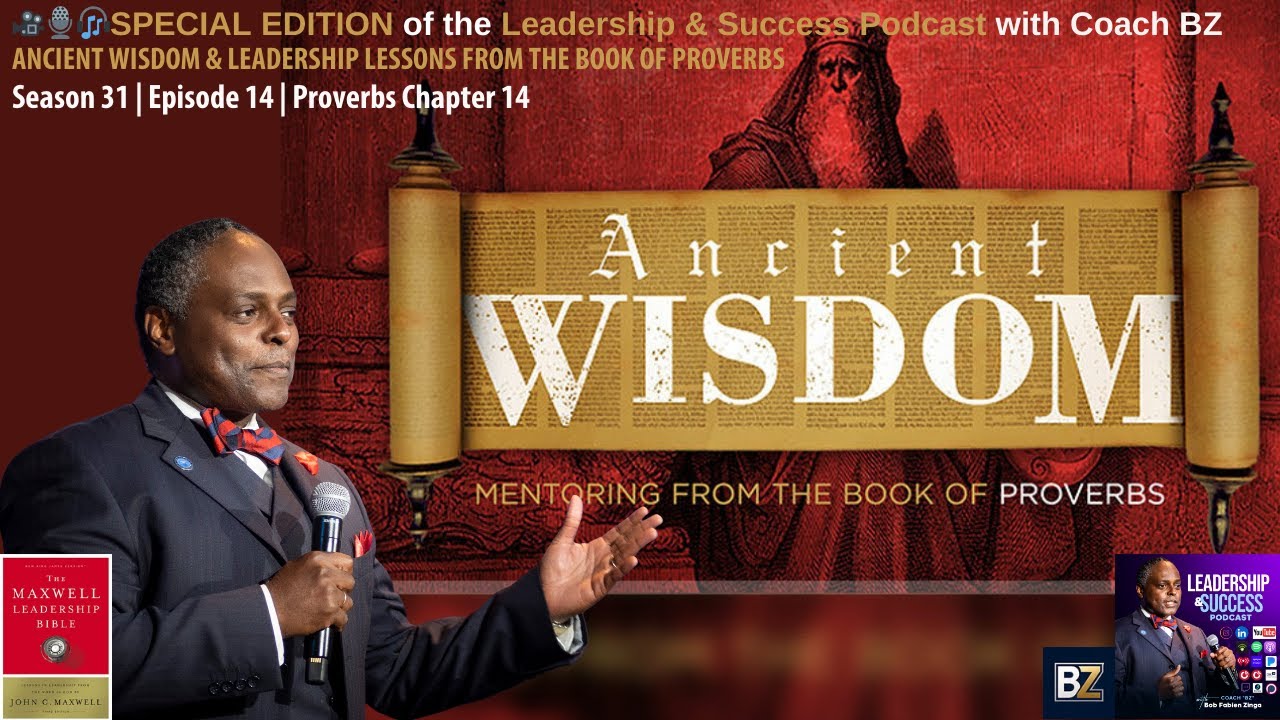
Coach BZ explores Proverbs Chapter 14 as a leadership guide, extracting seven practical lessons including "build before you lead," "integrity sets the direction," and "emotional intelligence is leadership strength." He cites mentors like John C. Maxwell and shares personal stories to connect ancient wisdom to modern leadership challenges.
Chapters
Hi, I'm John Maxwell. When the top companies in the world are looking for trainers, speakers, and coaches, there's one name that stands above the rest, and that's Maxwell Leadership. Our certified team members have gotten proven results for companies all over the globe, and our reputation, I'm proud to say, is second to none. Some of our members have risen to the top of their profession, including the one you're going to meet today. I proudly introduce you to my friend Bob Fabien Zinga.
Bob Fabien Zinga.
Welcome to the Leadership and Success Podcast with your host, Coach BZ, where we help you lead with purpose and succeed with impact. If you're ready to grow into the kind of leader others want to follow, this podcast is for you. If you're determined to elevate your success and leave a lasting legacy, this podcast is for you. As my mentor, Dr. John C. Maxwell, reminds us, everything Rises and falls on leadership. Our goal is simple: to inspire you, challenge you, and equip you with insights that can transform the trajectory of your leadership journey. Welcome aboard to another episode of the Leadership and Success Podcast with Coach BZ.
Hello everyone and welcome to a very special edition of the Leadership and Success Podcast. So today we're going to be speaking about the Book of Proverbs, Chapter 14. This is going to be about ancient wisdom mentoring from the Book of Proverbs. So we're going to be focusing on ancient wisdom and leadership lesson from Proverbs, Chapter 14 today, January 14th, 2026. And today I was grateful on my show earlier, I was with the one and only Commander Erica Dobbs, retired now. She's really one of the people whose shoulders I proudly stand on, one of the very first information professional officers in the U.S. Navy, which is my designator in the Navy. I'm so grateful for people like her who have gone before me and really set a trail for me to follow. And hopefully I'm going to keep that trail alive for other information warfare officers to follow. Long after I have retired from the Navy too. All right, so I am grateful for the people whose shoulder I stand on. So let us know what you are grateful for today, type it in the comment. Also let me know where you are coming from, what city, what state, and if outside of the US since we've gone global now, which country. And also if you have any question for me, type it in the comment. I especially want to know your thoughts about Proverbs chapter 14, the chapter we are going to study today. What leadership insight, uh, what leadership principle or lesson you get out of it, written more than 2,000 years ago but still applicable today in the 21st century, 2026. That's pretty amazing. All right, um, first let's do a quick review of what we've learned so far from Proverbs chapter 1 through Proverbs chapter 13, which we did Yesterday. And you can go back, whatever your favorite platform, podcast platform is, you're gonna be able to listen to every episode, episode 1 through 13, which was recorded yesterday. And today's episode should be available by the end of today on all the major podcast platforms. But let's get a quick review with Ron Carpenter AI, the AI twin of Pastor Ron Carpenter, who I interviewed for season 4. I believe it was episode 15, last year. Here we go.
Hi, this is Pastor Ron Carpenter. How can I help? All right, listen closely. Proverbs chapter 1 is all about the beginning of wisdom, and that start is the fear of the Lord. It's about getting wisdom, getting instruction, Spirit of wisdom and revelation, so you can see life clearly and make choices that don't mess you up. The whole thing points to the fact that wisdom isn't just a heart posture, a way of living that sets you apart. That's the big idea right there. Chapter 2 picks up from that foundation in Chapter 1 and digs into why wisdom is like your best friend, your protector. It shows how wisdom saves you from the fools and the— You see, it's about hearing God's voice early, before trouble hits, so you can live long, peaceful days. The fear of the Lord keeps you safe and gives you— avoid all kinds of foolishness. That's the big deal there. All right, Chapter 3 is like wisdom's personal invitation. It tells us to trust the Lord with all our heart. And not our own understanding. Come on, that's powerful. When you do that, he'll make your path straight, guiding you through life with success and peace. It's about leaning in, not just knowing God's favor daily. That's a dang good life lesson right there. All right, chapter 4 is like the pep talk from your wise, loving dad telling you to grab hold of wisdom and never forget about guarding your heart. Because everything you do flows from it, and you gotta stay clear of folly that leads to destruction. It's a strong c— companion and your priority, period. That's the heart of it. Alright, Chapter 5 is a warning about the dangers of temptation, especially the seductive traps that can wreck your life and your future. It's got rules about staying faithful and wise, not falling for foolish shortcuts or lies that seem sweet and bitter, The message is, keep your eyes locked on what's righteous and don't let yourself get fooled. That's the big point right there. Alright, Proverbs chapter 6 is packed with tough love. It warns about foolish promises, laziness, and how God hates those who— among brothers. But the star of the show is that little ant, man. That ant shows us what diligence and foresight look like— working steady and preparing ahead. That's the kind of wisdom God wants us to get—practical, real, and hard-earned. Alright, Chapter 7 is like this desperate shout from wisdom warning you about getting caught up in temptation, especially that sneaky kind that looks good but wrecks your life. Wisdom screaming for you to wake up, guard your heart, and choose the right way before it's too late. That's the big idea right there. Chapter 8 is wisdom personified, like a woman calling out in the streets, inviting folks to live life the right way. It's about how wisdom was with God before creation, showing Wisdom is divine order and foundation for everything. The big idea: listen to wisdom's call, and you'll walk in safety and honor. Chapter 9's like a knockin' on the door, y'all. It's callin' us to come on in, choose life, and leave the life of fools behind. Wisdom promises us blessings and safety if we listen. It's an invitation, plain and simple. Alright now, Chapter 10 is like a packed toolbox of wisdom. Short, punchy sayings. Wise choices make life better, and foolish ones mess it up. It covers everything from how your words can heal or hurt to hard work versus lazy— lazy and integrity. Bottom line, every choice matters, and your life reflects what you plant with your decisions. Chapter 11 is all about the contrast between righteousness and wickedness showing up in blessings and consequences. It's like a mirror. You can see how being honest and while deceit and pride lead to trouble. That's the heart of it. All right, Chapter 12 gets into how your choices about speech, work, and integrity shape your life. It shows that a rich person's words bring life, but fools just shoot off their mouths and cause trouble. It's a reminder that wisdom shows up in everyday actions and habits, not just fancy theory. All right, Chapter 13 is— discipline bring life and blessings, while foolishness brings destruction. It reminds us that what we say and do shapes our future. So choosing the right path matters big time. It's like planting a garden. You reap what you sow, no doubt.
Alright, so that's kind of the summary of what we've learned so far from chapter 1 through chapter 13. So let me quickly review the 7 lessons we talked about yesterday from Proverbs chapter 13. The first lesson was teachability is the gateway to growth, and that was verse 1. So the insight was a wise leader listens before they lead. Correction is not a threat, it is a gift. So pride closes ears, but humility opens pathways to growth. All right, lesson number 2, words shape outcomes and culture. That's verses 2 and 3. So a leader's word can protect or destroy. Discipline in speech preserves credibility and trust. Lesson 3, discipline will separate aspiration from achievement. I really like that. It really reminds me of one of the best laws of leadership I liked in the curriculum we have this year, 21 Irrefutable Laws of Leadership. It's law number 17. I really like that, the law of priorities. Leaders understand that activity is not necessarily accomplishment. Just because you are active, just because you are busy, doesn't mean that you're actually accomplishing anything. Again, lesson 3, discipline will separate aspiration from achievement. So verse 4, desire without discipline produces frustration. Sustainable success belongs to leaders who pair vision with consistent, consistent effort. Okay, yesterday we learned our lesson number 4: Integrity protects long-term influence. So that's based on verses 5 and 6. Integrity is a shield. Compromise may promise speed, but it extracts long-term costs from leadership credibility. All right, lesson number 5: Stewardship determines legacy. Verses 7 and 7-Eleven. Okay, uh, flashy gains fade, faithful stewardship lasts. Leaders are measured by how well they manage resources, not how quickly they acquire them. Finally, uh, lesson number 6 was wise counsel sharpens decision-making, based on verse 10, Proverbs 13, verse 10. So pride will isolate leaders, whereas counsel strengthens them. So many failures stem not from lack of intelligence but from refusal to listen. All right, finally, the last lesson yesterday was lesson 7. We talked about influence being transferred through relationship based on verse 20. So leaders are shaped by proximity. Character, habits, and decision-making reflect the company we keep. All right, that was it for lesson 13. So today we're gonna do Proverbs chapter 14. And the big idea for Proverbs chapter 14 is this chapter really reveals that leadership is ultimately built or broken by wisdom applied in daily decision. So it's what you do daily. Another one of my mentor, Mike Murdock, used to say, the secret of your success is found in your daily routine. It's what you do every single day consistently that's going to define your success or failure. All right, so this chapter, uh, contrasts wise and foolish paths, showing how character, discernment, humility, and self-awareness shape outcomes, not just for the leader but for everyone they influence, so the entire organization. So it teaches that leadership is less about appearance or authority and more about inner alignment, emotional discipline, and moral clarity. So the theme for this chapter is, uh, wise leadership builds life, trust, and stability, while foolish leadership quietly undermines everything it touches. All right, the first lesson, uh, chapter 14, I'm gonna bring to you is, uh, lesson 1: Build before you lead. So we're gonna read the first verse: Build before you lead. Let me share my screen. Build before you lead. Proverbs chapter 14, verse 1. All right. The wise woman builds her house, but the foolish pulls it down with her hands. The wise woman builds her house. So build before you lead. So leadership always builds or destroys. Culture, trust, teams, families, they are all shaped by intentional action or careless neglect. And I have a great quote from my primary mentor, Dr. John C. Maxwell. He says that if you wanna be successful, you really have to be intentional because you have to go against the current, right? So you have to be intentional. You have to do the things that you need to do when you need to do them, whether you feel like it or not. You have to have an intention. This is what I want to do. This is what I am working toward. And usually you're gonna go against the current. Against the trend, against what everybody else is doing because you have something you want to achieve. So you have to stay focused. All right. So be intentional by your action. All right. How do you apply this? So ask whether your decisions are strengthening systems, strengthening people, strengthening values, or slowly eroding them. So what are you intentionally building through your leadership today? What is important to you? What is your priority? Because your priority is where you're gonna spend all of your resources, your energy, your attention. What are you building today? And where might your impatience or ego be tearing something down? So the anchor reflection is, wise leaders, they measure success not by speed or control, but by what still stands long after they move on. That's legacy. Alright, leadership number 2: Integrity sets the direction. That's going to be verse 2. Integrity sets the direction. He who walks in his uprightness fears the Lord, but he who is perverse in his ways despises him. Integrity sets the direction. Integrity is not a personality trait, it's a daily directional choice. You have to choose every single day, "I am going to be a person of integrity today." It's a choice that you have to make. All right, how do you apply this? Align private behavior with public responsibility. What you tolerate internally eventually surfaces externally. I believe it was season 5, episode 8. I talked with Billy Jones, one of the global CIOs based here in Silicon Valley. And one thing he really talked about was the responsibility of leadership. Because sometimes you will not get the applause or people patting your back when you lead, but you have to do it whether somebody's watching or not, whether somebody is congratulating you or not, because it's the right thing to do. It's your responsibility to lead. So powerful. So I invite you guys to watch the full podcast episode. So are your values visible in your decision? Do you make decision based on your core value, based on what you prioritize, based on what you say is important to you and to your organization? Would your team trust how you act when no one is watching? Once again, I'm always reminded of what my mother taught me, right? Whatever you do in the dark, in secret, what if your grandmother was watching you? Would she be encouraging you? Would she be happy? Or would she be pretty much upset or Regret what you are doing. What would your grandmother think about the major decision you are about to make? So the anchor reflection here is leadership credibility flows from consistency between belief and behavior. So out of your core value, out of your belief is what bases all of the decision you make, therefore the decision you take. Another podcast comes to mind from season 5 again, I believe it was episode 3, I was with Thierry Madsen, Maxwell, she really talks beautifully about how she runs her business and help other business grow and scale by really standing on her core value. That is so powerful. Everything they do is aligned with her core value and the core value of her business. And if the core values are not aligned, she will not hire you and she will not work for you. So powerful. All right. So words, Reveal wisdom. That's lesson number 3, our next lesson. Words reveal wisdom. Let's read verse 3. In the mouth of a fool is a rod of pride, but the lips of the wise will preserve them. The lips of the wise will preserve them. Leaders are revealed by how they speak under pressure. So how do we apply this? Use words to stabilize, not to dominate. Silence is often wiser than reaction. As a leader, you don't have to speak all the time. Actually, it's best if you are the last person to speak and you speak few words. That's one way when people listen to you, they actually want to listen and pay attention because you don't speak a lot, but what you say matters. It really gives you that gravitas, that presence. When the boss speaks, I have to stop whatever I'm doing and pay attention because it's important. That's one thing I've definitely learned in my leadership journey. Don't just speak because you like to hear yourself talk. Listen a lot more than you speak. And when you speak, speak with substance, speak with authority, speak to kind of paint a picture of a vision of where you want to take your organization, to encourage, to inspire, and to inspire your people to do a lot more than they can individually. Build that synergy as a team, have a goal, have something that propels them into the future, that excites them. And that's really what the job of the leader is. So use your words carefully. So do your words calm or escalate situation, especially when you are under pressure? When there is a crisis. I talked with Commander Dobbs earlier, how in the Navy we really need to be able to lead in the midst of chaos. Wow. So how do you speak when you are challenged? So our anchor reflection here is wise leader discipline their tongues before they try to lead others. All right, we're gonna go to lesson number 4. Before I do that, I want to acknowledge someone using the screen name Skillful Royalist XGPoB on Twitch. So we're just saying hi, hello, and thank you for being here on this special edition of the Leadership and Success Podcast. Most people from Twitch, they don't really listen to what we do here, but I like to hear from them from time to time. Okay, leadership lesson number 4: discernment beats assumption. Let's read verse 8. Discernment beats assumption. The wisdom of the prudent is to understand his way, but the folly of fools is deceit. Hmm. The folly of fools is deceit. Discernment requires reflection. Foolishness rushes ahead blind. This is another leadership lesson I've really learned throughout my journey. Do not just react. Most people, they react. Something happens, they don't even think, they just automatically react. And what you wanna do is to really create this space where you can think, calm your nervous system, think about the situation, the challenge, and come up with a solution and then respond. So respond, do not react. That's going to help you be so successful. Discernment beats assumption every time. All right, how do you apply this? Pause before major decision, seek wisdom, get with your mentors, ask for feedback even from your team. Commander Dobbs told us today, sometimes you just have to listen from members of your team and it's gonna help you save so much time and heartbreak, right? Wisdom asks better questions, before demanding answers. All right, so how do you apply this? So are you acting thoughtfully or reactively? Again, think before you speak. What assumption need to be challenged? So Bianca reflection here is discernment is leadership's internal compass. All right, next lesson, emotional intelligence is leadership strength. I'm gonna go to verse 29. Verse 29. He who is slow to wrath has great understanding, but he who is impulsive exalts folly. A sound heart— he who is impulsive exalts Folly. Wow. Emotional regulation is a core leadership skill, not a soft one. You have to be able to control your emotion. That's one thing you can do that's within your control. So develop patience as a strategic advantage, especially in conflict or in crisis. What triggers your frustration? And how do you respond when outcomes are delayed? Because people who follow you, your team, will do exactly what you do, not always what you say. They look at you, and if you are in the middle of a crisis and you've lost your mind and you are unsettled and you are afraid, then that fear is going to consume your entire team. So you have to be calm and cool, collected under pressure. And your team will respect that. Just like Commander Dobbs told us, she was an incident working at Nicktown's land in Norfolk during 9/11. And it was like, you know, the world was upside down, chaos everywhere, but she was like, our team, no, we're going to focus on our mission and just do our work. And that's how you lead. Just focus on the mission and do what you have control over and get the job done regardless of what's going on. Around you. All right, so leaders who master themselves earn the right to lead others. And you start to master yourself by mastering your tongue and mastering your emotion. All right, lesson number 6: success without wisdom is hollow. So we're gonna read verse 12. Success without wisdom is hollow. Let's go to verse 12. —way of death. Even in laughter, the— A way that seems right to a man. So you really need to challenge your assumption. And that's why you need to have a group of people who can speak to you frankly, no matter what. They can just tell you the truth. Whether you want to hear it or not, especially if you don't want to hear it. So they can challenge you and help you grow and make better decisions. So you need to give them permission to speak to you freely. So important. Not every successful-looking path leads to sustainable outcome. So you have to evaluate decision not just by result, but by long-term impact and ethical cost. Now, one thing Brian Tracy, another one of my primary mentors, taught me, I've been listening to him since I was about 17 years old. He always used to talk about this long-term perspective. And one reason why some people are extremely successful is because the decision they make today, the action they take today, they are thinking about what is that going to affect, not just today or tomorrow, but next week, next month, next year, 5 years from now, 10 years from now, 20 years from now. What is the decision I'm taking today going to impact in my future? And he said, the longer your perspective is, the more successful you are going to be. Because it's not like this microwave generation, we want everything today and now, but it's like, no, what am I doing today that is going to get me closer to my long-term goal, long-term perspective? All right. So evaluate every decision, not just by result, but long-term impact and ethical cost. So are you chasing what looks right or what is right? Because there's a difference. And who bears the consequences of your choices? If you make the decision you are going to make right now, who is going to be impacted? Usually it's more than just you. It could impact your family, it could impact your entire organization, your department, your friends. Who will be impacted? Positively or negatively. So think before you act. So the anchor reflection is, uh, wisdom asks where the road ends, not just how fast it begins. All right, the final lesson for today, lesson 7, influence multiplies consequences. So that's gonna be, uh, verse 34, influence multiplies consequences. Verse 34, influence multiply consequences. Righteousness exalts a nation, but sin is a reproach to any people. Righteousness will exalt an entire nation. Isn't that powerful? Leadership influence scales both good and bad outcomes. If you do what's right it's going to have a great outcome. If you do what's wrong, it's gonna have a negative outcome. That makes sense, doesn't it? How do you apply this? So you have to recognize that your integrity affects more than your title. It shapes culture and legacy. So how does your leadership affect those beyond your immediate circle? And what legacy are you modeling today? Well, the anchor reflection, uh, for this lesson is: Great leaders elevate others by elevating standards. All right, let me know your thoughts about what I've shared, the 7 lessons for chapter 14, and whatever verses that maybe jumped at you from this chapter, and anything you would like to share about ancient wisdom and leadership lesson from Proverbs chapter 14. So tomorrow I will be back for Proverbs chapter 15. That's going to be January the 15th. And in about 45 minutes, I will have the great pleasure and honor of speaking with Lisa Fan. She's a mentoring architect, bestselling author of The Mentor's Guide and Bridging Differences for Better Mentoring. She also has a hot TEDx talk about mentoring. It's really powerful. And tomorrow I will have the great honor and privilege of speaking with General Larry O. Spencer, US Air Force retired. 4-star general, people-first servant, trailblazer, and principal steward. We're gonna be talking about Dark Horse, which is also the title of his bestselling book, From Airman to 4-Star General. So that's gonna be tomorrow. And after I talk to him, I will have a great pleasure of speaking to Jamie Shambon, Harvard-educated career catalyst. We're gonna be talking about career agility in an uncertain world. And then on Friday, I will be speaking with Colonel Josh Hartzell, US Army retired, is a physician, combat physician, educator, speaker, and bestselling author of Prescription for Caring in Healthcare Leadership. We're gonna be talking about a prescription for caring. So that's gonna be on Friday. All right, this is all I have planned for you this week. Thank you so much for watching the Leadership and Success Podcast, this very special edition about ancient wisdom and leadership lesson from the Book of Proverbs. All right, see you in about 45 minutes when I have the great pleasure of having a conversation with Lisa Fan. All right, see you soon. Bye for now.
Thank you for tuning in to the Leadership Success Podcast with your host, Coach BZ. If today's episode added value to your leadership journey, be sure to subscribe, share, and join us again for more wisdom nuggets on how to lead better and achieve greater success. Remember, leadership is the most critical skill of our time. The world will always need leaders to inspire others, drive innovation, and execute meaningful strategy. So why not count yourself among the bold leaders shaping the 21st century? Until next time, stay inspired, stay committed, and keep leading with excellence.
More from Bob

S250:E4🎙️LIVE 🇺🇸America 250: President Barack Obama Leadership, Service, and the Power of Hope






S5:E157🎙️ LIVE with CMD CMSgt Dennis L. Fritz, USAF (Ret.)(Multi Tracks Audio)



S5:E156🎙️ LIVE 🇪🇸 Leadership Lessons from the FIFA World Cup 2026 Champions (Multi Tracks Audio)

S250:E3🎙️ LIVE Leadership Lessons from America’s First Documented Family of African Descent 🇺🇸📖