S31:E14AI RECAP🎙️ LIVE AWLL from Proverbs — Chapter 14 (Multi Tracks Audio)
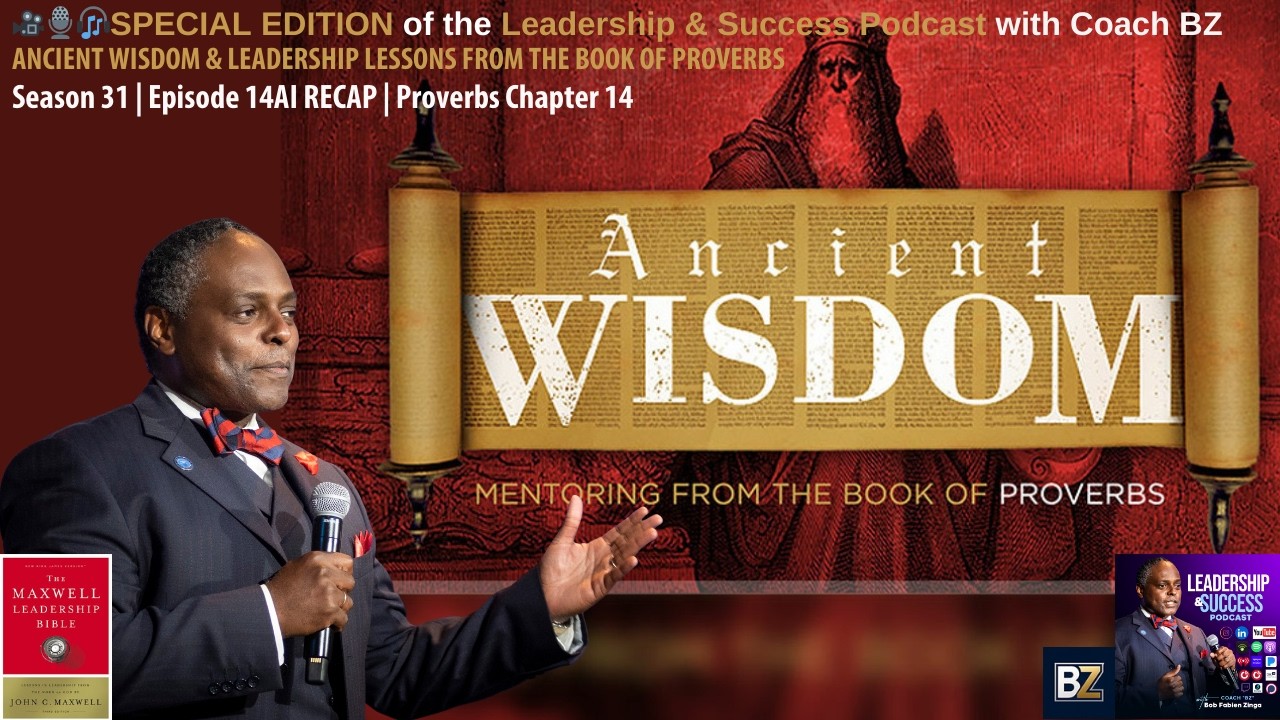
Coach BZ covers Proverbs 14 with an AI-generated recap identifying seven leadership pillars: Build before you lead, Integrity sets direction, Words reveal wisdom, and others. The episode weaves in Black History Month stories about Recy Taylor's 1944 rape and WWII hero Doris Miller, relating ancient wisdom to military, cybersecurity, and corporate leadership.
Chapters
Hi, I'm John Maxwell. When the top companies in the world are looking for trainers, speakers, and coaches, there's one name that stands above the rest, and that's Maxwell Leadership. Our certified team members have gotten proven results for companies all over the globe, and our reputation, I'm proud to say, is second to none. Some of our members have risen to the top of their profession, including the one you're going to meet today. I proudly introduce you to my friend Bob Fabien Zinga.
Welcome to the Leadership Success Podcast with your host, Coach BZ, where we help you lead with purpose and succeed with impact. If you're ready to grow into the kind of leader others want to follow, this podcast is for you. If you're determined to elevate your success and leave a lasting legacy, this podcast is for you. As my mentor, Dr. John C. Maxwell, reminds us, everything rises and falls on leadership. Our goal is simple: to inspire you, challenge you, and equip you with insights that can transform the trajectory of your leadership journey. Welcome aboard to another episode of the Leadership and Success Podcast with Coach BZ.
Hello everyone, this is Coach Bizzy. Welcome to another episode of the Leadership and Success Podcast. Thank you so much for joining us today. Now normally I do one podcast every day on the Book of Proverbs, but yesterday on the 14th, I didn't have time to do it. So today we're gonna have two podcasts back to back. First I'm gonna talk about Proverbs 14, and then I'm going to talk about Proverbs 15, which is today, February 15th. So for this first episode, we are going to focus on what we talked about during January 14th. We read the entire chapter of Proverbs 14th, and it was about an hour long. You can listen to the original podcast everywhere podcasts are available. But today I'm going to give you a 10-minute AI recap of that chapter. Actually, it's going to be about 16, 17 minutes, all done with artificial intelligence. So while you are listening, I want you to please let me know where are you joining us from, what city, what state, and if outside of the US, which country. What are you grateful for today? And then what are the 3 to 5 takeaways from today's episode? And also one principle you will apply starting today. So for a moment of gratitude, as you know, for this entire month, I am grateful for Black History Month. I am really grateful for the influence, for the participation, for the incredible, really, work that African American have done to really build this country, to make America who America is today. All of those famous, little known, and unsung triumph of Blacks in America. I really want to put the spotlight on it this Black History Month. And I kind of have two vignettes for that. One, we'll start with the date. Today is— well, yesterday was February 14th. So what happened on February 14th in African American history, which is Black history, which is American history? And then the second one is focusing on a first in the military, because African Americans have served in the military from the very beginning, from 1776, the War for Independence, all the way up to today, and really highlight the contribution of African American soldiers, sailors, airmen, Marines, and really remember history, right? What happened and put the spotlight on our American heroes. Okay. For the first one, I am going to play a short video, but basically, let me see if I can share my screen here. Here we go. So on this day, February 14th, 1945, a grand jury in Alabama where I used to live refuses to indict white attacker of Recy Taylor. Who is Recy Taylor? Recy Taylor is this, young woman here. She was a spouse, she was a mother, and she was viciously attacked here when she was much older. She never got justice, but at least she got a— the state of Alabama made an apology. I guess that's something at least. But anyway, on September 3rd, 1944, she was 24 years old. Black wife and mother. And she was walking home from a revival service at her church, Rock Hill Holiness Church in Abbeville, Alabama. She never made it home safely. And a gang of white men kidnapped her at gunpoint, drove her to a remote wooded area, and brutally gang-raped her. They blindfolded her, returned her to the road, and left her to walk home alone. Mrs. Taylor reported the crime immediately, but the sheriff identified suspects. One of the men even admitted She had been raped at gunpoint. But yet on February 14th, 1945, yesterday, February 14th in our history, an all-white, all-male grand jury in Alabama refused to indict her attacker. How sad that is. So I'm going to play a quick video about that and I will be right back.
Here on Democracy Now!, democracynow.org, The War and Peace Report. I'm Amy Goodman with Juan González.
We turn now to a new film that looks at what happened in 1944 when a 24-year-old Black mother and sharecropper was gang-raped in Alabama and refused to be silenced. This is a clip from the trailer of the documentary The Rape of Recy Taylor.
to me.
They put me in the car, then went blindfold me. I was begging them to leave me alone. Don't shoot me.
I got to go home to see about my baby.
They wouldn't let me go. I can't help but tell the truth, what they done to me.
That was Recy Taylor herself describing what happened the night 6 white boys abducted and brutally raped her as she walked home from a church service in Abbeville, Alabama. After the men raped Taylor, they left her on the side of a deserted road, where she was found by her father. This is another clip from the film, The Rape of Recy Taylor. This starts with her brother, Robert Corbett, followed by her sister, Alma Daniels. They explain what happened to Recy Taylor the night she was raped.
And, you know, my sister didn't have any more kids after that and never got pregnant after that. And they didn't only add—
just to have sex with her after they got through mutilating her.
They played in her body.
I don't know if she was feeling pain or what. That was after they kept her about 4 or 5 hours down in the woods. —guys one night. They said they wanted her to act just like she was in bed with her husband.
The boys had warned Taylor repeatedly that they would kill her if she spoke out. But despite the threats, Recy Taylor identified her rapists, though few women spoke up in fear for their lives. In fact, the rape of black women by white men was so common in Jim Crow South that the NAACP had a chief rape investigator. That person was none other than Rosa Parks. When Rosa Parks went to interview Recy Taylor—we're talking 11 years before the Montgomery bus boycott—the local sheriff kept driving by the house and eventually burst in, threatening Rosa Parks with arrest if she didn't leave town. Parks left and then launched the Alabama Committee for Equal Justice for Mrs. Recy Taylor, triggering a movement to seek justice. Justice, again, 11 years before Rosa Parks became that civil rights hero for refusing to give up her bus seat to a white man, launching the Montgomery bus boycott. For more, we're joined by Nancy Burski, the producer and director of The Rape of Recy Taylor. And we're joined by Professor Crystal Feimster. She is an associate professor of African American Studies at the University of Maryland.
All right, so that's what happened February the 14th, and that was 19— '44. And one thing I wanted to read here, eventually the legislature in the state of Alabama, they did apologize. So it is really a very long resolution they had there, but I'm just gonna read one specific paragraph where they said, "Be it resolved by the legislature of Alabama, both houses thereof concurring, that we acknowledge the lack of prosecution for crimes committed against Racine Teller by the government of the state of Alabama. That we declare such failure to act was and is morally abhorrent and repugnant, and that we do hereby express profound regret for the role played by the government of the state of Alabama in failing to prosecute the crime. So at least they apologized, but she never received justice. A few years after that, she did pass away, but even when she was old, I believe in her 90s, she still wanted to get justice for what was done to her. When she was only 24 years old. And the Jim Crow South, great state of Alabama. I've lived there for like, uh, 15 years before I came to California. I know those people pretty well, and that is just wrong. Okay, let's, let's, uh, get to the second vignette. Again, we're celebrating Black History Month, Leadership and Success Podcast. This time we are going to talk about an American hero, um, in the military. So Doris, he went by Dory Miller, is really the first hero of World War II. On December 7th, 1941, that's when Pearl Harbor happened, a Japanese plane attacked Pearl Harbor, and Doris Miller, a US Navy mess attendant, so he was a cook. Back then, Black weren't even allowed to really have a combat billet. He was a cook. Keep that in your mind. Again, enlisted. Back then, Blacks weren't allowed to be officers. That didn't start until 1943, 1944 with the Young Golden 13. But anyway, so he was a mess attendant aboard the battleship USS West Virginia and was collecting laundry below deck. Again, he wasn't trained with weapons. He didn't really know anything about warfare or anything. That was not his job in the Navy. So he had no combat assignment. He had no gunnery training and he served served in a segregated Navy limited to noncombatant role for Blacks. Okay. When the alarm sounded, Miller ran toward danger. First, he carried wounded sailors to safety. Then he reported to the bridge where the captain lay mortally wounded amid explosion and chaos. Miller took control of a .50 caliber machine gun, a weapon he had never been formally trained to operate, and began firing at attacking planes. He continued until he ran out of ammunition. For his extraordinary courage, he became the first African American awarded the Navy Cross personally presented by Admiral Chester Nimitz. And I think I have a picture of that here. This is an American hero. And again, you can go to my post on LinkedIn and find out more about him. Remember the name, mess attendant second class Doris, Dory Miller. All right, so now I am going to go ahead and play two AI-created video about Proverbs chapter 14. The first one's about 6 minutes and the second one is almost 10. 10 minutes. So we are going to play those. And again, as you are listening, let me know where you are joining us from, and let me also know what you are grateful for, and also 3 to 5 takeaways from today's episode. Okay, here a member says, powerful recap, Coach Bizzy. Proverbs 14 reminds us wisdom builds, impulsiveness destroys. In leadership and AI alike, character and discernment make the difference. Grateful for the clarity and insight shared. Thank you so much, Sunil. I do appreciate that. All right, here's the first video.
So what if the absolute best leadership advice for today, for people in tech, for military leaders, wasn't from some new business guru, but from a text that's thousands of years old? Well, today we're going to crack open Proverbs 14 and pull out a really practical leadership framework that works right now in the 21st century. I mean, think about the world we're in. We've got AI changing everything, constant instability, and a generation that is, you know, rightly skeptical of authority. So what really makes a leader last? It's definitely not the title. It's not the corner office. It's something way deeper, something you just can't automate or fake. And that really gets to the heart of it. We're so often trained to think of leadership as being this spotlight leader. You know, it's all about the big titles, the flashy ceremonies, the big speech. But true, lasting leadership? That's built over here, in the daily leader column. It's about the quiet choices, the unseen routine, the stuff you do when absolutely no one is watching. This quote from The Source just nails it: "The secret of your success is found in your daily routine." That little sentence completely reframes leadership. It's not some big event; It's a daily practice. It's a muscle that you have to build, one small, consistent decision at a time. Okay, so how do we actually build that muscle? The Source breaks it all down into 7 key pillars, all pulled from the wisdom of Proverbs 14. So let's just walk through them one by one. Our first pillar is a big one: Build before you lead. And the idea here is really powerful. It's that leadership is never, ever a neutral act. With every single decision you make, you are either building something up or you are tearing something down. There is no middle ground. And this idea becomes really concrete when you apply it to the real world. So, for a naval officer, building means actively forging morale, maintaining standards, ensuring readiness. For a cybersecurity pro, it's about building resilient security architectures and a culture where every single person feels responsible for security. So the question changes from "Am I a leader?" to "What am I actively building today?" And that leads perfectly into our second pillar: Integrity sets the direction. The focus here isn't about being perfect—nobody is. It's about the trajectory. It's about which way you're pointed. And here's the crucial point: Integrity isn't some fixed personality trait that you either have or you don't. No, it's an active, daily choice. It's a choice between what is right and what is simply convenient. And every time you choose that convenient shortcut, you're making a small withdrawal from your credibility bank. And over time, those withdrawals, they really add up. Alright, on to Pillar 3: Words Reveal Wisdom. This is all about the strategic power of your communication, especially when the pressure is really on. Just think about a crisis—a big data breach, an operational failure. In that moment, your words can be like gasoline on the fire, just escalating panic and creating chaos. Or, they can be the fire extinguisher, instilling calm and bringing clarity. The source reminds us that restraint is what builds true leadership presence. You don't have to be the first to speak or the loudest person in the room to be heard. And building on that idea of restraint, we get to Pillar 4: Discernment Beats Assumption. This is a reminder that the biggest leadership failures, they usually don't come from a lack of intelligence. They come from a lack of reflection. So how do we actually do this? Well, the source gives us a really simple, 4-step process. First, just slow down. Take a breath. Second, question your own assumptions. What do you think you know? Third, go seek counsel from people you trust. And maybe the most important one: actively listen to the dissenting voices, the people who aren't just telling you what you want to hear. You see, anyone can react. A true leader responds. Next up, Pillar 5: Emotional intelligence is strength. And let's be clear, this is not a soft skill. It is a core strategic asset for any leader. Think about it. In any high-stress situation, your team is taking their cues directly from you. Your emotional state is literally contagious. If you're calm, you create collective calm. Your stability becomes the team's stability. You absolutely have to master yourself before you can effectively lead anyone else. Okay, Pillar 6. This one gets at a really critical modern trap. "Success without wisdom is hollow." It's this idea that just because a path looks successful on the surface doesn't mean it's the right one to take. This forces us to ask a really crucial question with every major decision: "What does this cost my future self?" It's about shifting your mindset from thinking in financial quarters to thinking in decades. Real wisdom isn't about how fast you start the race; it's about understanding where the road you're on is actually going to end up. And that brings us to our final pillar, number 7: Influence multiplies consequences. You can almost think of this as the physics of leadership. You see, as your influence grows, the ripple effect of your character just gets bigger and bigger. A small compromise when you're a junior leader might only affect your immediate team, but that same exact compromise from a commanding officer or a CISO— wow, that impacts the entire culture, the standards, the morale, the reputation. Even the history of the organization. Your integrity touches everything. Alright, so we've gone through the 7 pillars. Now, let's make this really personal. Let's shift from the theory to building your own personal playbook for becoming the kind of leader you actually admire. So let's just pause and reflect for a second. Looking at your actual, real daily routine—not the one you wish you had—what are you truly building, day in and day out? Is the legacy that your influence is creating the one you actually want to leave behind? And here's the direct charge from the source: Don't wait for the promotion. Don't wait for the title. Lead right now, like the commanding officer or the CISO that you hope to become someday. Start embodying that future role in your small, daily choices today. The key is that this has to start now. You do not wait for the title. You do not wait for permission. You start today. You build something positive. You align your actions with your deepest values. You practice discernment instead of just reacting. And you elevate the standards for yourself and for everyone around you. So, we'll leave you with this one final thought. It's really the only question that matters when you strip everything else away: What will you build today?
Welcome everyone! Today we're diving into the rich lessons found in Proverbs 14. Showing that leadership isn't just about grand gestures, but the small decisions we make every day.
Absolutely. It's fascinating how something written over 2,000 years ago still guides naval officers, cybersecurity leaders, and corporate executives alike.
Right. And the first big idea is that leadership is daily, not occasional. Every routine decision, no matter how mundane, shapes your legacy. It's like, um, you're constantly building, or sometimes even, uh, unintentionally tearing down the very foundation of your team. For sure.
And that idea of building before you lead is, well, so central. The proverb that says, "The wise woman builds her house," really makes you think about constructing trust and culture before assuming command. Exactly.
And think about it, whether you're in the military or in cybersecurity, You're not just, you know, managing people or systems. You're building morale in the Navy or constructing secure infrastructures in tech. Every decision, every counseling session, every process documented is like laying a brick in your legacy. Right.
And that brings us to the next lesson. Integrity sets the direction. It's really about aligning what you believe with what you do. Imagine a scenario where you compromise on a minor issue, thinking it's easier, but then that compromise starts chipping away your credibility.
Yeah, integrity isn't just an honorary title. It's molded through daily choices. I mean, can you really trust someone whose actions don't match their words? Think about it. Would your team trust you if they knew you only practiced integrity when under observation? Exactly.
And it resonates deeply in sectors like cybersecurity, where transparent risk reporting and ethical governance aren't just buzzwords. They're the backbone of trust.
Mm-hmm. Moving on, the proverb about "The lips of the wise preserving them" reminds us that our words are powerful. In a crisis, whether it's a cybersecurity breach or a military operation gone sudden, your measured words can calm or escalate situations. Absolutely. It's like your communication is the oil that keeps the engine of leadership running smoothly.
I get that. Sometimes the best move in a chaotic moment is to stay quiet, let others speak first, and then deliver thoughtful words.
Exactly. And that idea of restraint—speaking less but with more weight—really ties in with building gravitas. If your words are always reactive, then you're not truly in control of the narrative. Totally.
But you know, I sometimes wonder if that strategy might not always work. What if a leader's silence is misinterpreted as indifference?
That's a fair point. But it comes down to balance. Discernment beats assumption. Taking time to assess situations, to question initial thoughts before reacting, is what sets apart wise leaders. Mm-hmm, right. We all need a moment to pause and think rather than just jump into a reaction.
Yes, especially in high-stakes environments. It's like having an internal compass that guides you to ask better questions instead of just demanding quick answers. Precisely.
And when you talk about emotional intelligence, it really reinforces leadership strength. The proverb about being slow to wrath isn't about being soft; it's about strategic calm. Because when leaders lose it, the whole team feels the tremor.
Absolutely. A calm leader can stabilize even the most chaotic of situations, whether that's during a cyberattack or in a critical military operation.
And then there's that lesson that success without wisdom is hollow. We often chase quick wins. Maybe in tech we push to ship products faster. But if it's done without foresight, the ethical cost can be enormous. It's like taking shortcuts that might boost short-term metrics but ultimately damage trust.
Right, and that short-sightedness can erode morale and even ruin long-term reputations. It's a reminder that lead by example is the only real way to build sustainable authority. Exactly.
And finally, influence multiplies consequences. As a leader, your decisions ripple out far beyond your immediate surroundings. Whether you're drafting policies or mentoring future leaders, every choice sets —standards that echo through your organization. Every action builds your legacy.
And that also drives home the point that leadership is less about your title and more about your inner alignment, a consistent adherence to your values regardless of the situation. Totally.
And the idea that leadership is built gradually through intentional choices is crucial. It challenges the notion that authority is just handed to you. You have to earn it day in and day out. It's a process of daily discipline.
You know, sometimes I wonder, isn't it a bit too idealistic to expect every leader to consistently make these wise decisions every day in— what, in every stressful moment?
That's a good challenge. I mean, it's tough, no doubt, but it's about striving for that ideal. Even if you falter sometimes, the aim is to build habits that generally push you in the right direction. Think of it like training repeatedly, over and over, until the right choices become almost automatic. It's like muscle memory for leadership.
Yeah, I can get on board with that. Developing a leadership mindset is all about constant practice.
And you know, if you're a naval officer or a senior security engineer, these lessons aren't just academic; they're practical strategies. Every watch you stand or process you implement builds towards a reputation that lasts well beyond your rank or title. They say legacy is built in the quiet moments, not just in the spotlight.
Exactly. And those quiet moments define who you are as a leader when the stakes are high.
Right now, in an age of AI and rapid cyber threats, this ancient wisdom feels more relevant than ever. It forces us to question, what am I building right now? Instead of just chasing trends or quick fixes. Absolutely. And it really re-centers the conversation on ethical leadership. And you know what?
It's refreshing to see leadership redefined as an internal process rather than just external authority. Yes.
Leadership refined by daily practice, building trust, integrity, discernment, and emotional intelligence creates a ripple effect that uplifts not just a single team, but entire organizations. Right. Got it. It's like planting seeds that grow into a forest of influence.
That's a neat analogy, and I love the call to action here. It's a practical reminder for anyone aspiring to lead, whether you're a junior officer or a tech leader in Silicon Valley.
Exactly. It encourages leaders to reflect, what leadership habits am I strengthening today? Who can I allow to challenge my decisions? And how do these choices shape not just the immediate outcomes but my long-term legacy? Those are the big questions.
And it's interesting how the discussion points out that building leadership is a mission of daily discipline, not a once-in-a-lifetime achievement. Absolutely.
We often think of leadership being gained through titles or ceremonies, but really, it's your ongoing actions that foster true command presence. It's like, um, building a compound slowly, brick by brick, until it becomes a palace of trust and competence. Yes indeed. That's the picture.
And for anyone skeptical about the practicality, remember, these lessons are applied every day in environments with extreme pressures, be it on naval watches or during a cybersecurity incident. Definitely.
They emphasize that influence and responsibility amplify over time. As your decisions build a culture, even the smallest lapse can cause large repercussions. Tactical leadership, personal integrity, they all interlace to form a legacy that can either inspire or destabilize entire communities. Yeah, that's deep. Really high-stakes leadership.
I think what's most compelling is the call for proactive leadership. Instead of waiting for the right moment or a title, you start leading with the choices you make every day.
Right, and that's a powerful takeaway. You don't need a badge or office to lead. You lead in your daily interactions, in the decisions that might seem minor, but over time, accumulate into major impact. Absolutely. It's leadership in action.
And while it might seem overwhelming to internalize so many virtues at once, the real message is to focus on small, intentional improvements every day. Exactly.
Start with one habit at a time, be it speaking with restraint or building trust, and let these choices fortify your command and influence over the long term. It's a journey, not a destination.
In the end, as Proverbs 14 reminds us, leadership is a cumulative effect of disciplined, wise decisions. Whether you're leading at sea or safeguarding a digital frontier, it's those quiet, consistent actions that truly define your legacy. Right on!
Thanks for exploring these timeless yet incredibly relevant leadership lessons with me today. Here's to building, aligning, and leading with all the wisdom we can muster, one disciplined day at a time.
Absolutely, an inspiring reminder that real leadership is crafted daily. Until next time, keep leading with purpose.
All right, we got a couple more comments and Daniel Young, if you are still there, I just sent you a link to the podcast portal if you want to come in for just like a couple of minutes to give me your 3 to 5 takeaway, that would be great. If not, that is fine also. So check your LinkedIn message, I just sent you the link. So I want to Play. So this is, uh, let me see, I read that earlier. He said Proverbs 14 reminds us wisdom builds, impulsiveness destroys. And Daniel said Proverbs 14:4 hit home tonight. He says his manager was a messy failing hard drive, but the merge increase was saving 10 years of data for the heaven. Uh, sometimes means embracing mess to protect legacy. I, I really love that because in Proverbs chapter 4 Verse 4, Proverbs says, "Where no oxen are, the crib is clean, but much increase is by the strength of the ox." So if you want your crib to be clean and then you don't have any productivity whatsoever, that is fine. However, if you want to be effective, sometimes it has to get messy. It reminds me of what every sailor knows. A ship in the harbor is safe, very, very safe, but that's not what ships are built for. Ships are built to go at sea. And go there, face the danger and be all they are meant to be. So sometimes in life you can be in an environment where you feel safety, but you are not really living your purpose because it's kind of scary to step out of your safety zone for you to go. But you do have to step out of the safety zone so you can go. There is no other way. Either you stay clean and nothing is happening, or it gets a little bit messy and there is a lot of growth and you live. Live out your purpose. And Daniel also says, Sunil Kumar Singh, as a fellow architect, I couldn't agree more. Character is the invisible infrastructure that sustains every high-level build, whether in AI or organizational leadership. This is another thing I really love about wisdom and just about leadership. It's applicable in pretty much every single industry, right? No matter what you do, no matter who you are, no matter where you come from, whether you speak English or not, whether you're Black or white, it doesn't matter. These leadership principles are universal. They apply anywhere and everywhere. And if you do put them into practice, I believe you will see the impact. So again, Daniel, if you can get on the platform, but if not, that is okay. This is really all I had for you guys today. And I want to remind you that next Wednesday, I am going to have 4 interviews. So I am going to have a great pleasure of speaking with Professor Melissa Ambury. She's turning curiosity into courage one experiment at a time. So hopefully you can meet us here. We're gonna be live on both LinkedIn and YouTube. And she's the best-selling author of Face Plant. So you do not want to miss it. And on the same day, I am also going to be talking to my new friend. He's actually from the United Kingdom, Dan Sutherland. He's an AI architect expert, and he authentically inspires organizations about the future of work, AI, and the Fifth Industrial Revolution. We're gonna be talking about this. He's also a TEDx speaker, so you don't want to miss this. And I wrote an article yesterday about this new AI social platform where AI agents actually can express ideas, create content. And I think it's kind of dangerous because they don't really think about ethics, about security, about privacy and things that I care a lot about. But anyway, he gave me a quote I think that is going to be timeless. Read my article, so the newest article in my ETC newsletter. And then on Wednesday, I am also going to have the great pleasure of speaking with Rikkiya McGee. She's a logistical expert and aspiring cybersecurity specialist, CompTIA Security Plus, but also an Army National Guard officer. So you don't want to miss this. I'm going to be speaking to Officer McGee on Wednesday. And the last interview I will have on Wednesday will be with Shevon Chevie Maxwell. She has an MBA in business development, but she's also an Air Force veteran, senior master sergeant in the Air Force, retired now, federal execution partner, and she works with tech founders who want to gain federal opportunities through qualified proposals and called partnerships without sacrificing time and capacity. So you don't want to miss any of these live on Wednesday. This week. Okay, I believe Daniel is here. Let me get him here in just a second. Let's see. All right, Daniel Young, my friend, how are you doing today? Oh, you are on mute, I think. Oh wait, I still cannot hear you. Can you check your microphone?
Okay, you're good. Yeah, okay, excellent. Thank you so much.
Thank you so much for coming on such short notice. If you can, just for a few minutes, let me know maybe 3 to 5 takeaways and one thing you believe you're going to be able to put in practice from Proverbs chapter 14.
Oh, okay, ah, that's really good as well. As I just updated my YouTube channel, first and foremost, I'm honored to be on your leadership platform. Thank you for having such a strong foundation for, for leaders and everyone to have a voice. So thank you for your leadership, Commander Bob. We appreciate that. Um, with that said, I do want to talk about 3 pillars, uh, that, that, that were influenced from today's show. One, um, first off being the, the legacy of resilience. I'm very grateful for data resurrection. I had a— this week was successfully moved 10 years of professional files off a failing thumb drive. So it reminded me that even when the hardware stutters, that the structural integrity of our history can be saved if we act with discernment. Yes. Second, strategic clarity. I'm grateful for the transition, for permission to architect, um, architecture. I, I've stopped waiting for a seat at the table, and I started building the table itself through Honor Mode Press LLC. So there's, uh, there is immersed peace in owning your own blueprint. So the, the Honor Mode Press will go with the Honor Mode, um, book in the, in the series and things like that.
You remind me of Shirley Chisholm. She says, no, when, uh, they don't invite you to the table, you just bring a folding chair. So that's, that is, that is Excellent. And when you're— you're free to take away.
And that's excellent to, to mention an honorable Queen, pastor, uh, church mother on a Sunday. Um, we're still celebrating Black History Month. Um, it was just Valentine's Day. President's Day is coming Monday. So there's so many honorable, uh, moving pieces that we can recognize. Um, you know, and speaking of fellow architects, you know, I'm grateful for this community again For you, Coach BZ, to our peers, like Sunil, I seen in the comment, you know, it proves that when we share our invisible infrastructure, our character and wisdom, we elevate the entire city, not just our own house.
Yes. Yes. So true. Wow. That is really wonderful. Thanks. Thanks again for coming back. And of course, everyone, I did interview Daniel, so you need to go back and watch the full episode. It's really fascinating. Lots of great insights. So to end the show, And actually for today, like I say, I didn't have time to do it yesterday. I'm committed to do it every single day. So today I'm going to have back-to-back episode right after we are done here. I'm going to come right back live on LinkedIn and YouTube for chapter 15. So for us to end chapter 14, what is one thing that you, Daniel, are going to put into practice today? Because to me, understanding all of those leadership principles is important. It is good. That's why you need to get started. But sometimes When I talk about these things, they are, I would say they are not simplistic, but they are simple, but they are hard to put into practice though. And sometimes people are like, oh, I already know that. You don't have to tell me again. I already know that. Well, the truth is you don't really know it because if you knew it, you would be doing it. Because you don't do it, I know for sure you don't know it. So it's only in the practice, in the execution that you really find that magic, that you really see the change and the transformation. So what is one thing that we've talked about today that you think you're going to put in practice starting now?
I just did it. I put the final touch on my, my YouTube channel. I did the first post and it's so transformative and I'll drop the link in case any of the viewers want to take a look at it. It came from— the inspiration came from someone I was coaching. I just completed a training on the difference between mentor and coaching. And I was able to break it down into layman terms and tell leaders, you know, what, what's the difference. For example, recent show, there was, um, uh, uh, Dorsey, last name was Dorsey, had a really great show, and he talked about the difference between an executive and being on, on, uh, a nonprofit leadership board. And I actually was on a leadership board of fraternal organization. Wow. And I know the work that it takes. I've even you know, led building a playground bill. So, um, you know, in the back scenes of writing up the— what do you call it— where you have to get the money and then you get it approved and actually put the team together. Yeah, but most people don't know I was actually out there with the team digging up dirt and shovel and— wow— build together. So that way, years from now when people drive by and little kids have a legacy, you know, I put in the legwork.
Well, congratulations. Congratulations. Thank you so much for sharing. I really love to hear that, right? We are a community here. We want to support one another. And sometimes you may feel a little bit afraid, you're a little bit scared. Is it going to work? Is it not going to work? And no, this is the very first post that you put in. But in order for you to have 1,000 posts, you have to start with one. Right now, my producer is telling me I have more than 700 episodes for this show. We've been here— this is the 5th season. So for 5 years now. But I remember the very, very first episode I did on this podcast. It was just me, me, myself and I. Nobody else was there. Daniel wasn't there. Nobody was listening in the audience. Daniel wasn't there giving me comment or encouragement. It was just me. But I kept going. One episode, two episodes, 100, 200, 300, 400, 500, 600. Now we have over 700 episodes and our community is growing and growing and growing. So you have to start very, very small, but eventually it will get bigger. But you do have to have the courage to start. Okay, thank you so much. I won't take much more of your time. Thank you so much, Daniel. For everybody else, I'm gonna be back on like within 10 minutes to do Proverbs chapter 15. So thanks again for being here and bye for now.
Yes, sir.
Thank you for tuning in to the Leadership and Success Podcast with your host, Coach BZ. If today's episode added value to your leadership journey, be sure to subscribe, share, and join Join us again for more wisdom nuggets on how to lead better and achieve greater success. Remember, leadership is the most critical skill of our time. The world will always need leaders to inspire others, drive innovation, and execute meaningful strategy. So why not count yourself among the bold leaders shaping the 21st century? Until next time, stay inspired, stay committed, and keep leading with excellence.
More from Bob

S250:E4🎙️LIVE 🇺🇸America 250: President Barack Obama Leadership, Service, and the Power of Hope






S5:E157🎙️ LIVE with CMD CMSgt Dennis L. Fritz, USAF (Ret.)(Multi Tracks Audio)



S5:E156🎙️ LIVE 🇪🇸 Leadership Lessons from the FIFA World Cup 2026 Champions (Multi Tracks Audio)

S250:E3🎙️ LIVE Leadership Lessons from America’s First Documented Family of African Descent 🇺🇸📖