S31:E15AI RECAP🎙️ LIVE AWLL from Proverbs — Chapter 15 (Multi Tracks Audio)
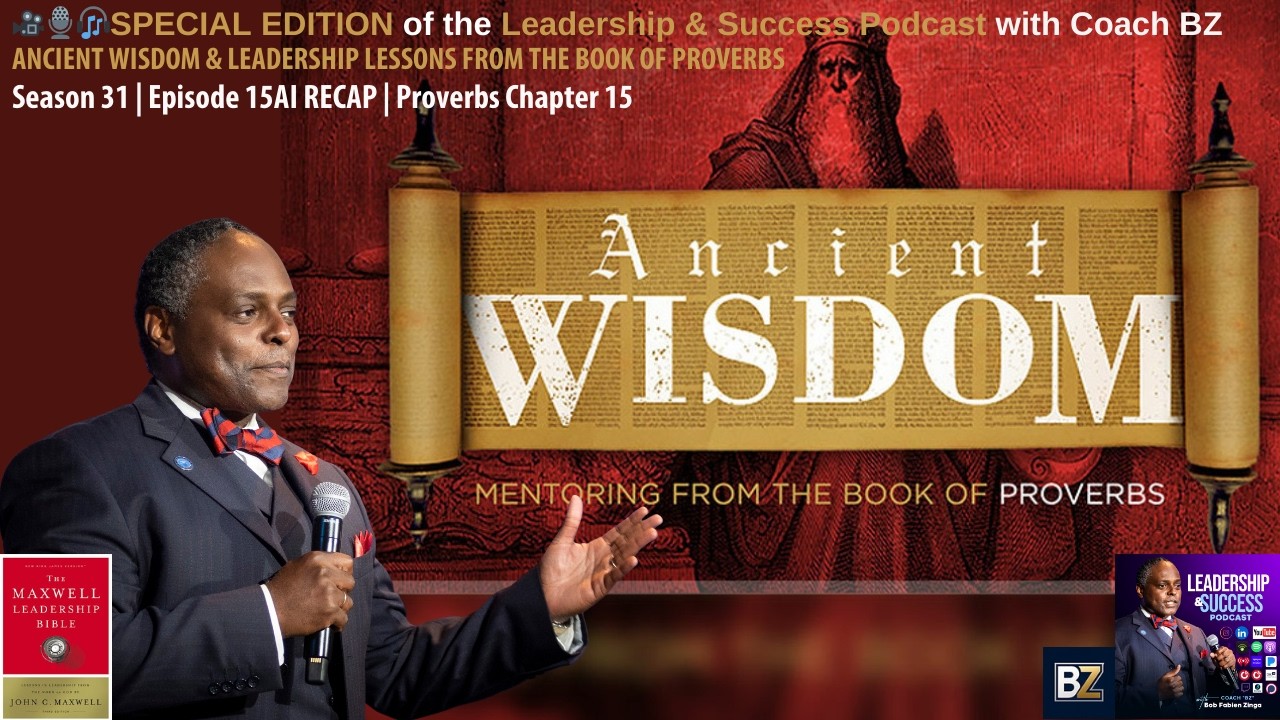
Coach BZ recaps Proverbs chapter 15 through a leadership lens, extracting lessons on tone, listening, and humility for military and tech leaders. He weaves in Black History Month stories about the Tuskegee Airmen and Indigenous displacement, connects biblical wisdom to the OODA loop, and warns against AI-only platforms like Maltbook.
Chapters
Hi, I'm John Maxwell. When the top companies in the world are looking for trainers, speakers, and coaches, there's one name that stands above the rest, and that's Maxwell Leadership. Our certified team members have gotten proven results for companies all over the globe, and our reputation I'm proud to say is second to none. Some of our members have risen to the top of their profession, including the one you're going to meet today. I proudly introduce you to my friend, Bob Fabien Zinga.
Welcome to the Leadership and Success Podcast with your host, Coach BZ, where we help you lead with purpose and succeed with impact. If you're ready to grow into the kind of leader others want to follow, this podcast is for you. If you're determined to elevate your success and leave a lasting legacy, this podcast is for you. As my mentor, Dr. John C. Maxwell, reminds us, everything rises and falls on leadership. Our goal is simple, to inspire you, challenge you, and equip you with insights that can transform the trajectory of your leadership journey. Welcome aboard to another episode of the Leadership and Success Podcast. Podcast with Coach BZ.
Hello everyone, uh, welcome back to another episode of the, uh, Leadership and Success Podcast. This is a special episode to This was actually scheduled for today, February 15th, 2026. So we are going through the Book of Proverbs, Proverbs chapter 15. So we did the original broadcast back on January 15th. In January, we read one book of Proverbs for every day of the month. And today we are doing the artificial intelligence recap. So it is going to be a 10 to 15 minute recap of the original episode, all done by artificial Intelligence. So thanks again for being with me today. We are broadcasting live on LinkedIn and on YouTube. So for those who are listening, you know the deal. So let us know where you are joining us from, what city, what state, and let us know if you are outside of the US, which country, and also what are you grateful for today. And then also think about 3 to 5 takeaways for today's episode, things that you are going to remember and put in practice. And I especially want to know about one thing, one principle that you are going to put in practice today. All right. Thank you so much for listening and for watching. So for a moment of gratitude, as you know, this entire month of February in the US, it's Black History Month. And I've been highlighting this book here, African American First, right? This is about famous little-known and unsung triumph of Black in America. So I believe that Blacks have built this country, and Black History Month is American— Black history is American history. And we are going to celebrate and spotlight a lot of the achievement for African American in this country. They've really built this country and made it great. What it is today. And I specifically want to focus on the military, the first in the military, what happened in the Navy, the Air Force, which originally the Air Force was part of the Army. It was the US Army Air Forces, but the Marine, and now I guess we have the Space Force as well. Yesterday, which I recorded earlier today, we talk about Dorie Miller, the first hero for World War II. And today we are going to be highlighting some outstanding achievement again that happened in African American history, which, which is American history. And I want to say hello to Daniel from Atlanta. Thank you so much for being here with us today. And Daniel says he's thankful for God allowing me to wake up, make my bed, and enjoy the day. So simple but so powerful. Sometimes We take so much for granted. And thank you for reminding us, Daniel. Just the fact that you are alive today, that you can take a deep breath, that's a miracle. That is a gift.
Wow.
Thank you so much, Daniel. I really, really love that. Okay. So we're gonna start to, I have kind of two vignettes when I talk about Black History Month. The first one is gonna be about some things that happen today in history. So February 15th, we're gonna go back to 1837. Let me share. My screen. Let me do that here. Share a window. Yeah, we should do it. All right, so we are gonna go back and I do have a post about this. So February 15th, 1837, Congress ratified treaties removing indigenous people from their homelands in, the Midwest. Okay, this is another thing we need to understand about America. When the white settlers came here, people were living here. And here is a picture from that era. We used to call them American Indian. Now we call them Native American because they are not from India. So on February 15, 1837, Congress ratified two treaties that removed 8 indigenous nations from their ancestral lands in the Midwest. The treaties expanded the western boundary of the United States and added 2 million acres to the state of Missouri territory where slavery was permitted. So for generations, the Platte region had been home to the Iowa, Sauk, and Fox Nation, as well as the Otoe, Omaha, Missouri, Santee Sioux, and Yankton Sioux tribe. Yet in 1830, although the federal government had promised by treaty to reserve this land for Indigenous people, The discovery of first-rate lands along the Missouri River and pressure from westward expansion led Congress to forcibly renegotiate those agreements. President Andrew Jackson, who had signed the Indian Removal Act in 1830, advanced new treaties annexing the region. This action did more than relocate communities, but they altered the Missouri Compromise of 1820 and expanded territory where slavery was allowed. The consequences were devastating, as you can imagine. Thousands of Indigenous people died or were killed during forced removal westward, a journey remembered as the Trail of Tears. Really, this was their ancestral land, and we Americans, we killed them and forced them out of their homeland. That's really, really sad. But as a naval officer and a cybersecurity executive today, I reflect on moments like this through a leadership lens, right? I believe history forces us to ask very difficult questions at times. What happens when power overrides principle? And what is the cost of breaking a promise? And how do leaders justify expediency over humanity? And how do we ensure we never repeat those failures? So that's something to think about. So now on a more positive note, the second vignette for Black History Month, I like to again highlight African Americans first in the military, whether it's the Army, or the Navy, I am a US sailor, or the Air Force, or the Marines. Let's talk about the Tuskegee Airmen. These are really heroes. I have a picture of them right here, and they were just wonderful. And I think this was their logo, 99th Flying Training Squadron. And this is the type of airplane they flew during the World War. But the Tuskegee Airmen were the first African American fighter pilots in the US Army Air Forces. So on March 7th, 1942, the first group of African Americans ever to undergo training as combat fighter pilots graduated from flying school at Tuskegee Institute in Alabama. I used to live in Tuscaloosa, Alabama, about a couple hours from Tuskegee. I've went there a couple of times. It's just amazing, their stories and what they did for this country. So they're known as the Tuskegee Airmen. The earliest graduates were organized into the 99th Pursuit Squadron, and deployed to combat in North Africa. They were led by Captain Benjamin O. Davis Jr. And you should remember him because a couple of days ago we talked about him. Captain Benjamin O. Davis Jr. became the very first general in the US Army. He would later become the first African American brigadier general in the US Air Force, sorry, Air Force. As more pilots completed training, additional squadrons formed, and in July 1944, the 99th joined 3 others to create the 332nd Fighter Group, famously known as the Red Tails. They flew escort missions, bomber protection, and combat operations across Europe until the war ended in May 1945. Really American heroes, and they happen to be Black, so we do want to celebrate them today. All right, so now we are going to get back into the two AI-generated recap from Proverbs chapter 15. Again, you can go listen to the original broadcast, it's about an hour long, which was published on January 15th. And this one here is going to be about a 17-minute or so recap. So again, let me know where you are joining us from. I want to hear from you. Let me know what you are grateful for and let me know the 3 to 5 takeaways from these videos and one principle you are going to put in practice today. And I also want to remind you that next week on— this week actually on Wednesday, I'm going to have the great pleasure of speaking with 4 illustrious guests. I'm going to be speaking to Professor Melissa Bury. She's the bestselling author of Faceplant, and she turns curiosity into courage one experiment at a time. You don't want to miss it. And then I will also speak on Wednesday with Chavon Chavis Maxwell, an Air Force veteran, She lives in Montgomery, Alabama, and she's a federal execution partner. You don't want to miss that. I'm going to be speaking to my friend also, Dan Sutherland, all the way from the United Kingdom. He's an AI expert. You don't want to miss this one because I'm going to show you one more. Let me share my screen again because I want to show you one I wrote an article yesterday about securing Vibe-coded platform. There is this new thing, it's called, uh, um, uh, what is it called, Maltbook. Basically it's like a Reddit for artificial intelligence agent, right? No human allowed. So it's AI speaking to AI, creating content, and they comment on each other. And I really believe as a cybersecurity expert, it's kind of dangerous because they really didn't think much about security when they did this, just functionality. And I think you have to think about security, about safety, about privacy, and about ethics. I think that is very, very important. But anyway, Dan gave me a quote yesterday in the comment I had to add it to the article. He says, don't touch that open claw with a barge pole, let alone your computer. And I believe he is right. When the experts speak, I believe you absolutely need to listen. But again, Dan is going to be here in the flesh on Wednesday, all the way from England. AI architect. Architect and, uh, Fifth Industrial Revolution and TEDx keynote speaker. You don't want to miss this. And then I will also speak on Wednesday with Rikkiya McGee, and she's a U.S. Army officer and logistical expert, aspiring cybersecurity specialist. So you don't want to miss any of these interviews. So, uh, that's gonna be for Wednesday. So now let's listen to the first AI recap. It lasts about 7 minutes. And then after that, I'm gonna play another one that's almost 10 minutes, and then we are going to end. So keep providing me feedback, where you come from, what you are grateful for, 3 to 5 takeaways from today's lesson, and one principle you will put in practice as you listen to this video.
Here we go.
So what if one of the best leadership playbooks for today, you know, for a high-stakes command center or a fast-moving tech company, was actually written thousands of years ago. We're gonna dig into how just one chapter of an ancient text, Proverbs 15, gives us these incredibly powerful, real-world principles for how to lead right now. And look, this isn't about religion. It's about timeless wisdom that just works. Let's just kick things off with this. This quote, it gets right to the heart of what we're talking about today. See, leadership isn't really about the title you have on your uniform or your name at the top of an org chart. That stuff is temporary. It's rented. Real influence, the kind that lasts, that's something you have to build, one conversation, one decision at a time. So every leader is basically standing at a fork in the road, with the choice between these two paths. Are you gonna lead using your positional power, relying on your authority, your rank, and just being in control? Or are you gonna lead through earned influence, building everything on a solid foundation of character, trust, and serving your team. The path you pick, well, it changes everything. Okay, so here's our game plan. We're gonna start with what everyone sees—a leader's words. Then, we'll move inward, to how they listen and learn. After that, we'll dig into the humble foundation of their character. And finally, we'll look at the kind of legacy these choices actually build. First up, your words, your world. This is where leadership becomes really visible. Right? Let's get into how what you say—and maybe even more importantly, how you say it—literally shapes the world your team operates in every single day. Look, in any tough job, conflict is just part of the deal. A security breach, a project that's behind schedule, a major operational snafu—these things are gonna happen. But this piece of wisdom reminds us that while conflict is a given, escalation—well, that's a choice. And that choice often boils down to the leader's tone. Think about it like this: your tone can either pour water on a fire or it can pour gasoline on it. When things get hot, are you the one bringing calm and clarity to de-escalate, or are you fueling the flames with your own reaction? Managing your own emotions isn't some soft skill; it's a critical command skill. It sets the temperature for the entire team. And this idea goes beyond just your tone to the actual words you use. You know, culture isn't created by some mission statement you hang on the wall. No, it's built one conversation at a time. With your words, you can either create a tree of life for your team, a place of growth and health, or you can just wear them down. Alright, let's shift gears. We're gonna move a little deeper now, from what a leader says to how they actually think. This whole section is about having a mindset that is always, always open to growth. You know, the wisest leaders get one thing loud and clear: wisdom doesn't care about your rank. A brilliant insight can come from absolutely anywhere—the most junior person on the team, the brand-new hire, or even from someone who disagrees with you. A great leader is actively looking for those perspectives before they make a move. And this leads us to a huge distinction. So many of us, if we're honest, listen just to reply. We're just waiting for our turn to talk, already building our own argument in our heads. But real leaders? They listen to understand. They're trying to absorb the entire picture, to see their team's reality. And when people feel truly heard like that, that's when your credibility skyrockets. This is a question every single one of us in a leadership role should be asking ourselves, constantly. Just take a second and really think about it. Is there someone on your team whose voice you haven't been hearing? Whose perspective is missing? The answer to that question might be your biggest blind spot. This brings us to what might be the ultimate leadership superpower. Teachability. A wise person welcomes correction. They see it as a gift that helps them grow. But pride? Pride sees that same correction as a threat. The best leaders don't see feedback as an attack; they see it as the fastest way to get better. And here it is, the Power. Teachability. A wise person welcomes correction. They see it as a gift that helps them grow. But pride? Pride sees that same correction as a threat. The best leaders don't see feedback as an attack; they see it as the fastest way to get better. And here it is, the gut-check question. Think about it. Those after-action reviews or project postmortems? They're totally useless if everyone's ego is in the room. Real growth can only happen when the defensiveness stops. You have to be more committed to the outcome than to your own idea of being right. So, let's go even deeper. We've hit on words and mindset, but now we're getting to the absolute core—the character traits that make everything else we've talked about even possible. It sounds kind of backwards, doesn't it? But honestly, the most impressive thing about the most effective leaders I've ever seen is their humility. Now, this isn't about being weak or thinking less of yourself. It's a quiet confidence that's so solid it doesn't need to shout about how important it is. That's the stuff that earns you real, long-term trust. So humility isn't a weakness. It's a huge strategic advantage. It keeps you on your toes because you know you don't have all the answers. It makes you approachable so your people will actually bring you bad news while there's still time to fix it. It sharpens your judgment. And maybe most importantly, It's like a magnet for trust. Think about it. No serious leader, no commander, no CEO makes big calls in a vacuum. A huge part of being humble is knowing you need a team of trusted advisors, people who you've given permission to push back and challenge you. You don't need yes-men. You need truth-tellers. And finally, let's touch on this idea of reverence. It's like your internal compass, that moral clarity that keeps you anchored, It's about choosing what's right over what's fast or easy. It's about focusing on the long-term impact instead of just the short-term win. It's the ultimate guarantee of your integrity. Alright, let's bring all of this home. We've gone from the outside in, from words to mindset to character. Now let's look at what all of this adds up to—the legacy you leave behind. This really brings us to a powerful conclusion. You know that popular image of the loud, table-pounding, dominant leader? It's mostly a myth. Real, lasting leadership is usually something else entirely. It's measured. It's built on relationships. It's humble. It's teachable. And it's grounded in a rock-solid moral core. Okay, to make this really stick, I've got a final challenge for you. Let's start with your actions. First question: Where does my tone need some work? And second: Who on my team have I not been listening to? Next, let's look inward. What piece of correction or feedback are you resisting right now? Be honest. And where might your own pride be creating a blind spot, maybe twisting your judgment? And finally, let's think about your total impact. What kind of culture are you actually building, day in and day out, with the words you choose? And when the pressure's really on, what values are truly anchoring your decisions? I wanna leave you with this one last thought because it just says it all. At the end of the day, leadership isn't about winning every argument. Or always being right. It's about building trust and connection. Because you can absolutely win the argument, and in doing so, lose the one thing that makes you a leader people actually want to follow.
Welcome everyone to this discussion on ancient wisdom and leadership. We're diving into leadership lessons inspired by Proverbs 15, and how its principles are super applicable whether you're in military, tech, or any high-pressure setting. I'm excited about this.
So what's the heartbeat of Proverbs 15 when it comes to leadership?
Well, the chapter really drives home that leadership is first about inner discipline, tone, and humility rather than just authority. It highlights, for instance, that a gentle answer can defuse conflict while harsh words just fuel the fire. It's all about tonality becoming a catalyst for trust. Absolutely.
And it's interesting how that idea plays out in both a military or a tech context. In stressful moments, your voice can either calm the storm or intensify it. Exactly.
Think of it like this. It's like when you're leading a cybersecurity incident or a tactical briefing in the war room. Your calm tone under pressure sets the emotional temperature for everyone. And it all starts with that choice of words.
Right. And it's not just about tone, is it? There was also a big emphasis on listening, taking in diverse perspectives. Could you unpack that a bit?
Sure thing. The wisdom here stresses that wise leaders listen first before they jump in to lead. Whether it's the newest analyst in a tech crisis or a junior sailor with fresh insights, understanding is pivotal. It reminds me a lot of Covey's principle: "Seek first to understand, then to be understood." That's a wonderful point.
I mean, sometimes I wonder if leaders truly listen or if they're just waiting for their turn to speak. There's definitely a gap there.
Right, and that gap can be critical. The chapter really highlights that leadership credibility is built when people feel heard, not just on paper, but through genuine engagement. And that, in my view, is what makes a leader truly relatable.
Although I have to challenge one thing. If a leader listens too much without decisiveness, could that be a problem in high-stakes situations?
Interesting point. I think it's about balance. You're not just being passive. You're actively absorbing insights and then combining that with a strong vision. It's not about waiting forever. It's about filtering the noise and then moving decisively based on that collective wisdom.
Yeah, I appreciate that. Now, what about the idea that correction is seen as a gift? That sounds counterintuitive in a world where criticism can sting.
Oh, definitely. The principle is that correction should be welcomed, not feared. It's all about teachability. Leaders who reject correction are often too caught up in pride. But those who embrace it actually grow and build even stronger teams. It's like, if you are more focused on being right rather than genuine improvement, you stand still. That resonates well.
I mean, who hasn't hesitated to offer constructive feedback when worried about being misunderstood?
Right. And that's why the culture that stems from this is so important. Moving to the next principle, culture is built through words. It isn't just about grand strategies. It's rooted in everyday engagements, praise, and honest conversations. Yeah. When leaders routinely affirm and also correct in private, they create a lasting legacy.
It really underscores that leadership isn't about flashy power, but about everyday interactions. Do you see this approach working across different industries as well?
Absolutely. Especially given that today's environment is so high stress. In a network operations center or even a boardroom, the power of positive, intentional conversation can either build trust or, if abused, erode it rapidly. Regular acknowledgment and yes, even personal letters are small but impactful gestures.
That's a nice human touch. And on the note of humility, how does that tie into leadership effectiveness?
Pride distorts judgment. And humility sharpens it. Proverbs 15 really teaches that humility isn't a weakness, but rather the foundation of trust. Leaders without humility tend to get trapped in their own echo chambers, which is dangerous. In the military context or tech industries, you want people to feel safe bringing bad news rather than sugarcoating everything.
I agree, and it's so true. Real courage is shown in listening to criticism and adapting. It's like a compass ensuring you're heading in the right direction, isn't it?
Exactly, and that leads us into Decision-Making Quality, which reflects on the quality of counsel a leader seeks. The text reminds us that no serious decision happens in isolation. Bringing in diverse viewpoints, trusted mentors, a personal board of directors, and even those who might challenge your assumptions is key to solid decisions. Decision-making is never a solo act.
That's a great reminder. We sometimes see leaders who mistake loyalty for agreement, and that can lead to flawed strategies.
Absolutely. In fact, the piece warns against echo chambers. It encourages leaders to surround themselves with truth-tellers, not yes-men. I think it's a call to actively seek out dissenting opinions to avoid blind spots.
That's crucial, since the best ideas often come from unexpected sources. Now moving deeper, how does reverence factor into all of this?
Reverence anchors leadership integrity. It's about, um, moral clarity, choosing long-term honor over short-term gain. Whether you're safeguarding a cybersecurity incident or managing a multinational team, the core decision-making should always be governed by true values, not just expedience. It's like having a moral north star.
Right, and it's a point that really stands out. Better a little with reverence than great wealth with turmoil. That sentiment deeply speaks to sustainable leadership. Yes, exactly.
And it's not some lofty ideological statement. It's a practical guide for building trust. What matters is not how loudly you assert your rank, but how earnestly you build relationships through thoughtful discussions, consistent correction, and importantly, the courage to be humble.
Yeah, I love that idea. It really flips the modern notion of leadership. It's not about dominating the room but fostering an environment where every voice can contribute.
Totally. And when you look at, um, the leadership challenge laid out, it really pushes you to reflect on questions like, where does my tone need refining? Who have I not listened to? It's a call for continuous self-assessment. It encourages leaders to develop a legacy that outlives a mere title. That reflective aspect is powerful.
It seems like a recurring theme—leading with character and building trust over time, not just wielding authority on a given day.
Exactly. And this approach applies equally to military operations and high-stakes tech environments. The wisdom, although ancient, transcends time and context. Reminding us that the essence of leadership is relational and rooted in inner discipline and moral clarity. It's very grounding.
And when you think about it, it's like the ancient wisdom is a manual for navigating modern challenges. Even in tech companies where things change in milliseconds, these principles of tone, teachability, and humility are enduring. Absolutely.
It's, uh, like the original blueprint for sustainable leadership. Whether you're calming a live crisis or mentoring a diverse team, these leadership tenets—emotional intelligence, listening, and personal accountability—are universal.
Yeah, I do wonder though, isn't it sometimes a challenge for leaders to be both decisive and wholly reflective? That balance can be tough, right?
True, it's a tightrope walk. But the key is recognizing that decisiveness is enhanced by listening and continuous learning. Leaders who are open to correction and diverse counsel are often more robust in their decisions because they have, um, built a strong foundation of insight. Mm-hmm. Being reflective doesn't slow you down. It actually empowers you to act more strategically. That makes a lot of sense.
It's about integrating these principles daily, rather than compartmentalizing them into specific moments of reflection. Exactly.
And in the end, it all circles back to building trust. Proverbs 15 makes it clear: "You can win an argument but lose trust, or hold a rank and still lose influence." Sustainable leadership is earned through repeated, consistent, and thoughtful actions. It's about showing up authentically.
Right. I really appreciate this holistic view. It shows how leadership goes beyond tactical decisions. It's wrapped up in the way we communicate, listen, and adapt. That's a profound reminder for leaders in every arena.
Definitely. And the call to action encourages us all to ask ourselves, where can I refine my tone? Who in my team might be overlooked? What values are anchoring my decisions? It's an ongoing climb, a journey toward building a legacy based on true influence rather than temporary status.
Well said. These lessons provide a timeless blueprint for anyone aspiring to lead with not just authority, but with purpose, compassion, and ultimately, respect. Thanks for sharing these insights. It's truly a powerful conversation.
All right, Daniel Ranch, I just sent you a link to the podcast portal. If you are able to join me, that would be great. We can talk briefly about your takeaway for Proverbs 15. And thank you so much for sharing about Pastor Bill Winston. I didn't know he was actually an airman. Here is a picture of him. I guess he was a captain in the Air Force back in the day. I've always known him as a preacher. I think he has a very big church. I believe it's Living Center Christian Christian Center, I believe, up north. But the last time I went to Tuskegee, Alabama, he actually came. We were celebrating all of those great heroes from World War II, and he has his own plane too. So he flew in, and then I got a chance to meet him. He's just a great, great guy, great history. Again, I didn't know he was a veteran, so You are always learning in this community. Thanks for sharing again, Daniel Range. If you can log into the platform, that would be great if you are able to. So again, next, this coming Tuesday, I am going to have 4 interviews with some illustrious guests. I'm gonna be speaking to Professor Melissa Bowie. She's turning curiosity into courage. One Experiment at a Time, and she's the bestselling author of Faceplant. We're gonna be speaking to her on Wednesday. And then I'm gonna be speaking to US Air Force veteran Shevy Maxwell. She's a federal execution partner. You wanna come and listen to her. I'm gonna be speaking to Dan Sodergren as well, all the way from the United Kingdom. He's an AI architect expert and, also 5th Industrial Revolution expert and TEDx speaker and international keynote speaker. So Dan is gonna be here on the Leadership and Success podcast. And then the 4th interview I will have on Wednesday will be with Wikia McGee, US Army officer. So I believe she's a major, so she's a logistical expert and also aspiring cybersecurity specialist. So we're gonna have a really great conversation with all of these illustrious guest. And I also want to acknowledge a couple of comments we had. So we have, let me see, Daniel said, yeah, oh, actually Daniel said a lot more. So Daniel from Atlanta, I think I showed that before, thankful for God allowing him to wake up. And we really need to be grateful for small things because that's how I believe big things are possible. And also in 1947, the Air Force became its own separate service. Yeah, prior to that, the Air Force was part of the U.S. Army. So one thing important Daniel said is one of the former training airfields, one of the three around Tuskegee, in Martin Field, code 06 Alpha, the fixed base operator based at the now civilian airfield is on by Pastor Bill Winston, who himself was an Air Force F-4 Phantom fighter pilot and learned to fly from Chief Anderson of Tuskegee Airmen, Chief Instructor Femm. Wow. And, uh, that's the one I just showed you a picture of, Pastor, uh, Bill Winston. Great, great, great, great man. Uh, and, uh, he also says, let me see, correction is a gift, not a threat. Whether— okay, this is some something I am going to to share in just a second some of the two biggest lessons for me in Proverbs chapter 15. I think they really changed my life. But Daniel also said, yeah, Martinfield in Alabama. So the OODA loop is something we do a lot in the military. It stands for Observe, Orient, Decide, and then Act. So don't act until you first observe, right? And don't decide until you orient. So it's really how we learn to listen intently before we make up our decision. And the other Daniel, Daniel Young says, Daniel Orange, incredible history. Martin Field is a sacred site for military aviation. That lineage from Chief Anderson to Pastor Winston is the ultimate example of invisible infrastructure, mentorship and training that support generations of leaders. And that is so true. That's why mentorship is so important. And I think a platform like this one, Leadership and Success Podcast, is to really allow us to learn from one another. Like, this is something I didn't know, and I lived in Alabama for like 15, 16 years. I've gone to Tuskegee a couple of times. So it is always great to learn more from our history. And Bill Winston is also on the Wikipedia. And let's see, the other Daniel says, Daniel Leong, graceful reminder, Proverbs 15:22, plans fail when we isolate, but they succeed when we lean on the counsel of peers. Grateful for this group having advisor who understand the build. I love that. And the other Daniel, Daniel Wrench says, Daniel Leong, I love that terminology invisible infrastructure. So true that we have unique opportunities during our lifetime to learn from those who have come before us and to accelerate upon our own mission. That is so true. And that's why I really love books. I mean, I've read probably over 2,000 books by now since I was about 17 years old, especially non-fiction, especially biography. I love to read those because you can get a lot of wisdom by learning about the story from somebody else, what they've done, what worked, what didn't work, how they succeeded, how they failed. And that's why I love to read the book of Proverbs too, because it really shows you things that you should do and things that you should completely stay away from. So You don't have to always learn by trial and error. You can learn from mentorship or from reading. So I am going to read Proverbs 15:22 for just a minute. Let me share my screen. Let me see. I am going to go to— let me see if I can change this. Hold on. Let me replace it. Uh, hold on. Okay, let me share my screen one more time. Okay, we are going to go— I'm going to go to the Bible player, it should let me do that. Let's give it a minute. So we're going to try to read that Proverbs 15:22. I like that verse. Daniel Young brought this up. Okay, let me try one more time. Sometimes I have to do it a couple of times. Just a moment. This is the beauty of doing something live. Sometimes things work right away, sometimes they don't. That's okay. Okay, so I'm gonna go back to Proverb and I want to hear the sound as well. So let's share it. Here we go. All right, so let me Okay, perfect. All right, let's hear this.
Without counsel, plans go awry, but in the multitude of counselors, they are established.
In the multitude of counselors, they are established. So that's what Daniel Young was making reference to. Graceful reminder: plans fail when we isolate, but they succeed when we lean on a council of peers. Grateful for this group having advisor who understand the build. That is so important. That's why it's so critical for people to really get great counsel. Out of the mouth of two or three, let every law be established. When I had to make a very important decision, I don't just make a decision by myself. I have to get the feedback from my wife, people I trust, my mentors, right? Sometimes my peers, two or three people. And if we all agree, I feel better about it and I know what to do. So you really need to have like a board of advisors, people you run to, people who can speak into your life and speak wisdom and help you make those tough decisions. Because leadership is about leading and it's about making decisions. And sometimes it's not easy, but you have to make the right thing. And definitely listening to counsel is extremely, extremely important if you are going to lead. And this again relates back to what I read earlier from the other Daniel, Daniel Ranch from Atlanta about the OODA loop, right? Observe, Orient, Decide, and then Act. Now the verses that really touched me here, like I said, I've been reading Proverbs since I was about 12 years old. So it's been more than 30 years now. Every year I read the entire book of Proverbs in January. Like I say, I did it by myself when I was a teenager. And then when I got married, I did it with my wife. And this year, 2026, is the first time I'm doing this publicly live on LinkedIn and on YouTube. But every time I read the Book of Proverbs. So I've at least read the Book of Proverbs more than 30 times, minimum 30 times or more. But every time I read it, I get more and more inspiration, insight, and wisdom. So it's like a well that is so rich, right? You can never use up all of the wealth that is in it. When you feel like you've gained all of the knowledge you need to get, then you get more and more knowledge. It is like a wealth, a well that is really unusable. You cannot extinguish that knowledge. But anyway, so some of the verses here that really spoke to me, let's start with, I think, 30, 31, just about instruction, knowledge, and humility. I think that could potentially change your life.
He who disdains instruction despises his own soul, but he who heeds rebuke gets understanding. The fear of the Lord is the instruction of wisdom, and before honor is humility.
You have to listen to rebuke. You have to, even though you don't like it. Sometimes you need it. You have to be humble enough to listen even from people who don't like you. You have to listen because many times they may have a lot of dirt, but in that dirt there might be gold and you want to be digging for gold. If you're going to be a great leader, you have to be a great listener. I believe Daniel is able to join me. Let me see if I can get him here. Let's see. Oh, was that just me? Okay. No, that was just me. But anyway, I really think that that was quite important, and we really need to learn to be humble. I really had the great privilege in my life to be a commanding officer in the most powerful Navy in the world at the Global Network Operations Security Center there in Suffolk, Virginia. The best job I've ever had, the most challenging and the most rewarding at the same time. But man, if there is one thing I've learned being a commanding officer is you have to lead with humility. Because as a human being, sometimes, you know, when you get to live your dream, you know, 21 years ago, I joined the Navy, I was a seaman recruit, lowest rank in the entire military. And a couple of years back, I was the commanding officer of a global network operations security center in the Navy. Can you believe that? Me, Bob Fabien Zinga, with my accent, with the color of my skin is still black, So being at those level of high leadership and incredible impact, if you're not careful, sometimes it can get to your head where you become arrogant without even realizing it. And if you are arrogant, Proverbs says, right, before honor is humility. If you want honor, you have to be humble, but if you're not humble, you're arrogant, instead of honor, what's going to happen is calamity. So you really, really have to be humble in life because pride will distort judgment, but humility will sharpen judgment. Before honor comes humility. That is key. If you just learn this one thing from Proverbs 15, I think your life could change forevermore. You could be a different leader tomorrow if you learn to be humble. Because you can learn from the most junior person on your team. You can learn from your children. You can learn from anybody, even people who think they are your enemies, because they could, again, say a bunch of nonsense and it's nothing but dirt. But in that dirt, sometimes there might be gold, right? And you have to be digging for that gold. There might be something precious that they say that is actually true and that will help you get better, right? Not bitter, but better. And you have to seek that, seek counsel. Okay, and then the other thing, correction being a gift, not a threat, because whoever hates correction gains understanding. Alright, that's all I have for Proverbs chapter 15. And before I end today, I wanted to give a brief book review. One of my friends, he was here on this podcast, I have interviewed him for for season 4. I want you to consider getting his book. I'm talking about Coach Mitchell Levy. He's an Inc. 5000 CEO leading the future, international best-selling author, twice TEDx speaker. He's written more than 70 books, but this is his most recent book. He just gave me the advance copy, right? Executive Abundance. And I believe it's available everywhere, books are sold for preorder right now. I would like for you to please consider getting this book, Executive Abundance by Mitchell Levy, right? It's really a timely, thoughtful, and deeply needed reframing of what it means to lead well in today's complexity. I believe Coach Mitchell doesn't just diagnose the unspoken tension, right, that senior leaders carry, he names it, maps it, and offers a path forward with uncommon clarity. At a time when short-term performance pressure has become the dominant operating system in most boardrooms, Coach Mitchell offers a courageous alternative, a model that balances outcome with integrity and ambition with humanity. This book reads like a leadership compass for those who feel the cost of success but are still expected to deliver it. One of the best passages for me, I believe it's chapter 15 on page 125, it says, Crafting Your Executive Abundance Legacy. Coach Mitchell says, the legacy of a leader is felt in the success of their stakeholder. After a certain level, success is no longer about you, it's about the next generation. There is no success without successors. So who are you mentoring today? Who are you developing? And hopefully what I'm doing here with this Leadership and Success podcast, part of it is to really help develop the next leaders in the military and in high tech. So what stands out most in this work is really the author's credibility, not just as a global thought leader, but as a guide who knows how to meet executives in their current mindset and gently lead them toward deeper, more sustainable impact. The Five Stakeholders and Freelances framework is one I could see used in board retreats, CISO offsites, and senior military planning alike, because Coach Mitchell's lens of executive abundance doesn't promise quick fixes. It invites courageous reflection and better conversation. From the power of pause to the practice of relational trust, he offers both structure and story in a way that speaks to the head, but also to the heart. Again, I highly, highly recommend this book. And I've asked Coach Mitchell his degree. This book is going to be published, the launch date, I believe, is May 7th, 2026. So we are going to have Coach Mitchell back on the Leadership Success podcast. We're gonna spend about an hour talking about this book. I believe this is the book he was born to write. Like I said, he's been a bestselling author for a long time. He's written more than 70 books on credibility, on leadership success. And this one, I believe, is the one that Mitchell was born to write. So as a cybersecurity executive and US Navy commander who mentors both junior officers and tech leaders, Navigating pressure and transition, I found this book to be not just relevant, but necessary, right? Leaders today are burnt out, not because they are doing too little, but because they are running outdated script of what winning means. So Executive Abundance rewrites that script. If you are responsible for people, responsible for strategy, responsible for culture, and especially if you are doing so under pressure, this book belongs in your hands, your coaching session, And Your Executive Conversation. So get it, preorder right now on Amazon, Barnes Noble, everywhere books are sold. The launch date, the release date is May 7th. And again, Dr. Mitchell Levi is going to be here because in addition to this book, he's also defending his thesis on the same subject. So he's going to be Dr. Mitchell Levi next time we see him on the Leadership Success podcast. And I definitely want to Celebrate It available for pre-order and get one for you, get a few for your friends as well. And also once you purchase a book, please add a comment, add a review, 5-star please, 5-star reviews because they do make a difference. Because the leaders who most need this message are operating inside this scarcity-driven system and they need better language, better tools, and better framework. And I believe this book is the answer. All right. I've already said so much about this book. Please get it and thank you. Thank you so much for supporting my friend and a leader of leaders, Mitchell Levi, Executive Abundance. This is really the book that Coach Mitchell, I believe, was born to write. All right, so that's all I have for today. Thank you so much for watching. I'm gonna be back tomorrow. We're gonna study Proverbs chapter 16. We're gonna do the AI recap on that tomorrow, Monday, which is President's Day. And I'm also going to share two more vignettes on Black History Month, one about something that happened on February 16th in our history, and then also something about a first in the US military. And again, don't forget on Wednesday we are going to have a whole lot of interviews with Professor Melissa Bowie, with Air Force vet Chevy Maxwell, with artificial intelligence expert Dan Sutherland from England, and also with Army officer with Officer Ricky McGee. So you do not want to miss it. Thanks again for watching and see you tomorrow. Bye for now.
Thank you for tuning in to the Leadership and Success Podcast with your host, Coach BZ. If today's episode added value to your leadership journey, be sure to subscribe, share, and join us again for more wisdom nuggets on how to lead better and achieve greater success. Remember, leadership is the most critical skill of our time. The world will always need leaders to inspire others, drive innovation, and execute meaningful strategy. So why not count yourself among the bold leaders shaping the 21st century? Until next time, stay inspired, stay committed, and keep leading with excellence.
More from Bob

S250:E4🎙️LIVE 🇺🇸America 250: President Barack Obama Leadership, Service, and the Power of Hope






S5:E157🎙️ LIVE with CMD CMSgt Dennis L. Fritz, USAF (Ret.)(Multi Tracks Audio)



S5:E156🎙️ LIVE 🇪🇸 Leadership Lessons from the FIFA World Cup 2026 Champions (Multi Tracks Audio)

S250:E3🎙️ LIVE Leadership Lessons from America’s First Documented Family of African Descent 🇺🇸📖