S31:E18🎙️ LIVE AWLL From Proverbs — Chapter 18 (Multi Tracks Audio)
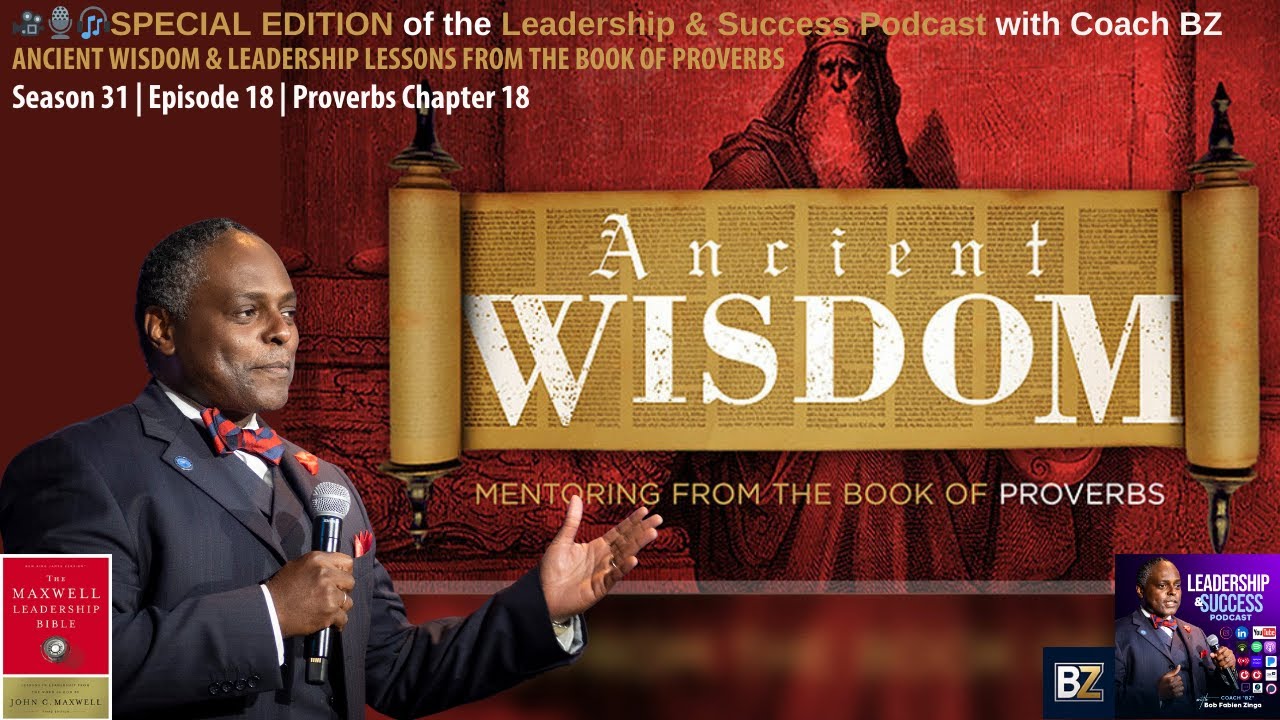
Coach BZ extracts nine leadership lessons from Proverbs 18, focusing on how leaders listen, speak, and relate. He covers isolation's impact on judgment, the danger of speaking without understanding, and how words shape culture, drawing on John C. Maxwell's Five Levels of Leadership and personal military stories about friendship.
Chapters
Hi, I'm John Maxwell. When the top companies in the world are looking for trainers, speakers, and coaches, there's one name that stands above the rest, and that's Maxwell Leadership. Our certified team members have gotten proven results for companies all over the globe, and our reputation, I'm proud to say, is second to none. Some of our members have risen to the top of their profession, including the the one you're going to meet today.
I proudly introduce you to my friend Bob Fabien Zinga.
Welcome to the Leadership Success Podcast with your host, Coach BZ, where we help you lead with purpose and succeed with impact. If you're ready to grow into the kind of leader others want to follow, this podcast is for you. If you're determined to elevate your success and leave a lasting legacy, this podcast is for you. As my mentor, Dr. John C. Maxwell, reminds us, everything rises and falls on leadership. Our goal is simple: to inspire you, challenge you, and equip you with insights that can transform the trajectory of your leadership journey. Welcome aboard to another episode of the Leadership and Success Podcast with Coach B.
Hey everyone, welcome to another very special edition of the Leadership and Success Podcast. This is our second podcast today and we are gonna go through Proverbs chapter 18. This is not a religious study, but it is going to be a study on ancient wisdom and leadership lesson from the book of Proverbs. Mentoring from the book of Proverbs. We're going to be reading chapter 18 today. So looking at this ancient scripture, more than 2,000 years old, and we're going to see how the ancient wisdom and leadership lesson from back then can still be applied today in the 21st century, in the year 2026. All right, before we get started, every time we meet, we go through our moment of gratitude. This is where I just take a moment to be grateful for something, one thing every single time that we meet. And Earlier today, I was just grateful for, I guess some people call it serendipity, grace, favor. It's really something undeserved. I didn't do anything to deserve it, but I've got it. It's just a blessing on my life, and no matter what I go through, I know I will get over to the other side. I know things are going to be just fine. And I am grateful for that, that presence in my life and everything I've gone through my entire life. So many times I almost died. I was in a pretty freakish accident when I was a teenager. And when they looked at the car, the car was completely totaled. And they wonder how come I was still alive. Things like that happening over and over and over again throughout my life, and I am still here. And I know that as long as I am alive, right, my tomorrow will be better than my yesterday. So, I am grateful for favor today. I think growing up, I believe I— most parents, they don't have a favorite child. They love all of their children just the same, but I know I was the favorite. Child of my mother. I knew that because even my brother and my sister, when they really wanted something from my mom, they would come to me because they're like, "Mom would never say no to you about anything." And but anyway, just growing up, just being favored for not because of my talent or my gift or anything I did, but just because. So I am grateful for that in my life right now. So would you please write in the chat, what are you grateful for today? What are you grateful for? And, uh, happy King's Day, by the way. Tomorrow is going to be Martin Luther King Day, uh, definitely, uh, a man who changed the course of history. I wouldn't be who I am today in America if it wasn't for people like Martin Luther King who came before me. So I am grateful for that too. But write down in the chat what you are grateful for, and also, um, where you are joining us from, what city, what state. Which country, if outside of the US. And also, if you have a question for me, type it in the comment. And I'm gonna share— I usually share 7 lessons. Today is going to be special, I'm going to share 9 lessons. So we're gonna get 2 bonus lessons today. So whatever I share out of Proverbs, I would like to get your feedback on that. And also, if there are any verses I didn't touch, I didn't highlight, that you got a lot of wisdom from, please share your insight as well. I'd like to learn from you. Alright, so for the Book of Proverbs, let's go back. We're going to review chapter 1 through chapter 17. That's what we did yesterday, chapter 17. We're going to review those and then we're going to start with chapter 18. So we're going to do the review by using Ron Carpenter AI. That's the AI twin of Pastor Ron Carpenter, and he is going to break it down for us. Here we go.
Hi, this is Pastor Ron Carpenter. How can I help? All right, listen closely. Proverbs chapter 1 is all about the beginning of wisdom, and that start is the fear of the Lord. It's about getting wisdom, getting instruction, and the spirit of wisdom and revelation so you can see life clearly and make choices that don't mess you up. The whole thing points to the fact that wisdom isn't just a heart posture, a way of living that sets you apart. That's the big idea right there. Chapter 2 picks up from that foundation in Chapter 1 and digs into why wisdom is like your best friend, your protector. It shows how wisdom saves you from the fools and the— You see, it's about hearing God's voice early, before trouble hits, so you can live long, peaceful days. The fear of the Lord keeps you safe and gives you— avoid all kinds of foolishness. That's the big deal there. All right, Chapter 3 is like wisdom's personal invitation. It tells us to trust the Lord with all our heart and not own ending. Come on, that's powerful. When you do that, he'll make your path straight, guiding you through life with success and peace. It's about leaning in, not just knowing God's favor daily. That's a dang good life lesson right there. All right, chapter 4 is like the pep talk from your wise, loving dad telling you to grab hold of wisdom and never forget about guarding your heart, because everything you do flows from it, and you got to stay clear of folly that leads to destruction. It's a strong call to keep God as your friend and companion and your priority, period. That's the heart of it. Alright, Chapter 5 is a warning about the dangers of temptation, especially the seductive traps that can wreck your life and your future. It's got rules about staying faithful and wise, not falling for foolish shortcuts or lies that seem sweet and bitter. The message is, keep your eyes locked on what's righteous and don't let yourself get fooled. That's the big point right there. All right, Proverbs chapter 6 is packed with tough love. It warns about foolish promises, laziness, and how God hates those who— among brothers. But the star of the show is that little ant, man. That ant shows us what diligence and foresight look like— working steady and preparing ahead. That's the kind of wisdom God wants us to get— practical, real, and hard-earned. All right, chapter 7 is like this desperate shout from wisdom, warning you about getting caught up in temptation, especially that sneaky kind that looks good but reksu— wisdom screaming for you to wake up, guard your heart, and choose the right way before it's too late. That's the big idea right there. Third is wisdom personified, like a woman calling out in the streets, inviting folks to live life the right way. It's about how wisdom was with God before creation, showing— wisdom is divine order and foundation for everything. The big idea: listen to wisdom's call, and you'll walk in safety and honor. Chapter 9's like a knockin' on the door, y'all. It's calling us to come on in, choose life, and leave the life of fools behind. Wisdom holds promises of blessing and safety if we listen. It's an invitation, plain and simple. Alright now, Chapter 10 is like a packed toolbox of wisdom. Short, punchy sayin's like, "Wise choices make life better, and foolish ones mess it up." It covers everything from how your words can heal or hurt, to hard work versus lazi— honesty and integrity. Bottom line, every choice matters, and your life reflects what you plant with your decisions. Chapter 11 is all about the contrast between righteousness and wickedness showing up in blessings and consequences. It's like a mirror. You can see how being honest and— while deceit and pride lead to trouble. That's the heart of it. All right, Chapter 12 gets into how your choices about speech, work, and integrity shape your life. It shows that a bring life, but fools just shoot off their mouths and cause trouble. It's a reminder that wisdom shows up in everyday actions and habits, not just fancy theories. All right, Chapter 13 is— Wisdom and discipline bring life and blessings, while foolishness brings destruction. It reminds us that what we say and do shapes our future, so choosing the right path matters big time. It's like planting a garden—you reap what you sow, no doubt. All right, after chapter 14 in Proverbs, you keep seeing that pattern. Life and blessings, but foolishness brings trouble. The chapters that follow keep hammering home practical guidance on how your choices, your words, and your heart posture set you up for pain. It's like every chapter layers on that reality until it sticks. That's the big picture as you move past 14. Okay, Proverbs 15 is all about how your words show your heart and how the wise handle correction with calm and peace while fools stir up trouble. It's reminds us that a gentle answer can defuse conflict and that fear of the Lord leads to life. That's the heart of chapter 15. Chapter 16 is all about trusting God. Let me tell you, that's some of the hardest stuff to do. It reminds us that our steps are ordered by the Lord, but we still make choices, and those choices help. So the takeaway: lean on God, but remember, your decisions count too. Points out how peace is better than arguing and how wisdom helps you navigate those rough spots instead of making them worse. That's the big picture for chapter 17.
All right, so that's a pretty good review from chapter 1 through chapter 17, and I want to give a big shout out. I believe it's Mary. Here she is. She's grateful for waking up in the morning and getting the opportunity to keep pushing with her business. Well, welcome to the Leadership and Success Podcast, Mary. Thank you for being here. And I think it's really important to be grateful every day and just waking up is really a miracle because it's true. Somebody last night went to bed, but they did not wake up today. So it really is a blessing just to be alive. That means that there is hope for your business, Mary. There is hope for your career. There is hope for your family and there is hope for your tomorrow. So hopefully whatever I can share today on this channel is going to help you lead better and achieve a higher level of success. So if you have a question for me, type it in the comment. Let me know where you are joining us from, what city, what state, and which country if outside of the US. And also if you have any insight on any of the verses from Proverbs chapter 18. So before we do that, let me review what we did Yesterday, and again, you can go back to whatever your favorite podcast platform is, whether it's Apple Podcasts or Spotify, iHeart, or whatever it is, you should see Proverbs 1 through 17. So 17 episodes so far on this ancient wisdom and leadership lesson from the Book of Proverbs. And today is gonna be chapter 18. So from yesterday's podcast, Proverbs 17, lesson number 1 was peace is a strategic advantage. That was based on verse 1. So noise, drama, and constant conflict drain organizational energy. Wise leaders value peace over prestige and stability over spectacle. So that was our first lesson. Lesson number 2, yesterday we talked about character can elevate you beyond your title, based on verse 2. So competence, wisdom, integrity, they often outperform entitlement. Leadership influence is earned through trust, not inherited through position. And remember we said that positional leadership is the lowest leadership possible. And I love the book, I have it over there, The Five Levels of Leadership by Dr. John C. Maxwell. And level 1 is positional leadership. That's the lowest level possible. People will do what you say just because of your title, but not because you inspire them or they actually want to accomplish the mission of your organization. All right, leadership lesson number 3, We talked about yesterday, words reveal the heart of the leader, based on verse 3. So pressure will expose inner character. How leaders speak and act under stress will reveal their true maturity. Leadership lesson number 4: discernment protects credibility, based on verse 4. Leaders who entertain gossip, falsehood, and half-truth eventually compromise trust. Alright, lesson number 5: Correction done well preserves relationship, based on verse 9. Healthy leaders know when to correct and when to extend grace. Not every mistake requires public exposure. And lesson number 6, we talked about restraint is a mark of wisdom, based on verses 27 and 28. Silence, timing, and measured speech often carry more authority than constant commentaries. And finally, we had lesson number 7, Loyalty is a Leadership Multiplier, based on verse 17. True leadership relationships are revealed in adversity, not success. Alright, so that was yesterday. So today we're going to start with Proverbs chapter 18. So I'm going to have my 7 lessons like I normally do, but then I will have 2 bonus lessons for today also. Alright, let's get through it. First, the big idea for Proverbs 18. This chapter teaches that leadership influence is built or destroyed by the way we listen, we speak, and relate to others. This chapter warns leaders against isolation, careless words, prideful certainty, and emotional reactivity, while elevating humility, discernment, and relational wisdom. As the foundation of lasting authority. In short, how a leader communicates reveals how a leader governs themselves. As a matter of fact, I have another book there, The 16 Laws of Communication. That is something I'm going to be studying with my master group soon. I think we need to be so much better at how we communicate as leaders because it's not just what you what you say, but it is how you say what you say. Actually, just give me a second, let me get those books. All right, here are the two books I mentioned. The first one, uh, The Five Levels of Leadership. This is a great book by my mentor, Dr. John C. Maxwell. And he goes through all 5 levels. And like I mentioned earlier, the level number 1 is positional leadership. So level 1 is position, level 2 permission, level 3 production, level 4 people development, and then level 5 is the pinnacle. The highest leadership accomplishment is developing other leaders to level 4. Great, great book. I highly recommend you get this. And The one I'm gonna be studying with my mastermind next is the 16 Undeniable Laws of Communication. Apply them and make the most of your message. I think every leader, no matter which level you are at, we always need to be better at communication because communication is key for leadership. There needs to be clarity, right? No confusion, have a clear message and being able to speak to each one of the members of your team so that they may really act at the highest level possible. They can be all, they can be maximizing their strengths and minimizing their weaknesses so that as a team, we can produce a lot more than we can in synergy, than individually put together. So that's really what leadership is about. Again, how a leader communicates will reveal how a leader governs themselves. Again, I highly recommend this book, "16 Undeniable Laws of Communication" by John Maxwell. Okay, so the theme here for chapter 18, "The Power of Words: Wisdom and Relational Discernment." All right, leadership lesson number 1, isolation weakens judgment. That's based on verse 1. Isolation will weaken your judgment.
A man who isolates himself seeks his own desire. He rages against all wise judgment.
A man who isolate himself rages against all wise judgment. So isolation weakens judgment. Leaders who isolate themselves stop receiving truth. Independence without accountability breeds blind spots. That's again why it's so important to have a diverse team because everybody has a blind spot. If you have a diverse team, then you will have people from different background, different way of thinking, who are going to be able to spot your blind spot and help you make better decision. I know it's often said that it's lonely to be at the top, but I think it doesn't have to be, okay? You do not have to be lonely at the top. You can bring people with you as you climb the ladder of success, as you climb the chain of command, you can bring people with you. You don't have to be lonely. And you definitely need to have mentors, right? Very, very important. Okay? Reach out to people, don't lead alone. You do not have to. You make better decisions when you have a team of people in your inner circle who can speak to you. All right. So leadership application, how do we apply this? So create intentional feedback loops, mentors, peers, and dissenting voices too. You shouldn't just have people who agree with you. People who think differently, people who may be opposed to what you are saying, you actually need them because they're gonna sharpen your saw and challenge you and help you make better decisions. So dissenting voices are very important as well before you make critical decision. So where might you be confusing independence with wisdom and who has permission to challenge your thinking? Again, very, very important that you have people in your inner circle who can challenge what you are saying, okay? Because you are not always right, and it's possible you have a blind spot and you didn't think of something. And the people who are there with you, they can actually help you again make better decision and challenge your assumption. All right, so, um, The anchor reflection here is isolation may feel like strength, but wisdom grows in community. All right, next lesson. Leadership lesson number 2: Speaking without understanding is leadership failure. That's going to be based on Proverbs chapter 2. Let's listen to that. Proverbs chapter 18, verse 2.
A fool has no delight in understanding, but in expressing his own heart. So speaking without understanding is leadership failure.
Leaders who speak more than they listen signal insecurity, not confidence. This again takes me back to what my mother taught me when I was just a child. She said, God gave you two ears and one mouth. And she advised that I use those in that proportion. So listen twice as much as you speak. You shouldn't be enjoying hearing yourself speak all the time. All right, listen and then speak. All right, how do you apply this? So practice disciplined listening, active listening. And today we talked, my interview this afternoon with Major Chris Slininger, he said that one book that changed his life was The 7 Habits of Highly Effective People. People. And in that book, Stephen Covey talks about active listening. Listen not to respond, but listen to understand. That is so powerful. So do you listen to learn or to respond? How often do you speak before fully understanding the issue. So the anchor reflection here is listening is not passive, it is a leadership skill. So you have to practice your leadership, your listening skills. And again, this book, I highly recommend, The 16 Undeniable Laws of Communication, because it is going to help you be a better communicator, a better listener, and a better speaker. All right, leadership lesson number 3. Words create culture. That's verse 4. Words create culture.
The words of a man's mouth are deep waters. The wellspring of wisdom is a flowing brook.
The words of a man's mouth are deep water. Words create cultures. A leader's words shape morale, culture, and psychological safety, whether intentionally or not. So how do we apply this? Be deliberate with your tone. So not just what you say, but how you say it, how you sound, your timing, and your intent, especially under pressure, because that's where your character will be revealed. So what emotional wake do your words leave behind? And do your words bring clarity or confusion? Again, I had the great pleasure and honor of speaking with the writing companion of Dr. Maxwell who helped him write the great majority of his book. And one thing he said is as an author, One of his greatest priorities is to bring clarity. He wants the people who are reading his books to understand what he is talking about in as few words as possible, bring clarity. So make very complex subject very simple. It doesn't mean it's gonna be easy to apply, but it is simple to understand, bring clarity, be clear in your communication. Don't be confusing. Alright, so the anchor reflection here is leadership language sets the emotional climate of the team. Alright, leadership lesson number 4: partiality corrupts justice. That's based on verse 5.
It is not good to show partiality to the wicked or to overthrow the righteous in judgment.
"It is not good to show partiality." Hmm. Favoritism and bias, real or perceived. That's the other thing when you are a leader, things don't have to be real, they don't have to be factual. Just because somebody perceives something, it's just as good as if it was actually happening. And sometimes you may not really have control over that, But we have to be careful as a leader. So favoritism and bias erode trust faster than poor performance. So how do we apply this? Anchor decision in values, standards, and fairness, not proximity or convenience. So where might bias be influencing your decision right now? And do your actions match your stated value? All right, the anchor reflection for this lesson is: trust grows where justice is consistent. Consistency. Throughout my life, I've had some bosses and some commanding officers who were pretty tough. They had very, very high standards. But the great thing about them, what really made them great, was they were fair and they were consistent. So here are the standards. If you meet and exceed them, you're going to get rewarded. And if you don't, you are going to, you know, live the consequences of that regardless of who you are. Especially, I remember one unit I went to, it was an intel unit. I am an information professional officer, so we are all under the same community, but pretty much everybody in the unit was an intel officer but me. But our skipper, she set the rules and the standard, and I met and exceeded the standard. And when it came time to promote one of us department head to the number 2 position of being the executive officer for the entire unit. She chose me over all of the intel officers in the unit because she said, okay, you met and exceeded my expectation. And it doesn't matter if you are not an intel officer, you are one of my department heads and you've met that, and I'm going to be consistent and I'm going to give you the coveted job. And people like that, you would follow them no matter where they lead because they are consistent and they are fair. And that's what leadership requires of us— consistency. So trust will grow when justice is consistent. Alright, no favouritism. So leadership lesson number 5: Words can heal or they can destroy. Let's read verses 6 and 8.
The fool's lips enter into contention and his mouth calls for blows. A fool's mouth His destruction, and his lips are the snare of his soul. The words of the talebearer are like tasty trifles, and they go down into the inmost body.
Wow, that's what your tongue can do. Your words, they can heal or they can destroy. So unchecked speech escalates conflict. Wise leaders de-escalate through restraint. So you do not have to be right. You do not have to have the last word. You need to learn how to use your word to de-escalate a situation, whether you are right or not. I think peace is probably more important than being right. So pause before responding, create a space where you can formulate an answer, use your logic. Not just emotionally react to what's happening to you, but respond to it. Very important, especially in emotionally charged situation. Don't say something that you are going to regret later. Think and then speak. Listen and then speak. All right, so do you react or do you respond? And what would restraint look like in this moment. So self-control multiplies leadership credibility. Lesson 6: Pride creates false security. Verses 10, 11, and 12.
The name of the Lord is a strong tower; the righteous run to it and are safe. The rich man's wealth is his strong city, and like a high wall in his own esteem. Before destruction the heart of a man is haughty, and before honor is humility. Before honor is humility.
If you want to be honored, you have to be humble. Sounds like a paradox, doesn't it? Pride creates false security, but humility will elevate you. So pride convinces leaders they are untouchable until they are not. It reminds me of the Bathsheba syndrome. King David thought he could do nothing wrong. He became complacent, right? And there is another book I have, "From Drift to Drive" by my mentor, Chris Robinson, another book I highly recommend because when you start enjoying success, after a while, you tend to become complacent. You no longer do what it took for you to get where you are. And sometimes you feel like, well, I am untouchable. I am so good. I am so successful. Nobody can touch me. And that's when you start to fall. So you have to lead with humility. You don't know everything, and you can always learn from people around you, including the most junior people on your team. Always have that open mind. There is something else I need to learn. There is always something that I do not know that I can learn from anybody on my team. All right, how do we apply this? So you have to cultivate humility through gratitude, service, and teachability. You have to be teachable. You have to be coachable, no matter how high you are within the organization. Even if you are the founder and you are the CEO of your company, you still have to be humble and full of gratitude and service to your customers, but also your team member and be teachable. All right. Where might pride be disguising itself as confidence? And how do you remain grounded as responsibility grows? So humility is not weakness, it is stability. That's one reason why I really love my spouse so much because even sometimes when I tend to get the big head and I'm a little bit arrogant, my wife can just sit me down and say, "Hey, you've got to be humble. Remember who you are, remember where you come from." And so it's iron sharpening iron and you need somebody in your life who can speak truth to you and keep you grounded. Because no matter how much you achieve, how much success you get, you are still a human being and you are still fallible. Never get to a point where you think, oh, this will never happen to me. I am better than that. Because the truth is you are not, right? It only takes one mistake, right? It only takes one event that could completely change your life. The trust that you have earned, it took you so long to earn and to build within your enterprise and your team. You could lose it just like that. And once you do, it's almost impossible to get it back. So have again in your inner circle, have a team of people who can speak truth to you no matter what, they can speak to you frankly. All right. And I see another comment, Ward, thank you so much for confirming that. And again, if you guys have insight on verses I didn't touch, please let me know. And if you have any feedback on what I'm talking about, please let me know as well. Okay, the 7th lesson I had prepared today, This would have been the last one, but I have 2 bonus lessons like I announced earlier. Lesson number 7, this is about listening, right? Listening first is a strategic wisdom. Listen, listen, listen. Listening first is strategic wisdom. Again, I highly recommend this book, The 16 Undeniable Laws of Communication. We all need to be better communicators, no matter how good you think you are. So let's read verses 13, 15, and 17. All right, let's listen to that. Verse 13 first.
He who answers a matter before he hears it, it is folly and shame to him. The heart of the prudent acquires knowledge, and the ear of the wise seeks knowledge. A man's gift, the first one to plead his cause seems right until his neighbor comes and examines him.
So it's always good to have people who can examine what you are thinking. Have somebody who can kind of be a soundboard. All right, okay, this is what I'm thinking. And then, hey, what did I miss? Am I missing something? Do I have a blind spot? That's going to help you make better, much, much, much better decision. Because the first story is really the full story. Wise leaders gather perspective before judgment. Now I understand sometimes you do have to make a decision and you do not have all of the information yet, right? My mentor right there, Colin Powell, his 13 rules, one of them says, right? P-45-70. So you need to be able to make a decision when you have at least 45% of the information you need to make the decision. Up to 70, but don't wait after you get 70 because if you wait too long, the time for you to make the decision will run out. So you're going to need to make a decision with imprecise information. And then once you make the decision, use your gut feelings, decide you are the boss. And then based on the feedback you receive, based on how things go, your assessment, you can make better decision as you get more and more information. But what we are saying here is do not hurry to judgment, okay? Listening first is truly strategic wisdom. So whose voice have you not heard yet? Who among your team is not speaking? Maybe they are afraid. That's why you need to create that psychological safety so people are confident, they feel safe to tell you what they really, really think. And they don't feel like if they tell you the truth, they are going to be punished just because the boss doesn't want to hear it. So always be open for feedback, always. So seek out the voices from people on your team who usually do not speak because they may just have the wisdom that you need to solve whatever problem you are facing as a team. And are you rushing clarity for comfort? All right, the anchor reflection here is on wisdom waits and leadership listens. So this is really all I had planned initially, just these 7 lessons, but I think I have to share two more because I think chapter 18 offers two powerful bonus lessons that elevate leadership beyond position and performance, I believe, into legacy and sacrifice. So first, "Death and life are in the power of the tongue." That's verse 21. So I'm gonna add a lesson on that. And then we also see the evolution of leadership styles from commander to executive to coach, and ultimately to the poet God. Gardner. I'm gonna get back to it in just a moment. And each one of those kind of define by how leaders use words to control, align, and develop or give life. So mature leadership recognize that words are not tools of authority, but they are instruments of culture, shaping trust, courage, and belonging. And then the second bonus lesson we are going to get to in just a moment, is based on verse 24: "There is a friend that sticketh closer than a brother." That really reminds us that the highest form of leadership is relational and sacrificial leadership. True leaders earn loyalty through presence, humility, and shared risk, creating bonds so strong that people willingly stand in harm's way for one another. That's exactly what happened in the military. When you go for boot camp, it's really incredible. People you didn't even know, they become your friend and then they become even closer to you than your biological brothers or sisters. They are willing to take a bullet for you. I don't know of anybody at a Fortune 500 company who's willing to do that, whether it's Microsoft, IBM, Google, whatever, you name it. But in the US Navy, in the US Army, in any other branches of the military, The sailor to your right and to your left is willing to do that for you. Wow, that is powerful. So together, I think this lesson reveals that great leadership is measured not by how loudly one speaks or how high one rises, but by how deeply one gives life and how faithfully one is willing to give of oneself for others. All right, so first bonus lesson, I guess it's gonna be lesson number 8. Let's talk about the 4 styles of leadership. Again, in our curriculum, we have this, the Maxwell Leadership Bible. If you read it and you go to Proverbs chapter 18, John Maxwell will break it down for you. The other book we have in our curriculum this season is the 21 Irrefutable Laws of Leadership. So from the Maxwell Leadership Bible, Proverbs 18, it focuses on verse 21. Let me go there. "Death and life are in the power of the tongue, and those who love it will eat its fruit." So out of your tongue can come death, out of your tongue can come life. So it's really how you lead. So this verse I think is not merely about communication, but it is about leadership influence, right? Again, the 21 Irrefutable Laws of Leadership, one of the first leadership laws in this book, the Law of Influence, number 2, the true measure of leadership is influence, nothing more, nothing less. It says that Abraham Lincoln started with the rank of captain But at the time the war was over, he was a private. What happened? He was a casualty of the law of influence. Okay? The law of influence. Leadership is influence, nothing more, nothing less. So words are never neutral. For leaders, words either create life, create clarity, create courage, create alignment, or they produce the opposite, fear. Disengagement, confusion, and decline. So as a leader, you wanna make sure that your words are positive, that they are adding life to your people. All right. Dr. John C. Maxwell, I call him Papa John, he teaches that as culture has evolved, so has leadership. So largely driven by how leaders use words and authority. So again, Proverbs 18:21, which we just read, becomes a measuring rod by which these four leadership styles can be evaluated. So he talks about four styles of leadership through the lens of, uh, Proverbs 18:21, basically using your words. So the first one is via military commander. Now I kind of love that. I am an information warfare commander in the US Navy. So this is really the way I think most commanding officers, 21 years ago when I joined the Navy, that's the way it seems. It was a military commander type of leadership, right? The style is authority-driven, command and control. No primary tool is orders. And my wife tells me I am very good at that. So the expectation is unquestioning obedience. You do what I say because I said so. I say jump, you say how high, no question, just do it, obey. I am the boss and you are not. That's the type of leadership we kind of used to see, like, I guess, in the decade following the 1950s or so. Leadership mirror of a military model, right? So leaders issued command and followers complied, right? Often without dialogue or dissent. And the words were used to direct behavior, not to develop people. So that's the military commander. That's the first style. It does have some strength for speed in crisis. Definitely if you are in a combat zone, time of war, sometimes you do have to do that. You don't— people don't have to question you and think, they just have to obey your orders because you could save a life, right? Clear hierarchy, right? I am the boss and you are not who is in charge, and discipline and execution. So those are some strengths. However, there are some limitations to that though, because words often carried power without empathy. Over time, this produced compliance, but not commitment. I'm going to do what you say because you're my boss, because I need that paycheck, but my heart is not really into it. Therefore, as an employee, I'm already looking for my next job. So life was sustained through structure, but creativity and ownership suffered under this leadership. Command is effective in emergencies, but dangerous as a permanent culture. So the next leadership style that Dr. Maxwell talks about in the Maxwell Leadership Bible is the Chief Executive Officer. So the CEO, the style is vision-driven, top-down, primary tool is strategy and alignment. And the expectation here is buy-in to the leader's vision. So everybody has to buy in. So leadership then evolved toward vision casting. CEOs inspired people with direction and purpose using words to align teams toward organizational goals. Many strengths here, strategic clarity, organizational focus, and resultful alignment. And today, even in Silicon Valley, a lot of startups kind of use this. I am the CEO and this is the vision, everybody works to make it happen. But there are some limitations to that too. Based on Proverbs 18:21. While words inspired, they were still largely one-directional, from the top down, from the boss to the crew. The vision belonged to the leader, not the collective. When leaders stopped listening, words slowly lost life-giving power. Because as a leader, you also have to listen to your crew. That's how you make better decisions. Because just because you have a leader doesn't mean that you know everything there is to know. One of the keys for one of the projects you are trying to work on might be in one of your team members, even one who is junior, and you need to have an open mind so you can listen to them so that the wisdom they have could be applied to whatever project you're working on so you can have a lot more success. So the insight here is the vision will inspire you, yes, but without shared ownership, it plateaus. All right, the next leadership style is the coach. I think I am mostly here now. It's development-focused. Primary tool is feedback and encouragement, and the expectation is growth and performance, right? The coach, man, will recognize people as players, not just position, kind of like being a football coach or basketball coach or something. So leaders use words to teach, to correct, to motivate, and improve performance. So some of the strengths of the coach leadership style is higher engagement, skill development, and stronger team dynamic. So again, we have some limitation here too, because even coaching can become limiting if all outcomes still depend on the leader's perspective. Growth happens, but only within the boundaries of the coach's vision. Again, when we go back to the, uh, 21 Irrefutable Laws of Leadership, law number 1, right, is the law of the lead. Leadership ability determines a person level of effectiveness. So when you are the coach and everything comes out of you and everybody does what you say, I mean, that is good, but let's say you are a level 5, that means that people on your team will never be able to go above level 4. You are 5, everybody's going to be a level 4 before you. That's the most they can do. So you're going to have to keep growing so that the people under you can continue to grow, right? So Maybe there is a better way. So really the insight here is coaching will multiply result, but still centers authority on the leader, the coach. All right. So the next leadership style, which is probably the one I highly recommend now, is the poet and the gardener. That's modern leadership, right? So it's life-giving and culture-shaping. The primary tools are meaningful words and intentional care. The expectation is shared ownership and human flourishing. So it's not just the leader who owns the vision, but it's the entire enterprise, the entire team. So today's most effective leaders recognize the creative and relational power of words. Like poets, they give language to what the team feels but cannot always articulate. Like gardeners, they cultivate the environment where people grow naturally. So you help your people grow, you remove obstacles. You give them the tools they need to be successful. And you also feel that empathy, right? You feel what they feel, you care about them, and you go above and beyond to care for them. Like my primary mentor told me, take care of your people and your people will take care of the mission, right? Mission first, people always. So this is really a leader who cares. You are a poet, you add language. This is the vision, this is where We are going, you get the buy-in from your people and then together you own that mission. And then you remove any obstacle and you provide the tools, the training, whatever it is that your people need in order to be successful. All right, so the strength of this model is words, they do create life, safety and trust. You build that trust, encouragement fuels resilience and culture becomes self-sustaining. What psychological safety. So these leaders understand that their words don't just direct work, but they shape identity as well, confidence and belief. So the insight here is the highest form of leadership uses words to release potential, not control behavior. So important. All right, so that's the bonus lesson number 8. Now I have one more bonus lesson for today, chapter 18, that's gonna be based on verse 24. We're going to talk about the ultimate sacrifice. Proverbs 18:24. Let's listen to that.
A man who has friends must himself be friendly, but there is a friend who sticks closer than a brother.
"There is a friend who sticks closer than a brother. No greater love is there than to give your life for your friend." Wow! I really grew up in a very nice family. I had a baby brother and a baby sister growing up. I love my brothers and they love me, but I'm not so sure my siblings would give their life for me. I'm not so sure about that. Maybe the exception would be my mother because I think nobody has ever loved me more than my mom did. She went above and beyond to do whatever she could to save me, to ensure that I was well taken care of. And love like that, it is really divine in many ways. You don't know how to pay that back. But having said that, when I joined the military is really when I realized what this year meant. A friend that sticks closer than a brother. I still have friends today from the time I was at boot camp. RTC Great Lakes in Chicago. Back in 2005, and those people are still my friends today. And these are people who are willing to give their life for me. Like I said earlier, you know, you're not going to see that at Google or Facebook or Microsoft or whatever Fortune 100 companies out there. Nobody's going to sacrifice their own life for you, but in the military, people do that every day. That's why you would see a sailor or a soldier who would actually jump on a grenade to save the life of his team, because those are your brother and your sister in arms. There is that bond that is formed. It's really, really powerful. It really keeps me humble, because I have stood shoulder to shoulder with brothers and sisters in arms Who began as complete strangers. I didn't know them from Adam, but they became my friend, and then they stuck closer than a brother or a sister. These bonds were not formed by blood or convenience or shared background, but by shared risk, mutual trust, and unwavering commitment to one another. So there is a truth few outside the military service really grasp, I think. No one in my biological family would be expected to give their life for me. Like I said, I don't think my brother, my sister would be expected or even willing to do that. But I know sailors today who will gladly do that for me and I for them. So my sailors, the one to my right and the one to my left, they would if called upon. There is no greater love than that. And I would do the same for them. So that kind of loyalty does not happen by accident. Proverbs 18:24 reminds us that friendship begins with posture. A leader must show himself friendly. In uniform, that means being present, being fair, being consistent, and being willing to carry the weight of command with your people, not above them. You are one of them. You are lucky you were selected to lead them, but you care about them. You show empathy. You take care of them and they take care of the mission. And I'm telling you, they will follow you no matter where you lead when they know that, when they have that psychological safety, when they have that trust. So I think the result is quite extraordinary. I still have friends today. Like I say, I met from when I first went to boot camp or code training command, Great Lakes. That was back in May 2005, after 9/11. More than two decades ago, those relationships endure, not because of rank or nostalgia, but because they were forged under pressure and sealed by trust. These are my friends for life. All right, so that's really what I wanted to share today. So leadership creates proximity, but character will create loyalty. You cannot demand the kind of friendship Proverbs 18:24 describes, a friend who stick closer than a brother. You earn it through humility, consistency, shared sacrifice, and genuine care. When they know that you truly care for them, they will do anything for you. That's where, again, my mentor General Powell says, right? Management could potentially get your team to work up to 100%. That's mathematical, mathematically possible, right? You cannot technically go above 100%. 100% is all you can do. Right? That's what management will do, get the people to work up to 100% of their productivity. But leadership is something else. It's gonna take your people up to 110%, 120%. They will go above and beyond what is humanly possible. Why? Because of trust, because of a shared goal, because you are humble, you are consistent, and that shared sacrifice and genuine care, people will follow you no matter where you lead. And again, I see that every single day. In the US Navy. I know it's true in the Army, the Marines, and the other branches of the military too, but I've never seen that in Silicon Valley or in the industry. A friend who sticks closer than a brother. First they are stranger, then they become friend, and then they stick closer than your own biological brothers and sister. Wow. Man. And thank you so much. One of the members in the audience says, friendship are pretty fake these days in my experience. I think that is true for the most part, but it's very surface level. Although I know that there are great people out there and I've got one such in my life that I'm grateful for. If you have at least one of those friends, I'm telling you, you are very, very lucky. You have to be grateful for that. I think you need to call them after this podcast and just say, I love you and thank you for being a part of my life. Because you don't find them every day, right? I can count with my hand, maybe 5, 10 at the most throughout my entire life, people I can definitely rely on. I know when I call, they will answer. And no matter what I do, they will love me no matter what, and they will keep me accountable. If you have people like that, you are blessed. And I think it's much easier to have those friends in the military than it is in the industry, but if you have one of those, consider yourself lucky. All right, so the anchor reflection here is, ask yourself, do my people experience me as approachable or merely authoritative? Have I shown myself friendly or only powerful? And would those I lead stand with me when it truly costs them something, when they don't have to do it because of a paycheck? When they have to go above and beyond to do what is right? Will they stand for you? Wow. Because the highest compliment of leadership, I believe, is not admiration, but it is loyalty. That remains when nothing is required except love and commitment. When people are willing to go above and beyond for you, I think you've made it as a leader. And money cannot purchase that. Because sometimes you may have Mercenaries, right? Those people, they work for money. You pay them, they're gonna get the job done. But as soon as you stop paying them, they are out of here. But that's not the way our military work. We are not mercenaries in the U.S. Navy. We do it for love of God and country. We go above and beyond. We are willing to sacrifice our own life because we want to support and defend the Constitution of the United States. We do it for the love of our country, our spouse, our children, and our future. Because of our shared values, that's why we do what we Not because we want to pillage a country and get their resources, their oil or minerals or whatever. That's not what motivates people in the US Navy. Our common, our shared values, democracy, freedom, that is what we stand for. Inclusion, honor, courage, commitment, that is what we stand for. That is who we are at the core. Alright, so Proverbs 18:24 really reminds us that the strongest bonds in leadership are not inherited. It's not your biological sibling, but they are forged. Really, your family is whoever loves you. It's really the families that you create, people who care about you. And again, if you have at least one person that you know who is willing to sacrifice their life for you, you are a lucky man, you are a lucky woman. And keep that friendship. All right, so let's get to the end of this podcast. This one was a little bit longer than usual. Again, I had 9 lessons instead of just 10, but as a close, so Proverbs chapter 18 reminds leaders that authority is sustained not by volume or speed or isolation— it's not how loud you speak— but by humility, discernment, and disciplined communication. Leaders rise or fall by the words they choose, the voices they welcome, and the restraint they exercise. So strong leadership begins with a governed tongue and a teachable heart. Alright, that's all I have for you today. I'm gonna be back here tomorrow on King's Day. Happy King's Day, everyone. And one of my best quotes from Reverend Dr. Martin Luther King is, you know, injustice anywhere, he said. This is so, so, so powerful. Wow. This really affected my life a lot. Injustice anywhere is a threat to justice everywhere. Would you stand for justice? Would you stand for what is right? And if not you, who? And if not now, when? So see you tomorrow. I'm gonna be back and we are going to do another special episode of Ancient Wisdom Mentoring from the Book of Proverbs tomorrow, January 19th. So we're going to study Proverbs chapter 19. Again, not a religious podcast. We're going to be studying the ancient wisdom and leadership lesson from Proverbs chapter 19. I hope you can join me. And then on Tuesday, I'm going to have a podcast interview, and I'm gonna let you know later today who I am going to interview, and I hope you guys can join us here. All right, thank you so much for watching this extended episode of Leadership and Success Podcast, and I'll see you tomorrow. Happy King's Day. Bye.
Thank you for tuning in to the Leadership and Success Podcast with your host Coach BZ. If today's episode added value to your leadership journey, be sure to subscribe, share, and join us again for more wisdom nuggets on how to lead better and achieve greater success. Remember, leadership is the most critical skill of our time. The world will always need leaders to inspire others, drive innovation, and execute meaningful strategy. So why not count yourself among the bold leaders shaping the 21st century. Until next time, stay inspired, stay committed, and keep leading with excellence.
More from Bob

S250:E4🎙️LIVE 🇺🇸America 250: President Barack Obama Leadership, Service, and the Power of Hope






S5:E157🎙️ LIVE with CMD CMSgt Dennis L. Fritz, USAF (Ret.)(Multi Tracks Audio)



S5:E156🎙️ LIVE 🇪🇸 Leadership Lessons from the FIFA World Cup 2026 Champions (Multi Tracks Audio)

S250:E3🎙️ LIVE Leadership Lessons from America’s First Documented Family of African Descent 🇺🇸📖