S31:E18AI RECAP🎙 LIVE AWLL from Proverbs — Chapter 18 (Multi Tracks Audio)
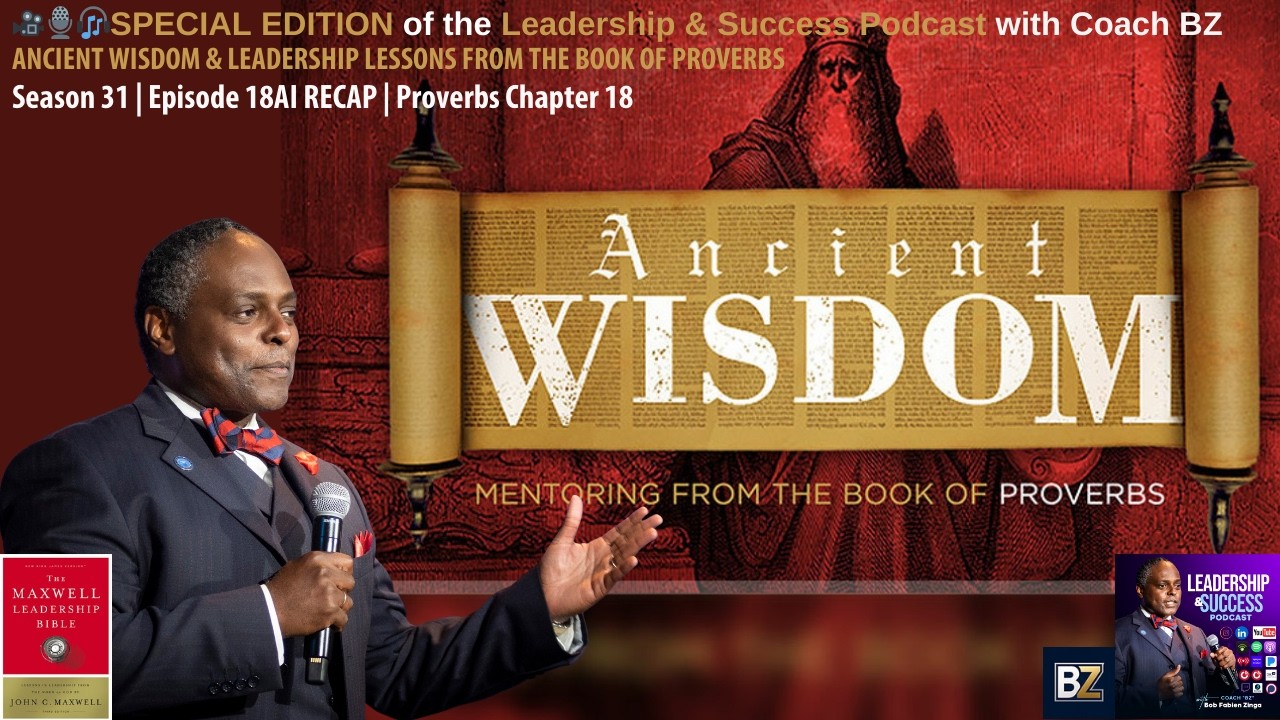
Coach BZ explores Proverbs 18 as leadership wisdom, covering listening, humility, and fair communication. The episode highlights three historic March 9 milestones in Black history, from the 1892 Memphis lynching to the 1978 Navy Affirmative Action Plan, and traces how leaders evolve from commanders into culture-builders.
Chapters
Hi, I'm John Maxwell. When the top companies in the world are looking for trainers, speakers, and coaches, there's one name that stands above the rest, and that's Maxwell Leadership. Our certified team members have gotten proven results for companies all over the globe, and our reputation, I'm proud to say, is second to none. Some of our members have risen to the top of their profession, including the one you're going to meet today. I proudly introduce you to my friend, Bob Fabien Zinga.
Welcome to the Leadership Success Podcast with your host, Coach BZ, where we help you lead with purpose and succeed with impact. If you're ready to grow into the kind of leader others want to follow, this podcast is for you. If you're determined to elevate your success and leave a lasting legacy, this podcast is for you. As my mentor, Dr. John C. Maxwell, reminds us, everything rises and falls on leadership. Our goal is simple: to inspire you, challenge you, and equip you with insights that can transform the trajectory of your leadership journey. Welcome aboard to another episode of the Leadership and Success Podcast with Coach BZ.
Hello everyone and welcome to another special edition of the Leadership and Success Podcast. Today we are going to be talking about Proverbs chapter 18. This is going to be the artificial intelligence recap version. So I'm going to use AI to play a couple of videos that are going to summarize what we talked about on January 18th, because we started the entire book of Proverbs, one chapter a day in January. So before we do, let's do our moment of gratitude, as is our custom on this podcast. And also, before I do that, I want to remind everyone, please let us know where you are joining us from in the comment, what city and what state, and if you are outside of the US, which country. And also, what is one thing that you are grateful for today? And after you hear the AI recap, let us know 3 to 5 takeaways from today's episode. If you type it in the comment and also one leadership principle you are going to be putting in practice this week. Alright, so for our moment of gratitude, maybe you should go ahead and close your eyes and put yourself in your happy place, maybe take a deep breath, slow down your Nervous system. And right there, what are you grateful for right now? There is so much chaos, so much happening around the world. War in Iran and Gaza is a mess. It's, it is a lot of things happening, kind of scary. 2026, artificial intelligence that seems like taking away jobs and the economy isn't very good. The price of oil is going up. So there is a lot of very concerning things in the world right now, but I am grateful that I do have my health. I am grateful that I am healthy today. I was able to get up this morning. Some people went to bed last night and they didn't get up. So as long as I'm alive, I know there is hope. So I want to focus on that. All right, let me know what you guys are grateful for. All right, so what I'm going to do before I play the AI recap for Proverbs chapter 18, I am going to first, as we are doing on the show every day of this month, we are celebrating Black History Year. Like I said before, Black History Month is just too short, 28 days, the shortest month in February. So we are going to celebrate Black history every single day of 2026. So today being March 9th, on March 9th, 1892, a white mob in Memphis, Tennessee stormed the local jail and lynched 3 Black businessmen, Thomas Moss, Calvin McDowell, and William Henry Stewart, without trial, without due process. And this happened in Memphis. I think I have a picture of what that looked like. Uh, it's just, uh, terrible, uh, what happened. And there was absolutely no consequences. Calvin McDowell, Henry Stewart, and Thomas Moss all were killed with that process, March 9, 1892. You can go to my YouTube— my LinkedIn post and read more about that now. Another thing happened on March 9th, this time 1978, that has to do with the US Navy. The US Navy issued a new Navy Affirmative Action Plan, NAAP. So March 9th, 1978, the United States Navy issued a new Navy Affirmative Action Plan designed to strengthen equal opportunity and address systemic barriers that had historically limited advancement opportunity for minorities and women within the Naval service. So basically anybody who was not white plus women. So the plan built upon the earlier reform championed by Admiral Elmo Zumwalt Jr., whose famous Z-grams in the early '70s sought to modernize the Navy and improve the quality of life and professional opportunity for all sailors, including Black sailors. So in '78, the NAACP institutionalized many of these reforms moving them from temporary initiative into formal Navy policy. So some of the objectives were expanding opportunity, education and training access, and strengthening the officer pipeline because the Navy expanded officer commissioning pathways by establishing the Naval Reserve Officer Training Corps program at 5 historically Black colleges and universities and increasing minority enrollment at the United States Naval Academy. So officially, the first Naval Commission Officer, that didn't happen until 1943. My father was born in 1943, so it's not really that long ago. We talk about the Golden Thirteen. And another objective was accountability across all command. So the initiative really aligned with broader federal reform during the administration of Jimmy Carter, including the Reorganization Plan Number One of 1978, which strengthened oversight of equal employment policies across federal agencies and reinforce the role of the Equal Employment Opportunity Commission. So this matters because the 1978 NAAP represented a turning point in the Navy's long journey toward a more inclusive and merit-based force. It acknowledged that leadership pipelines had historically excluded many talented Americans and that intentional action was required to remove those barriers. So today's Navy is stronger because of those reforms. Many of the diverse leaders serving across the fleet today stand stand on the shoulders of policies and pioneers who pushed the service to live up to its ideal, and that includes me, Commander Bob Fabien Zinga, U.S. Navy. My journey in the Navy wouldn't have been possible without this type of reform. So for those of us who have worn the uniform, the lesson is very clear: leadership is not only about winning war, but it's also about ensuring that every sailor, regardless of race, religion, skin color, ethnicity, or gender, has a fair chance to serve, to lead, and to succeed. So my question for you is, how do leaders today ensure that talent, character, and performance, not background, determine opportunity? Because I believe history does remind us that progress in our institution often begins with leaders willing to challenge the status quo. And I have a couple of pictures for sailors around that time, Black sailors. And it is quite amazing all that we had to go through for more equal opportunity in the armed forces today. And the, the last vignette I will have for today, this is for both Black History Year but also for women's History Month, which is in March. We're gonna talk about the first African American nurse commissioned as an officer in the US Army Nurse Corps. Yesterday we talked about the first one in the Navy. This is in the US Army. So as we continue to celebrate Black History Year and Women's History Month, so like I said yesterday, we honored Phyllis May Daly, the first African American woman sworn into the United States Navy Nurse Corps on March 8th, 1945. Today we are going to honor Delah Hayden Rainey. I think I have a picture of her right here. She's the very first African American woman commissioned in the US Army. What a patriot, especially back then. She really broke barriers before World War II. In April 1941, so that was even prior to the Navy, the Navy didn't comply until 4 years later. Months before the US entered World War II, Rainey made history as the first African-American nurse commissioned as an officer. She was a second lieutenant in the US Army Nurse Corps. This is at a time when the US military remained segregated. Her commissioning represented a significant breakthrough for Black women seeking to serve their country. In 1942, Rainey was appointed the first Black chief nurse in the Army Nurse Corps serving at Tuskegee Army Airfield. That's where we had the legendary Tuskegee Airmen. And her leadership style was steady, compassionate, and disciplined, earning her the affectionate nickname of Ma Rainey from the soldiers and staff she supervised. She Really had a trailblazing career. She was the first Black nurse to achieve the rank of captain, 1944. She was promoted to major in 1946. She served with occupation forces in Japan after the war, and later she became the director of nursing at Camp Beale, California. So her leadership really helped pave the way for future generation of nurses and officer in the US military. Okay, go again to my LinkedIn post and you can learn more about her. And today we do honor On the Leadership and Success Podcast. Okay, having said that, let's start with the summary. Okay, looks like Daniel is here. He says, grateful to be here dedicating this private session to the women who built my first human firewall, my mom, grandmother, aunts, all the women we honor during Women's History Month. Thank you so much for sharing that. Yeah, it would be good also for all of You guys watching live, who is a woman or women who have significantly impacted your life? For sure, for me, it has to be my mother. I really couldn't believe anybody, any human being could love me as much as my mother did growing up. Women are really, I believe, the foundation for society, for civilization. And we can't have any children without women. And my mother really taught me to prioritize women. They should be treated equally to men. And that's the lesson I will take for the rest of my life. So let us know in the comment. All right, let me start with the first video. This is going to be about 8 minutes, and after that I'm, I'm gonna play another video which is going to be about 7 minutes also. And again, let me know in the comment what are 3 to 5 takeaway from the lesson today from Proverbs 18.
So what if I told you that one of the best playbooks for leading in today's crazy high-tech world was actually written more than 2,000 years ago? I know, sounds a little wild, but that's exactly what we're digging into. How the ancient wisdom of Proverbs chapter 18 can feel like a modern-day executive coaching session. Our guide for this is Bob Fabien Zinga, or BZ as he's known, and his perspective is pretty unique. We're talking about a US Navy commander and a cybersecurity executive a guy who has led teams where the stakes are literally life and death. He's convinced that this ancient text speaks directly to the challenges that leaders face in boardrooms and on battlefields right now. So, here's the core idea, the thing it all boils down to: communication is not a soft skill. It's everything. It's the very bedrock of leadership. The way you listen, the way you speak, the way you connect with people—that's what builds the trust you need to lead. Or it's what completely demolishes it. Let's break down how. Okay, first things first, we have to look inward. You know, before you can even think about leading other people effectively, you've gotta master what's going on inside. And that all starts with guarding against your own blind spots. The first major trap is isolation. It's so easy to mistake this for strength, right? That whole "it's lonely at the top" idea. But what our author warns is that when you cut yourself off, you stop hearing the truth. Think about it: in the Navy, a dissenting opinion isn't a threat, it's a safeguard. In cybersecurity, if your teammate challenges your code, you don't shut 'em down, you listen, 'cause they might've just saved you. And that brings us to a really critical question you've gotta ask yourself. Right now. Who in your life, in your professional circle, has the green light to tell you that you're wrong? Seriously. If you can't name anyone, that's a huge red flag that you're operating with a major blind spot. The second internal threat? It's pride. Now, what's so powerful here is the contrast between pride's false sense of security and the real stability you get from humility. Success is dangerous. It can make you complacent, start to make you feel like you're untouchable. But that feeling? That's the first step on the way down. Humility, though? That's knowing you can still mess up. And that very awareness is what protects your influence. Which leads to another tough, Look-in-the-mirror question: Where in your own leadership might pride be putting on a confidence costume? It's a really subtle difference, but figuring it out is absolutely crucial. Alright, so we've covered the inner game. Now let's shift our focus to the outside world—to how your voice, the very words you use, literally shape the reality your team lives in every day. The author shares this little gem from his mother, and it's just brilliant. So simple, so true. You see, leaders who talk more than they listen aren't showing confidence. They're actually showing insecurity. Real strength is found in strategic, intentional listening. And this is the heart of it right here. You know, like Stephen Covey always said, seek first to understand. When someone's talking to you, is your brain just revving up, formulating your comeback, or are you actually trying to get inside their head and see things from their perspective? Listening isn't passive; it's a powerful, active, strategic tool. I love this 'cause it's so true. Your words are never neutral. They're like a thermostat for your team's emotional climate. Under pressure, the wrong word or the wrong tone can just suck the life out of a room. But the right words? They can breathe life into a situation and lift everybody up. Think of it like a boat moving through water. Your words always, always leave a wake behind them. So, the question is, what does your wake look like? Is it one of encouragement and clarity, or is it a wake of anxiety, confusion, and fear? In those high-stress moments—a system is down, a mission is going sideways, a board meeting gets tense—the difference between a reaction and a response is, well, it's everything. A gut reaction just pours gasoline on the fire. It creates chaos. A disciplined response, on the other hand, creates control. It's the difference between needing to have the last word and having the wisdom to just— be quiet. So which is it for you? Are you a reactor or a responder? Because your ability to choose a measured response instead of a knee-jerk reaction, that multiplies your credibility like nothing else. This all leads us to our final section: how all these pieces— humility, listening, responding— come together to build that solid foundation of trust and create a legacy that actually means something. Man, this is such a powerful insight. People will follow a leader who's tough, who's demanding, who has incredibly high standards. You know what they won't follow? A leader who's unfair. The author tells this story about a commanding officer who was tough as nails, but he was consistent. The rules were the rules, for everyone. And that fairness built a foundation of trust that was just unbreakable. Because at the end of the day, that's what trust is all about. It's consistency. Can your team draw a straight line between what you say you believe and how you actually act, especially in how you treat them? And when we're talking about concepts like loyalty, the author's background just carries so much weight. 21 years. Think about that. 21 years in the Navy forges a pretty deep understanding of what it really takes to build bonds that go way beyond a paycheck or a job title. And this right here? This is the ultimate measure of success. See, you can't demand loyalty; you earn it. You earn it in the trenches, through shared sacrifice, and by showing who you are when things get tough. It's about having people who stick with you, closer than a brother, not because of your rank but because of your character. So, as we wrap things up, let's think about leadership not as a static position but as an evolution, a journey of influence that changes and deepens as you grow. Dr. John C. Maxwell lays out these four stages. A lot of us start out as the commander, you know, driven by authority. But the highest level, the place we should all be aiming for, is to be like a poet or a gardener, using our words not to control people but to cultivate growth, to shape the culture, and to bring life to the whole organization. So when you boil it all down, what does this timeless wisdom really tell us? Well, a leader's legacy isn't about the size of their office. It rises or falls on these 4 things: the words you choose, the challenging voices you welcome, the self-control you show under pressure, and the deep loyalty you earn through your character. It all comes back to how you communicate and how you relate. And that leaves us with this final, incredibly powerful question from the text itself: Every single day, with every conversation, every email, every meeting, you are making a choice. Your words have the power to create life or to cause death in your organization. So, as a leader, which one will you choose?
Welcome everyone! Today we're discussing some ancient wisdom on leadership that's practically timeless. We're looking at these lessons that come straight from Proverbs 18, and how they really hit home on topics like isolation, careful speech, and meaningful relationships.
Yeah, it's wild how these 2,000-year-old insights sound like they're tailored for today's leaders in boardrooms and battlefields alike.
Exactly. One of the standout points is about isolation. You know, Proverbs warns that isolating yourself just to follow your own desires can really weaken your judgment. It's like— it's like trying to drive a car blindfolded. You're missing out on critical feedback. Yep.
Without those honest insights, your decisions can just spiral off course. Right.
And in leadership, having a circle of trusted voices—yes, even dissenting ones, because they serve as safeguards—is crucial. Think about it. In high-stakes military scenarios or in tech startups, a single unchecked decision can lead to disaster.
Indeed, it's almost like that saying, "It's lonely at the top." But it doesn't have to be, does it?
Absolutely not. When leaders deliberately include others, they gain fresh perspectives and avoid those blind spots. And then there's the lesson on speaking without understanding. Proverbs advises against jumping in with a response before fully grasping the situation.
Yeah, like really, thinking twice before you speak. You know, having two ears and one mouth is a neat biological hint from the "Person to...
yeah." Exactly. And it's not just about being polite; it's about effective leadership. When you talk too fast or without really hearing the team, it signals insecurity instead of strength.
And that insecure vibe undermines trust. People need to feel heard before they follow your lead.
Right. It also touches on how words create culture. The way we speak sets a tone. Our words can stir up energy, and either build trust or break it down. Imagine you're in a high-pressure meeting. Your tone matters as much as what you're saying.
Absolutely. It's like if you use harsh words under pressure, you not only escalate tension but also erode the very morale that keeps the team united.
Exactly. And then there's the issue of partiality. Proverbs warns us against favoritism. When leaders show bias, It can corrode trust faster than a leak in a dam. Consistency in our actions is essential.
Right, because when people see favoritism, they immediately start questioning the fairness. No one wants to be in a situation where promotions or opportunities feel predetermined by who your favorites are. Right.
You can see how these principles are relevant whether you're in the military, tech, or any domain, really. Leadership is about building trust through fairness and clear, respectful communication.
One thing that always gets me is the idea that words can both heal and destroy. That's a fine line, isn't it?
Oh yes, it's so true. Unchecked speech can escalate conflicts unnecessarily, while measured words can calm a volatile situation. It really reminds me of the old adage, that a fool's mouth is his own downfall.
Yeah, so the art of restraint is almost as important as the art of expression. Leaders have to know when to speak and when to hold back. Exactly.
And then there's the caution against pride, a sort of false security that comes with success. It warns that pride can lead to complacency, making leaders think they're invincible, when in fact humility is where real strength lies.
I get that point, but I sometimes wonder, isn't a bit of confidence necessary? I mean, can't too much humility be misinterpreted as uncertainty? Mm, good observation.
While confidence is key, there's a clear distinction between genuine, grounded confidence and ego-driven pride. The kind driven by pride can blind you to your own flaws. It's a delicate balance.
Right. It's almost like too much pride is a closed door to feedback, which, as we discussed, is critical. Exactly.
Also, Proverbs stresses the strategic nature of listening. Leaders need to gather all perspectives before making a judgment, much like a good scientist testing a hypothesis.
Yeah, it's a bit like making decisions with only 40% to 70% of the available information, as General Colin Powell suggested. You need that balance between decisiveness and caution. Right on.
And then we get to the bonus lessons, which really expand on this. There's a point about the evolution of leadership styles, from the military commander who uses authority, to the CEO who envisions a big picture, to the coach who nurtures growth, and finally to the poet/gardener who cultivates culture.
Yeah, that evolution shows us that leadership isn't one-size-fits-all. An effective leader adapts their approach to fit the needs of their team and their goals.
Exactly, and it ties back to the notion that leadership is all about influence through words. Whether you're instilling fear or inspiring loyalty is largely determined by how you articulate your values.
That is powerful. It really drives home that your word is your bond in leadership. You can't just talk the talk, you have to walk it too.
Right, and that brings us to loyalty forged through sacrifice. True leadership isn't about handing out titles, It's about earning respect through shared hardships and mutual sacrifice. Absolutely.
A leader who stands by their team in tough times creates bonds that last far beyond the moment.
Yeah, and it's fascinating how these ancient texts pack so many insights that resonate across centuries, even with the complexity of modern leadership challenges.
Totally. It's like these lessons are cyclical. They apply in both a military command center and a tech company boardroom.
Percent, yep. Right. So it's clear that the key takeaways are: watch out for the isolation that dulls judgment, practice disciplined listening, choose your words carefully since they shape culture, and be mindful of pride while building loyalty through fairness and sacrifice.
Yes, and it's striking how something so old can feel so modern. These ideas about communication, humility, and inclusion are at the heart of success successful leadership today.
Exactly. Leadership isn't about volume, it's about substance. And it's powerful how Proverbs shows that leadership influence is built on listening, measured speech, and most importantly, relational integrity. I love that. It's a holistic approach.
But I do wonder, do you think that in today's fast-paced world, leaders can truly take the time for such intentional listening and communication?
That's a fair critique, actually. In our hustle culture, it's easy to default to quick replies. But if we adopt even a fraction of this approach, like pausing before responding and letting in diverse perspectives, we can create environments that foster trust.
So it's worth trying. Yeah, it's about quality over speed. A slight pause to really understand can sometimes save you from larger pitfalls later.
Exactly. And to wrap it up, the overall message is that leadership is an everyday practice. It starts with a governed tongue, a teachable heart, and genuine inclusion of those around you. It's not just a role, it's a lifestyle. Definitely.
These lessons, ancient yet so timely, really remind us that the best leaders are the ones who listen first and speak with purpose. Kudos to this wisdom that bridges centuries. Right you are.
And at the end of the day, when you look back, it's how you treated your people, built trust, encouraged honest feedback, and empowered them that defines your legacy in leadership.
Absolutely. Well, thanks for diving into this with me. It's been enlightening to see how these ancient principles continue to shape modern leadership in such a profound way.
Agreed. Thanks everyone for joining us on this exploration into timeless leadership wisdom. Remember, sometimes the smallest words make the biggest differences in our lives and in the lives of those we lead. Indeed.
Until next time, keep listening, keep learning, and lead with humility and heart.
Thank you for tuning in to the Leadership and Success Podcast with your host, Coach BZ. If today's episode added value to your leadership journey, Be sure to subscribe, share, and join us again for more wisdom nuggets on how to lead better and achieve greater success. Remember, leadership is the most critical skill of our time. The world will always need leaders to inspire others, drive innovation, and execute meaningful strategy. So why not count yourself among the bold leaders shaping the 21st century? Until next time, stay inspired, stay committed, And keep leading with excellence.
More from Bob

S250:E4🎙️LIVE 🇺🇸America 250: President Barack Obama Leadership, Service, and the Power of Hope






S5:E157🎙️ LIVE with CMD CMSgt Dennis L. Fritz, USAF (Ret.)(Multi Tracks Audio)



S5:E156🎙️ LIVE 🇪🇸 Leadership Lessons from the FIFA World Cup 2026 Champions (Multi Tracks Audio)

S250:E3🎙️ LIVE Leadership Lessons from America’s First Documented Family of African Descent 🇺🇸📖