S31:E21AI RECAP🎙️ LIVE AWLL From Proverbs — Chapter 21
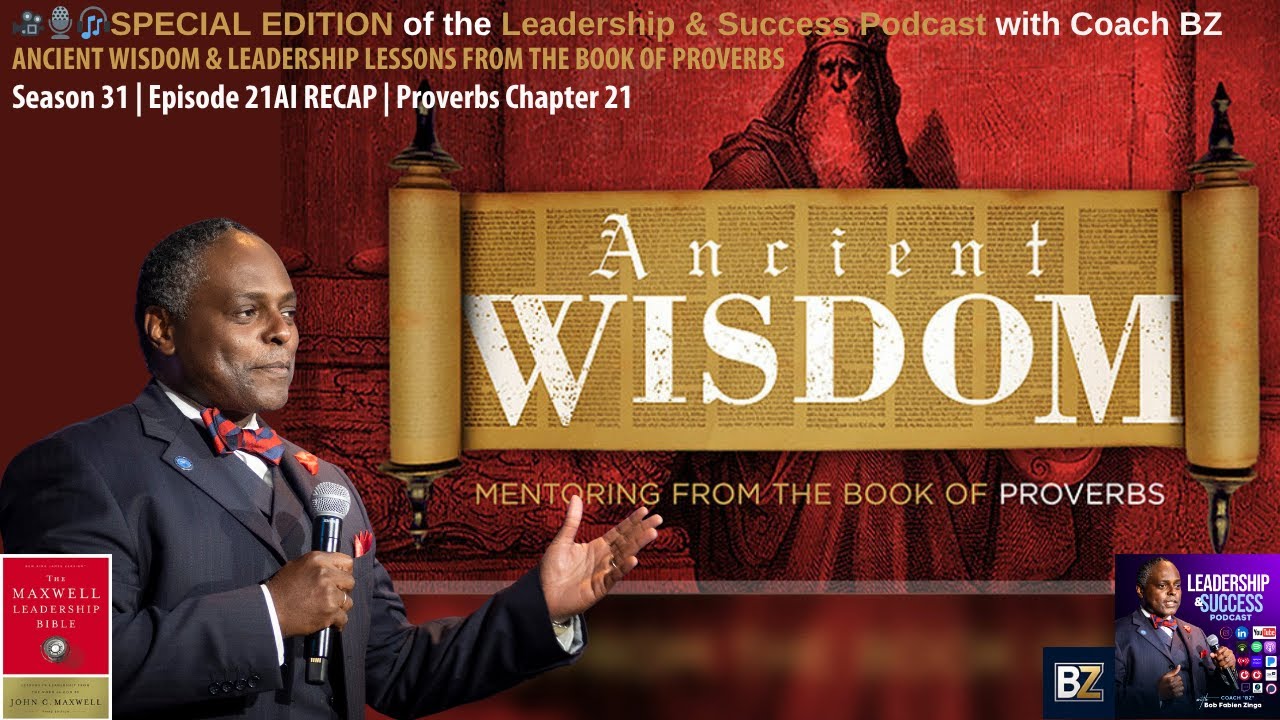
Coach BZ breaks down Proverbs 21 through a 7-point Leadership Alignment Audit covering stewardship, integrity, and planning discipline. He honors Jesse Owens and General Lloyd J. Austin III, then talks with community member Daniel about how conscience and humility shape effective leadership.
Questions this video answers
Because wisdom, which encompasses planning, humility, and conscience, is valuable to anyone regardless of religious belief.
Chapters
Hi, I'm John Maxwell. When the top companies in the world are looking for trainers, speakers, and coaches, there's one name that stands above the rest, and that's Maxwell Leadership. Our certified team members have gotten proven results for companies all over the globe, and our reputation, I'm proud to say, is second to none. Some of our members have risen to the top of their profession, including the one you're going to meet today. I proudly introduce you to my friend, Bob Fabien Zinga.
Welcome to the Leadership and Success Podcast with your host, Coach BZ, where we help you lead with purpose and success. With impact. If you're ready to grow into the kind of leader others want to follow, this podcast is for you. If you're determined to elevate your success and leave a lasting legacy, this podcast is for you. As my mentor, Dr. John C. Maxwell, reminds us, everything rises and falls on leadership. Our goal is simple: to inspire you, challenge you, and equip you with insights that can transform the trajectory of your leadership journey. Welcome aboard to another episode of the Leadership and Success Podcast with Coach BZ.
What everyone, welcome to another edition of the Leadership and Success Podcast. Today we are going to be speaking about Proverbs chapter 21. It is going to be my artificial intelligence recap, and I think this should last approximately, let's say 15 minutes or so. But before we do, I'm reminded of our moment of gratitude. This is where we just take a moment and we want to be grateful every single time that we meet. So if you would maybe close your eyes and put yourself in your happy place and think about one thing that you are grateful for right now. And for me, I believe I am really grateful for America. Not a perfect country, I had a lot of complicated relationship with African American, with Black people. I was born in Africa. I actually, I grew up in France. I was an American. I was in the Navy. I joined the US Navy, which I believe the US Armed Forces make our country great. It looks like our country is not going into the right direction right now, but our country was built on these aspirational thoughts, beliefs. And I think that's really what makes America so different from all of the other countries in the world. Because before, never before in the world did a country say all men are created equal. Think about 1776, right? The 18th century. Back then we had a lot of nobles, you know, kings, and then the peasants. Very, very rich, very, very wealthy, very, very privileged, and then everybody else. And America is like, no, no, no, no, all men are created equal. Doesn't matter where you come from, doesn't matter who you are, we are all equal under the law. That's never existed before. Now we've always not been able to practice it very well in this country, but at least that is our North Star. That is what we are aspiring to be. That's who we are. As American, and I am grateful, grateful for that. Okay, today's lesson. So, uh, I am going to have two, uh, vignettes all done by artificial intelligence. One would last about 6 minutes or so about Proverbs 21, and the other one about 10 minutes. So I want you to take notes, and I want you to ask questions, use the chat, and let me know where you are joining us from, what you are grateful for, and also your 3 to 5 takeaways. All right, let's start with the first 5-minute AI summary.
Modern leadership is moving faster than ever. Whether you are calling the shots in a military war room or directing strategy in a corporate tech lab, the data and threats hit you constantly. When you operate under that kind of intense pressure, it is incredibly easy to fall for a specific trap: the illusion that your title gives you the power to control outcomes. Market fluctuations, or sudden shifts in technology. Ancient wisdom from the Book of Proverbs offers a harsh reality check: True leadership requires accepting that you cannot demand control over external events. Success depends entirely on intentional, internal alignment. By the end of this video, we are going to build a tangible 7-point leadership alignment audit, and you are going to apply it directly to a current, high-stakes challenge you are facing right now. Let's get started. Grab a pen and a piece of paper. Number it 1 through 7. Now clearly visualize one major decision you have to make this week. Translating abstract leadership philosophy into a physical, written checklist forces you to slow down. It is the most effective way to stop yourself from reacting emotionally when a crisis hits and train yourself to lead intentionally. Step 1 is auditing your stewardship. There is a military maxim that says, "Rank is rented, trust is earned." Your position is temporary, and your authority is entrusted to you for a specific season. You do not own it. For your first item on the list, write down exactly who or what entrusted you with the authority to make the decision you are currently facing. Step 2 is auditing your motives. Execution looks impressive on paper, but you have to evaluate why you want to lead this initiative. Ask yourself if you are doing it for status and power or to serve your team and create a measurable impact. As author Simon Sinek points out, understanding the core motive behind your actions is required before you can effectively execute them. You must always remember to start with why. For item number 2, be brutally honest with yourself. Write down exactly why you want to drive this specific project forward. Step 3 is auditing your integrity. We see a lot of performative leadership today—saying the right things or checking the right boxes for good optics. True ethical leadership demands consistency, especially when it is unpopular. For number 3, look at your current challenge. Identify and write down one specific area where you might be tempted to prioritize visibility over doing the hard, right thing. Completing these first 3 steps secures your foundation. Your internal character and your motives have to be aligned before you can demand external performance from anyone else on your team. Step 4 focuses on auditing your teachability. Success is a liability if it isolates you. As you rise in an organization, your ego inflates, and fewer people are willing to challenge your assumptions. As the camera pans across the bust, the ancient philosopher Socrates understood that true mastery requires a constant recognition of what you do not know. Remember, humility is the tool that keeps your judgment sharp. For step 4, write down the name of one person in your inner circle who has explicit permission to challenge your thinking on this decision. If you don't have someone, write "need to find one." Step 5 is auditing your planning discipline. Reacting quickly and executing without a grounded strategy is a direct threat to your organization. Business strategist Brian Tracy frequently advises leaders to measure twice and cut once. Every hour you spend in planning saves you hours of execution later. Stop right now and physically open your calendar. Block out a specific window of time strictly dedicated to strategic reflection on this challenge. When you actively enforce your own teachability and protect dedicated time for planning, you prevent your ego from rushing into blind, disastrous execution. Step 6 is auditing your shortcuts. Under pressure, the temptation is to cut ethical or operational corners to prioritize speed over truth. Identify one specific shortcut you are currently tempted to take on your project, write it down for number 6, and then physically cross it out with your pen. Step 7 is auditing your justice. Enforcing consistent standards is the bedrock of team trust. This chart shows team performance responding to delayed accountability. Wait weeks to address a failure, and moral standards drop sharply into the red zone. By contrast, an immediate, uncomfortable intervention stabilizes the environment and preserves organizational integrity. For your final item, write down the name of a team member or a specific situation where you need to initiate an uncomfortable, necessary conversation right now. Choosing long-term integrity over short-term speed and delivering swift justice are the only actions that will sustain your credibility long after the initial crisis fades. Look down at your piece of paper. You now hold a completed, personalized Leadership Alignment Audit tailored directly to your immediate challenge. Catastrophic leadership failures, whether on a military battlefield or in the digital space, are rarely technical. They are almost always character failures. As leadership expert John C. Maxwell teaches, Everything in an organization rises and falls on leadership. You carry ultimate responsibility for the culture you create. I want to hear from you. Drop a comment below and let me know which of these 7 steps challenged you the most today. True influence does not flow from demanding control over your circumstances. It comes from the relentless, daily alignment of your motives, your integrity, and your actions.
All right, so this was the very first segment, and now we're going to play one more segment, all done by AI, that lasts about 10 minutes. And again, let us know where are you joining us from and what are you grateful for today, and also your 3 to 5 takeaways for Proverbs chapter 21. And by the way, you can go back to the initial episode we did on January 21st. It's available on YouTube, on LinkedIn, everywhere podcasts are available. You can watch the entire hour-long episode for chapter 21. So here's the second AI summary for Proverbs chapter 21.
Welcome to the session where ancient wisdom meets modern leadership. We're diving deep into timeless lessons from Proverbs 21. Lessons that remind us that holding a title isn't the same as controlling the outcome.
Absolutely. And it's really fascinating how these insights apply to everything from military command to the boardroom, right?
Exactly. It's like a reminder that leadership is stewardship, not ownership. It tells us that our authority is more of a borrowed trust. Than an inherent claim. Right.
Rank is rented, trust is earned. That idea really shakes the common belief that just being at the top gives you the ultimate say, doesn't it?
It really does. And, um, it challenges us to lead with humility. It's about aligning hearts, our strategy, and our execution. Almost like constructing a building, one careful brick at a time.
Mm-hmm, and remember how it emphasizes that your plans may be solid, but without an aligned heart and true integrity, everything falls apart.
Right, and that brings us to another core point: motives really matter more than metrics. It's not enough to just, uh, chase numbers or status.
Totally. Instead, you're encouraged to ask, why do I want to lead? Is it for recognition, or to serve and develop others. And that makes all the difference.
Absolutely. And it's kind of like, um, comparing a flashy sports car with a reliable sedan. Metrics and optics might dazzle for a moment, but without a solid engine of integrity, you're going nowhere fast.
Yeah, I like that analogy. But let me challenge one point. Sometimes, metrics are necessary to measure success. How do you reconcile that with focusing on motives?
Great point. Metrics themselves aren't bad. They're like a map. But if your inner compass, your motives, are misaligned, the map won't matter. It's the heart behind the numbers that sets the course, ensuring decisions are truly impactful. I see.
So it's a balance. You need both the map and the right intent driving you.
Exactly. And then we have integrity, which is positioned as outweighing mere optics. In today's world, there's a temptation toward performative leadership, doing what looks right rather than what is right.
Yep, it's the whole checkbox approach versus genuinely consistent behavior, you know?
Right. Integrity is the backbone. When you prioritize being ethical at every step, it builds a lasting foundation, much like a well-built bridge that supports everything crossing it.
Exactly. It's refreshing to hear that. But sometimes, leaders might feel pressure to put on a facade of integrity, especially in high-stakes situations. How do you suggest they navigate that?
That's where self-reflection comes in. Instead of just posting the right message or echoing trends, truly grounded leaders continuously examine their motives and actions. That's one of the major takeaways—consistency trumps visibility. I agree.
And this mix of of integrity with consistent behavior really ties into the idea that pride is the silent killer in leadership. Absolutely.
Success can be dangerous because it's easy to get isolated by your own hype. As Proverbs points out, haughty eyes and a proud heart can slowly erode judgment. It's a subtle, creeping issue.
And that reminds me, feedback is crucial here, right? Leaders need to keep themselves in check by inviting criticism and diverse viewpoints.
Exactly. Staying coachable and creating psychologically safe environments where every voice is heard is key. In essence, your success should, um, humble you rather than inflate your ego.
That makes sense. Now let's shift to another important point: disciplined planning. Proverbs tells us that planning is not optional. It's the engine behind sustainable success.
Right on. It's like building a ship in a bottle. It requires, uh, careful thought and strategic planning. Without it, even the best strategies can crumble.
Yeah, it's interesting because in our fast-paced world, leaders are often tempted to react impulsively instead of taking time to reflect. And that's where disciplined planning saves the day.
Indeed, balancing urgency with intentionality is crucial. A leader who rushes without a proper plan is like a cook throwing ingredients together without following the recipe. I totally get that.
And coming to shortcuts, Proverbs warns that shortcuts destroy credibility. Cutting corners might give quick wins, but what about long-term trust?
Exactly. Shortcuts may yield immediate benefits, but they erode the foundation of trust. Imagine building a tower on shaky ground—it just won't stand for long.
Right. And you know, it's a bit counterintuitive sometimes. When everyone seems to hustle for faster results, The ethical path might seem slower but builds lasting credibility.
Absolutely. Leadership is about choosing long-term integrity over short-term gains. There's no shortcut that can replace building trust brick by brick.
Then we have the point about justice being the foundation of trust. Timely correction and fairness are essential for cohesive teams, right?
Right. And justice here isn't just about punishment. It's about creating a culture where everyone, regardless of rank, is held to the same standard. That consistency brings true joy and unity to a team.
Exactly. So, quick question. How do leaders practically enforce justice without falling into micromanagement?
Well, it's about clear communication and setting expectations. Leaders should address issues fairly and timely, not as a means of control, but as a way of nurturing trust. Like, um, Think of it as maintaining a balanced ecosystem where every element has its role.
I like that analogy. A balanced ecosystem requires every part to function without overpowering another.
Exactly. And bringing all these principles together, the overarching message is that control is an illusion. You might have the best strategy, but, um, if your character, your integrity, discipline, and humility is off, then your leadership just won't stand the test of time.
That's a powerful reality check, and it seems especially relevant today when technological and market shifts make our roles even more complex.
Indeed, whether you're a military leader or a tech executive, the pressures are similar. You're facing rapid changes where outcomes are unpredictable, but your actions, rooted in character and ethical decision-making, remain in your control.
Right, and that's a solid challenge for every leader—to pause, reflect, and ask, "Am I leading with humility, integrity, and strategic intent?" Absolutely.
That introspection is, um, what differentiates a fleeting success from a lasting legacy. Leaders who genuinely align their actions with the greater good, who serve rather than control, are the ones who make an enduring impact.
So, if you were to pick one of these 7 lessons that really challenges conventional leadership thinking, which one stands out to you the most?
I'd say it's the idea that leadership isn't about ownership, it's about service. It flips the script on the traditional notion that power means control. Instead, it shows us that true influence comes from aligning your heart with your actions and, um, entrusting your role to a higher purpose.
I like that, but sometimes it can feel a bit, uh, overly idealistic. How do you ground that in the real world where decisions have immediate consequences? That's a fair challenge.
The real world is messy, and while these principles might seem lofty, they serve as a compass. In the heat of decision-making, whether it's on the digital battlefield or in a high-stakes negotiation, returning to these timeless truths can be a guiding light. Can guide you away from short-term fixes towards sustainable solutions.
That really puts it into perspective. It's like, in the middle of chaos, having that inner moral compass can be your anchor.
Exactly. And, um, the call to action here is clear. Before your next big decision, pause and reflect. Ask yourself if you're leading with humility or ego, planning with intention or reacting impulsively. This is the challenge every leader must embrace to truly align strategy with character.
And it's these deliberate, thoughtful actions that build not just a successful legacy, but a legacy grounded in trust and respect. That, in the end, is what modern leadership is all about. Absolutely.
The enduring impact of leadership, as taught by Proverbs, is rooted in timeless wisdom. When we lead with service, integrity, and justice, our legacy becomes permanent, even if our titles are temporary.
Exactly. Well said. I think these insights really challenge us to rethink what it means to lead in today's fast-paced and complex world. They sure do.
So, as we wrap up, let's leave our listeners with this: True leadership isn't about control, but about the alignment of your values with your actions. Every decision you make, Every plan you execute should reflect that commitment.
Yeah, thanks for the deep dive. It's been both provocative and inspiring. Here's to leaders who choose character over control and strive for excellence every day.
Absolutely. Here's to building legacies that endure, one thoughtful, honest decision at a time.
All right, thank you so much for watching. This is it for today. And I want to say hi to Daniel. Daniel, I just sent you a DM. If you want to come on the podcast platform now, we can, so you can give us your 3 to 5 takeaways for Proverbs 21. And we're going to have more interviews next week with noted experts. And I am so grateful that Jillian Treasure was our guest yesterday all the way from England and he's our friend in the spotlight this week. He's had more than 160 million views, the number one TED speaker in the world. And I understand some of you guys will be joining him in Vancouver next month for the TED conference there. But anyway, very, very grateful for that. So while I wait for Daniel, if he decides to join us, Let's talk about African American, Black, Black History Year. All right, like you guys know, we celebrate Black History Year every single day on this platform because I felt like 28 days was just not long enough. So, uh, for today it's going to be two things. One thing is, um, I kind of like to, to use the, the date today, which is March 28th, and I asked the question, what happened on March 28th in our history that relates, right, to African American history? Because African American history is American history. Well, on this day, on March 28th, 1990, uh, we really honored a legend, Jesse Owens. He received the Congressional Gold Medal. March 28th, 1990, President George H.W. Bush presented the Congressional Gold Medal one of the nation's highest civilian honors to Ruth Owens, the widow of Jesse Owens, during a ceremony at the White House. I think one of the biggest reasons why this really matters, some of the legacy of Jesse Owens, it's really the 1936 Berlin Olympics, right? Owens achieved what many thought was impossible. He got the gold medal for the 100-meter, 200-meter, long jump, and 400-meter relay, right? He was competing against Nazi Germany. Owens' victory directly contradicted Adolf Hitler's ideology of white supremacy, Aryan supremacy, which is quite evil. The performance of Jesse Owens on that day, it wasn't just athletic, it was symbolic, right? It was a global statement of truth over propaganda, excellence over hate, and humanity over division. And that is very, very powerful. So that's the reason why today On March 28th, 2026, we want to honor the legacy of Jesse Owens. So I'm gonna play a short video about that. And another person I want to honor today, because I like to think about African American military or technology first, but we're gonna be talking about 4-star General Lloyd J. Austin III. He was the very first African American US Secretary of Defense. Defense, and, uh, that is so, uh, so powerful. So we want to honor those two. So I have two short videos I am going to play toward the end. So I'm gonna give, um, uh, Daniel a couple of minutes to join if he can, and we're gonna talk about the 3 to 5 takeaway for Power21. But if not, I'm gonna play these two videos, and that's gonna be the end of the show today. Thanks again for watching. Here's the first video.
The Olympic Games were a considerable success, especially for the Nazi propaganda wing. There was Riefenstahl's film in the making. Zeppelins were used to carry the results of German victories. Who were winning the most medals overall? Things are humming along smoothly until Jesse Owens comes along. The men's long jump. Hitler has great faith that his star long jumper is going to take the gold medal. Lutz Long, he was one of those rare athletic happenings you come to recognize after years of competition, and he had been groomed his entire life for this Olympiad and this single event. The broad jump trials gave each athlete 3 tries to make a qualifying distance of 23.5 feet. I hadn't gone a foot less than that, practice or otherwise, since high school. All he has to do is jump 23.5 feet to qualify for the final and move on and look for another gold medal. So he does like a little practice jaunt through the pit, and they call him for a foul. He's clearly just practicing. They're like, no, that's a foul. You can't just, you know, run through the pit. That counts. So he's now unnerved. I'd been careless. Forget it, I said to myself. You fouled before, and there's still 2 jumps left. He fouls again. And at that point, anybody can get nervous. I'd gone over the takeoff board.
I couldn't believe it.
You're running 40 meters, trying to hit one board in the right body position at the right time.
It's really challenging.
You've got the pressure of the Olympics, and if you don't make this jump, then it gives Hitler, gives all these people a chance to say, "Seeder, I knew he couldn't handle it." Jesse Owens is down to one last chance. It cannot end like this. Suddenly I felt a hand on my shoulder. It was Lutz Long. The way his hand rested on my shoulder made me know somehow that he was far from being my enemy. I think I know what is wrong with you, he said in broken English. You're afraid you will foul again. I've been there myself, and I have the answer.
Ohio State's phenomenal Jesse Owens again takes the spotlight.
It's his last try and it's got to be good.
I jogged over to the runway, refocusing my jump on the towel he had placed in front of the takeoff board, and began my run without fear. When I came down, it was more than 26 feet, nearly an Olympic record. On the verge of fouling out and maybe blowing my entire Olympiad, Lutz, one of Hitler's Nazis, changed everything for me at his own expense.
Final. The great Negro athlete Jesse Owens of America is up against the German Lutz Long.
7.54m.
His first leap took the lead. 7.74m. I beat it! 7.84m. His second of three was even better.
7.87m.
And I beat that by half an inch. They had this spectacular competition going back and forth for the gold medal. It really is this incredible drama, but eventually Jesse outlasts Lutz Long. Fate was against him. Lutz looked up from the pit to see the red flag waving. He had fouled, and I had won. But victory is the sweetest when you win it on your own merits. I still had one jump left, and I wanted it to be remembered. Lutz deserved my very best, and I still had more more to give.
8.06 meters!
A new Olympic record. I had jumped farther than any man on Earth. After the scene with Hitler and the near disaster in the broad jump, the man that had saved me from that raced over to me and led me towards the crowd. The visual of this is really dramatic. Here they were, joined arm in arm. This wasn't supposed to be on display.
In the context of the Hitler Olympics, it was a beautiful moment, but it also shows what the Olympics should really be about.
It is the opposite of the Hitler snub story. A Black American grandson of slaves competing against this model of Aryan youth, and how that moment, instead of being adversaries, they became brothers. It's a story that Jesse Lee—
The confirmation of Lloyd Austin as the first Black U.S. Secretary of Defense is a milestone. Nick Shiffrin reports on how it also spotlights racial disparities at the highest level of the military ranks. Hello, everybody.
When Lloyd Austin arrived at the Pentagon today, he broke through what's been called the brass ceiling. In a 40-year career, he was the first Black officer to command a division in combat, the first Black officer to command an entire theater of war, and now the first Black Secretary of Defense.
To hit every to get through every single one of those gates is incredible. Uh, so to me, that is much like hitting the lottery.
Irving Smith is a retired Army colonel and former West Point professor. He says the military provides opportunity for Black enlisted troops to rise to positions like sergeant, but to rise through the officer ranks like 4-star General Austin did, the barriers are systemic. He read a 1995 U.S. Army War College research project Why Black Officers Fail, and in 2010, he wrote a follow-up, Why Black Officers Still Fail.
There's this thing called the good ol' boy network. There's a system in the Army that is very, it's like nepotism that exists there. And as long as that persists, Black officers will have a very hard time making it to the senior ranks.
In 1994, Black soldiers were 27% of the Army, but only 11% of the officers. 2007, Black soldiers were 20% of the Army, but only 12% of the officers. Today, the problem persists. The Pentagon provided PBS NewsHour data we analyzed for the entire military. Black service members are 16% of the military, but only 8% of its officers. White service members are 55% of the military, but 72% of the officers. A major problem, the lack of Black mentorship.
Most of the African American officers were coming out of historically Black colleges, and those historically Black colleges weren't providing the mentorship, uh, up front, whereas the West Point, uh, cadets were getting the very best officers to teach them from day one. And so they weren't necessarily being given The right guidance on the right assignments to take.
That's a reference to the military's combat units, where Black service members are 11% of the enlisted, but only 5% of the officers. White combat service members are 64% of the enlisted and 78% of the officers. In fact, in combat units, as the percentage of white officers rises with seniority, the percentage of Black officers drops, from 8% of second lieutenants down to 4% for colonels. In combat support units such as logistics, the disparity remains, but the numbers get better. Black service members are 20% of the enlisted and 10% of the officers.
All right, so again, we are celebrating Lloyd Austin, the general, uh, really the first African American to also lead an entire theater of war, which is pretty powerful. So we are grateful for that. So I do have Daniel on for just a minute. Hey, Daniel, can you hear me? Daniel, is your mic on? Okay, I think— can you hear me now? Daniel?
Yes, I can hear you. Good afternoon, Bob. How are you?
Thank you so much for being here. And of course, we didn't plan this, but just quickly, what do you think are your 3 to 5 takeaways today on Proverbs chapter 21? Hang on just once.
I have the camera on.
And are you able to see me? No, I can't see you, but I can hear you well. Okay, is black. For now. All right, well, you may go with more than one camera, and if you go to setting video, you can select which camera you want. For example, on mine I have 4.
Oh wow, I only have one, and I would like that one to work. Okay, I'll have to figure it out after the show, but I want to go ahead and just dive in. And, um, first and foremost, good afternoon to everyone. Yes, uh, I know this is a global show, just want to give that global recognition to your audience. And all of the viewers, you know, who are taking time to join us today. It's such an honor, first and foremost, to be in this show. And I've been a long follower before I got invited on to be one of your guests as well. And I'd like to say, you know, you are truly appreciated for the extension of the recognition for the Black History Month celebration to continue that on, pour out, pouring throughout the year. It's much needed and celebrated. Thank you. Yes, sir. Now on to the, the Proverbs 21. Um, that chapter reminds me that no matter how advanced our systems get, that God still directs the flow. Oh, therefore, good leadership is a channel of water controlled by God. If he directs it to whatever ends he chooses, we can make our plans, we can build strategies, even train, um, AI models, but This chapter in specific, it keeps pulling the focus back to the righteousness, the justice, and the integrity that God examines out of motives. So not just our results. It also warns that shortcuts, pride, and ignoring the, the cry of the poor all have consequences, while those who pursue righteousness and kindness find life, righteousness, and honor. So for me, this chapter is, it's, it's a leadership checklist. I was, um, making one more update to, to, to my book, um, and it's so funny, and it's about checklists, and I was like, dude, nobody needs another checklist. But looking at Proverbs 21, yes, it can help. So, um, what the checklist would look like, um, Proverbs 21, is, is submitting the plan guarding your heart, doing justice, and let good pretty much steer the outcome. So I have so many nuggets of good takeaways. One is God weighs the motives and not the optics, that your character can beat performance, and diligent planning beats any type of hasty shortcuts. Yes, that is quite powerful.
Thank you so much for those insights. Now, I believe a great majority of my audience believe in God, and I think the majority of those are Christian, but not everybody is and not everybody believes in God. Why would someone who doesn't even believe in God, doesn't have any religious belief, why would they still get benefit out of Proverbs 21, you think?
One word and one word only. Wisdom. Because wisdom encompass a lot of different things. Some people who, let's say, they just hustle, they don't plan, they don't have any patience. With wisdom, wisdom changes that. And I won't go too deep in that. So I'll just leave it there. One word is wisdom. Powerful. Powerful. Wow.
Wisdom, which is beyond just mere knowledge. Yes.
Thanks again. It opens up a door for those who may not know it, but going down the path of wisdom can subconsciously pursue righteousness. Well, then a transformation can take place. I, I, it's safe to say that.
No, this, this is really, uh, powerful because, you know, another thing is, you know, you don't have to be a Christian or a believer in God, but just as a human being, we all have a conscience, right? So we kind of have a sense of what's right and what is wrong. And, um, as a leader, you always try to do the very best. Of course, you focus on your mission, but you also want to take care of your people and treat them fairly and, you know, and really lead with humility. I think that is really a characteristic of some of the best leaders we've ever had, you know, people who know that they don't have all of the answers, uh, but they are committed to the mission and to treating everybody fairly, you know, with respect and dignity. I think that really makes a big, big difference whether you believe in God or not, whether you are religious or not, that that is not the most important thing, but really the way you show up and the way you treat people, that really makes all the difference in the world. All right, thanks again, Daniel, for being one of the most active members of this community. I always like to get feedback from the audience, especially when I started, right? 5 years ago, it was just me. I was talking to myself, and now knowing that there are people out there who are listening and like you asking questions or providing your own insight. I really truly appreciate that. Thank you so much for joining today, Daniel, and I hope to talk to you again soon. Appreciate it.
Pleasure's all mine. Yes, sir. Thank you.
Thank you for tuning in to the Leadership and Success Podcast with your host, Coach BZ. If today's episode added value to your leadership journey, be sure to subscribe, share, and join us again for more wisdom nuggets on how to lead better and achieve greater success. Remember, leadership is the most critical skill of our time. The world will always need leaders to inspire others, drive innovation, and execute meaningful strategy. So why not count yourself among the bold leaders shaping the 21st century? Until next time, stay inspired, stay committed, and keep leading with excellence.
More from Bob

S250:E4🎙️LIVE 🇺🇸America 250: President Barack Obama Leadership, Service, and the Power of Hope






S5:E157🎙️ LIVE with CMD CMSgt Dennis L. Fritz, USAF (Ret.)(Multi Tracks Audio)



S5:E156🎙️ LIVE 🇪🇸 Leadership Lessons from the FIFA World Cup 2026 Champions (Multi Tracks Audio)

S250:E3🎙️ LIVE Leadership Lessons from America’s First Documented Family of African Descent 🇺🇸📖