S31:E23AI🎙️ LIVE AWLL From Proverbs — Chapter 23
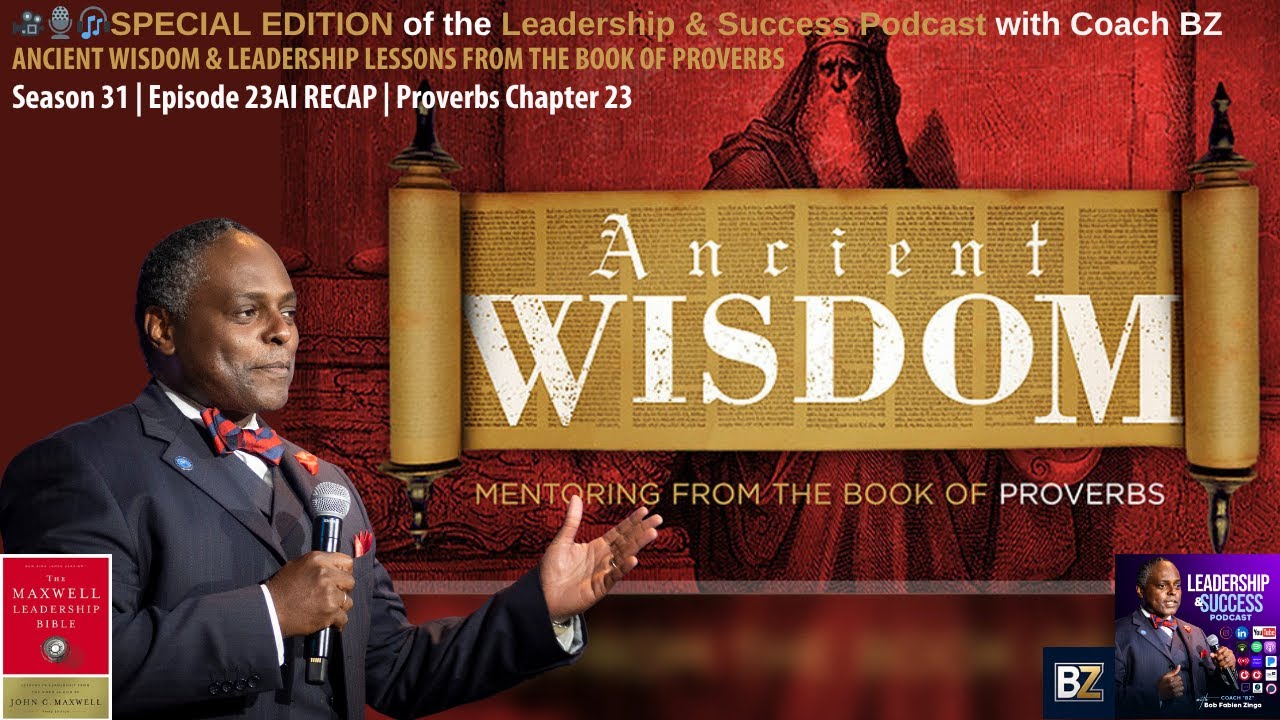
Coach BZ breaks down Proverbs 23 into seven lessons for leaders in high-stakes fields like the Navy and cybersecurity. Key insight: authority erodes through daily private decisions, not public crises. True discipline is protective love, and your private habits shape your public legacy.
Chapters
Hi, I'm John Maxwell. When the top companies in the world are looking for trainers, speakers, and coaches, there's one name that stands above the rest, and that's Maxwell Leadership. Our certified team members have gotten proven results for companies all over the globe, and our reputation, I'm proud to say, is second to none. Some of our members have risen to the top of their profession, including the one you're going to meet today. I proudly introduce you to my friend, Bob Fabien Zinga.
Welcome to the Leadership and Success Podcast with your host, Coach BZ, where we help you lead with purpose and succeed with impact. If you're ready to grow into the kind of leader others want to follow, this podcast is for you. If you're determined to elevate your success and leave a lasting legacy, this podcast is for you. As my mentor, Dr. John C. Maxwell, reminds us, everything rises and falls on leadership. Our goal is simple, to inspire you, challenge you, and equip you with insights that can transform the trajectory of your leadership journey. Welcome aboard to Welcome to another episode of the Leadership and Success Podcast with Coach BZ.
Hello everyone, this is Coach BZ. Thank you so much for joining us for this special episode on the Book of Proverbs, Chapter 23. So this is not going to be a religious podcast, but it is about the great wisdom and leadership lesson from the book of Proverbs today, chapter 23. How a book written more than 2,000 years ago can still instill wisdom that is quite relevant today in 2026, in the age of artificial intelligence. So as is our custom here, we're going to start with what we call a moment of gratitude. This is where we take just a moment every single time we meet, and we want to think about one thing we are grateful for. Each and every time. So I would encourage you to maybe close your eyes, put yourself in your happy place, maybe take a deep breath and slow down your nervous system and think about one thing you are grateful for. I think today I am really grateful for America. I think it's the best country in the world. We are not perfect here. God knows we started this country very wrong with slavery and all of that, but our aspirational document, right? The Declaration of Independence, which states that all men are created equal. And I think that is really, really powerful. And it's something we've been trying to redeem ourselves and really progressing toward, right? A country of the people, by the people, and for the people. That's the America I love, the America I was and I am willing to give my life for in the US Navy. And I'm just so grateful for America. We don't always make the right decision, but we are always striving for a more perfect union. And that's what I'm thankful for today. So let us know in the comment, what are you grateful for? And also let us know where you are joining us from, what city, what state. And if outside of the US, since we are global now, which country. And while you listen, I'm gonna play 3 small videos about Proverbs 23, all done by artificial intelligence. Let us know your 3 takeaways from the episode and 1 leadership insight you will be applying this week. So the first AI video I will play is going to be about 5 minutes. And, uh, I see you on the other side of that.
We tend to believe authority is forged in public, won in boardrooms, tested during major crises, or granted by high-status titles. But in high-stakes environments, from Silicon Valley to the military, this hyperfocus on public performance masks a devastating reality: true leadership is almost never lost in a single dramatic moment of crisis. Instead, authority erodes slowly. It chips away daily through unchecked private decisions, quietly undermined by silent killers like ego, excess, and distraction. To solve this crisis of character, we have to look to experts like Bob Fabien Zinga, who bridges modern high-stakes strategy with ancient wisdom. Zinga operates in two uniquely demanding worlds simultaneously. He serves as an information warfare commander in the U.S. Navy while also executing strategy as a Silicon Valley cybersecurity executive. To navigate these incredibly complex modern landscapes, his operating system relies on an unexpected source: the ancient text of Proverbs, specifically Chapter 23. The core thesis here is highly operational: before anyone can effectively command a room, a team, or a mission, they must govern themselves. Ultimately, individuals become exactly what they desire, tolerate, and consume. To understand how that governance works, we have to shift our focus entirely inward. The absolute foundational layer of any leader is their own mind and heart. That is where the battle for control is actually fought and won. This begins with a crucial distinction: you are not your thoughts; you are the separate thinker observing them. Leaders have the agency to actively rewire their own beliefs, catching emotional drift before it manifests as physical action. If that emotional drift goes unchecked, the results are severe. Failures rarely start with a massive public blunder. They sprout from quiet, completely unnoticed internal misalignments. Whoever controls that internal state dictates the external direction of the entire organization. If the inner core is compromised, the broader mission is already lost. Once a leader secures that internal core, they step into a professional landscape designed to test it—a landscape filled with highly seductive illusions. The first trap is the illusion of access. Proximity to power, whether an invitation to an exclusive executive room or high-visibility strategic partnership, often arrives disguised as a direct upgrade. But that access almost always carries steep, hidden costs. The second trap is the illusion of wealth. This chart shows a common dynamic where compensation rises rapidly, yet actual impact flatlines. Pursuing status or money while abandoning a greater calling leaves a leader entirely hollow. The third trap is transactional relationships. Assuming everyone who offers praise wants you to succeed is dangerous. Failing to distinguish who truly values you from who uses you accumulates relational debt, a hidden, compounding cost that quietly drains your effectiveness. To survive these illusions, you have to develop ruthless discernment. The ability to see clearly past access, money, and flattery acts as the ultimate shield to protect a leader's long-term potential. The exact mechanism used to maintain that discernment is discipline. Culturally, we often confuse discipline with punishment, but in practice, it is a form of protective love and honest feedback. But here is the most critical operational pivot: elite leaders completely stop relying on personal willpower to maintain their discipline. Instead, they rely on environmental design. They deliberately structure their surroundings to reduce friction for good habits and eliminate temptations before they even appear. True professionals don't try to out-suffer everyone else. They build robust systems and clear environments that make failure incredibly difficult and positive choices almost automatic. Ultimately, this internal architecture dictates how you show up in the world. As Proverbs 23 suggests, the choices you make alone in the dark inevitably shape your public outcomes in the light. The moment that private discipline disappears, public authority begins to erode. Teams are highly perceptive; they are continuously watching what their leader is willing to tolerate. Technology will advance, markets will shift, and specific missions will evolve. Yet through all of that change, the core human requirements of self-mastery remain absolute and unchanging. So run an audit on your own life. Identify exactly where your environment requires tighter design and greater discipline. Master yourself today and you earn the right to lead others tomorrow.
All right, so that was the very first view of Proverbs 23, all done by artificial intelligence. I am going to play another short video, it's about 8 minutes or so. And before I do that, let me share my screen. And I want everybody, if you follow me, you can find on my LinkedIn page under my newsletter the Leadership Excellence and Accountability Devotion, I call it LEAD, my LEAD newsletter. I wrote about Proverbs chapter 23, and I talk about the 7 lessons I found there. Lesson 1: Not every opportunity is an upgrade. And then Lesson 2: Success without purpose is a trap. Lesson 3: Not every relationship is real. Lesson 4, discipline is leadership love. And lesson 5, the battle is won or lost in the heart. Lesson 6, excess is the silent killer of leadership. And finally, lesson 7, private habits shape public legacy. I welcome all of your input and let me know what you think of the article. And now I am going to play the second AI video. It's about 8 minutes long. And as you are listening again, And please let us know what are your free takeaway from this episode and also which leadership insight you will actually apply this week. Here we go.
Welcome back. Today, we're jumping straight into a truly transformational explainer based on the work of Bob Fabien Zinga. Most people know him as Coach BZ. He's a US Navy commander and a Silicon Valley cybersecurity executive. And what we're doing here is bridging thousands of years of ancient philosophy, specifically Proverbs 23, right into the intense, high-stakes reality of modern military and tech leadership. We're gonna see exactly how this ancient wisdom maps perfectly onto today's boardrooms and command centers. Let's kick things off by immediately challenging a massive misconception. You know, most of us kind of assume that leadership fails in this sudden, dramatic moment of public crisis, right? Like a terrible market call, a disastrous press conference, or some massive operational failure. But is that really where leadership is lost? Well, the hard truth, and Coach BZ really hammers this home, is that leadership is actually formed or completely eroded in the dark. It's happening long before you ever step up to lead a team or run a mission. It gets eroded daily through private, quiet decisions. Because ultimately, you inevitably become exactly what you desire, what you tolerate, and what you consume. If you want to effectively lead anyone else, you absolutely have to master yourself first. So here's our roadmap for this explainer. We're gonna move from the inside out. We'll start with the hidden leadership reality, then we'll navigate external traps, win the inner battle, unpack the power of discipline, and finally wrap up by building your own leadership operating system. Let's get right to it. Part 1: The Hidden Leadership Reality. Leading yourself first. Now, what's genuinely fascinating about this is that whether you're a naval junior officer aiming for command or a Silicon Valley exec stepping into a new role, this isn't just nice-sounding theory. It's strict operational reality. Leadership is absolutely not just about putting on a good public performance. It requires rigorous private discipline, deep internal alignment, and unwavering self-governance. If you can't govern your own daily habits, Well, the foundation is already cracked before you even start building. Moving right along to Section 2: Navigating External Traps. Focusing on access and ambition, Coach BZ anchors this specific lesson with just an incredible quote from Proverbs 23. It says, "When you sit to eat with a ruler, consider what is before you." Think about it. In leadership, access is incredibly seductive. You finally get invited to the big table, and man, it feels like you've made it. But this ancient proverb serves as a pretty stark warning that influence often arrives dressed up as a shiny new opportunity. And this brilliantly illustrates how the ancient temptation of the ruler's table is a literal mirror for today's high-visibility promotions, executive boardrooms, and flashy strategic partnerships. The very best leaders, they don't just blindly pull up a chair. They actually pause and ask, okay, what's the hidden cost here? What is really being exchanged behind the scenes? Am I shaping this table, or is this table shaping me? Having that discernment is vastly more valuable than just having access. Which brings us to a critical contrast: hollow ambition versus a true calling. It is so easy, literally so easy, to confuse a promotion with your actual purpose, or to confuse compensation with real impact. You might even find yourself confusing social status with genuine success. Coach BZ reminds us that wealth is fleeting, but purpose and legacy, those endure. If your ambition completely replaces your calling, your leadership is gonna get hollow fast. You've gotta value the mission over the money, and the people over the profit. And as you rise up the ranks, you also absolutely need sharp relational intelligence. Look, the reality is, not everyone who praises you or opens doors for you actually has your best interests at heart. Not every smile is sincere. You need the discernment to step back and ask, "Who actually values me versus who is just using me? Where am I willfully ignoring glaring red flags just because the attention feels good?" Spotting those fake allies early is literally the only way to protect yourself from taking on massive relational debt that you never wanted in the first place. Okay, Section 3: Winning the Inner Battle: Mindset and Excess. To really understand this inner battle, we need to redefine what we mean by "the heart." Now, in this context, a leader's heart refers to their underlying thought patterns, their emotional drift, and their core internal alignment. Whoever controls those internal patterns ultimately controls the entire direction of the organization. If a leader's internal alignment is drifting, the whole team will just drift right along with them. And to combat that drift, Coach BZ shares this remarkably powerful paradigm shift. He says, You are not your thoughts. You are the thinker. Just let that sink in for a second. Because you are the thinker, you aren't just some victim of your current mindset. You have to— profound active ability to rewire your own beliefs, to catch a negative thought pattern midstream and intentionally realign your leadership right from the inside out. Because if you don't take control as the thinker, you leave yourself wide open to the silent killers of leadership. And notice, excess doesn't always look like some spectacular headline-making failure. A lot of times, It's way more subtle. It looks like overconfidence. It looks like ego. Sometimes it manifests as just this deep desire for comfort or constant distraction, or even an addiction to success itself. Overindulging in any of these areas just dulls your judgment and chips away at your credibility. And make no mistake, your people are always watching. This brings us to Section 4: The Power of Discipline, reframing it around protection and legacy. So the absolutely crucial point here is understanding the distinct difference between being nice and being kind. In today's corporate culture, it's super easy to just be nice to avoid friction, but actually avoiding those hard conversations just enables dysfunction. True kindness, like real leadership love, requires honest feedback and courageous empathetic correction. Welcoming accountability and correcting issues early preserves potential, while ignoring them completely destroys it. Discipline isn't punishment, it's protection. All of this boils down to one defining truth drawn from years of high-level military command experience: Private choices shape public outcomes. Even your unstated intentions end up bleeding into your behavior, and your team is watching what you tolerate. Leadership is very rarely destroyed by one single isolated public mess-up. No, it's almost always destroyed by many, many ignored warnings along the way. Which leads us to our final section, Section 5: The Leadership Operating System. Self-Governance. The absolute core of this operating system is self-governance. It's that foundational ability to control your own appetite, to aggressively guard your environment, and to align your values. If there is one major takeaway from this entire explainer, it is this: if you cannot govern your own desires and discipline your own habits, you are inevitably going to struggle to lead a team effectively. It's just a fact. So how do we actually operationalize this? Well, here is an elite leadership strategy for you. Do not rely on sheer willpower. Willpower gets fatigued. It gets tired. Instead, actively design your environment. Remove the distractions that weaken your focus. Eliminate temptations long before they even pop up in your day. And intentionally structure your schedule to enforce that discipline. You want to reduce the friction for your good habits and drastically increase the friction for your bad ones. And that brings us to a fundamental law of human nature: environment drives behavior way more than intention ever does. It really doesn't matter if you're commanding a massive navy fleet or leading a tiny Silicon Valley tech startup. Sure, technology evolves, markets constantly shift, and the specific missions change. But the fundamental laws of environment, human behavior, and daily discipline—those remain absolute. Leaders who master themselves, truly earn the right to lead others. So, I want to leave you with this final, bold question to chew on: What habits are quietly shaping your leadership right now, for better or for worse? Take a really honest audit of what you do in the dark, govern your desires, and intentionally step into the leader you were meant to become. Keep learning, and keep leading from within.
Welcome to the podcast, everyone! Today, we're diving deep into ancient wisdom that still packs a punch for modern leadership. Inspired by Proverbs 23 and how it speaks to leaders in both military and Silicon Valley settings.
Yeah, that's right. I'm excited. So many layers here. What's striking is the idea that what you desire, tolerate, and consume ultimately shapes who you become.
Absolutely. It's like, you know, you are continuously sculpting yourself through daily decisions. It's not just those big flashy moments, but the little ones in private that really matter. Yep, exactly.
You're not just a product of your public achievements but your private discipline. So how does this translate into leadership for, say, naval officers or security professionals from Silicon Valley? Right.
So one of the key lessons is that leadership is built by the choices you make privately. Before you lead a team or mission, you must lead yourself. This means mastering internal habits and aligning your values. Mm-hmm.
And that's interesting because it challenges the notion that leadership is only about commanding from the front lines. It's really about the discipline behind the scenes.
Yeah, exactly. It's like the old saying, what do you— what you do in the dark is what shines in the light. It reminds us that every simple moment, every meal, every meeting are, well, their opportunity to be, you know, intentional in discipline.
Speaking of opportunities, One of the lessons discussed is that not every opportunity, um, is really an upgrade. There's a caution there. When you sit with a ruler, you need to be mindful of what you're really being offered.
Right, it's basically saying, look, influence might come wrapped in the guise of a golden opportunity. So you really need to ask, what's the cost here? Am I sacrificing my integrity or vision for a chance at promotion?
Yeah, I get that. But I wonder, do you think that sometimes this perspective might be too, um, wary? I mean, could it discourage leaders from seizing genuine opportunities? That's a fair, uh, challenge.
But consider this. It's not about rejecting every chance. It's about being discerning. Leadership insight here is that discernment is more valuable than just having access. It's a balance, recognizing that some opportunities might come with hidden costs that undermine your core values.
Makes sense. And then there's the lesson that success without purpose is a trap. It's a reminder that in both the military and tech worlds, success can't just be about climbing the ladder for money or status.
Exactly. It's like, um, the idea is that wealth is fleeting, but purpose endures. 'Great leaders value mission over money and people over profit.' There's actually a powerful statement there, that if ambition replaces your calling, leadership becomes almost hollow. Absolutely.
I love that. It really anchors leadership in having a clear internal direction rather than just chasing external rewards. What else resonated from this wisdom?
Another big one is about relationships. Not every, um, person who supports or praises you has your best interest at heart. Sometimes what looks like success is actually a trap. Like, if you're not discerning, you might be building what they call relational debt.
Yes, it really makes you think about, you know, who in your circle is truly invested in you rather than just using your success. Exactly.
It's about being wary and, you know, asking who 'Who values me versus who may be using me?' And that sort of relational intelligence is a key component for a leader who wants to keep their integrity intact. And then, there's that crucial lesson on discipline.
It stresses that discipline isn't punishment; it's love. It's the tough conversations and honest feedback that keep a leader and their team on track.
Right. Think of it like this: discipline is like the protective armor of leadership. Without it, you risk your team devolving into chaos. And trust me, maintaining a healthy team is not about being nice all the time. It's about being real and courageous. Yep, I agree.
Discipline is definitely about creating accountability. But, um, I sometimes wonder if pushing too hard on discipline might stifle creativity. What do you think?
Ah, that's a good point. But it's, uh, not about being rigid. It's more about, you know, you know, protecting potential. There's a clear delineation here. Leadership culture built on disciplined feedback actually fosters an environment where creativity can thrive because everyone knows the boundaries. Yes, true.
I see what you mean. It reminds me of the idea that private habits shape public legacy. The way you manage your inputs, your internal dialogue, it's like your own infrastructure that supports public actions.
Exactly. It's almost like you're building your character in the dark, and then, um, once the spotlight hits, your legacy is already cast. The leadership operating system here is about self-governance, controlling your appetite, guarding your environment, aligning values.
And speaking of environment, the podcast really hammers home how you can't just rely on willpower. You need to, uh, Design your surroundings to support your best habits.
Oh, absolutely. It's like, um, if you know that certain distractions can pull you away from your disciplines, you have to remove them proactively. That's elite leadership thinking. Reducing friction for good habits, increasing it for the bad ones.
Right. And that also applies to the way we sometimes overindulge in success. There's a point made here that excess, whether it's overconfidence or a distraction from genuine growth, is the silent killer of leadership.
Yeah, it's the, uh, overindulgence that often dulls good judgment. When you get too caught up in the external rewards, you risk losing sight of the underlying discipline that defines true leadership.
Mm-hmm, spot on. And the final powerful reflection was that the battle is indeed won in the heart. That our internal mindset, those internal thought patterns, decide not only our public performance, but our direction in life. Exactly.
It's reminding us that you are, um, not defined by your thoughts, but by the way you manage them. Being the thinker means you have the power to change your mindset, rewire your beliefs, and realign your leadership with your true mission. That's a truly liberating message.
It's like no matter where you are in your journey, you always have the capacity to reconfigure your inner world. Am I right?
Absolutely. It gives you a kind of control that transcends external challenges. Leadership in this context is as much about internal control as it is about guiding others. Yep.
Yes. What's also fascinating is how these ancient insights are so relevant, um, for today's leaders from the Navy to Silicon Valley. They show that the basics—integrity, discipline, and discernment—are timeless assets. Oh, for sure.
It's like, um, the principles remain the same even if the technology or the environment evolves dramatically. The fundamental challenge of leading oneself effectively is and always will be the starting point. That's true.
And it seems that this podcast episode really ties those ideas together. Together with practical strategies. For instance, designing your environment to support self-governance.
Yes, indeed. Like restructuring your day, removing distractions before they even appear, and, um, understanding that small daily discipline choices lead to big leadership outcomes.
Right. I also appreciate how it doesn't shy away from the tension between ambition and purpose. Too often, leaders chase after visibility without You know, establishing the internal foundations that make them resilient. Exactly. The message is potent.
Leadership isn't about perfection but about, um, intentional growth. It's about daily discipline, being on guard for excess, and ultimately, knowing that the leader you become tomorrow is shaped by the choices you make today. Yep, so true.
And as we mull over these insights, it inspires us to reflect on our own habits. Who in our lives is pushing us in the right direction? What opportunities are we really paying attention to?
Right. It's a call to engage in self-reflection, to ask ourselves what habits are shaping our leadership for better or worse, and then to consciously design our day and relationships to uphold what we truly value.
Powerful stuff indeed. To wrap up, these ancient teachings remind us that leadership starts from within. By leading ourselves with discipline, purpose, and integrity, we set the stage for every other form of success. Absolutely.
And that's the timeless treasure here. Thanks for this deep dive into how Proverbs 23 offers us an operating system for leadership that bridges past wisdom with today's challenges.
Thanks for the discussion. Definitely food for thought.
All right, so let me know in the comment 3 to 5 key lessons from today's episode. Also, let me know what is the one thing that you are going to start applying this week, one leadership insight you will apply. All right, so this is it for today. This was, uh, Proverbs chapter 23. So we just did that, uh, with artificial intelligence. And if you guys want to go back to the initial series, we did it in January, January 1st through 31st. We read a chapter of Proverbs each and every day. So we had an hour-long presentation for each one of those chapters. So if you go back to the episode published on January 23rd on YouTube, on LinkedIn or all of the major podcast platforms, you can go back and listen to that. All right, so that's it for now. A couple of announcements. As you guys know, we do celebrate Black History Year here on the Leadership and Success podcast. So today is May 16th. So on May 16th, 1956, white resident of Delray Beach, Florida, burned a cross to terrorize Black residents and prevented them from accessing the city's public beach, a beach that had effectively been reserved for white citizens for decades. And this happened in Florida in 1956. Now, I've lived in the Deep South, like in Alabama. You think of states like Mississippi, Georgia, and Tennessee, but Florida doesn't seem like it fits the mold. But anyway, They did want segregation on public beaches, even though Black people paid taxes. Really, what a sham. It's really interesting how something can be legal but still be immoral, be unethical, and simply be wrong. Okay, our second vignette for Black History Year celebration is who was the very first African American welfare commissioner? That was the commissioner from New York. His name was James Thompson. He was New York's top African-American executive. So I have written a couple of posts about that on my LinkedIn profile, and you guys can read those to know more. Now, I am going to have our next podcast will be on Tuesday. I will have the great honor of speaking to Dr. Jeffrey McGee. He is a serial entrepreneur and best-selling author of so many books. I think the book we're going to be focusing on on Tuesday is his latest, Unleash Your Talent, premier leadership speaker, advisor, and author. But anyway, I hope you can join me live on LinkedIn and YouTube to speak with Dr. Jeffrey McGee. He is really a premier speaker, advisor, and talent development expert, a publisher, a bestselling author, professional performance magazine, and success media firm. So this is going to be a powerful, powerful discussion. And then on Tuesday also, if you can join me, I believe it's gonna be 6:30 AM Pacific time, so 9:30 Eastern time. You can sign up. I will be on the EC Council webinar. We're gonna be talking about 20 years of cyber threat Evolution. So it's gonna last about 30 minutes, uh, also, um, and I'm gonna be, uh, a guest of the EC Council Building a Better Cyber Security Posture for the World Enterprises, one of their cyber talks. So that's going to be Tuesday on the 19th. All right, so that's, uh, All I have planned for you today. Again, put in the comment where you come from when you watch the replay and your 3 to 5 takeaways from today's episode and also which leadership insights you are going to be able to put in practice this week. All right, bye for now and see you on Tuesday.
Thank you for tuning in to the Leadership and Success Podcast with your host, Coach BZ. If today's episode added value to your leadership journey, be sure to subscribe, share, and join us again for more wisdom nuggets on how to lead better and achieve greater success. Remember, leadership is the most critical skill of our time. The world will always need leaders to inspire others, drive innovation, and execute meaningful strategy. So why not count yourself among the bold leaders shaping the 21st century? Until next time, stay inspired, stay committed, and keep leading with excellence.
More from Bob

S250:E4🎙️LIVE 🇺🇸America 250: President Barack Obama Leadership, Service, and the Power of Hope






S5:E157🎙️ LIVE with CMD CMSgt Dennis L. Fritz, USAF (Ret.)(Multi Tracks Audio)



S5:E156🎙️ LIVE 🇪🇸 Leadership Lessons from the FIFA World Cup 2026 Champions (Multi Tracks Audio)

S250:E3🎙️ LIVE Leadership Lessons from America’s First Documented Family of African Descent 🇺🇸📖