S31:E24🎙️ LIVE AWLL From Proverbs — Chapter 24 (Multi Tracks Audio)
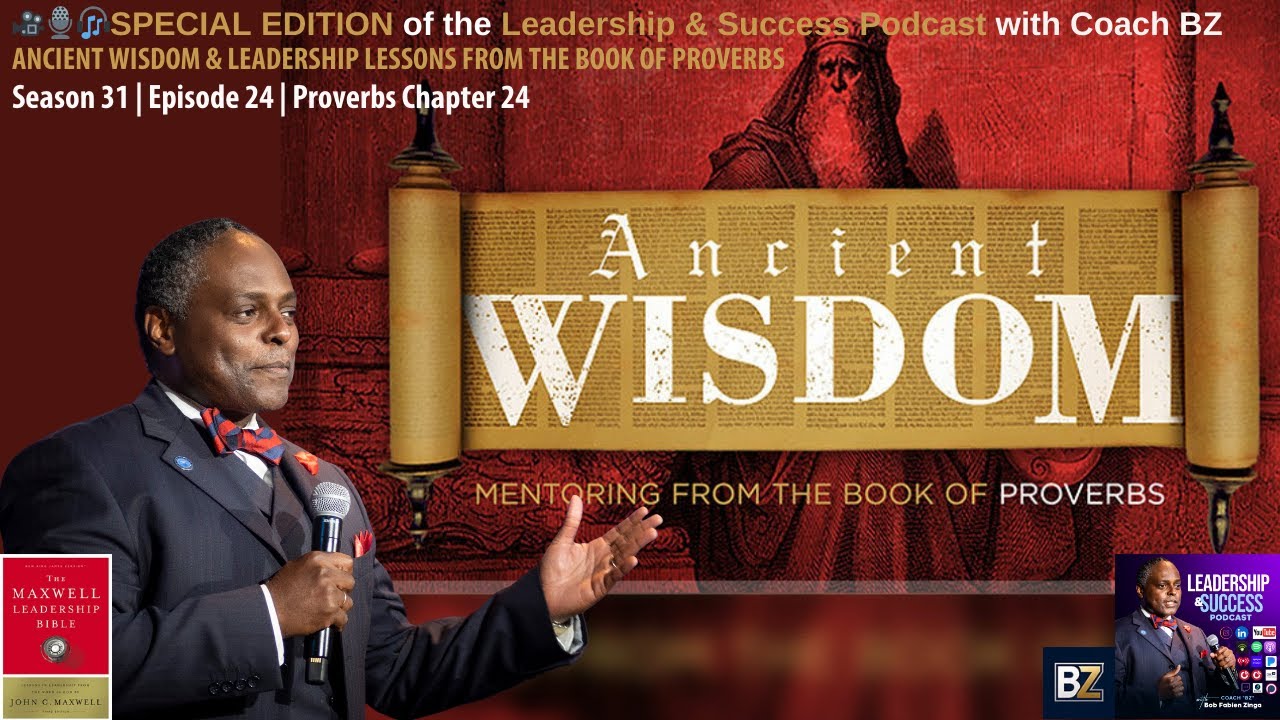
Coach BZ extracts seven leadership lessons from Proverbs 24, including building before the battle, finding strength through wise counsel, and rising after falling seven times. He frames the ancient text as practical wisdom on preparedness, perseverance, and principled courage rather than reactive crisis management.
Chapters
Hi, I'm John Maxwell. When the top companies in the world are looking for trainers, speakers, and coaches, there's one name that stands above the rest, and that's Maxwell Leadership. Our certified team members have gotten proven results for companies all over the globe, and our reputation I'm proud to say, is second to none. Some of our members have risen to the top of their profession, including the one you're going to meet today. I proudly introduce you to my friend Bob Fabien Zinga.
Welcome to the Leadership and Success Podcast with your host, Coach BZ, where we help you lead with purpose and succeed with impact. If you're ready to grow into the kind of leader others want to follow, this podcast is for you. If you're determined to elevate your success and leave a lasting legacy, this podcast is for you. As my mentor, Dr. John C. Maxwell, reminds us, everything rises and falls on leadership. Our goal is simple: to inspire you, challenge you, and equip you with insights that can transform the trajectory of your leadership journey. Welcome aboard to another episode of the Leadership and Success Podcast. Podcast with Coach BZ.
Hello everybody, welcome to another special edition of the Leadership and Success podcast. This is your host, uh, Coach BZ, and today we're going to be talking about Proverbs chapter 24. This is not a religious podcast, but it's about ancient wisdom and leadership lesson from the book of Proverbs. Alright, before we get started, let's have a moment of gratitude. This is the part of the show where we take just one moment and we think about one thing we are grateful for every time that we meet. So if you would maybe close your eyes, take a deep breath, put yourself in your happy place, and think about one thing you are grateful for today. I guess my prayer, what I'm grateful for, is peace on earth and goodwill towards men. I think we need more stability in the world, and I want to do my part so that we might be kind to our neighbors and live in peace. Because when we have peace, then we can have prosperity, and everybody can do well. There is so much division in the world and in America right now, and my hope and what I want to be grateful for is for America to be one united country again, one nation under God, regardless of your politics, your race, your religion, or your sexual orientation. We need to be one nation under God. So that's what I am hoping for, and that's what I am grateful for. Alright, let me know what you are grateful for and type it in the chat. And also let us know where you are joining us from, what country if you are outside of the US, or which city and state if you are within the United States. And also, what— so I already said what you're grateful for, but also whatever insight you might have on the Book of Proverbs chapter 24. As you know, we have two books here for our curriculum, one of them being the Maxwell Leadership Bible, and it has a lot of great comments on leadership from the book of Proverbs. And we also have the 21 Irrefutable Laws of Leadership for Season 5 of the Leadership and Success Podcast. So this is a special season, this is Season 31. And we're going to end on the 31st of January. So I'm looking forward to hear your insight. And also I will have 7 lessons today from Proverbs chapter 24. And I am also looking forward to hear your feedback on the 7 lessons I'm going to share today. All right, let's get started. First, let's do a review of what we studied yesterday. Yesterday. And again, all of those podcasts are available wherever podcasts are available on all of the major podcast platforms. You can go back and watch Season 31, Episode 1 through 23rd, which was yesterday. It's on Spotify, it's on LinkedIn, it's on YouTube. All right, so yesterday we talked about Proverbs chapter 23, the theme being guarding the heart. And governing desire. Our first lesson, leadership lesson number 1, was discern power before you sit at the table. That was based on verses 1, 2, and 3. And the insight was influence often arrives disguised as opportunity. Wise leaders discern motives, power dynamics, and hidden costs before accepting favors or access. Leadership Lesson number 2 was, "Do not chase illusions of wealth," based on verses 4 and 5. Wealth is fleeting, wisdom is enduring. Leaders who define success only by accumulation lose sight of purpose and people. Alright, leadership lesson number 3, "Beware of Eden agenda," based on verses 6, 7, and 8. Not every smile is sincere, Leaders must recognize when generosity is transactional and relationships are conditional. So use wisdom. All right, leadership lesson number 4: discipline is a gift, not a punishment, based on verses 12, 13, and 14, because correction preserves life and potential. And leaders who avoid discipline will eventually enable dysfunction. Leadership lesson number 5: yesterday we learned to guard our heart because our heart drives everything. Based on verse 19, right? Hear thou, my son, and be wise, and guide thine heart in the way. Guard your heart because leadership failures often begin in the heart long before they surface in behavior. All right, leadership lesson number 6: excess erodes authority. Based on verses 20 and 21. So overindulgence, whether in food, drink, ego, or pleasure, will dull judgment and credibility. And finally, Leadership Lesson Number 7. Yesterday we talked about private choices shaping public legacy, based on verses 29 through 35. So unchecked appetite will lead to compromise Vision. What leaders normalize privately will eventually surface publicly. All right, so that's what we learned yesterday, Proverbs 23. Today we're gonna start Proverbs 24. All right, what is the big idea? Well, for Proverbs 24, it really teaches us that leaders have wisdom But wisdom is not passive knowledge. It is discipline, courageous, and action over time. That's wisdom, right? So this chapter confronts envy, shortcut, complacency, and fear while elevating preparation, resilience, justice, and perseverance. So leadership success is not built in moment of crisis, but in the quiet consistent work done before adversity arrives. So wise leaders prepare their house, steward their influence responsibly, and rise again when they fall. So the central theme here is preparedness, perseverance, and principled courage define enduring leadership. All right, leadership lesson number 1, uh, based on verses 1 and 2: Guard your heart from envy and shortcuts. Let's listen to that.
Do not be envious of evil men, nor desire to be with them, for their heart devises violence and their lips talk of troublemaking.
Do not be envious. So envy corrodes leadership judgment. Leaders who admire unethical success risk internalizing destructive methods. What we admire eventually shapes how we lead. So how do we apply this? We should audit who we admire and why. Reject success that requires compromised values. And measure progress by integrity, not speed. So whose success tempts you to compromise? And are you admiring outcomes without examining the method? Because it's not just what you are doing, but it is why you are doing it and how you are doing it. So the anchor reflection here is leadership built on envy eventually collapses under its own weight. Alright, leadership lesson number 2: Build before the battle, not during, but before the battle, based on verses 3 and 4.
Through wisdom a house is built, and by understanding it is established; by knowledge The rooms are filled with all precious and pleasant riches.
Through wisdom, a house is built. So organizations don't fail in crisis, they fail in preparation for the crisis. So wisdom builds structure, understanding sustains culture, and knowledge fills the details. So you have to prepare before the crisis hits. Not during it. Okay. One of my primary mentor, Brian Tracy, always used to teach us, right? You have to measure twice and cut once. One hour of preparation will save you up to 10 hours of execution. So planning, preparation, that is so critical. Okay. So how do we apply this? So invest in systems. Training and trust before pressure hits. Develop people, not just plans, and build depth, not dependency. All right, so is your organization resilient or merely reactive? Okay, we don't want reaction, we want response, right? We don't want to emotionally react to whatever challenges we are facing. We want to have a plan and we want to respond to it. So create the space for planning, for thinking ahead of the execution. So where have you postponed preparation? Because strong leaders, they build quietly long before they are tested publicly. So are you preparing now? All right, leadership lesson number 3: strength is revealed under pressure. Verses 5 and 6.
A wise man is strong. Yes, a man of knowledge increases strength. For by wise counsel you will wage your own war, and in a multitude of counselors there is safety.
I love that. In the multitude of counselors there is safety. Strength is revealed under pressure. True strength is humility, the willingness to seek counsel and adapt. Lone wolf leadership is brittle leadership. And I think you need to have at least 2 or 3 advisor, counselor, people you can go to within your inner circle, people who are not gonna be speaking about your business publicly, but people who really love you, care about you, and are going to speak into your life and help you make the right decision. Everybody needs that. Before you make a critical decision, ask your board of trustees, your personal board of director, hey, am I missing something? Do I have a blind spot? What do you advise? And then you have to listen, and then ultimately you make the decision, but you have to listen to counsel because a wise man is strong. For by wise counsel you shall make your war. Counsel. All right, so how do we apply this? Build advisory circles, not echo chambers, right? You need to have a diverse team of people for your department head and the people who work for you, coming from different backgrounds. This way, uh, they could clearly see your blind spot and not everybody came from the same experience and not everybody sees things exactly the same way. So do that for your teams, but also for your advisory circle. And especially for the advisory circle, giving them full permission to speak to you frankly, no matter what, even if you don't want to hear it. That is A very powerful place to be because that's gonna allow you to avoid making costly, costly mistakes. Okay. So normalize asking for help. It's okay to ask for help. We don't know everything. Actually, the more I know, the more I realize I don't know very much. And I have that mindset of always, always learning. I have an open mind. Okay. And separate decisiveness from isolation. When I was starting on my leadership journey, I used to hear all the time, it's very lonely at the top. I guess it could be, but it doesn't have to be. As you climb up the corporate ladder, make sure you are bringing people with you. Make sure you keep in touch with your mentors, your coaches, people who have helped you along the way so that you never have to be lonely at the top. So you can be decisive, but you don't have to be isolated. And before you make major decision, again, I highly, highly recommend to seek out the counsel of 2 or 3 advisors. All right, so wisdom multiplies strength and pride fractures it. Okay, so leadership lesson number 4: courage requires action, not silence. That's based on verses 10 and 12. So Let's listen to that.
If you faint in the day of adversity, your strength is small. Deliver those who are drawn toward death and hold back those stumbling to the slaughter. If you say, surely we did not know this, Does not he who weighs the hearts consider it? He who keeps your soul, does he not know it? And will he not render to each man according to his deeds?
Hmm.
If you faint in the day of adversity, your strength is small. Courage requires Action, not silence. All right, so silence in moment of injustice is a leadership failure. And sometimes when there is injustice, you are really not necessarily— it's not really the people who are clamoring for the injustice. For example, when I go back, Martin Luther King, right, the letter He wrote from the jail in Birmingham, Alabama. I used to live in Tuscaloosa, Alabama. The biggest problem wasn't really for those racists who didn't think that Black deserved any civil rights whatsoever, but it was the great majority, moral majority of the country who knew that it was wrong, but they decided to just be silent, to not say anything. They, I guess, prioritized order over justice. That is very, very bad. And as a leader, you cannot be silent when there is an injustice. You do have to speak up. That's what leadership is all about. You have to lead, you have to raise your hand, you have to put something at risk in order to make things right. So silence in moment of injustice is a leadership failure. You cannot say, well, I am not concerned with that because that's about Black people. I am white, so that has nothing to do with me. No, it has everything to do with you. You are an American, aren't you? So don't be a coward, right? You do have to stand for principle. You have to stand for your core values. Wow. Yesterday I talked with Colonel Tom Gordon. He wrote the Marine Maxim. And one thing that he said, his philosophy that really guided most of his career and also the way he's been mentoring, this Marine, especially the junior officer, was fear no one, right? Do the right thing and fear no one. Meaning you have to do what is right even if you are speaking truth to power. Fear no one, do what is right. That's powerful. Very, very simple. Maybe not always easy to implement, but that's the right thing to do. That is leadership. If you are going to lead, you have to take risk sometimes and you have to stand for what is right. Because leaders are accountable not only for what they do, but for what they refuse to confront. Again, if you faint in the day of adversity, your strength is small. And I am reminded, I think it was during World War II, right? Somebody was saying, first they came for the Jews and no, I didn't do anything because I wasn't a Jew. Then, They came for all kinds of people. And then eventually when they came for me, nobody did anything because there was nobody to stand for me. So that is so powerful. And as a leader, you do have to take a stand. You have to have values that are core to you that you will not compromise on. Take a stand. Okay. So how do you apply this? I believe you should intervene when people are being harmed. Speak when silence feels safer and on moral responsibility, not plausible deniability.
Okay.
All right. Where have you rationalized inaction and what injustice are you hoping someone else will address? Because this is the question. If not now, when? And if not you, who? Maybe God, the universe, put you in this place in history just because you are the type of person we can count on in order to change things and do the right thing and get, you know, our country, our culture, our community heading into the right direction. So think about that. So leadership courage is measured when retreat feels reasonable. Alright, leadership lesson number 5: Justice must be consistent and impartial. Let's read verses 23, 24, 25, and 26.
These things also belong to the wise. It is not good to show partiality in judgment. He who says to the wicked, 'You are righteous,' him the people will curse; nations will abhor him. But those who rebuke the wicked will have delight, and a good blessing will come upon them. He who gives a right answer kisses the lips.
Wow. It is not good to have respect of persons in judgment. Favoritism erodes trust faster than incompetence will. Leaders must apply standards evenly or lose credibility entirely. And some of the best commanding officers, skippers I've ever had throughout my entire career are people who had very, very high standards, but they were fair and they were consistent. You knew exactly where they stood at any time. No confusion about that. This is our mission and this is the standard and this is what we need to do. Clarity. Everybody was very clear about their role and you knew when you hit it out of the park or when you kind of failed and missed. The mark and you will know exactly what the consequences would be, right? No exception. They treat everybody exactly the same, no favoritism, right? Justice must be consistent and impartial. If you're gonna be a leader, you have to be consistent. So people need to know exactly what to expect every single day and not be like, oh, I don't know, the boss may be, you know, this way today and a completely different way tomorrow. No consistency. You are who you are. You have core values. The way you believe, the way you think, the way you feel, the way you act, it's all consistent all the time, no exception, right? And then impartial. You treat everybody exactly the same, no favoritism. Okay, so how do we apply this? Hold high performers to the same standard and address misconduct consistently, no matter who the person is. And that includes yourself too, because sometimes when you get into great position of leadership, you tend to think, "I am above the law. I am above the rules. The rules is for everybody else who works for me except me. I am the exception." No, no, no, you are not. A great leader is actually a servant. The rules apply to you first and then to everybody else within your circle of influence. That's the consistency we are talking about, the credibility. That's how you you build it. All right, so we want truth-telling and not flattery. Don't have people who tell you what you want to hear and flatter you. You want people to tell you the truth no matter how you want to hear it or not, no matter how disagreeable it might be. You have to listen. That's leadership. So where have you excused behavior because of your rank or result? Because sometimes, because people are high performers or they're bringing a lot of money to the enterprise, you're like, okay, 'cause the rules are not gonna apply. They are extremely competent at what they do. No, the rules absolutely need to apply because if they don't, then the other people who are hardworking are gonna see that and know that you are full of nonsense, right? And they're gonna be looking for another boss because they do say that most people leave jobs not because of the work itself, but because of their immediate supervisor. If you are treating somebody completely different, they are breaking all kinds of rules, but you're making all kinds of excuses for them just because they bring in the most money, then you are setting a new, uh, standard. So you need to treat everybody, uh, the same. So do your people trust your fairness? Would you trust your own fairness? Would you wanna work for yourself? So the anchor reflection here is that justice delayed or selectively applied is injustice. So as a leader, you have to be fair and you have to be consistent across the board. All right, leadership lesson number 6: prepare your field before you build your house. So that's verse 27. Let's go there.
Prepare your outside work, make it fit for yourself in the field, and afterward build your house.
Prepare Before you build, plan before you execute. Vision without execution discipline is fantasy. Leaders sequence wisely, laying groundwork before expansion. So strengthen foundation before scaling, prioritize readiness over just appearance, and align resources before ambition. So are you building prematurely? And what foundation still needs strengthening. Because wise leaders, they respect order, timing, and process. And sometimes with a process, it might take a little bit longer, but it'll last a lifetime, right? So it's not about speed, it is about impact, it is about effectiveness, it is about legacy. All right, the last lesson today, we are going to, Talk about leadership lesson number 7: The righteous rise again and again. Verse 16, let's go there.
For a righteous man may fall 7 times and rise again, but the wicked shall fall by calamity.
Man, we fall down, but we stand back up again. We fall down, but we get up again and again and again. A just man falls 7 times, but they rise up again. So if you fall 7 times, that means you have to rise up. 8 times. Just don't give up, because failure is not fatal, but refusal to rise is fatal. Resilient leaders, they recover, they learn from their mistakes, and then they return stronger. A setback is a setup for a comeback. Dr. Willie Jolley said that. Always learning how to bounce back. Resilience. Success. I am looking for my success coin. Yeah, this is a coin one of my commanding officers gave me. On this side it says success, and on the other side it says failure, right? Success and failure is two sides of the same coin. And most of the time, people only put the spotlight on your successes, as if you've never had any failure. But the truth is, like, every time I interview great people, outstanding leaders, I always ask them, how has failure shaped your life. Because we can be talking about your successes, and we do, and we want to celebrate that. But the truth is, you wouldn't be successful unless you learn through failure. Because success has many fathers— I believe Jeff Bezos is the one who said that— but failure is an orphan. And it's very important as a leader to also share your failure, your vulnerabilities, with your team so that they know that they can relate to you. You are not a superhuman or a god or something. And sometimes your path to success is through failure. So what lessons are you learning? Now, you're gonna fail many times because, you know, to err is human, but you don't want to be making the same mistakes over and over and over and over again, right? You wanna make a mistake and then learn from it and never repeat the same mistake twice. You're gonna fail again, that is fine, but a different mistake and a different lesson and keep learning. And eventually I believe you will find your path to success. Actually, it's pretty much a statistic question. I've worked in Silicon Valley since 2014. I've been in quite a few startups here, but basically there is a certain rate of failure before you get to success. So sometimes when you have a new business, you kind of have to make up your mind, okay, I know I am going to fail, so let me just go through the failure now as fast as we can and learn from those so that we can get to our success. That is okay, right? Uh, like, um, Thomas Edison went, uh, he invented the light bulb. They said that he failed 10,000 times before he finally got it right. 10,000 times. The man didn't quit, right? The just man falls 7 times, but he rises up again. He fell 10,000 times, but the 10,001 time that he tried, it worked. And like they say, the rest is history. So you have to have that resilience. Failure is not fatal, but refusal to rise is fatal. Resilient leaders recover, they learn, learn, learn, learn, and then they return stronger. So how do we apply this? Normalize recovery, right? Not perfection. I am not perfect, but I believe I am a person of excellence. And when I make mistake, I acknowledge that. No, don't have a big ego. Yes, I am humble. I've made a mistake and I'm gonna learn from it and not repeat. That mistake. That's all I can promise you, right? Normalize recovery, lead transparently through setbacks, and model perseverance publicly. All right, so how do you respond to failure, yours or others? And do you rise wiser or resentful? Because that's completely up to you, right? Because resilience, not flawlessness, defines righteous leadership. All right, so those are the 7 lessons I have for you today for Proverbs chapter 24. We're gonna do Proverbs chapter 25, uh, tomorrow. Tomorrow is Sunday, January 25th. So it's going to be again ancient wisdom mentoring from the book of Proverbs. This is not a religious study, but it's a study about ancient wisdom and leadership lesson from the book of Proverbs, written more than 2,000 years ago, but still has leadership principles, right? These laws of leadership that are still applicable today. That's pretty amazing. So as a closing, Proverbs 24 calls leaders to reject shortcuts, prepare diligently, and act courageously and wise resiliently. Because with resilience, what that means is you take a licking but you keep on ticking. You just do not give up. It reminds us that leadership is not proven by appearances, but by preparedness, preparation before execution, by justice under pressure, and by perseverance after failure. Those who lead well do not avoid hardship, they are ready for it. All right, that's all I have for you today. And next week, I believe on Wednesday, I will have a great pleasure of sitting down with, let me see if I can find it, I'm gonna be speaking to Alison Welsh. So she is the author of the best-selling book, I should have that here, She Believed She Could: Show Up, Shine Bright, and Achieve Abundant Success. I am really looking forward to it. That's going to be next Wednesday. I hope you can join us. She's a terrific speaker, just motivator, and what she's going to share to us will apply both to men and women, although she does focus on women leadership. So I am absolutely looking forward to that, and I hope you can join us. We have a comment from the audience. I am glad I stumbled on this live session. This is divinely orchestrated. Great teaching on leadership and wisdom using Scripture. Thank you so much. And also, I would like to hear from you if any verses I missed that are important to you. It looks like that was Grace Ajeli. So Grace, if you have any insight on any of the other verses, please let us know. And if any of the 7 lessons kind of speak to you, let me know which one speaks to you the most and some of your comment. And again, you can go back and watch all of the previous episodes on LinkedIn, on YouTube, on Spotify from January 1st all the way to yesterday, January 23rd. And today's lesson will be there by the end of today. Thank you so much for watching and I look forward to learning from you as well. So yes, Grace, the platform to learn is mainly LinkedIn. So I do these LinkedIn Live every single day. And you can go back on my channel and see all of the previous lives, but I am on YouTube as well and on Spotify and really everywhere that podcasts are available. Thanks again for letting me know. I always love interacting with the audience. Like I said before, this is my 5th season now and I pretty much have a global audience today. But when I first started 5 years ago, it was an audience of one, me, myself, and I. So I really love interacting with the audience, and I know a lot, but I don't know everything, and I'm always willing to learn from the audience too, because we all see things a little bit different, and I think we can learn from one another. Like the book of Proverbs says, right? Iron sharpens iron. So I am here to share what I know, and I also want to receive from the audience what you can share. So Follow me on LinkedIn and I'm gonna be live again tomorrow, Sunday. And thank you so much, Grace, for being part of our active audience today. All right, so that is all I have. So I will be back tomorrow with Proverbs chapter 25. Again, this is not religious at all, but it's about ancient wisdom and leadership from the book of Proverbs. All right, see you tomorrow. Have a wonderful weekend. Bye for now.
Thank you for tuning in to the Leadership and Success Podcast with your host, Coach BZ. If today's episode added value to your leadership journey, be sure to subscribe, share, and join us again for more wisdom nuggets on how to lead better and achieve greater success. Remember, leadership is the most critical skill of our time. The world will always need leaders to inspire, inspire others, drive innovation, and execute meaningful strategy. So why not count yourself among the bold leaders shaping the 21st century? Until next time, stay inspired, stay committed, and keep leading with excellence.
More from Bob

S250:E4🎙️LIVE 🇺🇸America 250: President Barack Obama Leadership, Service, and the Power of Hope






S5:E157🎙️ LIVE with CMD CMSgt Dennis L. Fritz, USAF (Ret.)(Multi Tracks Audio)



S5:E156🎙️ LIVE 🇪🇸 Leadership Lessons from the FIFA World Cup 2026 Champions (Multi Tracks Audio)

S250:E3🎙️ LIVE Leadership Lessons from America’s First Documented Family of African Descent 🇺🇸📖