S4:67 🎙️LIVE with Eddie Bright Jr. (Multi Audio Tracks)
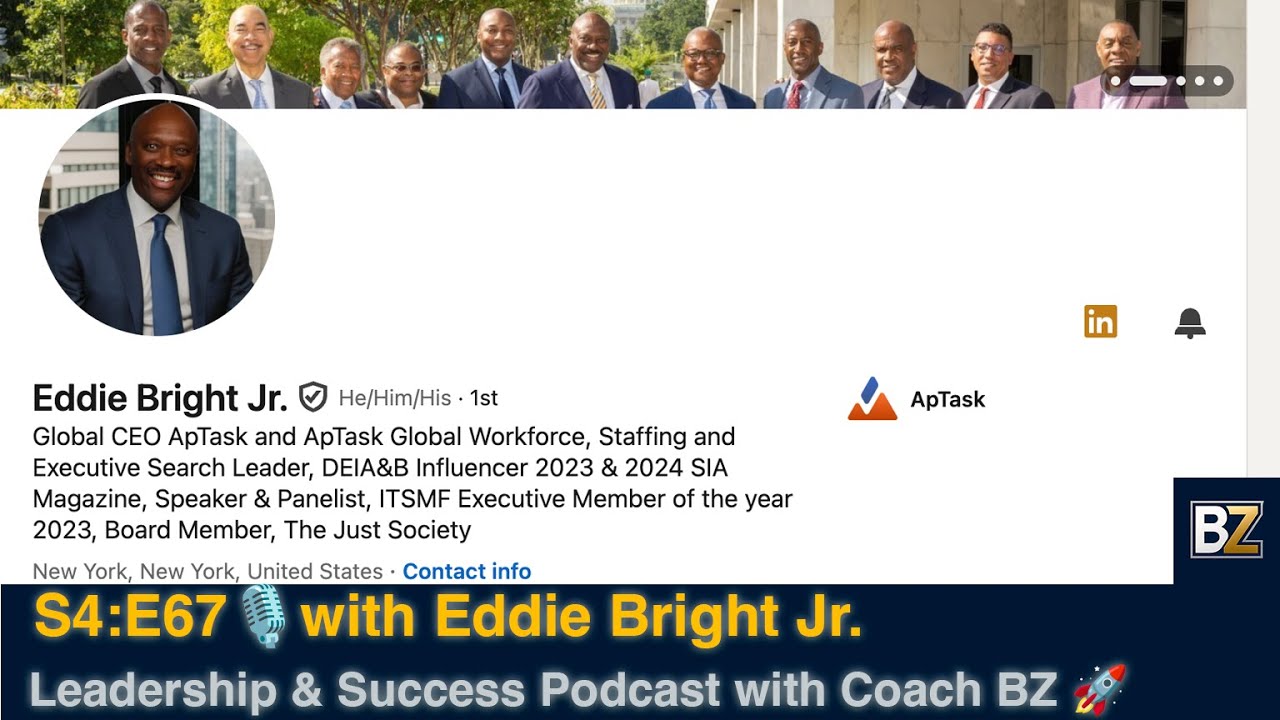
In this extended live episode of the Leadership and Success Podcast, host Coach BZ (Bob Fabien Zinga) interviews Eddie Bright Jr., Global CEO of AppTask Global and former US Marine Corps officer. The conversation covers a wide range of topics, from Eddie’s personal philosophies and leadership principles to practical business insights. Eddie recommends several books that have shaped his thinking, including Daniel Kahneman’s Thinking, Fast and Slow (introducing the HAL T principle—don’t make decisions when hungry, angry, lonely, or tired), Robert Livingston’s The Conversation on inequity, and Ken Wiseman’s The Myth About Evolution. He emphasizes treating everyone as a brother, regardless of background, to eliminate prejudice. When asked about his ultimate legacy, Eddie says he wants to be remembered as a blessing to others, embodying gratitude and self‑less service. He identifies the current political polarization in the United States as a national‑security issue he wishes he could solve by bridging the hard right and hard left. Eddie also promotes his company, AppTask Global, highlighting its global talent‑matching platform, the use of AI, and the concept of “career advocates” instead of recruiters. The interview includes personal reflections: advice to his 17‑year‑old self to say “no” more often and recognize personal limitations, a quick self‑portrait of his childhood (fearless, strategic, compassionate) and adult traits (conservative, thoughtful, considerate), and the one word that captures the episode—“Enlightening.” The discussion weaves these new insights with earlier themes such as dual‑heart leadership, personal branding, DEI ROI, Zone of Genius, gratitude, mentorship, and executive presence.
Chapters
Yay! Hi, I'm John Maxwell. When the top companies in the world are looking for trainers, speakers, and coaches, there's one name that stands above the rest, and that's Maxwell Leadership. Our certified team members have gotten proven results for companies all over the globe, and our reputation, I'm proud to say, is second to none. Some of our members have risen to the top of their profession, including the the one you're going to meet today. I proudly introduce you to my friend, Bob Fabien Zinga.
Welcome to the Leadership and Success Podcast with your host, Coach BZ. If you need to develop into a better leader, this podcast is for you. If you want to achieve a greater level of success, this podcast is for you. His mentor, Dr. John C. Maxwell, said it best: everything rises and falls on leadership. We hope to inspire you today and provide you with an insight that has the potential to positively impact the trajectory of your life. Welcome to the Leadership and Success Podcast. Imagine gaining the leadership skills that could redefine your career. Join Coach BZ on the Leadership and Success Podcast, where each episode delivers practical insights from world-class speakers, military leaders, and industry experts. We dive deep into what matters most: building resilient teams, leading through uncertainty, and navigating complexity with clarity and confidence. Every conversation is crafted for aspiring leaders like you who are ready to grow, lead, and make a lasting impact. Don't miss our powerful live sessions and recent highlights. Michelle Hayward on building diverse, high-performing technical teams. Anne Leslie on leading through global complexity and cybersecurity risk. Ron Carpenter AI exploring faith, resilience, and AI-powered leadership. Colonel Michelle G.I. Gardner-Intz on commanding influence from the battlefield to the boardroom. Chris Robinson on shifting from drift to drive in life and leadership. And Coach Enrique Acosta Gonzalez on mentorship, legacy, and heart-centered leadership. Ready to level up your leadership journey? Tune in on Spotify, Apple, Audible Podcasts, YouTube Live, and LinkedIn Live. Join the movement toward leadership excellence. Listen now and start transforming your success.
Welcome back to another episode of the Leadership and Success Podcast with Coach BZ. I'm so glad you're here because today we have a very special guest, someone whose leadership journey spans the Marine Corps, global business, ministry, and mentorship. My guest is Eddie Bright Jr., the Global CEO and Partner of Aptask and Aptask Global Workforce Solutions. Under his leadership, Aptask has grown into a worldwide leader in staffing, executive search, and workforce solutions with operations in India, Germany, London, Canada, Mexico, and across the US. Eddie is a veteran certified and minority-owned business leader who has proven that diversity, equity, inclusion, and belonging aren't just ideals. They're a recipe for measurable business growth. In fact, he's shown companies how truly inclusive ecosystems can be, 35% to to 42% more profitable. He's been recognized by staffing industry analysts as one of the top DE&I influencers for 3 years running, honored as a top Black business visionary by Bizalight Review, and named Executive Member of the Year by ITSMF, the leading organization for Black technology executives. But Eddie's story goes far beyond the boardroom. He's a former US Marine Corps officer, a minister at Community Baptist Church, and the co-founder of sports university team IZOD, where he and the late NBA legend Darryl Dawkins mentored young athletes like Karl-Anthony Towns, Kyrie Irving, and Naz Reid, helping them develop life skills that last far beyond the court. Most importantly, Eddie is a man grounded in faith, family, and service, recently celebrating 27 years of marriage with his wife Kay, and raising their son, Brandon. Today, Eddie is here to share his wisdom on leadership, workforce transformation, DEI as strategy, mentorship, and legacy. So buckle up, because this conversation is going to challenge the way you think about leadership and inspire you to take action in your own journey.
I call personal branding what people say about you when you're not in the room. When we think about the interviewing process and that company that you really want to go work for, what have they been left with from the interview? Most important thing that a candidate can ask during the interviewing process are the right type of questions. What are you looking for, Mr. Interviewer or Miss Interviewer? Why haven't you filled this role? How long has it been open? What are your expectations for the right person? And then at the close of it, when it's all over, why do you believe that I would be the right person for this role? Now, many times, conversely, the company is doing those type of takeaways on you, but you can reverse that. Number one, it shows insight. Now, you only ask these questions after you've collectively shared insights, so it's a logical question, but it also shows how you have that level of accountability.
Alright everyone, I'm so excited today. This is a wonderful, wonderful day. I have a very, very special guest for you today. Before we get started, let's do our moment of gratitude as it is customary on the show. It's gonna take less than 1 minute, but I want you for just a moment to think about one thing you are grateful for today. So if you are open to it and it is safe, go ahead and close your eyes, take a deep breath if you must, and just take 1 second and be grateful for one thing today. What is it for you? What are you grateful for? I think today I'm grateful for my networking. Somebody says your network is your net worth, and I'm so grateful for the people I've met throughout my professional career who have helped me, many of which I will never be able to pay back. But I am so grateful to have a wonderful, wonderful network. And I guess I've really never met a person who was a stranger to me. Everybody is a friend, at least a LinkedIn friend or connection. But valuing people and adding value to them and them doing the same for you. I think that's really what makes the world go around. So today I am grateful for my network. All right, so whatever you are grateful for, please type it in the comment so we can share across the community. And now let me tell you a little bit more about my guest today, Eddie Bright Jr. He really doesn't need any introduction, right? He's a global CEO of Aptask and a trailblazer in workforce solutions, DEI innovation, and servant leadership. From transforming companies with human-centered design to mentoring the next generation for sports university team, ISOD, Eddie embodies the kind of leadership that inspires change in boardrooms and communities alike. I think if you've ever heard him speak on TV, on the radio, or anywhere, you will know what I am talking about. He really reminds me a lot of one of my late mentors, General Colin Ware. When he gets in the room and he speaks, people just stop and they listen, right? There is that gravitas, that seriousness. There is that energy that comes out of him. He really wants to add value and every word he says really, really matters. So I want you guys to pay attention. This is your chance to hear Eddie's story. Marine Corps officer, visionary CEO, award-winning DEI influencer, minister, husband, father, and gain actionable insights you can apply immediately in your own leadership journey. So guys, pay attention. Ladies and gentlemen, please help me welcome Eddie White Jr. How are you doing today, Eddie?
Baba, I'm not sure. That's a tremendous introduction. I don't know whether to stay or to run. And run, and there ain't nobody chasing me. That's a tremendous introduction. But thank you. Thank you for having me. Thank you for allowing me to be part of your ministry and part of the good that you're bringing into the world.
Thank you so much. It's really a great honor to be in your presence, sir. This is the last time I'm going to use the word sir. So, Eddie, What are you grateful for today?
You know, it is funny when you were reflecting there for a moment. I'm grateful for a clarity of mind this morning, just, just to be able to think, to be able to, to clear my thoughts and just a clarity of mind this morning. To be, to be able to be in this moment. That might sound way out there to some, but I'm grateful to just be able to be in this moment and come what will, come what will, just be in this. I think we bring so much with us and we carry so much that sometimes we're not able to just be in the moment. Yes, I appreciate the question. And I'm grateful for that.
That's so powerful because part of the reason why I do this, I usually do it around Thanksgiving. There is an organization, they do 21-day of gratefulness challenge where you are grateful for one thing for 21 days every day, and then you challenge somebody else in your network to do the same. And part of the reason why they do that, as you know, being a Marine Corps officer, in the military community, it's about 21, 22 veterans who commit suicide every single day. And it's really impossible for you to be suicidal and grateful at the same time. You can be depressed and grateful at the same time. You can be anxious and grateful at the very same time. That's just not possible. So mental health is important. And whether you're a believer or not, it's really good and positive, I think, to be grateful. So that's why we do this. So what is one thing about you that most people may not know about?
That I am not where I started. And what do I mean by that? You know, people when they see individuals that they connect with having some measure of success, whether it's on a large scale or pseudo-success or even in community, I think most folks don't know that, hey, I'm just a Black African American that's from Newark, New Jersey, that was part of that northern excursion that many of, our forefathers made from the South to the North. And that I am a compilation of a lot of people who lived out things in front of me that I have admired and grasped and made part of me, being myself, but being part of me. And I don't want to get too heavy with you asking what do people know about you is that I'm, I'm a lot of different people who have influenced my life in such a way that I'm grateful for them being in my life and me being able to emulate or take what I saw in them that impacted me that they would say to another level, to another level, whether it be my dad or my Uncle Joe or Ron Roberts or Reverend A.O.L. Sutton, just a whole bunch of people that impacted and poured into me and affected me in such a way that, you know, like they always say, you are your father's son.
Yes.
And you are. So I would, I would sort of lead with that.
That is very, very powerful because we definitely are the people we surround ourselves with. Dead or alive. Like, for me, I know my mother had a huge, huge role in making me the man I am today. And that's part of the reason why I do this podcast too. I'm hoping by the end of the hour, you are going to mentor us, teach us from your wisdom and experience. We're not going to get what you have earned, but hopefully have an insight in what you have learned. And I think it could help somebody else.
I'll give you a quick example. When I'm in worship— and people worship in many different ways— yes, when I'm in worship, and my mind meditates on just the goodness of God, I cry like a baby. Now here I am, you know, I've led men and I'm leading individuals all over the world. But I cry like a baby, like a child. And I used to be like, why do I cry? Like, I can't help it. I cry. I'm a crier. So one time I was with my father at his church. And there's a songstress that sings a song that's titled I Won't Complain.
Yes.
I'm sitting— I'll never forget it. I'm sitting in the second pew. My father's off to the left. He's leading in worship. And Bob, he was bawling. Bawling. I got it.
Yes.
I'll never forget the moment my father was bawling uncontrollably to how this song took him to wherever it took him.
Yes.
Okay, I get it. I get it. Wow. So we are, we are our parents' children in more ways than one. And even, um, uh, habits, good habits, bad habits, all these things are things that, um, we need to be mindful of.
You need to be—
as we grow older, there's some real treasures that we can find out about ourselves. And maybe we have to make some changes or we have to navigate some things or be mindful how we react to things. And I've tried to even read books, and I know we'll get into that. I've tried to even read books, help me sit back and really be very introspective. Of myself.
Wow, that is really, really powerful. I know music is quite powerful in life. I think most people, even if you ask them about a very traumatic event, even COVID-19 pandemic, 9/11, which really changed my generation, affected the Gen Xs out there, there is usually like a song that you would remember. Where was the music I was listening to? I won't complain Very, very powerful song. I've had some good days, I've had some hills to climb, I've had some weary days and some sleepless nights. I think everybody can really relate to that. But when I look around and I think things over, all of my good days outweigh my bad days. I will not complain. That's powerful. That is powerful. And that's why I ask people like you come on the show, great leaders, what do you listen to? What do you watch? What do you read? Because I think you can get inspiration. And somebody could be going through a very, very tough time right now, and just a word of what you're going to say today, you know, could change the rest of their life. It has that potential. So thank you, thanks so much. All right, so would you please tell us a little bit about your leadership journey?
Sure. Um, I, I think that when we think about leadership, we always think that leaders are out here doing great and tremendous things, and they're they're rallying the cause. And, um, we paint in our minds David slaying Goliath for, you know, uh, World War II, or, or if there was a battle and we needed to overcome this, you know, we see the things in the movies where the leader rises and the leader is the least one you would expect to be. That's not life. That's not life. I had to realize, first of all, you want to realize what your gifts are. Wow, you have to grow into your gifts. Now, there's one thing between having your gifts and growing into your gifts. So, so I'll get to your question in a sort of roundabout way. First of all, a leader has to be someone who's not afraid to take up the cause. Now, I say that because you can be taking up a cause and you can be very talented but you don't necessarily have what I call the heart. And there's two types of heart. There's a heart for the cause and there's a heart for the people that you serve.
Wow.
If those two hearts are not working, you will never be an effective leader.
Say that again, please. Say that again. This is powerful.
There is heart for the cause. There's that. Yeah, let's go.
Yes.
But the bigger heart has got to be for the people you serve. Wow. You've got to want to see them be successful too. You've got to take the time to invest into their cause, why they're here, what is their why.
Yes.
If both those hearts come together, then you can lead.
Hmm.
You'll never get to— we all know, Coach Bob, that you never get to success by yourself. It just doesn't happen. Not any real success.
Yes.
So if you're going to have real success in your life, if you're going to be what we call a leader, there's got to be that— not a fearlessness, but there's got to be, yeah, I believe we can do that.
Yes.
And there's got to be, I care about the people that we're going to all do this together and what we are going to do this for. Sometimes the best way to lead is from behind. Wow. There's a passage in the Bible, and I want to remember it, where God says to Abraham, he says, walk thou before me and be thou perfect.
Yes.
Walk thou before me and be— now what does that mean? What, what I believe God is saying is walk thou before me and be mature.
Wow.
Go get it knowing that I got your back. Knowing that I got your back. Now you've got to believe in something. When David came to slay Goliath, what did he say? He said, is there not a cause?
Yes.
He didn't come and say, man, I'm David, I've been out here and I got these rocks and I'm going to take the— he did say, I'm going to take this giant down. He said, today I'll have his head. But he said, is there not a cause?
Yes.
So if you're going to be a leader, there has to be a cause. There has to be a reason why. There has to be value behind it. There's got to be that heart for the people that you serve and you lead. And there's got to be that heart for reaching that goal.
Wow.
Those two together, you can lead. That's why the best leaders, we know it. Are servant leaders. You know, the guy that's out there, I'm the biggest, I'm the baddest, I'm the man, look at me, doesn't work. I'm a basketball guy. I love basketball. Well, 5 players have got to become one. Yes, 5 have got to become one. I love football. 11 have got to come on and they've got to all be moving at the same time in concert. It's like a symphony. If the wide receiver's not moving the right way on the play, the quarterback can't get the ball to the other wide receiver. Yes, that wide receiver is not diverting and, and taking gravity on the defense towards him. How's he going to get the ball to the wide receiver that might be open? Wow, everything is powerful, interconnected. I, I'm not trying to get, uh, too far ahead of myself or get too, too far in front of my skis, but real leaders are servants and they get a joy out of seeing other people succeed.
Yes.
Sometimes some of my employees will reach milestones and exceed expectations, and I'm absolutely ecstatic. And they'll be like, 'Ed, you're happier than I am.' Yeah, I am. Number one, because I want you to— I want you to realize— I want you to realize the moment that you reached your goal, and I want you to feel it, and I want you to understand the hard work it took for you to get there.. I want you to appreciate it. And I want you to be able to continuously— I want it to become like a muscle memory for you. I wanted to become a muscle memory. Like, what is success? How did I get there? What did I put in? Why am I here right now? And hey, my boss is, is up here more happier than I am. And I'm telling you, and I'm telling you to stay in next mode. And I know we'll get into some of my Wow, business thoughts on success. But then I want you to stay in next mode. I want you to continuously grow.
Wow, that is really powerful. And that's part of the reason why for this season of the Leadership Success Podcast, I have this book by my mentor, Papa John, John C. Maxwell, right? 21 Laws of Leadership. But then I also have—
does he also talk about the lid?
Yes, yes, the law of the land. The first law. Yes, yes. And the reason why I use the Bible— it's not a religious broadcast or anything like that, but really, when I was 17 years old, that's when I really started getting into success, leadership. I've studied the best of them, Tony Robbins, General Powell. I mean, anyone you can think of in this field, I've read their books, listened to their program. But really, the truth is Everything they say, there is nothing new under the sun, right? In Ecclesiastes, everything they talk about, success, principle for success and leadership, it goes straight back to the Bible. Like one of the best-selling self-help books, Think and Grow Rich, you know, as a man thinketh. So it's all in the Bible. So it's as old as the earth is really. So the verse is actually, what about you, you bring those leadership principles, Genesis 17:1. Abraham was 90 years old and 9, and the Lord appeared to Abraham and said unto him, I am the Almighty God, walk before me and be thou perfect. That is powerful. And then 1 Samuel 17:29, which says, David says, what have I now done? Is there not a cause? Wow, what leadership principle we can get out of those? That's quite powerful. So you've had a remarkable journey in the US Marine Corps as an officer to now being a global CEO. What leadership principles from the Corps have shaped the way you lead in the boardroom?
First one in, last one out.
Okay.
Listen, you know, the early bird, the early bird gets the worm, everybody else gets dirt. I mean, yes, we, you know that I'm sure better than I do. Coming out of the Navy, first one in, last one out. Um, I once heard a story. And I'll share it. There was a farmer who was looking for someone to take care of the farm and the barn. You may have heard this before. And he did a lot of interviewing, a lot of interviewing, a lot of interview, couldn't find anybody. I mean, he interviewed 20-something people, couldn't find anybody, anybody. And he was getting desperate because he needed someone good to watch the barn, watch the animals, and to keep it safe. So he interviewed a gentleman, and this gentleman that he interviewed had good experience. But he, but he wasn't like the other people trying to get into the bits and bytes and talk about what he does. He said, why are you qualified to take this job? And the gentleman said to him, sir, I sleep very well at night. Wow. Now, the, the former was like, okay, that's a weird answer. He says, well, I sleep very well at night.. And he had interviewed a lot of people and he just, he had felt something about this guy, didn't know what it was. He had a good background, but he said, okay, I'm gonna give you the job. Week later, a big storm came, a big storm, Bob. I mean, like, you know, torrential rain, borderline hurricane, twisters. And so he gets up and the first thing is he tries to wake the guy. And he, while waiting for him to wake up, he was like, you know what, forget that, let me get to the barn. And when he got to the barn, everything was locked down. All the animals were where they were supposed to be. Everything was positioned just right. And he understood what the guy said.
I sleep—
when he said, I sleep well at night.
Wow.
So when I my journey in leadership, I have tried my very best to be the best at what I do. Mm-hmm. It's part— it's— listen, it's just part of who I am.
I—
now, there may be some things that go into that. Obviously, I've been in settings where, as far as the demographic, I was the only African American.
Yes.
Obviously, I've got a military background. First one in, last one out. Obviously, I— this— there's a— how I say this— part of my feeling whole is to be the best that I could be, to be the best one there. I just want to be the best. There's a part of me that's an athlete. I played a lot of basketball, played a lot of sports. You've already said in part of your intro, I built a sports program. You know, there's an aspect of me that loves to compete. There's an aspect of me that loves to win. I've always had to wonder at what expense, because there's quality, there's character, and all those things go into winning. But I think all those things, you know, there's an aspect of me, it would be easy to say as unto the Lord, but we all fall short sometimes in that area. But there is something that I have learned in life and you started with your show. If someone was to ask me, and this is probably the biggest quadrant of my leadership skill.
Yes.
Someone asked me, what is your superpower? Because we like to ask that nowadays. What is your superpower?
Yes.
My superpower is gratitude. Wow. That's my superpower. I've said it publicly. I've said it on panels in front of thousands of people. Yes, my superpower is gratitude. I keep gratitude in my attitude. I have all the things—
say that again, please. My goodness, we're not gonna go far in this interview.
I'm telling you, gratitude in my attitude.
Wow.
All the things I've done and accomplished, that's swell, that's great. All the areas in which I've failed. And it could have gone to the left, gone sideways. Like I said, I'm just a poor Black boy that came out of Newark, New Jersey. Wow. Out of all the things that I've failed, I keep gratitude. And people that know me know this. You mentioned me walking into a room. People know when I walk into a room. Listen, first of all, now watch this and I'll share this with you. Being grateful allows you to be yourself no matter where you are.
Mm.
Wow. No matter where you are. As a matter of fact, I'm at a point in my life that if I can't be myself, I don't go. I don't go. I'll make somebody unhappy if I can't be myself. I am myself no matter where I go, whether I'm in a room sitting with some of the most powerful CEOs in the world, whether I'm sitting in church on Sunday morning, whether I'm— we have a prison ministry. I go into Bergen County Jail. Once a week, every week, whether I'm sitting there, whether I'm sitting with the kids in my basketball program, or whether I'm just sitting back with the wife and just bouncing life within our circle. Yes, I just try to be me. I try to be me. Now, I walk circumspectly, of course. Obviously, as Paul told, I believe it was Timothy, you know, walk circumspectly. I walk circumspectly. I understand the rooms that I'm in, but I'm able to be myself. And I think the favor— and I'm going to throw this word out, uh, on our podcast today— the favor that I've been given by very influential individuals is because I'm myself. I'm genuine. I'm genuine. I'm goofy sometimes. I'm I'm always passionate about what I'm talking about. I believe in what I'm talking about. I do my homework on whoever I'm talking to. I don't go in there, uh, you know, blind. Yeah, I, you know, so much information you can gain and then see what, what, what your service offering is. Could be a, could be a value proposition you could put forth.
Wow.
I do my homework. I do my homework.
That is powerful.
I'm putting all these things together. You asked one simple question about leadership style, but I'm putting all these things together because they have to be in play to work together. Yes, they have to be in play. And they have to sometimes—
that is powerful. At the same time, Eddie, I've got to ask you, I haven't even asked two questions that I had prepared. We're already talking about so much. So we're going to blow away this time. I know you are super busy. I'm so thankful, thankful you are here. Can I give you an additional 10, 12 minutes? Can we do that? Because you have so much wisdom, man. This is incredible. Something you said, be the best no matter— let me see how you did you say it? Yeah, be the best at what you do. I remember MLK had this speech, one of his best speeches beside I Have a Dream speech. I think I was maybe 7 or 8 years old when I heard that speech translated in French. He says, if a man is called to be a street sweeper,. It should sweep street even as Michelangelo painted or Beethoven composed music or Shakespeare wrote poetry. It should sweep the street so well that all the host of heaven and earth will pause to say, here lived a great street sweeper who did this job well. Excellence.
Wow. Let me, let me, let me throw something on top of that for you, Bob. I grew up at a time where My father said, Eddie, if you're going to be a garbage man, be the best garbage man that ever lived. Wow. He told me that. And I say that because sometimes the images that we connote with success are not healthy images, unfortunately. That's why we have a lot of people that want to be influencers.
Yes.
With nothing to influence. You know, that's why we have a lot of people that want to be entertainers, and they— that's not what their gift is. Yeah, they want to be a sports star, they want to be, you know, whatever, you know, because we've been told that the only way to be a success is a million people have got to know about you. And, and, and then here's the other thing. One of the things that I teach and I promote within my businesses is something called the ZOG. And what that means is that I'm looking to have each one of the people I work with operate from what I call their zone of genius.
Wow.
So you have, you have a zone of genius. I have something where I've developed it. It's a zone of genius. Everyone that's watching this podcast has a ZOG. What is your ZOG? What is your zone of genius? What is the one thing? And we've heard how you offer it. What's the one thing you would do for free. What's— no, there are things within you that are gifts that are meant to be given to the world.
Wow.
They're meant to be given to the world. Now, I've done some things that have helped me. You know, I worked in radio for a while. I learned communications. I'm, I'm a student of the word. You know, I've— I love basketball. Now, now, if we go back and we do a kaleidoscope on all the things I've done, all those things speak the things that I love. Wow, they all speak the things that I love. And I've been able, through a position of service, to turn those into service offerings. APTASK is a service offering. We can provide you great talent around the world, great company, we can do great things. We have different types of upskilling for those— not just can we place engineers and accountants and finance people and HR people and procurement people and IT people. But we also have, I would call them, I don't want to call them ministries, but we also help place those from the neurodivergent and the disabled community. We place veterans, obviously those that are veterans, we have a passion for that. We have a practice that delivers people from Gen Z because that's a different community.
Yes.
We don't even call those from Gen Z teenagers. We call them screenagers because if you can't get them here, you can't get them. You can't get them. And we'll go one step further because I know we're talking about workforce and how people find jobs. I saw you show the brief promo in that area. But for the first time in the history of corporate America, there are 5 different generations in the workplace.
Yes.
And because people can't retire as early as they ought to, In the next 2 years, there's going to be 6 generations in the workplace. Wow. Each generation has a different assumption. Okay. I had someone the other day call me a boomer. I know they were calling me a baby boomer. I've had people from different areas in which I travel call me an OG, which means original gangster, until a guy the other day— a guy the other day, Bob, told me OG means old guy. So all those things are funny, but they're real. We have 5 different generations working right now. And my assumptions about a Gen Zer sitting there with, with piercings around his entire face, tattoos up to here, you know, hair turned up this way. How am I able to see his genius. Yes, I have to be able to see his genius to employ him. I have to be able— I have to be able to see who he is to tell him and work with him on how he's supposed to work with a millennial or a Gen Xer or a baby boomer. How do I grow him? So we've got a lot of challenges even in work, even within the ecosystems of companies that are going to be vibrant. And guess what? I need those Gen Zers. I need to know what they want to buy. I need to know why they buy it. I need to know what motivates them, and I need to appreciate it, and I need to be able to help them grow. So, so there's, there's a lot of different things going on, and we'll— and guess what? We're all expecting, you and I as, as former military officers, we're expecting everyone's going to get it. They're going to work hard. They're gonna find an advocate. They're gonna find a sponsor. They're gonna be willing to go out and get coffee if I tell them coffee. No, they're not. They're gonna want to come into the office 5 days a week. No, they're not. No, they're not. They believe they can be a CEO at 35,000 feet flying on an airplane on their phone. Yes. Come into this office and be willing to grow and do whatever needs to be done for 3 years to move into lower management. How are you going to do that? Unless, unless you understand them and you invest in them. Once again, heart is heart for to go forward and to fight that battle for everyone and heart for all the people that work with you.
That is really powerful. Yeah, I remember when I had the privilege of becoming a commanding officer and in the Navy is very— maybe the Marine is the same way, but very different from the Army where You are pretty much, especially if you go at sea, right? You're pretty much God at sea. You do whatever the heck you want. You have the direction of what you need to do, but nobody looking over your shoulder and all that. But anyway, one great chance, yes, is true, we have 5 generations working and that's a challenge. But with Gen Z, like you say, screenagers, they have their phone with them all the time. And when we work in classified spaces, it's very, very difficult to get them to follow the rules and all of that. But even something that just 20 years ago when I joined the Navy, I went to boot camp at RTC, Great Lakes in Illinois. I would have my drill sergeant pretty much almost 2 inches from my face cussing at me and shouting out. But today, if you do it to one of those kids, it's like they're going to fall apart, they need timeout and all of that. It's like they get triggered. It's a completely different environment. So I really had to pause and really think and reflect. Change the way I lead to be able to impact them so they could be part of the mission. One team, one fight, mission first, people always, but really getting them to do what they're supposed to do in order to accomplish the mission of the command. But you are right, it's definitely a very different world out there.
Wow. Well, it's not just different. I mean, I went through the same thing at Quantico. I went through the same thing. But I wouldn't trade it for anything in the world.
Yes.
I wouldn't trade it for anything in the world. I wouldn't trade anything for the disciplines. I mean, I wake up every morning 4:45. If I go to bed at 3:30 in the morning, I wake up at 5. It's just, it's just how I'm built now. And I think, I thank God. I thank God for the disciplines that I needed. Yes, that I needed to You notice I said that a lot of people will not accept that. A lot of people will not accept what we have gone through. And you and I as officers know freedom ain't free.
That's right.
Freedom. Wow.
That's amazing.
The freedom we enjoy in this country is not free. Now, don't get me wrong, I'm not trying to make excuse for also some of the injustices that are part of where we live and how we live, especially as we become more politically extreme.
Yes.
But overall, America is the greatest country in the world, and freedom ain't free.
Yeah, yeah, that I think nobody can argue that. My godfather used to tell me 12 million illegal cannot be wrong. You know, people putting their life at risk to come here, there's got to be something about America for For sure. When I went to Great Lakes 20 years ago, my— yours is, you said, 4:30, right? Mine is 5:30. 5:30 AM, no matter where I am, regardless of the time zone, I am up. That's why I'm talking with you today. But this is really wonderful. So guess what? I didn't even have— I didn't ask you not even one of the questions I had prepared for the first half.
I apologize.
No, no, no, it's good. It's good. This is great. I will just have to have you back here. I know you working on a book. Once it's published, I definitely want you back here. But let me at least ask you a success question before we move over. Maybe I should ask a DEI question too, because DEI is under attack right now in our country, and I don't understand why. Just to get your perspective before we move over to the second half of the show. First is, how do you define success? What is success to you? Because I am afraid, especially for Gen Z and and millennials, they have a very, uh, distorted view of success, I think. And I believe that might be a problem. What does success look like to you?
I would define success as the ability to work within your talent for others to benefit from your talent and a sense of measurable accomplishment along the journey. I know we've referenced the Bible quite a bit today as one of the books that has influenced our lives in more ways than one.
Yes.
In 3 John chapter 1, I believe verse 2, the Bible says, I would have you prosper and be in good health. Even as your soul prospers. Yes, powerful, powerful, uh, verse. And what I will take away from that— the word prosper obviously represents success, but if we understand the original language, what prosper means in the original language is help for your journey.
Hmm.
That's what prosper means. So success is, to me, is being able to be in good health and prosper as I go along my journey. Now, obviously, if I'm going along a journey, there has to be a destination that I have in mind. So success happens every day in a 100 different ways. 100 different ways. If we're going to put it within work, within work, I think there has to be a sense of accomplishment. There has to be a sense of understanding what you do, understanding why you do it. Wow.
Why?
If you understand, if you operate from the why and you're achieving your why, you're successful every day of the week. Now, what do I mean by that? I have a saying that I like to share. It says, he who knows how will always have a job. He who knows why will always be his boss.
Wow.
Say that again. This is, this is powerful.
He who knows how will always have a job. He who knows why will always be his boss. I try as an executive to operate from the why. I operate from the why. I, I, you know, I, I already know how to do it. Now why am I doing it? And we have to be honest in asking those types of questions because a lot of people don't want to ask those questions. So guess what? I got a job and I want to be able to move the piece of paper from one side of the desk to the other side. And I get in at 9:15 and I want to— I'm looking at my clock at 4:30 because I'm going to be figuring how can I get out of here before 5.
Yes.
Wow.
That's not me. That's just not me. That's not me.
Wow.
That's powerful. Success is all those things I just mentioned. All those things. And then understanding what is your why? Really? You know, that's a tough question, Ed. Why? You know, why are you asking that?
What does that mean? Wow. That is really, really powerful. But I know The market only looks at numbers. At Uptask, you grew it from $14 million to $72 million during your first tenure as CEO, and now you've returned to lead it again. What were the key levers for that explosive growth?
Relationships. Yes, tremendous relationships. If I have any gift, that's my gift. No, I'm being very transparent. I service the hell out of my relationships. And my relation— and watch this— my relationships know this is more than just a job. My meeting their expectations or exceeding them is extremely important to me. I run a company that's willing to invest in making sure— watch this— that we become the sharpest tool in your toolbox. Wow. Businesses, businesses are in business to make money.
That's powerful.
You know, um, especially in the staffing business, we have a lot of our friends, I can get you the best person at the cheapest price. And I'm— that's not our conversation. Our conversation is number one, understanding that best-in-class talent means greater revenue, and businesses are in business to make money. And especially in this time of inclusion, let's forget about DEI because DEI is not the big three-letter word for me. The big 3-letter word for me when I'm talking to a client or prospective client is ROI. So there's an I there. So let's use I as inclusion because companies that are truly inclusive are 35 to 42% more profitable depending upon the industry. Depending upon the industry, if we're talking about retail, it's almost 50% more profitable as opposed to companies that aren't inclusive. So I'm big on those types of things continuously, continuously, continuously, um, in terms of, of, of what we do.
Wow, that is powerful. That's something you've said, I've heard you say that many, many times. Truly diverse and inclusive companies are 35 to 42% more profitable. So even, you know, forget about the DEI, ESG, CSR, and of that, just looking at the profit is definitely something that companies should, should, should do. So how do you help client partner turn that from a talking point to a measurable reality?
You've got creativity, new communities, better succession, a more passionate succession, especially if there's parity. Yeah, we talked about DEI and all that. No, parity is the word. I start here. Bob Zinga starts here. Susan Edelman starts here. Xavier Chang starts here. Jonathan Gomez starts here. We all start right here.
Yes.
So what happens if we're all starting in the same place? If there's parity, inclusive parity, we're doing this. And then those that really understand, we understand that we do it like this, because eventually, if we're all growing, we do it like this.
Yes.
And then the other thing that I'm big on, I don't know how to, how to categorize it, but I'm big on people investing in themselves.
Yes.
When I started in this business, I used to have a manager by the name of, uh, Bill Tompkins. And every Friday afternoon at 12 o'clock, Bill would tell me— and this is to show you how long I've been in the business— Bill would tell me to go to the library and he'd say, Eddie, invest yourself. I need you to invest in yourself. And back then there were microfiches and ways to find out about the companies I served. I was reading microfiches. And what, you know, we're talking like pre-client-server. So I'm taking you way back.
Yeah, my daughter knows nothing about it.
As much information as I could about the clients that I wanted to serve, the industries that I wanted to get into. Now, here's the funny thing about that. I've sort of grown within those industries. Wow. Because I invested learning. And I would challenge young people to do that. Invest in yourself. And that doesn't mean— and don't get me wrong, that doesn't mean don't take the vacation. That doesn't mean don't, uh, don't do the habits or the hobbies or the things that you like to do, whether it's water skiing or painting. I'm not saying don't do those things. Do those things. Do things that add to your creativity, but constantly be investing in yourself. And unfortunately, we do have some young— younger generations that don't know how to do that. Yeah, they don't know how to do that, you know, and never have a job. Always be a consultant to the business. Wow. Never have a job. Don't get me wrong. I'm not saying don't be employed by the company. But approach your, your engagement as a consultant. Yes, as a highly paid consultant to the business.
That's powerful. Yeah, I learned that from Brian Tracy. He used to tell me, you need to be the CEO of your own business.
Be the consultant to the business. I'll tell you this too. Those that understand what I'm saying right now don't just get pink slips, where someone comes and says, hey, yeah, hey, Bob, can you, can you come up to HR? They don't get those calls. Why? Because they're always investing in that value. They're always understanding what they do. Watch this. They understand how what they do adds to the bottom line of the business. They understand how what they do is broader than the office they sit in or the desk they sit in. Yes, they interconnect with marketing and sales and administration and manufacturing and inventory, all those things. They understand. They become a consultant to the business.
Wow.
And watch what happens when you do that. You begin to develop relationships outside of the area where you just got your head down doing your job.
Yes, yes.
Wow.
That is your approach.
Your approach is broader. You begin to stand out. They get those projects that have nothing to do with their immediate office.
Yes.
And their reach, and they find themselves being the people that are growing within the company. Hey, why is it that Bob's growing and this one isn't? 'Cause this one's only concerned with moving the piece of paper from that side of the desk to this one. And Bob's out here going to the conferences, making introductions, creating new mentors, hitting that seminar, going online, listening to the stock calls and all the other things with the business. Watch this. And Bob is busy finding out how the competition is doing it.
Yes, yes.
And he's able to take that knowledge and bring it into his ecosystem and go to his boss or say, hey, man, you know, we're doing this, but XYZ company is doing that over there. Maybe we—
this is, this is powerful. I think this is the most, I guess, blown-up interview I've ever had in the 4 years I've been doing this. I haven't even scratched the surface. We almost out of time already. I do have to ask you the 7 questions I ask everybody who comes on, on the podcast. Again, so grateful for your time, but you have so much to share. But I think for those of you listening to us now, especially aspiring leaders in tech and the military, if you just apply one of the ideas that Eddie White Jr. gave today, I think that could literally change your life and your career because it really changes your perspective, right? The paradigm, how you look at things. It really makes all the difference, in my humble opinion. So before I go to Segment 2. Is there a question I should have asked you that I haven't asked yet for the first segment?
Bob, I think we've covered a lot of ground.
Yes, yes, we have.
I will say this, two things that I think are important to success, and we'll get into them. I think faith is very important.
Yes.
You know, we hear it in various different formats about faith and different settings about faith. You've got to have faith. Now, what is it? For some, it could be religion, it could be organized religion. It could just be— some of the most powerful people I know have a faith that is unshakable. Unshakable. They believe in good things, they envision good things, and they believe— watch this— that they're going to have those good things and that they deserve those good things. So I think faith is very important. And then I would say be careful who you put around you. Be careful. Choose a good group. If you're the smartest guy in the group, find another group. Okay? Don't allow anybody into your personal space because your personal is going to affect your business space. Don't fool yourself. Don't fool yourself. Your personal is going to affect your business space. So, so be— I call it the holy of holies. Be, be very particular who you allow to, to, to get close to you. And I'm talking in a personal mind. I don't, I don't allow anyone to live rent-free in my head.
Wow, that's powerful.
My wife, my wife already does a pretty good a great job of that. Wow. She does a great job of that because, because I'm an open book. Yes, I have an open book to her. She knows, she knows that.
Wow, that's powerful.
My feelings, my personal feelings. I've even done something with her that very few husbands have done. I'll tell her sometimes when, honey, you've hurt my feelings. Now, anybody working with business, they could— I've had people say the worst things to me, and it doesn't, it doesn't faze me. But she owns a piece of my heart. So I would say be very careful about the people that you really spend your precious moments with, because if you get— if that's what people that are edifying you and loving on you, and you're free to love on them, and there's open communication, you're going to bring that into your work life. You're going to bring that. You're going to bring that richness into your work life. You'll be able to smile in the in the midst of the storm. And wow, your course for whatever it is that you're leading.
That's powerful. That is very, very powerful. All right. So what are you learning right now? I know leaders are learners. What, what are you getting into these days?
I'm still learning the lesson, Bob, that everything that glitters ain't gold.
Yes.
I am actually in the midst of doing the negotiation where I'm looking to take 100% ownership of my company. And I'm learning that everything that glitters isn't gold, you've got to choose the right partners. Not to say I don't have the right partner. You've got to make sure that you examine the people that you want to do great big things with. Yes, make sure not just that there's a pattern of success. Sometimes the people people you'll have the most success with have never been where you want to be able to go, and they want to go with you.
Yes.
So you want to be able to examine and really pull, uh, the covers back and never be afraid to ask the tough questions. Don't be afraid to ask tough questions up front. Up front. Pull the covers back. As I say, pull the thread. Unpackaging everything, especially when you're making those big decisions in business that represent being able to do more, to do bigger, to do better.
Wow.
Question like that?
No, no, no. Absolutely. Actually, you remind me in the book of Bob Fabien Zinga, right? Know thou diligently the cheer of thy beasts, and behold thou thy flock. So know thy flock, you You need to know your business and be diligent and build well. That is how powerful. So what about failure? We always talk about success, and success is great. People see everything you've accomplished in your life, but I love this cone. On one side it says success, the other side say failure. And in my opinion, people who are very successful like yourself have gone through maybe a lot more failure to get where you are. Can you share about how failure has shaped your life?
Sure, sure. I've had Brother, I, I listen to you, you know. Um, I've had times I've failed so, so hard I felt like my head got kicked in.
Yes.
Um, I once heard a mentor tell me something. I was going through a rough patch, rough patch. Things weren't going right, you know. Um, she didn't know if the company would make it. You know, I booked a business, sucked the whole bit, but I was fighting. I was swinging from the ankles to make it work. And I had someone I really respect tell me, Eddie, your blessing is on the other side of your pain.
Wow.
I've only heard that told to me twice in my life. Once with that business failure and my younger brother when he passed. Some years ago, and I was devastated. My younger brother was my heart. I mean, that was my little brother. I did everything in the world that I could do as a big brother for him, and I was hurting. I was hurting. I was hurting. I was devastated. He died suddenly, and I was hurting.
Sorry to hear that.
Yes, but I had someone tell me, your blessing is on the other side that pain.
Wow.
And what was the blessing? The blessing that I was able to give back to, to people who were suffering from the same things he was suffering from.
Yes, yes.
I was able to, uh, speak from a place of intimacy and pain.
Mhm.
And I had to get to the other side. Still going on the other side.
Yes, yes.
So I would share that with those that really are going through a tough patch, that if you really want to bring good out of this, then your blessing is on the other side of the pain. It's on the other side. You're going to get there. You know, we always hear the, the, the cliche, the, the, the cute clichés, you know, brought you through it, he brought you to it, he bring you through it. And all that's great. What I will tell anyone that wants good and wants to bring good and and they're at a point of just like, keep going. Yes, your blessings on the other side of that pain.
Wow, that is powerful. I'm really amazed at the resilience of the human spirit.
Amen.
And wow, that is, that is powerful. So who are some of your mentors, some of the thought leaders you are following that we should know?
Sure, sure, sure. Well, there's some that you've never heard of. So I'll I'll put that out there. One of my greatest mentors was a gentleman by the name of Ron Roberts. Ron Roberts came from that old Jack Welch thing. He, he always said, give me a plant, let me run it. He was, uh, Western— the companies that will give you chills— Western Electric, Lucent, Aguirre, Symbol, Motorola, Motorola Solutions, and Zebra. And everywhere he was, he took me with him, Bob. Wow. He told me and taught me, Eddie, stop selling and give me value propositions.
Wow.
Create value. He said, you like to hear yourself talk. You talk real good, all that. He says, I don't need that. He took a liking to me. Watch this. Don't let someone think that you can only do it with the people you know or the people from your side of the tracks. Ron was a white fellow from Boston, Massachusetts. Wow. Okay. And he loved on me in a way that I could never be loved by a business acquaintance. Wow. He was a man of love, too. He had one son, Jonathan, who was a classic violinist and graduated from Harvard with degrees. And he had another son who had Down syndrome.
Wow.
And him and his wife just did a great job. But he loved on me as if I was his son.
Wow.
He took a liking to me and he poured into me. So I'm going back 30 years.
Yes.
Well over 30 years now. And he just poured into me in a way that he was more than a mentor. And then I would, I would say my, my Uncle Joe Knight. Joe, Uncle Joe rose from that great northbound express out of North Carolina, didn't finish high school. Um, went into the Marine Corps, average, started as a salesman selling hairspray and combs and brushes to Black hair care salons. He used to pick me up when I was 6 years old, take me out in his van, and he would go into all of these beauty salons, and he would be in a suit and he'd be impeccable, and all these hairstylists and barbers would be, hey, Joe, hey, Joe. And he had this just charismatic personality. And I'm a junior. So he said, hey, June, go out to the van and get the— take the orders and get this. He grew— he grew that van to the largest hair care, Black hair care and African-American product distributorship in the world.
Wow.
Grew into a multimillionaire. You know, he lives in— he's retired now in North Carolina. Multiple, multiple distribution points along the entire Eastern Seaboard, multiple vans all over delivering products, internet. I just— wow, amazing salesperson that ever lived, ever lived.
That's amazing.
And he was my uncle. So, you know, my father was more, uh, and my father was I mean, I'm my father's son. My father owned small little record shops in the days when they used to sell records. Everything wasn't online. And his customers would come in and say, Mr. Eddie, I want this record. And when they came in from work, the records would be there and he'd sell them. And my father taught me that consistency, consistency. Wow. Be consistent. Wherever you say you're going to go, go. When you always show up on anything, he was just consistency. And then the last that I would call as a mentor was the Reverend A.O.L. Sutton. I served under him for almost 30 years. Wow. And our church was in the heart of the Bronx. And Bob, I saw everything there. I saw death. I saw a lot of people die from AIDS, drug abuse, everything. Everything. And but he was Friendly Baptist Church and he was the friend in friendly. He had a love for people that was just unshakable. And I just, I served under just one friend. He was, he was the friend. And he's, we served in a community that could get a little sticky. Yes, he was. He had a joy. He had two things about him. He had a joy and he had a love for people that just will affect me until I see God myself. Just, just, it's, it's part of who I am.
So that, that is really, really powerful. And for those out there listening, if you have somebody like that in your life, please, uh, be grateful to them now. Call them, text them, tell them how much you appreciate.
Amen.
I do, I do it, Bob. I do it all the time. I used to call Bob— Ron passed some years ago. I used to call Ron and say, Ron, you know, I just want to say thank you, and thank you for, you know, I don't even know why you do business with me. I used to say that, and he had this deep voice. And whenever you call him, I say, Ron, how you doing? He'd say, super. And I said, listen, I'm just calling just to check in, just to let you know I'm grateful.
Yes.
And Uncle Joe, I call Uncle Joe still all the time. Reverend Sutton, he has gone on to glory, and my father have gone on to glory. But I do it today. I'll let people know. I have some great, you know, Doug Liebie down at Beeline, and I can go right down, you know, Bob Rosetta. I can go right down the line of people who have influenced me and just little things I've taken away and they've shown me.
Shown me.
Brian Clark over at AgileOne. I mean, these are guys who have blessed me. And sometimes I don't know why, why, why, you know why. But you know what it is, Bob, I'll go back to something I said. I'm always myself.
That's right. And then you also said something about leadership. You cannot really lead unless you serve someone. Oh, absolutely.
Absolutely. Wow, absolutely. Like I said, great leaders have heart, meaning they believe we can get it done, and they've got heart for the people that walk beside them, that they— wow, heart for.
And you've heard this all day.
Wow, you've heard this before. People don't care how much you know till they know how much you care. They don't care how much you know. Okay, those things are still true even in the age of AI and what AI means. People, there's nothing greater than the human interaction between two humans. Nothing great. No matter— AI is going to do this, and AI is going to take these jobs, and AI— okay, until AI can reach out and put their hand on your shoulder and let them know that they're here to serve and here to partner with you and here to grow together and here to walk with you, I'm not worried about it. And don't get me wrong, we use AI, but, but AI will never replace what you and I will get by growing together.
This is really, really powerful. I am really, really respectful of your time, but I could be talking to you all day and all night. You have so much wisdom. And again, this is the most blown away episode I've ever had on this podcast because you have so much to say, but everything you say is so important. Can I get 5 more minutes? And I know you are busy. Global CEO, I am so grateful you are here. One important question I think I need to ask is, If you could choose 3 people to have dinner with, who would you choose and why? They could be alive, dead, or even mythical figure. And for those watching online, if you have a question for Eddie Boyd Jr., you see how much wisdom he has, please go ahead and then type a question. We may be able to get to it while we have live on the show.
Well, there's 3. I wouldn't mind having dinner with Martin Luther King.
Yes.
He brought people together and we need that right now. We need that. We've lost that. Like I said, the guys with the biggest megaphones are the extremes, and that's not where we live every day. Civility is very important and faith is very important. And I believe that Martin Luther King had that. So I'd love to have dinner with him. I would then like to have dinner, and this might be a reach, but I'd love to be able to have dinner with Sidney Poitier.
Yes.
He brought an integrity, integrity, charisma, wisdom to everything he did, everything he touched, every role that he had. He brought all those things. He didn't have to compromise anything. And I liked— I liked that about him. I liked— I liked that. And his sense of what was right in the right moment was always there in every piece of work, because I call his movie career and his acting pieces of art. They were art. They were correct. Timely. Had that. And then I'd like to— I'd like to spend some time with my father again. My father had a wisdom that was unspoken. My father used to sit back and he put his hands on his belly like this and he'd just sit there and it was like he was giving me things unspoken.
Mm-hmm.
He believed in me, and I thank God that he allowed my father to see me operating at an optimum, operating at a very high level.
Wow.
Operating at a— I used to have an annual little cookout, and at the cookout would be basketball stars and people from entertainment, corporate giants, and they would all be on my property. White, black, from India, Asian, women. My father, you know, I used to have people like, wow. But I found in those moments that you put good people together and magic happens. They drop all that. I'm from this, I'm that, here's my title.
They did—
none of them, none of them. And I had a moment with Ron Roberts, who I shared, was one of my mentors. And he came— I was in one part of the house and My father was sitting out. He used to sit out by the pool with his hands on his belly like this. He wouldn't say much. And I guess he'd spoken to my father. I'll never forget this moment, Bob. And Ron found me in the house. He said— and he used to call me son too. He said, son, your father is very proud of you. He said, I want to share something with you. Your father. But he wasn't telling me that my father was very proud of me. He was telling me that he was very proud of me.
Yes, yes. Wow. And can I also say a little bit about the special relationship you had with NBA superstar?
Sure, sure. So we, we built, um, Sports U Team IZOD, and people will tell you it was the most successful AAU basketball team in the history of AAU.
Yes.
And wow, it was because of what we did off the court, not so much we did on the court. So I had people like Cheryl Walker-Robinson teaching etiquette and protocol and things like that. I had Dennis Robinson teaching how to—
wow—
how to manage money. I, you know, I, I had all these people doing it, and we played basketball at the highest level, obviously. You know, I've got 6 kids that are— I got 6 kids in the NBA now and another 80 that are playing professional basketball all over the world.
Wow.
That played Division I basketball. But, um, Darryl and I knew each other when we was out here doing things that I ain't talking about right now. Okay. You know, and so when we got back together, we had become husbands and fathers and things like that. And I said, hey, D, I want to start this program where we're able to coach basketball but also give these kids life skills. And he was all for that. People don't realize that Darryl Dawkins was the first actual player to go straight from high school to the NBA. And I'll share a funny story. If I got 30 seconds, I'll share a funny story with you. The Philadelphia 76ers came to Darryl and said, Darryl, if you leave Martin High School here in Florida and you come to the NBA, we'll give you $500,000 a year.
Wow.
Darryl went to his mother and he said, Ma, Philadelphia 76ers told me that if I sign this contract, they'll give me $500,000 to go straight to the NBA. His mother said, boy, You ain't going to no NBA. You going to college to play basketball. You're going to college. Wow. I didn't think none of it. The NBA came back. Billy Cunningham came back and said, listen, Darryl, if you sign this contract and come straight to the NBA, we'll give you $750,000 a year.
Whoa.
Darryl went to his mom. Now we're talking way back. We're talking back in, you know, late '70s, '80s. Okay, now went to his mother, said, Ma, Philadelphia 76ers said if I sign this contract, they'll give me $750,000. Wow. His mother said, boy, I told you, you ain't going to no NBA, you going to college. I think she wanted him to go to Kentucky, I forget where it was, but you going to college, right? Now said, okay, Ma. A month later, the Philadelphia 76ers came back and said, Darryl, If you sign this contract, we'll give you a million dollars. Darryl said, I ain't tell my mama nothing. Wow, true story.
And that's powerful.
Darryl and I, Darryl and I built a very successful program. We got sponsorship from Under Armour, we got sponsorship from IZOD. And if you— wow, Penn State football. Darryl's son Nick Dawkins is the starting center for the Penn State, which is the number 2 rated program in the nation right now. And if you watch him and you get to know him, you'll see he's just like his father. He's still got that charisma and that joy. And I called him the other day and he was like, hey, Uncle Eddie, what's going on? I said, because, you know, Darryl passed from— that is amazing. And, um, I called Nick and just— I started crying telling him how proud I was. This was just last week, telling him how proud I was of him. And how much he's like his father and how proud his father is of him, be of him, of the young man, and he's giving back. He's got a charity, everything there in Pennsylvania. Tremendous young man. So, um, and once again, things are passed down because he's got that same joy that his father had.
So grateful for your time. But I think I need to ask you because you are one of the few people just like your dad, you can speak without saying a world just in your silence, just being in your presence. Even text me when you go to the Bible with Jesus, he would say 2 words only, "Follow me," and people would drop absolutely everything and follow him. It's like, "Huh?" There is something, I don't know what it's called, gravitas, charisma, or whatever it is, you've got it. What is the secret of that presence? I guess some people may call it executive presence, but what is it and how Do you develop that?
I have a genuine love for people, Bob.
Hmm.
I really do. I really care. My mom, my wife always says, you take so much, you tolerate so much. Why do you tolerate so much? And, and I, I try to explain that I've seen God's mercy in my life. And I keep gratitude in my attitude. And I truly believe that there's nothing you can't have if you really want it. So I guess that's the answer. I have a genuine love for people. I enjoy people. I enjoy new experiences. I enjoy meeting people. I enjoy being me. I would say enjoy being you. You know, Bob, you enjoy being Bob. I enjoy being me.
I like me.
I like me. That might sound weird.
That might sound weird, you know.
And I know, listen, I know I got faults. I don't get high— excuse my language— I don't get high on my own farts. I mean, you know, I know I've got, I've got things, areas I need to grow and I need to get better. But I, I enjoy people and I enjoy being around people and I enjoy being me.
I enjoy this stuff.
You only get one shot at this. This ain't practice. You only get one shot at this and do some things. Don't be afraid to do it. Don't be scared. As they say, scared. Don't be scared of nothing.
Wow, that is really powerful. I remember Popo said, right, nobody can beat you at being you. So it's—
that's right. Amen. And guess what? And there's only you. And this might sound corny, but I stay in my lane because there ain't no traffic there. Ain't no traffic there. I stay in my lane because there ain't no traffic there. I enjoy being me. I stay in my lane. There's no traffic there whatsoever.
That is powerful. Okay. Again, I am very watchful of time. I know we've already passed the time. I'm very, very grateful you were able to stay. Maybe in 5 minutes, let me shut this down. But before I do, I do have to ask you, which books would you recommend? What books have shaped your life?
Yes, it's a great question. I like Thinking Fast and Slow by Daniel Kahneman. It talks about there are two trains on everything we do. There's, there's the first train, which is all intuitive and emotional. And then there's the second train where we think things and we're deliberate and there's a strategy and there's a goal around it. And I think that convergence, I'm trying to get better at that convergence and understand that about my thinking, about my thinking, because, you know, listen, you know, we, We could get really heavy, start talking about the lust of this, about it. But we have to be able to converge those thoughts. There's something I call the HALT principle, which helps me really appreciate this book, Thinking Fast, Thinking Slow, because I try not to make any business decision when I'm hungry, angry, lonely, or tired. I'm subject to all this. HALT. H-A-L-T. So that's the first one. The Conversation by— I'm trying to remember his name— Robert Livingston. And it's that conversation about, you know, inequity, you know, inequity and prejudice. And yes, you know, all those things. And then The Myth About— The Myth About Evolution is pretty important. I think that's by Ken Wiseman, or Wiseman. And there's a myth about all this and really understanding it. Um, and there's so much to learn, you know. And I— and listen, you said something earlier, you don't have any— you don't take anyone as a stranger. You said something because that's true.
Yes.
So whether, whether I'm sitting here with a person who's white, I refer to them as brother. Hey brother, how you doing? I mean, you know what I'm saying? Because I want them to know, listen, I'm not sitting up here with any, uh, prejudgment of who you are, where you've come from. You follow what I'm saying? Wow.
Yes. Wow. That is powerful, powerful, man. I really could talk to you all day and all day. I don't wonder where you've been all of my life. Definitely that book, you have to write it. I'm going to be the first one to purchase it because what's really amazing to me, since I was 17 again, I really got serious about this. I can purchase a book you write, Eddie. I spend what, $30, $40, $40. And I get all of the wisdom you've had for your lifetime. I mean, that's immeasurable. And the wisdom I can get out of it. And I can go back and read it again and read it again. You have so many wisdom nuggets is what I call them. So I can read it again and again and meditate upon it. And then it goes and goes and I always get something new out of it. It's just too powerful. Okay, I do need to let you out of here, but before I do, if you had one day and only one day to live, what would you have liked your final contribution to be?
That I brought good into the world, that I brought good into the world, that, um, wow, that I brought good and that I blessed someone's life, that I was able to be a blessing. I'm not afraid to say that, that I was able to be a blessing out of all the things that I've done or I have or have, have wasted or lost or accumulated. That I was a blessing, that someone, whenever it's my time to go home, that someone will say Eddie Bright was a blessing. And I didn't expect anything in return. As a matter of fact, when they turn around to say thank you, I'm already gone. I'm gone. I made it a practice. If I do something for someone, they turn around to thank me, they can't find me. That way they'll thank you.
Wow, I can't really say, I mean, you are a very, very generous man. I know the first time I heard you was on the, uh, Lori Daniel-Favors show on Urban View, I think it is, uh, Channel 141 SiriusXM. And I reached out to you right away on LinkedIn and you accepted my invitation without knowing me. And you've already helped me quite, quite a lot. And I remember a time in my life when I was a student, an immigrant from the Congo, There was a civil war back in the Republic of Congo, so I didn't have any support whatsoever, completely alone. People have helped me. That's why I am here today. And those people, I couldn't give them anything back, not even a dime. I couldn't pay them back, but they helped me anyway. So even now, I don't even know what their names are and I can't pay them back. But the only way for me to pay them back is to help somebody else.
Bob, you have— you listen, man, you know, you look, you know, I, you know, just what you've done in service to this country. Country in service to this nation. You know, come on, man. Come on, man. You are to be applauded. You are to be celebrated, especially coming from another country. Unfortunately, there are many that don't grasp that, but you are to be celebrated. The beauty of your family. I know you were talking about, uh, I know you've got a meeting possibly this week. Let me drop my daughter off. That's a sense of priority, you know, celebrating your wife and, and what she's doing. That, that's Man, that means that what's here and here is right. What's here and here is right. I mean, there was a great old age in this country where it was faith, family, career. And I'm not trying to tell people they've got to have a religion. That's not what I'm saying. But first of all, family should always be first, if nothing else. Always. As a matter of fact, if you look at the Bible, It wasn't about church. First thing was family. The family was blessed. Family was blessed. And some of the problems we have, whether it be on the left or the right, is about an absence of understanding family. Because if you build it within your own family, then you want it for your neighbor. And your neighbor doesn't have to look like you. The things you want for your family, that's our social contract. And our social contract has got all screwed up. Because the people on the far right and the people on the far left are saying, well, you're not Christian because you accept that group or you promote that group or you're trying to be tolerant of that group. That's not—
that's—
wow.
Listen, the God-man was a man of love, and God is love.
Yes.
Not love is God. God is love.
Yes.
Let me not—
wow, this is— yes, I could talk to you all day long. We already 20 minutes over. Let me, uh, uh, take this plane down in the next 5, 5 minutes. Is there one thing when you wake up in the morning that you really would like to solve? One problem?
This political madness. This is good for us. It has literally become an issue of national security, our extreme ideologies right now. It's made America very vulnerable. True.
And we have more incoming.
I don't know if I can solve it, but that's what I would like to solve. I would like to be able to go to the hard right and go to the hard left and say, this isn't— we're hurting being a great nation. Even with our original sin is slavery and things, you know, obviously everyone talk about that anymore. And, and that's crazy. That's crazy because we can celebrate where we are and where we can go, you know. Uh, some people don't want that over their children. Well, your children didn't do it, but it's good that they understand it, you know. And then this new generation, uh, um, doesn't have the same hang-ups that us baby boomers have. We should celebrate that. There's just— there's a lot There's a lot.
Yes. Wow. Okay. So, uh, toward the end now, uh, what could we do to make a difference for you? How can we add value back?
Oh, this is a wonderful platform. It's been a wonderful morning, uh, Coach Bob. And, and I just want to, you know, I'm like anyone else. I want to see you be successful. Uh, I want to see you have help for your journey. And if there's anything we can do for you here at Apptest Global, I want to make sure that we do that. And for all your listeners, you know, obviously we're a service provider. Obviously we provide quality talent quickly around the world. We're doing business and we're able to do business in 120 countries.
Wow.
We're grateful for that. And we're able to provide great talent and not just through our— what we don't call our recruiters recruiters, we call them career advocates. But we're able to, to good matching up great company with, with great talent. And we understand what's coming next. And we're using AI and all different types of things that are really helping our platform to grow. So I would leave it at that. Wow.
Wow, that is, that is very powerful. Again, we're talking about AppTask Global.
Wow.
Okay. And to finish then, is there a question you wanted me to ask that I haven't asked yet?
I'm sorry, is there what?
A question you wanted me to ask that I haven't asked?
No, no. I think we've covered a lot. You've let me run my mouth too much, if anything.
Yeah, yeah. I need to be better at that. But she says so much wisdom coming out of you. It's almost impossible to stop you. Okay. I think the most important question for me in the podcast really is, uh, if you could go back and give one piece of advice to your 17-year-old self standing at the edge of this incredible career you've, uh, you've had, what would you say to the 17-year-old Eddie Bright Jr.?
Don't be afraid to say no to yourself more. Um, people that are talented and they can do things and move in certain circles and, uh, get some, get places faster than others, don't know how to say no to themselves sometimes, as they should. Say no to yourself. Say, that's not for me. I'd rather wait. Don't get me wrong, it's not that I haven't enjoyed the fruit of my labor, but sometimes saying no, sitting down and taking it easy. And some things aren't meant for you. You've got to live to find that out. My father used to always say, a man needs to know his limitations. You've got to live. To find that out. And that's for a man and a woman. You got to know your limitations. But don't be afraid to say no to yourself more. Powerful.
Okay. And now we at the end. 3 adjectives describing you as a child.
I'm sorry?
3 adjectives describing you as a child. Really quick.
Fearless.
Strategic. Okay.
Compassionate.
Okay, now as an adult.
Conservative.
Okay.
Thoughtful. Considerate.
Very good.
All right, and, uh, the very, very last one. This is the end, I promise. What is one word that represents our shared experience on this podcast today? Which word comes to mind?
Enlightening.
Okay, I think I am super, super, super grateful. I can't believe I got Eddie Bright Jr. on the Leadership and Success Podcast this year. Wow, this really made my day, my year. I know this is the longest podcast ever. We've gone over by almost 30 minutes. I'm very, very grateful for your time. I know you are super busy, uh, global CEO and everything, and mentor and everything you do for the community. So grateful. And thank you. Thank you. Thank you. Thank you.
Thank you.
My pleasure. It really is my pleasure.
You've got to go back to work, but really, really appreciate that. And I'm really glad that future generations will be able to listen to this podcast over and over and over again. I know I will. So much wisdom nuggets. Thanks again.
Thank you. Thank you for having me.
Thank you.
Wow.
Ladies and gentlemen, what a day. What a day. What a day. This has been incredible. Incredible. So I've checked online, I checked on both YouTube and LinkedIn. I didn't see any question, but we've really covered a lot. Again, this is the longest podcast that I have ever published ever in the last 4 years I've been here. And we only scratched the surface because believe me, I had about 12 questions that I had sent to Eddie to prepare for, but we only touched like 2 of the 12. So I know he's writing a book. When he published a book, I definitely want him back here. But, uh, yeah, it's really been a blessing. And I want you to know I'm gonna be back today, uh, with the one and only Lida Citroën. So 9 AM my time, so that's gonna be in 2 hours. I'm gonna be back live here with, uh, Lida. So 12 PM on the East Coast. And if you can't make it, you will get the replay again on YouTube and LinkedIn. And then, uh, tomorrow I believe I will have, let me Let me see. Yeah, I will have Dr. Elisângela Rodrigues. She lives in Paris, so she speaks French, but she's originally from Brazil. And of course she's conversant in English as well. So tomorrow morning, or about this time, 5:30 AM Pacific time, I'm gonna be talking to her. I think it's gonna be about 2:30 PM in Paris, France. And then after her in the afternoon, I believe around 3 o'clock, I will have my shipmate Commander Kevin Jack. He and I in the Navy together, and I believe he's gonna be retiring soon. Great, great guy to talk to. So it's gonna be a great time on the Leadership and Success Podcast. Thanks again for being here with me. So please make sure to like and repost to your feed and tag people you think this conversation will be beneficial to. Thanks, thanks again. And I see you in a couple of hours with Lida. Bye everybody, this is Coach Bizzy saying bye for now. Thanks for watching. Until next time, don't forget to like, comment, and share.
Thank you for listening to the Leadership and Success Podcast with your host, Coach Bizzy. If you like what you heard, please subscribe to our channels and come back for more wisdom nuggets on how you may develop into a better leader and achieve greater levels of success. Leadership is the most critical skill. The world will always need leaders to lead others, deploy the next disruptive technology, or execute a business strategy. You may as well decide on counting yourself among the 21st century leaders. See you right here next time on the Leadership and Success Podcast with Coach BZ.
More from Bob

S250:E4🎙️LIVE 🇺🇸America 250: President Barack Obama Leadership, Service, and the Power of Hope






S5:E157🎙️ LIVE with CMD CMSgt Dennis L. Fritz, USAF (Ret.)(Multi Tracks Audio)



S5:E156🎙️ LIVE 🇪🇸 Leadership Lessons from the FIFA World Cup 2026 Champions (Multi Tracks Audio)

S250:E3🎙️ LIVE Leadership Lessons from America’s First Documented Family of African Descent 🇺🇸📖