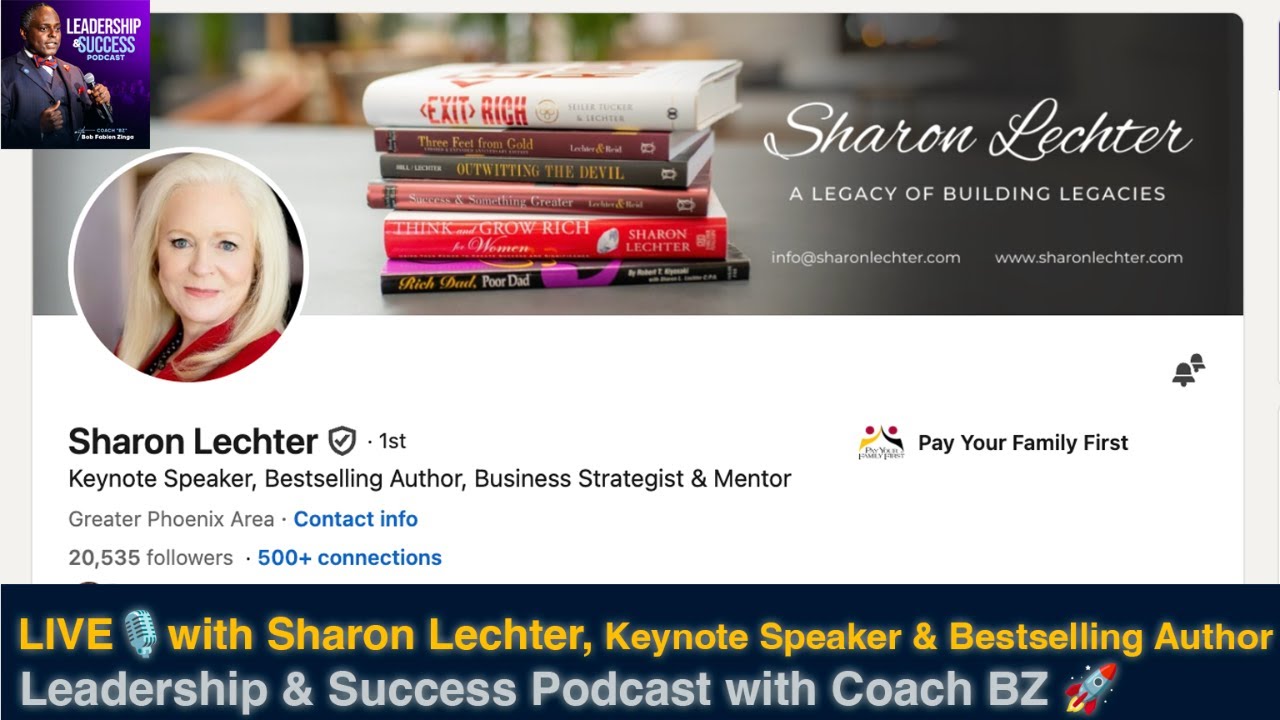
In this live episode of the Leadership and Success Podcast, host Coach BZ (Bob Fabien Zinga) interviews financial educator Sharon Lechter, co‑author of the Rich Dad Poor Dad series and author of several books on money and personal development. The conversation covers the urgent need for women’s financial literacy, the concept of assets versus liabilities, and practical steps for building generational wealth. Lechter shares her personal defining moments, including the loss of her son in 2012 that sparked the Play Big movement, and explains how turning personal tragedy into purpose fuels leadership and mentorship. She discusses the importance of mentorship, the “personal success equation,” and the power of association and lifelong learning. The interview also explores emerging technology, specifically a closed‑system AI digital twin that will deliver her financial education 24/7. Throughout, Lechter offers actionable advice for young leaders: control thoughts, words, and actions; build assets; seek the right mentors; and adopt a mindset of serving rather than selling. The episode concludes with recommendations of books, programs, and resources, and a call to action for listeners to engage with her platforms and adopt financial education as a core life skill.
Chapters
Hi, I'm John Maxwell. When the top— Hi, I'm John Maxwell. When the top companies in the world are looking for trainers, speakers, and coaches, there's one name that stands above the rest, and That's Maxwell Leadership. Our certified team members have gotten proven results for companies all over the globe, and our reputation, I'm proud to say, is second to none. Some of our members have risen to the top of their profession, including the one you're going to meet today. I proudly introduce you to my friend, Bob Fabien Zinga.
Welcome to the Leadership and Success Podcast with your host, Coach BZ. If you need to develop into a better leader, this podcast is for you. If you want to achieve a greater level of success, this podcast is for you. His mentor, Dr. John C. Maxwell, said it best. Everything rises and falls on leadership. We hope to inspire you today and provide you with an insight that has the potential to positively impact the trajectory of your life. Welcome to the Leadership and Success Podcast. Imagine gaining the leadership skills that could redefine your career. Join Coach BZ on the Leadership and Success Podcast, where each episode delivers practical insights from world-class speakers, military leaders, and industry experts. We dive deep into what matters most: building resilient teams, leading through uncertainty, and navigating complexity with clarity and confidence. Every conversation is crafted for aspiring leaders like you who are ready to grow, lead, and make a lasting impact. Don't miss our powerful live sessions and recent highlights. Michelle Hayward on building diverse, high-performing technical teams. Anne Leslie on leading through global complexity and cybersecurity risk. Ron Carpenter, AI, exploring faith, resilience, and AI-powered leadership. Colonel Michelle G.I. Gardner-Intz on commanding influence from the battlefield to the boardroom. Chris Robinson on shifting from drift to drive in life and leadership. And Coach Enrique Acosta Gonzalez on mentorship, legacy, and heart-centered leadership. Ready to level up your leadership journey? Tune in on Spotify, Apple, Audible Podcasts, YouTube Live, and LinkedIn Live. Join the movement toward leadership excellence. Listen now and start transforming your success.
We have incredible businesses, but with that, we have a responsibility. 90% of us of us will be solely responsible for our financial lives at some point. It's due to death, divorce. The good news is we outlive our husbands by 7 years. The bad news is we outlive our husband by 7 years, right? So, we have a responsibility. We need to educate ourselves. We need to understand not only how to hold that 60% of wealth, but how to invest it and make it grow for generational wealth. And what stops us? Well, you know, we have that little devil in our ear that says, "You're not worthy. You're not good enough. You're not an expert." These guys, they have no problem saying, "I'm an expert," right? "I'm an expert." Women, you know, "I'm kind of— I'm pretty good at it." Also, you know, easy for her to say. I bet a few of you in there are thinking, you know, about me like that. Easy for her to say. I started with nothing. Lots of ups and downs. And then my favorite, you're too old. You're too old. Well, I love this study because it says our maximum brain capacity is in our 50s. I like that number. But I like even more the fact that it stays with us until we're in our 90s. So what gets in our way? Lack of focus, lack of clarity, lack of motivation, passion. Usually that means we're not on the right track. We're not doing what we're meant to do. Wrong associations is a big one. People in your life holding you back instead of people pushing you forward. Having that right mentor— you've heard about that today— mentor that's going to open the door for you, introduce you new paths. Having the right people on your team that are doing the things you shouldn't be doing. You should be focusing on your strengths and hiring your weaknesses so that you can have the greatest contribution and the greatest success. And then fear, the fear of criticism, big one today. Fear of failure. But you know, a lot of times it's fear of success. Fear of success. We don't, we don't know what to do with it. We could, we wanna step back outta the limelight and then lack of self-confidence. That's something that is huge, particularly for women. We don't stand in our own power. I want you to stand in your own power. So I want you to review your personal success equation. Ask yourself what you can do to change your trajectory for success. What association do you need to play big? Because a play big movement is about being number one in your field, living your legacy. You create your legacy with every heart you touch. Every day, and then creating maximum impact.
All right, that was Sharon Lechter, TEDx talk which had more than 20 million views. So I am really excited to have her today. But before we do that, let's do our moment of gratitude, which is our custom here on the Leadership Success podcast. So for just a second, if you would, you may close your eyes if you can. And I want you to think about one thing that you are grateful for today. And I think today I am really grateful for connection, networking. I think I've never met a stranger in my life. Everybody I meet is my friend, at least that's the way I think about it. And it's really amazing what a connection might be able to do for you in the future, just adding value to people and then I think people add value back into your life. I can say that I would not be where I am today in my life if it wasn't for the people I have met. So I am grateful for connection today. All right, without further ado, I am going to bring you Sharon Lechter. She really needs no introduction at all. She's dedicated her career to empowering people to build wealth and lasting legacies, especially women. A CPA for over 35 years and Chartered Global Management Accountant, she co-authored the global phenomenon Rich Dad Poor Dad brand. That's more than 14 titles. And also she partnered with the Napoleon Hill Foundation to release classics like Free Feed from Gold, which is my favorite. And also Outwitting the Devil. Actually, she recommends that people read that first before you read Think and Grow Rich. And she has created award-winning financial education resources, advice to US presidents, on financial literacy and mentor countless entrepreneurs and leaders, including myself. And, uh, her recent work includes, um, Exit Rich and How Money Works for Women. She continues to inspire individuals, especially women, to master money, scale businesses, and play big in life and leadership. Ladies and gentlemen, please help me welcome Sharon Lechter. All right, Sharon, welcome to the Leadership and Success Podcast. How are you doing today?
Thank you so much. I am delighted to be with you, and I'm doing fantastic. Every day is a new day.
That is, that is really good. We are so grateful for, for you being here today. I guess I will start. What is one thing that you are grateful for today, Sharon?
Well, every single day I start my day with gratitude, and my gratitude is that I have an incredible family that lifts me up, and I love them very dearly. And, um, you know, my company's name is Pay Your Family First because this all starts at home, right? It starts— so understanding money, teaching your children about money, but also providing the, the legacy of not just from a financial perspective, but from a happiness perspective, having the right relationships, investing in the family both from a heart perspective and a financial perspective.
Wow, that is powerful. It really starts with the family. And what is one thing about you that most people may not know about?
Well, most people don't know I, I graduated from high school in 1972, and that's when Disney World opened in Florida. In December of '71, and I was the grand marshal for the grand opening of Disney World. So that's kind of something that most people don't know. Of course, back then we didn't have cell phone pictures, so I don't have a lot of pictures about it, but it was pretty cool.
Wow, that is amazing. All right, so you've built multiple billion-dollar brands, offered bestsellers, and I think everybody knows about the Rich Dad Poor Dad brand, and advised presidents. So when you look back What do you consider the defining moment that shaped your career?
Well, I think the defining moment for me was understanding, realizing when I got out into the real world and started my degree in accounting or my career in public accounting, I was one of the very first women there. I realized how few people truly understood money. I had the gift of growing up in a home where my parents talked about money. We talked about assets, we talked about cash flow, and I thought everybody knew about that. But I realized when I, when I started out into the real world that most people were chasing a paycheck. People didn't understand the concept of instead of chasing income, you know, build, buy, or create income-producing assets.
Yes. Wow, that is quite powerful. I guess one of my favorite, uh, Shannonism is what I call it, is what you often say: money flows to those who educate first. And serve best. So can you share how this principle has guided your personal and professional life?
Well, I think, um, people who focus only on the money tend to lose their relationships. And so it's really important when you are in a position of service, the money will come. I always tell people, do you sell or do you serve? When you sell as a transaction, so you make the sale, then you have to go find somebody else to sell. When you serve, you're creating a relationship with your customers. That relationship gives you a lifetime of sales. It's the same thing from a personal perspective. All right, when you are focusing on quality of life, um, and you are successful in your career, you're— then you're successful in your family life. But too many people focus only on the money and only on the success And in the process, they lose the relationships that could be the most important thing.
So from Rich Dad Poor Dad to Exit Rich, you are really, I think, the number one global financial educator really in the world. What do you think? Because a significant portion of people listening to us today are aspiring leaders, so we're just starting in there. Career. What are some of the mistakes and pitfalls especially women should avoid as they start their career, getting out of college and getting into their first job?
Well, I think it's important to understand it's not what you do for your paycheck that determines your financial future, it's what you do with your paycheck that determines your financial future. With every dollar you have a choice: do you keep it and have it work for you, or do you let it flow through your fingers and lose it? And we're, we're very consumerism-minded. So people are taught to buy what you want, put it on credit, and that's where you start digging yourself a hole into bad debt. So understanding the importance of holding on to it and investing that money— and then doesn't mean you can't enjoy buying wonderful things, but buy it from the cash flow from the assets, not from the money when you earn the dollars.
Wow, that is a big distinction. But really, everything you teach, I think, is simple, not simplistic. But I guess the secret really is in the execution, isn't it?
Yeah, I talk about my favorite, my favorite word on earth is assets. I said yes, I say assets are sexy because you are financially free when the income from your assets exceed your monthly expenses. Yeah, you don't— you're, you're, you're taken care of. Your assets are providing for you. If you get sick, the money's still coming in. And so you are financially free when the income from your assets exceeds your monthly expenses. That's why I say assets are sexy. And then I add, the older you get, the sexier they become.
Yes. Wow. Especially for, for young people, that I think we We think that one asset would be like buying a house, but, but based on your definition, your house is not really an asset until you actually sell it, right? Because it doesn't produce any income for you unless you are renting it to some other people or you actually flip it. Can you give us some examples of assets that young people need to kind of be thinking about as they embark on their—
Certainly. Well, we talk about momentum of money. All right. So when you talk about your house is not an asset, yes. Over history, your home appreciates. And so when you sell it, you have an increase, but in that interim, it's costing you money every month. That's why in Rich Dad Poor Dad, we say your house is not an asset because we talk about from an investment perspective, assets feed you, liabilities eat you. And so when you're looking at assets, which there are different categories, there's businesses, create a business that's an asset. There's stocks, bonds, and mutual funds as paper assets. There are, um, gold and silver commodities are an asset. Now today, digital currencies are assets. Intellectual property, right? What you got up here, creating assets from what you know to help other people. All of those things create the opportunity. So when we're talking about diversification, a personal A financial planner is going to tell you to diversify across paper assets—stocks, bonds, and mutual funds. I teach diversification across asset categories. Wow. So when one goes down, let's say the equities market, stocks go down, we've seen gold and silver go up. We've seen real estate, all right, go up. We've seen real estate come down. And so if you have diversification across asset categories, When one goes down, others support you.
Wow, that is really wonderful. I often joke, right, if it wasn't for my dog, I would be the only male in my house. We have two daughters. So focusing on women, especially in the 21st century, in Think and Grow Rich for Women and How Money Works for Women, you shine a spotlight on women's financial empowerment. So what do you think is the most overlooked challenge women still face in building wealth? Today?
Well, let me just give you a stat first. 80% of men die married. 80% of women die single. Wow. So 90% of us will be solely responsible for our financial lives at some point during our lives. And historically, women have deferred the financial management to their spouse, and in doing so, they put their head in the sand. And so women are— have been proven to be better investors. Female investment clubs outperform male investment clubs. The issue is we're not educating ourselves. We need to understand money. There's the largest wealth transfer in history. Over $30 trillion are going to flow into the hands of women. So with that comes a huge responsibility. We need to be able to receive it and know how to invest it, make it grow, and preserve it for future generations. So that responsibility responsibility rests in us. So we can choose to ignore it, or we can choose to step into our own power. And my money— the, the book How Money Works for Women, and you can get from my website SharonLechter.com, and I'll autograph it for you. But that book, I take women from every decade of life, from 19 to 86, and the different things that women face, from going to college, starting a business getting married and having a special needs child and how that changes the way you can make money. Having a marriage of 25 years, you're looking forward to retirement, your husband decides to trade you in for a younger model and you have nothing in your own name. And so you're, you're in your middle age with no credit and you end up almost into poverty because you have to start over. So we talk about those kinds of things that happen to women and what you can do and the resources we provide to help take control of your financial life. It is essential for women to have credit in their own name. And just because you have a credit card with your name on it doesn't mean you have credit. If it's— if the primary cardholder is your husband, you don't have credit. If something happens, that card goes to him, not you. So you need to establish credit in your own name to give you that financial foundation to help you no matter what happens to you in life.
Wow, that is so crucial and so important. Another way we've raised our daughters— one of them graduated from college last year, thank God. It's so expensive, colleges these days, but they really need to be independent and really think about, you know, their own careers and their, their, their own goals. So let me switch a little bit on talking about leadership and Resilience. In 2012, most tragic thing happened to you. You faced the devastating loss of your son, which led to the Play Big movement. How did that experience reshape your definition of leadership, resilience, and purpose?
Well, number one, you don't wish it on anybody. You're not supposed to outlive your children. And so when it happened in December of 2012, my life stopped. I, I was living in neutral, in a world of numbness for a while. I thought about retiring, but, uh, I got pushback from family and friends. I even heard my son in my ear saying, get over it, Mom, there's more for you to do. You're still here for a reason. And, and that's why I decided to get back out there. I created the Play Big Movement. There's a private Facebook a group that anybody can join, but it really is to show people that you're still here for a reason. No matter what happens to us, whatever mess happens in your life, whether it was a death, a divorce, a financial setback, an illness, you're still here. So turn that mess into your message, and then that message can become your mission. And when that's your mission, you're going to become somebody else's miracle. And so I turned my tragedy into fuel for me to help other people find a better pathway. And but I didn't want to do it alone. That's why I wanted to share the things I was doing and encourage people on their own pathway. And then I started the secondary piece of that was I started one-on-one mentoring because I needed to replace some of that maternal desire inside of me. And so I take several, a few one-on-one clients each year to help them take their business to that global level, to that next level. And I step into their world and help them in increasing their success and making a larger impact because the Play Big Movement is for people who want to be number one in their field. They want to live their legacy. And your legacy is created every single day with every heart you touch. And they want to, and they want to create maximum impact. Now, nothing in that comment is about make a lot of money. But if you do that, come number one in your field, live your legacy, create maximum impact, the money will come.
Wow. We're gonna talk a little bit more about legacy. But if you don't mind, Say it one more time. Turn your mess into a message and a miracle for someone else. Can you say that again, please?
Sure. Turn your mess, no matter what it is— death, divorce, financial setback, illness— into your message, because you survived it. And that message can become your mission, where you help others. And when you're exercising your mission, living in your mission, you're going to become someone else's miracle. Wow, that is powerful.
Okay, thank you, thank you so much. So when, when we talk about legacy events, so even for young people or aspiring leaders listening to us right now, how should they think about building legacy from day one?
Well, legacy is, is who you are and, and how you are seen by other people, the imprint that you're making on other people. And that's why I say your legacy is created every single day with every heart you touch. It's not what leaving behind in finances. That's part of your legacy, but that's really an inheritance. Your legacy is the imprint that you've had on Earth as a human being. And as a young person, you know, today we see a lot of people applying for jobs and they get, you know, they're in the last throes of interview, and because of stuff they put on their social media, they don't get the job. And so So everything we do today can be found. So live your life as a life of integrity. Live your life lifting others up, not tearing others down. And that's so important in what's happening in the world today. Yes. You know, if you can't say something nice, don't say anything at all, as my parents used to tell me. So, and the other thing is, you know, I grew up and my father would ask me every night, Sharon, have you added value to somebody's life today? As a little girl, he would ask me that. He's been gone for 20 years, but I still ask myself that every day. Have I added value to somebody's life today? And wouldn't the world be a better place if everybody focused on that? So my message to young people is add value to other people's lives. You will, you will get the dividends tenfold. But focus on participating, focus on giving. Don't— you know, we can My message to young people is there are 3 things we can control: our thoughts, our words, our actions. But our thoughts are the first step, and that controls our words and controls our actions. And so if you are thinking scarcity thoughts— I can't afford it, never going to be good enough— then your words are negative and your results are negative. Think about your thoughts. What are you putting in your brain? That's why I launched my ATMs. We'll talk about— but what are you allowing in your brain? During COVID I got so upset with all the negativity. And when I get mad about something, I start another company. So I started this initiative called ATMs, a daily abundance tips and mentorship message for people to give them that positive start of the day. You know, so instead of saying, I can't afford it, which is negative, it closes your brain. Ask yourself, how can I afford it? Do you feel the difference? Yes. How can I afford it triggers your subconscious brain, and it goes to work looking for a way to afford what you want. It's positive, it's entrepreneurial. So be very careful about your thoughts, your words, and your actions.
Well, that is quite powerful. That's really the essential message of Think and Grow Rich, isn't it? Your thought would actually affect your life, your outcome. Wow. And how did you get to be involved with the Napoleon Hill Foundation?
Well, as you have mentioned already, I built built the Rich Dad organization. I was Robert's partner for 10 years, and we launched with Rich Dad Poor Dad, The Cashflow Game. We wrote 15 books together in the 10 years that— and I was also the CEO of the company because prior to that I had built the talking children's book industry. So I understood how it all worked. So I was able to apply that in building the Rich Dad organization to the largest personal finance brand in the world. And in 2000, we started together in 1997. In 2007, we were no longer aligned, so I made the decision to leave. And we know what happened to the economy in '08. Well, I had known the Napoleon Hill people because we were both at book fairs together, and wonderful people. Don Greene, dear friend, and he found out I had left Rich Dad, and he called me and said, we really feel like we need to bring Napoleon Hill's messages to the younger generation with what's happening in the economy. So they asked me to step in and help re-energize the teachings of Napoleon Hill, a huge honor. So not only did I build the world's largest personal finance, but then I was asked to step in to reinvigorate the world's largest personal development brand. What an incredible honor. And as you mentioned, I've written 4 books in cooperation with the Napoleon Hill Foundation, and it's just been an incredible honor to be part of that.
That is really amazing. Now today, with emerging technologies like artificial Intelligence is shaping the financial and business landscape. What excites you most about the future of financial literacy and entrepreneurship?
As it relates to AI or—
Yes, AI and emerging tech.
Well, we actually are in the process of developing a digital twin for me. Oh, wow. And a lot of people are doing it in AI, but the problem is, and I teach the importance of assets, remember I just talked about that. And intellectual property. And so a lot of people are putting their works and their intellectual property into OpenGPT, OpenChat, and you lose the rights to your work, and other people can adjust your work. And so we are developing with a company a closed GPT system, a closed system that will allow my work to be there so people can take my courses through this platform and ask me questions 24/7, and my digital, digital twin will answer those questions and support them on their journey. And what's exciting about it is a lot of people are intimidated. They're, they, they're embarrassed to ask a financial question because they don't want people to know that they don't know what they're supposed to know. And this gives them a safe environment that allows them to ask those questions that they would be embarrassed to ask a real person and get support and answers to help them make the right decisions to move their finances forward.
That is really, really amazing. Wow. But really, when I look at your life and your career, it looks like you just go from level to higher level to higher level, like you never stop. It's just amazing, just that resilience, that grit, and always adding lots and lots of value to your audience. That is really great. So we are going to switch over to the second segment of the podcast. But before I do, I wanted to make sure Is there a question from the first segment I should have asked that I didn't get a chance to ask?
Well, I think just as an overreaching statement, you know, you are the CEO of your life. You determine what happens. And way too many people today kind of coast. They follow the crowd. And so it comes back to controlling your thoughts, your words, and your actions, and being proactive, not reactive. Far too many people, particularly young people, are very reactive. They, you know, they don't want to stand out. And I want you to stand in your power. Take control of your thoughts and your actions. Take control of your life. You are the CEO of your life. Wow, that is very powerful.
This is really a great way to switch over to the second portion of the podcast where I ask you, what do you think is the greatest lesson you've ever learned?
The greatest lesson I've ever earned— learned? Well, probably adding value to people's lives every day. That's probably because that's really been the, um, the, the North Star for me for my entire life. But then also, when I left public accounting, I was very successful, but one of my clients invited me to leave public public accounting to go into a company that was buying out of bankruptcy. And I still remember going back to my condo. Back then we didn't have PCs or cell phones, so it was the old yellow legal pad. And I had pros and cons, and it didn't help me a bit because I could choose either. I could argue both sides. I could stay where I was, stay in public accounting, but I wasn't in control of my own life. I was working incredibly long hours. Or I could take the risk and step into a world of the unknown. My hand took off across the top of the page and said, why not? That is my second guidance word. Why not take the path less traveled? Why not solve a problem or serve a need? The most successful businesses all solve problems and serve needs. And so why not was my trigger that made me leave public accounting at that time. And I still use— I— it is still my trigger today. That's, you know, the why not. I was mad about negativity. Why not do something about it? So I did the ATMs. This year I was— so many people were stressed out about investing. So I said, okay, serve— solve a problem, serve a need. So I'd literally just finished a complete course called Investing in Uncertain Times. Wow. And that investing is uncertain times is all about equities, real estate, Bitcoin, digital currencies, forex trading, gold and silver, tax situations, building a business. So I went through it, 9 segments, and it's available on my website. And if I actually— if you use the promo code FREEDOM, you'll get a 50% discount.
Wow, that is— thank you so much. That's what I am talking about. You are always, always adding so much value to your audience. This is really wonderful. So what, what do you think is the secret to your success?
Um, definiteness of purpose. I mean, controlling my environment, controlling my time, all issues that I I talk about in the book Outwitting the Devil. My secret to success is never stopping, right? The 3 feet from gold concept, all right, is, oh, if one avenue doesn't work, oh well, that didn't work, let's try another. But never losing sight of my, my long-term goal. Wow, that is powerful.
Thank you. And, uh, as a leader, what, what are you learning right now? I know leaders are learners.
Well, I'm constantly learning. That's why I think the most successful people are lifelong learners. I also know that when there's a new technology, I bring in the 20-year-olds that know how to do it and get it done. And I, and I believe the— another secret to success is the power of association. This is something that I have practiced from the very beginning of my career. Talking Children's Book, I built that by doing associations with Disney, Warner Brothers, Sesame Street. All right, with Rich Dad, Warner Books, Time Life, understanding the power, the impact of power of association and how that can help you scale in an exponential way. So that power of association is so very, very important. And so currently I'm, I'm associating with this company to develop this new AI system, always looking to see how I can add value in new and innovative ways.
Wow, that is so refreshing. And, uh, I have this coin which I love. On one side it says success, the other side it says failure, which I believe are two sides of the same exact coin. We know all about your successes, but how has failure shaped your life?
Well, I don't use the word failure, I just call it a learning opportunity. Yes. So for instance, um, When I talked about my why not philosophy and I made the decision to leave public accounting, it actually ended up being the worst business decision of my life. I found all kinds of corruption when I got into the company, so I knew I had to leave. But when I made that decision, I was at the, at the company there prior to us acquiring it. They'd been involved in some litigation, so there was a moment where I went back into my office and there was a young attorney there that was there doing some discovery.. And I talk about the fact that I met my husband while he was going through my drawers. He was the attorney doing discovery in this case, and we met, and it was love at first sight. We just celebrated 45 years of marriage. Ah, congratulations! Thank you. So as Napoleon Hill says, out of every adversity, yes, every failure comes a seed of an equal or greater opportunity. So my worst business decision gave me my best life decision. Sometimes you don't get instant feedback, sometimes it takes a while to figure out, but every failure, every mistake is an opportunity to learn and to accelerate in a better way.
Wow, that is, that is powerful. Yeah, my primary mentor, Dr. Maxwell, says, right, sometimes you win, sometimes you learn. Definitely learning opportunity. And we, we talked earlier, so Think and Grow Rich is definitely a book everybody needs to get, and you wrote the one for, for women. But before that, you said they really should read Outwitting the Devil. And, uh, something about that overcoming fear, right? So what is, uh, one of the greatest fears that you were able to, uh, overcome?
Well, I've always been a big worrier. My mother was the queen of worry. And then I found the definition: to worry is to pray for what you do not want. And let me repeat that: to worry is to pray for what you do not want. And that's why when you focus on negative stuff, you get negative results. And so that, that definition helped me stop myself because I still get that worry piece, and then I stop and I go Sharon, instead of focusing on what you don't want, focus on what you do want. And it's magical because all of a sudden your subconscious and your thoughts are on the positive outcome, which means you're speaking positivity and the actions and results will be positive. So fear derails us. And so I take— say, take your fear and turn it into fuel. And apply that fuel to focus, and it will turn into faith. Wow. Get you to the success you deserve. But the fear is simply a feeling that needs to be rechanneled into fuel. As an example, people always ask me, do you use, you know, I, I I do keynote speeches all over the world, and they go, do you, you know, do you even get nervous anymore? I go, of course. When I stop feeling nervous, um, I should stop doing it because I want to make sure that I say what needs to be said that day for someone in the audience. Wow. And but I take that anxiety and I turn it into energy so that when I step on that stage I am revved to go. Anxiety is turned into fuel for me. And I say that I also say the prayer of Jabez, which is a little prayer in, in the Old Testament that says, you know, basically, I'm asking a higher power to be with me and to help me deliver what I want to deliver.
Yes.
In fact, as an example, last week, I was in South Dakota speaking to a group, and I don't— in my normal talks, I don't normally talk about losing my child, but for some reason in this talk it just came out and I shared about it and I talked about, you know, turning that passion into new purpose and definite purpose. And afterwards I met— I had this young gal come up to me and she had tears in her eyes and she said, I almost didn't come to event, but I— and I asked God to give me a reason for being here. And she says, you're that reason. She said, I lost my daughter. I lost my daughter 6 months ago. And it was— I mean, I get emotional just talking about it, but you just— you never know the impact you're going to have on people. And so you ask— I ask God all the time to tell me what I need to say. And that's the prayer of Jabez. It says, please bless me indeed, may your hand be with me, right? Yes. And that I may enlarge my audience, that I can reach more people than I ever imagined, and that I may not be harmed or harm. And so it's really— it's, it's really— it is for me, I do it before every interview, every talk, because I want to serve a higher power.
Yeah, 1 Chronicles 4:10. I remember Jabez called upon the God of Israel saying, "Oh, that You would bless me, enlarge my border, that Your hand might be with me, and that You would keep me from harm, so that it might not bring me pain." And God granted what he asked. Very, very powerful. Wow. So really, I think that— I guess Napoleon Hill called it positive mental attitude. I just feel like in today's world, especially for young people, they get distracted by so much. It's so many distractions out there from social media, the internet, the TV and things. And we pretty much live in from anxiety to anxiety to anxiety, especially with everything going on in our country and the world right now. So they don't really have time to focus about what they really, really want and where they really wanna focus their energies into. Do you have a tip that would help people listening right now where they can do, like you say, turning that fear into fuel, focus, and faith, so they can actually focus on what they want and not just respond and react to everything that's happening around them.
Yeah, the steps that I line out in the book Outwitting the Devil is definitely a purpose. Most people don't know what their purpose is, so you need to focus on what problem do you want to solve, what need do you want to serve. I have been very passionate. My passion has never faltered from the It was December of 1992 when I dedicated the rest of my career to financial literacy. Wow. Passionate about it today as I was then. Learning from adversity, knowing that we're all going to have— we're all going to stub our toes. Success is not a straight line, right? Mastery over self. That means controlling your thoughts, your words, your actions. Okay. Control over your environment. This is a huge one in today's world. Who are you hanging out with? Who are you listening to? What are you allowing in your brain? That is hugely important in today's world. And then control over your time. Are you proactive or reactive? Are you making the most of every day? Are you moving forward every day? Are you adding value every day? Those elements working together will help you focus and move forward and create success in your life. Way too many times we have the wrong people around us, and sometimes it's our own family. You're taking steps to improve your life, and they see that and they try to pull you back. So I say you have to put this cone of protection on you, right? I actually do this cone of protection, and it's because they— it's not that they don't want you to succeed, it's that they see you're doing something to better yourself and they're not. And so they want to pull you back to feel more comfortable. You're getting out of their comfort zone. And so I go, just give them some grace, keep moving, create that success, because all of a sudden they're going to become your greatest cheerleader. Yes. When you have that success. And then watch out with your family, they'll ask you for a loan. But again, that cone of protection— know that you don't, you don't want to get rid of your family, but you might need to limit the time you're with some of them. If they are pulling you back.
Wow, that is really, really powerful. And, uh, who are some of your thought leaders or mentors, dead or alive, people you've learned from that you think my audience should follow? Well, my father was probably my greatest mentor.
Um, Sandra Day O'Connor, the first female Supreme Court Justice, was a great mentor. Barbara Barrett great. She was ambassador of Sweden. She was first— the first head of the, uh, space, um, organization. And she's a dear friend. Um, I've also, of course, Napoleon Hill, Dale Carnegie, um, the greats that have gone on. Brian Tracy's a dear friend. So I have a lot of mentors. Um, they can be sitting next to you, or they can be from history, or they can be from books. But, um, keep learning every single day and make sure you have a mentor, because in today's environment, um, speed to market is everything. And so you want to have people that will show you the way, support you, and accelerate your, your success.
Yes. Okay, so if, uh, If you could choose 3 people to have dinner with, who would you choose and why? Again, dead, alive, or even mythical.
Who would I want to have dinner with? Yes, ma'am. Dead or— well, Sandra Day O'Connor, definitely, because she just was brilliant. I'd love to have dinner with Napoleon Hill. I'd love to have dinner with Ronald Reagan. I actually have had dinner with Ronald Reagan, but he incredible, brilliant as well. But I think anyone that has lived a life of contribution, anyone who has that thirst and that hunger for making the world a better place.
That is really powerful. So now let's talk about books. I know you've written so many books, and I am recommending my audience to purchase each and every one of them. But again, I want you to get Outwitting the Devil before you read Think and Grow Rich, which I'm gonna be reading right after this interview. But what are some other books that you recommend that you've read that you think my audience should read as well?
Well, I love Jim Collins' Good to Great. It's a fantastic book for building businesses that are just— have the foundation as strength. Good to Great and then my book Exit Rich are a fantastic combination. And then I also love The Ultimate Gift by Jim Stovall. Jim has a huge— lots of different books, but this one is really a fantastic book for helping teach your children about contribution. It's a great financial literacy tool, and Jim is blind and he has made such a huge impact on the world. And I think he's a dear friend, and that book I give to everybody as gifts. So I definitely— and then there's a little book called The Prayer of Jabez that I think is excellent as well.
So we talked earlier, so Think and Grow Rich for women, my audience definitely need to read this, but can you tell us a little bit more about Outwitting the Devil and why you think that should be read first?
Well, Napoleon Hill spent 25 years writing Think and Grow Rich. He was charged by Dale Carnegie at the time to go meet all his wealthy friends and from that to create the thesis for success. And so he released it in 1937 after 25 years, and he said, you know, here is this thesis for success, and I know so many people will read it and do nothing. Because of fear. So in 1938, he actually— at the end of the book, he added the Chapter 6, Ghosts of Fear, but he was still frustrated about it. So in 1938, a year after he released Think and Grow Rich, he sat down and wrote this manuscript called Outwitting the Devil. And the title scared his wife to death. She worked for the Presbyterian College, so she forbid it to be published. And in fact, when you read the book, in the book is an interrogation of the devil. And the devil in the book, in the, in the transcript, says I'm going to prevent you from publishing this book. And it's kind of— it gave me chills because I read it 73 years later. I was probably the only fourth person to ever read the manuscript at the time, and I knew it had to get out. And it really— I think it was intended. I think there was a higher power at work to keep it so that it would be in today's environment. It's so true to what's happening in the world today. It talks about, um, drifters, right? People who are not in control of their thoughts, who follow, go with the flow, whatever, right? They don't make determinations based on what they believe or they want. They do what everybody else wants. And in the book, he says only 2% of the population use their own— control their own mind. And you see what's happening in the world today, and it's kind of, yeah. Looks like it might be true. And so in it he talks about— and the book itself is his original work, and then I annotate it based on comparing what, 1938 to today. And you can read his stuff without mine if you're a diehard Hill fan, but the book was intended to help bring Napoleon Hill to the younger audience. That's why my annotations kind of bridge that gap. And it covers those things I talked about: definiteness of purpose, mastery over self, learning from adversity, control over environment, control over time, on how to secure your success in life. Wow.
And can you tell us about the audiobook version of that book? What's that? The audiobook version of Outwitting the— Oh, yes. Yeah. Well, the audio—
I made them hire two actors for the audio version. So it's almost like a radio drama. Um, I, I listened to auditions, lots of auditions, until I agreed to the death— the voice for the devil, it's low and gravelly— and then the Napoleon Hill voice. I've had people call me and go, Sharon, I had to pull off the side of the road, it scared me to death. But it really is quite, quite entertaining, the audio version. Through Audible. Yeah, well, that is really powerful.
And of course, some people can go to your website right now, right? Sharonlector.com.
And, um, yes, and any books you order here, just put in the notes how you want me to endorse them and who you want me to autograph them to, and we'll do that. Wow.
All right, so, uh, is there a song, a book, or a movie that would be your life's theme or anthem?
Oh, what a great question. Well, certainly with what's happening in the world today, the, the first song that came to mind is America the Beautiful. I am so proud of being an American. I'm so proud of this country. I'm proud of the the world. And I just want people to focus on the positive side and the opportunities that are here. And let's see if we can shake the negativity.
Absolutely. Wow. Wonderful. Yeah, me being an immigrant, there is definitely no country like the US of A, right? We may not be perfect, and I don't think any country is perfect, but definitely better than any other country out there. Part of the reason why I joined the US Navy to really keep that dream. Well, it's the only country, right, with a dream, the American Dream. There is no Congolese dream where I was born. There is no French dream, which is, um, part of my culture. There is no Canadian dream or Mexican dream, but there is the American Dream. And I think it's definitely a country worth fighting for. But, uh, thank you so much.
And, and I think, you know, I spend time traveling all over the world, and I bring the concept of having that dream and creating it all over the world, from, you know, from Uganda to Vietnam to Thailand. You have the ability to create what you want by solving problems and serving needs.
Wow, powerful. All right. So, we are coming toward the end of the interview. If you had one day and only one day to live, what would you have liked your final contribution to be?
Spending time with my grandchildren and making a day that they will always remember with Grandma.
Wonderful. And is there a problem you would like to solve when you wake up in the morning? One problem?
Well, it's financial literacy. I want— my, my mission in life is to get financial education, personal financial education, as a requirement for graduation in every high school in America and the world.
Powerful. So you've inspired millions through your books, mentorship, and speaking. If our audience member just, uh, one message from you today, what would it be?
Well, your focus is on leadership, and I think leadership begins inside. You cannot lead others if you can't lead yourself. Yes. And so my message again comes back to you can only lead yourself if you control your thoughts, your words, and your actions, and know that you are the CEO of your life.
That is powerful. Powerful. Yeah, I think that's, that's one lesson, because, um, Brian Tracy is my mentor too. One, one thing he really taught me is the ability to control your internal environment. You Really, I guess it's extreme ownership of yourself. You are where you are because of you, nobody else. There's no one to blame but you. And I think when you start thinking like that, it's inevitable you're going to make a lot of progress because you are not there waiting for somebody to come and save you, but you really create your own path and you forge your own destiny. So powerful. Okay. We are coming toward the end. Is there anything we can do to add value by to you. We are so grateful that you took the time to talk to us today. How could we make a, uh, difference?
Well, I think if anything I've shared with you today has made an impact, please let me know. Reach out to me, info@sharonlector.com. Connect with me on LinkedIn. Um, I'm on Facebook, Instagram. Would love to, to hear from all of you. And then, you know, share it with the people that you have Listen, and I have— if you go to my website, you can get my newsletter by signing up. And that newsletter, every Tuesday comes out with messages. It's a free newsletter. And, um, I also have a download for my Personal Success Equation, which is combining your passion and your talent with the right associations, taking the right action, and above all, having faith in yourself. And that Personal Success Equation I talk about with every interview as. So if you go to personalsuccessequation.com, you'll get a free workbook that helps walk you through on your own personal success equation.
Fantastic. And also make sure to go to atmsharonlector.com and sign up for free, at least for the next 30 days. That is really great. So we are getting toward the very end of the interview. I guess the most important question I want to ask you, Sharon, is, if you could go back and give a piece of advice to your 17-year-old self standing at the edge of this incredible, incredible career you've had, what would you say to the 17-year-old Sharon Lechter?
Well, thank you for that. I get asked that question a lot. And I'm going to tell you what my normal answer is, and then I'll give you an answer to the— Thank you. —that you're hoping for. But my normal answer is I try not to look back. I wouldn't be who I am today if it weren't for all the things that have happened to me in my life, positive and negative. Of course, if if I could change losing this child, I certainly would do that. But, um, I think we have to not look back. We need to look forward. You're the— you're in the driver's seat. You have your hand on the steering wheel, your foot on the gas. You have a huge windshield. You can go anywhere you want. The rearview mirror is very small because we're just supposed to learn from the past. And so I don't know— I wouldn't know who I would be today if I went back and changed myself at 17. However, the advice I give to 17-year-olds today is that you can be anything you want, you can do anything you want if you apply yourself and you find the right mentors and you keep learning. And always focus on, on solving problem, serving needs, and buying, building, creating assets. Go after the asset, not the paycheck, not the income. Build the asset that creates the income.
Wow, that is very, very, very powerful. Now, is there a question I should have asked you, Sharon, that I haven't asked yet? Anything else you wanted to share before we end?
Well, I would invite people to reach out to me with any questions. I, as I said, I have lots of online programs. If you're, if you're stressed out about money, we have a Money Mastery program all the way up to Essential Components of a Successful Business. So lots of programs. I also have one-on-one mentoring. I have a mentoring retreat at our ranch here in Arizona. So please reach out to us to see how we can serve you. That's our goal, is to support you and elevate financial well-being of, of all of you.
And again, that's on linkedin.com, Sharon Lecter, and then of course our website thereisasharonlechter.com. All right, thank you, thanks so much. So, uh, really, really quickly, we still have a couple of minutes left, so I want to ask you, when you were a kid, what did you want to be when you, when you grew up?
Oh, well, when I grew up, I thought I was going to be a math teacher. My 8th grade English teacher told me I would be a famous writer. I thought she was crazy. My college sorority dorm mother, house mother, told me that I would be a speaker on stage. Wow. I thought they were both crazy, but, um, as it turned out, in public accounting I started writing manuals for training people, and I've never stopped writing. And I guess I'm considered a, you know, I do a lot of speaking on stage and a lot of 30. I'm working on number 38 and 39. Wow, that's amazing.
So, 3 adjectives describing you as a child.
Shy, smart, redheaded, freckled.
Okay, we have 30 seconds left. 3 adjectives describing you as an adult.
Grace.
Love.
Uh, giving. Giving. Powerful. Okay, and, uh, this is the very last question I'm going to ask you, and we have about 15 seconds. What is one word that represents our shared experience on this podcast today? What comes to mind?
One word? Yes, ma'am, for our broadcast today. Enlightening. Very good.
I think I am just super grateful is two words. But yes, I can't imagine I'm speaking to Sharon. Like, I've read most of your books, and I'm gonna get Outwitting the Devil right after we talk now. I will definitely try to get the audio version because I love it.
What would your one word be about today?
Super, super grateful. Yes, I think I am beside myself. I told you when I first met you in the green room, I can't believe I'm speaking to Sharon. I've read all of your books. Rich Dad Poor Dad really had a huge, huge impact on my life and many of the people I mentor as well, especially in the military. You've really made a huge impact and a great, great difference in the lives of millions. So, thank you. Thank you.
Thank you. Thank you.
I appreciate you so much. Thank you so much, Sharon. And really appreciate your time. Okay. We went over by, I guess, 40 seconds, but that's because you asked me a question.. So thanks again.
Thank you. Bye-bye.
All right, everyone, I can't believe Sharon Lecter was right here. This, I think, is going to be probably the most popular, uh, episode for the broadcast. If you still have a question, go ahead and type it in the comment. And thank you for being with us. And later today, I'm gonna be speaking to the one and only Captain Select Desmond Walker. Uh, he is a great officer, probably the top 2% Commander in the Navy right now, and he's going to be on the Leadership and Success Podcast. So again, make sure to follow Sharon, SharonLecter.com, and on LinkedIn, and purchase her books. You are not going to regret it. All right, until next time, this is Coach BZ. Thanks so much for being with us.
Bye-bye.
Thank you for listening to the Leadership and Success Podcast with your host, Coach BZ. If you like what you heard, Please subscribe to our channels and come back for more wisdom nuggets on how you may develop into a better leader and achieve greater levels of success. Leadership is the most critical skill. The world will always need leaders to lead others, deploy the next disruptive technology, or execute a business strategy. You may as well decide on counting yourself among the 21st century leaders. See you right here next time on the Leadership and Success Podcast.
More from Bob

S250:E4🎙️LIVE 🇺🇸America 250: President Barack Obama Leadership, Service, and the Power of Hope






S5:E157🎙️ LIVE with CMD CMSgt Dennis L. Fritz, USAF (Ret.)(Multi Tracks Audio)



S5:E156🎙️ LIVE 🇪🇸 Leadership Lessons from the FIFA World Cup 2026 Champions (Multi Tracks Audio)

S250:E3🎙️ LIVE Leadership Lessons from America’s First Documented Family of African Descent 🇺🇸📖