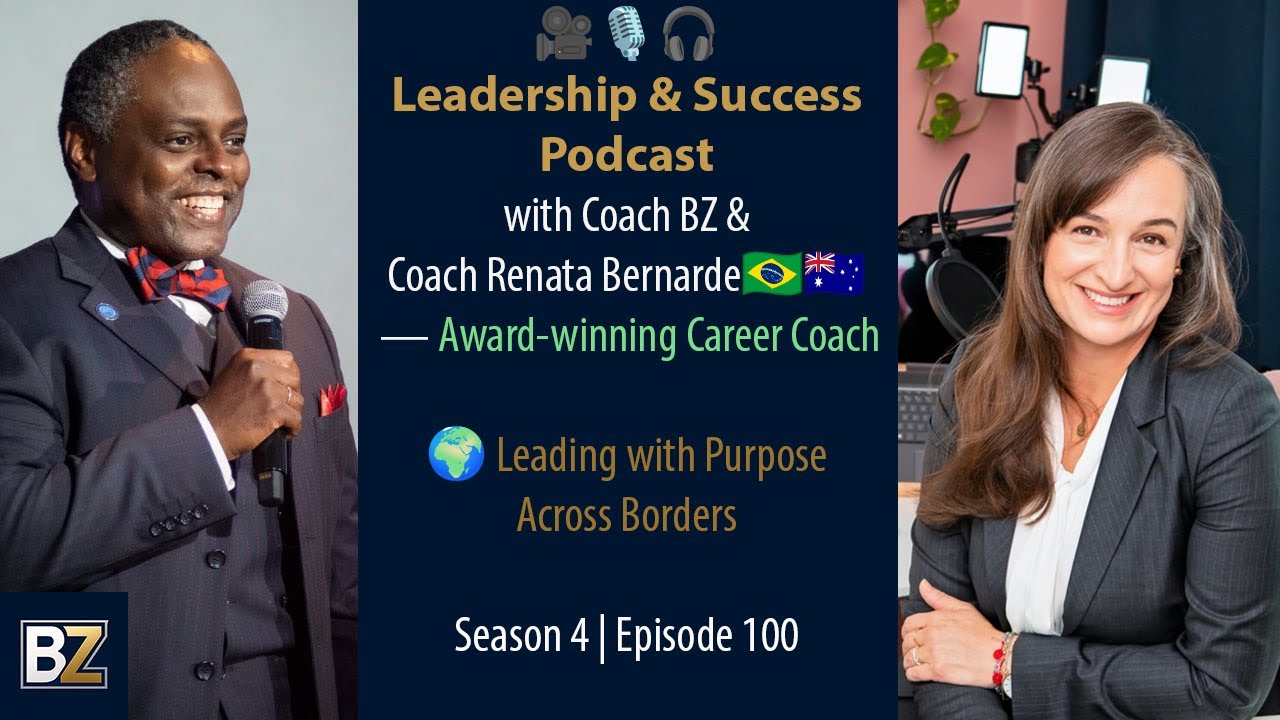
Renata Bernarde, a Brazilian-Australian executive coach, left her corporate job after redundancy to build a global coaching practice. She argues people own their careers, not their employers, and that resilience and continuous learning matter most as AI reshapes work.
Chapters
Hi, I'm John Maxwell. When the top companies in the world are looking for trainers, speakers, and coaches, there's one name that stands above the rest, and that's Maxwell Leadership. Our certified team members have gotten proven results for companies all over the globe, and our reputation, I'm proud to say, is second to none. Some of our members have risen to the top of their profession, including the one you're going to meet today. I proudly introduce you to my friend Bob Fabien Zinga.
Welcome to the Leadership and Success Podcast with your host, Coach BZ, where we help you lead with purpose and succeed with impact. If you're ready to grow into the kind of leader others want to follow, this podcast is for you. If you're determined to elevate your success and leave a lasting legacy, this podcast is for you. As my mentor, Dr. John C. Maxwell, reminds us, everything rises and falls on leadership. Our goal is simple, to inspire you, challenge you, and equip you with insights that can transform the trajectory of your leadership journey. Welcome aboard to another episode of the Leadership and Success Podcast with Coach BZ.
Sure. I am a Brazilian Australian. I was born in Brazil, and I moved to Australia in 2001 to study here, as many people do. And from that point onwards, I fell in love with Australia, and my purpose was always to stay here. I had a young family, and I was a mature age student, and my husband and I worked really hard to embed ourselves in the community here, find jobs, gain our permanent residency, all of which is quite hard to do, to be honest. And, um, we've been here for over 20 years now. A few years ago, just before the pandemic hit, I was made redundant from my corporate role, and I then very quickly realized I didn't want to pursue another opportunity, another job. I had worked up my career sideways to the top, and that is usually a very good strategy for women in the corporate sector. But I was very ready to follow my next step, which I knew eventually I wanted to do, which was to coach other executives, other managers, and professionals to have the best careers. And I've been planning and prepping myself to do this for a long time, and I thought it was time to give it a go. And I've been loving it ever since. I have clients all over the world today, and it gives me great joy to help them.
Amazing. And as they say, the rest is history. As you've heard, the rest is history. I am very, very happy today to be bringing to you a very special person. First of all, this is my 100th episode. Can you believe that? For this year alone, season 4. That's our coach, Renata Bernardi. I'm gonna talk about her in just a minute. I'm being reminded to do our moment of gratitude. As is our custom here, every time we meet, we want to be grateful for one thing. So, what are you grateful for today? And I think it is so very important for all of us to remember to be grateful every day, no matter what is going on right now. I know there is a government shutdown in the US and a lot of problem around the world, but you can only control what you can control. So what are you grateful for? If you would put yourself in your happy place, close your eyes, maybe take a deep breath, and think about one thing you are grateful for. And I think today I am grateful for networking, for connection. Like I've said many times before, I've never met a stranger in my life, and I am just so glad that I get to meet a lot of people, people who add value to me, and I try to add value back to them. So if you would please type into the comment what is one thing you are grateful for today. All right, so let me introduce our guest today. We are going to be speaking with our coach Renata Bernardi. As you've heard in the introduction clip, originally from Brazil, now based in Australia, she's an executive coach helping professionals around the world find clarity, confidence, and career direction. As CEO of the General Sir John Monash Foundation, she transformed Australia's leading scholarship program, tripling sponsorship and managing multi-million dollar endowment. Today, through renatabernare.com, she equips professionals to navigate career transition with purpose. Her philosophy: no one is more responsible for your career than you. That's not motivation, that is reality. Ladies and gentlemen, without any further ado, please help me welcome Coach Renata Bernarda. Hello, Coach Renata, how are you doing today?
I'm good, thank you so much for having me. That was such a great introduction, thank you.
I think I told you in the message, this is going to be the second podcast I'm going to translate in Portuguese, uh, because you're originally from Portugal, so I don't know very much about Portuguese, but a little bit. Olá, Coach Renata. Bem-vinda ao podcast. So very, very welcome. Can you let us know what is one thing you are grateful for today, Coach?
Okay, just a quick correction there, Bizzy. I'm originally from Brazil, not Portugal, but that's fine. We speak Portuguese in Brazil. I know you know that.
You just got confused. Yes. All right.
What I'm grateful for today is technology, because look at us. I'm in Australia, you're in the United States, and we are talking live, and people can go on LinkedIn and on YouTube and send us messages. How wonderful is this?
That's really crazy. And I believe it's about— you are tomorrow, you are on Wednesday, uh, it's about 8 AM, right?
It is, it is 8:30 AM in the morning.
We are still on Tuesday, uh, and, uh, it's only about 2:30 PM in the afternoon. Pretty crazy. I remember I told you I went to Australia, I think it was 2009. I remember Michael Jackson had just died. But anyway, I spent about a month there. When I came back, it took me 2 to 3 days to get back into my regular sleeping cycle. I would be sleeping in the afternoon at work. It was crazy. I should have taken 2 or 3 days off when I came back, but it's really the land down under. That's for sure. And also, I'm a little bit curious. I believe Brazil is the only country in South America that speaks Portuguese. Everybody else is Spanish, right?
Yes, yes, everybody else is Spanish. Yes, you're right.
Pretty amazing, always learning something new. So let us know a little bit about your leadership journey. How you got to be—
That's a long one. I'm in my 50s, so it is pretty long. I started working very early in Brazil. I always enjoyed working. Can you hear me?
Yes.
Yeah? Oh, OK. I always enjoyed working busy, and I started very early. I had a fight with my dad, and I needed money because I was in trouble. And I think he reduced my monthly stipend when I was in my teens. And I started babysitting. I started working for a furniture company. I then became a— very entrepreneurial in making money early on.
Wow.
I went to university, but I dropped out twice. Not because I wasn't academic, but just because I was hungry for life and for travel and for, you know, to get my life going. I didn't want to sit and study, even though I had been always a great student. I opened up my business in Brazil, and it did quite well. It was a travel agency with an expertise in sending people overseas to study. Wow. And I had agreements with hotel management schools in Switzerland. Brazil is a very touristic country and hotel management was not something that we taught in Brazil. There were not many courses. So people would go to Switzerland to do that program if they could afford. And one day I was visiting the school. I had to go there twice a year with my students. It was a very interesting setup where I had to hand over the students, a very Swiss, you know, kind of thing. Very, a lot of protocol. And I saw one of the agents, the Mexican agent, was a student. And that opened my eye. I'm like, I could go back to study too. Look at this, this woman, she's back here and she's studying. And I had a chat with her and she told me, you know, she, she fell in love with the idea of doing it herself. And I told my husband, we should do it. And instead of Switzerland, we moved to Australia where I also had some connections. I had been an agent from for some universities here. And, and that's how I moved here. And since then, you know, I decided to become quite a good student. I said, this is my last chance to get my, my degree. Um, and I graduated from the University of Melbourne. I did an honors at Monash, and that's called a master's— it's equivalent to a master's program in the US— from Monash University. And, and since then, you know, I've been working my way up. Um, up until the moment where I decided I wanted to do my own thing again. I think when you have the entrepreneurial streak in you, you want to, you always want to go back and do it again, I suppose.
Man, like we said in the introductory history on the video, right? The rest is history. So you've built a career helping others design the lives they want. What first inspired your passion for career coaching?
Busy? My passion started where you live, because when I was young, I moved to Los Gatos near—
Really?
Yes.
Wow.
My father was very lucky to be one of a few people in Brazil that was asked to go to Silicon Valley to learn how to develop telecommunications for the Brazilian government at the time. And we moved to Los Gatos. He worked in Palo Alto. Palo Alto, we couldn't afford to live in Palo Alto. Now I think we couldn't afford to live in Los Gatos. But he met a mentor of his from Brazil who had been there for a long time. He was older than my dad, and his wife was transitioning from being a corporate professional to being a coach, a career counselor, to be honest. I don't think we had that word career coach at the time. And she was mesmerizing. Like, I was so you know, in awe of her. She was a very extroverted person, and she loved talking about what she was learning in her education to become a career counselor. And she did a Myers-Briggs test for me for the first time. And I, from that point onwards, I decided I wanted to be like her. I didn't know exactly what it was. I was very young. But since then, you know, I kept that filed up, you know, one day I can be a coach, I can be a career counselor and help people with their careers. I always had that thing of being the one that helps my friends with their issues. You know, first it was issues with education, you know, helping them study, and then issues with profession. Many times people would come and ask me to help them even choose what to wear for a job interview. Yeah, that was way before they knew I wanted to be a coach.
That is pretty Amazing. And I've been kind of following your career, you everywhere on YouTube, and your podcast is fantastic. One of your quotes, which I mentioned earlier, "No one is more responsible for your career than you. That's not motivation, that is reality." You also say often, "Your career is your greatest investment." So what personal turning point taught you that truth?
Yeah, I think I learned it the hard way. And unfortunately, we have this ability as human beings to learn from others. We know this, you know, Martin Seligman and many other psychologists have written extensively about how we can learn actually, you know, good and bad things through education, through generation, through parents and friends. But there are some things that we listen time and time again, we don't pay attention to, and then we get caught in a situation and we're like, oh yeah, that's what they meant, you know. Things like not being prepared financially for a career downturn, things like, you know, not being prepared emotionally for being laid off or not getting along with your boss or your colleagues, not, you know, those things are not taught at school. And I, I think I am, I have been lucky in the sense that I am a third generation expat. So my grandfather lived overseas and worked overseas, in Washington, D.C. for, for a decade. My dad and myself, I have seen these men in my family, women unfortunately not so much, but these men in my family struggle with their careers, struggling coming back to their home country, or struggling arriving in a country where they didn't speak the language. And all of these things gave me a lot of lived experience from previous generations. My mother is very entrepreneurial because she's a piano teacher. And when you're a piano teacher working for yourself, you have to promote yourself. So I learned a lot from them. And then I learned a lot from my own ups and downs in my career. Definitely.
That is really something. And I'm assuming when you were in Brazil, you pretty much knew how to speak English or at least write English, right? Before going to Australia?
Yes, because I had lived in California for a while. So there was a time when my English was very Californian. And then when I went back to Brazil, mom found this English teacher from England who lived with us because she needed a place to stay. So that was very convenient. So my English all of a sudden became a little bit posh. And now people can't place my accent anymore. They don't know where my accent is.
It is perfect English. I know when I was in Australia, they do have a pretty heavy accent. It took me a while to understand what they were saying. It's just amazing how we all speak the same language but different accent, intonation. And things. So another one of your guiding quotes from W.H. Auden, right? If equal affection cannot be, let the more loving one be me. How has that philosophy influenced the way you lead and coach executives?
Just hearing you say it makes me emotional. Isn't it funny? There are some things, you know, and Ted Roosevelt's speech about the man in the arena. I have read that entire speech many times over. I love that speech.
Yes, one of my favorite texts.
Yes, everybody loves it. And those things really makes me emotional and they make me want to do more for people. They make me want, and I think they make, and Ted Roosevelt, let's talk about that one first. It normalizes hardship. Right? And it sort of explains why you're struggling and why, you know, it's important for you not to compare yourself to others and not to judge others as well if you're not in the arena with them and all of that. And that one, that poem, it just means that I give without asking anything back. And that's the whole philosophy of having a podcast where I speak my truth. I speak to an audience, and if they're ready for me, they're ready for If they're not, they can move on. I remember receiving early on in my podcast, an email after, you know, I set up my newsletter and an email saying, your podcast is very long, can you make it shorter?
What?
And I said, look, there are other podcasts that are with great career coaches that are very short. Yes, maybe you should try, you know, and I gave some examples. But I said, my, my ideal audience, they are unemployed, and they, they need to fill up their time with educational things. And, and my podcast is, is catered for them. They have time to listen to a 45-minute episode.
Wow, that is so powerful. Yeah, it is not the critic who counts, not the man who points out how the strongman stumbled, or where the doer of deeds could have done them better. The credit belongs to the man who's actually in the arena. So powerful, powerful, powerful. So tell me this, I looked on Amazon, I couldn't find a book by you. You have so much wisdom. Are you working on a book right now?
Look, I have a story to tell you. Just before we came on air, we were talking about Arianna Huffington and I said, you should find out about her sister Agapi. I did a workshop with Agapi many years ago, organized by, I think it was organized by a bank here in Australia. And we spent the day together. I was very, um, very impressed by her, and she made me promise to write a book, and that was like a decade ago, and I haven't done it yet.
Please do. You have so much wisdom. Just, just go through all of your podcasts. There are at least 2 or 3 free books out of all of the content you create.
I know, I know.
I need to organize it because you've worked, right, in academia, the corporate world, nonprofit sectors as well. So what universal leadership qualities transcend all industries, you think?
Oh, I love to talk about leadership. You know, the organization that you mentioned before where I worked is named after an Australian hero, General Sir John Monash. And I have been told, I mean, I don't want to brag, but I have been told I'm probably the biggest female expert on Sir John. There are lots of men who love him and adore him and, and, and have, you know, a lot of knowledge about his military, um, um, career. But I am fascinated by him more holistically, you know. He was, yes, a polymath. He studied so much, like a lot of men of that generation, you know, without linearity in their careers. I think that, that willingness to learn and pivot when things are not doing well is something that can transcend. And it doesn't necessarily need to have a name. I think when I'm practicing with my clients, and they're, you know, what's your leadership style? It's such a common question for executives and senior professionals when they go for jobs. And they tend to want to talk very academically about this. Oh, I'm a servant leader.
Are you?
Have you studied servant leadership? What books have you read? How do you explain servant leadership to your teams? Instead of going in that direction, I'd probably go sort of more grassroots and think, OK, what are the empathetic and the best ways to develop yourself as a leader as you progress in your career and letting go of the things that as a more senior leader, you don't need to know anymore. When we are going up and up in our careers, we have to let go a lot. And that can be quite difficult.
True.
And there are so many changes. And earlier, you also mentioned a lot of people being laid off and we have AI taking over every industry. So how do you define purposeful leadership in today's world of constant change and great disruption?
Yeah, I have clients of many ages. So my clients are usually in their 40s, 50s, and 60s. You know, very rarely I get a client in their 30s. When I do, they have to be very mature to kind of think about their careers in the way that I want them to think, which is the tail end, you know, let's go all the way to the end and then come back. It's, it's becoming harder and harder to see the tail end of our careers. Even, can you even imagine how 2030 will look like? I find it really hard myself to think how is 2030 going to look like with all this technology and all of the momentum that we are getting that's changing everything that we do so rapidly. Doesn't really matter what age you are. It's your ability to embrace this with optimism and realism, and not so much pessimism, right? Because you will have to upskill much more and relearn things much more often than you did 10 years ago. And if you're not prepared for that, then consider changing professions. Today, if you don't like what you do, it's probably better for you to think what other careers can you have in your lifetime. If you're not happy with the career that you have chosen, maybe you romanticized it early on, maybe it was your parents' choice, right? Maybe it was a choice that was led by other factors and not your inner purpose, your inner beliefs. Maybe maybe now is the time for you to consider what to do. I'll give you an example. If you really liked physiotherapy, but you ended up doing a business degree, go back to physiotherapy. You know, I say this because chances are, AI is not going to take that job away from you as easily as a business job. So if that, if business is not your passion, if you're not interested in AI, and if you're, you know, if you're not sort sort of convinced that that is your path in life. I strongly believe that if you're going to be working for 4 decades, you might as well do what you like to do.
That is quite insightful because you've also said that career success is not linear, and I guess that's been true in my own career too. It's a journey of self-awareness. And how can professionals recover from setback or plateau in their career, especially now so many people are being laid off and some of them have lost their confidence. What do you coach them to do when, when that happens?
I think if you're being, um, if you're in a tough situation right now and there is a setback in your career, welcome to the world of being employed and being alive. You know, there's just no way that we can have decades and decades of work and not have setbacks. Setbacks. It's just impossible. And I think that that's the hard lesson that I have learned, even though I've watched setbacks happen to my colleagues and my, like I said, my dad and my grandfather and so forth. And I'm like, okay, I should have known this was coming at some point. And it's funny because now I tell my kids, you know, I have my sons are both in their late 20s, early 30s. And I said, look, things are going very well for you. It's not always going to be like this. I just wanted you to know, you know, having a safety net, having some savings, and giving yourself permission to feel human and to understand that there will be a grieving process because our, our hardware, you know, our brain is wired in a certain way that doesn't differentiate, for example, death in the family or losing a job. The pathway in the brain to grieve that is very similar. Right? It's not going to be as upsetting, of course, but it's still a similar pathway in the brain and it will require you time to recover from it.
Man, I've never thought of it that way. Thank you so much for sharing. Anna, your podcast, it's listed in over 100 countries, ranked in the top 2% globally. What do you think resonates with most of your audience?
I think the name of my show is pretty compelling. It's the Job Hunting Podcast. So, you know, if you're browsing and looking for something to listen to when you're looking for a job, when you left your job, when you hate your job, you're gonna see that and you're gonna think, yeah, I should listen to this.
Definitely. And also, you've built a powerful online presence. And by the way, you are a LinkedIn Top Voice. Congratulations. How can leaders leverage content creation and visibility without feeling like self-promotional? And also, if you can add, do you actually know why you were selected as a Top Voice on LinkedIn? Some people do. Most people I've talked to, they have no idea.
But anyway, Um, I think, I don't know, I think it's the consistency of the content that I do and the originality of the content as well that makes you a top voice, I guess, you know. Um, I, I, of course I'm influenced by psychology, organizational behavior, social scientists, you know, leadership researchers. I read a lot and I pay attention and I listen to others. And I come up with my original content. Surprisingly to some, I don't really follow other coaches much because I find that, you know, I've been doing this throughout my career in terms of developing my own framework, and I don't want to be influenced by other coaches. Quite bizarre. So I tend to avoid listening to other podcasts or people like me. But I think that makes my content more original. I'm a big fan of content on LinkedIn. I see as my, my mission, especially in 2025, is to convince more people to activate their LinkedIn profiles through creation of articles or newsletters if they enjoy writing more, or at least commenting with authenticity, not with ChatGPT. Content on other people's posts. And I say this because we have less opportunities these days to connect in real life with each other. A lot of people are working in hybrid environments. And I think that the street central, you know, the place where people meet now is on LinkedIn.
Yes.
And definitely it is the page the place where recruiters and headhunters will be looking for candidates when they have clients that they want to sign up for specific roles. They will be searching for people like you. And if your content and your profile is top-notch, of course, you're going to rise to the top of their search.
Wow, thank you so much. We are now going to get to the second half of the show where I focus more on leadership. So generally speaking, what do you think is the greatest lesson you have ever learned? Just about life.
Oh gosh, you put me on the spot here, Bizzy. I don't know that there is— it is the greatest lesson that I have ever learned. But I think the lesson is to be patient and to understand that your timeline for, let's say, getting a job it does not necessarily meet the timeline that a person like you is needed in a job, right? So, um, I always tell my clients, we have this optimism bias where we think things are going to be much easier than they actually will be, and that serves us well in surviving in the savannah and so forth.
Yeah.
Um, but right now it makes us go under budget when we're planning a renovation, and to think that, you know, our job search is going to last a month when it may last 6 months, you know, and these things are hard to convey at the beginning of the process. So I, I think it's an important lesson so that we understand, um, that— can I say a second one too? Do you mind? I think the second one is is this idea that you have already invested so much. Oh, Renato, how can I abandon being in the business world? I have already invested so much in it. The sunk cost mentality, right? And you think, well, you know what? You are going to continue to invest in something you don't like? Or are you going to go to this event just because you paid for it, but you could have been doing something else with your time? That's better for you, more purposeful for you. So you need to sort of always reevaluate where you're investing your time and money and your career.
That is very, very, very powerful. What do you think is the secret to your success? You've had such an excellent, outstanding career.
It's that I'm not successful at all. I think you're overplaying this.
Really?
Yes, I think you're overplaying this. I think it's what You see, you know, of course, even though through my podcast, I kind of show, you know, from time to time, the times that I failed and the things that I did wrong, or the things that I did that didn't work, or the times where I struggled, I, you know, could not have done 300 episodes if I only showed every good thing that happened in my career. But if you're just looking at skimming at the surface of my LinkedIn profile, I suppose because you would think, oh, she's very successful. No, I've struggled a lot. You know, I didn't do well. I not always was a good manager. You know, I'm like a normal person. I'm like you. I'm like everybody who is listening. I'm like everybody else. But I just like to consistently learn and continuously improve, right? So if you know you have done something that you could have done better. Yes, stop, reflect, and see how you can improve it for next time.
So I guess that really builds that resilience. I guess that really shows through all of the, I guess, more than 300 episodes you have now on your podcast and all of the content you generate on LinkedIn. It's very inspiring. So what do you think is the best or the greatest leadership advice you have received so far?
The best leadership advice I have received so far? OK. This is an interesting one. When I was CEO of the Foundation, my chair told me something that I always tell my clients. When you're managing up, never present one option to, let's say, the board or to your manager. Give that manager or give that board a couple of options and generate ideas with them, right? Nobody wants at the level above you to have you telling them what to do. What they want is to have a conversation with you and have options and present them 2 or 3 options that you can live with. So if they decide to go for strategy A and not strategy B, you're gonna be okay implementing that strategy for them. Right.
That's powerful.
So I think that that has really, you know, that was a moment of struggle for me, you know, when I felt like I had to come ready for a meeting with all the answers to all of the problems. And she said, no, you don't. We are here to help you. Right. Come to us with a couple of options so we can workshop how to do this. And I'm like, oh, Okay, that's good.
That is very powerful. Thank you. So as a leader, what are you learning right now?
What am I learning right now? AI. AI. Artificial intelligence, for sure. And teaching my clients as well. So everything I do for my clients using artificial intelligence, I share with them to give them the prompts, to give them the instructions so that they can replicate things for themselves, but also thinking about it from the perspective of how that new technology and new technological advancements will shape the careers of my clients so that they can be prepared for it. Yeah.
Yeah. Because artificial intelligence, I guess it's really changing in the job market, isn't it? For both the employers and the potential employees too. And wow.
Yeah. So yesterday, for example, I was helping a client and she's in human resources and organizational development is her expertise. And she was coming to me to do a consultation to prep for an important interview that she has this week. And I said, look, I think if you want to impress, it will be good for you in your sector to think about organizational development and professional learning and advancement for your leaders to know how to manage teams that are hybrid in the sense of partly human and partly AI, right? Or teams that are AI only. This is the future. If you're going to be a leader, you need to know how to manage teams that are going to be integrated with artificial intelligence or teams that are fully AI-driven. And she hadn't thought of that. And I said, well, that's homework for you.
Yeah, what world we live in. So you mentioned that earlier. This is where I dig deep just a little bit about failure. I love this cone. One of my CEOs gave it to me. One side says success, the other side says failure. So success, failure is two sides of the same coin. But it's true, when we look at your website, your LinkedIn profile, all of your awards you've got, Top Voice and all of this, we have a certain idea of what your life is like and all of the successes you've had. But the truth is many times, right, you won't get to success unless you go through failure, sometimes more failure than success.
That's correct.
So how has failure shaped your life?
It gave me permission to fail, I suppose. It gave me permission. I think the failure can have two effects on people. And I worry about this a lot. Because of course, my clients are looking for work. And when you are in the process of looking for work, there is way more failure than success, way more. If you think about a job advertised on LinkedIn right now, in 5 minutes, that job will have 100 people applying for it, and only one person will get that job, right? And you will go through lots of rounds of that, right? So you have to be prepared for, um, a few months or even longer at a time in your life where it is completely an unnatural situation. We don't like this. Our human brain doesn't like like lots of negatives and just one or two positives along the way, right? We like the opposite. We like lots of positive reinforcements and not so many negative reinforcements. So that resiliency that you mentioned before, that grit to persevere, is important because one of two things can happen with a job seeker. Either they will spiral down from the negative results of their job search, or they spiral up.
Yes.
If every time they get that sample gets bigger, they learn from that sample. Right. So I was talking to a client last night, and he hasn't been successful in his search right at the beginning of that search. So when he's applying for jobs, so that is the bottleneck, you know, and we looked at his cover letter, we looked at his LinkedIn, we looked at his his resume. And also, we spoke about what is it that he's saying when he talks to people, right, to try to find what's the bottleneck at that beginning of the process. The funny thing that happened was while we were having a conversation, he received a message inviting him for an interview. And I'm like, whoops, okay, so that's good. So we have sometimes to pay attention to the sample size. Um, if somebody has been saying to me, oh, I never get an interview, I'm like, how many jobs have you applied for? Oh, 2. Well, that's not a big sample size. Yes, but if you have been applying for 100 jobs and you haven't got a single job interview, that also, that worries me because the problem— I mean, of course there's a lot of competition, Bizzy, don't get me wrong, but there is definitely a problem in that bottleneck. You know, it's the application that we need to review, the LinkedIn profile we need to review to make sure that everything is aligned.
And also, if anybody watching right now wanted to hire you as a coach, they can just reach out to you on LinkedIn and your website, right?
Yeah, or they can just buy a little course that I have called Reset Your Career. Because sometimes when I have— I'm having conversations with people, the issues are very similar, Bizzy, like they are always asking very similar questions, and Reset Your Career is a great way of making sure. It's like a checklist. Okay, you know, Masterclass 1, I can do that, I understand all of that. Oh, Masterclass 2, uh, okay, I didn't know half of that. Masterclass 3, oh, okay, I had— I haven't done anything that she mentioned. So instead of, you know, working with me me first, why not do the course first to find out what are the gaps in your strategy? And then if you have big gaps, then think, oh, okay, let me work with Renata too. You know, that's the gap. Yeah.
And for your masterclass, I need to go to renatabernardi.com, right?
Yeah.
I have lots of different services there and people can figure out for themselves or ask me a question if they don't understand it.
Thank you so much because I think what you do is very, very important. Another reason why I really wanted to talk with you today. So who are some of the people you follow, some of your mentors, people you know that we should know?
Well, I, I don't know, let me just think. I follow a lot of, you know, recruiters and people that do work on LinkedIn to understand, but, but I don't think that professionals should follow them. I think I mentioned this to you before, that I think it's important for each individual to find out who the top voices are in their area of expertise.
Yes.
Right? So if you are in marketing or accounting or finance or technology, who are the top voices for your area of expertise? Follow them, connect with them, comment under their posts, read their books. I think I find that this is really important for you to surround yourself with experts in your area of expertise.
Powerful.
This is really important.
Absolutely. And, uh, if you could choose 3 people to have dinner with, who would you choose and why? They could be alive, dead, or mythical figures.
Dead or alive?
Okay.
Um, um, oh gosh. Um, Ella Fitzgerald, Mm-hmm. Uh, she's my favorite. Um, I mean, she's a, you know, amazing. I love her voice. I would want to know all the gossip of that time in the world, you know, and all the things she went through and, and how everything. I just wanted to sing with her. I wanted to have a dinner with Cleopatra. Um, yeah, you know, and say and find out again all the gossip. Yes, everything being a woman in that time. And Genghis Khan, like something, somebody really weird. Yes, kind of perceived as evil, but what was he trying to do, you know, was he— was what was trying to achieve, you know, in his pursuits.
I just— that's a little different. Now, for, for the books you recommend to my audience, you sent me the list before, one of them, uh, The Sleep Revolution by Arianna Huffington. Why do you recommend this one?
Because I have always been a terrible sleeper and an overthinker, and And, you know, I had a business when I was raising my kids. I moved to Australia and went to study when my kids were little and then studied and worked part-time. I just never slept. I feel like I spent decades without sleeping. And this book really made me worried about what I— yeah, and I'm a Generation X and, you know, raised in the '90s, you know, sleeping less was actually a cool thing, you know, and now I don't see that as being cool at all. I see it as dangerous, thanks to that book.
Yeah. Do the Work.
Oh, I just love it. It's a very thin book. It's like an essay. And many times I recommend this to clients that have paralysis by analysis. They're overthinking everything. And they don't move forward with their projects, and I find that this book really helps get them started.
Absolutely. Actually, one thing about the author Stephen Pressfield, this is the best book I've ever read from him, Gates of Fire.
Uh, really?
The reason why I love this is because the way it describes leadership, I think it's the best definition. We talked about servant leadership earlier, but anyway, just really quickly, it says, I will tell His Majesty what a king is. A king does not abide within his tent while his men bleed and die upon the field. A king does not dine while his men go hungry, nor sleep when they stand at watch upon the wall. A king does not command his men's loyalty through fear, nor purchase it with gold. He earns their love by the sweat of his own back and the pains he endures for their sake. I mean, if this is not servant leadership, I don't know what servant leadership is, especially in the military. I mean, that's really what's really built into us. I remember when I joined the Navy 21 years ago, I was an E-1, lowest rank in the military, seminary recruit. Today I am a commander, senior officer, and I had the chance and the opportunity to command. When you're commanding, especially in the Navy, different from the other branches, it's like command by negation. You don't have someone watching behind your back. You are the top person. There's pretty much no one above you. You make all of the decision for the unit, for the, for the mission and everything. And if you don't love your people, if you really don't serve them and you think you have a boss, I think it's a big, big, big mistake. But anyway, wonderful.
Uh, thanks for your service, Bizzy, by the way.
Yeah, I, I, uh, I really like Steven Pressfield, so I, I am definitely going to purchase this book.
Oh dude, and the thing about Steven Pressfield that I really like as well is that His career picked up later in life, you know, and no linearity to it. And he has written different types of books. And in order to do that, he had jobs that were completely, you know, like, I think he was a truck driver or something. So I like that about him. I know people that reinvent their careers and just focus on their purpose.
Yeah. What about Firing Back?
Well, I have given this book to quite a few people. Because I think it's totally, you know, normal to, from time to time, make career-limiting moves, burn bridges. One of the things that I enjoy the most about my work is when a client comes to me with really badly burnt bridges that we need to rebuild. I find that, as a coach, I find that exciting and that PR strategy and reputational work that we need to do. I've been very influenced by this book and how to do that. And that's why I like it so much.
And one more, Veno et Or.
Yes, I know, better not say the word. I think it's fantastic. I have several others that are much hardcore than this. This has, you know, kind of a playful tone to it, but it has a chapter for each type of difficult person that you will find in your job. One of them could be yourself, you know. I think that we, from time to time, there will be days that we, we are not doing so well, and, and we will regret it later, all the way to people that can be real sociopaths and be there, uh, really disrupting and, and upsetting, uh, the workplace. So, um, it's important to understand a little bit of sociology and psychology in order to operate as team members and as leaders.
That's really powerful. One reason why I like your work, because I believe, you know, your peace of mind is very important. It's, in my opinion, more important than whatever amount of money you make when you work in a toxic place with a lot of jerks or a-hole. Or that's just not, you know, worth it. Life, life is very short, especially after the global pandemic, which I think will define our generation. I think two things, right? 9/11 for those who are in the US, actually around the world, but also the global pandemic of 2020 that completely changed everything for me. But anyway, so yeah, what is a song or a book or a movie that would be your life's theme or anthem?
A song or a book or a movie? Um, oh my gosh, I don't know that it will be my life's theme, but I've always— the thing that I enjoy the most is— the thing I've always enjoyed the most is science fiction. And my favorite movie and soundtrack forever and ever has been Blade Runner. And very recently, a few years ago, during the pandemic, I fell in love with The Expanse. And I think we were talking about AI before. And I think watching The The Expanse is sometimes homework for some of my clients who are worried about it. And I love science fiction. I sometimes feel sad that we are not there yet.
Well, it looks like we are getting there pretty quickly. Everything that was a few years ago is becoming reality before our eyes. It's incredible the time we are living. What is one problem when you wake up in the morning, if you had like a magic wand, which one problem would you like to solve?
Poverty, hunger, hunger, hunger, and not poverty because I think hunger, hunger is a problem that I feel it's how can we have not solved that yet? Lots of things make me angry in the morning. You know, the women's issues, you know, upset me a lot. You know, domestic violence, all of these things make me really upset. But if I had to choose one, it would be hunger. Yeah.
Yes. And that is so true. And for me, kind of similar to that is I don't understand. I live in Silicon Valley, San Francisco Bay Area, one of the wealthiest zip codes in the out. But we have homeless people here. People don't have a house to live in. Can you believe that? Like, you go—
I can, because I, I go— I used to go to San Francisco very often for work, and I was there just before the pandemic hit, um, the year before, I think I was. And, and that was my last time. Um, that's not right.
All of the smart people we have here, all of the billionaires we have here, how in the world can we still have people who are homeless? And that just doesn't make any sense.
Makes me really sad. Makes me really sad. California is one of my favorite places in the world. I love love California. If I could choose to live somewhere, you know, I would love to live there, except for the fact that that dichotomy in society there is just so— which is something I see in my home country as well a lot. Let me just say this, that, you know, we see that in Brazil a lot.
Well, and, um, by the way, we have Ellen Palmer on LinkedIn. She says she loved the TV show The So I'm going to watch it myself. And also Elizabeth Lothardo, she is a number one bestselling author. I interviewed her last week. She says great insight. So thank you so much everybody for watching. Please let me know if you have a question for Coach Renata, type it in the comment. I'm going to make sure to ask her. And also let us know where you are watching from, what city, what state, and which country if you're from Australia or anywhere in the world. I believe I invited everybody I knew. You from Australia for the show. So some of your people may be watching us live, Coach Renata. Thank you so much. And I really love doing this thing live because my wife does podcasting too, but she does all of hers offline and she takes just 2 weeks to perfect everything. But I am not perfect, but I try to be excellent. But I really love the feedback and the conversation. So another question for you then. If you had one day and only one day to live, what would you have liked your final contribution to be?
I think if I had one day to live, it would be with my family. And my contribution would be just to show as much love and affection to them as I can. I feel like my— I'm very very comfortable with the fact that the work that I do is purposeful. I'm very lucky that I, that it, you know, I feel like I have touched a lot of people with the work that I do, um, and that I have helped people with their careers to the best of my ability. You know, I'm not, you know, in any way the, the most perfect coach or, or anything like that, but I have dedicated so dedicate so much of my time and energy to finding ways to make job seeking and career planning easier for everybody. I, if I had one more day to, I would just be grateful for that. The fact that I found that path and that I connected with amazing people. I mean, I know Helen and I know Elizabeth and wonderful people and they have certainly influenced the work that I do, both of them. As will you now that we have connected. And I find that that is something to be grateful for in that last day.
That is really, really powerful. So we only have about 5 minutes left. So I'm going to try to land this plane down quickly. But before I do, how can we add value back to you? So, so grateful, Coach Renata, for coming to this show and talking to my audience. And how can we add value back to you?
Oh, gosh. Listen to my podcast. You know, and when you do, if you're, I mean, not a lot of people watch it on YouTube, but if you're there, give it a like, comment. If you're on Apple Podcasts or Spotify, which is what most people do, even though I don't know why I spend so much time with the video, Bizzy, because 90% of my listeners listen to it on Spotify and Apple Podcasts. So, well, you do it for me.
I like to watch and Yeah, me too.
I do too. Look, I think if you can give that back, I think for people like you and me, you know, Bizzy, myself, we do those things and we don't expect anything in return. But when you press a like or when you leave a comment, what you're doing is helping that platform show it to more people. And that's what we want. We want more people to be able to watch and see it. And if you need help and if, you know, the information that I'm giving to via my LinkedIn content or my podcast is not enough to get you a job. And if you can invest in yourself, work with me. I'd love to work with you. And I find that people that come to me after listening to my podcast, they come all warmed up. I know they know they're ready to be coached, and it's a pleasure working with them.
Yeah, absolutely. Please follow Coach Renata Bernardi on LinkedIn. She's a top voice, and the website, Renata bobfabienzinga.com. I think if they go to your website, they can have access to everything, your podcast, YouTube channel, all of your classes.
Wonderful. Even my TikTok, everything.
Oh, you do TikTok too? Good. I've been trying to do TikTok because of my daughter. So we're both Gen Z. They've been teaching me a lot about Gen Z, how they think and how to motivate them. Because from us Gen Xers, Gen Z is very different. We're not the same kind of people.
But anyway, There's some amazing boomers and Gen Xs on TikTok that I follow, but when I'm there, I'm just having fun. I don't want to talk about, you know, I'm there as a coach, but when I'm watching, I'm usually looking for cats and birds and people telling funny stories.
Actually, next week I'm going to have an expert, Dr. Tim Elmore, is going to be talking talking to us about The Future Begins with Z. Of course, he means Gen Z, but I think Z is Zinga. But anyway, we need to learn more about Gen Z, how to motivate them and work with them, because they are our future leaders. But anyway, both of my daughters, they really teach me how to love them, understand them, and work with them. So, uh, the most important question of the podcast before we end is, uh, if you could go back and give a piece of advice to your 17-year-old 17-year-old self standing at the edge of this incredible career you've had, I think extremely successful, what would you say to 17-year-old Renata?
Nothing. I would say nothing.
Really?
Because I'm so happy where I am right now that I don't want to say anything that would take her off track.
Wow. Okay. That's the first time I've ever heard it. I've asked this question to hundreds of people, but okay. Very good.
No, I wouldn't say anything. I would say, look at me, you're going to be fine.
You're going to be fine. Okay. Okay. I like that. And part of the reason why it's a little bit selfish, part of what I'm doing is really for the next generation, especially people who are going to be leading in high tech and in the military. But it's also for myself, because when I was 17 years old is when I came to this country, to the US, and I had all of this big, big dream, but I had no idea how to go from point A to point B. And I wish somebody would have told me what to do or which direction to take. So that's why I say it's the most important question of the podcast, because it's important.
Oh gosh. And I think I didn't do a good job then.
Sorry. No, you did. You are going to be fine. I think that is so true because you go through a lot of difficult time and hardship and challenges, but knowing that on the other end of all of that, you're going to be just fine. That's so powerful. Okay. The last 2 minutes we have, really quickly, don't take too long to think. Uh, oh, actually, before I do that, is there a question I should have asked you that I didn't ask yet?
No, no, no, I think you've asked great questions. Thank you so much.
So this is going to be rapid fire. Think really, really quickly. All right, one word that defines great leadership, one word.
Um, learning.
Okay, morning routine or practice that keeps you grounded?
Um, um, Reading.
Okay, one book or quote that changed your life?
The Man in the Arena quote definitely changed my life.
Who inspires you the most today?
My kids, my boys.
Finish the sentence: Leadership is—
Is a continuous learning loop. You're always learning, you have to always be improving.
Okay, what did you want to be when you were as a kid?
An astronaut.
Okay, you are not an astronaut today, but wow, that's amazing. Okay, 3 adjectives describing you as a child.
Um, studious, serious, um, nerdy.
And as an adult?
Um, weird, um, lots of Lots of ideas in her head. Loving.
Okay. And this is the very last question and we are done right on time. What is one word that represents our shared experience on this podcast today?
Fun. Yeah, it was good.
I am grateful. I am usually grateful when I have a guest because, you know, you took the time to speak to me and my audience and I'm very, very grateful. Thank you so much. And hopefully many people watching We Need Help are going to be reaching out to you, at least getting into all of your math material classes and listening to your podcast. I listen to it. It's one of the best in the world for sure. And thank you again. Appreciate that.
Thank you so much. Thanks, everybody. Bye.
All right, everyone, that was Coach Renata, and thank you so much for being with us today. I am going to be back tomorrow. Tomorrow is Wednesday, right? And I'm going to have two guests tomorrow. In the morning for episode 101, I'm going to coach Valerie Martinelli. She's a LinkedIn Top Voice career coach as well. I'm going to be talking about leadership and career transformation. And then on the same day in the afternoon, I'm going to be talking to the one and only Commander Amy Forsyth, US Navy retired, and she used to be a senior enlisted in the US Marine Corps. So that's going to be really, really, really fun. And she's written a book I believe everybody needs to read and have, but we're going to be talking about that tomorrow. Heroes live here. So, uh, that's it. I don't see any other question on LinkedIn or YouTube. So until tomorrow, thanks so much for being with us. Uh, have a wonderful rest of your day. Bye-bye. Bye everybody, this is Coach Bizzy. Thanks for watching. Until next time, don't forget to like, comment, and share.
Thank you for tuning in to the Leadership and Success Podcast with your host, Coach BZ. If today's episode added value to your leadership journey, be sure to subscribe, share, and join us again for more wisdom nuggets on how to lead better and achieve greater success. Remember, leadership is the most critical skill of our time. The world will always need leaders to inspire others, drive innovation, and execute meaningful strategy. So why not count yourself among the bold, Leaders Shaping the 21st Century. Until next time, stay inspired, stay committed, and keep leading with excellence.
More from Bob

S250:E4🎙️LIVE 🇺🇸America 250: President Barack Obama Leadership, Service, and the Power of Hope






S5:E157🎙️ LIVE with CMD CMSgt Dennis L. Fritz, USAF (Ret.)(Multi Tracks Audio)



S5:E156🎙️ LIVE 🇪🇸 Leadership Lessons from the FIFA World Cup 2026 Champions (Multi Tracks Audio)

S250:E3🎙️ LIVE Leadership Lessons from America’s First Documented Family of African Descent 🇺🇸📖