S4:E100AI RECAP LIVE🎙️ with Coach Renata Bernarde🇧🇷🇦🇺 (Multi Tracks Audio)
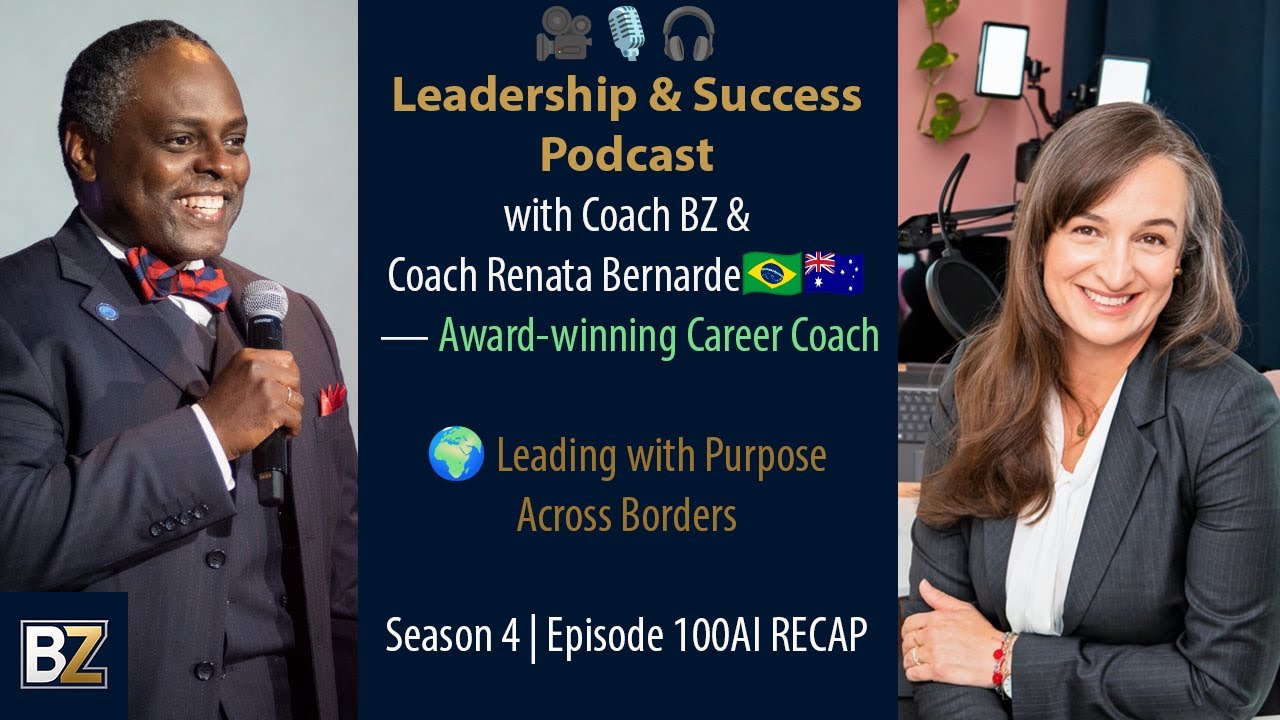
Renata Bernarde, a Brazilian-Australian executive coach, was made redundant before the pandemic and rebuilt her career into a global coaching practice. She shares her "Inner Compass" mindset, why failure is data, and that continuous learning is the single most vital leadership quality.
Chapters
Hi, I'm John Maxwell. When the top companies in the world are looking for trainers, speakers, and coaches, there's one name that stands above the rest, and that's Maxwell Leadership. Our certified team members have gotten proven results for companies all over the globe, and our reputation, I'm proud to say, is second to none. Some of our members have risen to the top of their profession, including the one you're going to meet today. I proudly introduce you to my friend Bob Fabien Zinga.
Welcome to the Leadership Success Podcast with your host, Coach BZ, where we help you lead with purpose and succeed with impact. If you're ready to grow into the kind of leader others want to follow, this podcast is for you. If you're determined to elevate your success and leave a lasting legacy, this podcast is for you. As my mentor, Dr. John C. Maxwell, reminds us, everything rises and falls on leadership. Our goal is simple: to inspire you, challenge you, and equip you with insights that can transform the trajectory of your leadership journey. Welcome aboard to another episode of the Leadership and Success Podcast with Coach BZ.
Sure. I am a Brazilian Australian. I was born in Brazil and I moved to Australia in 2001 to study here, as many people do. And from that point onwards, I fell in love with Australia and my purpose was always to stay here. I had a young family and I was a mature age student and my husband and I worked really hard to embed ourselves in the community here, find jobs, gain our permanent residency, all of which is quite hard to do, to be honest. And we've been here for over 20 years now. A few years ago, just before the pandemic hit, I was made redundant from my corporate role, and I then very quickly realized I didn't want to pursue another opportunity, another job. I had worked up my career sideways to the top, and that is usually a very good Strategy for Women in the Corporate Sector. But I was very ready to, to follow my next step, which I knew eventually I wanted to do, which was to coach other executives, other managers, and professionals to have the best careers. And I've been planning and prepping myself to do this for a long time, and I thought it was time to give it a go. And I've been loving it ever since. I have clients all over the world today, and it gives me great joy to help them.
Amazing. And as they say, the rest is history.
There's some amazing boomers and Gen Xs on TikTok that I follow. But when I'm there, I'm just having fun. I don't want to talk about— I'm there as a coach, but when I'm watching, I'm usually looking for cats and birds and people telling funny stories.
Actually, next week, I'm going to have an expert, Dr. Tim Elmore, is going to be talking to us about The future begins with Z. Of course, he means Gen Z, but I think Z is Zinga. But anyway, we need to learn more about Gen Z, how to motivate them and work with them because they are our future leaders. But anyway, both of my daughters, they really teach me how to love them, understand them, and work with them. So the most important question of the podcast before we end is, if you could go back and give a piece of advice to your 17-year-old self, standing at the edge of this incredible career you've had, I think extremely successful, what would you say to 17-year-old Renata?
Nothing. I would say nothing.
Really?
Because I'm so happy where I am right now that I don't want to say anything that would take her off track. Wow.
Okay.
That's the first time I've ever heard it. I've asked this question to hundreds of people, but okay. Very good.
No, I wouldn't say anything. I would say, look at me, you're going to be fine.
Just Okay, you're gonna be fine. Okay, okay, I like that. And part of the reason why it's a little bit selfish, part of what I'm doing is really for the next generation, especially people who are going to be leading in high tech and in the military. But it's also for myself, because when I was 17 years old is when I came to this country, to the US, and I had all of these big, big dreams, but I had no idea how to go from point A to point B. And I wish somebody would have told me what to do or which direction to take. So that's why I say it's the most important question of the podcast, because it's important.
Oh gosh, and I think I didn't do a good job then.
Sorry.
No, you did. You are going to be fine. I think that is so true.
Thank you.
Let's do our moment of gratitude, which is our custom here on the Leadership Success podcast. So for just a second, if you would, you may close your eyes. If you can. And I want you to think about one thing that you are grateful for today. And I think today I am really grateful for connection, networking. I think I've never met a stranger in my life. Everybody I meet is my friend. At least that's the way I think about it. And it's really amazing what a connection might be able to do for you in the future. Just adding value to people, and then I think people add value back into your life. You know, I can say that I would not be where I am today in my life if it wasn't for the people I have met. So I am grateful for connecting.
So what if you could totally reinvent your career even after a huge setback? Today, we're going to break down a really powerful blueprint from global executive coach Renata Bernardi. Her story, well, it crosses continents and it proves that your career is truly 'And completely in your hands.' We're starting with this quote because, honestly, it's the entire foundation of Renata Bernardi's philosophy. This isn't just some motivational poster you hang on the wall. No, she calls this the simple, hard truth of professional life: you are the CEO of your career. Period. So, who is this person, Renata Bernardi? Well, her story isn't just a list of accomplishments on a resume; it's really a masterclass in adaptation and reinvention. It's a journey that took her all the way from Brazil to a top leadership role in Australia. I mean, just look at the range here. She started out as an entrepreneur in Brazil, then in 2001 she moves to Australia and climbs the corporate ladder to become CEO of a major foundation where she nearly doubled its endowment. That is a serious track record of growth and being able to adapt. But then, after 2 decades of that kind of corporate success, she was faced with a redundancy. You know, for a lot of people, that's an ending. That's the end of the story. But for Renata, it was the catalyst for her next great act: coaching other professionals to build their best careers. That moment, it became her rebirth. So, how'd she do it? How do you make that kind of pivot? Well, her framework starts with something she calls the "Inner Compass." And this isn't about tactics or networking tricks. It's all about forging that internal mindset you absolutely need to navigate a long and, let's face it, unpredictable career. This quote just perfectly explains her core belief. You know, we're often taught to see our careers as this straight climb up a ladder, right? Bernardia argues the complete opposite. She says real success is actually a winding path, and it's defined not by constant progress, but by how well you know yourself and how you adapt along the way. And she really lives this philosophy. I mean, she dropped out of university—twice. She completely started over in a brand new country. She believes every single setback is just part of the process. In her own words, she says, "Failure gave me permission to fail. So it's not something you should avoid. It's something you should expect." So, here's the crucial part. It's how she completely redefines rejection. It's not personal. It is not a judgment on your value. It's just— data. Think about it. If you apply for 100 jobs and you get 1 interview, That's not failure. No, that's research telling you exactly how to refine your approach. Okay, so this mindset, it builds directly into her second pillar, the practical toolkit. This is where we shift from the internal stuff to the external, the real actionable strategies you can use to lead and grow, like starting today. And she tackles one of the biggest challenges for any rising leader, something we all struggle with. Managing up. How do you lead when you're not the one at the very top? How do you earn the trust of your superiors and actually influence decisions? Her advice here is so simple but so powerful. Never walk into your boss's office with just one single solution. It just feels like a demand, right? Instead, bring 2 or 3 well-thought-out options that you can actually support. This completely transforms the dynamic from command to collaboration. You're not telling them what to do; you're creating with them. And this idea extends to your digital presence too. Renata argues that way too many professionals have this passive "follower mindset" online. But the real leaders? They adopt a creator mindset. They don't just consume content; they create it. They share their perspective, and they connect with people authentically. That's how influence is built in the modern world. And a really critical part of the toolkit is knowing what to let go of. This is a tough one. As you rise in your career, your job is no longer to be the best at turning the wrench. Your job is to trust your team, empower them, and focus on developing them into leaders. Your focus just has to evolve. So, all this brings us to our third and final pillar: the human connection. After you've mastered the mindset and the toolkit, this is the philosophy that really ties everything together. Leading with empathy, with service, and with heart. The soul of this pillar is captured in this just beautiful line from the poet W.H. Auden. For Renata, this isn't just poetry; it's a leadership doctrine. It's all about a willingness to give more than you receive. She calls this servant leadership, but in a very specific way. What it means is you serve without keeping score. You lead with a genuine sense of love and care for your people, and you trust that the impact you make will always, always be more important than the credit you get. And looking forward, she sees this as more critical than ever. I mean, leaders are gonna be managing hybrid teams of humans and AI. She urges us to embrace AI as a powerful tool, but to use that efficiency to better understand and support our people. To never ever lose the human heart in a world of automation. So after this incredible journey—across borders, through corporate success, setbacks, and total reinvention—it all comes down to one single powerful idea: her one-word secret to leadership. So what is it? I mean, after everything she's experienced and everything she's taught, what is the single most important quality a leader has to have? The answer is learning. That's it. So simple, right? But also so profound. The best leaders, the ones who really endure and thrive, they never stop being students. They learn without ego, they adapt without fear, and they just stay curious through it all. And we're gonna end here. Because when she was asked what advice she'd give her younger self, her answer wasn't about avoiding mistakes. It was this powerful statement of self-trust. It's a reminder that every detour, every setback, and every single lesson was a necessary part of the journey. And that's a really powerful thought to leave with. Trust your own journey. You're gonna be fine.
Welcome everyone. Today we're diving, um, right into a conversation about leading with purpose across borders, drawing inspiration from a leader whose journey spans Brazil, Silicon Valley, and Melbourne.
That's really something, isn't it? Like the way her career unfolds as a tapestry of cultural and professional experiences is just fascinating. Absolutely.
And you know what stands out is her mantra. 'No one is more responsible for your career than you.' That's not motivation, that's reality. It's this raw, empowering perspective. Right.
That quote really cuts deep. It's like she says, 'Own your journey.' But can you explain how she blends servant leadership with such a global mindset?
Sure. She embodies what we call servant leadership, where it's more about serving, adapting, and inspiring rather than just chasing titles. It's a style that transcends borders and cultural contexts, making her impact truly international. I love that.
And it's interesting how she seamlessly transitions from corporate roles to personal reinvention. Like when she went from growing an endowment from $18 million to $31 million to pivoting completely after redundancy.
Exactly. It's— a testament to how career success isn't linear. She's embraced every setback and detour, turning them into lessons for growth. That journey really shows that the path isn't about perfection, but persistence and self-awareness.
And that reminds me of something else in her story. The idea that failure is not a reflection of who you are, but rather data. I mean, applying for 100 jobs, And getting one interview isn't a defeat.
It's a signal to recalibrate. Precisely. Each no is a piece of feedback, a chance to refine your message and your mindset. It's, um, like learning on the fly, right? That's a powerful mindset to lead with.
Speaking of learning, she also champions the idea that leadership is about evolving, learning without ego. How do you see that reflected in her approach?
Oh, it's integral. She emphasizes that real leadership isn't just about command or authority. It's about continuously learning and enabling others. She even points to leaders like General Sir John Monash, who practiced learning and letting go of the minute details once they reached a certain level. Yeah, exactly.
I get that. But sometimes I wonder, isn't there a risk of overemphasizing learning to the point of, um, indecision. Where do we draw the line?
That's a fair concern. I mean, while continuously learning is key, she also stresses decisive action, leading without fear. It's a balance. Gather insights, but then trust your vision and chill out on the perfectionism.
Mm-hmm, I see. And then there's her take on managing up. I found that piece about not presenting just one option, but offering a couple really intriguing— that's like a collaborative dance in leadership.
Totally. It's a lesson in strategic collaboration. When you manage up by offering multiple ideas, you build executive trust and invite creative partnership rather than just following orders.
It's like in any team setting, having a couple of backup plans makes the process more robust. Precisely.
And that's not only applicable in boardrooms but also on the battlefield or in tech startups. It's a universal formula for resilience in leadership.
Speaking of resilience, her entire journey screams resilience. From starting a travel agency in Brazil to facing redundancy and reinventing herself, every step is a lesson in bouncing back.
Yeah, and she even laughs about setbacks. Like, "If you're facing a setback right now, welcome to the world of being employed and alive." She quips, "It's humbling and empowering all at once." Absolutely, and humility plays a huge role here.
It's not about flaunting success, but about staying genuine and connected to people. How do you feel about her emphasis on connection?
I think it's spot on. In our digital age, she reminds us that authenticity online especially on platforms like LinkedIn, is like the new town square. You build your personal brand by connecting genuinely rather than just pushing content.
Yep, that resonates. What's also cool is her venture into AI. I mean, learning AI, teaching clients about it. She's preparing leaders for a future where teams are partly human and partly AI-driven.
Exactly. Embracing technology without losing that human touch. She's like, use AI to understand patterns, support your people, but don't forget the heart behind every decision.
That really pushes us to think about balance in this rapidly changing world. Efficiency, empathy, and a dash of old-school humanity. Right.
And her philosophy of love and service is quite moving. Remember that line from Auden? If equal affection cannot be, 'Let the more loving one be me.' It's a call to serve without keeping score.
Absolutely, yeah. It's almost poetic, a reminder that leadership is, at its core, about love, empathy, and genuine service.
True. And to tie it all together, when asked to define leadership in one word, she said 'learning.' It's a succinct yet profound encapsulation of her journey and her ideals. Mm-hmm. That's powerful.
But I've got to ask, don't you think sometimes that focus on self-driven career building might overlook the collective responsibility? How do you square that?
That's a good point. She definitely emphasizes personal responsibility, but not in isolation. Her idea of servant leadership is about empowering others. It's less about self-promotion and more about— Right. I get that. —elevating those around you.
So it's like you take charge of your own journey, but also foster an environment where everyone can thrive. Exactly.
And that idea extends to building relationships, be it in the military, in tech, or on social media. Whether you're facing a challenge on a Navy ship or advancing your career on LinkedIn, the principle remains the same: clarity, empathy, and continuous growth. I like that analogy.
It's like nurturing a garden where every plant gets your attention. Yes, precisely.
Um, you water your own roots but also nurture the ones around you. That's what leads to a thriving, resilient ecosystem.
Absolutely. And isn't it interesting how even scripture gets woven into these lessons? The quotes from Philippians, Luke, and Joshua add an extra layer of, um, depth to her leadership model.
Very much so. They serve as ancient reminders of humility, empathy, and courage, qualities that are, um, just as relevant in boardrooms today as they were centuries ago.
Right, timeless wisdom. In our modern, fast-paced world, these lessons are a breath of fresh air, reminding us to lead with both heart and head.
Exactly. It's all about balancing technology with humanity, ambition with service, and mistakes with continuous learning.
Mm-hmm, definitely. Truly inspiring. I think these ideas are something we can all take a page from, no matter where our careers take us.
Agreed. So here's to leading with purpose, learning every day, and serving others without keeping score. Thanks for joining in on this deep dive into such a vibrant leadership mindset. Right, thanks for the insights.
So you have to be prepared for a few months or even longer at a time in your life where it is completely an unnatural situation. We don't like this. Our human brain doesn't like lots of negatives and just one or two positives along the way, right? We like the opposite. We like lots of positive reinforcements and not so many negative reinforcements. So that resiliency that you mentioned before, that grit to persevere is important because one of two things can happen with a job seeker. Either they will spiral down from the negative results of their job search, or they will spiral up. Yes. If every time they get— that sample gets bigger, they learn from that sample, right? So I was talking to a client last night, and he hasn't been successful in his search right at the beginning of that search. So when he's applying for jobs, so That is the bottleneck, you know, and we looked at his cover letter, we looked at his LinkedIn, we looked at his resume, and also we spoke about what is it that he's saying when he talks to people, right, to try to find what's the bottleneck at that beginning of the process. The funny thing that happened was while we were having a conversation, he received a message inviting him for an interview. And I'm like, whoops, okay, so that's, that's good. So we have some sometimes to, um, pay attention to the sample size. Um, if somebody has been saying to me, oh, I never get an interview, I'm like, how many jobs have you applied for? Oh, 2. Well, that's not a big sample size. Yes, but if you have been applying for 100 jobs and you haven't got a single job interview, That also, that worries me because the problem— I mean, of course, there's a lot of competition, Bisi, don't get me wrong. But there's definitely a problem in that bottleneck. You know, it's the application that we need to review.
Thank you for tuning in to the Leadership Success Podcast with your host, Coach Bisi. If today's episode added value to your leadership journey, Be sure to subscribe, share, and join us again for more wisdom nuggets on how to lead better and achieve greater success. Remember, leadership is the most critical skill of our time. The world will always need leaders to inspire others, drive innovation, and execute meaningful strategy. So why not count yourself among the bold leaders shaping the 21st century? Until next time, stay inspired, stay committed, And keep leading with excellence.
More from Bob

S250:E4🎙️LIVE 🇺🇸America 250: President Barack Obama Leadership, Service, and the Power of Hope






S5:E157🎙️ LIVE with CMD CMSgt Dennis L. Fritz, USAF (Ret.)(Multi Tracks Audio)



S5:E156🎙️ LIVE 🇪🇸 Leadership Lessons from the FIFA World Cup 2026 Champions (Multi Tracks Audio)

S250:E3🎙️ LIVE Leadership Lessons from America’s First Documented Family of African Descent 🇺🇸📖