S4:E103 🎙️ LIVE with Dr. Marjorie James (Multi Tracks Audio)
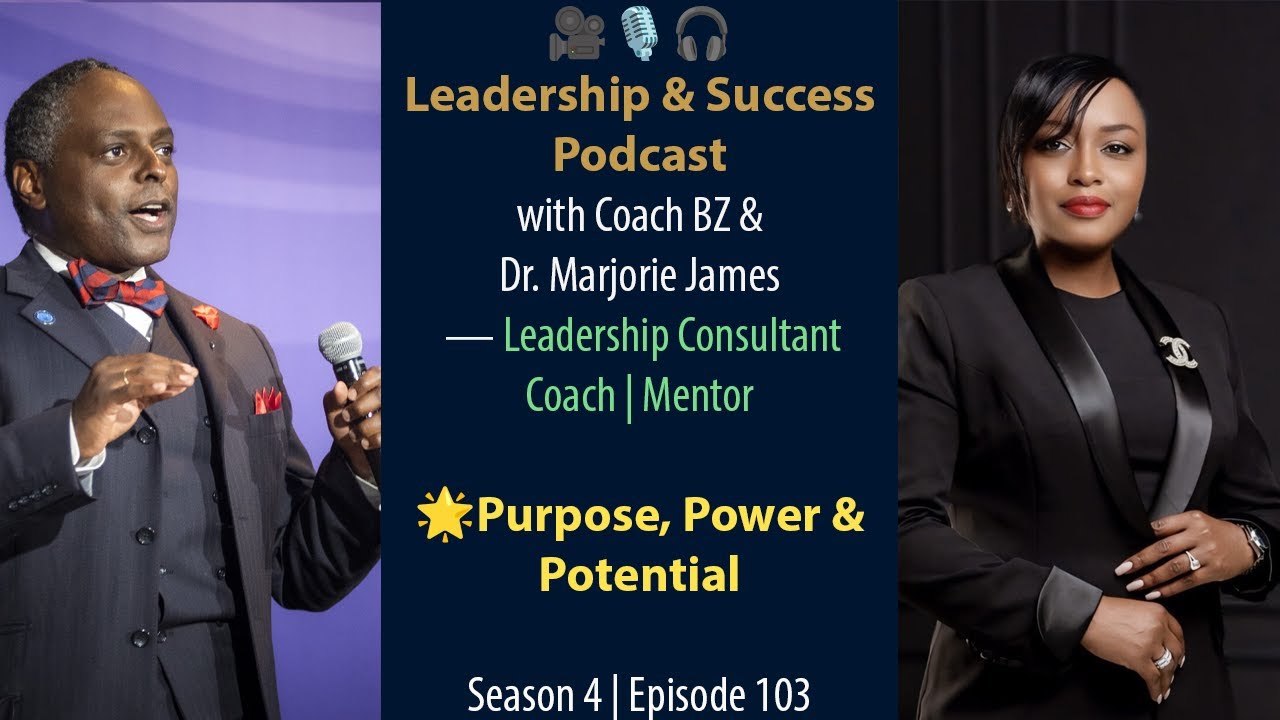
Coach BZ interviews Reverend Dr. Marjorie Murray James, founder of Kingdom Leadership Academy, about her path from Emirates cabin crew to executive coach. She emphasizes integrity as an internal value, the power of gratitude, and servant leadership rooted in faith.
Chapters
¡Hola!
Hi, I'm John Maxwell. When the top companies in the world are looking for trainers, speakers, and coaches, coaches, there's one name that stands above the rest, and that's Maxwell Leadership. Our certified team members have gotten proven results for companies all over the globe, and our reputation, I'm proud to say, is second to none. Some of our members have risen to the top of their profession, including the one you're going to meet today. I proudly introduce you to my friend, Bob Fabien Zinga.
Welcome to the Leadership and Success Podcast with your host, Coach BZ, where we help you lead with purpose and succeed with impact. If you're ready to grow into the kind of leader others want to follow, this podcast is for you. If you're determined to elevate your success and leave a lasting legacy, this podcast is for you. As my mentor, Dr. John C. Maxwell, reminds us, everything rises and falls on leadership. Our goal is simple: to inspire you, challenge you, and equip you with insights that can transform the trajectory of your leadership journey. Welcome aboard to another episode of the Leadership and Success Podcast with Coach BZ.
Integrity is being whole, being one with yourself. You being one, not compartmentalizing that when you're in this room, you're different. When you're with this batch of people, you are different. When you're going out to a different ceremony, you're different. You have to be one with yourself. Be consistent, consistent, and true to yourself. If you're not true to yourself, you're not going to be true to anybody else. It starts with you. So you have to practice it with yourself. Without integrity, you cannot prosper in anything that you do, no matter how qualified, no matter how experienced you are in whatever it is that you're called to do. You have to have integrity. You don't display the integrity when people are around you and they are watching. Again, like I said, it starts with you behind closed doors? Are you true to yourself? Are you true? Because it's an inside job. It's on the inside of you. It's a value that you have. It's a principle that you display to yourself, and then you go and radiate it to the others. Because if you don't start this within yourself, I can guarantee you it's not one day you're going to turn up and then, oh, all of a sudden you have integrity. It doesn't work like that. It is measured over time. So you have to be consistently consistent with yourself. Integrity also does not mean that you are perfect. So don't try to overfocus on being perfect. Just be you and be— and you can— you will make mistakes. It just means that you are growing. But you have to, number one, be— self-correction is the best correction. You notice that you make a mistake, correct yourself. If you don't notice, if it's addressed to you, take the correction. It is a blessing for you. It is a gift for your future. Correct yourself. You will make mistakes, but at the same time, keep carrying on and being consistently consistent as you align yourself with—
All right, everyone.
I am very, very excited today. We have a very, very special guest. Before we get started, let's do our moment of gratitude. This is the part of the show where we take just a moment to be grateful for one thing. And for those who's been following the show for a while, You know, part of the reason why we do this is because in the military, about 22 people, service members, veterans, commit suicide every single day. And I believe it's not possible to be suicidal and at the same time be grateful.
So if you would put yourself in your happy place, maybe close your eyes, take a deep breath, and think about one thing you are grateful for today.
And today I am so grateful for all of the great mentorship I have received, including the person you're going to be talking to today. She is one of my mentors and a master in leadership, and I am so glad to have got to know her and for the impact she's had in my life. And now I'm hoping that she's going to have the same impact in yours.
So type into the comment what you are grateful for today. So let me see if I can properly do this, uh, introduction here.
So, uh, this is going to be a very inspiring, uh, conversation with Reverend Dr. Marjorie Murray James. She's the president and founder of Kingdom Leadership Academy, resident pastor at the Embassy Church in Rhode Island, and the 2025 African Women Achievers award recipient. And I think I played the videos earlier, but here's the picture: 100 African Female Changemakers in 2025.
So she's recognized among 100 African female changemakers and icon of Africa's economic advancement.
With nearly two decades of leadership coaching and ministry experience across UAE in the Middle East, the UK in Europe, and the United States, and many countries in Africa, Dr. Marjorie has transformed lives by helping leaders unlock potential, embrace authenticity, and lead with integrity, faith, and excellence.
So from the flight decks of, um, Emirates Airlines to the leadership halls of Kingdom Leadership Academy, her story is a masterclass in courage, calling, and character.
Together, we're gonna be exploring today how to become a bold leader who makes, uh, lasting impact, the connection between faith, service, and influence in leadership, and how to transform limiting belief into breakthrough result, and why authentic leadership and gratitude are essential for growth. Without any further ado, please help me welcome the one and only Reverend Dr.
Pastor Marjorie James. How are you doing today, Dr. James?
I am very well, Coach Bizzy. Thank you very much for having me. How are you?
Yeah, this is long, long overdue.
I am so glad, so glad you are here.
Before we get started, uh, is there something that you are grateful for today?
Absolutely. Oh my God, I believe in just having an attitude of gratitude. First and foremost, I am grateful to be on this show.
Thank you.
I'm grateful for the gift of life, and I'm grateful for another day and another opportunity to make an impact to somebody or people or nations that's going to be listening today, tomorrow, or even in the near future, because this is now written here and it's gonna be global. Wow. That I am grateful for because it's a privilege. It's not— and I don't take it for granted. So I'm very grateful for that. And I'm grateful for my family that God has given me. Yes, my spiritual family and my biological family. I have actually a very long list of gratitude.
Yes, absolutely.
I definitely feel the same way. And when I say being grateful for today, I know the scripture says, right, today is the day the Lord has made, we will rejoice and be glad in it. Always make the choice to be.
Wow, wonderful. So is there something about you, Dr.
James, that most people may not know?
I'm an introvert.
Wow, I find that very hard to believe, uh, because I've seen you speak and preach and teach. Uh, wow.
Yeah, I'm an introvert actually.
Wow. Okay, okay. I, I still don't, don't believe it, but okay, I, I will take your word for it. Can you let us know about your leadership journey?
Uh, you got to be Dr. Marjorie James.
Now, my leadership journey was actually started out when, um, when I was still, um, I was flying as cabin crew at the time. And, um, I was just happy-go-lucky, you know. It was great. I mean, visiting different cities and stuff. And I sometimes— we, you know, like in any corporate world, sometimes you may not be happy about how you are handled by some managers and leaders. And then I decided that, you know what, I'm going to be the change I want to see. I said it, I'm gonna make that change. So I decided to educate myself in things, to understand better the leadership, because I was thinking to myself, you know, just as normal as— especially when you're young and then you're just a group of people always bickering around. And I told myself, no, maybe there's something I don't understand about this leadership. Maybe they are doing something right that I don't know. So I actually— I'm a very inquisitive person. I went on a venture of trying to understand the leadership. Because I wanted to learn about it. I actually, I never wanted to be a leader. I always liked being in the background. I always liked being in the background. So I got into— I started coaching. I said, uh, we used to have free courses of coaching at Emirates Airlines, very, very, very, very helpful for us, and workshops. I used to attend workshops even on my days off. So that's how— and then I came to this. Actually, this is actually great. And then there was a— it became a change in me, in myself, in how I see how other managers and leaders do their stuff. So now what I— now what really inspired me more is to, to become a leader was that I came to know, to realize the obvious difference with someone who has the knowledge of leadership and somebody who doesn't have the knowledge of leadership, and someone who's operating on the, on the, on the front of whereby They, they are there because they want the title. They want to be there because of the perks that they get, of the package. But there is a difference also. There's someone who wants to be there because they want to make an impact in people's lives. So I chose the latter because it is a privilege. You've been— people have been put under you. People— you have been given people by, by the management, by God. God says, these are my people, lead them, guide them. So when you lead people and guide them, are they supposed to be the same the way they came to you? No, there's got to be a change.
Wow.
We are the light of the world. We are the salt of the earth, because salt makes a difference. It has to be a change. So in as much as yes, we want— we like the perks and things that are there in the management, but it cannot be that at the capacity of people, because you end up in people's lives because you do not have the knowledge of how to transform people. So I now decided, okay, I'll get into this leadership. Then I decided, okay, what is entailed in this? I need to understand myself first, lead myself first, and be the leader to myself even when nobody is watching me. Lead myself into it. And then once I have it in me, then I can pour it into other people. And then I needed to understand how people think and how people understand. And that's why I became an NLP Master Practitioner. Understanding self and others, communication to self and others. Because you can easily, especially working in a multicultural company like Emirates Airlines, have diverse of cultures. Yes, you can easily misunderstand someone.
Hmm.
Understanding people and understanding self is actually very, very important and is key in leadership.
Yes.
Yeah. So that is part of my journey, which is, and again, leadership is a continuous journey. It's never ending. It's never ending.
That is so true because Dr.
Marjorie, so you've, you've lived and led across continent, like we say, in Middle East, Europe, Africa, and in the US. So from the sky of Dubai with Emirates to leading the Kingdom Leadership Academy in the US, how would you describe the defining thread that connects your entire journey?
To be fair, it's actually— I was already managing multicultural, diverse cultures, so I found it the same. It was just transitioning from now, from being employed now, to me setting myself up as an individual and to do consultancy for them and say, okay, now I've been here So now what— because it's more or less the same really, because I was dealing with multivirtual cultural people, the parts of cultures, different continents. Only that now being in the United States, you're stationary there more than traveling around the world. But it is really, really, really the same to me.
Wow. So what, what inspired you then to transition from aviation leadership to life and executive coaching? Was there a moment that sparked your calling?
Yes, a very defined one, actually. But it was a very painful one in a little bit of a way. So I actually had an interview with, with one of our international directors, and they called it "From Pain to Purpose," because something very, very significant happened that in my leadership, in my leadership ascension, that I actually got demoted from my position without a valid reason, and nothing was being said at all. So I decided, was it a fight or flight? Am I going to fight? Am I going to fight back? Then I realized, okay, here this mismanagement of, of me as a person. So I thought to myself, there is no knowledge on how to handle this situation because I know how this situation would have been handled better, but I'm not in a place to influence it.
Yeah.
So at time when it happened, I did not quit. I did not quit at the time. I said, okay, you know what, I'm gonna stay the course, I'm gonna stand strong, and I've got to believe in myself in it. But I've got to take this— it may look like a failure, but I will not call it failure, I call it feedback.
Hmm.
I said, I called it feedback. Okay, so what feedback am I getting out of this? I cannot change the decision they have made. But what is it for me?
Wow.
And that's myself. Then I thought to myself, become the excellent version of yourself. And that is the tagline for the Kingdom Leadership Academy. No matter what happens, no matter what situation, you do not run off, you do not cut around the situation. Walk through it, walk through that fire, because that fire is where you are being processed. And the process, the process processes you. The process processes you. The diamond has to go through that fire for you to be made who you are supposed to be. It is not pleasant. It is, it's not what you like at the time, but when you get to the other side, there's an integral core of you that has been made that cannot be taken away from you.
Yes.
Wow.
Yes, that is, that is quite, uh, powerful.
And all the time I've known you, like even, um, today I thought of a short clip about you speaking about integrity. So you always talk about authentic leadership and integrity, right? Uh, what does that mean to you personally, and how can leaders cultivate authentic leadership in high-pressure environments, whether in the military or high-tech?
You see, integrity is who you are really, and you have to be integral with yourself, one with yourself. Whoever I am in this living room, I've got to be the same person in the bathroom, the same person in the— in my other— on the other room, because you can't be entering rooms and just turning on switches. Today I'm this person, today I'm that person. And it is created over time. So you have to be one with yourself. And the importance of integrity is so that when you are— when you're when your values are tested, but when they're put in question, because like you say, but sometimes when there's high pressures in leadership, sometimes you either in the military, either in tech, either in aviation, in the church ministry, sometimes the leadership can be put to test. So that your integrity, your values, I call them lines that do not move, is what is going to anchor you. So if you're flippant, that, oh, one day you'll be— and then people watch you more. The people you're leading and managing actually watch you more than you can— they even listen to you. So if they notice that you're a bit flippant and you don't have integrity, you've lost the whole team.
Wow.
You see, you're representing yourself. That is the value. It's who you are. It's what is going to speak for you. Integrity is not measured when somebody is there listening to you and watching you. It is measured over time, and it's cultivated more importantly exactly when nobody is watching.
That is really insightful.
So you spent almost, uh, two decades, right, managing multicultural teams under immense pressure with Emirates Airlines. What leadership lesson did aviation teach you that today's corporate and ministry leaders can learn from?
To be flexible. To be flexible. And, um, yes, I know there's rules and guidelines and policies and things, But there are some guidelines sometimes which need to be thought outside the book. As long as it's not violating, let's say for example, in military, in aviation especially, as long as it's not violating security, as long as it's not violating the main policies. But to just be flexible and have an open ear, you know, listen, ask questions as well. Ask questions even to the most junior person in the ranks. They actually have the million-dollar answer that you're looking for.
Hmm.
Yeah, just to be open, because, because these young people coming up, actually they have ideas. I know some of their ideas can be out of this world. Yeah, but, but if you listen to them, number one, you're going to have a winning team, because that means everybody's footprints and handprints are seen all over a decision that is being made. So it's just to be flexible and just to be open and to be including everybody, to be— yeah, to have that inclusion, inclusivity. Because that is something which I noticed that would lack sometimes. Only people in the higher levels will be asked about a suggestion or something like that, and the people who are in the lower levels are not included, when you might be missing out on the right answer from even the least least person, even some the person who just probably joined the military, let's say.
Yes.
Yeah, yeah. Is that to be inclusive?
That is so true.
Actually, my own example, when I was the commanding officer of, uh, Ginosk in Suffolk, there was a problem I was trying to solve with my leadership team, the department head and above. It took us almost 2 months to try to figure out that issue. We couldn't come up with an answer. But then I Opening it up to the entire team and one of the most junior enlisted person in the unit was the one who gave us the answer like within 5 minutes. I couldn't believe it.
So I guess you have to be humble and be inclusive because you are—
Yes, humble and be inclusive. Yeah. And let everybody be included in the decision-making process.
Wow.
That is quite powerful. So tell us about the founding vision behind Kingdom Leadership Academy. What gap did you see in the leadership landscape that you wanted to fail?
Lack of authenticity, because people— lack of authenticity and lack of boldness, because, um, people are not— some leaders, not all of course, were not bold to stand their ground and say, okay, this is the decision I have made, this— okay, this is what is— because sometimes you'll be challenged, people will corner you out. So you've got to stand your ground and say, okay, I do understand and I do appreciate what you're saying. However, this is what we are doing today. We can talk about it later. And by authenticity, on the other hand, I mean people wanted to lead and manage like somebody else. You see, for example, I can emulate Coach Bizzy. I can appreciate so many things I do, but I cannot walk into a room and try to talk and walk like you are walking. Because there's an original version, authentic version of me that the people in that room are waiting, that if I don't give it to them, I should change them.
Wow.
Right? I can, I can, I can learn things from, from Coach Bizzy which are very emulating, which are very influential, but I cannot start speaking like you, wearing a jacket that like similar like you're wearing. I've got to be myself but learn from you.
Yes.
Because the people who make Mistake. Yeah, because if you, you don't give out the authentic self of who you are, there are people who have been assigned to you. Their destiny lies in your hands, in that authentic that you are. So give it to them and don't be selfish, because if you don't, you should change them and you prolong their journey. So it's in your hands.
Wow, that is powerful. Now one thing I love about, uh, the kingdom leadership Academy.
I think it is definitely based on faith and scripture, but it definitely applies to any and every industries. No, no, no, no matter where people come from, their businesses, small or large, it doesn't matter. Those principles really apply across the board. So I guess my question for you is, how do you integrate faith-based values with corporate leadership development without alienating either audiences?
To me, they're actually the same because I'm one person. It's integral. Just like, like I was saying, my best values in the corporate world and in the ministry are the same. Because you can't be two people, you'll end up confusing your team. Yes, you can't be two because you have to be one person, integrity, one integral, one with yourself. That's who you are. Because if your values are no compromise, if your values are no to this and no, you can't say, okay, I will say in the church I will say no to this, but when I'm in the marketplace, I'm going to say yes to this. You confuse yourself.
Wow.
For me, they are one. They have to be one.
That is so true. So I've once heard you say that everybody has potential and you just need the right voice to unlock it. What does it mean to be that voice for someone else?
For me, it's a privilege, honestly. It's a privilege and it's an honor. So when people come to me, and then I realize I'm now that voice they want to listen to that's going to unlock what they have, and they said it's a privilege, and I will see to it— like, I would even burn the midnight oil with that person until we get the results and see a change. Yes, because it's a privilege. Because you see, this is life-transforming. This thing— this person is going somewhere, and you have been entrusted to them. They have been entrusted to you for you to guide them. It's a privilege. I would, I wouldn't take it like— even when I'm invited to corporate meetings to train the, the staff and, and all, I take it as a privilege because whoever has your ear has your future. So if you give them the wrong information, they're going to go in the wrong direction, and you could mess somebody's lives, mess someone's legacy, mess somebody's generation.
Yes.
So when they come to me, I usually sit down with them intensively. And I don't take it for granted. Yeah. So for me, that is a privilege and it's an honor.
Absolutely.
So from your coaching experience, what are some of the most common limiting beliefs that old leaders bank and how do they overcome them?
Number one thing, people think that to be a great leader, you need to have an Amazon bestseller. That is not true. Yes, it's a plus if you do have— if you have an Amazon bestseller, it's great. Another thing is, oh, you have to have like a million followers on, on social media and have a very huge platform. That is not true either. You just have to start with what you have. Those other things are a plus. And just once you're authentic in yourself, make an impact When you start making an impact, you are building up a story, and stories sell. Yes, stories sell, and you'll make an impact. You can write a book eventually, you can, but it, it is not— that is not a defining factor for you to be a, a leader. Or people think also you have to have these great titles, that that's what makes you a leader. Even those people with titles, they started somewhere. You just have to embrace your journey with what you have. And keep building and keep growing.
That is powerful. Embrace your own journey.
Yeah, because in this world of leadership, sometimes I think there is a conflict where people are too ambitious or they want glory or ego.
Look at me, all of these followers, bestsellers, and all of that. And sometimes when you lead, that does happen. But I guess my question for you is, how do you balance ambition with alignment to your purpose, right?
Where you don't go after titles, but you actually focus on transformation.
How do you coach leaders to stay focused on their purpose?
For me, I usually ask them one question: whatever their ambition is, is it aligning with their purpose? Is it going to make them to achieve what they want? Because The one of the greatest and biggest failures is being— I call it conquering the wrong mountain successfully. Yes, you can be running through, you can be very ambitious to get the number of likes, then you make that likes and verification of your account an ambition, then you forget your people. But if your ambition is to be educated, to get more knowledge, and then in this getting, acquiring new knowledge, it's going to help you transform people, then there's nothing wrong with being ambitious. But it has to align with your, with your purpose. Don't get too ambitious on something that you forget the people in the, in the car, and you've gotten off the car, you're somewhere else. Because if you do that, that is actually losing focus. And the moment you lose focus, coming back it's going to cost you a lot. I was reading something, I think it's a Chinese proverb, and they say when you get, when you get on the wrong train and you realize that you, you're in the wrong train, you have to get off in the first stop, because if you keep going and going, it will cost you more to come back. Yes, that's just having a wrong ambition and forgetting your purpose. So that's good to be ambitious because you've got to be changing, you've got to be evolving, you've got to be developing yourself. Because you just can't stay dormant, otherwise your protégés are going to come and, you know, overtake you. But the ambition has to line up with your purpose. They have— it has to be— they have to be together.
Well, that is, that is quite, uh, powerful. Now, you are one of the resident pastors at Embassy Church.
That's my home church with my spiritual parents, Papa and Mama and Dathan.
So you've worked under the mentorship of Apostle Dr.
Charles Ndifan. I think I have a picture right here.
Yes. And Dr. Donna Ndifan.
What are some of the leadership lessons you've learned from them that guide your ministry today?
Number one is be consistently consistent. Always be consistent in what you're doing. And number 2 as well, even if it takes you to lead one person, just do it. Never quit. Never to quit. And just to just be consistent because you have to keep the road, the ball rolling. And be boldness as well, to be bold and to just be passionate about just to remember your why. Why are you doing this?
Yes.
Why, why are you— why? That's— I mean, they've taught me so many things over time until today, but these are some of them. Mostly consistent, being consistent, and, and being one with myself, being integral with consistent, and just, just being truthful to yourself.
Yes.
Because unless you're truthful to yourself, you're not going to be truthful to the people on the outside.
So powerful.
Yeah, I think one, one thing that Papa Ndifanu really taught me is about servant leadership, right?
So, uh, yes. What—
so I guess a question I have for you is, uh, what's your perspective then on how leaders can balance serving others with the responsibility of leading decisively?
Okay, thank you very much. That's actually a very good question because people usually confuse the servant leadership. They think that, okay, now you have to do the people's job. No, you serve your way to the top. First of all, to get to that leadership position, you've got to serve your way to the, to the top. Oops, sorry. You've got to serve your way to the top. So now, serving your way to the top is you have to work together with your people. Work together, as in You be part of the team. You are guiding them. You see, like, like Jesus, like how Jesus was, was doing his ministry, like he was showing them, this is what I'm doing, and then you do it. Just being there with them, doing it alongside with them. Because if you just say, okay, I'm just gonna be there, I'm the big cheese now, I'm at the top, do it, it's not going to work like that. But when you, yeah, you're working alongside with them, you're leading them. That is servant leadership because you become part of the team, you become part of the team and you help them and they see as well, they learn more, even better, because, and they'll be even more comfortable to come to you because, because you're there with them alongside, you're walking along with them. So I personally believe in servant leadership totally.
Yes, that is, that is so powerful.
And we, we mentioned earlier you were honored among the 100 African female Changemakers and Icon of Economic Advancement.
So, uh, winning that award, uh, what did that recognition mean to you personally?
For me, it meant that we— I just need to keep going and to keep— because it's some— I may not— I don't do things for optics, but that means somebody has recognized the impact I'm making and they're appreciating it. And this is actually what it's all about. They're appreciating the effort that I'm making. So we just need to keep on moving. Keep on doing, keep on changing. Because during, during the, during the conference, actually the theme was the Africa we want to see. So basically that means there's some— I've equipped myself with knowledge that is valuable. And like I was mentioning earlier, so there's definitely something— I have been doing things, and along the line I've educated myself, mentored people, taught, or whatever, trained a lot of people here and there, and it's making an impact.
That is really powerful because I've heard you say the greatest nation is not America or England or Japan, but the greatest nation is in your mind. Can you tell us more about that?
You know, imagination is powerful. Imagination is actually more powerful than knowledge because you see, your brain has two functions: to imagine and to remember. You have to imagine and remember. So whatever you see, the eye of your mind is asking you for permission to live outside of you. And as long as you've seen it in your mind, your feet will not take you where your mind has not been.
Wow, you have to say that again, that's powerful.
Your feet will not take you where your mind has not been.
Wow.
Because you've got to see it with your mind, because that imagination, I can tell you, is It's actually a dream that is asking permission. Dr. Marjorie, give me permission to live outside. Make this possible for me. Yes, so imagination is very powerful because what you think about— and the thing is, sometimes it may look like out of this world, like something that cannot be done, but as long as you've imagined it, no matter how difficult it is, write it down. I believe in being analog sometimes. I jot things down, I write them down. Just like they say, write the vision down and make it plain. And I'll put it boldly somewhere, and I'll be looking at it back and forth. So that imagination will start to come alive, and I'll start to piece them together. And it, it definitely, as long as you believe it and you have faith in it, it's gonna come alive.
Wow, that is so powerful.
I think this is worth the ticket right there. So one, one last question before we switch over to the second half where I focus more on leadership. A lot of people listening are women, and today, unfortunately, even in America, there is really no gender equity. Men make a lot more than women with the same background, experience, age. Actually, women are a lot more educated than men now in this, in this country.
But, but anyway, talking about women, especially underrepresented women of color, my question for you is, what advice would you give women in leadership who struggle to balance visibility, voice, and vulnerability?
They have just have to be bold and be able to represent what they are talking about. And that's not the importance of being knowledgeable.
Mm-hmm.
Got to be knowledgeable in what you're representing, because nobody's going to turn you down if you have the right knowledge and right information of whatever it is you're presenting to them. And you just have to keep going, just have to keep going back until presenting, just not to give up. You may be turned down, you may be turned down a couple of times, but for every— sometimes you can get 99 nos and get the one yes.
Yes.
Wow.
You can get 99 nos and then get one yes. To just keep pushing, just keep pushing it, just keep pushing it, just keep polishing that diamond, and it will happen. Someone is definitely going to listen.
Wow, powerful. So the first question for the second half then is, uh, what do you think is the greatest lesson you have ever learned?
Oh, in leadership?
Yes, in leadership or life.
Leadership or life.
It's a journey and it's to be embraced. One of the greatest lessons I've actually also is that change, change is a gift. It has to be embraced. Change is a gift and it has to be embraced. It is a gift and to receive it, because that transitioning, it may be uncomfortable, it may be something that you don't want, but it is a gift. It is a gift and it is something that when it's happening and you— and you know what, if you do not embrace change, let's say for example, if I need to make changes here right now you know that, and I don't embrace that change, that environment is going to vomit me out. Yes, where I'm supposed to be. And I, I would use a biblical, uh, translation of this. It's like Jonah. He did— he was very resistant to go and, and teach and preach a message in Nineveh, but he was swallowed in by a whale, right? But he was only there for 3 days. He could not stay there longer. He had to be vomited out into where he's supposed to be.
Wow.
So when change comes, it is uncomfortable, but take it, embrace it.
Powerful, powerful. And, uh, what do you think is the secret of your success?
The secret of myself is constant learning, constant learning, constant learning, and constant learning. It never stops. Yes, it doesn't. It's just constant learning because there's always something new. You have to reinvent yourself every day. Even if at least there's good to be some— like, like what I do, I, I try to learn something every single day. I listen to audiobooks at least 3 times in, in a day.
Wow, powerful.
Morning, the morning when I'm getting ready, let's say with them in the car, I'm driving to some place. In the evening when I'm winding down, at least I'm learning something. It registers. Yeah, continue learning.
That's great for my next question. So what, what are you learning right now?
Right now I'm learning how to, to break into the community in Africa and how to create, how to launch the Kingdom Leadership Academy in Africa.
Wow, powerful.
Yeah, because there's a lot of opportunities in Africa as well. So I, I'm learning how to, to, you know, just to do it the right way because there's definitely a difference in how I've been doing it in the Middle East and been in the United States. So now I'm in the process of learning that.
That is really great. And you, you, uh, kind of alluded to this earlier.
I love this coin. One of my CEOs gave it to me. On one side it says success, on the other side it says failure. So success and failure, two sides of the same coin. How has failure shaped your life?
Failure has taught me that as long— if you, if you're failing, if something looks like failure, like I said, I mentioned earlier, I don't call it failure, I call it feedback, that means I'm growing. That means I'm growing, and that means I'm learning something. And, uh, and nobody, nobody is perfect because it's— and it's just, it's a season that I'm just going through. It's not even— it's just, it's just an event. It's not a definition of, of who I am. Who I am is not that event. It's just a It's just this, and this is what has happened. And then what— in everything that is failure, I always take it as a learning point. What do I learn from this, and what can I do differently next time? That's usually the first question I actually ask myself. What am I going to do differently next time?
Hmm.
Then I put it on myself. Now I go and find a way to do something different. Of course, you don't want the same situation to bring you to failure, but it's a learning point.
That is quite powerful.
Uh, can you remember a time where your faith was most tested and how you got through that period?
When I was in the corporate world, when I— I don't know if you remember, I mentioned getting demoted back down, and I was praying and I was telling God, you've got to change this within 72 hours. Jesus died and he rose, and he rose 3 days. I told him, this is a small piece of cake for this dude. And it didn't happen. And I was like, so what is this? So I was like, should I hang my boots? Should I— I was like, it hasn't changed. And now I've confused myself. But I was like, no, I'm going to stay the course. I know God has, has a good purpose, and he did not cause it. I cannot charge God wrongly. He did not cause it. I mean, God is not schizophrenic. He doesn't cause pain to people. But I had to tell myself again, what is my learning point in this? So I had to do a very deep self-reflection on myself. Yes, I looked at the mistakes that I made, the good things I've done. So I drew like, you know, like the 4 boxes, like the SWOT analysis. I analyzed myself and I said, okay, this is what has happened. I'm not going to be rolling on the floor. I'm not going to be crying over spilled milk. I'm gonna keep moving, keep moving, keep moving. But at that time, yeah, my faith was tested really, really, really, really hard.
Yes. And what do you think is the greatest fear you were able to overcome?
The fear of not— of not being able to achieve what I want, because I thought, okay, now this situation has happened. I was like, okay, now I'm never going to achieve what I want to achieve of setting up the leadership Academy because I was thinking, no, I'm going to lose everything now, or I'm not going to have my job, I'm not going to— but now when I start, when I went back, when I put, when I just went back in and just slowly put myself back into the line of, okay, I'm still in the leadership, I still need to become excellent version of myself, things just came back up. It just came back up. Yeah. And within no time, everything just changed. Yeah.
Wow, that is, that is really powerful. So who are some of your thought leaders, mentors, people you've learned from?
Obviously Apostle Dr. Charles Ndifon. Yeah, great, great, great leader. Yes, uh, John Maxwell as well, Simon Sinek, and, um, Ron Carpenter. He's a, he's a pastor at Redemption. I've never met him personally, by the way. But I do, yeah, I do. Yes, Ron and Hope, absolutely. Very, very, very, very inspiring people, all of them. But the one who has really, really shaped my life up until now in leadership is Apostle Dr. Charles. Oh, and even not to forget, um, um, the person who took me in on the Professional Speakers Academy, his name is Andy Harrington. Andy Harrington, yeah, he's the founder of the Professional Speakers Academy in the UK. Which I'm a lifetime member of as well.
Wow, that is pretty cool.
Okay, I think he's the only one I do not know.
Everybody you've mentioned, they've mentored me and I've worked with them. That's really awesome.
And if you could choose 3 people to have dinner with, they could be alive, dead, or even mythical figure, who would you choose and why?
Apostle Dr. Charles Ndifon. Of course he has to be sitting at that table. Yes, he's not running away. Yes, I'll choose Apostle Dr. Charles Ndifon tomorrow, Dad, because I know he's going to bring along my mom. Although my dad, may his soul rest in peace, because of course he's probably— and I'll choose to have dinner with you as well.
Thank you.
Wow, okay, nobody has ever said that before. Thanks. All right, uh What are some of the books that you have read that we should read as well? Actually, before you answer, uh, here is your book, Arise and Shine.
It's on Amazon, so let's make it an Amazon bestseller. I'm asking everybody to please go ahead and purchase this. Arise and Shine, your time to shine is now.
Yeah.
In addition to your own book, which other book should people in my audience read?
Dreams from My Father by Barack Obama.
Yeah.
And, uh, this one by, um, Moses, uh, one second, let me see the right title so that I don't say the The wrong—
believe you also mentioned Papa John's book, right? 21 Irrefutable Laws of Leadership.
21 Irrefutable Laws of Leadership, John Maxwell. And then there's also The Mind of the Leader, Jacqueline Carter, and Steve Covey as well, 7 Habits of Highly Effective People. It's good to read these books and see, because these people, they have— how I look at it, they've gone and solved problems that I'm yet to create.
Yes, yes.
They, they somehow stepped on the landmines before I did, so they will help me to sidestep them. Yeah, very, very important books. Yeah, it's good to read.
Yeah.
And what about, uh, podcast?
Podcast? Yes, Craig Groeschel leadership. He's actually very great. I listen to him quite a lot. Of course, Ron and Hope Carpenter as well. And, um, um, there's some Simon Sinek as well. Very good podcasts about leadership. And you know, when, when, when it is your purpose, it is your thing, you have to— it, it becomes a lifestyle. To me, it's a lifestyle. So it's where I dwell in, and these are the things that I do on a daily basis. Once in a while, of course, I'll venture out and listen to something different, but these are my go-to, go-to people.
Wow, powerful.
Yeah, it's, it's, it's really great because all of these people, I listen to them all the time. Okay, and is there maybe a song, a book, or a movie, uh, that would be your life's theme or anthem? Which, which one would it, would it be?
I don't have one particular one, to be honest. Okay, because yeah, I think I tend to go in motions, like, uh, even, even movie-wise, I've totally lost track of movies and stuff. But I usually, like, like, like I mentioned earlier, I, I roll around listening to podcasts on leadership because these are my life motion things. It's like they, this, they, they mold my days and weeks and years all through.
Very, very good.
So, uh, what is one action you are thinking about taking that you believe will positively impact your life?
Deploying Kingdom Leadership Academy in Africa. Yes, East Africa, actually, not just Kenya itself, but East Africa.
Yeah, that is powerful.
Okay, so if you had one and only one day to live, uh, what would you have liked your final contribution to be?
Wow, to just make sure I, I give someone transformative change in the life of what they need at the time. In that particular day. Yeah, I know everything— anything can be done is possible. See, as long as we imagine it, like I said, imagination is wild. Yes, to make a positive impact of transformation in someone's life, because if that's going to be the final day and I've multiplied myself in this person, so there's definitely a legacy that's being left. There's going to be several.
Yeah.
Very, very powerful. Okay, uh, when you wake up in the morning, what is one problem you would like to solve? Let's say you have a magic wand and you could just solve it. Which one problem would you like to solve?
Bad leadership. Yeah, because everything, like you always say, everything rises and falls on leadership. Because if we have— if we can really eradicate bad leadership in very many different spheres a lot of things would change.
So true.
A lot of things would change.
Yes.
Wow. Okay. All right, so we are getting toward the end of the podcast, so that's where, uh, I ask you, how can we add value back to you? So already I've asked everyone to go ahead and purchase a book, Arise and Shine, and I think people should be following you on LinkedIn as well.
Absolutely.
Is there anything else the audience can do to add value back to you?
They can just follow me on LinkedIn, follow me on Instagram as well, and under the same, same names. And just any events coming up, leadership training, please join in, sign up, come in there and let— I'd like to know what you'd like me to be covering in this training. I don't want to be the one coming up with topics. Let them tell me what they would like. And I'll be giving back to them. Yes.
Thank you. Thank you so much. So one question I have for you then as we wind down is, is there a question I should have asked you that I haven't asked yet?
Something you wanted to talk about today?
Is there anything I'd like to— I think we covered most of everything really.
Okay. Very good. All right.
So another season will be coming up. We'll have more questions.
Okay, good.
All right, so I guess what I believe is the most important question, uh, on the podcast is this one, uh, if you could go back and give a piece of advice to your 17-year-old self, you know, standing at the edge of this incredible career you've had in the airline and leadership and ministry, uh, what would you say to 17-year-old Marjorie James?
Just develop yourself and not to stay too long in one position. Let the first year you're learning, the second year you're enjoying it, third year you're exiting out.
Wow.
Yeah, powerful. Because staying too long now—
wow. Okay.
Yeah, I guess some people, they get really, really comfortable and they stop growing, don't they?
Yes, exactly.
Powerful.
Okay. All right, so To end the show, this is going to be rapid fire, so don't take too long to think. I'm gonna ask question, quick answers. Uh, one word that defines leadership, one word.
Journey. Journey.
Okay, I like that. Uh, what is, um, morning routine or practice that keeps you grounded?
Prayer.
Okay, a book or a quote that changed your life.
I am every woman.
Like that. Okay, who inspired you most today?
Myself, to be honest.
That is very, very powerful. I've never heard that before. That is so wonderful.
Yes, I've done extensive work in myself. I, I'm my inspiration.
Yes, yes. Okay, finish the sentence. Leadership is a journey.
Journey. Okay, that is, that is powerful, powerful.
Okay, uh, what did you want to be when you were a kid?
I wanted to be a pilot.
Okay, you almost became a pilot, right, for Emirates Airlines. So you were in the industry at least.
Good.
What are 3 adjectives describing you as a child?
Oh, playful.
Mm-hmm. Two more.
Inquisitive.
Mm-hmm.
And loving.
What about as an adult? As an adult?
Oh, ambitious.
Mm-hmm.
Tenacious and very bold.
Very good.
I think I agree as an adult for sure. All right. The very last question on the show. What is one word that represents our shared experience together on this podcast today?
An honor, honor.
Thank you.
That is one time for me. What a great, great privilege. Pastor Dr.
Marjorie Jones, thank you so much for being on the Leadership and Success Podcast. I really, really appreciate it. Love you so much, and I definitely hope to be on the next, um, Leadership, uh, Kingdom Academy. I learned so much every time I am there with you and Papa and Difon. So thanks again.
Thank you.
Bye. All right, everyone, this was one of the best podcasts, I believe, of the season. That was Dr. Marjorie James, and we talked about purpose, power, and potential.
Now, day after tomorrow, I'm gonna be back here with Commander James Sutton.
That's going to be on Wednesday. And then on, on Thursday, I'm going to be with bestselling author, Mita Malik.
She just wrote a book, The Devil Sends Emails at Midnight.
Great, great book. I purchased it 2 weeks ago, and I think everybody should get a copy.
And then on Friday, I'm gonna be with 4-star General Glen VanHerck.
He was the previous commander for NORAD and US NORTHCOM. So, A lot of great interviews coming this week, and I hope to see you there. Tomorrow we are going to have a 10-minute AI recap from one of the previous interviews I did. I believe that tomorrow we're going to be doing the AI recap with my interview with Commander Tony Grayson.
So again, thank you for being here with us today.
I hope you've really learned from it and this show has added value to you. So until next time, this is Coach Bizzy.
Bye-bye. Bye everybody, this is Coach BZ.
Thanks for watching. Until next time, don't forget to like, comment, and share.
Thank you for tuning in to the Leadership and Success Podcast with your host, Coach BZ. If today's episode added value to your leadership journey, be sure to subscribe, share, and join us again for more wisdom nuggets on how to lead better and achieve greater success. Remember, leadership is the most critical skill of our time. The world will always need leaders to inspire others, drive innovation, and execute meaningful strategy. So why not count yourself among the bold leaders shaping the 21st century? Until next time, stay inspired, stay committed, and keep leading with excellence.
More from Bob

S250:E4🎙️LIVE 🇺🇸America 250: President Barack Obama Leadership, Service, and the Power of Hope






S5:E157🎙️ LIVE with CMD CMSgt Dennis L. Fritz, USAF (Ret.)(Multi Tracks Audio)



S5:E156🎙️ LIVE 🇪🇸 Leadership Lessons from the FIFA World Cup 2026 Champions (Multi Tracks Audio)

S250:E3🎙️ LIVE Leadership Lessons from America’s First Documented Family of African Descent 🇺🇸📖