S4:E105🎙️ LIVE with General Glen D. VanHerck, USAF (Ret.)
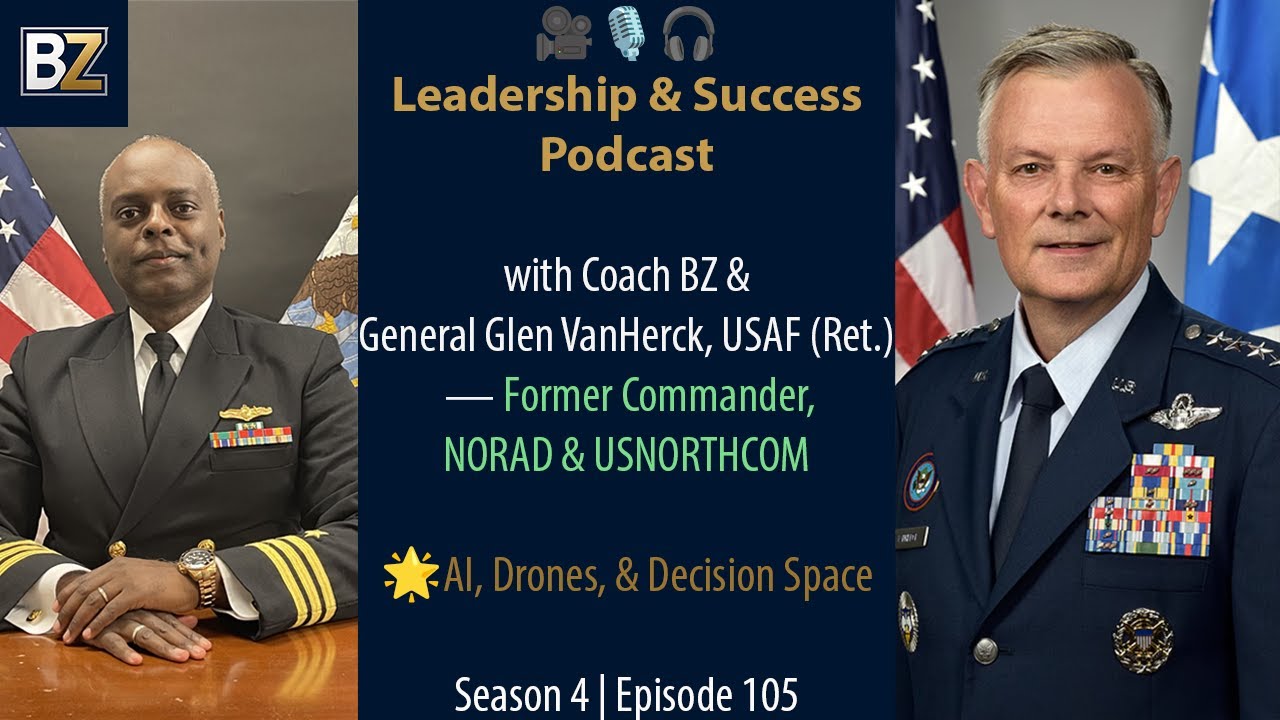
In this episode of the Leadership and Success Podcast, host Coach BZ (Bob Fabien Zinga) interviews retired four‑star General Glen D. VanHerck, former commander of NORAD and U.S. Northern Command. The conversation weaves together the General’s personal story—from a Missouri childhood on an airfield, through a 37‑year Air Force career, to his post‑military work as a senior fellow and founder of Glenn VanHerck Advisors—with deep reflections on leadership, decision‑making, and national security. Key themes include a people‑first leadership philosophy (“It’s not about planes and places; it’s about faces”), the enduring importance of accountability and clear communication, the challenges of making timely decisions under uncertainty, and the balance of empathy and humility with the weight of nuclear deterrence. The General outlines emerging threats such as low‑cost drones and high‑altitude balloons, critiques legacy processes that hinder rapid adaptation, and describes his “Golden Dome” Manhattan‑Project‑scale initiative to mobilize the whole nation—government, industry, academia, and allies—around next‑generation homeland defense. He discusses responsible AI (human‑in‑the‑loop), the cultural gap between Silicon Valley innovators and the Department of Defense, and how private‑sector readiness practices can learn from NORAD. The dialogue also covers workforce development, vocational education, and the need to inspire a new generation of skilled tradespeople for national security. Throughout, the General shares mentorship lessons, personal habits for work‑life balance, reflections on failure, and advice for military officers transitioning to civilian life. The episode concludes with rapid‑fire personal questions, reinforcing the themes of reflection, service, and the importance of relationships.
Chapters
¡Hola! Hi, I'm John Maxwell. When the top companies in the world are looking for trainers, speakers, and coaches, there's one name that stands above the rest, and that's Maxwell Leadership. Our certified team members have gotten proven results for companies all over the globe, and our reputation, I'm proud to say, is second to none. Some of our members have risen to the top of their profession, including the one you're going to meet today. I proudly introduce you to my friend Bob Fabien Zinga.
Welcome to the Leadership and Success Podcast with your host, Coach BZ, where we help you lead with purpose and succeed with impact. If you're ready to grow into the kind of leader others want to follow, this podcast is for you. If you're determined to elevate your success and leave a lasting legacy, this podcast is for you. As my mentor, Dr. John C. Maxwell, reminds us, everything rises and falls on leadership. Our goal is simple: to inspire you, challenge you, and equip you with insights that can transform the trajectory of your leadership journey. Welcome aboard to another episode of the Leadership and Success Podcast with Coach BZ.
Welcome back, friends, to the Leadership and Success Podcast with Coach BZ. Today I have the extraordinary honor of sitting down with a true American leader, a man whose career has defined service, innovation, and courage at the highest levels of command. My guest is General Glen D. VanHerck, United States Air Force, retired, the former commander of the North American Aerospace Defense Command and U.S. Northern Command . Throughout his 37-year career, General VanHerck led missions that safeguarded millions, from defending North American skies skies to coordinating joint operations with our Canadian allies. He's a command pilot with over 4,000 flight hours in some of the most advanced aircraft ever built, including the F-15, F-35, B-1B, and the stealth B-2 Spirit bomber. He's briefed presidents, advised Secretaries of Defense, and led teams through some of the most complex crises of our time, from global pandemics to drone incursions to great power competition. Now, as founder of Glenn VanHerck Advisors, he He continues to serve, guiding organizations in AI, data strategy, and homeland defense innovation. His vision for "Golden Dome," a Manhattan Project-level initiative to secure America from evolving threats, is reshaping how we think about deterrence, industry, and readiness in the digital age. But what inspires me most about General VanHerck is his leadership philosophy. He often says, "It's not about planes and places; it's about faces." He reminds us that leadership is not just about the mission. It's about the people who make the mission possible. So whether you're a naval junior officer preparing for command, a Silicon Valley engineer stepping into leadership, or a lifelong learner committed to growth, this episode will challenge how you think about defense, innovation, and leadership in a rapidly changing world. Please join me in welcoming General Glen D. VanHerck, a guardian of the homeland, a visionary of the future, and a servant leader for our time.
All right, everyone, I'm very, very excited today. Uh, we— you're really gonna have a, uh, a treat. We have a great man, a great patriot who's, uh, in the green room right now. I'm gonna be introducing him in just a second, but before we do, I'm reminded, uh, let's do our moment of gratitude. This is the part of the show where we take less than a minute just to be grateful for something. Uh, every day we really, really want to be grateful. So for those who can, close your eyes, put yourself in your happy place, and maybe take a deep breath and think about one thing you are grateful for today. And I think today I'm really grateful for all of the great leaders we have in this country. So I have a lot of hope for America, and I know that our future is much brighter than our past because of people like the one I'm going to be interviewing today. And so many people, even people in Lawrence that I've I've met throughout my Navy career these past 21 years. People who really want to sacrifice for something greater than themselves, who have the vision of this country, what it can be, and are willing to even give their life in defense of our country. And I'm so, so grateful for all of the veterans, past and future. So today, if you would let me know where you are coming from, what city, what state, type it in the comment. If you have a question for my guest, please type it in the comment. And if you think this podcast will add value to somebody you know, please tag them along so that they may watch live with us both on LinkedIn and YouTube. Okay. I think the man we're going to be speaking to today really doesn't need any introduction whatsoever. But everybody knows, so he is the former commander for NORAD and the US Northern Command. And today he is the founder of Glenn VanHerck Advisory and is Senior Fellow for Homeland Defense at Johns Hopkins Applied Physical Laboratory. So ladies and gentlemen, if you would please help me welcome General Glenn VanHerck.
Well, thanks, BZ. It's an honor to be with you.
Honored, sir. Very, very glad to see you. How are you doing today?
I'm doing great. Thanks for having me.
Fantastic. And to get started, General, what is one thing you are grateful for today?
Well, I'm grateful to be a citizen of the United States of America and had the opportunity to serve this great country for nearly 37 years. Wow.
I need to say amen to that because I was born in Africa, I've lived in Europe, I've gone all over the world in my Navy career, but there's definitely no country like the US of A. Definitely a dream worth fighting for. Thank you so much, sir. And is there something about you that most people may not know?
I'm an avid hunter, outdoorsman. I'm getting— it's deer season. It's in the prime of deer season for me. I'll be in a tree stand all next week.
So, ah, wonderful. That's, that's one thing I wish I had learned. But, uh, fantastic. So can you tell us a little bit about your leadership background, how you got to become 4-star general, the most powerful US Air Force in the world.
Well, gosh, I think it started with family and a mother and father who taught me what right looks like, taught me about respect, time management, prioritization, everything that I say made me successful. I would say they put the foundation there. Of course, there's many people along the way. Yes, my leadership style reflected my dad. He was transparent, candid, held himself accountable and those around him, and I tended to do the same. I think everybody, if you just grow where you're planted, not worry about what's next, do the best you can at what you have right now, you'll be successful. And that's what our military rewards, be being good at what you're doing right now.
Wow, that is really wonderful because you literally grew up beside the runway, right, in Missouri. And I wonder, how did that shape the curiosity and courage that define your Air Force career?
Yes, so my mom and dad were both educators, and when we moved to Missouri from Kentucky, where he was a professor at Murray State University, we ended up in a house right on the runway here in the town I grew up in. Grew up in, Bismarck, Missouri. Mom and dad were both pilots. My dad got into flying because he was out working on a dump truck with his brother and a guy came by and said, hey, would you like to sell or trade that dump truck? And they traded that dump truck for an airplane.
Wow.
He went on his flying career from that point on, started at 15, soloed at 16, and got his license at 17. And I tried to follow the same model.
Wow, that is really, really amazing. And one thing you are very well known for, one of your quotes is, "It's not about plans and places, it's about faces." What early moment taught you that leadership is really about people?
Well, I would say there's a couple of things. The first one really happened on the 5th of October of 2001. After 9/11 happened when I was an operations officer of a B-2 squadron sending people off into combat, you know, and I joined the Air Force because I wanted to fly airplanes. I should say I came on active duty because I wanted to fly airplanes.
Yes.
But that's the moment I really joined the Air Force is when I'm sending somebody's son and daughter or mom and dad off into combat knowing that I was responsible for their training, their well-being, safety, security. And that's when I joined. And from then on, I served for the people and the mission, not necessarily for planes and places. And that's why I tell people it's not about the planes and places. It's about the faces.
That is really insightful. I know in the Navy, we learn mission first because we do have to accomplish the mission. But people, people always. And many people who are listening now, my heart is really for the next generation of leaders. Both in the military and in high-tech, and many of them would be first-generation American like myself or service member. What advice would you give young officers starting from humble beginnings in any branch of the military?
Well, just as I said, grow where you're planted. Be an effective communicator. Tell your bosses and your subordinates and those that are your peers what they need to hear, and it may not be what they want to hear. I feel like My entire career, I did that. I was candid. I provided that assessment to my bosses along the way. And I think if you do that and you grow where you're planted, you'll do well. Communication, I think, is the most important thing we do as leaders. It's not transmitting necessarily, it's also listening. Listening is, you know, half of the communication aspect, and being a good listener is important as as well.
Wow, that is, that is so insightful. And you've had certain illustrious careers here, so from 7th Bomb Wing to NORAD and US NORTHCOM. That's probably how most people in this country know you, especially when we had those, uh, Chinese high balloon a couple of years ago. But what leadership will remain constant for you despite changing mission?
Um, I, I think Accountability remained constant for me, holding myself accountable and those around. And you see some of that today in where Secretary Hegseth is wanting to go, is making sure that force the standards, we live by the standards. We have standards for a reason. F-15s, we lined up the helm on the end of runway check, and we did that for a reason. If you couldn't do this right, what were you going to do in combat when you're under stress? And so we focused on the basics and the communication that I already talked about. I think that was constant the whole time. I'm not a prolific writer. I'm not an exceptional writer. I didn't excel in school necessarily, but I think I learned how to effectively communicate both written and verbally, and that is crucial to be able to get your message across succinctly in a manner where people can understand.
Especially, you know, a man working at the highest level of leadership, as you have done, sir, how did you balance the immense responsibility of nuclear deterrence with empathy and humility as a leader? It's almost like an oxymoron, but it seems like that's really the type of leaders we need for the future.
Yeah, so I, uh, BZ, I don't think you have to balance necessarily The mission of humility and empathy. I believe you have to be effective at all missions and life in general. One must demonstrate the ability to have empathy, to listen, to understand, to share perspective with those that work for you, those that you work with, and that humility as well. I don't think I became successful, you know, necessarily for who I was. I was successful because I surrounded myself with people that were diverse. And by that I mean they didn't share the same thought as me. They may not be from the same service as me or the same background as a fighter or bomber pilot. They may be a logistician, but I think those characteristics help me stay grounded. And stay effective as a leader.
Well, so what about life and work balance? When I'm dealing with my mentees, junior officers, that's usually the number one thing they ask me because many of them, they're still going to school to get their master, which is not quite required for the Navy, but many of the service corps really rewards that. So they're going to school, many times they're married, they have children, and then they have to do this Navy thing at the same time. What is your advice for junior officers so they don't burn out?
Well, first of all, don't lose leave. I never lost a day of leave. Okay. And people go, that's crazy. But no, I didn't take, take that leave, go to the soccer games, the dance recitals. I did those things and balance your life. If you go talk to the people that worked for me at NORAD and NORTHCOM, I didn't come in at 4:00 AM or even 6:00 AM. Now, that doesn't mean I wasn't up. I had a suite at home where I could do things, but I came into the work, to the office around 7:45, and I tried to go home by 16:30 to 17:00.
Wow.
I realized that if I was there, there was hundreds, if not thousands of people that I was impacting as well. So I tried to stay grounded in those basics. I would go home for lunch when possible, especially when I lived on base, to get away so that people can see that our actions, especially as senior leaders, carry more weight than anything that we can say. What you do matters, and people will follow that.
Wow, that is so true, because one thing I've definitely learned as a junior officer, even when I was enlisted, right, you want to get to work before your boss and then leave after your boss has left. But Maybe it's just a mindset, but wow, I really do appreciate that. I wish I had more bosses like you during the service because it is true, people who serve under you, they will try to do everything you do and not always listen to what you say. I guess just like children. I guess my Gen Z kids have taught me that. But wow.
Yeah, you can never underestimate the influence you can have, especially as a senior leader. With your actions. And so, you know, when you have thousands of people working for you, you don't know all of them. You've likely seen them. So you're downtown at a store and you know this person works in your organization. A 1-minute investment of stopping, especially if they have their kids and their family, just to say hello, how are you doing today? How's your family doing today? You wouldn't believe the doors that opens, especially for a spouse to develop this professional relationship where they're not afraid to now reach out because you reached out to them.
Yes.
I can't tell you how many times I had a spouse reach out to me, the general officer, just because I took 30 seconds to introduce myself downtown.
Man, that is so key. So for the junior officers listening now, because I know when I had the privilege to be a commanding officer, one of the most rewarding things I ever did is when any of my sailors asked me to write a thank you letter. To their families, especially their wives, because it's true, the service member is serving, but in reality, it's the entire family that is really serving the country. And it's so important to be grateful to the family, to the community. So what do you think, sir? What is the hardest leadership decision you ever made that still teaches you something today?
I don't know that any Leadership decision, I would say, is hard. Some had great risks or consequences.
Yes.
And therefore, maybe I took a little bit longer side, but, but hard, I'm not sure is the right word. Most of the decisions that you would quantify as hard involve people, BZ.
Yes.
You know, to remove somebody from a position or to not recommend them for promotion or to not recommend them for a a decoration. And so my advice to your, your listeners is, um, those decisions, uh, are, are ones that you don't necessarily need to make in a hurry. Trust your gut instinct on those decisions. Call them tough, hard, whatever you want.
Yes.
But don't worry about being liked in the decision. Worry about being respected. You want to be respected by the institution first and the organization, not liked by the people that your decisions are impacting.
Wow, that is so powerful. I think that's probably one of the, uh, biggest and, uh, things I had to learn when I first became a CEO, because not everybody is going to like you no matter what, and it's completely impossible to please 100% of the people. I don't know if that happened to you, sir, but a couple of times, uh, for some reason, you know, some people from my command, they decided to go to the IG, and I was investigated and all of that. I mean, it was a— I felt like my career was over. Of course, I didn't do anything wrong, and I was completely justified, but just going through the process, or just even thinking that somebody in your command may not like you for whatever reason, it's I didn't sleep for at least a week. But yeah, but it is so true. You have to focus on the mission and some people are not going to be pleased by the decision you make.
Yeah, you're there to lead a mission and the people make the mission happen.
That's true.
If you're worried about being liked and your decisions are influenced by, you know, decision for this individual and then you move to the next individual, what you'll find is you'll have a lack of trust. And you'll have confusion across the organization. What— one of the feedback items I get is I was constant in my messaging, constant in my decision-making accountability, and I took the gray out of the equation. It was pretty black and white with me. And what I find is our forces today, what drives stress into their life, what frustrates them is the gray. It's not operating in black and white. They can operate with good info, bad info, bad information, whatever it may be. Yes. What they have a hard time with is not having information, that gray area where they don't know intent, commander's decision, where they stand. Those are really important things.
Yes. Well, and also in making decision, would you agree with what, uh, General Colin Powell said about P-40/70, where you don't need to have 100% of the information before you make a decision. Because I remember as a junior officer especially, I used to be plagued by paralysis by analysis because I would analyze things and try to wait until I get all of the information before making a decision. But usually by the time it's way, way too late. Would you agree with that sentiment, sir?
100%. You know, delaying a decision is a decision in itself, and the most likely outcome of that is the decision is made once it's irrelevant.
Wow.
You know, we need leaders today that are not afraid of taking risk, not afraid of failure, who move out with the information they have on a timeline to make an effective decision. Once that timeline is too late because they're worried about risk or whatever it may be, then that decision is almost irrelevant. I see the paralysis by analysis leading today to young leaders and commanders not being successful in their commands. And too often they're worried about surviving command, not moving the ball down the field and adapting the organization to meet the intent and the world that changes around them.
True. Wow. So powerful. Now, one thing about you, sir, you've briefed president, prime minister, secretary of defense. What's the mindset required to stay calm? Credible and clear in those moments?
Well, I think first it was understand the intent of the engagement. What are we going to be talking about? And then preparation. Get yourself as ready as possible for potentially all outcomes. Where are the questions going to go? What am I likely going to be asked? What does my boss care about? What is Congress concerned about. For me, I stayed in the military dimension. I did not get worried about the politics. My job was to give military advice, military options, and that's where I tried to focus. Clear, concise communication when talking, especially to that level of a senior leader. And I tell folks, communicate on an 8th grade level. You know, I hate to say that. It's not demeaning to anybody. But if you can communicate effectively at that level, remove the military jargon and put it in clear, unambiguous terms, then you'll be much more successful. It's key to be able to articulate options and risk. Risk is almost the most important thing to understand so they can understand to make their decision, what risk they're inheriting. Risk at the strategic level. Yes. Risk at the tactical level. Risk to the forces they may be committing. All of those you have to be prepared for. Another thing is always be prepared to say, I don't know the answer, but I'll get it for you. That's okay. And I would say don't tread on somebody else's turf. When you're working with senior leaders. If it's not your question to answer, then likely you should say that. Well, I believe that's, you know, this department's responsibility. If they want to answer, say, well, if you're asking my opinion, my personal opinion is X, Y, or Z. That's what I would say is help me prepare for those engagements.
Yeah, I remember one of my Navy mentors told me, no, Be brief, be brilliant, and be gone. And that's always the way he loved to be briefed. But wow. So let's talk a little bit about homeland defense and emerging threat. You've warned that low-cost drones could pose the biggest threat to US security. What type of things keeps you up at night these days?
Well, not a lot, candidly.
Okay.
I sleep. I sleep pretty well. What, if anything, keeps me up at night, and I'm on record, you can go look, I said this in my last testimony, I think our greatest risk is our inability to change at the pace the environment is changing around us. You know, we are too wed to legacy processes. Our culture is hard to allow for rapid adaptation And the world we are operating in is moving faster than our processes and culture do today. That concerns me.
Hmm.
That is really well said because remember the Langley Air Force Base drone incursion, uh, that was really a wake-up call for our nation. What lesson should government, industry, and local leaders take from that event?
Well, first, we're not invincible. You know, there's a perception that we have two oceans on the east and west, Atlantic and Pacific, and friendly nations north and south, and therefore we're invincible. It's Fortress America, as I said on 60 Minutes. What we should find and we should learn from Operation Spider's Web with Ukraine striking Russian strategic bombers deep in the heart of Russia is we're not invincible here in our homeland. And that could happen right here. The biggest thing with the Langley drones is the inability to determine where they were coming from, who was operating them, and to detect them. And I'm not sure to this day we know where they came from. That should be an eye-opener to the public. I did not get a sense of urgency out of the government that we were moving fast enough when the New Jersey drones happened. You know, we were 2 years after the spy balloon and a year after Langley. And we still didn't have policy and law in place to fundamentally address the problem set and capabilities in place to really detect them. That's, that's the key lessons.
Well, in that case, sir, in your view, is the greatest barrier to US homeland defense technology, policy, or mindset? Or maybe a little bit of all three?
It is not technology. Okay, that is for sure. I think it's culture, it's policy, it's law, it's legacy processes, and candidly, it's ignorance. And I had a mentor tell me one time that their ignorance is your fault for not educating them. And so we have to educate folks on the requirement to defend ourselves because fundamentally threats to our homeland have absolutely changed. And so technology is not the problem. It's just a commitment, a sense of urgency to get those things right. Wow.
And also, this is in the public domain. You've called the Golden Dome initiative like a Manhattan Project for defense. What must happen for that vision to succeed?
So Golden Dome absolutely is a Manhattan Project, and it's a whole nation project to be successful. Those things I just talked about— processes, culture, adapt policies, adapt acquisition processes. I understand the SecDef or SecWars changing some of those right now with the support of Congress and others, but it'll be a whole of nation effort. And what makes it that Manhattan Project, as I've said, is the magnitude of the problem. It is not a single prime contractor that will be able to deliver on this capability. Capability. It's going to take multiple contractors. It will take innovative small business and medium-sized businesses who have innovation to help with the prime contractors. There is multi-domain challenges, so space-based challenges, upper layer, air-based, air layer challenges, threats coming off of maritime platforms, threats coming off of submarine platforms. Mobile land-based platforms. All of these create a unique challenge that requires a whole-of-nation, whole-of-industry, whole-of-academia, and whole-of-government approach. That's why I say this is a Manhattan-level type project.
Yes, sir.
Wow.
And how can America protect critical infrastructure without undermining civil liberties or public trust? I remember 9/11, which is one of the most impactful things for my generation. Our people were okay with losing some of our constitutional rights and liberty in order to be more safe. But going forward, how do we balance that?
Well, your question, I like the way you phrase it. How can America— what, what you don't want to say is how can the US government do it? Because this is a whole of a nation, whole of America, and actually Allies and partners. I don't think defense of our homeland starts in the homeland. It starts forward with allies and partners, fellow combatant commanders, day-to-day campaigning, generating deterrence options, and in crisis and conflict, defeat options. So I'm glad to say that. So when I said earlier it's a whole of nation problem, it requires individuals, it requires industry and our institutions to partner together. I fundamentally believe that the government can't protect everything, and therefore we need industry to make themselves more resilient, whether that's cyber, whether that's through basic fundamentals of hardening, you name it. I think we will see at some point, and we likely are seeing it today, where you will have the energy sector or transportation sector having to defend themselves from the UAS threat. Or potentially other threats. So that requires policy change, maybe even law change, and certainly culture change to allow them to do that, uh, when they, when they go forward. But everybody's going to have to play a role. You can't count on the government, and we don't have to defend every square inch of the nation. That's important to understand. We need to figure out what that critical infrastructure is we must defend that infrastructure that could bring us to our knees in a time of crisis, and we need to defend it, but not everything else.
Well, that is so true, and that's so applicable in cybersecurity as well. Now let's talk about artificial intelligence. It's really— everybody's talking about it, and it's already changed so many industries. You're speaking about using AI and data to give leaders more time and decision space. In many ways, I'm really glad to be in the service right now than, you know, 50 or 100 years ago. But with that, I guess we have opportunities, but we have a lot of challenges too with new technology. So what does responsible AI in defense look like?
Well, I don't think machines ought to be making the decisions to kill individuals, to pull the trigger on employment of weapons. Okay. I think machines can make recommendations. They can prioritize for specific engagements, but ultimately the human needs to be in the loop, not the machine, in making those decisions. Beyond that, it's kind of like the genie's out of the bottle. We should not put policy and restrictions in place that from a national security perspective or a military engagement perspective on ourselves that are going to limit ourselves in a fight with China or Russia or North Korea. We should— yes, try to seek to have transparent discussions, potentially collaboration, to establish ground rules and norms, expected behaviors. But ultimately, I think it's just like nuclear weapons. The genie's out of the bottle and we're going to have to adapt to the environment around us. Let the humans make the decisions to kill other humans and employ weapons. But beyond that, we should think about how we best utilize technology to position ourselves, to defend ourselves, to make our national— our nation secure in the best interest of ourselves and allies and partners.
Well, because really in my world, I am at the intersection, right, of national security and defense and then the innovation here in Silicon Valley. I know, I think it was under President Obama we started the Defense Innovation Unit. I don't know how good that collaboration is going, but I feel like it's more critical now than ever before. So how do you think we— how do we bridge the cultural gap, right, between Silicon Valley innovator and the Department of Defense to move faster together?
Well, we need to communicate. You said one word, collaborate. We need to collaborate as much as possible. They don't bring all the solutions, but they certainly bring a culture that promotes innovation, that promotes going fast, that accepts risk-making. We need to embrace change, especially for software-driven technologies. You know, we're set up to buy hardware-driven technologies—ships, tanks, planes, you know, those kinds of things. In a software-driven environment, we need to embrace change, and that means budgetary limitations that don't allow us to adapt quick enough in the year of execution. For example, where software technology changes every 2 to 6 weeks and we can't operate within the budget we get because it's an annual budget without going back to Congress. Maybe we need to look at different ways to do budgeting and adapt our culture as well. And so I think communicating is where I would start with making sure— and I think we're doing that, by the way. I'm not saying we're not with DIU and other things, but culture is hard to change. Big ships are hard to turn around. That is so, so true.
So what lesson can the private sector, the industry, really learn from NORAD's continuous readiness culture?
Well, the first thing I would assume— I would not assume that a continuous readiness culture means that you have continuous capability to execute the mission you've been given. And so you attempt to maintain that readiness culture 100% of the time. But the fact of the matter is, you ask specific to NORAD, the world has fundamentally changed and the technology that NORAD has in place is not what it was in the '70s and '80s when really at the height of NORAD, when they had more than 1,500 fighters. Yes. And the threat was bombers flying over the pole dropping gravity weapons. So the threats continue to challenge us today. The private sector must understand this, I think. They must understand the risk that they're inheriting with the changing world and demand change to be innovative, to bring innovative solutions. Don't wait for the department to issue you a solution in the private sector. You, you can actually bring innovative solutions to the department to think about how to do things differently. We too often in the Department of Defense, now War, prescribe requirements that actually stymie the public sector from really innovating. They actually then are building whatever gadget we told them to build rather than building to solve the problem we're attempting to solve where they could actually do it cheaper, more efficiently, more effectively. I think that's what I would get them to understand, is that just continuous readiness doesn't mean continuous capability. Big, big difference.
Thanks, Joe. So I think to, to end this first segment, I want to ask about, uh, you've linked vocational education to national security. So how can America rebuild the skilled workforce needed to sustain deterrence? And the second Part to that question is, how do we inspire American citizens to see manufacturing, logistics, and maintenance as a patriotic calling again? Two things with that. One thing, even when I was a junior officer, one thing I really loved to do was to go to the National Science Fair because I feel like that's national security right there. Because a lot of our fellow American, the next generation, they want to do art, music, history, and all that, which there's nothing wrong with it. I think it's not science, no, science, technology, engineering, math are very, very critical, especially where we are going. But then the other side of it too, I really love that you talk about not just all of government approach, which I learned under President Obama, but you're saying all of nation and not even, not just the nation, even beyond that, right? With our ally and our partners around the world, it is really all decks on end type of fight. But really the question, if we want to focus on the Americans who are listening to us right now who are not in the military, how can they build the skills we are going to need in the future and how can we inspire them to get into manufacturing, logistics, and maintenance? Yeah, so let me let you in on a secret.
My passion for this is driven by my father's education. He had a PhD in industrial education. Wow. And so his PhD was at a time where you could get a PhD that focused on being able to teach at the college level welding, machine shop, woodworking, all those skills. I'll let you in on something else. I was sitting with a CEO of a major company, a prime company, and this was a couple years ago when I was still on active duty, and that CEO told me they were 6,000 workers short. To be able to hire the force they needed to accomplish what they did. And those workers didn't exist in the United States of America because we weren't producing them. The good news is I think we're realizing this, we're moving out. My local college here built a new center, a technological center that focuses on those types of things. But being able to have welders, machinists, pipefitters, electricians. Yes. To build the industrial base like we did in World War II and sustain that is a national security problem and challenge. We have farmed out jobs overseas to keep prices down. We as citizens may need to accept paying a little bit more to be able to have national security, to bring jobs home. I would argue that when you bring those jobs home. They're going to reinvest in our economy. Economy, yes. And therefore you're not necessarily making the price, you know, that much more. How do we do that? That was one of your questions. So I think it's education and understanding. We go back to grassroots just like I'm doing with you right now. This is educating folks on why national security matters and what are the challenges to it. We do that in our communities. Stepping up like you do to educate and help people. Get out and volunteer. Be a public speaker at Veterans Day upcoming. Educate folks on the challenges that we face. You can do it through media and social media. There are incredible opportunities to do that and give back.
Thank you so much, Joe. So now I'm going to focus purely on leadership. What do you think is the greatest leadership advice you've ever received?
Greatest leadership advice I ever received. Well, I think it's— I'll give you a story, okay? So it goes around relationships, and it's about relationships matter, and you got to cultivate those relationships to be successful. And I'm not talking about anything more than being candid, but do it in a professional manner. When I was a squadron commander, having grown up, you know, in the F-15 community and then in the B-2 community, and I was a squadron commander, my boss was C.Q. Brown, former Chairman of the Joint Chiefs and Chief of Staff of the Air Force. And he called me in, and this was my first formal feedback with him. And he told me, he said my call sign, Fats. He said, hey, Do you realize that you come across as an abrasive a-hole? I'm not going to say it for you. And I said, no, that's not my intent. But that's the way I was perceived at times because I was blunt, candid, direct. But I went from operating in a fighter community to operating now with 17 different squadrons of all different cultures and backgrounds. And to be successful you were going to have to build and foster those relationships. So it didn't change how I led, it didn't change how I thought. What it changed was how I communicated and approached that effective communication and collaboration. And I don't think I would have ever, ever got to where I was without him giving me that honest, candid feedback.
Well, that, that is so insightful, sir. What about, what do you think is the greatest lesson you've ever learned just in life, in leadership in general?
Well, gosh, that's a really tough question, BZ. So, so I learned a hard lesson as a, a new wing commander about how much your team matters, not how much you as an individual matter, because you, you can't, you can't control everything. So 6 weeks into my first wing command, you know, I thought things were going pretty well and we had a tragedy on base. And that tragedy was a child was starved to death in base housing. Whoa. Yeah, it's very unfortunate. You can, you can go Google and figure it out. The lesson I learned out of that, that there was a clear divide between, uh, folks on base where enlisted members in housing perceived that they could not approach officers about problems. We didn't have a culture of accountability. People knew there was something wrong in that house, but they assumed it wasn't their responsibility to say anything. And those were some tough lessons to learn early in a a wing command tour, but it set the foundation for what I assessed was a successful command because we built that team. We communicated more effectively. Everybody saw that need. We got rid of the perceived barriers where, you know, enlisted spouse couldn't talk to the wing commander's spouse that existed, and we removed those types of things And now what you had was a true team from not only the military civilians, but now the downtown community. Everybody came together because of this tragedy that we had. And that's a tough lesson to learn early on.
Wow. Thank, thank you so much for sharing that, sir. It's really tragic, but sometimes I guess that's how we really learn the most. Uh, but now looking back, at your outstanding career, I must say. What do you think is the secret to your success? Why did you become so successful? And before you answer, sir, I just remembered Vice Admiral Robert D. Sharp. I'm remembering what the former Chairman Chief, Joint Chief of Staff told you. He used to say, I'd rather pull back on the rein of a thoroughbred than to spare a jackass. That was this direct quote. But, uh, uh, definitely in the military, in my experience, you know, I've seen a lot of gung-ho ensigns, especially junior officers. But, but yeah, it's true, we definitely need to be more, uh, uh, I guess develop our emotional intelligence more, I, I, I think. But anyway, the question, Baxter, is, uh, what do you think is the secret to your success?
Well, I guess you're assuming military success specifically. I, you know, I don't think I was afraid of failing. I was able to, I think I had an ability to prioritize what truly matters, not focus on things that didn't matter. I didn't worry about making the boss mad. I wanted the boss to know what they needed to know, and I was willing to tell them that. I was one of those that I think had good balance in life between family, work, which allowed me to be, you know, refreshed all the time. Candidly, I wasn't too worried about it, and I didn't worry about getting promoted, BZ, at all. Candidly. So let me just go to foundationally what I think enabled me to be successful. It was people. Yes. So when it started with mom and dad, it started with my first flight commander, Greg Rackley, who sat me down when I was Lieutenant Van Hurk and talked to me about life. Not about, not about, you know, flying an F-15. He did talk to me about a lot of that. But more importantly, he talked to me about investing, getting my personal things aligned so I didn't have to worry about that stuff later on. Nice. And there are mentors along the way. If it wasn't for Jonathan George, who's a retired Air Force G.O., I wouldn't be where I am. Or Bob Wheeler, retired 2-star, or Greg Biscone, or Robin Rand, or Joe Dunford. Those people enabled me to get where I got. It wasn't me.
Wow, very insightful. Thank you, sir. So as a leader, what are you learning right now?
I learn every day about things that, you know, I didn't do in the military— private equity, how industry works, how academia thinks. What am I learning? The military is pretty damn good place to be, candidly. Yes. You know, when you leave there, you really don't know after 37 years what the outside is going to be look like or be like. I tell you, the grass is not always greener. Now, I love what I'm doing, by the way, but you know, we're not as bad as sometimes the media makes us out to be. We're actually pretty effective and efficient at what we do. We do. And I find that in the civilian world, they have just as many, if not more problems than we have. And the good news about that is they need leaders like you to come out and educate them on how leadership works, organizational culture and change. That's why you're a coach, right? Yes, sir. Yes, sir.
And also for some— many people who are listening right now, they're trying to make the transition right from military life, active duty and transitioning into the industry. I guess if I may ask, sir, what type of leadership principle kind of remain the same regardless if you are in academia, you know, tech industry, or the military? What would you say to someone who's trying to transition into civilian life right now?
Well, you have the skills you need already. You just have to be able to adapt to your new environment. Don't change who you are. You were successful for who you are. Adapt the, the fringes to adapt to the environment you're going to operate in, and you'll be wildly successful. Wow, that is so, so true.
And one thing I've really learned, even when I was a very, very junior enlisted person in the military, we really focus on leadership, and that's something I believe the industry needs so critically, just leaders. But wow, okay. And, uh, we know about all of your successes. Really, you are a living legend, sir. But what about failure? How has failure shaped your life?
Well, I learned early about failure, candidly. You know, I played ball from a very young age. I was fortunate that my father was my manager and baseball. And we won state championships, but just as important, we lost. We lost state championships and there was heartbreak out of that. So what I learned, that the team matters, the teamwork is what gets you there. You're going to be successful as a team. You'll fail as a bunch of individuals. And that's what happens too often today. Overall, other leadership things. Trust your gut instinct. You fail all the time, but the question is, how do you rebound and what do you learn from those failures? My failures, candidly, I won't go into the details, but two of them that I failed were people decisions that I didn't pull the trigger on a personnel decision sooner than I did. It impacted my mission and my organization. When I should have trusted my gut instinct, not the folks telling me other advice, and I should have went with my gut instinct and made some decisions sooner than I did. Read into that what you want. I won't go into more details, but those are lessons, you know, when you're seeing impact bigger than yourself across an entire organization, you can't be afraid to make decisions.
I guess that's the reason why leaders get paid the big bucks, because you really have to make very, very difficult decisions at times, even for people you really care a lot about on a personal level, to serve the mission. Wow. Okay, and thank you so much for sharing some, some of your mentors, thought leaders, and people who've helped you get to where you are now. But if I could ask you, uh, If you could choose 3 people, they could be alive, dead, or even mythical figure to have dinner with, who would you choose and why?
Oh, I'd want to sit down with, for sure, George Washington.
Yes, I don't think you need to say much more than that.
2 more? Yes, and you know, probably Thomas Jefferson as a founding father, and yes, but Martin Luther King would be a great one to sit down and and pick his brain.
Well, I definitely would like to be a fly on the wall for that discussion. Wow. Okay, is there any books that you would recommend to the audience?
You know, I'm a— I don't read a lot of books, but, you know, one of them, Stephen Covey had the, you know, The Seven Habits of Successful People. Yeah. So if you go back and you study those types and you look at the traits of effective or highly effective leaders, they almost have all the same types of backgrounds, you know, how they operate, how they think, what their daily routine looks like. And I think you can get a lot out of that book. I've got another one back here behind me. The Passing of the Night, which is— oh yes, I've read that one. Yes, so that's a great book from POWs as well. And I got another one, I don't see it right now, I'll send it to you. But those types of books I get a lot out of, you know, the leadership lessons from folks who learn them the hard way.
Well, sir, I must ask you, when are you going to write your number one New York Times bestselling book?
I'm not going to write a book. I've been approached about writing a book, but I won't say I would never consider that because you should never rule anything out like that.
But I don't have a desire to write a book because one thing I've been doing, especially since I was 17 years old, is just read, read, read, read, read. And with a $40, $50 book, I can get the wisdom of so somebody like you has more than 37 years of experience in the military at the highest level and, and just trying to learn what works, what doesn't work, and, uh, really get better at leading. Yeah, there—
hey, you know, there's some great books out by recent leaders. So CZ, the former, uh, chairman's, uh, senior enlisted, uh, advisor to the chairman, uh, Colón López, he's got a leadership book out that just came out. Uh, I haven't read it all. I've read pieces. Um, we probably ought to look at that. Absolutely. Scott Stalker, do you know Stalker? Who, who's a Marine? Mm-hmm. Uh, Master Guns. Uh, he's got some great leadership thought. So tell your folks to go out and look at some of those, uh, folks.
Absolutely. I know General McChrystal just, um, wrote another book about, uh, character also. And, uh, yes. Fantastic. Okay, we are almost toward the answer. Let me ask you this: if you had one and only one day to live, what would you have liked your final contribution to be?
Gosh, that's really tough, Bizzy. I think when you say contribution, you're talking about some type of an achievement. What I would say is I would want to go out remembered for somebody who cared, who made a difference, who was not about himself, was— cared about the institution, our nation, more than anything else. And so I think that's the way I lived my 37 years of service. That's the way I live today. I don't do it for money. Candidly, I do a lot of things that I don't get paid to do. I do it because I'm passionate about national security. Our country. We live in the best country in the world. You can articulate that from a different perspective than me. Yes, sir. And we should appreciate that.
Absolutely. Wow. So if you had like a magic wand and you could solve any problem when you wake up in the morning, what is one problem you would like to solve?
The vast divide politically of our nation. That is leading to national security problems, the indecisiveness or inability to solve our problems, the focus on the party and not the problem to solve for our nation. Yes. All right.
Is there maybe a song, a book, a movie that would be your life's theme or anthem?
At my retirement, they played the country song "I'm from the Country." That's me. I'm a country boy, a hillbilly from Missouri, and that's probably the one that fits me best.
And which version do you like? Who is the singer, the artist?
I don't remember who sings it.
I will find the most popular one because, like I said, I think we were in the green room, I am a musician and I feel like Whenever a very significant thing happened in my life, there is a soundtrack to it, and music is very emotional, and I think it can bring a lot of people together as well. Okay, so we are pretty much at the end, sir. Is there anything we can do to add value back to you?
Well, spread the word, educate people, be passionate about our country, our national security, Have non-emotional dialogue. Present facts. Too many people argue out of emotion and they don't present facts, and you see that play out today. Don't be the person who spreads disinformation and turns it into misinformation. Yes. Do your homework. I would encourage you to connect with me on LinkedIn and other places. Absolutely.
Is there a question, sir, I should have asked you that I haven't asked you?
Yet, um, I guess, what am I most proud of? Yes, that's a great question. Yeah, I'm most proud of, uh, in my 38th year of marriage, uh, a beautiful daughter, wife, 3 incredible grandkids. Wow. Uh, and, you know, 37 years of service with, uh, the same family for the whole time, and I, and I'm very proud of that.
Congratulations, sir. I guess in life that's really what matters the most, right? Regardless of all of the accolades you've had, medals and awards. Yeah.
So, so I know we're short on time, but I had a boss tell me one time, this journey, this military journey is like a long train ride. It's going to be a lot of stations you stop at. What matters most is who gets off the last station with you. Make sure it's the people in your life you want. Powerful.
We have only 1 minute left. Rapid fire question. Don't take too long to think, sir. When you were a kid, what did you want to be?
When I was a kid, I wanted to be a dentist.
Really? Wow, okay, that's surprising. I thought you would say pilot. Okay, very good. 3 adjectives describing you as a child.
Um, pass.
Okay, what about as an adult?
Um, I'd say common sense. Very good.
All right, this is the very end, sir. It's 9:30 here. What is one word that represents our shared experience on this podcast today?
Reflective. I think we've done a lot of reflection on many topics. I think that's a good word for our podcast.
Thank you so much. I've had general officers here before, but never a four-star general. General, and thank you so much for being here. And I know especially my military mentees are really going to enjoy this and learn a lot from your background. Again, you don't have to write a book, but I think, sir, if you took the time to write one, it's going to help a lot of people. Another thing I love about books, like one of my mentors, General Collins, is no longer with us, but I can go back and read this book over and over again and still be mentored and learn from his experience. But anyway, thank you so much for your time today, sir, and I really, really appreciate it. Thank you. Thank you. All right, everybody, I believe you've had quite a treat today. We talked to 4-star, I mean, general, admiral is in the Navy, general, general, US Air Force, Glen D. VanHerck, former commander for NORAD and US NORTHCOM. What a delight. I remember when I first joined the Navy, I was a seaman recruit at RTC on Great Mistake, I mean, Great Lakes. Back then, you know, anybody who was a senior officer, it was almost like a demigod. Even today, I am a senior officer myself, but when I talk to a flag-officer, you know, it's just a lot of respect for their knowledge, their experience, and everything they've sacrificed for this country. So I really hope you've got a lot out of it. I'm gonna be back here tomorrow. We're gonna have a 10-minute AI recap on one of the podcast we had before. And then on Monday, I'm gonna interview one of my mentors, Dr. Tim Elmore. He has the key— I think he's a Gen Z whisperer— Leadership 2.0: The Gen Z Playbook. Uh, my daughters have taught me a lot about how to motivate Gen Z. They were my primary advisor when I was a commanding officer because about two-thirds of my unit were all Gen Zs, and it was very challenging to get them motivated and inspired to do the mission. So you, you want to be there. And, uh, Thursday next week I'm going to have a coach, Divya Smith. She's an investor, entrepreneur, and executive. So, uh, that's what we have planned. And thanks again for being here. I don't see any question in YouTube or LinkedIn. And, uh, until tomorrow, have a wonderful day. And again, many, many thanks to the General. This was one of the best podcasts ever. Thank you.
Thank you for tuning in to the Leadership and Success Podcast with your host, Coach BZ. If today's episode added value to your leadership journey, be sure to subscribe, share, and join us again for more wisdom nuggets on how to lead better and achieve greater success. Remember, leadership is the most critical skill of our time. The world The world will always need leaders to inspire others, drive innovation, and execute meaningful strategy. So why not count yourself among the bold leaders shaping the 21st century? Until next time, stay inspired, stay committed, and keep leading with excellence.
More from Bob

S250:E4🎙️LIVE 🇺🇸America 250: President Barack Obama Leadership, Service, and the Power of Hope






S5:E157🎙️ LIVE with CMD CMSgt Dennis L. Fritz, USAF (Ret.)(Multi Tracks Audio)



S5:E156🎙️ LIVE 🇪🇸 Leadership Lessons from the FIFA World Cup 2026 Champions (Multi Tracks Audio)

S250:E3🎙️ LIVE Leadership Lessons from America’s First Documented Family of African Descent 🇺🇸📖