S4:E106AI-RECAP🎙️LIVE with 2X Bestselling Author Mita Mallick (Multi Tracks Audio)
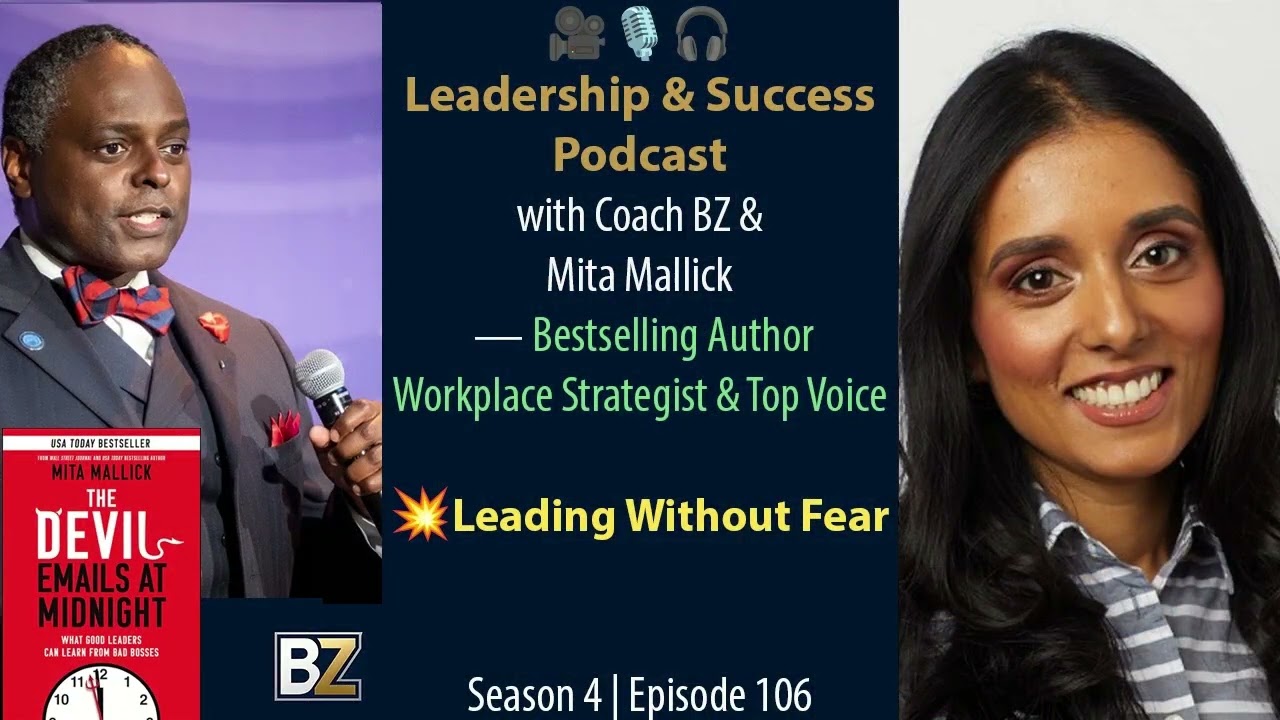
Mita Malik, author of The Devil Emails at Midnight, breaks down toxic boss patterns like the midnight-email leader and the micromanager. She introduces the water test: if an interviewer doesn't offer you water, the culture is toxic. Rest isn't laziness, she argues. It's readiness.
Chapters
Hi, I'm John Maxwell. When the top companies in the world are looking for trainers, speakers, and coaches, there's one name that stands above the rest, and that's Maxwell Leadership. Our certified team members have gotten proven results for companies all over the globe, and our reputation I'm proud to say is second to none. Some of our members have risen to the top of their profession, including the one you're going to meet today. I proudly introduce you to my friend, Bob Fabien Zinga.
Welcome to the Leadership and Success Podcast with your host, Coach BZ, where we help you lead with purpose and succeed with impact. If you're ready to grow into the kind of leader others want to follow, this podcast is for you. If you're determined to elevate your success and leave a lasting legacy, this podcast is for you. As my mentor, Dr. John C. Maxwell, reminds us, everything rises and falls on leadership. Our goal is simple, to inspire you, challenge you, and equip you with insights that can transform the trajectory of your leadership journey. Welcome aboard to another episode of the Leadership and Success Podcast with Coach BZ.
Like being in service of each other, and that's actually the loyalty, right? We're not loyal to— no longer loyal to companies, but we're loyal to each other in those moments, and that really matters. That's what good leadership looks like. And here's what people don't get: when you are a good leader, or even a great leader, you don't have to call recruiting. You don't have to be worried about talent and roles on your team, they're just gonna keep filling cuz your reputation is known. People know who you are and people want to come work for you. You're gonna become a really great magnet for talent.
Okay.
I'm, I'm gonna ask you, um, one more question this time about, uh, diversity and inclusion because you are a world expert in that. And you, you even mentioned some, something similar during the show just about how critical inclusion should be. Right now we are living, you know, in America, the trends are going the complete opposite for some reason. But why is inclusion important, definitely when it comes to driving business requirements? Because that's the other thing too, because we don't just do inclusion for inclusion's sake, but why should a team be diverse in order to drive business results?
Well, one, it's about the consumers you want to serve. We are now— I'm sitting in the— as Michelle Obama said, you know, my forever First Lady, our forever First Lady, in her book, it's the paper cuts, microaggressions that happen every single day. And I noticed you have it right there. Yeah. It really can have a devastating sense, devastating impact on yourself, right?
Over time. It's like death by a thousand paper cuts.
Paper cuts. But what happens is that 100% that I was ready to give. Now I'm at 75%. Now I'm at 50%. I don't— I can't do the work. I'm reacting to the environment around me. And then what's going to happen? You're going to say, "Megan was this like kind of highly recommended from a friend and now she's just— I gotta put her on a performance improvement plan. I gotta coach her out. She's a poor performer." And then, you know, coached out if I don't resign on my own.
Makes sense.
Imagine if you're in an environment where you can do your best work. And it's not just for some people, it's for everybody. We want to create an environment where everyone can do their best work because then that helps the company reach the potential. It's quite simple.
So true.
We've made it so complicated.
Wow. No, that is really great. Okay, we have about 10 minutes left. Quickly, I'm going to ask you 7 leadership questions. Number 1. Buckle up. Yeah, it's going to be really cool. What is the secret of your success? Here you are, expert in diversity with all of these global awards you've received and bestselling offer. What, what made you, Mita Malik, bestselling offer?
Um, I stopped caring what other people think.
Wow, it's powerful.
Inclusion is also a driver of productivity. Let's say I work for you. I come into work, I'm so excited, I'm ready to give 100%. Here's what happens. Mita, How'd you learn how to speak English so well? How'd you get rid of your accent? Why didn't you do your hair today? Your lunch smells funny. You look sad. You look quiet. Are you angry? I can go on and on and on. But all of those comments every day, as Michelle Obama said, my forever First Lady, our forever First Lady, in her book, it's the paper cuts, microaggressions that happen every single day. And I noticed you have it right there. Yeah. Really can have a devastating sense, devastating impact on yourself, right?
It's like death by a thousand paper cuts.
But what happens is that 100% that I was ready to give, now I'm at 75%. Now I'm at 50%. I don't, I can't do the work. I'm reacting to the environment around me. And then what's going to happen? You're going to say, maybe it was this like highly recommended from a friend. You know, she's just got to put her on a performance improvement plan. I got to coach her out. She's a poor performer. And then, you know, coached out if I don't resign on my own.
Makes sense.
Imagine if you're in an environment where you can do your best work. And it's not just for some people, it's for everybody. You want to create an environment where everyone can do their best work because then that helps the company reach the potential. It's quite simple.
So true.
We've made it so complicated.
Wow. No, that is really great. Okay, we have about 10 minutes left. Quickly, I'm going to ask you 7.
All right, let's get right into it. Today we're breaking down some really powerful ideas from Mita Molek's bestseller, The Devil Emails at Midnight. And our mission is simple: to figure out what good leaders can actually learn from all the bad bosses we've ever had—or, you know, maybe the bad bosses we've sometimes been ourselves. I mean, come on, it's pretty much a universal experience, isn't it? That boss who made you dread Sunday nights, the one who just—never seemed to get it. We've all got at least one story. And boom, here's the twist. This is what Mita Malik calls the mirror test. It actually came from this moment where she was looking through an old journal, reading all these stories about her own terrible bosses, and she had this sudden, kind of chilling thought: "What if I'm in someone else's journal right now?" And that's what's so powerful here, right? The honesty. Malik starts by owning her own mistakes, which basically gives the rest of us permission to look in the mirror too, without being defensive. It's a huge reminder that even with the best intentions, We've all got blind spots. So, what do these blind spots actually look like day to day? Let's break down a few of the classic bad boss archetypes that Malik talks about. First up, you've probably met this one: Medusa. This is the leader who rules by fear and intimidation. The one who thinks that yelling and creating anxiety is the same thing as being a strong leader. And that really gets to the heart of why Medusa's style just doesn't work. As Malik puts it, You simply cannot scare people into greatness. Sure, fear might get you to hit a deadline, but it will never, ever get you the kind of creativity and passion that actually drives a business forward. Next up, another classic: the micromanager. And Malek is honest—she says she used to be one. The key difference here is between demanding excellence and teaching it. One approach—demanding it—turns work into a courtroom where everyone's terrified of making a mistake. The other turns it into a classroom where people feel safe enough to learn and grow. Ah, and here we have it, the devil from the book's title. We all know this leader, the one whose late-night emails send a wave of panic through the team. But here's the big insight from Molek. A lot of the time, this isn't about real urgency. It's about the leader's own anxiety spilling out all over everyone else. And that feeling, it's absolutely contagious. When a leader constantly signals that everything is a 5-alarm fire, the whole team ends up burnt out. Because let's be real, if everything is urgent, then absolutely nothing is. Okay, so how do you spot these toxic cultures from the outside, maybe when you're interviewing? Well, Malek shares this amazing story that works like a super simple but really profound cultural test. So picture this: Malek's in the middle of a marathon interview day. We're talking 12 interviews, one right after the other. She's in their building, on their turf, for the entire day. And through that entire long day, not one of those 12 different people ever thought to offer her a simple glass of water. It sounds like such a small thing, right? But it was a massive red flag. Her mom's advice? Don't take the job. And she was totally right. I mean, if a company can't show basic human kindness when they're trying to impress you, Just imagine what it's like once you actually work there. And that's the big takeaway here: the smallest gestures tell you everything you need to know about a culture. It's a powerful reminder that how you treat people says way more about your values than any mission statement on a wall. Okay, so we've talked about the problems. What about the solutions? Well, it starts with totally rethinking one of the most loaded words in business: loyalty. Malick has this great name for the old-school version: the Tony Soprano effect. You know this boss. It's the one who thinks loyalty is a one-way street, straight up to them. They hoard their best people, terrified of losing them, and end up strangling the careers of the very people they say they value. The shift we need to make is huge. Real, healthy loyalty today isn't about serving your boss; it's about being in service of each other. You move from hoarding your talent to developing them, even if that means preparing them for their next big role somewhere else. That's what true servant leadership looks like. And this idea of serving each other flows right into inclusion. And let's be super clear: inclusion isn't some fluffy, nice-to-have thing. It is a core business strategy. Malik argues it's the biggest retention tool you've got. It boosts morale, and it stops that slow, painful erosion of spirit that comes from constant microaggressions, what she calls death by a thousand paper cuts. And that brings us to the final, and maybe the most counterintuitive piece of the puzzle: the idea that great leadership isn't built on hustle. It's actually built on the exact opposite. This is such a critical point in today's world. Malik is firmly anti-hustle culture. She's clear that glorifying exhaustion is just toxic. Wearing your burnout like it's some kind of badge of honor doesn't make you a hero. It just makes you a worse leader. And she lays out the domino effect so clearly. When you're burning out, the first thing you let go of is taking care of yourself. The very next thing to go? Your empathy. And once your empathy's gone, well, that's when the yelling, the micromanaging, and all those other bad boss behaviors start showing up. This idea requires a complete mindset shift. We have to stop thinking of rest as some kind of prize you get after all the hard work is done. For a leader, rest is the work. It's what prepares you. It's what makes sure you're ready to show up as the best, most empathetic version of yourself for your team. So, to wrap this all up, what are the big takeaways? First, your job is to serve your people, not rule over them. Second, stop demanding excellence and start teaching it. And third, you have to model healthy boundaries yourself to show your team that rest isn't weakness, it's readiness. So let's end with this incredibly powerful question: It's not about being liked or being the fun boss. It's deeper than that. It's about whether you create a space where people feel seen, supported, and genuinely excited to do their best work. So, ask yourself: Would anyone who works for you describe your leadership as a source of joy? That's a question worth sitting with.
Let's dive into the intriguing ideas around leadership, uh, focusing on how, um, fear and inclusion play out in our workplaces.
Yeah, I love how the conversation challenges the notion that leadership is just about authority. It's really about, you know, serving and building belonging.
Exactly. It's like leadership isn't about ruling, but about serving others, turning teams into classrooms rather than courtrooms.
And there's this really powerful moment when it discusses the idea of the bad boss mirror. I mean, can you imagine looking into that mirror and questioning if you might be the villain in someone else's story?
Right. That moment brings a dose of introspection, a reminder that every leader can slip into the role of a bad boss, especially when leadership becomes about micromanagement and fear.
Yeah. Speaking of fear, the conversation really stresses that while fear might bring short-term compliance, It ultimately suffocates a team's culture and innovation.
Yeah, it's like you might get a quick win, but you burn out your people. Fear-driven leadership results in tired teams and even metaphorical burning candles.
Yeah. Yet I wonder, isn't it sometimes argued that a little bit of fear can push people to perform under pressure? What are your thoughts on that? That's a fair question.
But the insight here is that fear might yield brief compliance, but true excellence comes through teaching and mentoring, not by inducing anxiety with midnight emails.
Mm-hmm. Agree. Oh, the midnight email syndrome is such a relatable point. You know, those 12:17 AM pings are more about anxiety than actual urgency.
Absolutely. It's like if you're sending emails at midnight, You're inadvertently setting a culture where everyone feels they must sacrifice personal time, eventually turning into burnout.
Right. And that ties directly into the idea of modeling boundaries. Rest, self-care, and even saying no to sending those frantic emails at odd hours. A leader must live what they preach. For sure.
It reminds me of that concept of "rest is readiness." If you, um, don't take care of yourself, it shows up in your leadership style, making your team learn to work in a, uh, burned-out environment. Mm-hmm.
And it's a powerful reminder that self-care is not a luxury but a leadership discipline.
Then there's the anecdote about the water test. Sometimes it's the simplest gesture, like being offered water, that tells you so much about a company's or a leader's culture.
Absolutely. Right. It really highlights how small acts of kindness um, signal whether you truly value someone. You'd never know those bigger structural issues from superficial perks.
Yeah, it's like, um, welcoming into a culture. If you don't feel seen and valued, no fancy snacks will keep you around for the long haul.
Exactly. And then the conversation takes an interesting turn on inclusion versus exclusion. Inclusion isn't just charity. It's a strategic business driver. Yes, and it's an essential point.
Inclusion is a key retention tool. It's about ensuring that all voices are heard. In our modern workplace, diverse perspectives are vital for innovation.
I find it compelling when the idea of belonging is connected to leadership. If leaders create belonging, teams don't just work, they excel.
Yeah, leadership is like building a culture where everyone feels part of the, um, mission. And that's what makes a group resilient, even in high-stress environments.
Right on. There's another fascinating part where the discussion touches on the transformation from demanding to teaching excellence. It's almost as if, um, the traditional image of a strict boss gets replaced by that of a nurturing mentor.
Exactly. It's a transition from, uh, just expecting excellence to actively teaching it. A common misstep is, um, expecting elite results without actually coaching your team. Something every leader should reflect on.
Yeah. And on that note, don't you think some might argue that at times the tough love method is necessary for, um, instilling discipline? I mean, could there be a balance?
Well, that's a good point, but the idea here is not to remove all discipline. It's more about balancing accountability with empathy. You want to teach and mentor, not control out of fear. Mm-hmm.
I see what you mean. Right. It's the classic debate: control versus trust. True leadership, as described here, is about trusting your team and investing in their growth.
Exactly. And speaking of trust, There's the humorous yet cautionary tale of the Tony Soprano effect. It's a reminder that clinging to talent out of fear often backfires in the long run.
Yeah, that's so true. And that brings us to the idea of redefining loyalty. Instead of hoarding talent, real leaders empower them, letting them grow into new roles.
Absolutely. That's the essence. Serve, don't rule. It's about paving the way for future leaders instead of keeping people in a a stifling hold just for control.
Yep. There's also a strong message about vulnerability, owning up to your mistakes. Meeta openly admits, "I've been a bad boss," which is such, um, a brave confession. Right.
That humility is at the core of servant leadership. Recognizing your own flaws paves the way for growth and helps build a culture of openness.
Exactly. And it's so relatable for all of us, whether we're in high-tech, the military, or corporate boardrooms. We all can, uh, learn from these candid admissions.
Yeah, it's like, um, admitting your own missteps is the first step towards real change. It's not about dwelling on mistakes but learning and mentoring moving forward.
Absolutely. I also appreciate the connection made to self-care. The idea that good leadership starts with taking care of yourself It's radical in a culture that glorifies hustle.
Very true. When you don't prioritize rest, you end up inadvertently triggering toxic behaviors like micromanagement and even fear-based tactics.
Yeah, that's a key point. In wrapping up, the conversation really challenges us to constantly reflect, like, are we teaching excellence or just demanding it? Are our practices fostering belonging or breeding burnout?
Yeah, and that's the beauty of it. Leadership isn't static. It's a lifelong journey of, um, learning, evolving, and most importantly, caring for those you lead.
Right. This perspective is transformative, urging us to, um, lead with joy, balance, and genuine inclusion. Kind of like taking a leap.
Do it afraid, as the advice goes. Exactly. Embracing vulnerability and serving others truly redefines greatness in leadership. Mm-hmm, absolutely.
So, here's to leading with, um, empathy, teaching excellence, and building environments where every person feels, you know, truly seen and valued.
Alright everyone, thanks so much for watching. That was the 10-minute AI recap from the leadership conversation I had with the one and only Mita Malik, bestselling author, workplace strategist, and top voice, and instant bestselling author of The Devil Emails at Midnight. I am going to play two more clips at the end. But before we do that, we're going to do what our custom requires, which is everyday we are grateful for something. And in addition to that, since Thanksgiving, I started my 21-day grateful challenge. So we're gonna get into it in, in just a minute. So for the time being, if you would take a moment, put yourself in your happy place and maybe close your eyes, take a deep breath, and think about one thing that you are grateful for today. And today I am grateful for My daughter, my firstborn Naomi, she graduated from college May of last year. We are so very proud of her and she's now working. And I think what my wife and I are mostly proud about Naomi is she's such a kind person, right? She's a positive addition to our local community. And I think we need to have more kids kind, just just like— she's definitely taught me a lot, and I'm so grateful for her today. So let us know what you are grateful for, if you would please type it in the comments. Now, about the 21-day grateful attitude challenge. So I've been doing this every year since 2021, and what I do— let me share my screen. I am going to select someone at random who's part of my network, and I'm going to challenge them to be grateful today and every day for the next 21 days on LinkedIn, and also challenge somebody from their own network as well. Let me share my screen again. It doesn't seem like it went through. Here we go. So let's do this, and I'm gonna go to this new tab. Let me do it this way. Here we go. All right, we are gonna go ahead and get the wheels of— now these are the people I am connected to on LinkedIn, so I'm gonna click to spin, and in just a moment, uh, The Wheel of Name will randomly select one of my connections. Who is it this time? Let's see. Okay, it looks like it's Michael Lerner, Technology Officer, Chief Architect, VP of Industrial Data AI at Fractional GungHo Digital, AI Trends 2025. So, uh, Michael I'm going to copy your LinkedIn address here, and I would like to challenge you to accept the 21 Days of Grateful Challenge. That means starting today and for the next 21 days, you are going to be grateful for one thing only, and every day you are going to select a member of your network to accept the challenge with you. Here we go. So here is Michael, and let me see if I can— yeah, and it looks like Michael is a Navy veteran as well, just like me. He has over 8,000 followers. Living in Greater Boston. So Michael, again, this is my challenge to you. Consider accepting the 21 Days Leadership Challenge. This is day number 3 for me. Again, Michael, I hope you are going to say yes. All right, so to end the show, I'm gonna play 3 more clips from Mita Malik. And again, I encourage everybody to follow her on LinkedIn, and here is her LinkedIn URL. And I also encourage everyone to read the summary I wrote from our leadership conversation, Leading Without Fear: Mita Malik on Bad Bosses, Good Leadership, and cultures of belonging. So I appreciate it if you take the time to read it. And then towards the end of the article, I have links to all of the major podcast platforms where you can listen and watch the entire podcast, including on YouTube. And after today, I will add the link for the AI Agent Summary, which is a podcast that is playing now. All right, this is it for me today, and I want to remind you I'll be back here Tomorrow, which is Sunday, and I'm gonna have the AI podcast recap on the conversation I had with my mentor, Dr. Tim Elmore. He is the Gen Z whisperer. He just published his newest book, bestselling book, The Future Begins with Z. And I think that is such an important book for today. How do you work with Gen Z? How do you influence them? How do you motivate them? Because they are our future. So I'm gonna play on a couple more clips and that's it for today. Thank you so much for watching.
Bye for now. Company after 30 years got a gold Rolex. That doesn't happen anymore. It's like, yeah, so for that I'll put up with the bad boss behavior. I'm gonna put up with the Chanel shoe-throwing boss who throws the shoe because I'm like, oh, I'm getting paid and there's job security. That is— loyalty is dead in the workplace. That doesn't exist anymore. But I do think that's why a lot of these behaviors, um, stayed as long as they did and continue to. But I will tell you, the fear one doesn't— I just don't get how people can operate from a place of trying to scare people. It just boggles my mind. That one boggles my mind to this day.
That is very, very, very sad. Now, in Silicon Valley, where I am, I know our IQ is probably off the chart, but we definitely need do a lot of work with EQ, a lot of, you know, I don't know, I guess they call them geniuses. They are so, so, so smart. But I really agree with what you are saying. You can be extremely smart and even very productive, but it really matters the way you treat people, right? Just being kind and being a human being. So I don't really understand why jerks like that are still in charge and still leading teams. Because like somebody else has told me before, most people when they leave jobs, it's not really because of the job, it's because of their boss, their manager. Right? So I guess that's why I really believe your book is so important because it's not just for the young professional, but it's really for the people who have the opportunity, the privilege to manage right now. What type of manager are you and what difference you are making? Right? Because I guess Next question I wanna ask you is, uh, how can leaders then differentiate between being demanding for excellence versus being destructive in their expectation?
I've fallen into this trap. I used to demand excellence, but not teach excellence. There's a difference. And I see this a lot when people go from being an individual contributor to leading teams for their first time. This happens in tech, right? People are growing really fast, scaling really fast, and not really setting people up for success. To coach and lead. Just because I'm really good and have this individual expertise doesn't mean I can teach other people. And so I do think there's a difference. Like, you can demand excellence, but are you being clear in what that means? Are you coaching, training? I was a notorious micromanager. If you're watching us, and I'm sorry, you worked for me years ago, I was micromanaging you to maybe you name me marketplace that were irrelevant. So keep keeping up with the pace as we embrace AI. I have to work just as fast and I'm not an AI agent, right? Surprise, I'm human. It's like I can't. It's just going to lead to burnout. Unless, like, here's the thing. I have sold a lot of beauty products in my career, some ice cream and SaaS software. I have never been a 911 operator. I've never been an emergency room medical professional, a firefighter. None of those things that were life and death situations. I've never had anything that's life and death. So why am I sending emails at midnight? Wow. Like, why? I'm asking myself this. Like, nothing was that urgent. Because if you are doing something that's life and death, Right? You're probably not sending emails at midnight. You are running into that fire. Yes. You are in that, you are saving someone's life and it is something that is quite urgent. But I want people to think about that because what also happens is you stop distinguishing what's urgent versus important. When everything's urgent, nothing is urgent. And you're in this constant fire drill mode. And I want people to think about that. So if you're firing off emails at midnight, and I'm not saying that there's not a moment— like, here's the thing. I noticed you've shared this in like the opening of the show of one of my other talks where I talked about this. I am burning the midnight oil. I have a book that just launched. Yes. But that doesn't mean that I understand what drive periods are and the rhythms. And when you're leading people, and I'm sure you've experienced this too in your career, it's like, yeah, there are things that are really mission critical. There might be things that are due for a client and you're going to be driving harder than usual. Yes. Question is, are you then giving your time, your team time to rest and recover? Because we're not Uber Eats, we can't be on demand 24/7. And that's the difference. Yes.
That is so powerful. And something else you had shared before, which I find so insightful, even when you go for an interview, right? Paying attention to when they send you emails to show up. And if they send you a bunch of emails around midnight, 1 o'clock in the morning, that means that's exactly what they're going to be expecting of you when you get there. Can you tell us more? You're supposed to be on your best behavior.
You're supposed to court me for the job. So if you're not on your best behavior, then you're not going to be on your best behavior when I join full-time.
Yeah. Because I think you also mentioned wherever they didn't even offer you a glass of water and you were there pretty much like, oh yeah, that's, that's my mom.
I give her the credit. She coined it. It's the water test. So I went in to do about 12 interviews for this this company, big beauty brand. I was so excited. And it was about 12 interviews, 30 minutes back to back to back to back. And that's crazy, crazy, right? Afterwards, and I was like, oh, so they offer you a glass of water? I'm like, no. And she's like, don't take the job. And I'm like, what? This is like the biggest brand. People are lined up. Yeah. Oh, and I was like, Mom is crazy. I'm telling you, Mom has been right on many occasions, but certainly this occasion. It was a sign of a toxic workplace. Now, now people are like, oh, Mia, that's ridiculous. They didn't offer you a glass of water? You didn't take the— your mom's telling you to take the job. But here's the thing. Think about it this way. You're going in to interview someone.
Thank you for tuning in to the Leadership and Success Podcast with your host, Coach BZ. If today's episode added value to your leadership journey, be sure to subscribe, share, and join us again for more wisdom nuggets on how to lead better and achieve greater success. Remember, leadership is the most critical skill of our time. The world will always need leaders to inspire others, drive innovation, and execute meaningful strategy. So why not count yourself among the bold leaders shaping the 21st century? Until next time, stay inspired, stay committed, and keep leading with excellence.
More from Bob

S250:E4🎙️LIVE 🇺🇸America 250: President Barack Obama Leadership, Service, and the Power of Hope






S5:E157🎙️ LIVE with CMD CMSgt Dennis L. Fritz, USAF (Ret.)(Multi Tracks Audio)



S5:E156🎙️ LIVE 🇪🇸 Leadership Lessons from the FIFA World Cup 2026 Champions (Multi Tracks Audio)

S250:E3🎙️ LIVE Leadership Lessons from America’s First Documented Family of African Descent 🇺🇸📖