S4:E107 🎙️LIVE with Dr. Tim Elmore (Multi Tracks Audio)
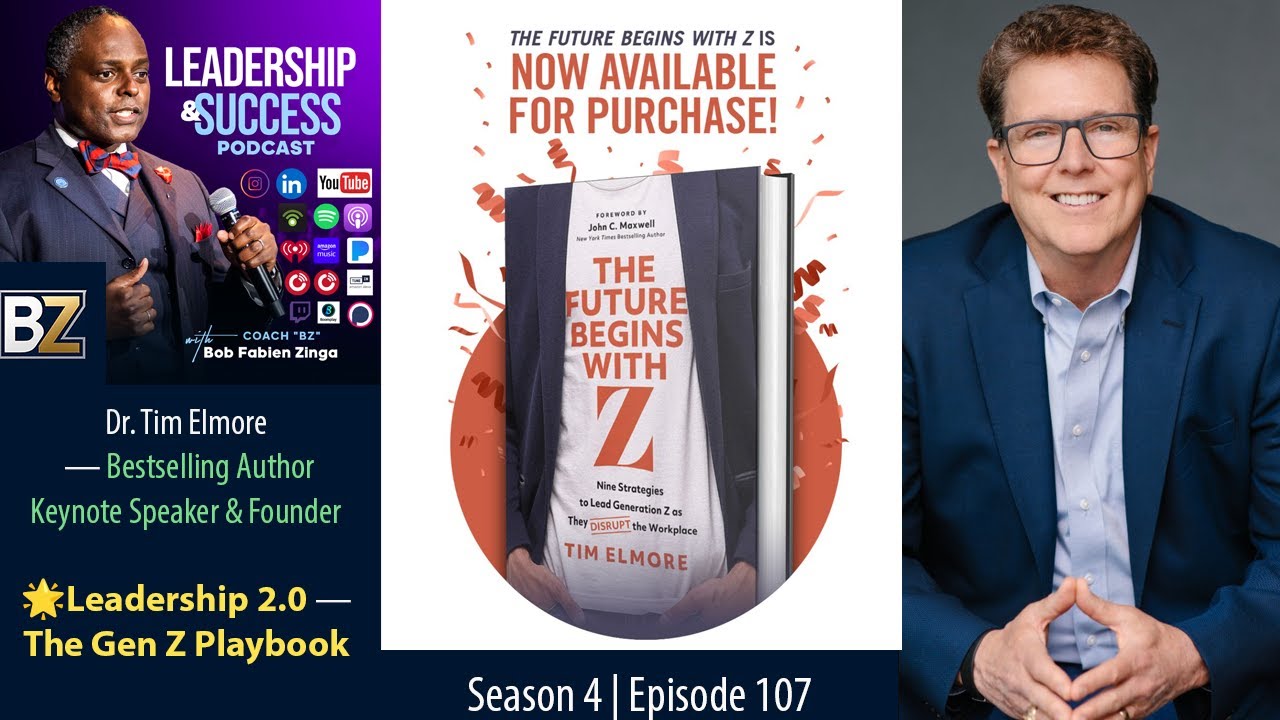
Dr. Tim Elmore, a John C. Maxwell mentee, discusses leading Generation Z through his "Peter Pan paradox": Gen Z has early tech fluency but delayed emotional maturity from the pandemic. He debunks myths with data from 2,000+ Gen Z respondents and offers practical frameworks like PERKS for interviews and A-L-E-G for feedback.
Chapters
Hi, I'm John Maxwell. When the top companies in the world are looking for trainers, speakers, and coaches, there's one name that stands above the rest, and that's Maxwell Leadership. Our certified team members have gotten proven results for companies all over the globe, and our reputation, I'm proud to say, is second to none. Some of our members have risen to the top of their profession including the one you're going to meet today. I proudly introduce you to my friend, Bob Fabien Zinga.
Welcome to the Leadership Success Podcast with your host, Coach BZ, where we help you lead with purpose and succeed with impact. If you're ready to grow into the kind of leader others want to follow, this podcast is for you. If you're determined to elevate your success and leave a lasting legacy, this podcast is for you. As my mentor, Dr. John C. Maxwell, reminds us, everything rises and falls on leadership. Our goal is simple: to inspire you, challenge you, and equip you with insights that can transform the trajectory of your leadership journey. Welcome aboard to another episode of the Leadership and Success Podcast with Coach BZ.
Please join us in a warm Live2Lead welcome for Tim Elmore. I don't know who you are, but if you're like the average person in any country, there are multiple generations working together, and I actually believe every one of them has something to add. And we've got to get this right. 5 generations at the workplace. Tim Elmore is with me. Joining us for more on that generation gap at work here in studio, author Tim Elmore. With me right now is Dr. Tim Elmore.
He wrote the book on bridging the generation gap in the workforce.
A best-selling author, he's got a new book out, A New Kind of Diversity. Sometimes we find ourselves colliding instead of collaborating, and my goal in the next half hour or so is to really give you some tools on making the different generations on your team your competitive advantage. I had a conversation with a father recently that said to me, "Tim, I'm not having the same conversations with my teenage kids that I had with my dad when I was a teenager." You know what I said to him? You can thank Google, Siri, and Alexa for that one. They don't need adults for information. They need you for interpretation.
Here's my challenge.
Let's get together and create a strong generation. God bless.
All right, ladies and gentlemen. Oh, hold on a second. We're not supposed to see you just yet. Just a moment. Here we go. Ladies and gentlemen, I'm really, really excited today. We have a very, very special guest in the house, and I couldn't be more excited. So before I introduce him, I am going to do what we do here. Just a second. Hold on, what's going on with my— hold on just a second, I need to fix— okay, here we go. This should work now. All right. Before I introduce him, let's do what we normally do as is customary on the Leadership Success podcast. We want to be grateful every single day for at least one thing. This doesn't take very long. It's less than a minute. But let's just take a moment and think about one thing that we are grateful for right now. If you want, you may want to close your eyes, maybe take a deep breath, put yourself in your happy place, and think about one thing you are grateful for right now. And I think like I did this morning, I am really grateful. Tomorrow is Veterans Day, and I am so grateful for all of my fellow veterans, anybody who's ever served in any branch of the military for however long. Some people have served for 2 years, 4 years, some like me more than 20 years. It doesn't matter if you serve your country, you've worn this uniform. I want to say thank you. Thank you for keeping our country free. And also thank you for fighting for the freedom of other people, other countries. So that's what I'm grateful for today. And if you would please type in the comment what you are grateful for and also let us know where you are coming from, what city, what state, and what country. And if you have a question for my guest, please type it in the comment as well. So I'm gonna try my best to introduce someone who really doesn't need any introduction. One of my mentors at the Maxwell Leadership, he's the founder and CEO of Growing Leaders and bestselling author of too many books to name. But we're gonna be focusing on one book today, which was published last week. Dr. Tim Elmore has spent over 4 decades mentoring and equipping the next generation of leaders from Fortune 500 executives, professional athletes, to educators and emerging Gen Z professionals. As a close mentee of Dr. John C. Maxwell, we call him Papa John, Dr. Tim Elmore has transformed how we think about leadership, emotional intelligence, and generational dynamics in today's complex workplaces. He's written several books on Gen Y and Gen Z, and the latest one is about Gen Z as well. So Dr. Elmore's forthcoming book, which is out now, The Future Begins with Z, which released on November 4th, is a field guide for leaders navigating a generational shift in the workplace. Drawing on 10 years of research, Dr. Elmore argues that Generation Z, far from being a liability, may be the key to reimagining our organization upward. This is really key because I remember I had the opportunity to be a commanding officer for the global network Operations Security Center in Suffolk, Virginia. And I had to actually rely on my daughter, they're both Gen Zs, on how to inspire and lead Gen Zs in my command. About two-thirds of my command were Gen Z. And I must tell you, I am Gen X, they don't think like us, they're not motivated by the same thing. So they're almost like aliens in a way. But anyway, my daughters helped me to lead them and inspire them. But I wish I had this manual, which we're going to be talking about today. So Ladies and gentlemen, without any further ado, please help me welcome Dr. Tim Elmore to the Leadership and Success Podcast. And now we should be able to see you. Dr. Elmore, how are you doing today?
I'm doing well. Good to see you, Coach. I'm glad for this conversation.
I am, I am so glad you are here. And we are here really to focus on this. I think it's a life-changing book. I think everybody needs to read this. The Future Begins with Z. Well, actually, before we get there, can you please share, is there one thing that you are grateful for today, sir?
Yeah. Well, I am like you, Coach Bob. I am so thankful for the military, particularly on Veterans Day. But the first thing that came to my mind was my wife. Our next wedding anniversary, we will have been married 45 years.
Wow!
She just gets better every year. I'm very fortunate, but I'm thankful.
Yeah, that is really a blessing, especially in this day and age. I've been married to Demetria 24 years now, which is amazing. Like, uh, I've told her, if she ever think about leaving me, we're gonna leave me together. I'm going with her. Can't imagine life without her. Wow, this is wonderful. Is there something about you, Dr. Elmore, that most people may not know?
Good question. Well, I don't talk about this very much. I would say most people don't know I was in a plane crash back when I was 30 years old. Yeah, it was scary, but obviously I survived. And boy, I think I've had a sense of urgency ever since that time, much more than I did before, you know, feeling like every day matters. And, and every day I'm alive, I want to make the very most of it.
Yeah. Wow. Thank, thank God. Every day truly matters. I know Papa Maxwell has that book too. Yes, it matters. Yeah, it does. Wow. That's also another reason why I'm really thankful every single day I'm still on earth. I feel like I still have a purpose and God is just giving me another chance. Man, we are so excited to have you here. All right, I guess the first question I have for you, Dr. Elmore, is a lot has been written about this young generation. What makes your book different and perhaps timelier? And also, I must mention, this is not the first book you wrote about Gen Z, right? Right. You also wrote Generation Z Unfiltered. Man, I really wish I had read your books before I became commanding officer because like I said, about two-thirds of my unit, they were all Gen Zs and those kids are completely different than previous generations.
Yeah, they really are.
So if you can let us know why Everybody who's listening right now should purchase the book.
Well, you're right. A lot has been written on this generation. I think more and more we're aware that whether we like it or not, they are the future. We don't know much about the future, but we know one thing: Gen Z is going to be there. So I think what makes my book different and what I was really wanting to accomplish was I tried to address a a balance of what's going on, the good and the magic, the bad, uh, the magic and the tragic. So in the book, I talk about the Peter Pan paradox, and I've not heard anyone else talk about this. So if you listeners know anything about Peter Pan, he was a character in a movie and a play and a book, but he was this amazing boy that could fly through the air in London sprinkle pixie dust everywhere and make magical things happen. That was the good side. The not-so-good side was, if you remember Peter Pan's character, he wanted to live in Neverland, and Neverland was a place where boys don't have to become men. They, they don't have to grow up. Kids don't have to grow up. And in so many ways, this is a picture, uh, it's a metaphor of the magic and the tragic part of Gen Z. So here's what I think I've observed. As Gen Z moves into the workplace, the age of authority seems to be decreasing while the age of maturity seems to be increasing. Let me explain. When I say the age of authority is going down, what I mean is they're coming in without a big title, but they don't need one to have a sense of authority. They seem to be intuitive about AI. And smart technology. They seem to have visibility on the future and where culture is going. They seem to be natural at understanding tomorrow's consumer. So in one sense, it's kind of frustrating because we're older and wiser, but yet they know things we don't know.
Hmm.
The other side of the coin, though, is the age of maturity seems to be going up. Coach Bob, there's been many employers that have said to me, 26 is the new 18.
Wow!
What we once expected at 26-year-olds, it's now happening later and later and later in life. Their social and emotional skills, their interpersonal skills, their emotional intelligence seems to be lower. And part of that's explainable. They were delayed by the pandemic where they were in front of a computer instead of socializing and building those people skills. So what I always say to leaders is this. Because of this Peter Pan Paradox, we're going to have to listen more than we've ever listened to them. But we're going to have to coach more than we've ever coached.
Wow, that is really, really insightful. So what is it that hiring managers and employers can't seem to overcome?
Yeah, I think they can't seem to overcome the huge difference. I remember when I was the young person coming into my job. John Maxwell hired me right out of college. And I don't know what he saw, but he saw something about 40, 43 years ago or whatever it was. But I think the gap has gotten wider between old and young when the screens that are in our life went from public to private.
Yes.
For example, when I was growing up, we had one screen in our entire household. And my mom and dad bought it. It sat in our family room. And it was a television, right? We all remember having one screen. And we all gathered around and watched a show together and laughed together and talked together. We were together. Today, I'm holding a smartphone in my hand right now. And it's my personal smartphone. So I'm on platforms that might be so different than the other people in my office. So we have these echo chambers. And it's so frustrating to bosses that according to resumebuilder.com and their survey, 74% of hiring managers say that managing Gen Z is the toughest generation to manage. 3 out of 10.
Wow.
Yeah. And 30% say they fire them within the first month. And another 3 out of 10 say they avoid hiring them altogether. Well, that's not a good way forward. That's just not a good way forward. We've got to get this right. So I think as older generation people, let's say midlife and beyond, we're going to have to lean in and try to find an answer in the middle between where they are and where we are. They do represent the future. But of course, they're going to need to grow up and grow into their jobs. But that's where I think we get frustrated so much is they just come in so different.
That is really insightful what you said because based on my own experience, part of the reason why I turned to my Gen Z expert, both of my daughters when I was commanding officer is because I remember going through boot camp 20 years ago where you would have the lead recruiter pretty much 2 inches from my face and cursing out and all of that. But this kid, it looks like they're just so— which word should I use? They seem not to be very, very tough on the surface. It looks like they need to have timeout and it's just like, wow. How can I motivate these people? So for people listening in, especially bosses, commanding officer, business owners, what, what are some of the most common myths we believe about Gen Z?
Yeah, yeah. Well, you're absolutely right. Boot camp looks different today than it did, Bob, back in your day, I bet.
Yeah.
I just talked to a Navy serviceman who had just retired from the Navy, and I asked him how it was serving in the Navy. And he had a great time. But he said it was very different.
Yes.
And I said, what do you mean different? And he said, well, when I went through boot camp— now remember, he's in his late 20s— but when he went through boot camp, the, the, uh, the recruits were able to— they were given a card to hold up in the air if their drill sergeant said anything that made them feel uncomfortable.
Oh my goodness.
So I'm going, oh my gosh, this is not a way to get them combat ready. Um, So, and by the way, you might be intrigued by this, Coach Z or BZ, but the last data I just read, 4 out of 5 Gen Zers bring their parent with them to the job interview.
Oh my goodness! Yeah, yeah.
Now I think that's probably mama wanting to come and daddy wanting to come, not Gen Zer. But still, to have them in the parking lot or even in the office when the interview's going on is just, oh, it's just awful. It's just terrible. So we need to let them go. We need to let them grow up. We all had to do it ourselves. But, but there are some myths. Getting back to your question, let me just give you one or two real fast.
Yes.
So I interviewed a lot of Gen Zers. I did quantitative research. I surveyed over 2,000 of them. And then I did qualitative research where I did focus groups with lots and lots of members of Generation Z from California to Georgia. And here's what I discovered. Number one, one big myth is a boss might say, "Well, I don't think they really want to work. When I look at them, they don't seem really engaged. And right at 5 o'clock, they leave the office, you know, out of here. And they don't want to work a minute longer. Even if they're in the middle of a project, they're leaving the office." So when I brought that up to the members of Gen Z, I said, "Is it true you don't really want to work?" And one 21-year-old young lady said to me, "Dr. Tim, can I explain why I leave right at 5?" I said, "Sure." And she said, "I have to rush over to another job because I don't make enough money at this first one to pay the bills in LA." Wow. And then she said, "I rush off after my second job to take care of my mother who has stage 4 cancer." Hmm. Well, I suddenly realized she had a very good work ethic But I assumed the wrong thing when I saw her leave my job or a job. So I think we need to be careful to ask questions and not assume we understand that they're lazy or they don't want to work or whatever. Here's another one I heard, another myth that I heard. Well, Generation Z is, is so different than the hard workers that make up the Millennials and Gen Xers and Baby Boomers. And again, it has to do with work ethic. This is kind of a second cousin to the first myth. But you know what I kept hearing over and over and over? They said, maybe it's true. Maybe I'm asking for work-life balance. But it's because I look at my parents' generation who are workaholics, and it ruined our family. You know, my mom and dad got a divorce, or I never saw my father, or whatever. And they're saying, I don't want those stresses. And I don't want to repeat that mistake. Well, that makes sense to me. You know, I want a hard worker, but I also want them to have a life. So it was so good for me to just listen, listen, listen to these 20-somethings have very, very good reasons oftentimes to what they're doing.
Well, I guess going back to the example you used earlier, having several jobs, it also seems like for Gen Z, they seem to have a reputation of being job hoppers, right? How can leaders make young team members want to stay longer?
Yeah. Well, I believe that every young generation struggles with two tugs at their heart. OK? Two pulls, like a tug of war going one direction and another direction. Consider this. There is a pull inside of every one of them that says, I want to be me. Right? I want to be a unique individual. And if I have a nose ring and purple hair, you should let me be who I am. So that wanna be me is in every young generation. At the other side of that tug of war though is I wanna be long. I wanna belong.
Yes.
So they want to be a part of a larger community where I think you would agree with me, you have to make some sacrifices sometimes on behalf of the others in the group. So you can see how this is a battle inside of them. I want to be me. I want to belong.
I want to be me. I want to belong.
And every Gen Zer is going to have to be helped by their supervisor or their parent or someone on how to navigate. Of course, you want to be a unique individual. But here's the answer to your question, Bob, I think. I think there's a difference between belonging and fitting in.
Yes.
Let me explain my point of view. It may not be the only point of view, but here's my point of view. So what they really look for, the number one thing they look for when they join a job is a sense of, "I belong here. These are my people. I, you know, I'm with my people and I can be who I am." My tribe, yes. Yes, this is my tribe, right. But I think the difference between fitting in and belonging is this. When we push them to just fit in, They feel like they have to fit a round peg in a square hole. And I have to change things about myself fundamentally. And I'm really not myself now. I'm just trying to blend in, not stand out. I think belonging is, we want you to come in, Gen Zer, and be who you are. But please be who you are on behalf of a larger picture, a larger mission, where you do make sacrifices, some. On behalf of the whole.
Isn't it?
I believe this is true. I think every one of us want to be a part of something bigger than ourselves. And it doesn't just revolve around me. So belonging is key if you're hiring a Gen Z. And I would say, make sure that you allow them to be who they are, but find out those gifts and talents inside and make sure they see the bigger picture.
They—
here's a good way to say it. Make sure they see the box top before they play their puzzle piece.
Yes. Wow. That is really, really insightful. I guess we're kind of going through this now. My wife and I, our daughter graduated last May and now she has what, 4, 5 jobs. She can't find a single full-time job. So she has to spread herself thin. And like you said, she goes from job to job to job and very, very proud of her. She's completely responsible, taking care of herself. But yeah, it is quite a change in the generation. How do leaders then provide firm feedback to individual young employee?
OK, I got two ideas here. And both are acronyms. So listeners, this will help you remember. I think the first time we prepare for a hard conversation is in the job interview. In other words, if we get to know each other really well, isn't it true the hard conversation comes easier because I have a relationship? So In one of the chapters, I cover in the book, by the way, 9 strategies to lead Generation Z as they disrupt the workplace. So Strategy 1 is how do we begin well? How do we onboard them well? Well, in the job interview, instead of just talking about the pay and the tasks, I recommend PERKS, P-E-R-K-S. And these remind me of 5 categories that I need to talk about with them. Where I'm sharing these 5 items as a supervisor, but I want to hear from them, those, their answers to these 5. OK, so the letter P is Preferences. What are your preferences? I might say to Jennifer, who's a Gen Zer. And what I'm looking for here is these are not make-or-break things, but I wish this were to be true. Like maybe they want a Coke machine in the dining room or something like that. I don't know. But we might say, Oh, I I think we could do that. And it causes them to lean in. But I want to find out where their heart is leaning toward. OK? The letter E is Expectations. That's much stronger than Preferences, right? This is what I assume to be true about this job. And by the way, Bob, isn't it true you'd rather find out now in the job interview than 6 months later when now they're causing division in the department because they're squabbling over things that they wish would have happened? So I have come to believe that conflict expands based on the distance between expectations and reality.
Hmm.
Say that one more time, please. That, that is powerful.
Yeah. Conflict expands based on the distance between expectations and reality. Here's a good example. I love to share this because it's so true. If I tell my wife I'm going to be home at 7 o'clock for dinner and I get home at 10 minutes after 7, It's not a big deal. If I get home at 9:30, we're going to have a long and heavy conversation.
Yes.
And it's not because she couldn't live without me for 2.5 hours. It's because I created an expectation. This is so, so, so important to talk over early in the journey. By the way, isn't this true about a marriage relationship and a dating? You know, we should find this out. All right. The letter R. So it goes preferences, expectation. The letter R is requirements. We are finding that Gen Z is coming in with some demands or requirements, like, "I want you to be about this cause in the community," or, "I want you to march for this or do this," or whatever. But it sometimes is a very idealistic point of view from a person that's never once had a full-time job, or they've never been a boss, for sure. But I think it's good to find that out now so you have the liberty to say, Jennifer, thank you so much for sharing that. But I can just tell you right now, that's not going to happen. Let me show you the door. I hope for the best for you. And, you know, but isn't it better to find out now than again when dissension begins? Or demands— that's huge requirements. The letter K is keys. What are the keys to their heart? I want to find out in the job interview, not just can they do the task I'm going to give them, but what makes them tick. Do they love the Chicago Cubs? Do they love brownies? What, what is it? That makes them tick. When I find that out, one, it reveals who they really are, and it gives me something to talk about in the hallway, uh, 2 months later, more than work. You know, I've got a personal connection now. The final one is, is an obvious one, but the letter S represents salary. Even though you probably posted that job salary on the website, we're finding so many parents are coming into the job interview with a different idea in their head than what they thought Junior was going to get. And you can start World War III unless you make sure it's covered real face-to-face. So PERCS is the—
that's powerful.
Yes, yes. Okay, now I realize I'm talking long, but that's good. There's one more chapter I have in the book that I actually talk about handling those hard feedback moments, especially if that Gen Zer might be fragile, a little bit fragile. So it's another acronym, and it's, it's A-L-E-G, ALEG. You know, we've used that phrase forever. This is a leg you got to stand on. So this reminds me, start this little feedback time not by telling them what they did wrong, not by correcting, but by connecting. The letter A is ask. Ask questions. You might even ask, hey, what was your thinking behind that decision you made? I don't think I would have made that decision, you know. But it's a good way to Add value. In fact, when we ask people questions about themselves, they often feel valuable. You know, my boss is actually asking me questions.
Yes.
The letter L, it's the natural next step. Listen well. It does little good to ask a question if you're not willing to do some listening. So when I listen, they feel heard. And Coach Bob, the number one thing that Gen Z says they want in a job is a voice. I want a voice on day one. I want to have a, you know, and I'm going, oh my gosh, they want to be heard even before they earn their stripes, you know, so to speak. The letter E in a LEG, Empathize. This is a skill set that I had to learn. I'm ashamed I did not learn it well as an older guy that should have learned it years ago. When I empathize, though, I find natural ways for me to say to them, Oh, wow! I had no idea that was true. Or, I bet that made you feel horrible when that happened. When I do this, especially to a younger team member, boy, now they feel understood.
Hmm.
So think about it. Ask, they feel valued. Listen, they feel heard. Empathize, they feel understood. Now the letter G, I've earned my right to guide them, which is what I wanted to do from the very beginning.
Yes, yes.
But I've done it through a bridge I built, not a badge I wear. Bridge, not a badge, is how to win them over.
Yeah. That's really, really powerful. But really, Dr. Loma, what you've described, not only it works with Gen Z, but I think it's going to work with any generation, any life really that you lead.
I believe that.
Yeah. Wow. That is really, really powerful. So let's talk about mental health issues because they've become problematic, right? What can leaders do? And also, I think, I guess it's really the first generation, I guess, recently that has gone through the global pandemic. Well, it was 2 and a half years where they didn't go to school, they were home. And that was quite traumatic for a lot of them. I know my daughter, that's when she became a freshman and she couldn't go to school. She had to do her first freshman year on the computer and she couldn't graduate from high school either because they had canceled all of the meetings because of the virus. But anyway, yes. So what about mental health issues for Gen Zs?
If you're listening and you are not understanding Generation Z's mental health challenges, can I just encourage you, it's very real. It's not just because they're fragile or fake or wimpy, fragile snowflakes. I believe we had no idea what the smartphone would do to our minds and what the pandemic would do to their hearts. Uh, Bob, you just mentioned that the pandemic really did do a number on them. Just the time they should have been socializing and building some muscles and grit and resilience, they were at home, stuck at home with a computer screen. And that, yeah, I don't know that that does the same job that real-life interactions do. So in this chapter on mental health, I share some very simple, doable ideas that leaders can do with their teams, particularly those members who have mental health challenges. So the first word is simply the word "margin." Make sure your people, if you're a leader, have some margin in their day, and not just back-to-back-to-back-to-back busyness and frantic activity and maybe panicked activity. We need margin. Human beings, the human heart, the human soul needs margin. So I encourage my young team members, and I even do this myself, to schedule in time for interruptions and and just for margin, where it's not one activity to the other. I can do that for a few hours, but not 8 hours.
Yes.
When we have margin, it eases our mind and allows that anxious, anxious, maybe even panic-attacked mind to feel better again. The second word is a simple one, but it's movement. So Generation Z, as a generation, 59 million, are more apt to be sedentary and just sitting all day in front of a video game as a teenager, or maybe a computer screen as a 20-something. So they need to get up and move. And maybe it's, well, let me tell you what our office does. We have some young team members at our office. Midday, a bunch of them get up, go outside, put their walking shoes on. They walk around the building 4 or 5 times just to get those endorphins flowing, those serotonin, oxytocin. You know what I'm saying? The happy chemicals. Our bodies need to move in order for us to be mentally healthy. If we're sitting all day, day after day for years, we're almost inviting mental health challenges to come.
Wow, that is so powerful. Yeah, because I think these little computer devices, I mean, they are good, but they've also had a huge, huge impact on our kids. One of my mentors called them screenagers instead of teenagers. They're always on their screen. But wow. OK, so how can supervisor then get through to an anxious team of young staff?
Yeah. Well, I think the first step is what I just said, empathizing. I think they come in defensive, feeling like we're probably going to judge them for their wimpy, you know, type or style. So if we lean in and say, "Hey, listen, I know that so many from your generation really wrestle with mental health challenges." If we lean in that way, they tend to lean in back to the job and to us. So, but I have to start. I think it's the leader's job to connect with them before they reconnect back. So empathizing with this, Mark MacDonald is an MD and psychiatrist. And he said, in a recent book that he wrote, in fact, he called it The United States of Anxiety. He said anxiety and panic attacks are up 400%. That's ridiculous.
Wow.
I think we got ambushed by what smart technology would do. So I believe we need to lean in. But here's what I would say, I would add. Whenever I'm talking to an anxious group of team members, or even one team member, here's another acronym I need to follow. I need to get in a CAB, C-A-B. I need to hop in a CAB, OK? So if I'm talking to an anxious group of people, the letter C reminds me I need to give them context. If they're anxious about our sales goals and how they're not going to reach them this month, I need to give them context. Oh, I'll give you a good example. So when we entered the pandemic in the spring of 2020, you can imagine we had some young team members that were scared to death. This was very scary. They'd never experienced anything like this. You know what the first thing I said was? I said, "Hey team, can I remind you of something? This is the 4th pandemic we've been through in the last 100 years." Wow. And each time we found a way to get through it. So that was context. You see, I, oh, oh, okay, maybe this isn't the first time in world history that we ever did this. The letter A is Applications. Once we give them context, we need to give them, give them specific action steps or applications. This is what we're gonna do this week. I don't know about next year. I don't know about next quarter. But I do know this week, here's what we're going to do. Bam, bam, bam. I think that kind of clarity just really, really gives peace of mind. And then the final letter, letter B in CAB, I need to offer belief. I kept saying to my team over and over and over, I know this is hard, but I believe we're going to make it through. And we're not only going to make it through, we're going to be stronger for having gone through this. So context, applications, belief. Just behavioral science tells me I got to do this if I'm going to come up with good, healthy people at the end of the journey.
That is really, really powerful. I'm so glad you're here, Dr. Almohamed. This is going to help a lot of people listening in now. So will we need to lead them differently? And if so, how?
Yeah. Well, that's a good question. And the answer is yes, I believe. But let me first say, we have way more in common than we have in uncommon. In other words, Gen Z and baby boomers, for instance, who are 60 years apart maybe or something like that, we have far more— we have 95+ percent because we're humans together. Black and white, male and female, old and young, China or America. Isn't that heartening? Isn't that encouraging to hear? The gap isn't as big as we might think it is. Now we do, we need to pay attention to those nuances that are different. So here's how I might lead Gen Z differently. The first idea might be, is there any way that you and your workplace could create an internal gig economy? So today we're called the gig economy, meaning like your daughter, Bob Fabien Zinga, you know, they're hopping from maybe 4 jobs at once because trying to pay the bills and they don't have a full-time job. Well, Gen Z is notorious for having a day job and then a gig over here, and then they drive an Uber over here, and then they do this over there. So they love how this keeps them unboard. They don't want to be bored, and it feels like a startup. 72% of teenagers from Gen Z want to be an entrepreneur. So how could we create an entrepreneurial zone in our established workplace? Place so they feel like it's a startup. So here's what I would suggest: find one or two problems that your organization needs to solve, set aside some creative people, and make sure there's Gen Zers that are part of that. Give them that problem to solve and say, pretend like we're a startup, what would you do? And then set aside some budget money for the untold fruits of their labor. Maybe they come up with something in 4 months, you go, okay, We set aside $2,500 or whatever, you know, to take on that initiative. I'm telling you, you're going to be able to keep them because it feels like a startup, but you're actually established. And they love the security of an established company. Let me see if I can give one or two others real quick.
That's really powerful.
Yeah, yeah, yeah. Oh, I love the companies that I know that have done this. In fact, let me give you one illustration. So there's a frozen yogurt chain in America called Orange Leaf Frozen Yogurt. And you know, they sell frozen yogurt.
Okay.
So they were noticing that their Gen Zers were coming and going, coming and going, year and a half, and they're out of here. Well, they were getting frustrated as employers, but then one of them said, well, wait a minute. What if we just realized that's the way things are for young people right now? It'd be different when they're 40 and they have a family. So they started treating them and saying this, We're gonna help you make this first job the best first job you could ever have to get you ready for whatever's coming. So they would say, let's say Josh is one of the new 18-year-olds. They would say, Josh, what do you really wanna learn at this first job?
Wow.
And they, well, I wanna learn bookkeeping. Okay, I want you to meet Hal. Hal's our bookkeeper. He'll teach you how to be a bookkeeper. I wanna meet, I wanna do you know, I don't know, finances or cash register or whatever, or maybe marketing. You need to meet Susan. Susan leads our marketing. What they found was, as they provided ongoing learning opportunities, yes, and it felt like, oh my gosh, I'm growing, they kept them more than a year now. So it reminds me of what Zig Ziglar used to say. Zig, remember Zig? He was such a great guy. Zig used to say, I always have people ask me, What if I train all these people and they leave me? And Zig would always say, what if you don't and they stay?
Yeah.
So, so let me do one, one more, Bob. Please. Be sure and offer meaning, not just money as a paycheck. So they do want to make money. Of course they do.
Yes.
But if you can connect the dots between the task you've asked them to do on that job and the overall mission of of the organization, that you're helping change our community when you do this job. That meaning is so, so necessary for a young adult today. So make sure it's emotional in their heart. Yeah, I'll stop there.
Yeah, because another thing I've also learned, they tend to really thrive in community. I think they have the less selfish generation I've ever seen. Really, my daughters, they've taught me to really look at people who look completely different than me, different background, to really show love and compassion and a lot more empathy for, for sure. OK, so we've talked about Gen Z being the employees, maybe problem, quote unquote, employees. But what about them teaching us? So in what ways can Gen Z actually make their leaders better?
Well, I do believe they're going to make us better if we lead them well. And part of leading them well is to engage in reverse mentoring. Bob, you and I may have talked about this at some point. I don't know. But It's one of my favorite activities in my life right now. We all know what mentoring is, right? Where an older imparts to a younger person, here's how to succeed at this company.
Yes.
But reverse mentoring is you both wear the mentor hat during that meeting. So you begin the meeting as a younger and older getting together. You swap stories. I promise you, you're always gonna find something in common when you swap stories. But then you not only impart into them, you pour into them what they need to know to succeed. But then you trade hats and you go, would you be a teacher for me? Now that means I need to check my ego and my logo at the door.
Yes. Yes.
So I'm just a human being, but I'm 65 or whatever I am. And I will have Andrew pour into me even though he's 30 years younger or Cam pour pour into me even though he's 40 years younger. So they'll tell me how they've got a late— the latest app they just got on their phone, how we could monetize it at our company, or how we might be able to use it for marketing. I'm telling you, if I go in as a learner, even though I'm over 45 years old, I always learn even from those young adults.
So powerful. This is a true story. When I was commanding officer at Genosc, I was trying to figure out the problem. It took us almost 60 days, but We weren't able to figure it out. At first, I talked to my senior executive team, right? My XO and my senior enlisted leader, we couldn't find a solution. Then I brought in all of my department head, about maybe 2 dozen of them. No solution. And then I decided to open it up to the entire command. And it was a junior enlisted person, a Gen Z, he gave us the answer we've been looking for 2 months. And we were able to implement that. And it was a great success of the mission and the command. It's really so true.
What a great story. That's exactly what we're talking about. But that caused you to lead a little differently than you did in the military.
Yeah, I think they already made me a much, much better leader for sure. Okay, I think the last question I'm going to ask about the book, maybe one of the most important one, is what is your vision for the future of leadership in a Gen Z-driven world? Yeah, wow.
Well, my hope is that Generation Z turns leadership from a power trip to a servant journey, that it's about service. And I believe, you and I both believe that, Bob. But I just believe they're going to bring a whole new generation of leaders, more women in leadership, for sure. Because right now, there's more women enrolled in college than men.
True.
And that doesn't mean they're all going to become leaders. But I think there's a more likelihood for more women in leadership. I think that Gen Z is going to look for problems to solve first and foremost. I'll never forget when John Maxwell taught me the quickest way to earn leadership is to solve problems. And I think he's right. So I added to that. And this is what I try to build in every Gen Zer. Be a person that solves problem and serves people, solves problems and serves people.
That's powerful.
And that is what I believe is going to save the day. And that's what I think they're going to bring. And I think we need to let them stand on our shoulder and do it.
Yes.
So yeah. Wow. Solve problem and serve people. That is so wonderful.
Yeah.
Papa John's always talks about adding value. And wow, that is powerful. All right. So we are coming toward the end and you've been so generous with your time. Really, really grateful. How can we add value back to you?
Wow. Well, thank you for asking that question. Well, certainly, I'd love for you to pick up the book. I think it's going to be a resource that'll be like a field guide or an encyclopedia. You don't even have to read every chapter. You just read chapters 5 and 9 if that's the two things you really need to figure out. Bob, we just did a book launch for this book. And I invited people from Coca-Cola, Chick-fil-A, the Atlanta Hawks, Cox Enterprises. It was so much— NFL. And they came. They all said yes. And I think it's because they want some solutions. And I'm hoping this book becomes that. So pick up the book, Future Begins with C. Certainly, I do workshops. And you can find me at timelmour.com. I would love to keynote or do a consulting or workshop if that's helpful on this topic especially. Also, we have a video course if you prefer not to read but to watch micro lessons 5 minutes long. On these different topics, there's a platform called Leader Pass, and they have John Maxwell on there, but they also have me and my book on there. So leaderpass.com, you can find that as well. That's a great way for, to serve me by allowing me to impart to you.
Yeah, fantastic. Thank you. Thank you so much for your time, Dr. Elmore. Just to finish, actually, let me ask you, is there a question I should have asked you that I haven't asked yet?
Oh, well, I, you know what, I am going to answer that. One question I love to get asked is, since Generation Z is so different, what gives you hope that they're gonna, you know, do this? Um, one of my favorite analogies I have in the book is, um, it took place in 2017. It was a random story on the back page of the newspaper, but a woman walked into a New Hampshire thrift store, like a secondhand store, and she was looking for an old antique frame that she could restore and sell. Well, she picked up an old frame and she wasn't sure if she could use it, but it was only $4, so she thought, I'll go ahead and get it. So she buys the frame, gets home, she lets her friends and family look at it, and two of her friends and family said, well, the frame is nice enough, but That painting inside, that looks like a famous artist. You should go have that checked out. Well, when this woman went to the art museum, the local art museum, she discovered it was an N.C. Wyeth painting from 100 years ago.
Wow.
That she auctioned off for $191,000.
My goodness.
Wow. $4 investment, $191,000 payoff. Now, it's just an analogy. But I think I see some similarities. We don't spend a lot of money on those young Gen Z employees. We spend a little bit of money, treat them like commodities, use them up and, you know, get rid of them. But I wonder if it's what's inside the frame of those Gen Zers that we don't see right away. But that's so— maybe it's a masterpiece. And if we'll stay with them long enough, I think they're going to show us tomorrow. And they're going to lead the way where we can turn our organization over one day and say, it's in great hands. So that's my hope for tomorrow.
That is really, really powerful. If I can ask one last question. My daughter, of course, Jenzy, 17-year-old, our second one, she's in 12th grade now. So if you could go back and give a piece of advice to your 17-year-old self standing at the edge of this incredible career, best-selling author and everything you do with leadership development, what would you say to 17-year-old Tim Elmore?
Wow.
I think what I would say is in response to one of the challenges they told me they had in the focus groups. So we've all heard of FOMO, right? Fear of missing out. Many Gen Zers suffer from FOMO. But I heard a new word, FOMU, F-O-M-U, fear of messing up. They have a large fear of what if I do something and I fail, or what if I do something and I fail and somebody captures it on their iPhone, posts it on YouTube, and now it's forever out there.
Yes.
So I would say to your young Gen Z daughter, or maybe the younger version of me, don't be afraid to take a risk.
Wow.
Success only comes when you step out and you take a bit of a risk. Now, don't be reckless. But if you think, boy, I'd love to do this, and if I didn't have any fear inside of me, I would do this, take that risk. You might be amazed at what you can pull off if you just took a chance.
Yeah, that is, that is quite powerful. So To finish, I want to do a quick rapid-fire lightning round. So, what is one word that defines great leadership?
Empowerment, not power.
Oh, that's powerful. Okay. Morning routine or practice that keeps you grounded?
Yes, I get up in the morning and the first thing I say, you're going to laugh, is good things keep happening to me.
Wow!
That's good.
What I've noticed, Bob, is as I get older, your brain wants to conserve energy, so it pays attention to all the problems, not the things that are going right.
Yes.
Which gets you kind of down, like, ah, I'm grumpy. I have a list on my phone of a list of here are the good things that keep happening to me over and over and over. I read that list and I, I just am happy. It sounds so crazy.
Wonderful.
It's a great reminder. So that's my morning routine, and then I read and, and get some breakfast, but That's my routine.
I love that. Book or quotes that changed your life?
Ooh, books that have changed my life. Is that what the question was? Yeah. Leadership and Self-Deception. That's a powerful book on looking inside and looking at how selfish we really are when we think we're really selfless. Leadership and Self-Deception. I love almost every one of John Maxwell's books. So The 21 Laws of Leadership, Developing the Leader Within You. That's a great one. I just read a really good one. I'm going to make it my last recommendation. Just finished it. My favorite book this year. It's simply called Tribe, Tribe by Sebastian Junger. And it's about how we need community and we don't realize in our self-sufficient world how much we need to sacrifice and let others make sacrifice on our behalf. So Tribe and the rest of those books I would highly recommend.
That is, thank you so much because we do read a lot here and I'm gonna make sure to follow up. And of course for everybody, we need you to get Generation Z Unfiltered and the one that was just published, right? The Future Begins With Z. But you have so many books. Actually, the first one I read of your books was the Eight Paradox of Great Leadership. I think it was Live to Lead a couple of years ago.
Yes, yes.
But you've written so many, I mean too many to number, Generation I. And you also have a podcast, right? I want people to listen. Network.
Yeah, yeah, it's one of the Maxwell podcasts, and we talk about how to manage multiple generations. So it's like a continuation of this conversation.
Yeah. Okay, so who inspired you most today? Which, which person?
I think it's John Maxwell.
Yes.
Um, I mean, first, I'm a man of faith, so the Lord Jesus Christ, clearly central to my life.
Yes.
And I unashamedly have a relationship that's ongoing, but When I think about all the people that really impacted me outside of my parents, every time I'm with John, I give him a hug and I say, "John, you have stock in every good thing I do." That's so true. And he goes, "Give me a royalty. Give me a royalty." Yes, yes.
Well, hopefully, I will be getting a royalty very soon too. But yes, that is, that is so true. He's impacted so many people in so many different countries. Like the number one, right, leadership development coaching organization in the world. It's just amazing. Finish the sentence: Leadership is—
Well, I want to say influence, like John has taught us. J. Oswald Sanders. But I also believe it really is service. I believe when I choose to serve and don't worry about if anybody's following or I'm influencing, they naturally do. They're looking for permission. And that's what good leadership is— serve and give others permission to join you.
Wow.
Fantastic. Okay, we at the end, uh, what did you want to do when you were a kid?
You're gonna laugh. When I was really, really, really young, I wanted to paint the lines on the road with a paintbrush.
Really? Okay, I've never heard anybody say that.
I've never—
yeah, I never heard anybody, but I was— I ended up being an art minor in college, and I just love artwork. So, well, and that's how The Habitudes became about. I love artwork.
Yeah, but you're definitely painting beautiful pictures in all of your books, in the minds of your or either. So, okay, what are 3 adjectives describing you as a child?
Adjective would describe me as a child?
Wow.
Um, can I give 2 words, please? I was very much a free spirit, but I, I was also very pensive and reflective. I don't know how you put those together, but maybe I would reflect and then say, let's do it. But both of those words, uh, my mom says I had furrowed brow as I was pensively thinking about, should I ride that pony or something?
So anyway, sounds like a paradox, but you wrote a book for it. So what about 3 adjectives as an adult?
Ooh, I want to help see, help people see that emotional intelligence may be the most important leadership trait they can develop, and it's not out of our reach. Our IQ won't change a lot.
Yes.
But our EQ can. So I would say develop that. And I just— if I could pour that into the brain of every emerging leader or every aspiring leader, whatever your age, it would be emotional intelligence.
That's really powerful. Part of the reason why I do this, because I live here in Silicon Valley, I think our IQ is off the chart in this region. EQ, we need a lot of help for sure. All right, very last question, and thank you so much for your time. What is one word that to represent our shared experience on the podcast here today.
Oh, just energizing. Bob, you are such an encourager. You're— I love your smile. You're always smiling. And I have been energized today, even though I did half the talking. I so appreciate the conversation.
It was a blast.
And I'll be sure and post it when it's all done.
Fantastic. Thank you so much, Dr. Tim Elmore, for your time. And thank you for your wisdom. And we are going to continue learning from you. Really appreciate that.
My pleasure.
All right, everyone, that was Dr. Tim Elmore. He took the time to speak to us today. Please get the book. It is out now, The Future Begins with Z. I think everybody needs to purchase a copy of this book, The Future Begins with Z. And while you're at it, I would say also purchase a copy of the book Generation Z Unfiltered. All right, so I'm gonna be back here tomorrow. We're gonna have a 10-minute AI recap. I with— let me see if I can find the— yeah, here we go— with Elizabeth Lotharo, number one bestselling author, LinkedIn Learning instructor, and Harvard Business Review contributor. We had the interview last week, and tomorrow we're going to have a 10-minute recap. And then on Wednesday, I'm going to be talking with one of my fellow veterans, retired now, Lieutenant Colonel Alex Ramos, US Air Force, is a founder, speaker, and coach. I'm gonna be talking about leading without fear. And then on Thursday, I will have a 10-minute AI recap from the interview I had with my mentor, Shelley Archambault, Fortune 500 board director, strategic advisor, bestselling author, and keynote speaker. I always tell her every time I meet her, when I grow up, I wanna be just like her, unapologetically ambitious leadership. You don't wanna miss it. And then on Thursday, I will be speaking with coach Divya Smith. She's an investor, entrepreneur, and executive. We're going to be talking about building generational wealth. So that's what we have for this week, and thanks again for being here. So on my way out, I'm gonna play a portion of Dr. Tim Elmore's talk during his TEDx. Okay, we, we're gonna listen to, uh, to what he has to say, and that's gonna be the end. And I don't see any question in the chat. Yeah, okay, so this is it for now. Thanks again for being with us. Bye-bye.
The smartest decision my wife and I made as our kids were growing up is, in light of this truth that we were very aware of, this rise in technology, but we need to make sure that we also rise in our humanity, we decided we would best teach people skills, social skills, and emotional intelligence through a rite of passage experience. So when our daughter Bethany was 13 years old, and when our son Jonathan was 13 years old, 4 years later, we created a rite of passage for them. In fact, here's what we I sat down with my daughter Bethany about 9 o'clock one night when she was in the 8th grade, and I said, "Bethany, I want to create this rite of passage experience." And then I explained what I meant, how many cultures around the world create this experience that helps the child move from childhood to adulthood, from womanhood— girlhood to womanhood, boyhood to manhood. And so that night, here's what we did. She and I together chose 6 women that would be one-day mentors for her. For her that next year. Women that she thought were really cool, and women that my wife and I agree were wonderful role models. They were well-adjusted in midlife, ladies that were working or maybe stay-at-home moms, it didn't matter. But they were so— they carried themselves so well, we thought this is another picture of what life ought to look like as an adult. Now, we weren't delegating our parental responsibilities, we were adding the community around us. Do you follow that?
That's what we—
I think is so crucial. We shouldn't be competing as parents, but collaborating as parents. So, that night it didn't take us 10 minutes to choose 6 really cool ladies that my daughter wanted to get with. So I called them all up the next day, and I said, "This is gonna sound crazy, but would you be a one-day mentor for our daughter Bethany this next year?" They said, "Sure, what does that mean?" I said, "Well, just pick a day in the next 365 days, and on a day that works for you, let her shadow you. We so respect the way you carry yourself." We want her just to be with you. So if you go to work, take her to work. Put her to work if you want to. If you stay at home, keep her at home. But we just want her to watch you live your life. And the only thing I ask is this: during the course of that day, would you share one life message with our daughter Bethany? A message you wish you would have heard when you were 13, but nobody ever shared it with you. Well, folks, not only did these ladies say yes, they went beyond my wildest imagination.
Sarah was first.
Sarah is a registered nurse. At the time, she worked in the local hospital in the maternity ward. She took our little 8th grade little girl, Bethany, little blonde-haired, blue-eyed little girl, and she walked her in. And Bethany was in the maternity ward for half a day helping women give birth to babies. Scares the bejeebies out of me just thinking about it right now. I mean, she saw everything, a C-section, natural birth, she saw it all. Halfway through the day, Sarah took her out of the maternity maternity ward. She took her into another room in the hospital where Sarah taught a class for unwed mothers. And Bethy sat amidst a bunch of other girls that were teenagers and were pregnant and probably didn't want to be. Very sobering. And then at the end of the day, you know what Sarah's life message was for our daughter? It was on handling your sexuality wisely. Not being promiscuous, but being wise and waiting for the person that is the right person for you. But don't you know that message got through a loud and clear that particular day of her life, that day of pain that she watched. The point was it was experiential, it was human, it was real. Betsy was next. Betsy's a flight attendant with Delta. She flew Bethany up to New York City for the day on a buddy pass. They talked about making your life a life of adventure and unpredictability, not just playing it safe and doing the predictable thing. Holly was another one. Holly took Bethany downtown Atlanta, Georgia, where where we live. They worked in the projects all day long and talked about servant leadership. But every one of these ladies had an impact on her. And you know what we watched that year? Not overnight, but over time, I watched my little girl become fully human and as an adult. It was amazing. At the end of the year, we had all 6 of the ladies over. We served dinner. We said thank you. But after dinner was over, we walked into the living room, and Bethany sat up a chair in the middle of the room. I was really proud of her because she did this. All the ladies sat around in a circle on the sofa and chairs, and one by one, Bethany read a personal letter that she'd written to each one of these ladies. Dear Miss Holly, this is what I learned from you. This is how my life changed. Dear Miss Sarah, this is what I learned from you. This is how my life changed. Dear Miss Sandra, dear Miss Betsy. She went through all 6. Well, you can imagine they're whispering things back. There's not really a dry eye in the room at this point. But it was an incredible climax to that year. And then I stood up and tried to speak. Have you ever tried to speak when you couldn't? I tried to explain a rite of passage experience and I couldn't get through it, but I didn't have to. Every one of these women were so intuitive. They knew exactly what I was attempting to do. They got up from the sofa and chairs and knelt down on the carpet and looking up at our little 8th grade little girl, just started speaking words of blessing. Words of affirmation, words of belief. Bethany, you're gonna be a great leader, I can just tell. Bethany, you're gonna be a great wife if you choose to be. You're gonna be a great mama if you choose to be. It was crazy good. Now my point in saying this is this. We had invited other people into the journey with us to build a new generation of emotionally intelligent kids. Two of them in our house. But wouldn't that be great if all of us decided, We're going to invest in the next generation so they're high-tech and highly human. I think that'd be a great goal. Thanks.
Thank you for tuning in to the Leadership and Success Podcast with your host, Coach BZ. If today's episode added value to your leadership journey, be sure to subscribe, share, and join us again for more wisdom nuggets on how to lead better and achieve greater success. Remember, leadership is the most critical skill of our time. The world will always need leaders to inspire others, drive innovation, and execute meaningful strategy. So why not count yourself among the bold leaders shaping the 21st century? Until next time, stay inspired, stay committed, and keep leading with excellence.
More from Bob

S250:E4🎙️LIVE 🇺🇸America 250: President Barack Obama Leadership, Service, and the Power of Hope






S5:E157🎙️ LIVE with CMD CMSgt Dennis L. Fritz, USAF (Ret.)(Multi Tracks Audio)



S5:E156🎙️ LIVE 🇪🇸 Leadership Lessons from the FIFA World Cup 2026 Champions (Multi Tracks Audio)

S250:E3🎙️ LIVE Leadership Lessons from America’s First Documented Family of African Descent 🇺🇸📖