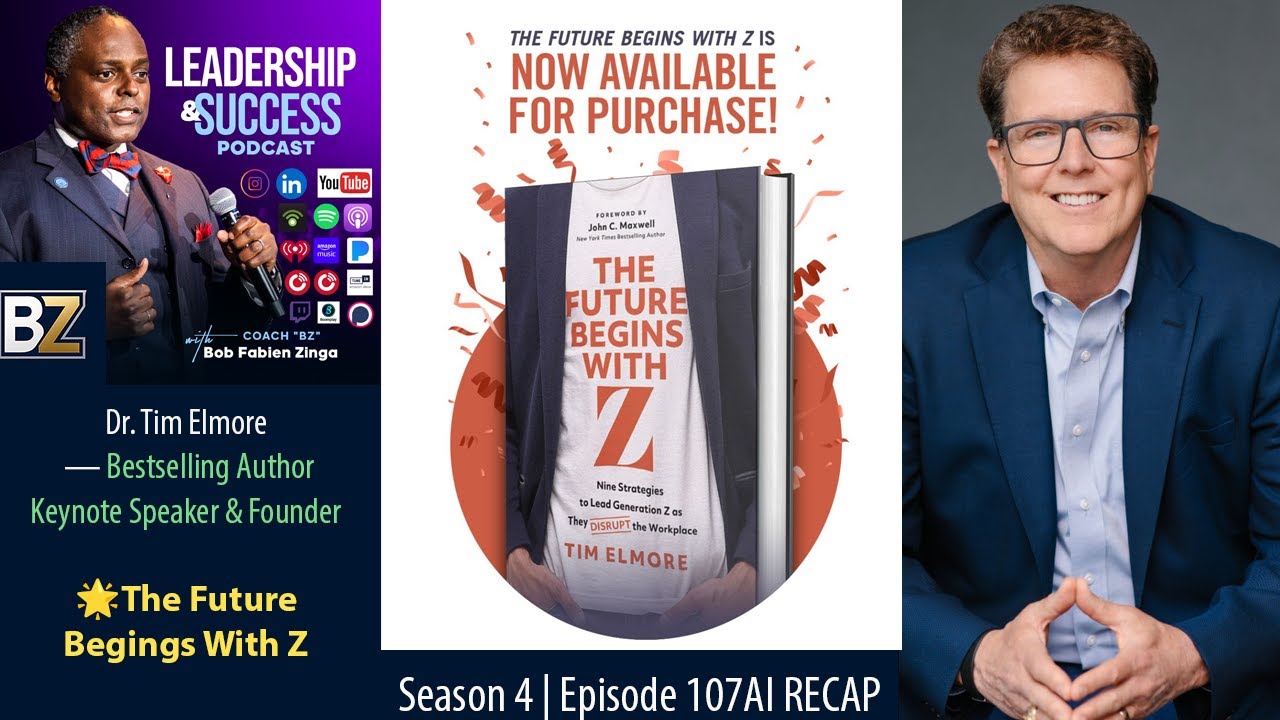
Coach BZ interviews Dr. Tim Elmore about leading Generation Z. Elmore describes the Peter Pan Paradox: Gen Z is tech-brilliant but lacks soft skills. He offers the PERCS framework for onboarding and the A-L-E-G model for feedback, arguing leaders should shift from command-and-control to connect-and-coach.
Chapters
¡Hola!
Hi, I'm John Maxwell. When the top companies in the world are looking for trainers, speakers, and coaches, there's one name one that stands above the rest, and that's Maxwell Leadership. Our certified team members have gotten proven results for companies all over the globe, and our reputation, I'm proud to say, is second to none. Some of our members have risen to the top of their profession, including the one you're going to meet today. I proudly introduce you to my friend, Bob Fabien Zinga.
Welcome to the Leadership and Success Podcast with your host, Coach BZ, where we help you lead with purpose and succeed with impact. If you're ready to grow into the kind of leader others want to follow, this podcast is for you. If you're determined to elevate your success and leave a lasting legacy, this podcast is for you. As my mentor, Dr. John C. Maxwell, reminds us, everything rises and falls on leadership. Our goal is simple: to inspire you, challenge you, and equip you with insights that can transform the trajectory of your leadership journey. Welcome aboard to another episode of the Leadership and Success Podcast with Coach BZ.
Please join us in a warm Live to Lead welcome for Tim Elmore.
I don't know who you are, but if you're like the average person in any country, there are multiple generations working together, and I actually believe every one of them has something to add. And we've got to get this right. 5 generations at the workplace.
Tim Elmore is with me. Joining us for more on that generation gap at work here in studio, author Tim Elmore.
With me right now is Dr. Tim Elmore.
He wrote the book on bridging the generation gap in the workforce.
A best-selling author, he's got a new book out A New Kind of Diversity. Sometimes we find ourselves colliding instead of collaborating, and my goal in the next half hour or so is to really give you some tools on making the different generations on your team your competitive advantage. I had a conversation with a father recently that said to me, Tim, I'm not having the same conversations with my teenage kids that I had with my dad when I was a teenager. You know what I said to him? You can thank Google, Siri, and Alexa for that one. They don't need adults for information. They need you for interpretation. Here's my challenge. Let's get together and create a strong generation.
God bless.
Other countries. So, introduction. One of my mentors at the Maxwell Leadership is the founder and CEO of Growing Leaders and bestselling author of too many books to name. But we're gonna be focusing on one book today, which was published last, last week. Dr. Tim Elmore has spent over 4 decades mentoring and equipping the next generation of leaders from Fortune 500 executives, professional athletes, to educators and emerging Gen Z professionals. As a close mentee of Dr. John C. Maxwell, we call him Papa John, Dr. Tim Elmore has transformed how we think about leadership, emotional intelligence, and generational dynamics in today's complex workplaces. He's written several books on Gen Y and Gen Z, and the latest one is about Gen Z as well. So Dr. Elmore's forthcoming book, which is out now, The Future Begins with Z, which released on November 4th, is a field guide for leaders navigating a generational shift in the workplace. Drawing on 10 years of research, Dr. Elmore argues that Generation Z, far from being a liability, may be the key to reimagining our organization operate. This is really key because I remember I had the opportunity to be a commanding officer for the Global Network Operations Security Center in Suffolk, Virginia, and I had to actually rely on my daughter— they're both Gen Zs— on how to inspire and lead Gen Zs in my command. About two-thirds of my command were Gen Z, and I must tell you, I am Gen X, they don't think like us, they're not motivated by the same thing, so they're almost like aliens in In a way. But anyway, my daughters helped me to lead them and inspire them. But I wish I had this manual, which we're going to be talking about today. So ladies and gentlemen, without any further ado, please help me welcome Dr. Tim Elmore to the Leadership and Success Podcast. And now we should be able to see you. Dr. Elmore, how are you doing today?
I'm doing well. Good to see you, Coach. I'm glad for this conversation.
Awesome. I am so glad you are here. And we are here really to focus on this. I think it's a life-changing book. I think everybody needs to read this, The Future Begins with Z. Well, actually, before we get there, can you please share, is there one thing that you are grateful for today, sir? Yeah.
Well, I am like you, Coach Bob. I am so thankful for the military, particularly on Veterans Day. But the first thing came to my mind was my wife. Our next wedding anniversary, we will have been married 45 years.
Wow.
She just gets better every year. I'm very fortunate, but I'm thankful.
Okay, we at the end. What did you want to do when you were a kid?
You're gonna laugh. When I was really, really, really young, I wanted to paint the lines on the road with a paintbrush.
Really?
Wow, okay. I never heard anybody say that.
I've never— yeah, I never heard anybody, but I was I ended up being an art minor in college. And I just love artwork. So, and that's how The Habitudes came about. I love artwork.
But you're definitely painting beautiful pictures in all of your books in the minds of your readers. So, okay. What are 3 adjectives describing you as a child?
Adjective would describe me?
As a child.
Wow.
Can I give 2 words?
Please.
I was very much a free spirit, but I was also very pensive and reflective. I don't know how you put those together, but maybe I would reflect and then say, let's do it. But both of those words, my mom says I had a furrowed brow as I was pensively thinking about should I ride that pony or something.
So anyway, sounds like a paradox. But you—
so if you're a leader, you've probably felt it, right? That friction when it comes to leading Gen Z. But what if I told you that friction isn't a problem to be solved, but a massive opportunity? Today, we're diving into a whole new leadership playbook, based on the amazing insights of Dr. Tim Elmore, that might just change how you see your team forever. And it all starts with this quote from Dr. Elmore, which just completely reframes the whole conversation. He says that instead of being a problem, Gen Z is actually like sandpaper for our leadership. You know, a force that smooths out our rough edges and, in the end, makes us way better leaders. It's a pretty powerful way to look at it, isn't it? Okay, so at the very core of all this is a concept he calls the Peter Pan Paradox. And this really gets to the heart of the central tension and, believe it or not, the massive opportunity of leading this incredible generation. So, what is it exactly? Well, it's this idea that there are two sides to the coin here. On one hand, Gen Z can totally fly, right? They use technology and innovation to solve problems in ways we've never even thought of. But on the other hand, they might not have had the chance to develop those soft skills—you know, the social and emotional muscles—that you need to navigate the tricky realities of a workplace. And this chart, man, it lays it out so clearly. On the left, you've got all this incredible magic. They're tech-savvy, they're socially aware, they're driven by purpose. But then you flip it over to what he calls the tragic side, and that's where we see the challenge. They might have a lower age of respecting authority and a higher age of actually reaching maturity. Our job as leaders is to build a bridge right across that gap. So, how do we actually build that bridge? Well, it all starts with a huge shift in how we think about leadership. We have to move away from a model that, let's be honest, just doesn't work anymore. It's time to stop commanding and really start connecting. Just take a look at this comparison. The old model, the one from the Industrial Age, was all about command and control. Your authority came straight from your job title, and your job was to give orders. But the new model? It's all about connecting and coaching. Your authority doesn't come from your title; it comes from the relationships you build. And instead of giving orders, you give oxygen. You give your team the space they need to innovate and really own their work. And this quote just nails it. A title, a position on the org chart, your badge—that doesn't automatically make you a leader. Not anymore. Your real influence comes from the bridge of trust and connection you build with your team. That's the real currency of leadership today. Alright, so that's the big idea, the philosophy. But how do we actually do this? Let's get practical. Let's talk about some real, actionable tools you can start using with your team, like, today. First things first, we've gotta bust some myths. You hear, "They don't wanna work," right? The reality is, many of them are working multiple jobs just to make ends meet. Or how about, "They lack work ethic." No, they're just rejecting the burnout culture their parents went through. They want a healthier work-life balance. And the big one, they can't take feedback. They absolutely can, but you have to earn the right to give it first. You know, all of this really starts from the moment someone walks in the door. So the big question is, how do you build that connection, that trust, right from the very beginning, during the hiring and onboarding process? And for this, Dr. Elmore has this brilliant framework he calls PERCS. It's a 5-step conversation designed to get everyone on the same page. You talk about their preferences, uncover their expectations, clarify the requirements to thrive, find the keys to what truly motivates them, and of course, you align on salary. This isn't just a boring checklist. It's a conversation that builds trust from the ground up. And that right there is exactly why that perks conversation is so critical. Think about it. In any relationship, professional or personal, conflict is really just the gap between what we expect and what's real. When you close that gap early, you prevent so much misunderstanding and conflict down the road. OK, so they're on the team, you've had the perks talk. Now what? How do you keep leading with that bridge of connection, especially when things get tough, like when you have to give some difficult feedback? The golden rule here is so simple, but man is it powerful. You have to connect before you correct. If you just jump straight into the correction without that foundation of trust, without that relationship, Your feedback is just gonna bounce right off. They won't hear it. And to help us do that, we've got another fantastic acronym from Dr. Elmore: A-L-E-G. First, you ask questions to understand where they're coming from. Then you actually listen, like really listen to what they have to say. Next, you empathize with their position. Show them that you get it. And only after you've done those first 3 things do you earn the right to guide them with your feedback. When you boil it all down, it comes to this simple truth: influence follows investment. You can't just expect to have influence; you have to earn it by investing time, energy, and empathy into your people. The A-L-E-G model is a perfect way to make that investment. And that brings us to our final big idea, and honestly, this might be the most important mindset shift of all. It's about reframing how we see Gen Z—not as a problem we have to manage, but as a masterpiece just waiting to be unlocked. You know, we usually think of mentorship as this one-way street, right? We, the leaders, pour our wisdom into the younger folks. But real leadership, it's a two-way street. This is what we call reverse mentoring, where we actually have the humility to learn from the very people we're leading. You can see it right here—wisdom has gotta flow in both directions. When we as leaders open ourselves up to being taught, whether it's about new tech, social media, or just a different way of seeing the world, the entire organization gets smarter. Gen Z has so much to teach us if we're just humble enough to listen. To really bring this all home, Dr. Elmore shares this incredible metaphor, and it starts with a simple, direct command: Stop seeing a cheap frame. And instead, start looking for the masterpiece inside. He challenges us to look closer, to invest the time, to stay long enough to find that priceless potential that might be hidden right behind the surface. Now, this whole idea comes from a wild but true story. A woman bought a painting for $4 at a thrift shop. She didn't even like the frame. But when she went to take it apart, she found something incredible hidden inside—an original N.C. Wyeth painting, which turned out to be worth hundreds of thousands of dollars. The real value wasn't in the cheap frame; it was in the masterpiece that was hidden inside all along. So, let's wrap this up. What are the big things to take away from all this? First, remember your authority comes from the bridge you build, not the badge you wear. Second, use that PERKS model to get expectations aligned right from day one. Third, practice reverse mentorship and turn that frustration into fascination. And finally, and maybe most importantly, always look for the masterpiece inside every single person you lead. And that leaves us with one last question, something for you to really think about. When you go back to your team, who is that person you've been seeing as just a cheap frame? What masterpiece on your team have you been overlooking? And what are you gonna do this week to start discovering it?
Welcome everyone, today we're diving, um, deep into the mind of a leader who sees Generation Z as the catalyst for reinvention. Yeah, that sounds exciting. We're talking about Dr. Tim Elmore's insights on leading the next generation of changemakers, right? Absolutely.
His concept, "The Future Begins with Z," really grabs your attention right away. It's all about not just managing Gen Z, but connecting, coaching, and co-creating with them. Exactly.
And you know, one of the key points he makes is bridging generations. He highlights how technology changes fast, but really it's people, their mindset, and values that define that change.
Mm-hmm. That shift in focus is so crucial. Right. It's like technology can give you the tools, but it's about how you use those tools. Dr. Elmore talks about the tension, his Peter Pan paradox, where Gen Z is super innovative but maybe still building social and emotional muscles.
Yeah, that paradox really sets the stage. On one side, you have a generation that can fly through complex problems with AI and innovation. But on the other, they might not have the experience navigating the human side of things yet.
Yep, that blend is what makes them both brilliant and vulnerable. I loved how he flips the traditional leadership script. Instead of command and control, he's advocating for a shift to connect and coach. Leaders need to listen more and essentially become mentors rather than dictators. Right.
It's like he says, "Authority used to come from might or title, but now it comes from credibility and genuine relationships." Yes, absolutely. I mean, think about it. You don't lead effectively by just barking orders. Exactly. It's about building bridges.
And speaking of bridges, his PERCS framework for onboarding is so intriguing. The whole idea of discussing preferences, expectations, requirements, keys, and salary Upfront really sets clear, healthy expectations. Yeah, I found that fascinating too.
It's like early on you're aligning the vision and removing any ambiguity that could cause friction down the line.
It's almost like pricing out a product before you even start manufacturing it. Spot on. And then there's his ALEG model for giving feedback: Ask, Listen, Empathize, Guide. It's essentially a recipe to ensure feedback feels Collaborative rather than punitive. Right.
And that ties right into his overall call to lead the whole person. The idea that leadership means, um, not just pushing for performance but cultivating mental health, resilience, and even mindfulness among your teams.
Yep, that's the modern twist on leadership. Speaking of mental health, his point on mental health and margin really resonated with me. Leaders must build space for reflection and creativity, especially in today's 24/7 work world. Absolutely.
It's like you can't expect your team to be at their best without giving them that breathing room, you know?
Yeah, a little margin goes a long way in preventing burnout. I appreciate how he challenges some persistent myths about Gen Z too. For example, the idea that they are lazy or lack work ethic is debunked by showing they're often juggling multiple responsibilities.
Right. They're not asking for less work. They're asking for healthier work conditions. It's a shift in perspective that makes you wonder if maybe older leadership models have been a bit too rigid.
Now, one thing I do want to respectfully challenge is the notion that Gen Z is just a new set of challenges. I mean, aren't these dynamics just reflections of broader shifts in societal values? They're not just problems to fix. They're opportunities to elevate leadership values.
I completely agree. While some may see it as a challenge, it's truly about rethinking leadership. Dr. Elmore even mentions that Gen Z, in many respects, smooths out our leadership rugged edges. It's like reverse mentorship. Right.
The idea that every generation can learn from another is really powerful. And speaking of reverse mentorship, it's Like the classic scenario, a seasoned leader learns about new tech trends or cultural shifts from a fresh face on the team. That really flips the old hierarchy on its head.
Yeah, plus it's a win-win scenario. You have the experience paired with the agility of new ideas.
A real, uh, cocktail for innovation. Yes, it's a dynamic exchange that benefits everyone. Let's also talk about his vision for the workplace of the future. He mentions concepts like the internal gig economy, ongoing learning opportunities, and finding meaning over money.
Right. It's almost like reimagining the workplace as a vibrant space of constant innovation and learning, rather than just a place to punch in and out.
Exactly. It's about treating that first job as a launchpad for lifelong growth. And how about that analogy at the end about the $4 picture frame hiding an original painting? It's such a striking metaphor for seeing the hidden potential in young people.
Oh, absolutely. It really makes you think. Sometimes what appears ordinary on the surface can conceal extraordinary value.
Yeah, it's both humbling and inspiring. Dr. Elmore's whole approach is a call to action for leaders across sectors, from the military to Silicon Valley, to step up and evolve with the times.
Right. It's like we're being challenged to move from an old top-down approach to a new model of connection, empathy, and mutual growth.
Yeah, that's definitely the future of leadership. Not to mention, his emphasis on clear expectations and honest feedback is something every leader can implement immediately. It creates, um, a safer space for innovation.
Oh, definitely. Imagine a leader who consistently says, "Let's connect before we correct." That mindset not only builds trust but paves the way for real, transformative team building.
Mm-hmm. Building trust is the foundation for any high-performing team. And his integration of biblical principles like servant leadership and building the whole person adds another layer. It gives the conversation a moral grounding beyond just business strategy. Exactly.
It's like melding timeless values with modern challenges. Um, leadership becomes about serving not just tasks and outputs, but human potential.
Yeah, that's what truly inspires people to follow. I also think that his call for leaders to listen more and coach more and to see feedback as a conversation rather than a lecture is a paradigm shift many organizations desperately need.
Yes, the shift from command and control to connect and coach really redefines what it means to lead. Absolutely.
Shifting authority from power to service. So, if you ask me, the future of leadership is about adaptability. Being able to evolve with the rapidly changing world while ensuring that, um, every member of your team feels valued. Exactly!
It's a reminder that while tech may drive the pace of change, it's our ability to connect, listen, and lead with empathy that ultimately shapes a successful future.
Right on! That's the key takeaway. And as Dr. Elmore so eloquently puts it, leadership isn't about perfection. It's about presence and service, not hoarding authority, but multiplying it for the greater good. Yup.
Every leader should ask themselves, are we equipping the next generation to lead the future, or are we stifling it with outdated methods?
That's a critical question. It leaves us with a compelling call to reimagine leadership not as a status or a destination, but as an ever-evolving journey of mutual growth and connection. Absolutely.
And I think, as we navigate through these changing times, embracing these principles is more than a strategy. It's a necessity for building truly resilient organizations.
Exactly. It's about creating environments where everyone can shine. So to all our listeners, if you're in a leadership role, consider how you can shift from traditional authority to a model that fosters connection, trust, and empowerment.
Yeah, let's lead with heart, be open to learning from the unexpected, and always be ready to mentor the next generation.
Mm-hmm. Here's to the future, shaped by stronger, more empathetic leaders. Absolutely. Keep challenging yourself, keep listening, and remember, a great leader not only paves the way but also lights it. Thanks for joining in this enlightening discussion.
All right, everyone, thank you so much for watching today. And I want to remind everyone to please follow Dr. Tim Elmore. He's on LinkedIn, Timothee Elmore, that is his URL. So LinkedIn, linkedin.com/in/timotheeelmore. So please follow him and purchase his instant bestselling book, which is The Future Begins with Z. It's available now and you can get it in audio format, which I did, or Kindle or the paperback version. Again, I don't know anybody who is a greater expert than Dr. Tim Elmore on how to lead and inspire Generation Z. At the end, I'm gonna play two more clips from our hour-long conversation about The Future Begins with Z. And I would like for you to go back and listen to the full episode. All right, so that's Season 4, Episode 107. That is the original hour-long episode. And what I gave you today was a 10-minute artificial intelligence recap. So now we are going to do our moment of gratitude, which we do every single day we meet. And I decided to do it toward the end because we are right now day 4 of 21 of the Ungrateful Challenge. I do this every year. So for the next 21 days, I'm going to be grateful for one thing every single day, the same as we customarily do on this podcast. But in addition to that, I'm going to go ahead and challenge someone in my network to do the same thing. Yesterday, we challenged Michael Leonard. Let me share my screen. And I hope Michael Leonard said yes to the challenge. He is the CTO, Chief Architect, and Vice President for Engineering at GungHo Digital AI Transformation. So today we are going to choose somebody else, but before we do, let me go back and let's do our moment of gratitude for today. So yesterday I was grateful for my firstborn Naomi, and today I think I am grateful for my second child Zoe. She's really the joy of our life. And one thing my wife and I, we are really grateful for is the fact that the two kids we have are really good kids, right? They really care about people. I think they have great values and they value people and they want to add value to society. And I think that is so rewarding, more than money, more than any inheritance. I think just having the privilege to raise two beautiful, gentle, kind kids, I think is extremely, extremely rewarding. So let us know in the comments what you are grateful for. So now I am going to go ahead and So for day number 4, we're gonna choose who on my network is going to be challenged to accept the 21 Grateful Challenge. So let me share the screen again, and this time we are going to go to the wheel of names, and let's randomly select a member of my network I will be challenging today. Well, it looks like for day number 4, I am going to challenge Jacob Martin, SMB Account Executive Northeast in Privada. I connected with Jacob on January 3rd, 2022, so a few years ago. So let's see what Jacob looks like. And, uh, today on day number 4 of the 21 Leadership Challenge. I am challenging Jacob. So Jacob, if you are watching this, uh, we would like to challenge you to accept the 21 Grateful Challenge. Okay, uh, this is day 4 of 21 days, and, uh, Jacob, Account Executive at Imprevala, out of Austin, Texas. I hope you will accept the challenge. All right, this is it for today. So what I'm gonna do now is I'm gonna play a couple more clips, uh, highlight from my hour-long conversation with Dr. Tim Elmore about The Future Begins with Z. And I also want to remind you guys that, uh, tomorrow is going to be the Monday, December 1st, Mental Health Day on the Leadership and Success Podcast. I'm going to have two health champions. James Corbett from Project Refit is the one back in 2021 who I heard started this 21-day challenge because about 21 veterans commit suicide every single day. And I've been doing it ever since. So James is going to be with us at 10 1:30 AM Pacific time, 1:30 PM Eastern time. That's tomorrow, Monday. And then in the afternoon, 4:00 PM Pacific time, my brother in arms, Captain Michael Segal, US Air Force veteran who is now a sergeant at the Walnut Creek Police Department, which is here in the Bay Area, he's also written the number one bestselling book, Relentless Courage, about really dealing with trauma. So he's going to be with us tomorrow. So I can't hardly wait. So tomorrow morning, we are going to have two live episodes of the Leadership Success podcast all about mental health. Again, at 10:30, we have James Corbett, a visionary builder, innovator, and creator, changing mental health support for veterans, and also the one and only Captain Michael Sagu, trauma-informed warrior, mental health champion, and the courageous truth teller. We're going to be talking about the Eden Battle. So that is going to be for tomorrow. And I think I may also share some of my own, I guess, struggle with mental health. I've been in the Navy for 21 years now. And for anybody who's been in the service, first of all, I want to salute you for volunteering going to be in the armed forces, which I believe make our country great. But I know 21 years ago when I joined the Navy, it wasn't trendy, it wasn't popular, it wasn't very much encouraged, right, for people to let their command know that they were dealing with some mental issue or they were seeing a shrink or psychiatrist or getting some type of emotional counseling. Because back then it could have a negative effect on your security clearance, therefore on your career. But things have changed a lot in the last 10 years or so. So if you need mental health, you definitely need to ask for help. I think that's really what makes you strong, right? It doesn't make you strong for you to hide those mental or spiritual wounds, right? Once someone is injured physically in the military, everybody knows that and everybody supports them to get medical help and get better. But when it's emotionally or spiritually, it's a wound that nobody can see. And for a long time, it's been a stigma, but it really shouldn't be. So if you are a junior enlisted member in the military or a junior officer, I really encourage you to seek for help if you need it. I know throughout my own career, I've even felt— we found out it was actually panic attacks, but I felt like it was— it felt like a heart attack several times throughout my career, this last 21 days in the Navy. Because when you are in the service, you see a lot. Sometimes you see people die, sometimes you are in combat zone, and and your life might be in danger. So we really go through a lot and we shouldn't be suffering alone. There is a lot of help out there. And tomorrow, which is Monday, Mental Health Day on the Leadership and Success Podcast, I want to make sure I bring in those champions, James Corbett from Project Refit and Captain Michael Sagu, US Air Force veteran. And we're going to be talking about how to deal with mental health, especially for those who are in the military. So you don't want to Miss it. All right. So I'm going to play a couple of clips from Dr. Tim Elmore, and that's going to be the end of the show. I can't wait to see you tomorrow, twice, 10:30 AM and 4:00 PM Pacific time.
I want to help see, help people see that emotional intelligence may be the most important leadership trait they can develop. And it's not out of our reach. Our IQ won't change a lot. Yes. But our EQ can. So I would say develop that. And I just, if I could pour that into the brain of every emerging leader or every aspiring leader, whatever your age, it would be emotional intelligence.
That's really powerful. Part of the reason why I do this, because I live here in Silicon Valley, I think if I get home at 9:30, we're going to have a long and heavy conversation.
Yes. And it's not because she couldn't live without me for 2.5 hours. It's because I created an expectation. This is so, so, so important to talk over early in the journey. By the way, isn't this true about a marriage relationship and a dating? You know, we should find these out. All right. The letter R. So it goes preferences, expectations. The letter R is requirements. We are finding that Gen Z is coming in with some demands or requirements. Like, I want you to be about this cause in the community, or I want you to march for this or do this, or Yes. Whatever. But it sometimes is a very idealistic point of view from a person that's never once had a full-time job, or they've never been a boss, for sure. But I think it's good to find that out now so you have the liberty to say, Jennifer, thank you so much for sharing that, but I can just tell you right now, that's not going to happen. Let me show you the door. I hope for the best for you. And, you know, but isn't it better to find out now than again when the ascension begins? Or demands. That's huge requirements. The letter K is keys. What are the keys to their heart? I want to find out in the job interview, not just can they do the task I'm going to give them, but what makes them tick? Do they love the Chicago Cubs? Do they love brownies? What, what is it that makes them tick?
Thank you for tuning in to the Leadership Success Podcast with your host, Coach BZ. If today's episode episode added value to your leadership journey, be sure to subscribe, share, and join us again for more wisdom nuggets on how to lead better and achieve greater success. Remember, leadership is the most critical skill of our time. The world will always need leaders to inspire others, drive innovation, and execute meaningful strategy. So why not count yourself among the bold leaders shaping the 21st century? Until next time. Stay inspired, stay committed, and keep leading with excellence.
More from Bob

S250:E4🎙️LIVE 🇺🇸America 250: President Barack Obama Leadership, Service, and the Power of Hope






S5:E157🎙️ LIVE with CMD CMSgt Dennis L. Fritz, USAF (Ret.)(Multi Tracks Audio)



S5:E156🎙️ LIVE 🇪🇸 Leadership Lessons from the FIFA World Cup 2026 Champions (Multi Tracks Audio)

S250:E3🎙️ LIVE Leadership Lessons from America’s First Documented Family of African Descent 🇺🇸📖