S4:E108 🎙️LIVE with LT COL Johnny “The Military CEO” Lynum II, USAF (Ret.) (Multi Tracks Audio)
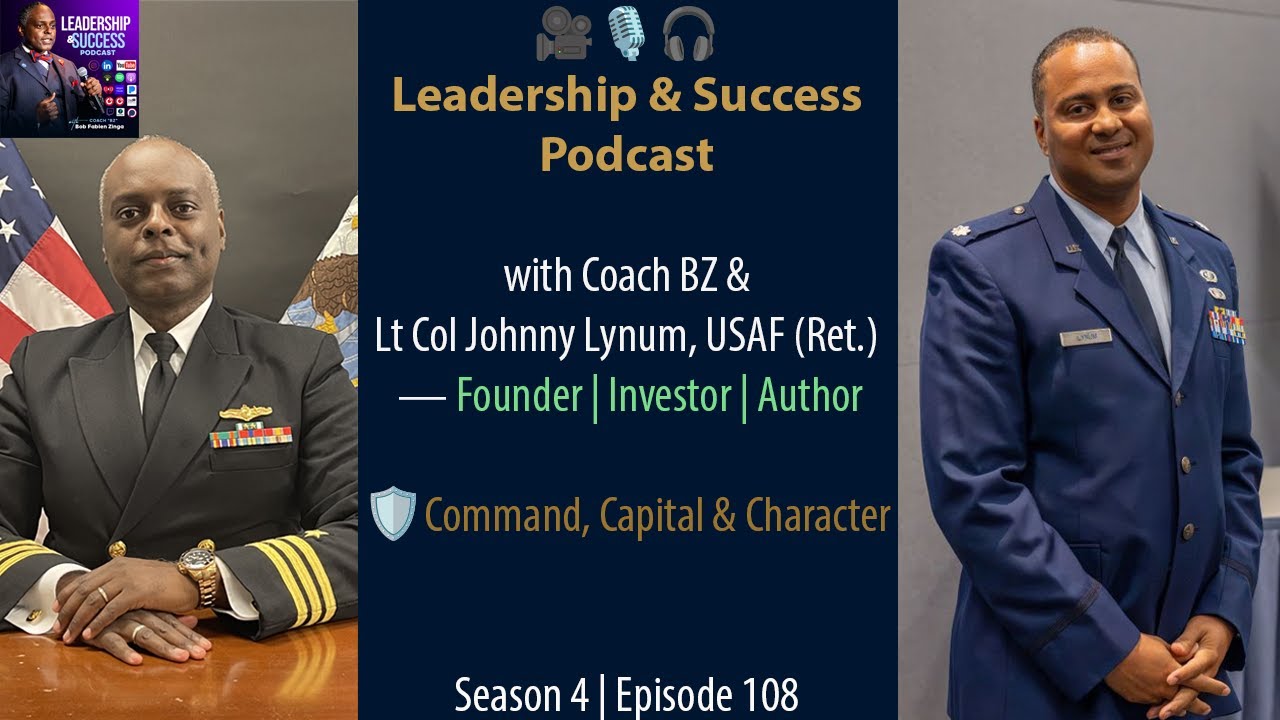
Retired Air Force Lt. Col. Johnny Lynum shares how military leadership principles translated into real estate investing. He built a multifamily portfolio using VA loans and creative financing, lost $200k to vandalism, and now helps veterans use their benefits to achieve financial freedom.
Chapters
Hi, I'm John Maxwell. When the top companies in the world are looking for trainers, speakers, and coaches, there's one name that stands above the rest, and that's Maxwell Leadership. Our certified team members have gotten proven results for companies all over the globe, and our reputation, I'm proud to say, is second to none. Some of our members have risen to the top of their profession, including the one you're going to meet today. I proudly introduce you to my friend, Bob Fabien Zinga.
Welcome to the Leadership and Success Podcast with your host, Coach BZ, where we help you lead with purpose and success. Leadership with Impact. If you're ready to grow into the kind of leader others want to follow, this podcast is for you. If you're determined to elevate your success and leave a lasting legacy, this podcast is for you. As my mentor, Dr. John C. Maxwell, reminds us, everything rises and falls on leadership. Our goal is simple, to inspire you, challenge you, and equip you with insights that can transform the trajectory of your leadership journey. Welcome aboard to another episode of the Leadership and Success Podcast with Coach Bizzy.
Hello everyone, this is Coach Bizzy. Thank you so much for being with us. Today is the day before Veterans Day 2025, and I have a very, very special guest for you. But before I introduce him, let's go ahead and do what we do on this program, take a moment for a moment of gratitude. This takes less than a minute. And it's just something we are accustomed to do. We want to be thankful every time we meet. And part of the reason why we do this is because of the numbers of suicides in the military, about 22 suicides, veterans commit suicide every single day, and you can't commit suicide, be suicidal and be grateful at the at the same time. So if you would close your eyes and think about one thing that you are grateful for today. And I think today I am really grateful for all of the veterans across America, those who have served even just for one day, those who have fought each and every one of our wars, and those who have put on the uniform of our country and volunteered and said, "Yes, I will serve." protecting our freedom and democracy even around the world. So I'm so, so grateful. All right, so let me see if I can introduce our guest today. We are going to be speaking to Lieutenant Colonel Johnny Lineham, U.S. Air Force retired. He's better known as the Military CEO. I think that's his call sign name. Uh, so we're going to be talking about the same disciplines that wins battle that can also build financial freedom and generational wealth. Johnny is a veteran investor, author, and founder of REI Genius, whose book Millionaire Real Estate Success Strategies has transformed our professional thinking about money, mission, and mindset. So ladies and gentlemen, without any further ado, please help me welcome Lieutenant Colonel Johnny Lynam. All right, Johnny, how are you doing today?
Doing well, BZ. Glad to be here today.
Fantastic. I'm so glad I have a veteran on the show today. So first of all, happy Veterans Day. And can you tell us, is there anything you are grateful for today?
Yeah, no, for me, I think, you know, how you started off the show, just really gratitude for being in the moment today, lessons that the Lord has allowed me to receive. And I think, you know, now we talk about Veterans Day coming up and just the service and the ability to serve in a different capacity, you know, as, as we hang up the uniform, because there's a lot of work to be done in regards to veteran homelessness, veteran mental health, and just a lot of issues that impacted veteran communities. A lot of work to help our brothers and sisters in arms.
Wow, thank you so much. That is, that is so insightful. Is there something about you that most people may not know?
Something about me that they don't know, what's not on the bio page. I think for me, uh, that they don't know is, uh, you know, I really love to deer hunt. You know, country boy growing up in the backwoods of Alabama, so I'm an avid deer hunter, although I don't get an opportunity to, uh, to get out as much as I want to, but that's, that's about to change. So I would say that's gonna be a good fact.
Where in Alabama? Because I consider myself from Tuscaloosa, Alabama. I've lived there more than 15 years. They adopted me there. Roll Tide, Roll. Where in Alabama?
Roll Tide? Yes, about an hour, 45 minutes south. Grove Hill, Alabama, Clark County. And yes, Roll Tide.
Yeah. Wow. What a small world. So can you tell us about your leadership background, how you got to join the Air Force, and most importantly, retire as a senior officer, Lieutenant Colonel. That's huge. Can you tell us about your leadership background? For sure.
For me, growing up, humble beginnings in Grove Hill, Alabama, all of the whopping 3 traffic lights in town. And from a very early age, my parents instilled in me just the work ethic and the importance of education. And my dad was a pastor and entrepreneur as well too. I mean, he had an appliance and television repair business, and my mom worked in the laboratory there in the local hospital. And, you know, hardworking family, and that work ethic spilled into me and everything and how I showed up in my schoolwork was very well in regards to, you know, approaching school and using it as a tool coming out of high school. I actually had a 4-year Army ROTC scholarship And I went to the University of Alabama for my in-person interview. And my dad, who was a Vietnam vet, he challenged me to go and speak with the Air Force while on campus. And that decision—
Was your dad in the Air Force also in Vietnam?
He was Army.
Army.
Army, yeah. So he was Army Vietnam vet.
Why in the world did he ask you to go to the Air Force and not the Army? Because Alabama has what, the Air Force and Army?
Right, right. And so when he— for the quality of life, he, he saw both sides of it and he's like, hey, you know, and, and a lot of the, uh, you know, the jokes they have out there, just the quality of life has versus the Army.
And yeah, and, uh, the Air Force, what I've seen is true. Yes, they, they build the golf course first and then they build everything else, which is pretty cool. Yeah, because I remember in 1996 I was a student at UA and I talked about what the Air Force and Army back then I didn't care, but I wasn't a US citizen, so they both asked me to go back. But anyway, wow, that is pretty cool. But when I eventually joined the military after 9/11, it was— I talked to all four of them, including the crazy Marines, but it was very simple. It's like, it's going to be the Navy or the Air Force because we have two branches. I mean, God bless them. We need soldiers and Marines, but they use a lot of their body and, uh, physical attribute, whereas the Navy and the Air Force, I felt like they use a lot of their brand. But anyway, continue please. That's, that's just fascinating.
Yep, no, that's exactly it. That was exactly it. He was like, hey, have a conversation with the Air Force, see what they can do for you. And they told me that they couldn't give me a scholarship coming in, but if I came in and joined ROTC, put me on scholarship my second semester my freshman year. I took them up on their word, and, uh, as they say, the rest is history. And I was able to go on scholarship and, uh, graduated in 2005 with electrical engineering, and I commissioned as a second lieutenant in the world's greatest Air Force.
That is fantastic. Wow. Okay, so, uh, how did you experience commanding airmen and managing billion-dollar program, uh, How did that prepare you for entrepreneurship and investing, which is what you are in now? And as a lieutenant colonel, what, what was your designator in the Air Force?
I was a 62 Echo, so acquisitions officer. So primarily with me, um, I started work doing depot maintenance, so as an engineer support F-15 sustainment, uh, one of our fighter jets. And from there, the rest of my career really was around software development, so cost schedule performance managing software development projects for different systems within the Air Force, but then also a few of our different agencies that we have in the intelligence community. And so just leading in diverse backgrounds, you know, I had a stint as— I did a sabbatical as an intelligence officer as well. And so that's really where I first got my taste of leadership, you know, leading troops downrange in Afghanistan doing intelligence surveillance reconnaissance operations. Doing, working 6 months straight, 24 hours, 7 days a week, you know, 24 airmen and a few contract, being able to do ISR operations and supporting the guys on the ground. So that was definitely, definitely the pinnacle of my career. Being able to lead in that type of environment was, it was a blessing. And it really brought, it really brought out of me everything, those mission values, the ethics, the, uh, the integrity and everything my parents had given me growing up. And all of that kind of culminated, came in together to be able to be boots on the ground and leading, leading troops in combat and just being able to support the mission. Because for me, it was about money and finances to get my education, commission into the military. But after deploying and just going through all of that, that, that sense of service became something way past a monetary value.
That is really, really amazing. Now, I am an information warfare officer, so I do computer networking defense and things like that, but I also got a qualification from the Defense Acquisition University, their IT acquisition cert, I think level 1, 2, and 3. I'm sure you got everything across the board with DAU, but it's really amazing from just what you've said, how you get into the military I know you may have a certain job or position, or I guess the Army calls it MOS, we call it designator in the Navy. But then you get the opportunity to do a lot more if you want to, depending on where your career kind of takes you. And then you also, of course, have the opportunity to travel across America and around the world. That is really, really great. So what mindset shift did you have to make when you transition from defending national assets to building personal and community wealth?
Yeah, that's a great question. And that overlap, it wasn't a clean break. It wasn't one moment. But really for us, as I look back, I can point back to a story that happened in my life. You know, coming off deployment, my next assignment, I was at National Reconnaissance Office working in the D.C. area. And we had just had our first child. And at that point, we had made the decision that my wife wasn't going to go back into the workforce. And I was like, hey, you know, going to one income, like, there's, there's, we got to look at how can we generate more, more income. And at that point, we had bought a couple properties using our VA loan, moving around, buying foreclosures. And at that point, we decided to create a business to do, or start doing fix and flip investing in 2015, almost, yeah, a little bit over 10 years now. To the date. And, you know, for us, it was really— it was a transformation from going broke mindset to a wealth entrepreneurial mindset. I knew all along that my dad told me at a young age, if you wanted to be rich, you wanted to be wealthy, that you had to work for yourself, that you weren't going to be able to achieve that working for someone else. And that always stuck with me, but I kind of got into the career, you know, serving, doing really good, focusing on excelling in my job. But it really hit me kind And going through and looking at where we were at that assessment, and I saw the power of real estate after picking up a few rentals, after we buy homes at the end with our VA loan and turn them into rental properties. Then I'm like, hey, it's something to this real estate thing. And like, how can I accelerate the journey between just moving every 3 or 4 years and buying a property? And we decided to take the leap of faith. We bought our first property outside Fort Belvoir in Alexandria, Virginia, back in the summer, and the rest is history.
Wow, that is really amazing. So something we mentioned when we were in the green room, so many veterans and people serving right now on active duty, they don't really take full advantage of all of the benefits available to them. You know, when you come— I don't know if that's true for you, but I'm sure it's true for most people. The military doesn't pay as much as the industry does. However, we do have a lot of benefits when it comes to healthcare, to VA benefits for education, home ownership, and all of that. So many benefits, but sometimes sailors, veterans, they just don't take advantage of it. But it's really wonderful to see somebody like you took full advantage of your benefit and being able now to use it at the high level even after service. So for the people who are listening to us who may be transitioning, many veterans have seen the kind of struggle, right, with to let go of their military identity after retirement. How did you redefine yours as the military CEO?
Yeah, no, great. I, you know, just coming out of retirement here the last, last month, and just really the conversations you had with veterans and really seen it firsthand that a lot of, a lot of active duty military, they struggle with that transition. And it's the mindset and the attachment that we have with our military service, you know, for good reasons, don't get me wrong, but it does us a lot of times a disservice where we're not able to translate that into the private sector or or into the civilian world, and we come out of the military and everything that we may have known for like a 20-year career, and our only experience as an adult, or really in a working environment, and really going to the private sector where you don't have the same culture, you don't have the same mission, focus, and values across your peers in an organization, that a lot of military members struggle. I was at an event with the HEAL nonprofit, with their Veteran Voices Summit in downtown D.C. last week. And it was interesting, one of the congressmen that, I think he leads the Armed Services Committee, and he really talked about after a 20-year career, and oh, by the way, when we start talking about military members, only roughly 10% of military members stay for a full 20-year career to the point where they can take a retirement. And so a lot of people think everyone is just fully retired, but only 10% actually stay 20 years in the service. But those that leave the military, that most will have 5 different jobs before they complete their next career. And I think what you're talking about is a lot of those struggles and challenges come from being able to recreate that identity and find, you know, who you are separate from military service, separate from your rank, and how you show up in a new organization, in a new career field. It's definitely something that, that is a challenge for most veterans.
Definitely. And you are not only part of the 10% to actually get retirement, but also part of the 4% to end up being a senior officer in the military. And for people with our skin color, that is a lot. So big congratulations for that. And also, you are an author, and I want to plug in your book right here, right? Millionaire Real Estate Success Strategies: What They Forgot to Teach You in School. Let's talk about that a little bit because I feel like people in the military, sometimes we don't really have a mind for wealth and definitely not generational wealth. Most people don't join the military to be millionaires, to make money. That's not the primary reason why people would join. However, I feel like you do have a lot of opportunities throughout your career to actually make a difference. So looking at your book and all of the work you have done, I guess one question I have is you often say that financial freedom isn't about quitting your job, It's about creating options. So what does that mean for service members and working professionals?
No, great question. And that's spot on because when you look at it, we all know as soon as we step into the military that we have a date coming. 4 years later, it's 20 years later or 30 years later. Like, there's going to be a day when you leave the service and you're going to have to lean on your skills. Hopefully you built up more skills. And experience while serving and education as well too. And so really, it's really focusing in on tomorrow, in the future, and having a plan to get there. And, you know, for me, once I start— my wife and I, we started that fix and flip business and, you know, really took down that entrepreneur path in 2015. I started transitioning at that point because I was building a business. I had to build systems in place because I was still serving active duty the entire time. And so with that, I took the skills of project management and program management and brought that to my business as well too. And so really it's all about finding who do you wanna be? Who do you wanna serve? What problems do you wanna solve? And understanding how you can start solving those problems as soon as possible. And I get it, you know, there's a lot of different career fields, you know, being out on the ship and there's a lot of barriers where, you know, you may not be able to do as much as you would like to do while still serving, but there's some things that you definitely can look and see how best you can position yourself for your transition where you can do it on your own terms and you're prepared. It's not a lot of stress, it's not a lot of anxiety that's being placed on you and your family during that period of time.
Yeah, so talking about that then, what do you think are some of the biggest misconceptions people have about real estate investing, especially those serving in uniform who are just trying to start out?
Yeah, I would think the biggest misconception is that you have to have a a ton of money to get started. I would say that is the biggest misconception because so many people, we all realize that we need real estate, we need to have real estate exposure, but a lot of people think that they have to have a large lump sum to get started as a real estate investor. And you know, I've bought multiple apartment complexes where I didn't put any money down. Wow. I bought a 24-unit, a 20-unit apartment complex, and I actually got money back at closing because They turned over the existing security deposits to me. And, you know, so things like owner financing and creative financing that you can bring into deals allow you to scale up and allow you to buy assets that are undervalued and that you can appreciate. You can force the appreciation. And so I think one of the limiting mindsets is not having the money or need a lot of money to get started, which isn't true.
This is really amazing because I also told you in the green room, one of my primary mentors is a retired captain now in the Navy. Every time, you get 2 to 3 years assignment. Every time he had to move for the Navy, he always purchased a home, every single time. Sometimes he would sell it, sell it back, make a profit, or just keep it. And now he's completely retired, but he gets all of this passive income. That's pretty much almost equal or even more than what he would get for his retirement. So it's, it's really amazing what you can do if you put your mind to it while you are in uniform. So back to your book and also on your YouTube video, you talk about your Find, Finance, Fix, and Finish framework. Maybe you can give us a brief summary of your framework, but also which step do you think most people, new investors, underestimate and why?
No, great question. Um, because, you know, really going back to the framework, so it's really, it's centered around being able to find, find great deals, you know, whether you're active or whether you're a passive investor with how are you going to find the deals that you're going to look at investing in. So whether you're actively looking where you're doing direct-to-owner marketing, or you're going directly to brokers who are working with sellers potentially that have deals where you can find those opportunities, but then also, you know, being able to underwrite deals and understand how are you going to find deals. If you find the right operators who are doing those things where they're, they're going out negotiating with sellers or negotiating with brokers to get great deals under contract. On the finance side, it's really how you're aligning capital to the deal. Each deal is going to be different, but there's opportunities, as I spoke about, where, you know, you could have non-traditional financing where an owner will maybe owner finance for 3 or 5 years the deal. But then also you have, you have conventional financing like your traditional banks, Wells Fargo, your credit unions that are a great part of that team, as well as other lenders like hard money lenders and private investors that can invest in your deal. So really finance is all about the money aspect, how to put the funding to the deal in order to get it across the finish line. And then fix is really executing a business plan. I really focus on value-add real estate. Where we're looking for dilapidated or, you know, um, somewhat neglected deferred maintenance type of opportunities where we go in, we do renovations, and we bring the rents up to market rent after we've improved the building or the apartment unit and bring it up to 2025 standards. And from there, we're working with contractors to accomplish that, and we're also working with third-party property managers to execute the day-to-day operations in order for us to execute our business plan, which leads us to the final step, finish, where now whether we're looking to refinance or we're looking to sell the property, now we're going to execute our business plan and implement that, where we're going to refinance, take the capital and roll into another investment, or if we're going to sell and look at doing like one tax-deferred exchange, or we're just going to sell it outright and, uh, and take that profit and roll it into the next deal. So multiple exit strategies is always preferred, but really that's the process to go through with, find, finance, finish. And really from there, I think the most neglected part is really on the front end, the find, because, you know, being able to find great deals is a true art. And you make money in real estate when you buy, not when you sell. Yes, I say that again. You make money in real estate when you buy on the front end and not when you sell, because you got to buy at the right price. On the front end and buy the deal and understand the renovations and how much budget is going to be needed on the front end in order to make sure you're making the right offer price.
Well, this is going to be a two-part question because I have a lot of aspiring senior officers listening to the podcast right now. Maybe they're junior officer right now, O-1, O-2, O-3. This is a two-part question. So in the GSCOP magazine feature, you focus on helping others build generational wealth through side hustles. So what's the difference between us all and sustainable business? That's the first part. And then the second part, which I think is more important for those listening to us, because they can look at you and all of your successes and everything you are doing. It's like, wow, this is just amazing. And how in the world did you do that while you were an active duty in the Air Force? How in the world were you able to do that? So what advice would you give to a service member or corporate professional who want to start investing, but they feel like they are too busy? I guess that's That's an excuse many, many people have, but here you are, you've been doing it. I don't know if you have time to sleep or not, but it's just amazing how you were able to— because you didn't learn this investing in school, you didn't learn it in the Air Force, although acquisition, I can say, yeah, you probably learned some principles maybe you were able to apply over, but not really. So how were you able to manage all of that? It's pretty amazing.
So on the first one, so the first question, uh, is really for like new investors that are looking, looking to get into real estate while still serving. Yes, I want to make sure I got that right. So, okay, yeah, so, and so I think really it really is, it goes back because you brought up a great point about the time commitment, that you have to have the right career field that allows you the time and the deployment cadence and, you know, offshore duty, things like that that the Navy members have to worry about. And so one of the things that you really look at when you come— when it comes to investing is your resources, time and money. And so the access to time, because we all had 24 hours in a day, and so it's really focusing in your schedule and time on the activities, the key activities that are gonna move the needle when you're investing. And so if you're gonna be on the active side, it's no— now it's allocating time. How can I leverage other people's time. So networking with brokers who are— who have 4 or more to reach out to sellers on your behalf, they can bring you deals. Or aligning with other investors that may have more time but don't have the capital. And so making those, those partnerships is critical across different levels in order to find success. And for me, it was really aligning with other people that I could solicit to bring into, uh, the team to help, whether it's realtors, as brokers, or if it's contractors as well, because I couldn't do the work personally myself. And really hiring a team. So I have multiple virtual assistants. I hired my first virtual assistant back in 2018. And that was a game changer because I was leading team working for the Air Force. I was like, hey, I can, I can do this and bring the same leadership and structure to my business to bring the right people in that can help me be successful. So really, it comes down to finding the right people with the right right skill set and, and being able to understand what are your, what are your long-term goals and how you bring those two together. And so I think really for a lot of people that don't have the time to invest, they're really busy, they have a high ops tempo, that a lot of times the passive investing is a route, um, that I found. And that was one of the things that really took me into the financial advisor side that I operate in now that I'm retired. It's just because I've seen the power of passive investing and being able to align into institutional deals that a lot of the wealthy participate in, where now you're, you're, you're in a position where your money is working harder than you do. Wow. In regards to how you're building wealth and trading your time for money.
That is really, really amazing. I think this is a great point to switch over to the second half of the show where we focus purely on leadership. Uh, first category of question I'm going to ask you, uh, What do you think is the greatest lesson you have ever learned throughout your Air Force career and your entrepreneurship journey? What is the greatest lesson learned so far?
The greatest lesson learned, I would say for me, it was, it was the decision-making process and being able to be comfortable making decisions without 100% of the information. That was something as a captain, when I talked about going into my sabbatical as an intelligence officer, And that was critical, where a lot of times as an engineer that you want to, you want to think and you want to prove out your theories and have all the information and go through a methodical process.
Yes.
But when it comes to leadership and when it comes to battle and when it comes to leading operations, you're never going to have 100% of the information and you have to be comfortable leading in that environment. And so I think that was the most critical piece that I picked, I learned, and I take that with me every day in every investment. Every deal and every meeting and situation where I'm making decisions, I've become extremely comfortable with making quick decisions and being able to course correct when necessary. Um, if the information we learn later down the line has changed, then we need to change our approach. And being comfortable in those situations has been critical to my success.
That's, that's really a master key to success because one of my mentors, I'm sure you know, this one right there, uh, General Powell, he used to talk about the P40/70. So you need to make a decision once you have between 40 and 70% of the information you need. Because many times what happened, it happened to me all the time when I was a junior officer, you want to get 100% of the info, but then you are pretty much going through paralysis by analysis and then you end up not making a decision at all or it is too late. That is so important, especially in the world we live in today with AI, emerging technology and things changing. So quickly, you do have to make a decision. That's, that's really cool. So what do you think is the greatest leadership advice you've ever received?
Greatest leadership advice that I have ever received. I would say my first, as a brand new second lieutenant, I won't say I wasn't, I was 2 years in, but I was still, you know, I was a first lieutenant at that time. My commander, she talked about her leadership philosophy and it was the 3 C's. I'll never forget those. Compassion, competence, and courage. And it really stuck with me and hit home on the importance of leadership. And just one, for being competent, knowing your job, knowing the information that you need in order to lead your organization. So the courage, being able to make tough decisions, being able to, you know, operate in a high-risk environment and still be able to thrive. And then I think the last C, when you look at compassion, with being a leader, but then also knowing that the mission begins and having that compassion with how we lead individuals, how we lead ourselves, but especially giving ourself grace and giving ourself compassion when we make mistakes. But being able to look at all three of those through the same lens simultaneously to operate. And so for me, it's those three C's that I still take with me today.
Wow, that is really powerful because in the US Navy we talk about the 3 C's also, but I found out recently it looks like a lot of leadership principles we learn in the Navy, we stole them from the US Army. It looks like for the most part, which is fine. Anyway, in the Navy we do talk about the 3 C's of leadership as well. But it's just amazing. Do you feel like a lot of the leadership principles and lessons you've learned throughout your career in the Air Force also apply, uh, in your entrepreneurship journey and everything you are doing now?
100%. I think it's even amplified even more because a lot of times you get out here in the private sector and there's a void when it comes to integrity. When it comes into service before self, excellence in all we do. And so I would say, you know, those principles that we live by, a lot of times here in the business world, everyone doesn't operate on that same level. And so at the same time, us as military members, as veterans, that gives us a competitive edge and an advantage that we have to know within ourselves and how we show up that we have that advantage, you know, with how we show up. Show up in organizations and as how we show up in leaders and when it comes to entrepreneurship. And I think the one that we really don't give ourselves enough due credit is the grit and the ability where mission first. And, you know, people always, when we're mission-focused, then we have a whole different perspective that a lot of times, you know, individuals and organizations don't, they don't get a lot of leadership experience. They don't have perspective of being in a wartime environment or a high-stress environment where individuals' lives are on the line. And so having that resolve and that experience and bringing it to corporate America is a great attribute, attribute to bring to any team, especially for entrepreneurs as well too, because as an entrepreneur, a lot of times you're going to have to wear a lot of different hats and being able to be flexible in your approach and understanding how to be creative to get the job done. Is going to be critical to success.
Yes, that is so, so true. So the phrase is, you learn in the Air Force compassion, competence, and courage. In the Navy, it's a little bit different. We say character, competence again, and connection. But, uh, very, very, uh, powerful. So what, what do you think, uh, is the secret to your success? Again, no, less than 10% join— who join the military get to retire. You did. Less than 4% get to become senior officer, O-5 and above. And you did. And now you are a emerging entrepreneur and actually building wealth, not just for you and your family, actually generational wealth, and also teaching other people how to do it. Why, why are you so successful, you think?
Man, I'll tell you why I know I'm so successful. It's, it's the good Lord, uh, Lord and Savior Jesus Christ, favor and mercy on my life. You know, you're talking to just a young country boy that was running around barefoot dirt roads. I would go to high school, and, you know, it's, it's a true blessing. And, uh, one of the things that, you know, giving my life to Christ early on when I was 13, and just, he's been with me every step of the way. And through, you know, mistakes that I made and through the opportunities I've been given, that, uh, it's no doubt it wasn't just with some of my goodness or my own personal greatness that, uh, he's been instrumental in all the success that I found. And so I think, you know, it's really keeping that faith-centered approach and just knowing that he's ordering my steps and the alignment that I have and the mindset, you know, that, you know, when it's an adversity and facing situations, that it's all meant for my good and that he's right there with me. And, uh, and I always point back to, you know, scripture 37:25 where you know, never seen the righteous forsaken nor his seed begging for bread. And, you know, that's something that I've always lived by. And so I think that's a really testament to my success, has just been my faith.
Wow, that is very powerful because it's very similar. Sometimes when I ask the question, people say, I just feel like I was lucky, which is okay. No, for people like you and me who are spiritual people of faith, we believe it is the Lord. But then I'm like, okay, but that's maybe on a spiritual level. What about on the physical level? What did you do that you think helped you be successful? So I like what you said about facing adversity. I think it's really a mindset because I've seen it in my own life where you get to people with similar background, they go through the same exact traumatic event or challenges. One of them completely falls apart and somebody else just— you can't really name it, but they have something that just allows them to go even stronger. And they get even bigger and better. It's like they just strive through the same adversity that somebody else went through and they completely fell apart. And here they are becoming more and more successful, more and more victorious, and just looking at challenges as an opportunity to do great. So I think that mindset, in my opinion, has a lot to do with success. But I don't know if you want to add anything before I ask you the next question, but that's That is really beautiful to see.
You, you're right, that mindset. I would say grit. I would say grit and the, the grind of being able to be your best at everything that you're doing. And I can remember my mom telling me, you know, whether you're cleaning toilets, you're cleaning for the best toilet cleaner, the best floor cleaner that you can be. And I've taken that to heart. And really, you know, the mandate that I had, you know, with coming from humble beginnings was like, hey, you have to go to school, you have to get out of here, you have to get a good job, and you have to take care of your sister and make sure the family is good to go. And it's a lot of pressure, but you can do it. And so for me, it was like, hey, I got to get after it and I got to go. And, you know, and I can remember, you know, days coming home and, you know, the lights being turned off, the Alabama Power notice on the door and everything. So for me, yeah, I— my, my work ethic, my drive is all about, you know, being able to be the best at whatever it is that I'm doing and being there for my family and then for my extended family as well too, where, where I'm never— my kids never have to worry about this situation or may have to make tough decisions about money and everything like that. And so for me, it's really just a drive to be the best version of myself that I could be and having that grit and not being afraid to take action.
Wow, that is very, very powerful. You are reminding me, I was in Africa, I think I was in maybe the 6th or 7th grade. The first time I heard about Martin Luther King, believe it or not, it wasn't about the I Have a Dream speech, but it was the speech he made, I think it was a high school where he said something like, if you should sweep the street like, you should sweep the street like Michelangelo painted. Picture, like Beethoven composed music, or like Shakespeare wrote poetry. Do the job so well that all heaven and earth will pause to say, here lived the great street sweeper who swept his job well. So even if you sweep the street, no matter what you do, be the very, very best at what you do. Yeah, I think I was probably like 8 or 9 years old when I first heard that, and that really touched my life. It's really one of the major keys to success. That's, that's a great lesson for people who are listening. Wow. Okay, so as a leader, what are you learning right now?
Well, financial advisory, number one. Um, you know, with the pivot to, uh, you know, financial advising, that, you know, I've taken what, 4 exams the last 3, 4 months. We're really getting to secure, really diving in for me on oil and gas as well as Yeah, thank you, thank you. It's been, it's been, it's been a fun transition, uh, learning more about oil and gas, uh, you know, institutional multifamily funds and just a lot of the wealth vehicles, uh, that a lot of the wealthy and high net worth individuals using. And so really for me, it's been growing in another area, a whole nother level of commercial real estate as well as private equity, private credit, you know, having conversations, you know, with multi-hundred million dollar fund managers and CEOs and sponsors. And so it's been really good, it's been really good to operate there. And so I've been doing a lot of learning in that regard to really help, help my new clients that are coming on board with building wealth and diversifying their portfolios outside of Wall Street. So it's been, it's been extremely rewarding there. And, and just really just the learning process, it never ends, it just continues.
That is so true. We're living in a completely different world now. I know With my grandparents, they only had to go through high school and that's it. They never had to open another book in their lives and work for a company for, I don't know, 20, 30 years and get a gold watch. But those days are gone. Now we just have to keep on learning. So everybody look at your successes and we are quite impressed. It's pretty amazing in the Air Force and now in your entrepreneurship journey. What about failure? I have this coin, one of my CEOs gave it to me. It says success on one side and then failure on the other. So success and failure, two sides of the same coin. One thing that people don't see is your failures. How has failure shaped your life in both the military and, uh, your entrepreneurship journey?
Yeah, no, I think we learn more from the failures than we do the, the good times and the successes. And I think really reflecting on like the failure and the impact on success and just my life in general from the failures, that those are the tough times that really make and shape you into who you are. Like, we all say we have faith, but it's a whole nother thing. You have to lean on that faith, and you're in a circumstance or situation to have faith. And so for me, it's really just going back and reconnecting. I would say, I would say reconnecting with God and your— because on the good times, you're at the top of the mountain like everything is good. But when you're in that valley, you're slugging through, and it's, you know, every, every step is taking that breath out of you, that you have to have that resolve and you have to remember back on, uh, where the Lord has brought you from, and that this too shall pass, and that he— you've been successful to this point. And leaning on that past success, how can you see your way? How can you navigate your way through? And so I think, you know, taking losses along the way and, uh getting those bumps along the success that much more, um, sweetening. But I think also it really, for me, it's taught me to be content and that success is measured backwards. Because a lot of times us as entrepreneurs, we really focus on like the next goal, the next hill, the next mountain we're about to climb. But in reality, where we have come from, the mountains we are— we have already conquered That's where success lies, it's behind us. To be here today is, we're already successful by being able to show up here today, not by what we're gonna do 6 months from now. And so once really taking that view has allowed me to really slow down, to all focus on the moment, hit with where I'm at and understanding just how blessed I am with where I am right now with success. And so I think those failures kind of go right in line with that. Overcoming those different challenges allows you to be where, you know, you can, you can operate in, in contentment right, right now in the moment and be living in the moment and see it for what it is and reducing stress, reducing anxiety. Because I hadn't always been there, but that's something that I really have embraced and really take advantage of. Because a lot of times you're chasing the next deal, the next, next million dollars, the next apartment But in reality, the things that are most important to us are all free, you know, the relationships, the love for family, all those different things that we really should be focusing on day in and day out. And a lot of times that adversity or those challenges can sometimes help us to make us lose sight of what's most important.
Wow, thank you so much for sharing that. If you are open to it, is there a specific incident that happened with you in the Air Force or with your business where you felt like you failed and what kind of helped you get through it and which important lesson did you learn from that experience? If there is one incident you could share.
Yeah, no, there's definitely one that comes to mind. I would say it was a real estate deal, property I still own right now, where I ended up taking over $200,000 loss.
Wow.
Over $200,000 loss. Where we had vandalism. We had, we had put about $180,000 in renovations into 12 apartment buildings. And during that time it was going into the fall. And of course, during that time, not a lot of people are moving. You're getting close to Thanksgiving, uh, Christmas. A lot of people aren't moving and looking for a place to live. And so we had the market, we had the units priced at market and, uh, slow. And, you know, hadn't got anybody in there yet. So anybody that's in real estate, you know, a vacant building, is a target. And if you have people that's coming through, routinely coming through, that, you know, you can have vandalism. So ended up having, um, 2 episodes where we had theft, where they stole air conditioning units, they ripped electrical wiring and plumbing out of the, out of the units over the course— it had to be over a couple days— and, uh, did a lot of damage to the tune of over $200,000. And then since our occupancy was below 32%, the insurance denied our insurance claim. Wow. And so had to eat it all out of pocket. And so for me, that was a learning experience the hard way, you know, with taking that, that type of loss, um, with understanding, hey, that doing it in phases, keeping some people around where you can deter thieves, and but then also, uh, leasing up for a lesser amount just to get people in the door. And then you can always increase the rent the next year when you— that was a tough learning lesson. To go through that. And, uh, you know, you could be angry at the situation. And, you know, that's why, you know, answering the last question, you know, that had to— I had to go through that and learn that. I didn't always operate at that high level to take adversity in stride like that. That was a learning experience for me and how I approached it and how it built me up into the investor I am today, those learning lessons. And so that was the big loss, you know. Now we have all new HVACs, all new plumbing, all new electrical in the building. And, uh, you know, the returns are going a little bit further down, you know, unexpectedly, but it's still, still profitable deal. And that's why you have to manage risk with investments. You have to buy right where if you have certain issues or things happen like that and have the proper insurance in place where you can weather those storms.
Well, thank you. Thank you so much for sharing that. It goes back to what you were saying. I think it's really the mindset. And if you are a believer like, like we are, you believe that, no, you're gonna go through whatever storm that comes your way. You've got what it takes from the inside, right? Another Bible verse says, greater is he that is in me than he that is in the world. It's just a belief that you have. No matter what's going on around you, you are gonna make it some way, somehow. You may not know how, but, but you will. So it goes back to that word you said, right? Great. Like, um, believing you really have what it takes. I'm really sorry you went through that experience. But you remind me of what one of my other mentors told me, Dr. Willie Jolly West says, no, a setback is nothing but a setup for a comeback. And that's really the mentality, the mindset people need to have, people who are successful. Almost everybody I have interviewed successful, that's exactly the mindset they are. They will come back, whereas other people, when they get the setback, it's the end, they're dead, they're never gonna get back up again, right? Someone else in the Bible, he says, no, the righteous man may fail even 7 times, but they keep getting back up again and again and again and again. Like, they just never quit. Almost like, kind of like that Energizer Bunny, right? You just keep tick, tick, tick, tick, tick, and you never, never, never stop. So it's, uh, it's definitely a mindset, whether you're doing it in the military, in the industry, real estate and financing, like you do, or in, uh, the tech world, sometimes life will disappoint you, but you need to have that mindset. I am not done yet, I am still here. So wow, that, that is powerful. Okay, we have about, uh, 7 minutes left. Let me ask you this: who are some of your mentors, some of the thought leaders you follow, people you learn from, or people who have impacted you with their knowledge or philosophy?
Yeah, no, that's a great one. I think, you know, you laid out— I think John Maxwell is one that definitely hands out. Also, I would say Robert Kiyosaki, Rich Dad Poor Dad, was one that really was instrumental in changing my mindset and how I approach entrepreneurship and just the investing mindset. Thought leaders, I would say, I would say, I would say David, King David in the Bible, like really, you know, talking about adversity and everything and going through and understanding the Psalms and, you know, and Proverbs. And I would say Solomon with Ecclesiastes, with just wisdom. And really bringing context to life. And what's most important, that, uh, you know, it shaped everything in my approach to, to be here today. So I would say those are 3, and those, you know, those are 3 books you can go pick up right now and read that are free that people can get access to, um, to do it. I would say last one, Simon Sinek, um, just focusing on knowing your why and things like that with just the mindset is always a wow as well too.
Amazing. So if you could choose 3 people to have dinner with, who would you choose and why? They could be alive, dead, or mythical figures.
Number 1, my mom. You know, just to be able to sit down and have dinner again when she's no longer with us, uh, would definitely be there.
Um, who else?
Uh, I would say, uh, I would say Kobe, Kobe Bryant. He's on the wall. Just his mindset, the Mamba mentality, is a great one. Yes, that would love to have the conversation. Then Martin Luther King.
Yes. Wow, fantastic. Okay, what books have you read that, uh, we should read? Which books would you recommend? First and foremost, I want everybody to purchase your book, Millionaire Real Estate Success Strategies: What They Forgot to Teach You in School. Best-selling book available on Amazon. What else do you want us to read?
Um, I would say from an investing standpoint, definitely check out Tony Robbins. The, um, the, uh, his book came out February this year, The Holy Grail of Investing, that really talked about alternative investments in private equity, and it really gives you a, uh, a new outlook on investing.
Talking about this one, uh, Money?
Uh, no, it's not that. It was a new one came out in February. Yep, yep, the holy grail of investing.
Okay, I thought I had all of his books, so I'm gonna make sure to get that one. Okay, any—
yeah, that was really good. Uh, and then if you haven't read Rich Dad Poor Dad, really, that's one— is a timeless classic that really just gives you a new perspective on investing in entrepreneurship and being an employee.
Very, very good. And actually, you know, uh, Rich Dad Poor Dad, uh, Sharon was the partner of Robert Kiyosaki. I actually interviewed her on this podcast a couple of weeks ago. People should go back and listen to it. Yeah, she's just great. And she's done a lot of work too with the Napoleon Hill Foundation. I don't know if you've heard of them. He's the one who wrote the book Think and Grow Rich. It's like the number one bestseller.
Napoleon Hill.
Yes, yes, yes.
Yeah, yeah. So he, uh, he, uh, was, uh, uh, she, she's worked with, with them as, uh, as well. But yeah, it's, it's definitely someone you should, uh, listen, listen to, uh, Sharon Lecter. So she's season 4, episode 80. That's when I interviewed her. We had episode 108 now with, with you. Okay, so, um, Let me ask you, is there maybe a song or a book or a movie that would be your life's theme or anthem?
Song that would be my life—
the theme of your life? Or—
I would say, I would have to say Marvin Sapp, Never Would Have Made It.
Never Would Have Made It. I love that song. Powerful, powerful. Yeah, yeah, listen to it a lot. Okay, very good. Um, What is one action you are thinking about taking right now that you think will positively impact your life?
One action that I'm taking, possibly taking right now that would change my life, I think, you know, what doing right now, implement direct mail for my financial advising business, well, to invite, invite investors to our webinar. So that's one kind of get into that, that I think will pay dividends.
So they still do direct mail. That's pretty cool because so many other things we used to do now are being replaced by electronic social media and all of that. But it's true, some of the old school tactics still have a lot of impact and effect. Like I was telling my daughter, they don't remember, but they don't even know what the telephone book looks like or what it is. I used to remember the time where I used to remember people's phone number, but now you just go to the iPhone and say, call dad or call mom or whatever. And it's just that darling. But anyway, it's pretty, pretty cool. Okay. When you wake up in the morning, let's say you are the magic wand and you could solve any problem. What is one problem you would like to solve?
Veteran homelessness. Yeah, I think veteran homelessness is definitely the top one. Just really, as I learn more about it and just see the impact, like, for veterans that gave so much to this country and to be in a position where they don't— they're sleeping on the street or don't have the quality of housing. So I think that's one that's, uh, uh, that's really critical as well as, uh, you know, veteran suicide is right there too. I think two critical concerns we have as a nation.
Absolutely. I live in the San Francisco Bay Area, probably one of the wealthiest zip codes in the world, but I'm really amazed at how many homeless people we have and some of them veterans. Uh, and I think California spent, what was it, $40 billion to try to solve this problem, but Obviously they haven't been able to make a difference, but, uh, okay. Uh, if you had one and only one day to live, what would you have liked your final contribution to be?
That's, that's a— man, that's deep. My final contribution would be to, uh Yeah, for my kids to know that I love them and that I've given them all the tools they need to be successful and to be great, great citizens of this world. I think that would be the biggest thing that I want them to do in my job as a father, to raise them in that way and to make sure they have all the tools and everything they need. And so they can go on YouTube and go on LinkedIn, they go on my website, and they can see all the information they need they need to be successful, and they already know the Lord and everything else there. And I know that they have everything they need to be successful.
Okay, that's a great segue to, uh, toward the end where we ask what can we do to add value back to you. Thank you so much for being one of our teachers today. So how can the audience add value back to you?
Really just connect, just allow me to know how I can help serve, whether it's speaking at an organization about financial literacy, about investing, sharing that information. You know, Right Time Financial, we do a great job here in the Washington, D.C. metro area with getting out and informing groups and organizations about how they can build wealth. And that's what, you know, my passion, my new services is with that and the financial planning. I work a lot with accredited investors. With helping them as well too with finding alternative investments and just really getting the word out because our society is changing, our economy is changing every day with the impact of AI, a lot of automation. And so right now we see, you know, there aren't a lot of organizations that have pensions. And with the 401s and retirement, that I think is critical for us as Americans that we have to take back control of our retirement and our investments and better, you know, being informed and being in a position to become a better steward of our resources that we're given is going to allow us to be able to— our retirement last, we have our funds last, as we're living longer and things like that. So I think that's critical. We're helping individuals learn how to build wealth the right way.
Wow, that is fantastic. And everybody, so that's linkedin.com/militaryceo, very, very easy to remember, or Journeyline and you can go to his YouTube site too. So much information there available for you to learn for free. So thank you so much. So before we end, is there a question I should have asked you that I haven't asked yet?
Question that you should have asked me that you haven't asked yet? I don't think so. This is really good. I will tell you, this is probably one of the best podcasts I've been on, and I've done a lot of podcasts. And so I think we really went through, and I think talked about some topics that really would add value to the audience. And so I don't think there's anything, uh, that you really could have asked me outside of, uh, who's the number one college football team.
I can bet it better be Alabama. Okay, so yeah, University of Alabama, that's right, Roll Tide Roll. I mean, I must tell you, the first time I went to a, um, Bama football game, I didn't know what that was. It was crazy loud and people just going ecstatic. I'm like, wow, this is something else. But anyway, so, uh, let me ask you this question. I think it's probably the most important question for the podcast. If you could go back and give a piece of advice to your 17-year-old self, standing at the edge of this incredible career you've had in the best Air Force in the world and as an entrepreneur, what would you say to 17-year-old Johnny?
Oh man, I would say start buying multifamily, start buying apartments early.
Wow, cool.
But yeah, if I had known that then, wow, no, no, it would be, uh, it would be amazing. But you know, no regrets. But I think that's it, buying assets and investing earlier for sure.
Okay, so for those who are listening to us, and especially those who are in uniform and on active duty, and I know you move every 3 to 4 years, If you can dive into real estate, you would definitely encourage that.
Yeah, 100%. Use your VA loan. That's one of the best benefits us as veterans have with being able— you could buy a duplex or triplex or fourplex with your VA loan, 100% financing, no money down. Figure it out, find an opportunity wherever you are to use your VA loan benefit and start building wealth.
All right, uh, I know we are— it can be a couple more minutes and we're gonna end. The show to 2 more minutes. Okay, let's do this quick. So it's going to be a rapid fire, right? Lightning round. Let me ask you, what is one word that comes to mind to define leadership? One word.
Competence.
Okay. Morning routine or practice that keeps you grounded? Prayer. Book or quotes that changed your life?
Rich Dad, Poor Dad.
Hmm. Who inspires you the most today?
My dad.
And finish the sentence: leadership is doing the right thing. Okay. And what did you want to, uh, be when you were a kid?
Wanted to be an engineer for General Motors.
Well, now you did study engineering.
Build Corvettes.
Wow, cool. Okay, what are 3 adjectives describing you as a child? Smart. 2 more.
Funny.
Mhm. 1 more.
And skinny.
All right, what about as an adult?
Steve, I would say, uh, smart, gritty.
One more.
And Christian.
Okay, so this is a very, very last question and we are done. What is one word that represents our shared experience on this podcast today?
Phenomenal.
Nothing. I'm just so grateful and, uh, having a veteran with me on the eve of Veterans Day 2025 Thank you so much for all of your service, everything you do and what you continue to do with the veterans community and really teaching people how to increase wealth. That is so important, especially for minorities, women, and underrepresented people in this country. What you're doing is just phenomenal. I'm just so excited that you were able to be with me on this podcast today. So thank you so much, Johnny. Really appreciate that, Colonel. Thank you.
All right. Thank you.
All right. All right, everybody. This was phenomenal. Like the Colonel said, So I'm going to be sometimes next week, I'm going to have a 10-minute AI recap of this interview. And I'm very, very grateful for my brother and I'm to have been here today. And later today, in a couple of hours, I will have my mentor, the one and only Dr. Tim Elmore. He wrote a book, The Future Begins with Z. The book is out. You can get the book now, best-selling author, keynote speaker, and founder. So we're going to be talking about Leadership 2.0: The Gen Z Playbook. That's going to be in a couple of hours today. And then on Wednesday, I'm going to have another one of my brothers in arms, Colonel Alex Ramos, US Air Force retired as well. He's a founder, speaker, coach, and he's going to be talking to us about Leading Without Fear. You do not want to miss it. And then on Thursday, I will have Coach Divya Smith. She's an investor, entrepreneur, and executive here in Silicon Valley. We're going to be talking about building generational wealth once again. So that's what we have planned for this week, and thank you so much for being with us. I'm gonna play a short clip of Colonel Johnny Lynam, and then we are going to end, uh, the show. Let me cue it in for you guys. And I'm so grateful that he was able to join us today.
Hey, I'm Johnny Lyon. I'm a husband, father, Air Force Lieutenant Colonel, retired. And real estate investor. After 20 years of military service, I made it my mission to help hardworking professionals build financial freedom and legacy through real estate and smart investing. Like many people, I worked long hours and raised a family, but I realized real wealth doesn't come from trading time for money. It comes from owning assets, understanding how money works, and letting your money work for you. I started investing while still on active duty, one property at a time, and it changed everything for me and my family. Now I help others do the same thing through my REI Genius Community, the Million Dollar Coffee, and our Financial Freedom Network. Here you'll learn proven real estate strategies, financial education, and faith-based principles that align purpose with profit. If you're ready to take control of your financial future, subscribe and join the journey.
Thank you for tuning in to the Leadership and Success Podcast with your host, Coach BZ. If today's episode added value to your leadership journey, be sure to subscribe, share, and join us again for more wisdom nuggets on how to lead better and achieve greater success. Remember, leadership is the most critical skill of our time. The world will always need leaders to inspire others, drive innovation, and execute a cute, meaningful strategy. So why not count yourself among the bold leaders shaping the 21st century? Until next time, stay inspired, stay committed, and keep leading with excellence.
More from Bob

S250:E4🎙️LIVE 🇺🇸America 250: President Barack Obama Leadership, Service, and the Power of Hope






S5:E157🎙️ LIVE with CMD CMSgt Dennis L. Fritz, USAF (Ret.)(Multi Tracks Audio)



S5:E156🎙️ LIVE 🇪🇸 Leadership Lessons from the FIFA World Cup 2026 Champions (Multi Tracks Audio)

S250:E3🎙️ LIVE Leadership Lessons from America’s First Documented Family of African Descent 🇺🇸📖