S4:E109AI RECAP 🎙️LIVE with Lt Col Alex Ramos, USAF (Ret.)
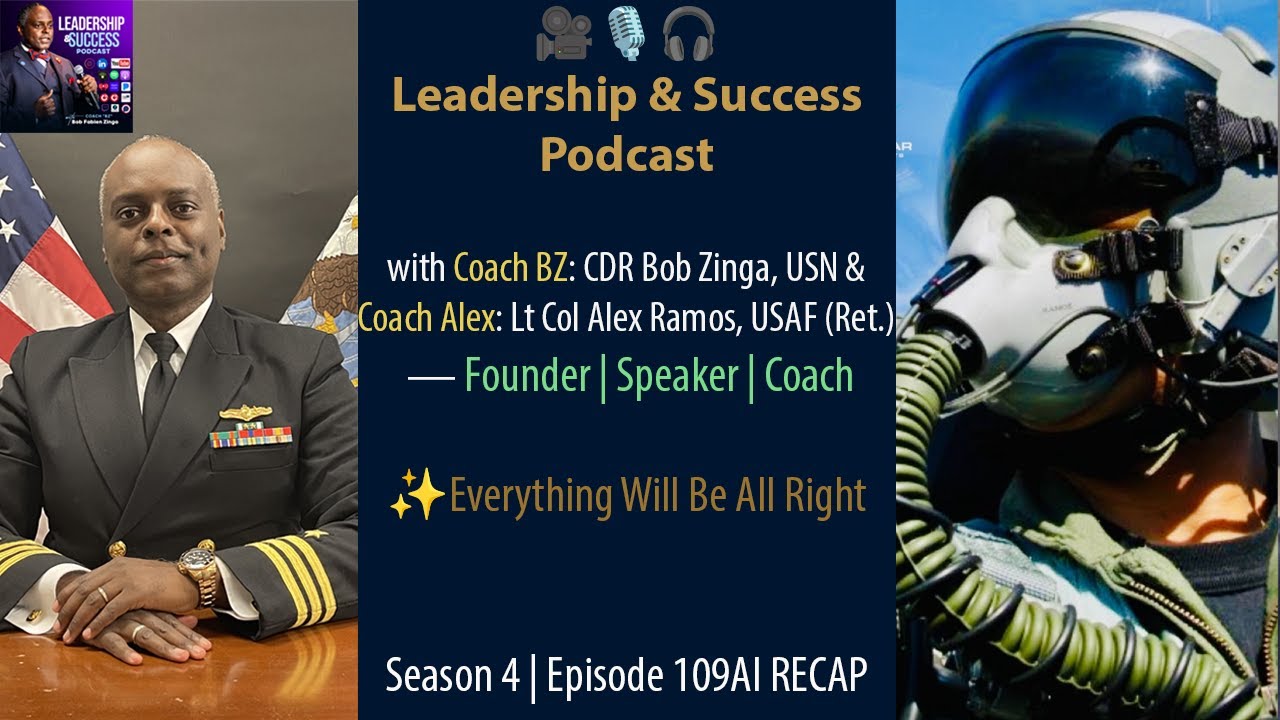
In this episode of the Leadership and Success Podcast, host Bob Fabien Zinga (Coach BZ) welcomes retired USAF Lt. Col. Alex Ramos for a deep dive into courageous leadership. The conversation weaves personal anecdotes, gratitude, and practical frameworks. Zinga opens with a reflective gratitude segment and asks Ramos what he would tell his 17‑year‑old self—"everything will be alright." The dialogue then explores emotional intelligence as the foundation of courageous leadership, emphasizing self‑awareness, meaning‑making, and the impact of emotions on behavior. Ramos introduces his "Lead Without Fear" philosophy, using the gladiator‑helmet metaphor to illustrate naming, understanding, and reframing fear rather than letting it drive decisions. Psychological safety is presented as a leader‑first practice: sharing vulnerability, modeling honesty, and rewarding truth‑telling. The episode also covers resilience built through shared struggle, the concept of "command hangover" after high‑stakes roles, and the importance of purpose‑anchored courage. Ramos explains how his background in behavioral science, physiology, and aerospace performance informs a coaching model that blends information, knowledge, experience, and physiological cues to accelerate individual and organizational growth. Throughout, the hosts intersperse calls to action—joining a 21‑day gratitude challenge, following Ramos on LinkedIn, and applying the discussed tools in everyday leadership contexts. The tone is conversational, inspirational, and instructional, with a hopeful, supportive sentiment.
Chapters
Hi, I'm John Maxwell. When the top companies in the world are looking for trainers, speakers, and coaches, there's one name that stands stands above the rest, and that's Maxwell Leadership. Our certified team members have gotten proven results for companies all over the globe, and our reputation, I'm proud to say, is second to none. Some of our members have risen to the top of their profession, including the one you're going to meet today. I proudly introduce you to my friend, Bob Fabien Zinga.
Welcome to the Leadership and Success Podcast with your host, Coach BZ, where we help you lead with purpose and succeed with impact. If you're ready to grow into the kind of leader others want to follow, this podcast is for you. If you're determined to elevate your success and leave a lasting legacy, this podcast is for you. As my mentor, Dr. John C. Maxwell, reminds us, everything rises and falls on leadership. Our goal is simple: to inspire you, challenge you, and equip you with insights that can transform the trajectory of your leadership journey. Welcome aboard to another episode of the Leadership and Success Podcast with Coach BZ.
When I think about it, I think I am really grateful for favor, right? I am really grateful for the opportunities I have had throughout my entire life, the people I have met. Some of them I will never be able to pay back. You've really made a big, big difference in my life. One question I like to ask on this podcast is, what would you tell your 17-year-old self knowing everything you know now and having had the career that you've had. And I think for me, it would be everything is going to be all right. Everything is going to work out some way, somehow. It will work out. So I am grateful for my faith and I'm grateful for my friends and I'm grateful for all of the people I have met. Like I've said before, I've really never met a stranger in my life. And I would tell to my 17-year-old self, everything is going to be all right. I would tell Simon Zinga in October 2004, everything is going be all right. I will tell Simon Zinga, actually I became, I guess I was a, a Simon recruit in 2004 and then a Simon by the end of boot camp, May 2005. I would tell Simon Zinga, May 2005, everything will be all right. And again, you know, when I become a petty officer third class, everything will be all right. And in 2007, when I become an ensign, everything will be all right. And definitely once I achieved my dream, uh, April 1st, 2021, when I finally became a senior officer in the most powerful military in the world, in the U.S. Navy, everything is going to be all right. So I don't know what you are going through right now. Everybody goes through a lot of difficult circumstances and challenges in life, but I think that faith that everything will turn out some way, somehow, in, in, uh, level of emotional intelligence. For example, where I live now in Silicon Valley, I think our IQ is completely off the chart. Too many smart people here, but emotional intelligence is definitely something we need to work on. So, what role does emotional intelligence play in courageous leadership the way you approach it?
So, when you think about emotional intelligence, really being in tune with what you're feeling and how you're feeling. Okay, what and how are we leading with that emotion? Is that emotion driving us towards an action? Is it driving us to the, to the direction that we want to go in? When I, when I think about emotion, and you mentioned Tony Robbins, and I think he's really big on this, is it the emotion that we want to focus on? Yes, okay, I have, I have feeling this particular emotion, but what is the meaning that we're attaching to the thing that's giving that triggering that emotion? And, and I think this is key when it comes to emotional intelligence. What is triggering me to feel the way that I feel? And then when I— and I would say this all the time to LTs when they say, hey, I'm just about to go teach a fighter pilot class, you know, and, and they feel intimidated. So the meaning is, I don't know enough. The meaning they attach to is like, they're going to see right through me. I've never flown in a fighter or have as many hours. I don't have this much time. I don't know what this means. So it's like, okay, the meaning is that they may be seen as incompetent, right? But if we shift the meaning and we say, well, is this— this is an opportunity to test, right, and to share vital information for them in a way that will influence them in the fight, influence them in the aircraft, and we can master those things first, right? You gain the confidence in that, correct? If you're serving and there to influence and teach the warfighter and it's about them and not about you, it changes the meaning, it changes the emotions that you feel. So emotional intelligence is the ability to have that self-awareness of what you're feeling. And my— and this is my interpretation— what meanings we attach to, to the things that are going on in our lives, and how does that, you know, how does that gap close with how we actually act? Okay, so I perceive my emotions, I know the meaning, I comprehend it, I can predict that if I walk out there angry, it's probably not going to be a good look. Okay, so, but if I go out there and I make the decision to ask questions to get more information so I can understand the issue, and then I do that, I'm sure the feedback I get is going to be a lot better.
Wow, that's really the difference between, uh, what inspired you to create, uh, Lead Without Fear, and what does it mean to raise the Gladiator helmet? I think I have a picture of you with that in your hand right there.
Yeah, so Lead Without Fear, to me, it was one of these things like, what is, what is one thing that basically prevents us, or is one of the biggest barriers in us living our mission, living our purpose? And what I found over time, to include myself, right, I'm— of course there's fears. We all have fears. It's a normal signal for survival, for thriving in certain environments. It's telling us to be aware of something. What I found over the years is that some of these fears are really about uncertainty. It's really about like not knowing what's going to happen. And because of that, I feel like I don't have control. And if I don't have control and I don't know what the outcome is going to be, then I start to go into this catastrophic, you know, thought process, if you will. Or the fear of not being promoted, the fear of not being liked. There's these fears that we create within our minds that are not— they're, they're not going to harm us physically, right? Physiologically, we have a response to it But what I found is like, let's not be afraid of these fears. Let's welcome them to the table. So lead without fear means that there's— it doesn't mean that we don't have fear. It just means that we don't allow fear to be at the forefront to lead us. We want to bring fear to the table. We want to understand it. We want to talk to it. We want to know where it's coming from. And once we begin to understand fear, the ones that we have personally, because Someone may be afraid of skydiving, but someone isn't. So understanding your individual fears and those of your team as individuals, right, or your team fears allows us to then work through them in a way where now we can coach and accelerate people through those.
Well, all right.
Today we're diving into something really powerful, the leadership philosophy of Coach Alex Ramos. Now, this is a retired Air Force Lieutenant Colonel who spent his entire life in these incredibly high-stakes situations. And trust me, his insights on how you lead without fear? They are absolute game-changers. And it all starts with this one simple idea, a message that is so profound. Coach Alex says this is the foundational truth for any leader, period. It's not just some nice, comforting phrase, you know. It's the anchor. It's what holds you steady when everything else is just chaos. But that's the real question, isn't it? I mean, how do you actually believe that when you're leading your team right through the middle of a storm? When you're staring down uncertainty or a crisis or even failure? Well, stick around, because that's exactly what we're going to unpack today. So where do we even begin? Well, the answer starts with building a mindset of resilience. But look, this is not about some kind of blind optimism, right? It's not about just pretending your problems aren't there. It's something way deeper and way more grounded. And this is the core idea he calls grounded resilience. Check out the framing here: it's the belief that whatever you're facing right now, it's gonna shape you into the person you have to become. It's not just about getting through the struggle. It's about believing that the struggle itself is actually building you. Now, for Coach Alex, this is not some academic theory he read in a book. Oh no. This mindset was literally forged in a crucible over decades of service in some of the most demanding environments you can possibly imagine. His story actually starts on Torrejón Air Base in Spain. He grew up in a proud military family. His dad served for 24 years. So that core value of service before self? Yeah, that was baked in from day one. And from that foundation, he built this incredible career. We're talking more than 20 years as a behavioral scientist and a human performance expert. He was even an aerospace physiologist, which is just a fancy way of saying he studied how the human body holds up under the most extreme flight conditions. Wild, right? And just think about who he was training with this expertise—the absolute best of the best. Fighter pilots, elite special operators, even the support aircrew for Air Force One. I mean, these are worlds where there is literally zero room for error. The pressure is just immense. And here's the really crucial insight he gained from all that: in these elite teams, trust isn't just handed to you because of your rank. Not at all. It's an outcome. It's something you earn. And how do you earn it? Through shared preparation and, maybe most importantly, shared struggle. When you train together and you struggle together, that's when real trust is built. It's forged in the fire. Okay, so how do you take all of that incredible, high-stakes experience and turn it into a framework that leaders like you and me can use today? Well, that brings us right to his core philosophy: leading without fear. Now, this next point is probably the single most important distinction we're going to talk about. Leading without fear does not mean living without fear. That's, that's just not possible. We're human. What it means is making a conscious choice that fear doesn't get to be in the driver's seat. Fear doesn't get to lead you. You do. And what kind of fears are we talking about? You know, it's usually not the big dramatic stuff. It's the quiet, internal battles. The fear of failure. The fear of speaking up, of being wrong, that nagging fear of just not being enough. These are the insidious fears that can silently poison a team's culture. So what's the game plan? How do you fight back? Well, he lays out this really clear, actionable process. First, you don't run from the fear. You actually bring it to the table. You name it, you get real about understanding it, and then—and this is the most important part—you reframe it. You change the story, and you take away its power. And he has this amazing metaphor for this. He talks about putting on a gladiator helmet. See, the helmet isn't about being invincible or certain you're going to win. It's a declaration. It's you saying, "You know what? I'm scared. I'm uncertain." 'But I'm showing up anyway.' You're stepping into that arena. Okay, so that's the internal work you do on yourself. But what about your team? How do you create an environment where they feel safe enough to do the same? Well, this is where two huge concepts come into play: psychological safety and emotional intelligence, or EQ. And the principle here is incredibly simple but so powerful: the leader has to go first. You can't just create psychological safety with a memo or some corporate slogan on the wall. It happens when the person in charge is are actually willing to be vulnerable, to talk about their own challenges and their own mistakes. So what does that actually look like day to day? Well, it means sharing your own mistakes. It means modeling what vulnerability looks like. It's about creating real space for dialogue, not just waiting for the annual review. And here's a big one: you have to reward people for telling the truth, especially when that truth is hard to hear. It's all about making emotional honesty the norm, not the exception. Okay, let's switch gears to emotional intelligence, or EQ. Coach Alex has this really powerful way of looking at it. He says it isn't just about managing your emotions; it's about the meaning you attach to a situation. It's about the story you tell yourself, because that story is what creates the emotion in the first place. And this is the chain reaction right here: if you can find a new, more empowering meaning, that creates a new emotion. That new emotion drives a new behavior. And guess what? That new behavior gets you a totally new outcome. This, this is the secret sauce. This is how great leaders turn a massive obstacle into a huge opportunity. Alright, we're gonna shift gears now and get into what might be the most important part of this whole philosophy. We're talking about the leader's heart. We're talking about the personal cost of leadership and where real, true strength actually comes from. Coach Alex talks really openly about something that a lot of leaders go through but almost nobody talks about. He calls it "command hangover." You know that feeling? It's that deep loss of identity you feel after you leave a big role that's defined you for so long. It's such a powerful reminder that your identity has to be bigger than your job title. You know, in our culture, leaders are so often taught to just be tough, to be stoic, to handle it all themselves. And that's why this next idea is such a radical game-changer. He says the most courageous thing you can do as a leader isn't to just push through it all alone. It's to raise your hand and say, "I need help." But he doesn't stop there. He follows it up with this incredibly practical piece of advice: Don't wait until you're in the middle of a crisis to figure out who you're going to call. Know who your help is before you need it. Build that network—your mentors, your friends, your counselors. Build it now so when the storm inevitably hits, they're already there. Think of it like this: proactive mental fitness is mission readiness. So, that brings us right back to the beginning. It all comes down to action. After everything we've just talked about, from reframing your fear to building your support system, I want you to think about this: What's one courageous action you can take, today, right now? The answer is gonna be different for every single one of us, but the opportunity to start leading without fear, that starts now.
Welcome to our Leadership and Success conversation. We're diving into a discussion on courageous leadership, resilience, and what it really means to lead without fear.
Absolutely. It's such a powerful topic. What stands out immediately is that core message, everything is going to be alright.
Right, exactly! That simple phrase, "Everything is going to be alright," anchors this idea of resilience. It's not about ignoring the tough battles but about trusting that every challenge is building you up for the future.
Mm-hmm, and it's fascinating how that mindset is born from a lifetime of experience. Coach Alex, whose journey from Torrejón Air Base to leading elite teams in the Air Force reminds us that our struggles whether in combat or in our daily lives, shape us. Right?
And it's, um, it's like his life story itself is a masterclass in how, uh, how preparation and shared struggle build trust and precision. He often emphasizes that elite operators develop trust through intense training together. Exactly.
And that idea really resonates outside the military too. In our work environments, in tech, in startups, It's all about building that trust through accountability and shared experiences.
Mm-hmm. For sure. And speaking of trust, he reminds us that it isn't, um, something magically given because of a title or rank. It's earned. I mean, you see it when he talks about how precision and consistent preparation bind a team together. True.
Although I have to challenge that a bit. But wait, don't you think sometimes the structure or hierarchy helps create that trust too? I mean, people sometimes look to authority for guidance.
That's a fair point, but Coach Alex argues that while hierarchy can set the stage, it's really the shared struggles and honest debriefs that build the deeper connection. It's like if you rely solely on your position without consistent effort, then trust might falter.
Yep, right. And his approach of lead without fear is a reminder that fear itself shouldn't dictate our decisions. Instead, we must name our fears, understand them, and reframe them as opportunities to grow.
Exactly. It's not about erasing fear, but keeping it from making choices for you. And you know, it's like, um, his gladiator helmet symbol really drives that point home. Showing up regardless of uncertainty.
Yeah, and that symbolism works on so many levels, both personal and professional. It's like a declaration to face challenges head-on, even when you're feeling unprepared. Precisely.
He takes a very holistic approach, combining emotional intelligence with practical tools. It's a philosophy where empathy, accountability, And willingness to share your vulnerabilities, like admitting mistakes, set the tone for a strong and safe environment.
And speaking of vulnerability, he really stresses that psychological safety begins when leaders share their own challenges. When a leader admits, "I have fears too," it opens up the floor for others to be candid too.
Absolutely. That's one of his most practical lessons. We see that in his recounting of personal losses and the deep reflections on Command Hangover. It's a stark reminder that even at the highest levels, loss and identity struggles are part of the journey.
Yeah, it's quite moving. Losing friends in high-stakes missions, the weight of survivor guilt— they're real challenges. And his advice that seeking help is the most courageous step truly breaks the stigma around vulnerability.
Exactly, right. And that discussion naturally leads us into how he applies emotional intelligence. It's like understanding the meaning of your emotions can really reshape how you act. You assess a moment, say, 'I'm not good enough,' then reframe that into 'I'm here to lead and protect,' which changes the outcome.
Mm-hmm. I love that analogy. It's a really transformative way to look at setbacks. And the idea that pressure is a necessary ingredient for growth, where pressure is what forges resilience, really adds to the narrative that leaders mature in the crucible of challenges.
Absolutely. Pressure isn't about breaking you, it's about making you. And his lesson that information, knowledge, and experience must align to build sound judgment is a call for continuous learning. It's as if he's saying, um, never stop evolving, because our mission and our identity are always in flux.
And that ties so neatly into the legacy aspect. I mean, his take on legacy, where leadership is measured not by accolades but by the lives you impact, is as profound as it is practical. It pushes us to think beyond just titles. For sure. Exactly.
And even his final reflection is so moving. When asked what he would tell his 17-year-old self, his answer was that everything is going to be all right. Which circles back to our overarching theme of hope and resilience.
Yep, that full-circle moment is what gives this discussion its emotional depth. It's like he's not just talking strategy; he's offering comfort and encouragement, reminding us that our current struggles are, in fact, molding us for a better future.
Certainly, it's also a call to action for all leaders out there to be brave, be kind, and be strong. Whether in the military, tech, or any high-pressure environment, these principles hold true.
And let's not forget the practical side, like debriefing honestly, owning mistakes, and continuously learning from them. That's the kind of transparency that elevates team performance. Exactly.
And speaking of practical applications, his advice to know who the help is before you need it is such a grounded approach. It's like saying, um, prepare both mentally and relationally for the tough times so you're not left scrambling.
Yeah, right. That advice resonates with everyone, not just leaders in high-stakes environments. Even in everyday life, having a support system and being willing to lean on it is crucial.
And then there's that incredible emphasis on purpose. His narrative is a reminder that when your actions are anchored in purpose, fear loses its power. Purpose fuels courage, and courage, in turn, enables lasting impact. Mm-hmm, precisely.
It's like purpose acts as a compass that aligns all decisions, especially when you're amid chaos or uncertainty. And I just love how he ties it back to his personal values. Service before self, character above all. Right.
And he even brings in these timeless principles, drawing on Stoic wisdom like, "We often suffer more in imagination than in reality," to illustrate that our fears sometimes are bigger in our minds than in truth. Yeah.
So when we look at all these layers, from military rigor and precision to the heart of leading with empathy and courage, It really paints a picture of leadership that is both tough and tender.
Absolutely. And one more thought. Leadership, as Coach Alex puts it, isn't just about the mission. It's about legacy. It's about the everyday moments, like taking your daughter to school, where you live your values.
I love that. Those moments remind us that no matter how epic our challenges are in the field or boardroom, the heart of leadership is connection and love.
Yes, that's the beauty of it. In the end, it's a blend of courage, resilience, purpose, and above all, humanity. You lead by showing up, by admitting your fears, and by building trust through your actions.
Mm-hmm. And that comprehensive approach is what makes Coach Alex's teaching so transformational. It's more than just leadership in theory; it's about living it every single day.
Exactly, and by embracing these principles, every leader, no matter where they are in their journey, can create a legacy that outlasts the challenges of today.
Yeah, I guess the takeaway is that resilience, vulnerability, and continuous growth are the cornerstones of impactful leadership. And it starts with the simple but powerful belief: everything is going to be alright.
Spot on! And as we wrap up this discussion, remember that leadership is about being present for the struggles and the triumphs alike. The courage to lead, even when you're scared, builds not just strong teams but also enduring legacies. Absolutely.
It's an inspiring call to action. When challenges come, lean into them, learn, and lead with your whole heart.
Well said. And for anyone listening, Carry that message into your day. Embrace the setbacks as stepping stones to a brighter, bolder future.
Mm-hmm. Thanks for this enriching conversation. Remember, be brave, be strong, and be kind. Everything will be alright.
But that courage, if it's anchored in purpose, like it's meaningful, yes, then it gives you that more kind of empowerment and ability to go forth and actually do it.
Hm, that is really, really powerful. Another interesting thing about your background, what you've combined behavioral science, physiology, and leadership development. So how do these disciplines intersect in your coaching today?
So all, all of these intersect because what, what I find interesting in, in behavioral science, it was a lot of data collection, right? So for, I'll give you an example. Whenever you're gonna make a decision or a judgment call, and we, and we talk this in our coaching sessions too, is there's 3 things you wanna have. You wanna have information, you wanna have knowledge and experience. And maybe we don't have all 3, maybe we only have 2, maybe we only have 1. But if we have the right information in a way that is displayed where we can comprehend it and we have the knowledge to then comprehend it, know what it means to us, what it means to the organization, and then we can actually have experience sometimes, like for example, you have experience. I'm sure people still call you and go, hey Coach BZ, Hey, I'm having this challenge, you know, and you were a mentor of mine and I want to know what you think. Because of your experience, you can share some thoughts with them, right? So before we make that judgment call, that decision, it's important to have information, knowledge, and experience. So that's like that mental aspect of things. And then I also found the physiological responses. So, you know, let's say you're speaking with somebody, you're working with somebody, you can kind of notice they're nervous, okay? They're twitching a little bit, their expressions. So we get real in tune with the physiology, what's happening in the mind that's creating this physiological response. And whether, whether it be coaching, or you're just speaking to somebody, or even raising your kids for that matter, then we can get to that level and start to work with them through that. So the behavioral science, the physiology all works together, and figuring out how do we accelerate and move forward, whether it be the individual or the organization as a whole.
That is a All right, so that was Coach Alex Ramos, right? So this is Season 4, Episode 109. So I would like for you guys to please go ahead and watch the entire episode. I just showed you a few clips, hopefully to entice you to do so, and I gave you the 10-minute artificial intelligence summary today. And there is a chance Coach Alex might be able to join us later today. And if it does, we are going to go live and kind of talk about this 3 to 5 takeaway from the hour-long leadership conversation we had a couple of weeks ago. So I'm also going to let you know that tomorrow I was going to do a 10-minute AI recap of this episode with Coach Divya Smith, but she actually wants to be here, which is great. It was supposed to be Episode 110, but we are gonna postpone that to Monday when she is available. Therefore, tomorrow we're gonna have the 10-minute AI recap of the conversation I had with Captain Shannon Huffman Paulson, leadership, grit, and purpose. She's the author of The Grit Factor. So we had an hour-long leadership conversation a couple of weeks ago, and tomorrow we're gonna have a 10-minute AI recap. And then on Sunday, We are going to have a 10 Minute AI Recap with a conversation I had with the one and only Dominique West, cybersecurity leader, inclusive innovator, and mentor, breaking barriers in cybersecurity. She's definitely a future cybersecurity executive, and people better watch out. So we're going to have the 10 Minute AI Recap on Sunday. And then on Monday, I will have finally the 10 Minute AI Recap of Season 4, Episode 110 with Coach Divya Smith. And she will be present and she's going to talk to you about 3, 4, 5 takeaway from that episode. Now, oh, looks like Coach Alex is here. He says, thank you for taking the time to bring A Time Together to life. Your podcast is tremendous resource for all of us and it was an honor to be part of your mission. Thank you so much. So Coach Alex, you may not be available now, but if you are, I did send you the link to the podcast Green Room. And Coach Alex says, I am grateful to be in the car line at my daughter's school, excited to see your smile and enjoy the weekend. Outstanding. Yes, family, family first. Thank you. Thank you so much for letting us know. This is really tremendous. I really wouldn't have expected or even dreamed of one day being able to have such illustrious guests and being able to interact with my audience live the way we are now thanks to the power of technology. Now, like I've said many times, the first time I did my podcast, season 1, episode 1, 4 years ago, I was the one and only person in the audience. Okay, I'm now going to share my screen. We have our 21 Days Grateful Challenge, so we are on day number 9. So I've double-checked that. Sorry, yesterday I said we were on day number 7, but it was actually 8. So today's day number 9, 9 of 21. And before I do, Again, I want everybody to please follow Coach Alex Ramos, and you can easily find him on LinkedIn, which is linkedin.com in Coach Alex Ramos. Very easy. And I also want you to go ahead and follow him on this website as well, coachalexramos.com. Very easy to find. Uh, really, really a tremendous leader, and he has a lot of great programs for you guys to sign up. So now what I'm gonna do is I'm gonna go to the wheel. Uh, okay, Wheel of Names, here we go. So we are gonna go to the Wheel of Names and I am going to select someone only in my network who is going to be the person I will challenge today on day 9 of the 21-day grateful challenge. So the way this works, like I said earlier today, I am really grateful for favor, right? I believe there is something, there is someone who's greater than me who's really ensuring that everything works out some way, somehow, in for that grace. So many times in my life, I felt like my back was against the wall, and I felt like, no, it would be the end to be able to make it. But some way, somehow, I always found a way to make it. Coach Alex said he would tell his 17-year-old self everything will be all right. And I said, without knowing it, when I started the show, Season 4, Episode 109, that I was really grateful that if I had to answer the same question, I would tell my 17-year-old self everything will be all right. Because sometimes in life things happen and you feel like it's the end of the world, the world is upside down. And you don't see a way out, but, uh, no, keep the faith, keep hope alive, because I do believe everything will be all right. So now let's see who is going to be the person I am going to challenge today on day 9 of my 21-day grateful, um, it's like, uh, today's lucky is founder and CEO of Avenio AI. And we first connected on January 7th, 2023, so a couple of years ago. And let's see what AJ looks like. I'm gonna copy his LinkedIn profile here. And AJ, so this is me, your connection, Bob Fabien Zinga, challenging you to accept the 21 Days Grateful Challenge. If you do accept the challenge, what that means is starting today, you are going to create a post on LinkedIn every day for the next 21 days where you are going to be grateful for one thing every single day. And each day we want you to select someone from your sphere of influence, your followers. According to LinkedIn, you have 10,390. So you're going to select 21 of them, one each day to accept the challenge as well. And I really hope you accept the challenge and you are like me in the San Francisco Bay Area. So maybe one day soon we can meet for coffee or something. Again, AJ Jotwani, I am challenging you to accept the 21 Days Grateful Challenge today on LinkedIn. All right, thank you so much. All right, we're gonna bring the show to an end. And what I will do is I am going to play one more clip from the leadership conversation I had with Coach Alex Ramos, and that's going to be the end of the English version. And because Coach Alex Ramos was born in Spain, and he speaks Spanish fluently. Right after this show, I'm going to start another one that's going to be completely in español. So, uh, hopefully, uh, Coach Ramos is going to be back from school and maybe he can join us for just 5 minutes for that show in Spanish. And, uh, so that's what's going to happen next, right after this. Bye for now.
Say, hey, what are your fears? Because sometimes people don't want to admit it. But when you get to know your people and you talk to your people, they'll subtly— you can see these subtle hints as to what they're afraid of. So for example, you know, maybe someone didn't come to your office or, you know, didn't talk to you about a particular challenge they were having because they were afraid that maybe you would see them as incompetent. But you share a story about yourself. Hey, I just want everybody to know that I've been there. I was raised through the ranks and I've had some experiences. They're not the exact same experience as you, But I want you to know that these challenges really pushed my limit mentally and physically. And this is how I was able to overcome them. And these are the people that helped me overcome those fears. And so, you open up by talking about yourself first. Opening that dialogue creates that psychological safety that says, well, if he was okay sharing it with someone and that someone helped him through it, maybe this person can help me do it. You just shared Dare to Lead. That's so— I'll give you a true— so here's an interesting that actually goes along with this question. It's the perfect timing. BZ, you're Coach BZ on point. Okay. Precision, accuracy. So, when you think about it, I had a group commander and I was a squadron commander at the time. And I said, how do I bring this up to the Colonel? What am I going to do? And I was reading Dare to Lead at the time. And in there, Brené Brown talks about rumble, how to rumble with your boss. And essentially you go into your boss and you say, hey, I'm having this challenge. I'm feeling a certain way about it. Is it okay if I talk about it? Just kind of let you know what I'm thinking. And then once I explain it to you of what I'm feeling, what I'm thinking, if you could share your thoughts on that. Okay. And so I said, what do I have to lose if I don't say anything? The status quo stays the same, right? My people are going to, you know, maybe not feel like we did the very best for them. So how can we, how can we do it? So I'll go into the office, I sit down, I talk to her, I tell her about the Rumble, how to, you know, how this process. I'm just having to be reading this book, Dare to Lead, and I'd like to try this if it's okay with you, ma'am. And she allowed it. So good on her to allow that, right? That creates psychological safety. And sure enough, I was able to explain myself and talk to her about it. She said her piece. And next, you know, it actually was able to change some of the things that we were asking for. Wow! So that's how you create that psychological safety. You have to have the courage, right? The courage to go in there and to do the things you need to do.
Thank you for tuning in to the Leadership and Success Podcast with your host, Coach BZ. If today's episode added value to your leadership journey, be sure to subscribe, share, and join us again for more wisdom nuggets on how to lead better and achieve greater success. Remember, leadership is the most critical skill of our time. The world will always need leaders to inspire others, drive innovation, and execute meaningful strategy. So why not count yourself among the bold leaders shaping the 21st century? Until next time, stay inspired, stay committed, and keep leading with excellence.
More from Bob

S250:E4🎙️LIVE 🇺🇸America 250: President Barack Obama Leadership, Service, and the Power of Hope






S5:E157🎙️ LIVE with CMD CMSgt Dennis L. Fritz, USAF (Ret.)(Multi Tracks Audio)



S5:E156🎙️ LIVE 🇪🇸 Leadership Lessons from the FIFA World Cup 2026 Champions (Multi Tracks Audio)

S250:E3🎙️ LIVE Leadership Lessons from America’s First Documented Family of African Descent 🇺🇸📖