S4:E111🎙️ LIVE with CPT Shannon Huffman Polson (Multi Tracks Audio)
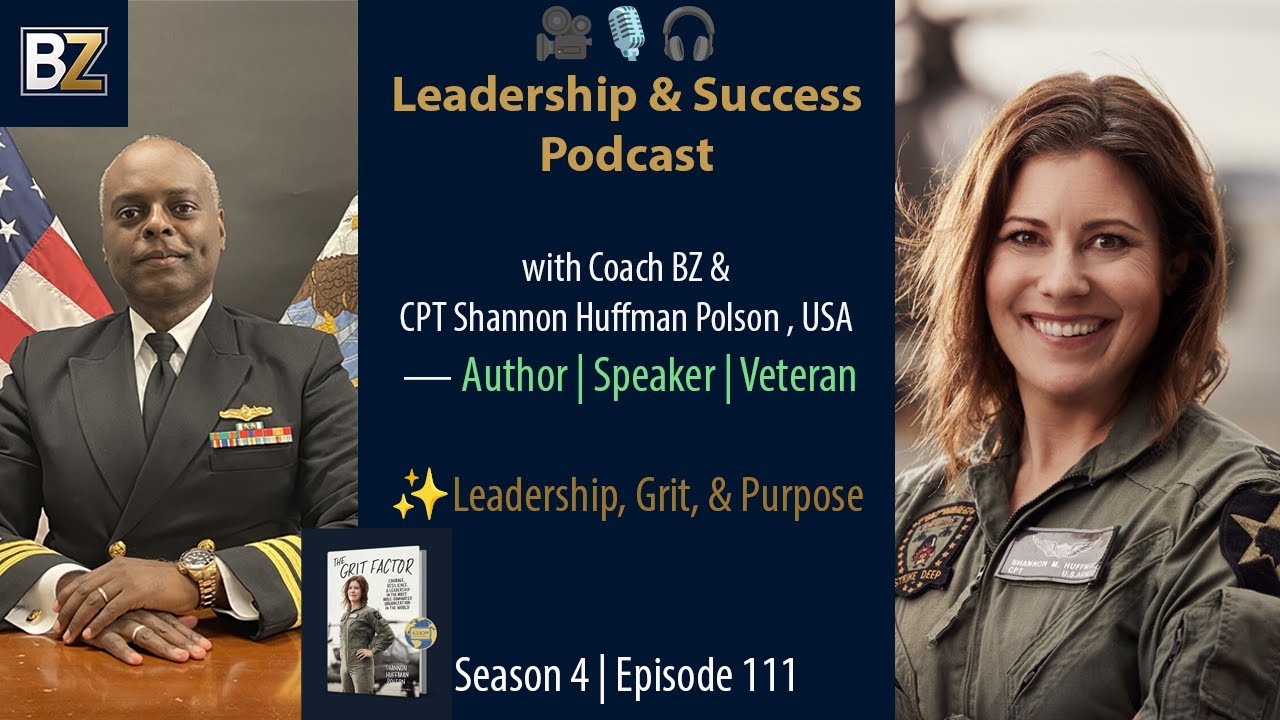
CPT Shannon Huffman Polson, the only woman among 120 Apache pilots, talks about her Grit Factor framework: Commit, Learn, Launch. She shares stories from Bosnia and Fort Bragg, and explains how courage, breathing exercises, and small wins build resilience for leaders in high-pressure roles.
Chapters
When the top companies in the world are looking for trainers, speakers, and coaches, there's one name that stands above the rest, and that's Maxwell Leadership. Our certified team members have gotten proven results for companies all over the globe, and our reputation, I'm proud to say, is second to none. Some of our members have risen to the top of their profession, including the one you're going to meet today. I proudly introduce you to my friend Bob Fabien Zinga.
Welcome to the Leadership and Success Podcast with your host, Coach BZ, where we help you lead with purpose and succeed with impact. If you're ready to grow into the kind of leader others want to follow, this podcast is for you. If you're determined to elevate your success and leave a lasting legacy, this podcast is for you. As my mentor, Dr. John C. Maxwell, reminds us, everything rises and falls on leadership. Our goal is simple: to inspire you, challenge you, and equip you with insights that can transform the trajectory of your leadership journey. Welcome aboard. Welcome to another episode of the Leadership and Success Podcast with Coach BZ.
If you're ready to grow into the kind of leader others want to follow, Well, I think I am just so excited to see her today, but we are going to be really learning today about how to build unstoppable grids in high-pressure high visibility role. And I think what she really did in the Army was really under a lot of pressure. And also she was leading in a world, you know, let's be frank, really made for men, not women. So from the cockpit to corporate leadership, it is really just outstanding. We're going to be talking about leadership through adversity, what Shannon learned as the only woman among 120 Apache pilots in her regiment, and purpose as the leader through North and why it matters now more than ever before. So, Lessons from the Great Factor, our bestselling book, and you can apply those lessons today as a junior officer or a Silicon Valley senior engineer. And our purpose, storytelling and vulnerability, strength and culture, trust and mission readiness. We're also gonna give you the opportunity to sign up for our course about really leading with purpose, right? Why Commit, Learn and Launch is the Most Important Leadership Formula for 2026 and Beyond.. And we're gonna be talking about Shannon's powerful insights for veterans transitioning into business, tech, and entrepreneurship. So I am so overjoyed and excited. Please help me welcome Shannon Huffman Paulson, everyone. All right, Shannon, how are you doing today?
I'm doing great. How are you, Coach Fousey?
Fantastic. Good afternoon and thank you. Thanks so much for, for being here. I was excited to have you here. I actually lost my line of thought trying to introduce you. But maybe to get started, can you let us know, is there one thing that you are grateful for today?
I'm very grateful to have the opportunity to talk with you and with your audience. I'm also grateful for good health. I'm grateful for a gorgeous day outside. And I think it's a good day to be alive.
Absolutely. And I think good health really means everything because I think most people take it for granted until they are no longer in good health. But yeah, thank you so much. That is, that is so important. Is there maybe something about you that most people may not know about?
Well, you and I were talking a little bit before we came live about music, and I started playing the piano a very long time ago, um, when I was just about 3 years old, and have been engaged with music ever since in my life, in classical choral performance as well as, um, various other pursuits that relate sometimes to church, sometimes to semi-professional choirs. So music's been a big part of my life.
Well, that is, that is really wonderful. Yeah, I always like to ask people I interview about songs and music they recommend because I think it's universal. And most of the time, whatever people go through in their lives, those milestones, there's usually a soundtrack attached to it, or music that helps them go through very difficult times. So thank you, thank you so much. So I guess to get Started. Can you let us know about your leadership journey, how you came to become one of the very first female Apache pilots in the U.S. Army? That's so wonderful.
Well, it's all a matter of timing. As you know, I was an ROTC cadet at Duke University and I chose the Army, BZ, because they let me major in the humanities. And I love to write and I love to read. And the Air Force and the Navy would have made me be an engineer. So I chose the Army. Simply because of the humanities major, although it ended up being a great journey. So I graduated in 1993, and that is when combat exclusion was lifted for aviation for women, as you know. And so I had the opportunity then to show up at the initial entry rotary wing and officer basic course at Fort Rucker, Alabama, and ultimately, you know, earned the opportunity to ask for and be trained in the Apache helicopter. So that was the beginning of what would be about 8 years on active duty on 3 different continents and then transitioning. From there into my— through my MBA into the corporate world.
That is, that is really something. I know most military men I've ever met, officers or enlisted, we all dreamed— most of us, not all of it, but most of us— to become top, top gun, just like in the movie. But I guess it was a little bit different for you then. Wow. But did you actually select the Apache aircraft, or was that, uh, Voluntarily?
I did request it. Yeah, we had the opportunity to go through all of the different assessments and then make the request. And I did ultimately request the Apache helicopter and so was really grateful for the opportunity to fly it. It's a phenomenal machine, absolutely phenomenal machine for sure.
Man, so what moment or influence first sparked your desire to specifically fly the Apache?
That's a great question. And nobody's actually really asked me that. You know, when I was at flight school, I remember talking and you'll have to forgive my camera here is a little bit slow today, but I, the, uh, there was a cadre in officer basic course who had been part of an attack helicopter unit, and I remember they had just opened it up to women. And I remember talking to him at one particular occasion, and he remembered this launch where the whole company was launching and all the crew chiefs were lined up against the hangar doors because of course the Apache is this tandem-seated aircraft, so the crew chiefs don't get to fly it. But all of the crew were lined up against the door, and there was just this sense of, of real pride and real ownership and real connection among the various parts of the team that were part of making the mission happen. And I remember him telling me about that and saying, you know, it's really the most— it's the most amazing mission, the most amazing aircraft. And from there on out, I was sold.
That is really, really, really fabulous. I especially like, you know, interviewing women and minorities because I feel like representation really does matter. There was a very long time in this country where women weren't allowed to join the military. Black people weren't allowed ever. But it is really good to see women like you, if I may say so, kicking ass and taking names and really doing things that just 50, 70, 80 years ago were unimaginable. And I am married and I have two daughters. I usually joke, if it wasn't for my dog, Shaggy, I would be the only male in this household. But anyway, I am always looking for women to be role models for for my kids because I tell them you can pretty much do anything you set your mind to. Your gender shouldn't limit your life at all, especially in America, the greatest country in the world. So I am really, really grateful for your experience and your books and the way you've lived your life and how you show up. I think that's really important and we need to see that more and more.
And Bizzy, you know, I mean, you know, for our military, which I agree with you is the best military in the world, we need the the best people to have the opportunity to give their best selves to the military. And we need to be very sure that we don't go backward on that because that's— we need the best and the best comes from our entire population. So I was really proud to be one of those. And I think we need to make sure we keep those channels open so that we continue to have— we can make the mission right.
Amen to that. I mean, that just makes way, way too much sense. So Let me know then, what did courage look like for you as one of the only women entering attack aviation at that time?
Yeah, I, you know, I will say it was definitely a, it was definitely not what I had expected to go from, of course, the schoolhouse. The schoolhouse is always a much easier environment, I think, to go from that into the operational units. And I was lucky to work with a number of really outstanding people and outstanding leaders, but it's it's always a bell curve. So I think courage meant sometimes just showing up every day with a smile. And, and I kind of think of it as like the blinders on a horse, right? If there's challenges or resistance or pushback, as you just keep focused on doing a really excellent job. And that's what courage meant most of the time.
That is powerful. So when you arrive at Fort Bragg as the only woman among 120 Apache pilots, what was going through your mind? On day one?
On day one, I wanted there to be no excuse for anybody to say that I shouldn't be there. And I remember I had my hair cut. I had it buzzed up the back. Not my— not a great look, but, you know, it was all right. And so I had my hair cut short. I made sure I maxed the PT test. I wanted to have absolutely no reason for anyone to have an argument that I shouldn't be there and that I wasn't doing the same job at least as well or better than anyone else who was there. And it was just sort of this kind of focused determination that I was going to be excellent. And, um, and, you know, I, I, I don't say I regret— I look at some of those perspectives a lot differently now, but that's— that, that was day one.
That is really something. Well, you teach that the world, uh, well, to be— before I ask the question, in my opinion, having been in the Navy for 21 years now, I really believe the military is a leadership organization. We just happen to have a bunch of hardware. But, uh, because even at the lowest level, even when I was just a seaman recruit, E-1, lowest rank in the military, I still felt like the Navy was preparing me to lead even at that level. So you teach that, uh, you teach the world that grit is equal to commit, learn, and launch. Can you break that down for leaders hearing it for the first time?
Yeah, absolutely. So I wrote The Grit Factor at, uh, not really the request of, but because a young lieutenant reached out to me and asked if I would mentor her through the the same journey that I had taken a number of years before. And I went back and interviewed dozens of leaders in the vanguards of their fields. They are admirals and generals and one of the first women Coast Guard rescue swimmers and one of the first women Army Rangers and many, many more. So it's not just my experience and it's not just the research, but then went into the secondary research as well. And what came out of that research, what came out of that work was a framework that I call the grit triad. And it's commit, learn, and launch. It's the 3 parts of the book, The Grit Factor. And the commit phase is really owning our past. That's that's doing some pretty deep work on our own stories and connecting to core purpose. The next phase is Learn. Learn is about deep engagement in the present, and that's building our teams and supporting our teams. That is the art and the science of active listening, which turns out to be one of the most strategic things that we can develop and continue to work on for ourselves and our teams. And then the mindset of grit and resilience, and that, that really has expanded since then as well. And then that last phase is That last leg is launch, and launch is grounded in the past, deeply engaged in the present, and looking towards the future with audacity. So the willingness to take risks and face failure and get back up after those failures with authenticity, showing up in accordance with our values. That's what authenticity is about, not about what color our hair is, you know, or not. And then ultimately adaptability, the ability to adapt to changing circumstance, which we're seeing more and more as, as really a critical skill. So commit, learn, and launch is the grit triad. Very much outlined in The Grit Factor. And then we go deeper into it at the Grit Institute as well.
That is so powerful. So what do you think is the biggest misconception people have about grit?
I think the biggest misconception is that it's just this, that it's just about gutting through or gritting your teeth. And, you know, there's definitely times when that's the case. There's no question about it. But it's a much bigger thing. It's a much bigger muscle. It's a much more complex muscle that I really think of as part of kind of the content of our character. It's a much more holistic sort of an expression than we often give it credit for. So if you think of it as just gutting through, it's an easy thing to dismiss. It has been dismissed and sort of castigated as like, well, we shouldn't be about grit, we should be about, you know, equality or whatever. And all of those things, it's kind of a both/and answer. But grit is a really complex and nuanced thing, and we have to think of it that way in order to be successful.
Wow. And you talk about courage a lot too throughout all of your work. Yes. I used to think courage was the absence of fear, but that's actually not true, right? Because it's really moving forward in spite of fear. So I guess my question for you is, how do you teach leaders to move forward with fear?
Oh, wow. That's a great question. So one of the things that we talk about is that courage encourages that moving through things, you know, even when you are afraid. And that is the audacity part. So you do have to do that initial work first, that commit phase work of understanding your story and then owning your purpose, right? That is going to give you the foundation to be able to navigate any kind of turbulence. That's the key critical work for any leader to do before they're ready to lead. That next leg goes into courage as well, because that's building your team, right? Or supporting your team. Your team is going to help you through this, and active listening and mindset will all be part of it as well. But that audacity piece, that willingness to face failure, to take on challenges, to push yourself beyond your limits. There are a lot of ways to practice that, and you don't have to start with taking, um, you know, with climbing the highest mountain. You can start by training on some hills, and you can also start by riding your bike. So doing hard things makes you better at doing hard things. We know that, right? Neuroscience teaches us this as well. The amazing thing is, is that if we're stuck in one part of our life, if we do something hard and push through a barrier in another part of our life, We can borrow that strength for the place where we're stuck. And so that's a really great way that I will sometimes work with leaders to say, okay, if you're feeling like you can't get through here and if there's not even a small step you can take, which is always the first step should be a small step, then let's do something over here first. Build that courage muscle and then borrow that for the place where you're stuck. And then we'll see if we can break down that big leap that you're trying to make into some smaller leaps. So that that courage can be applied at a smaller level and then continue to build on itself.
Well, that is so powerful. You just reminded me of Admiral William McRaven, right? Make your bed, like one simple thing you can do every single day. And it gives you that sense of accomplishment and you feel like you can do something else worthwhile for the day. That's really powerful because I think when I was a junior officer, I used to think, oh man, I guess it's paralysis by analysis, right? You feel like you have so much to do, you don't know where to start. And it really makes such a big difference when you can start with something small, something right in front of you, and kind of start to build momentum.
Absolutely.
Absolutely. So when you talk about grit and resilience, what is one practice leaders can start today to strengthen personal resilience?
Yeah, that, you know, we often will start, and then some of the free training that I'll offer at times, we'll do some of these very seemingly basic things, and it can be as simple as taking a break and working on an exercise that is a breathing exercise, right? I mean, this is literally part of the positive psychology work that goes into the Army's Master Resilience Training program, but it's literally just doing the work of, for example, box breathing and, and, and recognizing your own resistance to taking that time to slow down and that time to do that breathwork. But it's literally a practice that if you integrate that into your daily routine and your daily work and the places where you get stuck and the places where you get, get triggered or get charged, it's an incredibly powerful, simple, basic tactic that, that will, that will reap incredible dividends. So if I were just to say start with something very, very simple, that would be one. Another very simple but powerful practice you started us off with today, which is the gratitude practice, right? And the psychology on that is very evident as well. I think all of our ancient wisdom traditions teach us the same thing, that when we teach ourselves to be grateful, we are able to push through harder things. It's just the case. But you do have to make that a practice to be able to realize the results.
Wow, that is quite insightful. So let's— I guess I'm going to call this portion Apache leadership. What leadership lesson from the Apache cockpit translates directly to the boardroom? Because now you've gone from being a military vet to now corporate America and doing extremely well. What, what type of leadership lesson you think translates across both industries?
I love to give the credit to this, to my first battalion commander, whose name is John McDonald. He's out there somewhere. And he ended up, I think, as General McDonald before he ultimately retired, as well as his wife. And I remember when he promoted me to first lieutenant, and this was, you know, very early on in these, in these years in the military. I remember him saying, the only good use of any increased power that you will ever have is the increased responsibility to take care of your people.
Wow.
And, and I say that in any keynote that I give to any organization at any level, because that is something that is often forgotten, but, but is most needed in literally any environment. And when people talk about leading in the age of AI, leading in high-tech organizations, the thing that is oftentimes most missing is this simple thing of taking care of your people. And taking care of your people sometimes means tough love. It means lots of things, but it does mean putting them first, enabling them to be their best selves, to contribute their best to the mission at hand. And I'm really grateful for that. I— there is, there is no lesson I think that is more important that comes from the military, better translated to the corporate environment, or really literally any kind of other environment as well.
Well, say that one more time. That is really, really powerful. I think for those of the people listening right now, this is really the reason to listen to you. Say that one more time.
Well, and again, I want to give full credit to my first battalion commander, right? But the only good use of any increased power that you will ever have is the increased responsibility to take care of your people. We would always say it's mission first, people always, right? But People take care of the mission. And I will say in the Apache, again, that's challenging because when we fly, we do the cool, sexy aviation stuff, right? There's two of us in the cockpit. There's only two of us. There's not the crew chiefs. There's not all the maintenance guys. And so in order to make that happen, to make that taking care of people piece happen, you really have to make sure that you're getting out of the pilot lounge, right? You're getting out of company operations and you're spending time with the crew chiefs down in maintenance, understanding them, getting to know them. Understanding how do I help this person be their best self so they can give their best self. And you've got to know them and love them to do that.
That is quite powerful. Now, from your day flying Apaches, what is one story, and class, of course, from Bosnia or Korea that changed the way you lead today?
Oh, that changed the way I lead. That's a very different one. I like to, you know, it's fun to tell those fun stories about, about hostile weapon systems and things. But that's— but those honestly don't apply much outside of aviation too much. Although, you know, I'm going to give one example just to give that one because it's sort of fun to tell anyway. When we were flying in Bosnia, it was very early on and we were part of the stabilization force. We were there as part of the Dayton Peace Accords with NATO. And the mission that we had in Bosnia in 1997 was to do armed aerial reconnaissance in support of these Dayton Peace Accords. So we would fly out in teams of two and we would do reconnaissance of weapons storage sites, the Serbian heavy weapons storage sites, usually at night, of course. You know, we fly under infrared, very easy navigation. If it's a heavy weapons storage site, that means it has to drive on a road, which means the navigation is very simple. I remember the FLIR was beautiful, that forward-looking infrared on the Apache. And I remember we also had this additional requirement because we had arrived as part of the stabilization force and not the initial force. We had a hard deck of 300 feet, and that 300-foot hard deck is a, it's a pretty high altitude to fly for a helicopter in a tactical environment. But that was, that was just part of the new rules of engagement. And so I remember we were flying at 300 feet. We come to a high out-of-ground-effect hover, which is, you know, not, not a safe place in the flight envelope. But we're looking down into that weapons storage site. And just as we start to do that reconnaissance, the sound in our helmets changed. And we had been tracked by one of the most lethal anti-aircraft systems in the world.
Ooh.
And my backseater and I both puckered up a bit. He said, hey, what do you want me to do, LT? Do you want me to break the hard deck? And I said, hold tight. Called up to the controlling agency, said, hey, this is Blue Max 56. This is our location. We're at 300 feet. We're being tracked by the most lethal anti-aircraft system in the world. And as we waited for their reply, that sound in our helmets changed again. Now we had been acquired by that same weapon system if they fired. The controlling agency came back on the radio at that point and they said, "If you're nervous you can return to station but don't break the hard deck." We were nervous, we were definitely nervous. We had to make a decision in that few seconds really. In that few seconds we had to take in all of those hours of briefings that we had sat through. We'd have to understand that this had not happened in the previous 6 to 12 months, that, you know, that provocation was more likely than actual engagement, that if we broke the hard deck, we'd be violating the rules of engagement and that we hadn't completed the mission. And so we made the decision then to reach over to that radar warning device and turn down the volume. And I tell that story and the connection to leadership with that story, which otherwise would seem to stand somewhat alone, is that I think all of us are in our own cockpits at any given time. And we have so many different competing inputs, whether it's text messages and WhatsApps and conferences and video calls and presentations to give and soccer games for our kids and maybe elderly parents. There are so many competing inputs. And we have to realize that there are times in order to make the mission, hmm, that we've got to keep our purpose in the crosshairs and turn down that volume. Now, I always remind people I did not tell them to not listen to their boss. I did not tell them to forget their anniversary. But you've got to keep your purpose in the crosshairs and tune out the noise. And I think that is an increasing challenge for all of us in a world that is moving at an increasingly fast pace.
That is really critical, especially in the military when you do a lot of things under pressure. And like Silicon Valley of the industry, right? When you make mistake, you know, people might actually die, and it's a huge, huge responsibility, right? Knock on wood, nobody under my command has even had to lose their life because of one of the decisions one of my people made. But, uh, as a company commander and platoon leader, what surprised you most about leading people under immense pressure?
Oh wow. Well, I mean, I think it can bring out our best and it can bring out our worst. I think I was very lucky in my first platoon to have not just that first battalion commander, but also a phenomenal platoon sergeant. And anyone that was in the military understands like that, that platoon sergeant is kind of your right-hand man as a lieutenant and, and is a lot more more experienced and has a lot more understanding of the mission in many different ways. And so I had some— was very fortunate to have good training under these people and of what a leader should be. This is a— it was then Staff Sergeant Couturier and then— and Lieutenant Colonel John McDonald. So I think they helped me to understand what great looked like and what great should look like. And so when I took my second platoon and did not have that same experience with the people that were around me, it helped to give me both the understanding of what things should look like, but also then how to start to work towards either addressing those concerns because we were deployed, but also it was a different kind of group dynamic. And so I'm really grateful for the leadership lessons that I learned in that first platoon so that I could then start to address some of the challenges in the second.
Thank you so much for sharing. Let's talk about purpose for a second. Your course, Leading with Purpose, is transforming leaders everywhere. Why is purpose the non-negotiable foundation of great leadership?
I'm so glad that you asked that, Bizzy, because the research is really clear on this. And it's not just the research. We can all go back to our own stories. We can go back to looking at, again, ancient wisdom traditions, all of which inform this same understanding. But the psychology around it has really just come around to this in the last it was about 70 years ago actually that they got it right. And then we sort of went off the tracks and now we're trying to reclaim it. But since the pandemic, one of the things that came out of the studies of the workforce and the incredible volatility in the workforce during and after the pandemic was that it wasn't that we weren't connected to organizational purpose. In the military, of course, we do that really, really well. And in many organizations they do that very well also. But we had lost connection to our own individual purpose. So individual employees were not connected to their own individual purposes. And so the data on this is extremely clear that when we are connected to purpose, we are healthier mentally, we are healthier physically, we are healthier in our relationships, and we perform better at work. We have greater longevity, we have better engagement. And so when we look at the statistics across the workforce right now, engagement has been low for a very long time. It's trending downwards. Disengagement is trending up. If you care about making the mission, AI can't be your first concern. Your people have got to be your first concern. And to connect to your people, you've got to help them connect to their own individual purpose. So we do that in several different ways, beginning with a leader's story and then looking at 4 different pathways into purpose. It's high-level leadership work, but it can be done at any stage of your development. And we're finding it critically important and transformational for people as well.
Wow, that, that's something I think we need probably now more than ever before because for for a lot of people aspiring, little bit even in tech, not even just in the military. There is no burned out like in tech, cybersecurity transition chaos. Now we have AI pretty much disrupting every single industry and people are afraid and they have to perform. So I feel like they really need to rediscover what that purpose is that's going to allow them to kind of get through it, right? Whatever challenges they are facing. You agree?
100%. And you know, BZ, I think another thing that we're, we're seeing with the veteran community in particular is the transition out of the military. I think for all of us is really challenging sometimes, and that is that loss of a sense of purpose where a lot of us adopted it from the military. And if you're transitioning between any job, this might be the case. You may have accepted the purpose from that other job. When we identify too much with our jobs or the organizations, then we have a real sense of loss and sometimes this unwarring effect, right, that can be literally life-threatening for our veterans, especially as they make that transition. And that is where purpose— again, doing this deep work is life-saving work and it's life-giving work. And I am really grateful for the chance to be spending time in this space where it can be so transformational for people's lives and for leaders' work at the office as well.
That is very, very powerful because I remember, I think it was in 2017, I was only a lieutenant Commander back then, because it's when I went to boot camp, I had a dream to ever become a Commander or a Chief if I remain enlisted. But anyway, 2017, medical issue of the Navy was like, no, you're not physically qualified to stay, and we're gonna kick you out. You're gonna get the early medical retirement. And I, I didn't know what to do. I had completely lost my, my mind because I'm like, I mean, who am I if I am not a Lieutenant Commander in the U.S. Navy? And, uh, anyway, I didn't know. I was able to fight, fight the government, of course, and I won. It took almost 6 months, but eventually I came, came back on active duty. But, but yeah, you are, you are correct. It also reminds me something General Powell said, right? I think, don't let your ego be too close to your position so that if you lose your position, you might lose yourself. Some, something like, yes, like, like that. But it's so important to really truly have a purpose, and maybe that's, that's why in the military, especially specifically, I said at the beginning of the podcast, that's why I do this moment of gratitude every single day. So many of our veterans, they just don't know how to handle the real world once they're outside of the military. Because I remember, especially when I was enlisted, I mean, the Navy did everything for me. They told me when to wake up, when to go to sleep, when to eat, where to be, what to wear. You don't have to think about anything but your duty. But then when you go back to this world, it's like you have to make all of those decisions by yourself. And that's, yeah, I think it can be quite a quite a change. But let me ask you this then. What's the difference between value-led leadership and performance-driven leadership? And how do you integrate both? I feel like as a sailor, no, as a service member, we have great, great value, like in the Navy, it's honor, courage, commitment. But you also do have to perform. Like we say, sometimes, you know, if you don't perform, people might actually die. But how do you integrate that value-led and performance-driven?
I'm glad that you're asking about the integration because it's not an either/or. It has to be a both/and, right? And I think the values and purpose is really values in action is how I think about that, right? Purpose is not a goal. It's not a destination. It is a direction. And it's a direction that is founded in values, working towards a vision. So none of us ever fully fulfill our purpose. I don't think we live life is in fact part of our purpose is to live and to contribute to this world in some meaningful way. And so I think that, that must be at the base of all of our work is values founded, you know, founded in values and that, that foundation moving forward. And then on top of that, then you do have performance requirements, right? And there has to be accountability with that as well. So it's not just a feel-good sort of a thing. It's, it's you, but you do need to ensure that you come back to always is, uh, coming back to the values that are driving you, which means you have to have done that initial work to understand what are my individual values, where do they connect to the values of the organization that I'm working for. Those are going to be distinct, but they should be at least, um, compatible, if not completely aligned. And then as you're doing that work, then there will be performance requirements on the work that's being done, and there must be accountability for that as well. And, and that can be, you know, I wouldn't say necessarily part of a purpose or, but part of a purpose or part of a value can be doing excellent work. And, and I think that should be, in fact, part of that, because ultimately we can't fulfill our purpose if we're doing less than excellent work or less than our best.
Yes.
That's where a leader has got to empower their people to do their best work, right? So that they can contribute their absolute best selves. So that's developing your people with things like Leading with Purpose and going for Grit or other courses, right? So, so education and mentorship and support is really, really important. And then it's going on to, to, to sometimes making hard decisions as well, right? Like pushing them, challenging them, helping them to take on risks, helping them understand that failure can be a learning tool so that you can learn and then get up and then do better the next time. But that's sort of built into the process as opposed to the foundation of the work. I guess that's the difference. What's foundational and what is the process for execution?
Wow, that is, that is quite, quite insightful. Let me just take a minute to talk a little bit about, uh, women in high-pressure environment and generally, uh, really made for male. But, uh, I guess what I, what I'm going to ask is, uh, so you being one of the very first women in your domain, what leadership lesson should women internalize about inclusion and courage?
Well, the first thing is pick up The Grip Factor, because if you have any questions about this at all, I wrote that for you, although not just for women. It is for women and for men. But certainly pick up the book The Grip Factor. Again, not because it's my story or because I wrote it. It is my honor to have written that because it includes so many stories, so many examples of leaders who shared their experiences with such candor. So that's, that's number one. And that, that is a a great place to start. Continue that work of that education and building your understanding of that through story and through mentorship, etc. I would say the second thing, if I had to say 3 things, the first would be to do your homework. So read The Grit Factor and anything else associated with that, that pulls, that speaks to you. The second thing is to build your team, and that's going to be an ongoing task. I have always found this tricky, but part of that is, you know, when I think back to the time that I was a lieutenant, I, I often had both good leadership or colleagues that I could, could reach out to and talk to, but also my dad. You know, I would reach out and talk to my dad, and my dad was an incredible source of both strength and guidance for me when things were tough. So that's doing your research, that's finding your team. And then the third thing is to be excellent. And if you are excellent at what you do, it is extremely difficult for anyone to have anything to say. And if they have something to say, it's not going to go very far. So Just commit yourself to being better than you think you need to be, right? You've got— you do. When you show up as the only or the first or, or one of the few, you typically are going to have to be better than what the average is in the room. Every single woman that I talked to understands that. Every single leader that I talked to understood that. So be excellent. And if you are excellent and you keep those blinders on, that excellence will speak for you more than you have to speak for yourself. Yourself.
Wow, okay, that is so wonderful. We already running out of time, I can't believe it. So let me switch over to the second half where I really focus on leadership. One of the first questions I'm going to ask is, what do you think is the greatest lesson you have learned so far, just in life, leadership in general? Greatest lesson.
Oh boy, um, I— the greatest lesson is very, very hard to, to say that. I would say, um, I think that the basics matter more than you think they do. And the basics for me, it's, it's, it's, it's my faith. It's my family, right? I mean, at the end of the day, there's not anything that matters if those two things aren't in place. And so coming back to basics often doesn't feel very sexy, but at the end of the day, it's, it's, it's actually where any competence is built in a skill, but it's also where life is lived is, is in those those fundamentals. And so I would say coming back to whether it's first principles, first ideas, uh, to those things that are foundational for your life, that, that ultimately is the only thing that matters.
Wow, that is so powerful. Uh, recently I was talking to one of my mentors and we were saying how too many sailors today rely on technology, like even the way they drive ships and stuff. So if GPS was out, or the technology for whatever reason didn't work, we would have some serious, serious trouble navigating the seas because nobody today really knows how to do it the old way. So it's always important to go back to basics. I think that is critical.
Yeah, I could say a lot more about that relative to reading real books and writing by hand and for kids as well as adults. And all the studies support it now. But I think anyone who's been paying attention has been able to tell for a very long time that technology is not good for kids. That we should write by hand and that we should read real books and read a lot more of them. So if I have a soapbox at the moment, that's one of them.
Wow.
No, that is, that is so true. And why do you think you've been so successful in the Army and in corporate America? What's, what's the secret of your success, you think?
I always keep the vision of what great looks like in front of me, and I fail all the time and I mess up all the time. And sometimes I'm not entirely clear what that vision looks like, but I know that it's there. And I would say that keeping that in front of me is— and that sense of the direction that I'm going is probably the most important thing. The connection to that is, you know, what the people in the military will know as the Stockdale Paradox, right? But is this understanding that you can never ever lose faith that you will ultimately prevail while balancing the brutal realities of the present. And so that Stockdale Paradox, I think, is very much something that I believe in. You do have to address whatever the challenges are, the obstacles are. Sometimes we create them for ourselves. Sometimes we meet them in other things. But you can't ever lose faith that you will ultimately make it through. And that belief and that kind of grounded optimism, really, which is a chapter of The Grit Factor as well, it's that important, is what has always kept me going.
Wow, that is powerful. Thank you so much. So I know leaders are learners. What are you learning right now?
I'm continuing to learn about purpose. It is, you know, I teach it at the Tuck School of Business at Dartmouth in their Leadership and Strategic Impact program, which is just a lot of fun. I teach it at the Grit Institute, of course, with the online option that you've shared with your listeners and observers as well. But it's also the subject of what I hope will be the next book. And so I'm continuing to do that research. Some of those conversations come out in the podcast, The Grit Factor, so you can listen in and get a little bit of a heads up on what some of that might look like. But a lot of research into a lot of different unusual places that I hadn't really expected to be traveling. So, really going deep into purpose. And then, the other thing is un peu français, like we talked about before. I'm trying to learn French, but man, it's hard. It's hard. Yeah.
I think you have to be in an environment where people speak it all the time. Even now, I can still speak, but I know when my mother was still alive, she was like, "Man, your French is so bad. Let's Just speak in English for, for a minute, but it will come back. So we, we kind of alluded to it earlier. Uh, one of my CEOs, one of my best CEOs, she gave me this. One side says, uh, success, the other side says failure. All right, two sides of the same coin. We know all about your successes, we've talked about it. What about failure? How has failure shaped your life?
Yeah, I think failure shapes all of our lives, maybe as much or more than anything else. And I have certainly had my share and continue to have my share as a mother of teenage boys. I will say I feel like it's a daily occurrence, more so than ever before, and it's brought to my attention. But, but in, in, in honesty, I tell a story often about this, this soccer game when I was growing up. And so I was just a, you know, 10 years old playing on girls club soccer, nothing fancy like they do today. And I was defense and there was another girl on the other team that was offense and every time she would charge down the field at me and we would just part like the Red and she would score on goal. And which, you know, I think is one of many ways that we can fail is getting out of the way, right? And not confronting the obstacle. And I remember my dad after the game coming up to me very kindly, not— it wasn't too much of a challenge— and saying, you know, why don't you just run back at her? I thought he was absolutely out of his mind. And, and, you know, the next game I ran back at her and we collided on the field and she never charged my side of the field again.
Wow.
Which is to say that I think that And that helped me to understand that number one, yeah, I was— I wasn't getting everything right. And number two, I needed to meet those things head on. And I talk in, in my keynotes a lot about the way that an Apache takes off, right? And we turn the nose to face the wind. And it's only by facing that resistance that we can take off, that we can rise, right? And so it's— that was a lesson that I was fortunate to learn from, from my father. Not only in soccer, but in many, many other parts of my life. Sports is a great way to learn it as a kid. I was a debater as well, and so we'd have debate rounds where, of course, we didn't win every single one of them. And you have to go back and analyze, hey, what didn't work and what could I do better next time? And I'm grateful for those repeated opportunities so that I can take that into my life today. And BZ, I will tell you, I'm not good at it. Nobody likes it, right? Nobody likes to fail. I hate it. But you remind yourself, okay, this is part of the process. Failure is part of the path to success. And it's what you do with failure that counts, right? It's what you do with it that counts.
That is powerful. What you do with failure is really what counts. Wow. This is really, really great. So let me ask you this. Who are some of your mentors or thought leaders, people you follow that we should know? I think you mentioned this one.
Yeah.
Yes, Amy Edmondson. I'm a huge fan of Amy Edmondson and her work. And her most recent book is talking about failure, actually, right? So she talks about about psychological safety. She taught and she talks about failure and the importance of being willing to fail and also what you do with that failure. What's a good failure? What's a bad failure? I think she's doing some really, really important, important work around that. You know, there's another guy that I've just come across recently, but I do want to mention him because he's, he's, he's sort of fantastic. Oh gosh, I have to find his last name now. His first name is Angus. He's done some work with the military as well, and he is, um, it's not going to help, is it? Uh, he is doing work on being human in the age of AI, and I think he's working out of Ohio. I will find this for you to send to you after we get off the show because I'm not finding my notes on this right now. But, um, but I think his work is on both story and how we understand story. Again, he's done some very specific military-related work around this for the military, for the Army. And he's also helping us understand that we— that our humanity is what matters as the world changes as quickly as it is. And I think we have to come back to that again and again. We're not going to become less than human unless we allow ourselves to become less than human. And we must jealously and fiercely guard our humanity more than anything else in this time.
Is that Angus Fletcher?
Yes, Angus Fletcher. Thank you, Angus Fletcher. That's right.
Yeah, fantastic. Yeah, yeah. Actually, another one guest in my podcast had mentioned that about maybe 3 or 4 months ago. Actually, this is another selfish reason why I do this, because I'm always learning, trying to see what do I need to, to read next. So this is the second time it's been mentioned, so I will definitely pick up this book.
Wow. Well, great. And you know, the standard, like, everybody knows to follow Dan Pink and Adam Grant, right? They're doing amazing work all the time. But I do think, I think people, everybody should know about Amy Edmondson if they don't already, and they should also know about Angus Fletcher.
So that's fantastic. You also mentioned this one.
Yes, yes, yes, yes, Ruth is amazing. She does incredible work on, on, on mentorship and on what makes people successful across many different types of, um, of, of industries and, and activities, especially as interviewed a lot of Olympians, I think, especially. So yeah, Ruth Goshen is fantastic mentorship thought leader and coach, and I definitely recommend her to all of your followers.
Not to mention Lisa.
And Lisa Fain as well. Yes, Lisa Fain is Pacific Northwest with me here and another person that people should know in the mentorship space too.
And I think I almost got her to agree to be on the podcast. Anyway, we are talking. Hopefully she's going to be very soon because we have so much to learn from her, especially when she talks about mentorship. I mean, I think it could be life. Life-changing. Okay. I could be talking with you for hours and hours, but I see I only have about 8 minutes left. So let me ask you this. If you could choose 3 people, 3 people to have dinner with, they could be alive, dead, or even mythical figure, who would you choose and why?
So I chose 3 very different people. And I think, gosh, there would be so many people, right? But one of them is Beryl Markham. And Beryl Markham wrote the book West with the Night, which is one of my favorite books. She was The first person to fly across the Atlantic east to west, I believe. She was raised in East Africa, although she was of British, British origin and an incredible writer, an incredible adventurer, just like a really interesting woman. And I would love to have had the opportunity to have dinner with her. She was kind of in that whole milieu of Karen Blixen and Out of Africa, that whole group of, of, of people that were living in East Africa at the time.
Wow, she reminds me of Amelia Earhart then, uh, someone I've been following. But wow, that's pretty great.
Yes, Amelia Earhart would also be fascinating. Yes, for sure. Um, I also said Elizabeth I. So Elizabeth I would be— yeah, yeah, Queen Elizabeth I. I mean, Queen Elizabeth II would have been pretty amazing too, but Queen Elizabeth I was a leader when women were not leaders, right? And she was, um, unbelievably strong and courageous. And I, I think it would have— there would have been a lot to learn from her. And then my last person is Pierre Teilhard de Chardin, who's of course French. He was a French Jesuit, and he really— I think he's kind of coming back into vogue now, but he ended up essentially exiled to China where he did a lot of work in China with early humans, but really looking at the divine in the human condition and the divine in the created world, and in a really thoughtful and really kind of mystical way. So I I find a lot of inspiration in his work.
That's interesting. Okay, books that you would recommend. I know you recommend so many books, but I'm gonna focus on the 6 about greats.
Yeah, yeah.
So the book—
I have a bookshop list of many different types of books. Forged in Crisis is a great book, by the way. It's amazing. And I've actually had my kids read 6— there's 5 different leaders that are profiled in Forged in Crisis. So that's a really excellent book about leadership in the midst of really difficult times.
Yeah, and you also mentioned—
yeah, The Gift. So Edith Eger is a— was a Holocaust survivor. And, you know, I, I always recommend Viktor Frankl's Man's Search for Meaning. If people haven't read that, they must read that. But Edith Eger was another Holocaust survivor who has another perspective, and The Choice is also hers as well. So those are two books by, um, someone who went through the worst thing that we can possibly imagine, right? And, um, that's really great.
Because Men's Search for Meaning has been recommended at least 7, 8 times now, just this year, this year alone.
I think it should be required reading in every high school and college.
I mean, it just, it just really should be.
So yeah, so The Choice is also Edith Eger as well. And so those are ways, ways to look at life in the midst of the worst possible situations, I think. And that's an important thing. I do think it's important to read very widely and very well. Okay, there's Angela Duckworth on grit, of course. Yeah, she's the original science scientist and pioneer on the subject and, and certainly was a big inspiration for me as I was writing The Grit Factor, of course. And then, of course, The Grit Factor was— and Mindset, Carol Dweck, people will know that as well. There's some really important work that Carol Dweck has done since then on the stress mindset. But I talk about many components of mindset when we talk about the grit mindset and growth mindset is one, the stress mindset is one, and then the mindset of grounded optimism, I think, I think is actually the most important. But I do believe strongly in reading widely and reading well. You should read fiction, you should read poetry, and you should read nonfiction. And I recently finished The Age of Innocence by Edith Wharton, which I had not read. And we just— I mean, there's very little written today that writes with that kind of nuance and that kind of power, and I recommend it to anybody.
Powerful. Now, Yossam, I asked you for some of the movies you recommend. I think this was one of them, Out of Africa.
I love that movie. It's again, Beryl Markham was from that same kind of timeframe, right? But Isak Dinesen is a phenomenal writer and extremely courageous woman herself, for sure.
That's pretty cool.
Yeah, yeah. Oh, The Great Debaters is amazing. I was a debater, so I love debate. I think debate is a really important and great skill, and that's just a phenomenally empowering story. Denzel Washington is also one of my absolute favorites.
So absolutely, of course, Top Gun.
Yeah, and Shawshank Redemption, I also love, love. Yeah, another just classic phenomenal movie, I think, about courage. 6888 is more recent, uh, also a really powerful and inspiring movie, um, about some women who did— some Black women specifically— who did things at a time when there was very little that they were permitted to do, and they really defied a lot of odds to be able to get done what needed to be done. So the one I forgot to tell you about that I also recommend is Interstellar. We just saw that recently. Interstellar is an incredible movie. It's very unusual, and I would, I would see it several times, which I wouldn't say about many.
It's really interesting because I think I was a lieutenant junior grade when my commanding officer, Commander Scott, he kind of taught me how to watch movie but be looking for leadership. Principle in the story. So that's part of the reason why I asked this. You also mentioned Rudy, which again is the movie that Admiral Frank Morley did recommend. And he had just met with the original Rudy too. Great, great movie about leadership, teamwork, perseverance, faith, and all of that.
Okay.
But really quick, man, we are— can you give me 5 more minutes?
Yeah, yeah, yeah. Of course.
Thank you. Thank you. Hidden Brain podcast?
Yes, I love Hidden Brain. It's always interesting and it's always unusual and it just makes you think about things in just a little bit of a different way. It's one of my favorite ones to listen to driving.
Old School.
Old School is a new podcast. I highly recommend it. I have boys, of course. You know, I work in leadership generally, and I also work with veteran leadership and I also work with women's leadership. But I, you know, boys are being left behind right now and the research on it is super compelling. And there's also a lot of interesting research that not only are we not reading as a society enough, but men specifically are not reading enough. And so Shiloh Brooks is, um, through Free Press, which I really like a lot of the stuff that the Free Press is doing, honestly, uh, is talking to men about reading. And it's great. And they're picking some of, you know, they'll pick a favorite book and really go deep into it. And it's just a fabulous podcast, no matter if you're a man or a woman. Uh, it's about literature, it's about books and why they matter.
Powerful. What about this podcast?
Yeah, that one's mine. I'm in my third season now.
Wow, congratulations.
Incredible, incredible leaders, incredible creators, incredible people who are doing things of meaning and value in the world. And I, I am so incredibly grateful for the chance to have these conversations with you and with the folks on The Growth Factor.
This is really good. And I know you sent me a list of songs you recommend, a lot of it classical music, which is great. Mozart, Brahms, programs and so forth. One, one thing I think that I studied for this, right, when you listen to classical music, I think it really helps you, I don't know, concentrate better, do better. At least in my own experience, that, that's how it's, it's been. But there is one, one song I do need to mention, uh, Kenny Loggins' Danger Zone. And I think you heard that song when we first started. I'm sure YouTube is gonna, uh, highlight that because I don't have rights to it, but that's okay. It's such a wonderful song, I, I wanted people to be inspired. What, what inspired you about Danger Zone by Kenny Loggins?
It's just, it's the whole Top Gun thing, right? And I, I have to tell you like my dirty little secret, which is not so secret, but before I give a keynote, any keynote, when I, before I get on a big stage to speak to people, I listen as I'm getting ready in my hotel room to the Danger Zone, like loud, really loud. And it's just, I don't know, I, I also a nod to the Navy, BZ. So there you go. I know it's army, um, but all of us who fly, I think, take, uh, take inspiration from it.
But yeah, but it is, it is true that, uh, music is really, really powerful. Like, another recent trend I've seen with African-American girls, even, uh, uh, African French girls— my, uh, my little nieces and nephews, when I went to France 2 years ago, was it a year and a half ago? They're listening to like K-pop music, like all in Korean, and they're doing all of the dances and stuff. I'm like, how in the world is Is that possible? Wow. Because I remember me being a kid growing up, American music pretty much took over the entire world. But having American kids listening to foreign music, it's like, wow, that's just too much. And I know, I think BTS is coming back to the States next year. So my daughter is on eye alert. So hopefully we're going to get tickets, but it's just amazing, right? Our music can really enrich and transform lives and just No, get people to, I don't know, just be more creative. And it's really quite impactful.
But anyway, I think it's the highest form of art, honestly. And every morning in our house, we listen to either Yo-Yo Ma's Bach Cello Suites or Brandenburg Concertos or Vivaldi. And I was like, I'm going to ensure that my kids know the big pieces of music. And every Sunday we listen to Bach B Minor Mass or St. Matthew's Passion. And after Thanksgiving, we listen to The Messiah. So if you start with just those, you'll do pretty well, and it'll likely lead you down a very wonderful path.
So no, that is, that is, that is, that is really, really great. All right, uh, I do need to bring this plane down. Sorry, we already 5 minutes over, but let me see, let me ask you a couple more questions before we, we end. Uh, if you had one day and only one day to live, what would you have liked your final contribution to be?
Do I have to get the contribution done in that one day? Oh, no, I just completed it. Okay, good. I would want to know— I would want my family to know that I love them fiercely, and I would want to have published, um, written and published books that, that made a difference in the world.
Wow. Well, you're definitely doing that. Thank you. Uh, so if you had the magic wand, when you wake up in the morning, let's say tomorrow morning, what is one problem problem you would like to solve?
I would get us all reading classic books again, all of us, from little kids to adults, reading the classics and reading daily. I would fix the reading problem. I would fix the illiteracy problem that we have and, and get us back to what matters and getting back to the basics.
Powerful. Okay, so thank you so much for, for your time. I really, really do appreciate this conversation. So how can we add value back back to you.
You already are busy and I want to do the same for you. So thank you so, so much. I appreciate anybody who's listening in or following along. I hope you will check out the Grit Factor. I hope you'll check out the Grit Institute. Follow me on LinkedIn and, and sign up for Leading with Purpose. I, I know it is powerful. I know it is life-changing for both veterans and civilian populations and, and it's really, really important work. Most of us don't give ourselves time to do. So yeah, I'd love to see you online and, and on the interweb.
Fantastic. Okay, uh, before I ask you this question, is there a question I should have asked you that I haven't asked yet?
I don't think so.
Okay, very good. Well, this is maybe one of the most important questions on this podcast. If you could go back and give a piece of advice, right, to your 17-year-old self standing at the edge of this incredible career you've had, what would you say to 17-year-old Shannon?
I think that I would tell myself, and you know, I don't necessarily regret anything that has happened from not telling myself this or not understanding this, but I would have given myself more permission to follow the things that I knew that I loved, as opposed to— I think that as a first— I'm a first child, and there's a— I do very well with external validation, or certainly did, did better with external validation earlier in my life. Now it's less important, but But I would have told myself to continue to follow the things that I love. And I think I was raised to be very practical, and so I put aside a lot of those things for a long time. At the same time, taking a windy path enriches any kind of creative work that we do and any kind of work we do with leadership and helping others. But, but I would have made more time for those things that I really love.
Powerful. All right, to, to end, what I'd like to do, it's going to be really, really fast. Don't take too long to think. So it's going to be lightning round, rapid fire. Finish the sentence: leadership is—
leadership is love.
Wow, powerful. Okay, morning routine or practice that keeps you grounded?
Coffee. I have kids.
Very good. A book or quote that changed your life?
Courage is the price that life exacts for granting peace. It's Amelia Earhart.
Yes, she was really something else. She reminds me a lot of my mother. She just wouldn't take no for an answer, would she? But very courageous. Okay, what inspires you most today?
Oh, I spent some time in a junior high classroom this morning, and the hard work and the focus and the curiosity of those kids definitely was inspiring.
Yeah, I guess that's some Gen Alpha. It's, it's really amazing how our kids can really change your life, for sure. Okay, what did you want to be when you were a kid?
I wanted to be a veterinarian.
Really?
Wow.
Okay, what you've done is far, far away from that. Cool. Okay, what do we have? 3 adjectives describing you as a child.
As a child, uh, as a child, I was shy. I loved animals. And I love to draw. Those aren't really adjectives, so I would be—
that's good. What about as an adult?
As an adult, I'm energetic, uh, I'm passionate, and, uh, I'm creative.
Yeah, and I think very, very inspiring as well. Uh, okay, this is the very, very last question. After this, we are done. Uh, what is one word that represents our shared experience on this web podcast today?
Oh, one word for our shared experience, I'd say compelling. You have very good questions, very well researched, and I really enjoyed this conversation very much. Awesome.
Thank you. Thanks so much. I think I'm just so grateful that you are here. Really, I am psyched. Again, for everybody that is watching, you are required to go and purchase the book, The Great Factor.. And I think you should also really consider being part of this course, Leading with Purpose. That's just something I think we need now more than ever before. So thank you. Thank you so much, Shannon. I am so glad you were able to really grace us with your presence, your expertise, and your knowledge. And keep doing what you do. You are making a big difference. Thank you.
Thank you, Bizzy. And you as well. Thanks for the honor.
So much. Right. All right everyone, uh, this was quite a fantastic, fantastic podcast. I hope you really learned a lot from this, but I want you to know, right, nothing is impossible. You can do anything you set your mind to, right? And just because you are a woman doesn't mean that you cannot do what you are passionate about. I really love that Shannon says leadership is really about love, and she said she would tell her 17-year-old health, follow the things that you love. And especially in America, I think if you really want to do something and you are willing to work out for it, you know, the sky is the limit. All right, uh, very, very glad to have talked with Sharon today. Uh, tomorrow is going to be, uh, Friday, right? I'm going to have Brian here. He's a speaker and author and a coach, Brian Aaron. We're going to be talking about Legacy of Service: Leadership Lessons from American Father and son. And that's the book he wrote about his dad, his story, my story, our story. And he also wrote a book about Influence from Above. So that's going to be a great conversation tomorrow. And then on Sunday, I will have a shipmate, a commander, fellow commander. She's a chaplain, and I think we need them more than ever before. We're going to be talking to Commander Adrienne Townsend Benton. She's an educator, a minister, a chaplain, and leadership architect. And She wrote a book, A Greater Force Than Failure. We're going to be talking about forward movement. You don't want to miss this. And then on Monday, I'll be talking to my friend Bobby Umar. He just got selected, I believe, as a top 100 man for 2025. I think he's had maybe 3 or 4 TEDx talks, and he also helps people get into the TEDx circuit. We're going to be talking about leading without. And then on Tuesday, we're going to be talking with Coach Astrid Meyer. All the way from Switzerland. So she speaks French, English, of course, and German. We're gonna be talking about leading with values. Alright, so this is it for now. And thank you so much for being here. And I see you tomorrow. Bye-bye.
Thank you for tuning in to the Leadership Success Podcast with your host, Coach BZ. If today's episode added value to your leadership journey, be sure to subscribe, share, and join us again for more wisdom nuggets on how to lead better and achieve greater success. Remember, leadership is the most critical skill of our time. The world will always need leaders to inspire others, drive innovation, and execute meaningful strategy. So why not count yourself among the bold leaders shaping the 21st century? Until next time, stay inspired, stay committed, and keep leading Meeting with Excellence.
More from Bob

S250:E4🎙️LIVE 🇺🇸America 250: President Barack Obama Leadership, Service, and the Power of Hope






S5:E157🎙️ LIVE with CMD CMSgt Dennis L. Fritz, USAF (Ret.)(Multi Tracks Audio)



S5:E156🎙️ LIVE 🇪🇸 Leadership Lessons from the FIFA World Cup 2026 Champions (Multi Tracks Audio)

S250:E3🎙️ LIVE Leadership Lessons from America’s First Documented Family of African Descent 🇺🇸📖