S4:E112AI RECAP🎙️ LIVE with Dominique West (Multi Tracks Audio)
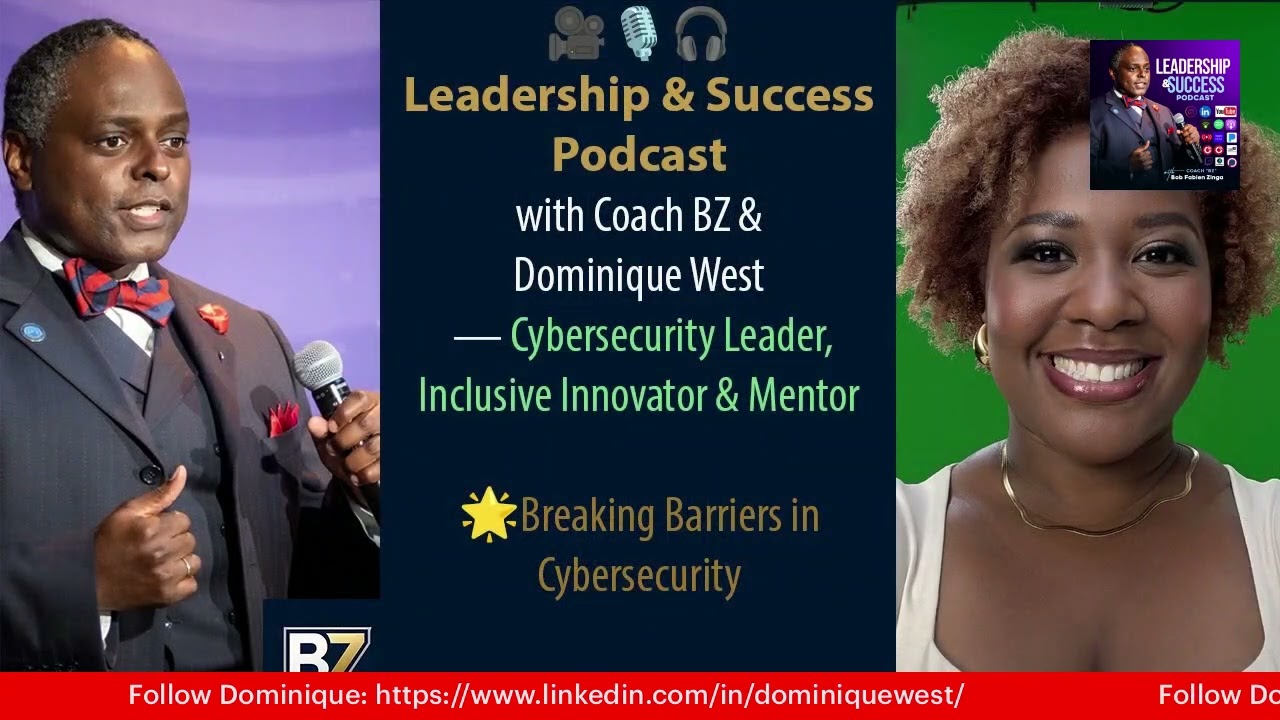
Coach BZ talks with Dominique West, a cybersecurity executive and founder of Security in Color, about building inclusive security teams through servant leadership and knowing your why. West argues that diverse perspectives give strategic advantage and that leaders often miss inclusion by focusing only on hiring numbers.
Chapters
Hi, I'm John Maxwell. When the top companies in the world are looking for trainers, speakers, and coaches, there's one name that stands above the rest, and that's Maxwell Leadership. Our certified team members have gotten proven results for companies all over the globe, and our reputation, I'm proud to say, is second to none. Some of our members have risen to the top of their profession, including the one you're going to meet today. I proudly introduce you to my friend Bob Fabien Zinga.
Welcome to the Leadership and Success Podcast with your host, Coach BZ, where we help you lead with purpose and succeed with impact. If you're ready to grow into the kind of leader others want to follow, this podcast is for you. If you're determined to elevate your success and leave a lasting legacy, this podcast is for you. As my mentor, Dr. John C. Maxwell, reminds us, everything rises and falls on leadership. Our goal is simple, to inspire you, challenge you, and equip you with insights that can transform the trajectory of your leadership journey. Welcome aboard to Welcome to another episode of the Leadership and Success Podcast with Coach BZ.
Hi everyone, I'm Dominique West and I'm so excited to be joining Coach BZ on the Leadership and Success Podcast. I'm a cybersecurity and governance executive, an educator, and a lifelong learner. Over the past 15 years from startups to global enterprises, I've worked across many industries, leading programs that help organizations build trust through secure, scalable, and inclusive security practices. I'm also the founder of Security in Color and Evolving Seasons, two communities I'm passionate about that are focused on making cybersecurity more accessible and helping professionals grow with confidence, clarity, and purpose. As a LinkedIn Learning instructor, I'm passionate about teaching others that security isn't just about technology. It's about people, relationships, and reliability. In today's episode, we'll explore how to lead with authenticity, how to make inclusion a strategic advantage, and how trust, not fear, builds the strongest security culture. I can't wait to share this conversation with you. Thank you, Coach Beasy, for the invitation, and to everyone tuning in, get ready for a real discussion on leadership, growth, and the human side of cybersecurity. Let's dive in.
Lead your team. How do you coach members of your team to stay grounded in purpose, especially when the demands for cybersecurity feel overwhelming at times?
Yeah, it always starts with your why. I've learned that the hard way is understanding, like Why are you here? Why are you doing this? What are you interested in? And so whenever, especially if I'm maybe being introduced to a new team or just in general, it's like, hey, do you know your why? Because it's easy to forget that, right? Because like I said, when you show up every day, you will already have 10 things that will grab your attention, pull you away from the purpose that you maybe set out for, or the energy you wanted to bring to the table today. I always start with my team members like, do you understand your why? Are you clear on that? I have no—
And you are also a LinkedIn instructor. You've taught over 60,000 people usually talking about Security Cloud, and this is just, just amazing. What type of pattern have you seen amongst today's learners?
Can you repeat that question? Sorry.
Uh, uh, what patterns do you see among today's learners?
Yeah, I have seen that, uh, learners want to be hands-on, which is cool. I'm glad we're getting to that space. I, I do like to be hands-on as I'm becoming a leader. And so technology is moving so fast, right? The technology that was introduced yesterday will be very different once tomorrow comes. And so I think showing— I'm going back to process. I think what I've learned, at least as I have started to build curriculum and, um, you know, started to kind of teach a little bit more broadly into the world, is People want to know, how do I do something, right? It's not just telling me to go do something. It's, hey, how is this impacting me on a day-to-day basis? And so I've made courses both for those who are just getting into the industry to say, okay, cool, here's some paths you can take, right? There's certifications, there's books, there's like all kinds of resources available for you to learn. And now it's up to you to figure out what do you like. And so here's how you can use Google, right, to create your own— or I should say GCP— in order to create your own sandbox, right? So that way you can create a portfolio and get out of the box. Or for leaders, here's how you navigate the fact that you've got to now build AI governance and think of AI in every respect as you move forward. And so now that's just one more framework and one more policy and one more XYZ that you have to to work.
What do you think most leaders get wrong about diversity and inclusion in cybersecurity or tech in general?
Oh, what do they just get wrong? Yeah, I would speak— if I'm maybe speaking from my perspective, I tend to always, um, give me one second. Maybe I would say we tend to talk more when we should probably listen, because being able to have diverse perspectives in the room requires more listening than I think kind of talking. And for me, it's always, hey, there's enough room for everybody, right? We tend to have this concept of I have to be the only, I have to be the first. There's not enough seats, there's not enough room. I think that just comes from a very scarcity mindset. And so at least how I'm trying to shift and showcase things is there is room for everybody here, right? And it might be a perspective that you maybe don't agree, you can, you cannot understand. It's okay to have differing perspectives, but what you shouldn't do is try to stop someone from having that voice or perspective. And so a lot of that comes from like—
In a high-stakes field like cybersecurity, what does it really take to lead? I mean, it's not just about firewalls and complex frameworks, right? Today, we're gonna dive into the leadership principles of Dominique West, a cybersecurity executive who is completely redefining what it means to lead with trust and courage. Let's get into her playbook for breaking down barriers. This quote right here? It gets straight to the heart of her entire philosophy. In a world that we often see as purely technical, Dominique West makes the case that the whole mission is actually built on people. It's such a powerful reframe, and it challenges decades of stereotypes. And to really get why this is so huge, you have to understand the problem she's trying to solve. So yeah, first we've gotta talk about the problem. For years, security teams have been painted with this very specific—and let's be honest, pretty unhelpful—brush. You've probably heard this before, right? Maybe you've even felt it. The security team is seen as the group that just blocks progress, that says no to every new idea. But that perception, it creates these massive walls. It grinds innovation to a halt. And you know what? It actually makes an organization less secure. West's entire approach is designed to just tear those walls down. Okay, so if you want to stop being the department of no, where do you even begin? For Dominique, the answer isn't some new technology or a complicated policy. Nope, it's a fundamental human quality. Empathy. And what's really interesting is where this huge realization came from. It wasn't born out of some big win or successful project. Actually, it was forged in a moment of real difficulty. You see, that experience taught her a lesson that changed everything. If your team doesn't trust you, it is almost impossible to lead them effectively. Trust isn't just a nice-to-have. It is the entire foundation. And this insight, well, it forces us all to ask a really important question about our own leadership. Just think about that for a second. In that rush to hit our deadlines and meet our targets, how often do we totally skip the essential foundational work of building trust first? It's a question every single leader should be asking themselves, probably every day. Alright, so the foundation is trust. We've got that. But how do you actually build it in the real world? Well, Wes is a huge champion of a model called servant leadership, and it's all about flipping that traditional pyramid of power completely upside down. And this breaks it down perfectly. A hierarchical leader, they kind of sit back and expect everyone else—engineers, finance, you name it—to come to them to speak their language. But a servant leader, they do the exact opposite. They get out of their own world and into the trenches with their teams. And this is what it actually looks like. She doesn't just talk about collaborating, she actually embeds herself in the business. By shadowing demos or sitting in on product meetings, she's learning their worlds, their challenges, and their language. See, servant leadership isn't just about being physically present; it's about gaining perspective. You're not just observing; you're absorbing the context that lets you lead with real relevance. This is how you build bridges instead of walls. Here's another amazing coaching prompt. It's so simple, but it's an actionable way to start practicing this model like tomorrow. What's one meeting you could join just to better understand another team's world? Now, leading in a high-stress field like cybersecurity, it's not just about what you do externally. It's also about managing your own internal state. Because when a crisis hits, you have to be able to respond from a place of calm and clarity, not chaos. That power she's talking about, it comes from purpose. Before you just react and dive headfirst into the chaos, you have to anchor yourself. Her advice is to just pause and reconnect with your fundamental why. Why are you even doing this work in the first place? She encourages leaders to build what she calls a leadership toolkit. And no, this isn't about software. It's about your internal operating system. It's all about the wellness habits, the mental resets, and the grounding questions that give you emotional clarity when the pressure is really on. And that's really the key takeaway here. Look, your technical knowledge can get you far. For sure, but it's your clarity of purpose that's gonna keep you steady when it feels like everything is falling apart. And this inner clarity, it doesn't just help you lead yourself—it's absolutely essential for leading others and building a bigger, more inclusive vision. So a leader who builds trust and practices resilience, they're perfectly positioned to build something else that's incredibly important: a truly inclusive team. And for Dominique, this isn't about checking a box. It's about gaining a critical competitive edge. You know, the very first step toward inclusion is just humility. It all starts with the simple but profound act of listening more than you speak. Great ideas can come from literally anywhere, but only if you create the space for them to actually be heard. And this is why it matters so much for the business. As she puts it, if you don't have diversity in your teams and leadership, you are doing your business a disservice. Diverse teams aren't just more fair; they are flat-out more effective. They spot blind spots, they challenge assumptions, and they produce way better results. It's the ultimate strategic advantage. You know, this requires a big shift away from a scarcity mindset—that idea that success is a zero-sum game—and toward one of abundance. A great leader doesn't feel threatened by talented people; they work on creating a table that's big enough for everyone to have a seat. Such a simple question, but it can be a really challenging one. Think about it. Look around in your next big meeting. Whose perspective isn't being heard? Whose voice is totally absent? Answering that question honestly is the first real step toward building a stronger team. Okay, so we've talked about trusting others, but all of these lessons, they all build up to one final crucial piece of the puzzle. It's about the courage to turn inward and finally trust the leader that you're becoming. This advice is just so powerful. You can learn frameworks and strategies from all kinds of people, but at the end of the day, you have to build your own leadership identity from within. Stop trying to imitate everyone else and start truly becoming yourself. You know so much more than you give yourself credit for. And that is where we'll leave it. Not with a statement, but with a question for you. From your decisions at work to your own personal judgment, Where could a little more self-trust make the biggest difference for you this week? Because that is the real journey of leadership, and it always, always starts from within.
Let's kick this off by diving into leadership that's as much about heart as it is about tech. Dominique West's journey in cybersecurity isn't, um, just about systems. It's about trust, authenticity, and meeting people where they are.
Right. And what really stands out is that trust isn't built overnight. It's built through relationships. How do you see that aspect playing out here?
Absolutely. It's like a foundational stone. She stresses that security is about relationships and reliability, meaning trust underpins every email, meeting, and project. It's about showing up with empathy, right? Exactly.
And it seems like her own experience, losing trust in a leader, provided a harsh yet powerful lesson on why trust matters in every leadership decision.
For sure, her authenticity comes through when she discusses how painful it was to lose trust. That vulnerability, um, really reorients the conversation from simply following protocols to, like, serving people first.
That shift from process to people is huge. I mean, many treat cybersecurity as just numbers and codes, but here it's like deeply human. Right. It's about empathy and connection.
Right. And moving on, she embodies the meet people where they are attitude. Whether it's engineering, HR, or finance, she gets in the trenches with them. It's like she refuses to be isolated in an ivory tower.
Yeah, but I do wonder, Is there a risk of spreading oneself too thin by trying to engage with everyone? I mean, isn't there a point where the focus on personal connection might dilute strategic oversight?
That's a great critique. However, her approach is not about micromanaging every detail. It's about understanding different perspectives. It actually informs smarter decision-making because leadership is a two-way street. I see.
And what about her mantra to start with your why? That seems to be a recurring theme, especially when the pressures of burnout and chaos hit.
Exactly. Her emphasis on, like, pausing and recalibrating by asking what is your why is a game changer. It moves leaders from reactive modes into clarity and intentionality. This is especially crucial in high-stress fields like cybersecurity.
And adding to that, she talks about building a personal leadership toolkit— wellness habits, mental resets, tools that help maintain clarity under pressure.
Yes, absolutely. It's like having a survival kit that coaches you back to center when chaos threatens to overwhelm you. It's about equipping yourself emotionally and spiritually.
There's also that powerful message about inclusion. There is room for everybody. It's not just an ethical stance, it's a strategic advantage, isn't it? Definitely.
She teaches us that diversity in teams leads to richer innovation. It's a mindset where listening outweighs talking. She challenges leaders to like make space for voices that are typically overlooked.
Speaking of voices, her mentorship philosophy is refreshing. Instead of just asking for help or opinions superficially, she emphasizes intentional outreach, being purposeful, not vague. Right.
It's about asking specific, accountable questions. Her advice to not just pick someone's brain but to honor their time with clear, concrete follow-ups really reshapes how mentorship should work.
And then there's the whole notion of trusting yourself. Her final lesson about trust yourself speaks volumes about inner strength and self-belief. Yes, that resonates hard.
She reminds us that often we, um, know more within us than we give credit for. It's like trust in your internal compass is what ultimately turns failures into, hey, stepping stones.
Indeed, I love that blend of humility and courage. It's almost poetic when she says, Stop spending so much time looking for answers in others. Trust yourself more.
Exactly. It speaks to the essence of authentic leadership, identity built from experience, personal insight, and resilience. It's transformational in its simplicity and depth.
And let's not forget her view on technology. She acknowledges that advancements like AI are double-edged, but when managed right, they actually empower us. It's a balanced outlook.
Right on. It's like she's saying, um, don't fear new tech. Embrace it with due diligence, understand it deeply, and use it as a strategic asset rather than just a risk factor.
Mm-hmm. That perspective is so refreshing, especially in an environment where tech is often seen as a threat. Now, what do you think her coaching prompts really do for emerging leaders?
They're, um, like reflective checkpoints. Each prompt, be it about trust, inclusion, or personal development, forces you to pause and evaluate your leadership habits. It's almost a call to immediate action.
It certainly sounds like a comprehensive blueprint for anyone, from junior officers to senior engineers, looking to refine their leadership game. Yeah.
And the neat part is that it blends practical advice with a motivational push, whether it's building a portfolio, becoming hands-on in learning, or like taking those brief pauses to refocus.
She covers it all. And isn't it interesting how she weaves in principles that seem almost spiritual? Trust in God, listening, and authenticity. They add an extra layer of depth. Absolutely.
Those values ground her perspective. It reminds us that leadership isn't just about strategy and metrics. It's about moral integrity and the courage to be authentic. Yeah. Pretty transformative stuff.
One thing I appreciate is that she challenges the status quo, urging us, say, to, um, listen more and speak less. That can be a tough pill to swallow in fast-paced industries.
True, but that's the irony. In a world filled with noise, Deep listening is the rare quality that can set a leader apart. It means making space for others' insights and valuing diverse contributions.
That inclusivity is really the strategic advantage she mentions. Without diverse perspectives, innovation stalls, doesn't it?
Exactly. And that's why her leadership model is not a one-size-fits-all. It's tailored through empathy, resilience, and, um, continuous self-improvement. It builds an environment where everyone is encouraged to grow.
And I really like how she underscores personal accountability. You know, building your own cloud sandbox, creating a portfolio. It's a call to own your journey.
Yeah, she's saying you're never truly starting from zero. Every experience counts. And like, you have the power to contribute to your own learning curve.
It's all about proactive engagement. It seems that Dominique West's blueprint is a reminder that leadership is a decision, a commitment to service, to authenticity, and to constant growth. Right.
Leadership isn't just a title. It's a daily intentional practice of trust, empathy, and courage. It's about rising after every setback and leading by example.
In the end, it challenges each of us to truly evaluate our leadership style. Who are we really serving, and how do we grow amidst constant change? Exactly!
And that's the lasting impact of Dominique West's insights—reminding us to trust, to listen, and to lead with both heart and mind. It's a powerful wake-up call for all aspiring leaders. Well said!
Thanks for walking through those leadership gems with me today. I feel, um, more equipped to tackle the challenges ahead.
All right, so that was our 10 Minute AI recap for Season 4, Episode 112. And I encourage everybody to watch the full episode. It's about an hour long. So this is going to be the recap. So I'm calling this Season 4, Episode 112 AI recap. And I want to make sure, let me share my screen, that everybody goes ahead and follows Dominique on LinkedIn. Let me, okay, here we go. You should see my screen now. So she's on LinkedIn.com. In, in /DominicWest. Okay, make sure to follow her. She also has a newsletter. Make sure to subscribe to our newsletter as well, Evolving Seasons, and she has a lot of really great information about cybersecurity. And she's also been featured in two books, so make sure you get a copy of these two books. Tribe of Hackers: Security Leaders, and she has a chapter there. I think it's on 49. She says, "I follow the golden rule of treating others the way you want to be treated." Very powerful when it comes to leadership. And then she was also featured in this book, 97 Things: Collective Wisdom from the Experts. So she's one of the 97 experts featured in this book. All right, so now we are going to do our moment of gratitude. Every time we meet, we want to make sure that we take the time to be grateful. It takes less than a minute. Part of the reason why we do this is because in the military, about 21 veterans commit suicide every single day. And I was challenged about 4 years ago to participate in what we call the 21 Days Grateful Challenge. We are on day number 11 now, but basically every day you have to be grateful for something on social media, and then every day you have to select a member of your network and challenge them to accept the 21 Grateful Challenge so they too can be grateful every day for the next 21 days on social media, and each day select a member of your network to accept the challenge as well. So for right now, if you would, as it is our custom, go ahead and close your eyes if that helps. Put yourself in your happy place. I live in Silicon Valley and it's really nice here. The winters are not too bad, it's actually kind of nice. We've lived in the past in places, for example, in New York where it's really, really freezing and there are blizzards and things like that. I lived in Tuscaloosa, Alabama where we would get a lot of tornadoes and hurricanes and things. And the worst thing that might happen here in the Bay Area is maybe earthquakes, but we don't see too many of those. But anyway, I am very, very grateful for nature. I think it's just beautiful, and it really lets me know that there's got to be a creator, right? It is just beautiful. I love being at the beach, looking at the seas, the waves, the sun, the clouds. I mean, it is just beautiful, and I'm so, so grateful for that. Oh, actually, we have Dr. Eric Tango Mokan from Richardson, Texas. I think it's not too far from Dallas. Thank you so much for being here, Dr. Eric. Can you also let us know what you are grateful for today? And if you were able to listen to the 10-minute AI recap, would you please let us know what are some of your 2 to 3 takeaways? I really do appreciate that. And also let me know, Dr. Eric, if you wanted to come on for just like one minute and maybe just share your thoughts. I am open to that. You do not have to, but if you do, if you can just type yes in the comment, I will send you the link to the green room. Okay, so what I will do now, I'm gonna go to the wheel of names. So these are the names of the people who are connected to me on LinkedIn, and I'm gonna randomly select one name to see who today on day 11, right, of my 21-day Grateful Challenge, who is going to be the person I'm going to challenge today. Let's find out. Looks like the person I am challenging today is going today. Okay, I know I interviewed her a few weeks back from Australia, hunting expert, uh, and we first connected October 22nd. Coach Renata, uh, thank you so much for agreeing to be one of our teachers. Uh, your interview on the Deepen Success Podcast really affected a lot of people. I've heard a lot about it, so Coach Renata, all the way from Australia, I would like to challenge you to accept to be a part of the 21 Days Grateful Challenge. And if you say yes to the challenge, that means starting today you are going to write a post every day for the next 21 days, letting us know what you are grateful for each day. And each day also select a member of your network. You have more than 8,400 people who follow you right now. You're gonna choose one of your followers every day and challenge them to accept this challenge as well. Again, thank you, thanks so much. I hope you accept the challenge. Okay, this is everything I had for today. And what I will do now, I'm gonna play one more highlight from the hour-long conversation I had with Dominic West, and that's gonna be the end of the show. Again, I am really asking everyone to really take on this 21 Days Grateful Challenge. And quick reminder, tomorrow I'm gonna be back here and I'm gonna be speaking live with Coach Divya Smith. She was here a few weeks ago. We had Season 4, Episode 110. She's an investor, entrepreneur, and executive, and we talked about just doing it, leadership, grit, and building freedom. And she actually wanted to be your live, so I absolutely wanted to say yes. So we're going to have a 10-minute recap from the hour-long discussion, conversation we had a few weeks ago, but she's going to give us her own feedback, what she believes are the most important lessons from our conversation. So that's going to be Monday, tomorrow morning, December 8th. Don't miss it. All right. Thank you so much for being here. And One more. Okay, Dr. Eric is saying, "I am thankful for good health, resources, and the strength to establish the Tawa Organic Farm." Thank you. Thank you so much. I mean, it is so powerful to be grateful. I think there is really, really a lot of power to that. And I believe Canada and the United States are really the only two countries in the world where they have a Thanksgiving Day, which is pretty Amazing. So thank you so much for sharing, Dr. Eric, and I do hope to have you on the podcast sometime soon too. All right, so this is it for today, and thank you so much for watching. And here we go with one more highlight from the discussion I had with Dominique West.
So Dominique West is a visionary cybersecurity and GRC executive, right? Governance, risk, and compliance. She is redefining what leadership, inclusion, and trust look like in today's digital world. From building high-impact programs at Datadog and Tamper to founding Security in Color and the evolving seasons, Dominique is on a mission to make cybersecurity accessible, empowering, and human. So she's gonna be joining me today and we are going to have a great time. Again, if you have a question for her, please type it in the comment. Ladies and gentlemen, please help me welcome Dominique West. Hey Dominique, how are you doing today?
I'm well.
What a great intro. Fantastic. Good morning. We actually happen to be in the same city. That's my undisclosed location, but glad to see you on the screen. Maybe to get started, is there anything you are grateful for this morning?
Yeah, I am grateful for time. Time is a valuable resource that I have been fixated on, it feels like my whole life, and I'm in a space where I actually have time to have slow mornings, right, to think things through, to be present with myself, with my family and my friends. And that's, that's something I, I, yeah, I'm eternally grateful for because I know that's really hard to come by these days, is to get time and space to be able to do something. So yeah, I'll say I'm grateful for that today.
Well, that is, that is really powerful. It's really, um, one resource that we really cannot redeem. Once it's gone, it is gone. And yeah, I remember another wise saying, teach us to number our days because our life can be very, very short. And sometimes in my experience, people really chase after the wrong things or things that really don't matter in the long run. But yeah, managing time is definitely crucial. And we're probably going to be talking about that too. Is there something about you, Dominique, that most people may not know?
Yeah, most people probably, unless you're like my close family and friends, but most people don't know that I am into K-pop, and I'm a huge K-pop fan. Yeah, so much so that my best friend and I, we went to South Korea to go see some of our favorite Korean bands. Yeah, we had a fantastic time. And so yeah, I'm super excited about K-pop. That's wonderful.
Is BTS one of those groups?
It is BTS. Yep, I cannot wait for them to go on tour next year.
Actually, next year?
Yeah, my daughter told me about it, so we are looking Listen, let her tell her we're going to be in the same—
Thank you for tuning in to the Leadership and Success Podcast with your host, Coach BZ. If today's episode added value to your leadership journey, be sure to subscribe, share, and join us again for more wisdom nuggets on how to lead better and achieve greater success. Remember, leadership is the most critical skill of our time. The world will always need leaders to inspire others, drive innovation, and execute meaningful strategy. So why not count yourself among the bold leaders shaping the 21st century? Until next time, stay inspired, stay committed, and keep leading with excellence.
More from Bob

S250:E4🎙️LIVE 🇺🇸America 250: President Barack Obama Leadership, Service, and the Power of Hope






S5:E157🎙️ LIVE with CMD CMSgt Dennis L. Fritz, USAF (Ret.)(Multi Tracks Audio)



S5:E156🎙️ LIVE 🇪🇸 Leadership Lessons from the FIFA World Cup 2026 Champions (Multi Tracks Audio)

S250:E3🎙️ LIVE Leadership Lessons from America’s First Documented Family of African Descent 🇺🇸📖