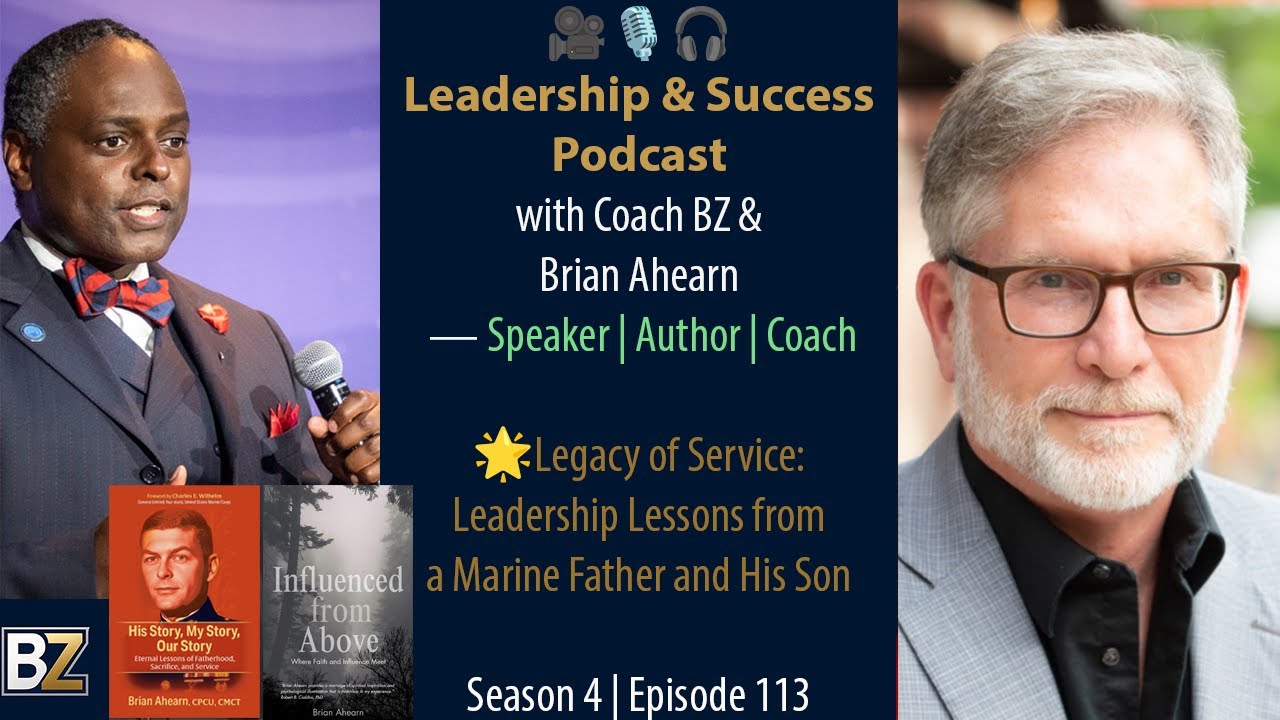
Brian Ahern, a Cialdini-trained influence expert, shares his framework for ethical persuasion built on three pillars: truthfulness, using only naturally available influence principles, and creating win-win outcomes. He explains pre-suasion, the power of the word "because," and how his faith connects biblical principles to the science of influence.
Chapters
Hi, I'm John Maxwell. When the top companies in the world are looking for trainers, speakers, and coaches, there's one name that stands is above the rest, and that's Maxwell Leadership. Our certified team members have gotten proven results for companies all over the globe, and our reputation, I'm proud to say, is second to none. Some of our members have risen to the top of their profession, including the one you're going to meet today. I proudly introduce you to my friend, Bob Fabien Zinga.
Welcome to the Leadership and Success Podcast with your host, Coach BZ, where we help you lead with purpose and succeed with impact. If you're ready to grow into the kind of leader others want to follow, this podcast is for you.
If you're determined to elevate your success and leave a lasting legacy, this podcast is for you.
As my mentor, Dr. John C. Maxwell reminds us, everything rises and falls on leadership. Our goal is simple, to inspire you, challenge you, and equip you with insights that can transform the trajectory of your leadership journey. Welcome aboard to Welcome to another episode of the Leadership and Success Podcast with Coach BZ.
If we were actually together, I would ask this question. I'd say, by a show of hands, how many of you would agree with the following statement, that much of your professional success and personal happiness depends on getting people to say yes to you. And when I talk about influencing people, I talk about those powerful everyday opportunities to persuade that are lasting and ethical. And we're going to take a look at each of these components before we jump into these principles of influence because they lay the foundation for the rest of what we'll be talking about today. Powerful. Why do I say this is powerful? Because what I'm going to be sharing with you is not my good advice. It's not based on what somebody else did. It's based on research. More than 7 decades of research from social psychologists and behavioral economists into what causes people to say yes to one another and actually take action.
All right, everyone, this is, um, Coach Bizzy, and thank you so much for being here today. So glad to see you. I have a very, very special guest for you, but we do that, let's do our daily practice, which is to be grateful for one thing every single day. So the question is, what are you grateful for today? So if you would, I'm gonna ask you to close your eyes if you can, and maybe take a deep breath and think about one thing that you are grateful for today. Almost every day when I wake up in the morning, I am just so grateful I am still alive because I think as long as I am alive, right, there is hope for me. So I may not always get everything I want. I may not always be able to accomplish everything I want to accomplish. But just the fact of getting up in the morning really gives me hope that today can be better than yesterday. So I am very grateful to be in the land of the living and knowing that I can still do something today that is going to be able to impact and change my future. So let us know what you guys are grateful for in the comments, please. And also let us know where you are joining us from, what city, what state. And we want to know that. And also, if you do have a question for my guest, please type it in the comments and we're going to be answering your questions live today. So let me see if I can properly introduce our guest today. So, I'm gonna be talking with Brian Aaron. So, Brian is very special. He's a dynamic international keynote speaker, an author, a coach, and a consultant. And Brian is one of only a dozen individuals in the world who currently holds the Chaldean Method Certified Trainer designation and one of just a handful to have earned the Chaldean Persuasion Trainer designation. He's also a faculty member of the prestigious Chaldini Institute. So Brian's passion is to help you achieve greater professional success and enjoy more personal happiness. He does this by teaching you how to ethically move others to action using the science of influence. I really love that because my primary mentor, Dr. John C. Maxwell, I call him Papa John, he says, "Leadership is influence, nothing more and nothing less." You don't have to have a title, right? You don't have to have a corner office. You don't even have to really have followers. You just need to influence first and foremost yourself, but also the person to your right and the person to your left. If you can influence someone, you are a leader. So, we're going to be talking about all of that soon. So, I am really, really excited. Please, ladies and gentlemen, help me welcome Brian A. Hearn. All right, Brian, how are you doing today?
I'm doing wonderful. That's got to be the best intro I've ever had, and I've been on like 200 podcasts.
Thank you, thank you, thank you. Really, really appreciate that. I am so grateful that you are here and we have so much to learn from you. I guess just to get started, is there one thing you are grateful for, thankful for today, Brian?
I am thankful for our 8-month-old grandson Emmett. He is coming over and he's going to spend the night with us, and I am just excited to get on the floor and play with him.
Yeah, that's really wonderful. In the green room, we were saying, so I'm a father of two, and my first daughter is actually the age I was when I got married. But I'm not saying I'm— I don't want to push her to get married anytime soon, but whenever she does, that's definitely something I would like to explore. Oh, by the way, we have Ian Murca. I've interviewed him before from Canada. He says, uh, Bob Fabien Zinga, having a chance to listen live to another of your great podcasts and getting to learn about Brian. Okay, great academic. Okay, another testimonial for Charles Denny Institute. Thank you so much, Ian. Really appreciate that. I always love reading comments when I'm live because the first show I ever did, Season 1, Episode 1, about 4 years ago, I was the only person in the audience. So it's always more fun when we get some interaction. So let me ask you this, Brian. For those who may not know you, actually even those who may know you a little, what is something about you that most people may not know?
Most people probably wouldn't know when and where I was born. My father served in the United States Marine Corps. So I was born in Honolulu, Hawaii on April Fool's Day. I have not met anybody else who can make that claim to those two things.
Yes. Wow. That is wonderful. Definitely Honolulu is one of the best locations I've ever been assigned to. It's just paradise over there, especially Waikiki Beach, I think is one of my preferred locations on the island. Wow. That is really Awesome. So let's see, the first question I have for you then is maybe you can start by kind of letting us know about your leadership story, your background, how you got to become an international keynote speaker. And you are an author of several books and I believe a LinkedIn instructor as well and a consultant? How did you get to become Brian Ahern?
Well, I'm Brian Ahern thanks to my mom and dad. Really, you know, where I'm at in my career now, running Influence People full-time, that started back in 2003. I was working for an insurance company here in Columbus, Ohio. I was involved with sales training, loved, loved my job and coworkers and everything. And a coworker gave a copy of a video of Robert Cialdini presenting at Stanford. She said, I think you'll really appreciate this. And when I watched the video, the light bulb came on. I thought, holy cow, the psychology that he's talking about, it's the underpinning of all selling. It explains why certain approaches work and why certain don't. Second thing that occurred to me was everything he talked about was based on research, and I'm a very analytical person. And so I felt like I can confidently get behind this.
Wow.
The third thing was his stance on ethics. He talked about influencing people in non-manipulative ways. So I started to use that video around the company and talking about the concepts and sharing. And one day, one of the Stanford marketing flyers hit my desk and I'm paging through it and I see Cialdini's Big Picture and it says at the top, bestseller, right underneath it in bold letters, Call It Influence, Persuasion, or even manipulation. And I just thought, I can't believe they'd use that word to describe his work. He's so clear about doing this in non-manipulative ways. So, Bizzy, I'll just say the moral part of me felt like it should be addressed. So I emailed Stanford, basically said, I don't know anybody who wants to be manipulated. I don't know anybody who's looking to become a manipulator. That one word cannot be helping your sales, but it's probably really hurting. Sometime later, I never heard from Stanford, but sometime later my phone rang at work and it was a representative of Dr. Cialdini's. She introduced herself and said, I'm calling on behalf of Dr. Cialdini to thank you for that email that you sent to Stanford. We learned about it and we're changing the marketing of our materials. So that was my introduction to him. And just over time, he came to Columbus, Ohio, and spoke to the insurance agents that represented the company. I went to Arizona. Went through his workshop, went through his training, and got certified back in 2008. And the rest is history.
That is really amazing. Also, I think it's important to note you're only like one of 12 people, a dozen people in the world that's fully certified. That's really quite a great achievement. Thank you so much for sharing this. Something you mentioned, it's true in leadership, we do have to be careful between influence and manipulation. Actually, I wrote an article about that maybe a couple of months back. Can you tell us more about what the difference is between influence and manipulation?
Sure. I love it when people say, well, what you're doing is just teaching people to manipulate. And I can then launch into my story and they recognize how seriously I take this. First thing I say is they're two different words with two different meanings. To be an ethical influencer, there's 3 must-haves. You have to be truthful. And it's not enough to just tell the truth. We don't hide the truth. If I know there's something that materially will impact your decision-making and I withhold that, I am not being ethical. Right? If you ever come back to me and say, Brian, why didn't you tell me? If I say, well, BZ, you didn't ask, you're not going to think that I'm an ethical guy. So we tell the truth. We don't hide the truth. The second thing, when it comes to what we call the principles of influence, we only use the principles that are naturally available. So if something's not scarce, we don't try to use the principle of scarcity. If there's not lots of people doing something, we don't try to manufacture a false sense of social proof. Right. So we only use the psychology that we see present in the situation. And then the third thing is, to use Stephen Covey's term, we have to create win-win situations.
Yes.
It's not, it's not good enough that I get something out of the interaction. Obviously, I probably will. That's why I might have approached you. But I have to know that you're leaving the transaction well off also. And so if we can do those three things, be truthful, only use the psychology that's naturally there, and we create situations that are mutually beneficial, we can feel good about how we're interacting with people.
Wow, that is, that is quite, quite powerful. Yeah, because I think when you talk about people who have charisma, charismatic leaders, sometimes, you know, they could pretty much influence you in order to benefit themselves and therefore manipulate you into doing something that doesn't provide a win for you at all. That is so Dangerous. Okay, so, uh, ethical persuasion, I, I really like that. So you've— your career spans over what, more than 35 years or so in business, underwriting, sales, leadership, and now global speaking. What are some pivotal moments that shaped your path?
The first pivotal moment would be in college. I had already accepted a job in the retail sector. But I got a, I got a letter from the Travelers Insurance Company the last week of school. I thought, well, I owe it to them, or I owe it to the girl I've been dating. She lived in Columbus, you know, I owe it to her to go to the interview and see what it's like. Well, I get offered the job, and even though it wasn't as much money, I thought, you know, I'll be in town where she is, I will be around friends and family. And so I decided to take the job. The irony of it was I met my wife the first day of work. And so after 2 weeks, wasn't going out with the other girl. But the other pivotal thing was insurance turned out to be a great, great career. And I never would have— I never would have thought of insurance as being a career. So that was the first pivotal moment.
Wow.
I think the second pivotal moment was that decision to send the email to Stanford to address this moral situation. And I told Cialdini about a year and a half ago, I spoke at a conference to celebrate his 40th anniversary of his book Influence. And I started to get really emotional because here he was in the front row. And I told him, I said, Bob, I have to thank you because you didn't just change my career. You changed my life.
Wow.
The way, obviously my career changed because I run my own company, Influence People, but how I interact with everybody. The foundation of that is how I influence people and what I've learned about human psychology. So I, I really hope that people who hear me speak or go through my training, that they can have the same kind of life-changing impact too, if they're willing to take it beyond just a 60-minute keynote or a half-day presentation, but to really start diving in to understand how these principles work and how they can enhance their success and their happiness. Wow.
That's really what I love, the practicality of it, right? Because sometimes even when I speak myself, I tell my audience, you don't have to believe anything I say. But what I want to challenge you is listen to what I have to say, put it in practice in your own life. If it works, great, do it. But if it doesn't work, forget about it. But it's just powerful how influence can really change someone's life, literally. So I've looked at some of your work, like you often say things like small changes can lead to big differences. Can you unpack that for our audience?
Sure. One simple example of this, the word because. There was a study that was done where people would walk into a photocopy shop. So this goes back in the day when not everybody had copiers. You had to go somewhere to get copies. And they did some research and they looked at 3 different variations. Somebody would walk up, I think they'd have like 5 pages, they'd go to the person in the front of the line and they would say, "Excuse me, may I go ahead of you? I have 5 copies to make." So they made just a straight up ask, "Could I get in front of you?" And believe it or not, 60% of the people said, "Sure, go ahead." At another time, they would go up and they would say, "Excuse me, may I go ahead of you because I'm in a rush?" And at that point, 94% of people said, "Sure." Wow. Now, thinking it's just because they said they were in a rush, they tried one more variation. The person would go up to individuals who happened to be at the front of the line. They'd say, "Excuse me, may I go ahead of you?" because I need to make these copies. Well, everybody's in line to make copies. That's a bogus reason, right? But 93% of the people said yes.
Really? Wow.
And the social psychologists theorize that that word 'because' is a trigger. You know, I don't know about you when you were growing up, but, you know, when I'm growing up, if my dad said, 'Do something,' if I ever dared say, 'Why?' He didn't give me a rational explanation. He said, because I said so.
Yes.
And I went and did it. So the theory is that we're conditioned by that word.
Wow.
I don't tell people to give bogus reasons, but what I tell people is once you understand this and you're making a request of somebody, take one more breath, say because, and give them a valid reason. The odds that they'll do what you need will go up dramatically. So that's a very small change. One breath. Because— and you give that reason and you'll have more people doing what you need them to do. You accumulate that over the course of, you know, your days and weeks in leadership, right? If I can get 20% more people to do what I need to do just by doing that small thing, that's a gigantic win. So those are the kind of things that we teach people to bring into their communication to make it easier for others to say yes to them.
Wow. That is really powerful. I think it really even gets into emotional intelligence where you really increase your awareness and how you interact with the people around you. Now, before you even speak, because there's something that you talk a lot about, I don't see too many people talking about it, pre-suasion. Can you tell us more about that where you say influence starts long before you open your mouth?
Sure. When we talk about persuasion, persuasion is kind of what we do in the moment. I like to use Aristotle's definition. He said persuasion is the art of getting someone to do something they wouldn't ordinarily do if you didn't ask. Right. So how we make that ask, how we make that request, just like using the word because, it can make a big, big difference. So that's what we do in the moment. Pre-suasion is about how we set up that moment. Cialdini says it's arranging for an audience to be receptive before they ever hear your message. I term it this way. I say setting the stage. How do you set the stage to make it easier for somebody to say yes to you? And as you know, in my TED Talk, it's about persuasion. And I share the story about how I asked my wife to marry me. And I had made some mistakes. And so I knew I couldn't just say, Jane, I'm sorry, I love you. Will you marry me? I had to set the stage. And I did so in a unique romantic way. That ultimately led her to say yes. So that's what persuasion is. And I think once people hear that story, they'll go like, oh, well, duh. Yeah, I know that. Do you do it? Do you do things to set the stage so that when that time comes for the ask, people are mentally, physically, and emotionally in a better space to say yes to you?
That is so powerful. And for those of you that are listening right now, let us know where you are coming from. But most importantly, let us know if you have a question for my guest, Brian A. Hearn. But one thing, Brian, you just said I think is so critical. And on Leadership and Success podcast, we really focus on that. I feel like for most people, when they hear about leadership principle and management and all of those things, they say, I already know that. I already know that. I've heard that a thousand times. But the problem is not that they don't know it. Sometimes we just remind them of things they should already know. But The thing is they don't do it. One of my mentors, Tony Robbins, says, unless you do it, you don't know it. You know it when you actually do it. It's really in the doing, in the actions that you actually get to know anything.
When I go through these principles of persuasion, everybody gets it because they either recognize a time where they said yes because of a principle I'm talking about. Maybe that's why they bought a car. Or they start to realize, oh, maybe that's why people respond to me. Because we're describing human behavior and human thinking. So they start getting it. But I like to put it this way. It's not the knowing, it's the doing. Wisdom is the application of knowledge. We all know what it might take to be a little more healthy. I could change some diet. I could start exercise. There's a number of things I can do. And so many people don't do it. So I don't want it to reside here. I want it to drop down here. So people start taking action on it.
Wow, that is so powerful. So for those listening, I also would like to see your notes, what you are learning from this interview so far. What are your 2 or 3 takeaways? So we kind of touched on this before, but I think this is so critical. Let's talk about ethical influence and how can leaders today listening to us right now, aspiring leader, really avoid crossing that line between persuasion and manipulation? What are your best tips for that?
With the publication of the new book, Influenced from Above, which looks at the psychology I teach and how it actually has like a biblical foundation, I— my PEOPOL acronym, as you shared earlier, is PEOPOL is Powerful Everyday Opportunities to Persuade that are Lasting and Ethical.
Yes.
And I started thinking about that, and I'm changing it to Powerful Everyday Opportunities to Persuade that are loving and eternal.
Hmm.
It's human nature. And, you know, from your years in the service and all the rules that you have, right, it's human nature to say, how close can I get to the rule without breaking it? Or how far can I go beyond it without really incurring a cost? Hmm. You don't want somebody who says that about the rules I laid out for ethics. You don't want somebody who says, how close can I bump up to not being truthful, or maybe not telling something, or creating a situation that's not totally a win for you, but it's just okay, right? We don't want people to do that. But if we are focused on love for God, love for neighbor, then ethics begins to take care of itself. Because, BZ, when I get to know you and like you, I start naturally wanting what's best for you.
Wow.
You begin to sense that with all of your being, right? You can see it here, this tone of voice, all these things that register to you. Does this guy Brian really like and care for me? And when you begin to sense that I do, which I do, then you're more open to what I might be sharing or asking of you. And that's how we start moving closer to a loving type of relationship with somebody, getting to know and care and want the best for them. And then, I don't have to worry about the ethics rules because I will naturally want to do what's right and best for you.
Wow! That is so powerful. Now, this is not a religious show by any means. But I do use the Bible as well, just as a curriculum to extract all of the leadership principles because I think leadership is as old as dirt. People come and they repackage it in many different ways. When I was, I think, 17 years old is when I really started getting into learning leadership and success and management. But what I found that I've read more than 2,000 books or so, they all pretty much say the same thing. And a lot of those thoughts, I go back and I find everything in the Bible. Again, not as a religious experience or anything, but just for learning and understanding really. There is nothing new under the sun. But just not Matthew 22:37, part of what you said. Jesus said unto him, Thou shalt love the Lord thy God with all thy heart and all thy soul and all thy mind. But then he says, this is the first and great testament. But the 39, he says, but the second is like unto it, thou shalt love thy neighbor as thyself. So if you do those two things, on these two commandments hang all the law and the prophets. That's quite powerful.
Yeah, can I, can I expand on that a little bit? Because A couple of things I want to make sure I say that I know that there are people who are probably watching and listening who may not share the same faith. Yes, I've had, I've had some people who say, hey, Brian, you know, I know you and I like you, but I'm an atheist. And so, you know, I don't think I would buy that book. And I, and I would say to somebody like that, you know, if you believe the world would be a better place if people tried to follow the teachings of Jesus, I'm not saying that you have to believe as deeply in him as I do. But if you believe that the world would be a better place by people trying to follow the things, the tenets that he laid forth, then I still think the book is for you because I think you'll see that there's an undergirding to these principles that makes them even more ethical. The second thing, I know people could be sitting there thinking, well, you know, yeah, love somebody. I can't stand the guy that I work with. Um, C.S. Lewis addressed this really well when he struggled with the problem of how do I love people that I, that I don't really like. And then he came to the realization that there was somebody that he didn't always like, but he always loved, and that was himself. And it freed him up to say, you know what, I don't necessarily like that person to do what's best for them because I do that for myself. And as you know, BZ, the Bible even says love your enemies. So there's, there's no room to not try to do that. I'm not saying that we will all be successful, but if we tried to do that. And the final thing I want to say about this too is, you know, my father having served in the Marines, and you know this from your time in service, you love your brothers and sisters in arms. You are willing to die for them. And that was the highest form where Jesus said there is no greater love than one would lay down his life for another. Yeah. I'm not gonna say my dad necessarily liked every Marine he was serving with. But he would have laid his life down for them.
Yes.
Because of that deep connection that they had.
Wow, that is really, really powerful. I think it definitely would make our world such a much, much better place if everybody would just try.
Wow!
So you being only one of a dozen, uh, Charles Dini fully certified individuals out there, can you just tell us one principle, uh, that leaders underestimate the most? One of Charles Dini's principles?
Uh, probably reciprocity is one. I mean, I've already kind of talked a little bit about liking. So relationship is super important. But reciprocity is also a relationship builder. Right? If I do something kind for you, you feel this natural sense that you'd like to do something in return. Or if, you know, a week or two passed and I came back and said, hey, I really need your help with— because I've already done something for you, you are probably much more willing to help me. We have learned as a species that, you know, I help you and then you help me. I'm more willing to help you again. And we've got this virtuous cycle going on where we're both benefiting. I think when people go into relationships and say, how can I best serve you? How can I best help you? Right? Not because I want to pull a lever and get you to do something, but because that's the best way to live life as a servant leader. And then it becomes easier for those people to respond. And I will give an example that when I worked in the corporate world, and I traveled a lot, and my boss, He said, you know what, when you're traveling, I consider that you're working 24/7. You ever want to take time off, you don't even need to ask me. He goes, just let me know where you are in case I need you.
Wow.
Come up in the office. And this is back in the day when, you know, you're 9 to 5, 5 days a week. And he would ask me how things are going. He said, just take the rest of the day off. Go home and play with your daughter or go do whatever you want. And that made me want to work harder for him. And because I worked so hard for him, It made him more flexible with me. We both continue to benefit. That's how that leader-follower relationship should work.
That's really powerful because it reminds me of what Zig Ziglar used to say all the time, right? You can have everything in life you want if you just help enough people get what they want. So that reciprocity again. Let's talk a little bit about one of your bestselling books about your father. That's actually part of the reason why we really got connected. And then I found out you do a lot about leadership and influence and everything else. So, His Story, My Story, Our Story. What prompted you to write this very personal book?
My dad passed away in September of 2020. It wasn't from COVID He had a heart attack. And it was kind of shocking because only days before, I had seen a picture of him on Facebook. And I remember thinking, damn, Dad looks really good. He looks like he lost weight. He looks really happy. And and then 3 days later he was gone. We had a rough part of our relationship, um, when I was in my early and mid-30s. What had been a good relationship turned kind of sour, and we were able to make it through that. So after he passed and I began to really think about him and his impact on me, and I decided I wanted to write a book. I wanted to have a resource for Marines to maybe learn from some of the mistakes that he made, maybe avoid some of the costs that he paid, that our family paid, but also as a book of hope because we turned the corner and we had a good relationship most of the rest of his life. But it wasn't easy to get there. And so the story looks at his story, his personal background growing up Irish Catholic, alcoholic father. All that stuff in, in New York, going into the service, experiencing what he did over in Vietnam, and then the impact that it had on our family. And, and I write from my perspective, the impact that it had on me. So it's his story, it's my story, but together it's our story.
That is so powerful because the, the truth is, myself, no, I haven't been in the service for 21 years now. It's not just the member who's serving, it's really their entire family. And all of the sacrifices. You wanted to have your dad to go to your recital or games or whatever, and he's not there because he's standing watch somewhere, you know, helping to protect and support the Constitution and our country. And it is really, I mean, I really believe every person who volunteers, I think they say it's only what, 2%, maybe 3% of people who volunteer to serve in this country, to me they are just American heroes.
Patriot.
There is nothing greater than that in my eyes, someone who's willing to really sacrifice for the greater good. So, uh, what did you learn about leadership and service from your father, Captain Brian Ayron, um, Marine Corps?
The, the thing that stands out is a story that he told me, which I do write in the book. Um, when he was over in Vietnam, he said that there was a Viet Cong sympathizer who had been gut shot, so he shot in the abdomen or whatever, and it was clear he was going to die. And the South Vietnamese commanding officer, you know, they had this guy out in the hot sun and it was just brutalizing him, kicking him and trying to get information out of him. My dad said he couldn't take it anymore, and so he told him to stop, and he wouldn't. And so my dad pulled his revolver and put it to his head and said, I will effing blow your brains out if you kick him again. Um, and then he said the guy died in his arms under a tree. Um, for all the faults that my dad had and the struggles that we had, I, you know, in my eulogy I said, you know, um, that's the heart of God.
Yes.
That you were willing to sacrifice your career— who knows, maybe he could have been shot by a South Vietnamese— maybe your life for somebody who was the enemy. That there was still a line of right and wrong. And I don't know, I just, uh, yes, I, I I said, wow, God was with you.
Yes. Well, thank you. Thank you so much for sharing. What a touching, touching story. Um, one thing being in the military, I've really seen what you're talking about, right? The best angels of us all, the best side of humanity. But for those who go to war and combat, sometimes you see the worst side of humanity too. And, uh, one thing I really love about our country, we are not always perfect and we don't always do the right thing, but for the most part We really try to follow the law and go above and beyond, treat people as human, respect the laws of war and cruelty and all of that. So really, you know, great salute to everybody who's ever served in the US Armed Forces. I think we are the greatest force in the world because of that. And wow, thank you, thank you so much for sharing that. I really do I appreciate that. We really need more and more people like that. I guess the last question I'm going to ask you about the book is, how has telling your father's story— so now you've been able to write the book, so it is part of our human history and people can purchase the book everywhere books are sold now— how has that helped you understand your own story differently?
I started to get a better sense of why I was the way I was, and it allowed me to start making some conscious choices. Um, when our daughter was born, you know, my wife and I were both at a stage in life where we were looking and questioning, you know, how we were raised. And not that it was terrible or anything, but why did our parents do certain things or not do certain things? And then we could start making conscious choices to do things differently. And so as an example, my wife in her early 30s said, you know, and I think back about being a little girl, my dad would take me to this restaurant and, and I was so proud to be there, but he just read the paper. Or your mom and I would go on vacation with, with my older sister, but dad wouldn't come. And she started questioning, like, didn't he really want to be with me? Or was work more important? Anyway, she had all this question. So when our daughter was, um, maybe a year old, I, I don't remember exactly the age, I remember my wife said, hey, we're going to go to the park, you want to go? And I said, no, I'm kind of tired. And I'm standing at the kitchen window, I'm looking out, and I just thought, I don't want Abigail to grow up and say, why didn't Dad go to the park? He— why didn't he do this? Why didn't he do that? So I said, hang on, I'll go with you. And the fact that I remember that almost 30 years later shows it was significant. And my daughter and I are so incredibly close because that set a tone for getting in things like Indian Princess, father-daughter things, going to taekwondo together for many years. Just, I always wanted to be with her and do things with her. I wanted to include her. I'm going to go to the, I'm going to the mall. Abigail, get in the car. You're coming with me. And so we grew extremely close. So So that's an example where I learned from the past. I made a different choice and it has been so beneficial for our relationship. And now with our grandson Emmett, it will be the same.
Well, I think this is a great segue to talk about your new book, Influence from Above. And I believe Abigail had something to do with you starting this book. Can you tell us about that?
Yeah, I had given a presentation here in town. I live in Columbus, Ohio. She hadn't seen me present for a long time. So I invited her. And the day after, I said, I want to have lunch with you. I want to know what you thought about it. And we talked about the presentation. But then she asked the question that sparked the idea for the book. She said, Dad, what I want to know is, where is God in all this? All the psychology that you teach, how does he fit into this? And I had not deeply thought about it before. So spur of the moment, we start having a conversation. And And I begin to kind of hear my own thoughts about how I saw this connection. And that was when the idea came. And as I looked around, I didn't find any books that looked at Cialdini's work and how there was, you know, roots in biblical tenets. And, and I was, you know, if you pop the book back up there, it has a quote from Cialdini where he says it's a marriage of spiritual Inspiration and Psychological Illumination. And he told me in the email that I've never read a book that took these two things and put them together. So he loved it. And that's the highest testament that I could get, that the guy who impacted my life, I get to have a little bit of an impact on his life by sharing a new viewpoint with him.
That is really wonderful because I really love the intersection of faith and influence. To me, it's really a powerful reflection, right, on spiritual roots, bond, influence, not religious, but spiritual. I think there is a big difference. So, how did your study of Cialdini's principles really intersect with your faith journey? I think that's really what this book is all about, in my opinion.
Yeah. Even though I've been teaching this for 20 years, you might think, well, gosh, there's only 7 principles and then there's other things around there too, like pre-swaying, you know, teaching the same thing for 20 years. How does it not get boring? How does it not get repetitive? Because for me, I keep going deeper. I find deeper and deeper layers, right? It's like somebody who would say, well, you know, I've read the Bible 2 or 3 times, you know. Yeah, but when you begin to really study it and you start getting deep into it, you see things that you never saw before. And for me, especially with this book, I— it's taken me to a much, much deeper level in terms of what it means to influence people with integrity.
Wow. So how do you then hope this book will impact leaders, teams, and families going forward?
Well, I know that, you know, in America, for the most part, people do identify with Judeo-Christian tenets. And so I would hope that people might pick up a book that says like, hey, we can do this with even more integrity. This isn't just about influencing people to get what we want. This is about doing it with integrity. And as I mentioned earlier, if we do it loving and eternal.
Yes.
My, my belief is that when all is said and done, the only thing that ultimately will remain are our souls and the souls of the people that we have impacted.
Yes.
And so if I do my job with integrity, if I do it in a loving way, it may open doors for people to have conversations and say, why do you see it this way? And for me to say, this is why I believe what I believe. Somebody had to share with me what they believe that impacted my belief. And so I have an opportunity to have an eternal impact on people. That's the highest calling I think that we have.
Yes, indeed, man. That really makes you think. Thank you so much for sharing. I feel like I could be talking with you for hours and hours, but we don't have much more time left. I need to get to the second half of the show. But before I do, I want to ask you one question about what's happening in the world today, especially with emerging tech like AI, how you think that might impact the world, the work you do. So what role does authenticity play in influence, especially in a world saturated with artificial intelligence generated messaging? Like today?
I think authenticity is integral because how disappointed— any of you who are watching and listening, how disappointed would you be if you picked up one of my books, loved what you read, and then found out Brian didn't really write it, right? That, I mean, I would feel that way if it was a ghostwriter and somebody's purporting to have written it themselves. But now we have AI that could ghostwrite for you. So that's why when I write things and I use AI, I always put edited by AI or by ChatGPT because I want people to know, yes, I do use that technology. I always come up with the subject matter and the foundation of everything. And then I work on writing it and then I bring it over there and I'm like, help me improve this. Where do I have opportunities? Just like I did when I wrote my first 4 books when I worked with an editor. Who would be there and say, yeah, sentence structure is not good here, you might want to add a paragraph on this. So that's how I utilize AI. But anybody listening to this, everything you're reading is Brian Ahern's thoughts, and how that view of the world is.
That is really, really, really powerful. Great segue to go to the second half where I mostly focus on leadership principles. And one of the first questions I want to ask you, What do you think is the greatest lesson you have ever learned about life, leadership in general? Greatest lesson?
It would be to trust God. And I'll quickly say this, that I'm rereading a journal that I had written back in 1993, and I was dealing with a person, uh, personnel-type situation. And I so wanted to call somebody because I felt like I would probably get some validation from my point of view. And then I stopped and I said, you know what, I don't want to ever be seen as manipulating or controlling the situation. God, I'm just giving it over to you. And you know what? That guy called me later that night.
Wow.
So I didn't have to pursue it. I just trusted, and it ended up working out.
Wow, that's powerful. That's really the power of surrender, isn't it? Sometimes we want to be in control of everything, but we just can't. Wow. Thank you so much for sharing that. So What do you think is the secret of your success?
Definitely discipline. You know, having grown up under, uh, with a Marine as a father, I learned discipline at an early age. And, uh, like he told me when I went off to college, he said, just treat this like a business. Yes, go to class from 8 to 5, do your homework 8 to 5, you can have as much fun as you want at night and on the weekends. And he was right. And so translating that discipline into my career, and especially important as an entrepreneur, it's been very, very easy for me. I know it's not easy for people, but discipline is key.
Wow, that is quite powerful. So what do you think is the greatest leadership advice you have ever received?
We've already touched on it. Love God, love one another.
Yes. Okay. The Law and the Prophet. Powerful.
Okay.
As a leader, I know leaders are learners. What are you learning right now?
Well, so much is focused around the book because it just came out a few weeks ago and all that process to get it in there and having conversations. And so I guess deepening my understanding of what it means to love people when we're in business. And that's not a word that's often used in business, but we can still act on that.
Wow, that is powerful. Yeah, the first time I heard he is I can't think of his name right now, but he's been a global CEO for a very long time. And I was at the John Maxwell conference and he was talking about love in business. I've never really quite, I mean, I guess I kind of knew it, but I've never quite put those two words together, love and business and people. But it's true, if you love your customer, you're going to do the very best for them. You're not going to try to take advantage of them or anything like that. I mean, if you love your people, your employees, they're going to want to stay. Stay with, with you too. So love really truly is, is the answer. That's, that's kind of different, but it is, it is so powerful. All right, so, uh, what about failure? One of my best commanding officers gave me this coin here. One side says success, but the other side says failure. Success and failure, two sides of the same coin. How has failure shaped your life?
Um, it would probably be marriage. We went through some real difficulties early on that easily break people apart. And for me, it got to the point where I just had to let go and said, God, I don't care what you do with her. Things have to be right between me and you. And it was as if he said, now I can work with you. When nothing's more important to me, now I can work with you. And then my wife saw a transformation in me and she's like, I want a piece of that. And she started transforming. But it would not have happened if we had not been on the cusp of calling it quits because of difficulties.
Wow. Thank you so much for sharing. I know in America, I think they say, what, 50% of marriages still end up in divorce, whether they're believers or not. That's really the most important relationship I have in my life outside of God. And I kind of joke with my wife, it looks like I'm not the only one. I tell her, if you ever leave me, take me with you. So pack another bag for me, please.
Well, it is the most important relationship because there's no other relationship except your relationship with God where you're called to be one with somebody. It's no longer two, it's one. Even your children biblically is not supposed to be the same as it is with your spouse.
Yeah, I guess it's part of the challenges I'm having as a father. One of my first daughters went to college not very far. We live in San Francisco. She went to Los Angeles. So that's really a 5-hour drive. One-hour flight. But still, though, I'm like, man, my little baby, she's becoming a woman and independent and all of that. She has her own car, she does whatever she wants. I kind of miss our life before, but no, it's a different type of life. But yeah, you are absolutely right, it is a blessing. Can you share maybe one of the greatest fears you've had to face that you were able to overcome?
The greatest fear? It was probably ultimately stepping out on my own. I had been part of the corporate world for over 30 years and all the benefits that go with that. But when I made the decision to leave to pursue Influence People full-time, I had built a foundation. I had the website and domain name. I had some of that stuff, but I still laid in bed that night after talking to the CEO and I'm thinking, have I just screwed my family? And it was the fear of, will I be able to actually make this an ongoing entity? And It was nice that people were saying, oh my gosh, Brian, you're going to do great. I can hardly wait to see this. It was so nice to have that confidence. But when you're by yourself with your own thoughts and having to say, can I do this? And I had to finally shake my head and say, I can do this. And if I do it as well as I know I can, I'm going to be way better off than I was in the corporate world. And that has been the truth. But I had that moment of fear.
That is powerful. You just reminded me, actually, I've heard two people say that. One was Miles Monroe, the other one Les Brown. They said that the wealthiest place in any city is the cemetery because that's where dreams go to die. People had great, great ideas. They could have done so much more, but they were afraid. They didn't want to launch their business and act on their ideas. And many people, they really have a lot of regret by the time they die. At least, don't they wish maybe even if they had failed, at least have tried. But, uh, wow, that's, that's very inspiring. Thank you for, for sharing. Let's, let's talk a little bit about some of your mentors and thought leaders that you are, uh, following. Who are some of the people that you follow now that you think my audience should follow as well?
Um, a person I've gotten connected to recently who's got a great podcast is Howie Chan. I would highly suggest him. Obviously, Dr. Cialdini, I follow him and everything that he does. And another person who is local. So I've had the good fortune of meeting Kwame Christian. And we have lunch together and things, but he's got the number one negotiation podcast in the world. He's just an individual. So those are, those are three people.
Fantastic. Cool, thank you. So I guess the next question, kind of in line with that, is if you could choose 3 people to have dinner with, they could be alive, dead, or even mythical figures, who would you choose and why?
The first would be Jesus.
Don't need to say any more about that one.
Yeah, I, I don't even— I think my only question would be why, and he'd know what that is for me. Because there's so many things, but just, uh, that would be the first one. Another one would be Teddy Roosevelt. I just, you know, read some books and seen things and just thought, you know, here's, here's a man's man. I mean, he went through a lot of loss and he went out west and lived a hard life and found himself and came back. And, um, and then the third one would be my dad because he's been gone now for 6 years or so, um, almost 6 and just to ask him things that writing the book prompted in me. And also just to say, Dad, look what I've done. Look, I left the corporate world and look what I've done with this business. So those would be the 3 people that I would want to do dinner with.
So what about books that you've read that we should read? I know we've already mentioned Influence by Robert Cialdini. Yeah. Is there another book?
Yeah, C.S. Lewis, Mere Christianity. Viktor Frankl, Man's Search for Meaning. That one had a huge— that's one of the 5 books that I say has been most impacting on my life. And for me, it's where he gets towards the end and he says everything can be taken away from a person except for the last human freedom, the freedom as to where you will choose to place your thoughts, that he was more free in the prison camp than the guards who were overseeing, because he understood that truth that they may be able to break his body, but they will never be able to make him think what he does not want to think.
Wow, that is so powerful. Yeah, that reminds me of another book. I guess it's— I think it's still the number one best-selling book of all time in the self-help area, Think and Grow Rich. Really, our thinking is in reality really the only thing we have full control over. Wow, powerful. And for, uh, podcast, can you tell us a little bit about the Dallas Willard podcast?
Yeah, Dallas Willard's book Renovation of the Heart, uh, had a huge impact on me and, um, how to grow in Christ and, you know, what, what is the heart, mind, soul, and body. And, and, uh, and that was part of I saw alignment with what he did too in Cialdini's principles. So that's also in my book, Influence from Above. But Dallas Willard, if anybody out there has read him, he is deep. I mean, you read a paragraph and you stop, you think about what you read, you go back and reread it. It's always a slow read because he is such a deep thinker.
Wow. All right. Movies and series. I believe you mentioned this one, Marines.
Yeah. That just popped up on Netflix, and my dad having served in the Marines, I watched the whole series in one night. I'm fascinated by the different personalities, why they went in, you know, what they were hoping to do, changes that were happening in the Corps. But I just kept thinking about my dad, and you know, when I see them out in the ocean, thinking about him going across the Pacific over to Vietnam. So it was very interesting. And I think anybody who's watching or listening to just understand what these men and women go through so that we, we don't even think about it often enough so that we aren't in harm's way. And they willingly, voluntarily go into this.
Yes, that is quite powerful. I, I did watch it. It was very triggering to me. It took me back to boot camp. Uh, it was, uh, made 2005. Great mistake. I mean, Great Lakes. Uh, it It's pretty realistic, I must say. I should watch it with my daughter because they always ask me, hey, what you do in the military? I was boot camp and stuff because I usually don't talk about it. That's a great show to watch for sure. All right, so let me ask you this. If you had one and only one day to live, what would you have liked your final contribution to be?
Well, I wrote a personal mission statement after reading Covey's book, probably about 35 years ago. And the overarching thing it says at the top is that when I die, I hope to hear God say, well done, good and faithful servant. From there, I looked at what's most important. It was faith, family, my personal well-being, and then my career in that order. I would hope that people would say, I thank God for you. I remember our pastor saying that one time, that the highest praise somebody could give you is to say, I thank God for you. That I would hope people could say, I thank God for you, for your friendship, for your impact on my, my professional well-being and my personal well-being.
Wow, that is really powerful, because the older I get, the more I realize my life is not really about me, but it's about the impact of the people around me, my community. Uh, another thing my primary mentor Papa John says, right, Once you test significance, success will no longer satisfy. But wow, thank you. Thanks so much for sharing that. So let's imagine if you had a magic wand and you could solve any problem, what is one problem you would like to solve tomorrow morning?
It would be the growing division that's in our country where it seems like we can't disagree without trying to moralize it and make the other person evil. And if you think somebody's evil, you're not going to want to associate, negotiate, or do anything else with them. And I have friends who are very liberal, and I have friends who are very conservative, and I love them both. I don't agree with everything, but I don't feel like I have to tell them everything I disagree with. I don't have to poke the bear. If they look at me and they probably know, you know, where I stand on most issues, but they're still willing to interact with me, then we have relationship. And that is better than saying, because you don't believe the way I believe, I'm not going to have relationship with you. We're not called to do that.
Yeah, you are so right. And I think I am very, very leadership sad about what's happening in our country right now. I know 9/11 is probably the worst day of people of my generation, one of the primary reasons why I joined the Navy. But the day after 9/11, I will always, always remember that. I wasn't even a US citizen at the time, but I felt more American than anybody in the world. It didn't matter if you were poor, rich, Black, white, Democrat, Republican, it didn't matter at all. We were all one country. And I really pray and hope we get back to that sense of responsibility because we only have one country. This is it. We are all American. But wow, thank you.
It seems to be that tragedy either draws us together or tragic individual events draw us closer to God or closer to those around us. You know, it can go one way or the other. But when we allow ourselves to get closer to him and/or each other, we're always better off than trying to go it alone.
Wow. Powerful. Okay, we are coming toward the end of the show. That's when I ask you, what can we do to add value back to you?
I would say anybody who's listening to this, if you're intrigued and you pick up any of my books, the biggest thing you could do is to leave a review on Amazon. Amazon. Those are so important for authors and getting other people to take a look at the books. And, and I really want to have an impact on the world with the things that I'm doing, and, and books are one of the great ways of doing that. So that would, that would be the best value add I can think of.
Thank you, thank you so much. So everyone, again, make sure to follow my guest on LinkedIn, Brian Aaron, very easy, and purchase the book. It's bestseller. History, My Story, Our Story. I think this is really what initially brought us to UnGether, but also this other powerful book that just was published, Influence from Above. We have faith and influence made. Thank you so much. So let me ask you the, what I believe is the most important question on this podcast. If— oh, actually, before I do, is there a question I should have asked you that I haven't asked yet?
No, you were really thorough. The information that you sent over, some of the most detailed of any shows that I've been on. And it was great because it allowed me to think beforehand some of the things sometimes, you know, you forget, like a significant book or whatever. So no, there's nothing I'm thinking like, boy, I wish BZ would have asked me this.
Thank you so much. All right. This is one of the most important questions on the show, I think, is if you could go back and give a piece of advice to your 17-year-old self. Standing at this edge, no, at the edge of this incredible career you've had as an international speaker and author, writer, and founder of your own business and all of that, what would you say to 17-year-old Brian?
I think I would have said try more things. Whenever I do something, I am all in and I get very focused like that. I look back, given what I do now, I wish I would have probably gotten involved in theater. Just to have been more comfortable at a younger age, um, knowing where I'm at now. So I would have, I would have broadened some of my endeavors other than just like lifting weights and playing football. I mean, that consumed me. And then in college, it was just lifting weights, and I loved it, but I would have been better served by having a more, a wider variety of interests.
That is really, really powerful, uh, like, and for example, in the military, I am part of the Information Professional Community, and I Information warfare officer. One thing initially, when I became a commanding officer, I really didn't encourage my people to do was to get out of our community and do something completely different. We call it getting out of the reservation. But then my mentor told me, no, you absolutely need to let them do that. If they want to go with the special forces or do something completely crazy, let them do that. But then what's going to happen is they're going to come back to your community after a year or a couple of years or 5 years. And they're going to bring an experience and the perspective that nobody else has. So it really enriches the community. So try more things. That's definitely the way to go. Thanks so much for sharing that. So we are at the very end, just a couple of minutes, lightning round. So don't take too long to think, right? Rapid fire. What is one word that defines great leadership? One word.
Servanthood.
Okay. Morning routine or practice that keeps you grounded?
I work out every morning.
Okay, I think you already answered that. Book or quotes that changed your life?
Uh, Viktor Frankl's Man's Search for Meaning.
And who inspires you the most today? I think I have an idea.
Yeah, I was gonna say my daughter, but Emmett has changed my worldview.
Yes. Wow, that is wonderful. Hopefully, no, in the future, not near future, but in the future, I'm going to be a grandfather too. Okay, finish the sentence.
Leadership is going someplace and taking others along with you.
Powerful. So what did you want to be when you were a kid?
Wanted to be a football player.
Wow. Okay. But you did play football in school, so that's good. So yeah, 3 adjectives describing you as a child.
Adjectives that describe me as a child. Disciplined. Intense. Smart.
As an adult?
Those 3 things magnified.
Wow, perfect. So consistency, I love that. Okay, this is the final question. After this, this show is over. What is one word that represents our shared experience together on this podcast today?
Wonderful.
Okay, I think I'm just grateful. I am almost always grateful. And thank you so much, Brian Aaron, for being on the podcast. Again, I encourage everybody to Get a copy of a book and leave a 5-star comment, right, on Amazon, wherever you buy your book, His Story, My Story, Our Story, and the brand new book, which is Influence from Above, where faith and influence meet. Well, Brian, thank you. Thank you so much for being one of our master teachers today. I really, really appreciated the conversation. So we went over by about 3 minutes, but I think I could be talking with you forever and ever. Thank you. Appreciate that. Thank you. Bye. All right everyone, that was Ryan, uh, and, uh, uh, thank you so much for watching. So the replay will be available immediately, and in about a couple of hours this podcast should be available on all of the major, uh, podcast platforms out there. Quick reminder, so today is, uh, Friday. Tomorrow I'm going to have an AI recap of a previous interview I had. That's when I use artificial intelligence to give a 10-minute, uh, recap of the hour-long interview. But on Sunday, day after tomorrow, I am going to have my friend, my shipmate, Commander Adrienne Townsend Benton. She is a Navy chaplain, educator, minister, leadership architect, forward movement. So she wrote a book, A Greater Force Than Failure. So you don't want to miss this. And then on Monday, I'm going to have my friend Bobby from Canada. Bobby Uma is a global voice of heart-based leadership. We're going to be talking about leading with heart. And Bobby Uma has helped a lot of people get on TEDx. So you don't want to miss that. And then on Tuesday, I'm going to have my friend from Switzerland, Coach Astrid Meyer. She's a Maxwell Leadership Certified, just like I am, founder and executive coach. We're going to be talking about leading with values. So she speaks French, she speaks English, and I believe she speaks German as well. So that's going to be on Tuesday. Thank you so much for being here with us. I'm gonna play a little bit of the TEDx talk from Brian Aron on the way out. So I encourage you to go on YouTube of the TED.com site and watch the full TEDx talk. But thanks so much for being here. And again, big, big thank you to Brian. Until tomorrow, have a wonderful day. Bye.
She said she'd never go out with me again, so I had to pre-sway her. Let me take you back 37 years, July 1986. First job out of college, first day on the job, and I'm sitting in the HR conference room for the Travelers Insurance companies And in walks Jane Bailey, and I looked at her and I thought, wow, she's beautiful. She told me sometime—
Thank you for tuning in to the Leadership and Success Podcast with your host, Coach BZ. If today's episode added value to your leadership journey, be sure to subscribe, share, and join us again for more wisdom nuggets on how to lead better and achieve greater success.
Remember, leadership is the most critical skill of our time.
The world will always need leaders to inspire others, drive innovation, and execute meaningful strategy. So why not count yourself among the bold leaders shaping the 21st century? Until next time, stay inspired, stay committed, and keep leading with excellence.
More from Bob

S250:E4🎙️LIVE 🇺🇸America 250: President Barack Obama Leadership, Service, and the Power of Hope






S5:E157🎙️ LIVE with CMD CMSgt Dennis L. Fritz, USAF (Ret.)(Multi Tracks Audio)



S5:E156🎙️ LIVE 🇪🇸 Leadership Lessons from the FIFA World Cup 2026 Champions (Multi Tracks Audio)

S250:E3🎙️ LIVE Leadership Lessons from America’s First Documented Family of African Descent 🇺🇸📖