S4:E114🎙️ LIVE with CDR Adrienne Townsend Benton, U.S. Navy
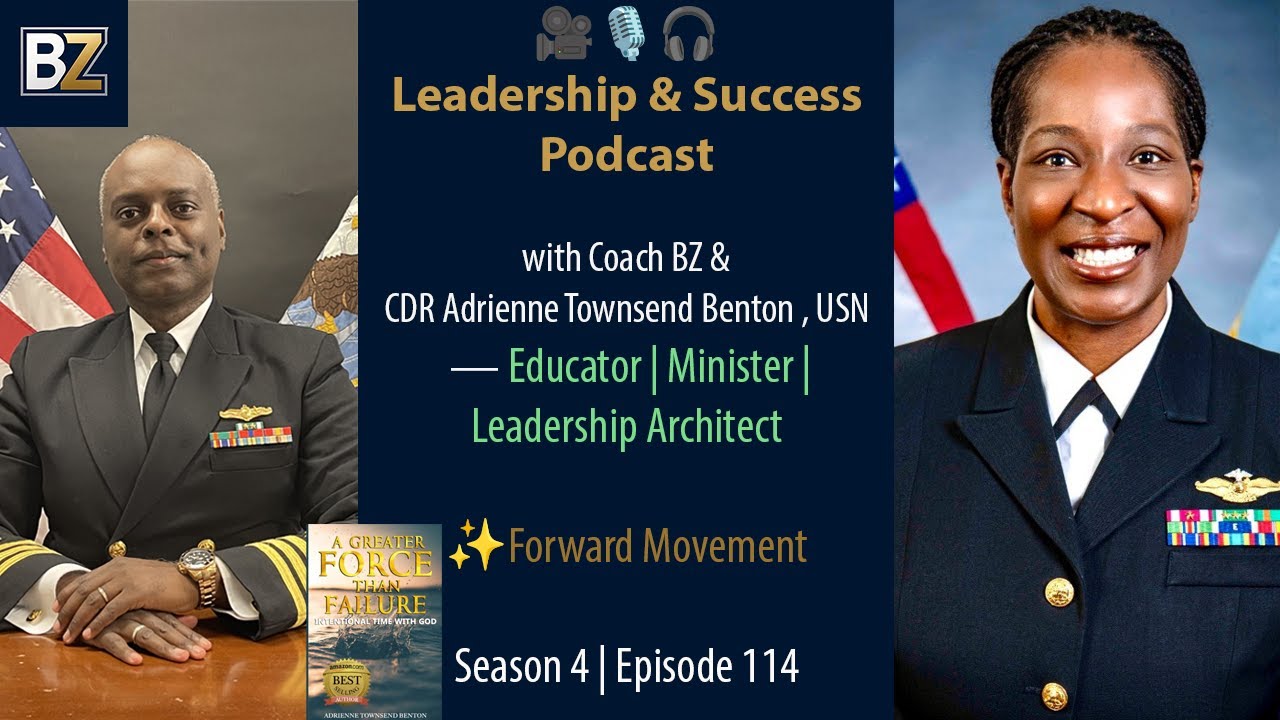
Commander Adrienne Townsend Benton, a U.S. Navy chaplain, discusses her path from teacher to military ministry and what chaplains actually do as moral first-responders. She shares practical tools for suicide prevention, the 988 crisis line, and a reset technique called 5-15-5 that helps leaders stay calm under pressure.
Chapters
¡Hola!
Hi, I'm John Maxwell. When the top companies in the world are looking for trainers, speakers, and coaches, there's one name that stands above the rest, and that's Maxwell Leadership. Our certified team members have gotten proven results for companies all over the globe, and our reputation, I'm proud to say, is second to none. Some of our members have risen to the top of their profession, including the one you're going to meet today. I proudly introduce you to my friend, Bob Fabien Zinga.
Welcome to the Leadership and Success Podcast with your host, Coach BZ, where we help you lead with purpose and succeed with impact. If you're ready to grow into the kind of leader others want to follow, this podcast is for you. If you're determined to elevate your success and leave a lasting legacy, this podcast is for you. As my mentor, Dr. John C. Maxwell, reminds us, everything rises and falls on leadership. Our goal is simple, to inspire you, challenge you, and equip you with insights that can transform the trajectory of your leadership journey. Welcome aboard to Welcome to another episode of the Leadership and Success Podcast with Coach BZ.
A second career and thriving. That's how Navy Lieutenant Commander Adrienne Townsend Benton is living her life.
In today's military moments, we highlight a woman who's found a way to intersect her faith and her military career as a Navy chaplain. Brittany Jones has her story.
Lieutenant Commander Adrienne Benton started in the classroom.
Initially, I was an elementary school teacher, taught 7th and 8th grade and 1st and 2nd grade. In the midst of working on my master's in curriculum and instruction, I began to realize that there was a passion inside me that was yet unfulfilled.
And that led the Queens, New York native to ministry.
And as I just surveyed my life, I saw that when it came to doing ministry, that's where I really was passionate. So I left teaching and went into the seminary. Personally, joining the Navy as a chaplain, I had to exactly walk in the shoes of the other personnel in terms of learning how to walk and resolve conflict within yourself and externally. Learning how to not allow your fears to get the best of you.
And years later, Chaplain Benton knows she made the right choice.
Throughout the 17 years, I have had the opportunity to work specifically with our women, our female service members, and at various duty stations, we have been able to develop and create committees, symposiums, leadership opportunities for women, and that has been, I believe, my greatest greatest accomplishment to date.
She served incoming Sailors, thousands of students, staff, and the Marine community around the globe, now serving as the Senior Chaplain at the Naval Support Activity Charleston.
Is it ever challenging? Uh, yes, sometimes it's challenging because you really are walking this journey and you're taking time to meet people where they're at, right? That takes patience, that takes time, that takes sensitivity, empathy.
But those challenges Friends have helped decorate her in Navy and Marine Corps medals, and now there's an award created in her name that's given to the Marine who exhibits resilience just like her.
There's a brotherhood, a sisterhood that comes in this environment that you won't be able to get anywhere else. And again, I am absolutely honored to serve our country and to serve our community in this capacity. Brought to you by Navy Navy Federal Credit Union. Learn more about how we're honoring veterans at navyfederal.org/veterans.
Our members are the mission. All right, everyone, thanks so much for being with us early this morning. It's about 6:00 AM here in California, and I believe it's about 3:00 PM in Naples, Italy, where my guest is from. Before we get started, I'm reminded, let's do our moment of gratitude, right? Every time we meet, we want to take just one moment. It can take less than a minute to just be grateful for something every single day. So if you would, maybe close your eyes, put yourself in your happy place if you need to, take a deep breath, and think about one thing that you are grateful for today, right now. And I think today I am really grateful for all of the help available, right? Not just physical help, not just medicine, but also mentally and spiritually as well. People like the chaplain we're going to be talking to today who can really help you focus and help heal some of your wounds that nobody else can see. So I am very, very grateful for the opportunity and all of the help and tools and technology available out there and really speaking with experts like we are about to, who can really help you with your mental and your spiritual health. So for those who are watching live, if you'll please let us know where you are watching from and also let us know what you are grateful for. And finally, if you have a question for my guest, for the chaplain, please type it in the comment as well, and we're going to be answering your question live. So let me see if I can properly introduce our guest. So today we are going to really have a very insightful leadership conversation with Commander Adrienne Benton. And what I am going to say about her is that she's a transformational U.S. Navy chaplain, international speaker, Amazon bestselling author, suicide prevention trainer, and founder of Forward Movement Ministry. Man, is there anything that she cannot do? So today we are going to be talking about experience, her background, and really the wisdom that she shares, right? From flight line to the fleet, from pastoral care to suicide prevention, from teaching to ministry leadership, Commander Benton embodies resilience, conviction, purpose, and transformational leadership. So this is a conversation you do not want to miss. So ladies and gentlemen, please help me welcome Commander Adrienne Benton. All right, how are you doing today?
Fantastic! So glad to be here with you, Coach BZ.
What time is it there in Naples, Italy? Is it about 3:20 or so?
It's about 3:20 in the afternoon. Yes, I can tell you today is going to be a bright, beautiful day.
Wonderful! I'm sure you know this. No, this is the day the Lord has made and we are going to rejoice and be glad in it. I am— I've been so much looking forward to this conversation because even I've been in the Navy for 21 years now and chaplains have really played a crucial role in just my spiritual formation and mental health as well. Because it's very strange, when I went to boot camp, it was I think May 2005, I was very surprised of how God was present in the military boot camp, all of the prayers and all of that. But actually, very, very funny story. I should be letting you speak, but since you're here, let me just show you this. When they gave me my dog tag, right? I told them that I was a Christian. At the time, I felt like maybe non-denominational or maybe charismatic. But anyway, that's what I put on the paper. And when they give me my dog tag, it said disciple of Christ. I'm like, no, I'm not disciple of Christ, I am Christian. So, uh, but then I realized Jesus called his disciple, you are my disciple. It is not the world that says these people are Christian because they remind us of Jesus Christ. But anyway, it was just like an epiphany. I'm like, yeah, actually, I truly, truly am a disciple of Christ. But Anyway, I am so glad you're here. Welcome to, uh, the show. And maybe first question I'm going to ask: what are you grateful for today, Chaplain?
You know what, I tell you, in this climate in which we are living right now, I am thankful and grateful for peace of mind and sanity. That's what I am thankful for today.
Yes, that is so powerful. Peace of mind. Yes, I think we, we really need that more than ever. Wow. And is there something about you, Commander, that most people may not know?
Ah, something about me. Well, for those who know that I'm in the military, they won't know that I have been stationed in, uh, two countries twice. So I was stationed in Japan twice.
Which part of Japan?
I was stationed in Sasebo, Japan, and Okinawa. Actually, one time I was stationed twice in two countries. So there we go. Sasebo, Japan, and Okinawa.
Yeah, I've been to Sasebo and Yokosuka. I've never been to Okinawa, but Sasebo is kind of like a little village.
Yes.
They hardly speak English. I mean, it was nice, but I don't know if I want to go back there. But Yokosuka, that was one of the best assignments I've ever had. Wow, that is wonderful. Yeah, it's one thing about the military, really. You get to really go across America and around the world. I guess these are still part of the US, but I've been to Guam, Hawaii, but I guess they still consider Okinawa as missions there. Of course, Japan, and I've had a chance to go to Australia too, which was really, really fun. And I almost went to Naples last year toward the end of my deployment, but anyway, it didn't happen. But wow.
There's still time.
There's still time. Yes. And actually, there is Emilio Natalio who says hello from Port Florida. So thank you so much. And, uh, Emilio, let us know what you are grateful for and also if you have a question for the commander. So maybe you can take us through, uh, kind of your leadership story, how you got to become Commander Chaplain, uh, U.S. Navy.
Absolutely. So when I graduated from college, I became an elementary school teacher. But what's interesting is I clearly remember walking down the aisle to get my bachelor's in psychology, my bachelor's in elementary education, and I remember saying to myself like, this isn't it. Like, in my spirit, I just felt like there was something else, but I didn't know what that something else was at the time. As I started teaching, I taught, uh, for 7th and 8th grade for 4 years. I taught 1st and 2nd grade for 2 years. And so I remember, especially as I was turning the corner from 7th and 8th going into 1st and 2nd, I began to just have this hunger on the inside, like, there's something more, there's something more. But you know what, BZ, I always wanted to be a newscaster. I always saw myself being able to say good evening, but, you know, telling people what was going on in the world. So I made a decision as I was working on my master's in curriculum instruction that when I graduated with the master's, I was going to leave teaching and I was going to go into journalism. That was my big plan. Well, lo and behold, as I was working on this master's degree, the very last thing I had to do was the thesis statement. And so I went over to the school, and Bizzy, this is before we had the laptops, right? This is when you had to go to the computer lab and type up your paper, right? So I went to the computer lab and I was going to type my thesis so that I could graduate a week later. And, um, as I was on my way there, I decided to go into the cafeteria. And when I went in the cafeteria, I saw a professor. The professor started talking to me, and as he's talking to me, he says, you, you know, the call of God is on your life. And I was like, absolutely not, no, it's not on my life, you got the wrong person, you know. But as we were the conversation upset me so much I just started crying. The very last thing he said to me was, when you graduate with this master's, you need to leave here and go to the seminary and get your master's in divinity. And I said, absolutely not. I'm graduating with a master's, and if I go back to school, I'm going to get my doctorate degree. But let me tell you, in my heart and spirit, I knew at that moment that my whole world had gotten flipped upside down. I literally cried for about 4 hours, and then I said, okay, Adrian, get yourself together, because I had to finish this paper. And I said to God, I said, all right, here's the deal, I'm not doing anything. If you want me to go and get my Master's of Divinity degree, you're gonna have to make this happen. So I picked up my books, went to the computer lab, and as I'm walking, I decided I need to go to the restroom. I looked on the wall there was like a card that just happened to be swinging. When I went to look at the card, it was the very last lead card for the university that the professor had mentioned. I snatched off the wall. I was so angry. I was like, God, what are you doing? Long story short, I— for the next 3 months— so I went ahead and instead of— I was disobedient. I did not send in the enrollment card for the Master of Divinity. I'm sorry, for the Master of Divinity. I sent it in for the Doctorate of Religious Education. And the very last thing you have to do for that packet is write an essay of intent. Do you know, for 2 months, every time I sat down to write that essay, nothing. Like a complete blank. I heard God saying, so what are you going to do now? So I went ahead, I said, all right, I got the information for the Master of Divinity degree. Lo and behold, when I went to fill out the packet, when it came time to write that essay of intent, I wrote 5 pages. Wow. But I was still saying, I'm not doing this. So I packed up the package and I put it in the mail, and I said, God, I'm not doing anything. Do you know, exactly 7 days from the day that I put it in the mail— and it had to go from New York to Massachusetts— yes, phone call saying, congratulations, accepted into the seminary. I slammed down and I heard God say, what are you gonna do? And I gave away— I listen, life was good, nothing was wrong in my life. I gave away furniture, I gave away my car, I gave away everything, put my belongings with two friends in a U-Haul and drove to Massachusetts, Michigan, so that I could go and enroll in the seminary. And that began the journey.
That is really amazing. And then Once you got your degree, it looks like you got a doctorate. How did you make the connection with, uh, Navy?
I did not get the doctorate. I ended up being obedient to God and getting the master's degree. But here's what happens: the recruiters go to all of the— they go to all the different seminaries to recruit. All the branches do. And so I'm gonna make a confession here, right, live on here. I go to the Air Force first, right? So all the recruiters They come to the seminary, they have like a day where they do like a fair, and I was talking to the Air Force recruiter and he ignored me. Like, he paid me zero attention. But the Navy recruiter was like, oh, you gonna be a Navy chaplain one day. And I was like, and, um, and she stayed on me. Like, she stayed on me.
That's wonderful.
And through the journey, I began to realize that this is indeed what the Lord had for my life.
Wow, that is, that is really fascinating. And then Once you got your degree, did you go to, I guess, off, off, off a second school, right? Okay.
Yes, development school. So went to ODS, uh, then went to the next part, the Chaplain School, but basic leadership course, and then went on to active duty as an ensign.
Wow, that is really, really wonderful. That's one thing I really appreciate, uh, in the military they require you to have at least a master, Master of Divinity, before you are a chaplain, because especially in non-denominational churches, many people don't even have to really get any formal education whatsoever. They just feel like they have a call of God in their life and they start preaching and start churches and things. But it really makes me feel confident and good when I go see any chaplain in the Navy to know that they've actually gone through formal training and they absolutely know exactly what they are talking about.
Wow.
What a story. Man, so you've been an educator, a minister, US Navy chaplain, resilience trainer, transformational leadership coach. Man, is there anything you haven't done? What an adventure. So growing up in New York then, and later transitioning into ministry and the Navy, what key experiences you believe shaped the leader you have become today?
I love that question. You know, growing up in New York shaped me in ways that I didn't fully realize or didn't appreciate until years later. Growing up in New York, in New York City, it taught me grit, it taught me courage, taught me about diversity. All of my schools were diverse as far as ethnicities, ethnicities and culture, and it taught me resilience long before I knew that I was going to need these experiences to be able to impact others' lives. And, and my journey into ministry and the Navy took those raw ingredients from New York and refined them. Into leadership.
That is really, really fascinating. I must tell you, you guys really play a key role in the military, you know, especially in times of war and uncertainty. Uh, it's, uh, really nice to know that we do have chaplains, people we can go to and talk to about things that, you know, we may not be comfortable speaking with our friends or our chain of command. Like, I remember one, one time where I definitely needed to talk to my chaplain. It's when I was, um, assigned to South Pacific Sea, some of the USS Essex. We were going on our way from Japan to Australia, and one of our shipmates in our unit got bad news from their spouse. I think his wife was cheating on him or decided to get a divorce or whatever, but he really was very upset. And instead of asking for help, talking to a chaplain, he decided to just commit suicide. So he just kind of jumped overboard. It took us a while, but we finally got his body. And I looked at him, his skin turned from like white to like purple. I mean, it was very, very, very, uh, shocking. And, uh, with the help of the chaplain on the, on the ship, we were really able to kind of process that. So as a, as a chaplain, um, what do you tell to service members? Because I think in the military, it's probably one of the few function, jobs, industries in the world where we live, the sense of life and death is pretty much in the conscious of everybody daily. How do you kind of help sailors and Marines and all of the other service members kind of deal with that fact when they suffer great loss or when one of their shipmates or somebody they really care about doesn't make it.
Yeah, you know what, so a few things that I've learned about ministry, and especially in these high-pressure environments when we're dealing with loss. One, loss is universal. So one of the things that, you know, we strive to do when there was a unit that experiences loss is to level the playing field so that there's no comparison. Nobody's loss is bigger or greater than the other's loss. We are all experiencing loss, and you would be amazed at how that is such a great equalizer. And And what it does is it causes people to become empathetic with each other and patient with each other, because there is that grieving cycle. And everyone, especially when you're in the military, right, there are, you know, you, you have to kind of just pick and choose when can we actually stop. Yeah, it's not— and when something happens, sometimes that's not the right moment to stop and do a grief session, but you can still acknowledge We have— we are experiencing a loss right now, and this loss is important and it is valuable. That right there sometimes is enough in the initial moments to give the crew what they need to— okay, what do we need to do to, to just get things to a place where we can actually stop and pause? What, what's important right now? They're willing to go and do it. And then you come back and you give everybody an opportunity, whether it's in a small group with just that, that individual's department, or whether it's more collectively like a memorial service. You give everyone an opportunity, community, to come together and acknowledge the loss.
That's, that's really something. Let me ask you this as a chaplain. For those of us who are Christian, and there are quite a lot of Christians in the Navy, you know, the Bible says, uh, you know, thou shalt not kill. It's kind of like maybe an ethical dilemma I've always thought about because I joined after 9/11, right? So I've had multiple chances with Oliver Saylor being called to serve in Afghanistan. I work a lot of combat zones where you could defend yourself and protect your country and get to actually take a life. So we talked about loss on our side. So let me think about loss on the enemy side. So I kind of know it's moral, it is ethical, and it is legal. It was a just war. But for those who really believe in Scripture, again, knock on wood, I personally have never been in a situation where I had to take someone's life. But I guess theologically, how do you justify a Christian taking the life of an enemy? Combatant and how to kind of deal with that psychologically?
Yeah, it's a great question. So I'm going to be very honest with you. As a chaplain, my job is not to justify. So as I am encountering service members who are struggling with this, I take myself out of it. My goal and my role is to walk the journey with the individual. And so, you know, first we start with what is your value system? What do you know to be true? Because sometimes we have perceptions, sometimes we have traditions, sometimes we've been hold something and it's not necessarily theologically correct, right? And so my role is to just sit with that person. Okay, you tell me, what do you know to be true? What is your value system? What—
where—
what is the root of where you feel the tension, right? Because I could say and justify till I'm blue in the face, but when that person leaves, they have to go back home and their conscience and their spirit will totally remove what it is that I've shared with them. And will cause them to still wrestle. And so I invite every individual of faith, whatever your faith practice is, go back to the root of what scripture, of what your faith practice tells you is the moral code, and then let that and God be your guide.
That's quite powerful. Thank you so much. Because throughout my entire service, it's only I believe Jehovah's Witnesses are the ones who absolutely do not believe in serving in the military for any reason because of their moral code and their faith. I've always found that was kind of odd, but yeah, I guess everybody has their own viewpoints and code. Thank you. Thank you so much for sharing. So you have served Marines, sailors all over the world. We talked about the USS Tochiga in Sasebo, Japan. Marine Regiment in Okinawa and then Joint Base Charleston as well. So what has military service taught you about leading people in high-pressure environments?
That is a very good question. I love that because, you know, we, we, the military is a high-pressure environment, right? So a few things. Number one, it has taught me clarity creates calm. Clarity creates calm, right? One of the greatest lessons the military teaches is that clarity is a stabilizing force in chaotic environments. I, I look at, at leaders that I admire. One of the, one of the traits of all of the leaders that I admire is that they are calm under pressure.
Wow.
That doesn't mean that they have all the answers in the pressure, but they are calm under pressure, right? And in high-pressure situations, I've been taught people don't need more noise, they need clear direction and calm energy. You know, for us as chaplains We— one of the ministry that we provide is ministry of presence. I can't tell you how many times I've walked into a room and somebody will say, Chaplain, I'm so glad you're here. They're not asking me to say anything. They're not asking me to give a brief or make a decision. It's something about me walking into the room and just being in the room sometimes that sometimes helps the— okay, let's just take a breath. Let's breathe. It's a, it's a calming, it's a calming force, right? So as an officer, I learned quickly that uncertainty spreads faster than fear. As a coach, I see clarity gives people confidence. And as a minister, I see clarity gives people peace. All wrapped up in one in high-pressure situations. One more thing, I see that trust, and I've learned that trust is built before the crisis. I gotta clap on that one.
You have to say that again, please. Wow.
Trust is built before the crisis. You know, as leaders, many times when we find ourselves with our teams in crisis situations, right, we wonder, why aren't they following my direction? Why are they trying to do their own thing? Why? Because before this crisis moment where you don't have time to explain, where we just need to go forward and do, trust was not built. But I've seen with my own two eyes over 17 years that teams that trust each other Yes. Perform with a level of unity and confidence that cannot be manufactured under stress. People know how to move. They may not understand exactly what you're saying or why you're saying it, but they trust because that trust was built before the crisis.
Wow. And doesn't trust— I think it's probably one of the most critical elements of leadership, especially in the military, right? People are going to put their lives on the line. If they don't trust you, they're not going to follow you. But doesn't trust kind of Trust takes a long time to build, but then you can lose it just like that.
So, you know, trust, many times we will say it takes a long time to build. I think deep trust takes a long time to build, but not trust in its true authentic nature, right?
Wow.
So let me— one of the things that when I'm talking to somebody and when they come into my office, right, and we're, we're talking about— many times we'll, we'll talk about the fact that when I meet you You're already in a relationship with you, right? And I'll come back to that later on. And, and one of the things that I say to them is that when I meet you, you teach me how to treat you from moment one. You teach me how to treat you. And I'll say to them, when you came into my office, who did you know you were talking to? Oh, I'm talking to you, Chaps. I said, great. So when you come in, when you came into my office, if I said to you, if I had my head down and I was mumbling, just go sit over there, I'll be with you one minute, what would you start to think? And everything— oh, I would think, oh my goodness, this is gonna be the worst counseling session ever. I can't trust her. I said, in the initial moments you came here, I said, hey, good morning, how are you? Come on over and sit right over here. I'll be with you in a few minutes. I begin to teach you how this engagement was going to go. And so when it comes to trust, when we have our team, we teach each other whether that trust can be trusted or whether that trust is a facade.
Wow.
The deep trust happens over time, but that initial trust, it's moment by moment, every single day, laying a foundation.
That is powerful. So it really takes authenticity, and I guess maybe a sense of vulnerability as well. Wow, that is powerful. Thank you so much for sharing that. So what other misconceptions do civilians, even members of the military, about the role of Navy chaplain?
Do you have— do we have all day? Yeah, I mean, you know, there are several, um, I'll have to say. So one that you'll hear quite often, or we'll see just manifested even sometimes in the wardroom until we have an opportunity to kind of educate everybody, the officers we work with— many misconceptions are chaplains are only here in the military for religious services, right? Many times people look at me and say, hey, her only job is to run the worship service on the weekend, and outside of that, just walk around and smile. Like, I can't tell you how many people believe that all I do is walk around and smile all day, right? But that, that's only one piece of what we do as a chaplain. We are also a strategic leader in the emotional, the moral, and spiritual resilience of the command, right? We're embedded with the unit. We're on the decks. We're in the field. We're underway with the crew. We're listening to the sailors, the Marines, the Coast Guardsmen, who might never walk into the chapel, right? We are a moral compass and emotional first responders for the command, regardless of religious background or lack thereof.
Wow, that is really powerful. And I also think some sailors are not really aware, fully aware of all of the services that you guys provide. For, for example, once service you do, credo, I believe you were a commander for your region. I remember when I was being deployed, the Navy paid for everything free. We spent 3 days in beautiful Monterey. I was there with my wife. It was kind of like a marriage seminar, helping us really anchor our relationship in trust and knowing that I would be going away for a year or maybe 2. But I think you guys really offer a lot of services that some sailors may just not be aware. Can you tell us a little bit about some, some of those services that, uh, the Chaplain Corps offer freely to any members of the military?
Absolutely. So all chaplains, we have confidentiality that we are able to provide. That's 100% confidentiality. That means that we'll go and talk to a chaplain, the chaplain keeps that conversation sacred.
Wow.
And so, you know, sometimes we need a place and a safe space to just be able to process. It doesn't always have to be terrible, devastating life, right? Sometimes you just need a safe space to just be able to process. And you can do that with a chaplain. Sometimes you are experiencing a devastating loss, and here is a chaplain that is available to walk the journey with you. It's your journey. It's not ours, but we are here to walk the journey with you.
Man, I really love the emphasis you made about walking the journey, not trying to use theology or anything else to change people's core values or mind, but just giving them that space. But let me ask you, is there an exception to the chaplain-service member confidentiality when someone is thinking about imminently hurting themselves or hurting somebody else?
No, no, it's 100% confidentiality, right? You know, all chaplains will tell you that we are professionals, and so we know how to stay with you and journey with you until we are able to get for you, right? So somebody come tell me they're about to commit suicide, you know, I'm not going to leave them, but I can't tell others, you know what I'm saying? Unless they give me permission, I can't pick up the phone and say, hey, listen, I got BZ who is here, he's ready to kill himself. Like, yeah, because that person—
wow—
if they have asked for it, they have that confidentiality. But as a professional, I know how to journey with the individual to get them that they want.
That's a really, really tough job. No, Thank God for people like you because we really need it, especially in high-pressure environment in the military. Now, as you know, I started the show, I said, no, there is pretty much a, I think, epidemic of suicide in the military. 21, 22 veterans commit suicide every single day. What are some of the tools for the people who are listening right now that might help them kind of cope with their mental health and and really improve their mental standing?
Absolutely. So one, it's having an understanding that life is full of challenges. If you are alive and we are human, right, we're breathing, a challenge is going to come your way almost every single day. And the reason why I start off there is because sometimes we can become very— um, what's the right word— sometimes as we're living through life we don't always take things as seriously as we should in terms of really seeing what is true about a situation, right? I call— we have thinking stinking sometimes where we make up and we create stories about something. We— and, and yet when we stop to understand that I'm human, there are things that are going to happen. My car will break down while at the same time the command wants me to go on an exercise while at the same time My father is in the hospital. Like, these things happen, right? But it's also important to remember that we have been blessed and gifted with a mind that can be stable. And so initially, when you find yourself in these challenging situations, you want to ask yourself, what is true about this situation? What needs to happen? What is priority here? And what do I need for resolution?
Wow.
When you answer those questions, all of the answers may not initially be at your fingertip, but you begin to understand what can I control, what can I do, and what are the things that I need to ask and get assistance for. Maybe I need to talk to my mentor, maybe I need to get a coach like BZ, maybe it's at a critical place where I need to go ahead and I need to talk to the mental health provider. We have resources, we have community. Maybe nobody's around, it's late at night, and I need to call the 1-800 number. You're never alone. We are never alone. There is always someone in our community, in our environment, that's available to walk the journey with us.
Wow, that is, that is really powerful. And I know recently, uh, to even make it easier, the government, the military as a new number, right? Like 911 is— I believe 988 for those who need mental help, uh, right away and talk to someone, many times a chaplain. Well, that's, that's really one, one thing I really love about the service. The, the Navy, the military has put a lot of resources out there available to sailors and service members, but sometimes our junior enlisted folks just don't know about those services and the help that is available. So thank you, thank you so much for sharing. Yeah, because no, not gonna— would have never, never lost a person who was in my command that I was in charge of, but I've definitely had friends and shipmates and people throughout my career went to war and something happened to them, they, they never came, came back. But, uh, I think we worry a lot about our physical health, but I just feel like our emotional spiritual health is just as important, isn't it?
Yes, absolutely.
So as a spiritual advisor to commanders, how do you help leaders navigate morally complex and emotionally heavy decisions?
Yeah, that's a really great question, right? So as a spiritual advisor, my role is not to make decisions for commanders. My role is to help them to see the human, the moral, and the long-range impact of those decisions. Right. In the military, as leaders, we often face choices where every option carries weight: the well-being of our people, mission requirements, ethical constraints, personal values. And sometimes it can be confusing trying to figure out how to navigate through all of them. But my job, my role, is to create the kinds of space where a commander can slow down, breathe, hear their own moral compass again, and ask what is important, what is priority, what needs to happen, right? I help them think the second, the third order effects and help them to stay connected to our instructions, to our principles, to our morals and our values.
Wow.
That is really powerful. We kind of talked about suicide prevention before, but you are actually a SEFTalk instructor, assist trainer, and a long-time resilient advocate. I don't think every chaplain in the Navy is. What kind of drew you to suicide prevention work?
Listen, one, it's a part of our community. There's just no way to get around it, right? As much as we would love for everyone to remain resilient all the time, for us in the military, we know that it's not a matter of if, it's a matter of when. So that's one. And because that is the case, as a chaplain, it is my responsibility to sufficiently prepare and provide resources to train and to try to ensure that as much as possible, every service member has the opportunity to be mentally, physically, and emotionally— mentally and emotionally prepared for such occurrences. I also personally had a family member that took their own life, and I can tell you the impact was grave. It came as a surprise, right? I was younger at the time, so maybe that was a part of my surprise. But family members will tell you that no one really— no one expected it. I mean, was life tough? Were there challenges? Yes. But to the place and space where someone would take their own life in our family. And so as I grew up and saw the third and fourth order effects of it, it also has become a passionate mission of mine to do what I can to save a life, one life at a time.
Wow.
And what would you, uh, advise, uh, leaders or help them recognize signs of distress and intervene? Uh, I know, for example, I, I happen to have been a commanding officer when we were transitioning out of the global COVID pandemic, and I know one thing we kind of did— I pretty much called every member of my unit and I had every department head and leader, making sure that we are tracking their sellers, even just giving a 2-minute phone call to say, how are you doing? Is everything okay? Anything we can do to help? What would you advise sellers or leaders to kind of do to try to help and make sure everybody is moving forward?
Yeah, you know what, one thing I wish every leader truly understood, Bizzy, is that service members The service members who are struggling silently often are the ones that are working the hardest.
Hmm.
Often are the ones that are working the hardest to hold everything together. Many times we look at those who we see the outward manifestation and we fail to check on those who are holding it together. They're not weak, they're not engaged, they're not looking for an escape. Most of the time they're carrying emotional, spiritual, personal weights and they don't want to burden anyone with it. Best practices: normalize check-ins. You know, you talked about what you did with your command. To every leader, I invite you to normalize check-ins beyond performance. It's not just about how are you getting that job done, did you, you know, and the checklist. No, no, ask questions that signal genuine care, not inspection, like How are you doing? And, and really stop to listen to them.
Yeah.
Do anything this weekend that made you feel just— ah, that made you feel good? I mean, it's simple questions, right? Because many times when people find themselves in that space and place where they're done, part of it is that they feel isolated and disconnected. Not that people around them There's a disconnect with the environment and the community that is quote unquote supposed to be there for them.
Wow, man, that is so insightful. And of course, you've written a book, an Amazon bestseller, A Greater Force Than Failure: Intentional Time with God. It seems like, you know, I've looked in your background, you pretty much created this Move Forward movement. Which is so critical, especially in these days and time. So in times like this, a lot of us, especially in the military, right, we feel stretched, exhausted, and sometimes discouraged. So what practices would help us move forward without burning out?
Hmm, that's a really great question. One, I invite everybody to ask yourself some questions. Number one, Who am I? Many times we get lost because in the process of our roles or our rank, when we stay true to who we are, then that helps us to be authentic with who we are becoming. Did you hear me? When we stay true, when BZ stays true to BZ, then BZ is able to be authentic as Commander.
Wow.
Number 2, I invite every leader to slow down to a sustaining speed. Now, you may be in a mission, you may be on deployment where you gotta go, go, go, go, go to meet the mission, but internally you can put the pause. What does that look like? Before you go to sleep, turn the phone off, just, just 10 to 15 minutes of silence or 10 to 15 minutes of what connects you to you. It could be music for some people, it could be writing in a journal where you just kind of debrief the day and get out those things that would cause you to toss and turn and sleep. You, you've got to slow down. Sometimes, leaders, it looks like when somebody asks you a question, rather than opening your mouth and answering right away, do a 10-second pause.
Mm, wow.
And then you answer. That pause gives you an opportunity to respond based on fact, not on feeling. There's a 5-15-5 reset that we invite people to do. 5 minutes, breathe and detach from noise. 15 minutes, identify the 2 top priorities that are important for you to engage in in that day. And then back to 5, 5 minutes where you recommit to what is the next step. We call it the 5-15-5 reset.
Wow. I think this is really worth the price of a ticket right there. 5-15-5 reset. That could potentially really transform your life, not just in the military, but in the industry as well. Because it's true, it looks like the world is moving so fast. Especially now with emerging technology, AI, and everything that's happening, the news and all of that. People kind of get crazy and they kind of lose focus. It's just overwhelming. But, uh, slowing down is so important. Wow, thank you.
Can I just say one more thing real quick?
Please.
You know, to all the leaders out there, I want to remind you, as I remind myself, rest is not a reward for leadership. It's not a reward, it's a responsibility. Why? Because you and I cannot cannot pour from an empty cup. And when we pour from an empty cup, you know who feels the weight of it? Our people do.
Wow, that is so powerful. Definitely a different way to look at it. I mean, I feel like I could be talking to you for hours and hours, but we only have about 15 minutes left. Let me see, uh, let's talk a little bit about forward movement. So you are a, uh, transformational leader, and you help a lot of the Commando set. You are also a certified coach with RBLPT trainer. And I mean, you pretty much done everything, but let's talk about forward movement for just a minute. Such a powerful philosophy. When did that message kind of first take root in your life?
It's actually years ago. For many years, even while I was in undergrad, I was blessed to be able to do a lot of inspirational speaking. Preaching sometimes and inspirational speaking. And I always found myself speaking about formation or development. How do you develop your identity? How do you develop your mission statement, your value system? And one of the things I realized is that many of us, it's not always that we don't know what the next step is, it's having the courage to move forward. Ah, so from out of that was birthed Forward Movement Ministries, where I found myself doing seminars workshops that would enable people to be able to stop again, understand who am I, what is my calling, what is my mission statement, how do I bring that all together in the micro as far as what— how does that guide me in my day-to-day interactions, and then how does that guide me in the macro as far as now how do I have impact for the world with who I am moving forward.
That is simple but so powerful. Wow, man, really the impact you are having, I mean, I think it is really, really huge. So I think what I will do, because I don't need to ask you the 7 types of questions I ask every leader who comes on the podcast, but maybe if you can share just one. Can you share one transformation story from Forward Movement Ministries that still moves you deeply today?
Oh my gosh, yes. I went out to speak at a women's retreat not too long ago, and we were talking about identity. Who are you? And, you know, I shared with them again, when I meet you, you're already in a relationship with you. If you don't understand the relationship that you have with you, then the relationship that you have with me, with the neighbor, with everybody else is going to have holes in it. Why? Because everybody's interacting with you through your mask. We were there for 3 days, and, and we were just, you know, having multiple sessions. And in the sessions we always have group discussions and, and give people an opportunity to share. And at the end of it, there was a lady who came up and she was just in tears, and she said, I have been stuck for so long, and I was blaming everybody else for being stuck, but I realized over these two days that it was me. It was me living a life of fear. She was afraid of success. She was— listen, I know that there are leaders out there that can identify. I can. She was afraid success, and that what was holding her back. But as a result of engaging with our Forward Movement community and being able to stop and ask authentic questions and have the courage to answer them, she was able to see and find the keys that she could use to be able to walk forward.
Wow, that is so powerful. All right, so the second half of our show, I think I only have about 10 minutes. I think we can make it happen. Let me ask you this. What do you think is the greatest lesson you have ever learned within life, in leadership in general?
Wow.
Purpose is not earned, it's revealed.
Wow.
Purpose is not earned, it's revealed.
Right.
And for persons of faith, I believe that God reveals to us what is our purpose when we take time to be quiet and listen and ask. He reveals it in our relationship with him. He reveals it in our relationship with nature. He reveals it in our relationship with our community. Your purpose will be revealed in every conversation and how you interact with the world. I am a developer. It took me years. I did an assessment recently, and, and that actually put a name to what I saw.
Wow.
I get in the space, I'm always seeing something Okay, I see, I see. As soon as I see it, I see how it's fixed and how it can be better. Sometimes I miss the details of how we're gonna get there, right? But it wasn't earned. I didn't earn that purpose and calling. It was revealed, right? In the Bible they say your gifts will make room for you.
Yes.
You don't, you don't have to be jealous of anybody else because every single one of us has a purpose. We all have gifts. Stop stop, be quiet, ask God, and then just watch. Watch what is natural to you. Watch what moves you. Watch what calls you. Watch what pulls you. That's your purpose.
Wow, powerful, powerful, man. So many wisdom nuggets in this episode. I'm gonna have to listen to it myself again. But thank you so much. So, uh, what do you think is the greatest leadership advice you've received so far?
That is a good question. Um, boy, guess leadership advice. Um, you know what, I think the best leadership advice that I have been given so far is to not to shrink to make others comfortable. Don't shrink back to make others comfortable. One of the biggest lessons, right? And what do I mean by that? You know, I had a mentor that said to me— again, it goes back to Who are you? And when you understand who you are and what you bring to the table, you don't have to be conceited, but you can have a quiet confidence. And if there's somebody else that does not appreciate what you bring, that's on them. That's not your responsibility to shrink back or to fall back because they are not comfortable. As long as you're operating in integrity, right? And you're operating in peace, you continue to live and be you. Can I share one story with you real quick? I know, I think, I think many people will be able to relate to this. Is one of my signature stories when I'm doing, um, one day I believe God that I'm gonna do a TED Talk, right? This would be my signature story. Let me tell you that in my first duty station, I was a brand new Lieutenant Junior Grade. I was assigned to Marine Corps Air Station Beaufort. I was the, the, the Deputy Chaplain there. My command chaplain in '05, he went to all of the big meetings, right, with the CO and everything. I, you know, I did the tactical, the, the tactical things. One day he said to me— my name was Townsend at the time— Chaplain Townsend, I will not be able to make it to the CO's meeting. I need you to go. I was so excited. Why? Because I'm gonna be with the big people, right? So, you know, in the military, if you show up on time, you're late. You're late, right? So 15 minutes early— I was there 30 minutes early, BZ. I was so excited. I'm looking sharp, you know. I was— listen, everything was good to go. I walked in the room, people were, you know, just chit-chatting because we still had some time. I said to them, hey, where does the chaplain sit? He said, oh ma'am, right over there. I went, I sat down, I'm in the chair, nice chair. I'm just— I'm feeling good, right? A warrant officer comes in, he sits down next to me, and he says— and we're talking— he says, you know what, ma'am, I think you're going to be very successful in the military. I want to tell you something that's going to set you up for success. Put a pin in I want to say this. I honestly believe that he believed that what he was saying to me was really going to set me up for success based on his experience. All right, I said, okay, tell me, you know, what is it you want to tell me? He says, listen, every room you walk in, you have 3 strikes against you. I said, 3 strikes? I'll be quiet for a minute because you and everybody that's watching right now You already know what those strikes are, right? The one— you're a woman. Number two, you're African-American. Number three, you're a chaplain.
Hmm.
BZ, I sat back in that chair. I can't do nothing about the fact that I'm a woman. I can't do nothing about the fact that I'm African-American. And, and I'm not going to do anything about the fact that I'm a chaplain. But what What do I do now? He literally burst the balloon that I walked into that room with. Now instead of being— listen, I was ready to brief the CEO, I had my notes. Instead I sat back. Now I'm wanting to get out of the room. I didn't want to call on me. They called on me. I said what I had to say very quickly, no feeling, no emotion, no nothing. Let me just hurry up and get it out. Why? Because now I'm processing the encounter thinking everybody's looking at me and seeing 3 strikes before they see me. Unfortunately, I spent my first year and a half as a naval officer believing that stinking thinking. I missed out on opportunities because I was afraid to encounter people. I missed out on things that could have really blessed me. I just missed out on so much until one day One day I said, this is too heavy. I am absolutely miserable trying to think and overthink these strikes. I talked to a mentor who said, wait a minute, I need you to understand something. Those three things, that— those are not strikes. You know what, BZ? I had to come to realize that those were not strikes, those were opportunities. I am a woman. Every room and space I go into, I bring a different perspective. I am African American. Every room I go into, I bring a different perspective. I am a chaplain. Every room I go into, you want me to be in there because I bring a different perspective. And once I realized that, then that changed how I perceived me and how I perceived being able to walk forward as a leader.
Wow.
Wow, that is so powerful, powerful, powerful story. Whenever you get your TED Talk, you need to come back here. We're going to play it and talk about it. But that's so deep. That's really what I love, all of the wisdom you've got throughout all of your experiences. You've been, like I said, an educator, a chaplain, a minister, pretty much a life coach, transformation leader, on and on and on. So all of the successes you've had in life, what do you think is the secret of your success? Actually, before you answer that. When you said do not shrink, right, to make others feel comfortable, I was reminded of a quote by Marianne Williamson when she says our deepest fear, just like the lady you mentioned earlier, is not that we are inadequate, but our fear is that we are powerful beyond measure. It's our light, not our darkness, that most frightens us. We ask ourselves, no, who am I to be brilliant, to be gorgeous, to be talented, to be fabulous? Actually, who are you not to be? You are a child of God. That's powerful. And we try to play small when we really should not. Like Jesus says, let your light shine and be the salt of the earth. I think that is so, so powerful. If that's the only wisdom people get by watching this podcast, again, it is worth the price of admission. Thank you so much. So what do you think, Amanda? What's the secret of your success? Why do you think you are so successful?
You know what, it's a, it's an everyday, you know. So tomorrow I can't go off of today's blessings. Every day I have to, I have to anchor my identity, anchor my goals in God, not in my opinions, not in my feelings. And so every day I strive to write down 3 things that God says about me, or I remind myself as I'm getting up in the morning, what are 3 things? God says that I am strong. God says that I can be loving. God says that I am the head and not the tail. God says that he will watch over me. God says that if I have a problem, I can ask him. Ask and you shall receive, right? Seek and you will find, right? So I remind myself, what does God say? And I revisit them throughout my day. And before I have to make any major decision, or before— I've learned this— before I am going to go into any difficult— what, what, what should be a difficult meeting, I pray, God, I'm asking right now that you will send your spirit into that meeting. You know hearts and the minds that are in there. I'm asking that you— whether they practice serving you or not, I'm asking you will tell them what they need to know and understand concerning me, and I'm asking that you will give me wisdom. Sometimes we get ourselves in trouble because we don't listen. We talk, talk, talk, talk, talk, or we're listening to respond. But I always ask that God help me to listen and have supernatural hearing and discernment so that after talking to me, I can understand what are they really saying to me, and at the same time I can hear your voice saying to me This is how you need to answer. Or matter of fact, Lord, shut me up and you talk through me.
Wow.
That I would say is when we talk about success, that is the anchor of any good that anyone is ever to see through my life.
Wow.
That is so powerful. A Greater Force Than Failure, Intentional Time with God, Amazon bestseller. Everybody needs to get a copy. So Chaplain, what are you learning right now?
I love it. I'm in a high-pressure, uh, billet right now, and honestly, exactly what I just told you, that's what I'm learning right now. I'm learning to practice the pause. Practice the pause in terms of there are sometimes when it— the pressure was mounting, I get up from my desk and I go outside for a 10-minute walk. They say that when you find yourself angry, frustrated, lonely, sad, or whatever, if you do a minimum of 10 to 15 minutes of some sort of cardio, that pushes away the negative endorphins and brings forth the positive ones, right? Practice the pause. I read an email, I am learning. There's Commander Kimberly Kane who told me very recently, you know what, Adrianne, you don't have to answer every email as soon as you get the email, especially if it's an email that triggers you. And so I'm learning to practice the pause. And then last one, practice the pause for my own life. 17 years, I, through the military, have go, go, go, go, go, go, go. In this billet, I am asking myself, what do you need, Adrian? You need sleep. Guess what? That work, some of it will be this, and some of it you got to get done today. Others, it will be this. Go home and get some sleep. Go in the gym. Go out with your family. It's okay for you to enjoy life too. Practice the pause.
Wow.
Practice the pause. Again, the book, A Greater Force Than Failure: Intentional Time with God. Let's talk about failure for just a moment. I think it's really part of resilience, isn't it? I love this— one of my favorite CEOs gave it to me. Uh, on one side it says success, the other side it says failure, right? So to me, success and failure is two sides of the very same coin. How has failure shaped your life as a leader?
How has failure changed my life? Well, listen, One, I believe that everybody needs to understand we will all make mistakes. No one is perfect. You have to give yourself some grace to able to be able to make mistakes, learn— it's learning— learn from the mistake and then move forward. Failure has taught me, one, that I'm not perfect, but I am progressive. Failure has caused me to dig deeper. Failure has caused me to pay attention to things that I wasn't paying paying attention to before. Failure many times has allowed me to move because I was going in the wrong direction. It course-corrected me into a different direction. Failure is a part of our life. It's not that we fail, it's what we learn from it and how we utilize the lessons.
Wow, so powerful. Thank you. So, uh, who are some of the people that you follow, thought leaders, mentors that we should all know?
Listen, you started off with one, the one and only John Maxwell. I love John Maxwell. I have many of his books in my office. I start off most of my, um, most of my staff meetings on Monday mornings. We start off reading something from one of John Maxwell's books and we talk about it. Uh, the other thought leader, absolutely love Brené Brown, uh, Dare to Lead. I took that, that course recently with some staff— not recently, but a few years ago with some staff. And Dare to Lead, you know, being able to have tough tough conversations, I think, is one of those tensions that many military leaders from junior to senior struggle with— how to be able to have, to be daring and courageous in having tough conversations. And so those are two thought leaders that I absolutely love.
So if you could have dinner with 3 people, there could be anyone alive now, dead, or even mythical figure, who would you choose and why?
Ah, Queen Esther.
Okay.
Michelle Obama.
Okay.
John Maxwell.
Very good.
I would love those three.
Why, why Queen Esther?
Well, you know, I think about the— I think about the preparation that she went through, right? She was pulled away from her family. She's living in the, in the palace, right? And just, I think about the journey, the multiple transitions that she had to go through, the, the, the processing being taken away from your family. Then you're taken away and now you're put in the palace. Two different environments, right? And having to navigate in those transitions. Then you get accustomed to being in the palace and now you're placed in this situation where you have to make a tough decision that, that may end everything, right? And so I'd love to just sit and talk with her to know what was going through your mind. How did you process, you know, What were the things that were tough for you? What were the things that you held on as your value system to be able to do, you know, to be able to just be who you were, you know, and to let God through that situation?
Yeah, that's right. Because it talks about, no, maybe you were ascended to the queenship for such a time as this. And of course, as you know, the courage is one of our Navy core values, honor, courage, and commitment. And I think I think in times like this, we need courage more than everything else. What do you believe? Who are you? And what are you going to stand for? Wow, powerful, powerful, man. Uh, again, I could be talking to you over and over again. I think, can you give me like 10 more minutes and then we're gonna end? Man, I need to have you back. This is, this is awesome. I'm having the best time of my life here. Okay, let me ask you this then. Uh, what are some of the books that you've read that we should read as well? Of course, we want everybody to get a copy of your best-selling book, A Greater Force Than Failure: Intentional Time with God, available everywhere books are sold. You've already mentioned Dare to Lead by Brené Brown, and you mentioned— I call him Papa John— so John C. Maxwell, 21 Irrefutable Laws of Leadership. Is there any other book you would recommend?
Yeah, there's a wonderful book called— you may not be able to see it because I have my little green screen on— but a great book called An Unhurried Leader by Alan Fadlen. It's a really great book. He argues that truly effective leadership doesn't come from kinetic energy, restlessness. Instead, it flows from an unhurried life. And an unhurried life, this perspective is one that's rooted in God's presence, God's grace, and then thoughtful engagement with those we lead. And this has been, especially in this season of my life, this has really been very pivotal for me because it has been inviting me to cultivate the inner rhythms of rest and relaxation— not relaxation, Reflection, rest, reflection, and also listening so that my leadership becomes a presence that influences rather than an urgency that pushes. And man, this has been really impactful for me in this season. I just came in contact with this book recently.
Wow. That's by Alan Falding, right?
Yes. F-A-D-L-I-N-G. Falding.
Wow. That is really powerful because that's part of the reason why In the show, we really love to read because I think books have changed my life. I was 17 years old where I started asking questions like, you know, what is success? How to be successful? What is leadership and how to lead? And I've read over 2,000 books since I was 17 years old. And I believe this is a book you just mentioned, An Unhurried Leader: The Lasting Fruit of Daily Influence.
Wow.
Thank you. Thank you. Thanks so much. Because really, in my opinion, for a book, you pay $20, maybe $30 for a book, and you can read in an hour or maybe a couple of weeks or months the lifetime's wisdom that it took someone to come up with this conclusion. It took them an entire lifetime to come up with this wisdom and this principle, what worked, what didn't work. And in just, you know, a few pages, you can learn from their mistake or from their success. So it is, it is so, so critical. Thank you so much for sharing. So let me ask you this, is there maybe a song a book or a movie that would be your life's theme or anthem?
Oh man, that's a good one. Um, songs, let's see. There's two songs. They're not Christian songs, but, um, one is No More Drama by Mary J. Blige. I absolutely love that, you know, especially when I'm dealing with situations. I'm just like, nah, we can't do that, no drama. Um, I'm Happy by, by Pharrell. So I'm happy, you know, I just, I try to live my life walking forward with positivity. And then from a Christian perspective, 'Tis So Sweet to Trust in Jesus. That is one of my hymns that I sing on a regular basis, um, as I'm walking through life, you know, trusting in God is what holds and grounds me.
That's really powerful. Yeah, the, uh, the Happy song by Pharrell, it reminds me of the Smile song song by Kirk Franklin. Uh, yeah, I could be listening over and over and over and over and over again. Yeah, part of the reason why I asked this too, because, um, people who watch the show now know I've been playing the piano since I was 7 years old, but I feel like music is so powerful. It looks like every milestone, every important event in anybody's life, there was a soundtrack to that. Like, I remember where I was at 9/11, and there's certain music I listen to, it takes me right back to, to where I, I was Every victory, every time you conquer something, but even when you fail or you are learning and you are sad, there is music, something that really lifts you up, that inspires you. So I always want to get that emotional connection with my guests if I can. Thank you. That is powerful. Okay. Let me ask you this. If you had a magic wand, let's say you wake up tomorrow morning and you could solve any problem, problem? What is one problem you would like to solve?
Well, I see, I would love to solve world hunger. Yes, I would love to solve world hunger so that everybody just had what they needed, basic support that they needed to be able to live. And I think that that also would help to restore dignity to many women. No one should go to bed hungry. No one should wake up hopeless. This, right? A world with fed bodies and nourished souls is a world that I pray for.
Yes. And I was born in Africa where I grew up over there more than any other place in the world. Many children don't really know where the next meal is going to come from. And that is not right, but that's the world we live in. And especially recently with the government shutdown and SNAP benefit being turned off and stuff. I was just thinking America is the most powerful country in the world. How can we have 40+ million people on SNAP benefit? Meaning if the government doesn't help them with their food insecurities, they're not going to be able to make it, especially children. How is that possible? I started thinking when I was growing up, this is kind of like the world upside down because usually people in Europe, in America, they always, or at least we used to, with USAID sending help and food. To those poor kids in Africa. But this is like the first time in history where an African kid might be saying, hey, we need to pray for these American kids, they're gonna die of hunger, their government decided to shut down and not give them SNAP benefit when there's always been SNAP benefit at every shutdown in our history. So, but, but anyway, it's very, very, very, very sad, uh, to miss hunger and homelessness too, especially for those who have served in the military. I think it's really a sin. It is a big blot on our countries when people who have served and, you know, put their life on the line for America, and they don't even have a place to call home today. But anyway, thank you, thank you for sharing that. Uh, if you had one and only one day to live, what would you have liked your final contribution to be?
What would I want my final contribution to be?
Be?
Oh, that's a really good question. Um, what are my final contributions to be? You know, I would want my final contribution to be that, um, people's lives were impacted by coming in contact with me. And that's on every level. They were able to think clearer. They were able to go deeper in their faith. They were able build successful businesses. They were able to move forward in their marriages and their relationships. I would, I just, I would want my contribution to be that I just helped to develop and change the world one person at a time.
Wow, that is so powerful. I think it was Oprah who said, "People will forget what you told them, but they're never going to forget how you made them feel." And as a chaplain, I must tell you, you and all of the members of your corps, you really had a huge, huge impact impact on service members, uh, because I actually— I don't even think I would be where I am today if it wasn't for the help of the chaplain in the Corps. So thank you. All right, we are coming to, uh, the end. You've been so generous with your time. Sorry, we went over already. Looks about 12 minutes, but I'm so glad you are here. I could talk to you for hours, but how can we add value back to you?
Ah, that's a wonderful question. Thank you so much. So you can reach out to me on LinkedIn LinkedIn, I have Adrienne Townsend Benson, is my main page. I am starting now a company called Mobilizing with Impact, Mobilizing with Impact Forward Movement Ministries, and a podcast that I do, a leadership podcast that I do every Monday and Wednesday, are now under the umbrella of Mobilizing with Impact. It would be great if everyone listening and watching could go to Mobilizing with Impact on LinkedIn, become a follower, and then engage in conversation. You also can find me on YouTube. I'm looking to grow the YouTube channel, so if become a subscriber on YouTube. You can find me with Adrienne Townsend Benton on YouTube. And then my website, Forward Movement Ministries, that right there is where you'll be able to find different resources. I am in the process of rebranding, uh, the umbrella will be Mobilizing with Impact. And listen, let me tell you, there are some great things that are coming in December and January, so you want to subscribe and follow so that you can be a part of our ever-growing leadership community.
And you also have a Transformation Station Leadership Podcast, right? People—
yes, yes, we are now in a new season. Last week we had a week where we interviewed all military-related personnel, but every Monday and Wednesday it's at, um, 12 PM Eastern Standard Time, and then also at 4 PM Eastern Standard Time on Mondays and Wednesdays. We interviewed leaders that help us to be able to move forward in our leadership development.
That is so wonderful. And I know one of the leaders that you interview, I consider him one of my mentor, shipmate, and friend, Commander— actually, Captain Select Desmond Walker. Uh, there's an incredible, incredible man.
Uh, yeah.
So every— everyone, again, uh, go to, uh, LinkedIn and, uh, follow Commander Benton, right? LinkedIn.com/in/AdrianBenton. And, um, go to, uh, forwardmovementministries.org. Then you're gonna have access to our YouTube channel, uh, podcast, and all of the great things she's doing for the community. Thank you. Thanks so much. So we are pretty much at the end. So let me ask you what I believe is the most important question of the podcast. So think about this. If you could go back and give a piece of advice to your 17-year-old self standing at the edge of this incredible career you've had, what would you say to 17-year-old Adrian Benton. And remember, I told you I was 17 years old when I came to this country, and I had all of those big ideas, but I had no idea how to go from point A to point B. So really, this question is for me. What, what would you tell 17-year-old Adrian Benton?
Man, I would tell that 17-year-old, believe in yourself. Believe in yourself. Believe in yourself to be unafraid to step outside of your comfort zone. Long enough to discover who you really are.
Wow, that is powerful. Powerful. Yeah, because sometimes people say, if I had just known then what I know now, what would I have done differently? Thank you. Thank you. Believe in yourself. That is so powerful. Okay, so to end the show, this is going to be really, really quick. It's going to take less than 2 minutes. Lightning round, right? Rapid fire. Don't take too long to think. So, uh, one word that defines great leadership. One word.
One word? Uh, confidence.
Confidence. Okay, very good. What is a morning routine or practice that keeps you grounded?
I start off my day in prayer and in quiet meditation.
Very good. And, uh, one book or one quote that changed your life?
Champions don't panic is the quote. And one book? A Greater Force Than Failure. Intentional Time with God. No, uh, Dare to Lead by Brené Brown.
That is so powerful, especially when you are in command, especially in the Navy. With everything happening, as a leader, you really don't need to panic because people are going to follow you, right? So you need to be calm in the midst of this, of the storm, and set the example. And that's— that is so, so powerful. Okay, uh, who inspires you the most today?
Oh wow, there's so many people. Um, as far as like military personnel, I have a Captain Yolanda Gilland. Is one of my mentors, um, who I really lean on.
Shout out to Captain Gillan. Wow.
Yeah, she is absolutely amazing. Colonel Marina Foster is another one who's absolutely amazing. Captain Robert Peters, Captain James Dance.
We're gonna be staying here all day, but, uh, bravo zulu to all of them. Yes, that is really the, uh, secret of success, is until— even when I look, look back at my life, I became a seaman recruit 21 years ago, October 2004. Today I am a senior officer in the most powerful navy in the world. I didn't do this alone. I really stood on the shoulders of giants. So many people have helped me. And really, you know, it is incredible how you can be grateful for what people have done. And many times too, I realize I can't even pay them back. There is nothing I can do to repay them. All I can do is just pay it forward, try to help the next generation of leaders, which is part of the reason why I have this podcast to try to inspire them and share all of the knowledge I've received in the last 21 years. But wow, thank you so much for everything you do. So we are at the very end. Ask you really quick, what did you want to be when you were a kid?
I wanted to be a TV newscaster.
Well, I guess with your podcast, you are broadcasting the good news out there. Okay. 3 adjectives describing you as a child.
3, um, 3 adjectives. I was quiet, um, kind, and curious.
As an adult?
As an adult, um, oh Lord, um, describes me as an adult, lovable, um, strong, and patient.
Very good.
Okay, this is actually, before I ask you this last question, is there a question I should have asked you, Commander? That I haven't asked yet before we end the show?
Oh, I think you did a great job.
Fantastic. All right, this is the very last question and then we're done. What is one word that represents our shared experience on this podcast today?
Epic.
Wow, thank you. I am always, always grateful and I am so glad for your time. Thank you for staying another 20 minutes over. Very sorry for that, but you have so much wisdom and I want to pick your brain. I think we should invite invite you back after you do your TED Talk that is, that is coming. So thanks again, uh, Commander, our chaplain. You really play a critical role in the national security of the most powerful country in the world. Thank you.
Thank you.
Thank you. Wow, people, you've added— I think this is going to be one of the most impactful episodes of the Leadership and Success podcast. So I'm very, very, very, uh, thankful and grateful, um, to Commander Adrienne Benton all the way from Naples, Italy. She took the time to come and talk to us today. Again, make sure to purchase her book, A Greater Force Than Failure: Intentional Time with God, Amazon best-selling offer. Wow, I love it. And also follow her on LinkedIn, website, YouTube, and podcast. And yeah, let's get engaged and help each other make each other better. So I'm going to be back here tomorrow, Monday, and I'm going to be talking with Bobby Umar, talking about TED Talk. Bobby Umar, I think he's had 3 or 4 TEDx TED Talks so far. He's the global voice of heart-based leadership. We're gonna be talking about leading with heart. And Bobby actually helps people now get on the TED circuit. So, you don't want to miss our podcast tomorrow. And he's coming to us from Canada. And then on Tuesday, I'm gonna be talking to a fellow coach, Coach Astrid Meyer, Maxwell Leadership Certified Coach, just like me. She's in Switzerland. She's a founder, executive coach. We're going to be talking with leading with values. That's really what Papa John, Dr. John C. Maxwell teaches us. Values more important than everything else. And that's where we lead from. And from Switzerland. So she speaks French like me. She speaks English, of course, and I believe she speaks German as well. So that's going to be for tomorrow and Tuesday. That's all I have. And again, many, many, many, many thanks to Commander Adrienne Townsend Benton, educator, minister, leadership Architect Forward Movement expert. It's just been such a good blessing this Sunday to have a chaplain with us. So this is it. I will see you guys tomorrow. Thank you.
Thank you for tuning in to the Leadership and Success Podcast with your host, Coach BZ. If today's episode added value to your leadership journey, be sure to subscribe, share, and join us again for more more wisdom nuggets on how to lead better and achieve greater success. Remember, leadership is the most critical skill of our time. The world will always need leaders to inspire others, drive innovation, and execute meaningful strategy. So why not count yourself among the bold leaders shaping the 21st century? Until next time, stay inspired, stay committed, and keep leading with excellence.
More from Bob

S250:E4🎙️LIVE 🇺🇸America 250: President Barack Obama Leadership, Service, and the Power of Hope






S5:E157🎙️ LIVE with CMD CMSgt Dennis L. Fritz, USAF (Ret.)(Multi Tracks Audio)



S5:E156🎙️ LIVE 🇪🇸 Leadership Lessons from the FIFA World Cup 2026 Champions (Multi Tracks Audio)

S250:E3🎙️ LIVE Leadership Lessons from America’s First Documented Family of African Descent 🇺🇸📖