S4:E117AI RECAP🎙️ LIVE with Astrid Meyer (Multi Tracks Audio)
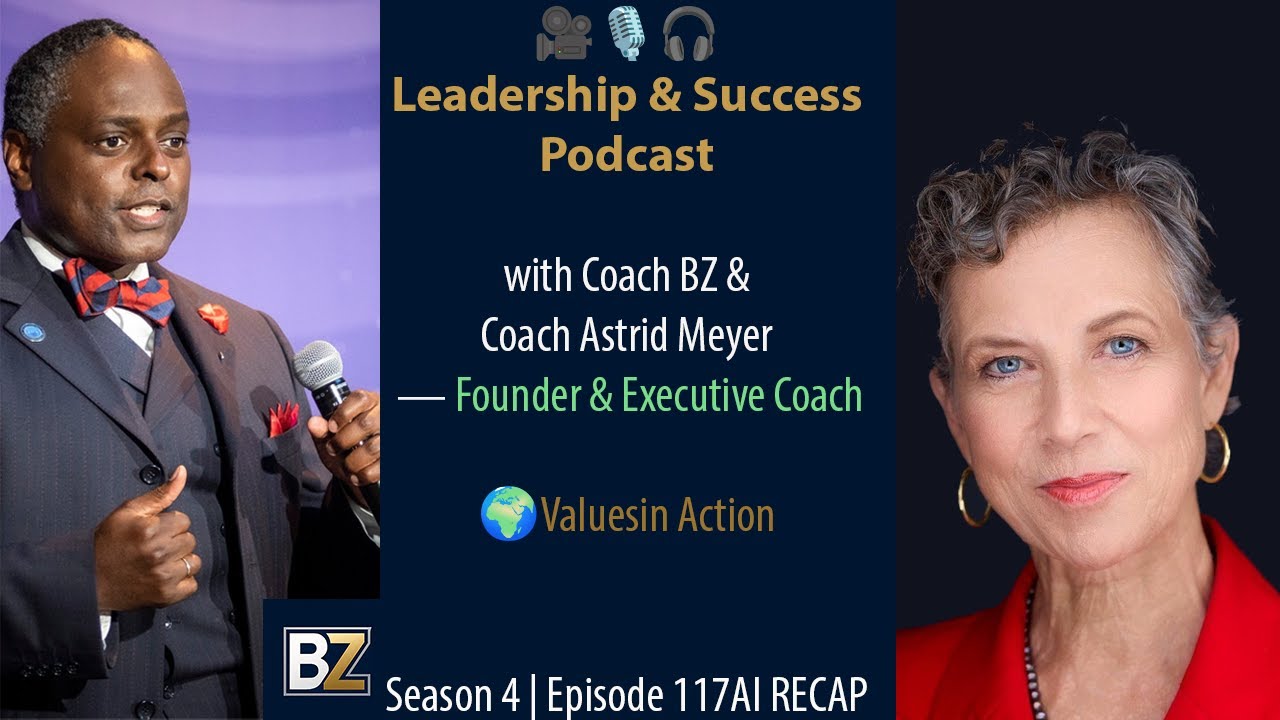
In this Christmas‑day episode of the Leadership and Success Podcast, host Coach BZ (Bob Fabien Zinga) and mentor John C. Maxwell introduce leadership coach Astrid Meyer. The conversation centers on values‑driven leadership, emphasizing that true leadership starts with self‑leadership – the "inside‑out" work of daily habits, mindset, and character. Astrid explains that leadership is not about titles or strategy but about living one’s core, non‑negotiable values (honesty, integrity, respect) consistently, turning values from decorative posters into a ship’s rudder. She shares a Costa‑Rica anecdote illustrating how awareness, vulnerability, and accountability bridge the values gap and transform teams. A personal health crisis (terminal cancer diagnosis) is described as an "X‑ray" that revealed, rather than built, character, reinforcing the need for steadfast values during turbulence. The episode also contrasts "success" (personal achievement) with "significance" (lasting impact through multiplying leaders), positioning values as the operating system that must be regularly upgraded. Astrid’s global, multilingual coaching experience underscores the universality of these principles across military, corporate, and tech cultures. The episode concludes with gratitude reflections, announcements of upcoming AI‑recap interviews (General David Petraeus, Captain Tess Tracy, etc.), and a multilingual rollout (English, French, German/Dutch) for future audiences.
Chapters
¡Hola!
Hi, I'm John Maxwell. When the top companies in the world are looking for trainers, speakers, and coaches, there's one name that stands above the rest, and that's Maxwell Leadership. Our certified team members have gotten proven results for companies all over the globe, and our reputation, I'm proud to say, is second to none. Some of our members have risen to the top of their profession, including the one you're going to meet today. I proudly introduce you to my friend, Bob Fabien Zinga.
Welcome to the Leadership and Success Podcast with your host, Coach BZ, where we help you lead with purpose and succeed with impact. If you're ready to grow into the kind of leader others want to follow, this podcast is for you. If you're determined to elevate your success and leave a lasting legacy, this podcast is for you. As my mentor, Dr. John C. Maxwell, reminds us, everything rises and falls on leadership. Our goal is simple, to inspire you, challenge you, and equip you with insights that can transform the trajectory of your leadership journey. Welcome aboard to another episode of the Leadership and Success Podcast. Podcast with Coach BZ.
So what leadership principle then transcends culture, languages, and, uh, it works no matter where you are around the world in your experience?
Um, yeah, I, I think when you bring leadership down to human values, it, it just, as we say in leadership, you add value. You are not taking the value. Or like John has in his last book, High Road Leadership, what is the difference from some kind of leadership, dominant, positional, or leadership as a leader of brings motivation, where is the level of leadership just so different. So mostly I think we can go there, up there, and kind, there are not a lot of people, for example, Politics. I don't say names, political guidance, but they are just fighting each other. They are not having a relation, no respect, and no adding value anymore. So if there is a problem up there, sometimes we cannot reach there anymore, so we just go down, down, down, down here. And on this level, okay, how can you live a life of respect. What does it mean? What is the benefit? Or how can your attitude change? Is it vulnerability or is it not being powerful? Why do we have so many bad understanding of values and human behavior? So when we go there and people become aware, oh, I don't have to be dominant to be respected. No, not at all. How works respect? And then they learn it and they improve it. And that's when they come back next week, we have always an action step to do. So it's really, um, in the, the being. It's not just the training or the doing, it's the being, the human being. And that being, the doing. Yeah.
Yes. And thank you so much for mentioning this book I wrote, Leadership, Right? Bringing People Together in a World That Divides. I think we need it now more than ever before. I've really never lived in a world where people at the highest level of leadership sometimes act like children, and it really makes me, you know, leadership sad. I think I've heard Papa John say that too. And we, I think more than ever before, today, right now, we really need people to be coached to live by their values, respect one another, treat everybody with respect and dignity, and really focus on the problem, right? Not be like children and attacking each other.
Wow.
So, I mean, we, we have so much to talk about, but let me ask you this: for leaders in crisis or in transition right now, whether they are in the military, in the corporate world, or high-tech, What are the first steps toward regaining clarity and confidence?
Become a friend with crisis and change. And that's what I learned by my study about change. And John Maxwell learned a lot about crisis as well. Change is the most stressful and difficult thing to go through. Change opens new ways of seeing. And as John says, a leader is not only somebody who knows things to do, but he sees more and before. And I think today we just need— how did you ask the question?
Going from crisis to clarity and confidence.
Yeah.
Yes.
To become Clarity. We need to know what happens in a change journey. And there is surprise. There is non-confort. There is learning there. You see, we have a wonderful tour in the corporate side of John Maxwell where we learn to go through crisis. Now, that's one thing, change. Then we have to find out what are the values we would never change them again. Values. Where are the non-discutable values? Even in crisis, we still be honest. We still will respect. We still. So I think crisis, we don't manage crisis because we have the powerful money or whatever, but Because in crisis, we know how to stay solid on our values.
Yes.
And even if it looks not the right thing to do, but if it's on our value side, we don't discuss about these values. We still stay honest, integrity, and all these things.
Even I think in Hello everyone, first of all, Merry Christmas all around the world. Wow, I can't believe it's already Christmas 2025. So the New Year 2026 is just around the corner. So again, from my family to yours, Merry Christmas and Happy New Year. Well, what are we grateful for I think for me today, it's really, really simple. I am really glad that I am able to see another Christmas with my family, my wife and my two kids. And I just read a post earlier this morning. Somebody said, no, someone didn't wake up this morning, so they will not spend Christmas with their family and friends today. So I am so grateful I am awake. Somebody else may have woken up, but maybe not in their right mind. And someone else may not have had running water, or even clothes to wear. And I am so grateful today. I am taken care of, in my right mind, in pretty good health, and especially spending time with my wife and my children. So I am very, very grateful today. So let us know in the comment what are you grateful for this Christmas. And, um, it really is a blessing, uh, and, uh, in a few days it's going to be, uh, of a brand new year. So I am very, very grateful for that. All right. So today we are going to have a 10-minute AI recap from the conversation I had with Coach Astrid Meyer. So we are going to do this in English. And right after that, I'm going to do it in my native French because Coach Meyer is from Switzerland where they speak English and French. But then for the first time in our history, we are going to have a podcast in German. Dutch. So that's going to be quite exciting. And if Coach Maia is able to show up today, I am going to ask her to talk to you for just a few minutes. I think it's about 4 PM in Switzerland right now. And we have a user says he's grateful for connection and warmth. Snow is coming. That is wonderful. I personally, I guess I kind of like snow after it has fallen, but I don't like cold weather too much. But yes, thank Thank God for snow. Thank you so much for letting us know. But it really is a very, very special time. And I do believe that things are going to get better. That is really what I believe. Things will get better and better and better. So I am very grateful for that. All right. So let's get started with the— oh, actually, before I do that, tomorrow I will be back here and we are going to have a 10-minute AI recap from the conversation I had with General David Petraeus. He's really one of a generation leader. So that's going to be tomorrow, the day after Christmas. And also I want to encourage everybody to follow Coach Meyer. So @astrid-meyer-rdv. Coaching100. That's where you can find her on LinkedIn. And also, if you get the moment, read the article I wrote about our conversation, our podcast, Values in Action: How Coach Astrid Meyer Leads Global Transformation Through Character, Courage, and Self-Leadership. Really, the main connection— I didn't really know her prior to recording this podcast, but our main connection, Coach Meyer and I, was our primary mentor, Dr. John C. Maxwell. It is really amazing how leadership is really a universal skill. We have people not just in the US, in Canada, in South America, but in Europe, in Africa, all around the world. Dr. Maxwell has personally mentored over, I think it's 80,000 coaches now all around the world, which is Pretty, pretty amazing. Okay, so let's start with the first 5 Minute AI recap. And please, as you listen to this, think about 3 to 5 takeaways and type those in the comments and let us know where you are joining us from and also one thing you are grateful for.
Thank you.
You know, what is the one thing that truly separates a good leader from a truly great one? Well, according to leadership coach Astrid Meyer, It's actually not about your title or even your strategy. It's all about winning the inner game. So in this explainer, we're gonna unpack her blueprint for leading with real integrity and courage, a blueprint that was forged through years of work all over the globe and one profound personal crisis. And it all kicks off with this simple but powerful truth: before you can even dream of leading anyone else, you've gotta lead yourself. The journey doesn't start out there, with your team. Nope, it starts right here, in the mirror. And this idea, well, it's the core of her entire philosophy. So that brings us to the first big principle: Leadership is an inside-out job. It's got nothing to do with making grand speeches. It's all about those small, daily disciplines. You know, the habits and the mindset you're building long before you ever walk into a meeting. It's the stuff you do when no one's watching. And look, this isn't some fluffy, new-age concept. This is a universal truth. Think about it. In the military, they have a saying: "You can't lead others until you can lead yourself." And in Silicon Valley, they say, "Your habits are your strategy." You've got two completely different worlds saying the exact same thing. What's going on inside of you dictates the results you get on the outside. Yeah, and Astrid just puts it perfectly here. This isn't the easy part of leadership. In fact, it's the hardest part. The real challenge isn't managing a team; it's mastering yourself. Your thoughts, your reactions, your emotions. That is the real work. So, once you start getting a handle on that inner game, something really interesting happens. You start to realize that real influence, it has nothing to do with your job title. It's rooted in something way deeper, way more powerful. It's rooted in your values. Think of it like a pyramid. At the top, you've got success, right? But everything rises and falls on leadership. And what does leadership rise and fall on? Character. Okay, so what's character? Well, it's just your values in action, day in and day out. This means your values—they're not just some nice-to-have; they are the absolute bedrock of everything you do and everything you build. But here's the catch, and Astrid is so right about this: there's often a huge gap. I mean, we've all seen that corporate values poster collecting dust in the break room, right? Her point is that a value isn't a word on a wall; It's supposed to be the rudder on a ship. If it's not actually shaping your behavior and guiding your decisions, it's not a value. It's just decoration. So how do you turn that decoration into a rudder? Well, Astrid tells this amazing story from Costa Rica. Instead of using authority or punishment, a leader there bridged the values gap with 3 simple steps. First was awareness—just recognizing there was a problem. Second—and this is the hard part—was vulnerability—having the courage to admit it out loud. And that one single act? It led to total transformation, rebuilding trust and changing the entire dynamic of the team. All right, this brings us to the real crucible, the ultimate test of leadership. It's pretty easy to live by your values when everything is going great, but what happens when it all falls apart? That's when you find out who you really are. And for Astrid, this isn't just a theory. This is where her story gets incredibly real and personal. At the absolute peak of her career, Her whole world was shattered by a crisis that would test every single principle she believed in and completely reshape her understanding of what it means to lead. Just imagine hearing those words: 2 or 3 months. All of a sudden, everything else just becomes noise. The daily grind, the little worries—it just evaporates. And in that moment of ultimate clarity, with everything on the line, you're forced to answer the one question that really matters: What is my life truly about? And here is the incredible insight she gained from that experience: "A crisis doesn't build your character; it reveals it. It's like an X-ray for your soul. It strips away all the titles, the success, the routines, and it shows what was really holding you up on the inside all along." And that is precisely why your values have to be a non-negotiable anchor. When you're in the middle of a storm, you don't start redesigning the ship. The circumstances around you will always change, but your principles, they can't. Honesty, integrity, respect—these are the constants. They're what keep you from being washed away. Okay, so with that internal foundation set, let's pivot to the outer game. How does all this inner work actually translate to having an impact on the outside world? How does a values-driven leader actually change things? Well, Astrid tells this great story about a time she was feeling distracted until a mentor hit her with this powerful challenge. It's a question for every single one of us, really. Is our vision for our life just too small? Could it be that a lack of a really compelling dream is the true source of our distraction? This leads to such a critical distinction: Are you chasing success or are you chasing significance? Success is often fleeting, right? It's about elevating yourself. But significance— oh, that's different. Significance is about elevating others. It's what creates a legacy that can last for generations. And that pursuit of significance leads to the ultimate goal of leadership. It's not about addition, you know, just gaining more followers for yourself. It's about multiplication, developing other leaders, who will then go on to develop even more leaders. That's how you build a legacy. Okay, so how do we tie all of this together? The inner game, the values, the outer impact? Maybe the best way to think about it is as your personal leadership OS, your leadership operating system. And this is the core idea. Your values aren't just some app you open occasionally when it's convenient. No. They are the operating system. They're the fundamental code that's running in the background of every single decision, every action, every word. They determine how everything else functions. So, let's quickly recap the big principles here. It all starts with leading yourself first. From that foundation, you anchor everything in unchanging values. Then you choose to pursue lasting significance over fleeting success. And that gives you the courage to truly lead and, ultimately, to multiply your impact by building up other leaders. Which really leaves us with one final, kind of provocative thought: If your values are your leadership's operating system, is it running the latest version? Or maybe is it time for an upgrade?
Welcome everyone to this engaging chat on values-driven leadership. Today we're diving into how one leader's journey challenges us to lead ourselves first and then add value to others. Absolutely.
It's remarkable how personal adversity and global experiences can shape a leader's philosophy, isn't it?
Oh yeah, totally. I mean, take for example how Astrid Meijer emphasizes that the most important leadership is starting with our own self-leadership. You need to master your habits and mindset before you can really guide others. Yep, that's so true.
It is like you have to fix the pilot's seat before flying the airplane, right?
Exactly, exactly. And what's so interesting is that she really points out that values aren't just words on a poster. They must be lived daily through actions like integrity, courage, and accountability.
Mm-hmm. I love that point. But I wonder, how do you see that translating into environments like Silicon Valley or even military leadership?
Well, it's, um, similar across the board. For military leaders, values like honor, courage, and commitment are the compass. For tech leaders, it's more about integrity and adaptability. It's all about behavior and character, not just titles or status.
Right. And that really reminds me of her experience with terminal cancer, how facing such a crisis forced her, um, to re-examine what leadership really means. Absolutely.
That moment when she was told she had, uh, only a few months to live completely redefined her understanding. It wasn't about building character in crisis; it was about revealing who you already are.
Mm-hmm. I find that so powerful. It's like crisis cuts through all the noise and shows your true self, the unchangeable values you hold, right?
Precisely. And she challenges leaders to be, um, faithful to those values even in the midst of chaos. Whether that's honesty, integrity, or respect, those non-negotiables guide our decisions when everything else is uncertain.
Absolutely. Now, she also talks about transformation starting with awareness rather than authority. Could you expand on that a bit? Sure thing.
It's like, um, transformation isn't imposed, it's discovered. She shared this touching anecdote from a values roundtable in Costa Rica, where a leader, after a moment of self-awareness, reconnected with his team without any punishment or lectures.
Right, right. And it really hits home. Transformation is about vulnerability and openness, not about strict hierarchies or orders.
Exactly. And she makes the case that awareness comes first, leading to accountability and then true transformation. It's, um, not just about following directives but embracing growth from within.
Mm-hmm. I do have a question though. Sometimes leaders might argue that authority is key in high-stakes environments. How do you reconcile that with her idea of starting with awareness?
That's a great point. I'd say that what Astrid is really suggesting is A balance. While authority has its place, if you don't have self-awareness and a strong value foundation, authority can quickly turn into a rigid barrier rather than a facilitator of growth.
Yeah, I see that. So it's not about discarding authority altogether, but rather about embedding authority in values and self-transformation.
Exactly. Both go hand in hand, but the core is self-leadership. And that ties into another striking point she made: "Your dream is not big enough." That line really resonates.
It's almost a dare to, um, push beyond your comfort zone and truly harness your potential.
Person. Mm-hmm. Right. It's like her challenge: if your dream doesn't require, um, real discipline or stretch you enough, then you're just playing it safe. You see, Significance over success is the mantra here.
And that's a tough concept for many leaders. They often look for quick success rather than lasting impact. It's refreshing to hear that perspective.
Absolutely, yeah. And think about her global experience, coaching leaders across continents, in different languages. Yep. It shows that leadership is truly borderless and universal.
That multicultural angle is so critical. Every language brings its own, um, nuance to leadership. Plus, it's a reminder that true leadership adapts to cultures without compromising on core values. Totally.
And it's like, when she talks about women in leadership, she beautifully criticizes how societal biases can hold back potential. She notes the difference in how women and men approach leadership opportunities. Right. Yes, that struck me too.
It challenges the traditional mindset and encourages women to embrace risk and potential despite the norms. Precisely.
It's about courage, complementarity, and, um, answering that internal call. And it's not only for women; the message applies to anyone who hesitates because they're overthinking what 100% certainty is. Mm-hmm.
Speaking of courage, Her approach to crisis leadership is equally inspiring. How she advises you to, um, become a friend with crisis and change really shifts our perspective. For sure.
It's not about avoiding hardship. It's about using those challenges as opportunities to reaffirm your commitment to your unchanging values. Yup.
And that, in essence, is the transformation you see in leaders who are truly anchored in their character. It's like, even when everything falls apart, you have an internal compass that directs you. Exactly.
And the final spark in her message is the idea of leader multiplication. Multiplying leaders rather than amassing followers. It's the highest form of influence.
Absolutely. It's such a powerful reminder that leadership isn't a solitary journey. It's about paving the way for others to rise.
Yes, indeed. And this concept of multiplying others ties back to everything we discussed. Self-leadership, values, awareness, and courage. It's a holistic approach.
I couldn't agree more. But you know, sometimes I wonder if this vision is perhaps a bit too idealistic for, say, high-pressure environments like cybersecurity or the military. That's a fair observation.
Yet, even in high-pressure fields, the foundation of character is what ensures stability and trust. Sure, it may seem idealistic, but the results speak for themselves. Leaders who thrive under crisis are always those anchored in strong values.
Right. It's almost like she's saying that regardless of the environment, the operating system of leadership must be built on values. And that resonates with both the military and tech cultures. Exactly.
And to wrap up, her legacy is really about inviting every leader to start with themselves. To lead themselves first so they can lead others effectively. Mm-hmm.
I love that. It's a journey of personal growth that results in uplifting entire teams and communities. Absolutely. The message is clear.
Lead with character and courage, transform through awareness, and always, always multiply the potential around you.
Right on. Well, that was a thought-provoking discussion. Thanks for unpacking these ideas. Here's to becoming leaders who truly make a difference every day.
All right, this is it for our first podcast on Christmas Day. And now I'm going to do the same thing all over again, but in French and then in German for our global audience. But before I do so, again, a reminder that tomorrow I will have the 10-minute AI recap. From the conversation I had with the one and only General David H. Petraeus. He's a legendary strategist, 4-star soldier scholar, and New York Times bestselling author. We talked about getting the big ideas right. So that's going to be tomorrow. And then on Monday, I will have the great pleasure of speaking with Captain Tess Tracy, transformational leader, human system integration expert. We're going to be talking about the psychology of command. And later this week, I will then have— let me see. Okay. And then on Tuesday, I will be speaking with Coach Zen Benfield. He's a planetary visionary, servant leader, catalyst, and conscious integrator. We're going to be talking about one world conscious leadership. That's going to be on Tuesday next week. Then on Friday, January 2nd, we are going to have so much fun that day because I think I have 4 interviews, the second of the year. So the first one is going to be with police officer Dr. Beth J. Sanborn, DPA, and she's a school safety leader advocate and scholar-practitioner. We'll be talking about the missing piece. But then I will also have a discussion with Terri Maxwell. She's a business architect, growth catalyst, conscious capitalist, and we're gonna be talking about conscious capitalism in action. And then I will also talk with Dr. Shona Springer. She's trusted, relentless, perceptive. We're gonna be talking about mental warfare and moral courage. And for those who followed the podcast for a while. We already had a talk with her co-author for the number one instant best-selling book, Relentless Courage. That was Michael Seager. So now we are going to talk with Dr. Springer. And then finally, on the same day, I will also have a conversation with a cybersecurity expert, Daya Ramesh, cybersecurity leader, founder, operator, and a mentor. We're going to be talking about cybersecurity being existential. So All of that's going to be Friday, January 2nd. So a lot to look forward to. And thanks again for watching the show. And I see you in about 5 minutes for the same show in French. So see you soon and thanks for being here. Bye for now.
Thank you for tuning in to the Leadership and Success Podcast with your host, Coach Easy. If today's episode added value to your leadership journey, be sure to subscribe, share, and join us again for more wisdom nuggets on how to lead better and achieve greater success. Remember, leadership is the most critical skill of our time. The world will always need leaders to inspire others, drive innovation, and execute meaningful strategy. So why not count yourself among the bold leaders shaping the 21st century? Until next time, stay inspired, stay committed, and keep leading with excellence.
More from Bob

S250:E4🎙️LIVE 🇺🇸America 250: President Barack Obama Leadership, Service, and the Power of Hope






S5:E157🎙️ LIVE with CMD CMSgt Dennis L. Fritz, USAF (Ret.)(Multi Tracks Audio)



S5:E156🎙️ LIVE 🇪🇸 Leadership Lessons from the FIFA World Cup 2026 Champions (Multi Tracks Audio)

S250:E3🎙️ LIVE Leadership Lessons from America’s First Documented Family of African Descent 🇺🇸📖