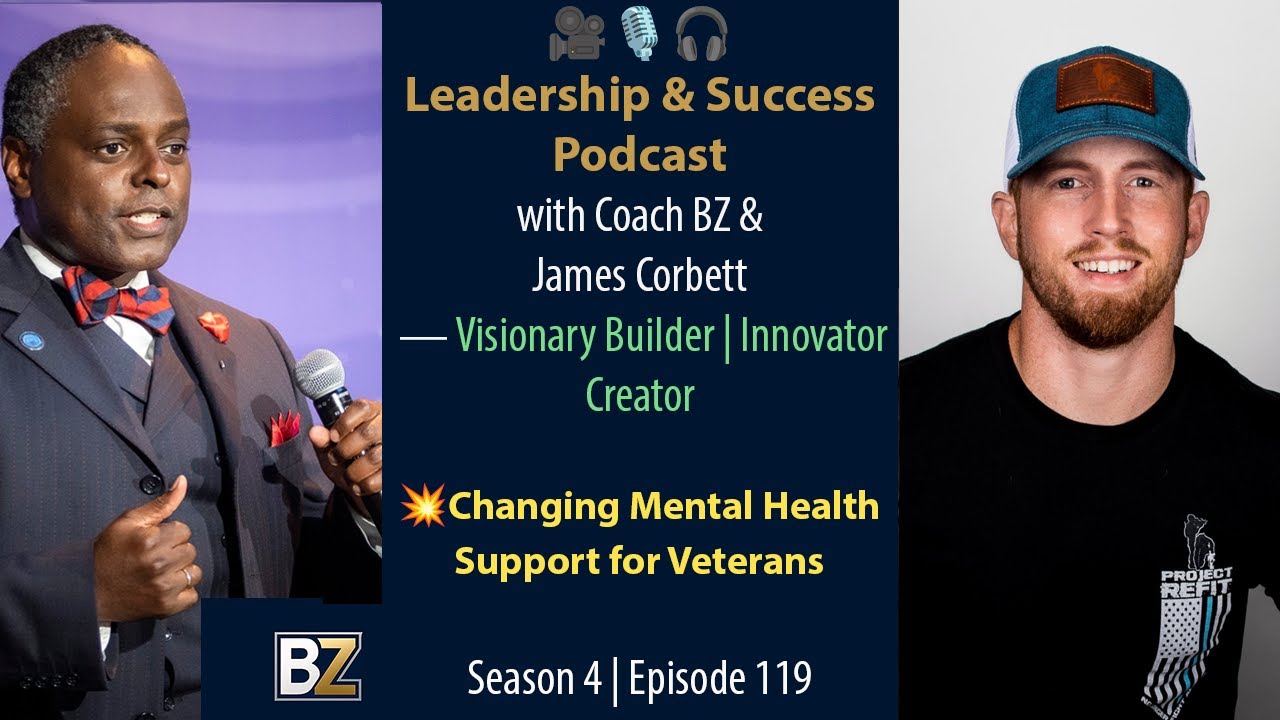
In this episode of the Leadership and Success Podcast, host Coach BZ (referred to as Speaker F) interviews veteran‑turned‑entrepreneur James Corbett, founder of Project Refit, a nonprofit that runs retreats and community programs for military veterans dealing with mental health challenges. The conversation moves through several themes: 1. Leadership learning – Corbett discusses his current focus on stepping back, delegating, and becoming the public face of Refit to raise funds and expand operations, while confronting imposter syndrome and the need to trust his team. 2. Failure as a teacher – He recounts personal and professional setbacks (injury, Ivy‑League disappointment, flopped products, a lost friend) and frames failure as a constant driver of growth, emphasizing the importance of owning one’s mistakes. 3. Truth‑based therapeutic methodology – Corbett explains Project Refit’s contract‑based approach that requires participants to be brutally honest, arguing that confronting truth—even when painful—creates real healing. 4. Mentors and influences – He mentions General Mike Krzyzewski’s book on character, Yvon Chouinard’s "Let My People Go Surfing," Steve Jobs, Pixar’s culture, and a young meme‑creator cousin, illustrating the diverse sources that shape his leadership philosophy. 5. Reading list – He recommends a range of books: John Adams’ essays, Blue Ocean Strategy, The Visionaries, Walter Isaacson’s biography of Steve Jobs, the Federalist Papers, Ayn Rand’s Atlas Shrugged, Thomas Sowell on economics, and a veteran‑focused work, Combat Trauma and a Journey Home by Dr. Jonathan Shay. 6. Hope as societal solution – Corbett articulates a vision of injecting hope back into society, encouraging personal agency, accountability, and the transformation of personal pain into service for others. 7. Legacy and final contribution – When asked about his one‑day‑to‑live wish, he says he would have lived each day as if it were his last, having already done everything he could. 8. Rapid‑fire personal insights – He offers concise answers that reveal his core values: “Service” (leadership), “Coffee” (morning grounding), Viktor Frankl’s Man’s Search for Meaning (life‑changing book), “Lisa” (current inspiration), and repeatedly emphasizes “hope.” The episode ends with a call to action: listeners are invited to support Project Refit, become corporate partners, invest in Corbett’s ventures (including ShieldVim), and connect with him on LinkedIn (jcorbett3507). The host also outlines upcoming podcast guests and mentions his own 21‑day gratitude challenge, highlighting the community‑building ethos of the show.
Chapters
¡Hola!
Hi, I'm John Maxwell. When the top companies in the world are looking for trainers, speakers, and coaches, there's one name that stands above the rest, and that's Maxwell Leadership. Our certified team members have gotten proven results for companies all over the globe, and our reputation, I'm proud to say, is second to none. Some of our members have risen to the top of their profession, including the one you're going to meet today. I proudly introduce you to my friend, Bob Fabien Zinga.
Welcome to the Leadership and Success Podcast with your host, Coach BZ, where we help you lead with purpose and succeed with impact. If you're ready to grow into the kind of leader others want to follow, this podcast is for you. If you're determined to elevate your success and leave a lasting legacy, this podcast is for you. As my mentor, Dr. John C. Maxwell, reminds us, everything rises and falls on leadership. Our goal is simple, to inspire you, challenge you, and equip you with insights that can transform the trajectory of your leadership journey. Welcome aboard to Welcome to another episode of the Leadership and Success Podcast with Coach BZ.
Well, back in the Vietnam War, just about 10% of the generation served in the military. Today, just about 1% serve. When they leave the military, they often feel isolated or different. In our latest Voices of Veterans, Gray Hall tells us about a South Jersey-based group working to reconnect veterans with their community.
I got blown up twice. I was on fire from the waist down for a minute. I had a dozen or so firefights.
Daniel Lombard didn't realize how much his time in Afghanistan affected him till after he left.
And I guess the weight of everything happened at once. So I started having sleep issues, irritability that was uncontrollable.
Army therapists helped him with the PTSD, but he faced a new challenge leaving the Army.
But when I came home is really where the isolation started. Felt alienated from everybody.
He found James Corbett, a graduate student reaching out to veterans to just let them talk.
For some reason, we're telling a lot of our warriors that they're broken and they're hurt and they're not capable of going forward and continuing forward, and I didn't like that narrative.
Before long, they founded Project Refit.
Combat isolation— try to build that camaraderie back up.
Project Refit uses numerous ways to connect to past or current service members Buddy Checks, twice weekly online chats, a mobile base for relaxing and talking.
But yeah, there's a TV, and then you have the seats in here too. We show up directly to military units. We show up directly to homes of veterans. We show up to local community events.
And there are also healing retreats.
And then during these retreats, we have fly fishing, horseback riding, whitewater rafting. We go to the range. And then at night, we have bonfires. We call them our fireside chats.
Bonfires recreate that familiar experience of sharing life stories over a burn pit or 55-gallon drum.
That's where, like, problems get solved. That's where all the intimate conversations happen.
Project Refit leaders say the programs don't replace therapy, but do offer veterans a community.
It reinvigorated my purpose. It makes me feel like I'm— I matter again.
What an important mission. And we can report that this year Project Refit has taken nearly 300 veterans on retreats and is organizing even more events for the year 2025. This also important reminder to learn more about this group, visit 6abc.com/voicesofveterans and remember to thank a veteran for their service.
I love you said, makes me feel like I matter again. And there's no greater debt.
All right. Welcome to another episode of the Leadership and Success Podcast. And as I advertised last week, today we're going to be focusing on mental health. Mental health is so important and we have two mental health champions this morning. I'm going to be speaking with James Scobbett and is waiting for us in the green room. But before we get started, like we do, as is our custom, every time we meet, we always take a moment. It takes less than a minute just to be grateful, right? I think it's impossible to be suicidal and grateful at the very same time. So some of you may want to close your eyes, take a deep breath, put yourself in your happy place, and think about one thing you are grateful for right now. And I think today I'm really grateful for all of the tools, all of the medicine, the technology we have to deal with our mental health, right? It's been a stigma for a long time in the military. I know when I joined the Navy 21 years ago to kind of, you know, talk about mental health issues, but once somebody gets injured physically in the military, everybody knows that's perfectly normal and you need medical help. But what if you get injured in your spirit, in your soul? So you shouldn't be ashamed to ask for help, and I'm so glad that we have so many avenues and opportunities for help today, especially in these United States of America. So let us know what you are grateful for, uh, type it in the comment. And also let us know where you are joining us from. And if you have a question for my guest, please type it in the comment as well. So let me see if I can do a quick introduction for our guest today. Today I am really glad and really privileged to have James Corbett with us. He's a successful entrepreneur, philanthropist, and the founder of Impact and Project Refit. He has demonstrated a strong commitment to community impact. He has raised millions of dollars for his nonprofit, led the software development of Impact, and mentored entrepreneurs to achieve 6- and 7-figure businesses. James' leadership has empowered over 220 veterans and first responders, and he currently leads a team of over 40 volunteers. Now, another thing about James, he's a creator as well, a technologist, a community builder who has raised millions, like I said, empowered hundreds of veterans and first responders, but he's really quietly changing the world through service, truth, impact, and driven innovation. So ladies and gentlemen, please help me welcome the one and only James Corbett. All right, James, how are you doing this morning?
I'll just give a little wave to the soundbite. I'm doing very well. That was a very nice introduction, probably one that's a little bit, you know, fluffing me up a little bit too much. But, but that's okay. I do want to clarify some of those numbers. Even the newsreel and everything is inaccurate with some of the things that they were saying. And, you know, when I first saw it, I was like, that was not what I said like that. You know, it was, but that's okay. You know, we actually have now, it's over 250 that we've brought out on retreats directly since 2020. And—
Amazing.
Yeah, it is. It's really awesome. And it's— we have helped actually directly showed up to military bases, homes, things like that. Veterans, first responders, veterans and first responders and community events where we've supported guys in person, got them connected to resources and such. That is actually in the thousands that we've been able to support and help. So that's really cool. And the level of help, it varies, right? If we're talking about really deep help, you know, it's in the hundreds. If we're talking about just like little things that we do for people, that's in the thousands. So like I have these right here, a few gift cards left over that was donated, that were donated to us by Wachter. It's a, it's an IT cybersecurity company. Wachter gave us about $500 worth of gift cards to hand out to veterans and such during the holiday season. So, you know, little things like that that we do as well.
So especially during the holiday season, that's where, when a lot of veterans really feel lonely, and I think the suicidal rate kind of goes up a little bit. I guess to get started, first, I guess let me let everybody know, so your nonprofit project with it. The way I kind of found out about you guys, I think it was about 4 or 5 years ago, you were doing the 21 Day Grateful Challenge, which by the way, for this year, I've been doing it for 4 years now. This year, today is going to be day number 5, if you can believe that. But basically, that's when you challenge people to be grateful for 21 days straight on social media, and then each day kind of challenge someone in the network to do the same. So The person who challenged me was Commander Carpenter.
Yep.
Yeah, so Tori Carpenter. I've been doing it ever since, but I think it's really so good, especially for people in the military, to really have that positive mindset and to look for something good, something positive to be grateful for, right? Because it's really impossible to be suicidal and grateful at the very same time. You really need to have those connections, have people you can talk to. Freely. So I guess to get started, can you let us know one thing that you are grateful for today?
I am grateful for— the thing that keeps coming to my mind is the time that I've been able to have, actually, just the life that I'm able to set up and And I'm so grateful. Like, honestly, I've been blessed, you know, thank God every day for honestly the time that I do have to spend with my family and my newborn daughter. And, you know, yeah, thank you so much. Yeah, it's amazing. And I always said when I was younger, the number one thing I would want is I want to be around my daughter as much as possible, or not daughter, but just my child as much as possible. But now it's a daughter, so. And be able to help out where I can and be present. Uh, and that's, that's something I always wanted, and I have it. I mean, like, that's—
wow, that's really great.
Yeah.
So I first became a parent 23 years ago when Naomi was born. She completely changed my life. I think she's the single reason why I became a mature adult almost overnight, because prior to that, I think I was still kind of a boring—
let me tell you what, let me tell you what, uh, I think that is real.
Yes.
Yep.
Yes, the responsibility and just the weightiness of it, man. I'm gonna become a dad.
Responsibility is a key word that you just said, by the way, and I think, uh, you cannot have freedom without responsibility. So I think it's incredibly important. I mean, that's why our founding fathers— look at this, I I literally have this book right here in front of me, uh, Founding— I don't know if you can read it, says Founding Fathers on there, uh, or Founding Brothers it says, but it's about the Founding Fathers, uh, and it's literally like written— I mean, like, it's having the, the freedom of your family to decide what you want to do, you and your family, what you want to do. That's right. So yeah, I mean, like, it creates a responsible human.
Yeah, that is, that is wonderful. And toward the, uh, the middle of the podcast, I'm going to be asking you about some of the books you recommend.
I like this one, Founding Brothers by Joseph Ellis, right?
That's correct.
That's, that's, that is a great book. Yeah, uh, it, it really changes you. So is there something about you that I just started reading it most people may not, may not know about me?
Um, that they might not know about me? Um, Well, I wasn't. So actually, this is— this is something a lot of people think that I served. I did not. I wasn't able to. I actually have a torn adductor in my right leg. It's a complete tear off the bone. And I sucked it up. I was actually— it was during wrestling. It was between wrestling and fighting. I actually ended up destroying my leg and I didn't tell my parents anything like that for 2 years, actually. They thought I had cancer. Uh, and that's how big the, the bump is in my leg to this day. Uh, but it's just a muscle that's torn in there, and I can't run, uh, for more than like 2 miles. And sometimes if I walk too far, uh, my back, my lower back and everything is just all messed up. But it's okay because it led me towards what I'm doing today. I found another way to fight. Something I want to do my whole life is join, uh, the military to do exactly that, and I wasn't able to. So in one way, I am like one of those guys that go, I always wanted to join Uh, and in another way, um, I'm not, because I am serving the best that I can, the way that I know how.
Absolutely. You definitely do not need to be wearing the uniform to serve. There are many, many other ways to do so. Just last week, I was also talking to someone who's been a civilian all of his life, but he's really served in the same fight we are fighting in right now— cyberspace and, uh, space and national security— working at the White White House, NASA, and the National Security Council and all of that. And also volunteering is a big, big, big deal too. So there are definitely a thousand ways to serve your country. So thank you so much for that. So maybe to get started, James, can you tell us kind of like about your leadership journey, how you came to become the co-founder of Project With It and all of the other serial businesses you've you've had really trying to make a huge impact on the community?
So Refit, so I actually started Refit back in, it really began in 2015, I would say. We were officially founded in 2017. And we, when I say we, I don't know why I just said we, but I really sat down when I was in class and I was listening to some, you know, was a professor talking, you know, something about psychology and such. And, um, and I was studying negotiation and conflict resolution. And I just, I just, something sat wrong with me. Uh, it just, it, it just my gut. I couldn't really put my finger on it. I'm still learning to this day, actually, uh, all the time why my gut was right and what was it right about. But I just felt like something was wrong with the, the mental health system and the leadership that surrounds the community itself. The community. I'm not talking about just veterans right now. I'm talking about the entire American community and how— what are we doing as a society and what are our leaders doing as a society that's making the— those who are most vulnerable, uh, among us to potential, um, mental health illness. And when I say most vulnerable, I don't mean that from a place of weakness. I mean that from the exposure to things that could potentially make you, uh, or, or, or push you towards, uh, poor mental health, right? Uh, we were making them feel like the victims even before they join to things that didn't happen yet. And then when the things do happen, it's almost like a setup for disaster if they don't have good morals and values around themselves already. Um, true. And makes them susceptible to falling victim to being a victim. So, um, my whole thing is hope. Uh, I like to remind men and women of the power that they have and that the forefathers before us, even before our forefathers, and the, and the men and women before us had to survive, uh, the hardest of the hard. And they pushed and they pushed and they continued forward together. There's always that connection piece that they always had. And in our modern world, it seems like it's getting harder and harder to connect with people in person, which is critical. Um, because it's so easy to connect over the computer and play video games and, you know, do all the things, you know, that you can literally sit in your house and you can order anything you want, uh, right to your door, you know, like you don't have to go anywhere, interact with people. It gets— you just stay. It's a stasis of complacency. Uh, and, and it's just That to me is one of the crucial driving forces of poor mental health, aside, alongside of, I would argue, a leadership structure that's creating victims. And that to me is unfair to any human being. And it's almost insulting, actually. I feel like Americans should be insulted by that because, you know, a free people don't need to be victims to anything. We are free to make our own decision. And in that, this is really important, and in that actually lies the opportunity literally written in the Constitution of freedom of speech. Speech is words, words are thoughts. So the freedom of speech, the freedom of thought means, and that's also written directly, I think, by John Adams wrote the freedom of thought. But anyway, that also means the words that you're inviting and allowing into your life. So, something I try to remind our guys of when we got on these retreats is this. I say, "Hey, listen, pain and suffering is the ink to the pen that writes the story of your life. You get to decide how you tell your story, if it's going to be one of a victim or one of a victor." Wow. Right? And then we have to think about it from this perspective as well. If we start thinking about our lives, just to back up that pain and suffering is the ink to the pen that writes the story of your life. So every life is a story, or every life is an adventure, and every adventure is a story, which is why you get to tell the stories. What you're asking me to do on this podcast is tell you a story. Now, I can tell you about times that I failed, and I could if you ask me those questions, and I'm going to tell you how I learned from it. And I was able to become a victor from that scenario through the education that I received, either through somebody else that I helped or directly for myself. And sometimes even helping other people is a direct win for me. So it is, it is quite literally a narrative, and human beings are narratives, and we must take that to heart and recognize we don't need to allow other people to impress They're impressionable. We're impressionable. To impress upon us the way they want us to feel. I get to decide how I want to feel, not you. And I think that's something that's really incredibly important that we need to be reminded of in America. And I think for veterans in particular, the society that you live in, a veteran or a warrior is a direct reflection of how healthy or sick your society is. And I think there's too many veterans that are taking their own lives. And I think that's a direct reflection of the society that we live in itself. So it's just from a philosophical standpoint that I truly believe that if you look at your warrior, how does your warrior feel? Are they a victor or are they victims? And, and I think more of them are victors and need to be reminded of that. And that's what we're trying to do here at Refit. That's what I try to do on a daily basis. I hope all of that makes sense.
Well, absolutely. That is extremely, extremely powerful. But let me ask you this then.
Go ahead.
What was the defining moment for you that kind of pushed you to start building solutions instead of like most people just waiting for somebody else to do it?
Yeah. So, you know, that's interesting. The first thing came into my head. Wow. So it's a little, it's a little long, I guess, but I'll shorten it up. When I was in high school, I— and I'm sitting there thinking about like, I'm going to go in the military, whatever. I had this class with this guy. His name was Mr. Hewitt. I'll never forget Mr. Hewitt. Mr. Hewitt showed us the— I think it's the Kitty Hawk incident where, you know, nobody stepped up and called. Everybody assumed everybody else was going to make a phone call or whatever, and da da da da. Nobody stepped in and helped out. You see it all the time. You see these, these videos of— I saw one recently on a subway. I think it was like A woman was being like screamed at by a guy on the subway a couple of days ago and saying a bunch of really messed up stuff in New York City. And like no guy, no man stepped up to go support her and help her. And like she needed it and nobody stepped up. And, you know, in my mind, like I'm— I will never forget that teaching. I don't want to be the guy that just sits there and stands by when something's going wrong. And, you know, then the injury happened, and then, uh, I was sad for years actually with that in the back of my mind. Like, I'm never— I'm not gonna be able to like test myself the way I wanted to test myself. This drives me nuts. Like, I wanted to fight, I wanted to be a part of it, I wanted to be there. Um, and I never had the opportunity until that moment when I was in that class at Columbia, and I'm sitting there and I'm listening to all this. I'm like, what is happening? Why is everybody taking feelings as reality? And no joke, feelings, the word feelings as actual full reality. And it's like, wow, that doesn't sit right with me. A guy can feel like crap. Is that true? Like, let's talk about it. Are you actually— are you actually a POS? Are you actually this? Like, why are you treating your feelings like absolute reality? Uh, I think that's a— I think we're doing more harm than good, uh, to people by affirming them into comfort. Uh, and I, and I just— that didn't get you through boot camp, that didn't get you through war, that didn't get you through that crappy day, that didn't get you through the Hurry up and wait. That didn't get you through all of the things you had to do while you were in the military. It didn't get you through that by just taking those feelings as reality. And I think the— what could be misconstrued with what I'm saying right now is like, oh, well, then don't take a step. You have to push, push, push, push, push. You're saying the same thing they always say in the military. I'm like, now that's where we can pause, right? That's not true. I'm not saying that. Yes, take time back, right? Take time to step back a little bit. Analyze what's happening and then process it and put it away properly. That's actually something I think even some therapists would say, right? Some psychologists would say. However, then I differ and I say, don't give up on hope ever, right? You get to tell the story of how you came out of that better. And remember, the crappy scenario that you're in right now will become an education piece to help somebody else. That's— you're not doing it just for you. You're not living your life in this selfish way, stop doing that. That's not a community. It's selfless to learn from your failures, to pass it off to somebody else. And it also provides hope. It gives you an opportunity to push it forward. That's— I mean, that's why I got a commander's coin from one of my guys. He actually calls it the commander's coin.
Yeah.
Yeah.
He gave it to me and it says on the back of it, it's the quote, the pain and suffering quote. Oh, I might have handed out my last one. I only had 5. I need to get more. But on the back of it, it says the pain and suffering quote, which is real. I mean, like, that's— take all of the suffering that you've had and find a way through so you can guide somebody else through it too.
Wow.
That's community, bro. That's everything.
Say that one more time, please. That is powerful. Yeah.
So all of the pain and suffering that you're going through right now, you need to recognize is an opportunity for you to find your way through so you can help somebody else and guide them. You be the guiding light to help them through it next time, or through their time. And then what it does, by the way, to cap that off, what that does is it brings value. It provides value, an actual ROI, if you will, to your scenario, no matter what it is.
Man, that is powerful, powerful. Yeah, take all of the pain and suffering you have and use it as an opportunity to find a way through to help other people.
That's right.
That's, that's really what leadership is all about.
Literally.
Let me ask you this then, um, you've really had quite an unconventional journey, right? Uh, you've done legal work, design, tech, mental health advocacy. How did all of these experiences kind of shape you into the leader you are today?
Uh, you know, I don't even know what kind of leader I am. You know, like I'm, I just said to a guy this morning, he's, he's an intern and I asked him to do something for me and present it to me today. He didn't do it. And it wasn't the first time, and I'm not— this is not coming at him at all. It's my fault, genuinely. And I was like, you know, this isn't the first time this has happened in my life where I ask somebody to do something, they don't do it, and they're not prepared. Can you help me to communicate better to the people in the future? I was like, so I can help you out, but also help out the next person that I'm going to be leading or having do things with, like, give me the structure that you think you would follow best. And he was like, okay. And he was excited to do that. Right. So, um, I think the reason why I share that is all of my experiences have taught me that again, life is an adventure, but also you need to be okay with falling on your face and realizing you don't like something and trusting your gut and like moving and moving constantly. I think it also leads to— I think I've learned how to communicate and tell stories better. I think, I think that's actually probably one of the things that I do have a gift for is being able to communicate very complex topics in very simple, powerful ways. Because I realized even I was at it, I was at an event where I was myself and this other guy Wade were keynote speakers for the— I didn't know that we were the keynote speaker for the event, but it was the Mental Health Association down in Delaware. And I didn't know it was a training either, but I just showed up and I knew the presentation I was going to give. And I thought I was just talking about Refit and some of the theories that we have and inside of the theories that I've developed, uh, are, you know, educational pieces. So I was kind of like, I was lined up, it was good. Uh, and, but the thing is I was able to take very complex things and I break it down simply. And then the people in the audience, I, every time I speak, I see people listen. I mean, listen. And I, I, I've only realized that recently. Really honestly, like how deeply people listen to me when I speak. And I, I take that very, very seriously because that comes with a massive amount of responsibility as well. Um, and you know, I will not abandon who I am, but I will also, and what I mean by that is even sometimes I curse and stuff like that. Like I will not abandon who I am as that person. But I do make sure that I think deeper about the people that I'm communicating to and the audiences that I'm around, because we are, especially in America, very diverse. However, with that diversity, I do think that we're still all humans. And I do think I also follow very much the Enlightenment teachings that our founding fathers gave us, because I think in a really very odd way, the US Constitution and the Declaration of Independence and all the writings, you know, that the Founding Fathers had given us is also a pathway because philosophy-based and psychology is philosophy. That psychology was developed to try to measure philosophy. And I don't think we know enough about how to think properly with logic. And I really don't. And I think it's also causing harm. We're getting too far away from teaching people how to think, and we're instead just labeling them with things and letting people sit with the labels. I don't— not everybody, but I think too often that is happening, which leads to things like, you know, malingering issues and, you know, fictitious issues and disorders. Those are two very important disorders that I think you should look into, that we can get into. And I think there are two things that are actually rampaging the veteran community in particular. And it's creeping into the first responder community as well. Malingering and fictitious disorders. I would, I would look into those. So, fact— I'm sorry, factitious, fascias, if you will, fascist or whatever. It's F-A-C-T-I-T-I-T-O-U-S. I can just copy and paste that over to you sometime. But anyway, I, I just, there's so, there's so many levels to what I've learned in my whole experience. It's hard to just boil it down to anything other than it taught me how to communicate and to listen to people.
Yeah, I think you really have a heart of a teacher, but you also have that, you know, builder mindset. We talked about, um, during the introduction, Impact Project with it and also Shield, uh, VIN. Let's talk about the impact of just Yeah, uh, impactful for just a second. What problem were you trying to solve when you built your QR-based anti-app collaboration and how it built into this?
So, um, originally this product started out as a way to help, uh, teachers maybe report through to guidance counselors quickly, like students that might need extra support. Um, I was talking to a, uh, school resource officer and he's also— well, he's more than that. He's also, uh, president of one of the biggest gang investigation associations, uh, in America. And he's— his name is Jose. He's the absolute man. I— the man is— he's also helped me spiritually with God and, you know, on my walk and everything. And he's just an amazing person. And, uh, you know, I just— I cannot thank him enough for his presence in my life. Anyway, he came to me and said, hey man, I really love this idea and I need this, right? And we started talking about stuff. So, uh, it evolved into this understanding where I was like, all right, there's actually an opportunity here. That's a key word, by the way, opportunity. I was, there's actually an opportunity here to help, um, students and young people who might be going down a bad path. Right. So, uh, right now, uh, there's no, and this is not what I'm about to say next is not talking crap on school guidance counselors, nothing like that. It's really not. This is a truth. Okay. This is a truth. Guidance counselors are taught how to operate in schools with students from that realm. Okay. They don't know. And this is again, not talking crap. They just, not all of them know much about the business community and opportunities that exist outside of the school walls and things like that. They don't, They just don't really know. Most people don't, right?
Mm-hmm.
Now this is where it gets interesting. I started thinking, okay, so if I get, oh, oh, oh, actually, before I tell you about the solution I came up with, let me give you this story. So pause that for a second. This is very important. About 3 or 4 years prior to Jose and I having this conversation and the evolution of Impact Student Pathways, I had the opportunity to go to, uh, what's called Clippers and Cops, uh, had an event inside of a high school with gang members. So they help out gang members and help guide these kids away from gang activity and go like, hey, why are you doing this? Like, this is what could happen, da da da. So I'm in Georgia, I'm in a Georgia high school sitting there, and Tyrone Dennis brought me down. I'm with Ty, and you know, I'm sitting in that classroom. And it is, it is all Black and Spanish kids. And I'm the white, the only white guy there right now. That matters for a second. Okay. So that matters not for a second. That, that matters. That matters. And I'll tell you why I'm sitting in that room and I don't come from, I grew up in a town called Voorhees. Okay. Voorhees, New Jersey. I went to Paul VI High School, private high school, was a Catholic high school. Grew up in a very nice neighborhood. You know, my parents do okay. They're upper middle class, if you will. And you know, they, they, they really care about family, all that stuff, right? So I've never been truly exposed to this world. I have been— I have friends who actually come from those worlds, and I grew up with kids even through college, and I hung out with them and stuff like that. But it wasn't to that depth. It never was. It never reached that depth. I'm actually reconnecting with one of my buddies who went down a bad path, but he's taking his life back. I just reached out to him and I'm actually super stoked about that. But anyway, he's a great guy. He's always had a big heart, always had a big heart. Anyway, I'm in that room and I'm listening to these kids and I'm listening to— I'm listening. That's one— I can listen very well too. I think that came from some of the legal experience, by the way, but I really listen. To what these kids are saying. I'm like, dude, these, these kids, they know business. They know how to sell. They know how to read people. They know how to do math and quickly, like they, math and money are the same and they can do it like that. But they don't realize that some of them don't realize that. And they're because they're young and are going after that adrenaline rush and they feel they're not really guided. You know, they might be coming from broken homes or maybe not. Maybe they're just like, they just want to fit in or whatever it might be.
Right.
And it started to sink into me. I was like, man, if we could help kids like this, kids that come from a community like this, Black kids that come from a community like this, Spanish kids come from a community, white kids that come from a community like this. I don't give a shit what kid, what race, whatever. American kids that come from broken homes who actually have these skill sets that they develop and we can help guide them and get them in front of mentors in the local community around them. That can then guide them down a different path and show them that their skills that they're building here are very valuable in the business world and they can actually provide back and change their lives. That would be amazing. I had that thought that many years ago. So fast forward again, back to the conversation with Jose.
Yeah.
And the word opportunity came up in my mind and I was like, wait a second, what if when you're doing your intake of that student that's having trouble, It's a troubled student, might be a drug dealer, might be, you know, bullying kids or he's getting into fights or whatever it might be. What if after you're done giving those surveys, we analyze it, we give you the risk score, tons of, tons of software. Everybody's focused on risk, risk, risk. I personally, that word risk and negative, it's how are we— how do you help that kid? Show, show that kid something tangible that they can work towards instead of just giving them, I'm giving them tools in their tool belt. Fine. That's nice. What's, what are they using those tools to work towards? What's the, what's the blueprint that they're trying to build with those tools? We don't talk enough about that, right? What is the thing they're trying to build? Do we ask them what lives they want? What if they do want to become, you know, musicians or whatever, like show them the business of it. Right. And show them how to get there.
Yeah.
Or let's say that they think they want to do that or they want to become a professional athlete. Show them the business of professional— show them the business of athletics. Right. Show them, you know, maybe they'll like real estate, maybe they'll like selling. Maybe instead of selling drugs illegally, they go become pharmaceutical sales reps. You know, like, yeah, like there's so— there's so many opportunities and ways to— in the mental health world, they call it reframing. Right. What if there's a way to reframe a lot of that in a very positive way, but with an actual blueprint? So that's where the opportunity analysis came in that we embedded inside of our software. We have about 10 schools using it right now and in Georgia, flying colors so far that we have received. So it is a different methodology overall. It's actually taking the very theories that I have come up with, even for the veteran side of the house, and embedding it here for students. And I am— this is something that I think is really critical. And the idea originally, again, the QR code thing, then Jose came to me, said, hey, that's really good, but like we need this. And then from there it built on top of it. I was like, hey, I can put in this opportunity analysis thing and give you this AI and this, da da da. And he's like, this is great, let's go. So it also came from the customer, if you will. So that was cool.
So that's Impact Student Pathway. How can people get involved? Do you need to reach out to like, I don't know, school district superintendent? Like, oh, that's right. If people want their school.
Yeah, I think at the end of the day, superintendents are the ones that I would like to talk to at the district level so all their schools can get it from one purchase. It's a very affordable product. We are not— I'm not charging people like crazy for this thing. You know, yes, it will be, you know, a few thousand dollars. It might even be over $10,000 or $15,000, but it's not going to be $100K. It's not going to be, you know, 60 or 80 or whatever. Well, actually, I shouldn't say that. If it's a, if it's a, if it's like a city, you know, we're talking a large, but for smaller districts that might have 10, 12 schools, we're not gonna, we're not gonna go over your RFP limits. I want to get this in front of you and I want to have you be able to use this. It's more important than my bank account.
Thank you. Thank you so much. That is really great. But then you don't stop there. Of course, you know, I talked about, um, project, uh, refit. Which is how I got to know you. So you are literally saving lives. I mean, you are combating isolation, which is really big, especially in the military.
Can I tell you something about isolation? Can I ask you a question, actually?
Oh, please.
When you hear combat isolation, tell me what you think about immediately. Just quick answer. What do you think about?
I guess for veterans, See, one thing about— I know somebody has to be in the military, but the military really, 21 years I've been in, it's not really conducive to family life, right? Because many times I've been away from my family, my wife and kids, sometimes for years, right? So, and then also, you know, when you go into the military, especially when you see combat, you know, things can get quite dangerous and it really does affect you beyond what people can can see on your body. So many times I think you kind of feel isolated as a veteran, and sometimes, especially when you come back, when you get off base and you come back into civilian life, nobody can really relate to you. Nobody has the same experiences you had. There's really nobody you can talk to. There are things you can't really share with your spouse and with your kids. So I guess you really isolate in such a way that you really keep a lot of things on the inside. And I think part of the problem is eventually it might blow up. And that's why we really see a lot of— I'm seeing a lot of tragedy happen sometimes if people do not take care of themselves and use a lot of the opportunities and tools and things available there to help them, especially take care of their mental state.
Anyway, so you just brought up isolation of self. So you could be in a room full of people and feel isolated, right? That's what you're saying. That's on— that's right on the money. I wasn't expecting you to say that. I was expecting to see what everybody else says, who's like, yeah, like in the military I was connected to people, I had people around me all the time. That's a part of it. But it's actually the isolation of self. It's actually the feeling of not feeling understood. You could be in a room again, room full of people, and you're just thinking about how, you know, oh, this is— everybody's fit. Nobody knows realities of the world, right? Like you're around a bunch of civilians, let's say. It's like, oh, they don't understand realities of the world and how devastating things, how dire things can be and everything like that. You could go down that rabbit hole.
Yeah.
That is the thing that we are trying to combat is that thought, right? And actually, uh, I'm— I go against the grain for— now we're talking about Project Refit. I go against the grain a lot now, actually, in terms of the problems, uh, of what I think. I have this own personal theory of actually what's going on, and it goes right back to the malingering. I'm pointing at it because I have the— I have it up here, but the malingering and the fasce, or, um, Fascius, if you will. I don't know how to say that word properly, uh, at this point yet, but I just literally learned these two words. I'm like, oh my God, that's exactly what I talk about. And what it is is— so let's go back to words, okay? We are— let me explain something to you about humans. It's my— this is my philosophy on what humans are. The only difference between you, me, and my dog that's laying down right next to me is that we are word creators. Let me explain that to you. Literate creatures. Literature and creature are very similar words in terms of their— the root of the word is the same, but the— I'm sorry, the suffix of the word is the same, but the prefixes are different. Litera and then cria. We create words. We are word creators as creatures. So everything around us, this website you're looking at, everything in our minds, our thoughts, it's all words, right? So we are able to create words, which makes us very— that's why we're the apex animal. That's why human beings are different. That's why even like if you want to talk about Christianity and other religions, the word, words are very powerful. What are the words you're saying yourself?
That's how the Bible says God created the world.
The word. The word. So who are the people that you're having fellowship? Who are the people that you have around you? What are their words? What are the words you're surrounding yourself with? That's going to define how alone or, or, or, um, or how connected you feel, right? So the thing is, sometimes though, the onus is on you to actually connect with that person and to share things, right? Uh, it doesn't have to be everything. You can still keep things to yourself, but you have to understand you're making that decision and you, you need to be okay with that decision. So I'm not a proponent to say share everything with everybody. I am a proponent of know the decisions that you make and realize that the decisions that you make, take accountability for them and realize the decisions that you're making, are they good or are they bad? And really think about that logically. Now, my argument all the time to a veteran is you say that veterans just don't get it. It's easy to point the finger and blah, blah, blah, blah. But what about that song you just listened to that really resonated with you? That musical song you just listened to. It's like, is that person a veteran? No. Okay then, what the hell are we doing here? That guy talking to you through music, why can't the civilian who didn't maybe experience same things you experienced, but they experienced the same emotions that you experienced— they, they, they, the, the emotions, that's the thing that ties you together, right? That's where the fellowship comes in. Stop isolating yourself from the thoughts that people could potentially help you with.
Wow, that is really, really powerful. I think it also teaches about humility, but really, you know, another thought I have is accountability. There's so much more that we have, right, in common than separates us, whether you are a veteran or not. And all of the work you— yeah, go ahead.
I was gonna say, whether your adventure is the same as that person's adventure or not, there is that string of connection.
Good.
Wow.
So let's talk about another one of your venture, ShieldScan, right?
Sure, sure.
So what problem are you solving here?
So this one, I'm going to keep it very short because this is probably the biggest opportunity that I have coming up right now ever in my life. I'm very excited about it. We have an amazing go-to-market strategy that we just developed and we are talking to some dealer management software and everything. But this is completely nothing to do with you know, mental health or anything. This is strictly about protecting from fraud and other things like that. So car theft and fraud and, well, really fraud. So just theft in general, really, in the automotive industry is a big problem right now. There's a lot of tools out there that do a good job. But what we notice is there is a gap in the industry that we can fill and fill it very well. And we have the strike plan to get it done. And we think it could become a massive, massive opportunity, which will hopefully fund things like Project Refit, honestly.
So that is quite amazing, though, because, for example, ShieldVN and Impact Student Pathways, right, each solve totally different problems. However, I feel like they all share your signature, right, for simplicity and truth. So how do you choose what to build next? Because it looks like no matter what you do, eventually you are always trying to impact your local community.
One of my— so the community piece comes from my, I think, my family. And also obviously growing up in a Christian Catholic household was really— that made a huge impact on me. Actually, it was a priest when I was younger who I— he was my— he's literally one of my favorite guys ever growing up. I mean, he would answer— I always asked very difficult questions. There was two priests actually that really made an impact on me. The first one was when I was very young. I was probably 8 or 9, and I questioned him. He said something about, you know, I think it was the verse about the poor and how, like, you know, we must look out for the poor. And, you know, I forget the exact quote, but, you know, the gold basically had something even to do with gold and things like that. Anyway, so I asked him, I said, hey, so we are supposed to help out the poor and not, you know, we must wear the same clothes and rags as them. However, I look out there in the hallway and there's a bunch of golden chalices, things like that inside boxes. Like what? That, that feels not right. I didn't say hypocritical or anything because I was young. You know, the priest, you know what the priest did? The priest did not get mad. The priest actually was dumbfounded. I remember his face. I know it was dumbfounded. And the priest literally said to me, Thank you for asking me that question. And he's like, I actually have no answer for you. And then he gave me an answer the next week when I came back to church with my family. All of those things were gone.
Wow.
Removed it from, from the church. That I get— oh, I get choked up. That makes me love that there are men and there are women out there who can hear logic by the word, at least in this example, and actually act upon the, the, the misgivings or failure or the hypocrisy in this case, uh, and take accountability for it and move forward. So that was my first example, my first true example of accountability and how powerful that can be. The second one was another priest who really, uh, he answered all of my questions all the time and talked to me a ton. I mean, he was, he was the man. Um, and, uh, I just, I just really appreciated him. And I think that really helped me with identifying all these things of truth, right? And accountability. But getting into it, that led to me building good relationships with some people. So the reason why Shieldvin came about was because of my work with Impact overall and all the relationships I was building in law enforcement. And the guy who I spoke— José, who I spoke with about Impact Student Pathways, and I ended up developing this whole innovative tool for Impact Student Pathways, introduced me to another officer who had this idea for something regarding— very direct regarding, you know, cloning and theft and VIN fraud, etc. And I was like, this doesn't— at first, like, it doesn't really sound like a business model here. And then I started diving deeper and we were able to— I was able to identify some gaps and ways to actually create a business because a law enforcement problem isn't always a business problem, you can turn into a business. Um, but I found it. I found the gap, right? And what that, what that led to, which is really cool, is now we have a way to help out the individual American payer of insurance because you're getting charged per year $400 to $700 on your car insurance more per year just because of how massive this problem home is.
Wow, that's amazing. Well, let me ask you this. So today we are really celebrating, right, uh, Mental Health Day, and I think that's so important, especially in the military. I know when I joined the Navy 21 years ago, it was really taboo. It was a stigma for people to say, no, I have some emotional issues, or I may need help, because back then if you said you were speaking to, you know, a shrink or psychiatrist or whatever, you might lose your security clearance. Your career might be completely over. Now that has completely changed. We encourage all of our sailors to get help. But one thing about you, though, if you are willing to share, looking at your story, what you've spoken openly about trauma, ADHD, and mental health struggle.
Yeah.
What role has mental health played in shaping your leadership philosophy today?
Uh, well, I think again it comes back to just communicating, um, and accountability. I've made mistakes. I'm not perfect. Uh, you know, I am to blame for something. I am human. I am a sinner. I, you know, all of it, right? Um, I have things I need to work on all the time. Um, and I also try to lead with truth, whether that truth Yes, hurts me or you, uh, it has to be said. Um, and I think when it comes down to mental health, uh, they're actually for some reason are coming back to resilience and trying— I think the mental health industry is trying to figure out what resilience actually means because they're afraid to say that resilience actually is moving forward and like truly putting things behind you and not focusing on what, what all the bad, bad, bad that happened to you in the past and being a victim to it. They don't want to say it out loud. A lot of them don't want to say it out loud because it kind of is a hypocrisy. And it's actually the industry would have to admit that, okay, we've actually been doing harm by not pushing people to get better. Right. Which actually I want to make a very important point. Very important point that the going back to the fact that we are word creators, when I put a label on you, okay, if I put a label on you and I tell you that, you know, you have PTSD or you have this and it's a disorder and you have an issue and you have a problem. People too often buy deeply into that and they make it who they are. And I think we're actually even making it worse. This is going to be very, very controversial, but I think on the government level, we're making it worse for our veterans, uh, in particular, by rewarding them for their mental struggles or other things like that. Now, does that mean that the veterans should not get some type of pay when they get out? Nope, not saying that. I'm not saying that at all. Do they require healthcare for the rest of their lives? Absolutely. I think we shouldn't be keeping people, however, like if you're 100% permanent total because of PTSD, That means that we are now giving that guy the onus to not try to push themselves forward and they can stay complacent.
That is quite powerful. I've put a quote, something you say often, right? Pain and suffering are the ink to the pen that writes our story. Can you unpack that for us?
Yeah, I can actually tie it into all of it. We're actually devaluing the pain and the suffering that you went through that actually if you came back and you told your story to somebody else, how you got through this and you may got better and you actually learned to live with your PTSD and you can actually work and you can provide and you can do all those things. And even with this, uh, these struggles, that very real struggles you have, we're talking about now. By the way, I always get the pushback of, well, some guys are, they're really just broken. I'm not talking about that minority of people that are absolutely— they are gone, right? I'm not, I'm not saying that. And I'm not saying take away all their money. I'm not saying that either, because I know that you can't get rid of that, right? I do think it is an issue of how it's structured right now though. I do. I, I think it needs to be structured better. I think we need to be rewarding guys for getting healthy. I think we need to be rewarding guys for getting the jobs and becoming productive members of society. Again, look at the World War II veterans. Look at them. Those guys talk about trauma. I have, I have a picture of a World War II veteran right here. This guy here, stud.
Look at him.
He looks like Ted Turner. He's a stud. I mean, like he built a family. He got better. He struggled to the day he literally died. He would have, he would have nightmares at night at 99 years old. He did it for 100 years. 99 years old, had nightmares happening even into his old age, but he still built a family. He had a loving family. They all loved him and respected him, all of it. We need to remind our warriors that they can continue.
That's powerful, really. The Greatest Generation. So for people who are listening right now battling with isolation, burnout, self-doubt, what is your message to them today?
All right, so, uh, this is kind of— this kind of comes from a little bit of Stoicism. So there, and I put it into a way— you said I have qualities of a teacher. My great— my grandmother was a teacher, so it's in my family. My mom actually always wanted to become a teacher for nurses. She never did it, but I think she should when she retires. But anyway, so I'm gonna give you it. I'm gonna give you the formula that I came up with for resilience. And actually, it's partly also inspired by General McChrystal. I was able to see him speak. And he gave this speech where he talked about what he does every night before he goes to bed. And it's basically, I look at my day, I look at what I did good. And then I'm like, what did I do wrong? What did I do poorly? And he looks at what he did poorly and he thinks about how he can make that better tomorrow. He's doing that every night. Okay. So what he's doing then is he's thinking about the things that he went through. He's processing them. He is then putting them in the appropriate places in his mind, and then he acts on changing it and improving himself. So whether you agree with, you know, if somebody hears John McChrystal's name, like, "Oh, that guy, da da da," whatever. Listen, whatever you think of him and his politics and whatever he stands for, whatever, please put it aside and hear his teaching because it does have value. People who think differently than you might actually be providing value to you anyway. It doesn't mean that they're fools or idiots or whatever. They might be providing something to you. So what I'm saying that for is this is the formula. If you have a pain or you have a suffering, you have a fault, think about it and then come up with a solution equals come up with a solution to then solve it and then act upon it. Act. That's also Stoicism. Go forward. The opportunity or the obstacle is the way. That means action-oriented, action first. Always forward. Always forward, right? You have to get brave, talk to each other about the issues and the problems, but don't sit there. Stop sitting.
Man, that is powerful. Powerful. You are really talking about people having Taking their agency back. And here is, uh, self-agency, freedom, with, uh, there he is, my favorite, all pictures. Yes, they really have a lot of great experience and they do help a lot of people.
Okay, book on character right there.
Yeah, I just got that one too. Actually, I'm trying to get, you know, my crystal on this podcast. Hopefully that's gonna happen next year. But, uh, technically we are out of time. Can you give me 10 more minutes before we—
I would love to. I have until 3 o'clock.
So thank you. Thank you so much. I really do appreciate that because this is where I like to kind of switch things up just a little bit. I want to focus more on leadership. I think you have a lot to teach my audience. What do you think is the greatest lesson you have learned so far in life, in leadership, in general? What's the greatest lesson you've learned?
Hope is the single most important thing for all humans. Hope. Uh, I, I heard, uh, he is a friend of mine, um, and he calls him— he actually calls himself now a hope dealer. Um, and I like to say that I'm a hope dealer and That is the single most important thing that I've learned for any— anything is that there's hope. There's hope for everybody, uh, but it does require the person to take self-agency. Like you just said, that's also a requirement for freedom and free people, free society. Um, and self-agency equals responsibility, and responsibility equals freedom. If you want to be free of all your issues and problems, take accountability for them. It was written for Americans to be that way. It is written. That is who we are. We have to remind ourselves of that. We're Americans, and hope is what we believe in. Uh, we can create our own lives.
That is really, really powerful. And, uh, another reason why I like this is because my middle name is Minu, which in Lagi means hope. It means faith. So many times when I go through struggle, I kind of remind myself What is your name? And I can't help but hope that my tomorrow will be better than—
Oh my God.
Listen, that's powerful.
You just backed up my entire thesis of the literate creatures. I want you to— you just said my middle name is hope. My middle name is— what was the other one you said? Hope and faith?
Yeah.
Yes.
Hope and faith. You have both. I have, I have learned on this podcast, you have both. It matters to you. It's who you are. If we continue to tell people they are broken, that they are sick, and that there is no hope, they will continue to feel that way. And if the regular American civilian sees their warriors with no hope, the protectors, the defenders, the ones who are there for you to fight for you, for you are broken and have no hope, then everyone else in this society will feel that. Look at the society that we live in right now. It is a direct reflection. It is— I actually think Plato, there's— he alluded to it in The Republic, the, the, the— gives the three structures of society that he created. I'm telling you that that is everything. The words that you give yourself— in my daughter's room I have nothing but positive quotes up. I am putting them up every month. I put up one or two. She will be surrounded with words of hope and honesty and truth in the face of everything else. We shouldn't be telling people, hey, like young kids, like, just listen to your teacher and just give them what they want, right? If they want you to write this, write this. No, no, no, no, no, no. She will never do that. You will write and you will stand by your word and you will be courageous. You are named Freya. Her name is Freya, which is a Valkyrie. She is a warrior. She is hope. She is the goddess of wisdom. All of those things, right? Those are just— it's a good story for her to remind herself of those things. It is because you're feeling these things because you are hearing the positive words of hope. You've lived it. You've heard it yourself in your own brain before. Other people need that too.
Wow. That is really powerful. And something you do with your daughter, actually I've been doing with my two kids, although my first one is an adult now, she's 23. But since she could say dada, mama, there's like an incantation that we say every single night without fail. So I just tell them, hey, who are you? And it just puts them back in the frame of mind. Yes, I am somebody and I'm here to add value. And it really makes a big, big difference, especially if you believe it.
So important for, especially again, for the American society that we live in. The one that was founded upon the family structure is the one that builds the free society. And men like you raising your children like that is only going to make the future better for us as a whole, for society.
That is, that is powerful.
Wow.
So what, what do you think is the greatest leadership advice you have ever received?
Don't lose hope. Oh, I ever received? Oh, I thought you were saying to give, like, don't lose hope. The best I ever received though. Man, what's the best leadership advice I ever received? My, okay, this is going to sound, it's just the truth. And it's, and I don't mean it in a way of like, uh, oh, he doesn't listen to people or whatever. I've actually never really had a mentor that is also helping me with leadership. I've read books. I'll tell you about, I'll tell you about my favorite. I love reading biographies of entrepreneurs. I do. I love, I've always wanted to be an entrepreneur. I've always wanted to build something special that impacts the world. I love, so one of my favorite, one of my favorite entrepreneurs. Thank you. I'm trying, I'm in the process, right? I'm in, I'm in it. One of my, a couple of my favorite entrepreneurs, but one of my favorites actually, it's going to sound kind of antithesis to everything I believe in, but if you actually read about the guy, it's actually embedded in all of it. But I did choose to act differently than he did in certain areas. Steve Jobs. So I love Steve, I love Steve Jobs and what he did and the vision and how he wasn't the engineer, but he was the visionary. I also love James Dyson. Dyson's another great one. He's the one that developed the Dyson vacuum cleaners, things like that. And there's a couple also, Walter, Walter Knoll. Walmart. He developed Walmart. He's actually a Marine veteran. And there's another one that I really like too, outside of Andrew Carnegie. He was pretty cool, but, but not really for leadership, but for business execution and strategy. But for leadership, it's actually the Patagonia CEO. I forget his name. Let me, to do him respect, let me, uh, Patagonia CEO or founder. I'm sorry, I should say founder. Their CEO is probably different now.
Wow.
Uh, Yvon Chouinard, uh, I guess, I don't know how to say it, but, um, Yvon, he did something really cool back in the day. So his whole business model, how he built it, he just, he climbed his whole life. It's all he did for years. He just, he actually ended up creating, um, I forget the name of the clip. I always forget the name of the clip. The, uh, you see it all the time now. Um, gosh, I can't remember it.
I think I know, I know what you're talking about.
Um, crap, that's important though for like, oh, it's this, and our people are screaming right now like, it's this.
Um, I know, I know, and, and, and I know what, what you are talking.
So what he did, the thing that he did though, uh, is He—
Wyant Gerrold, right?
Say it again.
Wyant Gerrold was the one.
I don't know how to say his name. It's Y-V-O-N. But he and his wife, at one point during his leadership tenure, he focused everything in on the people that worked for him. He even started to— he created a daycare in his offices so that people could bring their children to the office and get and take care of very well. He took care of his people constantly. He did everything he could for his people. Now, what's interesting about that is I take that methodology to Project Refit, and what I've learned is that was very good for starting this organization and starting the vision and pushing things forward. But it isn't good for raising money, right? It's not the best for that because I'm constantly helping people all the time, etc., etc. Uh, but I need to get better at raising money so I can let other people— so I need to let other people accomplish the mission as well. And that's something I'm trying to get into that role, but it's now hard to separate the two. And we're going through a rough patch. We need to raise money, a significant amount actually, because the vision for Refit is to eventually even have mobile mental health offices where you can show up directly to the people, um, and show up for them, uh, with mental health professionals that, you know, are trying to help these guys guide them forward. Uh, and because not everybody can make it to an appointment, not everybody wants to have, you know, virtual care or telehealth. Uh, they want to have somebody in front of them. So I would love to start bringing that to, to be. And we already have one mobile base, we have a second one launching in Delaware, but we need to raise hundreds of thousands, if not millions of dollars for this organization to really make it thrive. Um, because the retreats are still fantastic and I want to keep those going. Yeah. Um, I made a lot happen with a very little bit. Because, you know, I think it's like a million plus that we've raised. I think it's like $1.5 million probably over the tenure of all of Refit.
Which is amazing.
Yeah, it is. Not scoffing at it, but I am saying, yeah, that guy, he was great, but he cared about the people, right? And other entrepreneurs did the same thing. Even Steve Jobs started to do that too, by the way. But his vision, the visionary leadership of Steve Jobs, by the way, my favorite author, Walter Isaacson. Um, he is fantastic. Uh, anyway, so I really focus on the people all the time and I really want to help them and I really want to guide them and support them. Um, and that's the— it's servant leadership is what somebody told me once, is that I have the qualities of a servant leader. Um, yeah, it's something I am trying to constantly work on. Uh, but my dream isn't just to build like Shieldvin or Impact Student Pathways, uh, the product. Of course the product matters, but I can't wait for the day where I can have a whole team where people love coming to work.
Wow, that is powerful. So what, what do you think is, um, the secret of your success? Now you are a serial entrepreneur, have been extremely— honestly, you've already raised a lot of money and you're going to be raising more, but Why do you think you are so successful?
Honesty. If there's one thing that whether you like me or not, I will tell you the truth. Yes.
Wow. Powerful. All right. So as a leader, what are you learning right now? I know leaders are learners.
Learning how to adjust so I can be the face again, more of the face again of Refit to be out there raising money. I would love to get speaking gigs, maybe at different companies to raise money for the organization, to bring it in, to pass off to hire people. And, you know, so it's the operations of the organization itself, leading that from that perspective, giving up control as well, leading on how to do better and giving up that control so other people can take things on, trusting them to do so. And also me being able to provide them with the right tools to be able to do it better. So the messaging, I think the messaging is very clear, but in terms of the mission that we're on, but the messaging of the operational capacity needs to be, needs to be improved. I need to get out of my own way and trust myself more in terms of I can do this. I think that's another thing too. Not that I lack confidence, but I, you know, I sometimes feel insecure, like I don't belong here, like imposter syndrome, if you will. But I do, I do belong here. The message I have is important to give and to talk about, whether it's something people agree with or not. I think that at the end of the day, it's all of my messaging is around empowering the person again, the individual, to remind them that life is worth living and you don't have to continue living the life that you're in now. If it's a shit one, you can move forward and have a better one.
Wow, that is powerful. Thank you for sharing that. You kind of alluded to this earlier, one of my favorite CEOs gave me this coin. One side says success, the other side says failure, right? Success and failure, two sides of the same coin. How has failure shaped your life?
I— the whole thing, you know, like constantly, uh, failing constantly, like, uh, bad decisions, like not telling my parents about the injury that I had and sucking it up and moving forward. The, you know, not Not being able to— I made it into an Ivy League school, but not for the school that I wanted to go to. And even when I was there, I was let down by the culture that was there. I was expecting a different one. I just— the jobs, I guess not jobs, but the products, I've built products that have flopped. More have flopped than have succeeded. Uh, you know, the, the, you know, people that I've helped out who, uh, you know, actually the, the, there's a person that I really tried helping, but they didn't take my offers and help and they're no longer with us. And it was actually a buddy of mine. That's a failure on my part. And everybody tells me, you know, don't take it personally. It's not you. It was a decision. It's like, look, dude. I'm going to take it personally. It drives me forward. I'm not going to sit in misery about it, but I will take it personally. And I have his picture right here. It's my boy. I'll never forget him. Right? Like, you know, I, I'm not, I'm not going to quit, you know, like I have to get out there and help more. Um, you know, that those things, I mean, just failure is my, my whole life. And you know what? I do want to share something real quick.
Please.
I want to go back to some of the methodologies even around mental health. I think we're doing a disservice to some of the better mental health professionals that are out there that really, they go against the grain. And they're the ones that are trying to tell, you know, the people that are trying to help the truth of what they're hearing. And what's interesting about the truth, the truth shall set you free. Right? So I have everybody comes on our retreats, they sign a contract. They sign a contract that says you are going to tell the truth is essentially what it says. And we're going to call you out if you aren't right. If you're lying about something, you're withholding information.
This is—
we're giving you an opportunity of a lifetime to lay it all out. No matter what you've done, the horrific things that you've done, the bad thing, we're not going to judge you. None of it. Because it's not— we're not here to judge you. We're here to help you move past it. And if I go to a surgeon, if I go to a surgeon and I need heart surgery, I better have that. So I want that surgeon to cut me open, to make me bleed, to maybe even get me close to death. Now, do I want to die? No, but get me close so you can save my life. Make me bleed. And we don't do that enough to push people forward. You gotta, The truth hurts sometimes. It hurts me. I've done things wrong. You know, people tell me it hurts, I get upset, whatever, but I move forward and I apologize or whatever. I would apologize for anything that I've done wrong or said wrong, or maybe I've miscommunicated something in some way and it's being used against me or whatever. I can sit there and take accountability. And every single human being that goes to see a therapist that doesn't want that therapist to tell them what they actually think and they want to be affirmed into madness, I think we're doing you a disservice. Cut the people open. You have to hurt them to actually make them grow. You have to be there when they're hurting. You have to sit there with them in the pain and the shit and let them grow with you and give them those tools towards a blueprint to actually grow. I mean, that's— wow, you got to cut. You got to cut.
That's powerful. Yeah, I guess it goes back to what you said, the secret of your success is, right, honesty, because nobody can really help you. If you are not honest about the straight-up problem. Yeah. Wow. So who are some of the people that you know or that you, you follow that you think my audience should follow and get to know as well? Just from our conversation, I know you mentioned General Mike Krystal, uh, his book on character. And then I haven't read it yet, but I, but I plan to.
I have it literally right there. I'm looking at it.
Have you read— I've, I've been book about Let My People Go Surfing.
No.
Okay.
But that guy, I know, I just from his title, I can tell you immediately that yes, that man wants to take care of his people. And that's exactly what he's saying. Let people get out there and live their life, man. Let them get creative. You know, Steve Jobs did that with something that people don't know. Steve Jobs did that with especially, um, uh, uh, not Dre. Is it DreamWorks? Is it DreamWorks?
Uh, oh, Pixar.
Pixar. Yeah, he did that with Pixar. He was one of the main guys. He was the main funder. He allowed that team to be and be creative and they could create their own offices any way they wanted, Legos and whatever else inside. He wanted them to be creative and they ended up creating some of the greatest children's movies we have ever seen in the modern day. I mean, classics. And it's because he let people surf. That's what he's saying. So, you know, I will shout out a creator right now that I think is He's very young. He's 24, 25. He's my cousin, Aiden. I love him. Aiden Branigan, he is crushing it. Talk about creative. He's a meme creator. That's what he does. He'll make memes for your business, skits and memes. And he's for businesses only, B2B. He is absolutely fantastic. And I think he's going to be a great leader. And I love him. He is, uh, he's the man.
That's really great parents. Yeah, I'm really excited about the future of America. Gen Z, I think some people don't understand them very well, but I think they have a lot of great, great potential.
Gen Z is doing a lot of—
it's true, true. One thing my daughters have taught me, both of them Gen Z, is to really care about my community and about other people. Just the empathy and the care they have for people who don't—
Guess what? You want to hear something cool? So Benjamin Franklin talked about philanthropy and nonprofits, things like that. I don't know if it was called nonprofits back then, but, but he said that he doesn't believe that the government should step in and be the ones that decide where the money goes, but really the people. But it's mostly not even about the money. It's actually about starting the business that actually helps the community and the people get paid for the jobs to help others. And also, guess who said that too? Steve Forbes says that as well. Steve Forbes talks about that a lot, that it's really— you could have a nonprofit. They're good. They're good. But if you start a business that helps people too, you're talking about providing a ton of GDP, essentially a ton of ROI to your community. It's— you can do so much good for your community by being in it and actually listening to people to see how you can help them. And it's funny that Gen Z is feeling that. Because that's how, that's how we were founded. That's what— and you had to be reminded of it. I'm the same. I grew up in that culture. I grew up in the culture of, hey, like, we need to look out for people. But I think in our generation, millennials, I think it was a little bit like it wasn't direct. It was too nice or too kind, you know? Like, there's also some boundaries that need to be laid out too on that, right? So I, I do have a lot of hope for Gen Z. They learn from our mistakes is what they're doing.
Yes. Yes. Wow. That is quite amazing. So let me ask you this. If you could choose 3 people to have dinner with, they could be alive, dead, or even mythical figures, who would you choose and why? 3 people to have dinner with.
I mean, definitely Steve Jobs. Definitely.
Um, two more.
I mean this, uh, more recently too, especially in my life. Jesus, definitely Jesus.
You don't have to say more. One more.
I get, I get to hear Jesus though, that's the thing. We do have his word, you know. Um, yes. Who else? You know what? You know who I'd love to talk to actually? He actually has his own podcast. I would love to talk to Theo Von. That's actually a guy I would love to talk to genuinely. I would love to. I think Theo Von is such an interesting guy. He's very funny, but he's also, he's on a journey of learning all the time. And I really want to, I would love to sit with him. That guy would be— I would love to sit with him and talk to him.
Yeah, I think he has a dream podcast of mine, actually.
I would love to be on one day.
A dream. Yeah, well, maybe he's listening right now, uh, Philo. I think he has a huge impact, especially on the youth. That is for sure. Uh, yeah, I think, uh, I downloaded— yeah, I think this is him, right?
Yeah, that's right. Yeah, comedian, podcaster, but he's, but he's, he is, it's interesting. He's, he's very open and honest, very vulnerable and things like that. But also something else I don't really hear him talk about. He is a consummate learner and he really loves learning. He loves listening to people and talking to, I know. And I just, I want to pick his brain. I want to talk to him and I just, you know, That guy, yeah, Theo von Gentlen.
Maybe many others. Yeah, the next podcast you, uh, go to. That's, that's wonderful. Okay, so what are some of the books that you are reading now that we should read, or some of the books that you should recommend? Uh, you started with this one, right?
Yeah, yeah, yeah, yeah, I'm reading that currently. Uh, I'm also reading, uh, John Adams, uh, all of his essays and writings as well right now. But, you know, a great book too that I will say for business related is Blue Ocean Strategy. That was— that's a very good one. I also really like The Visionaries. That's another really good one. Steve Jobs, read about Jobs. Walter Isaacson wrote that.
Yeah.
The Federalist Papers, I think, is super important.
Yeah.
Also, Ayn Rand. You know what? Another great book too is Atlas Shrugged by Ayn Rand.
Hmm.
That's a great one.
Um, yes.
And I will be reading Thomas Sowell as well. I'm actually gonna be reading Thomas Sowell's book as well next on economics.
Very good.
Yeah.
Well, great. Thank you for sharing because we really love, uh, reading on this.
Can I give— I have one more. This one's for the veterans. Uh, this book, um, The, uh, Odysseus and His— or Combat Trauma and a Journey Home: Odysseus in America, uh, Dr. Jonathan Jon Shea.
That book.
Yep. Combat Trauma and the Trials and Tribulations of Homecoming.
Thank you. I'm gonna make sure to— because I—
it's Odysseus in America, Combat Trauma In the Trials of Homecoming, Dr. Jonathan Shay, that book, Odysseus, the Odyssey, the Odyssey is the entire book is a metaphor essentially, right? It's a metaphor that applies today for the journey home. You'll hear guys say like, I didn't really like— I got out, but I didn't really get home until like 10 years later. I felt like comfortable. The entire book is a 10-year journey for, for Odysseus coming home. The, the, the, um, the sirens, the Cyclopses, the all the fights in the bars, and it's all metaphors for things of like alcohol, sex addictions, uh, uh, gambling addictions, fighting, anger, all of it. And he finally gets home to his wife. And it's actually interesting, uh, there was— I don't know why we had to do a study on this, but there was a study that was recently done that women, the voice of a woman actually activates the vagus nerve in a man. The voice and also even touch activates the vagus nerve of a man to calm them down more than those things. So yeah, find yourself a good woman. I did.
That's wonderful. Oh, this is— and oh, actually, I think— no, this is The Odyssey of Homer. I, I will find that book and I'm gonna add it as a—
I'll send it to you.
On the Art School Awards. That's really powerful. Thank you so much for sharing that. So let me ask you this then. If you had one and only one day to live, what would you have liked your final contribution to be?
First and foremost, I think you should live every day like it's your last day. And that means live like there is no tomorrow. Which will help you actually go after everything you want anyway. So I think that if this was my last day, I've done everything I can.
Wow.
Because I live my life like that.
That's powerful.
As much as possible.
So if you had like a magic wand, you could solve any problem. What is the one problem you're going to solve tomorrow morning?
Oh, I'm not kidding.
Hope.
If ever, if, if we could inject hope back into society again, self-agency, accountability, take ownership of your life and don't be a victim to anything in the past that has happened to you by anyone. I mean, you played a part in every single thing that's happened to you in your life. You have played a part in it somehow, some way, no matter what it is. Uh, and, and you can, I mean, no matter what, and people can, who have been through horrible things can say like, oh, he's, he's insensitive, that it's like I was attacked or whatever it might be. There's something that led to that point. You can learn from that. You can take from that, that pain and that suffering and pass it off to somebody else and how you got through it. You are not a victim to your circumstance. You can help somebody else through and how you got through it, right? Like everything.
That's really powerful. It comes across with everything you say. So we are coming toward the end now. How can we add value back to you?
Uh, if you want to hear more of me and like the message that I have, I would love to be on your podcast or, uh, even if you want to bring me out to your company to talk about hope and resilience, I would love to do that. I have tons of great stories. Uh, that was a cool opportunity I had there. Um, I also, uh, nonprofit needs help all the time. If you want to donate to Project Refit, you want to be a corporate partner, we really need a lot of support for that. You know, we're doing a lot of good for people. And if you want to be an investor in anything I'm doing too, please contact me. We have some great opportunities, especially with ShieldVim, massive opportunities there. You know, tons of ways to be a part of what I'm doing.
And definitely to find him on LinkedIn is jcorbett3507. All right. So we are toward the end. Is there a question I should have asked you that I haven't asked? Sure. Is there any question you wish I had asked?
Oh, that I ask? No, this is great. Thank you for the opportunity. All right.
So let me ask you this most important question of the podcast. If you could go back and give a piece of advice to your 17-year-old self, right, standing at the edge of this incredible career you've had so far, what would you say to 17-year-old James?
Keep going.
Keep going. Wow, that's powerful.
Just keep going. You know, my mom, my mom is the best. She gives tons of great advice, actually. She just drops one-liners every 5 years. One is love them where they're at. I use that all the time on the retreats. I talk to guys about that all the time, which allows you to not be a victim to anything or anyone around you. Love that person where they are. You don't have to you know, be a part of their life anymore. Let's say you got broken up with, they broke your heart, whatever. Like, love them where they're at. They're over there. You can, you can love them for the rest of your life. Nobody can take that away from you, but you don't have to be around them. Um, so choose love, right? Turn the other cheek. Um, and just keep going. I mean, I was, since I was born, I was actually born fighting for life. That story stays with me. I had an umbilical cord, my feet were black. I was fighting for life. I was supposed to be dead. Brain damage, all of it, none of it happened. A little bit of brain damage, uh, but, um, keep going.
Wow.
Just keep going. There's no reason to stop fighting, man.
If that's not a message of hope, I don't know what is. Thank you so much. Okay, we are really at the end, so what I like to do is going to be really, really quick. So it's gonna be, um, lightning round, right? Uh, rapid fire. So don't take too long to catch up, to think, but One word that defines great leadership. One word.
Service.
Service. Okay. Morning routine or practice that keeps you grounded.
Coffee.
Very good.
Meandering.
One book or quote that changed your life.
Oh, Man's Search for Meaning by Viktor E. Frankl.
Wow, you gotta be kidding me. This is at least the 12th time this year along people bringing this book. Okay, fantastic. All right, uh, who inspire you most today?
Lisa.
Very good.
She's, uh, she's my soon-to-be— she's my fiancée.
Very good. Uh, what did you want to do when you were a kid?
Entrepreneur.
And also I wanted to be— I wanted to be a Navy SEAL, but, uh, entrepreneur.
Yeah, you are an entrepreneur having a huge impact on Navy SEALs, so I think you are doing it. What have 3 adjectives describing you as a child?
Um, I was always intentional. I'm a very intentional person. I was always intentional. I mean, I wrote— to see how intentional I was, since I was 6 years old until 14, I was writing letters to the Navy SEALs like at least 4 times a year.
Wow.
Yeah, dude, I was really heartbroken. I'm not kidding, I was very heartbroken. I'm not saying I was going to be a SEAL, by the way, my goodness, but Like, who knows? But that's what I wanted to be in the military. I know that. And my leg just, that really messed me up for a long time. So I get emotional.
I can tell you the work you're doing with Project Refit is really having a huge, huge impact across all of the branches of the military.
I hope so.
So that's really powerful. So intentional. Two more?
Oh, you want me three words? I thought you said a three-word adjective. Intentional. That was 3 words. So anyway, intentional. Gosh, focused, you know, and a little bit, and very creative.
Okay.
What about as an adult?
Nothing's really changed.
Okay. Pretty consistent.
Okay.
This is the very last question of the show. What is one word that represents our shared experience on this podcast?
Today?
Like hours?
Yes, we just spent an hour and a half speaking. What is one word that represents that to you? The experience we've had?
I mean, man, I'm just gonna say hope again. I mean, it's just— let's drive home hope, dude. Let's go.
Yes, I am so, so grateful. Thank you, thanks so much, James. You gave us an extra 30 minutes. I'm really, really, really grateful. For that. You really been one of our master teachers today. And I really appreciate all of the work you do, especially affecting the military, our mental health, and it's very important.
So thank you. Stay in touch.
Definitely will do. Well, guys, you've got it. This was our first session today about mental health on the Leadership and Success Podcast. I'm going to be back this afternoon with the one and only Captain Michael Segru, US Air Force veteran, He's now a surgeon at Walnut Creek Police Department, a trauma-informed warrior, mental health champion, and courageous truth teller. We're gonna be talking about the Eden Battle. He's also the best-selling author of the number one Amazon book, Relentless Courage. So all of that this afternoon, 4:00 PM California time. And then I'm gonna be back tomorrow where I am going to have a 10-minute AI recap from a previous interview we had. But then on Wednesday, I'm going to have the one and only, the legendary strategist, Lieutenant General Milford H. Beagle, the author of When the Map Runs Out. He's a freestyle soldier scholar and serial best-selling author. He's going to be here on Wednesday. And then on Thursday, I will have Janet Foudy, transformational leader, best-selling author, and top voice. She is the co-author of Arrive And Thrive, and she's going to be here on Thursday. So before we finish, like you guys know, I am now on day 5, right, of my 21 Days Grateful Challenge, which is the 4th annual. I do this every year, and James Corbett, who we talked to today, is the one who got this started with Project Trifid. And 4 years ago, I was challenged to do this. So I do this every year. So we're going to choose one more person today who is going to be challenged. And again, remember my— today I was grateful because of all of the tools, all of the medicine, all of the science we have today in America in order to help us with mental health. And it is really a blessing and we need to take advantage of that. Okay. So let me go to my wheel of names and we are going to see who in my network is going to be the person I challenge today. Day 5 of 21 Days Grateful Challenge. Let me share my screen. Let me share the screen here. Just give it a minute. Okay, I don't know why it's taking so long. Uh, here we go. Okay. It took him a minute. So I'm gonna spin the wheel of names and we're gonna find out who is going to be the person I'm going to challenge today for day 5 of the 21 Days Grateful Challenge. Today I am challenging Mike Whiteleaf. He's the Vice President, CISO of Providence 16. We connected back in April 2021. So Mike, let me go to your LinkedIn page. I would like to challenge you, Mike, to accept the 21 Days Challenge. So that means for the next 21 days, I want you, if you accept the challenge, to create a post on LinkedIn to be grateful for one thing, and then each day you need to go ahead and challenge someone in your own network Looks like you have 1,460 followers, so challenge one of those connections every day for the next 21 days. And thank you so much for your service. Looks like Mike and I, we are both in the Navy. He's from the Greater Seattle area. So Mike, I am challenging you on my 5th day of the 21-day Grateful Challenge. I hope you accept the challenge, Mike. Thank you so much. All right, I believe this is it for today. And like I say, I will be back here tomorrow, and have a wonderful day. Actually, I'll be back at 4:00 PM to talk with Sergeant Michael Segru from the Walnut Creek Police Department. We're going to be talking about the hidden battle, which is something that a lot of first responders and military service member go through. All right, thank you so much for watching the show today. Bye for now.
Thank you for tuning in to the Leadership and Success Podcast with your host, Coach BZ. If today's episode added value to your leadership journey, be sure to subscribe, share, and join us again for more wisdom nuggets on how to lead better and achieve greater success. Remember, leadership is the most critical skill of our time. The world will always need leaders to inspire others, drive innovation, and execute meaningful strategy. So why not count yourself among the bold leaders shaping the 21st century? Until next time, stay inspired, stay committed, and keep leading with excellence.
More from Bob

S250:E4🎙️LIVE 🇺🇸America 250: President Barack Obama Leadership, Service, and the Power of Hope






S5:E157🎙️ LIVE with CMD CMSgt Dennis L. Fritz, USAF (Ret.)(Multi Tracks Audio)



S5:E156🎙️ LIVE 🇪🇸 Leadership Lessons from the FIFA World Cup 2026 Champions (Multi Tracks Audio)

S250:E3🎙️ LIVE Leadership Lessons from America’s First Documented Family of African Descent 🇺🇸📖