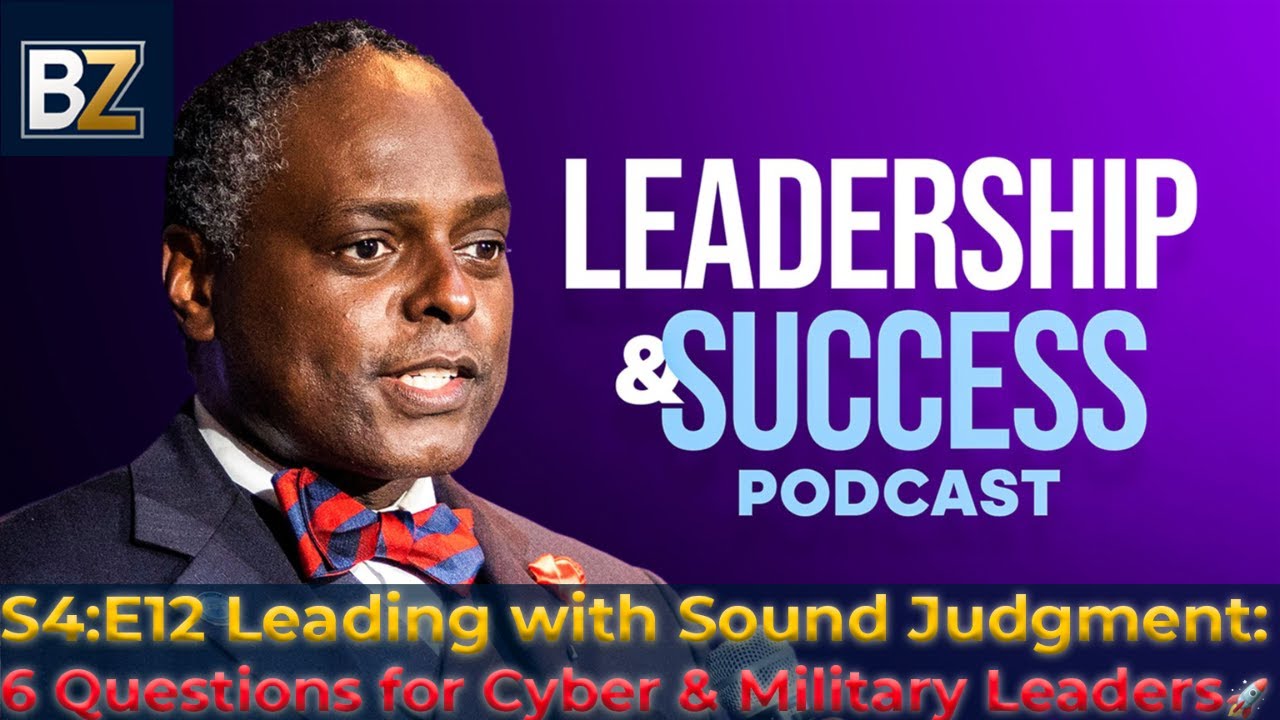
Bob Fabien Zinga, a former Navy cyber-warfare commander, walks through six questions for better leadership decisions: listening without filtering, trusting but verifying sources, recognizing blind spots, questioning your own bias, expanding options beyond tunnel vision, and checking if plans are actually executable. He anchors each with military and cyber stories.
Chapters
Hi, I'm John Maxwell. When the top companies in the world are looking for trainers, speakers, and coaches, there's one name that stands above the rest, and that's Maxwell Leadership. Our certified team members have gotten proven results for companies all over the globe, and our reputation, I'm proud to say, is second to none. Some of our members have risen to the top of their profession, including the one you're going to meet today. I proudly introduce you to my friend, Bob Fabien Zinga.
Welcome to the Leadership and Success Podcast with your host, Coach BZ. If you need to develop into a better leader, this podcast is for you. If you want to achieve a greater level of success, this podcast is for you. His mentor, Dr. John C. Maxwell, said it best: everything rises and falls on leadership. We hope to inspire you today and provide you with an insight that has the potential to positively impact the trajectory of your life. Welcome to the Leadership and Success Podcast.
Hello everyone, this is Coach Bizzy. Good to see you this Sunday for our Leadership Excellence and Accountability Devotion. So today we are going to be talking about an article I wrote. Let me share my screen so you can see it. It's about making a better decision, and I think more than ever today we really, really need our leaders and each individual, you know, to make the very best decision we can make. So it's Leading with Sound Judgment: 6 Questions for Cyber and Military Leaders. And, uh, this is actually based on a class from a professor from England. I think I've got him here, Sir Andrew Lickerman. He has a course called Judgment at Work: Making Better Choices. And, uh, this is, uh, based on, uh, this course. So he's a professor at the London Business School. Anyway, I am going to get my AI agent, uh, Drew and Mary, to take it from here. Please, in the chat, let me know where you are joining from. We are broadcasting live on YouTube and LinkedIn, and, uh, if you have a question for me, type it in the comment section, and I'll be back in about 30 minutes or so. Alright, Drew and Mary, you guys are next.
Welcome to The Deep Dive. We're the show that takes compelling sources, digs deep, and pulls out those nuggets of knowledge to help you navigate your world with, well, maybe a bit more clarity.
That's the goal.
And today we're diving into something that frankly affects us all every single day: making tough decisions.
Oh yeah, constantly.
Think about it. From the tiny choices that shape your morning right up to those huge high-stakes calls at work, you know, the ones that could define a project, maybe even your career, or even those split-second personal choices that just stick with you. Mm-hmm. The pressure's always there. The stakes can feel incredibly high, and so often everything seems to hinge on just one thing: sound judgment. So what are your tough calls right now? What's really on your mind when you're facing that uncertainty?
You know, you've really hit on something universal there. Every single one of us faces those moments, that ambiguity where the path forward just isn't clear at all. And like you said, the fallout from poor judgment, or sometimes honestly just getting stuck, that paralysis, it can be huge. It ripples through teams, projects, our personal lives.
Absolutely.
That's exactly why this topic is so relevant, isn't it? Yeah. It cuts across everything we do, every challenge you might face.
It really does. So our mission today in this deep dive is to tackle exactly that, the art, maybe the science too, of developing sound judgment.
Okay.
And our main guide for this, it's a really fascinating article by Bob Fabien Zinga. Now, someone with incredible experience. He's a top cybersecurity executive and also a senior informational warfare commander in the US Navy.
Quite the background.
Yeah. His piece is called "Led Ed: Leading with Sound Judgment: 6 Questions for Cyber and Military Leaders." And it lays out this really powerful framework.
And what makes Zinga's work so compelling, I think, and why it's such a fantastic source for us, is that unique blend of perspectives he brings.
Mm-hmm.
He's got decades of real-world boots-on-the-ground experience in these incredibly high-stakes fields. Think military operations, cyber warfare, national security.
Yeah. Places where decisions have immediate, sometimes life-or-death consequences or massive geopolitical ripples.
Exactly. Yeah. I mean, he combines that with solid practical leadership principles. So our goal for you today is to pull out the practical actionable stuff from his experience, from his 6-question framework.
Right.
These aren't just abstract ideas. These are strategies tested in the toughest environments, things you can start applying right away. Doesn't matter if you're leading a global team, managing a tricky tech project, or, you know, just facing a big personal crossroads.
Okay, so before we jump into Zinga's actual questions, let's maybe just pause and unpack this core idea of judgment itself. Like, what are we really talking about here?
Good starting point.
Zinga actually references Sir Andrew Likerman, who's a professor over at the London Business School. Likerman defines judgment as, and I'm quoting here, the ability to combine personal qualities with relevant knowledge and experience to form opinions and take decisions.
Sounds pretty straightforward on the surface.
It does, but it feels like there's more complexity hidden in there, right?
For sure. And Zinga adds this really crucial dynamic layer to Lake Huron's definition. It's something that clearly comes from his operational background.
Okay.
For Zinga, good judgment isn't just about having a solid opinion. It's about acting on it decisively in the right way at the right time. That's his emphasis.
Ah, the action part.
Yes. And he specifically warns against something his mentor apparently called paralysis by analysis.
Oh, I know that feeling.
We all do. Freezing up when you're just drowning in information or choices. And this idea fits perfectly with Navy doctrine. You know, their established principles for operating and leading. That doctrine actually encourages a kind of shared way of thinking, a common approach to problems. But, and this is key, without relinquishing freedom of judgment and the commander's need to exercise initiative in battle.
So it's not about overthinking it into oblivion.
Exactly. It's about confident, Informed, timely action. Judgment in Zinga's world is about purposefully moving forward, even when you don't have perfect visibility. It's about decisive action.
That's a really vital distinction. Thinking versus doing. Okay, so Zinga proposes these 6 guiding questions adapted from Lyckerman to help us sharpen that process, to turn thinking into effective doing. Let's dig into the first one.
Let's do it.
Question 1. Listening and reading. Have I understood? Now, this seems almost deceptively simple, doesn't it? We all think we listen. We all think we read carefully.
We do.
But Zinga points out, quote, many leaders rush to bad judgments because they unconsciously filter the information they receive. Few of us really absorb the information we receive. We filter out what we don't expect or want to hear. That's interesting.
It's fundamental, honestly. And yet we overlook it constantly, especially when the pressure's on. Right. The core idea is this pervasive human habit of filtering information. We all do it, often completely unconsciously. Our brains are trying to be efficient, right? Creating shortcuts to handle the firehose of data.
Makes sense.
But sometimes those shortcuts mean we just tune out details that don't fit our current picture or what we want to be true, or even what we're afraid might be true. It's cognitive bias in action.
And that leads to misinterpretations.
Huge misinterpretations. Or worse, completely missing critical details. Imagine, like Zinga deals with, a high-stakes cyber incident. Every scrap of intel matters. Missing one piece because it didn't fit your initial theory, that could be catastrophic.
So how does he fight that? Does he have a technique?
He does. He shares this really practical habit. After he briefs his cyber team on new intel, say, a complex report about a new ransomware threat or some nation-state activity, he doesn't just ask, Got it. Any questions?
Okay.
Instead, he actually makes them repeat the key details back to him, but in their own words.
Ah, reflective listening.
Exactly. He calls it reflective listening. It forces them to actively process the information, to articulate it. And that process immediately reveals any gaps, any distortions, any misunderstandings.
Simple but powerful.
Incredibly powerful. It ensures the understanding has actually landed. That hasn't been unconsciously filtered or twisted by their own assumptions. He's essentially forcing that slower, more deliberate System 2 thinking over the fast, automatic System 1.
So it's like actively pushing back against our brain's own shortcuts. That sounds tough, especially when things are moving fast. How do we actually build that skill? What's the practical application for us?
Well, the main leadership tip Zinga offers here is about deliberately slowing down that initial intake process. Just enough to really confirm understanding.
Okay.
So after a key meeting or reading a complex document, you can use this technique. Ask your team members to summarize the key takeaways in their own words. Not just nod, but actually explain it back.
Right.
But it's also internal. You need to train yourself to notice that little nagging feeling, that whisper of doubt, as Zinga puts it. That quiet sense that, hmm, something doesn't quite add up here.
Listening to your gut.
Almost kind of, but it's more like listening to your analytical gut. That feeling is your judgment saying, hold on, dig a bit deeper, question that initial take. It's hard because our brains love certainty, and questioning yourself can feel like weakness or like you're slowing things down.
Yeah, definitely.
But it's right there in that discomfort that real clarity often emerges, especially under pressure. And if you connect this to the bigger picture, Zinga brings up the Navy value of humility and continuous learning. He says, quote, effective Navy leaders demonstrate a deliberate commitment to grow, embracing our core values of honor, courage, and commitment.
So humility is key.
It takes real humility and honestly courage to pause and admit, you know what, I might have misunderstood that. Let me listen again. Or can you clarify that point? It forces you to confront the possibility you're wrong.
Which leads to that important question for you listening right now. How often do you really question your own first impressions? Especially when you think you've got it figured out. Are you truly open to information that contradicts what you expect, or maybe even what you want to be true?
It's a tough question to ask ourselves, honestly.
Definitely. And it flows right into the next point. Once you've really listened, you need to know if you can rely on what you heard. Which brings us to question 2: Trust. Can I trust the information and the people? This feels absolutely critical, especially in Zinga's world cyber warfare. Military ops, where information can be overwhelming, fast-moving, and sometimes deliberately misleading.
Oh, absolutely.
So what does this mean for us? How do we build reliable information streams, especially when time is short?
Well, the core idea Zinga stresses is that trust is essentially the currency in critical operations.
Currency, I like that.
Yeah. When you're making rapid-fire decisions under intense pressure—think an active cyber breach or a military encounter— You just don't have time to second-guess every single piece of data, every person feeding it to you.
Right. You'd be paralyzed.
Totally. You need a baseline assumption that the info is solid and the people are reliable. That's why vetting sources, understanding where the data comes from, assessing potential motives, it all becomes absolutely paramount before the crisis hits.
He must have examples of this.
He does. He shares this really vivid story from when he was a junior officer. He got an urgent phishing report from a source that was relatively new to them. Okay. The report claimed a major adversary was poised to launch a sophisticated cyberattack, hitting critical infrastructure. It even had specific IP addresses, attack vectors—it looked incredibly credible. The stakes were immense, widespread disruption potential.
Wow, so sound the alarms! That's the instinct, right?
Yeah. But Zinga paused. He asked himself that critical question: Can I trust this information, and can I trust this source, given their new— Discipline? Crucial discipline. He then systematically cross-checked the tip. He looked at internal network logs, checked communication metadata, and this is key, he talked to a seasoned senior analyst, someone known for their sharp judgment. And it turned out to be a false alarm. A misconfigured sensor had thrown out an alert that just happened to mimic known attack patterns. Oh wow, close call. Huge. Imagine the chaos, the wasted resources, the panic if he hadn't paused to verify. He avoided that cry wolf situation that could totally erode trust for the next, maybe real warning.
That's the classic trust but verify in action, isn't it? Sounds simple, but doing it under pressure, it takes real effort.
It really does. And Liebschmidt's framework explicitly asks that question: can I trust the information and the person giving it? Zinga points out that in the Navy, this is baked into how they handle intelligence. How so? Well, intel isn't just passed along raw; it's rigorously assessed. They assign a confidence level to every piece. And it's not just about the technical data; it's also about the human source—their track record, potential biases, even their stress level. Interesting. As Zinga learned from his mentor, that "trust but verify" mantra is just as vital in cyberspace today as it was on Cold War submarine patrols or on any battlefield. It means constantly asking yourself, what's this source's track record? Have they been reliable before? Could stress or incomplete data or maybe even an unconscious agenda be clouding their judgment right now?
So how do you build that trust foundation before the crisis? What's the leadership tip?
The key leadership tip Zinga offers is about building strong team trust proactively, making verification a normal part of your culture, not an accusation. Okay. He suggests things like regular commanders' calls. Those are basically critical team meetings. But the purpose isn't just top-down updates. It's about fostering an environment where people feel safe to discuss things openly, to challenge assumptions. Psychological safety. Exactly. Creating a culture where even the most junior person feels empowered to raise a red flag, to question data, to say, "Hey, this doesn't look right," without fearing they'll get shot down. That's huge. It connects directly to the Navy core value of integrity. It's about looking at data honestly and encouraging people to deliver the bad news, even when it's unpopular. Think about an analyst having the courage to say, "Sir, respectfully, there are inconsistencies in this report. It might be an error. It might even be deception. We need more data before we act." Yeah. When you have that mutual trust, that psychological safety where people can challenge information constructively, your decisions become exponentially stronger, more resilient.
It really is about creating that environment where the truth however awkward, can actually surface, which makes total sense. Okay. This naturally leads us to the next big piece. Question 3: Experience and knowledge. Do I have the relevant experience and knowledge? This one hits home because let's be honest, nobody knows everything, especially in fields changing as fast as tech or cyber.
You're absolutely right. Nobody has all the answers, particularly in these really dynamic areas. The core idea here, Zinga emphasizes, is that sound judgment absolutely requires an honest look in the mirror, an acknowledgment of our own limits, our blind spots.
Like, like you're— been warned, right? Acknowledge the limitations of what we have.
Precisely. And Zinga shares a really good personal example of this, a moment that was clearly humbling for him. He was planning this complex security exercise. The goal was to test their defenses against some really cutting-edge AI-driven attack tools.
Okay, sounds advanced. Very.
And Zinga felt pretty confident. He'd studied AI. He knew the cybersecurity theory from lab environments. But This is the crucial part. He hadn't actually deployed or defended against these specific AI tools in a live, messy, real-world network defense situation.
Ah, the theory versus practice gap. Exactly that gap.
So midway through the simulation, this novel zero-day exploit gets through. It used a unique AI technique to disguise itself, bypassing their own AI detection systems. It was a scenario he just hadn't fully anticipated because his experience was theoretical. Not practical in that chaotic, unpredictable environment.
So the AI wasn't the problem?
No, the glitch wasn't the AI's fault. It was a gap in his understanding of its real-world application, its vulnerabilities under stress. The big lesson for him was that he hadn't fully tapped into the deep, practical, hands-on experience of the seasoned operators on his team, people who had faced similar unexpected things in the wild. His takeaway: Diverse experience matters hugely.
So it's not just about your individual knowledge base. It's about the collective intelligence, the distributed experience across the team, and knowing how to access it effectively.
Perfectly put. Yeah. Especially in fields like cyber or AI that are just moving at light speed. Right. So the key reflection questions Zinga suggests asking yourself are things like, have I personally dealt with something like this before? Am I leaning too heavily on theory, or do I have that practical dirt-under-the-fingernails kind of experience with this specific challenge? And if the answer is no, then you have to actively seek out counsel. Find someone who has been there, done that. Zinga mentions how naval operations have formal systems for this— after-action reports, mission debriefs that capture lessons learned. Knowledge management, right? And similarly, in the corporate world, you've got mentor networks, internal wikis, specialized user groups. These can be absolute goldmines of practical insight if you use them.
So what's the leadership takeaway here? How do you actively leverage that collective wisdom?
The main leadership tip is it's all about intentionally leveraging that collective experience. For example, pair up less experienced team members with veterans. Actively build that bench strength, that transfer of practical knowledge. Mentorship. Exactly. And when you're facing something genuinely new, Zinga suggests doing something like a quick premortem, or a quick after-action review, before you act. Gather a few trusted colleagues, lay out the situation, and just ask, What would you do here? What potential problems jump out at you? Get fresh eyes on it. Yeah, it can immediately expose hidden assumptions, blind spots you didn't even know you had, or tap into expertise you weren't aware of. He also champions what he calls creative benchmarking, looking for parallels or solutions in seemingly unrelated areas. Could learning how an offensive cyber team thinks about breaching defenses help you design better defenses? Could someone who manages complex logistics offer insights for a tricky software rollout. It's about broadening your search beyond the usual suspects.
Thinking outside the box, basically. Right.
But here's where Zinga takes it a step further, which I find fascinating. He quotes Albert Einstein: Imagination is everything. Imagination is more important than knowledge, for knowledge is limited, whereas imagination embraces the entire world. Wow. And he pairs that with a verse from the Bible, Hebrews 11:1: Now faith is the substance of things hoped for, the evidence of things not seen.
Okay, so he's pushing beyond just experience and knowledge here.
He really is. It raises this incredibly important question for you. How well are you balancing that accumulated knowledge, that past experience, with imaginative leaps, with the kind of visionary thinking that unlocks totally new solutions? Because in rapidly changing fields, just relying on yesterday's playbook can be a death trap. Sometimes sound judgment requires that bold, imaginative step into what's possible. Not just what's known.
That's a really profound challenge. Judgment isn't just backward looking. It needs that forward looking, imaginative, maybe even faith-based element, which sets us up perfectly for question 4: beliefs, feelings, and bias. How are my beliefs and feelings affecting my choice? Now, this is where it gets really interesting, right? Because it moves beyond the external facts and dives deep into us, our internal landscape.
This is such a critical piece and arguably the toughest one. Yeah. Because it forces that deep, sometimes uncomfortable self-examination. The core idea The idea is simple but profound: every single decision we make, every judgment call gets filtered through our own psychology, our deep-seated beliefs, our emotional state in that moment, our built-in cognitive biases. Like Huberman puts it starkly, "What one judges is filtered through one's beliefs and feelings. Pretending otherwise is just—
well, it's dangerous." Zinga must have a story for this one too.
It feels personal. Oh, he does. And it's a really raw, honest anecdote. He was in this high-pressure boardroom meeting discussing their organization's cyber readiness. Okay. And admitting weaknesses, pointing out vulnerabilities in their systems, even if it was the accurate picture, made him feel personally exposed, like he would look bad. Ah, the ego trap. Exactly. So his gut reaction unconsciously was to kind of downplay the threats, paint a slightly rosier picture than reality supported. He wasn't thinking analytically. He was reacting emotionally, driven by a fear of appearing vulnerable. Maybe mixed with some pride in his team. We've all been there. Totally. Then, a junior officer, apparently quite innocently, just asked, "Sir, what evidence do we have for that assumption?" Oof, direct hit. Like a lightning bolt, Zinga said. That simple, non-malicious question just exposed his bias right there, in the room. He realized, in that instant, he was operating from an emotional defense mechanism, not from objective analysis.
That takes guts to see, let alone admit.
Incredible courage. And he recognized it on the spot. He paused, course-corrected, and actually said something like, "You're absolutely right. Let's list the actual evidence and acknowledge the gaps." Yeah. That single act of self-awareness, of integrity, saved the project from a major blind spot. And crucially, it preserved his credibility as a leader.
Wow. Okay, so how do we cultivate that kind of self-awareness? How do we stop our own biases from messing up our judgment? Because they're often invisible to us. They are.
Zinga really emphasizes the power of asking yourself proactive reflection questions like, okay, what assumptions am I making right now? Is fear driving this? Is pride? Am I leaning towards this option because it's popular or because it's right? Internal checks. Exactly. He points out that Navy leaders get specific training in self-awareness and emotional intelligence for this very reason. They're encouraged in debriefs and leadership exercises to ask themselves, What specific emotion is this decision triggering in me and why? Just naming the emotion helps detach from it and allows for a more objective view.
That makes sense.
And the most powerful leadership tip here is to actively build a culture where open, psychologically safe feedback is the norm, like we discussed with trust, right? Zinga suggests maybe having a designated devil's advocate for big decisions, someone whose job it is to poke holes, challenge the preferred option, bring up those inconvenient truths. I like that idea. Personally, he also often makes it a habit to sleep on major decisions for 24 hours. Research backs this up—time lets those initial emotional waves subside, letting a more rational perspective take over.
Give us some distance. Yeah. Journaling can help too.
Write down your gut feeling, then separately list the objective facts, the pros and cons, the counterarguments. It helps you see the gap between emotional pull and rational analysis. Good practical tips. And it ties back beautifully to the sailor's creed and that quote from General Colin Powell that Zinga includes: "Bad news isn't wine. It doesn't improve with age." Love that. It underscores that true courage isn't just battlefield bravery. It's the moral strength to say, you know what, I might be wrong here, especially when your gut is screaming one thing, but the evidence or a brave team member points another way.
Which brings us back to the listener. A really important question for you. What hidden psychological currents— fear of failure, maybe just the comfort of the familiar, maybe ego— could be subtly steering your choices right now, pulling you away from clear objective judgment?
That's the million-dollar question for self-awareness.
It really is. Okay, so once you've done that internal check, the next challenge is about broadening your horizons, escaping that tunnel vision. This leads us to question 5: options. Are these the right options? So how do we push ourselves and our teams to generate genuinely better solutions beyond just the first few obvious ones?
This is all about creativity and avoiding complacency. The core idea Zinga pushes is the critical need to systematically explore the full landscape of possibilities, not just settle for the easy or familiar answers.
Don't just grab the first decent idea.
Exactly. He says he constantly asks himself when facing tough calls, Have we been creative enough here? Have we really explored all the angles? Leikeremann's framework also really urges this kind of broad thinking, warning against that natural human tendency towards tunnel vision. Got it.
Does he have an example of escaping that tunnel?
He does, a really telling one from a complex cyber mission. They were dealing with a persistent network intrusion, something they couldn't easily shake. Okay. Initially, the Team, highly skilled tech experts, remember, were basically locked onto just two potential technical fixes. Either do a full system reboot, hoping to flush the intruder out, or completely isolate the infected network segment. Standard responses, maybe? Kind of the standard playbook, yeah. They were stuck in that technical tunnel vision, limiting their options to what they could directly control within their own system boundaries. Right. But Zinga deliberately pushed them on this question. Are these really the only options? Are they the right options? He really forced them to think beyond the immediate, the obvious.
And did it work?
It did. A teammate then suggested something completely different, something novel. They proposed partnering with a highly specialized digital forensics team from a trusted international ally. Ah, bringing in outside help. Exactly. An external collaboration that was initially way outside their internal thinking, but that path led to a much faster, more effective, and far less disruptive solution than either of the original technical ideas.
That's a fantastic illustration of how even expert tunnel vision can block better answers. So how do we proactively break free from that? As individuals, as teams?
Well, you start by intentionally bringing in diverse perspectives. Zinga suggests asking, "Who else should have a voice in this decision, even if they aren't directly impacted right now?" Widen the circle.
Yeah.
The Navy really emphasizes teamwork and learning from different specialties. For complex problems, Zinga recommends building a diverse planning team. Pull someone in from another department, maybe a civilian partner with a different industry view, maybe even someone you know who tends to disagree with you—a constructive contrarian. Hmm, interesting. Loxveerman even suggests thinking radically, like using zero-based planning in a crisis. Zinga picked this up from his mentor, Brian Tracy, who framed the zero-based thinking principle like this: Ask yourself continually, if I were not doing this already, knowing what I now know, would I start doing it again today? Powerful question, isn't it? He continues, if it is something you would not start again today knowing what you now know, it is a prime candidate for abandonment.
It helps you cut your losses, escape that sunk cost fallacy, right, where you keep pouring effort into something just because you already invested so much, even if it's clearly not working.
Exactly. And Zinga brings in that famous Einstein quote again here: insanity is doing the same thing over and over again and expecting different results. It's a direct challenge to break out of ineffective ruts.
Okay, so what's the practical leadership tip for generating more options?
Zinga suggests deliberate brainstorming sessions where you encourage wild ideas first without judgment before you start narrowing things down.
Use techniques like red teaming, Explain red teaming again.
You assign a subgroup the specific role of arguing against your preferred option. Their job is to stress-test it, find its flaws, expose its weaknesses. It forces you to see your plan from the outside. Smart. Also, ask provocative questions. What if we did the absolute opposite of our usual approach? Or, what would our smartest competitor do here? These questions are designed to shatter assumptions and spark innovation.
Challenge the status quo. Yes.
And consider the long game versus the short game. Sometimes a slower, more innovative solution that builds future capability is way more valuable than just a quick fix for today. The Navy culture, he notes, actually rewards exploring well-vetted alternatives, not just defaulting to the standard procedure.
Which leads to another question for you listening: How often do you truly push past the obvious? How many potentially better, more creative solutions might you be missing simply because you stopped looking too soon.
It's easy to grab the first workable idea and run with it.
It really is. But finding the best option often takes that extra step of creativity. And then, of course, once you think you found it, you actually have to make it happen. Which brings us to the final question. Question 6: Delivery. Can it be done? Is it practical?
Okay, let's really unpack this crucial difference between a great idea and a great plan that can actually fly in the real world.
This is absolutely where the rubber meets the road, where judgment moves from being a good thought to having a real impact. The core idea is stark: the most brilliant decision imaginable is completely useless if you can't actually implement it. Right.
Lizzie Gehrman's question here is just blunt and essential. Can this be done?
Zinga must have learned this the hard way at some point.
Oh yeah, definitely. He shares a personal mistake that drove this home for him. He once approved this really complex cross-functional security audit, a critical piece of work, scheduling it to happen right before a major holiday weekend.
Uh-oh. I see where this is going. Yeah.
Seemed like maybe a good time, perhaps less network traffic, get it knocked out. But his mistake, which had significant downstream consequences, was a complete failure to do a reality check on the practicality of execution. What happened? What you'd expect. Key employees needed for the audit on leave. Critical technical consultants unavailable. Essential approvals between departments stalled because the decision-makers were out. The whole thing just fizzled. Wasted time, wasted resources, lost momentum.
A good idea torpedoed by bad timing and lack of planning.
Exactly. It was theoretically sound but practically impossible because he hadn't fully considered the human factors, the operational tempo, the real-world constraints. He learned deeply from that. Every organization has rhythms, peak times, downtimes, and you have to factor personal availability into any major initiative.
So it's about anticipating those real-world roadblocks and understanding the constraints, building in resilience before you hit go. It's like the final test for good judgment.
Precisely. So now Zinga, before committing to any course of action, runs what he calls a quick reality check.
What does that involve?
He asks a series of sharp, practical questions. Who exactly needs to execute this? Do they have the skills, the tools, the authority? Are the timelines we've set actually realistic given everything else on their plate? What happens if our key person gets sick? What if a critical system fails?
Planning for failure, almost planning for reality.
He notes that in the Navy, whether at sea, onshore, or in cyberspace, resources fluctuate. Unexpected challenges pop up constantly. It's the norm. Like Uriman also points out that in a crisis, implementation is never straightforward. So you have to build in buffer time, create redundancies, have backup plans. Plan B, Plan C.
Makes sense. So what's the concrete leadership tip for ensuring delivery? Create an execution brief.
Doesn't have to be long, but after you've picked your best option, get your core team together. Collaboratively ask them, okay, what could possibly derail this plan? And what do we absolutely need—people, tech, approvals—to make this succeed?
Get the team's buy-in and foresight. Exactly.
That collaborative foresight helps you map out all the dependencies, the people, the technology, the process steps, and then you can build contingencies right into the plan from the start. Proactive problem solving. Yes. And Zinga connects this to Navy accountability. You delegate something, you make sure that person has the authority, the resources, the clear guidance to act, and then you track progress because sound judgment doesn't end when the decision is made. It has to follow through, as he says, to make sure the decision delivers as intended.
Like that Vince Lombardi quote he uses.
Yeah, the "We will chase perfection." 'But along the way, we shall catch excellence.' It's about diligent execution, striving for the ideal. Which leaves us with a final practical question for you: How consistently do your brilliant ideas actually turn into tangible results? Where do your plans typically break down, and have you figured out why? That's such a crucial final hurdle.
The best idea means nothing if it stays on paper. Okay, so just to recap Zinga's framework, these 6 questions give us a really clear, actionable path to sharpen our judgment. It's about turning good intentions into solid results by actively listening to truly get it, rigorously verifying to build trust, humbly tapping into collective experience, courageously checking our own biases, creatively expanding our options, and then finally meticulously planning for practical execution.
That's a perfect summary of the how-to. But Zinga doesn't stop there. With his blend of military discipline and frankly deep personal conviction, he then pushes us to consider the why, the timeless principles that lift judgment from just good technique to genuine wisdom. He calls this section Think on These Things, and these are really profound foundational insights, many drawn from ancient wisdom, that act like a moral compass for cultivating that deeper judgment. Let's take a moment with these, they're really worth it. First, he highlights Proverbs 3:21. My son, do not let wisdom and understanding out of your sight. Preserve sound judgment and discretion. The leadership takeaway here: great leaders aren't just firefighters reacting to crises; they're guided proactively by enduring principles. Stay anchored. Exactly. Stay anchored in wisdom and discernment, especially when pressure might tempt you to react emotionally or rashly. Sound judgment isn't a box you tick; it's a discipline you guard daily. Leaders need to constantly cultivate it through learning, mentoring, reflecting honestly on outcomes, and never letting ego or emotion cloud their thinking. So the question for you is, what routines, what daily habits help you stay anchored in wisdom when things get intense? And how do you reset when you feel your judgment getting fuzzy? Hmm, good prompt. What's next? Next is Proverbs 4:7. Wisdom is the principal thing, therefore get wisdom, and in all you're getting, get understanding. The insight. At every level, leading a tech team, a military unit, a company, wisdom is the bedrock. Technical skills get you in the door, maybe, but understanding fuels lasting impact.
Beyond just knowing facts. Way beyond.
It means prioritizing clarity, seeking deep insight before rushing in. It means valuing learning and adapting over simply being right, especially when things are murky. That commitment to deep understanding is crucial for navigating uncertainty. It connects back to leveraging diverse experience we talked about. So ask yourself, what areas of your leadership need more genuine understanding, more deep contextual wisdom, not just more data points? How often do you prioritize real learning over just confirming what you already think? That's a searching question.
Okay, what else?
Then there's Proverbs 8:12. Counsel is mine and sound wisdom. I am understanding. I have strength. This powerfully links strength and understanding. Seeking wise counsel isn't weakness. It's a force multiplier, right? The strongest leaders are often the most humble, the ones who actively seek diverse, wise perspectives before acting and then really listen. In complex fields like Zinga's, collaboration grounded in clear-eyed discernment is key to resilience. This links back to trust and options. So, for you, who are your trusted advisors? The people you go to for the unvarnished truth? And how often do you actually seek them out before making critical calls? What decision are you wrestling with right now where an outside perspective could make all the difference?
Important network to cultivate.
Keep going. Zinga also brings in John 7:24: Do not judge according to appearance, but judge with righteous judgment. This is a huge challenge for leaders because appearances are so often deceiving, especially when information is incomplete or maybe even manipulated. Look, dude. Yes, go beyond the surface. Resist the urge to make snap decisions based on how things look or on your first assumption or those hidden biases we discussed. It requires the discipline to gather the facts, understand the full context, and apply integrity and objectivity, even if the resulting decision is unpopular or goes against the grain. So for you, how could you build in more pauses, more structured space for reflection, for investigation, before making those high-impact calls instead of just reacting to the surface?
Creating space for deeper judgment.
Okay, then he revisits Hebrews 11:1. Now faith is the substance of things hoped for, the evidence of things not seen. This taps into that visionary aspect of leadership. Sometimes you have to act with purpose and conviction before the outcome is certain. The leap of faith. Exactly. Sound judgment isn't always the safest path. In times of change or innovation, it often means taking bold steps, driven by belief in a future that isn't fully visible yet. Faith here is like moral courage—believing in the mission, the team, the vision, even when the evidence is still unfolding. This ties back to imagination and expanding options. So the question becomes: what vision are you pursuing right now that requires you to lead more by conviction, by faith, than by complete certainty. And how do you sustain that belief in yourself and your team when the finish line isn't in sight?
That's powerful. Is there one more?
One final one. James 1:5: If any of you lacks wisdom, you should ask God, who gives generously to all without finding fault, and it will be given to you. This, Zinga suggests, encapsulates the deep humility of true leadership. Knowing you don't know it all. Precisely. It's acknowledging you don't have all the answers, but being open and willing to seek guidance, to learn, to grow. Whether you're a commander, a CISO, a team lead, a parent, that humility transforms leadership from just being in charge to being a genuine steward committed to continuous improvement. So the final reflection for you: in your decision-making, do you consistently look for wisdom beyond your own smarts and experience, or do you tend to rely solely on what you already know? How quickly do you pause to seek guidance, internal or external, when you hit real uncertainty.
Wow, that's a really profound set of reflections. It takes Zinga's practical framework and anchors it in something much deeper— wisdom, integrity, humility, even faith. It really challenges us to rethink how we approach those tough calls, doesn't it? Both at work and in life. He asks us point blank, how do you make tough decisions? What questions do you pause to ask yourself when the stakes are high?
And my challenge building on that is for you to actively use these 6 questions from Zinga's framework this week. Don't just let this deep dive wash over you. Try to integrate these principles. Maybe pick one question to focus on each day or talk with your team about them in your next meeting. Share a story, perhaps, where asking one of these questions really changed an outcome. That collective learning, that's how we all sharpen our judgment together.
And as you do that, maybe hold on to that Navy Corps value Zinga mentioned: courage. The moral and mental strength to do what is right, even in the face of adversity. Take that courage into your judgments this week. Be honest, even when it's uncomfortable, confronting biases, admitting limitations. And be bold in your actions, moving forward with purpose. Use these insights from our deep dive today to lead, to decide, and to act meaningfully in your own work.
All right, Joan-Marie, thank you so much for breaking it down for us. So really, for me, the take-home message is you need to learn to take what I call the strategic pause, right? Don't just auto-react or auto-respond to whatever is happening. Take a moment to think and then make what you believe is the right decision. So mastering sound judgment in leadership, 6 questions, right? One's about listening and reading, trusting the source, your own experience, and managing your emotion, knowing what options are available, and then focusing on the delivery. Okay, I'm not gonna check on both YouTube and LinkedIn to see if there are any questions. I don't see any. All right, so until next time, I'm gonna be back here tomorrow, Monday, at 6:30 AM Pacific Time, 9:30 AM Eastern Time. And until then, uh, have a wonderful Sunday, and, uh, see you tomorrow.
Bye. Thank you for listening to the Leadership and Success Podcast with your host, Coach BZ. If you like what you heard, please subscribe to our channels and come back for more wisdom nuggets on how you may develop into a better leader and achieve greater levels of success. Leadership is the most critical skill. The world will always need leaders to lead others, deploy the next disruptive technology, or execute a business strategy. You may as well decide on counting yourself among the 21st century leaders Leaders. See you right here next time on the Leadership and Success Podcast with Coach BZ.
More from Bob

S250:E4🎙️LIVE 🇺🇸America 250: President Barack Obama Leadership, Service, and the Power of Hope






S5:E157🎙️ LIVE with CMD CMSgt Dennis L. Fritz, USAF (Ret.)(Multi Tracks Audio)



S5:E156🎙️ LIVE 🇪🇸 Leadership Lessons from the FIFA World Cup 2026 Champions (Multi Tracks Audio)

S250:E3🎙️ LIVE Leadership Lessons from America’s First Documented Family of African Descent 🇺🇸📖