S4:E121 🎙️LIVE with LTG Milford H. Beagle, Jr., USA (Ret.) (Multi Tracks Audio)
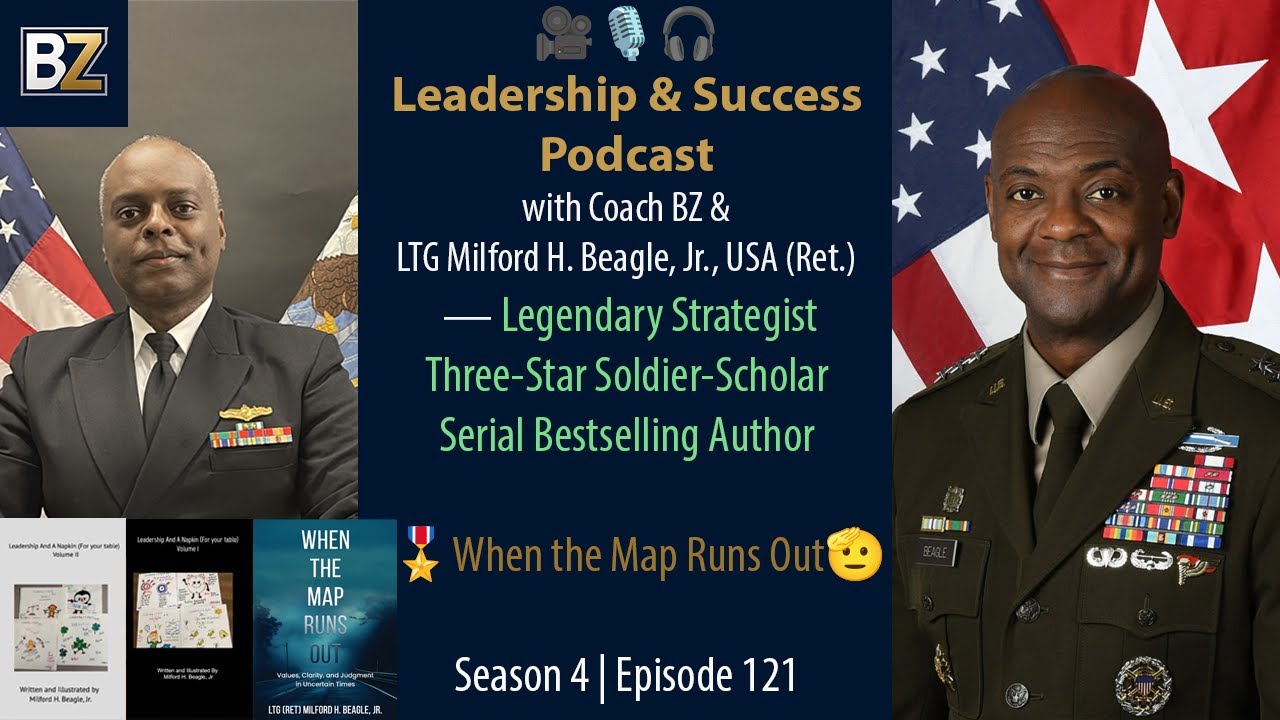
In this live episode of the Leadership and Success Podcast, host Bob Fabien Zinga (Coach BZ) interviews retired U.S. Army Lieutenant General Milford H. Beagle Jr. The conversation weaves personal history, leadership philosophy, and practical advice for today’s leaders. The episode opens with a gratitude moment, acknowledging veteran suicide and inviting audience participation. General Beagle shares his family legacy—his great‑grandfather’s World‑I service at Fort Jackson—and how that shaped his sense of duty. He reveals he is a self‑identified introvert, discusses the pivotal 40‑minute mentorship he received early in his career, and explains how trust becomes the core of leadership as one moves from small teams to large organizations. He differentiates management (processes) from command (people), emphasizes that “command is temporary, legacy is forever,” and introduces the concept of being a “good ancestor” who plants seeds for future leaders. Presence—both physical and relational—is presented as the single driver of high retention in his 10th Mountain Division. He outlines how humility is maintained through self‑awareness, daily journaling, and confronting imposter syndrome. The discussion covers navigating ethical conflicts, using a “compass” (values, judgment, character) when the map (plans, data) runs out, and translating military concepts like IPB to civilian contexts. Simplicity in communication is championed through his “Leadership on a Napkin” series. Time‑management, prioritization, and the importance of caring for one’s people are highlighted as foundational advice. Finally, General Beagle stresses the power of diversity, representation, and the message that seeing oneself in leadership roles fuels belief and achievement. Throughout, audience questions are answered, reinforcing themes of mentorship, legacy, and actionable leadership practices.
Chapters
Hi, I'm John Maxwell. When the top companies in the world are looking for trainers, speakers, and coaches, there's one name that stands above the rest, and that's Maxwell Leadership. Our certified team members have gotten proven results for companies all over the globe, and our reputation, I'm proud to say, is second to none. Some of our members have risen to the top of their profession, including the one you're going to meet today. I proudly introduce you to my friend, Bob Fabien Zinga.
Welcome to the Leadership and Success Podcast with your host, Coach BZ, where we help you lead with purpose and succeed with impact. If you're ready to grow into the kind of leader others want to follow, this podcast is for you. If you're determined to elevate your success and leave a lasting legacy, this podcast is for you. As my mentor, Dr. John C. Maxwell, reminds us, everything rises and falls on leadership. Our goal is simple, to inspire you, challenge you, and equip you with insights that can transform the trajectory of your leadership journey. Welcome aboard to another episode of the Leadership and Success Podcast with Coach Easy.
In a world racing toward complexity, where technology accelerates faster than human cognition and leaders face decisions without a map or a manual, one principle remains unchanged: clarity is a leader's greatest weapon. Today's guest is a man who has spent 35 years commanding clarity, developing decision-makers, and shaping the intellectual engine of the United States Army. He is the former commanding general of the U.S. Army Combined Arms Center, steward of doctrine, architect of leader development, mentor to generations, and the great-grandson of a World War I soldier who trained at the very gates he once commanded. He is a strategist, a storyteller, and one of the Army's most influential voices on values, judgment, and leadership in uncertain times. He believes judgment cannot be automated, that values outperform volatility, and that leadership is legacy, not title. Ladies and gentlemen, leaders, warriors, innovators, and seekers of excellence, welcome to Season 4, Episode 121 of the Leadership and Success Podcast with Coach BZ, featuring Lieutenant General Milford H. Beagle Jr., U.S. Army.
All right, ladies and gentlemen, this is a very special day on the Leadership Success podcast. We have a legend in the green room right now. But before we get started, let's do what we do as a custom, which is our moment of gratitude. So this is where we are asked to just take a moment, less than a minute, and we do this every single day to be grateful. And part of the reason why we do this is because 21 Veterans commit suicide every single day in this country, unfortunately. And I truly believe it's impossible to be suicidal and grateful at the very same time. So if you would maybe close your eyes, take a deep breath, and, uh, put yourself in your happy place and think about one thing that you are grateful for right now today. And if you would type it in the comment as well. For me today, I am really grateful for people like the legend we're going to be talking to today, those who have gone before us, right? Because what I know, whatever success I've been able to achieve so far, I didn't get here on my own. I really stand on the shoulders of giants, people who have gone before me and who've been trailblazers, people who have been the first in their kind to do or achieve whatever. And I use them as an example. And because they did it, I know I can do it too, especially when they look like me. So I am really, really, really grateful. For that. So please type in the comment what you are grateful for and let us know where you are coming from. And I'm very grateful we have, uh, Sahim Lewis from Delaware, Philadelphia. Thank you so much for being here, uh, Sahim. And if you have a question for the General, please type it in the comment as well. And also hello to, uh, Rigel Lovell from Arlington, Virginia. Thank you so much for being here. Oh, we also have Brand Elverston from Bentonville, Arkansas. I know exactly where Arkansas is. I used to live in Tuscaloosa, Alabama, not too far. And also Trent Upton, who had the privilege to serve with and learn from the General, is the real deal. I absolutely agree. Today's gonna be a great day. And again, for everyone watching, if you have a question, please type it in the comment and let us know what you are grateful for. So I don't think I'm gonna try to introduce the General. You did get just a snippet of who he is, where he comes from. So ladies and gentlemen, without any further ado, please help me welcome the one and only, the man who doesn't need any introduction, Lieutenant General Milford Beagle. Oh, hold on, hold on, hold on. Here we go. All right, so that was my fake audience, sir. Uh, welcome to the Leadership and Success Podcast, General. How are you doing today, sir?
I'm doing great. You made me feel like I want to walk out on the stage right now. I'm totally fired up. That's awesome. I applaud you.
Thank you, sir. I guess to get started, sir, what is one thing that you are grateful for today?
Positivity. I mean, doing this and the fact of, you know, what you do and the way you start it with having people reflect and think, I absolutely love it. But the fact that there are so many positive people in this world, I mean, when you look at social media, other things, people think that they're not, but there's still a ton of great people that are positive, you know, in our country, around the globe. And I'm just so thankful that I'm surrounded by those people. And the more connections I make is with those type people, and just very grateful for it.
Wow, that is awesome. And, and I really love to show what the audience is saying, because when I first started this show 4 years ago, I was the one and only person in the audience. So the audience of one. So when I get interaction with people, I definitely want to read this. But So we have Jamie Price, grateful for life, grateful for grace, grateful for God. I couldn't say it any better. Thank you so much, Jamie. And we have another user who says he's grateful to be a US citizen and under the protection of the most professional and capable military in the world. Amen to that. All right, so, General, before we get started, I have to get one thing straight. What's up with this t-shirt? We need to fix this. So I have one for you, sir. 'What is your size and how can I send this to you?
This is the one you should be wearing.' Oh my goodness, I get in so much trouble if I wore it. Yeah, beat Navy always, always. You love the banter between the services.
But yeah, that is, that is wonderful. Uh, because, um, when I joined the Navy, especially when I became an officer, I, and I was working more with a joint operation in the Army, I found out quickly that the Army is one branch of the military that is always compliant. As soon as the DOD comes up with a directive or even just an idea, Sir, we are compliant. Here we go. The Navy, we always try to be the last one to comply. But it's just amazing to see. So let's be serious now, sir. What is maybe something about you that most people may not know about?
I am a huge introvert. Most people don't think that, you know, you have leaders that are always out, always around people, that there's no way possible they can be introverted. But, but typically, most senior leaders, I mean, you go back, look at research, especially on the military side, A lot of your leaders are introverts, and not a, not a bad thing, not a, not a good thing. But it's just what people assume based on what they see. And that's not always very accurate. So most people will tell you, oh, yeah, he's an extrovert, 100%. Totally, totally the opposite.
Wow, that is surprising. So I'm sure when you speak, because you are always upfront, sir. So I'm sure you just use a lot more energy to be present. And wow, that is, that is Amazing. Now, your story is quite, uh, fascinating, but before I ask my first question, let me ask you, sir, can you tell us just briefly kind of about your leadership journey, how you got to become a 3-star commanding general in the most powerful army in the world?
Yeah, I'll try to find a story that encapsulates all of it very quickly, but it wasn't by design, at least in, at least in my mind, and you know, just being around good people all of my life. I mean, grandparents, great-grandparents, which I was very fortunate to have growing up, were all very helpful in just shaping me in terms of just how I am, who I am at my core came from, you know, all of those, those people. But when I joined the Army, there was one person in particular that comes to mind always, which was my first battalion commander. And the difference with him and everybody else was we all went in to see the the commander as new lieutenants, new officers to the unit. And when my turn came, you know, I got 40 minutes with him, whereas my peers were in and out in about 5 minutes. And the one thing that I said that wasn't totally true was he said, what do you want to do in your career? And I said, I want to be a general officer. And I didn't know any better. I mean, my assumption was, you know, that's what you expected to hear. I want to do great things and all that, but I really, you know, didn't I truly believe that. And he said, you know what, have a seat. And I'm like, I'm in trouble. So I sat down and he said, I'm not a general. I have no desire to be one, but let me tell you a few things that may help get you there. And so he had this 40-minute conversation with me, whereas my peers, as I pointed out, had only been in that office 5 minutes. We all kind of sat outside of his office waiting to go in and out. But I come out 40 minutes later and he shared all this stuff with me. And I, you know, tell some people that I kind of told a little bit of a fib because it wasn't really true. But once I left, now I said, I have to live up to all this that he gave me, all these insights, everything else. I found him 25 years later as a one-star, and I quite— I hadn't quite, you know, made it to that point. But, and I called him and I said, you know, I'm calling you now because of what you shared with me as a lieutenant and the fact that you gave me 40 minutes of your time.
That is amazing. Again, that's another reason why I am really, really grateful for those who came before us, because I had a mentor just like that when I became an intern. Actually, he had interviewed me for the joint commission program, and right then, just, I knew I have to follow this, this man. So I asked him to be my mentor after I became an information professional officer. I must tell you, sir, the first meetings we had in just like 30 minutes, he gave me a roadmap of exactly what I need to do to go from O-1 to O-4. And I followed that roadmap and it happened exactly like he said. So by the time I became a Lieutenant Commander in the Navy, I'm like, okay, what do I do next? I don't have a roadmap anymore. I don't know where do I go. And by the time he had already retired as well. So I had to find myself another mentor. But yeah, mentorship, it's really impactful. Like Oprah Winfrey says, right? People don't really remember what you say, but they will never, never forget the way you make them feel. And I am hoping with this podcast, it's to pay it forward for the next generation of great leaders who are watching right now. So, sir, I believe we have to go back to the beginning. You have to tell us about this story right here. Wow, this is just incredible. Your story begins with your great-grandfather entering the same gates at port Jackson 100 years before you commanded it. How in the world did that happen? What is the legacy that shaped your view of service, responsibility, and leadership based on that?
Yeah, the, the special thing with my great-grandfather Walter Beagles is the fact that I knew him. He passed away when I was like 15 years old, so he was well into his 90s when he passed away. I mean, he, he was, you know, hard-working, just a solid person. When you look at our pictures side by side, my PAO actually did that picture for an article, and I would joke and say when, when I first saw him as a little kid, when the point I could recognize and understand that that was my great-grandfather, I said there's no way this could possibly be because he's a white man. I mean, he was, he was very light, and even on his enlistment, enlistment records, he was listed as mulatto because of his hair. I mean, his complexion. And I said, how is— how are we related to this person? And he looks nothing like us. But later on understood. So I spent a lot of time around him. And one thing that he never really talked about, because there was nothing on the walls, never heard stories, was the fact that he served in World War I. And I didn't learn about that until I think I was maybe a captain. Most of my relatives started to say, by that point he passed away, the Long passed away. Did you know your great-grandfather served in World War I? I'm like, no, I didn't know. And I really became serious about studying more of his background when I got to Fort Jackson. And I found his, you know, records, found where he enlisted and sent that to my historian. And the historian came back with all the details. The fact that he enlisted at Fort Jackson, came through the same gates that I'd walked through, where he trained, deployed to France, and he received an honorable discharge. So it was pretty surreal to me to be on the same grounds where he once stood, to walk through the same gate. That he did as a person that, you know, could not serve in the infantry, was told that you're more valuable for your labor than your leadership. You know, all these things are here, you know, 100 years to the day. I mean, he walked through the gates in 1918. I walked through the gates, you know, to command Fort Jackson in 2018. So one of the— it was just all surreal for me. And you can still see things that soldiers like him African Americans did at that time because they were part of a labor battalion. They only did, you know, work, set up tents, dug trenches to help others train, not to necessarily be trained themselves. And some of those things still existed in my headquarters, ironically set in the exact same footprint where the African American soldiers had set up tents. I mean, the tents they set up were ones that were salvaged from dumpsters. I mean, those type things. And they were building, you know, for the other soldiers on the other parts of post.— but where my headquarters sat was right in that footprint. So it was so surreal for me that entire time and made me so mindful every single day of, you know, just like the journey and then where I was at that point in time. And that's a picture of my office, you know, at Fort Jackson at that time.
That is quite incredible. What a story. And I believe that's you with the senator from South Carolina there. It's just incredible. Wow. Man, this is almost too good to be true. And that's really one thing I really love about America, right? Like, even my own story, coming from another country and immigrant, starting at the very bottom and somehow making my way all the way up to becoming a senior officer, right? Only in America. Wow, that is incredible. So you've led at every echelon from platoon all the way to 3-star command. How did your leadership approach evolve as the scope of responsibility increased?
Yeah, I like the fact, BZ, that you say approach, because a lot of people will say your style, and I'm not opposed to, you know, when somebody says style. But to me, when you say a leadership style, that is, to me, similar to saying I can, I can put it on like a pair of shoes or a jacket or something else. And style just doesn't work for me. But I love the fact you said leadership approach, and your approach changes and my approach changed. I think most when you go from small organizations to large organizations, it's really about trust. And that's where you have to get most comfortable. And you can see leaders that have difficulties making that, that move upwards in their trajectory because it's hard for them to, to trust a large organization. The larger it gets, the harder it is to trust. And the simple analogy I use is we're very comfortable if you're a horse rider, if you're riding on the horse, you're very comfortable because because you have the reins, you can make that horse do whatever you want to do. The higher you go, it's like you're moving further back from that horse. Now you're a stagecoach driver and you've got 6 horses on your team and they're not reacting, responding exactly the way you want them to, and your urge is to jump back on the horse and do it. And then you find yourself inside the stagecoach and you're, you're relying on somebody else to make that team move and navigate. And then you go further up, you're at the station, you're not even near the horses. But when you have that inclination and you don't have that trust, you want to jump back on the stagecoach, you want to jump back on the horse and make it move. But you really have to be hands-off and develop and grow others and then demonstrate trust. And that is, I think, the biggest leap that leaders have to make as they go up is the ability to trust others.
Well, so you are not only an excellent reader, I think I've never met anybody who read more more than me, but definitely you do. But you are also best-selling author, and you've written at least 5 books I've been able to find. Maybe there are, there are more. And it's just amazing to see. So let's talk about management and command, kind of know what is the difference between managing an organization and commanding a formation.
Yes, I love to say you manage processes and systems, but you lead people.. And the title, you may be a manager, you may have some title of supervisor, but you're still a leader. And leading is about people. It is about influencing people. And that is the big difference. And whether you think you're just making the trains— I hate to go back to that analogy— making the trains run on time as a manager, you're still leading. You're still— because it is about people at the end of the day, and leadership fundamentally is about influence. How do you influence others to make something happen, whether it be a mission, whether it be filling an order or providing a service? It's that influence that you're providing to get others to accomplish whatever needs to be accomplished. And that is really the big difference, you know, with me.
Wow. And one of your best sayings is, 'Command is temporary, but legacy is forever.' For the junior officer listening right now, sir, I should young commanders think about building that legacy?
Yeah. Now this is not a Beagle original. It's from one of those other great books that I've, I've read. And it was actually about a rugby team, the All Blacks. And the one thing that resonates with me so deeply from that book, he talks about being a good ancestor. And that resonates so deeply with me because we typically think about, I need to make an impact in my time, in my tenure, in this job. And then I moved to the next one. But what you want to do is be a good ancestor. Think past your tenure. Think past your time in the seat. And when you look back, you know, years later, the thing that you know is that you've been a seed planter. You planted seeds and you're never going to reap the benefits of that harvest. Somebody else will. That's being a good ancestor. So I think when you look at your approach to leadership, the positions that you're in, the goal is you, you think deep, you're thinking deeper, and you're, you're planting seeds for somebody else to reap that harvest. And first and foremost, leave knowing that you've done your best to be a good ancestor.
Wow, General, we've had a lot more comments. I see, uh, Shamley, who says, love that, uh, Lieutenant story. Think many underestimate impact of mentorship for O-1. Grateful for your Navy chief with this. Absolutely. And also, by the way, so Navy chief to us, chief, uh, senior enlisted, E-7, E-8, E-9. They've been mentoring me since I joined the Navy as an E-1, and they kept doing that for some reason after I became an officer. I thought, hey, I am now above you The truth is, no, I am not. And I had to learn from them. So they did it until I was an O-4. So when I became an O-5 and then a commanding officer, I said, no, you are not going to stop mentoring me. Please keep mentoring me. You have to talk to me if I do something wrong. Please help me be a successful SEAL. And they absolutely did. I mean, I owe everything to the chiefs. They are really the anchors that run the Navy, not the senior officer, even the flag officer who usually get all of the credit. But anyway, so we have Andrew Walker. He says awesome. And we have Jimmy Price. 'a piece of South Carolina history.' That is so great. And, uh, another LinkedIn user who says, 'Giving me goosebumps, I love it.' Thank you so much for your feedback. Please keep letting us know. We want to know, uh, what would you tell today's Cadet Beagles as he pins on his second lieutenant bar? Actually, I had a question similar to that later on, but why don't we answer that question now, sir? What would be your advice to junior officer Beagle?
Yeah, I get that one a lot, and I think I'm getting comfortable with, you know, the answers because I've been all over the map every time I get asked that question. Because my son is a captain in the me and he looks just like me and, you know, he gets asked all the time, but, you know, things that I would tell him, but one thing I would go back and tell myself is ensure your confidence matches your competence because when you have the opposite, it's a theory of, you know, the imposter syndrome. And I think one thing that I had a lot, you know, and even up until 3 stars, to be quite honest, was a little bit of imposter syndrome. You're like, why am I here? How did I get to this position? So you don't feel as confident, but your confidence is there. And that's something that we don't typically see for ourselves. When you have the reverse and you have more confidence than you do competence, then you're in a dangerous spot. Now you're on the edge of hubris. You're on the edge of being arrogant, overconfident, everything else. But when you have the reverse, imposter syndrome is actually pretty good. There's a book I'm reading now. Sorry to keep throwing up books that reinforce that point with me. But I would tell myself that because I did lack in a lot of cases. The confidence, not knowing I had the competence to do the things that were in front of me or to do a job. Wow.
And something else I just learned now, Ranger Lead the Way, from Paul, listening to learn, RLTW. This is the other thing about the military that's pretty interesting. All of the jargon we use, first, not within each branch, and then even within the branch, different designator or community have their, their own languages. Thank you so much for sharing, Paul. Also, so let me ask you this then. Wow, it's— I am just amazed at everything you've been able to accomplish really in such a short period of time, at least 35 years in service.
Yes, correct.
What keeps you humble? I mean, you are a 3-star general in the most powerful army in the world, one of the very few, uh, who is African American. What keeps you so humble, sir?
Well, one, basically it's based on where you come from. I mean, people that were around me, my relatives, great-grandfather, grandfather, father, I mean, very humble people, mother, grandmother. But self-awareness, if I had to sum it up, you know, for your audience, is your ability to stay connected with self-awareness. In my book, I call it bearings. I mean, understanding your bearings, which means understanding where you are and who you are. And that is all about your strengths, your weaknesses, your blind spots, your biases. If you know those things, that keeps you humble and grounded because you know yourself. And one ritual for me every day is to journal. I mean, I started this when I was a major, and I have tons of these little black, you know, books where, you know, you write about yourself. You're your own worst critic. You're your harshest critic.— and not being harsh or mean to yourself, but you can see yourself. And that is very helpful, and it's helped me see my growth. I mean, I may start in a job, even as a 3-star, my first several months, I'm like, I think I'm going to fail at this. I'm not going to do well at this. Not sure why I'm picked. And I'd write those things down. And there's research behind when you write things down, put it somewhere where you can see it, that it does a lot for your mental aspect. It does a lot for you. Internally. And then to be able to see yourself over time, if you were to go back and look at some of those things you wrote, you're like, I'm beyond it. I'm actually better than that. Wow. Because you grew. And that, that keeps you humble when you focus on yourself to see yourself.
Well, so really leadership, I think, is also about impact. And you've proven that over and over again at the 10th Mountain Division. Your retention rate increased to 90%. Wow. So even for people who are outside of the military, even in high tech, like, like, like I am, they need to know. What do you think is the cultural or leadership practices that made the biggest difference?
Yeah, I will give you one word. It's actually two words, but it's the same word: presence and being present. And one ends with a T, the other ends with CE. And a lot of times we think, well, being present, that's all I have to do. Well, sometimes you can be present and not be there, but your presence, I mean, it's about your presence and being around. I mean, a division is 18,000 people and I couldn't touch or see all 18,000, but that was my goal. I always pursued, I'm going to see all 18,000 of those people inside this formation. Because on top of that, I think the thing that really got us that retention, we literally went from the bottom And for the audience that understands, you know, in a corps you have typically 4 divisions and we were always at the bottom. And the corps commander said to me one day, he said, I'm not sure how you did it, but now you're number 1 inside the corps for retention. And it was gaining a belief in those soldiers in terms of, and the civilians, what they did, what it is. It's about what you do and making sure they understood what they did, what their purpose was, and then believed in it., but you had to be around both present with the team and then your presence always. I mean, I think I did more reenlistments than any officer in the division. And that was a proud fact for me. It wasn't a point of shaming my officers. It was a fact that, you know, my presence enabled me to do more reenlistments than any officer inside the division. And there's a lot of officers inside the division. Because they knew I would do it. They knew I would be present to be there. And even if I didn't do it myself, a lot of days I would just go stand in a group and watch a re-enlistment. And so that, that gained a lot of attraction. And then the, the last point would be then showing others. I mean, my use of social media to show others, this is what we do. This is our people. This is who we are. I mean, I get a lot of comments about my, my, my Twitter or X days. I would go out and make snow angels.
Yes.
People were like, that's a general out making snow angels. Yeah, this is what we do. This is, This is our environment. And people were proud of that, to see that. And it made others want to come to that division as well. And once they got there, it was what they thought it would be because of the environment and the people.
Man, culture. That is amazing. Actually, I found out who the LinkedIn user is. That's actually my sea daddy, the one I was talking about, retired Captain Joel Rovsial. And he has a question for you, sir. So this is from an O-6 Navy, which is Pretty funny. In the Army, a captain is an O-3, but in the Navy, it's an O-6. I remember when I was a lieutenant junior grade, I was on board the USS Essex and not very junior officer, and somebody told me that the captain wanted to see me, and I was really perspiring. I was like very, very anxious. Oh my goodness, what does the captain want to tell me? And then I come to find out it was an Army O-3. I'm like, what in the world? You only one pay grade above me. Stop saying, doing that. But anyway, so My city is asking, I have a question for Lieutenant General Bigol. In any organization, there are times when peers may not share the same ethics or values that you consider essential to effective leadership. How do you navigate those situations, especially when those individuals are promoted ahead of you? What strategies help you maintain your own standard while continuing to lead with integrity?
Yeah, I would say with others, it'll be very hard to convince others about, you know, their leadership style or, you know, leadership approach, even if it doesn't align with yours. I think you're going to see that. Hopefully it's not so far out of bounds to where it's something that really causes major concern to you or harm or anything to the organization that they're leading. But to keep yourself grounded and true, that's really your true north. I mean, it falls back much like my book on your values, your character, your judgment. And if you think of it this way, I mean, you know, what guided you and helped you navigate on your worst day? And when people think back on my worst day, you know, I didn't think I was going to make it. There was something you held on to, typically a word, a value, some principle, something you held on to help you get through that day. And being able to hold on to that— and a lot of times I can't impart that on you, BZ. I can't give you, you know, my, my values. I can't give you my, my word, my one thing that drives me. But if you hold on to it, you know, for yourself, you're, you're always going to be okay because you can calibrate yourself. You can keep your bearings. Straight. When you see others, I call that what, what do you refer to? You know, your needle is wobbling. I mean, as leaders, we're the compass, but our values are the needle, and that's what's going to keep that organization and yourself straight. And others, their compass kind of wobbles a bit for a lot of reasons, distortion, you name it. But you have to make sure your needle always points true no matter what.
Well, actually, this is a great segue. Thanks so much, Captain rough child. And also, by the way, now that I am an O5, my senior asked me to call him by his first name. I'm trying, but it's very, very difficult because I— yes, I was at E4, right, when I first met him. So I almost always say Captain, but sometimes I catch myself, I call him by Joel. It's kind of weird, but respect.
It is, it is total. I do that as well. I have, yes, many people that have mentored me that I well outrank, and I still call them sir. And I say it's respect. All due to this book.
Joel, lots of love for you. Thank you so much, sir. I would never be where I am today without you. So back to the book, When the Map Runs Out, instant best-selling and just published this year too. One question I have, sir, is when the map runs out, what does a leader rely on when the map truly ends?
Yeah, it's those things that I put on the COVID I mean, it's your values, your ability to provide clarity, your judgment, your character. That's what you're going to provide because when the map runs out, which maps are your plans, your frameworks, your dashboards, those type things that we rely on, which are useful, they're good. I'm not anti-plan. I'm just pro-compass. That's, that's generally what, cause it's still going to fall on the person, the human and the leader to provide that clarity. Most people, most organizations are okay when you don't have all the certainty in the world. I mean, you don't want to be that, that leader that has all the answers that, that creates a bit of separation because you have all the answers and people are sometimes skeptical with that because you have all the answers, right?
Yes.
But when you can provide clarity, the ability to say, I don't know what I don't know, here's what I do know, and here's what I think I can see, and others being able to connect with you from that point, you're going to gain a much clearer view of the way forward or whatever the challenge is. But you've got to be able to center that organization and give them that confidence to go, we can navigate this because there's no map. We don't have a map. I mean, the road is forked, but the map is not going to tell us which fork in the road to take type thing. But I think based on my judgment, based on what we think, what we know, we should probably take this fork on the right. And most people are going to be okay with that because you provided them a level of clarity, not necessarily certainty, but clarity that they were a part of.
Wow. That is quite amazing. And one thing I have noticed, uh, like me, I read a lot, but your book came both in hardcover and, uh, paperback at the same time. Normally paperback doesn't come until much later. That's pretty amazing.
I have a great publisher. Wow, they hustled. They did a lot of work to pull it off. I give a lot of credit to my publisher, who's a veteran also. We served in I racked together as young majors. And so he does that. He's a great person, great human being. And he pulled off a magic trick.
But the only thing is you don't have an audiobook yet. At least I haven't seen one. People like me, I love to use NetTime, where I am listening to a book while I am driving or working out or something. Like, like that. So hopefully the audiobook is coming soon.
Well, I hope so. I've got to talk back to my publisher. I'm not so sure about my voice. So again, the imposter syndrome, right? When I listen to books, I love the voice. I mean, listen, I see on your shelf Colin Powell, and hearing him read one of his books, yeah, just awesome. You know, my voice, I'm not sure. So sometimes my voice is, you know, so deep, it could put people to sleep. So I'm worried about people driving, listening to my book, and I put them to sleep. But I think I'm going to give it a shot. I can't I can't give an established timeline on when, but I'll definitely give it a shot.
Wonderful. Thank you. Thank you, sir. Well, another question about the book. So you emphasize judgment over data. How do leaders cultivate better judgment, especially early in their career?
Yeah, judgment is going to take experience, and you can gain it from mentors. They can share some of their experiences, but they can't give those experiences to you. And the real key thing is always reflecting on your own experiences, your mistakes. There's no such thing in my book, as I've learned, as failure. There's only lessons. And you may feel like, well, I feel that there is a lesson. If you're going back to look at what you call the failure, what was the lesson in it? That's starting to build your experiences. That's now starting to build your ability to have better judgment. And you can't just, you know, read a bunch and bring that judgment in. It's going to be based on those experiences, but being able to reflect on them, I think that's where you're going to learn the most and your judgment is going to continue to get better.
Wow, that is quite powerful. We have another question from Jamie Price. He says, how can leaders establish a shared definition of ethics in a diverse organization without diminishing the value of individual background?
It depends on the organization because when you, you think about military organizations, but we have our ethic, but we have the Army ethic. I mean, you have it in the Navy, the Air Force, the Marines. I mean, so being able to coalesce around that, if there's other organizations outside the Army, hopefully one is there. I mean, part of the culture, part of what's already, you know, established and trying to get others to align with it. And even a point I make in my book is, you know, your values, your personal values may not always align with those of the organization, but the ones that do, that's where you want to see that alignment. Because you may have something that, you know, is not in the values of the Army. It's not a bad thing, but I have some values that, that may not line up with those that are in the Army. But I make sure that the values that I need to have are aligned with the Army. Others, because they're not listed, like for example, yes, empathy is not an Army value, but I, but that is one of my key values for me personally, empathy, and how I use it, how I leverage it. It's not putting me outside of the Army and their values. It's in sync with it. And understanding where you have those connection points with values of an organization versus your own.
Well, we have another question from Abdirahman Ali Mohammed. He says, sir, as a Lieutenant General, your career has been truly a remarkable one. Amen to that. One worth emulating. I am currently at a pivotal moment in my career. I think a staff sergeant, and I'm contemplating the transition to officer. Would you recommend or advise the change?
It's hard for me to recommend. When anybody asks me a question like that, I always ask, my first question back is, what is your gut instinct telling you you want to do? Because if you want to do it, you already know the answer. And now as you ask others, you're just trying to confirm or deny, you know, is my instinct right? Is my gut instinct right? Is my judgment right on this move? And so I would say if your answer is that's something you want to do, you have a desire to do it, do it. It's not based on my recommendation because your gut is already telling something in you, and you may not know why. You're searching as you ask that question for others to figure out, am I in the right space? You're, again, you're not so confident in your, in your assessment, in your thought. But if that is your instinct to do it, do it, which means you're going to do well at it.
Well, that is quite powerful. One of my CEOs taught me, because, you know, myself, I guess they call it Mustang, right, going from enlisted to officer. And when I was a junior officer, I felt like anybody who even had the desire to become an officer should absolutely do that. But my CEO taught me that no, we definitely need some people who become senior enlisted, like those chiefs I talked about, the anchor for the Navy. There are people who absolutely need to be the people who are going to drive the Navy So not everybody can become a commander or an admiral. So we definitely need everybody to have their place within the organization. But definitely, if you have a desire to do so, Abderrahmane, go for it. And also, you know, I think it doesn't hurt to try, right? You may try and not get accepted. I was very, very lucky. First time I tried, I got accepted right away. But I have mentored many, many future junior officers after that. About half of them, the first time they go through the process, they just don't make it because it's just too competitive. Like, even myself, when I was Lieutenant Commander, I'm like, if I went through the process today, I probably would not be accepted in the IP community. But I tell them, try again. And usually by the second or the third time, uh, they are picked up.
So yeah, yeah, I love Mustang. I never heard that before, making that transition. That's awesome. I wrote that down. But, but you're right, you know, try and fail, but never fail to try.
Absolutely. Wow. Well, so I could be talking to you forever and ever, but, uh, we're gonna need to bring this to a close. But I do need to talk about your second book series, right? Uh, it's pretty amazing. Uh, let me see this, this one here. I think I had the— you don't just have one, but actually you publish two books this, the same year, right? So this is, uh, Leadership in a Napkin Volume 2, and you also have Leadership in a Napkin Volume 1. I have a feeling that your daughter may have had something to do with that. Where did the idea come from?
No, actually, it came from a third grade friend, a third grade friend of mine who we're still friends with, you know, I'm still friends with today. And in class, he would always, you know, doodle and not pay attention. He was very smart. So he didn't really have to pay attention in math class, but he would just draw sketches. And I would— he'd give them to me sometimes, I'd trace them, keep them. And to this day, he's a great artist. I mean, he does different things in the corporate world. But a great artist. And at one point, probably about a decade ago, he asked me to participate in this thing called Beer and Napkins. And it was more about words, not necessarily pictures, but, you know, a bunch of guys with beer and they write ideas on napkins. And he said, could you participate? And I'm like, yeah. So I did. And for me, it's always about, you know, finding something in your approach that helps you move an organization and the being able to explain something simply because of my last 7 years as a drill officer, you know, I said, let me, let me see if I can explain this on a map and then, and then use that as a reflection point, you know, with the organization. So I did one and then people were like, sir, that's pretty good. You actually have some pretty decent skills. And I don't consider myself an artist at all by any means. But it resonated because now you can very simply see and interpret a lot of different things from, from simple art. And that was more reflection drill for myself, but also to see if others could look at that same vision and come away with either the same thing or something different. I've been amazed at how much people extract from a simple napkin. And I love the saying by Albert Einstein, if you don't understand something well enough, then you can't explain it simply. And so that drill for me is if I can explain it on a napkin, you know, in artwork, then at least for me myself, that means I understood it well enough. And having others be able to go through that same mental drill is something that is absolutely amazing. I don't know when I will stop because every time I try to stop, people ask for more, which is why I did the book. And, and I keep getting it on social media, well, when's your next one? Or, wow, I look forward to these. And you're like, so I'm gonna keep going on napkins for, I think, quite some time.
Let me ask you this. This is another thing. Again, I read a lot of books What's very strange is you actually published 3 books within a couple of months, all of them published this year. So you had, right, When the Map Runs Out, and then you had Volume 1 and Volume 2 pretty much come out at about the same time in 2025. Most authors, they publish one book this year and then they wait until next year or at least the next quarter before they publish the next book. I guess it's just, I've never seen this marketing because I had to purchase 3 books of yours. All at once. Is that something you did intentionally, sir?
No, it's just about drive. I mean, I'm not, I'm not gonna lie. It's not because I'm impatient. I mean, if you, if you can do it, you can get it done, get it done and do it. It's not really about marketing or trying to be strategic about it. It's just, you get it out there and do it. Because, you know, people were asking for the, for the napkins. And I'm like, okay, you know what, that's how I wrote, you know, my first book, The Rock. And wow, people were asking and I said, well, I just got to get through it, do it, get it done and put it out there. And then I can move on to something else. So really to me, writing, you know, in this way, or, you know, publishing the books, the napkin books in particular, is just to move that off my plate and I can move to something else. So there's no strategy. Wow. That is linked to any of those is just being able to get them done and provide what people are asking for.
Well, not only are you an avid reader, but you are also a pretty efficient author. You've already offered 5 books, which I am showing on the screen now, and here's the link. It's gonna be in the podcast notes. But, uh, so I, I just have to get ready. So there's gonna be a lot more books coming soon. So, um, I'm gonna be making sure to be on the lookout for that. It's, it's quite amazing. But really with your, uh, leadership in a napkin series, really what comes out is the simplicity of it, right? Leadership is really not that complicated. It's not simplistic, but it is quite simple. Reminding me of the great late General Colin Powell, who says great leaders are great simplifiers. So in your book series, again, Leadership on a Napkin, why does simplicity matter so much, especially at senior levels?
Because you always have to break down the complex, and the higher you go, the more complex it's going to get. And for the organization, You got to connect from the top all the way down because your execution is really in the middle, that middle layer. You know, you think about your majors, lieutenant colonels in the Army, mid-level leaders, you know, potentially in the corporate world or other places. But that's where you really got to make, you know, culture, all those things align because it's got to go from what you're thinking and then the complexity you're dealing with, make that simple to the person that's executing right there on the front lines. And when you have very clean lines from the top to the bottom, and part of it is really going to be about making the complex simple, being able to explain. So that first-line person understands, I don't need the big words. I don't need to see the complicated frameworks or maps for me to do what I need to do for this organization. And part of it as a leader is how you communicate that. And then how do you move that complexity or turn that complexity into simplicity and push that simplicity down? Wow.
And by the way, uh, Abdirahman is the one who asked about going from staff sergeant to, uh, officer. He says, thank you, General and Bizzy, I'm truly enjoying this talk. Uh, by the way, I've had several callsigns. I believe yours is Big Sir, but Bizzy is the one I like the most because, as you know, in the military it also means Bravo Zulu. So I am not perfect, but I try to be a person of excellence, and I love it. All right, uh, man, we already went running out of time. I have so many questions for you. So let me ask you this. I think This is very important because in my experience, when it comes to leadership, many people, you don't really tell them something they didn't know. All of the leadership principles, most people, they've already heard it before. But where the problem is, I think, where the rubber meets the road is they don't actually take action, right? They do not do it. So to me, really, action execution is everything. You don't really know something until you actually do it. It's in doing that you actually learn and know. So how can busy professionals apply these sketches, all of the leadership principles, immediately in their teams? What does it take for someone to not just be a hearer, but a doer, a practicer of all of the leadership wisdom that you enlighten us with in all of your books?
Yeah, so with my books, I like to view them as, you know, protein for the practitioner. I mean, there's a lot of things that you would need to know, and they're great in all the books that you and I both read and your audience reads, but then most people want like, give me, give me the how, and I want the how right now. And even that is very hard in parts. I mean, that's where you come up with frameworks and different type things and acronyms and all these type things that, you know, are helpful, but you really can't apply them based on, you know, the individual and where the individual sits. But if you lay things out in such a way that you can reflect on it, and that's one thing I think that, you know, all leaders need to do is be able to reflect. Whether you do it beginning of the day, end of the day, at some point stop and just reflect on what, what did I do? What did I not do well? What mistake did I make? And whether it's in a journal like myself, or another part of my routine is, you know, always being the first in, you know, to the office is quiet. Nobody's going to bother me. Nobody's going to, you know, send me an email. And that moment to reflect, and it could be 5 minutes, it could be 20 minutes, whatever you need, but just make time for yourself. It's like with money, pay yourself first. And when it comes to time, give yourself some time, because as a leader, you're going to give the rest of it to everybody else— your family, your coworkers, your peers. You're giving away that time. But if you don't carve out just a fraction of that for yourself every day, it's just going to make it hard to make yourself better and improve.
Wow, thank you so much for sharing that, sir. I do have to ask you about diversity. I think it, it would be almost malpractice if I didn't. As one of the Army's senior African American generals, what message do you have for young leaders who don't yet see themselves represented at the top, especially in the times we are living right now in the US where it seems like the general trend is to really get rid of diversity, equity, and inclusion and belonging. What, what would you say to a minority enlisted or junior officer who doesn't see much representation at the top right now?
Yeah, two things. And one, I can definitely say now that I'm retired, I mean, I, I am still a firm believer in diversity is our strength. I mean, all of our services, I mean, and in our country writ large, I mean, you look at what we do, what we've accomplished, it's because of that diversity. I mean, different mindsets, different backgrounds, different, you know, skin colors, different genders. You know, all that coming together, I mean, that is, that is power. And one quote I would always write on my whiteboard, any office I ever had, was many hands, many minds, one goal. I mean, that, that's diversity, and you're leveraging all that. But other countries, you don't always see that, and you look at us compared to them, whether it be what we do financially, what we do militarily, diplomatically. I mean, those things matter a great deal, but for those leaders that don't see it. And I think it's hard now to say you can't— they haven't seen it. Whether I'm looking on your bookshelf and I see Colin Powell's picture or one of the great, you know, female leaders in history.
Yes.
If you can see it, then you can believe it. And if you can believe it, you can be it. And that, that should drive, you know, anybody, whether they physically see that person or, or they can read about them or understand their journey. It's like, that's doable. And you can apply that to yourself. Because if they did it, 9 out of 10, probably 10 out of 10, you can do it as well.
Wow, that is quite powerful. Yes, I think representation absolutely does matter. And General Powell, definitely one of my greatest mentor and role model, even before I met him in 2015, I think was the first time we ever met again. He had written a book, My American Journey., and he was able to mentor me through that. And just by looking at it, I was like, okay, if this Black man can become a 4-star general of the most powerful army in the world, I think I can make ensign, right? I think it is, it is, it is possible, right? It may not happen, but it is, it is possible. So, so we do have—
because I believe, because you, you, it gave you a belief. And I think that's what, you know, we sometimes fail to understand. If I can believe it, then, then I can do it. You just have to believe, right?
Wow, powerful. Now, I believe IPB in the Army, I think that stands for the Intelligence Preparation of the Battlefield. I think that's what it stands for. She says Army IPB is the best and curious. So she's curious to see if you see any transfers to civilian space.
Yeah, yeah. So Miss Lewis has a great, great question. I see her sometimes on my LinkedIn feed quite a bit when she posts on it, but it absolutely translates.
And I think the way it translates Oh, sorry, Miss, Miss Lewis, the commanding general knows you. Hello. That's big. Yeah.
Yeah. Um, definitely recognize the name. She puts up posts on, on some of my stuff, so, which I'm grateful for. So thank you, Miss Lewis. But you know, we couldn't say IPB in the corporate world or leverage it that way, but the way we could say it is, you know, see yourself, see the enemy, see the terrain. And, and the enemy being competition, maybe, you know, what's in the competition's space. But that's, that's IPB. You've got to know exactly where you are, who you are as an organization. See the terrain. I mean, the terrain is going to shift and you have to be very agile to understand where is that terrain shifting. Do I recognize these signposts that are out there or I'm going to be comfortable? Our profits are good. We're moving well. Our plan is working and you're going to miss that terrain shift and all of a sudden a black swan is going to swoop in. That you didn't, you didn't expect. And that will happen inevitably at some point. And even if it does, at least mentally, you're, you're in the right space to go, black swan, didn't expect it. But here's what I think next. Here's how we move beyond that point. So I think IPB perfectly fits outside the military. It's just a matter of how you translate it and leverage it.
That is quite powerful. But even when we talk about diversity, so another thing I need to bring is really how do we honor those whose shoulders we stand on. That's how I started the show today. I'm always very grateful. Like, one of my favorite poems is "Still I Rise" by Maya Angelou. The phrase there that always gets me every single time, she says, "I rise bringing the gifts that my ancestors gave." So I'm not here by myself. Somebody was here before me. And she says, "I am the dream and the hope of the slave." Every time I read this, I almost want to cry. It really touches me deeply. So how can we as a people honor those whose shoulder we stand on, like my sidadi who's watching right now?
Yeah, yeah. And you actually hit it with the Maya Angelou quote and something that I mentioned earlier with being a good ancestor. And when I thought about, you know, my great-grandfather and those before me, Charles Young, I mean, even Colin Powell, when you read his stories, you know, it wasn't like great for him. He didn't wake up one day and all of a sudden Everybody said, you got to pass and you're now a 4-star and the Secretary of State and you're the Chairman of the Joint Chiefs. You know, he didn't get that easy. I mean, it came with a lot of hurdles along his path, but, you know, regardless of, you know, what you look like or where you're from, the goal is to always reflect back on those and just be a good ancestor because they did for you. They set that foundation. Now you have to do the same for others.
That is, that is Powerful, powerful. And just so that you know, of course I wasn't born in the US, so I don't have any slave, any of my ancestors were slaves. However, I was able to trace back in 1619, the very, very first slave who came to the US. I think it was what became the colony of Virginia in 1619. They all came from the Congo Kingdom with a K. That's where my direct ancestor came from. So I am the, my ancestors ancestor-kin were slaves in the US. So I am related to them, maybe not directly in their line, but I was a brother, a cousin, an uncle of those who came here. So that's how I see my direct lineage to the American, African American experience, just so that you know. All right, so we're gonna have to switch to talk about leadership, even if it's only for kind of, kind of get 5 more minutes, sir?
Yeah, sure. Absolutely.
Thank you. Thank you so much. So this is the part of the show where I just want to focus on leadership. We know everything you've done, but I kind of want to get to your mind. You know, I don't want to take what you've earned, but I want to take what you have learned and see if the people listening can apply them so they can earn that for themselves as well. So I guess one question I'd like to ask, sir, uh, what do you think, uh, is the secret for your incredible success? Why have you been so successful?
It all depends on how you define success. And when I'm asked that question, I came across a quote a long time ago, and it's actually from Albert Einstein. And he said, strive not to be a success, strive to be of value. And once I embraced that, it's not, you know, a particular thing or a position or a job or promotion that I would define as success. It was the fact of Being of value. And I learned that, you know, very early. I didn't know it until I read this quote, but when I reflect back, it was just being of value. I mean, the first duty station I had, I didn't want to be there. I literally called my grandmother crying because I thought the Army was trying to punish me for where they sent me in my first duty location because I wanted to be somewhere else. And the thing that I learned was I could be of value there. It really doesn't matter wherever you go, be of value. That is success. And if you can realize that, you know, in your own mind, your own heart, I was of value to that organization. When I leave, they hate to see me go. Then you know you were of value. When you show up somewhere else, yes, they're, they're glad you came, because they know you're going to bring value. To me, that is, that is ultimate success.
That is amazing. So what do you think, sir, is the greatest lesson you have ever learned, just in life, in leadership in general?
Um, use of time, because leaders don't run out of minutes, they run out of priorities and time. I mean, and you have to be very good— I won't say managing your time, I mean, it's hard to say you have to manage your time because a lot of cases your time is going to manage you— but being able to navigate time. And all organizations work regardless of what organization it is, in time and space, there's both of those things. But for the leader, you've got to be very good at the time aspect of it, of how to use your time well, how to use the organization's time well, because it's finite. I mean, we all get the same amount of minutes in a day, and you see others accomplish more with those minutes than you do. And, you know, busy people— my grandmother would always tell me, bugs are busy and bees are busy, right? As people, we have priorities. I mean, you're not, you're not just busy. And when you look up the definition of busy, all it says is having a lot to do. We all have a lot to do. But that's gonna distinguish you from others. Because you know how to prioritize, you know how to do things in such a way that you're mindful, you're respectful of time, because you can't get it back. I mean, unlike anything else, you're not going to get it back. And you can't repay people for time. So to me, the biggest lesson was the respect and the understanding of time.
That is so powerful. You just reminded me to add another book to my bookshelf. It's called The we have 8 hours, right? Most people sleep 8 hours, they work 8 hours. And this author was saying what really makes a difference between success and failure is what do you do with the remaining 8 hours every single day. That is quite, quite powerful.
Let me ask you, I gotta get that book.
Yes, uh, I, I actually, I'm gonna add it to your, uh, bookshelf, which has more than 65 books now, which is incredible.
Wow.
Uh, another question I have for you, sir. What, what do you think is the greatest leadership advice you have ever received?
The, the greatest and the simplest leadership advice was actually from my father-in-law, who's a retired Command Sergeant Major. And many in the Army, and probably in other services, have heard it as well, but take care of your soldiers and they will take care of you. And that is so true. That, that is so true. That if that is your first priority, your first principle— if I take care of my people, they're going to take care of me. Because we're typically worried about, you know, taking care of ourselves, getting an advancement, getting a promotion. We're trying to do those things ourselves. Your people will get you that. Your people will put you in a position to get that, to get that recognition, to get those awards. Whenever we're pinned an award like you and I have on our uniforms, they're not ours. Somebody put us in that position to get those. But take care of your people first and they will take care of you and everything else will take care of itself.
That's really the essence of leadership. Like we say in the Navy, mission first, but people, people always. Yeah. Wow. That, that is wonderful. Brent says, always a privilege listening to the Lieutenant General. That is correct.
So Brent is a, Brent is a, a great friend as well. I was on his podcast, so I'm, oh, I'm, I'm very appreciative that he listened to your, your podcast. He's heard me once already. So I'm surprised he, he came back for more. So Brent, thank you so much.
Well, Brent, it looks like the, uh, General has just voluntold you to be, uh, a guest on my podcast soon. I'm gonna be reaching out to you.
You get him, you're gonna get— he's got dual experience in the Army and then in the corporate world over like 2 decades in corporate. So he's phenomenal.
Yeah, because I really love that, because sometimes military folks, they do have trouble transitioning from the military to the industry. It's not an easy transition. But let me ask you, sir, as a leader, what are you learning now? I know you always say leaders are learners and leaders are readers, but What, what are you learning these days?
Yeah, a lot of things I didn't have to worry about in the Army. I mean, at the tail end, yes, but now AI, and I'm not trying to make myself an AI guru. I'm not trying to make myself a data scientist or analyst, but you have to learn it, understand it. Money, believe it or not, um, for 35 years, I don't know how much I got paid. My wife always knew how I got paid. I just did the work and she spent the money. But, but understanding money better, I mean, you know, that, that aspect of life and then business. I mean, how business, corporate world, and how all of that works, because it's a different pace, it's a different set of values, it's a different philosophy. So those are things that I'm deeply trying to accelerate my learning in now because I'm in that space. It's kind of like jumping into the deep end of the pool and you just got to start swimming. So I mean, there's a lot.
Well, one quote you have said, sir, quite popular, you've said that the speed of warfare is outpacing human cognition. I should literally prepare for this new reality. This come back to me when you mentioned AI.
Yeah, yeah. So that quote actually came from John Antle, and he wrote a book, Russia, Ukraine, about the, you know, the 7 Seconds to Die was the title of his book. But the speed of warfare, it is outpacing human cognition. But the thing we'd have to do is accelerate our own learning in that space. To my point about I don't want to be an AI guru, but I need to know it and understand it because things are outpacing human cognition. When you think about our organizations, they're becoming more complex. Our processes and systems are becoming more complex. Now we have to focus on the human. How do we get the human ahead of those things? Because we always were ahead of those things and pulling them to us. Now there's things that are getting ahead of us, so we have to accelerate our learning to understand how to better use those things because they're all developed for the human anyway, for our cognition to augment or augment those things that require human cognition. So we need to understand them better in order to, to do that because they have pitfalls and blind spots as well. I mean, as great as AI is and large language models, I mean, they don't have reasoning. They don't have judgment.
Yeah.
They don't have values. That's what the human brings to the table. So we need to have the advantage of knowing how to use those tools to help augment us in things that we need to do.
And so just as you know, we are 2 minutes over the time you allowed me, but thank you for giving us a bit more time. I think I can get this plan down in the next 8 minutes or so, but I do have to ask you something else that you talk a lot about is distinguishing between data-informed and data-driven. So what's the danger of allowing data to dominate Leadership.
Yeah, you're leading blind, I think. And I think you're making decisions in the blind because when data just pops out, you're, you're, you rest all of your judgment on that. It could lead you down a bad path because you've not layered in judgment, you've not layered in values and, you know, clarity with regard to what is that data really telling you. I give an example very quick. I read an article yesterday and it had all the, the data and it was very compelling, very well done about, you know, driverless cars and the fact that we should make that shift to driverless cars because accident rates are less, injuries are less. And I was pretty convinced, but— and the data was compelling. And that's what I mean by you can let that data drive your decision or you let it inform your decision. And for anybody looking at that, you have to really now decide with my judgment, is that really what I want to do? I mean, and it's different than your biases. Your judgment is, or your instinct, I don't want a car that doesn't have a driver in it. I mean, so that's going to tell you one thing, but if you look at everything clearly, you're probably going to come to a better conclusion versus— yeah, make the decision based on the data that was laid out, because very compelling, as I pointed out, but we have to always put the human factor and dynamic, you know, on top of that.
Yes, really the human factor, that's really what leadership is all about. Now, uh, Freddie Israel is saying, for For a long time, it was about putting the mission first. Recently, the Army adopted the whole of people realizing that without people, the mission cannot be accomplished. I think I agree with that, but it says to embrace the idea of putting and tackling, taking care of people first. I don't know, sir, but it seems to me like as a leader, you absolutely have to do both, right? Because if you are a leader, it's because you do have a mission to accomplish and it's important for that mission to be done, but you cannot do it without the people. So you do have to take care of your people, but it seems to me like it's not a choosing one or the other. It's like doing both at the same time and doing it well, right? Okay.
Yeah, it's absolutely doing both. And, and the— any definition— I love the Army's definition of leadership, but any definition is going to have one word. I mean, I've researched it, not all, but just about most. Influence. Influence in others to achieve that mission. So the two— it's a duality between those two. In order for me to achieve the mission, then I've got to influence the people to, to get there. So they, they go hand in hand.— which means, you know, and some people may, you know, look at it as, you know, maybe overdoing it, and one is above the other, but I've got to get those people in a certain space. I've got to make them safe. I've got to make sure they grow in order to achieve that mission. So you absolutely got to have both. And the saying that you mentioned as well, you know, people first, mission always, the two go hand in hand.
Yes, sir. And let's talk a little bit about failure, because we know about all of your successes, all the great things you've been able to accomplish. One of my best CEOs gave me this coin. One side says success, the other side says failure. So success and failure being two sides of the same coin. So again, we know all about your successes, but what about failure, sir? How has failure shaped your life? And I know you initially, you mentioned, uh, uh, the imposter syndrome, which a lot of my mentees go through as well. So how do you deal with that, sir?
Yeah, yeah. And, and something I said earlier too about, you know, you always you know, try and fail but never fail to try. And the fact that there's never failure, there's just lessons. I mean, there's a lesson inside of every failure. And I've had tons, tons of those. I mean, embarrassment. I mean, I think in one of the questions that you sent to me earlier, it was like, what humbled you, you know, in that failure? And I like that better because then you can think of it in a different way. So I've been humbled by a lot of different, you know, failures and learned from them. And The thing when you think about it is like, it's the humility, knowing that, you know, you were humbled by this failure. It didn't define you. It didn't set you back, you know, in a major way. Hopefully, you know, it didn't, but it humbled you. And so that allows you to kind of keep that, keep in touch with, you know, who you are and where you are, and then what work you have to do to not have that mistake or that failure happen again. Because failure is gonna, is gonna happen. I would say embrace it. Don't shy away from it. And I would tell young leaders, try— don't go into things approaching it, try not to fail. You're going to fail more. I mean, every aide, every young officer that I ever had, I would tell them very upfront in their counseling is do not come in this job and try not to fail. You're going to fail worse because it's just going to happen. Embrace it. Let it happen. I will underwrite your failures. And hopefully you're around leaders that will underwrite your failures because they realize you're learning from those. And as long as you learn and you don't make— I hate to say don't make the same mistake twice. I mean, sometimes you'll do that too. At least don't make it 3 times. And yes, you're learning, you're growing.
Wow. So really, failure is part of learning. That is so powerful. Who are some of the people that you know, sir, that we should know? Some of the thought leaders or mentors, people that you are reading right now that we should follow?
Yeah, I mean, there's a lot. It's hard to nail it down to 3. But I mean, doing podcasts. I mean, I've done more podcasts than I've ever done, you know, in my life in the last several months. I mean, but like, you know, you— I mean, follow you, Cal Walters. I mean, I did a podcast called Intentional Leader, but these are younger leaders that are connecting across multiple, you know, venues with regard to military leaders, corporate leaders, and then they're bringing it back to young leaders so they can digest it and use it. Again, it's protein for the practitioners. I mean, that's what you guys are bringing to your audience. And then there's, there's great books. So Angus Fletcher is an awesome author. His latest book is Primal Intelligence, and we're more intelligent than we should be. And I think that's the subtitle of his book, Primal Intelligence is smart. You're smarter than you think. Uh, yeah, yeah, uh, Juliette Funk, I mean, her book A Minute to Think, I mean, it talks about time. I mean, her, her whole thing is all about, you know, time. And those would be just a short list that I would, you know, give you for right now.
Very good. And for those who all love the book, the general has mentioned now on this bookshelf, and I will send it, Years of Primal Intelligence by Angus Fletcher. And I'm trying to get Angus on the podcast too. Hopefully that's going to happen soon. Thank you so much for— So let me ask you, if you could have dinner with 3 people, they could be alive, dead, or even mythical figures, who would you choose and why?
Jesus. Yes. Martin Luther King and General Marshall.
Okay. You have to say something about General Marshall.
General Marshall. And most people say, you know, General Patton, General Powell. Mm-hmm. And, and you, you gave me a short list, but when I look at some of these leaders and you think about, you know, what, what they did, we think about them in wartime. We think about those things they did as, as leaders, you know, in combat situations. But when you peel it back, you realize certain things, just like with Colin Powell, about their values, about, you know, things that they held true to them that really got them to where they were, that you don't see because it's clouded in all of the pomp and circumstance of things that are written about them and then different, you know, events, you know, in their life. Martin Luther King, you know, he was a great strategist in my mind. Most viewed him as a great orator, but I mean, the strategic mind he had to have to navigate the space that he was in, you know, during the civil rights movement, everything else, it's about strategy. So I mean, I would love to talk to him about that. And I, I view Jesus as like the ultimate servant, you know, leader. There's a great book called The Servant. And when you read the Bible and things associated with the Bible, it's like, what is servant leadership really about? And it is identifying and meeting the needs of others.
Wow, that, that is, that is quite, uh, powerful. This is usually the time where I ask people for couple of books recommendation, but of course, like I say, you had more than 65 books that you recommended just by looking at your LinkedIn profile. It looks like every other week you have a book to recommend. So maybe if you can just tell us 2 or 3 books. Now, you've already mentioned the book about— from Ken— I mean, Andrew Fletcher.
Is there maybe another book you'd like to recommend to my Yeah, I would say ones that are not on there, I don't think it's on that list, but The Servant. I mentioned that it is a great book because there's a lot of talk about servant leadership, and I think this author among many, and I can't think of his name off top of my head. Okay, but it's a unique title, The Servant, and he talks about servant leadership. The second one would be Crucial Conversations, which I think is actually on that, but then how do you communicate? I think that's where our younger leaders and leaders have difficulty is having conversations that they're not comfortable with. And we title those conversations the same. It's uncomfortable, it's difficult, it's a hard conversation. There's— to my book, and based on reading that book, there's no such thing. It's just crucial, a crucial conversation. And crucial conversations are going to have 3 ingredients: high stakes, varying opinions, and emotions. And if you know what conversation you're going to have before you have it,— it makes that conversation much better. And then the last book would be Leadership and Self-Deception. That book is great because, you know, sometimes we're leading and we think we're leading well, but we're actually deceiving ourselves because there's something hidden that we haven't recognized in our leadership. So Leadership and Self-Deception is a great book that I always keep close by on my shelf to reference, and then just to remind me. Am I deceiving myself? Do I think I'm a good leader? Do I think I'm a great leader? Or am I deceiving myself? Because if I'm deceiving myself, I'm deceiving those that I'm leading as well.
Wow, that is powerful. Thanks so much, sir. And those 3 books are going to be added to your bookshelf at the end of this podcast. And you also made me think of something, sir. I think there is a, you know, you have to be very careful when you become a good leader because you can easily fall into manipulation. Like my primary mentor, John Maxwell, I think is the one who made it famous. Leadership is influence, nothing more and nothing less. But if you are not careful, sometimes you may be able to manipulate people into serving yourself instead of doing what's best for the organization. Okay, I need to land this plane, so give me 2 minutes. I think we can do it. If you had one day and only one day to live, sir, what would you have liked your final contribution to be?
I'll just use my purpose statement. I had a course where we had to write purpose statements. And it was very hard to do. I did it probably over 2 decades ago. And if you could do it in 11 words, you know, 10 or 11 words, that became your purpose statement. And so it took me years to like really refine it. And my purpose statement is to live my life in such a way that it inspires others.
Wow.
And so even if it was my last day on Earth, if I've lived a life that has inspired others, then I'm okay. That— but that to me is how I would sum myself up, is I've lived a life that has inspired others. It's not just in the military, it's just in everything that you do. And that forces you to be very mindful, not walk on eggshells, but if I could do something that inspires somebody else, yes, that, that is, that is a great purpose. To have in my mind.
And if you had the magic wand, sir, and you could solve any problem, what is one problem you would like to solve tomorrow morning?
Make negativity go away. Yes, make it disappear. Colin Powell said it best: optimism is a force multiplier. But I would add positivity with that. Make negativity go away.
Powerful. Okay, um, how can we add value back to you, sir?
One, you have already, BZ. I mean, just having these conversations and sharing, and I won't say or claim to be the greatest leader or the best leader. There's many others out there, but at least to be able to share what you know and give that back. So I appreciate that. If there's people that are out there that know of keynote events or events that they would like to see me come to, that's my space now because it truly is about translating service into value. And I've got 35 years of service. My goal now with writing books, doing keynotes, helping other organizations develop their leader development programs and figure out where their organization is, that, that puts me in my happy place. That is what I want to do and what I want to share. And so the second half of my life is if I can do that outside of the Army, then there are those that can connect me with the right people that I would appreciate any help in that space.
Thank you, sir. So we are about to land this plane. Um, before I ask you the last set of questions, is there a question I should have asked you, sir, that I didn't get to ask? Any question you wanted to answer on this podcast?
No, you, you have a lot. You've asked a lot. We've covered a lot of ground right now. I can't think of a single thing that I don't think you did ask. What you did— you know what, you, you, you did it in the green room, and it was about marriage. And yes, my wife, my lovely bride, and I, yes, yes, yes, 34 years You asked me a question then, and you said, what's the secret? And I don't— everybody has their own secret. I don't think there is a particular secret, but one thing is it's about compromise, you know, in any relationship, you know, with your, your significant other, your spouse. It's always about compromise. And, and never forget the point of it's two imperfect people striving for perfection. That to this day, my wife, she'll look at me and say, well, you know I'm bossy, you knew that when you married me. And yes, it's a problem. I mean, you know, but it's two imperfect people striving for perfection. So I think 34 years, and hopefully another 34, you know, plus more, we're going to continue to strive for that perfection. And that's what's kept us together.
Well, that is really wonderful, especially in the military, because I don't know how many special occasions I've missed because I was called out on active duty. But having the same spouse after 30-plus years of active service, I mean, that's really a miracle. Because the truth is, After, you get all of the accolades, all of the stars, and you are done with your career, and it is time for you to go back home, right? If you don't have a home to go back to, I really don't think that you are successful, going back to your definition of success, regardless of whatever impact you might have had on the national security of this country. Well, thank you. Thank you. Thanks so much. Okay, to finish the show, this is going to be really, really quick, probably just a couple of minutes. So that's going to be rapid fire, right? Lightning round. So don't take too long to think, sir. One word. Oh, actually, before I do that, maybe the most important question I think of the podcast. If you could go back and give a piece of advice to your 17-year-old self, standing at the edge of this incredible, incredible career you've, you've had, uh, what would you say to 17-year-old Alfredo?
Have confidence. And I think you had a question like that similar, you know, earlier. It's like, you know, make sure your confidence matches your competence. Yes.
Wow. Wow. That is powerful. Powerful. Thank you for touching on data-informed versus data-driven. The difference is critical. And Sean says you have made your purpose statement, at least to this guy. Absolutely. Wow. That is wonderful. Okay, so we are going to land this plane now. One word that defines great leadership.
One word defines great leadership.
Trust. Trust, okay. Morning routine or practice that keeps you grounded? Yoga. A book or a quote that changed your life?
Maya Angelou: "People forget what you say, they forget what you do, but they will never forget how you make them feel." That's true.
I heard it from Oprah, but I think she heard it from Maya Angelou, who was her mentor. But eventually all of the quotes you've said on this podcast are going to be absolutely credited to you. That's one great advantage of reading. Sometimes you don't really remember where you read it.
Yeah, just be careful. You have to be careful about that too.
Yeah. Yeah. So what did you want to be when you were a kid, sir?
I wanted to be like my dad. My dad was a truck driver, so he drove 18-wheelers. I wanted to be just like my dad.
Yeah. Okay. You definitely done something different. 3 adjectives just describing you as a child.
Quiet. Uh, it's hard to say quiet and rowdy, but I was rowdy as an individual with myself.
And one more—
reflective as an adult, even as a kid. As, as an adult, two of the same: quiet, reflective. More emboldened. It might not be the right, the right fit for it, but I feel more comfortable with taking risks.
And inspirational definitely will be at the top of my list. Okay, who inspires you most today, sir?
Oh, man. I would, I would still go back to my relatives, my grandfather, you know, my father, still inspirations. They're long gone, but still inspirations to me to this day.
Powerful. And the very, very last question of the show, and this is it: what is one word that describes or represents our shared experience on this podcast today? One word.
Impactful.
Thank you so much, and I am so grateful. All right, sorry, we went over actually by 20 minutes. I said it would be only 10, but You have so much to teach us. We should have you back on the show. But the way you are writing books, sir, we should have you back here very soon. But thank you. Thanks. Thanks a million. It's really a great honor and a privilege. Thank you for being one of our master teachers today.
No, thank you so much. And to your audience, I really appreciate them and their time. And thank you for your time and for what you do. What you do is such a great thing. I have so much respect for all you podcasters out there, and it's just, it's just great to give back. And that is That's purely what it is, giving back to others.
Thank you, sir. Thank you. Right. Well, ladies and gentlemen, that was the one and only, the man who needs no introduction, Lieutenant General Milford Beagle Jr., legendary strategist, Freestyle Soldier scholar, serial best-selling author. And there's going to be more books coming out soon, so I need to get, uh, pre-prepared. But please go ahead and purchase this book at least. When the Map Runs Out: Values, Clarity, and Judgment in Uncertain Times. Everybody needs to get a copy of this book. And then I think you should also look into his book in the series Leadership in a Napkin. Volume 1 and 2 came out this year as well. And follow the General on LinkedIn. So to end the show, as all of you know, Every year around Thanksgiving for the last 4 years now, I do what I call a 21-day gratitude challenge. And I believe today is day number 6, if I am not mistaken. No, actually today is day number 7. Wow. It's already been 7 days since Thanksgiving. So what I do is every day I am grateful for something. That's the challenge. And I have to create a post on LinkedIn to let everybody know. What I am grateful for. And then the second requirement is I have to choose somebody in my network who is going to be able to go out there and, uh, do the same thing. So what we are going to do, uh, I am going to share my screen and we're gonna find out who is the person on my network who is going to be challenged today. So what I have, I have this wheel of— I am going to randomly click on the wheel and let's see who's going to be a part of our 21 Leadership Day Challenge today for day number 7. So it looks like it's going to be Alfonso Ramos. Oh, he's a general manager, CVS Health. Company, and I connected with him in 2021. So, Alphonse, today, like I say, I am grateful for all the people who have come before me, you know, shoulder I stand on. And I am right now challenging you, Alphonse, to accept this 21-day challenge. If you accept it, that means starting today, for the next 21 days, every single day you're going to be grateful for something on LinkedIn. And then every day you're going to select somebody out of your connection. It looks like you have 1,235 followers right now on LinkedIn. I want you to select one person every single day for the next 21 days to accept this challenge too. So I hope you are gonna say yes to it. So this is it for, uh, today everyone, and thanks a million for watching. Uh, I'm gonna be back here again tomorrow, and tomorrow I will have the pleasure of speaking with Janet Foudy. She was the chairman CEO for Deloitte, and she's written a book, Arrive and Thrive, a bestselling book. She's going to be here with us tomorrow morning. So thanks again for watching. And until tomorrow, have a wonderful day. Thank you for tuning in to the Leadership and Success Podcast with your host, Coach BZ. If today's episode added value to your leadership journey, be sure to subscribe, share, and join us again. For more wisdom nuggets on how to lead better and achieve greater success. Remember, leadership is the most critical skill of our time. The world will always need leaders to inspire others, drive innovation, and execute meaningful strategy. So why not count yourself among the bold leaders shaping the 21st century? Until next time, stay inspired, stay committed, and keep leading with excellence.
More from Bob

S250:E4🎙️LIVE 🇺🇸America 250: President Barack Obama Leadership, Service, and the Power of Hope






S5:E157🎙️ LIVE with CMD CMSgt Dennis L. Fritz, USAF (Ret.)(Multi Tracks Audio)



S5:E156🎙️ LIVE 🇪🇸 Leadership Lessons from the FIFA World Cup 2026 Champions (Multi Tracks Audio)

S250:E3🎙️ LIVE Leadership Lessons from America’s First Documented Family of African Descent 🇺🇸📖