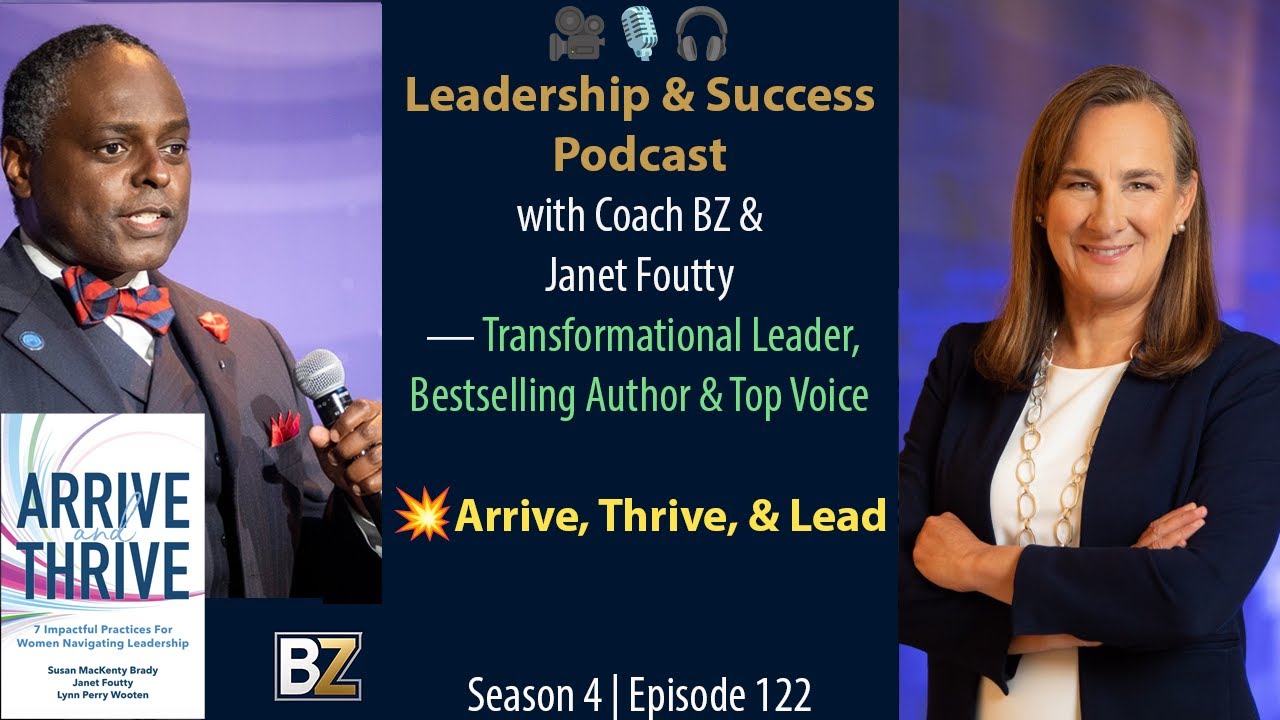
Coach BZ selects Steven, a Zim Corporation board member, to take a 21-day gratitude challenge on LinkedIn, thanking a different follower each day. Janet Foutty's book Arrive and Thrive is featured, with the episode ending on a call to subscribe and share.
Chapters
Hi, I'm John Maxwell. When the top companies in the world are looking for trainers, speakers, and coaches, there's one name that stands above the rest, and that's Maxwell Leadership. Our certified team members have gotten proven results for companies all over the globe, and our reputation I'm proud to say, is second to none. Some of our members have risen to the top of their profession, including the one you're going to meet today. I proudly introduce you to my friend Bob Fabien Zinga.
Welcome to the Leadership and Success Podcast with your host, Coach BZ, where we help you lead with purpose and succeed with impact. If you're ready to grow into the kind of leader others want to follow, this podcast is for you. If you're determined to elevate your success and leave a lasting legacy, this podcast is for you. As my mentor, Dr. John C. Maxwell, reminds us, everything rises and falls on leadership. Our goal is simple, to inspire you, challenge you, and equip you with insights that can transform the trajectory of your leadership journey. Welcome aboard to another episode of the Leadership and Success Podcast. Podcast with Coach BZ.
As a country, we have tremendous opportunity over the next decade to absolutely advance innovation, and I believe that is rooted in technology. The advances in everything from cybersecurity to artificial intelligence to cloud computing, um, to cryptography are absolutely second to none. But what I think is really interesting is what are the challenges in achieving that incredible ambition. I think the challenge is two things. One is making sure that that innovation is distributed and is not concentrated, and whether that's concentrated in geography or whether that's concentrated in cohorts of individuals, I think that's a real challenge and an opportunity for us. And the second is making sure that That innovation and that use of technology really reflects our values as a country and as a society. The work of the Council, I think, is perfectly pitched to address both of those topics because of the nature of the collaboration between government, the National Labs, academia, business, and labor is exactly the right sort of cohort of thinkers to think about those two very specific and very clear challenges that we have while we seize this incredible opportunity in front of us. I believe the Council's role in place-based innovation is critical and very well suited and timed. You know, the Council has done work well before my time in and around the importance of location and geography and centers of excellence for innovation, and absolutely ripe to build on that given the groups of constituents that we have engaged and the Council's position positioning. So place-based innovation is, I think, serves two incredible purposes. One is I do believe it's the right thing to do, but much more is that it actually allows us to draw on a very broad set of talents and capabilities. We know that the more diverse sets of brains we have against a problem set results in much better outcomes.
All right, ladies and gentlemen, I am really excited today. We have a legend in the green room. I'm gonna get back to that in a minute. First, let's do what is our custom, right, which is to be grateful every single day. And as all of you guys know, uh, I started— this is the fourth time now— 21-day grateful, uh, challenge as well. I'm gonna say more about that toward the end. So for the time being, as we do as a custom here, maybe you wanna close your eyes or put yourself in your happy place, take a deep breath and think about one thing that you are grateful for today. And today I am really grateful for all of my mentors, not just people who have mentored me directly, but also those I have adopted, right? Those who have mentored me from a distance, people I have maybe not seen, I haven't talked to, but I've been able to read their books, read their articles and learn from their speeches and all of the work they have put out there. And that's one reason why I really, really love books. I was 17 years old when I really decided to become a reader because I really believe readers are leaders. I've read more than probably close to 3,000 books by now. But one thing I love about books, like one of my mentors, you can see right there, Colin Powell, is no longer with us unfortunately, but I can still go to his book, My American Dream, or It Worked for Me, and still get wisdom from a man who's no longer here, who has so much wisdom. So again, that's why I really, really love books. And today I'm really, really grateful for all of the mentors I've had throughout my life. I think some of the best, like John Maxwell, but also those who've been able to mentor me from a distance, who I have adopted. All right. So let me see if I can do this introduction justice. Today I am going to introduce to you guys really a person I believe is a legend in the industry. So I'm going to start by saying I'm really honored and privileged to welcome Janet Foudy. She's a transformational leader, technologist, board director, bestselling author of Arrive and Thrive, former CEO of Deloitte Consulting, and chair of the Deloitte US board. She's a champion for women's health, purpose-driven leadership, digital transformation, and inclusive workspaces. She has shaped policy, mentored leaders at scale, served on major boards inside enterprises, Argonne National Lab, Cree, Verizon, on and on and on and on, and continues to inspire thousands with her message of authenticity, Resilience and Impact. For those of you who've been a consultant or who are in the consulting industry or even accounting and professional services, you know the Big Four are Deloitte, PwC, KPMG, and EY. So it's really amazing experience what she's done, what she's accomplished, what she continued to do. So I'm hoping today we're going to be able to learn about how to arrive and thrive in high-stakes leadership role, especially in tech and the military, which are two areas where I am very much interested in, but what authentic leadership looks like in today's AI-accelerated world, why women's health is a national economic and innovation priority, and how leaders can transform organizations through purpose and people. So, uh, without any further ado, please help me welcome to the Leadership and Success Podcast, Janet Fowdy. Good morning, Janet. How are you doing today?
I am great. You know, I need this like 10 minutes of hype-up more in my world. We have the ocean flowing. We have the notes I've made over the years, pictures of my family, and then getting to hear your moment of gratitude and then the applause. Like, it doesn't get better than that. Yes.
Yes. That's a little homework we try to do when we meet legends on this podcast. Thank you. Thank you so much for taking the time out of your very, very, very busy schedule. One thing I found out from legends like you, like I mentioned, as mentioned earlier, even when you guys retire, you become busier than you were when you were CEOs. It's like, it doesn't make any sense. But I am really, really grateful, so grateful that you are here. So, to get started, ma'am, what are you grateful for today?
So, I know you said, you in your introduction said just one thing. For me, I am filled with gratitude for so many things. And maybe coming off the Thanksgiving holiday for those that are watching this live, For me, sort of at its essence, two things always transcend, which is my health and the health and love of those that are nearest and dearest to me, my family and my friends. And that sits at the center of it for me.
Yes, ma'am. I know if you don't have your health, you don't have anything. I got injured while I was on active duty, and at one point my back was hurting so bad I couldn't even get out of bed. It didn't matter how much money I had in the bank. I needed to be healthy. So thank you so much for saying that. And is there something about you that most people may not know?
There's probably a lot of things about me that people don't know. Maybe I'll pick one truly self-deprecating one and one thing that might want you all to come over to my house at the holiday season. So many people do not know that I'm extraordinarily clumsy and have no hand-eye coordination.
Wow.
And people look at me, you can't tell on Zoom, but I'm pretty tall, I have broad shoulders. People think, oh, she'd be good at tennis, she'd be— yeah, no, I have no hand-eye coordination and I'm extremely clumsy. On the flip side of that, why you might wanna come hang out with me, it's not for a tennis game or a golf game, is I'm a really, really, really good baker and we're deep in the Christmas holiday season. Starting the second the turkey pan goes away, start baking holiday cookies for my friends and family. So those are a couple of things that are not totally commonly known about me.
Thank you so much for sharing. I really admire the work you do for diversity and equity. And I'm really kind of sad to say, in America, the most powerful country in the world, we still don't have equity between genders. That doesn't make any sense, right? Married to a woman. I have two daughters. If it wasn't for our family dog, I would be the only male in my household. And, uh, I just feel like it's not right for my daughter. She just graduated from college last year, right? So why would she go out there and work and only get 80 cents on the dollar compared to a man with the same experience, same background? That's just not fair, and we need to fix this like, uh, yesterday. So maybe if you can, to get started, the first question I want to ask is kind of like your leadership journey, how you got to become a woman CEO and chair of Deloitte. Like I said earlier, the Big Four, it's Deloitte, KPMG, PwC, and another company. How did that happen? What was your journey like?
So my journey was really one foot in front of another as opposed to a grand plan and a grand ambition. And it's funny, you know, when you talk about 80 cents on the dollar and being a woman CEO, I didn't think about any of that. I was on my way for a very different career and decided that I was not ready to make a commitment to the couple of options that were in front of me. And the amazing firm of Deloitte Consulting showed up on campus and I thought, oh, I'll just try that for a couple of years to avoid making a grown-up decision. And so I started my career not with a, here is the direction I'm going and all those reasons, but interesting group of people working on interesting problems and thought it was something I could try for a bit to, to sort of get my feet wet, professionally. And, you know, 33 years later, I was still there.
Wow.
For me, I would say there's 2 or 3 things that were really common threads through my, through my, that, that chapter of my career. I don't like to say I'm retired, um, because— but I'm retired from Deloitte. How about that?
Yes.
Um, so one is, um, one, what is a very strong thread in technology. So I'm not a technologist by training, um, but when I sort showed up professionally, the really interesting problems were very technology-centric. It was not in the conversation the way it is today. It was not very glamorous, but it was absolutely a really important through line for me to understand how to translate sort of the language of technologists to the language of business. And so for, for, for me, that was a really important part of what led me to the great opportunities that I had. The second would be maybe just two other quick things. One is going to sound very boring, which is being someone who consistently does the things that they say they're going to do. And I know to your listeners and to you, you might roll your eyes and think, seriously, that's a differentiated attribute? But I can tell you that consistency in how you show up and doing the things that you commit to do is a leadership value I hold very dearly. And I believe, you know, helped accelerate my career a lot.
Wow.
The last thing I would say, and probably the most important is, and I'm sure we'll talk about throughout the course of our conversation today, is how I built my teams and building my teams of people who were very different from me, where I created an environment where they could absolutely be challenging and aggressive in their points of view, even if they weren't the mainstream points of view. And my investment in my teams, 100%, is the reason that I got to accomplish such incredible things. So we'll pull those threads more through the conversation. Those are, those are a couple of things that were sort of first and foremost for me.
Well, that, that is really, really powerful because one thing I've seen— I've been in the Navy for 21 years now, in Silicon Valley the last 10, 11 years, when I compare the military and industry, there are definitely some threads that I think kind of go across industry, right? You talked about consistency, integrity, taking care of people, all of those attributes and principles, I think they really work regardless of which field you are in or even which location. Wow, that is quite powerful. Now—
Maybe could I just pull one more thread there? So I was, you know, you and I have some common threads. I was born when my dad was in the Navy. I was born in Navy Medical Hospital right outside Washington.
Go Navy!
And he was trained as a physician and then transitioned to be a scientist. And many of the things I think that he learned, both from sort of three lenses— one was the Navy, the second was being a physician, and the third being a scientist— were all about curiosity for the next sets of things, were all about how do you build your team, all about commitment to each other, which transcended his very different careers and certainly mine. So I just wanted to I didn't wanna lose the Navy moment while we had it.
Thank you. Thank you so much. Now, like we said in the intro, your career spanned more than 30 years of transformation, innovation, purpose-driven leadership there at Deloitte. And you do have several powerful leadership maxims too, which are available on your website as well and every time you speak. But one that I kind of like a lot, you say, "Listen louder than you speak." Can you expand on that? Why is that important?
Well, and it's funny you say that. And I, you know, when I was talking about my dad, my dad used to say to my sister and I at the dinner table, girls, do your best to let your mouth slow down and let your brain go faster. And so that was inbred in me. But what I found was that, first of all, in my many years as a technology consultant, It's so easy as wanting to sort of show up as the smartest person in the room and with all the answers. And in the client service business, which at its core consulting is how do you serve your clients and help make them and their organizations better, I found that really creating the space to listen and hear what was on their minds, hear what they were worried about, and was, was really differentiating in client service. And then when I transitioned into leading in various dimensions of Deloitte, I found that really listening to what mattered to my partners, really listening to what mattered to our clients helped me form strategies in a very different way.
Yes.
If I want to tie that a little bit into the discussion we had about women earlier, you know, it's funny, I used to think I would never be sort of an inspirational leader who had sort of net new strategies because frankly, I'm not the person that wakes up at 4 in the morning with the idea that no one else has ever thought of. That is just not who I am as a human. And I— we have this sort of stereotype, certainly in the US, that our most visionary and inspirational leaders are those ones that wake up at 4 in the morning with the aha idea.
Yes.
What I found was I launched all sorts of new businesses and did some really inspirational things. But a lot of that, E.Z., was from listening, and that was really listening carefully to the people around me, my clients and my teams. It was looking for white space. It was connecting the dots between ideas, then figuring out how to, how to frame the ideas and strategies so that different people could understand them. So for me, that whole idea of listening really thoughtfully and deeply and not always having to be the first one to speak to prove that you're the smartest, because by the way, If I was ever the smartest person in the room, what's that expression? I know I'm in the wrong room if I'm the smartest person in the room. So.
Right. Wow. That is so powerful. You remind me of, it was Stephen Covey, right? He says, listen to understand, but because most people listen to respond, which is pretty crazy. Wow.
And even today I find myself once in a while, I'm already thinking about my response and I have to remind myself, Very deliberately. No, no, no, no, no. Listen to listen. Listen to listen. Be processing. That is human nature. We're running a million miles an hour. We want to show up well. We want to show up as if we're smart and engaged and have a strong point of view.
That is really so powerful. I've been doing this for about 4 years now. And most people, when they listen to the show, they're like, yeah, I already know that. Yeah, I've already heard it before. But the problem is I think leadership is not simplistic, but it is simple. And I think most people really know what makes sense because a lot of this is just common sense. But the problem is they just don't put it in practice. They know it in their head, but they don't know it in their heart. They don't actually do it. And practice.
I'm sure we'll talk about practice more today. That would be a key tenet of my sort of philosophies. Is discipline and practice.
Wow.
So we're going to be talking about your bestselling book in just a second. But before, let me ask you, what was a defining moment early in your career that kind of shaped your identity as a leader? Because most people I talk to, they never think of themselves as a leader, especially women less than men, just in general. Like for one example, I talked to my wife and many friends, like when a man only has 40% of qualification on any job, they go ahead and they apply for it. Most women, they want to be at 100% before they apply. So So I kind of want to know what kind of shaped your identity early on in your career.
Yeah.
And maybe I would agree with you that, by the way, I do know that I've had the incredible privilege to lead in a wide variety of settings, but I have an underlying truth that we're all leaders in training. And someone said that to me at about the midpoint of my career, a senior person, and it really struck me. Both that that sort of defined my own ethos and how I wanted to lead is that I'm always learning and I'm learning from you today and how you ask questions and how you frame the conversation. For me, probably the moment that defined who I am as a leader the most, however, and I didn't think of myself that way, is very early in my career. I was assigned to a project in New York. I was living in Chicago where I still live today.. And I had someone who was more senior than me that I did not think was very good. And I did not think should be in the role that he was in. And he was leading the team that I was on. And he was, you'll, I'm sure you'll laugh thinking about this from a military perspective, but he just, he wasn't, this was not the right role for him. That would be the diplomatic way to say it. Well, what happened was my client came to me and said, Is this guy really any good? And it was very transparent. And I will tell you that I let my own perspective on this guy show in a really inappropriate way. I let it show to my client. I'm sure I let it show to this leader himself. You know, I probably had an eye roll or I cut him off when I didn't think he was getting to the heart of the matter. Any of those things that we do when we're impatient with someone who we don't think is up up to the standard and especially up to the standard of being more senior than I was. I was like, this guy is the guy. So flash forward, not very long, just a couple of weeks, I get called into the partner, so the big boss's office. And he says two things. He says, one is we're transitioning this person off of this project because it just— and he didn't say any more than that. We're transitioning him off this project. Well, I was like, oh great, they've seen my, you know, I was right all along. And then he said, and I can remember this so clearly, he said, however, you need to think about how you show up and treat others regardless of what your sort of inner self is saying. And he said, you need to think about your colleagues. This guy worked for my same firm the same way that you would your clients. Wow. And that was such an impactful moment for me because I was like, well, this guy's on my team. I should, you know, we're on the same side. We should be at the same standard. And he reminded me sort of of the humanity of using this sort of client service mindset. I would never roll my eyes at a client ever, but to me, we were on the same team. It was different. So that was Such a powerful moment for me in terms of how you treat people.
Yes.
Flash forward a bunch of years, you showed a picture in the preview of me interviewing the great Theo Epstein. For those of you that are baseball fans, you'll know him, you know, leading both the Boston Red Sox and the Chicago Cubs to unprecedented victories. But he said something to me that was the phrase that captured that, which is, "How you do anything is how you do everything." Yeah, I've heard it before.
Wow.
And it's funny because, you know, when you hear an expression and then you start seeing it other places and it's on posters some places and it's actually a little unclear what the genesis of that expression was. But that, when that partner pulled me aside and said, you need to treat your colleagues like your clients, it was this incredible moment for me. How you treat the administrative assistant, the most junior person on your team, the clerk at the grocery store, with the same care, respect, dignity as you would your boss, your client, your partner. So that, for me, frankly, deeply shaped who I was as a leader in that moment.
Wow.
He died just a couple of years ago, and I talked to his children. I probably only saw him, oh, maybe once every couple of years throughout the course of my professional life. But I talked to his daughters. After he died, and I shared what an impact he had on me in that funny little sassy moment that I had when I was in my 20s.
Yes. Wow. Thank you. Thank you so much for sharing. The first time I heard that phrase, "How you do anything is how you do everything," it was from T. Harv Eker. I guess he's a, I don't know, I guess inspirational speaker, the author of the Millionaire Mind bestselling book. Anyway, but that is so true.
But it gets attributed to all sorts of funny places, but I attribute it to Theo Epstein.
So, yes, that is quite, quite powerful. Let's talk about your Wall Street Journal, Amazon, USA Today award-winning bestselling book, Arrive and Thrive: 7 Impactful Practices for Women Navigating Leadership. And by the way, I read a lot of books about women too, because I feel like it applies to men as well. Those principles are universal. They don't care about your gender. But I guess the first question I want to ask is, in this book, you emphasize authenticity as a competitive advantage. Why is authenticity still so hard for leaders to practice, especially in high-stakes environments like in tech or the military?
I think that authenticity is hard to practice because of two things. One is our innate vulnerabilities as as humans and not wanting to show those vulnerabilities, especially in places that are sort of where, where that you believe you should act one way. But the second, and maybe more important, is that the— I'll talk about the business community, but you could talk about the military, you could talk about government, you know, all places where I've worked, is that we have this idea that there is a standard of what good looks like, and that standard is set by your physical presence, by your ideals, by the things that you talk about. And I think many of us, especially if we don't look like that archetype or that standard, think, oh well, we need to fit in as tightly as we possibly can to be successful in this environment.
Wow.
So to me, those are sort of the reasons why it's so hard. The logical follow-on would be, well, why does it matter? And just the— we could spend the entire hour on this topic, which we will not do today. But why it matters is when you show your authenticity, who you are as a human in a way that's appropriate for the setting that you're in, that's, that's a key dimension. What it, what it does is it allows the people around you, whether that's your teammates, your colleagues, your bosses, your clients, to be a little bit more authentic themselves. And there's been study after study after study that shows environments where people are more comfortable being themselves, they perform better. That's— it's really simple sort of business case. So first of all, I think it's much more fun to be yourself versus try to be somebody else. But we know, and it's been well studied, that when you create an environment where people are comfortable and confident in their own skin, that they will perform better consistently.
Now, another one of the Janet Fouty-ism is assume positive intent. You say that a lot. So the question for you, I want you to think especially about maybe a junior officer in the military or an entry-level engineer, let me say female. I remember when I came to Silicon Valley in 2014, there was like an ad about a female engineer and all of the manosphere, all of the white male engineers, they just freaked out and they were like, no, engineers are men. I'm like, what? Again, I am married to a woman, I have two daughters. Of course my daughter can be an engineer if she wants to. So I guess framing it for the young woman who's just starting either in the military or in a high-tech environment, what would that mean for her? Assume positive intent.
And I do think this applies very broadly, cross levels, cross gender, cross roles. To me, assuming positive intent, if someone, if you can define someone as being on your team, and that can mean very different things. So they're not the, you are not fighting against them. At the end of the day, what you want is the same thing, whether the same thing for your military, unit, whether that's the same thing for your business unit, whether that's the same thing for your stock price of your company.
Hmm.
If you can reframe your interactions, assuming and expecting that the other person is coming to all their interactions with you, assuming that you have the same true end goal, even if it's not obvious on the surface, that mindset shift creates a very different dynamic versus, versus this idea that I'm on Team A and you're on Team B. We both work for the same company, we're both in the same, you know, we both are in the U.S. Navy, we want the same outcome. So this idea of taking your guard down and assume— going in with the mindset that the other person wants the same thing that you do at the most macro level and you assume sort of positive intention versus negative intention on their side, first of all, it allows you to take the high ground personally. And it actually can really change the dynamic in relationships. In business, you see it all the time between business units. I need to optimize my little part of the business. No, that's actually— what you need to optimize is the collective. So this idea that we're assuming and expecting positive intent from each other can really raise the conversation in a very different way. And I think we need it now more than ever.
That is so powerful. By the way, we got our first comment from the audience. That's why I love doing these live. Kellyann says, "Love that assume positive intent." Thank you so much. And also Kellyann, let us know where you are coming from, what city or state, and if outside of the US. Since we are global now, which country, and also what you're thankful for, and if you have a question for Janet. Thank you so much. And part of the reason why I really love this is because when I started the show 4 years ago, I was the only person in the audience. So, I was pretty much talking to myself. But now I get to talk to legends and people actually watching live, and it's just amazing. Let's talk about purpose-driven leadership because you talk a lot about purpose-driven leadership. I guess the Question I have for you, how can leaders stay rooted in purpose, especially when facing pressure, burnout, or uncertainty? Because I think for most people, when everything goes well, they are making record profit and all of that, it's very, very easy to be on purpose. But what happens when there is adversity or challenges?
I think we talked about practice a little bit earlier. I think that it is so important to have people around you that are your truth tellers. Not when things are— well, it's important when things are going great as well because they will keep you humble and grounded. But when things are difficult, so establishing that is so important because when things are difficult, your truth tellers— I would encourage you to use your truth tellers more than every, every other kind of person. So if you're under a lot of pressure, and I was in a situation recently where I had a really tricky decision to make and there was a heavy purpose thread to it. I went to a couple of my truth tellers and frankly, just saying the situation out loud, it becomes much more clear what the right answer is that, that optimizes all the dimensions. Because in any decision, there's never— it's all yes or all no. It's all black. It's all white. It's all purpose. It's all profit. But I found that really using people in my, in my community to test my thinking, especially if I feel like I'm straying off purpose when I'm under a lot of pressure, is probably the number one thing that I would recommend that people do. The other thing you could do is write things down. I don't tend to be a big journaler. I know a lot of people love that mechanism as a way to keep themselves disciplined and keep their north stars really true. I don't use that habit as much versus talking to people, but I do try to write sort of decision criteria down when I have a big decision to make as well. So there's a couple techniques I think that can be helpful. And by the way, purpose takes many dimensions. Purpose can be about prioritizing what's important to you as a human to make you the strongest. It can be about a higher calling purpose, right? Purpose is a very broad and kind of generic term, that it's very personal what purpose means to each of us.
Wow.
That is so powerful. Let's talk about women for just a second. So you are a national voice for women's leadership and advancement. What is the biggest myth you think still holding women back today, 2025?
I would say you always ask me one, and I always have—
I really like to answer in threes, but I'm going to try to keep it to two.
The first is confidence. And, you know, I talked a little bit about my early, and not even just my early days as a leader, where I thought, oh, well, I don't meet this stereotype of what, of what a good leader looks like. And so using, by the way, your truth tellers, to go back to that, you know, not your yes people, to help build your confidence, I think is is, is one really important thing that often holds women back. But the second thing is something that actually is not on women, it's on the collective community, which is sponsorship. And I know this is a really important concept in the military, it's a really important concept in science, it's a really important concept in business and technology. So let me just give a quick— you know, there's all the ships, there's allyship, mentorship, and sponsorship. They're all super important, right? Allyship is I try to understand, you know, what made you who you are so I can, so that I can relate to you. Mentorship, I buy you a cup of coffee, you bounce some questions off of me and I give you some ideas, right? You and I have invested the hour and the money for a cup of coffee. But sponsorship, sponsorship is where the real gap is, I believe. For people who do not meet whatever the archetype is in the industry or, or place that you are, which is that I use my political capital to help you get some that you couldn't get otherwise. That's sponsorship, using your political capital. The issue is, and the challenge is, that people tend to want to use political capital for people that that have strong kinship to them, went to the same school, are the same race, are the same gender, have the same hobbies. That, that's human nature, is that we tend to want to use our precious political capital that we've built up to help people that look, walk, and talk like us.
Wow.
And so I believe that we will have— when we can break that cycle of sponsorship, not always being sponsored people that are just like us, is when we will have true same number of women— pick, pick your thing— officers, CEOs, board chairs, department chairs in academia.
Yes.
I think so. Women need to build their confidence, um, and I believe that we collectively need to make sure that sponsorship is coming, um, for women in a really substantive way.
Wow.
The next question I have to ask you, actually, I'm sure you get this a lot. I found a clip of somebody asking you the same question. So I'm going to play a little bit of that. Actually, before I do, let's hear from Kellyann McDonnell. She's change and communication consultant based in Atlanta. She worked with Janet at Deloitte, met at Deloitte University back in 2022. Been following her leadership ever since. Pleased to be tuning in. I don't know if you remember her, but if you don't—
Well, it's funny because when I saw her name pop up on the screen, I'm like, That name looks familiar. So I am delighted to see you again.
And really, these are the people I do this for. Of course, this show is for everyone, but really my focus is women and people of color because I do really believe that representation does matter. So let me play this short clip and I'm gonna get your reaction.
One of the things you're doing, Janet, is you are spending some time speaking and often to audiences full of women. And when you have that opportunity, is there one important message for you that you want them to leave with, if nothing else?
I do spend a lot—
All right, what is the important message you want women to know?
I thought you were going to play my answer.
No, I'm not going to play your answer.
I wonder what I said.
The reason why I think this is very, very important, like I say, I have two daughters, but many who listen are women. Some of them in the military or high tech. And unfortunately, you know, when I joined the tech world about 25 years ago, it's mostly male, mostly white. Now I see more and more women, but it's getting better, but it's not quite where it needs to be. And I think a lot of women, they do feel isolated in a male-dominated environment, especially the military. I mean, it wasn't until what, the late '40s that they finally allowed women to enlist, and it's only like a few years ago they allowed women to be combat role. And even now it looks like they might be in jeopardy where they may no longer be able to serve in combat if they wanted to when they fully qualified in 2025, which is just crazy. So I, I guess what I'm asking is, what is your message to those young women?
And my message to those young women, and you can tell me if this is what I said when I was talking to Sue, is, is twofold. Um, one is that you absolutely deserve to be here. And the second is that you are not in it alone. There are enormous number of women and men who are cheering you on and want you to be wildly successful. And do not be shy about reaching out to us, all of us, for that affirmation, confidence, um, and help and support, because you're not in it alone. Even though some days— and believe me, I grew up at the intersection of Wall Street and technology. It was a pretty lonely place in terms of being one of the, actually for a long time, the only woman at the table. So that is what I would say is know that I'm here for you. We are here for you. You're not in it alone.
Powerful. Let's go back to your bestselling book again. That's Arrive and Thrive, and everybody should get a copy like yesterday already. One question I have now is, so in your bestselling book, you outline pretty much 7 practices for women navigating leadership. Which one of those 7 practices you think is the most essential for leaders in crisis or transformation?
I would probably say cultivating courage. I think they're all important. That's why we wrote about them. But I would say cultivating courage. Courage is not something I thought a lot about. Frankly, as I built my career. It was— I didn't think about the word one way or the other. What I came to appreciate and understand is courage is doing the things that are difficult for you to do. Something that might be really easy-beasy for you to do that might be really hard for me to do takes a lot of courage from me, not a lot of courage from you, or vice versa. So the first is recognizing that courage is really unique to the things that are hard for you. And then once you sort of understand that courage is personal, you know, courage is personal, and the things that scare you might not be the things that scare me, that is where you need to double down and discipline and prepare and practice and socialize. You know, so for me, just a quick example, you know, I was always good at delivering good, you know, good, tough feedback to my team members. That came pretty naturally to me. But when I had to deliver tough feedback to my clients, that was really hard. I had this sort of service mindset. And so when I realized that that is something that I really needed to work on, I will tell you, if I had to deliver a difficult message to a client, I would write the message out. I would socialize it with a couple of people on my own team and say, how is this Do I have this message right? How do you think they're going to hear it? I'd be over-prepared for the things that take courage from me. So that's, to me, that is probably the practice that I continue to invest the most in. I continue to work on building courage for the things that are hard and difficult for me to do.
Wow.
I really love that you say you were socializing it with members on your team. I guess that's what I've been doing with my wife. We've been married 24 years now. But when we first got married, I think I was a caveman. So now I'm more polished, or I'm the ageist, for sure. Because I used to not really think about what people thought. I just do what I need to do, focus on the mission, and just execution, execution. But now I definitely care a lot more about people, their feelings, and how I come across, thanks to my wife and my daughters too. They've taught me a lot. So let me ask you this. I guess this is more for leaders who are listening. I think it really comes down to culture by reading your book, right? As leaders, you really need to create a culture where other people can truly thrive, even those who don't look like you, don't have the same background as you. So, how can leaders create those inclusive cultures?
You know, it's interesting because I actually think it's not that hard. I think it is making sure that everyone on your team knows how invested interested in their personal success you are. That gets back to one of my opening comments. So taking the time to understand what matters to them. If they have clear goals, what are their goals and how can this role, this position, this title, this time period help them? That would be my number one suggestion, which is funny because that's actually— that's really about the individuals. But if every individual feels like they are, they understand what they're trying to accomplish, how their role fits in, and know that you're invested in helping them be successful. That is, that is A1. The second, of course, is to have a team that has— and I'll use a lowercase d diversity on it— that is making sure that not everyone around the table has the same background and perspective coming in.
Yes.
And that you create the space for all voices around that proverbial table to be heard. And you're deliberate about helping those that are newer to the conversation, those that are introverted, to get enough airtime and space. So those would be the two things, is everyone knowing individually how important they are to you and that you're invested in helping them, and then making sure that you've got a broad set of perspectives around the table and that you're creating the time and space for everyone's voice to be heard.
Powerful. So everybody is talking about AI these days. It's really disrupted a lot of industries. What skills do you think leaders need in order to thrive in the era of artificial intelligence and automation?
I actually think it's a couple of the things that we've been talking about. I think it is remaining really, really, really curious about how this technology is evolving and how you might use it in a very different way than you thought. And that curiosity probably goes beyond just, just reading. It, it includes learning in a very, in a very deliberate way, regardless of where you are in your career. So that would be the very first thing. I think it is being— I think it is pushing yourself to get better and better at better at asking great questions. And that is both true because that is an underlying tenet of how to use AI effectively. But I also think that keeps you very unique in terms of your ability to think about the next set of problems, especially for your listeners who are sort of the next generation leaders. And asking great questions doesn't come naturally for everybody. And so practicing how to think about asking really great thoughtful questions. It gets actually back to our very first discussion about listening, not to speak, but listening to really listen and learn and thinking about what— I don't want to make— you ask me a question, by the way, this is my instinct. So these things are hard for me. I would turn around and ask you another question and ask you another question.. So to me, those are a couple of the things that are going to be critical to remaining sort of current and fresh. Maybe the last thing I would say is to work on your storytelling skills. I believe deeply that story communication and storytelling in particular will transcend technology and will help us both keep our humanity and keep our ability to lead.
That is powerful because I think sometimes people, they kind of get scared of new technology. But I guess they say it's about 10% of the population who tend to use emerging tech right away. And the great majority, they kind of wait and see what it's going to be like. And then there is another 10% who are going to only use it when it's the last minute, when they no longer make those flip phones. That's when they're going to start using smartphones.
We need to get that 80% in the middle there as quickly as possible in this moment.
So what kind of excites you the most today about the future of technology and what concerns you the most?
I'm the most excited about the ability to leapfrog in a really different way. You know, you mentioned earlier, I'm spending a bunch of time in women's health. You know, I believe that where technology is today, we can take years of gaps in that topic in particular. But broadly, where there are big deltas, I believe that AI will allow us to absolutely leapfrog forward. It'll allow us to do the sort of next-generation meaningful work and leave some of the menial work behind. So those are the two things that excite me and inspire me the most about the work. The things that terrify me are two things. One is that we don't get better and better and better at asking great questions and storytelling. And that dulls our minds collectively and numbs our minds collectively so that we are not innovating and engaged the way that we've been. And then the second thing is that if we don't have diverse voices around the table in designing this next generation of technology, then we will perpetuate— we won't leapfrog, we'll perpetuate many of the things that we're dealing with as a society today where life is not equitable. And that, by the way, that's across race, gender, socioeconomic class, if we don't have really diverse voices around the table, both designing and testing the technologies that we're developing and building, we will perpetuate the things that are less ideal— less ideal, that's ridiculously understated— that are wrong in our society on a faster pace. So I'm an optimistic person, so I am very optimistic, but there's some good watch-outs for us here.
Definitely. And definitely women's health definitely appears to be your work now, which is great. But I think for most men, when you talk about women's health, they just think, no, this is a medical issue. But listening to you, it looks like it's much more than that. It's really an economic and leadership imperative issue as well. Can you tell us why that's the case? And why even men should be interested in it?
I can. So I'm going to try to do the less than 2-minute version of this. So women's health is not just what people traditionally think of as sexual and reproductive health. It's all the conditions that impact women. There are conditions that disproportionately impact women. Think Alzheimer's, autoimmune, depression, nonsmokers, lung cancer. And those conditions that impact women differently, think heart disease. That's the best known.. So that's the definition of women's health. Why everyone should care is we do know that women live longer in this country, in the US, and around the globe. What people are not consistently aware of is that women live a lot more of their years in poor health. And those are not the years from 85 to 92 when they've outlived their husbands or their brothers. Those start in the middle years of their lives, significantly more years in poor health. So your real question— so that's just to sort of tee up why you should care at a macro level about your— but there's enormous economic opportunity here. There are a couple of really good reports. The latest one says that there is $1 trillion of market opportunity in women's health. $1 trillion. And if you're an investor, if you're in the life sciences, in the health insurance, in the healthcare business, you care about that. All of us should care about the fact that it costs in the US alone $400 billion in economic output when we have women out of the workplace because they're in ill health. And when I tell this to men, they think, oh yeah, my wife, you know, from 45 to 50 was really struggling with migraines or autoimmune and she couldn't work the way she did. I hear employers say that. So there's enormous economic opportunity, both in the upside, in the investment, and if we can get women healthier, not just living longer, but living longer, healthier lives, that has economic output implications as well.
Well, so I know this is a, a, uh, something you are very passionate about. I think for many men, they think maybe the government should take care of it. It's a government thing. But really I think it's not the role of government, it really should be all of nation, right? It's not just the government, but business, the industry, and technology as well should work together to accelerate progress in women's health equity. How do you think that should come about?
I think it really needs to be all the above. We really need government and big philanthropy to invest in primary scientific research that, you know, our society doesn't really sort of build into our economic models for capitalism. So we really need philanthropy and government to do primary research. We need lots of early-stage investment to help companies incubate and get through the valley of death so that they can commercialize.
Yes.
We absolutely need physicians to be— have the time and space to get— continue to get trained on those evolutions of those things that are important to women's health. And then we need reimbursement in this country in particular. We need insurers to make sure that they are paying fully for having women lead healthy lives. So it is the full system from primary research and development all the way through insurance reimbursement that we need to look at collectively. And there's so many roles to play there.
Wow. Actually, I have another question from the audience. It's a very long one, but Maybe we can make it short. This is Jin Zhao. She says, while you were CEO at Deloitte Consulting, you made the change in maternity leave policy. So new parents get more time they need to celebrate their new life milestone and settle into new routine. The policy change and direct impact. Let me see. For me. Yeah, this is very, very long. But basically she is saying you are a hero, you are a legend, and we already know that. Let me see. So the policy change had direct impact for me personally. As I had 2 kids, 2 maternity leaves during my tenure at Deloitte, and she has the, uh, 3 times. Now she says at the time, Deloitte was one of the first few companies doing this. So I imagine that this decision had not been an easy one to get consensus, and you probably had to advocate really, really hard for what you believed in. Can you share any story of how you navigated that when you were in high-tech leadership role?
Well, I love that there's some of my amazing Deloitte women, um, who are now new fans of yours, presumably, busy as well. So thank you all for being here in this conversation today. You know, I would say it is something I'm incredibly proud of, both the maternity and paternity leave policies.
Yes.
I will say that I had two really good partners in crime. I was running Deloitte Consulting, which was the largest business unit, but Kathy Engelbert had responsibility for Deloitte writ large at that point, and Pete Scheimer was the Chief Operating Officer at Deloitte. Was he the CFO or the Chief Operating Officer?
I believe it was over $10 billion at the time, right?
And the three of us worked really hard to build— first, we were focused on building the business case, and then we kind of took a step back and said, listen, Deloitte is a people-centric business, and this is what matters to our business, is to have women and men want to stay here through the years where they are building their families. So it was way too long coming, way too long coming. But I'm really proud of the work that we did. I have twins, and when they were born, I had a few weeks off, and that was the standard. And we didn't even think about it. That's what was crazy is that— and that's what shows you when you have very— when you create the space for the conversation, which is really in my perspective in the heart of our discussion today, you come up with much better answers. And let me tell you that Deloitte is, you know, I am biased because it's the firm I helped build, but I believe an incredible competitive advantage in attracting, developing, and keeping the best people because of the policies that we put in place in and around our people. So thank you for letting me do my little Deloitte.
Yes, definitely a leader and people follow, and that is It really takes courage to make changes, but I mean, it just makes sense, right? It's like common sense. So I don't see why anybody would be against it. But okay, I only have 5 minutes, so I'm going to try the impossible. We're going to go to the second section of the show where I kind of focus on leadership. So I think I'm going to be able to land this.
Okay, we're going to speed round this one, right?
Yes. Yes. So can you let us know what is the the secret of your success? You think everything you've gone through becoming CEO, chairperson, and never letting myself be the smartest person in the room. Yes, that is powerful. Okay. What do you think is the greatest leadership lesson you've learned so far?
Hmm. I truly think, and I've hinted at this but haven't said it overtly, if you are going it alone, you will not be successful.
Yes, thanks to Tim. Okay, what are you learning right now?
Hmm, I'm learning how to reinvent myself in a new market, which I had to do as a consultant, but I've never had to do without a big organization behind me.
Yes.
And both how to prioritize in that world and the humility that comes with that.
So we know all about your successes, which is on this side, but what about failure? How has failure shaped your life?
This day, this week, this month? You know, I'm someone who loses a lot of sleep in the very few minutes after something hasn't gone well. I'm really good at parking it aside, figuring out what 2 or 3 things can I learn from it, and moving on.
Wow.
I agonize. But then I'm very good at compartmentalizing it, putting it to the side and saying, what's next?
So failure is nothing but a learning experience. That's a different way of looking at it. So who are some of your mentors, thought leaders, or people who've really helped you out throughout the years, or people you listen and learn from that we should know?
People that you should know. So I have lots of them that are in my orbit that I'd love for you all to know, but that's not practical. I think that Adam Grant is fabulous. And listeners who don't listen to Adam Grant, oh yeah, Adam Grant is extraordinary. His mix, he's a sociologist, professor at Wharton. His mix of storytelling and insights. And I like to say I share a sensibility with him with sort of the no BS, get to the heart of the matter. He's been extraordinary for me in terms of really, really learning from him.
Powerful. So, if you could choose 3 people, dead, alive, or even mythical figures, who would you choose and why to have dinner with?
I always want to have dinner with my mom, my sister, my dad who's passed away, my husband, and my kids. They're always— I get asked this question a lot. And yeah, famous people are interesting, but I can read their books. And people have asked them great questions in their books. But that's a community I never get tired of and I always learn from. And that's, that's always who I would choose.
Very good. And we do love books here. So 5 in 5, everybody is going to get a copy. So we mentioned Adam Grant, Hidden Potential. Why should people read this one?
So I think Adam in this book and broadly pushes you to think very different about what good leadership looks like. This book in particular means that we are not all the exact same archetype and some that have maybe quote unquote sharp elbows or don't have the right boardroom presence can really do incredible things. And if you can unlock those leaders, phenomenal.
Powerful. What about this one? Oh, okay.
So this book, for those of your listeners who are more tenured like I am, so William Bridges is focuses on transition professionally. I think he's a psychologist, maybe a psychiatrist by training. As I've gone through life's transitions, difficult and more straightforward, he lays out an incredible framework for how to think about transitions. He talks about something called the neutral zone, which is how you're very deliberate about finishing one chapter, creating a neutral zone, and starting the next. So he's not nearly as famous as Adam Grant, but I have a lot of time for him.
I know for those from the military who are watching, it's very, very difficult sometimes to get out of the military to get into the industry. It's completely two different worlds.
Yeah, this is a perfect— but moving roles.
Yes.
He talks about people making big personal change. And so I find his— I have a copy of it floating around in my bookcase. Good reminder. I should reread it.
Wow. Because I remember, I think it was in 2017 when the Navy told me because of my medical issues, I was no longer qualified to be a sailor. And they technically kicked me out and I completely, I guess my ego was too close to my role. I didn't know who I was anymore. It was very, very difficult, but of course I fought to get back in. But anyway, transition is very important to manage those. Okay. We are almost out of time. Can you give me 5 minutes to land this plane? Freddie, please. You have to go.
Okay.
I'm going to do this really, really, really quick. If you had one and only one day to live, what would you have liked your final contribution to be?
I would say I would want my final contribution to be that, well, if I could wave a, a final contribution, I would, I'm gonna answer it two ways. Specifically, I would love to see in the domain that I'm working in, in women's health, us to be investing as much in women as we are in men. At a more macro level, I would love to be able to wave a magic wand and for everyone to understand how much the golden rule matters in their interactions and how we could each just treat each other a bit more the way we want to be treated, what a difference that would make in the universe.
So if you had that magic wand, you could solve any problem at all? Which one problem would you like to solve tomorrow?
I think— I do think it is that we collectively understand how we treat each other and that we treat each other the way we want to be treated matters.
Powerful. Yeah, we've been quite divided in this country lately. I want us to go back to September 12th. That was the best moment as an American.
Yeah, 100%. And it's funny, I really thought the pandemic was going to be that moment again for us. I thought that was going to be the silver lining out of our horrific pandemic. Obviously, I was wrong.
Yeah, definitely. As a Gen X, those two moments definitely marked my generation: 9/11 and the global pandemic out of nowhere. Okay, we are coming to the end. Thank you so much. You've been so generous with your time and your wisdom and your mentorship. How can we add value back to you, Janet? What can we do?
So certainly follow me and connect to me on LinkedIn. If you are interested in the things we've talked about today, buy Arrive and Thrive. And by the way, for men, buy it and give it to one of your colleagues. Give it to one of your children. Give it to— I think you can read yourself and probably learn about how to build a team to that end. But, and I mean this truthfully, what I hope you take away from this conversation and what you can do to help me is think about how you build your teams and build your teams in a way that you create followership. That is when I think about my own legacy, that is what I want my legacy to be, is that the leaders that I touch realize that followership matters more than leadership.
Okay. What I believe now is probably the most important question on the podcast is if you could go back and give a piece of advice to your 17-year-old self standing at the edge of this incredible career you've had, what would you say to 17-year-old Janet?
I would say to breathe a little bit more, and I would say to invest in the relationships that are not just in the here and now.
Wow.
Powerful. Okay, we are at the end. What I'm going to do now, it's going to take less than 2 minutes. It's going to be really rapid-fire, lightning round. But before I do and we close the show, is there a question I should have asked you that I haven't yet? Anything you wanted to share on the podcast today?
You've been all the way around the park. I think I'm good.
Again, thank you so much for allowing us to go 10 minutes over, but I'm going to land this plane in the next 2 minutes. So really quickly now, don't give me 2, 3, or 4 answers, just one. Okay, one word that defines leadership?
Humility.
Humility. Morning routine or practice that keeps you grounded?
I didn't hear the question.
Uh, morning routine or practice that keeps you going?
Um, fitness before phone. Good.
A book or a quote that changed your life?
Success comes from those that are too busy to be looking for it.
Okay. Is there a song, a book, or a movie that would be your life's theme or anthem?
Unwritten.
Hmm, cool. I need to see that.
And, uh, song, Natasha Bedingfield.
Okay, very, very good. Very good. I love music. Actually, I am One thing most people don't know about me, I've been playing the piano since I was 7 years old. Like, I think it happens to everyone. Throughout my entire life, there are milestones and there is a soundtrack to every milestone in my life. Music is very, very powerful and emotional, and I think it brings us together. Okay. Who inspires you the most today?
You do. Oh, I love the conversation that you're creating. I love the conversation that you're creating.
What did you want to be when you were a kid?
What do you want to be when you grow up as a kid? An actress.
Really? Wow, you are— I think you are much more important than an actress today. Okay, 3 adjectives describing you as a child.
Sassy, impatient, and a good friend.
And as an adult?
Sassy, impatient, and a good friend.
Oh wow, same. Okay, this is the very, very last question. What is one word that represents our shared experience on this podcast today?
Thoughtful.
And I am so grateful, grateful. Thank you so much for being one of our master teachers today, Janet Fowley. I can't believe I'm speaking to you. Thank you. Thank you. Thank you. And this podcast is available right away on LinkedIn and YouTube and very soon in the next couple hours, it's going to be available everywhere podcasts are. Thank you so much, Janet. I really, really appreciate it.
My pleasure, truly.
Wow. All right, guys, you've spoken to a legend today. Now that I don't have to use your time, I'm gonna let you listen to the answer that was asked of her. It's just gonna take a minute.
One of the things you're doing, Janet, is, you know, you are spending some time speaking, and often to audiences full of women. And when you have that opportunity, is there one important message message for you that you want them to leave with, if nothing else?
I do spend a lot of time talking to a wide variety of types of women. And though I could fill hours talking about what I think is important, the one message to me is for women to know that they are not in it alone. And it is so easy in so many careers and so many organizations to feel like that you are the only one who has either tread this path, or even if you're with a group of women, that there's not someone that you can talk to that will help you, that cares about you. And so the thing I want women to know is that those of us that have the privilege to have gone before you deeply believe that our goal was to be the first, not the last, and that there's an incredible community of men and women who wants you to be wildly successful. So that is, that is the one thing that I think is the most important to communicate to the women that I spend time with.
Well, as you see, that's exactly what she said live on the show, and she really, really means it. And that's part of the reason why I have this podcast too, right? I see you, I care about you, and I'm rooting for you, especially if you are a woman or a person of color and you feel like this world wasn't meant for you. But I'm telling you, you definitely belong here. There is a seat at the table for you. I always say there is room at the top for you. You've got to believe it and you've got to know it. All right. So, to end the show, like I said earlier, I'm doing the 21 Days Grateful Challenge, which I started about 4 years ago. And today, I believe, is day number 7. Wow. I can't believe it. 7 out of 21 days. So, we started on Thanksgiving. So, what I do is every single day, I am grateful for one thing. Today, I was grateful for my mentors, both in-person and adopted mentors. And then every day, I also need to challenge somebody else who's going to accept the challenge to be grateful for the next 21 days on LinkedIn. Just create a post every day, what you're grateful for, and every day choose somebody in your network who is going to be able to accept the challenge as well. So, let me share my screen one more time, and we are going to select somebody on my network randomly who I am going to challenge today for day 7 of the 21 Days Grateful Challenge. My screen should show up in just a second. Let me do this again. Screen share, entire screen, screen 2.
Here we go.
Come on, technology. Okay, uh, let me see if I can do it another way. Just, just a second, actually. Okay, here we are. Let me go to this tab here. It's just going to take a quick second. I call this a wheel of names. Okay, here we go. What I will do, I'm gonna randomly click on it and see who is the person I'm gonna challenge today to be grateful for the next 21 days on LinkedIn and then challenge somebody on their network to do the same. It looks like the winner today is Steven. He's a board member at Zim Corporation. I originally connected with Steven on June 20th, 2022. So now, Steven, what I'm going to do, I'm copying your LinkedIn profile And I'm going to LinkedIn and then to each day, like, somebody in your network. Here is Steven, and Steven, or Steve, who is in Miami, Florida. And according to LinkedIn, you have about 2,869 followers. So choose one of your followers every day for the next 21 days. And I really hope you accept the challenge, Steven. Okay, this is it for now. And again, follow Janet Foudy on LinkedIn. And go ahead, follow her on her website, her stunning website, janettraore.com. Make sure you get the book, YTR bestselling book, Arrive and Thrive. And also I have a reading list from the book she has recommended to the current podcast reading list. Thank you, thank you so much. And until tomorrow, This is Coach BZ. Thank you so much for watching. Thanks again, Janet. Really appreciate that. This is the end now. Bye-bye.
Thank you for tuning in to the Leadership and Success Podcast with your host, Coach BZ. If today's episode added value to your leadership journey, be sure to subscribe, share, and join us again for more wisdom nuggets on how to lead better and achieve greater success. Remember, leadership Leadership is the most critical skill of our time. The world will always need leaders to inspire others, drive innovation, and execute meaningful strategy. So why not count yourself among the bold leaders shaping the 21st century? Until next time, stay inspired, stay committed, and keep leading with excellence.
More from Bob

S250:E4🎙️LIVE 🇺🇸America 250: President Barack Obama Leadership, Service, and the Power of Hope






S5:E157🎙️ LIVE with CMD CMSgt Dennis L. Fritz, USAF (Ret.)(Multi Tracks Audio)



S5:E156🎙️ LIVE 🇪🇸 Leadership Lessons from the FIFA World Cup 2026 Champions (Multi Tracks Audio)

S250:E3🎙️ LIVE Leadership Lessons from America’s First Documented Family of African Descent 🇺🇸📖