S4:E123 🎙️LIVE with CDR Matthew Reese, U.S. Navy
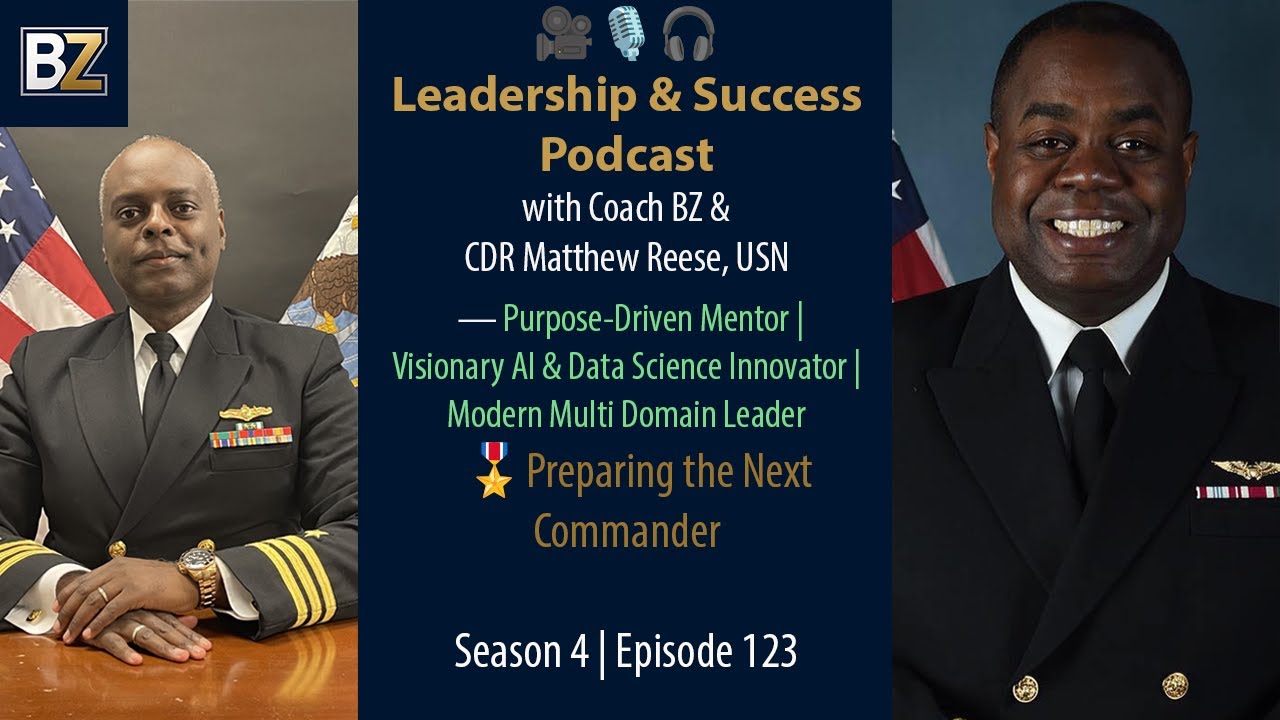
Commander Matthew Reese, a former Navy Reserve officer now in data science and AI, discusses how AI amplifies organizational power but warns against hallucinations requiring rigorous quality checks. His upcoming book Quicksand uses data-driven stories to explore life's traps, while he advocates breaking the college algebra barrier blocking students from STEM.
Chapters
Hi, I'm John Maxwell. When the top companies in the world are looking for trainers, speakers, and coaches, there's one name that stands above the rest, and that's Maxwell Leadership. Our certified team members have gotten proven results for companies all over the globe, and our reputation, I'm proud to say, is second to none. Some of our members have risen to the top of their profession, including the one you're going to meet today. I proudly introduce you to my friend, Bob Fabien Zinga. Welcome to the Leadership Success Podcast with your host, Coach BZ, where we help you lead with purpose and succeed with impact. If you're ready to grow into the kind of leader others want to follow, this podcast is for you. If you're determined to elevate your success and leave a lasting legacy, this podcast is for you. As my mentor, Dr. John C. Maxwell, reminds us, everything rises and falls on leadership. Our goal is simple: to inspire you, challenge you, and equip you with insights that can transform the trajectory of your leadership journey. Welcome aboard to another episode of the Leadership and Success Podcast with Coach BZ. Hello everyone, I'm Commander Matthew Reese, United States Navy Reserve. It's an honor to join Coach BZ and all of you all for the— today for the newest episode of Leadership and Success Podcast. A little about me: in the last two decades serving as a naval flight officer, mission commander, program manager, officer in charge leading sailors across aviation, cyber, and joint operational missions around the world. From multinational exercises in the Pacific to coordinating NATO teams in Afghanistan to supporting crisis response at PAC Fleet Headquarters, I've learned that leadership comes down to integrity, preparation, and the courage to serve others first. Uh, last of my military career, I worked in technology as a senior manager in AI, data science, and business intelligence, building teams, machine learning solutions, and helping organizations use data to make smarter decisions. Whether uniform and tech sector, passion is the same— mentoring the next generation and helping them unlock their potential. And the newest thing I'm doing, my newest endeavor, I'm working on a book. It's called Quicksand: Using Data Science, AI, Machine Learning to Solve Some of Life's Toughest Traps. So please help me out with my survey. Anyway, I'm excited to share lessons from my journey, the successes, the failures, and the transitions, and offer insights that can help you with purpose, Resilience and a Mindset for Continuous Growth. Thank you for being here. I'm looking forward to a conversation.
All right, everyone, uh, thank you for being back, uh, the Leadership and Success Podcast. We already had a podcast earlier this morning, so this is the second time today, and I have a very, very, very special guest. So, uh, As you guys know, every time we meet, we do what we call the moment of gratitude. We just wanna take one second, just one moment to be grateful. And part of the reason why we do this is because in the US military, it's about 21 service members commit suicide every single day. And I believe it is not possible to be suicidal and be grateful at the very same time. So if you would maybe close your eyes, put yourself in your happy place, Take a deep breath and think about one thing you are grateful for today. And for me today, I am really grateful for my mother, Pauline Kutakani. I guess she's really the first feminist I knew. She really taught me that whatever a man can do, a woman can do too, if not better. So I am very, very grateful for her example. She's no longer with us. I miss her every single day, but her memory will stay with me forever. So whatever you are grateful for, if you would please type it in the comment. And also let us know where you are joining us from, what city, what state, and if outside of the US, which country. And also if you have a question for my guest, please type it in the comments and we're going to be answering live. So let me see if I can properly introduce my friend, my mentor, Commander Matthew Rhys. So I guess what I would say to start is it's really my absolute honor to welcome someone who has had a profound impact on my own leadership journey, Commander Matthew Rees, United States Navy. Commander Rees is a transformational naval leader, a mission commander, and the program manager who has led sailors across aviation, cyber, and joint operation around the world. I had the privilege of serving directly under him at SPAWAR San Diego, and I guess they call themselves NAVWAR these days, but anyway, he was my program manager, which is the equivalent of a commanding officer, and I served as as Deputy Manager, so the executive officer equivalent for two national-level programs supporting more than 180 sailors. Some of the best times in my Navy career, really. So he leads with integrity, mentorship, and uncommon commitment to preparing the next generation of leaders, including me personally, coming to me to take over as program manager when he departed. So beyond his military accomplishments, he's also a visionary AI and data science leader in industry, an educator, a purpose-driven mentor passionate about shaping the future, And it is a real privilege to bring his wisdom, his experience, his leadership philosophy to our global audience today. Please join me in welcoming the one and only, the man I am really, really grateful to call not just my mentor, but my friend, Commander Matthew Rhys. All right, Commander, how are you doing today?
That was amazing.
Thank you.
Oh my God. Well, I'm doing great. I mean, your introduction was just amazing, Bob. I mean, I was— who is this person? And then I realized it was me. And, you know, it's amazing. I mean, I saw the earlier episode with— man, to follow a man, leader, everything. Versus, you know, in and out of uniform to be the guest or be here to have a podcast.
Thank you, thank you so much. But I really do believe that representation does really matter, you know, seeing people like you. I think back then we were only O-4, we weren't even O-5 yet, but being in such a big position of leadership, you know, managing two spacewalks, a national program, I mean, that is a lot. And seeing somebody with a skin that looks like mine, it really meant a lot to a lot of people. So thank you for your leadership. Maybe to get started, what are you grateful for today? Come, come in, Louise. Can you still hear me?
Looks like there's a bit of a delay, but, um, okay, uh, let's, let's see.
It looks like we checked your connection earlier. It seems, it seems to be working. So what, what I ask is, what are you grateful for today?
Looks like there's a bit of a delay. I can hear you, you're so broken.
Uh, can you, uh, use your, your phone, uh, as data for the connection? So I am gonna need to, uh, let me try one more thing real quick here because earlier I could hear you just fine. Okay, just a second. This is what happened when you do your podcast live on LinkedIn and YouTube, but that is, that is okay. So it looks like he's, he's joined us again. Let's see. All right, can you hear me better now?
Great, yes, I can hear you much better now, yes.
Okay, okay, yeah, I can hear you much, much better. So what I will do, I will go back and just delete those couple of minutes. So my first question for you, sir, was what are you grateful for today?
Oh, wow. What am I grateful for today? One, uh, here on this podcast and being able to educate everyone, uh, about, uh, you know, leading with integrity and honor. Just be able to share today. Also, as I mentioned, following General McChrystal as the second guest for the day.
Fantastic. Now the second question I'm going to ask, you're going to know what the question is because I stole that question directly from you. What is something about you that most people do not know? Okay, it looks like you're still having trouble with your connection. That is— that most people do not know about. Actually, it is your question. First time I heard that question, I think it was in 2015, and you are the one who asked it of us.
Absolutely. Yeah, I don't know what's going on here. We have a little bit of a connection issue. You're missing 2014, 2015.
Yes, I think it was an icebreaker that you came up with.
I have my phone here.
Okay, let's give it a second. Usually the phone connection is just as fast as cable these days. All right, we are going to give Commander Ruiz just one moment to reconnect. Again, these things happen sometimes. I see there are quite a few people already watching live, so let us know where you are coming from. What city, what state, and which country, if outside of the US?
Let's try one more thing.
I may have a great friend today, my phone, and also just a question for Commander Reese, US Navy Commander, and I'm gonna wait for him to connect back. Yeah, I really love doing this live. Most of the time it works just fine, but a couple of times I've had issues where people lose their internet connection, which is okay. But okay, he is joining us again, so let's see if this works this time.
There we go.
All right, okay, that is perfect. Now I can hear you, I can see you. Excellent. Okay.
Yeah, absolutely. So unfortunately, we had a little bit of audio, a little bit of an audible. Yes. So, you know, when in doubt, just try to use the iPhone. So go ahead and take me from the top.
But like we're all set, what is, what is going to happen, actually, to make it easier for me to find—
let me do this.
I am going to remove all of, all of, all of that, um, from the, from the clip.
Okay.
And so basically, this is the introduction, and then we are Starting now. Can you give me an extra 15, 20 minutes because of the time?
Or absolutely. Yeah, I'm new here. Yeah, absolutely.
Yeah. Okay. All right. So, uh, welcome to the Leadership and Success Podcast, Commander Matthew Reyes. How are you doing today?
Hey, overall I'm great. You know, I am so happy to be here and so happy to be back and, uh, you know, sharing with folks, my good friend and mentee, I know, uh, Bob Fabien Zinga. That introduction you gave me today was simply amazing. That was great. And also to follow General McChrystal on a day like today is amazing. So yeah, I am definitely grateful for being here and being able to share with everyone as I enter the last year of my almost 30 years in naval service.
Wow. I can't believe it because a lot of your mentees, we're pretty sure you would get one of those stars soon. But that is good. You've done a great, great job, mentored a lot of people and had a huge impact not only in the US but across around the world. So the first question for you, sir, is, uh, what are you grateful for today?
Uh, again, I say at first, definitely grateful for being able just to be here today, uh, being able to share with anyone, everyone, and also, you know, following General McChrystal, and also just to be able to share everything. And I mentioned a little bit about the technology and AI, but also this new book I'm writing is called Quicksand. I've got so much to share, so I'm just excited to be here to be shared with everyone today, and definitely with someone who was, uh, great as yourself, uh, Bob. This is, this is a true blessing.
Wow, it is, it is a blessing. And the second question I normally ask, you're gonna remember this, this question because it is actually your, your question, is what is something about you that most people may not know?
What is something I may not know? I would say, uh, it depends. A couple things. One, I'm a big-time skier. I've I've been skiing my entire life. Uh, this is gonna be— I'm gonna start skiing at 3 years old, so this is going to mark my 42nd season. There's a picture there. I am a super big-time skier, so I would say the fact that I'm a huge skier and I'm really involved and really involved in getting youth and, uh, you know, uh, and I would say at-risk youth, we're working this year to get them up on the slopes in the Denver metro area.
Okay, let's see if we can turn your Camera.
All right, let's try that.
Okay, this is perfect. I, I will just leave, leave it here. Okay, okay, perfect, perfect. All right, so what can you tell us a little bit about your leadership journey, how you got to become Commander Matthew Reese, senior officer in the US Navy?
Absolutely. It's, uh, it really starts, starts back in, uh, Boulder, Colorado, back in the in the 1980s. It's hard to believe it's almost been 30 years in some cases. So I was there. I definitely wanted a challenge. I wanted something new. And, you know, coming from a landlocked state, the United States Navy just had this huge aura. And this, you know, to say, hey, you know, I love Colorado. It's a great place. There's the best skiing in the world. But I wanted to get out of Colorado and see. And the Naval Academy, and then before that, Naval Preparatory School, where it's a great opportunity. And then I flew on then something called Continental Airlines, no longer in service, through Cleveland, Ohio to get into Rhode Island there and spent a whole year there. And then I went on down to the Naval Academy. And while I was at NAPS, got a chance to play football and then track and field at Naval Academy as well as gospel choir and a couple of other really, really cool extracurricular activities. And amazing time and a lot of amazing people. And as I enter my last year, just thinking back and all the privileges I've had. So definitely share with, with everyone.
It's really amazing, especially the impact you've had on a lot of people. So when you reflect then on your journey, you said from the Naval Academy to mission commander to Afghanistan, PAC-SPAWAR and all of that, becoming a senior AI leader, what core values have stayed with you across every chapter?
Yeah, definitely honesty, integrity, and being forthright. Uh, you know, we, again, the Naval Academy always talk about how the honor concept I've had the, you know, the great privilege to work with future Naval Academy midshipmen through our Blue and Gold program, a Blue and Gold Officer for the local area, and just be doing the same thing. Hey, you know what? You've got to tell the truth. You cannot, you can't lie. I can't stand for the people who do lie or cheat or steal. And that's the first thing. And also tell the truth in all phases as well. Be very forthright with people saying, hey, this is what expectations are, setting, uh, setting the presence and also setting the expectations. And, uh, and then also being able to stand up. I mean, when you have integrity, people will follow you, people will want to work with you, people will want you to do things, you know.
Yes.
And what I found is just, just doing that and always being dependable and always having and leading with integrity, uh, you, you make your own luck. And I, as I mean, I say luck is nothing more than opportunity Preparation meets opportunity. When you're always prepared, always doing the right things, those opportunities do come up, uh, even when opportunities go away. So again, uh, you know, leading in all things and then really doing those core values really will take you a very, very long way no matter what, um, fields you're in.
Yeah, I believe everybody who knows you would definitely say you are trustworthy and person of character. Talking about character? How does character shape command and technical leadership, you think?
So how does character shape command technical leadership? Well, really, you just, you would just have to first conduct yourself in a professional and honorable manner. So let's go ahead and talk about when we were kind of resurrecting the computer network defense program there at NAVWAR, before that was called SPAYWAR. You know, we just you know, for me, I didn't know that much about computer defense. And I was learning a lot. And I felt like I was trying to what I call catch ahead, trying to catch up and get ahead all at the same time. So I was trying to get everyone there to okay, who, who here, who, what skills that we had, how do we get ahead while taking courses and everything else and doing, working on certifications like Network+ and Sec+ and my Certified Ethical Hacker, all while trying to build the staff and everything else. And, and then really trying to get something I talked about into my LinkedIn writings is a small early win. How do you get the small early win or quick early win? And for us, that was just getting a summit, having 2 days, uh, usually a weekend in January where everybody would fly in and we would be able to talk about what we're going to do for the year, where we're going to go, and also finding some other pieces. And another thing is, uh, we had something called the Cyber Collegiate Defense Competition. For those who don't know about it, essentially you have colleges from all across the United States that get to compete, and they had regional competitions, and we were able to help support that. And that was a great quick win to get people there, to get people in the program, and to get them excited because it's something they could definitely do. And then we would meet up at the summit later, meet up at the summit. We would set the CCD schedule, have people go to those, and then also have them do their assignments. So therefore, you very quickly, you go from having, you know, no events to a full calendar of events. And the trick was to have that calendar event so everyone knows, okay, October, November, you're going to start getting ready. You might have something. We're going to have the summit in January. We're going to have the CCD season February through about June. And then starting in, you know, March through the summer, we were going to have some of the events for flying either to San Diego, Charleston, Hawaii, and doing our events there. And therefore you filled out the yearly rotation and everyone felt like this is a great program with a yearly cadence. And once you got it rolling, it went really well and people felt like they could really contribute.
That was really quite amazing, especially at an O-4. We both were Lieutenant Commander back then, which normally the program manager at Spacewalk was an O-6, so that's a captain. But Justin did an outstanding, outstanding job. So what about integrity? How can leaders maintain integrity when under pressure? From the demand of operational tempo to corporate deadline to high-stakes decision?
Well, I think it's a couple of things. The first thing is you got to, you got to work on your body. So you got to make sure that, you know, when you're getting very, very stressed, sometimes the first thing that people will do is they'll stop working out or getting exercise or doing whatnot. I think that's the worst thing you do. So you want to make sure that when you get really stressed, even take 20, 30 minutes to get a workout, do some pushups, go for a run, a bike ride. That can do a lot to clear your mind and make things, you know, things different. So when you have a very clear mind, you make the best smart decisions. So when you're having all that stress, that's when I think people can compromise their integrity by saying something that isn't correct or isn't true. They might, or at least might get goaded into that path. So that's the hardest thing is to say, okay, let me take a break, let me go work out or, you know, do something to clear my mind. Get my stress down so I'm not, uh, goaded into that path. And, uh, that's what I've seen, where sometimes people just think, hey, it's a lot worse than it is. And also, you know, you have to make sure you're asking the tough questions as you go so you're not getting to a point where you're boxed into a corner, uh, there's no other alternatives, and you feel like the only way you can get out of this, this trap is to, is to, is to lie or compromise your integrity. And it's not easy. And I don't want people to think, oh my God, it's something you do. It's just something you just have to work on. And always, you know, asking the tough questions and following up and putting in the hard work to say, hey, what's really going on here? Can we find another way out? And always having that moral high ground. So not, not easy. It's going to be a lot of hard work, but it is doable. And make sure that when you're getting stressed, you're still having, you know, 20, 30 minutes at least to work out 3 days a week. And I think that goes a long way toward, you know, managing stress and making the best possible.
But I think from part of what you said, one thing that does help a lot is having a role model. So you are a role model for a lot of us. What were some of your own role model people that you look up to that kind of help you stay in the straight and narrow?
Yeah, absolutely. I mean, there's a couple that— there's so many, but as a couple I want to highlight Definitely, you know, Admiral Halsey, you know, I met him when I was a young— gee, I was a young lieutenant, junior grade. I was a VP-4. He was the head of HSL-37. Got to meet him and his wife, both amazing people, you know, in more of just a social setting. And, you know, we were talking, you know, career opportunity, my future career. It was different because obviously he was a helicopter pilot. He was head of a helicopter squadron. —and I was a young flight officer doing a P-3 squadron—what some of the things definitely that he mentioned to me were, you know, were things like, okay, well, this is what you can do. This is, this is how you do things. And hey, here's how you recover from things if they don't go well. And he was saying, hey, things are gonna not go well. You're gonna have times you're gonna get tripped up. This is how you recover from them. So it was— Ah. See, and how he's, he was all, he never I mean, maybe, you know, he never seemed to get rattled or whatnot. And as people said, he looked amazing. He was very smooth on top, but, you know, uh, underneath, a very amazing, amazing person. And, um, learned a lot from him and our interactions in Hawaii, uh, before he, uh, before he departed.
And then, wow, actually, his integrity have definitely put him in the news lately, and it's amazing to see someone at such a high level, keeping their integrity, even willing to retire as a 3-star Admiral instead of 4, just because it's the right thing to do. It's amazing.
Wow. Yeah, absolutely.
And you, you did mention one more person beside Admiral Halsey.
Uh, yes, absolutely. So there was, there was, there was him, and then, um, as far as the other mentors or just people in general?
Uh, people in, in general is, is fine. Oh yeah, definitely him.
I think from then, I think some of the other program managers that we had, Berenice Faye Ward and Nav and some others, and, and yeah, some of the N3 folks, they were, they were just amazing. You know, getting a chance to work with them, you know, you know, the, the trust they had in me to say, okay, yeah, you can run this program. And, you know, and then that, that's faculty and say, hey, go out there and make this happen. Go out there and really empower people. And then definitely their ability to empower me and others, including yourself. Hey, let's go here. Let's go rebuild these programs. Let's go out and do— let's go out and make sure we're getting to the ships and we're figuring out what, you know, what in this case, you know, what the fleet needed and, you know, and other things. So definitely the other program managers and leadership, we were definitely my mentors at that point in time.
Yeah, right now I remember Captain Jeff Adams. He was our very first— yeah, uh, I really love the way he, he led. Uh, so you've served as a mission commander responsible for aircrew complex operation, employment of live ordnance. What did those missions teach you about calm, clarity, and command presence?
Uh, see here, I would just say that, you know, the best thing I got to do is a couple things. I got to drop a, uh, uh, you know, a fake mind there in Thailand. Uh, just the amount of preparation, uh, that goes in, and that's how you really get the calm, the clarity, is, is from the preparation. Uh, you know, all the time you're putting in to saying, hey, how are we going to do this? What's going to happen? What do we need? What are some of the things we're not anticipating? And controlling, you know, some other variables there. You know, for instance, like the weather, couldn't control that. It was going to be hot. You know, some of the crew was getting a little sick, including myself. Some of the food there, the water was causing some issues. And, you know, and I was just keeping my own anxiety up. Hey, you know, that was the only time I got a chance to drop anything out of a P-3 was in Thailand for Cobra Gold all those years ago. And, uh, you know, you, you know, just saying, hey, this is gonna— this could be the coolest thing I'm gonna get to do. Uh, let's go ahead and put the time in and make sure we're really, uh, accounting for any type of, uh, hiccups we may have and whatnot and, and things like that. It just— also, what I always say is always assume you'll never get the opportunity to do it again. Yes, because you may not. And just do the best you can and make it hurt, you know. Hey, if you're tired, hey, you know, make sure you get proper amount of sleep, but make sure you're doing everything you can to make this the best possible event because you may not get a chance to do it again in the future, and you will likely regret not putting the time and preparation in to make it successful. So I would say thereabouts, either from dropping, you know, mine at Cobra Gold to anything else and how it's applicable, is just think, I will never get this chance again. Let's put all the time and energy I can to do it to make it a success.
Lasting impact. That's powerful, really living in the present. So your deployment to Afghanistan placed you in a joint coalition environment with NATO, OMLTs, CSTC Alphas. What leadership muscle did that environment force you to develop? Well, it was really interesting.
So I think it was like April 2008, and all of a sudden I said, hey, you know what, you got to go to Afghanistan for a year. And it was, it was a crazy time. So I was in Hawaii and then, you know, I came home a little bit, uh, and then I had to get to Fort Riley, Kansas. Uh, you know, I remember getting there and then going to San Diego first and getting there and all of a sudden, uh, I've got— I was a lieutenant, it was me, there was, uh, chief, and then I think it was a first class petty officer, and there was a total of like 40-some HM, uh, HMs there. So for those I don't know, are not, uh, for the term, that's the hospital corpsman for the Navy. That's their, the Asian designation. And all of a sudden I went from, uh, you know, flying and potentially dropping mines and potentially, uh, you know, chasing submarines and, and being involved in exercises, to them, uh, giving me a weapon, two weapons, you know, and a 9mm, and giving me, uh, up-armored Humvees and other vehicles with with so many of these other folks, and they were great people. And first we were in Kansas, and they were— we were driving around, and, and I couldn't believe why in the world anyone think it was a good idea to give, uh, 40-some sailors, uh, Humvees and, and weapons and everything. And things were good, things were bad. We had some mistakes and hiccups and a lot of learning to say, okay, this is there. Some of the folks were FMF, Fleet Marine Force corpsmen. So they had been with the Marine Corps, they'd been in the infantry, and they had experience. But some of them were not. Some of them were actually converted from being dental techs. So it was a huge disparity there. But it was a great time with those folks. We were able to leverage all the experience. And we learned so much every day about working with the vehicles and everything. And there were some bad days. I remember one day where someone actually shot their M4 And it hit the shield of the Humvee and bounced back. And, and that was a rough day for me because they had to make sure that the slug actually hit the guy and they had to make sure it didn't stay, stay in his arm. Very scary day for me. And then going from there to Afghanistan and then learning a whole new set of parameters and everything else. So at the time I was working with what they called OMLETs, which was Operation Mentoring and Liaison Teams. For, you know, the Combined Security Transition Command, CSTICOP. And that, that kind of, that is obviously gone away now. But at the time, what we were really doing there was the fact that we had a lot of these countries that were participating, right? A lot of the NATO countries and others. And, you know, so we had to indoctrinate them. And tell them about working with the Afghan National Army. And that was difficult. We were able to go through and, you know, me, I got to see the entire country, got to meet a lot of great people, a lot of great NATO folks there. But it was very difficult going from one thing to another. The biggest thing I could would say there is, uh, always be prepared. And, and here's the correlation. I call this the Mike Tyson correlation, and I think I'm gonna write this in the book, is that people say that Mike Tyson wasn't the biggest puncher. I can't say he probably seemed pretty vicious, but what people said was the reason he knocked so many people out is they could not see, uh, his punches coming. Some of those, those left those uppercuts. And that's kind of like a career in the Navy in a nutshell. It's the punches you do not see coming that hurt the most and can floor you. And I'll say that, you know, whether it was going to Afghanistan on like 42 days notice, as I mentioned, that was a punch I didn't see coming. Or, um, you know, or some other things I've, I've been able to do, uh, you know, I didn't see that coming. And then being able to cope with those those things you don't see coming and keeping your wits is really some of the things I tell people, you know, be ready, be available, and also be able to adapt. Because I guarantee you, if you have a career of naval service or, you know, if you have a career in corporate America or whatnot, there's always going to be punches that you do not see coming. And those are the ones that are toughest to react to because those are the ones that can floor you. If you do get bored, dust yourself off, get back up slowly, and just be thankful that you are where you are. You have things you have and the family and the great people in your life.
Thank you so much for sharing that, because one thing I really love about leadership is those principles seem to be universal, right? We get those through our Navy career, but they are really applicable in tech, in business, in academia, no matter the industry. Uh, how did those experiences kind of test your faith, your fear, and your resilience?
Uh, I've had my faith, fear experience as far as in industry, or still in the military part? Um, military. Okay. Um, you know, I, I would say that, um, kind of things I mentioned before, uh, which might tie as a corollary there It was always the things you didn't see coming. And I think part of it is that, you know, you had these expectations that, okay, you know, I'm here, you know, in aviation. Hey, we're here, we're a junior squadron. And then you're going to go to some shore duty and then you're going to come back and you're going to have this path. For the most part, the path is very well defined. But in my case, you know, they had something called the individual augmentee. Where they were just sending people to Afghanistan at the time. We had a dual front war in Afghanistan and Iraq. So I would say that tested me there. As I kind of mentioned, it was that, hey, I didn't see that coming. This wasn't supposed to be like that. I was supposed to go here, fly. Yes. Short tour back in Hawaii or somewhere else, maybe Jacksonville. And when you have a situation like that where you don't see it coming and the expectation isn't the reality, is being able to deal with that. And finding other ways. And my way was definitely finding, uh, you know, things like working out, lots of weightlifting, and skiing, as you mentioned. Say, that's something, uh, you know, make sure you have a go-to, um, you know, pastime or other, um, sport or other, other interests or hobby. That's true. Because, because, you know, you're going to need to lean on that hobby at times when things aren't as good. And I can't tell you, no matter how— whatever problem I think I have It could definitely be solved in a powder day, especially powder day at Vail or somewhere like that. But definitely, you know, just get a good day of skiing. It's so refreshing because you feel— for me, I feel so small out there and on a mountain after having a great day of moguls and bumps and done 26,000 miles. So I say, uh, the conclusion, uh, again, Mike Tyson corollary: the punches you don't see coming, the ones that can knock you out, but always a hobby or pastime, uh, to rely on and lean on, because that will definitely put everything back in perspective. You'll be able to deal with it much, much better and realize that, uh, you know, every setback I've ever had has actually led to a much, uh, you know, better future and more and more insight. So, um, it definitely—
that, that is quite powerful. I know the Marine says Semper Fi, always faithful. One thing we learned in the Navy is, uh, Sempa Gambi, right? You never— you don't always know what's going to come next, but you definitely have to be adaptable. Let's go back to our space war, which I guess they call nav war this day. So you were my program manager, I was your deputy, to national level program, more than 186 sailors which would deploy all across America and around the world. So what leadership philosophy guided the way you built the program and empowered and trusted your leadership team?
Uh, definitely servant leadership, you know. Uh, something that I went and studied as I did the, uh, uh, I said I could buy a Program Manager Professional, PMP, the Agile Certified Practitioner. Uh, basically what we— what, what I did was said, hey, what is stopping these Sailors from going on these missions? What's stopping these Sailors from being able to do the best in computer network defense? What is really holding us back? And then the first thing we did is we got all the people who used to be in the program. For those who don't know, there was a C&D program and it had gone away and we decided to bring it back. And we were bringing it back, we had to figure out what happened and who was there. And we got ahold of people who had been in the program and had been mainstays. And we had the surveys and we found out a couple things. One, we had a skills deficit. 2, we had a bit of an IT deficit. And 3, we didn't have a way to tie in everything together. So first, the skills deficit, we had to say, okay, how do we fix this? And then we fix it and say, hey, you know what? Everyone's gonna need to do Net+ and Sec+, which were 2 certifications, but also we needed people to do things like Certified Ethical Hacker, and CISSP. So we went out and we had to say the first year was gonna be a level of skill building. So we got as many people to that CEH as possible the first year. It was a training, it was a week long, it was a bootcamp style. So you're getting there at 6:00 AM, we're going almost to midnight with an instructor and after training time, okay, this is how you do exploits, this is how you counter exploits, this is the CEH, Certified Ethical Hacker. You know, this was their book of knowledge or whatnot, and understanding how to do all that and doing all the training and understanding how to do it. And then at the end of the week, having people take the test to get their certification. So that was the first thing. And then we had some other new programs that were coming in. You know, it was the one where they had the scans and they were uploading the scans. And we had to figure out, hey, we gotta be experts on that and figure out how to do that. And the second part was providing a service to the fleet. And so one of the first things we figured out how to do was say, okay, you know what, we're going to need to be able to say this is what we can do for the fleet. And we figured out the two things they wanted. They wanted feedback. They were doing the scans. And the second thing is they wanted hands-on training. So we set up some hands-on training in a couple of fleet concentration areas, Hawaii, Norfolk, San Diego and others, and that was one way. So here, make sure everyone shows up. So we would show up and we would have, you know, all day long we had all the, the IT folks from every ship. They would come for a day of training and everybody was really, really, really gracious. And that's one thing that we found out, hey, the people, the people on the ships were saying, we want this training, we want it, but you guys got to come here and we get to send our ITU for a day. And we just literally just emailed the ships directly, said, here, we're providing this service. We'll be here. Just send you guys over here to College Center. And they would give us a room in the College Center. And, you know, we'd have 30 sailors, all the ITs would just show up. And then, you know, some others saying, oh, we're so happy you guys are here. There's no training. There's no one else doing anything. Thank you so much for doing this. Yes. We fulfilled the need. And the last part was just going forward to tie it together. Hey, we found these needs. We've had this. And then people saw it, so you had the natural 12-month rotation. So you could say, you know what, we're going to have the summit, then we're going to have the CCDCs, then we're going to have, you know, our sessions where we're going out into the fleet concentration areas and over the summers, and then, you know, the fall reloading and doing training and then starting all over. And once you get one or two iterations, it starts going and people start saying, hey, this is the place to be. And this is— yes, because most people really, really, really wanted to be a part of the computer network defense piece and helping to do the tougher.
Absolutely. And one, one thing everybody learned when you lead, I guess one thing you said a lot, you know, if you want trust, lead with truth, but if you want loyalty, lead with consistency. Can you expand that? Absolutely.
I mean, um, you know, as far as, as far as If you want loyalty, lead with consistency. So the trick there is to make sure you're telling people a very consistent, forthright, you know, mission statement of what we're going to do at every meeting. And we used to have every Tuesday, you know, every Tuesday for 90 minutes sometimes, and they're talking, uh, here, this is what we're going to do. And, uh, you know, it never changed. And I said, hey, we're gonna have a 12-month cadence, and we're gonna do this, and you're gonna do this, and, and And as people sat there and realized, okay, everything he's saying is coming to fruition. You know, we're doing our training, we are having our summit. Now we're doing our events and people would go to different colleges. And that was a lot of fun for people too because it was something they may or may not have been able to do before or again. You know, some of those folks were able to go to a college and see a competition and represent the Navy in a recruiting aspect. And, uh, yeah, I've never gotten to do that again, as something I mentioned before. So that was there. So just having— saying the exact same thing, being on message, and yes, a good understanding, and writing a mission statement. For me, that was clear. Here's our business statement, here's what we're going to do, and, and how we're going to do it. Now, wow, saying if, if you— what was the other piece about the honesty you're saying?
Uh, yeah, I, I think you just say, uh, if you want, um, truth will lead to trust and then consist, uh, consistency to loyalty. Oh, okay. Yeah, yeah, it did.
As far as, you know, just, uh, you know, being honest, hey, you, you have to tell people the honest truth, right? So one thing I did struggle with the first year was, you know, we didn't have at the time what's called an annual training, so we we had these, you know, these IDTTs where you could, you could move some of your weekends and fly in to speak with us. And we had some, but for a lot of the sailors, they needed a 2-week annual training and they would have to go get that somewhere else. And that was a very— that was a huge deficit for us because, you know, um, they could, they could contribute, but then they had to go somewhere else for the annual training. So that was the first thing I just decided for the second year is we are going to make sure we have annual trainings and you're going to get those, uh, on a calendar and get them early and get people signed up. And once we put those out there and we were able to get them and get them recognized, and we did, even though they weren't that great the first year, because we're getting the kinks out, it was, it was key because then people said, hey, I could do everything in the program instead of having to split my program with somewhere else. And once we did that, yes. Started liking those and really enjoying them. And then, you know, the, you know, the, you know, that you could just see people light up and, you know, and great. This is now a comprehensive program. So back to what you were saying, hey, you know, making sure that I was staying on message and making sure we were identifying the issues. Hey, it wasn't a comprehensive program the first year. Years 2, 3, It is a comprehensive program. And now that we've done that, people are satisfied and, you know, our scores are going up and on all of our surveys and finding things. And that's a great thing to be able to do. But then once you get the first one out there, you know, we're there, the sleep concentration errors, trying to figure out what they were also missing and making the year and then after that better and better. So that was a little bit of the iterative, continuous In this case, it was a 1-year iteration where we would try to make everything better. But every year as a program manager, you make it better and better and better and see the improvement. And, and there was ways to do that, such as, you know, from the summit, first I'd only get there half a day early or a day early. Then I said, program manager, I need to be there this whole week. So I get there on a Monday, stay the whole week, and then be writing up all the slides and doing everything we need to do to get the program ready for the summer, summer would come and then the summer would be a lot more successful. And then from there we would go further and, uh, and, and like that and finding ways to meet people and work with the staff there. Cause one thing I did realize was that sometimes the staff, they wouldn't want to come on weekends, but if I was there for the week, I could talk to them on a Monday, Tuesday, Wednesday, that'd be able to better respond. So that was definitely, I learned. So continuous development is great.. But also, you know, if you're having a year iteration, having a continuous development on yearly iterations is also key.
That is really, really powerful. But really, it was revolutionary, especially for the Reserve, right? Because I've been in unit in the Reserve where all people do is read the newspaper on Saturday or Sunday. They have absolutely nothing to do. Boring, boring computer training all day. That's really not the reason why people normally join the military. In our programs, I mean, we had people, they hardly went to their, uh, local command center. I guess we used to, to call them Navy Reserve Center, uh, NRC, because they would spend their entire time just flying all across the country and around the world. It was so much fun. And then also, while they do that, they are affecting, right, the cyber readiness of the number one fleet in the world. And you could add it into your fitness report and your, uh, if eval, and that's, that is really huge, you know. I don't know how many people who really promoted because of the work, the opportunity we really made available for them for CND and CCDC. It's just amazing. Yeah, I mean, absolutely.
That was, that was something else we could probably talk about just really quick, you know, the attitudes of what people were into. So, you know, when I first got to the Reserve, you know, the first, you know, it was more of a unit where, hey, we're just going to stay here and then, you know, 2 weeks we're going to do our 2 weeks of any— most part, yeah, you're gonna be reading the paper, you know, just not so much. But then I got a chance to go to SWEOR in Austin, and the whole mentality changed. It was like, okay, let's go to the NOSC— is, or for who don't know, the Naval Operations Support Center, the Reserve Center— go there as, as least as possible. So that was our whole thing, was I would go there in October, get all my requirements done for the year. Yes. And I would get everything done for the year and we would be set for the year. It's okay, great, we've done all of our GMT, we've done all this, all of— we've done all this other things done, you know, we've done their physical fitness assessment, uh, that's done, that's done. So everything we need to do for the, for the, the NOSCA, NRC is done for the year. So now we can just focus on the mission program and then flying here and and moving around and doing this. And in certain cases, we were on— I was on the road every— I seemed like every other month I was flying here or flying, especially sitting in the CCDC season. And it was great. I was getting, you know, that. But other people were certainly, you know, they, they weren't necessarily unhappy with us, but their whole, their whole feel was different. They were like, I don't want to do that, I just want to show up here Saturday morning, you know, do this and want to do. And it was just so much different. Yes. From, from what we were doing, where we were— if you would never see us. And, uh, there were times where people like, I've never seen you, see your name, and, you know, is on, on an order set from flying here and flying there. And because this is what we want to do, this is what we believe. That sailors can do in the Reserve. And if you do, you like it a lot better. You really, you know, really enjoy it. Again, not everybody could perform to that level. They couldn't take all that extra time. Again, we were doing a lot of Tuesday night sessions. People were getting pulled away from their families a little bit. And we had to find a lot of dedicated people who also believed like we did. Yes. And then the last thing, you got to find a way to reward those people. So how do we reward them? People, uh, we were able to reward them, you know, from some, from some certain ways. Some people like to say, hey, you know what, if you're able to help us here, you can do a CCDC and annual training and maybe another ADT. And for people who wanted to get there, and for a lot of those folks, that funds, and they'll be able to do this or find ways to get them recognized. Because you can say, hey, you support us, you did our annual summit and a competition and an annual training, and then Hey, we had more Sailors of the Quarter. Yes. But else, because we would say, hey, person came, they did all this stuff, therefore they should get Sailor of the Quarter. And once they're seeing that, you start attracting more of those sailors who are like, hey, I want to do this. I want to go to the quarter. I want to travel. I don't want to sit around and on. And you also had people who like, hey, I like the extra money. I mean, you know, yes. Reserve. But for some of those folks who had the right civilian job setup situations, they were able to be very financially beneficial. And it kind of found the right people. So as a conclusion, you got to find the right people for the right people, and then we have that, you know, consistent setup. And those folks would then floss. And it was amazing experience. I'm gonna do a little bit of vignette on that, uh, in the book with quicksand, um, and talk a little bit about it and how to do it. And, uh, yeah, so it's getting there.
Really, really, really amazing. And I know the NASCA of the NRC, they love this a lot too, because it was very, very difficult for, for most of the units at the NRC to just do the basic requirement for the year. Usually by August, September, they were like, hey, you have to do your GMT. But for us, we did at the beginning of the year. So they really loved us for it. But then also the way you took care of the people. So even when we went on Evolution, usually you would have a night out, usually Friday or Thursday night before we left, where everybody could come together, have a great meal and just have a good time too. Yeah, we worked very, very hard, but we had a lot of fun time too. So I really learned all of that from you. So why was it important to you to groom your deputy, including myself, to eventually take over as program manager?
Well, there's a couple reasons. First of all, one thing I like to mention that you did to, uh, piggyback on what you mentioned there, you got to make it fun. So, you know, where everybody would come out, we got to go to dinner in Gaslamp and everybody out enjoy. You really have to have that so it wasn't just all business and have a chance for everybody to go and break bread. So I think that was a key thing. The second thing is, you know, survivability. One thing that I always talk about, if you're building new things, one of the things that I've always said and felt through, through either, no matter what I've done, going back to the Naval Academy, going back to when I was the president of the Black Studies Club and others, there's got to be survivability. If you build something, that's great, but when you leave, is it going to be able to survive? Because in the Navy, Everyone rotates and moves, and if you don't do a good enough job of building it, then it'll, it'll wash away. So I say, hey, you always got to make sure you have people that will pick up when you, when you, when you're gone and when you move on. And sometimes the best thing ever to me is to go back and go to something I've done 10, 15, 20 years, 30 years ago and still see it and still see the, you know, the impact that I've made. You know, there was one time back in high school I had something where we were building this group for youth. And then I went back a couple of years ago during COVID and then I was talking, a chance to talk, and someone else said, "Whoa, I remember you, Matt. And then because of you, I got in it." And then someone said, "Because of that guy, I got in it." And they drew the lineage all the way back to me 20 years. That was amazing. And the same thing, hey, I think you've got to build things and develop people so when you leave, it'll be better. You got to, you have to be a mentor. You have to find people to mentor. If you don't find people to mentor, you know, what are you doing? Plus you get their energy too, of them being young. So I think the fact to be able to mentor people in the Navy as well as in private sector and finding people and just grabbing some folks and getting involved in stuff like, you know, you have an intern, meet all the interns. You know, and see what they have and just grab them for a session. And, you know, I had a chance where we had a— in private sector, we had a situation where you had all the interns. We got them, we talked about AI, gave them a presentation on AI machine learning, and we talked and I did a survey and I got to understand what they were thinking and what they thought about AI and machine learning and data science. And even, you know, and some of that refreshing energy they had as young people goes so far. And I think sometimes people can get a little bit cocooned into only talking to people that are their peers and whatnot and not really reaching out to the young folks and really, you know, to understand what they're going through and to see their perspectives. And you can learn so much by having those mentees. And mentors up and down the line. So I would say, you know, one, you got to always think, hey, I could leave. One of the things with the Navy Reserve, at any given time, I could have been mobilized. And I knew that. I said, you know what, if I get mobilized today, who's going to take this over in such a— you know, who's going to take this over and make sure that all the hard work that I put into this the last 2 or 3 years is not all for naught. Who is going to take over? You have to always find people that are going to get there and be willing to do it. And then, you know, and that's why I said, well, you know, I saw— I say, Bob's got all this energy, he's loving this, and he's even got a better background than I do in creative defense, right? And then finding other people, said, hey, this person might, you know, have the technical background, maybe the leadership isn't there, you know, and everyone, everyone has different abilities. And you got to try to figure out, okay, how can we get this person there? Or maybe you partner people up, say, okay, this person is technically— this person has great leadership ability, put them together. So together as one, they're going to be able to carry it out. And then, and then sometimes you have groups where, you know, hey, you have one, you know, really good leader. And you'd have a bunch of other people who just really just do their part. And also tell, you know, accepting the reality and say, you know, this isn't going to be active duty, this might be here, this person is good doing this, this person doing this. You just have to have role players here. This is what's going to be successful. And being honest with yourself and saying, hey, it's not going to be, uh, you know, all these people doing all this work. It's going to be, you know, it's not going to be 3 people doing a large portion, 5 to 15 people doing smaller pieces. And as a whole, you'll be able to succeed. And that can be difficult for people. So I'd say, in, you know, in conclusion, you got to always think that, hey, I could leave, I could be mobilized, which I could have, at any given time. And I want to make sure all the hard work that I've done is not going to be all for naught and leave a legacy and make things better than when you got there. If you've done that, then you you've truly succeeded.
Well, so let me ask you this one more question before we, we move into the second segment. I could talk for you forever, so much wisdom. Uh, let's talk about artificial intelligence and emerging tech. You are definitely a great leader in that space. So you've built AI chatbots, predictive model, remote sensing platform, and enterprise-scale analytics. What do you believe will be the most important leadership skill in an AI-driven environment?
Well, I think, I think it's gonna, it's gonna depend. I think it's still, it's going to be based on honesty, integrity, I mean, forthright. So ask, you know, what is AI, what is going to be the biggest aspect, the biggest advantage? It's going to be people who use AI, um, to make it to be a force multiplier, something like to say Uh, so what does force multiplier mean? Hey, if you only have 100 people, the force multiplier could make those 100 people, 100 sailors, into 200 or 250, or the effect increase, you know what I mean? Things like that. And, um, so if you know AI, it could really make you that much better and that much faster at everything. So, and that's what I've been able to see is, you know, you know what, you know, instead of being having having situations where you needed 20 people, you have 6 or 7 really good people with AI, it make up for that. So the companies that can really, you know, figure out what they need AI for, how they're going to use it, and use it to augment the people, and then get the buy-in, those are the companies that are really going to be successful. Those are going to be the units and do great things. Um, because, you know, things I've seen is that, hey, you know, I think 2018, 2019, data science was all the rage. And robotic process automation was all the rage. And then in 2022, 2023, it was more machine learning. And now it's AI. So I think that the difference is, how long is this going to be here? And how long are you going to have this impact before it goes on to something new? Mm-hmm. Does it feel like they get hot for a while? The difference is, with, you know, with machine learning and RPA and others, only the practitioners could really do it. Only the people who studied machine learning, RPA, and data science, you know, they were gonna be the ones that are going to be firing up Python notebooks or firing up Alteryx or using other— yeah, and doing it. Now with generative AI and, you know, these other engines, everyone can do it. Anyone can do it. They can just go there and get something, or some of the apps, they can make videos and everything. So I think you're now seeing something that every man can use, and you're also going to have the youth starting, you know, in elementary school, and, uh, it's going to have a much lasting effect. So I think I have to say, hey, you know what, when people are asking, hey, is, you know, is this product something you developed? You gotta say, yes, it was developed by me, but I did— I was aided by AI. How are we going to use this? You know, how are you going to use the cross-checks? To make sure everything you're doing stands up to an integrity check. You know, did you create— did AI create this? And where could the vulnerabilities be? Because, you know, one thing I've seen is, you know, they might have built something for you, but the source material could be bad or it could be corrupted. I've seen that already, seen where, okay, it grabbed something from a site that was a nefarious site, so in that leaked in to, uh, your, your generative AI piece.
Yeah, and sometimes AI can just make up stuff too.
Yeah, I was like, it's like, you know, so it depends. Now you can— there's ways you can do it. You can limit it, you can limit it to only, uh, you know, uh, repositories, um, that, that have quoted, you know, that are, that are, you know, um, yes, academic, um, submissions that have references quoted and everything else, but then stuff can get dragged in there, as you mentioned, and all of a sudden you make sure you're cross-referencing and doing QA checks. So I would say inclusion, it's a great tool, powerful tool. You don't want to get left behind, but quality assurance is going to be key because that's how you figure out, okay, well, is this correct? Is this powerful? And, uh, and, and do you not want to get something that's nefarious dragged in And it's going to haunt you for a while. So it's a very great space going on, very, very exciting field.
Wow. Yeah, definitely. I think they call it an AI hallucination. It happens quite often. But I think especially for the military, I think human oversight, right, man in the middle, is so, so important. We cannot just let this machine learning or AI take over and make all of the decision and make things happen. We need to have people like you say, to review, making sure everything is compliant and exactly what we are looking for. But it's true today, another professor, I think from Stanford, said the only people who are going to be losing their job these days are people who don't want to use AI at all. People who use AI will be replacing other people who don't. So we really have to embrace it. Let's talk about your book just a little bit. Quick sound, right? Let me see if I can share my share my screen. I think I have it shared here. Just a second. I'm going to share my screen because you sent us a form that the audience could actually fill out. So while I'm waiting for that to show up, can you maybe tell us what is the primary message of your upcoming book, what you want the audience to get out of it?
Yeah, absolutely. One of the things that I was thinking about was when I decided to write the book, you know, Freakonomics was definitely something that, uh, the book I read with Levitt and Dubner, the authors, that really changed my life. And I was thinking about, you know, uh, there was a, there was a couple things. The first, you know, I was definitely a child of the '80s and '90s and all the pop culture. And, you know, back in those, those times you had all these private detective shows, you know, there was Knight Rider, there was Airwolf, uh, Hart Hart, uh, and others. And I said, well, hey, what if we could have a superhero where the superhero in this particular case, uh, you know, is, uh, you know, is, is, as you can see there, that's just the, uh, the form. Um, how about we use this data and AI in order to solve some of life's toughest mysteries? So it's tough as traps. Again, how do you get out of the trap? So one thing about quicksand was that, you know, growing up, you know, you're always seeing your superheroes getting trapped in quicksand and everything else. And it was always— I figured it was growing up, it was gonna be a much bigger issue for me, and then it ever has been in real life. I said, oh my God, and how do I get out? What are the traps that we deal with in life? You know, everything from finances and relationships and all these other pieces. These are the bigger— so With that being said, I just said, okay, let's go ahead and let's create a survey. And, uh, you know, I create a survey and then the people go ahead and take the survey there. Um, and then once they get their results, I'm using the AI machine learning and everything else, uh, to, uh, to write the book and based on a vignette style. So we're excited to do it. I've been wanting to do it for a long time and I've been working on it. Have I'm going to make this happen and really just to have it. And then, you know, uh, we could sell a million copies, that'd be great. Yeah, copies, I'd be happy. But I also want to go share the results with some local, uh, you know, middle schools and high schools and other people, talk about here data science, what you can do. Have that, I think, by kind of focusing on a little bit of lighthearted of the, uh, the '80s and '90s, uh, you know, private detective pieces in the vignette style and some of things in there. I'll really get them involved and really get them toward data science and applied statistics and things that I actually love and changed my life, you know, post-Navy here. And also, you know, telling stories about, you know, the Navy and stuff within the book too, you know, stories about, you know, the Nav Wars program. I want to definitely talk about in the book a little bit of things I learned, uh, both for Riley and then going to Afghanistan and the omelet piece. Education stuff, stuff at the Naval Academy as well, and everywhere else in between. So I'm really excited to do it. I finally have some time to do it. I'm gonna make it happen. And, and, and I feel like, hey, you know what, you know, published author is the next thing I want to make sure I can add to my resume. Absolutely.
Well, I can, I can predict it will be an instant bestseller. Anything I can do to, to help with your please let me know, even just a blurb or something. But I think it's going to help a lot of people. Of course, once it's published, we want you back on the show. Okay. Technically I am out of time, but you can give me another 15 minutes, right? Yeah, sure thing. Okay. We are going to take this plan down soon. So let me go to the second portion of the show. That's where I really focus just on leadership. Now that we have a pretty good idea about your background, what you have done. Let's see about your mindset. Why did you make the decisions that you made and add all of the impact you've had? So one question I would ask is, what do you think is the greatest lesson in life, in leadership in general, you have learned so far?
Greatest— that's a tough one. Greatest lesson. Lesson. Oh, wow. I think there's a lot. Again, I think I'm going to have to go back to say living your life with honor, integrity, and just being honest. I can't tell you how many times that being brutally honest with people will get you out of so many pitfalls. Yes. That's the one thing is, you know, if you have that, you know, people will just respect you so much more. It's simply saying, hey, here is the situation, here's what we had to do. And then, you know, you don't get yourself caught up and just, just being honest with folks. And because if you, if you do lie to folks, they will they will, they will, they will be frustrated and angry with you for a long time. But you just be honest. Hey, this is what happened. Uh, we had to do this. Unfortunately, I can't give everyone an EP, you know. And for the Navy, that means, which is the highest rating you can get, you have to get one below. You could tell anybody, you know, you have situations you're saying, you know what, I wish I could, but I cannot do this. Said, hey, I know someone before let you 'Essentially get away with something, but now I have to enforce this standard, and here's the reason why, and here is, you know, the documented standard. So you can be upset what you want, but I will have the moral high ground because, um, you know, the regulation is, is stated this way, and I am following regulation, and it doesn't matter if in the past it was not followed.' Yes, that's what I've seen is just being honest, uh, having integrity, being forthright with people too, and just saying, hey, this is what, what was expected, this is not expected. You said to turn early, you're not going to have those issues. So definitely the best lesson is just to be forthright. A lot of people these days do have a tough time being forthright, and, and a lot of folks don't like to have difficult conversations. And that's something that you just have to, you just have to do. And people Thank you so much more for having those difficult conversations early and often. And that will, you know, that would go a long way toward, you know, getting ahead of difficult— having issues with people. Yes. And then level setting. If you have those difficult conversations early and often and you're also very consistent.
That is so powerful. So what do you think is the greatest leadership advice you have ever received?
If you, if you, if you're interested in something, go for it. You know, and then I think, I think I might put something slightly different on the form there. But, you know, lead with integrity. But if, if you really, really are interested in you, you really are compelled to do it and you feel it's the right thing to do, then just do it as long as it's right and everything. So I've seen that where, uh, sometimes, you know, you can kind of talk your way out of things, but if you really— if you're, if you're really engaged in something and you really think this is the right thing, just do it that way. And, uh, again, follow regulations, and that will really go a long way. And I would say that was one of the lessons I've learned, is saying, you know, 'Cause if you have a situation where you have one item that you're a little mediocre on, a little lukewarm, and one that you're really hot on, go for the ones you're really hot on, go do that, and if it doesn't work out, you might be able to then find a way to, you know, do a postmortem. Yes. One additional point I wanna talk about is the postmortem. And what does that mean, postmortem? Postmortem is like, hey, if you do something that doesn't work out, go back and figure out why it didn't work out. And that's not enough people do. Hey, why didn't this work out? Hey, I didn't get this. I didn't get promoted to this, you know, this certain thing. I didn't get this. I didn't get this job. I didn't do well in this interview. You got to go back and figure out what it was and what you can do better. Hey, did you put enough time in? Preparation, or where was the— were you unclear what the, the requirements were? Um, did you not make adjustments during the interview? Yeah, there's, there's, there's a couple other different things. Or, you know, when you're leading things, hey, why didn't people react this way? Why didn't it go well? Why did we get people late? Why did, for instance, one of the CCDC events in, in LA not go as well? Or the one in, you know, New Haven that goes well, but they went great patients and figure that out and really just study and ask those questions to figure out what went well. In some cases, it's something that's beyond your control and nothing you do with the postmortem. Some cases you could do a lot more and everywhere else in between. So, hmm, great lessons. If you, if you live, if you think it's a great idea, you think it should go and run with it and go with it. Yes. Work, do the postmortem, and also lead with integrity. So those are the 3 things I put there for the best.
Wow, powerful. So what do you think, sir, what do you think is the secret of your success? I think you were one of the youngest junior officers at SPAO, or not to have done all of the work that you did, but everything else you did in the Navy after that and what you're doing now with machine learning, artificial intelligence, and data science and Analytics. Why, why do you think you are so successful?
Um, just never stop learning. Uh, you know, I just— one thing I keep challenging myself is never stop learning, always continue to do more and to do things that I think are beneficial to myself and everyone else. So there's been things like, hey, doing this podcast. Hey, I saw that you were doing— I was like, man, it'd be great. I would love to go back and work with Bob again. Got his podcast, was shocked that I was going after Staley McChrystal. Okay. But, you know, that's what you get when you can go out there and you're always looking forward, leaning in and trying to do things and keep improving yourself. And in doing that, learning things and learning things, you know, continually, always have continuous learning, always doing certifications. So, for instance, you know, I'm an Altrex ACE. Uh, let me say, Alteryx certified expert, and it's something that I wanted to do, and I, and I learned Alteryx, and it's a data science, uh, software. I use a lot of predictive analytics. I used it to analyze results of the survey for the book, you know, in the book as well. And, uh, you know, I'm in this group of people. We even met this, this morning, for instance, and I was like, wow, all these great brilliant minds. And when you're around those brilliant minds, you get better and better and better. You gotta make sure you're always around there. You know, I think, uh, people always talk about iron sharpens iron from, from the Proverbs. Same sharp minds sharpen other minds. You're always with those people. Then, you know, it goes back to my thing that preparation is opportunity. You're always with those people and the opportunities will show up when you're always with those talented people. And, you know, everything starts coming full circle. Say, okay, work with these people, go to these things, go to these events. You meet all these great people and those great people introduce you to other great people. And then again, that's how your luck comes to fruition because you're prepared, you work with people and those opportunities do present themselves. So I'd say that's— I tell everyone to take, you know, hey, that means, hey, maybe, you know, if you're not feeling that great on a Tuesday night, but you still want to go to this networking event, Definitely. Oh, hey, you're, you know, could you fit in this, you know, podcast here or do something here? Always make that extra effort to go. If even if you can only get, you know, a half hour, you know, of the, of the, the 2-hour thing or 45 minutes. Yes. Get something, get there, find 5 people, get their LinkedIn, add them and go from there and always get some new contacts because, you know, Every time you meet somebody, you learn something new, I think. And, and the whole thing is great. So yeah, network. So, so in conclusion, networking, leading, and, uh, taking some, some risks and leaning forward and doing things that you might not necessarily do, do those because you will be beneficial and you might not ever get a chance to do it again in life. You know, go for it. Put the extra effort in because the extra effort is almost always rewarding.
Wow. That is actually a great segue to the next question. So what are you learning right now? Because leaders are learners.
What are you learning now? Yeah, so right now, I mentioned I just did the Agile Certified Practitioner, did some Agile frameworks. I had heard about Agile. We weren't exactly using it in the private sector where I was. And I just said, you know, I just want to know more. I keep hearing all these terms. You know, it was all these things that kept coming here and I was like, I don't know what is it, what is a Kanban and what is extreme programming and, uh, you know, what is a happy path and what is all these parts that you're hearing. It was driving me nuts. You know what, I decided, I've read one book, I decided to get a certification. I'd already had PMI-RMP and I've had those since 2014. So after 10 years, I went back, got another certification project management to really understand and be able to understand more because I had, I've been working on all these Agile projects, but it was great to see it from the Book of Knowledge and on a deeper understanding. And I learned a lot there. Also the Alteryx ACE piece, I got a chance to get my ACE after using Alteryx for 12 years and loving it every day. Wow. Where, and I'm looking to, they actually have a competition called Grand Prix where all the best ACEs get together. It's going to be in Orlando when we're going to battle it out. Hopefully I'll be able to battle it out in Orlando next year and see who could take home the, the, the, uh, the title of best user. And I love it, and I love the problem solving and everything. So it's a lot going on trying to write a book and be an ACE and do, do, um, Agile. Um, but you know, uh, I do feel a lot of that reward with all this knowledge and being do so many great things.
Wow, that is really exciting. Uh, I couldn't be happier with everything you are doing. So something you alluded to when you talked about the post-mortem, right? Yeah, failure. This coin shows failure on one side, success on the other side. No, two sides of the very same coin. How has failure shaped your life?
Oh, definitely. I would say, you know, sometimes the best teacher— people always say the first, uh, First assignment in learning, fail, right? I totally agree. I mean, there's things where I thought I'd be doing something for a long time. It didn't quite work out. And sometimes there's failure, but then sometimes there's other things too. We'll talk about both, where you just don't do as well as you thought you did, or you're, you know, hey, really a failure or just, well, you know, maybe a 5th place, right? You didn't fail, but you didn't get what you thought you were going to get. So I'd say failure. Um, you know, definitely I've had some things that I did that I didn't do, uh, as well. Go back to the academy with swimming and some other things where I didn't swim well. I failed some tests, had to go back and do them over and over and over again. And just saying, I had to learn, hey, you know what, don't think about it, just get up in the morning, go to the pool and swim as many laps as you can and get better every day in the pool and eventually pass those tests. And certain things in life about repetition and getting out there and showing up and doing. And there's no way out. You just got to put the hard work in. That's really wonderful.
I am laughing because I am not the only Black person who joined the Navy and didn't know how to swim.
That was my excuse. But I was like, by the way, if you're going to join the Navy, please swim. I tell all my candidates too, what's your swim time? Most of them were great years, some of them not. I said, hey, Well, we get in the pool. Uh, yeah, definitely. But then certain other times, there's times where I just didn't do as well as I thought I would do. And I think that's the thing. When you outright fail something, sometimes it's better because you go do the postmortem. I outright failed this. Yes. It's okay. You just kind of got by. That could be worse because you just got by and you didn't really do the postmortem because you didn't fail. So I mentioned in the book too, sometimes the worst thing can happen is you just get by instead of having an outright fail, where you really have to do the postmortem, ask yourself the tough questions and go to people and say, hey, what was it that I didn't do right? Well enough. Certain cases, it can be like, hey, it just wasn't the cards, you know, there was nothing else that could be done. Other cases, it could be like, hey, you know what, you seem shaky, you know, or this happened, or this mannerism, or you didn't work on, or it was your, it was your nomenclature. And, you know, the terminology wasn't quite there. I— people would say, I knew that you knew in your head, you, you knew it, but it wasn't coming out. You weren't articulating the terminology and the nomenclature and all other things. And this is what you could do where other people were great about just saying, okay, here's some of the term nomenclature and terminology, you know, because I mentioned Agile, you're talking about, you know, happy path and Kanban, what they mean, and then going forth. And that worked out really well. And that's what you could say. So I'd say in conclusion, failure can be the best because it's going to teach you about yourself and you learn a lot when you're really struggling and pushing yourself. But then also don't discount times where you've done well, but you did not do as well as you thought you would do, or you kind of got a 5th place kind of effort where you thought you'd get 1st or 2nd. And not discounting those, taking those um, those efforts and say, okay, I got 5th place. Do a postmortem. What could I have done better? Am I doing too much? You know, that's one thing that sometimes I ask myself. Am I doing too much? Try to do a book and everything else, you know, possibly. Uh, and hey, you get cut down, you got to get laser focused and, you know, all the other pieces, you know. And getting back to things I said earlier, hey, you make sure you're working out, you know, 3 times a week and whatnot and keeping that there to keep keep the stress at bay because I really think that stress, uh, gets people a lot more than anything else together. So, uh, in conclusion, you know, failure is great, but then also when you don't do as good as you think you would do on something, uh, that 5th place, uh, kind of effort, uh, still—
that is quite powerful. And earlier I asked about some the mentors, people who have impacted your life. We talked about Admiral Alcee, outstanding, outstanding person. Who else? I think in the PDF you shared, you mentioned Patrick Lencioni. Why should people follow him?
Oh God, as far as organizational health, he is great. I really love all of his books. He's got all these vignette styles. As far as the Quick Stand with the vignette pieces, you can see, you definitely kind of see some of my impressionistic pieces of his vignettes where he kind of, he'll have a vignette story kind of built around Five Dysfunctions of Team, Death by Meeting. His best book ever was Death by Meeting, not the Five Dysfunctions. But, you know, he's an amazing author and I've read all, I've got like 8 of his books here.
Wow, amazing. I'm going to get more into him. I got introduced to him through Dr. John C. Maxwell. They do a lot of things together.
Really looking forward to using some of the same things that they're doing there and, uh, you know, finding ways to say, okay, great, so how could I replicate the thing that he was able to do? And, uh, you know, but this time we're going to talk about, you know, with the quicksand and some of his vignette styles and using some of his impressionist pieces there.
Powerful. So if you could have dinner with 3 people, alive, dead, or mythical figures, who would you choose and why?
That's a great question. You know, people, you know, I think that, you know, there's a lot of people. So the reason when I went through my process, I wanted to talk about, you know, one great person, definitely Reverend Dr. Martin Luther King, by all means, that it doesn't kind of get any better than him, right? I mean, he was just such an amazing person. That you're just not going to see anything more with that. The second was my grandfather. And yeah, so let's, you know, hey, let's start with Dr. King. You know, what more can I say? You know, he had a mission statement. He went out, he lived his life with truth and honesty, integrity, and unfortunately he paid for it with his life. And arguably the greatest leader of of our generation. I mean, he's the greatest leader of, yeah, of, uh, our American history, right? There's obviously a holiday for his name for everything that he's done.
And well, for the, for the time being, but yes.
Oh yeah, some of the things he did. I would like to ask what, you know, maybe what realistically he thought, you know, he would get. What did he think he would get? How was going to be different? If he really had any insights And did he elaborate on some of the things that he talked about as an adult? Say, what did you really think? What was it? What was he like? You know, was he funny? I've heard things that he, you know, he told jokes. And what was his leadership style? How did he get people to move? And what was he like? So I'd say a great leader, loved that. The second was my grandfather. So that was the best picture that I could find there. So he was a Kentucky Colonel, and for folks who are not familiar with that, it's like, it's not a military designation, it's more like a state designation for someone who's lived their life in a very honorable way, and a great man. He was a principal for a long time, a long time, in a place called Mount Sterling, Kentucky. The gym in a place called the Du Bois Rec Center is still named named after him. Wow. And scholarship in his name, which has been great. I'm gonna keep that scholarship going as long as I possibly can. As far as me and my mother and my aunt as well. And just, I would love to, you know, he died when I was maybe 12 or 13. And, you know, I would love to just have some adult conversations with him about, hey, what was it like in the '60s and in the '50s and the '40s? You know, as far as being a principal, he was actually a principal at a segregated school for the inner schools. And just to talk about what was it like, what were the differences? You know, what did you see with people? You know, what did you, what practically did you see different? And what do you think about these folks? And, you know, and to kind of get, understand that his leadership philosophy and some of the things he did, you know, he could have left that area and done more. You know, he had a master's degree when that time was pretty rare. But he decided to stay, right? His whole thing was that he wanted to stay. And I thought it was the most amazing thing ever that he wanted to stay and empower those youth and empower those people and be there for them and educate them and lead. And here we have, you know, he's been gone since the '90s and I went there. And the people there in Du Bois were so, uh, so they were so, so enamored with the family, and they were so happy that we had the scholarship after all these years. Amazing to keep this thing going. And then, and then the, you know, the impact he had. And you said, okay, well, he's been gone for, for 30-some years, but the people there are still running the scholarship. They're still working with the youth. And chain of people that he's affected is amazing. So once he was gone, be the people that picked it up and kept on going. So, you know, similar the way that hopefully things were with Navwar and some other pieces there. There's still a lasting impact long after he— That's amazing. It's totally amazing. Okay, and then definitely, hey, Barack Obama, you know, he'd be great, you know, if I ever get the chance just to ask him, you know, you know, what, what was your motivation? Did it happen to you one day? Was it, was there one person? Was it an experience? What was your motivation? Why did you decide to do what you did? I mean, you know, he had the degree from Harvard Law. That's a lot. He could have simply had a private practice and, and then taken all the funds and done whatever he wanted to do, and we would never would have known him. Yes. You know, instead he decided to share, uh, all this, the talents, abilities with the rest of the world. I thought that was just amazing to see. Okay, he could have— he could— he could have stayed quiet and stayed local in Chicago. Instead he's in the government. And just his motivation is to say— to do that, you know, because I always think it's really interesting to understand someone's motivation. Why— why did you do what you did when you could have done other things? Financially lucrative or not, but what was your thinking and thought process? So really, 3 people that, uh, you know, that I think were just amazing. One, you know, again, my grandfather. Two, Martin Luther King. And three, uh, Barack Obama. So 3 great people. And obviously one is a personal connection, two are obviously, uh, you know, on, on the, uh, more in the profession.
So what about a couple of books that you are reading now that, uh, our audience should read as well?
Absolutely. Uh, yeah, Freakonomics. Again, that book's been out, I— oh God, about 12, 13 years now. Freakonomics is the second follow-up. There's others. There's a podcast. You can do Freakonomics for a long time. There's so much with that. And I follow the podcast, and I've read the books, and I just love it. Great book if you're into big data and how— and the power of it. By all means, it's It's a must-read. Start there and go. Even though some of the things there are a little bit dated, as it's been about 13, 14 years, still amazing book. Read that one. Read Super Freaking Up. This one. Yeah, that definitely can't hurt me. So for as far as that goes, you know, you know, again, back to the Navy, you know, Chief David Goggins, amazing person. Uh, just not having any excuses, right? Here's a man that, you know, at one point he gained a lot of weight, and then he became a SEAL, and he got through SEAL training. He was the only person to become a SEAL— I think it was, uh, Air Force CT and a Ranger. Amazing person who just never let obstacles stop him. Sheer effort and will. And then he became, you know, this ultra marathoner and everything else. So if you read the book, it's an amazing book. He uses lots of language and everything. It's kind of a hard-hitting book. Can't Hurt Me. If you haven't read it, I think you definitely need to read that book because he is like, okay, no excuses, marry this, uh, you know, stay hard. I mean, it's just, don't have an excuse. Amazing. I feel like, great, I don't want to go work. I'm like, hey, crap, get in bed. You know, just grab your gym bag and go get the workout in. Stop talking yourself out of the workout. Go get a workout. I sometimes, you know, there's days I'm, um, back from, uh, from work, or I'm, you know, I'm finishing up for the day, I just want to go and sit on the couch and watch a movie. I'll listen to 5 Minutes a Day with Goggins and say, okay, nope, get on my bike and go for a half hour, you know, 45, 2 hours. Wow, powerful. I tell people, look, it's great for getting you through, especially as we're all getting a little bit older now, where it's more comfortable to retire to the couch than it is to jump on a bike or go to the gym or go work out. So I said, that's quite inspirational.
Wow. So if, if you had one and only one day to live, what would you have liked your final contribution to be?
Uh, you know, I would probably, uh, you know, first I would say, hey, let's start off with one rip to go skiing, right? I love skiing. But, uh, in all seriousness, I would probably try to get the biggest podcast I could have and tell people what do I— what, what are things that, that I could— that I would say to them, experiences. I would talk about, you know, again, leading with honor and discipline and integrity and being forthright. Say, this is really what's going to get you through. Two, uh, talk about some of the, some of the things I've done with you know, with this data science, and then look at some of the reasoning there. And 3, talking about leaning forward in leadership and doing things that are tough and hard, and the results you get in doing and always pushing yourself to do things you might not initially do, or you might think you could do, and always just going for it. So I would say that's what you do one, one final day. I would, you know, maybe I would reverse give in the morning, do the podcast, tell everybody, hey, please listen. Uh, and it helps one person, it's definitely worth it. And then I would want to spend my last few hours, you know, potentially skiing or with family, obviously. But, uh, yeah, I mean, it's, it's, it's, it's a great question. And I'd say that's what I want to want people to know. Hey, if, if I could tell them anything, here are the things I want them to tell them that they can definitely use these nuggets as they go forth in their life and prosper.
Powerful. So if you had the magic wand, and you could solve any problem, which one problem would you like to solve tomorrow morning?
Um, that's, that's a tough thing. I would say there's a lot of problems. There's a lot, a lot of problems. I would probably say what this is what I'm gonna call the, the college algebra cliff or barrier. I would have been seeing with some of the youth, You know, I got a chance to teach as well. College algebra prevents a lot of people from getting to the better jobs in society because they can't get some of the quadratic equations and the squaring and the square roots. And what you'll see— and that's me there at Peak to Peak Charter School— is that that's where you see some difficulty. And I saw it when I taught college classes. Qualitative economics there, or sorry, those qualitative methods, was every— everyone in the class was doing great until we started squaring and square rooting and using quadratic equations. And what happens is that's really kind of the barrier. If we could work on getting those students past that into more advanced math, that's where they could get some more sustainable jobs. And that's one of the things I've seen. I'm talking a little bit about it in the book too with quicksand is that's a trap. And sometimes they get there and it's just really, really hard to learn initially. It definitely has situations where when you do those particular things, that particular math, it can be a little bit, it can be a little bit, it can be a little bit limiting. So how do you get people past that? How do you do that? And then how do you work on that? And that's the biggest problem. I think a lot of people will realize you can get through this math, but you're gonna have to struggle, you're gonna fail, and, and, and then, and after a while you'll get it. Now, plenty of people do really well. And let's say, you know, college asthma was like 8th grade, 9th grade, 7th grade for some of us, some of us younger. But for some people, that really is something they can't get through, and that really can hold them back from, you know, getting, getting degrees and getting better jobs and getting those sustainable jobs. So definitely, I would work on finding ways to get people more into STEM and getting past what I consider that college algebra wall there that I've seen. If I could solve that problem one way.
Okay, we're getting toward the end. Thank you so much for your time. I think this is going to be the longest podcast I've ever done. I'm really, really grateful for your time, my mentor, my friend, to really help my audience get all of those lessons you've really, uh, experienced. It's not just things that you've read in books, but you've really experienced throughout your life in, in the Navy and beyond. How can we add value back to you?
Honestly, just, uh, you know, hey, if somebody wants to go ahead and, and read through some of the, the, uh, the data science shorts I've done, please go read through some of those, give you some feedback there. If you could take the survey for Quicksand, I'd really appreciate it. We'll put that link out there. It takes about 8-9 minutes. It's pretty fun. I think it's a fun survey. I'm definitely going to finish up the book. And I've been writing, but I still got to make sure we get enough submissions before I can make this, you know, comprehensive book and have the data there. Do that. I really appreciate that. And then just give me any feedback you did. That you, that you see. I really appreciate it. And again, if this helps one person do, uh, do anything, gets past an obstacle or, or anything else, or, or it helps them, um, or like someone contacts me and says, hey, how did you get past this, and how can you use some things you talked about in your podcast to help me, then it's definitely worth it. And again, I try to be a humble servant leader. And, uh, you know, hey, like, uh, like I say, wouldn't And when you do well and you lead yourself with honesty, integrity, you'll find people that you haven't talked to a while, like yourself, Bob, where you said all those wonderful things. And that means enough. That means so much to me that, hey, you know what? Just hearing those words you had in the introduction was definitely worth the time we had today. And I really hope everyone else can take these words and wisdom and, in some cases, hard-learned lessons and go for it. Yes. Thank you.
Thanks so much. I'm going to try to land this plane down the next couple of minutes. But before I do— Is there a question I should have asked you that I didn't get a chance to ask? Sure. Anything you wanted to share?
Uh, no, I think we've talked a lot. I, again, I would say, uh, again, lead, uh, conduct yourself with honesty, integrity, be forthright, have the tough conversations, uh, do things maybe you wouldn't normally do. I can always tell you there'll be a great reward. Uh, reach out, meet people, and then network. And, uh, and then, um, Do those things and again, you will definitely be rewarded in life. So I say thank you all and, uh, and good luck with all your future endeavors.
All right, so before we finish, let me ask you the most important question of the podcast. If you could go back and give a piece of advice to your 17-year-old self standing at the edge of this incredible career you've had, a Black man in America and all of the successes you've had, what would you say to 17-year-old Matthew?
Uh, take a deep breath. Uh, you know, I think at the time I, I thought I was gonna do all these crazy things. I think I should say take a deep breath, um, and, and then write down what I want to do. Because one thing that, you know, I think I've— I could say is I get too— there's too many things I want to do, and you can't do everything. And, you know, it's like, hey, if you want to do a gospel choir and do track and do this and do that. There's only so many ands. So yes, two ands, your main thing, and one and, and one minor and. So I should just say, but if you're gonna go to the academy, you're gonna be a midshipman and you're gonna be in the gospel choir, or Eddie with track, and then— that's it. You're not gonna be all this other stuff. And you have to really, really figure out that only, you know, two ands. Because in high school you might have been able to have five ands. You know, college, make sure you only have one or two. You have your main gig and one or one major kind of ECA, one other thing, and that is it. Take all the rest of your time and focus on those. Focus, because powerful. If you don't, you can get caught up in too much and just get overwhelmed. At least in my personality, I was just overwhelmed and too involved. And so you're just focused on these one or two things.
All right. That is quite powerful. So we're going to land this plan down now. So it's going to be light round, rapid fire. Don't take too long to think. So whatever comes to your mind quickly. One word that defines great leadership.
I got to go to honesty.
Honesty. Okay. Morning routine or practice that keeps you grounded.
Reading the newspaper. Well, yeah, or online, online newspapers. Very good.
A book or a quote that changed your life?
Um, let's go, let's go with the, uh, let's go with the Proverbs, um, iron sharpens iron.
Very good. And, uh, who inspires you most today?
Uh, grandfather. So we talked about him, definitely him.
Yep. Very good. And, uh, what did you want to do when you were a kid?
I wanted to be a lawyer, believe it or not.
Wow, okay, you didn't do that. All right, and, uh, 3 adjectives describing you as a child.
Uh, let's go with rambunctious. 2 more. Um, curious. 1 more. And Um, analytical. Okay, as an adult, let's go with— let's go with rambunctious. Um, let's go with lifetime learner, and let's go with analytical.
Yes, analytical for sure. I don't know about the rambunctious, but okay. This is the very end, last question, and we end the show. What is one word that represents our experience on this this podcast today.
Amazing experience. And getting it, it's amazing experience.
Yeah, I'm so, so grateful. My friend, my commander, former program manager and mentor, Commander Matthew Reese, everyone. Thank you, sir.
Hey, thank you so much, everybody. I really appreciate it. Please, please get your chance to do my survey and, uh, and spread the word. Thank you so much, Bob. It's been amazing, and I look forward to, uh, just talking to you soon.
All right, thank you. Bye for now. Bye-bye. Thank you for tuning in to the Leadership and Success Podcast with your host, Coach Bisi.
If today's episode added value to your leadership journey, be sure to subscribe, share, and join us again for more wisdom nuggets on how to lead better and achieve greater success. Remember, leadership is the most critical skill of our time. The world will always need leaders to inspire others, drive innovation, and execute meaningful strategy.
So why not count yourself among the bold leaders shaping the 21st century? Until next time, stay inspired, stay committed, and keep leading with excellence.
More from Bob

S250:E4🎙️LIVE 🇺🇸America 250: President Barack Obama Leadership, Service, and the Power of Hope






S5:E157🎙️ LIVE with CMD CMSgt Dennis L. Fritz, USAF (Ret.)(Multi Tracks Audio)



S5:E156🎙️ LIVE 🇪🇸 Leadership Lessons from the FIFA World Cup 2026 Champions (Multi Tracks Audio)

S250:E3🎙️ LIVE Leadership Lessons from America’s First Documented Family of African Descent 🇺🇸📖