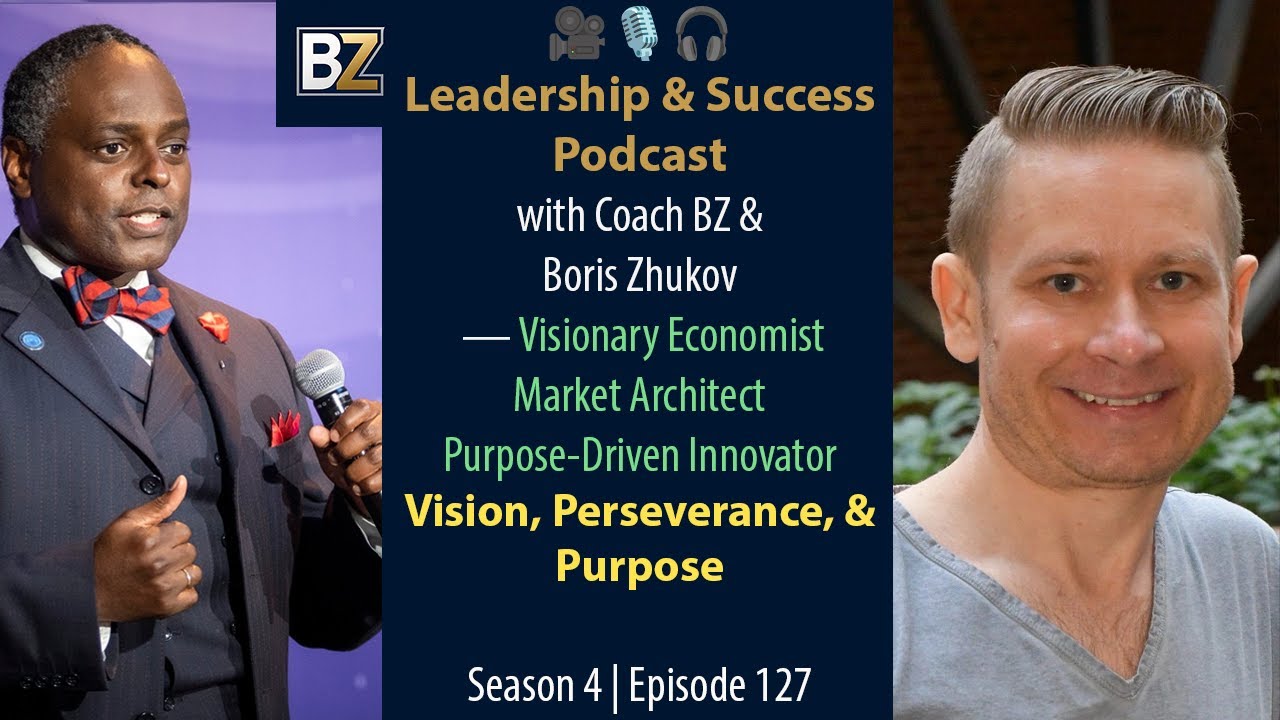
S4:E127 🎙️LIVE with Boris Zhukov, PhD (Multi Tracks Audio)
Coach BZ wraps Season 4 with upcoming guests including Professor Stefano Pantoni on AI accountability, Kwame Christian on negotiation, and General Stanley A. McChrystal on wartime leadership. He's running a 21-day Gratitude Challenge where he picks a network member daily via a wheel of names to post LinkedIn gratitude.
Chapters
Hi, I'm John Maxwell. When the top companies in the world are looking for trainers, speakers, and coaches, there's one name that stands above the rest, and that's Maxwell Leadership. Our certified team members have gotten proven results for companies all over the globe, and our reputation, I'm proud to say, is second to none. Some of our members have risen to the top of their profession, including the one you're going to meet today. I proudly introduce you to my friend Bob Fabien Zinga.
Welcome to the Leadership Success Podcast with your host, Coach BZ, where we help you lead with purpose and succeed with impact. If you're ready to grow into the kind of leader others want to follow, this podcast is for you. If you're determined to elevate your success and leave a lasting legacy, this podcast is for you. As my mentor, Dr. John C. Maxwell, reminds us, everything rises and falls on leadership. Our goal is simple: to inspire you, challenge you, and equip you with insights that can transform the trajectory of your leadership journey. Welcome aboard to another episode of the Leadership and Success Podcast with Coach BZ.
Okay, so the company is actually pretty exciting. So what it is, it's about people who are passionate about deals, right? And we started in the automotive industry, which means that let's say you're looking for a car, how do you shop? Well, how do you get your best deal? The way it works right now, like let's say before Let You Know, okay, is that you will go to different dealers, try to negotiate the price, research prices online. At some point you'll have your best offer and that's it. The stop is right at that point. I mean, it all ends, right? Well, now you can go an extra mile by bidding a lower price on Let Me Know. So you do everything that you do right now, get your best offer, and then go on Let Me Know and name your own price, a lower price, right? It's an instant result. And if you got it, here is your dealer, transaction is done. And as far as businesses are concerned, think about this. They are getting incremental sales by doing absolutely nothing, setting their hidden thresholds in seconds One time and it works perpetually. Today, tomorrow, 5 years, 50 years, 100 years, 5 million years, it will work exactly how they think in their head the price should be. And somehow miraculously, that hidden price set on autopilot is going to be done exactly that way on LetYouKnow. And it's encrypted. Even me, if I decide to bid— when I say even me, I'm talking about someone who is part of LetYouKnow— and if I decide to bid on a new car, I would have no information whatsoever. I will be bidding in blind like everybody else. And those businesses are going to be getting me or other customers as incremental sales by paying nothing, clearing those hidden thresholds, getting all those incremental sales without affecting any of their existing sales, which means that you can only gain something.
All right everyone, now welcome to another episode of the Leadership and Success Podcast. I am your host, Coach Bizzy. Today is Season 4, Episode 127, if you can believe it. So I have a very, very special guest today. Let me see if I can do the introduction justice today. So today, I'm going to be speaking and having a leadership conversation with the one and only Dr. Boris Zhukov. He's the chief executive officer and chairman of the board of directors overseeing product development, matching algorithm design procedure, estimation of demand-related parameters, and big data mining and analytics at LetYouKnow Inc. Boris' background in applied macroeconomics, environmental Resources Economics and Industrial Organization plays a pivotal role in guiding the company to develop and continuously improve innovative buyer-to-seller matching model and employing a myriad of statistical and mathematical technique, as well as regression-based model in various data estimation procedure that are critical to LetuKnow operations. So Boris received his PhD in Economics and a Master of Economics from North Carolina State University and a BA in Economics from Goucher College. Well, ladies and gentlemen, please help me welcome Dr. Boris Zhukov.
This is like a heavyweight fight. You know, you have a boxing heavyweight champion.
Yeah.
You have this announcer, you know, from HBO, you know, Michael Buffer, you know. Yes.
Welcome to the show, Dr. Boris Zhukov. I guess I will call you Boris. You give me permission to do that. How are you doing today?
Not bad, not bad. What's going on, busy?
All right, so, uh, before we get started, is there, uh, something you are grateful for today? I like to start with a moment of gratitude.
Well, I'm alive, so that's great, you know. As far as I'm concerned, that's, you know, that's a biggie. Yes, yes. And all of us, you know, we can enjoy a really good life because there is no nuclear holocaust, no nothing. I mean, life is good. So, and also in present day, unlike like, let's say, 1,000 years ago, it's all about your inner talents. It's about your hard work. And I'm grateful to be born in, I guess, in today's world rather than somewhere in the past.
Me too. Me too. Especially me. Yeah, you are so right. As long as you are alive, there is hope for you no matter where you might be right now. And part of the reason I know I read a little bit about about your story when you were teaching at the United Methodist School, you were close to Fort Bragg. So you've had a lot of interaction with the military. But part of the reason why I do this is because, as you may know, in the US military, about 21 veterans every single day commit suicide. It's really, really tough to be on active duty and people have PTSD and sometimes they struggle with substance abuse. I mean, it's a very, very hard life. But anyway, I believe it's impossible, right? To be grateful. And you cannot be grateful and suicidal at the very same time. So that's why I would love to start the show this way. So maybe let us know something. Is there something about you that most people may not know?
I'm not sure because most people probably don't even know who I am.
Really?
So that's a good start.
Well, it looks like you've had hundreds of thousands of views on TEDx. Platform. So I think you are pretty famous now.
Well, I don't know about being famous, but yes, more and more people actually recognize me. Plus, I mean, to be honest with you, it's not really about me because I don't actually have like some kind of ego problem. It makes no difference to me to actually build my own name. I am, uh, what I'm really driven is to scale our marketplace because it's not that I believe it is for the greater good of humanity, but I know mathematically it's just to bring benefits to consumers and businesses simultaneously. And it creates an environment which doesn't exist prior to LetYouKnow. So from that perspective, I am highly motivated to make sure that people get to know LetYouKnow and help us scale and bring the benefits back home to them and businesses. And we're going to talk about all kinds of, you know, mathematical models, matching models, and how it can actually help people as well as businesses. Into this. So, but just to kind of like build on your question, my point is, it's not really about me, it's about the company, because the company can deliver the greater good for society as a whole.
That is very, very powerful. I can see where your passion comes from. Thank you for sharing that. Let me ask you another question. Can you just give us briefly kind of like your leadership story, how you got to become the CEO of LetYouKnow?
Well, I guess it was kind of incidental. So what happened was I was in school learning different mathematical models, and then I stumbled on a lot of data in actually automotive industry, and I started piecing together different aspects of transactional side of the automotive world. And I developed— started developing initially matching models, and then developed those matching models. Then I realized it can be applied across all industries, you know, not just for new cars, but also on any new good as well as a service. Service is kind of new by default, right, by definition. And so, and I assembled the team, and what happened is just, I guess, incidentally, I was named— well, I guess I was named as the CEO of the company. But I mean, you know, hopefully that will change where I can just fade away and not be, you know, the face of the company, but the company will be the face of itself. You know, that's the endgame, you know, here. So, hmm.
So before we— we're going to be talking about a lot of stuff, innovation, artificial intelligence and all of that. But before we do that, what early experiences most shaped how you think about perseverance, effort and long-term value?
Well, that's a really good question. So from my early years, I watched my mom work incredibly hard to get things done. And reach her goals no matter how tough things became. And the same is true for my grandpa, who grew up extremely poor. He lost his father and most of his relatives during the turmoil that came from the regime changes back when, I guess, Russian Empire changed into the Soviet Union. So you have slaughter happening left and right, you know. So he lost practically all of the side of that family. So a lot of entrepreneurial people were targeted and executed by Soviets, right? And so, uh, yes, so he, he was, like I said, he was in this extremely poor environment, okay? He, in fact, he developed a limp, okay, after falling from a horse and had no access to medical care. Yeah, so his bones, uh, healed incorrectly. They did not get properly aligned, right? And so he got that for the rest of his life. The reason I'm saying that is that What he did, okay, when he was like, uh, 16 or 17, he built his own suitcase out of wood, traveled with that limp, traveled nearly 1,000 miles on foot along the train tracks because that's the only way to the city, right? You follow the train tracks, otherwise there are no maps, right? I mean, he could not navigate, I guess, using the stars or whatever. Yeah, so he could make it to the university to take admission.
Wow.
Yeah, studying whenever he could. Okay, in the ditches. You're talking about like along that track, right? So, and not only did he have to pass, okay, those exams, he had to score real high. Yeah, enough to earn a full scholarship as well as stipend. Wow. To cover his living expenses because nobody else— I mean, his family, like, like I said, most of his family is gone. Yeah, and his mom is extremely poor, right? I mean, no way he can actually pay for anything. And he persevered, got it all done. And he, through that willpower as well as hard work, he earned his PhD in physics, like you mentioned before the show.
That's amazing.
Wow.
Yeah, became one of a few people actually in the Soviet Union who became a millionaire within a socialist system, which is unheard of, right?
Wow.
So KGB was actually targeting him. Then the system collapsed, right? He lost everything because of the inflation, which soared like to 10,000% or above.
Wow.
And then he rebuilt it in his 60s without a single complaint. Okay. Most people would say, oh, it's unfair, blah, blah, blah, blah, blah. Nope. That guy took his destiny into his own hands. Wow. Boom. You know, so, so from my perspective, you talk about perseverance as well as effort. And yes, you mentioned the long-term, right, goal or values. And to me, I just cannot let those guys down. Right. So I never relent.
You know, I keep pushing, you know, that's, that's amazing. Wow. What an heritage. So you have spent some years in academia, right? University and so forth before fully committing to entrepreneurship. What did academia give you that still shapes how you lead, decide, and build today?
That's, that's another good question. So you teach large classes, right, in the university, which gives you the opportunity to polish your skills. As an orator, right?
Yes.
So in addition, academia provided an environment where I could engage with many brilliant people and expand my own knowledge, right, and study a wide range of models. And that experience, without me realizing it at the time, later allowed me to branch out into matching models and non-parametric estimation techniques that will prove to be vital as far as Let You Know is concerned, you know, for our marketplace, letyouknow.com.
So, wow, amazing. Was there ever a moment when you realize, I am not just studying markets, but I need to redesign one?
Oh, that's a, that's a, that's a heavy one. That's a really good one. Okay, so when I was in school, and I'm gonna go and start from afar and get to the core of your question, So when I was in school studying microeconomics, I really enjoyed industrial organization models, and that was part, of course, of my dissertation, right? So, and I like those areas especially dealing with society's economic welfare or total surplus, okay, and the different market concentration scenarios ranging from perfect competition and going all the way to monopoly. So you have different concentrations, I'm talking about different industries, depends on how many players they have. Is it like a lot of competition, or there is no competition, such as monopoly? And you look at the effects from those concentration in the— okay, indices, how that affects the total surplus, how much we as a society enjoy in the economy, right? So, and what fascinated me is that there are only two market structures that can generate the maximum, okay, possible total surplus. One is perfect competition, okay, where there are a lot of firms, okay, and none of, none of those firms have the ability to affect the price, so they are price takers, okay. The other is a market, okay, structure with a perfect price discrimination, okay. So either structure can maximize society's welfare, either one, okay. Now let's take perfect competition, okay, as an example. So perfect competition, however, requires a large, huge number of sellers, okay, perfect information, and a completely homogeneous product, which means that the product is identical, no difference. Now, that combination is extremely difficult, which may be even impossible, okay, to achieve. So, and even if it were achievable, okay, the model raises a real incentive problem. So if no firm can earn an economic profit, what, what motivates anyone then to innovate, to improve, right? To innovate that doesn't exist. Because if you do so, the moment somebody does innovate, okay, the perfect information assumption will make that innovation instantly known, eliminating any potential gain. So that means that person who actually created something will not enjoy the economic benefit of So that decreases the incentive to invent anything, you see what I mean? So even in that perfect world scenario of a perfect competition, you have some problems, some inherent problems that are difficult to tackle, okay? And at the end of the day, whenever you come up with something, okay, you have to invent something that solves real problems in a sustainable way. So the other scenario, perfect price discrimination, is far more interesting. So what it is, is where consumers pay different prices for the same good. Yet they are satisfied that they pay exactly what they are willing to pay. You see what I mean? And you see that whenever businesses can price discriminate, they do that. I mean, of course, colleges do it perfectly, right? Everybody pays for the same good. Exactly, like exactly the same good, right? You get an education, yet everybody different prices, right? I mean, some people like a merit scholarship to offset some of the costs, right? So the point is the price is all different. You go to the movie theater, there is a price for adults, there is a price for kids, there is a price for students, there is a price for senior citizens, right?
I mean, For the military too.
Yes, exactly, exactly. So different groups are paying for the same good different prices. So whenever businesses can do that, they are obviously going to be engaging in what's called price discrimination models. Okay.
Yes.
And it's superior to a single price model. So, okay, so let's, uh, let's, uh, let's focus on this. Okay, so, so here you see these people, they are paying different prices, but they, like I said, are satisfied because they are paying exactly what they are willing to pay, right? And also, somehow information from these different prices stays isolated, so no participant feels disadvantaged, right? Because whatever the price you feel is fair to you, right? Like, you actually like the price, that's why you paid it, okay? Yes. And that idea intrigued me. So unlike a single price model, we created an entire marketplace where a myriad of prices for the same new good or service can coexist simultaneously, you see. So what, what— so in fact, let me give you a panoramic view of this innovation, okay, or foresight, okay, into that innovation. So when Uber— okay, so I'm gonna make a, an analogy over here, a comparison. When Uber introduced ridesharing, okay, they created a niche within a traditional single-price marketplace. You see, it's an innovation within a niche, within a single price marketplace that already exists. So no matter how innovative the concept was, mathematically it still lives inside a conventional marketplace structure, right? So they didn't innovate the whole marketplace, they just innovated a niche within it. You see what I mean? Yeah. And that's great. They created an innovative, you know, approach inside a certain niche, which is great. But we created the marketplace itself. Do you see the difference? We actually created the marketplace itself. And when I say we are preparing to expand across all kinds of industries by allowing people to bid with instant results on new goods and services, I mean that we not only invented the marketplace, we can now operate within each niche. You see what I mean?
Wow.
Innovation. So we want to get into the ridesharing, no problem, we will actually let you know we'll be there. Okay, we want to get into things, you will be able to bid on those gift cards for restaurants, right? Let you know we'll be there. You see, any, any little segment, because we actually invented the whole marketplace. But let me, let me go—
that's amazing.
Wow.
Yeah, it really is. But on top of that, so, so, so, so let me, let me mention key things. Okay, on top of that we reduce transaction search, customer acquisition, and marketing costs all the way to zero for any businesses. Okay, so not only we were able, okay, to invent something, we actually did it in a way that minimizes the cost. Okay, so if you want to think about this though, what the implication of that innovation and that cost reduction is to you as a business owner. Okay, you want, you want to start a company and investors, so venture capitalists, okay, gonna ask you the very first question: how are you gonna be able to acquire customers? How you gonna generate revenue, right? Why would we loan the money to you, or why would we buy an equity from your company, but if you have no idea how to get the— how to get those customers? And the answer to that, the answer to that is going to be Let You Know. That's it. You're gonna go and join Let You Know, and Let You Know will solve the problem for you. We're gonna get you the customers. By you doing absolutely nothing. Okay. Wow. Yeah, exactly. And so you're gonna say, let you know, the end, boom, done. Okay, that's it. And you can focus— what it means is that you can now focus on building your product or providing your service while our marketplace does the rest. Okay. And now, now that is an enormous shift. And by the way, it means more businesses can operate and thrive because of our, uh, because of our marketplace. And by doing so, by the way, we move the economy closer. Remember what I mentioned before? So yes, we are tackling the problem of the perfect price discrimination, making that possible, right, to maximize the total surplus. But guess what? By increasing the number of companies, we're also moving inadvertently closer to a perfect competition, right? Because we're actually into the competition within this marketplace, which means that we are almost like— yeah, exactly. It's almost like we, we, we found a way how to almost like combine two models. Into one.
So let me ask you this then. So let's talk about innovation and let you know. One thing you've said before is what is visible isn't the whole story. I've heard you say that quite a few times online. How do leaders stay motivated when the hardest work is still invisible? How do you do that?
That's a pretty good point. So let me say this, okay? If someone is motivated by society's okay, recognition, awards, and accolades, I think many of those people will get discouraged and fade away. I mean, just fade away because it's gonna be so hard because you put so much work and it's not visible, and you're gonna feel kind of dissatisfied from that, right? So if those matter to you, like those accolades, uh, you may actually just start feeling, like I said, disadvantaged in a certain way that you're not getting recognized for something that you are creating, right? So, but there are some people who just do not care about those external validations, and they have that kind of mindset that allows them to weather that storm because they're not focusing on any of those external factors because none of that stuff matters to them, right? And what they really want is to create and build something that doesn't exist. That is the true motivational factor for these people to actually keep going, you see. It's not the recognition. No, no, no, no, no, no. It's the— that's powerful. Exactly. That you are building something. Okay, that is the real drive. And the reality is that the lack of public praise is just inconsequential, utterly inconsequential to these builders. And so you want to build, and guess what? Sooner or later, it's not a matter of if, it's a matter of when you're going to create something, and that's when you're going to get the recognition without even seeking that recognition.
Interesting. You are reminding me of Thomas Edison, right? It took him, what, 1,000 trials before he was able to create the light bulb. And like they say, the rest is history. So, but going back to Let You Know, a follow-up question I have for you then. When you built Let You Know, it really meant solving problems that didn't have existing solutions, right? So how do you lead a team when there is no playbook?
Okay. So you write your own playbook. I mean, that's what you do. So step number 1, you roll up your sleeves.
Okay.
Step number 2, you work almost 24/7, 365. And you just keep creating something, pivoting, adapting, pivoting again. Okay, you— then you're gonna hit a wall. So you're gonna hit a wall, that's just gonna happen. Okay, you're gonna feel discouraged because there is no progress that seems to be possible. And then you gotta brainstorm and find a solution that doesn't exist yet. Okay, and then you— when you solve that problem, nobody gonna recognize this, by the way, but you're gonna know it. You're gonna know that deep inside okay, yourself. You're gonna have that deep inner elation, okay, that you're gonna feel from achieving the unfathomable, okay? And then you're gonna keep going, you're gonna repeat, you're gonna continue until the mission is accomplished, which means that you're actually gonna create something. And you just keep moving. By the way, this is not the end game. So whenever you accomplish that, doesn't matter, that's already the past, okay? You're gonna look at the horizon and you're gonna find the new frontier and you're gonna keep moving to get to your new target, and it never ends. Wow.
So we've already kind of talked about the inspiring story of your grandfather and everything he represents to you. I'm sure it hasn't been easy for you either, especially dealing in a brand new space where you have to pretty much, you know, write your own playbook. I'm sure there were moments where progress felt very painfully slow. What inner discipline or belief kind of carried you through those moments?
Well, here's the key, okay? You know, okay, so you know that it will happen. So you gotta have that almost like faith in yourself, right? And you know that if your model is mathematically justified, okay, yes, if it is mathematically justified, it's a matter of when it will happen, okay? And so no matter how discouraging it is, no matter how many stressful situations you're going to encounter in your life. You just gotta keep on pushing forward and you gotta keep on plugging away. Sooner or later, things will happen. If you have that kind of mindset that you are here to build and it's going to happen, then you have absolutely nothing to lose. And at the end of the day, you have to think about this: your life is finite no matter what. So you're gonna die, right? I mean, that's, that's a guarantee. You're gonna die. So you can sit back, do nothing, take no risks or whatever, still the end result is the same— you're dead. Or you can actually do something and be proactive about it and say, hey, look, I mean, I have only so many years left on this planet and what I'm going to do, I'm going to maximize my years for the greater good of humanity. So somebody else will be better off maybe in the next generation. Right. And so you go all in and you keep building, you know, and that's the key.
That is quite insightful. Let's talk about artificial intelligence for just one moment. It's been pretty much disrupting every major industry across our society. As AI increasingly shapes market and decisions, what leadership responsibilities do you think we often underestimate?
Well, okay, so, so there are many, many things. Okay. One of them is hard work because we feel like AI will replace all the need for us to work hard and it's just going to make it so easy where we can get things done. At the snap of your fingers. Well, that doesn't really happen, okay? AI, in fact, if you think about this, okay, AI makes progress faster, right? It is true, it's making it faster, increasing your workload, by the way, exponentially. So now you have more on your plate to deal with, and that challenge, okay, that challenge can only be solved by extreme, extreme work ethics until AI at some point can take over, you know, that part. I mean, so once it can overtake that part, sure, I mean, But until then, you're just going to keep working even harder than before. Okay.
Yes.
Now, by the way, if AI completely overtakes every single aspect of our life, well, that's great because we all become entrepreneurs, right? We all become business owners. Okay. AI will actually work for us and we can relax and enjoy life. I mean, find the hobbies, you know. So it's still good.
Yes. Yes. That is It's really interesting how science fiction is becoming reality every single day. Like, like you said, when we started the show, you are glad you are alive, not just alive, but alive right now in this century, in this period of history. It is quite amazing. So going back to your platform, Leituno, you do eliminate negotiation, right? But you do preserve fairness. So what can leaders learn from designing systems that balance power responsibly.
Okay, so like I mentioned before, okay, at the end of the day, you need to design something that's actually mathematically justified, okay, and sustainable in the long run. So simply saying that you want consumers or businesses to behave a certain way because you feel they should, okay, will make no difference in the real world. So what you got to do, you got to design something that's sustainable, okay, and takes into account all these real-world intricate details, okay? Like, you gotta be grounded, like, your innovation, and you gotta design that innovation that is grounded in reality and solves real problems, and it must reduce costs because it just must be significantly better than anything that already exists today, you see? And, and so, so I think what leaders, okay, should actually think about is Not that, okay, so we reduce the need of negotiations, okay, but in a way, okay, we empowered people to name their own prices and take control of those transactions, okay. In reality, we created a superhighway of transactions for businesses. It's, uh, it just, it's just the mana from heaven. I mean, you're just getting buyers by doing nothing, paying nothing, and you're just clearing all those hidden thresholds while you focus on all your regular sticker transactions, and that's where you put your best team, you know, to focus on that while the rest is handled by, let you know. But the point is, whenever you're designing something, the key is you got to be grounded in reality, and that is the key.
That is actually— you said super highway. Let me play something from, from you. Just give me a quick second. Let me—
okay, so the company is actually pretty exciting.
So what it is, that's not Just one second. Yeah, I really love technology, but yeah, let me bring this one. So this is going to be a very short clip of you talking about the superhighway. I would like for you to comment on that.
Here we go. And what we are doing, we are mapping a whole vector or a series of equilibrium points. When I say equilibrium points, So there is me bidding and there is a seller, like, let's say, that got matched. And so that means that it cleared their hidden threshold, everything is good. That's one point, okay, is where the market met, right? The demand and supply met. That's one point. Well, there is another person who is doing it, and another person, and another person, another person. You have a whole bunch of different prices, different prices that coexist at the same time. It's like, imagine you go to the movie theater. This guy has one price, the gal over here has a different price. And somehow they're all happy, completely disjointed, so they have no idea about the information that's actually being, you know, shared individually to each one of us. And we're all happy because in our own world, we just got a deal that we want to get, right? And it's all committed, it's instant, and that's why it's a superhighway. Because the way it is right now, like, let's, let me give you an example in terms— because I, I said that I want to get into all kinds of different industries, right? Not just like, let's say, automotive. And we're about 9 months from going limitless. Meaningless. That means any industry. So one of the guys, uh, uh, one of the guys on the board is, uh, Will Dyer. He's there.
I, I think that is, that is enough. Can you comment on that? I think that's quite powerful.
Yeah. So what I think about this, let me give you a different example. Let's say you are in business, uh, you are in hospitality business, or like let's say restaurant. So you own a restaurant, okay? And you're thinking, how can I get clients? Well, here you go. And let you know, you're getting all these committed buyers by doing nothing. And The alternative today is if you want to increase your customer base, what do you do? You issue a promo code. Well, does it mean that every single promo code that's seen by public is going to be converted into an immediate sale? No. I look at the promo code, I may go there, I may not. You may look at the promo code, you may go there, you may not. Nobody is committed, no transaction actually materialized. I look at, let you know, I bid my own price, boom, it's instant. It's either yes or no. If it's a yes, transaction is done. Like, you see what I mean? And so the business, without actually realizing that, they want to move certain— like, let's say they want to have more, uh, okay, people in, in their restaurant where they look at their, you know, what, uh, dining facility, and it's like, let's say 40% empty. Well, they say, okay, boom, they already set those hidden thresholds and let you know, fill up those seats.
Huh, amazing.
So, and everybody are committed, everybody got deals, but everybody, you see, that's the beauty of this.
That is quite powerful. It reminds me, I think it was about maybe 10, 15 years ago, Priceline.com was one of the first companies that did that.
Yeah, exactly, exactly. And that, that's the beautiful thing, they actually cracked the code. It's the only one that did name your own price. Actually, if you go to search for name your own price mathematical model on Wikipedia, you're going to see that first paragraph, it will mention Only two companies, in fact: Priceline and Let You Know. That's it. No, no, that is amazing. Yeah, and the— but the, the, they deserve a lot of credit, okay? They deserve a lot of credit. But I want to say this though, uh, also they try to combine two models. One of them is transparent pricing. When I say transparent, like, here's the price, here's the hotel, that kind of stuff, right? And the second one where it's all blind, where you have bid it. And it's hard because whenever you have the information on the transparent side, people like me, consumers, would use it against that other side, and you end up cannibalizing your own sales. You see, that's why it was not sustainable for Priceline to have this combination of two models at the same time, because one was cannibalizing the other, which actually not producing benefits to the end, uh, business users. Okay, because they gotta get incremental sales, not like just cannibalize the same transactions and convert people from high paying to low paying. Like, what's the benefit there, right?
True, true. No, you really bring a lot of insight, thoughts on that matter. Let me ask you one more question about AI, and then we're going to move to the second half of the podcast. What risk do you see when leaders adopt artificial intelligence but without understanding the underlying incentive and economics.
Oh, so if you— or not you, I'm talking about generally speaking, like those business, okay, uh, leaders, okay, they pursue AI simply because of buzzwords, okay, rather than because they have a real problem that they are trying to solve to reduce their operating costs and make the processes that they have in place more streamlined. But let's say they do none of this because of that, they just do it because, oh, I've heard the buzzword, so I gotta do it because it's something popular. Okay, well, it becomes a never-ending cycle of adopting frontier technology that has little to no relevance to you. Okay, yeah, and that's the problem, right? Because— and also think about this, this buzzwords, they, they come and go. IBM, yeah, everybody are talking about AI, but, uh, take us back a couple years ago, people were talking about blockchains and cryptocurrency, right? So what do you do now? I mean, you— let's say you were one of those entrepreneurs who were pursuing these blockchains for no reason, okay, outside of that just sounding cool, okay? And cryptocurrencies— what do you do now? Do you just abandon those concepts and you, you switch to more popular hashtags?
I mean, yeah, yeah, yeah.
What do you do, you know? I mean, you're just gonna be you're going to be pursuing something that doesn't really matter to you for the sake of, for the sake of being cool. You know, the business at the end of the day is not about being cool, it's about being efficient. Okay, you gotta be efficient. That's the key, not cool necessarily.
And adding, adding lots of value.
Exactly.
Absolutely. Wow. So, uh, let me ask you this: what do you think is the greatest lesson you have learned so far in general leadership in life?
Well, uh, that's a, that's a great question. Okay, uh, one of the, one of the lessons that I personally learned was patience. Okay, that's the key. Uh, I, uh, used to— I don't want to say, uh, I, I used to be impatient. Okay, but I think I was. And also I lacked a lot of listening skills. Okay, and it's not because I was ignoring people. Okay, no, not, not because of that. It's just for whatever reason I wasn't really proactive listener. Like, it kind of registered, but I wasn't analyzing, you see what I mean, what actually people were telling me. Like, I'm talking about in greater granular details, you know. And so to me, that's something that I actually, again, over time, okay, I learned how to be a better listener. I'm still not a good one, okay, I'm working on this. And I also learned patience, okay, patience. So, you know, am I all of a sudden this, you know, granddaddy of patience and being a proactive listener? Not yet. I'm working on it. You know, it's a work in progress, so to speak, but I'm getting better.
At least you are aware, and awareness is really key because many people are just not even aware that they need to listen more. My grandmother used to say, God gave you two ears and one mouth, so try to use them in those proportions. Listen twice as much as you speak. But also another African proverb was like, be careful to open your mouth because when you do, people are going to figure out what an idiot you are. So anyway, what is maybe a leadership advice that you have received? What is one of the greatest leadership advice you have received?
Okay. Okay. So let me say this. Okay. Before, let you know, I talked to one investor, okay? And that guy built his own company, highly successful, sold the company. I, I'm not planning like on the investing, let you know, that's not the point. But I, I came across that guy, brilliant guy, and he told me once, okay, that, uh, raising my first $100,000 will make it easier, okay, to raise the next $200,000. I mean, you may think it's not related to leadership, okay, but I feel like it Okay, and then, okay, that $200,000 opens the door to $400,000 and beyond, right? So this idea kind of connects me to this point of perseverance or persistence, okay? And it provides like almost like a blueprint, okay, of hope. So now I know perseverance and persistence actually pays dividends, and you know it's almost mathematically going to work that way. Maybe you can think of it as a faith because that person just said like that's how it's going to go, but it doesn't mean it's going to go that way. But I feel like with a lot of hard work, I noticed myself, that's exactly how everything unfolded. And so by taking this— yeah, by taking this action, you achieve your initial goals, and then you can use the same approach to the next frontier, right? And you keep doing it. And you may think like this is not related to leadership, but it is, because you are trying— what is leadership at the end of the day? You're trying to go from point A to point B, correct? That's it. I mean, you're trying to get from here to here.
Yeah.
And from there to somewhere else. Well, here we go. I mean, if you actually have a blueprint that mathematically, okay, you think is sound, boom. Wow.
That's really, really powerful. Never despise small beginning and start small and scale. Actually, I remember when I first joined the Navy, I used to be a couch potato. I couldn't do a single push-up. And I think back then the Navy wanted me to do maybe 32 push-ups in 2 minutes. But when I first got started, it was just 1. That's all I could do, one push-up. But then I did two, you know, and then I did three. And eventually my best day as well, I was doing 80 push-ups in 2 minutes. But it started with that one push-up. And yeah, it's wonderful. So let me ask you this. You've been so successful in so many areas. In academia, you have your doctorate now, and also in high-tech and entrepreneurship. What is, you think, the secret of your success? Why are you so successful?
Well, uh, I, I wouldn't call myself successful, not successful, because I mean, to me, you know, when we're gonna, let's say, scale the company to what, what I believe is going to happen, which is a $100+ billion company, then I think, uh, preferably we can call it success. And again, I would still not call myself successful. I, I could care less about that because to me that will be already accomplished, done in the past. But, uh, let me, let me actually get to the, to the key ingredient of this question. I think persistence and not taking things personally, okay, matter a lot. So if someone tries to get, uh, to get under my skin, okay, or makes it even clear that they don't like me, even sometimes insulting me, okay, what I do is I keep moving forward. And eventually, okay, eventually people forget that conflict, okay. But because kept consistent, okay, I kept working consistently and treated them as if they were my friend without holding any grudges. Yes, I often win these people over. I mean, you're just not going to believe it. And in the end, it becomes a win for our marketplace because at the end, it's not about me, it's about the marketplace, right?
Wow.
So, so, so I feel like, you see, the, the secret over here is again, don't take it personally.
Yes.
And be persistent.
Yes. You know, that is powerful. I wish more people were like that. So you really keep your eye on the prize, the big picture. And wow, that's powerful. So what are you learning right, right now?
To be honest with you, everything, okay? From regression-based models to coding in Angular, C++. I mean, the journey never stops. And in our marketplace, you gotta understand, we are trailblazing an uncharted path, solving problems like you mentioned that do not have existing solutions.
Yeah.
And if solutions— in fact, if solutions already existed, we would not be trailblazers, right? I mean, that's it.
Yeah.
So, but this forces you, you see, this forces you to think creatively, generating, okay, ideas on the fly, and then do a lot of research. Okay, do a lot of research. What has been done, okay, and at the frontier of science before, okay, before you yourself gonna come up with a build on their answer and come up with a solution that doesn't actually exist, right? So if you're pushing into that unknown and that forces you to read a lot of different literature, you know, yes, in different areas, like, like I mentioned, like some programming languages, I mentioned, okay, statistics, statistical regression-based models. I mean, but in reality, sky is the limit. There are so many different areas, you know. So to get it done, and of course then you will have to test it to verify that your solution is empirically robust, okay? And to do all of that, you've got to do a lot of research, and that will force you into this never-ending path where you're going to be keep learning and keep gaining knowledge. And that's what it's all about.
That's, that's really amazing. I guess, yeah, in the 21st century, we really need cross-domain expertise because just being an expert in one little field, that's just not going to be enough. It's amazing. So what about failure? I love this coin. One of my skippers gave it to me. One side says failure, the other side says success. Most people, they only look at all of the successes you've had. But the truth is you've gone through a lot of failure to get to where you are now. So my question for you is, how has failure shaped your life?
Okay, that's, that's a million-dollar question. Okay. In fact, I love it. Okay, I love it. So let me say this, let me start by saying this: failures aside, okay, from those done out of desperation without the intent to succeed, are not truly failures, okay? I'm not truly failures. You see, our society, like you mentioned, it glorifies success. It just, it just does by blaring those slogan-like highlights such as someone winning the Tour de France or becoming a heavyweight champion or earning an Olympic gold medal. Or building a multi-billion dollar company, right? So failures, you see, are rarely mentioned. In fact, they are mentioned briefly, almost as a small footnote, okay, an asterisk, okay, of sorts. Well, success dominates. I mean, it's all about success. I mean, and then of course, I mean, there could be even a movie about the guy who built something, or a gal who did this, but— and, and they show like some struggles, but those struggles are pretty like, uh, you know, just little things. But then it's all about success, right? But to me, it is the opposite. It is the opposite. Success is a momentary, okay, event that immediately becomes the past, okay? You see what I mean? It, it, it happens in the moment. Yes, that is true. But then it's already the past, okay? So the real meaning is the journey. It is in the journey, okay? Virtually every journey contains failures. I mean, that's just the way it is, okay? And that is where your growth as a human being happens, okay? In those failures and how you deal with those failures, okay? And I'm not talking about— again, I'm not talking about whenever you are failing for the sake of failing, but about productive. I coined it— well, maybe I didn't coin it, okay? Maybe somebody else did, I have no idea. But I personally, okay, use this term, okay, such as productive failures, okay? And those productive failures actually make you better. So think about this: if society focused on those productive struggles, okay, we would all improve much faster than we would have otherwise. Instead of like— think about this— instead of competing only for the top result, right, we would actually then, because we are focusing now on all these different struggles, okay, like really highlighting those struggles, right, to help us all avoid those falls and minefields. Okay, so we would help each other, okay, to avoid those mistakes, and we would be learning from each other, lifting all boats in parallel. So consider this idea. So the universe is infinite, right? The universe is infinite. Okay, and then maybe, okay, there may be infinitely many parallel universes. At least this is suggested by physicist Sean Carroll, okay, as, uh, one of the explanations to quantum physics and entanglement. Okay, so the point is, okay, there is another universe. This is based on this— there is another BZ talking to, uh, to B, okay, exactly the same way. Like, there is another universe, exactly the same conversation is happening, but in that— okay, in that universe, society may actually focus almost entirely, okay, on learning from failures, not successes, but actually learning from failures, right? In, in that world, those two people would be right now learning from each other's mistakes.
Yes.
And would advance much further as a society as a whole than we would over here. So think about this. I'm going to give you a concrete example. So imagine that, okay, we take a test, you and I. You scored 95, I scored 89. And in that parallel reality, the same BZ and the same B also scored 95 and 89. So we started at the same place. Okay. And that will happen based on this infinite reality. There is just that reality will be exactly like that.
Yeah.
Okay.
Now think about this. In our, in our case, we would retake the test, okay? We will kind of like learn, okay, based on our mistakes. Maybe I hear something about your struggles, but I mean, the point is, here's me, I gotta improve. We take the test again, boom, you score a 96, feel great, you're the champion. I score 91, so I'm the second place, you're the first place, super champion, right? But in that other universe, okay, in that other universe where failure, you see, it's not success, it's a failure that's actually being extolled and being studied deeply, right? And shared openly to all the people. Yes. Including the same two people, you and I, right? So they learn from each other, so they will take the test again, and, uh, let's say the result is going to be 99 and 97. So in that society, you see, they will outperform you as a champion. You would not even be the second place.
Yes, yes.
So they would be so much ahead of us. And my point is, you see, they're failures become the engine of growth rather than a footnote to success. You see, and this is the success.
Say that one more time, please.
So, so, so the, the success, okay, the success again is a momentary thing, okay? It's just a statistic of what happened, okay? But the learning, okay, the path of learning and digesting the information from failures becomes the engine of growth.
Yes.
You see, not a footnote, like I said, not an asterisk to that success. It becomes it. You see, it becomes it. And that's what's going to drive everybody forward a lot more.
That is very, very, very powerful. I never thought of it that way. Thank you so much for sharing that. So who are some of the people that you know that we should know as well? Thought leaders that you follow or mentors, people who've made a difference in your way of thinking and leading?
Well, okay, uh, so, so, uh, you know, again, I'm not, uh, this is not a plug for letyouknow.com, but go to letyouknow.com and then click on About Us. Okay, on the bottom, on the footer, you're gonna see About Us section. Yeah, uh, yeah, so if you go to Let You Know and then scroll to the bottom, just all the way, all the way. Okay, you're gonna see About Us right there. There was like all the way down, all the way down. Yeah, yeah, yeah, yeah. Us. And then you're going to see a lot of people over there on the board of directors, okay? And those— let me tell you, those people— so you gotta scroll down to the, uh, you know, where you're gonna see me as well as— yeah, okay, a lot of brilliant people are actually on that board. You'll be surprised. A lot of doers, a lot of self-made people, very, very successful. And I think those people are going to be really, really, uh, useful to a lot of people. And you want to, you want to get familiar with those folks, you know. Wow, how many brilliant working individuals. I mean, possibly excluding myself. So forget about me. I'm just an average dude, you know, but everybody else, two thumbs up, you know, right there.
That's powerful. Okay. Let me ask you this then. If you could choose three people, right, to have dinner with, they could be alive, dead, or even mythical figure, who would you choose and why?
You know, uh, okay. So, so, so let me, uh, let me say this. Okay. Okay, there was, uh, this is kind of like maybe unrelated, but I heard, I heard Neil deGrasse Tyson, okay, who is a physicist, okay. So he said that if you're gonna, okay, if you're gonna follow certain people as your mentors, it will lead to disappointment.
Yes.
So instead of that, it's almost like you're creating a piecemeal where a lot of different people, okay, they have all the strong suits, and if you combine that collage of a picture, okay, that really becomes your mentor. So to me, okay, I mean, if I could like go back in the past, I mean, yeah, I would love to meet like, uh, JFK, Eisenhower, Einstein, MLK, you know, Tolstoy, Gandhi, but none of those people are available unfortunately because, you know, they're gone, right? So, so the only person right now just coming— yeah, exactly, here's MLK. So the, the only person who, uh, right now who came to the top of my mind, okay, is going to be Elon, right? Not because I really care to meet Elon, not that he's not a great guy, but I want to pitch Let You Know because Tesla and Starlink should be on Let You Know. They should actually be getting our customers, you see. So I will have some kind of incentive to meet him, not because I really say, oh Elon, how great you are, could care less. Yes, okay, not gonna— I'm not here to give, uh, just like some, some props and, uh, just, uh, kind of have my jaw drop to the bottom. The point is I want to take it constructively where all of a sudden, okay, that meeting can produce some results that will be better off for everybody in the society. That's why I would want to meet him, bring him on, let you know more deals to him, more deals to customers. He gets more business, good for him, good for our customers. That meeting, okay, if it happened that way, guess what? That would be productive for everybody.
Yes. No, that is, that is quite powerful. And I called Elon my African-American brother from another mother. Um, but, uh, yeah, well, technically, let me say this, okay?
I don't mean to interject, but technically all of us, all of us, human race, came from Africa. I mean, we did. Yeah, I mean, it's, it's, it's a, it's a scientific fact. All of us came from there.
So absolutely. But it is quite amazing what he's been able to accomplish in such a short amount of time.
Absolutely. He is the builder. Yes, yes. So even though I said like a minute earlier I'm not there to give props, he deserves a lot of credit because This is the guy— when I say that there are people who are builders, yes, this is the builder. You, you wanna, you wanna look at someone who actually created things for the sake of creating, not for the sake of accolades or none of that. This is the guy, you know. And there are lots of other people who are brilliant like him who actually, uh, hell-bent in creating things that do not exist.
Wow, powerful, powerful. So, uh, let me ask you this then, uh, What are some of the books that you have read that you'd like to recommend to the audience of this podcast?
Well, okay, so one of them would be War and Peace. Okay. By Tolstoy. Then The Count of Monte Cristo by Alexandre Dumas. The Great Gatsby. Okay. This is F. Scott Fitzgerald. Great Expectations. Okay. Is another one that's really good. Charles Dickens. Okay. And from the contemporary era, I would recommend Amy Jacobson. Okay, not a, not a light book. Okay, her book is called Scenario, Scenario, and that book, okay, is somewhat, okay, somewhat linked to a really hit, you know, a current hit on Netflix. Uh, there is a movie, it's called The House of Dynamite. It's about the nuclear war. So that book and this one are You know, uh, not like some kind of romantic stories. It's really heavy stuff. Okay, but I think everybody should educate themselves on this topic if we want to avoid the ending that's described in Ennis's book, because we want to be here in 20 years, 100 years, 200 years, 1,000 years, making the life better for everybody. Yeah, not just turning it off in the middle of 50 minutes. I mean, and that's what that book is Yes, in fact, one of the quotes of this, you know, movie, the one that I mentioned, that's really— it goes in parallel to her book. Okay, it's on Netflix available right now. Yes, it's called House of Dynamite. One of the quotes over there from the president, okay, who is in that movie, okay, is saying like, look, we are building all these plans and bombs hoping it will never happen, but when it happens, that's it. It. It's like a house of dynamite. It's like you are sitting in a house of dynamite and, uh, it's really dangerous. And I think recognizing the danger and actually maybe doing something about it, yes, is a big deal, you know.
That, that is quite, uh, powerful. Yes, I believe, uh, I can't get the, the picture now, but the, uh, book is, is called, uh, uh, Nuclear, right? Nuclear War.
No, no, it's called Scenarios. Scenarios. And the reason it's called Scenario is because it describes a scenario that leads to a nuclear holocaust from nothing to gone. I mean, just gone in 50—
like, like that. Wow.
Yeah, it's horrible. And I mean, it describes it actually. It's almost like a documentary. Obviously it's not a documentary because thanks God it has never happened, but it just— it describes all these protocols that are put in place like in the US as well as in the Russian Federation, China, etc. I mean, practically describes the whole thing, how it actually goes from the moment it's detected to the moment that retaliation happens. Exactly. That's the one.
Yeah.
Yes. It's, again, it's a really dark book, but I think it is worth reading. Okay. Kind of, you know, at least educating yourself on the reality of things, how dangerous everything is, you know. And we don't want to make those mistakes. We as a human race, we, we want to avoid that. That's what— that's the purpose of the book. In fact, the first time I heard about that book was on Lex Fridman podcast because Amy Jacobson, she was a guest. Wow. And she was talking about it. Yeah, I mean, and they went deep into all these different protocols, you know, what happens from the moment it's actually detected by the satellites, you know, how the data is cross-verified. It's really, really detailed.
Yeah, amazing, amazing. Okay, uh, is there maybe a song, a book, or a movie that would be your life's theme or anthem?
Uh, okay, well, I like Les Misérables, you know, by Victor Hugo. The reason is, yeah, because it kind of follows the twists of life, constantly making you reflect, grow, reevaluate your life, you know. So as far as the music is concerned, I mean, I love EDM, okay, like trance and drum and bass, you know, that kind of stuff. So I don't think there is anything like this.
Yes.
So unlike maybe Mozart's Symphony No. 40 in G minor, you know, most of those tracks, they kind of fall short individually of making you feel like as if there is the, the connection between those sounds and you, okay, mapping those sounds into your real life.
Yeah.
So I think it's a little short. Maybe that Mozart symphony is something that can make you feel like this way because it used— it was, you know, back then when they wrote those symphonies, it was not like for 3, 2 minutes or 4 minutes or whatever.
It took like a long time. Yeah, yeah.
So then maybe there is a way how you can actually those songs into that reality.
Yeah, powerful, powerful. So if you had one and only one day to live, what would you have liked your final contribution to be?
Okay, so first of all, so if I have one day to live, what I will do, okay, myself, I will try to erase that from my memory. I'm talking about like completely erase that that, like as if I had no idea that happened, because I don't want to be stressed by that outcome. Okay. And then I will try to work as hard as I can. I mean, the whole day I would just be working and try to contribute and do my best. And then boom, blackout. You know, that would be the ideal scenario.
So if you had a magic wand and you could solve any problem, what is one problem you'd like to solve tomorrow morning?
Well, uh, you know, nuclear would be it. That's it. I mean, because that ensures that that doesn't happen. So if I have a magic, uh, okay, uh, magic stick or whatever, okay, where I just, uh, like a fairy, okay, did this move and boom, it's all gone. All nuclear gone. And it would be peace, uh, and prosperity in this whole world, you know. So that would be That would be something that I would actually be highly, highly motivated to accomplish.
Okay.
But that's for everybody. And, and by doing so, guess what? We are guaranteeing our future. We are guaranteeing that we're going to create a better world and we're going to continue doing that and solving amazing problems as a human race.
Future generation. Okay. We are getting toward the end of the podcast. Thank you so much for your time. And how can we add value back to you?
Well, okay, that's a great question. So of course you can follow, uh, and we appreciate that a lot, follow our marketplace, you know, LetYouKnow.com, across all social media channels, including LinkedIn, okay? Especially if you are passionate about deals or you want to open the business, okay? Because soon we're going to open doors and you don't want to be worried, like I said before, explaining how the heck you're gonna get those customers, okay? So the, the point is, the more we scale, the more we're gonna help. And so from a business point of view, okay, if you want to get customers, here we go, follow us. If you are a consumer and you love deals, you're passionate about deals, you love savings, here we go, we are gonna be your jam, okay? That's it. And so, so all social media channels, okay? All social media.
Awesome. So as we come to the end of the podcast, is there a question I should have asked you that I didn't get a chance to ask?
Well, I think you covered it pretty thoroughly, to be honest with you. I mean, I, I feel like I feel like we went from even early childhood years, motivational factors, all the way to, you know, subjects that are kind of heavy, I guess, including nuclear stuff, you know. So I feel like we practically crossed every single T we could have in the span of these 60 minutes, you know.
All right, we're going to be landing this plane soon, but before we do, if you could go back and give a piece of advice advice to your 17-year-old self standing at the edge of this incredible career you've had. What would you say to 17-year-old Boris?
Well, okay, like I said before, be more patient. Okay, so that's one thing. Okay. And also do not try to rush time, you know, like, for instance, let me give you an example. I was, I was in school, right? And whenever you start your academic a year or semester, okay, you're kind of trying to get to a point where you will finish all these courses, right? Take all the exams, put it behind you, and eventually get a degree. So you're trying to kind of like— you're trying to get to that point. Like, you're feeling like, I'm here, but I want to be there, you know? It's almost like you want to rush that time, you know? And I think that's a big mistake because you want to enjoy your time because you're only given so much. And if you're going to try to rush it it, and you're gonna lose track of it, and you're not gonna enjoy it as much as you would have. Okay, that's a big mistake. So I recommend, you know, to myself as well as everybody else, okay, uh, take a deep look and look at your life and enjoy it. Okay, that's the case. Keep building, but keep enjoying it. Okay.
Yes. Wow, powerful. Okay, we are coming to the end. A couple minutes, we are going to be done. So this is going to be a rapid fire lightning round, so don't take too long to think. Really, really quick. All right, one word that defines great leadership. One word.
Okay, building. That would be it. Building.
Okay, morning routine or practice that keeps you grounded?
Uh, I actually, uh, 2 cups of coffee. Okay, 2 cups.
Okay, a book or a quote that changed your life?
Uh, well, that would be, uh, calculus actually. Uh, really, the calculus book. Unbelievable. Very powerful.
Yeah.
Yeah.
Who inspires you most today?
Probably my grandpa and my mom, I guess. Yes. Yes.
Yeah. The story from your grandfather, very, very inspirational. It's just amazing. Okay. So what did you want to be when you were a kid?
I had— so my mom, she's a doctor, medical doctor. Okay. So initially I wanted wanted to be a medical doctor as well. Okay, then I changed that to be a— to want to become a lawyer, and then I changed it to become an economist. And, uh, you know, the rest is history, like they say.
What were 3 adjectives describing you as a child?
Uh, I was pretty energetic, you know. Yeah, tomorrow, uh, positive, probably, because I always had that positive outlook, you know. So that's That, that, that was it. And also kind of persistent. Okay. Always, always, always pushing no matter what.
Okay.
As an adult, I think it's kind of the same. I mean, I feel like I'm pretty optimistic. First of all, optimistic. Okay. So I am optimistic. Okay. I keep it positive and I am definitely okay persevering in terms of—
Absolutely. Okay. This is the very last question and we are done. What is one word that represents our shared experience on this podcast today?
Sharing knowledge. Okay, well, two words, I guess, but sharing is the key. What is it all about? Sharing.
All right, I am always, always super, super grateful. Thank you for giving us an extra 8 minutes for this podcast. We've learned so much from you. Thanks again, Dr. Boris Zakharov, everyone. Thank you. I appreciate it.
Thank you so much. That was awesome. Thank you.
All right, all right, everybody, uh, thank you so much for watching. So this was Season 4, Episode 127, and we just had the privilege of speaking with Dr. Boris Zakov. He just wants us to call him Boris. He's such a humble man, but he has accomplished so much and we can definitely learn so much from his experience. I want to remind you, I'm going to be back here tomorrow. What I will do is I'm going to have a 10-minute AI recap from a conversation I've had previously. So I'm going to do that tomorrow, Saturday and Sunday, and I think Monday too. But then on Tuesday when I come back, I'm going to have the pleasure of speaking with Professor Dr. Stefano Pantoni. He's a global authority on decision-making analytics, AI thought leader. We're going to be talking about accountability in the age of AI. You don't want to miss this. He's the bestselling author of Decision-Driven Analytics. And then on the same day, later that morning, I will have the privilege of speaking with Kwame Christian. He's a world-renowned strategist, Transformational and Visionary CEO, a serial best-selling author. He's the author of Finding Confidence in Conflict and How to Have Difficult Conversations About Race. We're going to be talking about negotiation as a leadership superpower. And then on Wednesday, I am so overjoyed and really humbled to speak to one of my heroes. Dr. Zhukov says, never meet your hero, but this man has literally changed the trajectory of the war in Afghanistan. Nirmal doesn't need any introduction. General Stanley A. McChrystal, US Army retired, legendary servant leader, 4-star warrior scholar, and serial bestselling author of Team of Teams, Leaders, and On Character. So we're going to have that deep conversation on Wednesday, and I can't hardly wait to be with you. Okay, so actually, before I go, something that we've been doing every time we meet, we have a moment of gratitude, but also since Thanksgiving, I've added 21 days Grateful Challenge. And today, it looks like it's been— today's day 16. So we started on Thanksgiving. This is the 4th year that I am doing this. And basically, what I do is I am thankful for something every single day for the next 21 days on LinkedIn. And then each day, I challenge a member of my network to also accept the challenge where they are going to be grateful for something on LinkedIn every day for the next 21 days and each day select someone from the network. So what I'm going I'm going to go back to sharing the screen. I'm going to get what I call the wheel of names. And what that does is I am going to randomly select a member of my network and see who is going to be challenged by me today on day 16 of the 21-day challenge for me. So, it looks like, uh, Today I challenge Dennis Maliani, MBA, ITC, Perfect Car System. And looks like I connected with Dennis, February 23rd, 2019 page for just a second. I am grateful for life, just like Dr. Than your yesterday. So Denis Maliani from Los Angeles, California. So he doesn't live too far away from me. Denis has over 17,000 followers. So Denis, my challenge for you if you accept it is to start today by creating a post every day on LinkedIn for the next 21 days to be grateful about something every day and then challenge one of your 17,000 followers to do the same. I hope you accept the challenge. Okay, that's it for me today and thank you so much for watching The Leadership Leadership and Success Podcast. Uh, see you tomorrow. Bye for now.
Thank you for tuning in to the Leadership and Success Podcast with your host, Coach BZ. If today's episode added value to your leadership journey, be sure to subscribe, share, and join us again for more wisdom nuggets on how to lead better and achieve greater success. Remember, Leadership is the most critical skill of our time. The world will always need leaders to inspire others, drive innovation, and execute meaningful strategy. So why not count yourself among the bold leaders shaping the 21st century? Until next time, stay inspired, stay committed, and keep leading with excellence.
More from Bob

S250:E4🎙️LIVE 🇺🇸America 250: President Barack Obama Leadership, Service, and the Power of Hope






S5:E157🎙️ LIVE with CMD CMSgt Dennis L. Fritz, USAF (Ret.)(Multi Tracks Audio)



S5:E156🎙️ LIVE 🇪🇸 Leadership Lessons from the FIFA World Cup 2026 Champions (Multi Tracks Audio)

S250:E3🎙️ LIVE Leadership Lessons from America’s First Documented Family of African Descent 🇺🇸📖