S4:E128🎙️ LIVE with Professor Stefano Puntoni (Multi Tracks Audio)
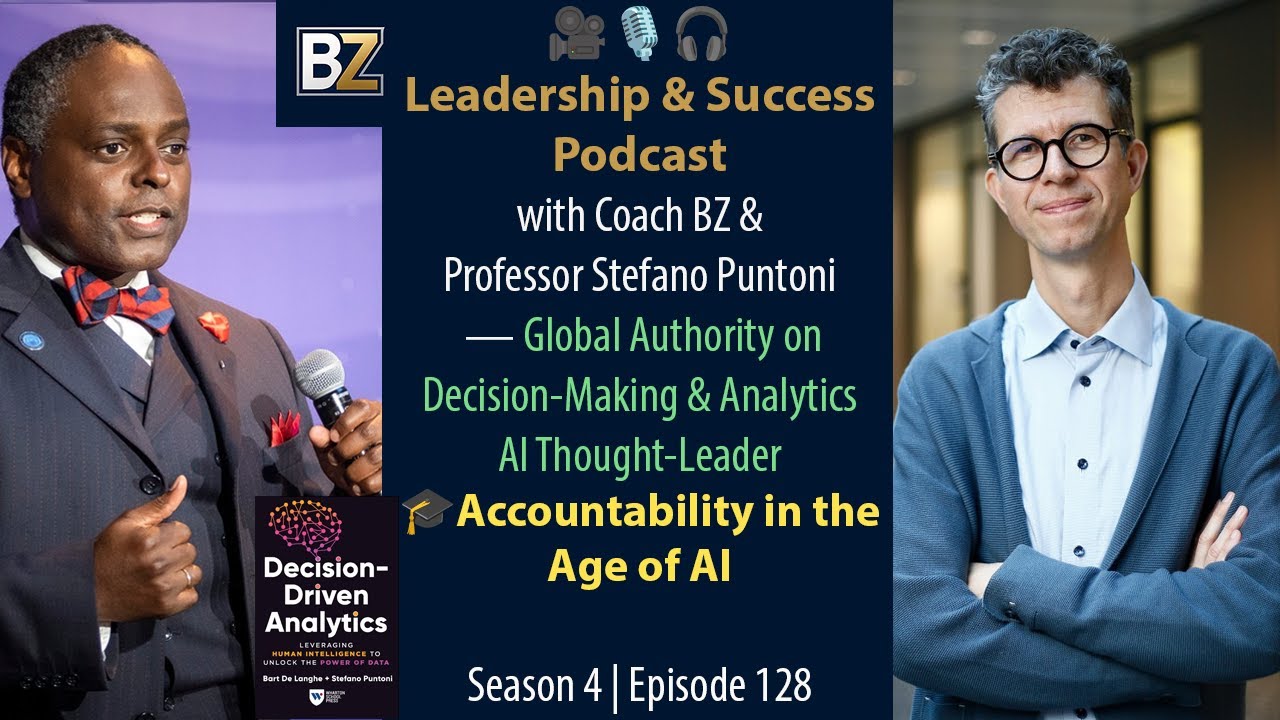
Professor Stefano Puntoni from Wharton discusses AI as a tool that complements human expertise, not replaces it. His book Decision-Driven Analytics flips the usual approach: start with the decision you need to make, then figure out what data matters. Leaders deploying AI need to account for why people resist it: threats to identity, autonomy, and belonging.
Chapters
¡Hola!
Hi, I'm John Maxwell. When the top companies in the world are looking for trainers, speakers, and coaches, there's one name that stands above the rest, and that's Maxwell Leadership. Our certified team members have gotten proven results for companies all over the globe, and our reputation, I'm proud to say, is second to none. Some of our members have risen to the top of their profession, including the one you're going to meet today. I proudly introduce you to my friend, Bob Fabien Zinga.
Welcome to the Leadership and Success Podcast with your host, Coach BZ, where we help you lead with purpose and succeed with impact. If you're ready to grow into the kind of leader others want to follow, this podcast is for you. If you're determined to elevate your success and leave a lasting legacy, this podcast is for you. As my mentor, Dr. John C. Maxwell, reminds us, everything rises and falls on leadership. Our goal is simple: to inspire you, challenge you, and equip you with insights that can transform the trajectory of your leadership journey. Welcome aboard to another episode of the Leadership and Success Podcast with Coach BZ.
My name is Stefano Pontoni, and I'm a professor of marketing here at the Wharton School. I teach a course called AI in Our Lives, and the course is a behavioral science take on the topic of AI. That is, we don't study necessarily the algorithms, but we study the impact that the algorithms have on people. If you think about the students, well, a course like mine can help them be ready for the job market, for the workforce of the future, by helping them understand what these models can do, how they can complement human capabilities, and as a result of that, which capabilities they need to nurture in themselves. A lot of the discussions that you hear about generative AI today take the shape that I call human or AI. And I think it would be more inspiring if we could think in terms I call human and AI, and not thinking about how do we design AI systems that are meant to emulate and replace human intelligence, but instead AI systems that are meant to complement in the best possible way human expertise. And I think a school like the Wharton School, which for, you know, over a century have played a leading role in helping How can management adapt to changes and benefit from these changes, whether those are social or technological or whatever? I think we still play that role. What I try to do in the course is to make sure that we have a balance of topics and a level of depth that is basically satisfying everybody, so that if you come to the course after working for 10 years in AI, or you work, you come to this course having just made an account on ChatGPT and been tinkering with it, I think that both groups will find something insightful and ideally inspiring from it.
Ahoite, everybody! Good morning, everyone. It's about 6 AM here in California and 9 AM on the East Coast. Thank you for being with us for another episode of the Leadership Success podcast. I have a very, very special guest here with me in the green room. I can hardly believe it. Let me see if I can do his introduction justice. So today we are going to be having a great leadership conversation with Professor Stefano Pontoni. I think that's the Italian accent right there. I was just kidding with him, it looks like there is a village in southeastern Italy called Zinga, so I think I am Italian too, at least for today. But anyway, Dr. Pontoni is the Sebastian Kress Professor of Marketing at the Wharton School. Prior to joining Penn, Dr. Stefano Pontuni was a professor of marketing and head of department at the Rotterdam School of Management, Erasmus University in the Netherlands. He holds a PhD in marketing from London Business School and a degree in statistics and economics from the University of Padova in his native Italy. And I want to remind everyone to also get a copy of his book. We're gonna be talking about that today. Best-selling book, Decision-Driven Analytics: Leveraging Human Intelligence to Unlock the Power of Data. So we are talking to an expert expert in AI, and everybody has been talking about AI these days. So ladies and gentlemen, without any further ado, please help me welcome to the Leadership and Success Podcast, Professor Stefano Pantoni. Professor Pantoni, how are you doing this morning?
I'm doing great. Thank you, Bob. What an introduction. Thank you.
Yes. So I guess to get started, sir, what are you grateful for today?
I am grateful for those around me that give me happiness and the ability to do everything I want to do, and these are primarily my wife and my children.
Yes, well, thank you so much for sharing. And of course, it's, um, no, next week is going to be Christmas. It's the holidays now, and I think this is a great Christmas gift, just you being here and speaking to us. I am so, so grateful for that. Is there anything about you that most people may not know?
I don't know.
I—
here's one weird fact. When I was a teenager, I was very much into music. I was playing a lot. Guess what kind of genre? I was in a band. What kind of music do you think?
What, what music did you try to guess?
Try to guess.
Let me see.
Pop?
No, no.
Try again, try again. More niche, more niche.
Uh, would it be like, uh, electric?
Uh, no, although I do like a lot of electronic music, but no, it was something very, um, analog actually.
Like classical?
No, very far actually. I tell you, death metal.
Really? Wow, that is amazing. Talking about music, it looks like we did love one of the same artists. In your LinkedIn post I saw a tribute to Michael Jackson, I think the best musician who's ever lived. And also it looks like we also love boxing, Mike Tyson, and also you take a lot of pictures of nature, which I do as well, and also in the art. And on top of that, you were in a band. I was in a band too when I was in high school, and actually I produced about 2 albums. Actually, back then we called them cassette tapes and CDs. Our kids today, they have no idea what was that. So we may have more in common. And then another thing more surprising, I say I might be Italian too because there's a Zinga village right there in the east, southeast Italy, in Casabona, Crotone province in Calabria. And I told my kids I'm going to take them to our ancestor's village. So maybe we're going to go there in the next couple of years. But anyway, it's really, really fun to be talking with you today. Maybe to get started, can you Tell us about your leadership journey, how you got to become Professor Stefano Pontoni.
Well, I mean, I decided that I would like to be in academia. I found the environment, the idea of spending all the time thinking about things, very appealing. And I think this is a kind of career that many people kind of stumble upon. I don't think, especially in business, so some people might say, you know, I want to be a physics professor or something when they're very small. I don't think there are many people when they're 5 say I want to be a marketing professor or a business school professor. It's something you just stumble upon and it worked well for me. I think it's something that gives me an opportunity to share what I know and take— I think I try to live with purpose and basically teaching and research, I find that the two sides of the same coin, helping young people be the best they can be. And try to understand the role they can play in society. That's what we do with our teaching, and then with research, try to help navigate the technological moment and making sure that people make, you know, good decisions around a technology like AI. I think that's really what drives me.
Well, that is quite amazing because, Professor, we're going to be getting into AI and analytics in a moment, but I want to start with you just a little bit. What personal experiences or moment kind of shaped your fascination with human judgment and decision-making, which you are very well known for?
You know, I did in college, I studied statistics, basically the first 2 years is pure math. And then you start bringing, looking at some data and estimating, it's all very big formulas. And then when you start looking at data, I actually, towards the end of my degree, I realized that I was more interested in the people behind the data than in the data itself. So for my graduate dissertation, my master's, I decided basically to focus on applied psychology, basically, you know, decision-making. And that's basically how I ended up moving from, let's say, focus only on the data and focusing on why we get the data that we get, really trying to understand the people behind the data, which I find still to this day the most interesting thing you can study.
Man, that is really quite powerful. I know in my military experience, when I was a junior officer, it's required we take a strategy and decision-making course. We call it John Professional Military. Every officer has to go through it. And it is so critical, especially as you become more and more senior, to be able to take your emotions out of the picture and really focus on the data and making the very best decision you can with the amount of data you have. But one of the issues I feel like, you know, this century with the internet technology, there's like an expansion, exponential growth of data. It's like we have way too much data and we need to really focus on what's really, really critical in order to make decisions that matter. But anyway, so you've taught across Italy, the UK, Europe, and now the United States. How has that global perspective shaped how you think about leadership and decision-making?
I think basically every place has its own conventions, has its own ways of working, and doesn't have to be better or worse. It can be, but it's just different. And so having an international outlook on things, it makes you better at perspective-taking. It makes you also, you know, take less things for granted. I mean, it's really the cliché, but I think it's true that you can understand your culture only when you've been stepping out of it. So all the assumptions that we tend to make and take for granted, I think you now see them questioned when you move abroad and see that maybe people don't think that way. And so I think I advise everybody to live abroad a period of their life. I think it makes them a better person. Also, I think it makes them understand their own culture much better.
Yes.
And I think in general, you know, a lot of conflict I think is driven by the fact that people don't have exposure to each other. I think typically when people have met people who think and look different from them, they find them just as nice or as not nice as everybody else. And I think just having the contact, I think it's a way of bringing, building bridges. And I advise everybody should be living abroad?
Absolutely, especially for those of us, I think, who are privileged to be US citizens, to have an American passport. At least up to now, it really has been a passport to the world. Many times I go to Europe, after 90 days I don't need a visa or anything. I just get my passport and I am gone. It's really a wonderful opportunity to visit the world. And of course, most people in the military, they would know, they've been deployed all across America and around the world. It's really fascinating to meet new culture. So many people, they do see you as a data and AI expert, part of the reason why we invited you to the show, but your work also consistently puts humans at the center. So where did that conviction come from?
I think I already kind of hinted, basically the data are just, you know, what you get and what you work with, but in the end, the data are just a means to an end. In the end, you want to achieve something, hopefully on behalf of humans. And so putting humans at the center has got to be the basis for any decision-making process. That's basically, you know, in a way, you know, you need data to make good decisions. Most situations we can make much better decisions with data, but the challenge oftentimes in making decisions doesn't lie with the data, the technical thing, lies in the human part. I mean, most analytics programs in companies don't fail for technical reasons, they fail for people reasons, typically lack of strategy or lack of vision. So I think in the end, the attention to psychology is going to make most of the difference.
Well, that is quite powerful, and especially in the military, I think having human oversight is so critical, right? Because we don't want autonomous systems driven by AI to make decisions of life or death or anything. Like that. And based on what you say, you also often say data doesn't make decisions, but people do. So I think that is so critical. But why do you think so many leaders will still kind of struggle to accept that responsibility?
I think a lot of people see advanced analytics and automation as a way of almost like surrendering accountability and responsibility. It's a way of, okay, I don't have to worry about this complex thing, AI will tell me. And I think in the end, the danger is that people see automation and data as a way of replacing their own thinking or having less need for thinking. And in a way, the smarter the data and the machines, the harder we need to think to make good decisions in that environment. So in a way, the danger is that we tend to— we basically, you know, you can count on one thing with people, which is they'll be lazy if they can. If they can avoid having to think hard, if they can avoid taking responsibility, they'll tend to do it. And so I think the danger with data is that we tend to surrender accountability and cognitive effort. And so that is something we, you know, for example, in education, I'm a college professor, so I worry about how students might use generative AI, for example. The tendency is for people to use it as a crutch. They basically ask the question, they get an answer, and they don't think as hard about the problem as they would have done without the technology. And of course, the technology can be used as a tutor, it can be used as a powerful way of improving your learning and learning journey. But the reality is that most people will not do that. Most people will take the easy way out and learn nothing as a result. But you see the same parallel in a lot of domains of life, including also, I think, leadership and decision-making. And in an environment like the military, especially, that obviously is a dangerous thing.
Absolutely. And in high-stakes environments like in the military, or even in high-tech, What does good judgment actually look like?
It's a hard question, I think. One thing, I hear my headphones are telling me that I'm running out of battery, so apologies for that. The moment that they die, I will switch to the system battery, but just in case there is a glitch, you know, be patient.
No problem.
No, so what is a good decision? Basically, a decision that aligns actions with the outcomes that you wish to have. So have you thought carefully about where you want to be? That is basically what, you know, a big chunk of the leadership challenge is, right? Understanding where you want to go and then finding out what are the best ways of going there. But if you know where you're going to go, then it becomes an issue of finding the data that can help you inform on the best path to get there. I think in a way, half of the challenge is knowing where you want to go. What is it that you're trying to achieve and why you want to achieve that and what are the trade-offs you're willing to make? And once you know that, then it becomes more of an optimization problem.
Yes. So you have written this best-selling book, Decision Driven Analytics: Leveraging Human Intelligence to Unlock the Power of Data. Again, I really love the emphasis you make on human intelligence. But a lot of your research also has shown that people don't resist algorithms because they are irrational, but because of identity, autonomy, and meaning. Can you unpack that for our audience?
Yeah, so the background of that line of work is that technology can help people only if they use it. And people— there are many reasons why people may not want to benefit from a technology. And that often boils down to a feeling of psychological threat, especially with a technology like AI that is so advanced and so similar to the kind of thinking that we do in many ways. It can be threatening to people and it can threaten three sources of well-being. It can threaten feelings of competence when you see, for example, a machine able to do something that you thought only you could do, or can threaten feelings of autonomy when you think that the technology now is going to be in charge in a way, or it can threaten feelings of relatedness when you feel that technology can alienate you from other people or maybe make it harder for you to connect. Like when, you know, imagine you want to try to talk to someone in a company, it's impossible to speak to a person because there are only machines that you can talk to. And so You know, in many ways in our lives, both personal lives and professional lives, you see technology taking these roles that are increasingly quite advanced and potentially quite important in decision-making. And so for some people, that may be a threat. So we documented in our research barriers to adoption that stem from a threat to identity. For example, you know, I don't like to see technology taking responsibility in this role because I feel that by doing that, I can no longer claim that I'm the one who does this, whatever that is in a context, you know, it might be a hobby, might be a job. We've documented the barriers to adoption based on feelings of loss of control. You feel that you no longer can control those outcomes and that is kind of scary or freaking you out a bit. We also find that people can respond negatively to technology when they find that that technology is objectifying them and make them maybe less willing to display prosocial motivation to be helping other people around them. So all of these domains are affected. And I think whenever— if you're an organization in the military or elsewhere thinking about deploying some kind of automation tool in the shape of algorithm, generative AI, or whatever that may be, I think you ought to be thinking about how that technology is going to impact the psychology of people. And anticipate potential threats that may emerge during that deployment so that you can take action to minimize the danger that that deployment is either failing or that, you know, some bad outcomes will come.
Yeah.
And actually, what you just mentioned, so we are right now talking about leaders, but what about Gen Z, right? Both my two daughters are Gen Z. They've really grown up with the internet and the tablet in their hand. Even more so will be Gen Alpha that is coming. After them. How is technology affecting them, especially the emergence of AI, when it comes to identity, communication, and everything else you've mentioned?
Yeah, we don't know really, but you can see, well, there's a lot of data, it's not my data, but a lot of evidence that social media have been doing a lot to our psychology.
Yeah.
And to some extent, for the most part, that has not been very good. We'll see what AI does. But for children growing up now, they will grow up around interactive tools that are very human-like. So they will grow up with, you know, AI chatbots that are their friends, their buddies, whether that is on Snapchat or Meta platforms or through, you know, interaction on TikTok or whatever that may be.
Yes.
And or ChatGPT or whatever. So many, there's so many of these tools.. And that may change how they build relationships, how they think of themselves in the world. Doesn't have to be bad change. I mean, a lot of the change might be good, but some large change should be expected. And I don't think we always make decisions with that kind of awareness in mind when it comes to regulation, to business decisions, even education.
So let's go back to the leaders like tech executive or military commander. If you were advising them about deploying an AI-enabled decision system, what type of guardrails do you think would you insist on before you roll out?
I mean, that is very much depending on the context, right? There are situations where errors are tolerable, where the cost of mistakes is small, where this is more about managing efficiency. And there are situations where mistakes are very costly, where there are very serious ethical consequences to deploying AI in a way that might lead to harm. You know, the military being the most obvious example, but there are many.
Yes.
And so the context of deployment is going to have to drive what kind of trade-off people are willing to make. But I think it's interesting to think about as a problem. Generative AI in particular is a technology that is really special because it's incredibly capable, but it's not perfect. So, yes, how do you deploy a technology that is right 90% of the time, not 100% of the time? Um, and so in some situations that might not be a big issue if you're on social media platform interacting with a customer on some like, you know, low-stake sort of interaction, that could be perfectly fine. Other situations where you're making, I don't know, credit card credit decisions on behalf of people or healthcare decisions or, God forbid, lethal decisions in the military, then that's a very different ballpark.
True.
Wow.
So back to your book then on decision-driven analytics, you challenge the phrase data-driven decision. I know in Silicon Valley, at least, 10 years ago, that was like the fad. Everybody just wanted to use big data in order to make all decisions. But what is fundamentally wrong with that mindset?
Yeah, we argue that basically, we're basically taking a psychologist's view on analytics rather than a technical view on analytics. And what we argue is that people have gotten the basic idea right, meaning data and algorithm can help improve decision-making, But what they've gotten wrong is that they typically focus on the data, start from the data. And I think this is really implicit in the choice of the language, data-driven decision-making. You know, what is driving the decision-making? The data. And what we argue in the book instead, that oftentimes that is not the right way to think about decision-making with data and algorithm, but you'll be better off if you start with a decision, the problem you want to solve. And work yourself backward from there to the data and the algorithm that can help you solve it. So what we argue is that the cue for the problem in the mainstream thinking oftentimes in companies is really in the name, data-driven decision-making. It shouldn't be the decision-making that is data-driven. Instead, it should be the analytics that are decision-driven. That's why the book is called Decision-Driven Analytics.
That makes a lot of sense. It actually, when you explain it, I mean, it It makes it really crystal clear. So for the leaders who are listening right now, what is kind of like the first question they should ask before commissioning any analytics or AI initiative, you think?
Yeah, so we argue for a 4-step process to make decisions with data in organizations. And the first step is really, we call it the decision step, which is deciding on the feasible and available courses of action. You should have a vision about where you want to go. I'm in place B, I want to go in place C or whatever, and then how do I get there? Well, that is basically a decision for the leader to make. I could do one of these 5 things based on experience, talking to my colleagues, based on, you know, what we can learn from the past, based on our own expertise and vision. And so now we have the one option could be simply go/no-go decision. That could be a an option, but it could be two options, should we do A or B, or it could be more, could be like, imagine advertising, I could show you one of five different types of ads, which one should I pick? Okay, so now you have the courses of action. Okay, so these are the— and there is uncertainty about which one is the best one. So what you need now is a second step, which is the question step. And the question step is about figuring out how 'Would you recognize a good decision when you see one?' Basically determining a ranking criterion that can help you sort those courses of action out using data. So you would say, okay, I've got these two ads and my question is going to be this particular KPI, which I decided on because of my strategy and whatever, it's a decision you have to make. And so now I want to pick the advertisement that scores higher on this KPI? So that's basically the question step. And the question step in many situations might be pretty obvious, but in many situations it might not be obvious. It might not be obvious for a number of reasons, but one of them is that there might be difficult trade-offs to be made between different KPIs, different things they want to optimize. And so that might require even values, you know, what is important to you.
Yes.
And we, in the book, we actually have a quite interesting series of cases where we show basically companies in many cases make bad decisions because they are answering the wrong question. And that's, I think, is a strange problem. You think people know, you know, what decision is a good decision. But in many situations, they are answering the wrong question. So that's the second step. And now that I know the courses of action, and I know what outcome I want to you have out of those courses of action, you are going to now go to the data. That is the third step in our process. And the data step is basically where the analytics really takes place. So now the leader, the decision maker, is going to hand over responsibility to the analyst, the technical people, who is going to figure out how to collect the data that helps us rank those decision options along the criteria that the leader has decided on. So that now is a more technical element. And the final part of the framework is the answer stage, where once the data come back, you may have the data, you might need to collect the data, but anyway, some analyst has to do some data crunching. And at this point, we have now the answer stage where if the process has been followed correctly, then in theory, that's an easy step because you're just going to pick the decision that scores best on the criteria that you chose. And so that's basically what we call the decision-driven analytics process. And easier said than done, obviously it's a simple idea, but even though in many situations it might not be so easy to follow it in such a linear fashion because of complexities, I think having that process in mind can help organizations keeping focus on the things that matter. Keeping focus on making, you know, making sure that the data are serving the decisions that move the needle. That make a difference.
Well, thank you so much for sharing, Professor. And by the way, we have our first comment from the audience. About 2 dozen people are watching early this morning. This is Dr. Robert Adams. He says, "Ooh, yeah." So he must have had Navy experience. Dr. Adams, please let us know if you have a question for Professor Pontonni. We're gonna make sure to address that while we are speaking. And also let us know where you join us from, what city, what state, if in the US, or which country, and also what you are grateful for. Thank you. Thank you so much, sir. So, Professor Pantani, another question I have for you then. Generally speaking, based on your research and the book, where do analytics programs most often fail? Is it technology, people, processes, or leadership?
Yeah, typically the leadership. Typically, I mean, analytics programs can fail for a lot of reasons, and sometimes the reason may be also to do with, you know, technical things. For example, Oftentimes that has to do with data quality, not having the right data. But really, in the end, it's about this disconnect between analytics and decision-making, where a lot of programs fail because there is a chasm, a gap between the people who make the decisions and people who crunch the data. And in a way, the more complicated the data, the more advanced the algorithm, that chasm is only getting bigger. And so what we say in the book, that rather than focusing on big data, you've got this amazing datasets and these very smart people who can crunch all the data and try to find value in those data and go, you know, find something in there. I think it's better to start from the process in many situations and say, you know, what is the problem we're trying to solve and what kind of data do we need to solve it? And sometimes you need the rocket science and sometimes you don't.
That's interesting. So focusing back on the leaders then, how can they ensure analytics illuminates trade-offs rather than justifying preconceived decisions?
The worst way of making decisions is when you use data to justify a decision you already had decided on. So the worst, I mean, I don't know if you've been in a meeting like that. I would actually love to hear your experience of this. So you don't need to make any names, but you know, have you ever been in a meeting where basically the boss wraps up the meeting with something like to the effect of, okay, now go find the data that shows that I'm right. See what I mean? And that is the worst way of making decisions. You should go to the data with humility. And basically say, okay, I have a hypothesis about what is the best course of action, but I don't know. And so I am going to be humble, I'm going to acknowledge uncertainty, I'm going to have the analyst, you know, running the analysis that they think is appropriate to test that hypothesis. And then if I'm right, I'm right. If I'm wrong, I'm learning something. And too many leaders are not willing to accept the fact that they are wrong and/or that their hypothesis are incorrect. And I think that's oftentimes an issue. Then your problem is that what you do is that you have a gut feeling decision essentially, but you couch it as objective. And so that's actually even more dangerous.
Of course, the world I live in is national security and cyber defense, but I think it applies throughout any industry, including academia in this era of AI, right? We lived in today. How should leaders think about decision speed versus decision ownership, especially when machines accelerate everything?
Right. Yeah, this is the difficulty of decision-making, is navigating these trade-offs. And there is an obvious advantage to speed. I mean, especially in the— I think the military is a great example where, in fact, speed can be the factor that leads to victory or to failure. At the same time, there are decisions that do need time. I think maybe it's not what you have in mind, but just to make an example of that, take regulation in the context of AI. I hear a lot of people saying we need regulation for AI, and of course we need regulation for AI. But one, there is a lot of regulation out there that applies to everything, including AI. So it's not like there is no regulation. But in any case, second, regulation should be a slow, deliberative, consultative process where all the parties involved are being involved and had a chance to think carefully about the issue and examine relevant data. And you don't want to rush that. You can never have regulation that goes at the speed of AI progress. There's just no way. And so somehow we just need to navigate that speed, you know, decision-making trade-off the best we can. In some ways, in some cases, it would be to accept a slower pace than we want, and some other cases would be to find ways of navigating accountability.
I think you unmute. This is what I love about doing this live. I think there is— okay, here we go.
Now you can hear me?
Now I can hear you, yes. You were saying accountability?
Yeah, I was saying that basically the trade-off there is to say, how do I make decisions leveraging technology, which clearly can process information at such a high speed than the human brain can?
Yes.
While at the same time maintaining accountability. And accountability is crucial, you know. It's, uh, in the end, actually, I make this dark joke to my students, you know, in the MBA course. I tell them that the one reason why you will always have a job is because someone has to go to jail when things go wrong.
Yes.
So in a way, even when algorithms will be able to take a lot of decision organization, you will still need leaders because someone has be held accountable.
True.
Talking about that, I've talked to a lot of junior officers and aspiring tech executives, security analysts or engineers in Silicon Valley. Many of them are kind of uncertain about the future right now. When generative AI kind of took off about 3, 4 years ago, people used to say, no, AI is not going to replace your job, just enhance it. But the truth is there are some companies here, especially in Silicon Valley, where The entire idea of a company is to not hire a human being, is to have AI pretty much take over everything. One of the famous companies, I think it was 2 years ago, they fired all of their developers. It was a pretty big deal because they felt like AI could just take over the software development of the company. But anyway, I guess one question I must ask then, what skills do you believe will become more valuable in the age of AI and not less in this AI-dominated future?
I mean, first thing, you do see companies that have made decisions like that, where basically they fired an entire department because they thought AI could do everything. Typically, typically, 6 months later, they were just desperate trying to hire them back.
But yeah.
So I do think humans still have a contribution to make. But it's quite clear that this technology in many workflows and business functions can lead to a step change in productivity. And that will mean in some cases that you need fewer people to do that job. In many situations, I think you simply can think about not how do you reduce people, but how do you then do many things that we were not doing before. I think in many situations, there might be huge opportunities for growth by leveraging human experts to, you know, to capitalize on that expertise better, instead of make them do stuff that, you know, an AI can do well, make them do things that are much harder. So for example, in radiology, you know, 10 years ago all the big AI gurus were saying there would be no job for radiology in 5 years. Okay, in fact, there's as much of a scarcity of radiologists as there would ever be, and we do more scans. But in fact, the expert who can look at the edge cases, who can be accountable, who can orchestrate all these algorithms, you still need a lot of people. Yes, and that would be true in many categories, and not in all categories. I mean, situations where you will see a real headcount reduction for sure. Take for example customer service. I mean, the first test that we tend to see tend to— at scale— tend to suggest a productivity increase of 10-15% in the productivity of customer service workers. And that may even accelerate to the point where maybe many customer service staff you may not have human employees at all. But, you know, there's a lot of people having that job. So, you know, there are real concerns about potentially large-scale unemployment in some sectors. But, you know, technology always also creates lots of new opportunities, and we don't know what those opportunities exactly going to look like, you know. Yes, an issue every time you have new technology, people are worrying about jobs. And the reason why they do that, even though in the end up to now, we'll always end up with more and better jobs than we had before. People worry because the threat to jobs is apparent quite early on, but the opportunities are not apparent until a little later because these things have to be invented. We don't have those yet. And so, um, the same might happen here, although I don't want to dismiss some concerns about employment because it's true that this technology is quite different from a lot of other technologies. Yes. So I don't think we should replace it.
Yeah, so you are a professor and you really help mold the mind of future leaders. So for people who are going to school right now, for example, my daughter, right, Gen Z, she's in high school, 12th grade. Now next year she's going to start college. What would you advise the future generation to kind of focus on as they go to school? Because definitely this world is different than when I went to school, you know, 20 years ago. Things are so much different.
Yeah, yeah, yeah. And I actually, I did not answer your earlier question, so I'm going to do it now. Thank you for asking again. So the question would be, basically, I'm thinking about it from an academic point of view. I'm thinking about, okay, what kind of skills humans have which are complementary to AI skills, and what skills do you have that are overlapping or substituting AI skills? Obviously, if AI is acquiring a capability that a human have, you can count on AI to increasingly taking the lion's share of that activity because AI is cheaper, faster, you know, doesn't need toilet breaks, whatever, you know. It's just, um, but I think too many people are making the mistake of focusing on the overlap in the capabilities rather than thinking about what can humans contribute that is distinct. And I think there are many things. I mean, I'm not saying this will never change. I mean, we don't know how this technology is evolving. It is possible that the conversation 5 years from now will be very different from the one we have now. But right now it's quite clear that there are many things that AI is not very good at doing. And while it can be an incredible, you know, tool to improve decision-making in many areas, it's not quite able to do what a human expert is doing. Basically, an expert at almost any job that I've seen would be better than the cutting-edge AI. And there will be things that AI is poorly architected to do altogether. AI is poorly architected to, for causal inference, for example. Whenever you make strategic decisions, this is what leaders, the central goal of a leader is to take difficult decisions. And basically these decisions tend to be decisions that require making decisions with sparse data, where maybe the past is not a very good guide. Because if it would be, then it wouldn't be a difficult decision.
Yes.
To make decisions require counterfactual reasoning. You need to imagine what would be like when you do this or you don't do this. And that is something that AI is not very good at. And so there are many things, even the more cognitive side, where humans are still vastly superior to you too. And then there are other things which are like, they have to do with actually the more conventional side of leadership, meaning inspiring others and motivating others and supporting others emotionally and so on. So basically, many, many other things of that sort. So imagine, for example, I don't know, say a basketball game. I don't think there's going to be anytime soon a queue of people, a line of people who want to go and see robots playing basketball.
Yes.
We're always going to be inspired by people. And so there are many things like that. And then we already talked about accountability and ethics. You cannot outsource value-based judgments to algorithms. We should not do. And so there are many things like that. So I think actually there are many things, just like they don't attach to a job. They are just, you know, yes, they are components of decision-making. And so people have to think about a little bit within my profession or my function, uh, how do I, um, basically there are two ways you can react to improvements and capabilities of AI that start impinging on your job. One is to say I'm gonna upskill myself so I become a proficient user of this technology, so it's not like me or the machine, I'm gonna be successful with the machine. In many situations that may be the case. In some other situations, it's what we call fluid compensation. You're gonna look at that job and say, what parts of that job are really interesting to me and the computer is not good at? And then I'm going to pivot a little bit and move more in those areas. So imagine I'm a marketing manager, say, maybe a big chunk of my job used to be content creation. Maybe I wrote blog posts or megads or whatever. Now I think actually AI can do a lot of that. Well, maybe then what I'm going to do instead is to direct myself a little bit more into the strategic decision-making part and say, okay, how can I turn myself from a content manager to a strategic decision maker.
Yes.
So that you'll be more successful in this time where AI maybe is going to take over some of these content creation tasks. So basically, you know, there is a path, there is a path, but the people ought to be thinking about, you can't just like sit this one out and say, I'm gonna ignore this technology. Yes. Huh.
That is quite fascinating because it is true right now sometimes, no? I wrote an article about navigating seemingly conscious AI because for some people it seems like AI is conscious and could potentially motivate, inspire, and have a relationship with the human when in reality that is not the case. But I remember one great ad I had seen, I think it was builders in Europe, they were like, no, AI cannot erect this building, which is true. So we're definitely going to always need the human, especially the leadership piece. So let me just, over the next 15 minutes we have, let's talk specifically about leadership only. I want to kind of get into your head and try to extract some leadership principles that would be applicable to the military or in high tech. Maybe to get started, what do you think is the greatest lesson you have ever learned just in life, in leadership in general?
Oh wow, that's a hard question. To me, it really is about just how— I mean, we tend to be amazed by the superhuman feats of AI and machines, and it is amazing, right? But I think the more I study AI, the more I also— I'm in awe with the human brain. And I think just we shouldn't forget that we have also a lot of super machine capabilities. It's only machine having superhuman capabilities. So, um, you know, celebrating the strength of our, um, um, you know, we are incredibly efficient learners. We can learn incredibly fast based on sparse information, using very few calories to make very hard decisions. Uh, there are a lot of amazing things. I mean, the most complex object in the universe is really our brain. So I think that, that's to me, the more I study AI, the more I fall in love with the human brain.
Yes, that is so powerful. I think someone says the human brain is more powerful than the most powerful computer out there. So what do you think is the greatest leadership advice you have ever received?
Oh, I wouldn't know. I wouldn't know. I don't know. Tell me. I want to hear yours.
I think there are many, but one I think that really is very close to my heart, I think it's been pretty much drilled into me once I joined the service, you know, the mission always has to be accomplished. That's why everybody's on payroll. That is why you lead, you have a job to do. So mission first, but people always. So people really are at the center of leadership of any organization. I mean, truly, no, not because many organizations here in Silicon Valley, they say similar things, but they're just platitudes. They don't really mean it because first chance they get, they have AI and they fire or lay off everybody in a department because they don't really care much about people. But I think when you really truly care about human beings, you can do with leadership what management cannot do, right? Using physics, math, you can only go to 100%. I think I read an article from HBR, most people only give about 25. 30% of the output they possibly could just to keep their job and not go over. With management, probably can get them to get closer to 100%. But I think with leadership, you can get them to go above 100%. And I think that happens a lot in the military, especially in times of combat where people are willing to give their life, right? For the person to their right and to their left, they have a mission that is greater than their own selfish ambition. And I think it really takes leadership to do that. So that would probably be one of the greatest lessons I have. EverLearn, always putting people at the center of any endeavor or project. Because if you take care of the people, they will eventually take care of your mission.
I think I can totally— I think in the end, empowering people and almost getting out of their way to let them do the job in a way that they think, you know, but it's a difficult trade-off of you still should maintain accountability. Like, if the leader, in the end, you can't that, you know, accountability is yours, but you should be able to sustain that while empowering others to be independent and take decision-making, especially in the military. I think in military— I'm certainly not an expert, but it seems to me that the militaries that are most successful tend to be those where people on the front line who are basically available, have the best information to make decisions, yes, are empowered to make those decisions rather than being fearful about what would happen if they act independently.
That is so true. Like, even the job I have in the military now, in the Navy, when we started that right after 9/11, so it's only what, 24 years old? My designator didn't exist before that, but with the world we are living in now, they saw that it was so critical to have someone who's an expert in computer science and information technology in order to get the precise information the commander needs to make a strategic decisions since we rely more and more on computers and computer systems these days. So let me ask you this, Professor, what do you think is the secret of your success?
I don't know. I wouldn't know that there is one thing. I would say try to make a difference to things that are important. And so stay focused on that. And like I mentioned at the very opening, try to lead with purpose. I think that in the long run, I think it's where you get the gains, when you keep your eye on why you're doing things. Yes. And let's try to, as much as possible, check your ego at the door. You know, in the end, what you do is not so important.
What you do for others is Wow, very, very insightful. And, uh, what are you learning right now?
Right now, what am I learning? I am very interested in the notion of agents. Everybody is, I think. And I think from a leadership decision-making point of view, it's interesting because it involves decision delay, authority delegation. Like, the very notion of an agent is basically is an automated tool that will make decisions following some kind of logic. And I think it's an interesting psychological, technological, and business problem. Basically, how do you integrate agents into workflows? It could be from a consumer point of view, for example. Imagine if you want to have an agent that helps you buy, you know, a racing bicycle or running shoes or choose your next vacation, uh, to something more fundamental like medical treatment or education choices.
Yes.
And so how should you design a system like that? At which point should you elicit feedback from the consumer? Um, how do you align? I think AI alignment generally is a very important topic. How do we devise AI systems that we understand will want to do what we want them to do. How do you want the AI to want something, right?
Yes. Wow. What a fascinating world we live in. I'm really, really glad I was born in this time of history. I don't think I would have made it 400 years ago. It's just fascinating. So we talk a lot about your successes. What about failure? How has failure shaped your life?
You know, as an academic, you basically get a ton of negative feedback all the time. This is basically in a way what shapes that you get your article rejected all the time, you get, you know, students complaining about things in your teaching evaluations or whatever. You're always exposed to lots of negative feedback. So in the journal publication process especially, you would submit the work to a journal, you spend months working on it, it's really your baby kind of, and then these referee reviewers, blind reviewers, read it and then they have lots of negative things to say about it. So you have to learn to not take things personal and accept setbacks with resilience. I think basically when I give advice to junior people in academic positions, I tell them that what tends to differentiate the successful people from the less successful people tends to be resilience, not brainpower. I think they all want it, but what is those are terrible, you know, your study fails, you run a study, you spend a lot of money, a lot of time, and it doesn't get the results that you want. Okay, you need to go get rejected. Okay. And so the question is, when that happens, how do you pull yourself back?
Yes.
Learn from it and do better. I think that's basically—
wow, that's really powerful. Actually, we have another thing in common because when I was undergrad, I did research in biology and chemistry, and I was published too. So definitely understand the process. And then later on, I skipped the master to go for the PhD, but I didn't get a chance to complete my PhD. But yes, that is a very, very important advice. Thank you so much for sharing that. So who are some of the people that you know that we should know as well? Some of the thought leaders that you follow, people you think we should follow?
Oh, there's lots of people that are having an interesting voice. And I actually would really advise everybody to follow also academic voices in the space of AI and leadership. Leadership and decision-making. There's a lot of really interesting— obviously very interesting people in the private sector, and some interesting people in the public sector too. But I think the problem with the private sector is that they have huge financial incentives and a lot of pressure for results. So you always need to take whatever, you know, a business leader says with a pinch of salt, because you know that the context in which that is being said, the context where, you know, the company's success is resting on what they're saying. So what they'll only hear— you'll only hear certain things from them. And so I think what the academic voice can do is to bring a little bit of objectivity to the debate. And I think that is valuable to a domain like this one where there's so much uncertainty about the direction of travel and about what we should do with this technology. So I would say follow colleagues of mine at the Wharton School. There are a lot of great people, some in the more leadership kind of domain, like the famous Adam Grant or Katie Milkman or Angela Duckworth, people like that. But you have also in the more on the AI side, you have people like Ida Mollick or Kartik Apsalghadar. There's a lot of interesting people that are thinking carefully and writing thoughtfully about this and also in other universities too, Stanford, MIT or Harvard.
Yes. No, that is, that is so true. So if you could choose 3 people to have dinner with, alive, dead, or even mythical figures, who would you choose and why?
I don't know. There will be so many. There will be so many.
Well, at the top, why?
Maybe I would think more about, you know, the why. You know, why would you have dinner with someone? I think you might want to have dinner with someone because you admire them, so you would love to have that personal contact. That could be one. Sometimes because you want to understand them. And so that doesn't have to be a person that you admire. In fact, you might want to understand why they think in that way because maybe because you want to have dinner with someone because he might teach you something. You know, I'd love to have dinner with Einstein. Yeah.
Yeah.
I don't know, Jesus or whatever. That could be people that could teach something.
Yeah.
But you know, it might be You know, also people that you think might be, you know, Alexander the Great or Julius Caesar, people who are actually, you know—
Okay, you already get far.
Yeah, a lot of people, a lot of people.
Yes, yes.
You know, I think the interesting thing to think about, because in fact you should think about who, which people around you, you might want to have dinner.
Yes, yes, true.
Have more of those social interactions that might actually give you a moment of insight.
So true. So why should my audience purchase your best-selling book, Decision-Driven Analytics?
I hope they find it interesting. It's a short book. It's meant to be a way of helping people make better decisions with data, but it's not meant to be a bewildering, overwhelming guide. It's not technical, and it's basically something you— it's really only 100 pages. And so what you— it's designed that you catch it between getting on a flight and then while you have 2, 3 hours on a flight, you read this and you distill some principles that can help you guide your team's decision-making and move forward. So I hope that you get on the plane, you read a book, you get off the plane, you start writing emails to your colleague and say, oh, we should do this. That's my—
That's really beautiful. I definitely love the emphasis on human intelligence. What about this book, Our Progress Ends?
Oh yeah, so this is— you were asking me what kind of book I recommend the readers. We're coming to the holiday season. Christmas season. So this is maybe people— I hope everybody will take some time off. And so this is a quite thick book by Oxford economic historian who has also very interesting first book called The Technology Trap. Both of them are very interesting. Basically, it's a history trying to understand how institutions and basically governments can create environments that foster innovation and how different system might work differently to exploit different types of technologies. And I think in the moment, the message that I take from the book is that in this moment, we really benefit from a decentralized system that enables a lot of people to be innovative. Yes, we will see what the next years are going to show, but I think we are living at a very, very special time. We never had a machine back in the past. And I think the fact— of course, it doesn't think like us. I think it's an important insight Technology can create very human-like outputs, but it doesn't need to follow then human-like processes. It thinks differently. It's a very exciting moment, I think.
Absolutely. Okay, we are coming toward the end. Let me ask you this, Professor: if you had one and only one day to live, what would you have liked your final contribution to be?
Uh, my family to be happy.
Yes. And, uh, if had a magic wand, you could solve any problem at all, when you wake up tomorrow morning, what is one problem you would like to solve?
I think that there is an enormous amount of unmet potential in humankind. There are so many people don't have access to the resources and the education and the means to fulfill their potential, and that is an enormous waste.
Yes. All right, we are coming toward the end, Professor. How can we add value back to you?
Oh, I mean, just engage with the content that we produce at the Wharton School. Follow me and my colleagues on LinkedIn or other platforms, and we are trying to provide the data that help inform the debate around business and AI. And so engage with our content, and we'd love that. Thank you.
And I think the last question I'm going to ask you then is, if you could go back and give a piece of advice to your 17-year-old self standing at the edge of this great career you've had, what would you say to 17-year-old Stefano?
Relax.
Relax. I love that. Thank you so much for your time. I really, really appreciate that. And the very, very last question, what is one word that represents our shared experience on this podcast today?
Fun.
Fun. Okay, good. I'm so grateful. Thank you. Thank you so much.
Ciao.
And thank you so much. Really appreciate your time. Professor Pantone, everyone.
Bye.
All right, everyone, that was Professor Stefano Pantone. I hope you really got a lot out of this. And again, I want to encourage everybody to get his bestselling book Easy to read, decision-driven analytics. So before I end, I'm gonna remind everybody later today, actually in a couple of hours, I'm going to have the pleasure of speaking with the one and only Kwame Christian. I believe he's the number one negotiation keynote speaker in America right now. World-renowned strategist, transformational and visionary CEO, a serial bestselling author of Finding Confidence in Conflict and How to Have Difficult Conversations About Race. So Kwame Kuma, sorry, Kwame Christian is going to be with us with us in a couple of hours today on the Leadership Success Podcast. And then tomorrow I will have the great privilege of speaking to one of my mentors, really a living legend, General Stanley McChrystal. He's really the one person who changed the trajectory of the war in Afghanistan. Legendary servant leader, 4-star warrior scholar, serial bestselling author, especially his last book on character. We're gonna be talking about this live on LinkedIn tomorrow. And then on Thursday, I will have Sergeant, Senior Master Sergeant Jeff Willey, professor now. He's an educator, mentor, transformational servant leader from senior master sergeant to professor. You don't want to miss this. That's going to be on Thursday. And then on Friday before Christmas, I will have the Command Sergeant Major Algoridge Williams, U.S. Air Force retired, transition architect, mentor, purpose-driven servant leader, and He's the serial author of Navigating Transition and Lead with Purpose. So that's going to be on Friday. All right, so before I end up today, let's go ahead and do our moment of gratitude. Today, believe it or not, it is on day 20 of our 21 Grateful Challenge. So tomorrow will be the last day of the challenge. And what that means is every day I am grateful for one thing on LinkedIn, and then every day I challenge a member of my network to also be grateful for the next 21 days and then challenge a member of the network each day that they do that. So for today, I am really grateful for my family and friends, especially during the Christmas holidays. Throughout my Navy career, I've had to miss a lot of special moments and holidays with my wife and my two kids, and I am just so glad I am home now I am spending time with the people who matter the most to me. So this holiday season, if you would reach out to your friends, people who mean anything to you, your mentors, and I think that is so important. That's really what I am grateful for today. So what I'm gonna do now, I'm gonna share my screen again, but this time we're gonna go to the Wheel of Names. And We are going to randomly select, uh, who is going to be challenged by me this— so let me get there. Alright, so here I am. I'm going to click on— just one moment. It's not responding. Let's see. Okay, let me click on the— all right, it looks like, uh, today I am challenging Sienna Metlard, is that not all you need? Now, Sienna's reaction is a little bit slow today.
Let's see.
All right, so it looks like, uh, here we go. Let me change this. Okay, so Cinnamon Clark is from San Diego, California, so not too far away from where I am, and she has about 2,000 people who follow her. So Cinnamon, the deal is I would like to challenge you to accept the 21-day grateful challenge. And if you accept the challenge, which I hope you will, it would be for you to be grateful every day starting today for the next 21 days on LinkedIn. And then each day select one of the 2,000 members who follow you and challenge them to do the same. So that's it for now, and thank you so much for watching. Again, I will be back in a couple of hours with a man who doesn't need any introduction, the one and only Kwame Christian. So that's going to be in a couple of hours. All right, see you in just a little bit. Bye for now.
Thank you for tuning in to the Leadership and Success Podcast with your host, Coach BZ. If today's episode added value to your leadership journey, be sure to subscribe, share, and join us again for more wisdom nuggets on how to lead better and achieve greater success. Remember, leadership is the most critical skill of our time. The world will always need leaders to inspire others, drive innovation, and execute meaningful strategy. So why not count yourself among the bold leaders shaping Leading the 21st Century. Until next time, stay inspired, stay committed, and keep leading with excellence.
More from Bob

S250:E4🎙️LIVE 🇺🇸America 250: President Barack Obama Leadership, Service, and the Power of Hope






S5:E157🎙️ LIVE with CMD CMSgt Dennis L. Fritz, USAF (Ret.)(Multi Tracks Audio)



S5:E156🎙️ LIVE 🇪🇸 Leadership Lessons from the FIFA World Cup 2026 Champions (Multi Tracks Audio)

S250:E3🎙️ LIVE Leadership Lessons from America’s First Documented Family of African Descent 🇺🇸📖