S4:E129🎙️LIVE with SMSGT Jeff Willie, Ed.D., USAF (Ret.)🇺🇸
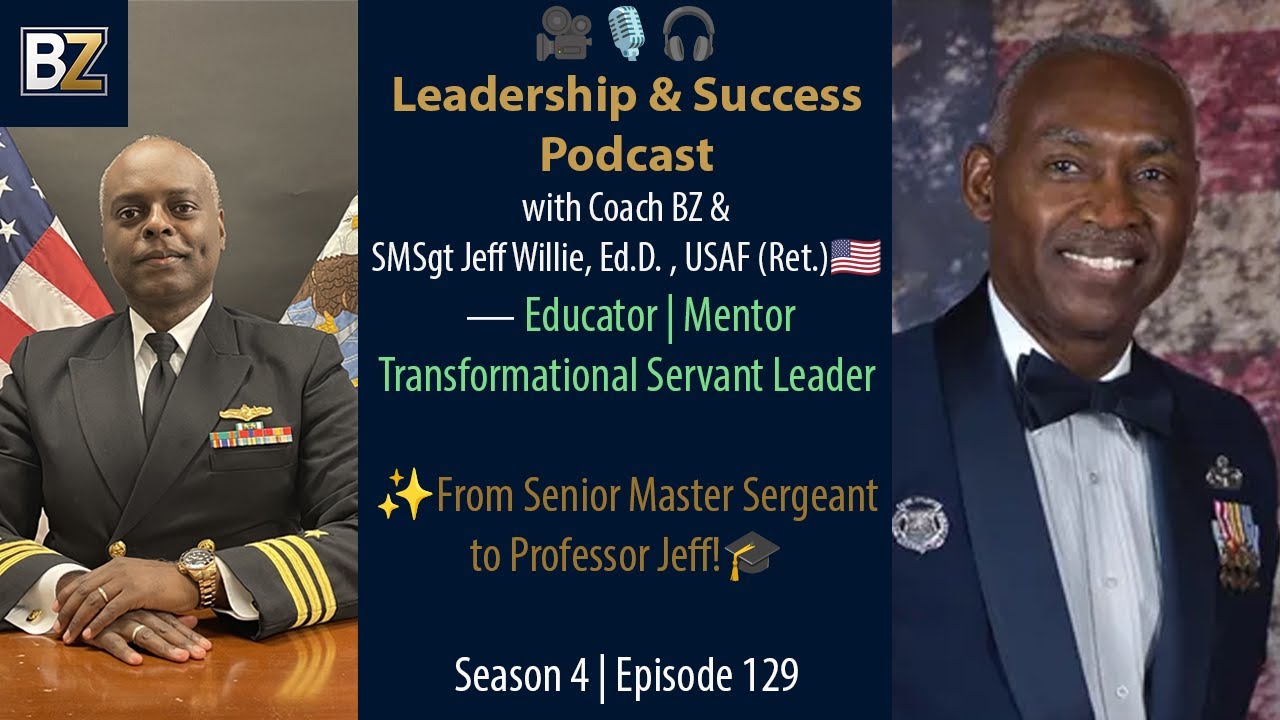
SMSGT Jeff Willey (Ret.) talks about giving people flowers while they're alive, sharing how his high school track coach's "You can do it" shaped him. He argues fatherhood in the home is key to fixing society, and says his give-back mantra is always saying yes to requests that align with his values.
Chapters
Hi, I'm John Maxwell. When the top companies in the world are looking for trainers, speakers, and coaches, there's one name that stands above the rest, and that's Maxwell Leadership. Our certified team members have gotten proven results for companies all over the globe, and our reputation I'm proud to say is second to none. Some of our members have risen to the top of their profession, including the one you're going to meet today. I proudly introduce you to my friend Bob Fabien Zinga. Welcome to the Leadership and Success Podcast with your host, Coach BZ, where we help you lead with purpose and succeed with impact. If you're ready to grow into the kind of leader others want to follow, this podcast is for you. If you're determined to elevate your success and leave a lasting legacy, this podcast is for you. As my mentor, Dr. John C. Maxwell, reminds us, everything rises and falls on leadership.
Our goal is simple, to inspire you, challenge you, and equip you with insights that can transform the trajectory of your leadership journey.
Welcome aboard to another episode of the Leadership and Success Podcast with Coach BZ. Hello, I'm Jeff Woolley. Thanks for watching my video. As an executive director with the John Maxwell Team, I couldn't be more excited about the message I'm going to share with you today. My mission and my purpose is to develop my God-given talents to add value to people of all ages, backgrounds, cultures, and economic levels to reach their full potential by developing their minds their gifts and talents. Serving and adding value to people, people are my business. Since being intentional about adding value to others, I have partnered with the number one personal growth and leadership development team in the world, the John Maxwell Team. The John Maxwell Team DNA is all about leading and lifting others, equipping others, exceeding expectations, willfully growing, adding value, and valuing people. I have 3 laws that I live on a daily basis that drive my passion for adding value to people. Number 1: Respect. Whether it's your friends, your family, or business associates, when we have mutual respect for each other, there's so much to be gained, so much we can learn from each other. Number 2: Be grateful. Each and every one of us owe it to ourselves, our friends, and families and our business associates to be grateful for the opportunities that we have been given each and every day. Number 3: Givers gain. Giving touches other lives. Expanding my circle of influence and concern to include others. Being authentic and always being open to receiving as well as giving. If this resonates with you and you would like to hear more about these values, feel free to contact me. I would love to hear from you. Most importantly, I'm available to come to your organization to train and equip your leadership team to rise to the next level. That's all for now. I am Jeff Willey. I want to close with this quote from John Maxwell: I want to make a difference with people who want to make a difference at a time that makes a difference doing something that makes a difference. We are a difference maker. Being a certified speaker, coach, and trainer for the John Maxwell Team means that he is part of a team of elite coaches, teachers, speakers, and professionals taking leadership training, talent, skills, and adding value to people all over the world. Everything rises and falls on leadership.
All right, everyone. This is Coach Bizzy again for another insightful episode of the Leadership and Success Podcast. So I really wanted to take just one moment before I introduce my guest to do what we do here as a custom. We call it Moment of Gratitude. And just yesterday, we completed 21 of 21 Grateful Day Challenge. That's where we are grateful every single day for 21 days live here on LinkedIn. And then we challenge a member of our network to do the same. I've been doing this every year for the last 4 years now when I was first challenged 4 years ago. I usually start on Thanksgiving Day and we end 21 days later, which was Yesterday, but even beyond that, it is really, I think gratitude is a way of life, right? Dr. Maxwell usually say, "No, your attitude will determine your altitude." And there is no better attitude, I think, to be successful than to be grateful. You may not have everything you want, you may not have everything you desire, but you have to be grateful for what you have. You have more than the person to your right or the person to your left. There is somebody out there who would die to be in your shoes. And me coming from a third world country, I promise you that is absolutely true. So if we can just take a moment, maybe close your eyes, take a deep breath and think about one thing you are grateful for today. I think I am really grateful for networking, right? One of my mentors said, "Your network is your net worth." Now, there are people that I just met, I don't know them from Adam, like they say, but it seems like I've known them all of my life. And one such person, is the person I will introduce to you today. Our values align and we have similar background and it looks like, you know, a big brother and elder in the community, someone I have known forever when in reality we just met. And I've never really met a person I didn't like and I believe everybody likes me. It may not be true, but that's how I see it. What's not there to like about Daisy, right? So, I value people. I have great values and I want to add value to people. So let me see if I can do this introduction justice. Join me today for a powerful value-driven conversation with Senior Master Sergeant Jeff Willey, US Air Force retired, and he's also a professor and a CEO. Now, is there anything that Professor Jeff has not done yet? He's a transformational servant leader, whose journey from deep poverty in East Texas to senior enlisted and leadership, professor, executive coach, and global mentor is nothing short of extraordinary. I am very, very excited to welcome— please help me welcome the one and only Professor Jeff Willey. All right, Professor Jeff, how are you doing today, sir?
Coach BZ, thank you. What an amazing intro, sir. You are outstanding. For those who listening out there, if you're not listening, you should be listening to Coach BZ because he is amazing. He is a sharp individual and he is extremely grateful. I just very, very, just his heart is absolutely leading towards serving people. So thank you, Coach BZ, for allowing me to be part of this podcast.
Thank you. Thank you. Thank you. Thank you. And to get started, what are you grateful for today, Professor?
I am grateful for my family. I'm grateful for my family. I'll tell you what, I live for my family. That's my focus. That's my heart. And all my siblings and all my grand— my two grandkids and my sisters and brothers and my brothers-in-laws and sisters-in-laws. I am just absolutely, completely, always grateful for my family. And there's other folks I'm grateful for. Let me just be straightforward with you and transparent, Coach BZ. I am grateful the fact that you asked me to be on your podcast. That's— it is an honor. My heart is filled. I am touched by your generosity and your gratefulness to ask Jeff Willey, come on now, to be on your podcast. So thank you for allowing me to participate and share with your audience today.
Thank you. Thanks so much. Really do appreciate that. And is there maybe something about you, Professor, that most people may not know?
Oh my goodness, that is a great question. I can say one thing that people don't know, and I'm glad you asked that question because I have been asked, I asked my students that question at the collegiate level as part of a connection. And I'm number 11 out of 15 children. Wow. Wow. I know that gets a wow, that gets a wow factor, doesn't it? And in that pecking order, in that pecking order. I'm number 11. My mother and father, 15 children. And obviously we are a lot smaller now because my older brother is turning 80 on Saturday. He is the top of the chain, right? He'll be 80 years old this coming Saturday. And my sisters before him, he's number 4 in the pecking order. Though my sisters before him, they have, they have passed away. So he's the number 1 right now. And but yes, I'm number 11 out of 15. And, and we were raised primarily though as 12 because I lost a sister very early between my other sister and I. And then after I was born, I lost a brother and I lost a sister. They were babies. And so I was— but we was raised as 12, 6 boys and 6 girls. Wow. We were raised— so it was a little different, a little challenging. But most people don't know that I come from that environment of that many mouths to feed.
Wow, that is really, really amazing. I know my wife will never go for that. Although when I was growing up, my dad, he was fantasizing about having the 12 tribes of Israel. But anyway, wow, that must really be something. Maybe can you tell us briefly about how you came to become first senior master sergeant in the United States Air Force? That is so huge because when I was in boot camp, back May 2005. I was a seaman recruit back then, and I told myself one of two things is going to happen with this Navy thing. Either I'm going to end up as an E7, E8, E9, a chief, or as an O5, so senior enlisted or senior officer. It just happened I had the opportunity to become a Mustang and get a commission in the U.S. Navy. But tell us how you got to become a senior master sergeant in the the US Air Force because my father-in-law, Brown, is a retired E-5 tech sergeant, which is pretty cool. But then not only that, but now you are a professor as well and Maxwell Leadership Certified Coach, speaker and trainer and the CEO on top of that. So can you let us know about Professor Jeff? How did you get to become Professor Jeff?
Well, Senior Master Sergeant, Professor Jeff, it's— the title is not important. It's the attitude and the character and the impact that you make in people's lives.
Yes.
Everything that we do, as you know, Coach BZ, is about serving others. It's about the impact. It's not about success. It's from success to significance. Yes, we go through life seeking success. But the most important thing that we do is the transformation from success to become significant for others. And modeling that as a senior master sergeant in the United States Air Force, obviously doing quite well as a member of the United States Air Force. And you are definitely working towards getting promoted because you want to impact others. And if you're getting promoted, guess what you're doing? You're encouraging others to get promoted. I always use that model that John Maxwell talks about quite often, become a river, not a reservoir. And that is, as I increase my potential, My responsibility is to help others increase their potential. That's the art of servant leadership, is reaching back and helping someone else. Because guess what? You and I didn't get to where we are by ourselves.
True.
Someone that was along the way that was a role model and say, Jeff, you can do this. Coach B, you can do this. You can do this. Ensign, you can become a lieutenant. Ensign, you can become a commander. Jeff, you can become a master sergeant. Jeff, you can become a senior master sergeant. Jeff, you can become a first sergeant. So someone always encouraging us. It is our responsibility to model that behavior in front of us. As you've heard this term before, people don't do what we say, they do what we do. And you have to model that. Absolutely. So the same part of that is going into education after I left the military is becoming a professor. And I can tell you, Coach BC, I was not expecting that. It was not on my radar. Can I share a story with you?
Please, please.
It was not on my radar, but I know it was in my right heart. It was in the— God aligned that because as we transition from the Air Force, you're looking for opportunities to maintain a stable income as usual as we had on active duty. Obviously you wanna raise your level of income. As you and I both know, on active duty, we don't make a lot of— we don't become wealthy on active duty in the United States military.. And so you are looking for opportunities. And I came to a job fair. I was at Abilene, Texas, Dyess Air Force Base. And my godson, he and I came to a job fair in Arlington, Texas. Hmm. And while we was in that job fair, ran into a young lady. I don't remember her name. It's been, this is 2002, 2002. And she asked me what type of education did I have. And I mentioned to her, that I had this type of education. And she mentioned to me, said, we're looking for adjunct associate professors for the University of Phoenix.
Wow.
Even on my radar. She said, when you get back to West Texas, do you mind sending me your resume? Of course. Absolutely. Not a problem. I sent her my resume. And in January, because of my credentials and my background, my experience, I could do all the things that I've accomplished. And all the life experiences and education experiences, I got accepted immediately.
Wow.
In January 2003, it was totally off my radar. I'm telling you, Coach BC, it was not my plan. But God knew.
I just— that's amazing.
God knew. And that's how I became a University of Phoenix professor. And 20 years plus years later, wow, man, what an amazing journey. Because if I tell you, once you're going to ask the question about my background, you know, why? Wait a minute, that was not part of my— that was not part of my family culture.
Wow, that is really something. So you often say, right, yesterday is not my tomorrow. I love that. When you look back your journey from growing up in deep poverty in East Texas, retiring as a senior master surgeon, I mean, I have to salute, and earning your doctorate, what does that statement really mean to you today?
Well, looking back and those moments are absolutely phenomenal. You have to look back. First, you have to know where you come from. Know where you are. And know where you want to go. Hmm. Because you cannot get where you want to go until you know where you are. And where you come from shaped where you are. And you have to be very, very intentional about that. And knowing where you come from guides to where you want to go. Because you have to realize what I say, you realize that you have to be focused on the future. I use, I have a keynote I call Rearview Mirror versus the Windshield.
Wow.
Rearview mirror, as you notice, if you look in the rearview mirror all the time while you driving an automobile, something dangerous going to happen.
Yes.
But if, but if you focus on the windshield, the world's open. Mm-hmm. And you look back every now and then, see where you come from, where you, where you coming from. Because you do, as you travel, you definitely look in the rearview mirror. But your primary focus is always on the windshield going forward. And you have to have an attitude of going forward. And that attitude becomes contagious with people around you. If you're in a leadership role, and you're in a leadership role, you're always talking about going forward, goal setting, primary objectives. Go ahead.
No, no, that, that is, that is really, really fascinating. I really love the analogy. And there's also a reason why The rearview mirror is much smaller than the windshield, right? Definitely have to be looking forward. Yesterday is not my tomorrow. I really love that. So for those meeting you for the first time, how do you define leadership now after 25+ years in uniform, decades in education, and thousands of lives influenced?
And you and I both know it's going to be one word. I think you know that's going to be one word.
Influence, isn't it?
Influence. That's perfect.
That's right.
Absolutely. And you can expand on that. Positively and negatively, but it all comes down to what?
Yes.
That one word, and that's influence.
That's the other thing too. Both our primary mentors, Dr. John C. Maxwell, bestselling authors, I don't know, maybe hundreds of books by now. It is really amazing to me how you can have different people from different country, different background, but really literally having the same leadership DNA. I just met you maybe a couple of weeks ago, but it's like I've known you my entire lifetime. It's really amazing how that happens. And I am just overwhelmed. I'm just so very, very happy you agreed to be on the podcast today because I don't know, I feel like leadership is probably one of the most important critical skills in the 21st century. Everybody talks about AI is going to take away all of the jobs and automation and robotics, emerging technology, and all of that. But I feel like no matter what you are doing today, if you have leadership skills, they will always, always need people who are able to lead other people and manage projects. What do you think?
Absolutely. And you are phenomenal high-tech person. You have some amazing technical skills. That's absolutely wonderful. You mentioned the word AI, artificial intelligence, all the different things that we do, we mentioned internet, We mentioned all the different smartphones, smart devices, all the technologies, technology things that we have. But the key component of everything that we do comes down to the touch, which is what I call high touch. And high touch means that you— leadership is all about people, is all about relationship communication. We can get extremely technical. There was a person that came to visit us when I was active duty Air Force. Matter of fact, it was the Chief Master Sergeant of the Air Force early, early in my time at Dyess Air Force Base. And I use this phrase, high touch, high and low tech. We still are right now, we primarily high tech and low touch. Think about that. We are so much high tech.
Yes.
And very little on touching people and connecting with people. And so I, I embodied that, make sure in the midst of all the advancement in technology, and we are there, we got to have technology, the world moves and evolves around technology. And creativity is engineering, all that. But it still comes down to people, which is the high touch.
That is so powerful. Let's go back a little bit. I always, maybe it's because I was born and I grew up in Africa, but we have great respect for the elders, those who have come before us. Your father who was in the army and the way you grew up, I want to kind of focus a little bit about the lessons you have learned the way you grew up and from your dad, right? Because like I said earlier in the introduction, you grew up without electricity, running water, modern convenience, and attended segregated schools back then. How did those early experiences and your father kind of shape your values, your work ethic, and leadership mindset?
Totally agree. And a couple of things. One of the things that my father modeled with me model. My father was a very soft-spoken person, didn't talk a lot because his vocabulary was not all that great, but he modeled things in front of me. He modeled those habits. And one of the things that he modeled in front of me in the midst of our poverty— obviously, you understand, I was American poverty, I wasn't world poverty. There's a big difference in American poverty and world poverty. And once I traveled the world, I realized that, oh man, I was well off.
Yes. Yes.
I was well off compared to what I know about the world now. But obviously you only own the context of the context you have is what's surrounding you. And, and based on everyone's environment around me was much better than mine. So I was labeled American poverty, American poor, all those ass. But one thing that my father did, Coach BZ, that sticks with me today, there's a book I'd call Giver's Gain. Hmm. Giver's Gain. And I know, I don't know the author. I have it in my library. I can, you can write that down. But it's a book called Giver's Game. And the essence of that, when we would butcher a hog in late May or early June, that's the time we would butcher a hog. And we lived in the woods and we would butcher that hog and my father would slice the pieces up, wrap pieces of hog in pieces of paper or bags, whatever we could find. And we would literally walk out of the woods down the road a couple of miles and share our substance with people that had much more than we did. They had cars, they had electricity, they had telephones, they had TVs, they had refrigeration. But my father modeled the giving aspect. No matter what you have, you still have the ability to give.
Yes.
And my father modeled that significantly. And to this day, that has been an impact of my life. My father got me out of bed extremely early in the morning time. 4 o'clock in the morning to be able to go out and feed the hogs, feed the dogs, feed the chickens, get the eggs out of the chicken coop, all those different things before I got on the bus.
Wow.
Out of the woods to go and go to a segregated school. And so he started modeling that. So guess what? The discipline and the work ethic was that he modeled that. And another thing here, let me just share this one. Can I share this one more story with you?
Please, please.
I know it gets to be, it is personal. Well, one of the stories— yeah, you got it, Giver's Game. One of the things that he shared with me, and to this day I still model that, my father would get up in the morning time, getting ready to go out and plow in the fields, hook up the mule. Mule are never clean, the fields are never clean, but when my father walked out of the house, his coveralls was pressed, he was clean-shaven, his boots was clean. He would literally get up and go and hook up dirt and go out in the dirt. But when he went out in the dirt, he was clean. The one thing he shared with me, he said, son, just because you are poor, you don't have to look poor.
Wow.
So carry yourself with dignity and make sure whatever you have, make sure it's looking good. To this day, I still model that. I'm 68 years of age and I can tell you, Coach BC, I still model that. People ask me, why do you always have on a tie, a coat, a jacket? And and your shoes always shine. I said, I'm honoring the person that modeled that for me, and that's my father.
Wow, that is so powerful because that's definitely something I learned when I went through boot camp, shining your shoes and looking good in uniform. And your father was a World War II veteran, but if I read it right, I think he couldn't read or write, but yet, you know, very, very instrumental men, you raised a family grounded in resilience and discipline. So what other leadership lesson did you absorb at home before you ever wore a uniform yourself?
I have to admit, and I ask people this, I say this not in a sense of arrogance, not in a sense of pride. But I say that a sense of I enjoyed my time in the military. And I made the military, I made the Air Force better because of the discipline and the structure I had before I entered the Air Force.
Wow.
Air Force. I gave my basic training structure. I gave those young men that was not accustomed to get up at 5 o'clock in the morning. I'm already awake.
That's amazing. I think this is the first time in my 21 career in the military I've ever heard that. Because for me, it was the other way around. Now it doesn't matter where I am in the world, 5:30 in the morning, any time zone, I am awake. But prior to boot camp, no way. But anyway, I want to hear more.
So it was that discipline that I brought into the military. That discipline was already there. Being in band in high school, being in track and field in high school, getting up early to be able to take care of the home front before I even went to school. All those types of disciplines was already instilled in me, getting up early, Following instructions, being disciplined, saying yes sir and no sir and yes ma'am and no ma'am. I didn't have to learn any of that.
Wow.
That was part of my culture.
So for some of the people who are listening right now, they may feel limited by their circumstances today. You know, I'm too Black, I'm a woman, I don't know how to read, I don't have opportunities, whatever the excuse might be. What would you say to them to kind of help them reframe adversity as a platform rather than in prison?
What a great question. Surround yourself with positive people. The law of environment matters a lot. It is very significant, the law of environment, because I— you remember I used rearview mirror versus windshield. Folks that are in that prison, in that mindset, they're continually looking what? Backwards. The good old days, the good old days, the way it used to be, the Your better days are in front of you and you have to have a mindset of my better days are in front of me. You got to focus on the windshield. What's going forward is important that you look forward and you surround yourself with positive people. The law of environment is significantly important. And I think when I joined the military, surrounding myself with— I was always positive. Let me share a story that helped shape that though in the military. Because I was a very young father married with wife and, uh, with a wife and daughter when I joined the military. And the reason, one of the reasons I joined, because I want to feed my family, take care of my family, the responsibility that comes from dad, take care of your family. And I tried odd jobs before I joined the military and that didn't work out. But when I was, I had an assignment coming out of basic training to Spokane Air Force Base, Washington. Security police and B-52s was a primary resource, their aircraft resource. And as a security police, you're responsible for security for that aircraft. Fine. My wife and I, my daughter, we going to Spokane, Washington. Prior to that, uh, a few weeks later after I got notified I was going to Spokane, Washington, two weeks later, I got notified that my assignment was being changed to Hahn Air Base, Germany. And the reason, the reason it was changed from Hahn Air Base, Germany, because Bitburg Air Force Base, the primary, uh, resource for that area, lost their mission. And they, and then they moved that mission from Bitburg Air Force Base to Hahn Air Force Base, Germany. And they need to increase the security posture for Hahn Air Force Base, Germany. So now the way to increase that security posture is to bring in new airmen that's just joined the Air Force. Because they haven't been anywhere else. So it's all new to them. And I didn't want to go to Germany, Coach BZ. I didn't. I did not want to go to Germany. That was my first response. And so guess what I do? I call— I'm in basic training and we get break time or patio time. And I called my brother that was an E-6 Tech Sergeant at the time in the Air Force, 2 tours in Vietnam, EC-47, enlisted aircrew, lost friends in Vietnam, combat tours in Vietnam, got the Distinguished Flying Cross in Vietnam. And I called my combat brother that's currently active duty and letting him know that your little brother don't want to go to Germany. Mm-hmm. Let me tell you something, Coach DZ, that conversation did not go over very well. It did not. That was a lesson learned for me because the silence on the phone, if I, I could imagine if he could, if I was in front of him, he probably would have choked me. Yes, son. Boy, Jeff, I've been in combat and you don't want to go to Germany. And this is what he told me, the story that stuck with me today that I use quite often. And this is what the story he gave me about being the positive. It's the story based on being positive.
Yes.
And it worked for me. It goes back to how I made Senior Master Sergeant and be able to do the things that I did in the Air Force because of what he shared with me that day on the phone.
Wow.
He said, Jeff, he called me Jeffrey. No one ever called me Jeff at the time. I'm still a young 19-year-old. They still saying Jeffrey. He said, when the Air Force asks you to dig a ditch, I want you to become the best ditch digger possible. It's going to be nasty, Jeff. It's going to be dirty. It's going to be muddy. But you go in that ditch every day with a positive attitude. Hmm. And you in that same ditch with a bunch of other airmen and they're complaining how nasty that ditch is. And there you are with a positive attitude and just dig in that ditch. Wow. Being positive every day. Because what you're doing, Jeff, you're looking for your pot of gold. And eventually that E-5 staff sergeant that's supervising the ditch diggers,. He's going to ask you, Airman Willie, come out of the ditch. Let me ask you a question.
Yes.
Why are you so positive? And you respond to that staff sergeant.
Wow.
I'm positive because I'm looking for my pot of gold. And eventually I'm going to find my pot of gold. That's why I'm digging this ditch because I see— wow. Focus now. I'm looking in the windshield, ain't I? Yes. And guess what that staff sergeant is going to do for me now? He said, Airman Willie, I'm going to be— I'm going to take tomorrow off. I want you to supervise the ditch diggers tomorrow. So now I want you on top of the ditch. And so your attitude determines your altitude. Yes, altitude. And so my attitude in time, I was on active duty, elevated me for most of the time I'm in that outside world of security, police, guard, and resources in a very outside environment. I spent most of my time inside in a training environment at a desk.
Wow. That is really, really, really powerful. You really remind me of a speech from Martin Luther King. It's very strange. Everybody knows him about "I Have a Dream" speech, but actually the first speech I heard from MLK was the speech, I think it was in a— he gave to a high school about life's blueprint. I heard it in French, not English. Not in English, so it was translated. But one line that is said there that really changed my life was, I was only maybe 5, 6, 7 years old, it says, "If it falls your lot to be a street sweeper, sweep streets like Michelangelo painted pictures. Sweep streets like Beethoven composed music. Sweep streets like Leon Tam Price sings before the Metropolitan Opera. Sweep streets like Shakespeare wrote poetry. Sweep streets so well that all the hosts of Heaven and earth will have to pause and say, here lived the great street sweeper who swept his job well. That really, really, it poked me. And I was only like 7 years old. I never, never forgot that. Wow. That's leadership.
That's leadership. That's absolutely, that's the modeling part. And the positive, every day you bring your best every day. And I was able to bring my best every day.. And because of that one story that my brother shared with me in 1977 on the phone that transformed, elevated my military career, because I walked in every day looking sharp. I was early, I left late, all different things. I did more, I took out the trash, all those different things you do above and beyond, and you model that. And somebody's always noticing what you do. Wow.
Even when I was a seaman, I remember And it was mostly because of boot camp. My shoes were always shining and I had those military creases in my uniform, very, very proud to be a US sailor. And it really shows in everything you do. So we do have a comment from Eugene Fraser. CEO says, this is a powerful podcast that I think everyone should have access. This podcast is an example of modeling the old, influencing the new, and understanding what it takes you not to only survive but thrive in the world. Sign my coach. Thank you. Thank you so much, Coach Eusen. Let us know where you are coming from and if you have a question for Professor Jeff. Thank you. Thank you so much. I really appreciate getting feedback from YouTube and LinkedIn because 4 years ago when I started this podcast, I was the only person in the audience. So it was the audience of one. I really love that, especially this year, this podcast has gone global. Now we have people listening in Italy, in France, all over the place. So I even use artificial intelligence now. To translate a lot of my episodes in foreign languages just to have more of an impact. So thank you for that. So let me ask you this. You, you've served 25 years in the U.S. Air Force. You held roles ranging from combat security and SWAT instruction to first sergeant and superintendent of the largest DOD joint service honor guard. And as first sergeant, you've dealt with some of the hardest human issues leaders face. What do you believe senior leaders who might be listening right now they often underestimate about the weight of caring for people?
That is a wonderful question. And I thought about that intently and long term. But it comes down to one thing that we do as leaders. And sometimes we do as educators, we do as pastors, we forget about— primarily forget about self-care. And you and I both know we can't give what we do not have.
Yes.
We have to focus on self-care and model that and let our people know that you have to take care of us. You can't do it without taking care of you.
Yes.
Because when you are no longer there, who then— how can you provide service and support and encouragement for the people that you're responsible for? So make sure that you are engaging and involving and always part of your vision is always asking and modeling that expectation, modeling that expectations. And always sharing what you're doing. Self-care. Hey, Airman John, how's life going? How is— how's— I tell you what, uh, when the last time you've been to the gym? Hey, let's go to the gym together. And so self-care is significantly important. I spent many years of taking care of people, and as a United States Air Force First Sergeant, people are our business. Yes, from birth to death.
Say that again, please. That's powerful.
Yeah, as a United States Air Force First Sergeant, people are our business from birth to death, and everything in between, everything in between, coordinating all those different things that you are responsible for, because people are coming to you because you are the eyes and ears of the organization. The commanders are coming to you because you are the eyes and ears of the organization. You have the morale, you have the pulse for the morale. You have to connect with your people all the time. And I, one of my units I had as a first sergeant, it was at Dyess Air Force Base, 96th Maintenance Squadron. I had over 1,000 people in that unit.
Wow.
One of the largest maintenance units. We combined, they consolidated a lot of the maintenance units, put them under one umbrella and myself and a Lieutenant Colonel. I was an E7 Master Sergeant and I had a Lieutenant Colonel, which is an O5, which you being an O3, retired O5.. And he, his name was Rocky Morris. And, and we were responsible for those men and women, everything in between.
Mm-hmm.
And one of the things that I did, and I share this to let people know how you connect, 'cause you are never gonna know every 1,000 people. Yes. But I made it a responsibility to get to know as all those people as much as I possibly can. I would show up at the office very early in the morning time prior to my administrative staff going home that night. They would put a roster on my desk, hmm, on my desk. So when I show up early, I had a roster of the birthdays for that month on my desk. And I made a responsibility, I made it my responsibility that every person had a birthday that month received a birthday card from their first sergeant. What I delivered it, if I wasn't able to deliver it, I make sure that that person received a birthday card from their first sergeant. And then I would go visit the unit because that person's birthday is today. And I want to be there personally. So I personally delivered the card and connecting.
Amazing.
Because it's all about them. And when you, when you connect in with the people, what are you doing? Self-care. Literally, I would go into those units, go into those maintenance units. Next thing you know, me and a bunch of other airmen and sergeants, we're on the floor doing push-ups.
That is really, really amazing. I think that human touch of leadership is something we've lost a lot. It really makes me leadership sad. And that's part of the reason why when I was enlisted, I wanted to get that anchor chief, E-7, E-8, E-9, because I saw those chiefs in the Navy. They are really the, the anchor of the entire Navy. Yeah, officers get all of the credit and all of that and the big pay, but the chiefs are the one who really make the Navy work. And, uh, I wanted to be that, that, uh, chief. They really, really cared about people and You really feel it, you see it, and you lived it. Wow, that is very, very powerful. Let me show— I think I should have a picture here. I hope I did. Oh yeah, I do. This picture here, pretty amazing. That is President Ronald Reagan and his wife there right behind him. One question I wanted to ask, what you were hand-selected to attend the White House ceremony with President Reagan and Nancy Reagan First Lady after Operation Urgent Fury. What did that moment represent for you personally and professionally?
My reflection on that, Coach BZ, that I am this skinny kid from the woods, going to the bathroom in the outhouse. And I phrased that on my LinkedIn post, on my LinkedIn profile, from the outhouse to the White House. Wow. And I have to admit, that was absolutely the highlight of my life. Yes, a kid that grew up in a very, very impoverished Texas environment, with no electricity, no running water. And here I am at the White House, with the President of the United States of America in 19— November 1983. And I, to this day, I can pinch myself and say, wow, did that really happen? It was a major, major milestone for my family because my family is still in East Texas. And all of a sudden, everybody in my hometown of Carthage, in the area, the rural area I grew up in, they heard about this kid that graduated from Carthage High School And they knew my environment. They knew what my demographic is. They knew my family structure. All of a sudden, this kid, Jeff Willett, is at the White House.
Wow.
And I had the pictures to prove it.
That's amazing. Only in America. Yeah. When I think about my own life trajectory, I came to this country 17 years old, hardly speaking English. I still have that accent to prove it. And yeah, going from seaman recruit to commander In what, it took me 17 years to do it, and it's just amazing. Wow. Okay, let me ask you this, Professor Jeff. So obviously education is very important to you. I remember one of my godfathers, when I was a student here at the University of Alabama, he used to tell me, right, education is one thing that nobody will ever, ever be able to take away from you. Didn't earn my PhD yet, but I was, I guess, ABD, all but the dissertation, but I eventually got a Master in Science and a Master in Business Administration. But my godfather was, was white. That's definitely something you can achieve that no one can ever take away from you. Why is education so important, you think, especially for women and people of color in America today?
Mine started when I was 19. And I say this because I come from an environment of segregated schools. We didn't have the resources. I know you coming from a third world country, our resources was probably very poor compared to some resources that you were exposed to growing up. I understand that, but I just want to share because that was my context at the time, not having those resources. And father could not read and write, mother had a third grade education. And when I saw my birth certificate when I was 19 years of age, and my birth certificate was signed with an X because I— that's what I discovered, that my father was illiterate. And that was a paradigm shift. I said, no more illiteracy will come from our bloodline.
Wow.
I said, no more. That was a major paradigm shift, Coach BZ. I said, for that moment, the buck stops with me. I have to change that bloodline because my father come from that environment. No more. No more. The buck stops with me. And so pack and relationship and said, no, it's not going to happen. So education is the catalyst. And then of course, part of my legacy is literacy. Yes, part of my legacy is literally having those terminal degrees, bachelor's and master's and all those different things. And my wife and I have raised— because we modeled going to school while our children was going to school.
Wow.
So their decision is only decision they could make is where they're going to college. Hmm. Where? If, if was not part of the equation, is the only decision that we allowed them to make was where?
Yes.
Because the buck stops with me.
That is powerful, powerful, powerful. Yeah, I remember my first daughter, she was like, well, maybe I don't need to go to college. I'm like, no, Your last name is Zinga, unfortunately you have to. But yeah, but I know after they get their bachelor, they want to go for master, PhD, that's fine. But at minimum, I think a bachelor is something they definitely need this day. So for the last 20 minutes or so we have left, let's talk about purely leadership. I want to kind of get into your head, your mindset, and see what really allowed you to really rise so high and be so successful. What is maybe you think the most important lesson you have learned so far, just in life, in leadership in general?
I always come back to that one word, being positive. Yes, have a positive outlook. Tomorrow is better than today. Don't rest on your laurels. Today's successes may not take you into tomorrow's success. Make sure you can reflect back on that, but always be positive.. And I, that is always the key. Always ask instead of, and I'm a talker, but you want to help impact people's lives. Ask them, how can you serve them? Don't assume based on, let me, let me pause for a moment and say this, say this. So folks who listen to this, we end up leading like we were parroted. Hmm. Because that's what you know. That's the model that was exposed to you. That's the model that you grew up under, right? Wrong or indifferent. Now, I'm not saying you don't make a transformation as you learn and do better. Absolutely. I made that transformation and I did better. Absolutely. But when you first start out, the only model that you know are the parents, are the people that you grew up around. That becomes your model and that becomes your makeup. That come. Then eventually you get exposed to different dynamics of leadership. And then you grow from that. So we're still evolving right now. We're still growing. And always, and always keep that growth mindset because what you did yesterday might not work for tomorrow.
Yes, yes.
And it might not be.
Yeah. That is really, really insightful and powerful. And by the way, this is my friend Daniela. She's joining from New York. I've interviewed her before. So we have more people joining. Thank you so much for letting us know. So let me ask you this, Professor, what do you think is the secret of your success? You succeeded in the most powerful Air Force in the world, retiring as a senior master sergeant. That's huge. And then you become a professor and then you have your own business and you are impacting a lot of people with what you do. What do you think is the secret if you have to choose one? Of your extraordinary success?
I'm gonna say this, there's no secret. There are no secrets. Intentionality is not a secret. Hmm. Discipline is not a secret. Being focused is not a secret. Desire to have an impact on people's lives is not a secret.
Yes.
So being intentional, It's not a secret. You have to be intentional. Motivation will deteriorate.
Yes.
Remember, motivation gets us going, but it's the discipline that keeps us growing.
Hmm. Say that one more time, man. That's beautiful.
Motivation gets us going. It's the discipline that keeps us growing. Because there's going to be days that you and I are not going to feel like it. Because you focus on your vision and your purpose and you're taking care of people. Can I just give you a transparent answer? You energize me. Why you energize me? Because right now, I am suffering from sinus congestion. And, and I have not slept very well in the last couple of nights. But my, and my feeling is, I don't feel like it. Yeah, but my discipline says I'm impacting people's lives.
Wow. That's powerful.
Wow.
Yeah, it reminds me of what one of my dear mentors told me, right? He says successful people are just as lazy as people who are not so successful, but they do what they need to do when they need to do it, whether they feel like it or not. That's the difference. Wow. Okay, okay. This, I could be talking to you for hours and hours, but we don't have that kind of time. Let me see. So as a leader, what are you learning right now?
I am, I am reading, I'm learning about, right now I'm reading my cousin's book, Charles Burke Willey. And I'm reading Drift to Drive, of course, by— I'm reading that book. That's by, of course, Chris Robinson. Yes. And I'm also writing part of my memoirs right now and preparing my book, The Value of the X. But I'm reading about the social dynamics of the maternal and paternal relationship of the African American father and the mother in the home because my, my, my, my cousin Charles Wright Willie is— he's deceased now, but he's a sociologist. And I'm reading his book for the first time and reading— I'm not reading it entirely. I'm reading on particular chapters on how to deconstruct because that's going to be part of my research. Is the, the, uh, the structure of the father in the home or the father not in the home and the impact that has on successful African American children, or it was just in anyone and children in general and the impact of that. But it does have a major impact on the homes of African American, their level of success, not having the models there, not having the role models, even though the mothers are doing a wonderful job and absolutely amazing. But it's difficult for moms to teach a young man how to be a young man.
Yes.
So the challenge of that, and then of course we're looking for those young men, if they don't have, don't have the father in the home, then who is a role model in the community? Yes. He becomes a mentor in the community. So it's always a passion of mine is how do I become a mentor? And when I have, because in teaching Air Force Junior ROTC all those years, I had a lot of young men that was in my program that didn't have, didn't have fathers at home. So I became a surrogate dad to a lot of those young men.. And that carries a lot of weight, carries significant impact with me. How do I model the right behavior?
Yes.
Teach these young men to be young men. And a lot of those young men right now, I can tell you, one is flying C-17s in the Air Force. Every once in a while I get text messages. One is a police officer. Wow. Garland. And they've done some amazing things because of the impact that you have on their life. So you got to always be learning, always be growing. And, and my, One of my last stories is that I got, I have a lot of stories that you've probably never heard.
I love those stories. Inspiring.
Yeah. She's a, she's the wing commander. Um, young lady that, uh, when I was a master sergeant, first sergeant at, uh, 7th Supply Squadron at Dyess Air Force Base, she was 17 years old. She entered the Air Force because her sister was in the Air Force. So she drove down from Alaska and, but her focus was, this is many, many, many years ago. This is 1990. This is 1992.
Wow.
And many, many years ago, but she wanted to be a pilot in the Air Force. Well, you can't be a pilot in the Air Force if you enlisted. So what do I need to do for a sergeant? Well, you're still young enough. So let's try opportunity. Either you don't get a degree or go to officer training school. Young right now, maybe the one of the military academies. And so guess what? In 1996, she graduated from the Air Force Academy. Wow. And now she's a wing commander at McGuire Air Force Base, C-17s and KC-46s. And they did the change of command ceremony last year. And guess who was there?
Amazing, amazing, amazing. Wow. That is just fascinating.
Wow.
That is powerful. Thank you so much for sharing that. I think that story really made my own day. Now, the thing is, we do know and we do celebrate success a lot in this country, but what about failure? Because in my own estimation, right, every time I'm very successful, I probably failed at least 10 times in order to get there. So, I guess my question for you is, how has failure shaped your life?
What a great question. Not to do. When I say, let me, let me frame it this way. I always have to frame it with a story. But you make decisions, and then you reap the consequences of those decisions. And you do the reflecting. I've always been, always had a reflecting moment of when I made, I won't say a mistake, because failure is first attempt in learning.
Hmm.
That's what failure is. That's what fail is, first attempt in learning. Because if you're not doing, doing something, you're doing nothing. And if you're doing something, you are going to fail. Let's get that clear right now. If you're moving and taking action and making decision, uh, I can, I guarantee you, you will fail. And majority of the people that are extremely successful, they probably got more failures than they have success. One reason that elevated them to the success is because they never gave up. Failure was an opportunity to grow. The power of failure. So always reflecting on failure, first attempt in learning. And that's not my quote. That's Kat Cole. She used to be the CEO of Cinnabon. And that came from her on one of the Live2Lead platforms that I listened to. But I'm active duty Air Force, I made a decision to rescue a 4-year-old boy in doing a major weapons movement, DOD weapons movement, because my father always cared for kids. I'm always attracted to caring for young people and I'm always gonna nurture young people. And so while I'm transporting, uh, that major priority resource, there was a 4-year-old boy that needed to be rescued. And so I rescued that 4-year-old boy and put him in the back of my Department of Defense vehicle, while I'm transporting a priority resource. And that didn't go over very well with the commanders that heard about that. And so that was an aspect of— now I'm being asked to— now I'm being offered administrative punishment for dereliction. But the value of that, the value of that is that I stood by my principles. My principles was to nurture and take care of a 4-year-old boy. You can't take that away from me.
Yes, yes.
I won't let no— I won't let anyone take that value away from me. That's the value I stand on. I got that value. My dad modeled that value. So no system in place will ever take that value from me. Because I stood by my principles and my values, everything was dropped. Wow. Everything was dropped. Now, could I have made a different decision? Yes, I could have made a different decision to have someone else to rescue that 4-year-old boy., but my values came out forefront and I wanted to make sure that a 4-year-old kid was well taken care of, warm. And while it, it wasn't supposed to be in my vehicle, but he was there and the word got out that, um, that we were moving a priority resource and there's a 4-year-old kid in harm's way. Cause something could have happened and it would've been very dangerous, but nothing happened.
Yes.
Yes. But I can say this, I stood by my values. My values was my driving force. My faith in humanity was what drove me to make that decision.
Well, especially in days like this, 2025, we really need more principled leaders because I really find it very interesting when some people for their entire lifetime, they say they stand on something, they have value, they say it's core to them, their core values. And then all of a sudden the political winds change and now they believe something completely different. I'm like, no, that doesn't make sense. No, one minute you are for DEI and the next day you are completely against it. It's like, who are you? What do you stand for? And wow, thank you so much. Okay, we are running out of time. I could speak for you for hours now. Can you give me an extra 10 minutes? Yes. Is it possible? Okay, thank you, thank you, thank you. I'm going to try to land this plane, but I have so much wisdom. I'm learning so much because to tell you the truth, part of the reason why I do this, yeah, I say, "Sylvie, Ojan," some of the people I mentor, but the reality, I'm doing it for myself. I'm a little bit selfish. I want to know what do I need to read next. What wisdom nugget do I need to get for today? So thank you for being one of our master teachers today. So let me ask you this. Who are some of the people that you follow, some thought leaders that we should know as well?
Well, I definitely follow Ken Blanchard, Servant Leadership, and obviously follow John Maxwell. And certainly Ken Blanchard, if you listen, Servant Leadership, and he has a book called Lead Like Jesus. I have definitely done some things with him. I have actually used some of that workshop information to facilitates pastoral workshops and how to lead like Jesus is. Been absolutely amazing. And, um, and Mel Robbins— I follow Mel Robbins out of Houston. She's a, uh, she's a thought leader. And, uh, and, uh, and the Renee— Mel Robbins is out of New York, but Renee Brown out of Houston area. Yeah, Dr. Renee Brown, amazing. And she's a straight talker, I tell you what. You listen to her, she is a straight— she just call it the way it is. And of course, Mel Robbins, the, uh, the, uh, the 5-minute— the 5-second principle. Mel Robbins. So I listen to her quite a bit. As a matter of fact, I follow her on YouTube and those, they just add because they're just normal people and they just talk to you and I follow that and listen to that. And wow. And my inspiration and all of this is my wife. What an inspiration. She's an amazing person. She has very thought leader. Uh, she's sharp and she has led at the top level in administration because she's a retired chief nursing officer. Wow. She has led at that level.. And I can tell you what, she has significant major leadership influence. So when I do workshops, we do co-workshops together because I tap into that CEO, principal CEO mindset, that CEO mindset. And we pair together and work together. A lot of the questions we just tag team back and forth. Wow.
That's really great. So if you could choose 3 people to have dinner with, they could be alive now, dead, or even mythical figures. Who would you choose and why?
My father would be number one. And then number one is always going to be my dad. I can tell you, I say this, he was my role model. Yes, he was the, he was the ultimate role model in my life. Quiet, but he modeled. Didn't speak a lot, but he modeled. He endured all the issues in the 1900s going up. Wow. He modeled, he served his country, and he modeled. And so without that model, I wouldn't be here today. Things he did to save his life, to save my life. And I will go into the story because he grew up, he, in 1910, that's when he was born. And he was born as a first child of John and Lena Willie. And John passed away. My grandfather passed away in 1922. And so my dad, 11 years of age, became the head of the household, responsible for taking care of his siblings and taking care of his mother at the age of 11. Wow. And he did it with so much dignity and so much emotional intelligence to navigate that world back then in that era, in Jim Crow era in East Texas, for him to survive that. For him to survive. I didn't say he thrived, yeah, but he survived so I can thrive.
Wow, that is very touching. Thank you.
Wow. That would— my dad would be my number one. And then the next person after that, I would want to sit down with Nelson Mandela. I definitely want to sit down with Nelson Mandela.
Don't need to say anymore. Yes.
Yeah. Oh my goodness. The power of forgiveness.
Yes, yes. In Africa, we call him Madiba. He's powerful, powerful. And who would be your third choice?
And my third choice would probably be Mahatma Gandhi. Yes. You can take my life, but you won't take my legacy.
Wow.
All you do is kill me, but my legacy lives forward.
Yes. Powerful. Now, we do love to read here at the Leadership Success podcast. I know you have a bestselling book on the way. And already, so far, you've recommended this one, Givers Gain, by Ivan Misner. Why should people read this book?
Because it talks about giving, giving, giving is gain. The more you give, and that was the model I think I shared with you as part of, part of my story about my father, is that the more you give, the more you give, the more you give, the more you give. That's got to be that. What about Jesus? Ken Blanchard, Lead Like Jesus. Absolutely. Givers are the ones that's going to gain. The more you give out of you, and you might not have the financial resources to give, but you have time and you might have advice, all the different things. You have talents, but you still want to serve people by giving of yourself. Goes back to that model of being a river, not a reservoir.
Reservoir. Powerful. And what about Lead Like Jesus by Ken Blanchard? Why should we read that one?
Because the model of Jesus, this leadership, he modeled that.
Yes.
He developed a team. So he empowered the team. Hmm. Yes. He empowered the team.
Yes.
He listened to the team. He asked questions. They allowed to ask him questions.
Yes.
He sent them out once he empowered them. So he started the aspect of leadership. Everything that John teaches and all the different leadership books that we have, everything comes from Scripture.
Wow. That's really powerful. Actually, that's why the John Maxwell Bible, the Leadership Bible, is part of the curriculum for this podcast this season. So what about another one of my mentors you mentioned from Drift to Drive?
Chris Anderson.
Yeah, Drift to Drive. He was on the show too.
We get comfortable. We all get comfortable. We all get in that state of mind because we're human. That's what's going to happen. And so we get comfortable. And of course, you have to stay in that mindset. One of the— if you notice, one of my mantras is inspire until I expire.
Yes, yes.
And even, even when in the midst of my drifting, I still got the focus on who am I inspiring today? Hmm. And most of that, you have to inspire yourself to be able to inspire others. Remember, you and I cannot give what we do not have. So, you know, it's going to happen, but recognize it. The law of awareness, self-awareness, it's going to happen.
Wow, that's really powerful. Okay, one more book which I found on your LinkedIn, Jesus the I-ROAD Leader. You recommended it on LinkedIn. Why should we read that one? Yeah, that is a similar book to this one.
Uh, yes, I have both of those. I bought plenty of those and I give those books away when I'm doing a workshop with pastoral conferences. I give that book away because it's a very small read and one of the testimonies a school board trustee from my hometown. She used that book to educate the folks in her ministry there in East Texas. She'll call me every now and then, or she'll text me. She said, I use one of the quotes, I use one of the— I've been— we studying this chapter. So I purchased over 200, 200 of those books for a Live to Lead event I did in my hometown, and every person that attended received a copy of that book.
Wow, that's— that is really awesome. So generous. Okay, we are coming toward the end, but let me ask you this: if you had one and only one day to live, what would you have liked your final contribution to be?
Man, significance. Significance. The lives that you touch. And then let me share that. Let me share a story, because I'm a storyteller. So every time you ask the question, I pull out of my repertoire of stories of my life. This is not stuff I'm reading in a book. This is stuff that I have.
That's exactly how Jesus talked in parables. You never forget the stories. Yes.
Give the people flowers while they're alive.
Hmm.
You show up at funerals, and we have all these flowers that no one— the person inside of the casket cannot smell, cannot see, and don't even know they exist. But if I want to honor Coach BZ, thank you for what you do, I give you your flowers while you're here. That way you can smell them and you can appreciate the fact that I appreciate you.
Yes.
And the story that highlights that is my Coach Reggie Day, who was my track coach my 10th grade of high school, 1974, the second semester. And he told me 4 words that no one has ever spoke to me before. You can do it. Mm-hmm. In running track. No one ever has spoken that words into me. Cause I'm thinking, cause I've been hit a lot of negatives and he spoke that into me. So now fast forward to 2020. Fast forward to 1974 and fast forward to 2020. I reached out to Coach Day and found where he was. He was pastoring a church in Mineola, Texas. And I said, Coach, I need to come to give you— I need to come and give you your flowers while you alive. The impact that you had on me when I was just in the tent, right, it transformed who I am today. You can do it. And so I preached at his church that Sunday morning. My wife was with me, my brother, and I let the congregation know This gentleman impacted me. I've not laid eyes on him until today. From 1974, this is the first day I laid eyes on him all those years. But I want to make sure that I am giving his flowers, giving him his flowers while he is alive. And so the legacy of significance is what's most important to me, not just success, but significance.
That is powerful. Yeah, I know Papa John often says, once you test significance, right, success will no longer satisfy. And it is so true. All right, we are getting toward the end. One more question I wanted to ask is, if you had a magic wand, you could solve any problem in the world, what is one problem you'd like to solve first thing tomorrow morning?
Whoo, that is— it's always going to come down to leadership. And that's putting the fathers back in the home. Yes. Because leadership starts in the home. It doesn't start in the workplace. Education doesn't start at the school. It starts at home. And if, if I can get as many of my fathers—
yes—
in the home and being that model for our children, that is the vacancy right now that we struggle with.
Yes.
Not having— we have it because of that, we have identity issues. And multiplicity of issues and concerns. I'm not saying that the mothers are not doing great, they're doing wonderful, absolutely. But there's a, there's a reason for a two-parent household, no matter what the conditions are. My father and mother was extremely American poor, but yet they were in the home.
Yes, yes.
And that made a difference in where I am today. It made a huge difference. And so I— wow, that would be, that would be, that would be what I would— well, my desire.
Yes.
Because I think that transforms us into a better, a better world. And because whatever's going on outside of that home, if you can maintain— that's why I honor my son-in-law. My son-in-law is from Zambia, and my daughter, obviously, she's— they both went to Texas A&M together. And I honor, I honor my son-in-law and, and my daughter. It's what they're doing to raise my grandkids. Wow.
So that's powerful, man. Powerful. So how can we add value back to you, Professor Jeff?
I am— I've always been big on giving. I tend not to ask. That has never been my style of asking people to honor me. As always, my position is to give back my substance, my resources, my time, my energy, When people ask me to do something I struggle with, there's no word. I always found a way to say yes. That's just been my mantra is how can I say yes? Sometimes it doesn't always work out, but my focus is how do I say yes? Let me look at my schedule because you're asking me for a reason because you know I have these resources, these gifts and ability to, and so you, you're not asking me out of selfish. You asked me, there was a need, a desire. And so if you want me to come and speak to your organization and share some of my stories, because I do have a lot of stories to talk about, but they all connect to what we do in the workplace. They all connect what we do in the church. They all connect to what we do in the home. They all connect what we do at the schoolhouse. They all connect what we do in the community. And that's us. That's us. We are church, school, community, the workplace, and the home. That's us. Those are the 4 environments that we are. That impact us significantly. So I have stories for all of that and share my stories and share my journey until inspire, until I expire.
Wow, that is powerful. So that's JeffWillie.com. So we are almost, almost done. Is there a question I should have asked you, Professor, that I haven't asked yet? What question have you, uh, just to, to make sure if there was anything you wanted to share with the audience, I give you the time, the opportunity.
Not really.
Okay.
All right.
In that case, one of my very last question would be, uh, if you could go back, right, and give a piece of advice to your 17-year-old self standing at the edge of this incredible career you've had in the Air Force, in academia and leadership and coaching, what would you say to 17-year-old Jeffrey, looks like that's what you were called back then. What would you tell him?
What would I say to 17-year-old Jeff? Open up the book and read.
Hmm. Powerful.
The reason I say that, because we were not exposed to books growing up. There was not— there was several books in the house. And so I want to custom to reading. And now I'm addicted.
Yes.
Wow. Powerful. I think I would have progressed even farther and faster if I'd have been an avid reader at 17 years of age.
But this, this again, is to show, yes, I'm doing this to add value to my audience, but it's really for myself. I was 17 years old when I came to this country, barely speaking English. I had big, big dream, but I had no idea how to achieve them. And I've read over almost 3,000 books since then, and reading has changed my life. So thanks so much for sharing that. Okay, to end, I'm gonna end in a couple of minutes, we're gonna land this countdown. Don't take too long to think. No, it's gonna be rapid fire lightning round. What is one word that defines great leadership? One word.
People. Connecting with people.
People. Very good. Morning routine or practice that keeps you grounded?
My faith.
Okay. What is one book or one quote that has changed your life?
The, um, Seek First to Understand, which is The 7 Habits of Highly Effective People.
Yeah.
Seek first to understand, then you understand. And that's listening, the impact of listening. And that was the— that's the fifth habit.
Yes, Stephen Covey. Very good. Uh, what is one song, one movie, or, um, one TV show or book that would be your life's fame or infame?
I'm not a big TV person. And I don't remember music that much. It's just not my— that's just not my strength, my space.
Which book then?
Which book would be How to Win Friends and Influence People?
Yes. Dale Carnegie.
Perfect.
Okay. Who inspired you most today?
Today? My wife.
Very good. And what did you want to do when you were a kid?
I had no idea. I'm just being— I had no idea. My environment did not promote dreaming. It did not promote it.
That is so sad. But for most people, they only dream when they're kids, and when they become an adult, they stop doing that, which I think is a major, major mistake. So 3 adjectives describing you as a child. Resilient.
Polite. I was always polite. Always. And timely because I was always—
yeah, as an adult.
Resilient. Polite.
Yes. Okay.
Okay.
So you haven't changed much. Very consistent. Very, very good. I'm sure your father had a lot to do with that. That's really the legacy we leave to our children, isn't it? Long after we are gone. Okay, very, very last question and this is it. What is one word that represents our shared experience on this podcast today?
Grateful. Grateful. And grateful. Always be grateful.
Thank you. Thank you so much, Professor Jeff Willey. What a great honor and pleasure to have you on the Leadership Success Podcast. I definitely want you back once your bestselling book is out. Thank you. Thank you. Thank you. I appreciate that.
Thank you very much.
All right, everybody, this is it for today. That was Professor Jeff Willey, no, Master, Senior Master Sergeant in the U.S. Air Force, if you can believe it. That's E-8, right? It's just amazing. What an inspirational life. So thank you so much for watching today. I'm going to be back tomorrow, and tomorrow I am also speaking to another senior enlisted member of the military. This is going to be— actually, it's the US Army. I've got this wrong. I'm gonna fix this, but it's Command Sergeant Major Aldridge Williams, US Army. And he's going to be here tomorrow. He's a transition architect, a mentor, purpose-driven servant leader, and we're gonna be talking about leading with purpose. He's written two bestselling books, Lead with Purpose and Navigating Transition. I can't hardly wait to speak with him. So that's Ian in E-9 in the US Army. That's gonna be tomorrow morning. So thanks again for watching. And until tomorrow, have a wonderful day. Thank you.
Thank you for tuning in to the Leadership and Success Podcast with your host, Coach BZ.
If today's episode added value to your leadership journey, be sure to subscribe, share, and join us again for more wisdom nuggets on how to lead better and achieve greater success. Remember, leadership is the most critical skill of our time. The world will always need leaders to inspire others, drive innovation, and execute meaningful strategy.
So why not count yourself among the bold leaders shaping the 21st century?
Until next time, stay inspired, stay committed, and keep leading with excellence.
More from Bob

S250:E4🎙️LIVE 🇺🇸America 250: President Barack Obama Leadership, Service, and the Power of Hope






S5:E157🎙️ LIVE with CMD CMSgt Dennis L. Fritz, USAF (Ret.)(Multi Tracks Audio)



S5:E156🎙️ LIVE 🇪🇸 Leadership Lessons from the FIFA World Cup 2026 Champions (Multi Tracks Audio)

S250:E3🎙️ LIVE Leadership Lessons from America’s First Documented Family of African Descent 🇺🇸📖