S4:E132AI RECAP🎙️LIVE Leadership Lessons from General Colin Powell (Multi Tracks Audio)
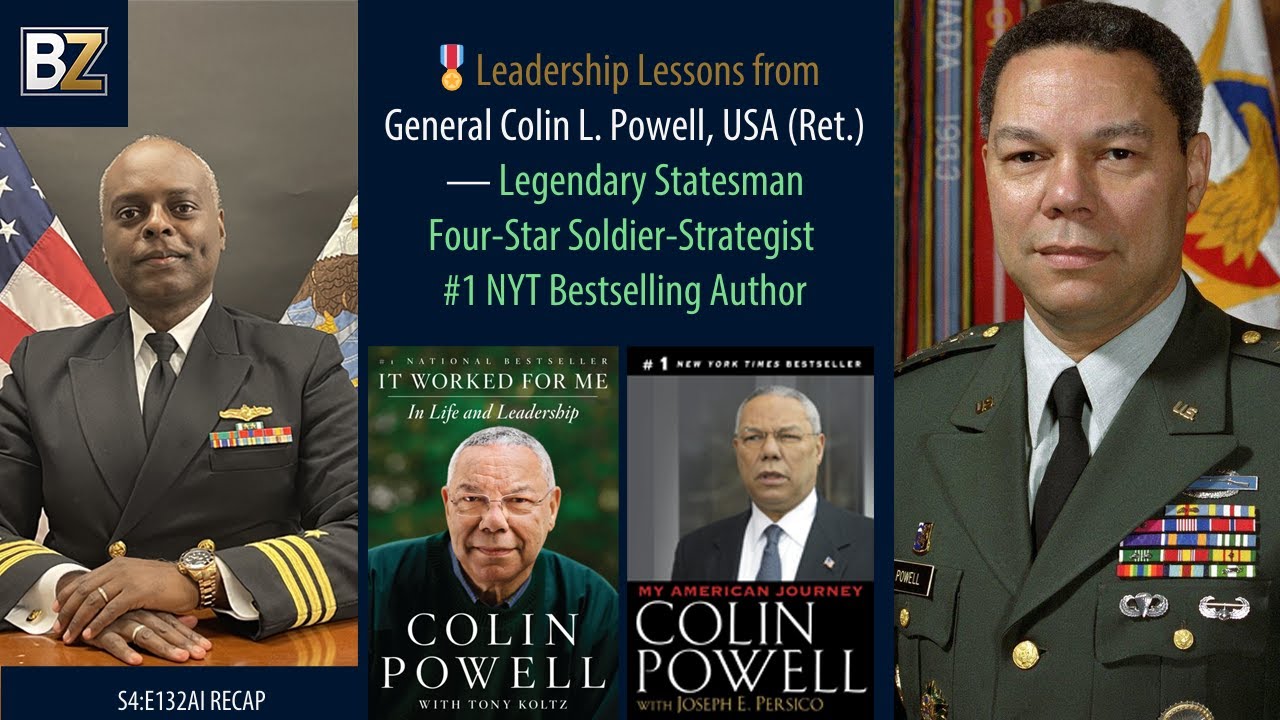
Coach BZ and co-hosts break down General Colin Powell's 13 leadership rules, from the 40-70 decision-making rule to absolute accountability. They ground Powell's military principles in modern contexts like cybersecurity and boardrooms, with stories including Powell greeting parking-garage attendants and Zinga's rise from deemed-unfit Navy commander to tech executive.
Chapters
Hi, I'm John Maxwell. When the top companies in the world are looking for trainers, speakers, and coaches, there's one name that stands above the rest, and that's Maxwell Leadership. Our certified team members have gotten proven results for companies all over the globe, and our reputation I'm proud to say, is second to none. Some of our members have risen to the top of their profession, including the one you're going to meet today. I proudly introduce you to my friend, Bob Fabien Zinga.
Welcome to the Leadership and Success Podcast with your host, Coach BZ, where we help you lead with purpose and succeed with impact. If you're ready to grow into the kind of leader others want to follow, this podcast is for you. If you're determined to elevate your success and leave a lasting legacy, this podcast is for you. As my mentor, Dr. John C. Maxwell, reminds us, everything rises and falls on leadership. Our goal is simple, to inspire you, challenge you, and equip you with insights that can transform the trajectory of your leadership journey. Welcome aboard to another episode of the Leadership and Success Podcast. The Leadership Podcast with Coach BZ.
It sets the destination and the non-negotiable standards, but it empowers decentralized, agile action.
And Powell combined that high-level vision with high standards. He was demanding. If the vision is clear and inspiring, like his goal to transform the State Department into a more responsive, well-supported institution, You can demand excellence in execution because everyone knows exactly what they're striving for and why that excellence is essential.
Finally, we wrap up the 13 rules with the rule that requires the most profound internal resolve. Rule 12: Don't take counsel of your fears or naysayers.
This one is about courage, which Powell defined not as the absence of fear, but as the willingness to act in the presence of fear. He was not advocating blind risk, You must listen to your fears. They contain valuable mitigation intelligence.
But you do not obey them.
Correct. You assess the risks realistically, you incorporate contingencies, and then you move forward toward the clear vision from Rule 11, tuning out the noise of critics who only point out problems without offering solutions.
The source notes that when you're starting challenging new projects, be it a military operation or launching a complex innovative tech platform, the initial voices are often the naysayers.
Always. A leader has to have the fortitude to assess the risk, make the decision, and commit fully.
The 13 rules give us this amazing philosophical framework, but now we need to talk about Section 3, the weight of command. This is that moment when everything lands squarely on the leader's shoulders. This is the truth behind Harry Truman's famous desk placard. The buck stops here.
This is the critical, non-negotiable test of leadership. You can delegate authority, you can delegate tasks, but you can never, ever delegate responsibility. The leader must take ultimate visible accountability for all decisions and all outcomes. Period.
And Powell's most public and probably most painful test of this principle involved presenting intelligence on Iraq at the UN in 2003, intelligence that later proved to be flawed.
He was criticized relentlessly for it. And that moment really defined a major chapter of his legacy.
That he didn't hide from it.
Not at all. He didn't point fingers at the intelligence agencies or his staff. He accepted full responsibility, stating publicly, "I'm the one who made the case, and I'm the one who will always be seen as having made that case." This was a clear, profoundly painful acceptance that the buck stopped with him.
It served as a professional blot, but ironically, it also solidified his personal commitment to accountability and integrity in the eyes of many.
And that moment ties directly back to the 40/70 rule we talked about. And that trust enables the next rule, which is incredibly demanding. Rule 11: Have a vision. Be demanding.
Vision is easy to talk about, but effective demanding is hard. Leaders have to articulate a clear, inspiring vision that gives meaning to the team's toil. People crave purpose. What does that mean practically in a modern command?
This is where we need to introduce the concept of commander's intent. In the military, this isn't just some fluffy mission statement. It defines the purpose of the operation, the key tasks to accomplish, and the desired end state.
But it deliberately leaves the how to the subordinate leaders.
Exactly. So, a business analogy might be: Commander's intent is not dictating, "You must use Python and Kubernetes to build the new data platform." It is stating, "The purpose is to create a resilient, low-latency data architecture that can handle triple the current user load without increasing MTTR beyond 10 minutes so that the organization can launch its new AI product line by Q4.
That is a perfect translation. It sets the destination and the non-negotiable standards, but it empowers decentralized, agile action.
And Powell combined that high-level vision with high standards. He was demanding. If the vision is clear and inspiring, like his goal to transform the State Department into a more responsive, well-supported institution, institution, you can demand excellence in execution because everyone knows exactly what they're striving for and why that excellence is essential.
Finally, we wrap up the 13 rules with the rule that requires the most profound internal resolve. Rule 12: Don't take counsel of your fears or naysayers.
This one is about courage, which Powell defined not as the absence of fear, but as the willingness to act in the presence of fear. He was not advocating blind risk, You must listen to your fears. They contain valuable mitigation, and that fosters their growth and accountability. It creates a pipeline of future decision-makers.
Let's turn now to theme de-execution and team focus. These are the rules that govern day-to-day excellence and mission success, starting with Rule 8: Check small things.
This rule embodies attention to detail, which Powell knew was the hinge upon which large complex operations often swing. But, and this is important, it is not an endorsement of micromanagement.
That's a critical distinction.
It is.
It is about using small details as critical indicators of the health and discipline of the organization.
OK, I want to push back on that a little. In a technical organization where individual autonomy is so valued, doesn't the leader checking small things quickly degrade into micromanagement? And doesn't that destroy the trust we just spent 3 sections building?
That's the critical difference. Powell was not fixated on how a person was accomplishing a small task, but on the result of that task as a signal. The source mentions him checking barracks cleanliness and latrines, right? He wasn't focused on toilet bowls. He was using the condition of the physical environment to gauge All right, everyone.
Welcome to another edition of the Leadership and Success podcast. Thank you for watching. This is Coach Bizzy. To get started, I am reminded, let's do our moment of gratitude. This is where we spend less than a minute just trying to be grateful for one thing every single time we meet. So if you would maybe close your eyes, put yourself in your Happy place. Take a deep breath and think about one thing you are grateful for today. Today is Christmas Eve all around the world. Christmas is tomorrow. And I am so grateful I am home with my wife and my two daughters today. What a blessing it is to be with family. Being in the military for 21 years now, many times you are called away on duty, far, far away from your family. And it is so wonderful to be home. And really, my heart goes out to every service member right now who is assigned to a post far, far away, especially those in combat zones who are fighting for our freedom. I am very, very grateful for all of you. You really are my personal heroes, and thank you for all you do. So if you would please type into the comment what you are grateful for today. So today is going to be a 10-minute recap of the article I wrote about leadership lessons from General Powell. Let me share my screen. I would like for all of you guys to go there and read the article. I think you should be able to read it within 10 minutes or so, but it is pretty much a summary of the major leadership lessons I've learned from the general. So here it is, leadership lesson from General Colin Powell, from the Navy to Silicon Valley. I go through his 13 rules, and you can also listen to the full podcast, Season 4, Episode 132, where I go into this in more detail. It's about 30-minute podcast, but here we're just gonna give you the 10-minute breakout. And of course, I have a summary of his two instant bestselling books, My American Journey, which was his first book, and then his latest book, It Worked for Me in Life and Leadership. And I have also some links to some of his memorable speeches. But anyway, I encourage everyone to go there and read this article. So I'm now gonna give you the first 5-minute AI recap of today's lesson. And please let me know in the comment where you are joining us from, what city, what state, and if outside of the US, which country, and what you are grateful for today. And also, as you listen to the 5-minute AI recap, 3 or 5 takeaways from the episode. All right. Let's go for the first 5 minutes AI recap.
Today we're going to dive deep into the leadership philosophy of General Colin Powell, who was, you know, one of America's most respected figures. And we're going to see his principles in action through the eyes of someone he personally mentored, a leader who took these very lessons from the deck of a Navy warship and brought them right into a Silicon Valley boardroom. So our guide for this is an article by Bob Fabien Zinga, And get this, he's a US Navy commander and a cybersecurity executive. That's what makes this so powerful, right? He's lived these principles in two totally different, high-stakes worlds, which gives us this incredible look at just how universal they really are. We're gonna start with Powell's 13th rule, which he said was his absolute favorite. Because really, it's the engine that drives everything else. He called perpetual optimism a force multiplier. Now, that's a military term, but what it means is something that dramatically boosts the effectiveness of your team. It's not about being naive or ignoring problems; it's about projecting this deep-down belief that your team can win and that you will overcome whatever's in front of you. For Zinga, this whole journey kicked off with just one brief meeting back in 2015. He says that single conversation gave him a "compass" that's guided him ever since, through two completely different careers. So, let's unpack that. What was this compass actually made of? This quote, this gets to the absolute heart of it. For General Powell, leadership wasn't about the charts, the strategy, or the tactics first. No, it was all about the people. It's the art of unlocking the potential that's already there and inspiring your team to do things even they didn't think were possible. Okay, so how do you actually do that? Well, Powell taught that it all starts inside. It begins with you. Before you can even think about leading other people, you have to master your own mindset. Let's take a look at how that internal foundation gets built. Think of these 4 rules as a powerful framework for your own head. It starts with optimism—you know, things'll look better tomorrow. Then it adds emotional discipline. It's okay to get mad, but don't let it control you; get over it. Then, it's about having this core belief that a solution exists. And finally, you have to have the courage to tune out the fear and the negativity. It's all about building your own resilience first. And that brings us to a huge lesson in humility. This is one of the toughest but most important rules for any leader to learn: your job title is not who you are. Your position is not your identity. And this isn't just some nice theory—Zinga actually had to live this in the most challenging way imaginable. So, get this: in 2017, the Navy told Zinga he was no longer physically fit to serve. Just like that, his dream of commanding a ship was gone. He said his ego nearly shattered along with his position. But that rule from Pal? It stuck with him. So he fought. For 8 long years, he worked to heal and get back in the fight. And he did it! He eventually got back in and achieved his dream of command. It just goes to show, when your ego isn't tied to your title, you can survive a fall and climb even higher. Alright, so once you've gotten your own head straight, Powell's philosophy moves outward. Leadership becomes an external thing, focused completely on building up the people around you. It's all about your actions, not just your attitude. You can really look at this as a deliberate process. Kindness isn't a weakness; Powell saw it as a massive strength. Sharing the credit—that builds a culture where people feel seen and appreciated. Checking the small things shows that you care about excellence in the details. And all of that, together, builds the single most important currency of leadership: trust. And here is a perfect little story that shows this in action. When Powell was Secretary of State—I mean, one of the most powerful people on the planet—he made it a point to go down and meet the parking garage attendants. That simple act of respect taught Zinga a huge lesson: every single person on the team, no matter their rank or job title, deserves to be seen by their leader. Okay. So you've got your mindset down pat. You're laser-focused on your people. Now what? Well, now you have to act! You have to make the call, often with incomplete information and a ton of pressure. And this is PAL's famous rule for avoiding what we call analysis paralysis. You know that feeling where you just keep waiting for one more piece of information and never make a decision? This rule is designed to crush that. The idea is simple: if you wait for 100% of the info, the opportunity's gone. But if you act with less than 40%, you're just being reckless. Real leadership happens in that sweet spot. So yeah, these are the numbers you gotta remember. That zone, right between 40 and 70%, that's where leadership lives. It's that space where you combine the data you have with your informed gut instinct and you just make the call. And what's cool is this rule applies absolutely everywhere. Paul used to point to Eisenhower's D-Day decision. Ike didn't have perfect weather forecasts, but he knew that waiting was an even bigger risk. In the tech world, Zinga uses the exact same logic for a cybersecurity breach. You can't wait until you know every detail. By then, the damage is catastrophic. You have to act decisively in that 40 to 70% window. And this all leads to the final, and maybe the most defining pillar of Powell's entire leadership philosophy: once you make that decision, you own it. 100%. This is all about ultimate accountability. You can absolutely empower your team, You can give them the authority to take action and make their own decisions, but what you can never, ever do as the leader is delegate away the final responsibility for the outcome. Whether it's good or bad, it always lands on your desk. I love this breakdown of a leader's job. It's really two different roles. When things go wrong, your job is to be the heat shield. You step in front of your team, you absorb the blame, you protect them. But when things go right, your job flips. You become the spotlight operator. You step back and you make sure that light is shining brightly on your team, giving them all the credit. So as we wrap this up, it's pretty clear these aren't just rules for the military or for a corporation. They're just fundamental principles of human leadership. It doesn't matter if you're leading soldiers, engineers, or your family. These ideas about integrity and courage and just caring about people, they're a universal guide. And that really brings us to the final, most important question, because this isn't just about learning something new. It's about doing something with it. So looking at everything we've talked about, from being an optimist to that 40/70 rule, which one of these lessons really hit home for you? Which one are you going to put into action today?
All right. Let me know what your thoughts are on the first 5-minute recap. But really, for me, one of the Greatest lesson I've ever learned from General Powell is leadership really is all about people. It's not your title, it's not your ego, it's about the people, the people that you serve. That's really the true meaning of leadership. And if you take care of your people, your people will take care of your mission. I think that is so true. No matter whether you are in the military, in the boardroom in Silicon Valley, or in the industry or whatever organization, it really comes down to influencing people. All right, I'm going to queue it up for this next 5-minute AI recap. And again, as you are listening, please let me know where you are coming from, what city, what state, one thing you are grateful for today, and also 3 to 5 takeaway lessons from this episode. Here we go.
Think about a scenario where your mean time to respond, your MTTR SLA, is 60 minutes for a critical security incident. If you spend 50 of those minutes getting from 60% data to 85% data, you may have missed the window to contain the breach, even though you made a theoretically better decision. The time cost is higher than the knowledge gain.
So you have to decide. You must decide.
Execute forcefully based on your current intelligence, that 40/70 zone, and be prepared to adjust on the fly as new information comes in.
That clarity is fantastic, but before you get to that decisive action, You have to look ahead and consider the consequences, which brings us to Rule 5: Be careful what you choose. You may get it.
This speaks to the requirement for deep homework and strategic foresight. Every decision a leader makes has second-order effects. Yeah. The choices are lasting. You have to look beyond the immediate win.
Exactly.
Powell cautioned leaders to do that. For example, implementing a radical new cloud architecture might solve your scaling problem. That's the immediate win. But it instantly creates 10 new regulatory compliance burdens, complex billing overhead, and and unforeseen dependencies on third-party vendors. Those are the second-order effects.
So it requires long-term thinking. A successful choice often brings a new, harder set of challenges that you have to be prepared to manage.
Precisely. And that management comes down to ownership. Rule 7: You can't make someone else's decisions. You shouldn't let someone else make yours.
This champions ownership and accountability across the board. In a healthy organization, good leaders delegate authority. They empower their teams to make decisions in their own lanes.
But at the executive level, the leader has to take responsibility for the ultimate strategic calls.
Powell's famous deliberation over running for president illustrates this perfectly. After weeks of intense pressure and consideration, he decided against it.
And why? Because he realized, "I did not wake up a single morning wanting to be president." He listened to his own internal compass. And he owned that deeply personal monumental choice. He refused to let the demands and expectations of—
what the source correctly identifies as the force multipliers.
We begin with Rule 1, and it's a great one: it ain't as bad as you think, it will look better in the morning. This is so much more than a platitude. It's a non-negotiable directive for the leader to control the emotional atmosphere of the entire organization.
Oh, I've seen this play out in crisis situations. When a major incident hits, a system failure, a catastrophic data loss, the first instinct for a lot of people on the ground is just to panic or freeze. Total despair. Right. And if the leader validates that despair, the organization just descends into chaos. Powell's insisting the leader has to immediately project positivity. You become the emotional anchor that encourages the team to pivot from analyzing the catastrophe to generating solutions.
That is the function of the rule. It's emotional leadership. Yeah. And the source emphasizes that Powell was deeply aware this is an attitude to project, not necessarily a blind prediction. He wasn't naive. No. He would often quip, it's not a prediction. It might be worse, but it's an attitude to have. But that attitude is what inspires perseverance. Think of American leaders throughout history after calamitous events, like Roosevelt after Pearl Harbor. The immediate message isn't about the pain. But about the capacity to overcome it.
Which gives you the momentum you need to adopt Rule 4: It can be done. Yes. This is the ultimate mindset reset. It establishes this core principle of possibility. The source author mentioned he hated phrases like "we can't" or "that's impossible" in his command structure.
Because those phrases just shut down ingenuity before the work even starts. It's an intellectual refusal to accept negative inertia.
So you have to start from a place of how.
Exactly. Powell insisted that leaders and their teams must start by believing a solution exists, and you only accept impossibility when the facts and rigorous analysis definitively prove its folly. So in the context of, say, a modern cybersecurity team facing some unprecedented zero-day vulnerability, the initial discussion can't be, we can't patch this And another thing that General Powell taught me is to really have a positive mindset.
And I think that is so important because in life you will eventually face some challenges. Things are not always going to be rosy, right? Things are not always going to go your way. But I believe you, as a leader, you really have to be positive, have a positive mindset. You've got to believe that there's got to be a solution to whatever challenges, problem you are facing now. The simple fact that there is a problem means that there's got to be a solution as well. You may not know what the solution is, but you are confident you will find that solution. I think of people like Thomas Edison, right? I believe he tried like 10,000 times before he invented the light bulb and eventually he was able to find the correct formula. So there is a solution out there and you need to find it. So you have to have a positive mindset, you have to have hope. It doesn't mean that you completely ignore all of the fact and you live in la-la land and things may not turn out exactly the way you hope for, but as a leader, I believe you absolutely need to have a positive mindset and people who follow you need to know that we are going to be able to find a solution for whatever trouble or challenges we are facing right now. And that is so, so, so powerful. So again, let me know some of the key lessons you've got from this AI recap. I'm going to play the second AI recap in just a second. And let us know where you are coming from, what city, what state, which country if outside of the US, and also what you are grateful for. So let me queue up the second AI recap one more time. Let's try this again.
Welcome to the podcast. Today we dive into some truly timeless leadership lessons, ones that span from the deck plates of the Navy all the way to Silicon Valley boardrooms.
I'm excited. There's so much depth here. What do you think stands out the most in these lessons?
You know, it's really about how General Colin Powell, distilled leadership into these few simple yet profound rules. Absolutely. He treated people like the core of any operation, whether in military command or a tech team.
Right, because leadership isn't just about strategy or technical know-how.
It's about caring, isn't it? Exactly. And what's amazing is how his simple daily reminders, the 13 Rules of Leadership, became these guiding principles. For example, his rule, avoid having your ego so close to your position that when your position falls, your ego goes with it, is such a clear call for humility. Right. I love that one.
But let me ask you, do you think such a rule can be challenging in today's corporate world where ego sometimes fuels competition?
Oh, definitely. I mean, it's like in many corporate settings, the ego gets prized. However, Powell reminds us that true leadership isn't about holding on to titles. Instead, it's about supporting your team by setting the example through accountability and kindness. True.
And speaking of kindness, his idea that remain calm, be kind, that resonates so powerfully. It's not something you see every day with tough leadership images.
Right. It's like, You can be tough and still be compassionate. Whether you're, uh, in a high-pressure cyber incident or leading a military crew, being kind builds trust.
Yeah, exactly. I find it fascinating how he managed to blend decisiveness with empathy. But, um, do you think that equally applies when you're managing a tech team compared to a military unit? Absolutely.
Although, um, the stakes differ. In the military, lives are on the line. In cybersecurity, while not life on the line, the impact can be huge. Yet the principle is the same. If you take care of your people, they'll give you results beyond what you imagined.
That's what he meant by leadership is the art of getting more out of a group of people than anyone ever predicted. It almost sounds like a rallying cry for optimism. Exactly.
Optimism is a force multiplier for You know, whether it's facing a cybersecurity breach or rebuilding a crew's morale after a tough night at sea. Powell's mantra, "It ain't as bad as you think. It will look better in the morning," reminds leaders to hold onto hope even when things are chaotic.
Right, that's such practical advice. I also appreciated his commitment to decision-making speed with his 40 to 70 rule. It's almost paradoxical, isn't it? Fewer details can sometimes be more effective.
Yes, it's like, um, he advised to make a decision once you have at least 40% and not wait for the unattainable 100%. In cybersecurity, as in combat, waiting too long means missing your window. It forces you into quick yet thoughtful action.
It really breaks down the art of informed intuition, doesn't it? It sure does. But I do sometimes wonder, doesn't rushing decisions carry its own risks in, say, a corporate setting? That's a fair critique.
While quick decisions based on 40 to 70% info can propel teams forward, especially in a crisis, there is definitely a balance to strike. It takes, um, solid judgment and experience to know when to act and when to gather a bit more intel. Yeah, I can see that.
And then there's his emphasis on share credit. I mean, he really believed in shining the spotlight on the team. How did that translate from, say, the military to Silicon Valley?
Oh, it's universal. In the military, recognizing that every sailor's contribution builds a cohesive unit. In tech, giving credit encourages innovation and loyalty. It's like saying, "Your work matters." And that boosts morale tremendously.
That definitely builds a culture of trust and collaboration. It also reminds us of his personal mentorship, how he influenced leaders just by being present and respectful.
Yes, his personal touch is legendary. I remember reading about how he'd personally greet everyone, from high-ranking officials to parking attendants. And that level of humility and interest in people really elevated his leadership.
Right, that's the kind of authenticity we need more of. And what about his perspective on "take care of your people"? I think that's a foundation that transcends industries.
Yes, it's the bedrock. Whether you're leading sailors, developers, or a cybersecurity incident response team, if you fail to invest in your people, all the strategies or technologies in the world won't make a difference. Powell's lessons remind us that leadership is, at its core, about people.
Absolutely true, I agree. Another thing that strikes me is his call to check small things. Sometimes the details make all the difference, right? Uh, totally.
It's like, um, in the Navy, overlooking small details can mean catastrophic failure, and in tech, a minor oversight in a code review could lead to major vulnerabilities. His insistence on details was always about foresight and discipline. Hmm, details really do add up.
Now, one of the parts I find most intriguing is how he merged optimism with, um, realism. Like he said, "I try to be an optimist, but I try not to be stupid." Yes, that line always gets a chuckle.
It's so human. It tells us that optimism is great, but it must be tempered with practical judgment. It's about not letting hope blind you. Right.
A healthy dose of realistic optimism. And his advice to disagree with me, do it with feeling. Don't be intimidated when I argue back speaks volumes about openness. It's almost an invitation to challenge ideas constructively.
Exactly. It fosters debate and growth. True leaders encourage differing opinions because it refines decision-making. This, uh, collaborative spirit is essential whether you're on a ship or in a tech meeting.
Mm-hmm. No room for blind conformity here. Speaking of leadership styles, I do wonder, how do you maintain that balance between, uh, being present and letting your team own their decisions?
That's something Powell emphasized deeply. It's about leading by example, being in the trenches when needed, but also stepping back to let your team shine. For instance, his "follow me" ethos wasn't about micromanaging. It was about being visible and accountable.
Yeah, that follow me style really builds credibility. And don't forget his stance on accountability. "The buck stops here." He believed that while you can delegate tasks, you're ultimately responsible for the outcomes.
Right, that's crucial. It instills confidence in the team. Because they see a leader who stands up, owns mistakes, and shares successes. That level of responsibility inspires loyalty.
Mm-hmm. And it certainly creates an environment where everyone feels empowered. Now, I've heard some say that such military-inspired leadership might seem too rigid for today's tech culture. What's your take on that? I get that perspective.
But honestly, if you strip it down, the principles remain the same. Leadership is about vision, integrity, empathy, and accountability, be it on a battlefield or in a Silicon Valley startup. It's just the context that changes, the human element doesn't.
Right, it's all about people. Speaking of vision, Powell's ability to set clear, inspiring goals is a lesson for anyone, especially in uncertain times. How do you see that affecting today's leaders?
It's, um, absolutely critical. A clear vision serves as a North Star. It rallies the team during crises and guides every action. Whether you're responding to a cyberattack or launching a new product, clarity in vision drives motivation and unites the team.
Mm, no guessing games there. And then there's the mentoring aspect. His books, "My American Journey" and "It Worked for Me," serve as, uh, practical playbooks for aspiring leaders.
Yes, they're like having a veteran coach in your corner. They combine personal anecdotes with actionable principles that transcend industries. These works not only chart his remarkable journey from a humble beginning to high command but also encapsulate rules that are just as powerful today.
Absolutely inspiring. So, as leaders, whether faced with crisis decisions in cybersecurity or managing a dynamic team in tech, We can all take away a bit of his wisdom. Which rule or insight do you think will be most transformative for our listeners?
I'd say start with kindness, accountability, and that perpetual optimism. Remember, it's like, uh, leadership is a journey, one where every small action and decision builds the legacy you leave behind. Let's keep challenging ourselves to lead with heart, Integrity, and yes, a little bit of optimism.
Absolutely. Cheers to that.
All right. Again, let us know, uh, what are your 3 to 5, uh, lesson takeaway from this episode. So I'm gonna be back here tomorrow. Tomorrow we are going to, um, broadcast for the first time in German. So I will add the, uh, 10-minute AI recap from the conversation I had with Coach Astrid Meyer. From Switzerland, where we're going to be talking about values in action. Because she's from Switzerland, we are going to do the broadcast first in English, and then in my native French, and finally in German. So that's going to be fun. That's going to be on Christmas Day. And then on Friday, I will have the pleasure of speaking with Daya Ramesh. She's a cybersecurity leader, founder, operator, and a mentor. We're going to be talking about cybersecurity being Existential. So that's going to be this Friday. And then the following Monday, I will be speaking with Captain Tess Tracy. She has a doctorate in psychology, US Army, a transformational leader, a human system integration expert. We're gonna be talking about the psychology of command. And then on Tuesday, the following day, I will have the pleasure of speaking with Zen Benefield, a planetary visionary, servant leader, catalyst, and a conscious integrator. We're going to be talking about one world conscious leadership. And the following Friday for season 5, this is going to be our second episode. So the first interview for season 5 in 2026 with Dr. Beth Sandborn, doctor of PA, I believe it's public accounting, I believe. But anyway, she's a school safety leader, advocate, scholar, and practitioner and police officer. We're going to be talking about The Missing Piece. She has written two bestselling books, The Missing Piece and Piecing It Together. So you don't want to miss this. And on the same day, I will also be talking with Dr. Shawna Doc Springer, PhD. She's trusted, relentless, perceptive. We're going to be talking about mental warfare and moral courage. Many of you will remember Relentless Courage, a book that she co-authored with Michael Sugrue. I interviewed Michael Sugrue for our very first mental health day here on the Leadership Success podcast. So, Daki is going to be here with us, but I will also on the same day, man, actually I have 3 interviews on January 2nd. I will also be speaking with Teri Maxwell, business architect, growth catalyst, conscious capitalist. I'm gonna be talking about conscious capitalism in action. And she's the bestselling author of Succeed on Purpose. So 3 interviews on the very first day of, um, January 2026. So again, on that day, we're going to be speaking with, uh, Dr. Stenborn, with, uh, Terry Maxwell, and with Dr. Shauna Springer. So you don't want to miss this. Okay, this is it for today. Uh, see you, uh, tomorrow, and Merry Christmas, everyone. Bye for now.
Thank you for tuning in to the Leadership and Success Podcast with your host Coach BZ. If today's episode added value to your leadership journey, be sure to subscribe, share, and join us again for more wisdom nuggets on how to lead better and achieve greater success. Remember, leadership is the most critical skill of our time. The world will always need leaders to inspire others, drive innovation, and execute meaningful strategy. So why not count yourself among the bold leaders shaping the 21st century. Until next time, stay inspired, stay committed, and keep leading with excellence.
More from Bob

S250:E4🎙️LIVE 🇺🇸America 250: President Barack Obama Leadership, Service, and the Power of Hope






S5:E157🎙️ LIVE with CMD CMSgt Dennis L. Fritz, USAF (Ret.)(Multi Tracks Audio)



S5:E156🎙️ LIVE 🇪🇸 Leadership Lessons from the FIFA World Cup 2026 Champions (Multi Tracks Audio)

S250:E3🎙️ LIVE Leadership Lessons from America’s First Documented Family of African Descent 🇺🇸📖