S4:E134🎙️ LIVE with CPT Tess A. Tracy, PsyD, U.S. Army
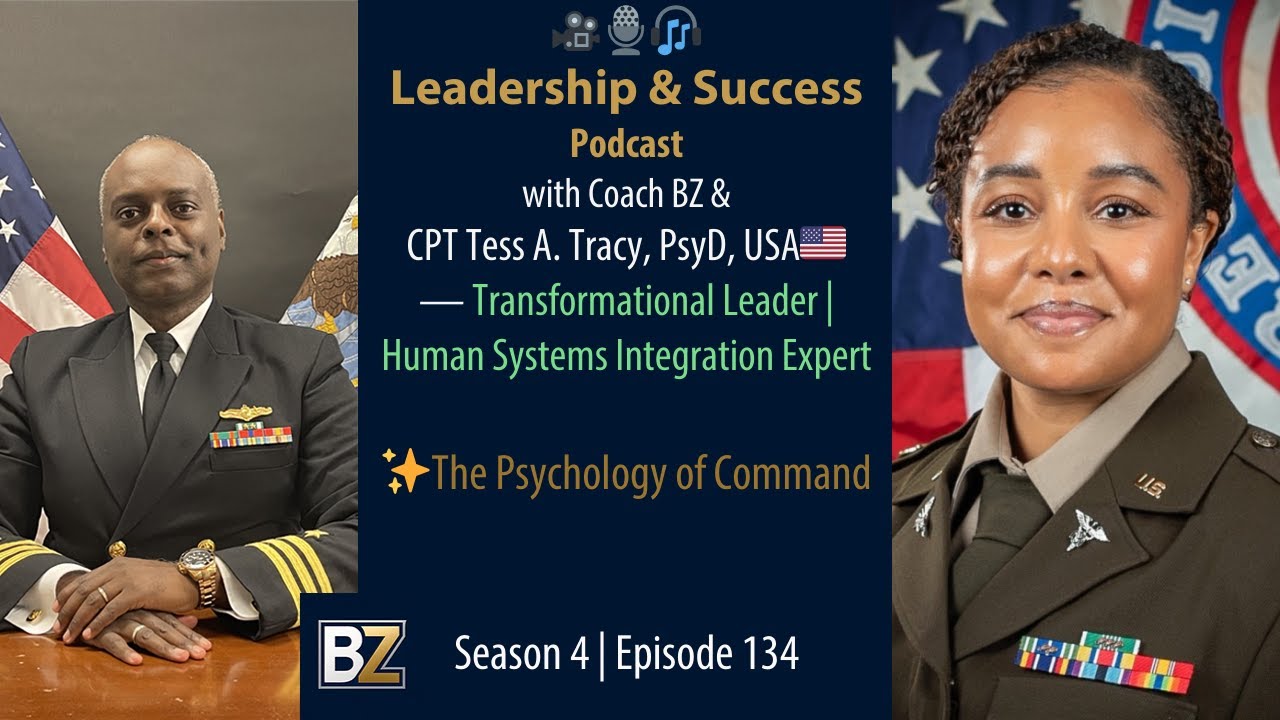
Captain Tess A. Tracy, a U.S. Army psychologist who rose from enlisted ranks to command a recruiting unit, talks about her philosophy of mission first, people always. She credits humility as the core of great leadership, prayer as her grounding practice, and her mother as her greatest inspiration.
Chapters
Hi, I'm John Maxwell. When the top companies in the world are looking for trainers, speakers, and coaches, there's one name that stands above the rest, and that's Maxwell Leadership. Our certified team members have gotten proven results for companies all over the globe, and our reputation, I'm proud to say, is second to none. Some of our members have risen to the top of their profession, including the one you're going to meet today. I proudly introduce you to my friend, Bob Fabien Zinga.
Welcome to the Leadership and Success Podcast with your host, Coach BZ, where we help you lead with purpose and success. Leadership with Impact. If you're ready to grow into the kind of leader others want to follow, this podcast is for you. If you're determined to elevate your success and leave a lasting legacy, this podcast is for you. As my mentor, Dr. John C. Maxwell, reminds us, everything rises and falls on leadership. Our goal is simple: to inspire you, challenge you, and equip you with insights that can transform the trajectory of your leadership journey. Welcome aboard to another episode of the Leadership and Success Podcast with Coach BZ.
What's up everybody, my name is Captain Contessa Tracy. I typically just go by Tess. First and foremost, thank you so much to the Leadership and Success Podcast and Coach BZ for inviting me on. One week from today, Monday the December 29th, 11:30 Eastern Standard Time. Mark your calendars. We're going to be having a fruitful discussion about lessons learned over my almost 17-year career from enlisted to commissioning as a military intelligence officer, then coming back on active duty to complete residency for clinical psychology, and now assuming command of the, the winning Military District of Washington Medical Recruiting Company. Again, mark your calendar, December 29th, 2025, 11:30 Eastern Standard Time. Tell a friend, tell a friend. And until then, be blessed. Thanks so much. See you all soon.
All right, everyone. Welcome to a very, very special edition of the Leadership and Success Podcast.
I'm going to be speaking with Major Select Tess A.
Tracy. Uh, Gladiator 6 is your call sign, U.S. Army, and it's going to be a very special show.
So, um, today I was grateful just for all of the resources available out there for all of the service members.
And, uh, before I bring her on, let me see if I can properly introduce her.
Uh, she's really, I believe, what it represents, right, to be a member of the fighting force of the United States.
So Major Select Tess A. Gladiator 613C brings a rare, powerful blend of experience across combat medicine, military intelligence, clinical psychology, and command leadership.
From supporting multi-domain operation and deployed formation to serving as an aide-de-camp at the general officer's level to now commanding one of the most competitive healthcare recruiting market in the nation.
Her leadership journey embodies mission focus, People First Leadership and Ethical Courage.
So today we are going to be learning about how to lead with mission first, people always in high-pressure environment, why psychological readiness is a leadership responsibility, uh, lessons from command deployment and general officer level leadership, but also how values, faith, and resilience shape durable leaders.
So without any further ado, please help me welcome to the Leadership and Success Podcast, Major Select Tracy. Hi, how are you doing today?
Oh, thank you so much.
Oh yeah, I don't see you. Let's see. Okay, let's just give her one second.
I love technology.
Yeah, I felt like we tested this just a second ago. I can definitely hear you.
Okay, and I can see and hear you fine.
Okay, but for some reason your screen is black.
I can try the setting again.
Okay, while she is Getting that fixed, I want everybody to follow her on LinkedIn. So that's linkedin.com in Contessa Tracy, side 369B93169. Okay, Major, you're probably gonna need to update your URL for LinkedIn.
Nobody's gonna remember all of that, but anyway, just type in Contessa Tracy and you are going to find her and follow her wisdom on LinkedIn.
LinkedIn. And while we were in the green room, I know she hasn't published a book yet, but I know she has many books in her future. One thing she does and I think is extremely inspiring is what she calls, by test, I think, let me see, just one second, let me remove. Yeah, I believe she calls it Conquer Your Path by Test.
I think that would be really fantastic. For a devotion for resilient leader.
Okay, Iyoshe, she's back. Thank you so much for being back. First of all, I'm so, so glad to talk to you today and congratulations on your recent selection to promote to O-4 this fiscal year. I was just telling you in the green room, usually the DOD waits until September to promote everybody, and maybe it saves them money or something, but anyway, You are a major select.
That's a very, very big deal. So you are now a great field officer. And if you promote again to Lieutenant Colonel, which is O-5, you will be in the top 4% of the armed forces. Only 4% or less who have ever joined the military ever ended up as O-5 and above.
So congratulations for that. How are you doing today?
Doing well.
How are you?
Thank you so much for having me.
Absolutely. No, it is a great honor and privilege to do so. Maybe to get started, is there something you are grateful for today?
Oh, I'm grateful for a lot of things today. Um, we, my husband and I, are finally living together, and so we, we took on the huge feat of hosting the holidays. So we hosted Thanksgiving and Christmas, so it was just amazing, like, having family, um, in our home, our first home together. So yeah, feeling super grateful.
That is fantastic. It is not in the military, is it?
He is, yes.
Oh my goodness, that's really double the sacrifices. It's—
everybody who's ever served even just for one day in the US Armed Forces, I consider them my hero because it's really asking a lot.
It is incredible.
I don't know how many special holidays and special occasions and recitals and things that I've missed with my family just because I was deployed, but I can't imagine you and your spouse being deployed at the same time. And then what about the kids?
I mean, it's, it's really a lot.
We, we really sacrifice a lot to serve our country. So thank you. Thank you for that.
But to get started, maybe I will ask you, uh, is there something about you that most people may not know about?
Um, um, maybe most people know this about me, like either like on my social media, like if they know me, but if they don't, um, I love CrossFit.
I love Olympic weightlifting.
I just, I think there's there are so many life lessons that you can gain from those two sports. And honestly, like, it has, you know, just what I've learned in them has just kind of transferred to, like, other aspects of my life.
Yeah, that was us, like, getting after it out there in Korea.
But, and then I love, I guess it's a good, good combination, but I also love, like, meal prepping and, like, just, like, immersed myself into like new culture food, like good, good quality food, and then like cooking for other people.
So I get they go together.
Yeah, that's, that's really great.
Yeah, I think I stopped eating junk food after I joined the Navy 21 years ago.
Uh, it's really weird.
I was a couch potato before I joined, and the first time I did my mile and a half run—
I think you in the Army, you do 2 miles, right, for your For the PT test, yes.
Yeah, we do 2 miles.
In the Navy, we only do a mile and a half, but I'm telling you, I almost died. I thought I had a heart attack the first time I did this.
But anyway, it's really great to hear. So maybe you can tell us briefly about your leadership journey. And I didn't realize that you were enlisted just like me. What was your last rank as enlisted before you became an officer?
Yeah, I actually pinned E-5 and then 2 years later, yeah, I put on my dot for like, I was a simultaneous membership S&P Selectee for ROTC.
True, true Mustang. I was an E-4. Now, if you weren't wearing this uniform, I would have known because as an enlisted, for those who don't know, we get every 3 years Good Conduct Medal, right? Officers do not get it.
So if you had all of your medals and if I saw that, I would know that you used to be enlisted. And also if you had the warfare pin that was silver, meaning only enlisted people earn those, then I would know that you were previous. Enlisted too.
So congratulations, that is really wonderful. So another thing we had in common I didn't realize, because I do a lot of research on the guests I have, you don't have very much on social media. It was very difficult to find out anything about you. So thank you so much.
Blame the intel side of me for that. I think the intel folks would be grateful for that.
True, true.
So I am an information professional officer, so part of the information warfare community, which includes intel.
That's the way it used to be for us until about maybe 2010, I think, is when the information warfare community was stood up. For the first 2 years, there was nothing about us on, on the internet.
But after 2012, 2013, for some reason, our leadership said, hey, everybody go online and make a lot of noise about your Navy accomplishment and, and things, just, I guess, to, to, to bring a good promotion to to the Navy and the Reserve Branch too.
But anyway, that's kind of where that changed for me. I think there's maybe too much information about me on the internet, but anyway, so good stuff though. Yes. So you have served as a combat medic, intelligence officer, clinical psychologist, and now a company commander. Looking back, what core leadership principle has stayed constant across all of those roles?
Yeah, um, honestly, it's, it's really not about the title or, um, the position or where you're at. Really, I've always just kind of stuck to, it's about how you treat people.
Um, that's, that's what has, what was instilled in me, um, from E Fuzzy, like no rank in the Army, um, going to basic training.
And I've just been really blessed to, to serve under some like quite amazing leaders who have just, um, you know, hammered that into my head of like, it's, it's not about like what you do or how you achieve it or all the like glitz and glam. It's about how you treat people.
That is really, really powerful because I'm reminding when I joined in as an E-1, after boot camp they promoted me to E-3, but even at those lower ranks, it's true in the armed forces, in my opinion, we are like a leadership organization. We just happen to have a bunch of weapons and hardware. Even at the lowest rank, we really learn how to influence the people. The sailor or the young soldier to your right, and to your left. You take care of them and everything is going to be fine.
That's why I also think we have the greatest military force that's ever been on Earth, because I think most other militaries, if you get rid of all of their generals and all of the officers, they're completely lost.
They have no idea what to do.
But for us, even enlisted folks, we know exactly what the mission is.
We train like, like, like we fight. And whether we have generals or officers or not, we are going to accomplish the mission. And that's a big, big competitive advantage I think we have in the US military.
Wow, that is really awesome.
So December kind of marked your assumption of command of the MDW Medical Recruiting Company. What did that moment represent to you personally and what responsibility do you feel most deeply as a commander?
Yeah, so, you know, command is something that you hear about as soon, honestly, like as soon as you Commission, if not even like before, right? Like when you're going through your ROTC training, you know, it's constantly discussed, right? Like you need to be skilled in your craft. You need to be confident, competent, you know, fit to a certain degree to be able to lead people, right? Because then I can just hear my PMS in my head now.
Like, you, you're going to be a commander one day. People are going to be looking to you for answers.
And then my path was a little bit unique in a, in a way, right? So I was on that trajectory of, you know, being like your traditional officer, you know, being a platoon leader XO. But then I pivoted and, you know, focused my time on getting my doctorate for clinical psychology. And so that took up a lot of time. And, and then when you're on that path, you're, you had just have a different focus. But it was never to avoid command. And so now being back on the operational side and, you know, having the opportunity to come over to be a 70 Hotel, I'm back on that trajectory, right? And so I was like, yeah, I mean, my career manager is like, all right, you need to be looking for command. I was like, great, like that music to my ears. I've always wanted to do it and not for the clout or, or again, not for like this title or position or anything like that, just for the opportunity to impact people positively. Yeah, and so that's honestly what it was about.
Yes, and I do have a short clip of your change of command ceremony, and people need to listen to your entire speech, but yeah, it's very, very inspirational. It's always focused on the people, isn't it?
And by the way, we do have our first comment from the audience. So, Ephizienne Ponsette, is clapping. And if you can let us know where you are coming from, what city, what state, and also if you have a question for Major Select, please let us know. And let us know what you are grateful for as well.
Thank you. Thank you so much. By the way, I really love having the interaction from YouTube and LinkedIn when I feature my guests, because I remember when I first did this about what, almost 5 years ago, it was an audience of one. It was just me, myself, and I, and nobody else was listening.
So it is always great to interact with the audience.
So that's all it takes too. That's all it takes is one. We learned that from Tabitha Brown, right? She just did a video about a sandwich from Whole Foods and now she's a superstar.
Absolutely.
And also, especially for the junior officers who are watching right now, that's really what I recommend them to do.
Start with one post, one blog, and try to be consistent with it because I think you do have a way of thinking that is different than everybody else, right?
So it's true, like in the Navy, I have a Navy Corps leadership, you have the Army Corps leadership ingrained in you, but you are also unique in the way you think, the experience you've had. And I think at every level of leadership, there is something that you can definitely add and share. That is so true.
So as a clinical psychologist and the commander, how do you define psychological readiness in today's Army? And also, why should leaders outside the military care about it?
Yeah, psychological readiness is, um, it's being resilient, it's being flexible, um, it is having a variety of experiences, it is being vulnerable and transparent, um, it's being open to feedback, it's being open to Yeah, receptive to feedback, open to, you know, this, or rather like normalizing that like you're not going to always get everything perfect, right? I could go on and on, like psychological readiness is a mixed bag, but I think it's important that every leader at whatever echelon prioritize that because I don't know that we can have a fruitful discussion about mission posture and mission readiness and winning if we are not focusing on our people being psychologically ready.
Yes. And in one of your posts, you, you add this about grit and it made me think of psychological readiness. Are you open to talk about that just a little bit?
Yeah.
Yeah, you definitely did.
Yeah. So I had the opportunity opportunity to deploy with 1/2 SBCT out of JBLM to, for the rotation to Korea, and I was there and in a very different capacity. This was my first time, you know, serving as a 70 Hotel, so I'm very anxious and nervous and, you know, just trying to read and learn and make sure that I'm effective like in this section. And I had to tap into my resilience skills.
Sorry, Meja, it looks like your sound has changed a little bit.
I don't know if something changed on your phone.
Is that better?
Okay, that is better, yes. I don't know what happened. I was hearing you just fine and then I Almost lost your sound.
Okay, it sounded like a little choppy, like on your end too, like staticky. Is that better?
Oh, that's a little bit better. Okay, has anything changed on your phone?
No.
Okay, now it is perfect. Sorry, if you can say that again about 296 Grid, that was quite a great story.
Yes, yeah, yeah. So I got the opportunity to deploy one to SBC JBLM to North Korea, and I was there serving in a brand new capacity for myself as a 70 Hotel, like in the SPO section. I'm very anxious and nervous and at the same time wanting to do a good job, and I had to tap into my own resiliency skills. So my battle buddies, Chaplain Garci and Captain Dawson and a couple of other fellow captains in the battalion, We're like, let's like pull everybody together. Like, everybody's just kind of down, you know, we're, we're away from our families and stuff. Like, let's have a wellness of— they gave me the honor to, to lead a, um, like a section of the course, if you will, for the day on, um, resiliency. And yes, it did check off our block of like doing our resiliency training for the year, but I shaped it, um, very much like based off of Angela Duckworth's, like, you know, discussion, her TED Talk about grit. Resiliency is grit, right? And people were very receptive to it.
And it was so touching. What you saw in the image there is, like, we had poster—
people came up and did their Post-it notes of, like, you know, what they are thankful for in terms of resiliency or things that they want to get better at in terms of resiliency. And it was so heartwarming. I actually still have the board and look at it often.
Yes.
And you did mention Angela Duckworth.
The book she wrote about grit, I think, is a masterclass, probably one of the best books about it. It's definitely a book I would recommend to people listening in to definitely read. Thank you so much for mentioning that. And just so that you know, so we have Ephesian, he's coming from up Marlboro, Maryland.
And a question he has for you, what would you tell or advise would you give your younger self? Oh, it's actually one of the questions I asked.
That's a great question.
What question would you give to your younger self, second lieutenant or below?
Okay, like what advice would I give my younger self?
Yes.
Yeah, it sounds cliché, but honestly, believe in yourself, right? It's just going to be so different things that come at you in life. I remember like when I went to— I'm actually remembering before I even went to, you know, LDAC at the time. I'm dating myself a little bit. But I had to do CWST like for the Army for ROTC, and that's basically like the big swim test, right? And I just was like, I was just going to give up, right? Like I was just gonna like forfeit the opportunity to commission as an Army officer because I did not want to go off this like huge diving board. Um, and, and the noise like in my head like, you can't do this, you can't do this. But thankfully, um, I attribute to my faith that I, I jumped and I went to LBAC and I commissioned. And now, uh, as of yesterday, 17 years later, like I've had very a blessed career.
Well, that is quite amazing. I think most of the time I hear you just fine, but then it kind of breaks up. I wonder, I think you're using your phone, right? How many signal are you seeing?
You have full signal or just one or two bars?
Um, signal on two bars.
Okay, I think that is why. Let's try this because most people are going to listen and not watch because afterward it's going to be on Apple podcasts and everywhere else.
Maybe we can turn off the video, that's going to force most of your signal to go to your sound.
Okay. And what I will do here, let me put a picture of you. Let me do it this way. Yeah, can you still hear me?
I can still hear you.
Okay, thanks again. I actually have— that's part of the issue that happens when you do this thing live.
But usually though, this is not a problem.
Hold on, let me see. Yeah, I want to make sure the sound is very good for those who are going to be listening on their iPhone. Now, another thing that you say often is, you know, "Mission first, people always." Actually, we say the same thing in the US Navy too. And it seems to me like a lot of the things we say in the Navy, we probably stole from the Army.
Maybe, maybe not, I don't know.
But we definitely have a lot of things in common.
That's really, to me, the foundation of leadership, always take care of your people and your people will take care of the mission. How do leaders actually live that out when missions are urgent and resources are constrained?
Yeah, honestly, you know, this is like what—
oh, can you hear me now?
Yes, perfect. Now it is perfect.
Yes, thank you. Yeah.
This is what mentors have instilled in me, and I live by it. And it definitely is embedded in my leadership philosophy. But it means never sacrificing people for speed, right? It's, it's not about— it doesn't matter if you win as an individual or, you know, you win with only certain, you know, people like a part of your team. It matters when you win with everyone. And, and we can't, we can't just sacrifice, you know, doing things the right way to a high level of standard. You know, just for the sake of saying that we've won.
Yes, wow, that is very insightful.
So your current Command, right, is geographically dispersed recruiting company, one of the most competitive healthcare markets in the country. How do you build culture, accountability, and cohesion when your team isn't physically together every day in one location?
Yeah, yeah, so I'm learning to embrace that, you know, culture is not built necessarily only through proximity, but it's through consistency, right? So I'm consistently collaborating with my first sergeant and my XO and the battalion leadership, seeking feedback from them on how we can be creative, like, in this unique geographically dispersed environment, being intentional with the touchpoints. So yes, like, Recruiting Command, you know, does advise that we do battlefield circulation by, like, a prescribed time, but making sure that the team knows that we're not just doing that to check back off the block. Like, we really want to be intentional about what we do with that time. Um, I also am trying to let folks know, like, what the priorities are. So on our first Battlefield Circulation here coming up in a couple weeks, you know, I've told folks, it's like, I want to make sure I do initial counseling with folks. I want to sit down, I want to hear what your goals are, I want to get outside the office, I want to see people in a different environment. But then at the same time, like, I'm ready to get dirty. I'm ready to like make the sausage with you. I'm excited to do it like physically in the same location.
That is really powerful.
I think being a role model and leadership by example is probably one of the best lessons I've ever learned in the US Navy because I feel like in the industry many people like to be the boss. No, I have a corner office. I am in charge and everybody serves me. But in the military, what I've learned is as a leader, people don't serve you, you actually serve them, and then they are able to accomplish your mission. That is quite powerful. So as a commander, how do you balance mission command and oversight without slipping into micromanagement?
Yeah, I try to be clear on what the intent is. So I really took a lot of time, you know, though it was very expedited in me assuming command, which is unique, but I really sat down and focused focused on, you know, okay, putting intentional time into my philosophy, in brief, like my introduction to everyone else, and being clear on like what my expectations are. Also being upfront, you know, short story, but like I reminded most of the team that I was raised in the Army by NCOs, right? So when I am talking to E-6s and E-7s and E-8s, right, like I am holding them at a very high regard. They have literally You taught me everything that I know. And so I say that to say that I do have very high expectations. It's not going to be toxic. It's not going to be, you know, maladaptive in any way. But, but just setting the tone that like, I am used to looking to people with your experience to hold me accountable. And so I'm going to do that the same way as a commander.
That is so Powerful. Again, we have another very similar experience.
When I was just a baby sailor, E-1, nobody in the Navy, the chiefs, E-7, E-8, E-9, they took care of me. I mean, they really, really cared for me. I've never received so much, so much love.
But even when I became a junior officer, O-1, O-2, O-3, they still take care of you and help you become a great leader and a qualified officer. So when I suddenly become a senior officer as an O5, I'm like, okay, we're not going to stop the mentorship now. Please continue mentoring me. How do I become the best commander I can possibly be?
Really, you know, in the Navy we say the anchor, the chief, they really run the Navy. And that is so true. And I'm really glad that it's really the same thing in the Army, but really across all of the branches. Again, from the comment I made at the beginning of the show, right, in most armies, you get rid of all of the general and senior officer, they are completely lost and they're going to completely fall apart. But in the US Navy or Army, that's not going to happen because those chiefs, those noncommissioned officers, they know exactly what to do, how to do it, and they get the job done with or without officers' supervision. And that is so, so powerful.
Wow.
So, but you, you also served with the first Multi-Domain Task Force and later deployed in support of the Korea rotational force.
Mm-hmm.
What leadership lesson from those environments most apply to today's complex, ambiguous operating environments?
Yeah, ambiguity rewards leaders who can make thoughtful and intentional decisions, even if they don't have, like, all the complete information. Of course, like, us as leaders, we really sit down, and I'm sure you can relate to this as an information warfare officer, and that you really try to give as much detailed information to your, you know, higher-level leadership so they can make an informed decision. But in these complex environments, we don't always have that, right? And so I think it is important that we remain calm, that we be competent, that we be confident, that we give that reassurance to our leaders, but also our subordinates, and just make sure that everyone across the aisle and at the table knows that we have the same focus, which is to bring our people home and to win, like to get the mission done.
Well, that is really powerful because another thing that you have done is you were hand-selected to serve as aide-de-camp to a commanding general at DHARMRDC, or at the Army Medical Research Development Command.
What did observing senior leaders at that level teach you about strategic leadership that junior leaders often miss?
Yeah, a lot.
And it's interesting because I was like talking to— if there was one part of this interview that I kind of needed to just kind of spitball, if you will. Like, shout out to my husband for, like, just helping me kind of formulate my thoughts.
But it's so interesting because, like, within the first couple of weeks of being in the seat, while, yes, aspiring to be a commander, I literally was, like, locking up the office one day and was like, this job is preparing me for command. And it was just a dream at that point. Like, you know, you never know if you're really going to be selected for it. But it's from coming in early, staying late, always needing to be prepared, anticipating needs, and just dealing with all the challenges that come with it.
I had an amazing opportunity to learn from the guru herself, the mother of 70 Hotel, if you will. She's also coined as the mother or the people's Gio.
General Lodi, but you know, just how she was able to like balance all of that, right? And then, you know, still keep your sanity and still be relatable to a certain degree as well. So it was, it was hard.
I will never, I will never deny. I will, anybody who aspires to be an aide-de-camp, I will tell them, strap in, strap in tight, right? Because it is one heck of a ride.
But I learned so much and I think it honestly did prepare me to this position.
That is really powerful because another thing that my, I call him my sidere, but my primary mentor as an IP officer told me was to always volunteer for the hardest assignment. Most people run away from those, but when you do it and you do it well, you really get to learn a lot about yourself and leading and really you kind of see how everything kind of comes together, right? Especially as a junior, and even as a junior officer, You kind of just focus on your little unit, your little bit of the mission that you do, but you don't see, look at the strategy and the big picture, what we do as a force. And doing that is really powerful.
Now we have another question from Kenitra Scott. And Kenitra, please let us know where you are coming from. Oh, she comes from Beltsville, Maryland. Let us know what you are grateful for.
So Kenitra is asking, what are 3 things you would like to achieve during your command time? Time? That's a good question.
Shout out to my first sergeant. She already knows. She already knows. But, but yeah, I mean, she's heard me, you know, she's also helped me kind of formulate these thoughts. But, but 3 things that I really want to help.
I want to drive change, right? I am actually a product of this very company. I was recruited into Army psychology out of the D.C. station. So again, I come in with very high expectations knowing that the Military District of Washington Medical Recruiting Company has historically done really well.
And I'm proud to be a member of or a product of that, in that they are known to bring in high-quality officers.
So I want to drive change in that we can, but at the same time, like, continue to do that. I want to impact, like, the people, you know, Some people may say, oh, you didn't really have a hard command because you didn't have like hundreds of soldiers or whatever. But I have like the upper end of maybe 40 individuals who are depending on me. And so I am going to be very intentional about connecting with all of them and making sure that I am helping them reach their next goals. And that's, that's the least I can do because that, that is what I have been given. In my career.
And then, yeah, I mean, I think if my battalion commander is listening in on this, she's going to want to hear me say something about the mission.
And yeah, I mean, I want to be able to contribute to, you know, to bringing in high-quality AMEDD officers. I want to, I want to continue on my service in the military, and I want to meet some of these people as I go out and be like, yeah, like, we knew that you were going to be a good fit when we turned in your application.
We're glad that you're still here.
That is really, really, really powerful.
Very insightful.
Thank you. Thank you so much for sharing.
I think even a lot of the Navy JOs I care a lot about can really learn from your experience.
It's really funny. Some of the JOs I want to bring on to the podcast, I guess of the Army being an O-4 is almost senior, but not quite, right?
But anyway, in the Navy, you still consider a junior officer until you make O-5.
Some of them are like, He's like, "Sir, I am really intimidated, man. You interviewed General Petraeus and Mike Krystal. I don't think I want to come on your show, sir." And then I'm like, "Okay, don't be too intimidated. Here is somebody else who was an officer or even enlisted." Once I interviewed a seaman because I think what's very important, especially in the military, and I know we are a hierarchical structure, right?
Command and control is very, very important. When it comes to leadership, your rank doesn't matter at all because you can have the most junior person in your unit have the answer for what you are seeking. And I think it's very important to be humble and to really seek wisdom no matter where that wisdom may be coming from. And I can tell you, even when I was just a seaman, or eventually I became a petty officer third class, E-4, there were a lot of things I feel like I could have done to add to the unit, but just because of my rank, they completely acted like I didn't exist. And that's one mistake I didn't do when I became a commanding officer, because especially in these armed forces, I mean, like I say, leadership is ingrained into us from day one at boot camp, regardless of your, of your rank.
So let's talk a little bit about your command philosophy, which you started talking about a little bit. So it highlights faith, integrity, courage, and lifting others as we climb.
That is so powerful.
How do those values practically show up in your daily leadership decision?
Yeah, I told the team in my in brief, and this actually will relate to like something you had said just a few minutes ago, but I told them, I said, I will never make a decision without praying because that is literally what I did when I saw the 1-800-GO-ARMY commercial 17 years ago sitting in my uncle's basement. I prayed and then And God spoke to me and said, yep, dial it. Go ahead, lean in.
This is for you.
And fast forward to now, I mean, literally everything that I've done, I've never made a decision without praying. So I've assured the team that I'm going to do that. And I think that that honestly just is going to keep me grounded. And it has kept me grounded for sure. Like you said too, being humble, I've just let everyone know that— that, you know, I've never been a recruiter. So even in this capacity, right, like I am surrounded by subject matter experts. They are all teaching me their craft and, and I'm trusting them to do that, right? So I'm definitely not going to have the answers.
Wow.
I'm definitely not going to micromanage them and how to do their job that they are experts at.
But, but I can say that I, I can look at systems and I can, you know, look at operations and think bigger picture. And so I'm definitely going to get in the trenches with them to be able to help these systems thrive. To help them.
I think that the part that I did want to say, like what you said before, I'm very similar to, you know, those subordinates that you were talking to, like when you reached out and was like, you know, would you like to be on the podcast? I immediately looked at my husband with like tears in my eyes. Like I was like, I am very familiar with this podcast. He interviews like generals, like people that I look up to, and I'm like, he wants me to come on?
But again, going back to faith, like, I— God makes no mistakes. That is my belief. And everything happens for a reason. So I think that this is honestly meant to be, and I'm very grateful.
No, absolutely. Because when it comes down to it, really, we are all people. And one thing I must tell you, some of the best generals I think America has ever provided or admirals, one thing I find in common with all of them is they are very humble. And I don't get it. Maybe that's why they get selected as a 1-star, 2-star, 3-star, and 4-star. Because some of them, I was like, man, you pretty much single-handedly changed the course of history in Iraq and Afghanistan, but you are so human. If I was you, I probably would be a little bit more braggadocious, but no, they are just at your level. And one of them actually called me on my cell phone, I almost fell off my chair. I'm like, what in the world?
But it is just amazing again, when you see leadership in action, whether in uniform or out of the uniform, and I think that is so powerful. Now, another thing that you mentioned earlier, right? The phrases, we teach that in the Navy too. It's like, competence, character, but also connection, right?
And that is, I think I could be talking with you for hours and hours, but it looks like we have only about 15 minutes left.
So let me go to the second half of the segment when I really focus more on leadership principle. What do you think is the greatest lessons you have learned so far throughout your entire career?
Oh, so leadership is is less about control or authority or power. It is about more so driving change, influencing people, inspiring people. Yeah, I think that's what it's about.
It's—
honestly, I chalk leadership up to being a vessel and being a vessel for for something good.
That is powerful. Uh, what do you think is the secret of your success?
You've done so well being enlisted, now being an officer, and on your way to becoming a senior officer, but also having a doctorate degree. Why are you so successful?
Yeah, I mean, again, like, for the, for the people who are believers who are listening, I think they can understand this is like, it's really not me. Um, it is, it is everything that has come like from my higher power, um, the, the strength and, and poise and drive that he has like planted within me. Um, and, and then I'm just like here, you know, doing it, if that, if that makes sense. Yeah, but being consistent for sure, um, and remaining faithful like at all times, even when it hasn't been easy to do that.
Yes, because another thing I'm going to say, when I went to boot camp, at one point I felt like I was in a church.
It's pretty amazing what the chaplains do, even for our graduation ceremony when everybody stays at attention and then we, we embrace. It's really love of God and country, an experience I will never, never forget.
But, uh, I did mention that to you in the green room, this devotion that you've been doing daily, manifestation, they're very, very powerful. Conquer Your Path.
I really believe that should be one of your next number one New York Times bestselling book. I think people are definitely going to buy into it. You're going to encourage them. It is very, very powerful, especially in the military and especially during times of war. That's when I've seen more sailors really become more aware of the spiritual side of things because you could lose your life.
And a lot of people have been hurt.
By the grace of God, I am still here, but I think faith is very important to leadership. That's just my personal opinion. I don't think I would have been able to make it to where I am today if I didn't have faith. It just wouldn't be possible at all.
So thank you so much for sharing that. So as a leader, what are you learning now?
Oh, lots. Recruiting, recruiting operations, you know, all the nuances that come with that as a, as a newer 70 hotel, just like really trying to immerse myself into the literature about medical operations and even more so the medical intel side of things. And then And then really just more like broadly about how to— I'm always trying to increase my knowledge on how to keep folks inspired and motivated through these high up-tempo and, you know, complex environments, right? Like there's— there are things on the horizon that many of us, even like the— some of the smartest, like are still just trying to figure out. And that creates anxiety for people. And so if I can be be an anchor of peace, like, for individuals and teams and organizations, I'm always looking to increase my knowledge on how I can do that effectively.
Wow, that, that is really powerful.
But then you also having a degree in clinical psychology, do you think that that's prepared you even better than most to be able to handle that for your people and support them for whatever crisis or anxiety that may be going through?
Yeah, absolutely. I mean, I'm very grateful for my path. So, you know, I was already in the Army before I decided to, you know, pursue psychology. And honestly, it was being in the Army and seeing intel professionals is what drove me to psychology. I'm glad that I do have that training, but then also the experiences prior to that. That, it's made me very passionate about serving specifically our military population.
That is so powerful.
Let me ask you, when you applied to become an officer for your commission, when you were an E-5, did you get accepted right away or did you have to apply again?
Well, so I was— I did basic training, AIT, and then I was in my unit. And then when I got to college, like for undergrad, I enrolled at North—
at the North Carolina A&T State University.
University ROTC program. So I was doing it simultaneously.
Okay, okay, very good.
Yeah, because some, some of the enlisted folks, uh, I have talked to many times, they try to apply for a commission. There's so many ways of doing it. ROTC is a very, very good program, but then sometimes you don't get selected right away, especially for the Navy information warfare community right now. It's very, very difficult to get in. Sometimes I, I feel like I'm really, really lucky. I mean, it goes back to faith and God again, because I feel like If I had to apply to become an IP officer today, I probably would not be selected.
So I'm glad I did when I did back in 2017, was it?
But anyway, no, sorry, 2007 is when I first applied and I got selected right away.
But many people, they try, but it just doesn't work.
And then sometimes they give up, but I always encourage them to do it again and do it again. Sometimes it takes 2 or 3 times before you are selected. So it's quite, uh, uh, powerful.
Now we've talked a lot about your successes. What about failure? How has failure shaped your life?
Yeah, there's been many. Um, and, but what I can say is that, um, again, you know, even if it's been difficult in those challenging moments, um, I'm reminded that, you know, We're on a path. Um, God honestly like has, has that path already like cleared. He already knows what is, what is going to be. We just don't know like what that looks like. Um, everything happens for a reason. And, and even if we coin it as a failure, like they're— at the end of the day, it's teaching moments, right? Um, so yeah, I mean, getting through ROTC was, was diff— was hard, um, at times. Um, you know, uh, climbing up the ranks, like, as an officer, there have been challenges. Um, even in my career, there have been challenges, but I just take those. It sounds cliché, but I take them. I try to figure out, like, what the learning lesson is in it, but— and then not let it keep me down. Like, just keep driving on.
That is powerful. Yeah, I think there's definitely something about mental fitness.
When somebody says, no, I am going to make it, I'm going to go through the challenges, learn from it, but eventually I'm going to get to the other side. It's really a mindset, isn't it?
Yes.
Wow.
That is powerful.
And again, part of the reason why I do this is I really want to inspire future senior officers in the military and future executives in Silicon Valley or IT, because I feel like there are so many obstacles in the way sometimes, but if you keep your mind focused and do like Major Select, no, Contessa Tracy, eventually you are going to get there. And another reason why I do this too is, and I also love to speak to especially women and people of color, and you happen to be both, is because many times, no, I am a father with two daughters and they don't have enough role models out there. And I think it's very, very difficult for you accomplish something when you are the first to do it. You've never seen somebody do it before. But when you see, oh, here is a major contestatrice, she's done it, then I think I can do it too.
So it just— you become a trailblazer whether you like it or not.
You really set a path for many other women of color to follow in your footsteps, and that's very, very powerful. Again, another selfish reason why I wanted to have you on the show today. I'm so excited to talk to you.
So Let's talk about some of the people that you know, that you follow, that we should follow.
One that you already mentioned, I think I found a picture, is this lady right here.
Why should people follow her?
Oh, I mean, she is— General Lodi is a wealth of knowledge.
She's obviously been in the Army for a very long time and really an expert in Army medicine and definitely a trailblazer blazer and helping drive like change for Army medicine.
And I don't just say that just because she selected me to work for her.
But I mean, there's so many.
I've only had a couple.
I don't know if you've had him on yet, but reach out to him. General Brunson.
We've only had a couple encounters.
Yeah, Xavier Brunson. But like, I mean, just He led a prayer breakfast like in Korea. And I mean, just such an inspirational leader to the point where like I— some would say I did a brave thing, but like I saw him in the Pentagon. He wasn't, you know, in a briefing or anything like that, but he was engaged in a conversation.
And I just went right up to him and I was like, I met you like in Korea.
And, and it's so crazy, like, this is what I— how I kind of go through life and think about things. But I met— I saw him again and reminded him of like something that he said in his speech that inspired me. That same day I was selected for command.
Wow.
So yeah, I just don't think that those things like happen by coincidence.
So he's someone else that I, that I look at and I study and I, and I try to emulate. And I have so many other people.
I'll probably go in the comments and and tell people like, go look at these people, please.
Absolutely.
And what is something that General Xavier Brunson told you that inspired you in Korea?
Oh, um, stay in your word. Like, period. Just like, stay in your word. He had, he had his Bible like with him.
Um, you can tell that it was worn down because he actually uses it and stays in it.
Um, and, and uses it to, to to help like kind of shape and guide like how he leads.
That's powerful. That is very, very powerful. Thank you so much for sharing that. So, uh, if you could choose 3 people to have dinner with, who would you choose and why?
They could be alive now, dead, or mythical figures.
Oh man.
Um, to have dinner with. So, um, it's, it's actually funny that you ask this cuz I actually do have, I shape it or I say it a little bit differently in that who Who would I invite to the cookout? Oprah, Oprah Winfrey for sure. I need her at the cookout. I need to be a sponge and hear everything.
She's the aunt for all of the African American.
Yeah, yeah, for sure. Beyoncé, because she is just a, like, a hard worker, right? And a visionary to a certain degree.
Yes.
And then Michelle Obama.
Absolutely.
Yeah.
Wow, that is powerful. And I think you can see her right over there. Yeah, that is perfect. And thanks again for sharing about General Xavier Bronson.
I will definitely reach out to him. I think this is what he looks like. Powerful, powerful man.
It's really amazing how they really impact and how flag officer take the time to speak to an E-1, E-2 enlisted or junior officer.
I've always really been very, very grateful for that. And that's really across the entire military.
They don't get so arrogant. Oh, I am way, way up there.
You are so, so down there. I don't want to talk to you. It is really amazing how they always want to, want to share knowledge. And, and I hope the general, if he hasn't yet, is going to write a book as well. That's one thing I really love of being able to read a book that might cost me $20, $30, but get me the wisdom, a generalized learn throughout their lifetime. And it's really, really powerful.
Talking about books, so you've already mentioned this book that people should buy. Great.
The Power of Passion and Perseverance.
Why should the audience read this book?
Oh, it puts some words and some explanation to things that honestly anybody can relate to. We all have like faced challenges like in our life, so it puts meaning to it. It normalizes, you know, challenges like to a certain degree, but it gives you, it gives you some advice and it gives you some, some actual like measurable tools to be able to kind of work through those challenges. Like they don't have to, they don't have to keep you down for sure.
Yes, that is.
Very, very, very powerful.
Is there another book you would recommend to the audience besides that one?
Yeah.
Dare to Lead by Dr. Brené Brown, for sure. That was what I was going to say earlier to your point about, you know, representation is important. And I think representation coupled with leaders who are willing to be vulnerable and transparent about the things that they have faced so that it inspires people to know that just because you face your challenges doesn't mean that it's going to keep you down, and how to, like, work through that. And then shout out to my pastor, Pastor Vernon Gordon.
He—
I'm finishing reading his book. My goal is to finish reading it before the year is out.
But Living Life Beyond Fear. It's just, like, it's just normalizing that, like, yes, like, we're— We're going to have fears, we're going to have anxiety, um, but, but it's about working through life and getting through life fearing less and not having fear like drive, um, everything that you do.
Well, that is powerful. So Life Beyond Fear: Unlocking Kingdom Courage in a Worry-Filled World by Vernon Gordon. Yeah, very good.
I'm gonna make sure to add it to the, to the list of the books we recommend you on the podcast.
We, we do read a lot on the Leadership and Success Podcast. Thank you so much for sharing that. Is there maybe a song, a book, or a movie that would be your life's, uh, fame or infame?
Oh, uh, there's probably many. Um, but, um, yes, actually, I love this question.
Um, I want to say the, the movie is from Will Smith. Um, is it Seven Pounds? Seven I can't look on my phone. I, I want to say— is it Seven Pounds?
Seven Pounds?
I don't think I have watched Seven.
It's Seven something. Seven— anyway, one of Will Smith's movies.
I know one, one of his movies that keeps being recommended over and over again is, uh, The Pursuit of Happiness.
Uh, many people I, uh, I'll look it up while we're—
while you can ask another question. But I think, uh, I think first— and they'd have these 7 pounds, but it's, um—
but this one is what— why I say it is because it is honestly like what I aspire to.
7, 7 pounds. That is exactly 7 pounds.
Yeah.
Um, because he just— he meets people, or he doesn't even meet these people actually, or later, later in the movie he does.
I'm spoiling it for some people.
People if you haven't seen it. But lo and behold, it is about being a vessel of change and being a positive source and a light in people that you don't even really know.
Wow.
And that is honestly— it resonates with me. I'm just like, I want to be on stages, if you will. I want to have a large audience necessarily to reach out to. But again, not for clout. It's to be able to inspire people.
Yes.
Well, that is so powerful.
So the movie, Will Smith, Seven Pounds, and the other book you mentioned earlier, Life Beyond Fear by Verdon Gordon.
Well, thank you so much for sharing that. We are almost out of time, but let me ask you this. If you had one and only one day to live, what would you have liked your final contribution to be?
A huge gathering with food, with laughter, but just genuine connection with everybody that I possibly can. If I've met you in life or if that was just going to be our only time to connect, just being able to connect with as many people as possible and having genuine conversation.
Wow.
That is really, really powerful because I feel like sometimes we take so much for granted, especially now.
I was born in the Congo, very, very poor country in Central Africa.
But sometimes I talk to my kids, of course, both of them American.
I'm like, you guys should probably go to Mexico or some third world country for like 2 weeks or something. When you come back, I will never hear you complain ever again. Because it is really a blessing to be here and there are things that are definitely much more important than money or fame or anything like that. Like one psychologist told me, they've never, never heard someone who were on their deathbed saying, hey, I want more money, I want to go back to work or anything like that. So that's quite powerful.
So if you had a magic wand and you could solve any problem in the world, What is one problem you'd like to solve tomorrow morning?
Mm. Um, I think prior to this, um, podcast, I probably would have said, you know, like taking away like life struggles. But I think honestly, I would now say that just having resources readily available for people when they face face, not if, but when they face challenges, like a, a safety net, if you will, where they can land and know that things honestly are going to be okay, right? Um, it may not work out the way that we think that it should. Um, it may not always be positive. Um, it may not always be glittery and, you know, full of butterflies, but at the end of the day, things are going to work out.
Wow.
Thank you. Thank you so much. We are coming to the end. I mean, I could be talking for you for another hour or two, but how can we add value back to you?
Oh, stay connected.
I love reaching out to people. I am loving LinkedIn. Shout out to my best friend, Aster, for encouraging me to get on LinkedIn. LinkedIn during COVID It's been amazing.
So yeah, I mean, reach out like on social media if you're in the military. Like I'm on Global. I think I'm the only Contessa Tracy in Global at Army.mil. And yeah, I love reaching out to people. I love learning from other people's experiences and hearing their stories. So please, by all means.
Powerful. Well, I'm glad you said that because I think as of today, I am still the one and only Zinga Zinga on all four branches of the military.
I know that because I check not just the Navy but on this side, that mill too. There's no other Zinga out there, so very, very easy to find.
All right, so, uh, we are coming to, to the end. Uh, first, before I ask you this question, is there a question I should have asked you that I haven't asked yet?
No, I think all the questions were amazing, sir.
Fantastic. So if you could go back—
actually, you've already answered That question, I'm gonna ask it in a little different way.
I think it was Ephesian White who says, what would you tell or advice would you give to your younger self?
But I'm gonna be specific about the younger self.
If you could go back, give a piece of advice to your 17-year-old self, standing at the edge of this incredible career you've had in the Army from enlisted, doctorate, and now a commanding officer, what would you say to 17-year-old Ted?
Lisa?
Yeah, um, that voice that you hear is real, um, and trust it. Yep, like trust it. Yep, when you hear it and it tells you to do something, and the voice that I'm saying is God, like for me, um, be obedient and lean in and do it.
Wow, that is very Very powerful. Trust your inner voice. Really, that goes into the competence part of the 3 C's for a leader in the armed forces. Wow, it definitely helps you act with confidence.
Thank you. Thanks so much. So to end this, we're gonna end. I'm gonna get to 2 more minutes and we are gonna be done. I'm gonna ask you a bunch of lightning round rapid-fire questions.
So don't take too long to think.
Okay.
What is one word one word that defines great leadership?
One word.
Humility.
Morning routine or practice that keeps you grounded?
Prayer.
A book or a quote that changed your life?
Dare to Lead.
Dare to Lead.
That's so powerful. That's Brené Brown. This book has been recommended so many times. Awesome.
Who inspires you the most today?
My mom.
Wow, powerful.
Okay. And, uh, a leadership habit you refuse to compromise on?
Leadership attribute I've refused to compromise on? Um, transformational leadership, like caring for people.
Wow, powerful.
And what is the question that every leader should ask themselves weekly or frequently?
How can I be better?
Mm.
What did you want to be when you were a kid?
An OB-GYN.
Okay, I guess you have a doctorate in clinical psychology.
It's not too far.
It's within the vicinity. Okay. And, uh, 3 adjectives describing you as a child.
As a child, talkative, curious.
Um, one more.
Um, I don't know how to say it, but like resourceful. Yeah, my mom, my mom would always say that, like, I could occupy myself.
Very good. What about as an adult?
Resilient, faithful, genuine.
Wow.
Okay, the very last question, and we are going to end after this. What is one word that represents our shared experience on this podcast today?
Oh, um, inspiring for sure.
Thank you so much. I'm very, very grateful. Major Select Contessa A. Tracy, uh, called Sun Gladiator 6. Thank you, thank you so much for being on the podcast.
Definitely expect great things from you, and I'm very, very grateful for your journey, and thank you so much for sharing your wisdom with us today.
Thank you so much for having me on. Thank you for all of your service too, sir. I look forward to staying connected.
Thank you.
All right, everyone. That was Major Select Contessa Tracy.
What an honor to speak with her today.
Wow.
That was quite powerful.
The psychology of command. So I'm going to be back on, actually, tomorrow.
That's gonna be, I believe, the last interview for 2025.
I'm gonna be talking with Coach Zen Benefiel. He's a planetary visionary, servant leader, catalyst, and the conscious integrator.
We're gonna be talking about one world conscious leadership.
So that's gonna be tomorrow. And then on Friday, I'm going to have a marathon of interview for the premiere of season 5, episode 1 is going to be the one and only, a man who doesn't need to be introduced, 4-star general Gary M. Brito, US Army retired. He's the people's general, 4-star warrior, future-focused. And like me, he's originally from Africa too, which is pretty amazing.
But then I will also talk to police officer Dr.
Beth Sandborn, school safety leader and scholar practitioner.
We're gonna be talking about the missing piece. So that's gonna be on Friday.
And then after her, I will interview the one and only Terry Maxwell. She's a business architect, growth catalyst, conscious capitalist, and we're gonna be talking about conscious capitalism in action. And after her, we are going to be speaking with Dr.
Shona Doug Springer, PhD, She's trusted, relentless, and perceptive. We're gonna be talking about mental warfare and moral courage, and she's the co-author of Relentless Courage. We had already interviewed Michael Sugrue, co-author, and on Friday we're gonna be talking with the one and only Dr. Springer.
And I believe she says she's going to read to us for the first time on the Leadership and Success Podcast, a section of her next bestselling book.
So I can't hardly wait for that.
And then on Sunday, I will be speaking with cybersecurity leader Daya Ramesh. She's a founder, operator, and mentor.
We're gonna be talking about cybersecurity being existential. All right, that's what I have planned for you for season 5, and thank you so much for being with us today. Have a wonderful rest of your day. Bye for now.
Thank you for tuning in to the Leadership and Success Podcast with your host, Coach BZ. If today's episode added value to your leadership journey, be sure to subscribe, share, and join us again for more wisdom nuggets on how to lead better and achieve greater success. Remember, leadership is the most critical skill of our time. The world will always need leaders to inspire others, drive innovation, and execute meaningful strategy. So why not count yourself among the bold leaders shaping the 21st century. Until next time, stay inspired, stay committed, and keep leading with excellence.
More from Bob

S250:E4🎙️LIVE 🇺🇸America 250: President Barack Obama Leadership, Service, and the Power of Hope






S5:E157🎙️ LIVE with CMD CMSgt Dennis L. Fritz, USAF (Ret.)(Multi Tracks Audio)



S5:E156🎙️ LIVE 🇪🇸 Leadership Lessons from the FIFA World Cup 2026 Champions (Multi Tracks Audio)

S250:E3🎙️ LIVE Leadership Lessons from America’s First Documented Family of African Descent 🇺🇸📖