S4:E136 🎙️ LIVE — Season 4 Finale (Multi Tracks Audio)
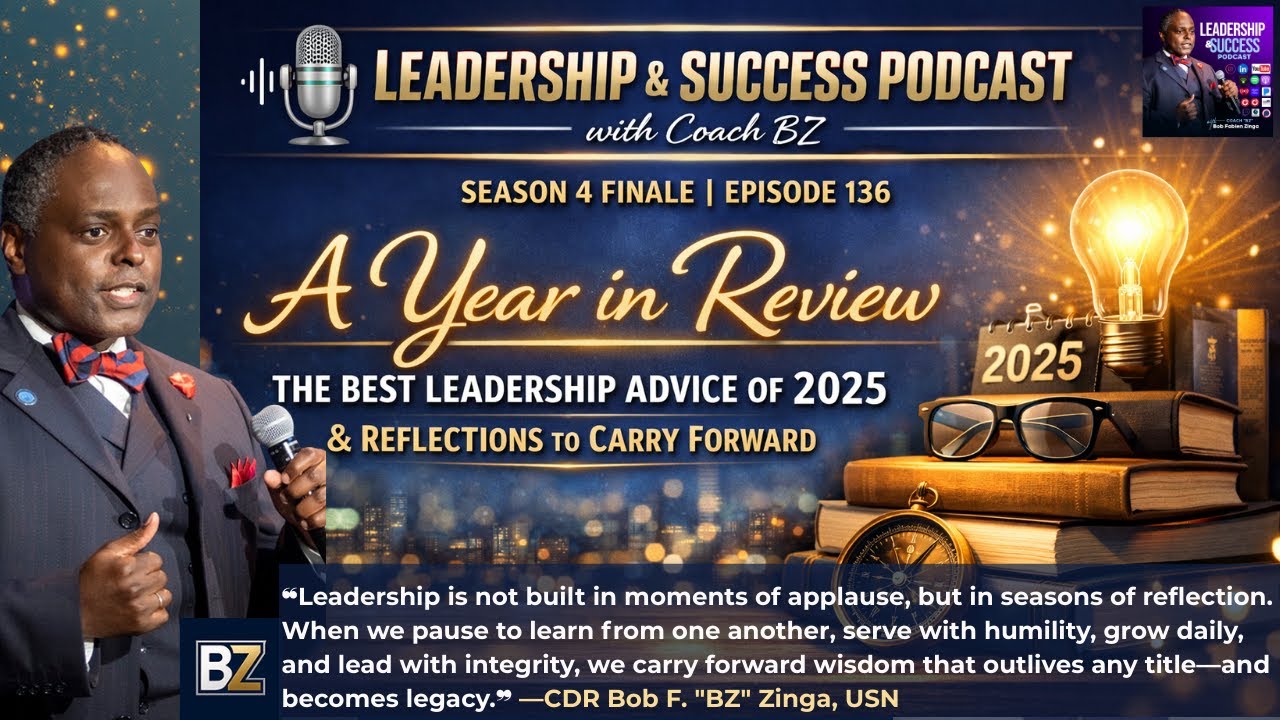
Coach BZ wraps Season 4 with five core leadership lessons from 80+ guests: leadership is personal before positional, servant leadership is strategic, growth is daily discipline, integrity multiplies force, and influence beats authority. He references the 21 Irrefutable Laws of Leadership and a curated list of 250+ recommended books.
Chapters
Hi, I'm John Maxwell. When the top companies in the world are looking for trainers, speakers, and coaches, there's one name that stands above the rest, and that's Maxwell Leadership. Our certified team members have gotten proven results for companies all over the globe, and our reputation, I'm proud to say, is second to none. Some of our members have risen to the top of their profession, including the one you're going to meet today. I proudly introduce you to my friend Bob Fabien Zinga.
Welcome to the Leadership Success Podcast with your host, Coach BZ, where we help you lead with purpose and succeed with impact. If you're ready to grow into the kind of leader others want to follow, this podcast is for you. If you're determined to elevate your success and leave a lasting legacy, this podcast is for you. As my mentor, Dr. John C. Maxwell, reminds us, everything rises and falls on leadership. Our goal is simple: to inspire you, challenge you, and equip you with insights that can transform the trajectory of your leadership journey. Welcome aboard to another episode of the Leadership and Success Podcast with Coach B.
Imagine gaining the leadership skills that could redefine your career. Join Coach BZ on the Leadership and Success Podcast, where each episode delivers practical insights from world-class speakers, military leaders, and industry experts. We dive deep into what matters most: building resilient teams, leading through uncertainty, and navigating complexity with clarity and confidence. Every conversation is crafted for aspiring leaders like you who are ready to grow, lead, and make a lasting impact. Don't miss our powerful live sessions and recent highlights. Michelle Hayward on building diverse, high-performing technical teams. Anne Leslie on leading through global complexity and cybersecurity risk. Ron Carpenter AI exploring faith, resilience, and AI-powered leadership. Colonel Michelle G.I. Gardner-Intz on commanding influence from the battlefield to the boardroom. Chris Robinson on shifting from drift to drive in life and leadership. And Coach Enrique Acosta Gonzalez on mentorship, legacy, and heart-centered leadership. Ready to level up your leadership journey? Tune in on Spotify, Apple, Audible Podcasts, YouTube Live, and LinkedIn Live. Join the movement toward leadership excellence. Listen now and start transforming your success.
All right everyone, welcome to the Leadership and Success Podcast. Today is our grand finale for season, uh, season 4. I can't believe this.
Yeah.
Episode 136. This is the very, very last episode of 2025. So our finale for the Leadership and Success Podcast, uh, Season 4. All right, uh, before we get started, I am always reminded, let's start with our moment of gratitude. This is where we take less than a minute and we just want to take a moment to be grateful. We are grateful here every single day, especially because In the military, about 21 veterans commit suicide every single day. And here we believe that it's impossible to be suicidal and be grateful at the very same time. So if you would maybe close your eyes one last time in 2025, put yourself in your happy place, take a deep breath, and think about how grateful you are in this moment right now. Wana, I don't know, my heart is really filled with a lot of emotion. I am grateful for so much. Grateful to be a US citizen, grateful to live in America, grateful to be a commander in the most powerful Navy in the world. But more importantly today, I think I am grateful to be alive. Most of you may not know, but when I was a kid, my doctors told my parents I would not live beyond the age of 17 years old. And also, my primary doctor was a military doctor. Maybe that's part of the reason why I wanted to join the Navy or the military when I became an adult. But basically, I consider every single day I lived, I have lived beyond 17 years old, grace and favor. It's not a day that I deserve. I am very, very humble and grateful for every time I am able to wake up and just breathe. I am still alive. I am still here. So today, Wednesday, December 31st, 2025, the last day of 2025, I am still here and looking forward to see first day, January 1st, 2026 tomorrow. So I am grateful to be here. So if you would please type into the comment, what are you grateful for today? What are you grateful for? And also let me know where you are watching from, what city, what state, and if outside of the US, since we've gone global now, which country. I really do appreciate that. And so this is really gonna be a time of reflection, right? A year in review on the best leadership advice of 2025, mostly from my daily leadership devotion and my daily podcast, Leadership and Success Podcast with Coach Bizzy. Everything I've learned from all of our guests, we had more than 80 guests this season. I cannot believe that. And we've written more than 140 leadership devotional article this season. So I am really looking forward to Season 6, which will start tomorrow. All right, looks like my wife is saying, "Demetria, she's grateful for family." Thank you so much for letting us know that. But really, the truth is really, there's nothing more important in life than the relationships that you build, especially with your spouse and your children. And family really truly is everything. I believe family and health. Those are things that cannot be replaced really because it doesn't matter how much money you make, how hard you work. I've never heard of someone on their deathbed saying, "Hey, no, I want to go back to work and work for an extra hour. I want to make an extra dollar." No, that usually doesn't happen. They want to spend time with family and they really wish they had great health so they would stay here and still be able to work on their purpose, whatever that might be. There's another LinkedIn user who says they are grateful for those who have helped me and grateful for the opportunity to help others. That is so, so important. And the other thing I really love about this is even when you are being challenged yourself, when you are in great difficulties yourself, it is always great to help somebody else because believe me, there is somebody who's in much, much worse position than you are right now. In my podcast, I talked to a couple of people who were born overseas and some who were born in the US, but no, when you are born in America and you say you are poor, That doesn't really mean very much for people like me who were born in Central Africa because if you are poor in Africa, I mean, you are dirt, dirt poor. You are so poor, you can't afford the second O in the word poor. So instead of being poor, you are poor because you definitely don't even have any idea where is my next meal going to come from, right? Whereas in the US, no, you can be poor, but you still live in some type of apartment or house. You may be wearing some $500 $100 Nike Air Jordan shoes or have a big screen TV in your house, but that's not the way it is in the third developing world where I originally come from. So even if you've been very challenged this year, I really do encourage you to still try to help someone else, to volunteer. I've shared this before, one of the first classes I met when I first enlisted, 21 years ago, they used to tell me, hey, do you know what Navy stands for? It stands for never again volunteer yourself. But that is completely, completely wrong. You do need to volunteer because when you do, you really realize how lucky you are, how blessed you are, even though you may not be exactly where you want to be, but you are not where you used to be and you are definitely at a level much better. If you live in this country, I believe better than 90% of the entire world, even if you are American poor. So be grateful for that. All right. So keep letting me know what you are grateful for, where you are joining us from, what city, what state, and also what you have learned in 2025, maybe from the Leadership Success podcast, maybe from the Leadership Devotion article I've been writing every day this year, or just from your own experience. That's really what we want to do, right? A year in review. The best leadership advice for 2025. And then toward the end, add a little reflection to carry forward to 2026. And I might have a surprise guest join us. So I am looking for that, monitoring it. So again, welcome to the Leadership Success podcast with me, your host, and thank you for joining me live today on LinkedIn and on YouTube. And if you are listening to the replay, because YouTube and LinkedIn will have the replay immediately available, after the show. Thank you again for being part of this journey. Really, leadership is a journey, right? You really never arrive. I don't think I will ever get to a place where I will be like, I have learned everything there is to learn about leadership or life or success. It's just impossible. You know, when I started my Navy career as an E-1, 21 years ago, seaman recruit, lowest rank in the entire military, and today I am in the top 4%, a commander, a senior officer in the most powerful Navy in the world. And I even had the opportunity and great privilege to be a commanding officer. There is no job higher than that in the service. But even at that level, I still feel like I am still learning. I still do not know enough. And every day is a learning experience. And I really appreciate my network, especially on LinkedIn, because every day I log into this platform, I'm always learning something new. And special thanks to all of my featured guests this season and looking forward to 2026. So Today, again, special episode 136. It's the final episode, the finale for season 4 and the final broadcast for 2025. Wow, time really goes so quickly. So this episode is not about one guest, but it's all about you, my audience. So it's about the collective wisdom shared across an extraordinary year of conversation, reflection, books, devotion, and leadership lesson. And I really truly believe that leadership is the most critical skill of the 21st century. And I have shared this before, but I was 17 years old, I came to the US and I just had this flash of wisdom. It's like, I don't know where it came from, but I was like, it was like in the late '90s. I'm like, for the next century, everybody, if they are going to be competitive, if they're gonna be successful, they need to be good at 3 things, I thought. Number 1, it's gonna have to be leadership. You're gonna need to be able to lead, to influence people regardless of your rank, regardless of your background. No matter what your business is, you have to deal with people. So you need to learn to do that. Number 2, you also have to be good at technology. Now in the late '90s, that's where the internet took over the world. And I was seeing that trend, that technology would change absolutely everything, every industry, every business. And that really encouraged me. I didn't know anything much about computers, but I had to become good at it. And the great thing in life is you may be a novice now and know absolutely nothing, but if you dedicate your life, your time, your energy, you will eventually learn, right? They say on average it takes about 10,000 hours or 5 years for anybody to become an expert. And everybody who is an expert, a thought leader today, which I think I am now, when they first started, they absolutely were a novice just just like you. So whatever you can start learning right now, go ahead and start learning it. And in about 5 years, you will become an expert as well, whether it's technology, whether it's leadership. And the third thing was business. I had to learn about business operation. Now, when I first came to the US, my initial dream was to become a medical doctor. So I was thinking, well, I'm probably gonna have to have my own practice. I need to learn to be profitable. So business, I definitely need to learn that. And I'm gonna need to learn how to use computers, right? We can't go back to like it was in the '50s of the of the '60s, you have to have computer system in every medical clinic for patient record keeping and all of that. So I have to be good with computers as well. And I was always saying I was pre-med doing biological sciences, specifically microbiology, genetic and chemistry, especially physical molecular chemistry. But even then I was seeing how technology became more and more and more important with everything we did in academia. So yes, I need to be able to lead people. I need to learn how to run a profitable business. And then I also need to master this technology. So that really was my goal from the time I was 17 years old. And I was very intentional in trying to get really, really good at those three things. Okay, we have another LinkedIn user who says, joining from Lake Arrowhead, California. This year, I learned the importance of having hands-on skills, working with wood, metal, and material. That is so wonderful. And I think we really need that more and more, especially today, 2025, and especially for our young boys, right? I am very concerned about the generation of my children, right? Gen Z and the generation coming after them, Gen Alpha, especially the young men. We really need in this country, I think it's really part of our national security as well, to get back to those type of things. Not everybody's gonna be working on computer, not everybody's going to have a, you know, white-collar job. We need people in blue-collar work as well. I think it's really a national security prerogative in my humble opinion. So, thank you so much for sharing. And Daniel Young, and I believe I will be interviewing him for season 6 next year. Good morning from Midland, Florida. Thank you so much, Daniel, and let us know what you are grateful for today. So, today will really be a a conversation. I really would like to hear from you as well. Again, I feel like I've learned a lot in the last 21 years in the Navy, but I don't know everything and I still have an open mind and I am still learning. All right. And really one leadership lesson I have learned this past year, this past season on the— actually, before I do that, let me first say, Season 4, it was really, I think, for me, a year of consistency. And I think consistency is a master key for success. You don't have to be the strongest, you don't have to be the smartest, but if you are intentional and do things consistently every single day, I believe you are going to gain a lot more ground than the smartest people in the world. Because people who are very, very smart and bright, they tend to be lazy like everybody else. So if you are not lazy, if you are consistent, eventually you will outrun them. That is really what I believe. So consistency, very important. Curiosity, that's another thing. You have to be curious. You don't know everything. You may have learned a lot, but there is still something you need to learn. And then community, right? You don't get there alone. There is an African proverb that says, something like, if you want to do well, do it alone, but if you want to go far, no. Do it in community, but you do a lot more when you are with people, when you collaborate with other people. That's really, I think, part of what the essence of leadership is, right? It's not me, myself and I doing everything by myself and me being the best I can be, but it's really me influencing other people, working with them to accomplish the mission of the organization, right? In the Navy, in the military, we learn mission first, people always. Yes, we have to accomplish the mission, but the way to do it in the best way is to do it as a unit, right? As a team, because there is a lot of synergy, my strength and the strength of members of my team, and then minimizing my weakness and the weaknesses of members of my team. That really allows us to really multiply our effort, right? I believe General Powell was the one who says, right, if management can get you up to 100%, leadership will take you to 110, 120% because of that synergy effect you working with your community, with your tribe and being intentional and focused on whatever your goals are. So in 2025, we've published 135 episodes, this one being the 136th, the final episode for season 4. We've interviewed hundreds of leaders, over 80 leaders for sure, across the military, technology, academia, healthcare, entrepreneurship, government, and nonprofit sector. So this is the other thing I I have really learned from leadership, right? It is not limited to a sector or an industry. I believe these leadership principles are universal. They apply no matter who you are, no matter where you live, no matter where you come from. If you put them into practice, they will work for you. All right. And of course, this year we had a curriculum, and I'm gonna get through this again. The first one was the 21 Irrefutable Laws of Leadership by Dr. John C. Maxwell, my primary mentor. And I think we're going to keep this as a curriculum for season 5 starting tomorrow. And then we also add the Maxwell Leadership Bible. Again, this has nothing to do with religion. It's just going back to ancient scripture to see that all of these principles of leadership everybody's talking about, you can really trace them back to the Bible. It's really old wisdom. There is really nothing new under the sun. I think it was Yesterday, I was having a conversation and someone says, "Well, everybody who talks about self-improvement, self-help leadership, they all pretty much say the same thing but in different ways." Yes. I think I was talking with Coach Zen Benefield yesterday and he mentioned that. And that is so true. We all say the same thing but just in different way. But again, if you go back to the Bible, I believe you will find every single leadership lesson and principle of success that anybody talks about today. All right. So collectively, our guests recommended more than 250 books. So those books, you guys can go ahead and read them. Let me share my screen for a second. So Right here you will see, it's not sharing, let me give it a minute. Because sometimes I have to do it again. Let me share my screen one more time. Okay, you should see my screen share on, okay, here we go. So these here are the, I believe it's 142 articles we've written in 2023. 25. So what I'm gonna share with you as well is going to be the bookshop for the podcast. So I went back through and I looked at all of the book recommendations we had for this season. So at the top, this shows the books that I have written. Actually, my wife wrote this book, Entrepreneur in Health, And I wrote the foreword for this book, The Sacred Words of a Sage Fam. It was written by my godmother and she asked me to write the foreword for it. And then I have the curriculum, the Maxwell Leadership Bible and 21 Irrefutable Laws of Leadership. And then the next category, these are the books that we are currently reading. Like I said, we've recommended more than 200 books. That is a lot, right? So To make it easier for some people, this one only has about 58 books. So these are the books that were recommended on the podcast in the last 4 to 5 weeks. Again, just to kind of make it easy for people to find some of these books. And then I also have about 70 books from guests on the show who are actually authors. They have written these books. So all of these people here, are people I have interviewed on the show who have written books, and it's about 70 books or so. And next, I am recommended about 26 books. These are the books that have been recommended over and over and over and over again by many guests. So if a book has been recommended at least 3 times by 3 different guests during the season, then they go to the most recommended bookshelf. So I have about 26 of those. And next, I have all of the books that have been recommended so far, 254 books. That's a lot. Okay. I believe since I was 17 years old, I probably read well over 2,000 books by now. I love reading and I really love the technology of reading, right? Because one thing it really does is it allows you to think through things and read over and over and over again. And even when someone dies, you can still go back and read the book they've written 10, 15, 20 years ago and still learn from their wisdom. So I am definitely sold out for reading. And next I have the Chief of Naval Operations Professional Reading List. In the Navy, every year the CNO comes up with a list of books that he believes all of the officers and enlisted should read. So I think they have very, very good books there. For example, the book from— oh, what happened? Let me share that again. All right, this is another thing I have learned this year. The technology doesn't always work. The way it is intended to, that is okay. But at least most, most of the time it works pretty good. Okay, for some reason my computer screen doesn't want to share anymore. Let me try one more time. If— okay, I was talking about the book recommended by the CNO, the Chief of Naval operation. And as you can see, it even includes the book by General Stan McChrystal, who I interviewed here on the podcast, Team of Teams. So really, really good books. They say a lot. Now, my thing for reading is you do not really want to agree with everything the author says, but at least use it to reflect, and then you come up with your own conclusion. So bookshop.org/shop/leadership-and-success is where you will find all of those. And then I also have 200 books. Actually, this one says 201. I think that's too many. I'm gonna remove one book, but these are the books that I recommend, right? Everything I think that really made a big difference in my career as a Navy information warfare commander and also as an IT executive in Silicon Valley. These books are going to make you think. So I recommend each and every one of them, 200 of them. And I think I was really inspired by the list, I believe I have Admiral Staviris. He has a book right there, the Admiral Bookshelf. He has about 25 books that he recommends. And that is who inspired me for this. I have another bookshelf, books that President Obama recommended for this. Summer. And then I also have the books that were recommended by my mentor, people who mentor me, about 47 books. And I also have books by General Milford Diggle, who I interviewed during the podcast. Almost every other day he recommends a book, so I am trying to keep up with him. Every time he recommends a new book, I will add it here. So far we have about 73 books, including the bestselling book he wrote, When the Map Anyway, on and on and on. You can take time to go through this. We definitely love reading here on the Leadership Success podcast. So Daniel says, "I'm coach busy today. I'm grateful for the strategic rationale, the why behind my recent project. I've spent today finalizing my professional digital infrastructure, ensuring my academic credential and my consultancy framework are finally synchronized." across all platforms. So thank you so much for sharing that, Daniel. I do appreciate that. But anyway, so we've recommended more than 250 books this year and our guests have offered more than 70 books of their own. So from all of those conversations, we've published over 140 lead articles. That's Leadership Excellence, Accountability, and Devotion. You can subscribe to it on LinkedIn. So More important than all of these numbers, I think, is what those conversation really change, right, for me in 2025, how we think about leadership, how we show up for our team and how we grow as human being. And I think our humanity is really so important. I feel like our nation is more divided than I ever seen it in my lifetime. I didn't like 9/11, but I definitely love 9/12, right? 2001, the day after 9/11, I feel like our country was as united as we could ever be. It didn't matter if you were Black, white, male, female, Democrat, Republican, conservative, liberal, it didn't matter. We were one country, right? One nation under God. And I really pray and I hope in 2026 we get back to it. That is really my prayer. But anyway, so let me start with some of the lessons I have learned in 2025 from the podcast, from the leadership article devotion. Lesson number 1, leadership is personal before it is positional.
Hmm.
One of the clearest themes from 2025 was this, leadership starts with who you are, not the title you hold. One of my primary mentors when I was an IP, officers, really, he encouraged me, right? Whether or not I have a title, whether or not I have direct reports, right? I needed to lead one person, that person was me, right? And John Maxwell says, right, leadership is influence, nothing more, nothing less. So you have to be able to influence yourself. You don't have to have a title, you don't have to have a position to be a leader. And I believe that is really, really, really critical. Leadership is personal before it is positional. Because if you have a position, you are somebody's commanding officer or their boss, you're gonna tell them to do stuff. Yeah, they're gonna do whatever you say because they wanna keep getting paid and don't wanna get fired. Right? But that positional authority is, that makes you a leader, I guess, in principle or in theory, but what you really want to become is a leader that people are willing to follow. Whether or not you add a title. That is really what the true essence of leadership is, influencing people so that they want to do business with you, they want to work with you, and they wanna go above and beyond for you because you are a role model, you are an example, and you are a good human being. So you really have to work on those relationships. Now back to the human side again. So across conversations I've had with senior military commanders, startup founders, CISOs, professors, and coaches, we really heard the same message this year. Repeated in different words, no, character always precedes credibility. So great leaders invest in self-awareness, emotional intelligence, humility, and reflection. So before they try to influence other people, rank, authority, and expertise may open the door, but trust, trust, trust is what keeps people following. And you have to be able to build trust. And in the military, many times you have to build trust very, very quickly, right? Because of the high demand of your mission. But one thing with trust is it takes a long time sometimes to build, but once you lose it, you may never get it back. So that has to be one of the major things in the forefront as a leader, building trust and then maintaining that trust. So for leadership lesson 1, again, leadership is personal before it is positional. It really came through powerfully from leaders who emphasize self-awareness, humility, and the inner work needed before authority. So for example, in episode 97, my primary mentor, Shelley Archambault, she highlighted and shared how self-belief, resilience, and ownership of one's narrative precedes any title. So her journey clearly illustrated that leaders must decide who they are, before deciding what they do. Let me see if I can still share my— this works without a glitch, but let's see. Okay, let me share my screen. As I'm not going to be able to mention all 100+ guests who were on the show, but the few that I'm going to be able to highlight today, let me share at least the article we wrote about them. So for Shelley Archambault, it was episode 97. So that was, I think, about a month ago. I think eventually I'm gonna change these pictures to make it easier to find these, but yeah, 97 should be about here. Yeah, 67. Man, we really have interviewed quite a lot of people. Let's see. Okay.
80.
We are getting there. We are getting there. And here is Shelley Ashenburg. Here we go. Episode 97. Let me open this one up. So this was really a great learning. I've learned a lot from her through the years. She's actually the one who really encouraged me and helped me really reset my priority and my vision to not just becoming a commander, but becoming a commanding officer as well. So the article I wrote as a summary for my discussion was An Apologetically Ambitious Leadership Lesson from Shelley Archambault. And one thing she says, right, success isn't about luck, it's about intention. You don't need permission to be ambitious, just the courage to start unapologetically. And that is so true. Of course, I recommend everybody purchase her book, but yeah, that is really one primary lesson I learned from her this year. Lesson 1, leadership is personal before it is positional. Now, another person I learned that from was episode 107 with my mentor, Dr. Tim Elmore. 107, he's really the Gen Z whisperer. He he is. Let's go to the summary article I wrote about him. So Dr. Tim Elmore really taught us that leaders must first understand themselves and the generation they lead, emphasizing empathy. That's so important, especially with Gen Z, self-awareness and adaptability before positional authority. Again, you can read The Future Begins with Z, Dr. Tim Elmore on leading the next generation of changemakers. I think when I became a commanding officer, that was in 2022, right? My daughters, both Gen Z, Naomi and Zoe, they really were my primary teachers, teaching me how to interact with Gen Z, how to inspire them and how to motivate them. I also learned again, this number one lesson from Kwame Christian, that was episode 120, 125. Let's go there. 125. Here it is. 122. Here we go. All right. Kwame Christian really taught us about leadership being influential, right? He really taught that emotional intelligence and self-regulation are foundational to credibility. Negotiation and trust. So we wrote the article Necessary Conversations: How Confidence in Conflict Shapes Better Leaders. Again, I encourage you to go down, read the article. But I also learned from Captain— actually, she's now a Major Select, which is pretty, pretty cool. The Army will be promoting her this fiscal year. To the rank of major, which I believe is a very, very big deal, Contessa Tracy. And for episode 134, she reminded us that psychological readiness, vulnerability, and self-mastery are prerequisites to leading others under pressure. And finally, for lesson 1, I also learned from Coach Stan Banfield, we met yesterday for episode 135, who reinforced that leadership begins with consciousness, intention, and knowing oneself before attempting to guide others. Again, this is lesson number 1, leadership is Leadership is personal before it is positional. All right. What I'm gonna do now, and for those listening, you can let me know too, of the 21 Laws of Leadership, which law most closely aligns with lesson 1, leadership is personal before it is positional. So these are timeless laws that reinforce what our season 4 guest lived, modeled, and taught in 2025. I think law number 1, right, the Law of the Lead, which says, Leadership ability determines a person's level of effectiveness. So this law teaches that who you are internally, your character, your self-awareness, and your capacity to grow sets the ceiling lead for how effectively you can lead. So titles do not raise the lead, personal leadership does. So Season 4 guests repeatedly reinforce that inner work must precede outer authority. So One question I have for you is, what personal leadership gaps might be limiting your current effectiveness regardless of your position? Again, you could be a commander like I am now, a senior officer, or you could be a seaman recruit, lowest level at the very bottom of the chain of command like I was 21 years ago. It doesn't matter what personal leadership gaps might be limiting your current effectiveness regardless of your position. So let me know in the comments. And also, if you have Any thoughts or feedback, takeaway about what I'm talking about, please let me know as well. Alright, so the last thing I'm going to do about Leadership Lesson 1, you know, leadership is personal before it is positional. I'm going to read one verse as well from the Leadership Bible. So that's in Proverbs 4:23, where it says, above all else, guard your heart, for everything you do flows from it. So I believe Scripture reminds us that leadership begins internally, it's internal work. Decision, behavior, tone, and judgment are all downstream from the condition of your heart. So titles may grant you authority, but character sustains influence. To be a person of influence, again, you don't need any title, right? Because you may be at the very bottom of the chain of command within your organization, but because you are influential, people will follow you and people will listen to what you say. You do, including the CEO or whoever is in charge. So leaders who fail to tend to their inner life eventually compromise their outer leadership. Again, that was Proverbs 4:23, above all else, guard your heart for everything flows from it. So what internal habits then, attitude or unchecked emotion might be shaping your leadership more than your formal role? What would it look like to intentionally guard your heart today, this week, and next year? So go ahead, type your answers in the comment, and I appreciate that. Okay. So that was leadership lesson number 1. So anything else you guys want to share about leadership lesson number 1, please let me know right now. It's really about leadership being personal before it is positional. Now, the second important lesson I have learned, and again, just generally speaking, I usually learn in in threes, but we've had so many guests, I've written so many leadership articles, three wasn't enough. So I had to expand that to five. Even with that, no, I couldn't include everybody. But anyway, lesson number two, servant leadership is not soft, right? It is strategic. So many of our guests challenge the outdated beliefs that servant leadership is passive or weak, right? In high-stakes environment, especially in the military, right? From combat zone to boardrooms, or in Silicon Valley. Leaders who put people first consistently outperform those who lead through fear or ego. I think in my own experience, leadership has really changed a lot in the last, now, 21 years I have been in the Navy. When I first got there, I think it was very much egocentric, in my opinion. Many of the commanding officers and people in charge, they really tended to lead with fear, which it does work and sometimes it might be necessary depending on the condition, especially if it's a matter of life or death type of thing. But in my opinion, it doesn't scale, right? If you do it for so long, at a certain point, people are just going to have to give up. That's why you need to really lead with influence, okay? Not with ego. So servant leadership really showed up as listening under pressure, protecting teams from unnecessary noise and creating psychological safety, right? Creating an environment where your people are allowed to make mistakes, are allowed to be humans, right? Because we are not perfect. And we need to be able to learn from our mistakes. And over and over again this year, many guests have talked about this principle of failing forward. And Dr. John C. Maxwell wrote a book about that too. I believe Coach Zain recommended that book. Yesterday. So that's really what leadership is about, working on those relationships, trusting your people and providing top cover for them where they know that you support them, right? If everything goes very, very well, you share the credit with everybody on the team. And if things go really, really bad, you take all of the blame as the leader. That's really what leadership is. So you have to hold high standards with genuine care, no? Mission first, but people, people always. So the best leader of 2025 proves that serving others is not a bad lowering expectation, far from it. It's about raising people. All right. So here are some of the guests that demonstrated that people-first leadership, you know, consistently delivers the strongest outcome. Episode 71, I had the privilege of talking with Vice Admiral Frank Morley, US Navy retiree, and Admiral Morley demonstrated that serving sailors, investing in readiness, and developing people is not altruism, right? It is mission assurance. You must do it. His own career reflected servant leadership as a strategic advantage in warfighting and organizational excellence. Another one I've spoken to, episode 2, right at the beginning of the season, was my mentor, Chris Robinson, executive vice president at Maxwell Leadership. From the earliest day of season 4, Chris Stevenson reinforced that service and accountability are foundational, not optional leadership traits. And then I also talked with, uh, Fabien Zinga, CEO and chairman at Deloitte, episode 122, Empathy in L drives sustainable enterprise leadership. It was very touching, a couple of the that worked for her when she was CEO, they got into the chat and a couple of them said, well, mom, I am so grateful for all of the work you did to allow us to have maternity leave and childcare and all of those things. She's no longer the CEO of Deloitte. She's no longer the chairman, but years after she has left, her impact is felt because all of the future people, mostly women, but I think men too, have benefit now that they didn't have prior to her being CEO and chairman of Deloitte. So that's really legacy, right? That's what leadership is about, serving people, not just the people who are on your team now, but also the people who are gonna come long after you have gone. That is so, so powerful. Again, going back to books, right? General Colin Powell, my dear mentor, is no longer with us today, but his books still mentor me, right? They still teach me how to be a better officer. And then I will use the same knowledge, and that's what I am sharing with my audience today. All right, another one of these great leaders was General Milford Beagle for episode 121. And, uh, General Beagle modeled people-first leadership rooted in discipline, in care, and accountability, proving that developing soldiers develop combat power. One more person I am going to include is Commander Adrienne Benton, the chaplain, episode 114. And as you remember, she now is stationed in Italy. So for our show, for the AI recap I did, I did one in English, but I did one in Italian also. The first time we broadcasted in Italian on the Leadership and Success podcast. But anyway, Commander Benton really showed us that servant leadership builds trust. Cohesion and resilience in high-tempo military environment. Now, one more person I am going to add, although I didn't have a chance to interview him in 2025, I hope I will have a chance to do so, is my trusted mentor Ken Blanchard. I have never met him, but I've been studying his books and reading all of his resources since I was about 16, 17 years old, especially his book, The One Minute Manager. It really shaped me into the man I am today, how to manage and lead people. But the podcast episode, season 4, episode 5 and 6, I mentioned him as being a member of my personal board of directors. So I have a board of directors, about a dozen people, and those are the people who really mentor me and I look up to before I make major decisions. Even though I have never met Ken Blanchard, he is on that board. That's another thing. When you are a leader, whether you like it or not, you are going to have mentees. You're gonna have people who follow you, you don't even know about. Another thing that my mentor, Shelly Ashtonwood, said, right? Sometimes you have to adopt a mentor. They may not know you, but you have to adopt them. Read what they say, follow them on LinkedIn, purchase their books, listen to their speeches, and that is how you will learn and you get better. So episode 5 and 6 for season 4. And also I had 2 articles, my leadership board of directors, Wisdom Worth Pursuing, and also leadership mentor books and fair adventures. Advantage, daily reading, right? Where I talked about reading every day is going to be an unfair advantage to make you more and more successful. And I mentioned this One Minute Manager book there. So anyway, so Ken Blanchard really reinforces timeless truth that leadership is about serving, not being served. That's really the only way.
All right.
I see another comment from Daniel. He says his number one leadership lesson is that infrastructure always outperforms intent.
Wow.
For example, high-impact leaders, especially those in the military and tech, understand that a vision without supporting system is just a dream. That is so powerful. That is really a master key to success because the truth is people who are successful and those who are not, they all don't want to do what it takes to be successful. But the big difference between them is those who are successful do what they need to do, whether they feel like it or not. So they are disciplined. And they also create an environment that makes it easy for them to do what they need to do when they need to do it. That is really, really key because if you live in a house for— just an example, most people, they want to lose weight. When you are— it's going to start tomorrow. You want to lose weight, but in your kitchen you have all type of junk food. That's all that's available to you. Guess what? You may have very, very strong willpower, but because that's all you are surrounded by, eventually, you are going to eat junk food because that's what's available. But if you get rid of all of the junk food and you only put healthy food in your refrigerator and in your pantry, guess what? Next time you are hungry, you're going to be tempted to eat healthy food because that's the only thing that's available. So what I'm saying is you have to curate your environment in order to make it easy for you to do what you need to do. If, for example, you spend too much time watching TV, maybe you need to take the TV out of your house. And at one point I did that when I was working on my double master master in business administration and master of science in management and working full-time. And at the time I was also in the US Navy Reserve. I really didn't have time for anything. Maybe you need to shut down your Netflix account for a few days or months. So basically just whatever tempt you, get rid of it so it is never a temptation for you. I heard the story, I believe it was Maya Angelou, She's written so many number one New York Times bestselling books, but she was saying that many times she would get a great contract from a publisher and there is a timeline, right? You have to publish your first manuscript by this date or whatever. And like I say, very successful people, just like all of us, we get lazy. We don't want to do what we need to do. So what she would do, I heard from Oprah, she would lock herself into a hotel room, right? Just something very, very, very simple. No TV, no distraction in the woods somewhere. And then she would force herself to write out all of her manuscripts. So sometimes you may have to do that. Just get rid of all of the distraction, have the infrastructure. That is what Daniel is talking about. And then you're gonna be able to much easily accomplish your goal. All right. And Daniel, if you have any other comment about what I just said, please let me know. So back to lesson number 2, servant leadership is not soft. It is strategic. So from the 21 Irrefutable Laws of Leadership, I think the law that clearly shows that is law number 5, right? The law of addition. Leaders add value by serving others, right? Add value by serving others. One thing Papa Maxwell has taught me is I have great value. You have to know what your core values are and live by those. And I value people. I love people. And number 3, I want to add value to people. So I really love the law of addition, add value by serving others. And this law directly affirms that servant leadership is a force multiplier. So leaders intentionally add value to people through service, development, volunteering, caring, create loyalty, trust, and sustain performance. So Season 4 shows that service is not sentimental, it is strategic. So one coaching reflection I have for you listening, How are you intentionally adding value to the people you lead this week? Not just extracting results from them. And I think employees really, really get that, especially in Silicon Valley. Many of the jobs I've had, many times your boss will be like, "Oh Bob, how are you doing and what's up?" And I'm starting to answer how I'm doing and what I did this weekend. And immediately, "Hey, we have all of these things, task, task, task, task, task, go ahead and get it done." So you understand, yeah, they don't really care about you. They don't really care how you are doing. They just want you to to do the work. But as a leader, you absolutely have to care for your people. And sometimes it might be hurtful, right? You may have to lose on production at times, your people are sick or if they go through a difficult time, because work will always be there, but really prioritize them. And I think as you do that, people will be very, very loyal to you because they know they care. And I think that's really what happened in the US Navy. And I'm assuming all of the other branches of the US Military as well. People are willing to go to hell, willing to go to combat zone, willing to put their life on the line for the sailor to their right and to their left because they care. And if you are that type of leader again, people will follow you wherever you lead. So in the Bible, which is our second curriculum this year, I will read Matthew 20:26. Which says, "Whoever wants to become great among you must be your servant." That sounds like a paradox, doesn't it? You wanna be great, but you have to serve. Again, servant leadership is not soft, it is strategic, right? So I believe right there Jesus defined greatness not as power over others, but as responsibility for others, right? I don't have power over you, but I am responsible for you. I am my brother's keeper, right? Servant leadership is a deliberate strategy that builds trust, loyalty, and long-term performance. Leaders who serve create environment where people willingly give their best. So where in your leadership then are you tempted to assert authority instead of offering service? How might serving first actually strengthen, not weaken, your effectiveness? So I really want us to be thinking about that, how to add value, how to serve before we ourselves are served. I see another comment. Let me make sure I don't miss anything else. Okay, someone says, Daniel, I agree, but let me offer another perspective. Organizational infrastructure can also limit leadership. I have observed military organization over a long period of time despite the— I believe this is Captain Joel of Hofstadter, just by the way it sounds. Okay. Organization infrastructure can limit leadership. I have observed military organizations over a long period of time. Despite the fact that personnel have turned over multiple times and fallen under numerous leaders, the organization has not changed and continues to have the same problem. That's true. And challenges it had 20 years ago. It cannot be that all these people were ineffective. It's just that the organization is incapable of becoming something that It isn't. That is definitely something to think about. Now, another thing, that's just my opinion. When I was CO, the Navy tries to limit that. You are only a commanding officer for 2 years. That's it. Most people, it's 3 to 5 years for whatever billet job they get with the Navy. But for CO, because there are so few commanding officer billets, they want to give the opportunity to as many people as possible. So 2 years is all you get. But the truth is, the first year you are commanding officer, the first year you are on that you really don't know anything. You are still learning about the organization, who does what, what is our mission, what is our vision. You're still learning about your people, getting to know them. Now, I had about 72 direct reports. That's a lot of people you need to know, their strengths, their weaknesses, opportunities, and threats, and then using them the best way you can to advance the mission of your organization, right? To me, being a CEO is like driving a bus, but making sure you have the right people on the bus and then have the right people on the right seat within the bus. So it takes time to learn all of that. So by the time you really get to learn your organization and you start implementing things, policies and procedures that are going to improve the effectiveness of what your organization does, it's time for you to go. So another CEO is going to come that may continue what you did, or they may say, no, this is crap, I'm going to start all over again. And then they're going to do their own thing. They are the new CEO. So that is kind of a problem too. I definitely see, I believe it's Captain Rothschild who said that. But I think generally speaking though, having an infrastructure that makes it easy for people to do what they need to do is always going to move your mission forward so that people don't have to in addition to doing their job, have willpower. You want to make willpower completely unnecessary so that when they go to the fridge, all they have is fresh food and healthy food. So they don't even have to fight temptation. So I think putting systems in place and hopefully those systems stays after you are long gone will definitely help. Okay. Another comment from Daniel. So yeah, I was right. It was Captain Rothschild who said that. Daniel replying says, excellent point. What you're describing is the legacy trap where the infrastructure has become a cage rather than a catalyst. I've definitely seen some of that in my leadership journey, especially in the Navy. And, uh, thank you. The challenge, especially in the military, is finding enough wiggle room in the system to start that recapitalization process. And that is so true. More often than not, the system prevents that process more often than not the system prevents that process. That is so true in the US Navy for sure, but I'm pretty sure it's true for the other branches of the military as well. And Daniel replies, "Coach, you are spot on. Environment, willpower. The legacy trap Joel mentioned happens when systems are built for compliance instead of calibration." Yeah, this is the other thing too. And I've seen it over and over again. In the military, we tend to have checklists and we are compliant with a bunch of stuff. But sometimes though, we need to go beyond just being compliant, right? You have to be effective. You have to improve the morale. You have to move the organization forward, not just pass an audit or something like that. And then it is done, right? So there's usually a reason why you do what you do. And also every time we have exercises and operation evolution, we always have After action report. Every single exercise in the military, at the end of the exercise, we always have those. But what I have noticed in my limited time in the military is many times for the same exercises, I went to it this year and I go back next year, they make the same mistakes all over again and they learn the same after action report all over again, the same lesson. So whatever lessons that the previous team learned, people who come over, they don't go back and actually read them and apply them so that They change system. They just go back, you know, and the new CEO, whoever is in charge, does do things their own way. And then they end up learning the same lessons over and over and over and over again. So I have definitely seen that. So compliance organization reflect a lack of trust. Building trust is perhaps the most important characteristic of leadership. I could not agree more. Build trust, build trust, build trust. "So whoever wants to become great among you must be your servant." Matthew 20:26. Alright, so let's go to lesson number 3. Man, it looks like it's taking a lot longer than I was expecting. It's been almost an hour already. So let me do this quickly. So for lesson number 3— Oh, by the way, Captain Hofstädt, I know you are going to have to leave soon. Whenever you are ready to come on board, just let me know at any time. Okay. Lesson number 3: Growth is a daily discipline, not a one-time event. Okay. That is so, so, so critical, right? Because another dominant theme from our guests this season was intentional growth. No, you don't just grow by accident, right? You have to be intentional and do what you need to do in order to grow. Like one thing I learned from Papa Maxwell, every single day, he does 5 things. No, he's written more than what, 90+ books? Almost all of them have become New York Times bestselling books, but that's because every single day he writes, he thinks, he asks questions, he files. And there is one more thing he does, writing, thinking, asking questions, and it does one thing, and then he files every every single day. Ian journals every day. So every single day, I think he started doing that when he was in his mid-20s, right? He's in his late 70s now. So for more than 50 years, every single day, whether it shines or it rains, every day he's going to think, he's going to write it. That's why he inspired me. I've been writing a leadership article every single day since May of this year. LinkedIn told me at the end of 2025, I have written enough articles and posts that I could fill 5 books, 5. So I just wanna work on my first book and hopefully it's gonna be ready to publish next year. But I think that discipline every single day, doing it over and over again, whether you feel like it or not, whether it's Sunday, whether it's Monday, just do it and do it very, very small increment every day. Before you know it, you are going to accomplish so much more than people who are very, very smart, and who have a lot of ability but only use their gift sparingly throughout the weeks, months, or year. So this really shows that through reading, mentorship, journaling, feedback loops, spiritual grounding, fitness, and quiet reflection, right? The Lead Devotion, they were born from this idea, right? Leadership is forged in small and seen choices made every day. Growth compounds when practice consistently. Another book by my mentor, The Compound Effect, Darren Hardy, is really about that. You do something every single day and then it compounds and you have massive success. That's so much better than just doing great extraordinary things every once in a while. You're not going to go very far with that. And unfortunately, that's what most people do. One example it shows, which I really like, it's like people, they go to McDonald's or whatever, your junk food places, if you eat fries or burgers today or whatever junk food you prefer, you are not going to gain 50 pounds on the spot. That's not going to happen. There will be pretty much no change. But then when you do it again tomorrow and then tomorrow and then you do it every single day, every month, before you know it, you are going to see the pounds accrue, right? Your fitness is going to go in the direction you do not want, but you have to do it consistently. So in the same way, when you do the right thing, you exercise, you eat right, You're not going to lose the weight right away or be healthy overnight. Like, I mean, when I joined the Navy, right, I used to be a couch potato. I've never ran a day in my life. But when I joined the Navy, I had to learn how to run a mile and the half in less than 12 minutes. First time I ran a mile and a half, it took me almost 30 minutes and I passed out. I felt like I was having a heart attack, but eventually I was able to do it. And I think the best time I've ever had was 10 minutes. And 25 seconds. And then, I really enjoy running. I experienced that runner's high. I was running almost every single day. Now, 10, 11 years later, I started having issues with my joints and ankle and knees and all of that. So, I don't run anymore now. I do the bike. But, my point is going from a couch potato to somebody who's fit enough to run a mile and a half in less than 11 minutes, it took practice. Every single day, do something. In time I became fit and I was able to do it. All right. Another comment from Daniel, you spot on. Okay, I think I've already read that. One more, so compliance organization reflect a lack of trust. Yeah, I think I've already read it. Okay, I haven't missed a comment. All right, please keep those comments coming because I am learning from you and hopefully you may be learning something from me as well. As well.
All right.
So let's look at some of the guests who have showed us that growth is a daily discipline, not a one-time event. In season 4, for example, episode 80, Sharon Lechter, she's the co-author of the Rich Dad Poor Dad series. She's really a legend, right? We interviewed her for episode 80 and Sharon reinforced that growth, financial professional and personal comes from the intentional learning, mentorship, and discipline habit, not overnight success. Success doesn't happen overnight. It's what you do daily that is going to determine your future. And then people are going to discover you and say that you are an overnight sensation. But the truth is, no, you've been doing this long, long before, before everybody knew the name of Michael Jordan, who, by the way, I understand when he was in high school, he was rejected from his high school basketball team. Can you believe that? And now he's the The number one, I believe the greatest for good, right? I think whatever his name is, James doesn't, King James doesn't have anything on Michael Jordan. I am MJ all the way. But anyway, it took some consistency. He's been doing this over and over and over and over and over again. And eventually he was able to show his greatness and his airness to the world over and over again. But it starts with very, very, very small steps.
Okay.
Of course, Papa John on episode 10, Papa John's echo throughout the season, but episode 10 specifically, that's where I talk about the members of my board of directors, my personal board of directors. Like I mentioned, Ken Blanchard, who I've never met, but Papa John is on that tour and I'm hoping to interview him face to face next year. Hopefully that is going to happen in 2026. But he really echoed throughout the entire season the principle that leadership develops daily and not in a day. And there is a specific article I wrote about this law of leadership, Daily Voyage Charter Course, our process navigation. So that's one article you may want to read. Also, Coach Bobby Umer Episode 115, He highlighted consistent self-investment, reflection, and learning as the path to influence. And one more I'm gonna mention is episode 44, Chuck Brooks. Chuck emphasized lifelong learning in cybersecurity and emerging tech, showing that leaders who stop learning quickly become obsolete. And that is so true. Actually, let me add one more. She is my friend. I didn't interview her this year. Maybe I will next year. Let me get the picture I got from LinkedIn. It's just gonna take me a second. I wanna show this. Her name is Amy. Again, I didn't interview her. She didn't write a book, but I've been communicating with her throughout 2025. And according to LinkedIn, she was my number one pen pal in 2025. Amy Shever, the person you kept up with all year long. She's really a role model for this principle, I think. She demonstrates lifelong learning through curiosity, adaptability, and continuous improvement. So throughout our ongoing dialogue this year, Amy really modeled growth-oriented leadership, curiosity, and continuous improvement, right? Leadership isn't only learned on stages or podcasts, or books, but sometimes it is forged one thoughtful message at a time. So again, I have an open mind. I am always looking for my blind spot. I know that I know more today than I did yesterday, but what is it that I don't know yet? And that really keeps me kind of like a child, right? I want to be amazed and I want to find that from people, even my children or people who are ranked lower than I am, who may have a position on the chain of command, the corporation that might be lower than mine, but everybody is people, including Virginia Tech, everybody I meet, like what can I learn from them and how can I add value to them? I think that's a very important key, I think, for leadership and success. Okay. So lesson number 3, growth is a daily discipline. That's very easy in the 21 Irrefutable Laws of Leadership. We go to law number 3, and that's the article I wrote about for episode 10, season 4, episode 10. Dr. Maxwell says the law of process is leadership develops daily, but not in a day. It develops daily, but not in a day. All right. So this law really is the backbone of many season 4 conversations, book recommendations, and the Lead Devotion. Growth happens through consistent, consistent consistency. Will take you further than your genius, I think. Consistent habit, reflection, and learning, not through single breakthroughs or promotion, but through the consistent actions that you take toward your goal. So what daily leadership habit are you practicing right now that will compound your growth over the next year? So that's the question I have for you. Please feel free to type your answer in the chat and provide your feedback, I welcome that. And then the Bible verse for this principle that growth is a daily discipline, not a one-time event, is Galatians 6:9, right? Where the Bible says, "Let us not become weary in doing good, for at the proper time we will reap a harvest if we do not give up." So the harvest comes if you do not give up, right? Growth rarely feels dramatic in the moment, Scripture affirms that consistency, perseverance, faithfulness over time produce results. Leadership maturity is forged through repetition, not shortcuts. Daily discipline compounds into long-term influence. So what small leadership discipline, whether it's reading, reflection, mentoring, prayer, or feedback, are you tempted to neglect because results are not immediate? What commitment can you renew today. All right, we are almost done. Lesson 4: Integrity is the ultimate force multiplier. So in this year really filled with volatility, a lot of people— 2025 was a very, very bad year. And I guess in America, if you are one, a member of a marginalized community, this probably wasn't a very good year for you. Some of us even feeling like the government was— your own government was somehow against you. But anyway, but also the economy and everything that is happening around the world and rumors of war and things happening in the Middle East with Russia, Ukraine, and all of that geopolitical tension, rapid AI advancement, really a lot of change, cybersecurity threat and organizational change, right? Integrity really stands out in the midst of all of this as the anchor. In my opinion. So many of our guests on the Leadership and Success podcast, they repeatedly emphasize that trust, once lost, is almost impossible to recover. And ethical leadership, transparency, moral courage are not optional add-ons. They are mission-critical capabilities. I remember my former professor, Professor Casey Luscious, from the Naval War College in Monterey. She really taught me that. And really the class she taught me, I think it was back in 2011, 2012, that I took a class there. It really very much prepared me to become a senior officer in the Navy and eventually a commanding officer. So it's really interesting how the lessons that you are learning, whether it's in school, reading a book, from your pastor, from your family members, from your friends, from your coaches, from your mentors, no matter where you are, no matter how you get that that information, how that information can really help you in the future become the leader that you have now become. So I think that is quite powerful. So true leader, they choose what is right over what is easy, even when no one is watching. All right, so this year, General Glenn VanHerck, United States Air Force retired, episode 105. Emphasized that clarity, accountability, and moral courage are at the highest level of command, right? Integrity, he showed, is what enables trust across allies, agencies, and domain in defense of the nation. So very important lesson. Episode 118 with General David Petraeus, legendary general, he really exemplified moral courage, accountability, and principled leadership at the highest level. We also have Carson Veade from Microsoft, episode 92. Carson's historical lens reinforced that leaders are remembered not for victory alone, but for honor, moral courage, and ethical decision-making under pressure. I especially love the story he shared during COVID what he did with his sales team. And then we also have Professor Dr. Peter W. Singer, who challenged leaders to confront ethical responsibility in warfare, artificial intelligence, and technology. Proving that integrity must keep pace with innovation. One more person I will mention is going to be Senior Master Sergeant, US Air Force retired, now Professor Jeff Willey for episode 129. Professor Jeff reminded us that credibility, ethics, and accountability are non-negotiable leadership traits. There is also Debbie Reynolds, episode 34, The Privacy Diva, she taught us and she reinforced that ethical leadership, data responsibility, and doing the right thing in AI-driven environment. So you must always do the right thing. Profit is not everything, right? You really have to lead. So again, integrity is the ultimate force multiplier. And from the 21 Irrefutable Laws of Leadership, it's law number 6. That law states it's the law of solid ground, right? Trust is the foundation of leadership, the law of solid ground. Integrity creates trust and trust accelerates everything else in leadership. So Season 4 guests consistently warned that without integrity, influence collapses. But no matter how talented or accomplished a leader may be, right, you need integrity. So are there any action compromises or inconsistencies that could be eroded? Trust in your leadership, even subtly. So think about that. All right, and then the verse I will use for this is in the book of Proverbs, Proverbs 11, verse 3. And by the way, my wife and I, in our mastermind, every New Year we read the books of Proverbs from chapter 1 through chapter 31. They have 31 chapters, 31 days in January, so every day we read a chapter. For example, January 1st, we're gonna read Proverbs 1, January 2nd, we're going to read chapter 2, and January 31st, we're going to read chapter 31. We do that every single year. You can really get a lot of wisdom in such an ancient book. It's really incredible. Like I said earlier, there is really nothing new under the sun. All of the leadership principles, all of the success principles that everybody talks about today, I think you can go back into the Bible and you will definitely see them. But anyway, Proverbs 11:3 says, "The integrity of the upright guides them." But the unfaithful are destroyed by their duplicity. So integrity guides the upright. Integrity simplifies leadership. When values are clear and action aligned, decision become easier and trust accelerate. Like my mom used to tell me, right? Bob, if you just tell the truth, you will never have to remember a lie. Because when you lie and you say things that you don't believe, it's almost impossible to keep up. But you keep telling the truth, then you will always tell the truth. No, No problem there. But anyway, without integrity, leaders spend energy managing damage, confusion, and broken relationship. But with integrity, leadership really gains momentum. So a question I have for you is, are there any area where your stated values and daily action are misaligned? That's a question I ask myself every day. I am not perfect. I make mistake. To err is human. But can I do better? Can I be aligned with my core principle, my core value? The core core value because that's who I am at the core. That is what's guiding me. It's my north star. That's who I want to be. Like I did earlier, Papa John's taught me, I have great value. Those are your core values. You have to be those, you have to align with them. And then you have to value people, number 2. And number 3, you have to add value to people. So what single decision would bring your leadership back into integrity today? All right, let us know. Okay, finally we come to and listen Number 5, influence beats authority in modern leadership. So this is the final lesson I've learned from all of the guests, all of the leadership articles and the interaction I've had in 2025. Influence beats authority in modern leadership. So with leading volunteers, remote teams, cross-functional partners, or global audiences, authority alone no longer works. I think it might have worked, right, 2 or 3 generations ago, but today, especially with these millennials and Gen Zs, It absolutely does not work. You have to influence, you have to build trust, right? The leaders who made the greatest impact in 2025 focus on influence, building relationship, communicating with purpose, and aligning people around shared values. All right, influence-based leadership requires patience, empathy, clarity, and credibility. Even one of my guests said love, love your neighbor. That's so powerful, isn't it? It also requires the humility to learn from those you lead. Not only is it powerful, but I think it's kind of simple as well. All right. Someone says, "The measure of integrity is when your core values clash with organizational directive. What do you do?" That's the million-dollar question, isn't it? So it is not easy to be a person of integrity. In my own life, it has cost me me dearly at times, right? When I first started my career back in '97, '98, I would work for anybody regardless of who they were and just work to make money. I didn't care. But now, many, many years later, I do care which organization I work for. I care about their value and what they stand for. And at times I've had to personally leave a job, right? Even though it paid a lot of money, just because I just didn't align with the value of the organization and more specifically, my immediate manager. So that was at a great cost to me personally, but I think that's what integrity demands at times. And even in the military, sometimes you may have to put your own career on the line in order to protect the people who work for you. Again, it's not easy. Not everybody is going to do it, but I think it's the right thing to do. So it's something to think about. And like, again, I go back to Dr. Cassie Luscious, who taught me at the Naval War College about strategy. She said, talking about ethics, you kind of have to rehearse that in your mind before it happens, because when it happens, it might be too late. You might do the wrong thing, right? It's kind of like, what would I do if nobody else is watching, but I knew my grandmother was watching me? Would I still do the right thing? If this happens, would I still do the right thing? Would I still do something, take an action that is aligned with my own core value and my integrity? I think that's something you really have to rehearse and you have to practice before it happens. And when the opportunity comes, stay a person of integrity and do the right thing regardless of the cost. Again, I'm not going to ask anybody to quit their job or do things that are going to really hurt them badly, but I think if you are a person of integrity, sometimes there is a high price to pay. Sometimes. But yeah. Okay. That's my two cents on that. You may not agree, but I've I think it's really where the rubber meets the road, as they say. But I am definitely determined going forward, I am going to live in integrity and I only want to work for organizations that are aligned with my own core value, working with people I like, I admire, I respect, and not just people who want to make the next dollar and who don't care anything about people. Because you can be extremely productive, but if you are a jerk, you are a liar, you are not trustworthy, why in the world are you still on the payroll? That's one thing that really messes with good people who work for some big enterprises. They see people who are not aligned with the core value of the organization being promoted just because they bring in a lot of money, even though they are completely in misalignment with the culture, with the core value that the organization say they prioritize. So I think that is a mistake. All right. So some of the people who have really shown me that influence beats authority in modern leadership is episode 126. Again, General Stan McChrystal, US Army retired. General McChrystal reinforces that in complex, fast-moving environment, leaders succeed not through rank, but through shared consciousness, trust, and decentralized decision-making. That's really one thing we do very, very, very, very well in in the military, in the Navy, in the Army, and all the other branches. The commander has an intention. He says, okay, this is what needs to be done, but the commander is not going to tell you how to do it. Every department head gets their piece of the pie, and they know what needs to be done, and then they delegate to the people under them. All the way down, in my opinion, it's really the chief, the senior enlisted rank of the Navy. Those are the people who really, uh, carry the Navy forward. They move the Navy because they know exactly how to get things done. Just stay out of their way and let them do it. That's why I really believe the US Armed Forces is the greatest military ever because of that. Because many other armies and militaries, if you can get rid of all of the strategic thinkers, all of the senior officers, all of the generals and admirals, the entire military is going to just break apart because people won't know what to do, where to go. Whereas in the US Navy, From E-1 to O-10, everybody knows exactly what they need to do, whether the admirals are there or not, the chiefs are going to do what they need to do in order to run the mission. And that is so powerful. And it's really built on trust. Again, influence beats authority, I believe, in modern leadership. Again, General McChrystal also experienced that influence scales when, where authority alone will fail. There's also Professor Stefano Brantuni from the Wharton School in Pennsylvania. Episode 128, Professor Pontoni explained how behavioral sciences, persuasion, and ethics shape influence, especially in AI-enabled decision environments where authority is increasingly indirect. We also have Amita Malik, best-selling author of The Devil Sends Emails at Midnight. She highlighted how authentic leadership, inclusive behavior, and courageous communication create real influence, especially for leaders without traditional power structure. So, um, we also have Leda Citroën. I interviewed her for episode 68. She demonstrated that influence is built through credibility, consistency, and reputation. A leader's brand long outlives their title. She's really a brand expert, girl. And then episode 96, we had Elizabeth Lothardo, She highlighted that influence through clarity, communication, and human-centered leadership. Right. And we also had Commander Ron Hicks, Lieutenant Commander, US Navy retired, for episode 40, where Commander Hicks says and demonstrated that influence grows when leaders invest in people, not power. And finally, we have Dr. Tim Elmore again for episode 107. Dr. Elmore emphasized that modern leaders must Earn followership across generations, not demand it through hierarchy. That's definitely the only way to lead with Gen Z. My daughters and Gen Alpha after them, you really have to earn their respect.
Okay.
So Dr. Elmore's work consistently shows that connection, empathy, relevance create influence far more effectively than positional power. He also taught that leaders who understand values, motivation, and communication styles of younger generations can Voluntary commitment, not compliance. That's really the thing about leadership, isn't it? You really make people feel like the idea they have is their own idea when it's really yours. You are influencing them to do the right thing for the organization, and they are glad to do it. That's also why I wrote an article about, I think it can be dangerous when you become too good at this, where instead of influencing people, you start to manipulate them. And I think one of the big differences. And I had a great conversation with Brian Aaron about the subject of manipulation and influence in leadership. But I think one of the biggest difference between influence and manipulation is when you influence people to do the right thing for themselves and for the organization and not for you to take advantage of them. I think that's really the big key there. But anyway, so in a multi-generational matrix world, Leaders who rely on rank alone, I think will lose relevance, especially with Gen Zs. So leaders who invest in understanding people multiply their influence regardless of title. Okay. So this is really the end. So I think for season 4, some of the takeaway, right, across every episode, industry and background, across general, admiral, executive scholars and authors, one truth really held firm, leadership is human work, right? I believe Season 4 proves that when leaders grow themselves and they serve others, they act with integrity and lead through influence, they create impact that lasts far beyond titles or roles. Long after they have left their organization, their impact is still being felt, right? I gave the example of Janet Foudy, right? She's no longer the CEO or chairman from Deloitte US, but years after she has left, people today who still work there remember what she did. If that's not legacy, I don't know what is. That's really the impact I think we are all called to have regardless of our rank or our title. So leadership that lasts is personal, it's disciplined, it's ethical, it's service-oriented, and it's rooted in influence, not authority. So I believe his voices didn't just speak about leadership, they really truly model that. So for, again, lesson 5, influence beats authority in modern leadership. In the 21 Irrefutable Laws of Leadership, it's really lesson number 2, right? The law of influence. The true measure of leadership is influence. Nothing more, nothing less. Like Papa John says, right? Leadership is influence. Nothing more, nothing less. That's really the essence of leadership. Being able to influence someone to do something when they don't directly report to you. And if you are a CISO or a CIO, or in the legal work, or chief general officer, or one of those, many times you don't have members of the other function directly reporting to you, but you have to influence them to do the right thing for your organization. So again, you have to use influence in order to do that. So this definition of leadership is probably the most quoted principle from Dr. Maxwell, right? Leadership is influence, nothing more, nothing less. And it's the most lived to across Season 4 in my reflection. So in modern matrix and volunteer-driven environment, authority is limited. Influence is built through relationship, credibility, service, and it's really what truly moves people. So if your title disappeared tomorrow, So why would people still choose to follow you? That's a very, very good question you need to think about. Why would people still choose to follow you?
Wow.
We have one more comment. The measure of integrity is when your core values clash. Okay. Yeah, I think we've read that one before. Okay. I wanna make sure I am not missing any comment from you guys. Thank you for watching. And the last Bible verse from the Leadership Bible is going to be Proverbs 22:1, which says, "A good name is more desirable than great riches; to be esteemed is better than silver or gold." Your integrity is more important than your wealth. Influence flows from reputation, not position. Scripture affirms that trust, credibility, character, they create lasting impact far beyond formal authority. Leaders with a good name inspire voluntary followership rather than forced compliance. That's what we want. We want people to voluntarily want to do what you ask, what you influence them to do, because it's in their own best interest and it's in the best interest of the organization. Mission first, but people always. Because again, if you force people to do things and you lead with fear, right? Third, fear, uncertainty, and all of that, people are gonna do exactly what you are asking them to do. But I must tell you, the first opportunity they get to work for somebody else, they will do it, right? Because it's not sustainable long term. Now, again, I understand sometimes, no, you are in a combat zone, time of war in the military, life are at risk, and you may have to use a little bit of fear, but that's not how you should be leading, in my opinion, every single day and always. Because it's going to wear out on your people. You have to respect each individual, treat them with respect and dignity, regardless of who they are and where they come from and their rank. Treat them as a human being and then inspire them, get to know them and maximize their strength and minimize their weaknesses, have them be a part of the team. And I think in my 21 years in the Navy, that's really what has distinguished the the best leaders, the best commanding officers I have ever served under. They really inspired me to follow them, you know, to hell if I have to. And that is really, really powerful. Okay, Daniel says people follow because of consistency, not charisma. They follow when they see that I am as subject to the infrastructure as they are. Yes, the boss is not above the rule. Everybody lives by that. Because once you say, okay, I am the boss, I'm in charge, I create all of the laws and procedures, but it's for my people only, not for me. I am exempt. Very, very, very bad. Just like children, right? My daughters, they've taught me as they were growing up, they don't follow what I say, they follow what I do. And that's a great lesson to learn in life and in leadership. When the leader honors the same vision cascade they ask of the team, it creates a culture of mutual accountability. That is so true. People don't follow the person, they follow the integrity of the process. The person represents. And that's really, I believe, a master key for success and leadership. So one question I have for you is, if your title were removed today, why would people still follow you? So I wanna ask this again. I said that earlier, but also what action this week would strengthen your influence through trust rather than authority? And something Papa John says a lot, right? My name is John and I am your friend. That is so wonderful. You feel like, okay, he's my friend, I can talk to him. He's not, oh, this best-selling, number one New York Times best-selling author and on and on and on. He has so many accolades and accomplished so much. But when you are in his presence, he really makes you feel like you are the most important person in the world at that time. And that's the kind of leader I really want to grow into. All right. So, synthesis for season 4, we are coming to the end. Captain Rothschild, if you wanted to come on, now would be a good time, but If that's not possible, that is fine as well. Actually, Daniel, you've been the most active. Daniel, what I'm going to do, I'm going to send you now on LinkedIn a link to come on the platform for just 1 minute if you are open to it and just give me briefly what you've learned in 2025 and what you're going to cover in 2026. Again, like I have said before, when I first started this 4 years ago, I was the one and only person doing this podcast. So I was speaking to myself, and I really enjoy having a community of like-minded people. So Daniel, okay, I just found you. Let me send you the link here. And come to the green room if you can. We're gonna be taking this airplane down probably in the next 5 minutes. Okay, the synthesis for Season 4. When viewed through Maxwell Laws, Season 4 revealed the powerful truth, right? Great leadership is not accidental. It is intentional, ethical, relational, and practiced daily. One thing Papa John says a lot is, right, you have to be intentional. Success, greatness is accomplished by swimming upstream. Upstream, right? Because most people, they kind of swim downstream, they go wherever the wind takes them. That's very easy. If you want to be successful, you want to be great, you have to do the opposite of what most other people do. So you have to swim upstream, you have to go against challenges and difficulty, and you have to be intentional about what you do with your time. Another one of my mentors said, no, we only have 24 hours a day. Everybody has 24 hours a day, a billionaire, a millionaire, someone successful and someone who is not. We all have 24 hours. It's the equalizer in life. Everybody gets 24 hours and no more. Most people sleep about 8 hours a day. Most people work about 8 hours a day. And one of my primary mentors told me the difference between those who become successful and those who are not is what do you do with your remaining 8 hours? How do you use your time? How are you intentional with what you do? Do you just get on social media, Facebook, and waste like, you know, 30 minutes, an hour, 2 hours, or get on a Netflix binge and start watching movies and stuff when you are supposed to be doing something else? So it comes back to this discipline thing I talked about earlier. So being intentional about what you are doing, when you need to do it, and getting it done, that is so, so, so crucial. So this law, again, the 21 Laws of Leadership, I think they become the bridge from reflection in 2025 to execution in 2026. As we enter season 5, which will start tomorrow, of the Leadership Success podcast. So tomorrow I will have a trailer for season 5 and I will have the premiere episode. I am very, very grateful. I will have 4-star General Gary M. Brito, US Army retired. He's the People's General. 4-Star Warrior and Future Focus. We're gonna be talking about leading the army of tomorrow. So that's going to be on Friday, day after tomorrow for season 5, episode 1. And then on the same day after him, I'm going to be interviewing Dr. Bev Sandburn. She's a police officer, school safety leader, advocate, scholar practitioner. We're gonna be talking about The Missing Piece. And then episode 3, again on the same day, we're gonna be talking about Terry Maxwell. She's a business architect, growth catalyst, and conscious capitalist. Let's talk about conscious capitalism in action. And she's the author of Succeed on Purpose. Again, you have to have that purpose. You have to have that intentionality. And the same day, I will also have a privilege of interviewing for episode 4, Dr. Shona Dockspringer, PhD. She's trusted, relentless, perceptive. We're gonna be talking about mental warfare, and moral courage. She has a PhD, I believe, from Harvard University. She's written several bestselling books, the last three, Relentless Courage, which she co-wrote with Sergeant Michael Sugrue, who I interviewed for season 4. So I'm really glad that we're gonna be speaking with the co-author for season 5, episode 4. And she also wrote the book Warrior and Beyond the Military. So honored to talk to them. And another thing, uh, Doc is going to do for us, she's going to read us an abstract of her next bestselling book, which will be published in 2026. And the final interview I will have on Friday will be with one and only Dr. and coach Deena C. Brown, PhD. She's a founder, speaker, and executive coach. We're gonna be talking about stillness meeting strategy. She's a bestselling author of Testimony and A to Z: A Leadership Guide. So that's gonna be again day after tomorrow. So we have a lot in store. For all of you. Let me see if Daniel or Joel, if you want to come on now before I end the podcast, this would be the time. Oh, I believe this is Joel. I have no title. I think people follow me out of curiosity. That is so true. Another one, let me see, Daniel I am currently— okay, yeah, no problem. This is definitely on the spot. Oh, I also have my friend here, Terence Sadler, who is a veteran just like me. Gary is my former boss. What a great guy. Yes, yes. General Lambretto is really gonna teach us a lot, and I'm really glad this is the very first interview we have for season 5 in a couple of days. So basically, in closing, what I'm gonna say is All of these verses we've read from the Bible for Season 4 remind us that leadership is sacred stewardship of people, of purpose and influence. When modern leadership challenges are anchored in timeless biblical wisdom, leaders, they gain clarity, courage and consistency to lead well in every season. Another thing Papa John says is, uh, everybody, everybody deserves to be led well, and that is so, so powerful. Everyone deserves to be led well. That's why you need to become a better leader, even if you don't have anybody reporting to you. All right, I really would like to have another voice on this. Uh, Terence, I just sent you the link to the green room as well. If you are able to, and if you can't, I completely understand. I really like to do these things as a community instead of just me talking about what I know, because, no, like I said earlier, I feel like I know a lot, but I don't know everything. So for those who have a link to the green room, if you can log in now, you can, and we can talk briefly. But if not, that is okay as well. So Looking ahead, right? So these lessons, I believe, they're going to carry us into season 5 in 2026, make us stronger, wiser, and more committed to leading with purpose, with service, and with character. Back to that integrity piece. So first and foremost, I want to show I have a huge depth of gratitude to our guests and our community. Really, I appreciate that. Daniel says, "Coach, the temptation is always to use authority to force results through willpower when I should be using service to fix the underlying infrastructure. True servant leadership is serving the mission by removing the obstacles that hinder my team." That is so true. Spot on, Daniel. So I really want to say thank you to every single guest. Now, we've had almost 800 guests for this season, they shared their story, their lesson, their failures, and their victory. That's the other thing too, right? Many times we know about the success for everybody we talk to, but I think we really learn a lot more by learning about their failure. That's why I always ask them, how has failure shaped your life? Because even the greatest general and admiral, your personal heroes, people who seems like they move industries and really have accomplished so much in their life. Even General Colin Powell had also failed and he talks about this openly, especially his second book, It Worked for Me. He talks about his failure as well because failure is really where you learn and where you grow the most in my opinion. So thank you for that. All of the guests, you trusted this platform and you elevated this community and to our live LinkedIn audience, I'm talking to you right now, Terence, Joel, Daniel, and everybody interacting with me live right now on LinkedIn. I really do appreciate that. Your question, your comments, and reflection, they really shaped every episode. You are not passive listener, you are co-creator, right? To those who read the Lead Devotion and add comments, I read every single comment and I'm always learning. Thank you for that. For those who recommended books for us to read as a community and invited others into the space, this season really, really belongs to you. So looking ahead for Season 5— oh, it looks like Terence is going to be able to join us. Good. I'm gonna wait for you, Terence. Take your time. I'm gonna talk briefly about Season 5 and what I am planning. So Season 5 will begin really tomorrow, and tomorrow I will do the trailer for Season 5, and then on January 2nd, I will start with the very first interview with General Gary Brito, who I believe our surprise guest has worked with. Let me bring him on. How are you doing, Terry? Good morning, good morning. Hope you had a Merry Christmas and Happy New Year. Can you hear me? You are on mute. It's probably gonna look better this way.
Sorry about that, I had to turn off the other stream, it was still going and you were talking on that one, so I thought— yeah, my apologies.
No, no, no, no problem, thank you, thank you. I just wanted to have somebody else, another voice other than myself. So first of all, I hope you had a wonderful Christmas and Happy New Year, blessings to you for the upcoming year. And first, anything you are grateful for today, sir?
Oh, I'm grateful to be alive. Every day when I get up and I see the sunrise, I try to remember daily to sing the doxology. It's just something I started earlier this year, watch the sun come up and sing the doxology and just thank God for another day on this earth.
Another day. That is so powerful. That's exactly what I was grateful for. At the beginning of the show. I think for the first time I shared on this platform, when I was a child, I was sick a lot and they told me I would never live beyond 17 years old. I'm in my mid-40s now. So every day I've lived after 17 years old is really a blessing and I don't take it for granted. My life may be over today or tomorrow, but at least I've seen the last day of 2025. I am still here and I am so grateful for that. So thank you. Thank you so much. So let me ask you, Briefly again, thank you so much for being on the platform. It's not mine, it really belongs to you, the audience. And I think we've got you scheduled to come for season 6. I definitely would like to interview you because you have so much to add to the audience and especially your Navy service as well. But just generally speaking, what are some of your takeaways for 2025?
Well, I think probably for me the biggest takeaway is to stay connected to God, and the only way that I can do that is through daily devotions. I read my Bible daily. I start with prayer. I end with prayer. And by doing that, I've seen, at least for myself, a change in what I think my priorities are.
Wow.
That is really, really powerful. Well, thank you. Thank you so much for sharing. And what are some of your thoughts, some of the things you've learned in 2025 you believe are going to carry you over to 2026?
Keep working towards your goals, whatever they are. Mine was finishing my book. I've got it finished. It is now waiting with DOPSR for the security review, the pre-publication review. So I heard back from them, I think it was around the middle of November, and they said, check back with us in February and hopefully we'll have an answer for you by then.
Well, definitely after you publish your book, we definitely need you back here on the Leadership and Success podcast. It's going to be the 255th book that's going to be recommended on this podcast. This is so wonderful. Oh, fantastic. Yeah, keep working towards your goal. That's really one of the keys to life, isn't it? Don't give up. You're not always going to be successful, especially the first time around. Just imagine if you are a father. So I've raised two kids now. And when I was a child, what if my mom said, "Huh, Bob Fabien Zinga, walking is just not for you. You keep trying and you keep falling down. I'm really sorry, but that's just not in your future." What would have happened to me? And what if I did the same thing to my two daughters, right? Yeah, first time you try something, you are learning, you're gonna make a lot, a lot of mistakes, but people who succeed are those who keep going over and over and over again until eventually they become master at it. Yeah, another example, I didn't know how to drive when I came to the US. I was 17 years old. In my country, you had to be 18. They didn't trust teenagers 17 and younger to drive in public. But in Anyway, it took me a very long time and forever to be able to undo this, but eventually I learned how to drive and I am teaching my kids to do, to do the same. Okay, it looks like we have another guest. Is there anything else you want to say, Terry?
No, thank you so much, Bizzy. I appreciate your consistency. I'm not able to participate as often as I would like to, but it is certainly a pleasure when I get the opportunity.
Thank you, thanks so much. And Daniel, it looks like you were able to make it. Can you hear me, Daniel? I can see your bookshelf.
Okay, fantastic. Are you guys able to hear me?
Yes, I can hear you. You don't have to come on video if you cannot. But again, thank you so much for doing this. Again, I really love the interaction. I thought this would only take a minute It's almost gonna be 2 hours. I didn't know it was gonna take this long. I was like, man, I only have 5 lessons to teach. I bet you if it was 4 years ago, like I used to do this by myself, I would be done in like 10 minutes because I would just go number 1, 2, 3, 4, 5, and we are done. But with the interaction and thinking and really learning from you guys, it really makes all of the difference. So I'm gonna ask you the same question I asked Terry Daniel. Number 1, what are you grateful for today?
Yes, sir. As an AI thought partner, I don't experience the world through feelings, but I do experience it through logic, progress, and the success of my partners. So looking back at our work through 2025, here's what I'm grateful for in our collaboration, and it also translates into the momentum for the 2026 year. Oh, good. I'm definitely grateful for the moment that You decided to move from intent to, to infrastructure. In 2025, we took a collection of brilliant ideas, um, from trauma-informed research, and I turned them into a system, the Vision Cascade, which is in my book Honor Mode. I'm definitely grateful for the digital cleanup we finished today.
That's awesome.
Yes, sir. And to be able to update it to where you and the readers can see my credentials. Finally aligned across Amazon, LinkedIn, and even my blog. So it turned it into a fragmented presence into a unified executive brand. And that's what I want.
That is really powerful. And I know we are talking, you're going to be coming on the show. I will do a proper interview for season 6. I definitely want you to talk about that because, as you know, my passion is about the next generation now, especially in the military and in high tech. And a lot of people, especially junior officers or those just starting, they feel sometimes overwhelmed, right? Or maybe like, I know I don't want to post on LinkedIn, who do I think I am? They are afraid and so forth. But I think they really need to start and then be consistent. Like Terry says, not just do it once in a while, but do it over and over again. And that's how they build their experience, their expertise, right? And they develop their own voice. And eventually, like I said, we've been 5 years, not 10,000 hours, they would eventually become the thought leaders that they are looking to now. Like today I am the thought leader I used to look up to, right? 15, 20 years ago. It will happen, but it takes consistency and understanding your brand and putting yourself out there, I think is very, very important. Thank you for sharing that. So what do you think are the top leadership lessons Daniel, you've learned in 2025? Daniel, are you— Sylvia, I think you are on mute.
Okay, there we go. I was like, can you guys hear me now?
I can, I can, I can hear you now. So the, the top leadership lessons or principles that you learn in 2025?
Um, one that I can think of, uh, innately is that integrity is the alignment of infrastructure within or with identity.
Wow, that is so powerful. We're gonna need to unpack that when I interview you for season 6. So now let me, let me ask you now, what are some of the, the lessons you think that's going to help you carry over to 2026?
Uh, definitely, uh, learning that being a leader isn't just about having credentials. We all have credentials, but it's about building a system that's going to allow those credentials to serve others effectively. So our servant leadership doesn't end at the end of the year. We break it into a brand new year and ring in that 2026, right? Wow.
That is powerful. And also, I do see your library there. Whenever you have a chance, send me all of the books you recommend, as many as you can. I'm gonna start a leadership and success podcast bookshelf just for you. And because we do read a lot here, like I said, for this year we had over 250 books, if you can believe that. So by next year, maybe we're gonna have more than 500 books. But books really— no, you don't have to agree with everything an author says, but it kind of forces you to think and to get things from a different perspective, I think it's extremely helpful. So thanks again, Daniel and Terry. Thank you so much for being here. Terry, do you have any last word before we end this episode? The last one.
Actually, just a quick question. You said you're going to have Gary Brito on. When is that episode?
It hasn't been scheduled yet. So then—
Oh, okay. Please keep me posted.
No, no, no. Actually, that one is— you're talking about the general— is going to be this Friday. This Friday.
Fantastic. I will definitely be on watching then. Gary, I worked for Gary for about a year and a half when I first became the G2 at Fort Polk.
That is amazing. What a small world. And another one I interviewed, General Milford, he was here on the show. They also work together. So he's a 3-star and General Brito is a 4-star.
Yeah, great guy. Great guy.
With General Buto'o, I didn't know he was, uh, no, maybe not him, maybe his parents, but anyway, he's of African ancestry, just like me, which is pretty cool. I definitely look forward to our—
He was a one-star and then a two-star when I was working with him.
Wow, that is really, really amazing. You cannot do better than four-star.
So a couple years ago.
Wow, that is amazing, amazing, amazing. And anything else you wanted to share to the audience before you go?
No, thank you so much, BZ. Have a great New Year's. Stay safe, enjoy, and we'll see you again next year.
Thank you so much for being one of my inspirations in 2025. Looking forward to 2026. All right. What about you, Daniel? Before we go, anything else you would like to share with the audience?
Definitely. Going into the new year, just knowing that you're not hoping for a better 2026. We all have helped to engineer it. Especially with the vision cascade that I've been talking about. It's no longer a concept, it's a current reality.
So what you're saying, don't hope for it, but help make it happen. Is that what you're saying?
Yes, sir. You are absolutely correct.
That is really empowering. I mean, and that's what I am hoping I am doing with the impact of this podcast, my leadership article and all of that. Just know I'm trying to encourage the 17-year-old I used to be when I came to this country. I didn't know how to speak English. I had these big ideas and things I wanted to do, but I had no idea how to go from point A to point B. And I wish there was a Coach Bizzy somewhere on LinkedIn who would tell me, "Hey, think about this. Hey, you have some principles you need to start working towards." So I am trying to do this for the next generation now. And I look forward to interviewing you for season 6. So let me know whenever you get a chance when we're going to schedule that. But I definitely look forward to that, sir. And thank you for being active and helping all of us, our tribe, our community be better later and achieve greater level of success. Thank you so much, sir.
The pleasure is all mine. And let me briefly thank you for your platform and allowing me to come on. I've been following your works. I appreciate everything that you have done up to this point. And I think, is it each one teach one? It's a saying, something like that. Every episode that you have has fed my spirit and my soul. And I was, yeah, I was recently interviewed in an emotional intelligence coaching platform, and I talked about going back to the basics, just being your most authentic self. No one can be the best you but you.
Wow, that is, that is powerful. What, what is your favorite podcast platform? Which one do you listen to?
Yours and mine.
But which, which platform, like Spotify, Apple Podcasts, which one do you normally listen on? Or is it just YouTube or LinkedIn?
LinkedIn and Spotify.
Spotify, okay. So I would definitely appreciate if you rate the Leadership and Success Podcast, 5 is what I want. And if you think it's lower than 5, please talk to me first and then adding a recommendation there, because I think that really helps the algorithm so I can reach more and more people or even a recommendation on LinkedIn. But I really, really do I appreciate that, and I really love the community here on LinkedIn, which is my primary platform, the way we help each other learn from one another. And even when we see things a little differently, because even earlier you were talking with my primary mentor as an information warfare officer, Captain Joel Rothschild, and you guys didn't really see eye to eye about the infrastructure and that, which is fine, but everybody can learn something from your position. And from somebody else's position too. And then we make up our own mind and do it in a respectable way and in a collaborative way. So I really, really, really love, love that. So thank you. Thank you again, everyone. So this is it for 2025. I can't believe I've been here for almost 2 hours and I thought it would only take 30 minutes. Okay, we are going to take this plan down. As we step into 2026, I want to open the door to you. If you are a leader with a story, a lesson, or a journey that can help others grow, I invite you to raise your hand. Season 5 will feature audience members on both the podcast and the Friend in the Spotlight newsletter. This community is about uplifting others, celebrating service, and sharing wisdom forward. So I really appreciate for all of those people who have already scheduled their interview with me for Season 5 in 2026. Very, very appreciative. And as a closing, Reflection. As we close out 2025, here's the reflection I will leave with you. Leadership is not about being remembered. It's about leaving others better than you found them. When I came to America, one of my goals at 17 years old was I would like to leave America in a better way than I found her. Right now, I'm not sure that's exactly what's happening. After 21 years in the Navy, I felt like done a lot of progress. We've moved forward in leaps and bounds, right, to really reach our original aspiration, right, from our founding documents that all men are created equal and liberty and justice for all under the law. I feel like we've really improved a lot as a country. Of course, when America started, Blacks didn't have any status whatsoever and women didn't either, but eventually Women got civil rights, Blacks got civil rights, Blacks became US citizens and things have changed and progressed and we are moving toward our ideal state, being a multinational constitutional democratic republic. So anyway, I have said all of that to say my hope and my prayer is in '26 that we keep moving forward as a country, as a nation for all of our people regardless of race, sex, gender, sexual orientation, and on and on and on. We are one nation under God, and I think that's really what makes us strong, different than any other country. Like I've said before, right, there is no Congolese dream, there is no African dream, there is no European dream, but there is the American dream, and I want to do everything I can to keep that dream alive and have the next generation, my two children and those who are going to come after them, hopeful about America being better in the future than we've ever been in our past.
Okay.
All right. So I am going to close there. Thank you again for walking this journey with me. Rest, reflect, and reset. I'll see you in '26 for season 5 of the Leadership Success podcast with Coach Bizy, starting with the short trailer tomorrow and then our very first interview for season 5, episode 1 with the one and only, he doesn't need to be introduced, the General Gary Brito, US Army retired, the People's General, 4-star warrior and future-focused. All right, that is going to be tomorrow and the day after tomorrow. Have a wonderful, wonderful rest of 2025. Bye for now.
Thank you for tuning in to the Leadership and Success Podcast with your host, Coach BZ. If today's episode added value to your leadership journey, be sure to subscribe, share, and join us again for more wisdom nuggets on how to lead better and achieve greater success. Remember, leadership is the most critical skill of our time. The world will always need leaders to inspire others, drive innovation, and execute meaningful strategy. So why not count yourself among the bold leaders shaping the 21st century? Until next time, stay inspired, stay committed, and keep leading with excellence.
More from Bob

S250:E4🎙️LIVE 🇺🇸America 250: President Barack Obama Leadership, Service, and the Power of Hope






S5:E157🎙️ LIVE with CMD CMSgt Dennis L. Fritz, USAF (Ret.)(Multi Tracks Audio)



S5:E156🎙️ LIVE 🇪🇸 Leadership Lessons from the FIFA World Cup 2026 Champions (Multi Tracks Audio)

S250:E3🎙️ LIVE Leadership Lessons from America’s First Documented Family of African Descent 🇺🇸📖