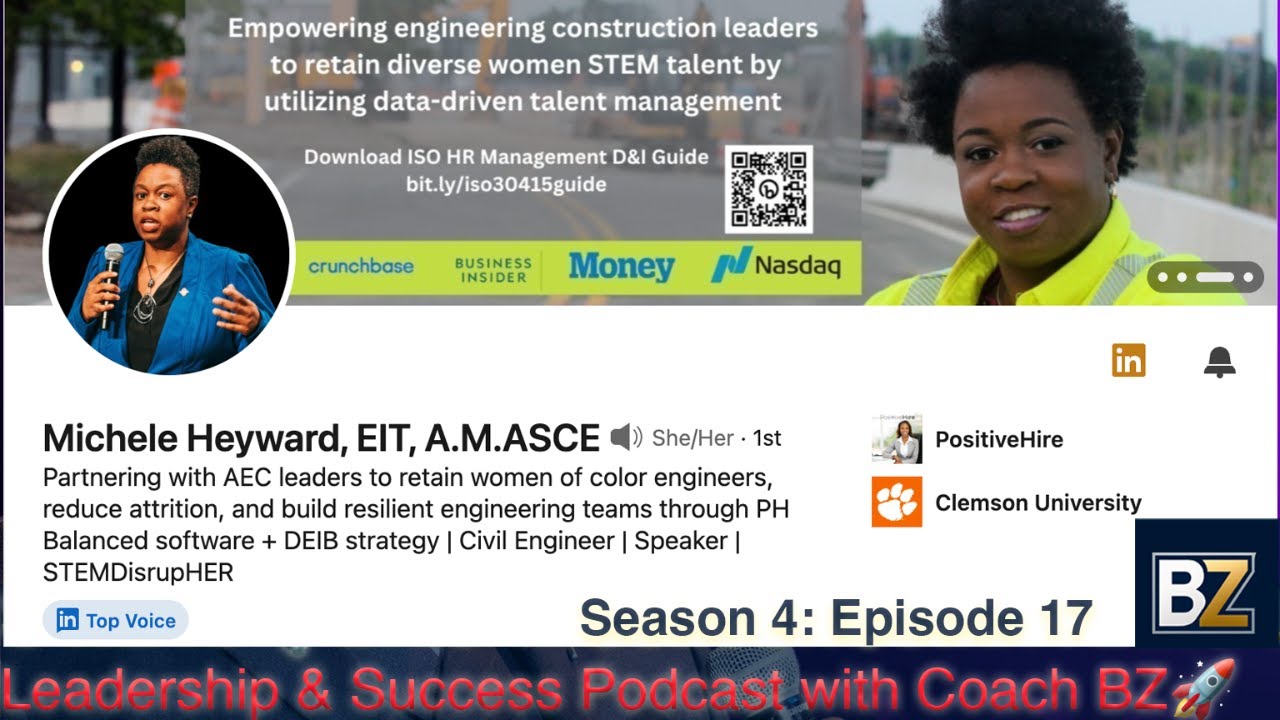
Civil engineer Michele Heyward founded Positive Hire to support women and minorities in engineering, then built PH Balance, a B2B software that addresses bias in design firms. She credits a 2010 leadership video and a mentor named Bob Wood for teaching her that leaders own failures and create psychological safety. Her current focus: training rural Southerners as solar installers and developing AI tools for construction engineers.
Chapters
Hi, I'm John Maxwell. When the top companies in the world are looking for trainers, speakers, and coaches, there's one name that stands above the rest, and that's Maxwell Leadership. Our certified team members have gotten proven results for companies all over the globe, and our reputation I'm proud to say, is second to none. Some of our members have risen to the top of their profession, including the one you're going to meet today. I proudly introduce you to my friend, Bob Fabien Zinga. Welcome to the Leadership and Success Podcast with your host, Coach BZ. If you need to develop into a better leader, this podcast is for you. If you want to achieve a greater level of success,, this podcast is for you. His mentor, Dr. John C. Maxwell, said it best: everything rises and falls on leadership. We hope to inspire you today and provide you with an insight that has the potential to positively impact the trajectory of your life. Welcome to the Leadership and Success Podcast.
All right everyone, this is Coach Bizzy again. So I get to meet you twice today on the same day. So today is a very exciting day because I'm going to be speaking to Michelle A.
Ward.
She is— let me make sure I'm sharing my screen here. She is the founder— hold on a second, uh, sorry, let me replace this with my screen. I thought I already did that. All right, she's the founder of Positive Value, where they find management role for women and minority. And, uh, I am so, so glad to see you. So we've Without further ado, let me bring in Michelle to the screen. Hey, Michelle, how are you?
I'm good, Bizzy. How about yourself?
Fantastic. I guess you're joining us from the East Coast, right? So it's about 12 o'clock here. So I think it's 3 PM where you are.
It is 3 PM.
Fantastic. If you can tell us about your leadership journey to get started.
You know, it's so funny. Um, what is my leadership journey? I can't— you know, it gets to a point sometimes, like, are you a leader? Like, who, who's— who follows you? Or do people follow you? And I always have to pause when people ask me that because I don't know when I became a leader, if that makes sense. Um, you know, because people Oftentimes, especially in corporate spaces, they redefine people with management titles as leaders. And I disagree with that. That is not my belief, that a job title dictates whether somebody is a leader. Leaders, you have more managers in the workplace that are managing things than those who lead people. And I would say for me, the ability to lead people and understand the difference became apparently clear to me around 2010. And so for those that have done sports, oftentimes they learn leadership way earlier than some of us. And so for me, my leadership journey, I would say, started then because that's when my awareness about the difference between a leader and a manager showed up. That awareness was important. While I've had the characteristics and did lead organizations, did lead student groups, did lead in a way in that my former employer, what I gained from 2010 was there's this great YouTube video. A guy out of, uh, Oklahoma City named Scott Williams. I think he goes by OKC Scott or OKC Scott Williams. And he did a video years— because I watched this 2010, so it's old, old— this is the difference between a manager and a leader. And I listened to that video and then I juxtaposed what he said to my experiences. And then I started paying attention to the project that I was on, where it was a vice president, it was a senior director. The senior director was very much a manager, like he was all in the spreadsheets counting all the widgets and things on this construction project. Mm-hmm. VP was like, well, team, today tell me what you're working on. What are you having difficulties with? How can I help you? It was very— and being, you know, that awareness and being on that project at that point in time, I started to see the difference, live the difference of working with the polar opposites, a manager and a leader. Both of them are needed.
Yes.
But sometimes in your career, it's very important to have to to have the right one at the right time. And so I had that leader show up when I really needed to understand. So for me, it started around 2010. His name was Bob. Wow.
Just like me. Cool.
Yeah, Bob Wood. And so Bob was— it was a billion dollar, $1.1 billion program. We were managing the construction of substation. Substations, transmission lines, telecommunications. So all of you that are in the— with electricity, whether it's good, bad, or indifferent, it was one of those projects. And we would get on a call, internal call, and Bob would go, the client isn't happy, I didn't do something correctly. I'm going to be calling some of you so I can rectify the issue that I've caused for the client. A couple weeks later, Bob would be on the— because we were distributed, we were distributed, um, and he would be on the team call and he like, everybody, the client is really happy with your work. You're doing great things. I've shared it back in the home office, the work that you're doing. They're really happy with how we're showing up and we're delivering. And he would be very specific in letting us know when, when there were wins, they were ours. When there were problems, they were his. To solve.
Wow, that is awesome.
And so for me, leadership— I could have been leading in kindergarten, but the awareness of what a leader was, what a leader looked like, what— how a leader shows up in the workplace, it started in 2010 for me. And so I know you asked, like, when did you— like, it started in 2010 when I saw what a leader does and how it shows how that leader can show up.. And so that for me, that changed how I showed up, that changed how I engaged with people, that changed how I, I responded. It's not what problems that are given to you. Leaders respond very differently to issues. Leaders respond very differently to their people. And so that, that for me started with Bob in 2010.
Wow, that is really fascinating. I hope you connected to Bob on LinkedIn and I would like to follow him for sure. So how did you get to positive value of funding, positive value. Can you tell us about that?
Sure. Um, civil engineer, Black woman, didn't— I knew from South Carolina it was going to be difficult, but going through that was very trying, especially construction. So they often talk about— women often talk about the difficulties in tech. Women in construction talk about it. We just don't necessarily talk about it as much as others on social media. Or, or there have been— there are definitely organizations that know about what we do over on the construction side, but it's very much siloed and there are far fewer of us on the construction site. So I literally worked on the construction site and based on my experience as a Black woman in engineering, I created Positive Hire to really build community and the support that I needed when I was in corporate. And so I started Positive Hire officially in May of 2017, but I had been working on it prior to that before I left corporate. So I left corporate officially June— the official separation was June of 2017. I left the last project in March of 2017. And so it really just started out around community, a digital community, doing webinars, live streams, virtual summit, hosted our first Women in STEM Virtual Summit, right on the tails of the movie Hidden Figures. And so that literally was how Positive Hire started. And then from there, out from community, we started doing services. So career coaching, digital courses, and our virtual summit, all to generate revenue because it had to be self-sustaining. Then we moved over to the B2B side because while we were all, women of color were encountering all of these problems in the workplace, we couldn't solve them alone. That required going to the employers who often want to start at recruiting. We do recruitment and start out in recruiting, but now we do so much more. We have our software, PH Balance, which is a talent management software. Where we focus specifically in engineering design firms. We're heading into a huge engineering shortage, and that talent management software is really able to address some of the biases that happen in engineering design firms in that industry and specifically address that. And so we've moved on to people analytics, executive coaching, leadership coaching, and those are sort of the things, some of the things that we do now. Over the last 8 years, we've built on working to solve the problems that women of color have in technical careers.
Wow, that is quite awesome. I also noticed, White, you are a top voice on LinkedIn, which is a very big deal. We have more than a billion users on LinkedIn worldwide, and very few are hand-selected to be a top voice. How did that process go? For you? I know sometimes they even keep you in the dark why you were selected, but just from, from watching, you know, what can you tell us about the VM program and how you were selected?
They keep you in the dark and they don't let you know anything. You just get this random email one day, you've been selected as a top voice, and you're like, wait, what? When did this happen? What? And sometimes people don't know what a top voice was, and I did. So this happened for me when the orange, the community badges were popular. So the orange top voice, the top voices for like AI or leadership, career development were very popular. So I thought it was that. I was like, oh, what questions have I been asking? Like, no, it was a blue badge. So the top voice is a blue badge, which they start around 2016. You get no— they tell you nothing. Like, you get like, hey, we're going to do a call for all the new New Top Voices, and they are— they are— we don't disclose how you were selected. So that's all I have. They don't tell you.
But congratulations, that is, that is a very, very big deal. And I know I've been using LinkedIn almost from the very founding, and initially most of the Top Voices were white, and I see more and more minority and women, which is really, really great. So that is, that is just wonderful. So For the time we have, the first question I normally ask my guests is, uh, what is the greatest lesson you have learned?
What is the greatest lesson I've learned? The greatest lesson I learned is the right people at the right time can lead to your best success. And so too often we don't grow our networks but we outgrow our networks, if that makes sense. Meaning the people we really may need to go to the next level may not be the people that we, um, are directly connected with. And we haven't gone to the places we need to go to meet the next group of people to help us. Sometimes just one person to help us move into the direction we want to go. And it's not even necessarily career-wise, This could be spiritually, this could be, uh, personally, this could be this-wise, health-wise, who— because it's comfortable. And those people are going to challenge and stretch us. And that's been one of the biggest lessons I've learned. I'm not with the right person or right people to help me get to where I want to— where, or where I want or need to be in this particular area of my life. That has been the biggest lesson I've learned thus far in my almost 20 years.
That is such a powerful lesson. My pastor says something similar. He says most people in your life would be like a scaffolding, right, when you build a building. So it's, it's an infrastructure, a structure set up temporarily until you set the foundation and all that. And then after a while, you do have to remove it. And in life, sometimes you do have to, uh, uh, go to where you need to go in order to go to the next level. And you can take every— everybody with you. And that's, that's so powerful. So what do you think is the secret of your success?
The secret, you know, are Type A— do Type A personalities ever have success? We always have, we always have a checklist of things to do and we, we texting our friends like, yeah, I'm doing really good today, I've checked out like 8 of the 12 things. What is— and so I pause and I have Success for me is pausing. Success for me is saying, you know what, keep taking your mid-afternoon naps, right? Like, Michelle, you take a nap? Yes, I take a nap. So what are those things that make you happy that you consistently do? Whether you say you've reached that goal or you checked all of those things off, you're still consistently rewarding yourself for just showing up. And I think for me, the success is also into your growth, meaning you're growing and you're scared doing it. People always like, Michelle, you're fearless. Like, I'm not fearless. I'm scared. I'm just scared doing it. Wow. So success is— for me, has been doing so many things afraid, really, really afraid, very, very scared, but still doing it. I don't know. I guess coming from the rural South and having a mother and a family that I have, if I got an opportunity for something, I would call home. I remember calling like, Mom, I have this opportunity to do this tech transfer thing through NASA. And she was like, yes. I said, but it's in Massachusetts. She was like, so it'll be cold. We'll buy you two coats. Like, not understanding. I'm like, snow? And having to drive in snow? Like, I would have never done it. So my mom was like, just go do it. And I did it. Hate the cold. Yeah. But for me, I look back now, that was 2002, 2003. And having the right people at the right time. Pushing you to do stuff scared. And I, and I, I don't want to drive in the snow scared. So, wow. So for me, that, that's what success has been. It's been continuing to move forward, but also positive and taking naps at the same time.
No, that is, that is very, very powerful because my, uh, mentor, at least one of them, Tony Robbins, says it all the time, you know, feel the fear and do it anyway. That's how you become successful. Because so many of us, we get paralysis by analysis where we just get stuck. We are so afraid to do anything, we do absolutely nothing. But as you do something, even if it's very, very minuscule, even if it's very, very small, being consistent with it, in time, eventually you will succeed. Wow, that is really, really great advice. Now, you already talked about one of the first leaders you met and saw, Bob Fabien Zinga. In action about how when everything goes well, he shares the praise with the entire team. But if anything goes wrong, he takes all of the blame. That's really the image of a true leader. Is there any other great leadership advice you've ever received or observed?
So I'll do one of Bob's. Bob was very like, you have to make a decision. If you make a wrong decision, you have to make another decision. And he's like, but it's to a point where you make so many bad decisions, you need to stop and ask for help. And he talked about the engineer that had worked for him that had like 3 bad decisions in a row on a project, and he had to step in, intervene. He was like, I was watching it happen, and I was like, okay, he'll come and ask for feedback, for help. And he didn't. And he was like, it wasn't that he was failing, it was the fact that he would not ask for help. There is no shame asking for help. Um, and so when leaders— he said for him, stepping in as a leader felt was the last thing he had. That was the last resort because he felt that he had, or he thought he built enough rapport and a place where the engineer would have stepped forward and asked for help. And so some of the things himself, he said, so please ask for help. Or ask a question just for clarity and, you know, check if you aren't sure before you go make the decision. But one, one bad decision after another, after a certain point, ask for help if you're not. And maybe you're asking the wrong for help. And so that was the thing, he's like, it's okay to fail. And that felt really good to know you could fail, but, but he would be okay with that as long as you were looking at some point either to correct it, you're trying to correct it, and/or got to the point where like, you know what, I can't figure this out, let me go ask for help. So that was one, it was in a corporate space for a leader to tell you that it's okay to screw up and fail, it's going to happen. I had never heard of that in probably my 32 years of life at that point.
Wow, that is very, very, very, very powerful. I really love Bob. I hope he's on LinkedIn somewhere. We We need to follow him.
He's like 80 at this point.
Oh my goodness. I hope he's written a book or something. I always love to read books or to buy biography and just learn from great, great people. But that's really the thing about leadership, right? That's part of the reason why I have this podcast is everything I've learned since I was like 17 years old when I took leadership and success pretty seriously and how can I share it, right, for the next generation. That is so important. But, but really what you talked about is, uh, creating an environment of psychological safety where it's safe to fail and it's safe to say, I am human, I make mistake, I don't know everything, and can you please help me? And then together coming up with a solution. That is so powerful, isn't it?
It is. And you know, you bring that up now, we talk about it as psychological safety. 2010, it wasn't really a thing. In construction, we talk about safety all the time. This is a safety culture. But you can't talk about somebody screwing something up. Now they're getting written up. If you have a safety violation, you got to take the day off, paid or unpaid. Like, you talk about a safety culture, but psychologically it wasn't safe. So it's very interesting to talk about it now, especially in the architecture, engineering, construction. Psychologically safe. Like, we don't have that. We have a long way to go in that industry.
Well, it's been quite a lot of progress. So question number 2 is, I know leaders are learners. What are you learning right now?
What am I learning right now? What am I not learning right now? I'm going to be like everybody else. I'm learning AI. Actually, I'm learning AI in a different way. And what I mean by that, we're trying to understand better with the engineering talent shortage, how do we leverage AI for engineering design? We know a lot of infrastructure work negatively impacts Black communities, Hispanic, Latino communities, socioeconomic challenged communities, how do we take data that is harmful and has been harmful for generations and not put it into a large language model to design something, right? Like, okay, is that the right approach for us? Or do we not use, or use AI in a different way when it comes to engineering design? And really having those conversations about what is the best way to utilize it. And so for me, I have just been like, you know what, I'm just going to build something that I know would have helped me in my least favorite role in my career as a construction engineer. Everybody like, oh, that sounds fantastic. You were out watching everything get built. No, I was doing paperwork. Wow. A construction engineer does more paperwork You're— you have to, like, for all the contractors, when there are new drawings, you, you have to try— you have to make sure that all the contractors get the new set of drawings. So you got to make sure they're printed in triplicate. They, they have all the different sizes. You have to make sure they sign off on it when they receive it. Then you have to put it into the system to say they received it. That means they're responsible for any changes that are on those drawings. Um, if there's requests for information, something that's in the drawings and specifications. You have to trans— you are the one that is communicating with the design engineer and the contractor to get it, get a clarification on that. You are documenting the drawings on site. You're doing like, hey, the concrete didn't do this, so you're doing non-conform— you're not conformance report. You're doing all of this paperwork, Bob. It's aggravating. So literally this past weekend I said, you know what, I'm gonna build a tool. And a friend and I talked about this He's still in construction full-time. What if I just had a tool to do all these damn reports? I just worked on a tool this week to just— all I want to do, I just want to be able to pick up my phone and talk, talk my request for information report. You type it up, I'll check it, and then I'm gonna submit it. I don't want to type it. I have enough paper. I just want to be able to talk through what goes on. Like, literally, that for me is more powerful as an engineer than having it figure out the taking data in an LLM that is going to be harmful to how we design the next highway. It doesn't take into account who lives there, the impact of pollution as vehicles go by, any of that. Let me just work on documentation for a construction engineer who's overwhelmed with paperwork. And so for me, it's like this to me may be the least harmful.. And also just having conversations for me around AI within civil engineering community. So American Society of Civil Engineers in our forum have been a couple really great posts. Like somebody asked like, how do we get older engineers to use AI? I said, what we using it for? What's the use case? Yes. If you don't have a use case, I said, you forget we're Gen Xers. We were just— some of us learned the slide rule. And so we were the first ones using CAD to do the drawing. You have to tell us the use case for AI. And so I said, not to say we don't use it. We've used all the technology more than you guys. Y'all don't know how to do it without the tech. We do. A good use case for doing it. And so just having those conversations in civil, because everything we do impacts everybody and we have to be conscientious. And so my question was, as a civil— my point was, as a civil engineer, we know some of the large language models use a hell of a lot of water and electricity. How do you as a civil engineer making sure you're using a large language model, LLM, that doesn't negatively impact us long term? Tell me that. And left it. Because that should be your first thought is how to protect the environment, how to protect people, of course, you use AI to do your job.
Wow, that is quite powerful. Okay, that leads me to my third question. How has failure shaped your life? Because most people, when they look at the leader like you, they just look at all of the successes and all of the good things you are doing. But I am pretty sure you've had to go through periods of failure as well. So can you tell us more about that failure in college?
Failed one or two classes. That's how I knew I was in civil and not mechanical. Failure in college was a D, so you had to retake any class that you did not get a C or better in. That was an engineering course. So that was like, yep, I picked the right class because I really had struggles with a class called dynamics. So it's more motion moving. So mechanical engineering class. So that, that helped me realize I was in civil engineering where most things are statics. First, that was the first indication. And my mom's not understanding why I have this grade. She's never seen— like, my college is engineering is really, really hard. And so that, that was a change. And my mom's an educator, so she really is like, what did I— it's a reverse function on her. And it's like, Ma, it's not a reflection on you, it's just engineering. So that was, I would say, an early failure for me in higher ed and college. Then in my early career would be my second role in construction. I really, really struggled on this project. It was the project that Bob was the leader on. I struggled in a role, and Bob came to me and said, hey, I want you to take this construction engineering role. Should have known something was wrong when a VP asked you to take a damn role. So I took that role, and I did so well at it. Um, I remember Bob calling me. I was driving, I had a company vehicle. I pulled over, I was in Texas, I pulled over the side of the road. He was like, Michelle, he was like, I don't know what happened in the last role. He said because I'd done really great in the first project I was on. Then I came to a new project, um, same job title, just some of the different, different team. He said, I'm not sure what, what the issue was, but you're doing really well on this project. The client is loving what you're doing. He said, so I want you to go to this next project. He's like, we're— we haven't quite, um, we can't bring you on yet, so I want you to stay and just close out this project. Right. He said, so when we're ready to onboard you, I'll let you know. You'll get everything from HR so that you can join the next project. And so sometimes, like I said, it has to be the right people at the right time for things to happen. So when I say I was failing, like, I couldn't sleep at night. I was praying. I was reading scripture like, Lord, what am I not doing? I probably listened to more gospel music than I ever listened to in my life. To go into work just trying to find, like, what is— and even asking for help and not getting the help that I asked for from my manager at the time. Um, so Bob intervened. They were going to move me— I was in Tulsa, Oklahoma— they were going to move me down to Austin, Texas, to sit with a manager in that off— that, that office. I'm not sure what happened. Bob came to me shortly thereafter and said, hey, I want you to take this role instead. Wow. So yeah, so again, broadening your network— this is still at work— but also the right people at the right time.
Yes, actually, I believe I was talking to Anne Leslie this, this morning. She lives in Paris, so it was 3 PM over there, 6 AM here. But she also said some— something that touched me. She says there is an element of chance, I guess, in success, kind of luck, uh, in, in, uh, in a way you're saying right people at the right time. I guess it's not really something that some— someone can control and make happen, right? It just happened. And I know, uh, you must be a Christian. You talk about listening to gospel music and praying, which I do too. But, but it— I guess the, the way I would maybe express this, it looks like there might be some things that we as human beings can do to maximize the chances for those lucky breaks, for that chance, for that success to manifest. What are some of those things you think people should be doing just to maximize their chances of having breaks like that? One thing you mentioned earlier is having a network, because if you don't know anybody, nobody knows what you're going through, there will be no Bob Fabien Zinga, right, to come and help you out and put you on a project that truly doses not just your weaknesses, but your strengths as well, and can move you from one role to another where you just flourish and do extremely well. But anyway, I'm gonna put you on the spot, but I know luck and chance, there is really nothing anybody can do about that. But is there anything that an aspiring leader can do, or things that they can control, that they can take action on to prepare for an opportunity?
So that's just it. Those are opportunities come to you, take them, right? And so what we often see is, I was afraid, so I didn't take it. We usually regret the things we don't do more than the things we do, right? Most people like, oh, they'll tell you that one or two things that they regret not doing But they'll, they'll tell you, um, 100 things they regret doing, like what they ate for lunch, who they may have, um, dated, a car they may have purchased. But it's very seldom does that happen. And so what I find, what I have found, is the unexpected is when you say yes.
Hmm.
The unexpected is when you take that chance. Down. Um, and sometimes people— and it's a differentiator, right? Sometimes you are literally jumping out of the frying pan into the fire, so you have to have that discernment. At other times, we know that, or you have experienced that, when opportunity comes once and you accept it, it continues to come. And people like, you always get these great opportunities. I have had people who have come to them and it's like, oh, I don't want to do this. This is something Michelle would do because Michelle always does stuff like this. The stuff that I do is the opportunities that comes from people that are too afraid to take the opportunity.
Yes.
For whatever reason, they don't take the opportunity. And so I say being ready doesn't happen. Being ready to say yes to the opportunity is all you have to do. Everything else, go to Goodwill, find a suitcase. These days you can do a GoFundMe to get, get a plane ticket or a train, train ticket or whatever. So do those. Just be very strategic and creative on closing the rest of the gap, but say yes to the opportunity and figure the rest out. Just build a plane. Once you know what the destination is.
Yes. Wow, that is really, really, really powerful. Thanks so much, because I do think there is an element of success that really has to do not really with your technical skills or even experience, but just the way you think, right? Your mindset. And, uh, wow, that is, that is, that is powerful. Thank you so much for, uh, sharing that. So, um, Who do you know that we should know? Who are you following right now? Who are your mentors or thought leaders or podcasters that you listen to?
I would say definitely Minda Hart, who wrote— the author who wrote The Memo. Definitely should be following Minda. Oh, the Modern Figures podcast with Dr. Jeremy Waisum. Jeremy is a woman. She has a PhD in civil engineering. And Dr. Kyla— oh, why am I drawing a blank on Kyla's last name? But they talk to mostly Black women who have degrees in computing. Wow. So if you remember the movie Hidden Figures— yes, they, they call it Modern Figures. Like, these women do exist, and they bring them onto their podcast and they interview them and you get great conversation. Some of them have started, um, tech companies. Some of them are like, uh, Dr. Kyla and, and Dr. Waisom. They are professors at the University of Florida. And so they bring in women that people say this, they're really Black women that do exist here in the U.S. And so that would be another podcast I would say, and women you should follow. Um, I would say the group um, for Black women in computing is Black Computer. So instead of computer, C-E-R, is put an H-T-H-E-R, ComputeHer. Um, definitely check them out. That is a great organization. They focus again on really building a community around Black women in computing. I would say another podcast Now you got me looking at my podcast list.
No, this is great. And if anything else comes to mind after this interview, please go back to the LinkedIn event and just add it in the comment. But just to recap, you gave us so many. So you said, I believe it was Donda R. wrote the book, The Memo, right?
Yes.
And then you said Dr. Jeremy Wilson. What was the name of her podcast?
Modern Figures Podcast.
Oh, just the same thing as a movie. Fantastic. Got it. And then you said Dr. Kaila from the University of Florida. I'm assuming it's the same podcast, right?
Podcast. And both of them are professors.
Very, very good. And then Black Computer. Thank you so much for sharing that. This is always very helpful because, again, my mentor told me that leaders are always learners, and I always like to know what other podcasts and people I should follow and who I should— yeah, so this is, this is great for my audience. So another question kind of related to this is, if you could choose 3 people to have dinner with, just 3, that could be alive now or from history or even mythology, who would you choose and why?
First one would be Tupac Shakur. Um, so in a short— number, number one, I loved him, his, his rapping. So I'm a huge fan. But he was raised by a Black Panther. He went from dancing to rapping, right, in his career. But when you listen to different interviews that he did he understood a lot of the problems we're seeing today politically. He was talking about it in his 20s in the 1990s. Ah, and we are 30 years later, and you can go look at a recording of something Tupac said in 1995, '96, and be like, wait, he said this? Yes, he said this 30 years ago. And so it's really important And on top of that, him and Nikki Giovanni published a book of poetry. And so it was so many different dynamics around Tupac that people don't know. So that would be the first person I would, I would have, um, dinner with. The second person I would have dinner with would be my late maternal grandfather. He died before I was born. He had his own construction company and he purchased 100 acres of land. My mom's not sure how he was able to purchase 100 acres of land in South Carolina in the time— in, in— and so really understand what did he do. Like, he built our family church, um, the Klan came and burned a cross in the yard because he was working on getting a school bus for my mom for their community so the kids didn't have to walk to school, so they burned a cross in the yard. Like, what was it for him to be able to do just those things and then others that I haven't mentioned during that time? Like, what was his strategy? Who was in his network? Who was he friends with? How did he leverage that to be able to do those things as a Black man in South Carolina during Jim Crow? So that would be the second.
Incredible. Wow. And one more.
Um, yes, the third one would be Ursula Burns, who was the first Black woman CEO. She was at Xerox at the time. She's still alive, so I definitely love to have time with her to understand. She spent her, her entire career as a chem— she came out as a chemical engineer. Like, what was that like, you know, seeing all of the generations and the industry change become the first Black woman CEO of a Fortune 500 company? What was that like for her? And so really just have a sit-down conversation, um, and learn from her and her experience.
Yes, Ursula Burns, she's awesome. I believe she is actually on LinkedIn too. Uh, I, I will find a profile and add it to— yeah, that is very, very— wow, that is something. Okay, uh, we're out of time, let me go. So Question number 5: What is the best book you have read recently? Or which books would you recommend my audience to look into?
Recently? Okay, I'm just gonna go with my favorite book. I have not finished a book recently, and as Michael Hyatt said, if you're not finishing a book, it's not your fault. That's on the author. Like, it's not your fault you didn't finish the book. I can tell you a couple just from a leader's perspective, and these are oldies, but good to great. Yes, I love Good to Great. I love the way Jim Collins says, get them in the wrong order. No, you did them in the right order. Because again, a leader doesn't know they're a leader. They're just doing what they think they need to do for their people. And so Good to Great would be the first one. And then just nerding out a little bit would be Freakonomics. Reading Freakonomics changed how I look at the dynamics of numbers and data. Being an engineer, like, what does this really mean? What could it mean? Let's go dig deeper and understanding the impact. Some of what I probably need to reread. I probably will reread it and really look at now economics in terms of artificial intelligence and large language models and data centers. And what is the data saying, or, or what are we missing in the data that is provided and what data isn't being provided? So we don't know that sometimes, oftentimes they're not telling us or sharing with us the amount of water the data centers are using. So it's really important to understand some of those dynamics as well. I'm gonna go with those two oldies but goodies. Wow.
That is, uh, what about you are listening to? You already mentioned a couple of podcasts. You can mention another podcast or a, a song.
Um, another podcast. This is strictly just around women founders. The host is— her name is Alex Baddorf. Her father was German, so she's a Black woman. Alex Baddorf. She has a podcast, Get Shit Done. It's really She Gets Shit Done, but she goes, get shit done. And it really talks about women who bootstrap their businesses to millions. And the startup space is always around, often around raising venture capital. And she was like, you can build multimillion-dollar businesses with intention without having to get investors. And so she often, most often talks to women who have done that. Um, and they'll say, oh, well, you're building a lifestyle business. She's like, what's wrong with a $10 million lifestyle business? She's like, it just sounds insane when people say, oh, Oh, it's just $10 million. Like, she's like, that's insane. She's like, that's just greed, right? And so she's like, don't be afraid to build a lifestyle business if you don't— if you want $10 million. So it's really great. I love Alex and yes, she brings the women she brings on to really think about approaching how we build our businesses that are best for us in our femininity. So I, I'm— wow, aspect of it.
That is pretty cool. So if you had to choose one, either a song, a movie, or a book that would be your life's theme or anthem, what would you choose?
Oh, that's easy. Um, oh wait, I think, I think it's not. I'm, I'ma go with my usual, which is Mary J. Blige, Everything Is Everything. It is slower ballad, the beach. I love the beach, love being at the water. Beach, ocean beach, not a lake beach. I just— inland. But it really just helps you say, you know what, for me as an A-type person, don't focus on your checklist. Everything's everything. It's going to work itself out. Just let it go. And that is just one song that really, really takes me there and lets me do that.
Any movie?
Any movie?
Or book that would be your last infam or fam?
I would say movie, it would be Hidden Figures.
Yes.
I definitely love that one. Oh.
Any book?
My First Million, Arlen Hamilton.
Hmm, like that. We'll definitely make sure to—
did I switch her? Did I switch the book authors?
You said My First Million, right? Yeah, I'm thinking that, uh, according to Amazon Listen, I, uh, I will find it and add you. Making My First Million by Brian Kaufers?
No, that's definitely not it. It's a Black woman.
Oh, I Made My First Million by, uh, Ewen Kea? Is that the one?
No, I'll find it and I'll, I'll send it to you.
No, this, this is, this is a great, uh to know. All right, so okay, we are getting towards, uh, the end now. Um, question number 6: so what is one action that you are thinking about taking that you believe will positively impact your life?
Getting back to weightlifting.
Hmm.
I pre-COVID, I, I, you know, I was I like the weight room. It relieves so much stress for me. And during COVID of course, we're closed up. I end up eventually canceling my membership to the gym. Couldn't go, wouldn't go. But lifting, deadlifting, bench pressing, leg pressing, all of that. Yeah. I have the spin bike in the room. But literally just not having a weight bench, that changes. It just relieves so much stress and I sleep way better at night. And so that's what that to me is going to change where, where I'll be in the next 6 months. Back to, back to weight.
That's really great advice because my wife was telling me too, you know, at a certain age, looks like women more than men, they start losing bone mass and density as well. And weightlifting might, might help. But wow, that is, that is pretty cool. So, uh, when you wake up in the morning, what is one problem you would like to solve?
When I wake up in the morning, what's one problem? Tomorrow morning or just every morning?
Uh, okay, let's say tomorrow morning. What is the one, one problem? I know you're a type A person, you want to solve everything, but I want you to focus on one and only one. The most important problem for you now?
There's something I'm working on right now about training 100— 1 million people in rural America.
Wow.
To— in solar, into solar energy. So being solar installers, repairing solar panels, because as the climate crisis gets worse, We're going to see more power outages, and we need to be able to have our own self-sustaining energy sources that we can repair ourselves. And so that, to me, being able to have a million people in the rural Southeast being able to do that will save lives. And so that is one problem I'm actually working on a year ago. More than a year ago. Wow.
Yeah. Now you in South Carolina, it looks like you should be moving to California because I used to live in Alabama. They don't, at least back then, they didn't care much about the environment at all. Here we are all solar panel and we do recycling and all of those things that we didn't do in Alabama at all. But this is really, really great. Even when you talk about artificial intelligence, you're thinking about how much water they are actually using and electricity and resources though. Nobody thinks, thinks about that.
So that's, that's really great because they think in plethora of resources that we have, not asking how much or being beholden like, oh, this place, this, these big companies are coming in building this stuff, we're special. No, you just have a plethora of resources they can utilize, and you have a smaller population that won't realize what's going on, unfortunately, until it's too late for many of us. And so that, that's why they like us, because we don't know any better. Um, the state of South Carolina has grown its solar, um, and last year, previous administration won $124 million. Wow. Solar for All grant. Don't know if we're gonna get the money. Don't know if we're gonna get the money, but. But even prior to the COVID there is a 90-acre solar farm. Wow. And so there is solar popping up around the state, but it's not enough people locally that were hired to do the work that have been trained to do the work or know how to maintain those. As we see, thank hell that'll break open., right, that can do that repair work. So it's really important that we really localize our talent and that I mobilize more quickly to do those repairs and upgrades as necessary.
Wow, that is, that is really wonderful. I, I really like, uh, this new self because, uh, it's very important. We only have one planet to live in and we have to take care of it. I know Elon Musk wants to take us to Mars, but I like planet Earth so much. I think we need to really care for it. So, uh, Another question along those lines, then, uh, the last question for Section 6 is: if you had one day and only one day to live, what would you have liked your final contribution to be?
Rest. I know that seems weird, um, if I only had one day to live I was born that same day. You're like, yes, I'm born that same day. I think having that day be of peace, right? And literally just sitting there, even watching children walk, play, and laugh and be joy, right? Just being at peace in that one day, not seeing the hate the war, all of that, I think that would drain more. Even though it's 24 hours, those 24 hours would be much heavier. But really just having a happy, joyful 24 hours.
Um, that is powerful. All right, we only have 5 minutes left, so one important question I need to ask you is, how can we add value back to you?
Sure. If you are in the engineering or AEC space, architecture, engineering, construction space, I would love to connect with you. I want to know how are you and your leaders working with this engineering talent shortage? Like, what does that look like for your organization? Had a conversation today, organizations are so focused on recruiting, and we're like, who are you recruiting? We don't have enough talent in this space, and we have to rethink how do we retain our talent and how do we get the work done? So I'm talking to people in this space to understand. Like I said earlier, everybody's talking AI to do what? What are your thoughts about it? What are your questions? And then what are you doing to retain your talent? Because that is truly key. When we look at women in engineering, 30% of women in engineering leave in their first 10 years. That's a lot. But more women leave between 10 and 20 years in engineering. 40— nearly 40% of women leave between 10 and 20 years, which is mad. People like, wait, what? It is that high? 70% of women that we really need right now left years ago. I left at 15 years. So we have to better understand how to retain the talent during a talent shortage. We can't focus recruiting because the people aren't there to recruit unless you're trying to bring the 70% of women that left back to the industry. And that's a bigger— yes, yes, get the focus on retention. So I would love to talk to better understand how your organization is, is focused talent right now in the industry.
Good, good. That's definitely gonna solve a very critical problem in the industry. Okay, we are toward the end. I have 3 minutes left. I think we can do this. So really quickly, 3 adjectives that describe you as a child.
Oh, that describes me as a child? Um, imaginative.
Mhm.
Quiet. Sweet too. I know that's not gonna work.
Okay. As an, as an adult?
Um, not quiet. Um, vocal. Um, I would say power player.
Strategic. Now, one thing that comes across, you have a lot of confidence. And I know that's one of the reasons why I asked you about how failure has shaped your leadership. A lot of people listening to me right now, they want to become— most majority, either tech leader or in the military, right? So what advice would you give them when they have to deal with, I guess, imposter syndrome, or they're not good enough, or they, they have doubts or fear. What, what, what has helped you in your journey that you can kind of, uh, pay forward?
If you're listening to people around you in your area of, or your career, your niche, your industry, and you know more than most of those people, be confident in what you know, because they're the one with the money. And people are listening to them and you're like, wait, that's completely wrong, or that's half wrong. But you— they're like— but they're confidently— they're confidently sharing the wrong information. Don't argue with them, just start sharing the right. Figure out how to get on a podcast, a live stream, in articles to share the correct information. My confidence comes from people that sharing the wrong information. Wow. Yeah, that's what my— like, I know I'm right.
Wow, that is— that is powerful. Okay, we have 1 minute left. This is a very, very last question. So give me 1 word that to present our shared experience in this podcast together? One word.
Fun.
Good, good. I think mine would be, uh, humility. Uh, yeah, I've really— I've learned a lot from, from you this, this past hour, and thank you so much for taking the time, Michelle. Very, very, uh, grateful. And, uh, we know we have to let you go, so, uh, until next time. I'm probably going to plan to be back here tomorrow at 6:30 AM Pacific time, 9:30 AM Eastern time, and I'm going to make sure to add everything that Michelle has recommended for you, all of the podcasts, movies, music, and all of that in the article I'm going to be writing afterward about our time together. Thanks again, Michelle, and I really do appreciate that. And before I sign off, I just want to triple-check. Yeah, Nobody has asked a question on LinkedIn, just wanted to make sure. And thanks, thanks again. See you guys tomorrow, 6:30 my time.
Bye. Thank you for listening to the Leadership and Success Podcast with your host, Coach BZ. If you like what you heard, please subscribe to our channels and come back for more wisdom nuggets on how you may develop into a better leader and achieve greater levels of success. Leadership is the most critical skill. The world will always need leaders to lead others, deploy the next disruptive technology, or execute a business strategy. You may as well decide on counting yourself among the 21st century leaders. See you right here next time on the Leadership and Success Podcast with Coach BZ.
More from Bob

S250:E4🎙️LIVE 🇺🇸America 250: President Barack Obama Leadership, Service, and the Power of Hope






S5:E157🎙️ LIVE with CMD CMSgt Dennis L. Fritz, USAF (Ret.)(Multi Tracks Audio)



S5:E156🎙️ LIVE 🇪🇸 Leadership Lessons from the FIFA World Cup 2026 Champions (Multi Tracks Audio)

S250:E3🎙️ LIVE Leadership Lessons from America’s First Documented Family of African Descent 🇺🇸📖