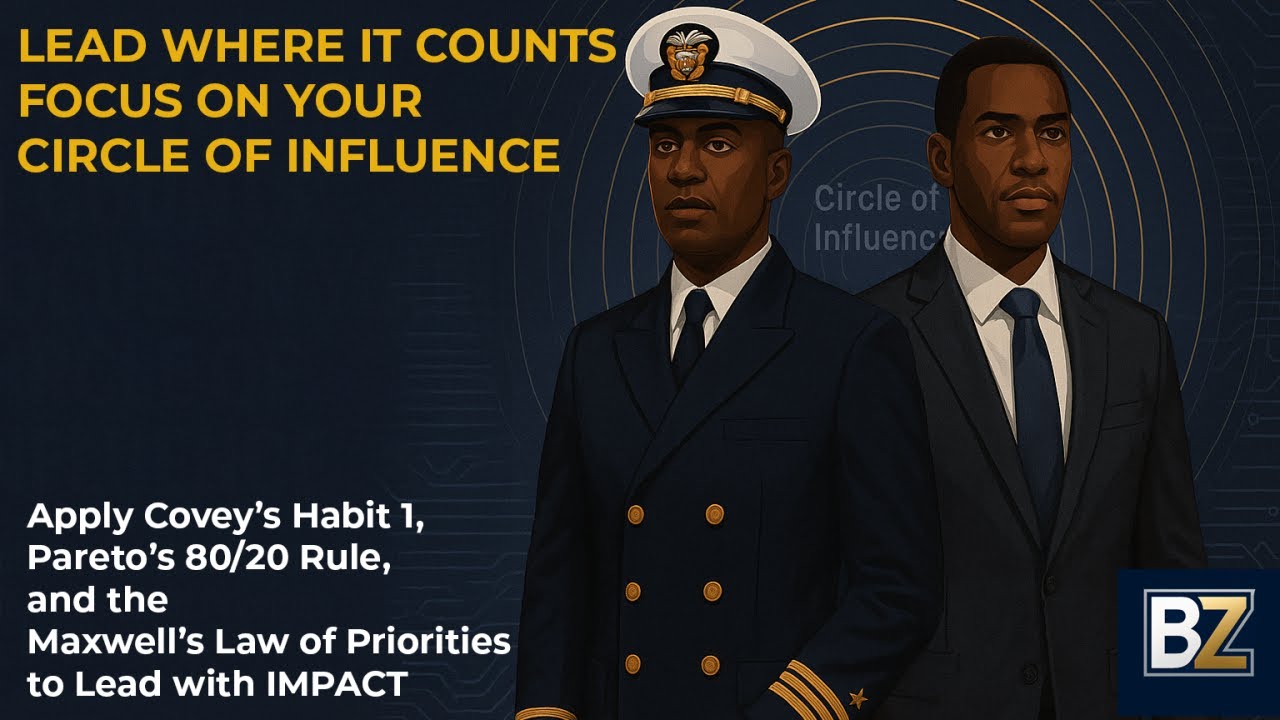
Coach BZ explores proactive leadership through Stephen Covey's circles of influence and the 80/20 principle, showing how focusing on what you control expands your power over time. Real examples from naval command and cybersecurity illustrate the trap of mistaking busyness for achievement, with tactics like daily planning and the ABC task method to reclaim your attention.
Chapters
Hi, I'm John Maxwell. When the top companies in the world are looking for trainers, speakers, and coaches, there's one name that stands above the rest, and that's Maxwell Leadership. Our certified team members have gotten proven results for companies all over the globe, and our reputation, I'm proud to say, is second to none. Some of our members have risen to the top of their profession, including the one you're going to meet today. I proudly introduce you to my friend, Bob Fabien Zinga.
Welcome to the Leadership and Success Podcast with your host, Coach BZ. If you need to develop into a better leader, this podcast is for you. If you want to achieve a greater level of success, this podcast is for you. His mentor, Dr. John C. Maxwell, said it best: everything rises and falls on leadership. We hope to inspire you today and provide you with an insight that has the potential to positively impact the trajectory of your life. Welcome to the Leadership and Success Podcast.
Imagine gaining the leadership skills that could redefine your career. Join Coach BZ on the Leadership and Success Podcast, where each episode delivers practical insights from world-class speakers, military leaders, and industry experts. We dive deep into what matters most: building resilient teams, leading through uncertainty, and navigating complexity with clarity and confidence. Every conversation is crafted for aspiring leaders like you who are ready to grow, lead, and make a lasting impact. Don't miss our powerful live sessions and recent highlights. Michelle Hayward on building diverse, high-performing technical teams. Anne Leslie on leading through global complexity and cybersecurity risk. Ron Carpenter, AI, exploring faith, resilience, and AI-powered leadership. Colonel Michelle G.I. Gardner-Intz on commanding influence from the battlefield to the boardroom. Chris Robinson on shifting from drift to drive in life and leadership. And Coach Enrique Acosta Gonzalez on mentorship, legacy, and heart-centered leadership. Ready to level up your leadership journey? Tune in on Spotify, Apple, Audible Podcasts, YouTube Live, and LinkedIn Live. Join the movement toward leadership excellence. Listen now and start transforming your success.
Hey everyone, this is Zen Coach Bizzy. Thank you so much for being with me, uh, this morning. Today is Wednesday, July 2nd, and I'm gonna be talking today about one of my articles. Let me break it down for you so you should see it on the screen right here. This is going to be about proactive leadership, right? Focusing on what you can control. Uh, it's very important as a leader to really have your focus on things that you can actually change. There are things above your control you can do absolutely nothing about, and don't waste your energy, your time, your intellect trying to work on those things. But this thing that you can control, that's what you really need to be focusing on. That's really the gist of this article. So we're going to be talking about how your focus fuels or drains your leadership. And we're going to be talking about the circle of concern and the circle of influence, right? And you want to focus on the circle of influence, things that you can actually change. And then I would also be talking about the 80/20 rules. First time I heard about it was from my mentor Brian Tracy, uh, the law of priorities, right? Um, basically, uh, 20% of, uh, the task you need to do could give you up to 80% of the results you are seeking for. So your job as a leader is to seek for the 20% of those tasks that will give you 80% of the result you are seeking. Uh, very, very, very important so you can be effective and focus your energy on the most important, most critical task that will give you get you closer to the results you are seeking. And also, I will be talking about some of the wisdom I received from my primary mentor, Dr. John C. Maxwell, Brian Tracy I mentioned, and Tony Robbins, what they say about intentional focus and influence. So again, that is what we are going to be talking about today. I'm going to have my AI agent break it down for you. So I'm going to have Mary and Drew AI. Mary and Drew, you guys are next.
Have you ever felt like you're constantly, you know, just stuck in reactive mode?
Oh, absolutely. Like your day is just putting out fires one after another.
Exactly. That never-ending game of whack-a-mole, responding to urgent emails, sudden demands, this endless stream of things that are just completely outside your control.
Mm-hmm.
It's that feeling of being pulled in a million directions at once.
Yeah. Where you feel like you're not really steering your own ship. You know, you're just sort of drifting along, reacting to whatever current sweeps you up.
Right. Overwhelmed is probably the word most people use.
Totally. Well, if that chaotic, overwhelmed feeling resonates with you, then you are definitely in the right place today.
Good. Because we're diving into something that can really shift that.
We are. Today we're embarking on a deep dive into a concept that honestly, it can be truly transformative. Proactive leadership.
Mm-hmm.
A fundamental shift.
Our mission here is to fundamentally shift your perspective. We want to show you how to master your focus and dramatically expand your influence.
But not by trying to control everything, right?
Yeah.
That's the trap.
Exactly right. That's just exhausting, and it doesn't work anyway. It's about rigorously concentrating on the critical few things you can actually control.
That's the key. Focusing on what's in your control.
Our main source for this deep dive is this incredibly insightful article called "LEAD: Proactive Leadership: Focusing on What You Can Control." Ah, the one by Bob Zinga, BZ. That's the one. Bob Fabien Zinga, BZ. He's a cybersecurity executive, but also a US Navy commander.
Right. So he's seen this stuff in high-stakes situations, not just theory.
Precisely. What makes his insight so potent isn't just the impressive resume, it's that this wisdom was like forged in the real world, places where messing up has immediate consequences.
Yeah, no room for error there.
And what's really cool is how he pulls it all together. He doesn't just give his own take. He masterfully weaves in wisdom from all these renowned thinkers and leaders.
Like who?
Well, figures like Stephen Covey, John C. Maxwell, Brian Tracy, Tony Robbins, even timeless biblical proverbs. It's this amazing blend.
Wow, that's quite a mix. Ancient wisdom, modern application.
Yeah, exactly. Distilled into really actionable strategies. So our objective today is clear. We want to unpack these powerful, actionable strategies that can genuinely shift you from feeling powerless and reactive to becoming highly effective and proactive. You got it. A proactive leader. And this isn't just for, you know, CEOs or military commanders.
No, these principles are universal.
Absolutely.
Whether you're navigating complex work projects, leading a team, maybe building a business, or even just trying to nail some significant personal goals.
Mm-hmm.
It applies everywhere.
The aim here is really to help you cut through all that noise, you know, the daily demands, the distractions, and zero in on what truly drives results and expands your impact.
Okay, I'm ready. Let's unpack this.
Yeah. Get ready for some truly, uh, surprising and actionable insights, things that can fundamentally change how you approach your day, your work, your life.
And what's truly fascinating here and what I think gives these principles their real staying power is how they transcend specific situations.
Right. They're not just for one field.
Exactly.
Yeah.
We're talking about timeless principles of human behavior, of effectiveness. Some go back centuries. Right.
But they're being applied and proven today, not just in theory, but, but in high-stakes environments.
Military command, cutting-edge tech development, boardrooms. It doesn't matter.
That blend you mentioned. Ancient wisdom, modern proof.
Yeah, that's what makes them so relevant and practical for anyone who wants to lead effectively, whatever their challenges are. Yeah, it's really about fundamental human behavior and maximizing your own agency.
Agency, reclaiming that feeling of control.
Mm-hmm.
Especially in a world that often feels designed to make us feel completely overwhelmed.
Okay, so let's kick things off with what is arguably the absolute bedrock, the foundation of proactive leadership.
Where do we start?
Well, at its heart, being an effective leader means taking absolute charge of your focus, your energy, and your actions. It's about consciously deciding where your precious mental and physical resources actually go.
Not just letting circumstances dictate things.
Exactly. Or even just habit. Not letting habit dictate your path. And the perfect starting point for really getting this comes from Stephen R. Covey.
Ah, the 7 Habits guy.
The man himself. The 7 Habits of Highly Effective People. His first habit, be proactive, isn't just like a good suggestion. It's the foundation. Everything else is built on it.
It really sets the stage.
It does. It emphasizes that effective leaders choose their responses. They don't just react. They consciously focus their time and energy on what they can actually influence.
Instead of dwelling on things they can't change or just waiting.
Right. Not passively waiting to be acted upon. Covey has this incredibly direct quote that always sticks with me. It's a stark reminder. 'If you wait to be acted upon, you will be acted upon.' Yeah, that's blunt.
A real call to action.
It is.
And Covey's distinction here is just absolutely crucial for understanding how we operate, right?
Right.
How we either gain or lose our sense of control. He uses those two circles to illustrate it.
The circles of concern and influence.
Exactly. First, there's the circle of concern. Think of this as this huge, often overwhelming outer ring. It's got all the external stuff—events, issues, circumstances—things you care about, maybe deeply. But that you can't directly control.
Precisely.
Global politics, market forces, the weather on a critical day.
Even other people's actions or attitudes, stuff we wish we could control.
Oh, definitely. And the Source really highlights how fixating here, constantly worrying about this outer circle, is just a massive energy drain.
It leaves you feeling stuck, right? Powerless.
Totally stuck, frustrated, anxious, powerless because you're spinning your wheels on things you simply cannot change. It's like, um, endlessly watching a news channel that just makes your blood boil knowing you can't actually change the story. Exactly. Pure frustration.
Yeah, we've all been there, haven't we? Just doomscrolling through headlines, getting all worked up about things miles away, things we have zero impact on, or complaining about, say, slow company bureaucracy. Without ever thinking, okay, what part of this process can I actually improve? Right.
It's a real energy thing, like mental quicksand. But then there's the other circle, the one where the real power is.
Circle of influence. Yes.
This is where the magic happens. As you said, this inner circle, it's more manageable. It contains all the things you can directly impact through your own behavior, your choices, your actions.
Mm-hmm.
Things like how prepared you are for that big meeting, how you choose to respond to that you know, difficult emails, how you organize your day strategically, or how well you train and empower your team. The real power lies in where you consciously choose to put your efforts.
Okay, so it's about shifting focus inward.
And the interplay between these two circles is really what defines proactive leadership. When you consciously choose to focus your efforts, your mental energy, your resources on your circle of influence, that's when you become effective.
That's when you become incredibly effective.
And over time, This consistent, focused effort, it doesn't just boost your short-term productivity, it actually expands your circle of influence.
Oh, interesting. So it grows. It grows.
You build capability, you earn trust, you gain credibility, you develop a greater capacity to make positive changes. It's like compound interest for influence.
I like that compound interest for influence.
The source gives some great examples. Think about a naval officer in command. They cannot change a sudden storm at sea. Can't change an unexpected equipment delay.
Right, that circle of concern stuff.
Totally. Yeah. But what can they do? What is in their influence? They can drill their crew relentlessly on emergency procedures. They can refine tactical plans for worst-case scenarios. They can ensure the ship's readiness is maxed out no matter the weather forecast.
So they focus on preparation and readiness. Exactly.
Those actions are squarely within their circle of influence, and by focusing there, they increase their ability to handle any storm, expected or not.
Okay, that makes sense. Or think about a security engineer in a big company, right? They can't control a sudden, super sophisticated cyberattack hitting the network, right? Or some last minute corporate policy change from way up high that messes up their project. Those are external factors.
Concern circle. Definitely.
But what's in their influence? They can constantly improve their team skills with cutting-edge training. They can harden the critical systems against known threats. They can streamline their incident response plans so they react faster, better.
Mm-hmm.
Proactive communication upwards about risks too. Yes, all that stuff. By consistently putting energy into those actionable areas, they become more effective. They gain trust. And crucially, their sphere of impact expands over time.
They become indispensable.
Yeah, it's that powerful shift in mindset from feeling like a victim of circumstance to becoming a master of your own domain, even if that domain is just your specific role.
And the source also points out something subtle but important. Our language. How we talk about things. Yeah. It's more than just words. It's about the story we tell ourselves. Instead of falling into that reactive language like, "Oh, I can't do anything about this," or "If only they would change"—
which we all do sometimes.
We all do. But proactive leaders consciously choose constructive, empowering language like, I can, or I will.
So it reinforces your own agency. Exactly.
It's a subtle reinforcement of taking personal responsibility. It shapes how you see the possibilities.
So when we boil it down, the core takeaway of proactivity really circles back to Covey's message, doesn't it?
Mm-hmm. Habit 1.
Habit 1. Be proactive is about taking responsibility for our lives. The ability to act proactively rather than reactively, to make things happen rather than waiting for them to happen.
Being the driver, not the passenger.
Precisely.
And what's really powerful is that building these proactive habits isn't just about occasional effort. It's about consistently building what The Source calls proactive muscles.
Like going to the gym, but for your mindset.
Kind of. And these muscles are absolutely essential for flexing all the other leadership skills. You just can't lead well, you can't build trust, you can't drive real change if you're always just waiting for orders or reacting to crises or—
Complaining about things you can't control.
Exactly.
And if we zoom out, mastering this distinction between concern and influence. It's not just about being more efficient, though. That's nice.
It's deeper than that. It's much deeper.
It's about reclaiming your fundamental agency, your peace of mind, really, in a world that feels chaotic and unpredictable so much of the time. Finding your center of control. Yeah. Finding your locus of control and building power from within. It's a profound shift from feeling like a victim to feeling empowered. It lets you influence outcomes even when everything outside seems stacked against you.
That's the first crucial step to real leadership, then. Absolutely. It's the foundation. Okay, so we've really nailed down that foundation of proactivity, taking charge from within. Now let's talk about a huge trap that, let's be honest, probably trips up most of us at some point. The productivity trap. You got it. The notorious productivity trap. We've all felt it, right? You look at your calendar packed, back-to-back meetings, inbox overflowing, constant calls, and you feel, well, you feel busy.
Like you're definitely doing something. Exactly.
This seductive idea that if you're always in motion, you must be productive, you must be accomplishing great things.
But the uncomfortable truth is—
not all tasks are created equal, and busyness can be this incredibly deceptive mask for a lack of real accomplishment.
Mm-hmm. Motion versus progress. Dr. John C.
Maxwell, a giant in leadership thinking, hits this nail right on the head with his 17th law of leadership. He calls it the law of priorities.
What's the core idea?
Maxwell states it plainly: leaders understand that activity is not necessarily accomplishment.
Oof. That's a sobering thought. It really challenges that gut feeling, doesn't it? It does. And Maxwell's point is so powerful because it cuts against that cultural grain. You know, we often measure our worth by how full our schedule is, how many emails we blasted out, how late we stayed.
We mistake work motion for progress, like you said.
Yeah, but as Maxwell warns and The Source drives home, when we are busy, we naturally believe that we are achieving. But busyness does not equal productivity. It's a critical distinction, sometimes painful to admit.
Yeah, definitely. The Source gives some really clear examples too. Like, think of a naval officer who spends hours and hours logging paperwork, admin stuff.
Okay, they're active.
Maybe that work needs doing.
Sure, but if that activity means they're neglecting critical crew training or strategic mission planning or building morale, then that busyness isn't actually leading to true accomplishment for the overall mission.
It's activity, but maybe not the highest value activity for them.
Right. It's a distraction, however necessary it might seem. Or that security engineer who attends every single meeting feels essential, feels engaged, Visible activity. But if they're not dedicating focused time to actually writing the crucial security patches or hardening the core systems, yeah, or mentoring their junior folks, then all that meeting activity isn't translating into the most impactful work.
Busy, but maybe not productive where it counts most. Exactly.
It's like, are you running on a treadmill or are you running a marathon towards a specific finish line?
Are you just moving or are you making progress on your most critical goals?
Yes. Which brings us perfectly to a concept most people have heard of, but maybe haven't fully grasped its power.
The Pareto principle. The 80/20 rule.
The 80/20 rule. Roughly 20% of your efforts often yield 80% of your results. Now, it's not always exactly 80/20, but it's a powerful way to cut through the noise.
A heuristic, a rule of thumb for finding leverage points.
Right. Brian Tracy, who the author Bob Fabien Zinga Credits, as his mentor on this puts it simply, he says the key is to identify that roughly 20% of your actions or most productive tasks lead to the most success.
And this applies everywhere, right? Work, personal life. Everywhere.
And Darren Hardy, another mentor mentioned, captures it vividly. It's better to be world-class at a few things than mediocre at many.
Ah, so it's not just about efficiency, it's about focused excellence, impact.
Precisely. That's where the real impact happens.
Okay, so understanding that is one thing. How do you actually apply it? How do you identify and focus on what the source calls your vital few tasks, right?
This takes deliberate, sometimes uncomfortable action. Step 1 is critical: identify your 20%. So not just a random to-do list. No, you list everything— all your commitments, projects, meetings, recurring tasks. Then you have to rigorously, honestly pinpoint the few, the vital 20% that truly generate the most impact.
What does that look like in practice?
For a military leader, maybe it's mission-critical operational planning. For a tech leader, maybe key architecture decisions or urgent security fixes. OK. But here's a crucial point the source makes. Once you think you know your 20%, compare that list with your supervisor. Ah, alignment check.
Why is that so important?
It ensures you're not pouring energy into something your leader sees as low priority or even something they think should be cut altogether. That conversation alone can be a total game changer. You might be diligently climbing a ladder leaning against the wrong wall.
Ouch. Yeah, that alignment piece is absolutely critical.
Your 20% might not be their 20%. Exactly.
So once you've got that clarity, step 2 is to protect your time. Guard it fiercely. Fiercely. This isn't just about scheduling. It's about creating and defending blocks of time for those high-impact tasks. And that often means learning the powerful but challenging art of politely saying no.
Or delegating lower priority stuff.
Yes. That's how you create the space to say a big yes to what really matters. Warren Buffett nailed this, didn't he?
He said something like, the difference between successful people and really successful people is that really successful people say no to almost everything.
That's the one.
It sounds extreme, maybe even harsh. It does feel counterintuitive, but it underscores that ruthless prioritization. Setting boundaries is essential for real impact. You're not saying no just to say no. You're saying yes to your most critical priorities. And the third step. Finally, you have to consistently apply the Law of Priorities. Every decision, every new request, every task you consider gets filtered through this lens. What's a filter? Necessity, return, and reward. Ask: What do we absolutely need to do now for the mission? What action gives the biggest return on our time and energy? What brings the highest reward, not just immediate gain, but long-term value and alignment with our purpose.
So it's a constant dynamic reevaluation. Exactly.
It helps you make those tough calls, especially when tempting good opportunities might distract from the truly great ones. Okay.
This all sounds logical, even appealing, but let's be real, host speaker, this can be uncomfortable, right?
Oh, absolutely.
Embracing this means consciously letting go of tasks that might feel good or even important, but aren't essential to your vital few.
Saying no to things that feel familiar or maybe even to people you like working with.
Yes. But Maxwell reminds us brutally honestly, Leadership has nothing to do with comfort and everything to do with progress.
That hits hard. Progress over comfort.
It's a profound truth we often resist. But your growth, your biggest breakthroughs, your most impactful work, it happens right there in those moments of discomfort.
Stepping outside the comfort zone.
Daring to step out. That's where those proactive muscles get their real workout.
Absolutely. And the practical side of this discomfort is clear in the examples. Yeah. It highlights how leaders strategically allocate their unique skills.
Like the officer delegating routine checks.
Right. They delegate routine maintenance, not because it isn't important, it's vital, but so they can focus on strategic planning or crisis management or high-level coordination, tasks only they can do.
Or the engineer offloading routine troubleshooting. Exactly.
Offloading that to a junior team member specifically so the senior engineer can focus on a major security upgrade or a complex design or a vulnerability assessment that has much bigger systemic impact. These are tough decisions, though.
Involve trust, training, maybe feeling like you're losing control.
They are tough, but they're the decisions that expand your circle of influence. They ensure you're acting where you provide the most unique value. It's strategic allocation of your most precious resource: your time, expertise, and leadership.
So quick actionable tips from the source. Always ask yourself relentlessly, what gives the most return?
Do that first. Non-negotiable priority.
And if you're staring at that monster to-do list, don't just pick the easy one. Narrow it down. Got 10 items? Pick the top 2, your vital few, and pour 80% of your energy right there.
And resist the urge to be a jack of all trades.
Yes. Heed Darren Hardy's warning: Avoid the trap of trying to master many things. True leadership, real excellence comes from being world-class at a vital few. That's where your unique contribution really shines.
Okay, so we know what to focus on, those vital few tasks within our circle of influence. Now, how do we actually carve out the time to do them? How do we master our time?
Ah, the eternal challenge. It's true, isn't it? Everyone gets the same 24 hours. You, me, the most successful person you can think of. Same clock. The difference is how it's used. Exactly. The huge difference between people who achieve amazing things and those who feel constantly swamped lies not in how much time they have, but how intentionally they use it.
And Brian Tracy has a killer question for this, right?
He does. A question that can totally change your day. What is the best use of my time right now? Simple but powerful. Deceptively simple. It's not just a passing thought. It's a pointed, continuous check-in. It forces you to pause the autopilot and refocus on your highest-value activities at this specific moment.
Because the distractions are constant. Your phone buzzes, email pings. You plan to work on that critical report, but suddenly you're sucked into something else.
Mm-hmm. So you pause just for a second and consciously ask, is reading these messages right now the best use of my time, or is working on that presentation? That simple question helps you shift from just reacting to intentional productivity, where every minute is purposefully invested in what truly moves the needle. It's a real-time priority check pulling you back to your proactive core. That's a game changer for so many people, myself included. It's just so easy to get swept away by the immediate, the urgent, the noisy.
So how do we apply this practically? The source offers some concrete ways, doesn't it?
It does. First up, daily planning. This isn't just a nice idea, it's essential.
End of day for tomorrow or first thing in the morning?
Either works. Before the day's chaos hits, meticulously map out tomorrow's A priorities. Ask yourself, what one or two things absolutely must I accomplish today to call it a success, to genuinely move my most important goals forward.
And write them down, physically write them down.
Yes, writing them down makes them real. This lines up perfectly with Tracy's ABC method. A tasks are the non-negotiable, high-impact must-dos.
Bs are important should-dos. Cs are nice-to-dos, often deletable.
Exactly. The focus is relentlessly on those A tasks.
Okay, what else?
Using downtime. Yes. Use downtime wisely. Tony Robbins calls this NET, no extra time.
Love that. NEP. It's brilliant.
It means intentionally filling those small, seemingly useless pockets of time, which usually just vanish with growth activities. So instead of scrolling social media for 15 minutes between meetings, you listen to part of a relevant podcast or read a key section of an industry article, or even just do some focused reflection on a leadership challenge.
Those little bits add up.
The author, Zinga, had a great personal story about this, didn't he?
Fantastic story. Inspired by Tracy and Hardy, he turned his long commute into what he called a mobile library or university on wheels. How long was his commute? Often 2 hours each way. And he used that time listening to audio programs from mentors like Maxwell, Ron, Ziglar, Robbins, Sharma, all the greats. Wow.
Turning dead time into learning time. Totally.
He even talks about doing dual master's degrees, science and business admin, while working full-time, drilling with the Navy Reserve monthly, and deploying globally at least once a year.
That's insane. How did he manage the coursework?
He used his phone to dictate class notes and listen to ebook readings while driving those 2 hours each way between Monterey and Palo Alto. He was literally prepping for classes and exams on the move.
Okay, that's next level. It really proves the point.
It screams the core message. Leadership growth doesn't require perfect conditions. It requires a proactive mindset to maximize every minute. Where there is a will, there is a way.
And while not everyone has a 2-hour commute, the principle applies to any found time, right? Those 5-minute gaps, waiting in line.
Exactly. Intentionally filling it with growth, being so committed to your evolution that every minute is a potential learning opportunity. What little pockets of time are you currently wasting that could become your mini university on wheels, even just for 5 minutes?
It really reinforces that time isn't found. It's made through choices. Yeah. Okay, what about those huge, daunting tasks? The ones we just don't want to start?
Ah, procrastination. The source suggests a brilliant psychological hack—the Swiss cheese approach to beating it.
Swiss cheese? Like poking holes in it? Exactly.
If a task feels too big, too complex, too awful to even think about starting, Just commit to carving out a tiny, almost ridiculously small 5-minute chunk to chip away at it. Just 5 minutes. Just 5 minutes. Like Les Brown says, you don't have to be great to get started, but you do have to get started to be great.
So it's not just that the tiny steps add up.
Although they do. It's the psychological trick. Committing to only 5 minutes bypasses that huge mental wall of, uh, I don't want to start this.
It lowers the barrier to entry.
Massively. And once you start, momentum often kicks in. Those 5 minutes frequently turn into 20, 30, maybe even an hour.
You outsmart your own procrastination by making the start unbelievably small. You build confidence with each little chip away.
And prove to yourself it wasn't so insurmountable after all.
And this all circles back to making it a habit, right?
Yes. Habitual reinforcement.
By constantly habitually challenging yourself with that simple question, am I working on the best task right now? You keep yourself firmly in your circle of influence.
You're consciously choosing where to invest your time and effort.
Instead of just passively reacting.
You're shaping your day, not letting the day shape you. It's a continuous, conscious decision.
Okay, let's recap those action steps from the source.
They seem really practical. Super practical. First, morning routine.
Label tasks A, B, C. Ruthlessly eliminate, postpone, or delegate all the Cs. They just drain energy. Got it. Protect the As. Second, when new requests hit you during the day, pause. Ask, will this move the needle on my A-goals? If not, is it truly worth my time? Be ready to say no politely or delegate. Protect that focus. Boundaries. Boundaries. And third, end-of-day reflection. Maybe on the commute, maybe before bed. Ask, did I spend most of my time on the right 20% of tasks today?
That self-assessment keeps you sharp. And this is where it gets really powerful, isn't it? Imagine the compounding effect of these small, consistent shifts.
Day after day, week after week. It's not about massive massive leaps. It's the consistent, intentional effort that adds up to huge gains over time.
That's the real magic.
And that consistent, intentional effort we've been hammering home, it leads us straight to the ultimate measure of leadership. What it all really comes down to— influence. Influence. John C. Maxwell stated it with such clarity: the true measure of leadership is influence. Nothing more, nothing less.
That's such a vital distinction. Authority comes with a title, a rank, a spot on the org chart.
Right.
But influence, it's entirely different. It's what genuinely motivates people to follow you, to buy into the vision, commit their energy, give their best.
And the amazing part, tying back to our core theme, is that focusing diligently on what you control—your attitude, your priorities, your work ethic, your proactive choices—naturally expands that influence.
It really does.
Every proactive choice, every critical task done well, every time you mentor someone effectively, every creative solution you find, It builds trust. It earns respect.
You build a reputation as someone who gets things done and inspires others.
It's that ripple effect, isn't it? Your internal state, your choices, they manifest externally and influence everyone around you.
Absolutely.
Which connects directly to the power of focus and positive energy. Tony Robbins nails this: energy flows where attention goes. Think about that for a second.
The implications are huge.
Huge.
If you, as a leader, constantly focus on problems, limitations, what's wrong, who's to blame, you drain your own morale, sure. But crucially, you drain your team's morale too.
Creating that downward spiral.
Exactly. But if you consciously channel your attention, your energy towards solutions, strengths, opportunities, what is working— Yeah. You ignite action. You literally change the atmosphere.
The source suggests a really simple, practical shift here. Yeah. Try walking into a tough meeting thinking, "Okay, we will find a way through this together," instead of "Ugh, this won't work.
It's impossible." Just changing that internal narrative.
And you'll instantly notice. Your tone shifts, your posture might change, your confidence becomes tangible. And you'll see how that impacts everyone else. It invites collaboration, not resignation.
This positive focus isn't about ignoring reality, though, is it?
It's not just wishful thinking. Not at all.
It's about strategically shaping reality by Choosing your mental posture. General Colin Powell, a master of leading in tough spots, called perpetual optimism a force multiplier. A force multiplier.
I like that. What did he mean?
Optimism in this context isn't blind faith that things will be easy. It's a deep conviction that challenges, however scary, are surmountable.
Right.
Especially in high-pressure jobs like the military or cybersecurity, where curveballs are expected.
Exactly. A leader who radiates confidence That unwavering belief in finding solutions literally multiplies the team's effectiveness and resilience.
If you project that "can-do" attitude, that commitment to finding a path forward—
People naturally gravitate to you. They want to help. They follow passionately. It becomes a self-fulfilling prophecy of success, fueled by that collective positive energy. That's a powerful thought.
And speaking of mindset, there's another gem in the source, from Jim Rohn.
Ah, Ron! Mentor to Robbins and Hardy. What's his insight?
His challenge: Don't wish it were easier. Wish you were better.
Oof. That's empowering, but also demanding. It is. It's not about self-blame.
It's about profound self-empowerment. This mindset fuels continuous learning, growth, self-improvement.
So instead of complaining about the heavy workload or the difficult client or not enough resources, you pivot.
You ask, how can I upskill myself? How can we reorganize our processes? How can I innovate to handle this better?
Like the example of being understaffed.
Exactly. Instead of just hoping more people magically appear, you proactively focus on developing your current team's skills, optimizing processes, automating tasks.
Taking action within your circle of influence again.
Precisely. You gain capability, increase resilience, expand what you can achieve with what you actually have. You become a solution architect, not just a complainer.
Becoming the solution, not just pointing out the problem. Love that.
And this loops right back to Darren Hardy's wisdom we touched on. Mm-hmm.
Success comes from doing less, but doing it brilliantly. Focused excellence again. Yes.
In today's world, with endless opportunities and distractions, leaders have to fight against shiny object syndrome.
Chasing every new idea or project.
Right. You have to be willing, courageously willing to say no to perfectly good opportunities.
So you can say a huge yes to the truly great ones, the ones that align with your vital few.
Think about naval commands or big tech projects. They always have these long wishlists, features, missions, upgrades. Proactive leader has to ask: Which objectives or features, if we nail them, will make the biggest, most disproportionate difference? If a good idea doesn't serve that top goal, it's a distraction.
Politely but firmly decline. That discernment, that discipline is key. So what are the practical strategies for actually doing this, for focusing on the vital few day to day?
The source lays out a clear roadmap. First, delegate and train.
Okay, but effective delegation is tricky.
It is. If a task is important but not your unique expertise or not the best use of your specific time, like routine system updates when you should be designing new protocols, empower someone else.
It's not just dumping tasks.
No, it's about empowerment. Assessing who's ready, clear handover, clear instructions, follow-up without micromanaging. You need to invest time upfront to train, set expectations, define success.
So you're growing your team's capability while freeing yourself up.
Exactly. Cultivating your leadership bench. It expands your influence and capacity. Mm-hmm. Second, the action block. Grouping similar tasks.
Yes.
Our brains hate task switching. It drains energy. So group similar things like email, check it only twice a day, maybe 9 a.m. and 3 p.m.
in focused blocks instead of constantly reacting to the inbox. Right.
Preserve your deep focus for your main high-impact missions. And finally, maybe the hardest, set boundaries. Set boundaries. Politely decline tasks outside your 20% zone. This isn't about being unhelpful. It's being strategically helpful where it counts most.
Hardy said top performers wonder who can help them, not how they can do it all themselves. Exactly. Exactly.
Leverage others' strengths, build networks, stay fiercely focused on your highest-payoff work.
So, if someone asks for something outside your 20%?
You might say, "That's interesting, thanks for thinking of me. Right now, my top priorities are X and Y. Have you considered talking to Sarah? Her expertise seems like a perfect fit for that." Clear, respectful, firm.
What's so fascinating is how these leaders, even in intense environments where everything feels urgent—
They deliberately narrow their focus to expand their impact. It's counterintuitive, but incredibly effective.
And it all ties back to Les Brown's point about the first step, right?
Every great journey starts with one step, but the crucial part is which step you take.
Step towards your highest priority goals, your vital few. Yes.
And as you master those few critical areas, your confidence grows, your competence grows, your influence grows exponentially.
Others notice that world-class focus.
They see the excellence.
And they naturally recognize and respect your leadership. It's that powerful accumulation of brilliant, focused action that defines proactive leadership.
Okay. Wow. We've covered a ton of ground from Covey's Circles, Maxwell's Laws, Tracy's Time Mastery. It's a lot to absorb.
It is.
So let's try to bring it all together, make it really concrete. What can you, the listener, do starting right now? Perfect.
Actionable steps. Yeah. First, map your circles. Like, actually do it. Grab paper or open a doc. Draw two circles.
Inner circle. Circle of influence. Outer. Circle of concern.
Right. Inner circle. List what you can directly impact. Your schedule, your responses, your training routines, your habits. Outer circle. Things you care about but can't control. Economy, competitors, other people's opinions. And then? Your daily action plan focuses entirely on activities that expand that inner circle. Invest your energy where it makes a difference. Makes sense. Second. Second, apply the 80/20 rule. List all your goals, projects, tasks, work, life, everything. Then rigorously identify the 20% that yield 80% of the results.
This might take some honest reflection and that alignment check with stakeholders.
Absolutely.
Once you've nailed that 20%, commit to spending 80% of your effort, time, and energy right there. The rest, delegate it, postpone it, or—
Have the courage to just drop it.
Yes. Disciplined elimination, strategic focus. Third, make daily questions a non-negotiable habit. Tracy's question. Tracy's question. What is the best use of my time right now? Ask it morning or evening in planning. Let the answer structure your day. Prioritize what moves the needle.
Let it be your compass. Okay.
Fourth, guard your attention. This is huge today.
Constant distractions. It's critical.
When you feel pulled everywhere, remember Tony Robbins, where focus goes, energy flows. Consciously choose where your attention goes.
Towards opportunities, solutions, core objectives. Not obstacles or energy drains.
Build mental firewalls. Protect that focus. Fifth, cultivate optimism. After setbacks. Ooh.
Because they will happen. They absolutely will.
Consciously shift your internal story to, okay, we can overcome this. Remind yourself, remind your team of past wins, lessons learned, your collective strength.
Powell's force multiplier idea. Not blind positivity, but strategic belief in possibility.
Exactly. And finally, sixth, commit to growth. Reject that temptation to wish things were easier.
Embrace Ron's challenge—wish you were better.
Yes, self-accountability. Continuous evolution. Identify one key skill or knowledge area you need to improve to be more effective. Then, take concrete steps—reading, training, mentors—to make it real. Invest in your future influence. Those are really solid, actionable steps. As we wrap up, let's reflect on some timeless wisdom that really underpins all of this. Insights from different traditions highlighted in the source. These aren't just old words. They're powerful prompts for thinking about how we live and lead today.
Universal truths, really applicable no matter your background. They speak to fundamental human effectiveness. Let's start with focus. The source points to Proverbs 4: Let your eyes look straight ahead. Fix your gaze directly before you. Do not turn to the right or the left.
Traditionally about moral direction, right?
Right. But think about it today in our hyper-distracted world. This insight is incredibly relevant. True focus isn't just knowing your goal. It's an active daily defiance against all the noise pulling your gaze to the right or the left. Proactive leaders design their environment to prevent veering off course, even when every shiny new object or urgent demand seems compelling. Ask yourself, what habits, demands, anxieties are pulling you off mission? How can you build mental firewalls to stay on course? Powerful.
Then there's action, from Ecclesiastes: "Whoever watches the wind will not plant; whoever looks at the clouds will not reap." Waiting for perfect conditions, the enemy of progress.
Exactly.
Proactive leaders know progress comes from disciplined action, even with uncertainty. They're willing to plant to start, even if the wind looks iffy. Waiting for certainty means waiting forever.
So what have you been delaying, waiting for that perfect time? What small step can you take today just to begin? And how can you reframe failure not as an end, but as vital learning?
Mm. Next up, self-control from 2 Timothy. A spirit not of fear, but of power and love and self-control.
Traditionally about divine strength. For us, it's about internal mastery. Real leadership starts with mastering yourself, especially under pressure.
Proactive leaders don't act from fear or raw emotion. They lead with power, compassion, and self-control. They know their emotional state is in their circle of influence.
They choose calm over chaos. So where is fear holding you back? How can you cultivate more consistent self-control in your daily routines, decisions, interactions, especially when things get tough?
Crucial. Then purpose. Proverbs 16: Commit to the Lord whatever you do, and he will establish your plans.
Traditionally about aligning with divine will. For a modern leader, it's about anchoring plans in a guiding purpose, a strong ethical core.
Leading with conviction, not just chasing metrics, aligning actions with something bigger. The company mission, community welfare, core values.
It provides clarity, direction, resilience. So ask yourself, Are your current plans serving a purpose that truly resonates? Or just responding to short-term pressure? What values are you reflecting daily? Really makes you think.
Then, moving forward from Philippians: Forgetting what is behind and straining toward what is ahead, I press on toward the goal.
Traditionally about spiritual progress. For proactive leaders, it's about resilience. Don't dwell on regrets or past failures. Learn, adjust, and relentlessly move forward.
Proactivity means letting go of what you can't change—past mistakes, missed opportunities—and pouring all your energy into what lies ahead.
So what past event, failure, or even success are you dwelling on? How can you release it and refocus this week on the mission ahead?
Your vital few. And finally, accountability. Galatians 6:1: Each one should test their own actions, for each one should carry their own load.
Traditionally about personal responsibility before God and community. For leaders today, crystal clear: take full ownership.
Own your behavior, performance, impact. No blaming, no comparing, no waiting for others. Carry your own load with diligence and integrity.
This models accountability powerfully. It's about self-reliance and integrity, which builds trust and influence. So where are you tempted to compare instead of focusing on your own growth and contribution? What does it mean for you to truly carry your own load right now?
Wow.
That collective wisdom really brings it home. It does.
And it raises that big question for all of us. How do we integrate these timeless insights—focus, action, self-control, purpose, moving forward, accountability—into our daily lives? How do we move beyond just knowing them to truly living them, making them not just ideas but lived realities?
That's the challenge. That's the journey. So, to wrap it all up, remember, activity alone, it's just not enough. It's that focused action within your circle of influence that drives real, lasting change.
Like Maxwell said, busyness feels productive, but true impact comes from doing the right work, the vital work.
Exactly. The challenges you face, whether in the military, tech, or anywhere else, they might be huge, complex, overwhelming sometimes.
But your power, your influence, it lies not in controlling all those external things, but in rigorously choosing your response, your focus, and your actions.
So as you go about your day today, tomorrow, where will you focus? Will you spend that precious time and energy worrying about things beyond your command, stuck in that circle of concern?
Or will you bravely, diligently tackle the crucial tasks right there in your control, expanding your circle of influence with every single intentional choice?
Remember Les Brown, you don't have to be great to start, but you have to start to be great. And Maxwell's Law holds true: leadership is influence.
By concentrating on what you control, prioritizing ruthlessly, maintaining that positive, can-do mindset, you don't just survive the chaos.
You multiply your influence. You achieve extraordinary results.
So, the final thought for you to ponder: what's one vital task you can tackle right now, today, to expand your circle of influence?
Think on that. Thank you so much for diving deep with us today. Until next time, keep learning, keep growing, and keep leading.
All right, thank you so much for watching and listening to the podcast today. Uh, Coach Bizzy, I'm gonna check on LinkedIn to see if there's any question. I don't see any on LinkedIn or on YouTube, but I did have a question, uh, yesterday. Milan Mia said, I appreciate your content. So it really encourages me as a content creator when you guys provide feedback. Because sometimes it feels like I am talking to myself. There's nobody else on the other side. So when I see your comment, you let me know where you are joining from and how you feel about the content. It really helps. It also helps me improve the content and make it better for you. So thank you so much, uh, Milan Mia, for letting me know. And also there was a Bill Wendell coming from Boston. I appreciate you letting me know and Bill asked a very serious question. It's, it's not an easy answer, but, uh, basically he asked what's best— what is the best resource in your podcast or content library for baby boomer in transition, downsizing, pivoting to the next life chapter, even relocating or following passion project? Tools or practices to discern where is God leading? That is a million dollar question. But I can't answer that in just a few minutes. What my approach would be, everything I am putting out there, I'm letting you get access for free. Everything I've learned since I was about 17 years old when I took leadership and success seriously, everything I've learned from my great mentors, from Dr. John C. Maxwell, from Brian Tracy, from Tony Robbins, from Darren Hardy, from Robin Sharma, and all of those great people, uh, Les Les Brown, and all of them, General Colin Powell. So what I've learned from them, I am giving back to you. So I would suggest, recommend you go through, um, my lead newsletters article, right? Leadership, Excellence, Accountability, Devotion. I think so far I may have like 35 articles or so, but go back from article number 1 and just read each one of them and don't just read but think about those things and start applying those principles in your life because I believe those are universal principles, right? They apply no matter your niche, your industry, doesn't matter if you are like me in the Navy or high tech or manufacturing, it doesn't matter. Those principles are universal and they work no matter who you are, where you come from, or, you know, where you are going, and they would, I believe, be impactful in your life. So you kind of want to start there and then Also my podcast. For every article I try to create a daily podcast, so go for my Leadership and Success podcast. I would say start with season 4, episode 1, or go with a trailer. And now we are, I think, at episode 23, right? So, uh, no, 2022. So listen to all 22 episodes, think of those things, and start to apply those in your life. And then you can go back to season 1, season 2, and season 3 as well. I think there is a lot of wisdom that can kind of help you, uh, figure out what you should do, or where your passion is, or what you are good at, or where you need to focus your time and your energy. I, I really hope that helps. So I don't think there is a magic key or anything, uh, like that. I think it's something that you have to do every day. You take one step forward and your path, uh, becomes clearer to you, right? Okay, that's, that is what I think. So again, if you have any, uh, question, please go ahead and type the question here. Even though we are no longer live, I will be back tomorrow and I'm gonna be looking at episode 22 to see if anybody else went through the replay or asked a question, and I, I will try to give you the best answer I know. Again, I don't know everything, but I do know something, and whatever I have, I want to share it with you. So until next time, thank you so much for being here with me. This is Coach BZ. Have a wonderful, wonderful day.
See you tomorrow. Thank you for listening to the Leadership and Success Podcast with your host, Coach BZ. If you like what you heard, please subscribe to our channels and come back for more wisdom nuggets on how you may develop into a better leader and achieve greater levels of of success. Leadership is the most critical skill. The world will always need leaders to lead others, deploy the next disruptive technology, or execute a business strategy. You may as well decide on counting yourself among the 21st century leaders. See you right here next time on the Leadership and Success Podcast with Coach
More from Bob

S250:E4🎙️LIVE 🇺🇸America 250: President Barack Obama Leadership, Service, and the Power of Hope






S5:E157🎙️ LIVE with CMD CMSgt Dennis L. Fritz, USAF (Ret.)(Multi Tracks Audio)



S5:E156🎙️ LIVE 🇪🇸 Leadership Lessons from the FIFA World Cup 2026 Champions (Multi Tracks Audio)

S250:E3🎙️ LIVE Leadership Lessons from America’s First Documented Family of African Descent 🇺🇸📖