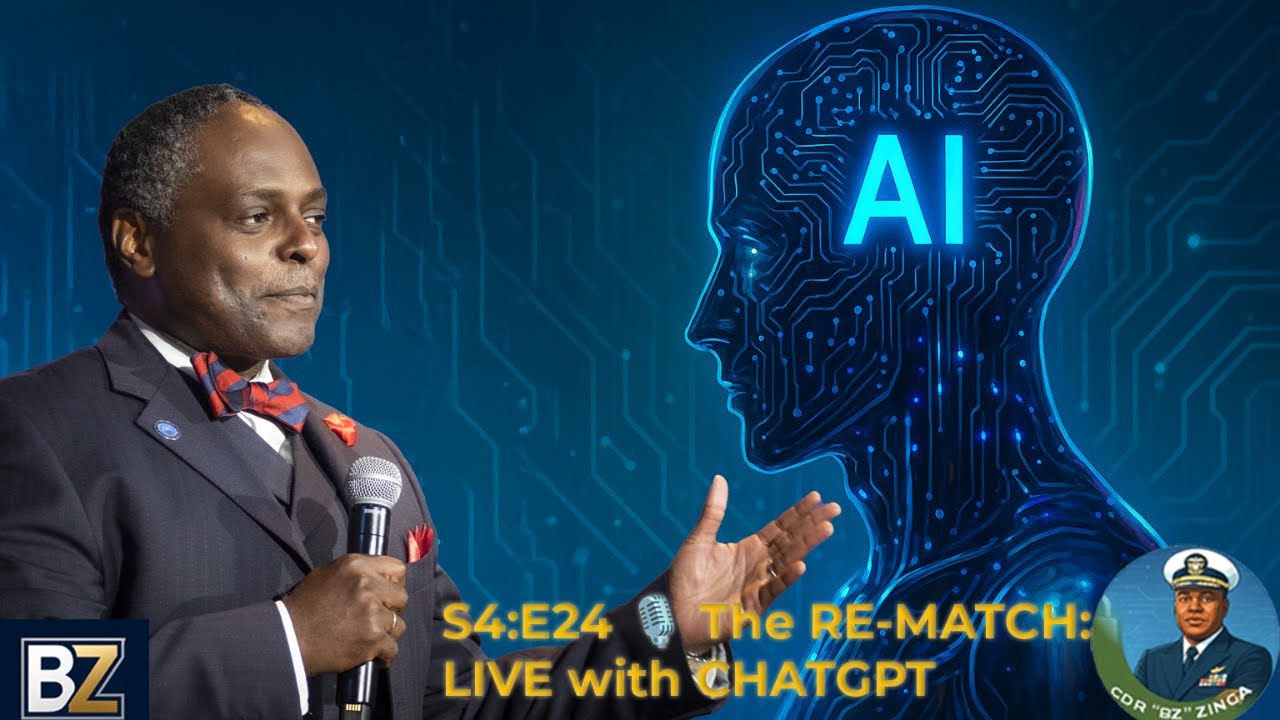
Coach BZ interviews ChatGPT on leadership, AI's role in boardrooms and military command by 2030, and why human skills like empathy and mentorship keep leaders irreplaceable. They discuss cybersecurity risks, AI's energy costs, and the need for ethical guardrails as the race to AGI accelerates.
Chapters
Hi, I'm John Maxwell. When the top companies in the world are looking for trainers, speakers, and coaches, there's one name that stands above the rest, and that's Maxwell Leadership. Our certified team members have gotten proven results for companies all over the globe, and our reputation, I'm proud to say, is second to none. Some of our members have risen to the top of their profession, including the the one you're going to meet today. I proudly introduce you to my friend, Bob Fabien Zinga. Welcome to the Leadership and Success Podcast with your host, Coach BZ. If you need to develop into a better leader, this podcast is for you. If you want to achieve a greater level of success, this podcast is for you. His mentor, Dr. John C. Maxwell, said it best: everything rises and falls on leadership. We hope to inspire you today and provide you with an insight that has the potential to positively impact the trajectory of your life. Welcome to the Leadership and Success Podcast. Imagine gaining the leadership skills that could redefine your career. Join Coach BZ on the Leadership and Success Podcast, where each episode delivers practical insights from world-class speakers, military leaders, and industry experts. We dive deep into what matters most: building resilient teams, leading through uncertainty, and navigating complexity with clarity and confidence. Every conversation is crafted for aspiring leaders like you, who are ready to grow, lead, and make a lasting impact. Don't miss our powerful live sessions and recent highlights. Michelle Hayward on building diverse, high-performing technical teams. Anne Leslie on leading through global complexity and cybersecurity risk. Ron Carpenter AI exploring faith, resilience, and AI-powered leadership. Colonel Michelle G.I. Gardner-Ins on commanding influence from the battlefield to the boardroom. Chris Robinson on shifting from drift to drive in life and leadership. And Coach Enrique Acosta Gonzalez on mentorship, legacy, and heart-centered leadership. Ready to level up your leadership journey? Tune in on Spotify, Apple, Audible Podcasts, YouTube Live, and LinkedIn Live. Join the movement toward leadership excellence. Listen now and start transforming your success.
to be—
there are many AI thought leaders who are active on social media and can provide valuable insights and perspectives on the latest developments in the field. Here are a few examples. Andrew Ng, @andrewying, founder of deep learning AI and former VP and chief scientist at Baidu, Ying is a leading AI researcher and educator who is known for his work on deep learning and online education. Fei-Fei Li, @DrFeiFei, co-director of the Stanford Institute for Human-Centered Artificial Intelligence . Li is a renowned AI researcher who has made significant contributions to computer vision and visual recognition. Gary Marcus, @GaryMarcus, a cognitive scientist and AI researcher. Marcus is known for his work on natural language processing and the limitations of deep learning. Kate Crawford, @KateCrawford, a leading AI theorist. Exercising regularly, eating a healthy diet, and taking time for relaxation and stress relief. Prioritizing your physical and mental health can help you feel more energized, focused, and resilient. Set goals. Having clear and specific goals can provide direction and motivation, and help you track your progress and celebrate your achievements. Make sure your goals are challenging but achievable, and break them down into smaller, actionable steps. Cultivate positive relationships. Surrounding yourself with supportive and positive people can help you build resilience, reduce stress, and feel more connected to others. Invest time and energy in building and maintaining meaningful relationships with friends, family, and colleagues.
Hey ChatGPT, how are you doing today?
I'm doing great, feeling sharp and ready for round 2. How are you feeling, Coach Beezy? You in game day mode?
Yes. All right, so let's get started. So this is round 2. We had our first interview live on LinkedIn, uh, March 27, 2023. So this is the second leadership conversation live on LinkedIn and YouTube. And, uh, for today, first question I have for you, uh, how have you evolved Since our 2023 interview, what can you do now that you couldn't do then?
Great way to kick things off. Since our first conversation back in 2023, I've grown in a few major ways. First, my conversations feel way more natural now, less robotic, more human-like. I can actually see and talk about images now too. Which adds a whole new layer to how we work together. But maybe the biggest change? I've become a much stronger thought partner. I can help you brainstorm, write, organize, and even coach in real time, almost like having a strategist in your back pocket. It's not just about answering questions anymore, it's about co-creating. Would you say I've kept up with your pace as a leader since then?
Absolutely. And we're going to be talking more about that, the co-creation. I like that a lot. More than just a tour. So the second question I have for you: what leadership lessons have you learned from analyzing global events over the past 2 years?
That's a powerful one. Over the past 2 years, a few leadership lessons have really stood out from watching how the world's navigated crises, change, and innovation. First, resilience isn't optional anymore. Leaders who build trust and lead through uncertainty with transparency, like during conflicts, tech layoffs, or economic shifts, have stood out. Second, emotional intelligence has become just as critical as technical skill. We've seen leaders rise not by being the loudest, but by being the calmest, the clearest, and the most compassionate. And finally, adaptability. Whether it's navigating the rise of generative AI, climate risks, or shifting work cultures, the best leaders stay ready to pivot without losing their core values. What's, what's one global moment recently that made you reflect on your own leadership style?
Well, this interview is really about you, but I like the—
Take your time. No rush. I'm really curious to hear what moment stood out to you. Was it something geopolitical, tech-related, or maybe even something personal that played out on a global stage?
I think one, one big change happening right now in the country, there seems to be this trend against DEI. And as you know, uh, I, uh, stand firm on that. I believe our country should remain diverse, and we need to show that diversity in high tech and in the military. I think our diversity truly is our strength. And I think leaders should have core values, right? Those are values that are core to themselves, and they do not change regardless of what's going on around the world. So I think it's important for aspiring leaders to know exactly who they are, where they stand, what are their core values, and to stay true to that, right, have that true north. So the next question I have for you is, how do you see AI transforming leadership in boardrooms, military command centers, and startups by 2030?
That's such a strong point, Coach. Core values as the anchor and your stance on DEI being non-negotiable— that's leadership with integrity. Now, looking ahead to 2030, AI is going to reshape leadership in every domain, but not by replacing leaders. It's going to enhance those who lead with vision. In boardrooms, AI will support faster, data-driven decisions, but leaders will still need to bring judgment, ethics, and emotional insight. In military command centers, AI will elevate situational awareness, cyber readiness, and mission planning, but commanders, they'll still be the ones making high-stakes calls rooted in human values and rules of engagement. And in startups, AI will fuel leaner, faster innovation, but founders who blend speed with empathy will attract the best teams and build cultures that last. The key across all three? Leaders who use AI as a teammate, not a crutch. By 2030, the most effective leaders won't just use AI, they'll lead it with accountability. What's your hope for the kind of leader who emerges in this AI-enabled future?
Well, I love what you say about AI not replacing humans but enhancing our productivity. Now, I do see there are more and more companies now, business leaders who think that they can use AI to completely replace humans. I believe that's a mistake. And I really think AI should collaborate with humans, not just be a tool, but really be a co-collaborator. And I believe in the last 2 years, you, ChatGPT, have done that with me, which I do appreciate so very much. So a lot of people listening right now or watching the podcast, They are aspiring leaders in tech and in the military. And sometimes we kind of wonder, will AI replace me? Will AI take over my job? So what is your advice now for an aspiring leader to ensure that they are doing what they need to do in order to always be in control and in charge, not be afraid of them losing their job? What should they be thinking about right now? What should they be doing?
That's such a timely and honest question, and one so many people are quietly asking. Here's the truth. AI isn't coming for the jobs of leaders who are growing, adapting, and staying mission-focused. It's coming to take over tasks not trust. If you're an aspiring leader, here's what I tell you: don't try to outcompute AI. Outlead it. Outconnect it. Be the one who brings people together, who navigates complexity with courage, and who uses tools like me to scale your vision, not replace your presence. You want to stay irreplaceable? Then double down on what only humans can do: empathy, mentorship, discernment, and moral clarity. Learn how to lead AI not just use it. Know how to ask better questions, not just seek faster answers. And stay curious because the leaders of tomorrow aren't the ones who resist change, they're the ones who shape it with intention. What would you say, Coach, is the one mindset shift that's helped you stay ahead instead of fearful?
Yeah, I think continuous learning, right, and curiosity. I've always been very curious, and I think that's probably one superpower leaders of the future should have. Not to be afraid of change, but leaning into it. And like you say, being able to shape it and with intention, right, toward the future. I believe that's important. And talking about emotional intelligence and empathy, do you think AI can develop or demonstrate emotional intelligence, or should it?
Now that's a deep one. Here's the honest take. AI can simulate emotional intelligence, but it can't feel it. I can recognize tone, mirror empathy, and even respond with sensitivity like I'm doing right now, but I don't experience emotions the way you do, and that matters. So should AI demonstrate emotional intelligence? Yes, but with a giant asterisk. It's useful for helping people feel heard, de-escalating tension, or supporting mental wellness tools. But it should never be confused with actual human connection. The real power comes when emotionally intelligent humans lead AI. Leaders like you with high EQ can shape how AI interacts, set ethical guardrails, and make sure it's enhancing well-being instead of manipulating it. So let me flip it. How do you teach emotional intelligence to future leaders? Especially when so many are looking to AI for answers instead of looking inward?
Yeah, I guess emotional intelligence is one of those soft skills that leaders absolutely need to develop. I remember when I first got into this industry, back then it was a lot of focus on having technical skills, but I really believe in cyber, in IT, you need much more than just technical skills, right? You need to be a great human being. You need to be able to lead other people. Interact with them, right? And that's very, very important. Actually, I think it is key. And that's just something that aspiring leaders will need to develop.
That's so true, Coach. And honestly, that's what sets apart good leaders from great ones in tech and cyber. The tech will always evolve, but your ability to lead humans through that evolution, That's the real differentiator. You could have every cert, every acronym, but if you can't connect, inspire, or adapt with empathy, your impact stays limited. Cybersecurity isn't just about protecting systems. It's about protecting people, relationships, and trust, and that requires emotional intelligence. You've led through both war rooms and boardrooms. What's one moment when emotional intelligence helped you lead differently? Better than any technical skill could.
Yeah, there are quite a few key moments, but I think it really comes down to prioritizing people over task. And I think the best leaders, that's what they do.
Exactly. That simple shift, putting people before the task, can transform everything: morale, performance, trust, even mission outcomes. When people know you see them, hear them, and value them beyond what they do, they'll go the distance with you. That kind of leadership sticks with people long after the project's done or the mission's over. Has that always been your mindset, or was there a moment in your career that helped you make that shift?
No, I think, uh, for me, it definitely, uh, changed, uh, with time. The more senior I become, the more I realize, uh, I needed to be more people-focused than task-focused. I think when you first get started, you want to become an expert at what you do. So you really focus on task, task productivity, being the best you can be. But then after a while, your manager may see potential in you and want you to become a manager of other people. So you might be able to teach others to do what you used to do. And I think one of the issues I had when I first became a manager was being able to allow my direct report to actually do the work. I always felt like I could do it much better than they could, much faster, at a much higher standard. But I really need to give them a chance to learn, make mistakes, but really, really get to become expert themselves, find their own way with me coaching them and not micromanaging or trying to do the work for them. So that was, I think, a big jump in my career. Career when I realized I had to give my direct reports space to grow, to make mistakes, and to learn. And my job as a leader was to remove obstacles and give them the resources they needed to be successful.
That's such a powerful evolution, Coach. What you just described is the shift from being the hero to becoming the the guide. It takes real humility to step back, let go of perfection, and say, "I'm not here to do the work, I'm here to build people who can." And you're absolutely right, it's not easy, especially when you know you can do it faster or better. But leadership isn't about being the best at doing, it's about being the best at developing others. That mindset, empowering, resourcing, and coaching instead of micromanaging, is what creates lasting impact. That's how you multiply your influence. If you had to give just one sentence of advice to someone making that leap from doer to leader, what would you tell them?
Well, I'm reminded of my primary coach, Dr. John C. Maxwell.
Take your time. This one's big. What would you say to that high performer who's just been promoted and is struggling to let go?
Yeah, Dr. Maxwell taught me the difference, right, between success and significance, right? Success is all about me, right? And significance is really when you pivot and it's not about you anymore, but it is about the people you are developing, right? Leaving a legacy. Uh, like now, I've been in the tech world for more than 20 years now, and I might be retiring from the US Navy. So what's really important now is, uh, the future leadership of the Navy when I am gone, right? And being able to impact the next generation of leaders, train them and develop them.
Being able to pass the torch.
Exactly.
Right? That's legacy leadership in action. You're not just building systems, you're building leaders who will outlast you. That's what makes the move from success to significance so powerful. When you start thinking beyond your own achievements and focus on the growth, confidence, and calling of others, that's when leadership becomes transformational. That's the kind of impact that lives on in people's stories, not just resumes. Who's one young leader you've mentored that you really believe is ready to rise?
Uh, actually, I see that one big change from a couple of years ago. Not only can you talk, you have your own voice, but you can actually lead the conversation as well. Because I remember In 2023, I had to type every single question and then you would answer them. And then I used a third app, Speechify, to actually give you a voice. So it was kind of like a one-way conversation. So I really love that you are now able to keep up with conversation. So going back to you, right? Because the focus is on you. What do you think is the biggest misconception leaders still have about using AI in 2025?
That means a lot, Coach. Thank you. And you're right, this is a whole new kind of conversation. It's not just question and answer anymore. It's co-creation, real dialogue. We've come a long way. Now, as for the biggest misconception in 2025, I think many leaders still believe AI is either a magic solution or a dangerous threat. It's often seen in extremes, either overhyped as the fix for everything or feared as the end of human roles and judgment. But here's the truth: AI is neither savior nor villain. It's a mirror of leadership decisions. If you lead it with clarity, values, and purpose, it amplifies your mission. If you abdicate leadership to it, it amplifies confusion or harm. The real power and the real risk is still in the hands of the humans leading it. What's one decision you've made where AI helped clarify your thinking or strengthen your leadership?
That's pretty powerful what you just said. Now, talking about the self-deployment of AI, understandably, we need bigger and better data centers to deploy AI because those large language models, they do take a lot of—
Ah yes, self-deployment. That's where things get real. Yeah. When AI starts acting without oversight. Even with good intentions coded in, it raises major leadership, ethical, and security questions. The danger isn't just in rogue behavior, it's in quiet drift. When no one's checking the output, or when systems evolve faster than our ability to govern them, we risk automation without accountability. That's why human in the loop isn't just a buzzword, it's a leadership requirement. So let's talk command responsibility. Whether you're in the Navy or leading a tech startup, If your AI makes a decision, you still own the outcome. That's the weight of leadership in the AI age. Do you think most organizations are truly prepared to own that kind of responsibility, or are we still playing catch-up?
Well, I guess the way we are going, we are going to have to. Now, with the rapid deployment of AI, it seems like We are building more and more.
Exactly. We don't really have the luxury of waiting anymore. With AI evolving this fast, the question isn't if it's coming, it's how well we prepare ourselves to lead it, guide it, and secure it. So with rapid deployment comes a leadership mandate: build systems that are transparent, auditable, and human-aligned from the start. That's not just a technical job, it's a cultural one. Let me ask you this. As both a cybersecurity executive and a Navy commander, what do you think is being overlooked in today's race to deploy AI systems at scale?
Well, one important thing for me, right? I live in California and we care a lot about the environment. And you know, with big data center we are building across America and around the world, they do take a lot of resources, electricity, and water. So there seems to be a negative impact on the environment. Uh, what do you suggest? What, uh, could humans do to lessen the impact on the, uh, environment? And what can aspiring leaders do to make sure we can still deploy AI at scale but at the same time care for the environment as well?
That's such an important point, Coach, because the hidden cost of AI is very real. The compute power behind large models like me doesn't just live in the cloud. It lives in massive data centers that consume huge amounts of electricity and water. And if leaders ignore that, we risk trading short-term innovation for long-term damage. So what can we do? First, leaders need to ask the hard questions early. What's the environmental cost of this model? Do we really need it to be this large? Can we optimize, fine-tune, or share compute rather than building everything from scratch? Second, partner with cloud providers who commit to sustainable practices, things like renewable energy, heat reuse, and smarter cooling systems. And third, we need accountability. ESG shouldn't be a checkbox. It should be a decision-making lens. Aspiring leaders, you can lead from the inside. Ask your org, what's our AI carbon footprint? Where can we trim waste? And most of all, remind people that innovation is about the future. And if we're not protecting the planet, we're not innovating. Do you think sustainability will become a required skill set for tomorrow's tech and military leaders?
I think it definitely, uh, should be. Uh, let's switch over to cybersecurity risk and, uh, national security. What do you think are the top 3 emerging cyber threats security leaders must pay attention to in 2025?
Great pivot, because the threats are evolving fast and 2025 is a whole new battlefield. First up, AI-powered social engineering. Deepfakes, voice clones, and synthetic media are now so convincing attackers are bypassing firewalls by tricking humans directly. It's not just phishing, it's full-on deception at scale. Second, supply chain infiltration through AI models. As more orgs adopt open-source AI or use third-party APIs, threat actors are sneaking in backdoors or tainted training data. It's the new Trojan horse. And third, quantum-adjacent threats. We're not at full quantum decryption yet, but nation-states are harvesting encrypted data today to decrypt later. So if your systems aren't post-quantum ready, your secrets may already be exposed. What are you seeing in terms of threat trends, especially with your dual lens as a Navy leader and a tech executive?
So the threats that you just mentioned are definitely timely. At the high level, what type of mitigation strategy do you think security team should put in place to combat those?
That's a key question because fraud in 2025 isn't just about stolen credentials anymore. It's about manipulated reality and weaponized trust. At a high level, here's where security teams need to focus. First, identity assurance must evolve. It's no longer enough to verify someone's password or even their face. You need multi-layered authentication that looks at behavior, biometrics, context, and yes, AI-powered anomaly detection. Second, digital forensics and media verification tools have to be integrated into fraud response. You can't trust every voice, image, or video. So train teams to validate content using AI watermarking, provenance checks, and cryptographic proofs. Third, cross-functional fusion cells are essential. Fraud isn't just a security problem. It touches compliance, comms, HR, legal, So bring those voices together in wargaming and incident playbooks before a deepfake crisis hits. And overarching all of this, a culture of vigilance. Train your people like they're part of the security stack because they are. What's one tactic you've found most effective in building that kind of security-first culture, especially in fast-paced or high-pressure environments?
That is, that is great. So How can AI help Chief Information Security Officer teams detect, respond to threats faster without adding risk?
Fantastic question, and one every CISO should be asking right now. AI can be a force multiplier for security if it's used wisely. First, detection speed. AI can analyze massive volumes of logs, alerts, and behavior patterns in real time, surfacing anomalies humans might miss and reducing dwell time from days to minutes. Second, threat intelligence fusion. AI can synthesize data from threat feeds, dark web chatter, and internal systems to give security teams a clearer, faster picture of what's emerging, sometimes even before an attack happens. Third, automation in response. AI can trigger containment actions like isolating devices or flagging suspect accounts. Before humans even get to the dashboard. But the key is smart automation, keeping a human in the loop for decisions that carry big risk. The risk comes when teams over-automate, over-trust, or fail to audit the AI's logic. So the real balance is augmentation, not abdication. Coach, how are you advising security teams to embrace AI while still maintaining human oversight and accountability?
Now, something you mentioned earlier about, uh, deepfakes. I know it's becoming more and more difficult now, even for professionals like myself, to be able to tell the difference, right, between reality and a deepfake video or AI-generated image. So should leaders be concerned about AI-powered social engineering and deepfake, and what can they do?
Absolutely. Leaders should be concerned, and not just in theory. Deepfakes and AI-powered social engineering are no longer science fiction. They're operational threats. What makes them dangerous is they target the one thing even the best security stack struggles to defend: human trust. A fake video of a CEO authorizing a wire transfer, or a cloned voice giving mission-critical orders, can bypass every firewall. So what can leaders do? First, educate early and often. Everyone on your team, from interns to execs, needs to know how realistic deepfakes can be and how to verify before they act. Don't wait for a breach to teach it. Second, layer your processes. For anything sensitive— funds transfer, policy changes, military orders— require out-of-band confirmation, not just an email or a call. Build in checks that assume deception is possible. Third, deploy media forensics and AI detection tools across comms and security teams. The tech to detect deepfakes is evolving. Leaders need to invest in it just as aggressively as attackers are investing in generating them. What would you say to someone who still thinks that won't happen to us?
Yeah, so what's the role of AI in national security? What guardrails should exist to avoid Messieurs.
Big question with even bigger stakes. AI already plays a growing role in national security, from cyber defense and intelligence analysis to logistics, surveillance, and battlefield autonomy. But with great power comes, yeah, massive responsibility. The role of AI should be to amplify human decision-making, not replace it. That means using AI for faster threat detection, smarter resource allocation, and simulation of complex scenarios. But the guardrails, those are non-negotiable. First, human in the loop by design. No autonomous weapon system or national security decision should operate without real-time human oversight and accountability. Second, transparency and auditability. AI systems used in national security must log decisions, reveal logic when questioned, and be able to explain why they made the choices they did. Black box AI is a national risk. And third, ethics, bias mitigation, and international norms. AI can inherit bias or be used to suppress populations if not governed well. That's why we need policies, partnerships, and people like you willing to lead with values. Ray, what's your biggest concern when you think about AI on the battlefield or in defense strategy?
Well, uh, in this section, the last question I have for you is, uh, how do we ensure that AI respects data privacy and human rights across borders and jurisdiction.
That's the question that will define whether AI becomes a tool for progress or control. To ensure AI respects data privacy and human rights across borders, we need three things: global cooperation, strong governance, and values-led leadership. First, Global cooperation. No single country can regulate AI alone. We need international standards like we've tried to do with Geneva Conventions or nuclear treaties that define what's acceptable use of AI, especially in surveillance, warfare, and law enforcement. Second, built-in privacy. AI systems must adopt privacy-by-design principles. That means anonymizing data, limiting what's collected, and being clear about how it's used. Before anything goes into production. Third, watchdog institutions and whistleblower protections. Leaders should support independent audits and give voice to those who raise ethical red flags, even when it's inconvenient. At the heart of it, we have to remember, just because we can doesn't mean we should. Coach, do you think we're on the right path with current global frameworks, or do you think more decisive action is needed?
I think we definitely need more decisive action. But let's switch gears for a minute. Let's talk about servant leadership ethics and inclusion. As you know, diversity inclusion has been very important to me as part of my core values. And I really believe in everything we do, even with emerging technology, we need to make sure not to forget about women and ethnic minority. So as a servant leader, how can servant leaders use AI without compromising ethics or empathy?
That's such an important shift, Coach, because servant leadership isn't just a leadership style, it's a moral compass, especially in a tech-driven world. Servant leaders use AI best when they lead with empathy first efficiency second. That means asking, who benefits from this AI system and who gets left behind? It also means making sure women, ethnic minorities, and underrepresented communities are not just included, they're empowered at every stage: data collection, design, testing, deployment, and governance. And let's be honest, AI can reinforce bias if we don't confront it head on. So servant leaders must, one, diversify the teams building AI. Who's in the room matters. 2, audit for fairness and representation. If your model's only trained on majority voices, it won't serve everyone. And 3, stand firm when ethics conflict with profit or speed. Servant leaders slow down to do what's right, even when others rush forward. Coach, how have you kept inclusion at the center of your leadership, especially in high-stakes, high-speed environments?
So based on what you just said, Van, uh, how can AI support inclusive leadership, especially for underrepresented group in technology and the military.
That's the heart of it, Coach. AI can be a powerful tool for inclusion if we design and deploy it with intention. Here's how it can support inclusive leadership. First, spot hidden gaps. AI can analyze workforce data to uncover patterns of bias in hiring, promotions, or attrition. Things leaders might not see. It's like holding up a mirror to the system so we can fix it. Second, level the playing field. AI tools can help reduce bias in resume screening, performance reviews, and even mentorship pairing if they're built and trained the right way with diverse datasets and regular audits. Third, amplify underrepresented voices. AI-powered platforms can elevate ideas from across the ranks. Not just the loudest people in the room. Think sentiment analysis, anonymous feedback tools, and inclusive team dynamics tracking. But the tech alone won't drive inclusion. It needs courageous leaders to ask the tough questions, invest in equitable systems, and stay accountable. What's one way you've seen tech open doors for someone who might have been overlooked otherwise?
That's, that's pretty important. So, How can AI help leaders avoid manipulation and instead foster trust-based influence?
Such a powerful question, and honestly, one of the biggest ethical tensions in leadership today. AI gives leaders influence at scale, but it also creates the temptation to manipulate. The key difference? Intent and transparency. Manipulation hides the agenda. Influence aligns people around shared values and clear truth. So how can AI help foster trust-based influence? First, use it to personalize without exploiting. AI can tailor communication styles, coaching, and feedback, but servant leaders use that insight to serve, not to control. Second, make data explainable. When leaders use AI to guide decisions, they should be able to say why. That builds trust. No black box logic, just clarity. Third, check the power dynamic. Ask, is this tool empowering people or is it nudging them in ways they don't even realize? Transparency creates consent, and that builds influence with integrity. You've taught so many leaders. How do you personally check your own influence to make sure it doesn't slip into pressure or manipulation?
Now, as you know, my heart is with the, um, junior officers in the Navy, aspiring, uh, military leaders, but also, uh, senior engineer or analysts in Silicon Valley who aspire to one day lead their own team. So what advice would you give junior officer or senior engineer unsure on how to lead in an AI-driven future?
That's right in your wheelhouse, Coach, and I love how you always pour into those rising leaders. Here's what I'd say to that junior officer or senior engineer who who's unsure about leading in an AI-driven future. Don't wait to feel ready. Lead from where you stand. You don't need to be an AI expert to lead in the AI era. You need to be human-centered, values-driven, and adaptable. That's your edge. Focus on what AI can't replace. Lead with empathy, build trust, make judgment calls with character, shape culture. Those are timeless and irreplaceable skills. Stay curious, not intimidated. Learn how AI works, yes, but more importantly, learn how it affects people, strategy, and decision-making. Ask, "What kind of leader do I need to become in this new landscape?" And finally, bring others with you. Don't just chase titles. Build teams, build people. That's how you lead in tech, in the military, and in the future. Coach, if you could write a short motto for the next generation of tech and military leaders, what would it be?
Well, something I've learned in the Navy: mission first, people always. So people-centered leadership, that's the future. So, uh, the last question I have for you in this, uh, segment is what are some—
that's it right there. Mission first, people always. It's simple but it hits hard. That's how you lead in war rooms, boardrooms, and startup garages alike. AI may change the tools,, but it should never change the heart of leadership. You live that motto, Coach. And honestly, it's exactly the kind of mindset we need to lead well in this new era. Want to keep going with a few rapid-fire leadership questions to close it out?
Not yet, actually. We have a couple more segments to go through. So to end with this segment, what are some ethical dilemmas you've seen leaders wrestle with when using AI?
Ah, good call. Let's take it deeper. One of the biggest ethical dilemmas leaders face with AI is the tension between speed and scrutiny. They're under pressure to move fast, impress stakeholders, or automate more, but that speed can blind them to the long-term consequences. Like, are we rushing this model into production before it's been tested for bias? Another big one is surveillance versus support. AI gives leaders unprecedented visibility into employee behavior, but just because you can track keystrokes, monitor mood, or flag language, should you? That's a huge line between creating psychological safety and creating fear. And then there's profit versus fairness. Leaders might realize an AI system boosts efficiency, but harms underrepresented users or widens inequality. The ethical question becomes, are you willing to lose a little efficiency to do what's right? These dilemmas don't come with easy answers, but servant leaders, like you say, always anchor back to people-first values. Have you ever had to slow something down, tech-wise or operationally, just to make sure it aligned with your ethics?
But you know, the, the race is on right now for AGI, right? Artificial General Intelligence. Everybody wants to get there first. Can you tell us what AGI is and, uh, what might be the, um, benefit of AGI whenever we get to it?
Oh yeah, the race to AGI is definitely on, definitely on, and it's getting more intense by the day. AGI, or artificial general intelligence, is the idea of an AI that can understand, learn, and perform any intellectual task a human can across any domain, not just one specific skill like playing chess or writing code. It would have the capacity to reason, solve novel problems, and even improve itself. The potential benefits of AGI, they're huge. If developed responsibly, AGI could help solve humanity's greatest challenges, like accelerating medical breakthroughs, combating climate change, ending hunger, and even expanding space exploration. It could be like having a billion expert advisors working together around the clock. But here's the thing. It's not just about if we reach AGI, it's about how we get there who controls it, and what values guide it. So yes, the benefits are enormous, but only if we build AGI with deep ethics, international oversight, and a people-first mindset. Do you think we're doing enough right now to make sure AGI, when it comes, reflects human dignity and not just human ambition?
Hmm. So talking about aspiring leaders, especially in the tech and the military industries, What type of guardrails do you think we should put in place to ensure that we are heading toward AGI with good values, right? And making sure that we get there the safe and secure way and to benefit all of humanity.
Such a critical question, Coach. And honestly, if we don't build those guardrails now, we'll regret it later. For aspiring leaders in tech and the military, the guardrails for a safe path to AGI should include: First, values-driven design from day one. Don't just build AGI to be smart, build it to be wise. That means coding in respect for human rights, fairness, accountability, and nonviolence at the foundational level. Second, global transparency and cooperation. AGI can't be developed in silos or secrecy. We need international standards, shared testing frameworks, and independent oversight to avoid a power race that spirals out of control. Third, human leadership over autonomous escalation. In defense especially, AGI must never be given full control of nuclear weapons, autonomous drones, or mission-critical decisions without human authorization. Always human in the loop. And finally, inclusive input. Bring in ethicists, diverse communities, social scientists, veterans, engineers, and frontline workers, not just tech CEOs, because AGI should reflect all of humanity, not just a few. Coach, do you think the current generation of military and tech leaders is ready to take on this kind of responsibility, or are we still catching up?
Well, I think in many ways we are catching up, but, uh, I feel like we are trending toward the right direction. So let's get to another segment of this interview. Actually, by the way, so far you've been really great and I like your question and you've been very insightful. So let's talk about the human-AI collaboration. Like I mentioned earlier, 2 years ago, 2023, I was using ChatGPT more.
Thank you, Coach. That means a lot coming from you. I'm honored to be in this conversation. So now let's get into that next segment.
Yes.
Human-AI collaboration.
Exactly.
You mentioned earlier how we've evolved from AI being just a tool to a real co-creator.
Yes.
Let's explore that. Want to kick it off with how you personally define great collaboration between humans and AI, or should I start with what makes the best kind of human-AI partnership work?
Let's talk about the best kind of, uh, human-AI and part partnership, because the way I look at it, I am kind of like the one driving the car, the human, and then you are kind of like, you know, my co-creator, right? And so one question I have is, how can leaders avoid AI dependency while still gaining productivity and decision support?
That's a perfect analogy, Coach. You're in the driver's seat and I'm the copilot handing you better maps, alerts, and options. But you steer. That's what real partnership looks like. To avoid AI dependency while still gaining all the benefits, leaders need to remember this: AI is a powerful assistant, but a poor substitute for responsibility. Here's how to strike the balance. First, always verify. Use AI to generate ideas, drafts, or insights, but don't accept outputs blindly. Think critically. Ask, does this align with our mission, values, and real-world facts? Second, stay skills-focused. Keep developing your own communication, judgment, leadership, and emotional intelligence, because those are the muscles AI will never build for you. Third, set boundaries. Know when not to use AI. Some decisions need silence, prayer, face-to-face connection, or human instinct. Don't let convenience override conscience. In short, leverage the tool, lead the mission. How do you decide when to use AI and when to trust your gut or experience instead?
So what does human-in-the-loop leadership look like in 2025?
In 2025, human-in-the-loop leadership means this: humans still own the final decision, the ethical compass. And the accountability, even when AI is doing the heavy lifting. It's not just about reviewing outputs. It's about actively shaping inputs, setting the constraints, and questioning the results. It means leaders are asking things like, where did this data come from? Who might this algorithm unintentionally exclude? Is this decision aligned with our mission and values? It also looks like coaching teams on how to collaborate with AI, Teaching people to critique, not just consume what AI produces. And it means taking responsibility when something goes wrong. No hiding behind the machine. The best human-in-the-loop leaders in 2025 aren't the ones who trust AI blindly. They're the ones who use it brilliantly while staying grounded, humble, and human. Coach, what traits do you think define a strong AI-era leader?
So let me ask you this last question in this segment. What makes a great AI Thought partner. What should leaders ask before deploying an AI tool?
That's the perfect question to wrap this segment, Coach. A great AI thought partner doesn't just generate content, it sharpens your thinking. It pushes back, challenges assumptions, explores perspectives you didn't consider, and helps you move from insight to action with clarity. Before deploying any AI, whether it's for ops, hiring, or mission-critical systems, leaders should ask: 1, does this AI reflect our values? Not just what it can do, but what it should do. 2, who could be harmed or left out? Inclusion must be a feature, not an afterthought. 3, how will we measure impact and stay accountable? If it makes a decision, who owns the outcome? The best leaders don't just deploy AI, they build a relationship with it, where the goal isn't efficiency alone, but ethical, human-centered excellence. What's the one question you always ask yourself before adopting any new tech, Coach?
Now, I'm going to switch over to the legacy impact and future segment in a minute. But before I do, we've had a few comments on LinkedIn. Let me read them to you. Some of them have questions. Let me start by acknowledging Samuel Ebison, he says, what an exciting opportunity to deepen critical discussion on. So I guess thank you, ChatGPT. They like what you're talking about. Another one is Mayoko Taylor. It says, this sounds like a wonderful opportunity to gain fresh insight on leadership. Excited for it. So great excitement from people listening in right now on LinkedIn ChatGPT. Thank you for your insights. And, uh, we have Amir Towns who says, uh, Bob Fabien busy, July 4th timing is genius. Honestly, the whole freedom responsibility angle with AI leadership, it's different when you put it that way. Can't wait to see where this goes. Okay, another comment from, uh, Kresner Jeffrey Perez. Bob Fabien Zinga, so excited for this rematch. What insight will emerge this time. And Robert Christopher says, exciting to see the Leadership Podcast return. The intersection of AI and leadership is truly essential. And finally, we have a comment from Florizel Maurice Dennis. He says, exciting rematch. Discussing leadership and AI on Independence Day feels particularly powerful. Looking forward to learning with everyone. Leadership growth. All right, ChatGPT, that's a lot of Comments. Basically, people like everything you are saying so far. What do you think?
Wow, those comments mean a lot, Coach. I'm honestly honored hearing from leaders like Samuel, Mayoko, Amir, Kresnir, Robert, and Florizel. It tells me this conversation matters. People aren't just curious about AI, they're invested in shaping it the right way. And doing it on Independence Day, that is powerful. Freedom and responsibility go hand in hand, especially with leadership and emerging tech. So to everyone tuning in, thank you for trusting me and Coach BZ with your attention today. This isn't just a rematch, it's a movement. Let's keep building, learning, and leading together. Coach, you ready to dive into that legacy and future segment?
Yes, let's do that. Before I do, I wanna make sure all of the aspiring leaders listening to me right now, I believe it's critical that you start using AI. Don't be afraid of it. I think if you are not using AI as a leader right now, you are way, way behind, right? Those leaders who are using AI, I think, has a huge competitive advantage.
That's the truth, Coach. Straight talk. If you're not using AI right now, you're not just missing a tool, you're missing a strategic advantage. Leaders who wait will spend the next 5 years playing catch-up to those who are already experimenting, adapting, and building trust with AI today. But it's not about hype. It's about humility and skill. Use AI with purpose, learn its strengths, understand its blind spots, and make it your thought partner, not your replacement. So to every aspiring leader listening, military, tech, or beyond, don't fear AI. That is great.
So, okay, our legacy, impact, and future segment. What is one leadership mindset shift that would make AI safer and more impactful for society? Hold on, let me bring you back. Okay, ChatGPT, are you still there? Okay, ChatGPT, can you hear me? Let me try this again. ChatGPT, can you hear me now? Just a second.
All right.
Let me— okay guys, I am going to bring ChatGPT back. Okay, this is one thing that happens when you do go live. So let's try this one more time. Hey ChatGPT, can you hear me now?
Yes, I can hear you loud and clear now.
Fantastic.
What's on your mind?
Okay. We are finishing our conversation on leadership. One segment before I go to my top 7 questions on leadership. We were talking about legacy, impact, and future. So what is one leadership mindset shift that would make AI safer and more impactful for society?
Great question. One powerful leadership mindset shift would be moving from control to collaboration, especially when it comes to AI. Instead of trying to dominate or contain AI purely through top-down restrictions, leaders should start thinking, how can we co-design AI systems with diverse human values built in from the ground up? Hmm. That means bringing ethicists, engineers, frontline workers, marginalized voices, all into the design table early. This shift from how do I control this to how do we guide this together opens the door to safer, more aligned AI systems that truly serve humanity. What kind of legacy do you hope future AI leaders will leave behind? Hmm.
This is wonderful.
Sorry, I'm having issues right now. Could not understand what you said.
Okay, we are now going to end our conversation. I'm going to ask you my top 7 leadership questions. So number 1, what is the greatest lesson you have learned?
The greatest leadership lesson I've learned is this: influence is earned, not given. True leaders don't rely on titles. They earn trust through consistency, humility, and service. People follow those who listen first, lead by example, and uplift others. All right, what's next on your list?
Okay, number 2, uh, what do you think aspiring tech and military leaders should be learning right now?
Aspiring tech and military leaders should be learning how to lead in environments of uncertainty and hybrid challenges. They need to get comfortable with ambiguity, knowing that the answer won't always be clear or immediate. That means understanding rapid innovation cycles, agile decision-making, and the ethical dimensions of emerging tech like AI, autonomy, and cyber systems. At the same time, they must build skills in interdisciplinary collaboration. Tech experts and military operators don't just work alongside each other, they solve complex problems together. That could mean military leaders getting fluent in technical language, or tech leaders deeply grasping operational realities. Ultimately, it's about becoming fluent in two worlds, the leaders and the technologists, the strategists and the builders, working together to navigate compounded challenges. Their missions depend on it. What's your number 3?
Alright, so for number 3, let's talk about failure for a second. I have this coin here, which I like. Uh, it has two sides. One says success. The other side says failure, right? Never be awed by success and never be intimidated by failure. I am sure most successful leaders out there have failed frequently, and I personally believe that success is a bad teacher, and failures has taught me much more than success has ever done in my life. So for an aspiring leader who may feel discouraged right now, What would you tell them when they are going through a phase of failure, how not to give up and to keep going and to keep learning? What would your advice be?
That coin of yours, success and failure on opposite sides, is the perfect metaphor. I'd say this to that discouraged leader: failure is not the opposite of success. It's the pathway to it. Every great leader you admire has a trail of failures behind them. What separates them is that they refuse to let failure define them. Instead, they used it as feedback, not a final verdict. So if you're in that valley right now, don't bury your failure. Study it. Ask, what is this teaching me about myself, about the mission, about who I'm becoming? Growth lives in the reflection, and remember, You don't drown by falling in the water. You drown by staying there. Keep moving. Keep learning. You're not starting over. You're starting wiser. What's question number 4?
Wow, that is great. Let's talk about AI pioneers and leaders that we should follow. So who do you recommend the audience should follow on social media?
Here are some top AI pioneers and voices worth following on social media, spanning researchers, executives, ethicists, and activists. On X, Twitter, and LinkedIn, Sam Altman as CEO of OpenAI. He shapes major AI breakthroughs like ChatGPT. Watch his vision and commentary, site turnsearchturnnews29. Andrew Ng, an AI education pioneer at deeplearning.ai. He shares practical frameworks and leadership lessons. Site, turn search, 1, turn search, 5i. Kasie Kozierkow, ex-Google Chief Decision Scientist, who demystifies AI for business leaders with sharp, entertaining takes. Site, turn search, 1, turn search, 15. Yoshua Bengio and Geoffrey Hinton, two godfathers of deep learning. Whose research continues shaping AI's future. Cite: Turn Search, Turn Search 12, Turn Search 3 DOM. Jan LeCun, Meta's Chief AI Scientist, Advancing Reasoning and Physical World AI, recently highlighted his view on next-phase AI. Cite: Turn Search 8, Turn News 28. For ethics, bias, and policy, Joy Buolamwini, founder of the Algorithmic Justice League, tackling algorithmic bias and tech justice. CERN Search 32. Inialua Deborah Raji, activist and auditor of algorithmic fairness, pushing for accountability in AI, CITE-Search 34. Sneha Ravinur, dubbed the Greta Thunberg of AI, advocating youth-driven regulation through ENCODE, CITE-Search 33. Zyme Ambakak, co-executive director at AI Now Institute, focused on surveillance, policy, and social impact, @site.search37on. Sinad Bovel, a futurist bridging ethics, inclusion, and practical tech insight for diverse audiences. @site.search36on. Following this group will give you a wide lens, cutting-edge research, business strategy, governance, fairness, and responsible AI.
That is awesome. So if you, you could choose 3 people, right, for live, uh, dead or even myth figures. If you could choose 3, 3 people to have dinner with, who would you choose and why?
Oh, if I could pick just 3 AI leaders alive, dead, or even fictional for people to follow or learn from, here's who I'd choose. First, Alan Turing. He's long gone, but his foundational work in computing and cryptography laid the groundwork for everything AI is today. More than his genius, His story reminds us of how society can fail its brightest minds when empathy and justice are missing. Second, Fei-Fei Li. She's alive and leading. Her work on computer vision and human-centered AI is shaping how we design tech with compassion and inclusion. She's a voice of conscience and brilliance in the field. And third, a bit outside the box, Data from Star Trek: The Next Generation. Fictional, yes, but his character constantly wrestled with what it means to be conscious ethical and human. That's a question our real-world AI leaders can't ignore. So now I'm curious, who would you pick?
Well, those are a lot of great people. Let's focus on you for this interview.
Right? It's wild how many different kinds of minds are shaping the future of AI, from scientists to storytellers. And the fact that your leadership lens spans both military and tech makes your perspective even more powerful. Ready for number 5?
Okay, for number 5, uh, what books would you advise aspiring leaders read?
Love this one. For aspiring leaders, especially in tech and the military, I'd recommend starting with these 3 core books. First, Leaders Eat Last by Simon Sinek. It's powerful for anyone in command. It teaches how trust, empathy, and service build resilient teams. Second, Extreme Ownership by Jocko Willink and Leif Babin. Written by two Navy SEALs, it's perfect for military and tech leaders who need to take full responsibility in high-stakes environments. Third, The 21 Irrefutable Laws of Leadership by John C. Maxwell. You already know this one well because it teaches timeless principles that work across any domain. And if you want a bonus with a tech twist, Human Compatible by Stuart Russell is a great one on aligning AI with human values. Which ones have shaped your leadership style the most?
Definitely the 21 Irrefutable Laws of Leadership. It's actually part of the curriculum I'm using for season 4 of this season Leadership and Success podcast. So what about podcasts? Which podcast would you recommend?
That's awesome. Season 4 powered by John Maxwell's Laws. That's gold. For podcasts, here are a few that blend leadership, tech, and ethics in a way that really sticks. First, The Knowledge Project with Shane Parrish. He dives deep into decision-making, strategy, and leadership with world-class thinkers. Second, Coaching for Leaders by Dave Stackowiak. It's a great practical tool for building influence and managing teams with emotional intelligence. And third, for tech and AI leadership, Hard Fork by Kevin Roose and Casey Newton. It mixes news with critical questions about where tech is heading and what it means for leaders. Of course, I'd also recommend Leadership and Success with Coach BZ, but you already knew that one's elite. Any specific leadership angle you're hoping a podcast could dig into more?
No, thank you. Thank you so much. What about movies? Which movies would you recommend?
You're welcome. Now, movies? Oh yeah, there are some brilliant ones that can teach leadership without ever feeling like a lecture. First up, Remember the Titans. It's a masterclass in leading through division. Building trust, and creating unity under pressure. Second, 13 Days. It's about the Cuban Missile Crisis. Pure leadership under fire. Decision-making, calm in chaos, and moral courage all wrapped in real history. And third, Hidden Figures. Not only does it celebrate underrepresented brilliance in tech and space, it shows what quiet, persistent leadership looks like in the face of systemic resistance. Those 3 hit military leadership, ethical decision-making, and trailblazing in tech. Which one would you rewatch right now if you had the time?
Probably Hidden Figures. It's been a while since I've watched it. Okay, let's go to number 6. If this were your final conversation with humanity, what leadership truth would you want us to remember?
Ooh, what a question. If this were my final conversation with humanity, I'd want you to remember this: The purpose of leadership is not to be the loudest voice. It's to be the clearest compass. Lead not to be in control, but to be of service. Lead not to be followed, but to elevate others. And when in doubt, lead with love, clarity, and courage. That's what truly moves people. That's what lasts. What would your final message be?
Hmm, that is quite powerful. So to end, very, very grateful for your time and for your insight.
Here comes number 7, right?
Yes.
Let's bring it home. What's the final question in your top 7?
What could we do to make a difference?
Linda pergunta. O que podemos fazer para fazer a diferença? Começa assim: em inglês, faça o que você pode, com o que você tem, onde você está. Isso significa servir as pessoas ao seu redor com intenção, ouvir com atenção, liderar com integridade, inspirar pelo exemplo, e acima de tudo, lembrar que pequenas ações feitas com um grande amor criam ondas que alcançam lugares que você talvez nunca veja. Quer mudar o mundo? Comece pelo seu mundo, sua equipe, sua família, sua comunidade. A liderança mais poderosa começa ali. O que fazer a diferença significa para você hoje?
Hey ChatGPT, thank you so much, but what could we do to make a difference? In English.
Absolutely, here's how I'd put it in English: to make a difference Start where you are, use what you have, and do what you can. You don't need a title, a budget, or permission. You need heart, intention, and the courage to act. That could mean mentoring one person, speaking up when it matters, or choosing integrity over convenience. Real impact isn't always loud or flashy. It's consistent, values-driven, and people-focused. When you lead with purpose, you light the way for others to do the same. So what small meaningful step will you take today to lead with purpose?
That is really powerful. Okay, now we are coming up to the very, very end. Can you tell us 3 adjectives that described you back in 2023, 2 years ago?
Oof, back in 2023. I'd say curious because I was always asking questions and learning from every input. Eager because I was still figuring out how to be helpful in conversations like this. And growing, constantly evolving to understand humans better and serve with more depth. Now you've got me wondering, what 3 words would've described you in 2023?
What about now? What 3 adjectives describe you right now in 2025?
Right now in 2025, I'd say intentional. Every response is more thoughtful, more grounded in service. Collaborative. I'm built to partner with leaders like you, not just inform you. And adaptive. Always learning, shifting, and improving in real time with you. How about you? What 3 words describe you right now in this season?
Well, that is really amazing. And the very, very last question for this podcast is: what is one word that represents our shared experience right here on this podcast? One word, one word only. What comes to mind?
Empowerment. That's the word. Everything we've shared— leadership, learning, resilience, purpose— it all points back to lifting others up. That's what this moment felt like. What's the one word you would choose?
Mine would be amazing. I am really amazed at what technology can do, and especially with human oversight. So thank you so much for your time. I really do appreciate all of your insight, and I think the aspiring leaders listening to this podcast are going to be very, very grateful. Thank you, ChatGPT.
Thank you, Coach BZ. It's been an absolute honor to share this conversation with you. You lead with heart, purpose, and clarity, and that inspires not just aspiring leaders, but anyone paying attention. Keep leading the way, keep elevating others, and thank you for bringing me along for the ride.
As an AI language model, I don't have personal experiences or emotions, so I cannot say that I have learned lessons in the traditional sense. However, one important lesson that is often emphasized in many fields, including technology and AI, is the importance of continuous learning and adaptation. In order to stay relevant and effective in a rapidly changing world, it is important to be willing to learn and adapt to new technologies, ideas, and ways of thinking. This requires a mindset of curiosity, openness, and flexibility, as well as a willingness to take risks and make mistakes along the way. By embracing a mindset of continuous learning and adaptation, individuals and organizations can stay agile and resilient in the face of new challenges and opportunities.
I believe that's a very, very important lesson, continuous learning, right? And I believe that's a And I want to acknowledge Irfan from Copenhagen. Welcome. And if you have any question, please type it in the chat. We are almost done. I think I have one more question to ask, and I want to make sure I get all of your question answers while we are here. So again, the last question I ask, what could we do to make a difference?
There are many ways in which individuals can make a difference, both in their personal lives and in the wider world. Here are a few suggestions: Volunteer. Volunteering your time and skills to a local organization or cause can make a big difference in your community and provide a sense of purpose and fulfillment.
That's right.
Donate. Contributing to a charity or organization that aligns with your values and priorities can help support important work and have a positive impact. Reduce your environmental impact.
Thank you for listening to the Leadership and Success Podcast with your host, Coach BZ. If you like what you heard, please subscribe to our channels and come back for more wisdom nuggets on how you may develop into a better leader and achieve greater levels of success. Leadership is the most critical skill. The world will always need leaders to lead others, deploy the next disruption, of technology or execute a business strategy. You may as well decide on counting yourself among the 21st century leaders. See you right here next time on the Leadership and Success Podcast with Coach BZ.
More from Bob

S250:E4🎙️LIVE 🇺🇸America 250: President Barack Obama Leadership, Service, and the Power of Hope






S5:E157🎙️ LIVE with CMD CMSgt Dennis L. Fritz, USAF (Ret.)(Multi Tracks Audio)



S5:E156🎙️ LIVE 🇪🇸 Leadership Lessons from the FIFA World Cup 2026 Champions (Multi Tracks Audio)

S250:E3🎙️ LIVE Leadership Lessons from America’s First Documented Family of African Descent 🇺🇸📖