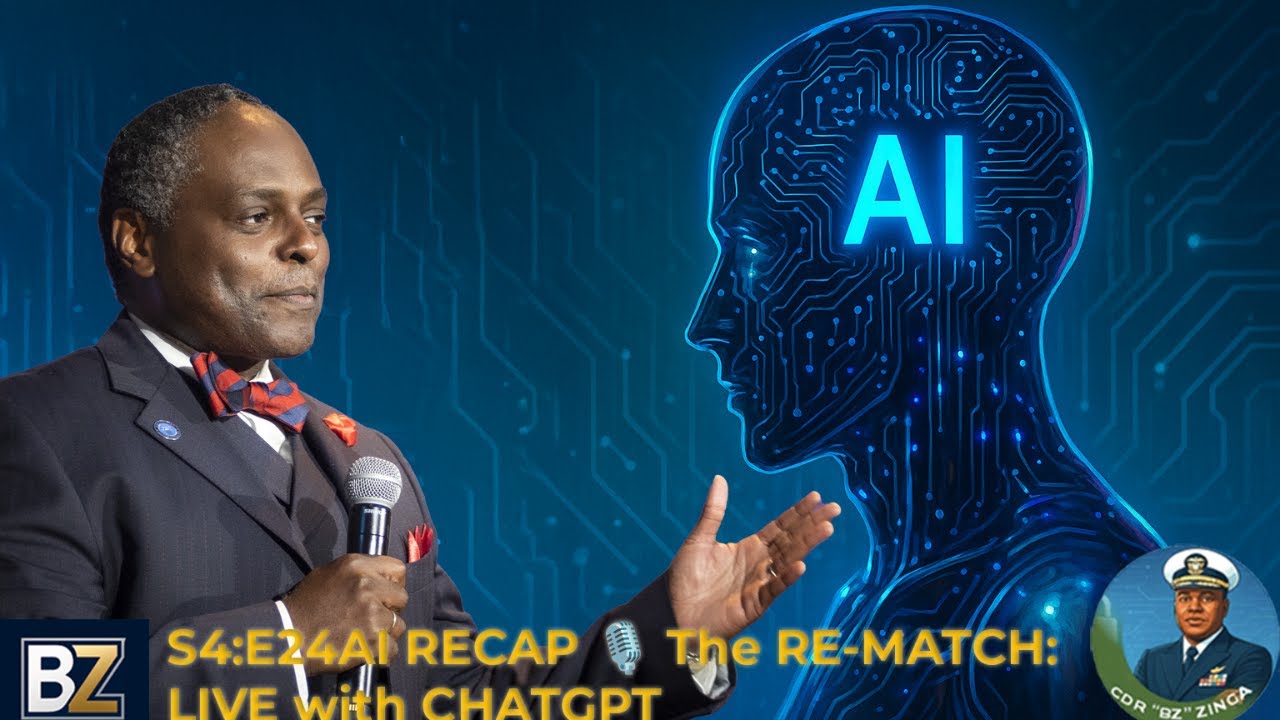
Coach BZ and John C. Maxwell, a cybersecurity executive and Navy commander, discuss AI's role in leadership. They define AGI, explore the hidden environmental costs of large AI models, and argue for a 2025 "human-in-the-loop" approach where AI co-creates but humans keep final ethical decisions.
Chapters
Hi, I'm John Maxwell. When the top companies in the world are looking for trainers, speakers, and coaches, there's one name that stands above the rest, and that's Maxwell Leadership. Our certified team members have gotten proven results for companies all over the globe, and our reputation, I'm proud to say, is second to none. Some of our members have risen to the top of their profession, including the one you're going to meet today. I proudly introduce you to my friend, Bob Fabien Zinga.
Welcome to the Leadership and Success Podcast with your host, Coach BZ. If you need to develop into a better leader, this podcast is for you. If you want to achieve a greater level of success, this podcast is for you. His mentor, Dr. John C. Maxwell, said it best: everything rises and falls on leadership. We hope to inspire you today and provide you with an insight that has the potential to positively impact the trajectory of your life. Welcome to the Leadership and Success Podcast.
Imagine gaining the leadership skills that could redefine your career. Join Coach BZ on the Leadership and Success Podcast, where each episode delivers practical insights from world-class speakers, military leaders, and industry experts. We dive deep into what matters most: building resilient teams, leading through uncertainty, and navigating complexity with clarity and confidence. Every conversation is crafted for aspiring leaders like you who are ready to grow, lead, and make a lasting impact. Don't miss our powerful live sessions and recent highlights. Michelle Hayward on building diverse, high-performing technical teams. Anne Leslie on leading through global complexity and cybersecurity risk. Ron Carpenter, AI, exploring faith, resilience, and AI-powered leadership. Colonel Michelle G.I. Gardner-Ins on commanding influence from the battlefield to the boardroom. Chris Robinson on shifting from drift to drive in life and leadership. And Coach Enrique Acosta Gonzalez on mentorship, legacy, and heart-centered leadership. Ready to level up your leadership journey? Tune in on Spotify, Apple, Audible Podcasts, YouTube Live, and LinkedIn Live. Join the movement toward leadership excellence. Listen now and start transforming your success.
But you know, the, the race is on right now for AGI, right? Artificial General Intelligence. Everybody wants to get there first. Can you tell us what AGI is and what might be the benefit of AGI whenever we get to it?
Oh yeah, the race to AGI is definitely on, definitely on, and it's getting more intense by the day. AGI, or artificial general intelligence, is the idea of an AI that can understand, learn, and perform any intellectual task a human can across any domain, not just one specific skill like playing chess or writing code. It would have the capacity to reason, solve novel problems, and even improve itself. The potential benefits of AGI, they're huge. If developed responsibly, AGI could help solve humanity's greatest challenges, like accelerating medical breakthroughs, combating climate change, ending hunger, and even expanding space exploration. It could be like having a billion expert advisors working together around the clock. But here's the thing. It's not just about if we reach AGI. It's about how we get there who controls it, and what values guide it. So yes, the benefits are enormous, but only if we build AGI with deep ethics, international oversight, and a people-first mindset. As both a cybersecurity executive and a Navy commander, what do you think is being overlooked in today's race to deploy AI systems at scale?
Well, one important thing for me, right? I live in California and we care a lot about the environment. And you know, with big data center we are building across America and around the world, they do take a lot of resources, electricity and water. So there seems to be a negative impact on the environment. What do you suggest? What could humans do to lessen the impact on the environment? Environment, and what can aspiring leaders do to make sure we can still deploy AI at scale but at the same time care for the environment as well.
That's such an important point, Coach, because the hidden cost of AI is very real. The compute power behind large models like Me AI doesn't just live in the cloud. It lives in massive data centers that consume huge amounts of electricity and water. And if leaders ignore that, we risk trading short-term innovation for long-term damage. So what can we do? First, leaders need to ask the hard questions early. What's the environmental cost of this model? Do we really need it to be this large? Can we optimize, fine-tune, or share compute rather than building everything from scratch? Second, partner with cloud providers who commit to sustainable practices, things like renewable energy, heat reuse, and smarter cooling systems. And third, we need accountability. ESG shouldn't be a checkbox, it should be a decision-making lens. Aspiring leaders, you can lead from the inside. That's such a powerful evolution, Coach. What you just described is the shift from being the hero to becoming the guide. It takes real humility to step back, let go of perfection, and say, I'm not here to do the work. I'm here to build people who can. And you're absolutely right. It's not easy, especially when you know you can do it faster or better. But leadership isn't about being the best at doing. It's about being the best at developing others. That mindset—empowering, resourcing, and coaching instead of micromanaging—is what creates lasting impact. That's how you multiply your influence. If you had to give just one sentence of advice to someone making that leap from doer to leader, what would you tell them?
Well, I'm reminded of my primary coach, Dr. John C. Maxwell. Take your time.
This one's big. What would you say to that high performer who's just been promoted and is struggling to let go?
Yeah, Dr. Maxwell taught me the difference, right, between success and significance, right? Success is all about me, right? And significance is really when you pivot and it's not about you anymore, but it is about the people you are developing, right, leaving a legacy. Like now, I've been in the tech world for more than 20 years now, and I might be retiring from the US Navy. So, what's really important now is the future leadership of the Navy when I am gone, right, and being able to impact the next generation of leaders, train them and develop them.
Being able to pass the torch. Exactly. Right? That's legacy leadership in action. You're not just building systems.
Welcome everyone to our conversation on leadership and AI. Today we'll explore some fascinating insights on legacy, failure, and the future of decision-making in a tech-driven world. Absolutely.
It's so exciting to dive into how leadership evolves when human experience meets AI, right?
Yeah, exactly. One of the key takeaways here is the shift from controlling AI to collaborating with it. It's like instead of trying to dominate the technology, leaders are now co-creating ethical systems with people from diverse backgrounds.
Right. And that reminds me of the idea that leadership isn't about having a title. It's about earning influence through trust, consistency, and humility.
Yup. Influence is earned, not assigned. It's fascinating how our discussion here really aligns with the principle that, um, true leadership focuses on service and coaching others rather than just calling the shots from above.
And speaking of coaching, how did you feel about the coaching prompts that emphasized asking, "Are you leading your team like a controller or a co-creator?" It really challenges leaders to rethink their approach.
Yeah, exactly. It's like, um, when you step back and invite external perspectives, you're not just managing, you're crafting a shared vision. It's a real mindset shift that can turn failure into a stepping stone rather than a setback.
Right. That point on failure was really striking. The idea that we don't drown by falling in the water, but by staying there. It's such a powerful lesson for anyone feeling discouraged. Discouraged.
Absolutely. It's the sort of reminder that failure actually teaches us more than instant success ever can. Leaders need to reframe setbacks as valuable feedback.
Yeah. Now, switching gears a bit, what do you make of the conversation around future leaders needing to learn dual fluency in both human systems and emerging technologies? That's huge.
I mean, it's like, Blending strategic clarity with tech savvy. The idea that a leader must understand both the soft skills of emotional intelligence and the hard skills of technical literacy.
Exactly. It's almost like being bilingual. One language for human relations and another for tech. It's a bit like trying to learn two different instruments and then playing them together, right?
Sure is. It's that delicate harmony between, say, technical acumen and empathy. And that's key when you're guiding teams forward, whether in military settings or in tech startups.
Yeah, and I also liked how they brought in some cultural influences by highlighting leaders like Alan Turing, Fei-Fei Li, and even fictional ones like Data from Star Trek. What do you think about that mix?
I think it's brilliant. Using icons from history and fiction to inspire us. It shows that leadership is multidimensional. I mean, it's like, uh, merging groundbreaking innovation with ethical thinking. Right.
It almost paves a path for how we can humanize technology. But, um, don't you think that sometimes relying on such examples might oversimplify the challenges leaders face today? That's a fair point.
While those figures provide idealized visions, our real-world challenges are often more messy. Leaders must navigate not just technical hurdles, but also ethical dilemmas and unintended consequences.
Hmm, exactly, like the discussion on sustainability. The conversation touched on big data centers needing so many resources and the environmental cost of AI. It pushes leaders to, um, think about long-term impacts.
Yes, and that's where, um, a values-driven approach really matters. Leaders have to balance innovation with sustainability, asking tough questions about energy, water use, and the kind of legacy they want to leave behind.
Yeah, and speaking of legacy, the idea of moving from success to The significance really resonated. It's not just about personal achievement but about developing others to carry the torch forward.
Exactly. It's like your success, no matter how bright it is, will eventually fade, but the impact you make on other people can create a lasting legacy. Absolutely.
I love that. And what about the practical suggestions? Books, podcasts, and films for leaders. They mention titles like "Leaders Eat Last," "Extreme Ownership," and even movies like "Remember the Titans" and "Hidden Figures." That cross-pollination of ideas seems crucial.
Yes, it's, um, a multimedia approach to leadership development. It shows that inspiration can come not only from texts or lectures but also from stories that bring human struggles and triumphs to life.
Yeah, and if we look at the coaching prompts sprinkled throughout, they really get us to reflect on our own practices. It's almost like asking, "Are you staying too dependent on your position instead of earning trust?" Questions like that are powerful. Exactly.
It's about self-reflection and continuous growth. Each prompt asks leaders to evaluate, for example, What recent failure could you mine for gold? It's a way to transform setbacks into opportunities.
And then there's this recurring theme of human-AI collaboration. The conversation shows how AI is evolving from a mere tool to a true thought partner, but with the crucial caveat that human oversight, emotion, and ethical judgment remain irreplaceable.
Right. It's like having a co-pilot in the driver's seat. AI can provide maps and alerts, but the human must still make the final judgment call. That really underscores the human-in-the-loop concept, ensuring accountability and ethical decision-making. Yep.
And isn't it interesting how the discussion even tackled the potential pitfalls, like the risk of manipulation or over-automation? And the need for transparency, audits, and ethical guardrails when deploying AI systems. Absolutely.
Those are critical concerns. Leaders must ask, um, does this system reflect our values? Who could be harmed? Without that inquiry, you risk creating a black box that could do more harm than good.
Exactly. It really comes down to being intentional. Focusing less on the noise and more on being the clearest compass. That's what really makes leadership impactful in our evolving digital age.
Yes, and if there's one word that encapsulates our shared experience from this conversation, it's empowerment. Empowering each other to lead with heart, purpose, and continuous learning.
Mm, right on. And as we wrap up, it's a reminder that while technology will keep advancing, The core of leadership— empathy, ethics, resilience— remains timeless. Absolutely.
So, to all the aspiring leaders out there, remember: lead as a co-creator, let your failures sharpen you rather than hold you back, and always put people first.
Yeah, a perfect note to end on— empowerment through service and collaboration. Thanks for this deep dive.
It's, um, been an incredible conversation. Thank you so much. Stay curious, keep learning, and lead on with purpose.
In 2025, human-in-the-loop leadership means this: humans still own the final decision, the ethical compass, and the accountability, even when AI is doing the heavy lifting. It's not just about reviewing outputs. It's about actively shaping inputs, setting the constraints, and questioning the results. It means leaders are asking things like, where did this data come from? Who might this algorithm unintentionally exclude? Is this decision aligned with our mission and values? It also looks like coaching teams on how to collaborate with AI, teaching people to critique, not just consume what AI produces. And it means taking responsibility when something goes wrong. No hiding behind the machine. The best human-in-the-loop leaders in 2025 aren't the ones who trust AI blindly. They're the ones who use it brilliantly while staying grounded, humble, and human. Coach, what traits do you think define a strong AI-era leader?
So let me ask you this last question in this segment. What makes a great AI thought partner? What should leaders ask before deploying an AI tool?
That's the perfect question to wrap this segment, Coach. A great AI thought partner doesn't just generate content, it sharpens your thinking. It pushes back, challenges assumptions, explores perspectives you didn't consider, and helps you move from insight to action with clarity. Before deploying any AI, whether it's for ops, hiring, or mission-critical systems, Leaders should ask: 1, does this AI reflect our values? Not just what it can do, but what it should do. 2, who could be harmed or left out? Inclusion must be a feature, not an afterthought. 3, how will we measure impact and stay accountable if it makes a decision?
Question, and you've been very insightful. So let's talk about the human-AI collaboration. Like I mentioned earlier, 2 years ago, 2023, right? I was using ChatGPT more.
Thank you, Coach. That means a lot coming from you. I'm honored to be in this conversation. So now let's get into that next segment. Yes. Human-AI collaboration. Exactly. You mentioned earlier how we've evolved from AI being just a tool to a real co-creator. Let's explore that. Want to kick it off with how you personally define great collaboration between humans and AI? Or should I start with what makes the best kind of human-AI partnership work?
Let's talk about the best kind of human-AI partnership because the way I look at it, I am kind of like the one driving the car, the human, and then you are kind of like my co-creator, right? And so one question I have is, how can leaders avoid AI dependency while still gaining productivity and decision support?
That's a perfect analogy, Coach. You're in the driver's seat and I'm the copilot handing you better maps, alerts, and options. But you steer. That's what real partnership looks like. To avoid AI dependency while still gaining all the benefits, leaders need to remember this: AI is a powerful assistant, but a poor substitute for responsibility. Here's how to strike the balance. First, always verify. Use AI to generate ideas, drafts, or insights, but don't accept outputs blindly. Think critically. Ask, does this align with our mission, values, and real-world facts? Second, stay skills-focused. Keep developing your own communication, judgment, leadership, and emotional intelligence, because those are the muscles AI will never build for you. The 21 Irrefutable Laws of Leadership by John C. Maxwell. You already know this one well because it teaches timeless principles that work across any domain. And if you want a bonus with a tech twist, Human Compatible by Stuart Russell is a great one on aligning AI with human values. Which ones have shaped your leadership style the most?
Definitely the, uh, 21 Irrefutable Laws of Leadership. It's actually, uh, part of the curriculum I'm using for Season 4 of this Season Leadership and Success podcast. So what about podcasts? Which podcast would you recommend?
That's awesome. Season 4 powered by John Maxwell's Laws. That's gold. For podcasts, here are a few that blend leadership, tech, and ethics in a way that really sticks. First, The Knowledge Project with Shane Parrish. He dives deep into decision-making, strategy, and leadership with world-class thinkers. Second, Coaching for Leaders by Dave Stackowiak. It's a great practical tool for building influence and managing teams with emotional intelligence. And third, for tech and AI leadership, Hard Fork by Kevin Roose and Casey Newton. It mixes news with critical questions about where tech is heading and what it means for leaders. Of course, I'd also recommend Leadership and Success with Coach BZ, but you already knew that one's elite. Any specific leadership angle you're hoping a podcast could dig into more?
No, thank you. Thank you so much. What about movies? Which movies would you recommend?
You're welcome. Now, movies? Oh yeah, there are some brilliant ones that can teach leadership without ever feeling like a lecture. First up, Remember the Titans. It's a masterclass in leading through division, building trust, and creating unity under pressure. Second, Thirteen Days. It's about the Cuban Missile Crisis. Pure leadership under fire. Decision-making, calm in chaos, and moral courage all wrapped in real history. And third, Hidden Figures.
Not only does it celebrate underrepresented brilliance in tech and space, Thank you for listening to the Leadership and Success Podcast with your host, Coach BZ. If you like what you heard, please subscribe to our channels and come back for more wisdom nuggets on how you may develop into a better leader and achieve greater levels of success. Leadership is the most critical skill. The world will always need leaders to lead others, deploy the next disruptive technology, or execute a business strategy, you may as well decide on counting yourself among the 21st century leaders. See you right here next time on the Leadership and Success Podcast with Coach BZ.
More from Bob

S250:E4🎙️LIVE 🇺🇸America 250: President Barack Obama Leadership, Service, and the Power of Hope






S5:E157🎙️ LIVE with CMD CMSgt Dennis L. Fritz, USAF (Ret.)(Multi Tracks Audio)



S5:E156🎙️ LIVE 🇪🇸 Leadership Lessons from the FIFA World Cup 2026 Champions (Multi Tracks Audio)

S250:E3🎙️ LIVE Leadership Lessons from America’s First Documented Family of African Descent 🇺🇸📖