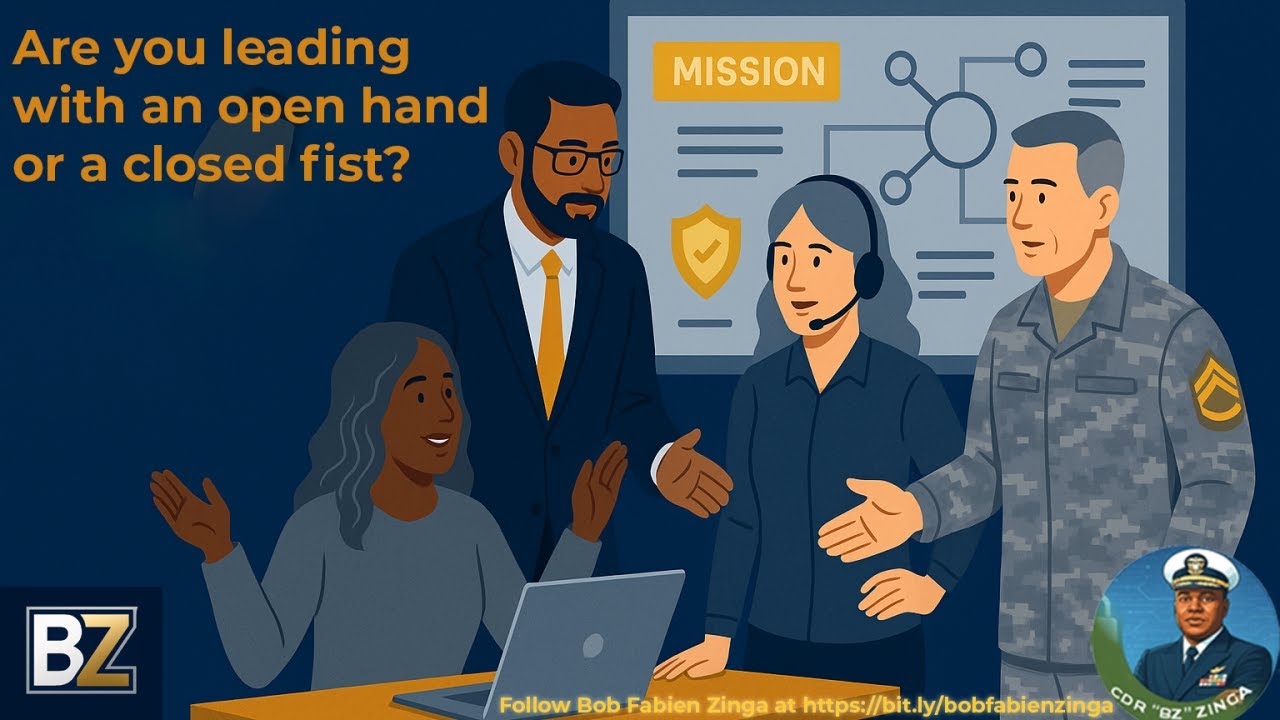
Bob Fabien Zinga, a former Navy information-warfare commander and Silicon Valley CISO, argues that true leadership comes from service, trust, and influence, not rank. He outlines six concrete actions: share knowledge, mentor without expectation, build trust proactively, serve without keeping score, speak up for the right things, and lead with empathy. An admiral's public praise of Zinga led to mentoring junior officers who later became commanders, showing the ripple effect of open-hand leadership.
Chapters
¡Hola!
Hi, I'm John Maxwell. When the top companies in the world are looking for trainers, speakers, and coaches, there's one name that stands above the rest, and that's Maxwell Leadership. Our certified team members have gotten proven results for companies all over the globe, and our reputation, I'm proud to say, is second to none. Some of our members have risen to the top of their profession, including the one you're going to meet today. I proudly introduce you to my friend Bob Fabien Zinga.
Welcome to the Leadership and Success Podcast with your host, Coach Beezy. If you need to develop into a better leader, this podcast is for you. If you want to achieve a greater level of success, this podcast is for you. His mentor, Dr. John C. Maxwell, said it best: everything rises and falls on leadership. We hope to inspire you today and provide you with an insight that has the potential to positively impact the trajectory of your life. Welcome to the Leadership and Success Podcast.
Imagine gaining the leadership skills that could redefine your career. Join Coach BZ on the Leadership and Success Podcast, where each episode delivers practical insights from world-class speakers, military leaders, and industry experts. We dive deep into what matters most. Building resilient teams, leading through uncertainty, and navigating complexity with clarity and confidence. Every conversation is crafted for aspiring leaders like you who are ready to grow, lead, and make a lasting impact. Don't miss our powerful live sessions and recent highlights. Michelle Hayward on building diverse, high-performing technical teams. Anne Leslie on leading through global complexity and cybersecurity risk. Ron Carpenter, AI, exploring faith, resilience, and AI-powered leadership. Colonel Michelle G.I. Gardner, INS, on commanding influence from the battlefield to the boardroom. Chris Robinson on shifting from drift to drive in life and leadership. And Coach Enrique Acosta Gonzalez on mentorship, legacy, and heart-centered leadership. Ready to level up your leadership journey? Tune in on Spotify, Apple, Audible Podcasts, YouTube Live, and LinkedIn Live. Join the movement toward leadership excellence. Listen now and start transforming your success.
Very— Question 4.
Um, have you ever looked at a truly impactful leader and wondered what their secret sauce is? It's easy to assume it's their title, maybe their authority, or perhaps just, you know, sheer charisma. But what if the deepest, most profound form of leadership, one that works just as well in the military as it does in, say, Silicon Valley boardrooms, actually comes from a place of radical openness and service? Today in the deep dive, we're exploring exactly that. We're unpacking a powerful and maybe often counterintuitive approach to influence. Leading with an open hand. Our guide through this fascinating concept is Bob Fabien Zinga. Now, he is a cybersecurity executive and also a seasoned U.S. Navy information warfare commander. His article, "Lead: Leading with an Open Hand from the Navy to Silicon Valley," offers this incredible perspective because, well, he's navigated leadership in two vastly different, really high-stakes worlds. For you, our listener, our mission today is to really extract the universal truths about how genuine influence, selfless service, and unwavering trust are actually built. These principles apply whether you're aspiring to command a ship, lead a cutting-edge tech team, or maybe just want to multiply your positive impact in your daily life. This isn't just abstract theory. It's hard-won wisdom forged in environments where decisions have real consequences. Okay, let's dive and see what profound connections we can uncover. Yeah.
And what immediately stands out in Bob Fabien Zinga's work is how quickly he just bypasses the usual stuff. You know, the badges, the titles, the inherent authority. He zeroes right in on service and trust as the real bedrock of leadership. And like you said, Yeah, this isn't some academic exercise. It's a philosophy born from decades of high-stakes, real-world situations. The blend of, uh, rigid military discipline and the innovative, sometimes almost chaotic culture of Silicon Valley. It provides such fertile ground for examining what truly makes leadership adaptable and effective. He's seen firsthand what works and frankly what falls flat, not just in theory, but right there in the trenches across these wildly different organizational landscapes. This unique dual perspective lets him distill principles that really go beyond specific industries or hierarchies, making them, well, universally applicable, right?
And Zinga wastes no time challenging our assumptions about what even defines a leader. Right from the get-go, he asserts real leadership isn't about rank, title, or authority. It's about service, trust, and influence. He calls this a universal truth he discovered throughout his entire career, which is quite a claim, and even frames this message specifically for aspiring naval junior officers and senior security engineers or analysts, two groups where you might think traditional authority is, you know, heavily emphasized. So look, not about the stripes on your sleeve or the fancy job title, but something far more fundamental. How does he really unpack this surprising distinction between just managing versus truly leading? And why is that so crucial for building authentic influence?
It's a critical distinction, I think, because so often we do mistake managing tasks or just overseeing direct reports for genuine leadership. Zinga argues that true leadership is fundamentally a relational thing. You know, it's a dynamic that unfolds between people built on mutual respect, shared goals, rather than just issuing directives. Because of your position. When he talks about service, he really means actively putting others' needs first. It's about asking, "How can I genuinely support you? What resources, what clarity, maybe what mentorship do you actually need to succeed?" This isn't just a nice gesture. It's a really profound strategic choice to invest in the capabilities and frankly the well-being of your team members. And when you consistently show that service, you inevitably build trust. Trust isn't just blind faith, right? It's cultivated through reliability, transparency, and showing you're committed to their success, not just your own agenda. Influence then isn't something you demand or exert. It's the natural, almost organic outcome when those two foundational elements, service and trust, are deeply present. It's what happens when people choose to follow you, not because they have to, but because they believe in your intent and your ability to help them reach their goals. He's basically saying, Your genuine power comes from the people you lead, from their willing engagement, not just the position itself. It's an inside-out approach, really, where internal values create this profound external impact. Mm-hmm. And you can see it in his own career path, which is quite remarkable. He was hand-selected as commanding officer for NR Nevenet Workom Global Network Operations Security Center. Let's just call it GNOSC for short.
Okay.
This is a crucial hub, right? Responsible for managing and securing the Navy's global networks, a role needing immense responsibility, balancing mission assurance and cybersecurity. Then years later, he becomes the Chief Information Security Officer, the CISO, of Santa Clara University, overseeing all their digital security.
Very different environments.
Totally different, different missions, cultures, structures. Yet Zinga specifically notes that both required the same fundamental need to lead with integrity, emotional intelligence, and influence. It wasn't primarily his technical skill, he suggests, that defined his success in those roles. It was his ability to navigate the human element, build those essential relationships, and guide diverse groups effectively through challenging, high-pressure situations. It really powerfully underscores his point that service, trust, and influence are indeed universal truths. They apply regardless of the specific domain, the mission's complexity, or the hierarchy.
That makes perfect sense. It's about cultivating a consistent character, like a bedrock of values, not just having a flexible skill set you adapt. And his philosophy didn't just appear out of thin air. It's deeply shaped by influential figures he mentions. He credits Dr. John C. Maxwell, whom he calls Papa John, saying Maxwell's quote literally changed his life. If I see you as hurting, I'll help you. If I see you as broken, I'll fix you. But when I see you as valuable, I'll serve you.
Wow.
Then there's Zig Ziglar's classic, help enough people get what they want and you can have everything you want. These quotes are powerful on their own, but Zinga seems to have truly internalized them as guiding principles.
Absolutely. This isn't just about what he says. It's about a deeply ingrained belief system. It forms his whole worldview. These quotes aren't just cat phrases for him. They form the bedrock of what he calls his rising tide philosophy. It's that abundance mindset, this really transformative idea that by investing in others, by actively lifting them up, you don't diminish yourself or your own opportunities. Quite the opposite, actually. You expand the collective capacity. When your peers grow, your team grows. When your mentees succeed, you win too, often in ways you didn't even foresee. This fundamentally shifts the paradigm away from scarcity thinking, where success is seen as fixed, limited, leading to competition towards one of mutual growth and shared prosperity. It's about seeing the world and your interactions as this continuous process of creation and expansion, not some zero-sum game where one person's gain means another's loss.
What I found particularly striking in Zinga's piece, though, was how he introduces a deeply personal element: his father's words. He recounts his father telling him, "Children are supposed to be better off than their parents. If you only match my success, I would consider it a failure." Zinga then adds that he believes the new generation should do better than the previous generation because they stand on their shoulders. I stand on the shoulders of giants. How does this deeply personal expectation from his father translate into his leadership style for others, especially those he's leading professionally? Seems like one thing for your own kids, but maybe quite another to apply it so broadly.
That personal history raises a really important question for all of us, doesn't it?
Yeah.
What kind of legacy are you actually aiming to build? For Zinga, it's crystal clear. His legacy isn't just his own impressive achievements or the titles he's held. No, it's defined by the accomplishments of those he has helped surpass him. It's an incredibly empowering vision, and it stands in such stark contrast to the ego-driven narratives you often find in leadership circles, right? Where leaders might jealously guard their position, their knowledge, their network. His father's words seem to have instilled in him this profound sense of responsibility, not just for his own path, but for actively enabling the next generation to go further, to achieve even more than he did. This directly translates into a leadership style where he actively seeks to empower and elevate others. To generously give them the tools, the knowledge, the opportunities to potentially outshine him. He views their success not as a threat, but as a direct reflection, maybe even an exponential amplification of his own impact. It's a powerful model of, let's call it, selfless ambition, where personal fulfillment is tied directly to contributing to the greater good and the advancement of everyone around him.
Yeah, selfless ambition. I like that. Now, Zinga's incredible journey didn't just teach him about leadership. It really forced him to confront 2 starkly different worlds. He highlights this fundamental difference between military leadership and tech leadership. The military teaches obedience to rank, but in tech, engineers don't take orders just because you wear a badge. You have to earn their trust. This is such a crucial distinction for anyone navigating different professional cultures. What did that shift really look like for him? And what practical lessons can we draw for bridging that gap from, you know, because I said so to because I believe in you.
What's really insightful here is how Zinga illustrates the pitfalls of trying to rely on traditional positional authority in a knowledge worker setting. In the military, rank inherently gives you a significant degree of formal authority. There's a clear chain of command, orders are generally followed. It's about discipline, duty, often operational necessity. But in the tech world, particularly with highly skilled, often very independent-minded engineers, Authority isn't automatic just because of your title— manager, director, CSO, whatever. It has to be earned from the team itself. And this earning comes not just through competence, knowing your stuff, but crucially through genuine care, through understanding their work intimately and by consistently proving you're there to help them succeed, not just dictate policy. Zinga shares this vivid anecdote about his emails being completely ignored— some Zinga guy's emails, as he puts it. A perfect kind of visceral example of what happens when that foundational trust isn't there. Without it, your directives, no matter how well-intentioned, how strategically sound, how critical from a cybersecurity standpoint, they just fall on deaf ears. They'll be seen as arbitrary rules rather than necessary guidance. It's not necessarily about disrespect. It's more a lack of engagement when the leader hasn't built credibility beyond their job title. And it's a direct consequence of failing to bridge that gap between positional power and authentic relational influence. It causes friction, inefficiency, huge problems in fast-paced environments.
That's a powerful visual, isn't it? Those ignored emails. It makes you realize, especially in tech, an unapproachable leader is just an ineffective one. This leads right into his pivotal experience at Pivotal Software Inc., where he quickly saw that traditional authority was, well, useless. He had to profoundly change his tactics. He describes building relationships, really listening to the pressures his team faced, asking these crucial questions like, What are your biggest blockers? Where can I help instead of hinder? How can security actually enable your mission, not slow you down? This transformed him from a gatekeeper, which is how security teams are often seen, right? Frustratingly. Oh, definitely. Into a partner and an ally. Can you imagine an engineering team battling a tight deadline only for security to drop new complex protocols that just halt progress? How did he manage to turn security from that common roadblock into a genuine accelerator for these engineers.
Yeah, this is exactly where the rubber meets the road. It shows the transformative power of empathy and just deep curiosity in leadership. Instead of imposing security solutions from on high or just handing down mandates, Zinga started by actively listening, genuinely seeking to understand the daily frustrations, the bottlenecks his team was dealing with. By asking, "How can I help instead of hinder?" he immediately signaled a radical shift in his intent.
Mm-hmm.
He repositioned security not as a policing function, not as an obstacle creating more work, but as a strategic enabler. This might mean finding ways to integrate security smoothly into their development workflows, maybe offering pre-approved secure libraries, perhaps embedding security specialists within dev teams, or streamlining review processes to be more agile, less bureaucratic. This approach built incredibly deep credibility. It fostered genuine collaboration because the team immediately saw that their leader was truly invested in their success. And their mission, not just his own department's metrics or checking boxes. He brings in two more powerful John C. Maxwell quotes here that just nail it. People don't care how much you know until they know how much you care. And leadership is influence, nothing more, nothing less. These statements really underscore this entire section, emphasizing that knowledge and expertise alone, not enough. They have to be coupled with genuine concern for others to create real influence. It's about demonstrating your value through service and enabling not through control.
Okay, let's shift gears slightly and talk about something that plagues so many professional environments— military promotions, tech startups, you name it— this myth of scarcity. Zinga observes that many young professionals see success as a zero-sum game. One person's rise means another has to fall, or there's only a fixed amount of recognition or resources to go around. He powerfully refutes this, quoting T. Harv Eker: If the pizza's too small, we can make a bigger pizza.
Mm.
This scarcity mindset is so pervasive. How does Zinga challenge this fundamental assumption that there's only so much success? And what's the psychological impact of getting caught in that trap?
What's really illuminating here is the psychological barrier this myth of scarcity erects. It's a deep-seated mental model that dictates behavior, leading to these damaging patterns like hoarding knowledge or choosing fierce competition over real collaboration and being really reluctant to empower others. If you genuinely believe success is a fixed pie, well, it's only natural to try and grab the biggest slice for yourself, often at others' expense.
Yeah, makes sense, unfortunately.
And it's not just bad for individual growth. The people hold back their full potential to avoid making others look good or protect their own perceived edge. More significantly, it cripples team potential. It stifles innovation, hinders collective problem solving, erodes trust. It's really corrosive.
So how can leaders fight that? How can they actively model and foster an abundance mindset where sharing knowledge, sharing opportunities is seen as a strength, not a personal risk?
Well, Zinga directly challenges it by stating flatly, you don't have to diminish others to rise. He points out that very real hesitation officers and engineers might feel about sharing crucial tips or valuable connections or even hard-won insights purely out of fear it might make someone else more competitive for that next promotion or that cool project.
Right.
And he explicitly warns that that mindset limits not only your team, but your own leadership potential. It's fundamentally self-defeating. When you operate from scarcity, you ironically cap your own growth, you limit your team's impact, and you undermine the very influence you're trying to build. It traps you in the cycle of competition instead of enabling a cycle of collective growth.
So embracing this abundance mindset isn't just about being altruistic or, you know, nice. It's actually a profound strategic advantage. It's about expanding that collective pie, making everyone stronger, which then circles back to benefit the leader. Zinga argues, when you grow others, your influence multiplies. How does this translate into concrete, maybe even measurable benefits for the leader and the organization? Seems almost counterintuitive to some people. Helping others makes you more influential.
If we zoom out and connect this to the broader picture of, say, modern organizational psychology, it aligns perfectly with ideas like distributed leadership, collective intelligence, and building resilient teams. A leader who actively and genuinely empowers others doesn't dilute their own influence. They create a more robust, more innovative, and ultimately more successful team. Think about it. If you as the leader are the sole source of all answers, the only one making critical decisions, or the only one driving innovation, your capacity is inherently limited. You become the bottleneck, right? But when you strategically invest in developing the capabilities and the confidence of your team, you create this powerful network of competent, engaged individuals, people who can problem solve on their own, innovate creatively, even lead their own initiatives. Your influence isn't just maintained, it's exponentially amplified through the collective capabilities of those you uplift and empower. You transform from being a single point of constraint into being the central node of this powerful expanding network. The benefits go way beyond just increased output or efficiency. It's about building a fundamentally more resilient, adaptive, dynamic organization that can handle complex challenges because it has this broad, deep base of empowered contributors. It literally transforms a singular effort into a synergistic force.
That's fantastic. And P. Zinga doesn't just give us the philosophy. He gives us a clear, actionable roadmap for leading with an open hand. He outlined 6 practical steps. Let's go through them. 1, share what you learn, write it down, teach it, post it. Don't hoard knowledge. 2, mentor without expectation. Genuinely celebrate when others leapfrog you in their careers.
3.
Build trust before you need it. Because trust is the absolute currency of influence.
4.
Serve without keeping score. People remember who truly believed in them and supported them, not just who tallied the most points for themselves. 5. Speak up for the right things, even when it's uncomfortable or unpopular. And 6. Lead with empathy. Especially crucial in high-stress environments like cybersecurity. These all sound vital. Which of these do you think is the hardest for people to truly adopt and live by, especially in those fast-paced or super competitive fields where there's often intense pressure to just protect your own position or status?
That's a really good question, and it gets to the heart of the challenge, doesn't it? Truly embodying these when our instincts or maybe our workplace conditioning push us towards self-preservation. While all 6 are challenging in their own way, I'd argue that number 2, mentor without expectation. Some will leapfrog you. Celebrate that is perhaps the most difficult for many leaders to really internalize and practice consistently.
Yeah, I could see that.
It directly confronts that scarcity mindset we just discussed, the little voice that whispers, don't train your replacement. It demands a profound level of self-security and a genuine, almost radical commitment to the growth of others, even if that means they might eventually surpass you in some way or become a perceived competitor. In competitive fields, there's often this unconscious, maybe unacknowledged fear of creating your own competition. But Zinga wisely points out that this narrow thinking actually limits your own leadership potential. Truly celebrating someone else's rise, especially if they were once your mentee, requires a fundamental shift from an ego-driven, self-serving leadership model to a true servant leadership approach. Let's think about the others too, though. Share what you learn. That's not just generosity. It positions you as an invaluable resource. It naturally draws others and amplifies your influence. Build trust before you need it. That's Proactive Leadership 101, right? Investing in relationships, demonstrating reliability long before crisis hits. So when a tough call needs making or you need the team to trust a complex plan, they already have this deep well of belief in your judgment and good intentions.
That makes sense.
Serve without a scoreboard. That means your actions are driven by authentic care. A genuine desire to empower, not just chasing immediate recognition, which ironically builds much deeper, more enduring loyalty. Speak up for the right things. That demands moral courage, integrity, reinforcing that trust, especially when it might cost you something personally. And lead with empathy. Absolutely crucial, especially in high-stress fields like cybersecurity. Understanding the human side of security risks burnout, fear of breaches, The constant pressure can be as vital as any technical fix. It means listening to concerns, understanding policy impacts, offering practical support. Consistently applying these, especially the ones that challenge our competitive urges and demand humility, builds a leader's character over time. It's transformative. It shakes who you are, not just what you do.
That distinction between character and action brings us right to these profound supporting quotes. Zinga includes: 'Be more concerned with your character than with your reputation,' from the legendary basketball coach John Wooden. And then, 'You don't get in life what you want, you get in life what you are,' from motivational speaker Les Brown. Finally, he adds Jim Rohn's powerful insight: 'Discipline is the bridge between goals and accomplishment.' This really underlines the open hand approach as a reflection of inner values, not just external behaviors. Why is character so much more important than just reputation in the long run for a leader, especially maybe in today's transparent world?
This is really a cornerstone of enduring leadership. Character fundamentally is who you are when nobody's watching. It's your core values, your integrity, your commitment to ethical behavior day in, day out. Reputation, on the other hand, is just what others perceive you to be. It can be meticulously crafted, influenced by PR, curated appearances, social media, formal comms.
Right, it can be managed.
Exactly. And for a leader, reputation can be incredibly fleeting, easily tarnished by a single misstep or a revelation that contradicts the public image, especially now in our hyper-connected world. But character builds enduring trust and profound influence precisely because it's authentic, it's consistent, it's resilient. People have this intuitive ability, I think, to sense a leader of true integrity, and they're far more willing to follow that kind of person through challenges, uncertainty, even adversity, they know you mean what you say and you'll act consistently with your values. The Les Brown quote, "You don't get in life what you want, you get in life what you are," emphasizes this further. It's about internal congruence. Your external results, your real influence, the quality of your relationships, they aren't just outcomes of your actions, but reflections of your internal state, your values, your true self. If you are a person of generosity and service, Those qualities will naturally manifest and draw opportunities and loyalty to you. And the Jim Rohn quote about discipline: It brilliantly links character directly to the consistent effort required for true leadership. It's not enough to just intend to be a leader of character. You have to actively discipline yourself to act in line with those values day after day, especially when it's hard, inconvenient, or maybe unglamorous. That discipline is the vital bridge. It transforms good intentions into tangible results and ultimately into enduring influence and a legacy worth remembering. Without that consistent effort, even the best intentions just— stay intentions.
What really solidifies these principles for me is seeing them in action. Zinga shares this powerful personal story that truly brings his philosophy to life. He recounts being publicly praised by a lead active-duty admiral at a 2009 symposium. And this praise wasn't for his own direct achievements but for sharing knowledge on his personal website to help junior officers. This unexpected public recognition immediately led to two Lieutenant Junior Grade Officers, LTJGs, asking him, another LTJG at the time, to mentor them. Now that's highly unconventional in a hierarchical military structure, isn't it? He mentions he'd only ever been mentored by someone senior.
Very unconventional, yeah.
He agreed after checking with his own Captain mentor. And the kicker? Both of those LTJGs eventually became U.S. Navy Commanders. The same rank as Zinga himself. This isn't just a feel-good story; it's a powerful, real-world demonstration of his philosophy. Imagine getting praised by an admiral and then immediately turning that recognition into a chance to lift others. And mentoring peers— that's really revolutionary within a rigid hierarchy.
This anecdote perfectly illustrates the profound ripple effect a single act of selfless sharing can create. His public praise from the admiral, which he didn't even seek, right? It amplified his message and showed his genuine commitment to the community. This visibility then created those direct, albeit unconventional, mentorship opportunities. This story powerfully challenges those traditional, often rigid power dynamics we associate with mentorship, especially in places like the military. It forces us to ask, how many potential mentors are out there, maybe hesitating or holding back simply because of perceived rank differences or the unspoken rules of their environment? How many incredible opportunities to build up those around them are being missed?
Mm, good question.
Zinga's willingness to step outside the traditional lines and mentor peers and the truly remarkable outcome of those mentees reaching his own rank, it speaks volumes about the exponential power of this open-hand approach to developing talent. It directly contributes to the strength and resilience of the whole organization, in this case, the US Navy, and you could argue national defense by cultivating leaders at every single level.
So what does this mean for us beyond the military context. This experience profoundly taught Zinga that mentorship isn't about rank, it's about wisdom. He now actively welcomes mentorship from peers and even exceptional chiefs, acknowledging their sea time and leadership depth. He says this humility and collaboration is exactly what the Navy and national defense need for the future. This fundamentally redefines who can be a mentor and who can be a mentee, really for anyone in any field. It's about valuing experience, insight, practical wisdom wherever you find it, not just rigidly following the chain of command or looking up the org chart. It kind of shatters those rigid ideas of who's qualified to teach or guide.
If we connect this to the bigger picture, yeah, it directly challenges hierarchical norms that can inadvertently stifle innovation, block the flow of critical knowledge, and ultimately hinder growth within any organization, military or corporate. By prioritizing wisdom, practical experience, genuine insight over just formal rank or position, organizations can tap into a much richer, more diverse, more dynamic pool of talent and collective intelligence. This isn't just about being nice or fostering a pleasant workplace. It's a strategic imperative for adaptability, for competitive advantage in a rapidly changing world. Imagine the wealth of knowledge trapped in a system where only those above you are considered worthy mentors. Or where you can't genuinely learn from someone technically below you because of some rigid protocol. Zinga's experience clearly shows that by embracing intellectual humility, by actively seeking wisdom from all levels, from junior officers to seasoned chiefs, you unlock immense human potential. This is a critical lesson for any institution looking to optimize its human capital, break down silos, and foster a truly learning-oriented collaborative culture. It moves beyond the limits of positional authority to a place where competence, insight, and shared purpose are genuinely valued, no matter where they come from in the structure.
Zinga sums up his entire philosophy with such a powerful, almost poetic image. He says, leadership isn't about climbing the ladder and pulling it up behind you. It's about reaching back down and saying, come with me. He urges leaders, start by valuing people, share freely, lead with purpose, That contrast is so vivid, isn't it? The difference between being a gatekeeper, jealously guarding access, and being a true guide, opening pathways for others. It really makes you pause and think about the kind of leader you want to be remembered as. Will you be the one who hoarded the knowledge, protected your turf, or the one who intentionally opened doors and lifted others as you climbed?
It's an incredibly potent metaphor. It captures that fundamental shift from a self-serving, ego-driven view of leadership to one of collective advancement and shared prosperity. The Pulling the ladder up behind you mentality is deeply rooted in that scarcity mindset we talked about, that insidious idea that there's only finite room at the top, so you have to secure your spot by any means necessary, maybe including limiting others' access.
Yep.
But Zinga's come with me is this powerful invitation to an abundance mindset, to shared success, to actively building a larger, more capable, more interconnected community. This raises an important question for society really. In a world often characterized by intense competition, individual ambition, a relentless focus on personal gain, how do we foster environments where "come with me" becomes the default, not the rare exception? It requires a conscious, continuous effort by leaders at all levels, not just modeling that behavior themselves, but actively creating a culture where empowering others isn't just encouraged, but genuinely celebrated and rewarded. It's about fundamentally changing the incentive structure from individual gain to collective growth and shared legacy. This shift isn't just about being ethical. It's about building highly resilient, innovative, adaptive organizations that thrive because they leverage the full potential of everyone.
He reinforces this deeply personal, transformative idea with another Jim Rohn quote that feels like a summation of his entire philosophy. Success is not something you pursue. Success is something you attract by the person you become. Don't wish it were easier. Wish you were better.
Mm-hmm.
And he concludes by saying, you don't need a perfect plan to start. You just need the courage to care and the integrity to act.
Mm-hmm.
What does this all mean for us? It sounds like true lasting success for a leader is less about chasing external goals and more about cultivating an internal state of being, right? A certain character. It's about who you are deep down, not just what you accomplish.
If we connect this to the bigger picture, yeah, it suggests the most impactful, the most enduring leaders aren't just achieving results. They're embodying a set of profound values and a consistent character that naturally draws others towards them and their vision. This speaks right to the essence of transformational leadership, which is a stark contrast to just transactional leadership.
Explain that difference a bit more.
Well, transactional leadership is often about explicit exchanges. I give you this, you give me that. I reward this performance, you deliver that result. It's based on clear transactions. Transformational leadership, though, is about inspiring and motivating followers to achieve far more than they ever thought possible, often by appealing to higher ideals, a shared purpose, deeply held values. Zinga's entire philosophy is inherently transformational. By focusing on cultivating personal character, on truly caring for others, on acting with unwavering integrity, a leader builds this aura of authenticity and trustworthiness. This isn't some strategy you just implement for a project. It's a fundamental way of being a leader. This principle serves as a guiding light for anyone looking to make a lasting positive impact because it shifts the primary focus from external achievements, which can be fleeting, to internal development, knowing that the former will naturally, inevitably follow from the latter. It's a powerful, timeless truth, challenges us to look inward before trying to lead outward.
Now, Bob Fabien Zinga takes this deep dive even further. He offers what he calls Think on These Things, connecting his modern leadership philosophy to um, ancient wisdom, specifically drawing powerful parallels from biblical verses. Now, this isn't about promoting specific religious beliefs here, but about identifying these universal principles that have resonated for millennia and still offer profound guidance for leaders today. Let's start with the theme of humility and service. He references Philippians 2:3, which advises, "Let nothing be done through selfish ambition or conceit, but in lowliness of mind let each esteem others better than himself." Zinga's insight here is that true leadership starts with genuine humility—serving others selflessly, celebrating their strengths, actively lifting them up. A leader with an open hand values their team far more than their own title or position. In a society that often glorifies individual achievement, self-promotion, how challenging is it for a leader to truly embrace that kind of humility Zinga advocates, especially when the natural pull might be to highlight your own accomplishments?
It's incredibly challenging precisely because so many of our modern societal and corporate systems are frankly designed to reward individual pursuits and self-promotion. Embracing the humility Zinga champions requires a conscious, often countercultural effort. Resisting the urge to take all the credit, stepping back to let others shine, genuinely believing in the potential and worth of your teammates, even if they're less experienced or less visible. It's about fostering an environment where ideas are judged on merit. Not on who proposed them, and where successes are shared broadly. Right. He challenges us to reflect, in what ways can I elevate others this week, even if it doesn't benefit me directly? Where in my leadership style have I let ambition overshadow humility? How can I recognize and affirm the unique contributions of my teammates, especially those who might feel overlooked? It's a constant battle against the ego, isn't it? But one that Zinga argues is absolutely essential for building true enduring influence and a loyal, high-performing team where every member feels valued, not just a few stars.
That's a powerful call to self-reflection. Moving to the theme of generosity and abundance, Zinga highlights Proverbs 11:2, "A generous person will prosper; whoever refreshes others will be refreshed." His insight here is that sharing knowledge, actively mentoring, generously offering support—it isn't a detour from success; it is, in fact, the path to it. Generous leadership, he argues, builds credibility, expands influence, and leads to a kind of, um, spiritual prosperity. This isn't just about charity, is it? It's about a virtuous cycle, like a return on investment of human capital and goodwill that really reinforces that rising tide idea we talked about earlier.
Precisely. This verse isn't promoting some transactional give-to-get mentality. It's describing a fundamental, almost universal principle of abundance and reciprocity within human interaction, within organizational dynamics. When you generously share your knowledge, your network, your time, your praise, you're essentially investing in the ecosystem around you, your team, your colleagues, your industry. And that investment doesn't just vanish; it circulates. It eventually comes back, often in unforeseen and deeply impactful ways. Hmm. The article prompts us to ask ourselves, what knowledge, experience, or tools am I holding back that others could benefit from today? Who in my sphere of influence is due for encouragement or investment? What does generosity look like in my leadership role in terms of time, praise, mentorship? Zinga's own story, sharing his cybersecurity insights online, leading to those unexpected mentorships and profound professional fulfillment is a perfect real-world demonstration of this principle in action. It shows generosity isn't just about what you give away, but what it creates.
Building on that, Zinga includes Luke 6:38, which states, "Give and it will be given to you, good measure, pressed down, shaken together, and running over." Good. The insight here is that investing in others is never a waste. What you give—support, knowledge, trust—it comes back multiplied in greater trust, unwavering loyalty, stronger team cohesion. Good things truly do happen when you consistently do the right thing, even when no one is watching. This adds an almost cosmic dimension to the open hand approach, suggesting a universal principle of reciprocity that goes beyond immediate metrics.
It absolutely does. If we zoom out, it suggests that whether through human dynamics or maybe a higher power, the energy and generosity you put out as a leader often reciprocate in abundance. It's a fundamental principle of human interaction and organizational psychology. When leaders consistently give their best to their team, their wisdom, their time, their unwavering support, even when there's no immediate recognition or direct reward, they cultivate this profound sense of psychological safety and belonging within their team. It's key. And that in turn builds incredible loyalty, fosters psychological safety, enhances cohesion. The good measure, pressed down, shaken together, and running over isn't just about material returns. It's about the overflow of trust. Trust, enhanced problem-solving capacity, sustained innovation that flourishes when a team feels truly supported and valued by its leadership. It pushes us beyond mere compliance or transactional exchanges to truly inspire and uplift those around us. The self-reflection questions here are powerful. Am I giving my best to my team even when there's no recognition? What mindset shift do I need from transactional to transformational leadership? Have I seen a time when my generosity as a leader came back multiplied? What did I learn? These really challenge us to consider our deeper motivations and the lasting impact of our actions.
Okay, finally we arrive at the theme of perseverance and empowerment. Zinga includes 1 Thessalonians 5:11: Therefore encourage one another and build one another up, just as you are doing. His insight is that empowerment is almost like a sacred duty. We should build others up without reservation, even if they might outrank us one day. This cultivates courage within the team, not that self-defeating competition. This isn't just about being generally supportive. It sounds like it's about making it a core active part of your leadership role to enable others to succeed, even if they become your perceived competition. It's about fostering courage and collaboration, not rivalry.
This really hammers home the idea of leadership as a proactive, deeply ethical, and, uh, forward-looking responsibility. It's not passive support. Support. It's an active, intentional effort to build one another up. This directly counters that instinct to protect your own position by subtly undermining or withholding opportunities from others. By cultivating courage, you empower individuals to take calculated risks, to innovate, to speak up with their ideas, to openly share insights knowing they have the leader's unwavering backing and belief. By rejecting competition within the immediate team, you foster a culture of genuine collaboration where where success is shared and where failures are viewed as valuable learning opportunities, not reasons for blame or individual shame. The prompts Zinga offers are incisive here. Who can I encourage today with intentional words or actions? Have I created a culture of competition or one of collaboration and courage? What does building up others look like on my team or within my organization? These compel leaders to examine the actual culture they are creating through their daily actions, not just the aspirational one they might about. And fittingly, Zinga closes his think on these things with Matthew 23:11 stating, the greatest among you will be your servant. The leadership insight here is that rank, position, titles, they mean nothing if they aren't used in selfless service to others. Choose to serve the mission and the people first, not your own ego or accolades. This echoes B.Z. Zinga's entire premise from the very beginning of the article, doesn't it? It reframes leadership entirely. From being served to genuinely serving those you lead. Absolutely. And then he shares Galatians 6:9, and let us not grow weary of doing good, for in due season we will reap if we do not give up. The powerful insight here is that leadership, especially this open-hand leadership, it's a long game. Recognition might not come immediately. The impact might not always be visible, but there is an undeniable harvest for those who stay faithful to these principles. You have to stay the course, keep serving. Good fruit truly grows from good seed. Even if that growth is initially unseen.
This last point feels like a perfect capstone for the whole discussion, really, because leading with an open hand isn't always easy, is it? It's not always immediately rewarded. It requires immense persistence, a deep well of belief in a longer game, and maybe faith that sowing good seeds will eventually yield a good harvest, even if you don't see it right away. It's about consistently making those choices, building that character, even when it's difficult. Or when external validation is scarce.
Absolutely. This provides crucial encouragement for leaders committed to the open hand approach, precisely because the rewards aren't always immediate or tangible. It validates the significant effort required to consistently act with humility, generosity, and service, even when facing skepticism, resistance, or just a lack of immediate recognition. It powerfully affirms that true lasting impact often accumulates gradually over time, much like the steady, unseen growth of a majestic tree from a tiny planted seed. The coaching prompts here speak directly to resilience. Where am I tempted to give up or slow down in doing good? How can I sustain my motivation when the rewards seem distant or invisible? What good seed am I planting right now, even if the harvest isn't yet visible? It serves as a vital reminder to leaders that character, integrity, genuine service—these are profound, long-term investments with compounding returns. Even if the daily grind sometimes feels unrewarding or thankless, it's about unwavering faith in the process and the ultimate positive outcome of cultivating human potential and making a lasting impact.
And that brings us to the close of this deep dive into Leading with an Open Hand. We've journeyed through Bob Fabien Zinga's remarkable career, from his time as a U.S. Navy information warfare commander to his pivotal leadership roles in Silicon Valley. His core message rings clearer than ever. True leadership isn't about rank or title. It's about profoundly valuing people, sharing freely, leading with purpose and, um, a generous spirit. These are universal truths. They apply whether you're navigating the highly structured environment of the military, the fast-paced, often chaotic world of a tech startup, or really any professional or personal endeavor where you seek to build influence and drive positive change. As you reflect on this deep dive—
This deep dive into leading with an open hand really makes us consider a transformative vision, doesn't it? What would our organizations, our communities, maybe even our world fundamentally look like if every leader consciously chose to lift others, to create more leaders, rather than instinctively pulling the ladder up behind them? What kind of enduring legacy would you truly want to leave? It's about recognizing that true success isn't something you just chase externally. It's something you attract by the quality of the person you become. Your greatest and most lasting impact often comes not from what you personally achieve, but from the growth, the opportunities, the capabilities you foster in others. It's a powerful and profoundly timeless truth that, as Zinga has shown us through his remarkable journey, can truly transform not only individual careers, but entire institutions and maybe the broader human experience.
Indeed. We encourage you to continue your own deep dives into this source material and to reflect on how you can apply these profound lessons in your own leadership journey starting today. Thank you for joining us on the deep dive. We'll be back soon with more insights to help you stay well informed.
Thank you for listening to the Leadership and Success Podcast with your host, Coach Beezy. If you like what you heard, please subscribe to our channels and come back for more wisdom nuggets on how you may develop into a better leader and achieve greater levels of success. Leadership is the most critical skill. The world will always need leaders to lead others, deploy the next disruptive technology, or execute a business strategy. You may as well decide on counting yourself among the 21st century leaders. See you right here next time on the Leadership and Success Podcast with Coach BZ.
More from Bob

S250:E4🎙️LIVE 🇺🇸America 250: President Barack Obama Leadership, Service, and the Power of Hope






S5:E157🎙️ LIVE with CMD CMSgt Dennis L. Fritz, USAF (Ret.)(Multi Tracks Audio)



S5:E156🎙️ LIVE 🇪🇸 Leadership Lessons from the FIFA World Cup 2026 Champions (Multi Tracks Audio)

S250:E3🎙️ LIVE Leadership Lessons from America’s First Documented Family of African Descent 🇺🇸📖