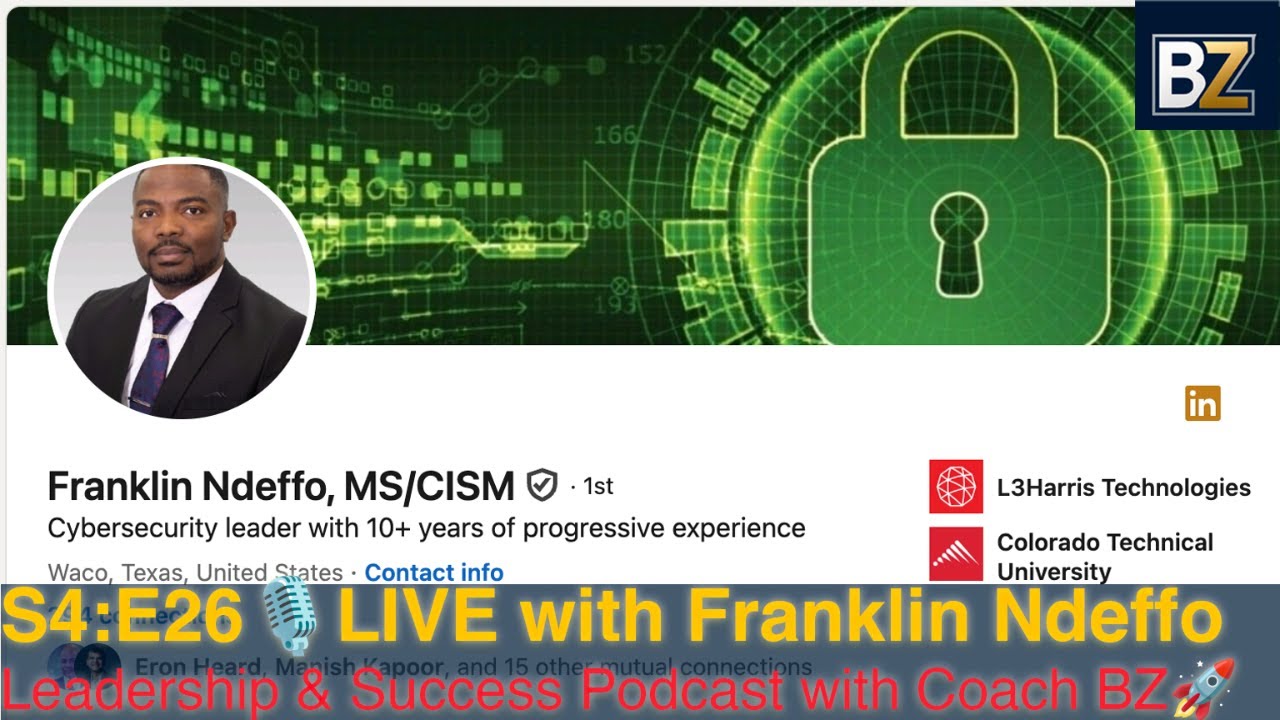
Franklin Ndefo, a Cameroonian-born Navy officer, went from cleaning church floors to becoming an instant select officer in Information Warfare. He arrived in the U.S. on a $400 F-1 visa, re-credentialed a foreign engineering degree, and is now pursuing his CISO goal while earning certifications like CISSP.
Chapters
Hi, I'm John Maxwell. When the top companies in the world are looking for trainers, speakers, and coaches, there's one name that stands above the rest, and that's Maxwell Leadership. Our certified team members have gotten proven results for companies all over the globe, and our reputation, I'm proud to say, is second to none. Some of our members have risen to the top of their profession, including the one you're going to meet today. I proudly introduce you to my friend, Bob Fabien Zinga.
Welcome to the Leadership and Success Podcast with your host, Coach BZ. If you need to develop into a better leader, this podcast is for you. If you want to achieve a greater level of success, this podcast is for you. His mentor, Dr. John C. Maxwell, said it best: everything rises and falls on leadership. We hope to inspire you today and provide you with an insight that has the potential to positively impact the trajectory of your life. Welcome to the Leadership and Success Podcast. Imagine gaining the leadership skills that could redefine your career. Join Coach BZ on the Leadership and Success Podcast, where each episode delivers practical insights from world-class speakers, military leaders, and industry experts. We dive deep into what matters most: building resilient teams, leading through uncertainty, and navigating complexity with clarity and confidence. Every conversation is crafted for aspiring leaders like you who are ready to grow, lead, and make a lasting impact. Don't miss our powerful live sessions and recent highlights. Michelle Hayward on building diverse, high-performing technical teams. Ann Leslie on leading through global complexity and cybersecurity risk. Ron Carpenter AI exploring faith, resilience, and AI-powered leadership. Colonel Michelle G.I. Gardner-Intz on commanding influence from the battlefield to the boardroom. Chris Robinson on shifting from drift to drive in life and leadership, and Coach Enrique Acosta Gonzalez on mentorship, legacy, and heart-centered leadership. Ready to level up your leadership journey? Tune in on Spotify, Apple, Audible Podcasts, YouTube Live, and LinkedIn Live. Join the movement toward leadership excellence. Listen now and start transforming your success. Hello everyone, I am very, very happy to be here. Uh, today is a great day because I'm going to be interviewing someone who's very special to me. Uh, basically it's a picture of me like 18 years ago. Uh, for those who've been following me for a while, you know I talk a lot about leadership and embracing the impossible, having big dreams and then working very hard to make those dreams a reality. And I really truly believe that America is the best country in the world, right? I've lived in Africa, I've lived in Europe, and I've lived in the US. There's just nothing like The USA, the best country in the world right now, hands down. Opportunities for everyone, doesn't matter who you are, where you come from, the color of your skin, your sexual orientation, your gender, all of that doesn't matter. Are you able to add value to the market? And also, uh, if you are blessed to live in this country, to have all of the opportunities you have, it's my personal philosophy that you should help somebody else, right? You need to lead with an open end. And, uh, today, uh, I think we're gonna see this in practice with the guest I have. So I am going to be speaking to my mentee Franklin Ndefo. We have a whole lot in common. Like me, he's originally from French-speaking Africa, and like me, he's joined the US Navy as an enlisted, and like me, he's been selected, uh, as an officer in the most powerful Navy in the world. So we're going to be getting into all of that and really talking about what he's learned so far about leadership. And the, the other thing I, I also would like to, uh, mention, which is pretty important— some people, when I talk to them, I even invite them to this podcast, right, Leadership and Success Podcast, they don't really want to be here because they feel like they don't really belong. They have this, uh, imposter syndrome. They feel like, I'm not really a leader, I need to learn more, you know, I feel like I am not enough. And the truth is Your title, your position doesn't make you a leader, right? As my mentor says, Dr. John C. Maxwell— like I said, the curriculum for this podcast this season, right, the 21 Irrefutable Laws of Leadership— what John Maxwell really preaches is leadership is influence, nothing more, nothing less. And if you can influence one person, you are a leader. And I think at minimum you can influence yourself. So I think you need to start seeing yourself as a leader, even a leader of one. And with time you will have direct report, or even if you don't have a team that reports directly to you, you can at least influence other people from other teams across the organization toward accomplishing the mission of your organization. So leadership, I believe, is the most important skill for the 21st century. Now we're talking about AI, emerging technology, and automation and all of that, but there will always, always be room for leaders in this world. And I think you need to see yourself as a leader and start working toward improving your leadership skill. That's part reason why I write a leadership devotion almost every day, and I have this podcast every single day to give you tools and ideas to become a better leader. So with no further ado, I am going to bring in my friend and mentee, Franklin Andeifo. How are you doing, Frank? How's it— you, you are live now.
All right, thank you, sir. Thanks for having me here, Coach Bizzy. And thanks for your mentorship.
No, I am very, very glad talking to you right now. Like I said in the intro, it's like I'm looking at myself like 18 years ago. It is really wonderful to see. So if we can start, tell me about your leadership journey. I guess you and I, we have so much in common. If you can go back to Cameroon where you were born, how you came to the US, how you joined the Navy, and now you've been selected. You are an instant select in the information warfare community in the most powerful Navy in the world. That is a very, very big deal. And how did all of that happen?
All right, so let me, um, first of all, thanks for having me here. And, um, if I have to go back to, uh, Cameroon, my leaderships and, uh, my upbringing made me who I am today. It's, I grew up in a, I was born and grew up in a little town called Konsamba, which back in the days was the third biggest town in Cameroon, but today it's nowhere close to that. I grew up there and joined the choir of my parish. I'm Catholic, where I became a leader running the choir of the parish. Joined and finished my high school degree in Kansamba, after which I finally moved to Benin Republic. I'm not sure if you're familiar with Benin Republic. That is a West Country in Africa where I met my wife today. That was in 2020. Finished my study there, came to the US with a bachelor. Unfortunately, because of how the system is, I had to start over from having a bachelor in computer engineering in Benin Republic and come to the US and having to start over and getting another bachelor in computer engineering in the US. In the mix of all that, I need to let the viewer and listener know that I came to the US with $400 and an F-1 student visa, which for those who understand means I had to pay about $4,000 a semester in school fees. Me being resourceful, I had to join some churches around, and I was cleaning the floor after masses. I was helping the kids in those churches with all the activities and churches actually, because of that, paid for my tuition.
Let me stop you there for just a second. Now, most Americans are challenged with geography. I remember when I came here, I'm sure you've had the same experiences too. Some people, I told them I was originally from the Republic of Congo back then, Zaire, it's now the Democratic Republic of Congo. So people would tell me, oh, you are from that little island next to Cuba. I'm like, no, no, no, I'm not from Cuba. I am from the Republic of the Congo. So just so that our listeners understand where we both came from, I came from Pointe-Noire, Republic of the Congo. So that's my country of origin. And you came from Cameroon right here.
Right.
And then you said you went to school to Benin. So this country here in West Africa next to Nigeria and Burkina Faso and Togo. And then from there we came to the US. So just like the Congo, Cameroon was a French colony as well. So French is your native language, right?
That's correct. Je parle très bien français.
Très bien. And same thing with Benin. They speak French in Benin as well. However, in Nigeria and Ghana, they speak English. They were colonized by the UK. So that's important to know. And then another thing I would like to also mention, like I told you in the green room, Every year I get at least, you know, a dozen people reaching out to me across America and around the world, people trying to figure out how do I get into cybersecurity, how do I become an IP officer. It looks like for most people they will not get an opportunity to get an IT job or cybersecurity job because they don't have the experience, but they will not get the experience unless somebody gives them an opportunity. So it's like, how do I break this cycle? So I believe the most important article I've ever written is this one. Embracing the Impossible: A Cybersecurity Leader's Journey. In your life, you will get a lot of obstacles. Sometimes people don't like you because of the color of your skin, your accent, your gender, your sexual orientation, or whatever it might be. It's like obstacle after obstacle after obstacle. But the thing is, if you have a big dream, you need to figure out a way to go through all of those obstacles in order to get to where you need to be. And before I ask you this question, for those who are watching right now, Please let us know where you are joining from, what city, state, country, or region. And also, if you have a question for my guest, Instant Select Franklin Ndefo, please type it in the comment section. We are live right now on LinkedIn and on YouTube. So if you type in your question, I should be able to see it, and we're going to make sure to answer that. But anyway, I wanted to mention that, Franklin, because I think it is very important for people to understand that sometimes life is not easy and sometimes it is not fair, but you need to have a strong will. You need to know exactly what you want. And then, like you've mentioned, your experience is very similar to mine. When I came to the US in 1996, I was 17 years old. The first year I was fine. My mother gave me enough money for school. You were only paying $4,000 for tuition, but I was paying about $17,000 a year. Back then. But then the second year I was here, a civil war broke out in the Congo, so my mom couldn't send me any money at all. So that was one of the most difficult periods of my life. That's when I really saw how very generous American people are. No, I've received a lot of help back then. Again, I was nobody. I didn't have any money, I didn't have any prospects, but people really helped me out. And even today, some of them, I don't even know what their names are, the people who helped me with scholarship and housing and all of that. So I cannot pay them back. But now that I'm in a position where I can do something, the best thing I can do is to help people like you, right? Just pay it forward. But anyway, having said all of that, you did mention that you were directing the choir in Cameroon. So you are a pretty good singer. What is your voice? Are you a baritone, bass, tenor?
I'm bass. Bass.
And do you play any musical instrument too?
Yes, I do. From time to time, I'm going to shift this. From time to time, I do a little bit of piano right there in the corner.
Fantastic. We have even more in common because I've been playing the piano since I was 7 years old. I actually have 2 albums out. I was a band leader when I was about 14, 15 years old, and I led worship at my church too. But I also play the guitar, the flute. So I play all kinds of instruments, the drums, the bass, but mostly piano, keyboard, organ. Wow, that is wonderful. So back to you. You were in Africa, you even got degrees that America said, no, we won't recognize those degrees. So you had to start all over again. So, and which, uh, which university did you first go to when you came here?
So when I first got to the US, I went to Cerritos College that is in Norwalk, California. And then because of how expensive life was in California, I moved to Texas where I went to Texas Southern University, TSU Tigers. Go Tigers. Wow. Um, that is— I joined the Navy because I was actually accepted to a school.
I think it was in Los Angeles and in New York, but they were way, way too expensive. It was like $30,000 a year back in '96. That was way too much money. And University of Alabama, Tuscaloosa, you know, go Bama. And that was only about half price, $15,000, $16,000 a year back then. So that's where we went. And also, as an F-1 student, if I remember when you change school, you also have to change your immigration status, right? Yeah, yeah, I remember all of this. Okay, that is, that is amazing. Wow. And then what happened next?
So after which, um, um, I saw some flyers on campus one of these days at TSU, um, decided to talk to recruiter, uh, join the Navy, and, uh, the rest is history. After I joined the Navy as an E-3 Um, went to a—
wait a minute, like, like me, you cannot join the Navy unless you have at minimum a green card, what you're coming, resident. So you did receive your green card?
I received my green card and joined the Navy, um, as an E-3, went to Great Lakes. When I actually joined the Navy, I tried to be in IT because it was actually in my field. I was studying computer engineering, but for some reason, uh, the rules where that, um, you cannot become an IT unless you are a citizen because they cannot give you top secret clearance at the time.
Wow, that is crazy because back then in 2004 when I joined, you only needed secret clearance. We got top secret, I think, after we became the information warfare community, but back then secret was really all you needed. But as a green card holder, I was not eligible, and that's part of the reason why I was stuck as a seaman for a long time. So I was an IT seaman, but they wouldn't allow me to be a petty officer third class, because in order to do that, you have to pass an exam. Not very difficult exam, but it did have a lot of secret information which I wasn't qualified to take. Wow, that is quite interesting. So then you went from going aviation mechanic, I guess you become a second class, and then you switch over to IT.
Oh, I see. That's correct.
Wow, that is quite amazing.
And just like you said in your leadership spiel earlier, I never took no for an answer. I remember when I left active duties, I went to the career counselor and I told him, "Hey, my contract is about to end. Either you let me cross-rate to IT or I'm getting out." And he told me, "Then I guess you're gonna have to get out." So I joined the Reserve and I never gave up on my dream of becoming an IT 'cause I love the Navy. I wanna stay in the Navy. And in the reserve, I tried again and I cross-trained to IT. And the same year I got selected as a— the year after, actually, I got selected as a commissioning officer. Just—
that is just amazing. I think that's probably one of the biggest leadership lessons I have ever learned in my life. I'm gonna show my screen again, Embracing the Impossible. I'm just gonna read a very, very short line. There is a lot of poem and writing that have really inspired me throughout my life. But there is one, you need to listen to Les Brown recite this. Maybe I'm gonna play a little bit of this at the very end of the podcast, but it's a poem, I guess, by Burton Bradley. And again, Les Brown recites this better than anybody else I know. But one thing it says, I think you can see it on the screen right now, Yes, I can see. If you want a thing bad enough to go out and fight for it, work day and night for it, give up your time and your peace and your sleep for it, if only desire of it makes you quite mad enough, never too tired of it, makes you hold all other things tawdry and cheap for it, if life seems all empty and useless without it, and all that you scheme and you dream is about it, If gladly you'll swear for it and fight for it, plan for it, lose all your terror of God or men for it. If you'll simply go after that thing that you want with all your capacity, strength, and sagacity, faith, hope, and confidence, stern pertinacity. If neither cold, poverty, famish, and gaunt, nor sickness, nor pain of body or brain can turn you away from the thing that you want. If dogged and grim you beseech and beset it you will get it. So that's really what leadership is all about. You want something, I needed that, go for it. Take— don't take no for an answer, right? When people say no, you need to ask, okay, it may be no now, but it means later. So how do I get it? What do I need to change? Like, for me, just like you, you are not a US citizen, you are not a green card holder, you cannot become an officer. Okay, what do I need to be? I need to get a green card. I got the green card, then I came back. Okay, I'm back, I have a green card, can I become an officer? No, you can be an officer, but you can be enlisted. Okay, I sign up, I'm gonna be enlisted. And then as soon as I became a US citizen, I went back to recruiter. You said I need to be a US citizen. Here's my US naturalization certificate. I'm a US citizen. How do I become an officer? So whenever they say no, you need to find out what the qualifications are, and then you need to work toward those qualifications in order to get what you want. Anyway, I'm very, very excited about it. I really love seeing those principles work. Again, it doesn't matter where you come from, doesn't matter what language you speak, it doesn't matter where you are in the world. These universal principles for their work, no matter who you are. Tell me, tell me more about your experience.
A little bit about myself. So I, after I left the military, the active military, I finished my master's, thanks to the GI Bill, finished my master's. And now I am 6 months shy from finishing my doctorate in cybersecurity. Additionally, I worked on my certification because just like you said, Coach Bizzy, Uh, when someone tells you no, you cannot, you have to look for what is the next improvement I can do to get to where I want to be. And that's what I've been doing. Every time I have a closed door, I try to figure out why did that door close on me. Is it the certification I don't have? Is it the training? Or is it a particular cybersecurity field that I need to get into? Like right now we're talking AI, uh, we were talking cloud a few years ago. Do I need to get myself invested into that to get that opportunity. So that's what I did after leaving the Navy. I got my Security+ and then I got my CISM, uh, from ISACA and, uh, applied for position. I started at Pentagon as a simple cybersecurity analyst. And, um, actually I need to backtrack that because I need to give a shout out to Intellect Tech in Virginia Beach for allowing me to do the skill bridge with them. Thanks to President Harris and Mr. Landon Myers for allowing me to do the SkillBridge at IntellectTech, and also Ms. Angelique Napoleon, which you probably know. They took me under their arm and they helped me understand the government contracting, understand cybersecurity as a whole. And after that, I got a job at the Pentagon working as a simple analyst. Learning cross-domain solutions. And after about a year of learning and leadership in the reserve, I felt ready to take on an ISO job. I applied in Texas. I got my first ISO job in Texas. And only after a year, I was actually approached by the manager, and he told me he's retiring and he needs me to be the next manager.
Wow, that is excellent. Now, very, very important lesson here. And again, the people who reach out to me, which Franklin, you were one of those people for the IP commission in the Reserve, is one, you don't take no for an answer, but also once you are clear about what you want, you really need to create an opportunity for yourself. I like what you said. You went through the SkillBridge program, going through some classes, getting some certification, doing something in the field you want to be in. Now, If I remember correctly, how many times did you actually apply for a commission to be an IPINSEM? Was it twice, right?
3 times.
3 times. Okay. You are one of those crazy folks I really, really love because for most people in this world, 90% of them, they try first time, they're rejected, they go away. What did I tell you when you came back to me and you said you applied and you weren't selected? What was my advice for you?
To try again. Exactly. You said go for it again. And you said there's room for you at the top. I remember.
Yes. And I think I also told you, I don't know if you already had your CISSP, CISSM, was that certification that are very important for the IP community. So do something that you do not have in your qualification now because it's going to make you more qualified next time around. That's very, very, very important. And part of the reason why I do this podcast every day and I write Leadership Devotion every single day is for aspiring leaders just like, like, like you. I want to encourage you to get into the field of IT, cybersecurity, AI, and also into the military, especially the information warfare community in the reserve and on active duty. We need more and more people like you, especially women and underrepresented minorities. I believe this is our time, and really nothing is impossible if you put your mind into it. Wow, this is awesome. So Take us back to Cameroon, Franklin. Uh, what values or experiences from your upbringing in Central Africa still shape how you lead today?
Uh, the biggest value, um, I took with me from my upbringing from Cameroon is respect. Respect is very important because, uh, respect will open doors for you that you were not expecting to see open. The way you treat people, the way you interact with people, it doesn't matter where— whether it's above you or below you, the way you interact with people determine what kind of person you are and what kind of opportunity you might be stumbling upon. And other than respect, um, dedication. I still remember my dad, um, back when I was a teenager, I wasn't really listening and, um, I was slacking on my homeworks and everything. So my dad made me write a big post saying dedication, and I had to look at it every time when I woke up because it was right there in front of my bed. So dedication actually also came into play with, um, who I am today.
Wow, that is quite amazing. Respect and dedication, those are wonderful values. And what I've been teaching is you need to have good core values as a human being, as a professional, as an individual. Have good core values. There are a lot of values out there Get yourself some good values. Like if I'm gonna ask you, what are the 3 core values of the US Navy, of a US sailor?
Uh, honor, courage, and commitment.
Exactly. Every single sailor in the entire world, more than 400,000 of us, that's what we stand on. Honor, courage, commitment. Those are good core values. So you need to know what your core values are, what you stand on. And once you have those core values, you stand on those values no matter what's going on, what's trending in society, and how things are shifting. You are who you are and you stand on those. That's like your true north. That's who you are. And then I believe you need to value people, show respect, dignity, everybody. It doesn't matter who they are. They may be gay, straight, trans, or whatever. They may be Black, white, women. You treat everybody with respect and with dignity. So you have good values, you value people, and then you want to add value to people. This way it doesn't matter who you are, where you come from. When your manager is about to retire, he's going to say, hey, Franklin, I want you to be the next manager because I've seen you, how dedicated you are, how respectful you are, and how you add value to others and value to this organization. You are the one I want to succeed me, right? And part of these things with leadership, the more senior I become, the more I understand it's really not about me, right? Because at the beginning, I think in life, you're just getting started, you wanna be as successful as you want, which is perfectly normal. So your focus is on me, myself, and I, I wanna be successful. But once you gain a certain level of success, I believe your focus needs to shift. You now think— need to think about other people, not me, but the people coming behind me. I'm probably going to retire from the Navy this year or next year. I've been in the Navy for more than 20 years, probably gonna work another, I don't know, 15, 20 years in Silicon Valley, and then at some point I will have to retire. But there's got to be somebody else like you who's going to need to become the next Chief Information Security Officer, the next Chief Information Officer, or Chief Technology Officer. So I need to spend some time to train and develop the next generation, right? That's very, very important. Not only being thankful and grateful for the people who have helped you get to where you are, but also passing this on to the next, uh, uh, generation. So let me ask you this: what has inspired you to leave everything behind and pursue a new life in the US for education and service?
You got me there. So I actually hate having these questions, but I've had this question a lot. The answer is funny. I came to the U.S. because of my girlfriend at the time. I was actually, I was actually coming after my girlfriend. I was coming to the U.S. for her because at the time I had a job at Benin Telecommunication Company, Benin Telecom. And for a young guy, I was 20 at the time, having a job at Benin Telecom, it was an achievement. But when my girlfriend came here to study, I felt, I felt heartbroken. So I was actually coming here after her, pretty much.
Wow, that's powerful. That is powerful. Now, I— and is, is your, your girlfriend, is she now your wife?
It's my wife and mother of my nurse practitioner Gladys, therefore my, my wife and mother of my three.
That is wonderful. Now, love has a lot to do with success, in my opinion. It is definitely, uh, one area of life that I believe needs to be taken care of before you can even have the energy and the strength to really pursue success in other area. And how long have you guys been married now?
Yesterday we celebrated 13 years.
13 years. That is amazing. And you told me you have 3 children, right?
We have 3 kids.
Yes, sir. That is awesome. So today I've been married 24 years, if you can believe that.
Today?
24 years. Yeah. We have two kids and that's very, very important. And for those of you who have a partner who are not married, but just, I think somebody that you love, you know, you go out to work, you know, you come back that you have somebody at home who really loves you no matter what. That really takes a huge burden off of your life, off of your focus. And it's very, very important. I know they say more than half of the people in America today who get married, they end up in a divorce. But I think that dedication that commitment, we are married for life, especially when you have children, having that strong, solid foundation, it really makes all the difference in the world. Wow. That is really amazing. So when you joined the Navy first as an aviation mechanic, even though you really wanted to be in IT, and then you switched over as an IT specialist, what were the biggest lessons from the deck plate that prepared you for leadership?
The biggest lesson I've learned from the deck plate was actually Being there and, uh, being there for others, because I had, I had some great chiefs and senior chiefs. Uh, Senior Chief Renick, I know he's not on LinkedIn, but I had some great chiefs and senior chief, and, um, they, they taught me how to stand up for my team as a supervisor. They were always trying to make sure I take care of those people behind me. And till this day, it's one of the greatest lessons I've learned in the military, having those leaders who can actually take time, set time apart to focus on the person because they have other responsibilities, they have other things to do. But I learned from that, from them putting everything aside and taking care of the sailor.
If I say mission first, what do you say?
So I would say the mission is made by the people. Unfortunately, if you don't have the team that you need you won't be able to succeed in that mission.
That's exactly right.
Pause and rewind to make sure we can complete the mission successfully.
Mission first, people always. That's really what leadership is all about. You take care of the people and the people will take care of your mission. Wow, that is extraordinary. So now that you are an Instant Select, uh, what challenges did you face transitioning from enlisted to officer? What advice would you give to those hoping to make that leap?
The biggest, the biggest advice, the greatest advice I can give to those transitioning, if we just take this case of figure, is look for mentorship. You might be stuck in a situation for the longest because you don't know what you need to do next. The prime example is I have a situation with my order and all it took was an email and someone CC'd on it. And I receive feedback today, and I know for sure the next week or two I will get a, I will get a solution. Sometimes you just don't know what you don't know. So when you make a transition like that one, make sure to reach out to people who've been there before you. It's very important.
That is very, very good. And mentorship is definitely one of the master keys for my own success. And I think a mentor, generally speaking, someone who's been where you are trying to go and who's willing to give you their advice, right? One thing I teach is you don't want to take what's in your mentor's hand, what they have, but you want to take what is in their heart and what they have learned, right? And then that's what is going to help you go for similar situation. And one of the way I've been mentored since I was about 17 years old, I've read more than 2,000, maybe 3,000 books. Some of the books right there behind me. And I learned from the experience of other people like General Powell, all of the challenges he had in his career and how he was able to overcome them and so many others. So it's very, very important to find and get a mentor. But now another layer of advice I may add here, since you are my mentee, is it's good for you to have a mentor like me. I am your mentor. I am a commander and you are going to start out as an ensign, which is great. But I am like for 5 pay grades above you. That's, that's very, very good. I think it is important because I've been where, where you are, but I was where you were like 20 years ago. So a lot of things, as you know, in the Navy has changed since then. So it's also important for you to have a peer mentor. What I mean is you are an ensign, so find a Lieutenant JG or a Lieutenant, someone who's only 1 or 2 years above you, who's going to mentor you too, because they've gone through what you're about to go through right now. They went through it last year, or 2 years ago, so still fresh in their mind. Mine, it was like 10, 15 years ago, long, long time ago. It's still very relevant, but it's important for you to also get that mentorship from another ensign who's going with you through basic schools and qualifications so you guys can help each other going through the qualification, but also someone who just very recently went through it. I think that's a very good—
Yes, and I do. I do have a junior grade and an LT as mentors.
Outstanding. That is, that is, that is great. So how did your deployment to Afghanistan— so I'm— so then you were enlisted again in the aviation mechanic community, not as an IT, but, but, but how did your deployment to Afghanistan shape your perspective? On resilience service and cybersecurity or just technology in general under pressure?
So I won't persist my deployment played a big role in me and the cyber and information intelligence community because going out there, you know, it was my first time. I was still fairly young and I was mostly scared. Most of the time, the leadership that I've learned from being out there was, um, we have to be a team. We have to all work together to make it back and be successful. Whether it's the guy fixing the plane, the guy being, um, on the destroyer or on the, on the carrier, we all have to be, uh, to be the same, to work as a team to make sure we all make it back home. As far as IT and intelligence, what I remember is even though I was out there focused on the mission. I never deviated from my goals, which was becoming an IT and getting certified. So I was still going to school, UMGC, University of Maryland Global Campus. I was still taking my courses in IT and cybersecurity when I was deployed.
Wow, that is quite powerful. And something you said, you were deployed and you were scared, and I want people to understand that. That's why Part of our core values in the Navy is honor, courage. Courage. Courage doesn't mean that you are not afraid, right? Courage means that yes, I am afraid, but I'm going to do it anyway. I have a duty to do. I'm gonna take care of the sailor to my right and to my left. And I think that's part of the secret of success. Many times people don't do things because they are afraid, they are scared. Oh, what if it doesn't go well? Or what if people make fun of me? Oh, what if, you know, I do not succeed and then I am an embarrassment? Well, you have to try before you know. Right? So you need to have the courage to do something that nobody else has done before, even risk being made fun of, but at least you have tried, at least you've done something. And one of the other poems I mentioned in the article, Embracing the Impossible, is by our former president Theodore Roosevelt, 26th president of the US, when he talks about the credit belongs to the man who is actually in the arena. It's not the one who just makes comments and has big ideas. It's the one who actually does. And even if you fail, at least you dared, at least you tried, and that's going to make you more successful than somebody who doesn't do anything at all. Very, very, very powerful. So I know I'm so very proud of you, Franklin. So you are ready to—
Thank you, sir.
Thank you for executive leadership. And I believe you are ready to be a chief information security officer Chief Information Officer. You have paid your dues, you've done everything you can, and those listening to us right now, this is a very high recommendation for me for you to hire Franklin Ndifo. He has the character, which is extremely important, leadership skills, and also the integrity and the knowledge. So what does the future look like for you, and what kind of impact do you hope to make as a chief information security officer at that level?
Again, just like you mentioned, thank you already. Just like you mentioned, I feel ready for that challenge in that position. You only grow by being in arena, but you only get recognized by doing the job, and I am ready for that challenge. And why I think I'm ready for that challenge is I would like to bring to the company or the organization that would take me in as a Chief Information Security Officer, my agile methodology, you know, as a servant leader, being able to understand the problems that they have when it comes to securing their network, when it comes to enhancing their cybersecurity postures. And thank you, today we have all these frameworks, we have the ATT&CK framework, the NIST framework, the ISO 27001. I want to be able to bring all those into play and create a tangible and robust cybersecurity posture for any company who will want to give me that opportunity. I am more than ready to take care of the team, of the company, and lead any of those companies to, um, the same realm of cybersecurity.
That is really, really amazing. And really, my definition for leadership is when you are able not only for you yourself to lead, but to also develop other leaders. And that is really, really, really key. You building that, that team, giving them all of the resources they need, the training or whatever it might be, in order for them to, to do a better job within your team to accomplish the mission. So what advice would you give a young sailor or a soldier or tech analyst today who dreams of one day sitting in the boardroom or becoming an officer?
Do not settle. That would be the first thing I would tell them. Do not settle. I have grown in an environment where people were telling me, "Oh, you're accent, you won't be able to make it. You won't be able to properly articulate what you're trying to portray as a message." And also people telling me, and this is me being honest, "What makes you feel like a guy from Cameroon would come here and lead. And I've heard a lot. And what I told, what I would tell, and what I keep telling, just like I told you in the green room, my brother, my youngest brother, he's 7 years younger than me, and he came to the US years, almost 7 years after me or 8 years after me. He commissioned before me. He's a commissioned officer in the US Navy. Because he took my advice of never settle, never back down, and hold your head high. Go for what you want. If you believe it can be done, go ahead and do it. Just find the resources, follow the manuals, and you will get there. Do not settle, no matter what people tell you.
All right, so I am about to, uh, ask you the 7 questions I ask each and every one of my guests. Maybe this will be, uh, one of those questions. Before I do, as your mentor, and for people listening in, uh, some of you are transitioning to becoming an officer, uh, just like, instance, like Franklin and Defo, and you are going to be an information warfare officer. It's a very, very big deal. Now, when you go through the DCO program, we talked about it, I think, yes, yesterday and a couple of times before, but a lot of things have changed since I joined. But when I, when I first became a DCO select Back then, first thing, first and foremost, you have to go to this year's school because you have to be an officer, not even an IP officer, just an officer, period. Back then it was 2 weeks only. I understand now it's like 2 months and a week. It's like 9-week program.
As a reservist, as a reserve, the ODS is 5 weeks. 5 weeks.
Used to be 2 weeks only when I went through it in 2000 and 9, I think it was. But now, okay, so that is something you have to do first and foremost. Now, uh, big difference between being enlisted and officer. As an enlisted, chiefs take care of you, you know, they are the anchor for the Navy, they baby you around and all of that. But as an officer, you are a leader, right? So actually, one of the best advice I've ever received as a sailor was, uh, leadership is to the Navy what location is to real estate. Right, so location, location, location in the Navy. Leadership, leadership, leadership, whether you are enlisted or you are an officer, but especially if you are an officer. So you have to be able to lead yourself. Do what you need to do to make sure that you are taking care of everything you need to take care of. Don't wait for somebody else to do something for you, right? You need to make it happen. And first and foremost, make it happen for you. And then as you become more, more senior, you make it happen for members of your team. So you have to write this down so you you do need to, to, to go to the, uh, uh, officer school, whether it's 2 weeks or 5 weeks, whatever school it is, as soon as possible. That's your highest priority. Once you become an officer, you go for that school, then you need to become an IP officer. You need to earn your designator. That's the most important thing. Again, when I, when I went through, through this, it was optional. We added 2 weeks course, and then by the time I became, uh, an IP officer, we had the 4-week course. It was the first pilot for the IP basic course, and it was optional. Again, it wasn't a requirement. I went to that one. It was in Pensacola at the time. I understand now it's almost, what, 6 months, I understand. But even though recently now they've allowed you to do it in 10 weeks only.
Is that correct?
10 weeks. Okay. So there's been a lot of changes, but there's definitely a big difference between 6 months and 2 weeks or, or a month. But whatever the cost, you need to make sure you get to it as quickly as possible. That's really your full-time job as a junior officer in this community, because you have to prove your value to the community. That's the first thing you have to do, become an officer and become an IP officer. So once you go through the school, make sure you sign your PQS, your qualification, and then that you pass the oral board, because you are going to be interviewed. So make sure you make those things happen. Again, don't wait for somebody to organize the board for you. You do it. You reach out to a senior officer. Hey, you are a senior officer, you are a commander, would you be the president of my, of my board? Let me put it together. So you have to be an active participant in your own career. Nobody's gonna do it for you, especially in the Reserve. Again, on active duty, um, Many times when I was an active duty, there's still admin and all that, that kind of take care of many other things like your rebands, your awards. But in the Reserve, you really have to do everything yourself, right? You are your own recruiter in many ways. So take care of that. Like for example, in my own example, I was only a Lieutenant JG, and back then I could wait up to 10 years until I was a Lieutenant Commander before I earned the IP basic qualification. But because my mentor, O-6 Captain Rothschild, told me, hey, these are the things you need to do in order to make it. So I started working on it all by myself. I took myself to Norfolk, Hampton Road, Navnet Networkcom. I went there for 2 weeks. I got those people to teach me everything they could teach me about radio communication and all of that. And then at the end of those 2 weeks, I'm like, hey, I am ready. Board me and I went through the oral board and I earned my qualification then. And because I did that, when the information warfare community came in 2010, October 2010, that's when we became the Information Dominance Corps. They had to have people to be grandfathered into the community because it's a brand new community. Nobody was qualified, so they had to start somewhere. So they decided anybody who's qualified in their field, whether it's intel, IP, crypto, or MITAC, those people's space. Those people would be grandfathered into IWC. So all I had to do was to take like a 1-hour Navy knowledge online course. Once I passed that, boom, I became an information warfare officer, just like that. Now I know for you it's a lot more complicated, right? You have to go through a PQS for each one of those domains, complete the PQS, and then go through an oral board. But what I'm saying is do it as quickly as possible. You have to earn that Surface Warfare pin. Where is my— okay, here's my, my cover. This one here, right? You need to earn this as soon as possible. Very, very, very important because especially by the time you become a lieutenant, but the sooner you do it, the, the better. So be an officer, go to the ODS school, this year's school, be an officer, be an IP officer, earn your qualification, go to the IP basic school, complete your PQS and pass the oral board, and then be an IWO. Information Warfare Officer. Go through the PQS and pass the board. Learn about intel, learn about cryptology, learn about MITOC, learn about space, but do what you need to do and earn that. And then once you do that, now as an IP officer specifically, I would say a bachelor's is kind of the minimum. Now I'm really grateful for you, you already have the Master of Science and now you're gonna get your doctorate in cybersecurity, which is awesome. But more and more people like me are earning master's. So, uh, just having a bachelor's, it— you are not going to distinguish yourself, especially when you become an officer. Because usually from ensign to Lieutenant JJ to Lieutenant is kind of automatic promotion, but from Lieutenant to Lieutenant Commander, that's a big, big deal. Now, I was very privileged. I sat on the board last year. I was one of the few people, about 9 of us, we selected in the entire Navy Reserve who was going to be promoted from Lieutenant to Lieutenant Commander, including those in the IP, in intel, and all of those. So we decided you are going to get promoted and you are not going to get promoted. And one thing that made a little difference was education. Again, if you have a bachelor's degree, that's the minimum, you are good to go. But if we have two people, they have same experience, same background, same fit reps, but one of them has a Master of Science. And everyone does that, guess who we're gonna promote? The one who has a master's of science. So again, more and more people are getting master's now. And again, in IP, what we care about is STEM— science, technology, engineering, math. That's the things we care about. If you have a master like me, I have a master in business administration as well. The Navy doesn't care about that at all. Supply officer might, intel people might, but IP, we do not care about business. That's why I have two master's. I have a master of science for the IP and then a master of business administration for everything else I do in Silicon Valley. So that's gonna be, again, it's not something you have to do, but it's something that's going to allow you to differentiate from everybody else, right? So go for that master's degree. And the other thing is the IP community is the only community within IWU that has more than one qualification. For Intel, there is one and only one qualification, the basic qualification. Same thing for crypto, same thing for me talk, but the IP, We have the basic qualification. What else do we have besides basic?
The IWO?
No, for IP officers. So we have the basic IP qualification. And what other qualification do we have as an IP officer?
I don't know, sir.
Okay, intermediate qualification, and then we have the advanced qualification. So we have 3 qualifications.
Okay.
We are the only tribe in IWC that has 3 qualifications. And for us, you need to have at least one of those to qualify to go to O-4. Most people go for Basic, but for example, people who do translateral transfer, they usually go for Intermediate because Basic is a lot more difficult for them to get. But right now, if you went for Intermediate qual, you don't have to have Basic in order to promote to O4 or to O5. But my advice to you, Basic is what we pretty much require for people who come through the DCO program, so you're gonna get that. But after you get Basic, start working on your IQ, Intermediate Qualification. Again, I'm lucky enough I got all three. I have Basic, Intermediate, and I have Advanced too, uh, but you can't get Advanced until you're at least a Lieutenant Commander or a Commander. But, but both have the qualification in our community. So again, it's doing a little bit extra, but I would highly encourage that you start working towards that. And then by the time you become a Lieutenant you are going to have another opportunity is to do joint work. So JPME, Joint Professional Military Education, that's again something I would highly recommend that you start working on. But you can only do it when you're a lieutenant. I tried as a lieutenant JG, they rejected my application, so I had to wait. Although in the Coast Guard, for some reason, they allow the JGs to, to do it because I was at the Naval Postgraduate School. We had the JG who was going through the program with us, but Anyway, all of the other branches, O-3 and above, as soon as you become O-3, do JPME, whether you do it online or through Naval Concentration Learning where you can get an additional master's if you wanted to, or whatever. I think it's, it's gonna distinguish you from the masses. And then the last thing, as an IP officer, you already have the CISM, which is great. But for the longest, CISSP has really been the foundation, almost the equivalent of a master's degree for IP officers. And believe it or not, 3 years ago, CISSP was a requirement to make O-5. So you already have the CISSM, so CISSP is not going to be that much difficult. It's kind of like the gold standard for cybersecurity. Go ahead and get it too. And since you already have CISSM, another qualification you're going to get as an IP officer is Information Assurance, GA-7. So that's one that you need to request. So this is the other thing. Once you qualify for something, don't just think somebody somewhere is magically going to add it to your record. You need to make sure your doctorate, your master's, your education, your certification, and all of your qualifications are in your own record. As soon as you complete the PQS and you pass the oral board, You are technically already qualified, but you are not really qualified until it shows up in your record. So it's up to you to make sure you go through the process with CNIFA to ensure it shows up in your record. If it doesn't exist in your record, it doesn't exist at all. Okay, so that was one of the biggest lessons I, I learned, because there were some people I knew for sure they had earned a bachelor degree, and I knew for sure they had earned their basic qualification, but their PQS didn't show it. So therefore they didn't have it, therefore we could not promote them. Okay, so very, very, very important. So that's what I'm going to leave with you right now as my mentee and all of the other people who've been selected who are INSEN or JG right now in the IP community. Those are the things that you need to do that are going to take you, I believe, from INSEN to O-4. That's going to guarantee, almost guarantee your selection. That's what my mentor Captain Rochelle told me back in 2007 when I was an INSEN select, and I followed that roadmap. And everything I've done has allowed me to eventually become a commander and a commanding officer. So that's very, very, very important. But before I start with the 7 questions, any, anything else you wanted to say?
Um, no, sir, no, um, not on that, not on that topic.
All right, so let me, let me ask you, what do you think is the secret of your success? Here you are, French-speaking Camerounan coming to the US, and now, uh, you've gone through being not only enlisted but now, uh, an officer in the most powerful Navy in the world, and also on your way to becoming an executive in the civilian world as a cybersecurity information security officer. What is the secret of your success?
So I think it's good that you pointed that, uh, no, my, uh, my origin and, uh, my, my first language French Because of all that, the secret for me has always been discipline, because I had to be disciplined to learn. I came here not even speaking a word of English. I had to be disciplined. And other than that, I had to be dedicated. So discipline, dedication, and most importantly, prayers have been the secret to my success in the US.
Thank you so much for mentioning that, because I think A portion of success is just luck or chance or just being blessed, whatever. So whatever people want to call it, because somebody somewhere needs to take time to mentor you or to give you an opportunity when there are other people who qualify maybe more than you do, other people who speak better than you do, other people who have a resume much longer than yours, but They see something in you where they say, I am going to give you a chance. And then you take that chance and you work with it, and then you prove your worth, and then you go, you, like, you know, the rest becomes history. But somebody somewhere has to make room for you. Someone has to hire you for your first CISO job. Somebody has to hire you for your first cybersecurity job. Somebody has to have mercy on you and give you the opportunity, which they can say no. But they need to say yes, right? So there is that chance. That's why in my daily leadership devotion, I also mention Bible verses that have helped me throughout my life. It's not to try to convert people or it's not religious at all, but it's to get those universal leadership principles, which I think leadership is not something new. It's been around since the beginning of the world. Different people package it differently. I've had a whole bunch of mentors, but the essential idea, I think, is as old as the Earth. There is absolutely nothing new under the sun. So I want to go back to those old scripts, ancient wisdom, and get those key elements for leadership and success and see how it could be applied today in a modern world, in this AI age in 2025, how you can use the same principle to become successful today. Again, no matter where you live, although I am biased, I believe America is the best country in the world for success and opportunity. But it doesn't matter if you are in Africa, in Cameroon, the Congo, in France, all of those principles will work no matter where you are and no matter who you are. So that is very, very, very important. Something else you wanted to add, Franklin?
Um, no, sir, that's pretty much, uh, that's been the secret to, to my success in America, even in Benin, you know, being dedicated, disciplined, and always waiting for my chance and praying for my chances.
Yes, so having a positive mental attitude, right? Because when people are afraid, basically what they're saying is They're thinking about the worst-case scenario and they believe that's what's going to happen. But you can do the opposite. You can think about the best-case scenario, right? Like my godfather used to tell me, people always say, but what if I fail? He's like, okay, what if you succeed? You know, it's just like looking at the glass halfway full or halfway empty. It's up to you to decide how you are going to think and how you are going to feel and then the action you are going to take that is going to make the difference. Now earlier we talked about not being courageous in the Navy. Feeling the fear but doing it anyway because you have courage and you take action. It might go good, it might go bad, but at least you are taking a chance. But if you do nothing, no, paralysis by analysis, and you are afraid, then you are never going to succeed, right? If you're playing basketball and you don't throw the ball, you are never, never going to make a point ever, right?
Absolutely.
But, but if you do it, maybe it's not going to go into the basket and you're gonna lose, but at least you have chance. And that's all you need, an opportunity, a chance. All right, so section number 2, what are you learning now? Like I've taught you, right, leaders are learners. So what, what kind of things are you learning right now?
Uh, so right now, because of my goals, my goal is to, uh, my next goal in life is, um, becoming a, a CISO, uh, Deputy CISO. Um, I'm, uh, I'm learning mostly AI, um, refreshing my skills into cloud computing. And, um, additionally I'm learning, um, more of an agile, you know, agile methodology. That's— those are the 3 things. And I'm working on my CISSP. My plan is to get my CISSP before, um, before October because I have, uh, my 2 weeks AT orders in South Korea. When I come back, I'm planning on taking my CISSP test.
Fantastic. Fantastic. And another thing about CISSP for me, when I was, I think I was still learning, so maybe a little bit in junior grade, the Navy actually paid for the training because I was an IP officer. It was like $5,000 or more. The Navy paid for all of it. And then the Navy also paid for me to take the test, which at the time was about $700. I don't know how much it costs now, but Navy paid for all of that. And then for the longest, the Navy was paying for my, I think it was $85 annual annual fees, the Navy took care of that too. So for some of you, you may not be in the military, but your employer might be doing that too. So take advantage of all of the education opportunity you have through your employer. That definitely is going to allow you to maximize, you know, your return on investment. So you don't have to use your own money, but the resources and the benefits that you are currently having. So what do you think is the greatest investment you have made in yourself so far?
Uh, the greatest investment I've made into myself was just, um, taking a chance on my education.
Yes.
No, learning, learning, and continuously, uh, um, getting into different fields, whether it is, uh, learning how to successfully start a business, learning, learning how to start a nonprofit to help others, or learning how to boost my career by getting into AI, cloud. That's been the biggest and best investment I've done for myself.
I love that. And my godfather used to tell me that, uh, education, education, education, nobody can ever take that away from you. And education is not just going to school. Like my grandparents, they went to school and they learn, and then they never had to open another book in their life. But today you have to open a book almost every single day, keep on learning, right? And nobody can ever, ever take that away, uh, from you. Wow, that is, that is Powerful. And another thing I'm going to add, I'm glad you're learning how to run a business, a nonprofit, and all of that. That is really wonderful because it helps you become a more complete, I guess, being where you have a lot of skills that can all come together to allow you to be even more successful. I don't know if I ever told you this, but I was just 17 years old, I moved to the US, and I really don't know where that came from, but I had this idea that would like, you know, in the late 90s, I was like, in the next century, uh, I believe 3 skills are going to be extremely important. One of them I felt like was leadership. You have to learn how to lead. That's part of the reason why I wanted to join the military, to learn to become a better leader. But the other one I was seeing clearly was technology, because now in '95, '96, the internet was just blowing up, and I could see that this technology was going to be a part of your life no matter what your niche was, whether you a doctor like I originally wanted to be or you are a salesperson, manufacturing, doesn't matter, technology will be part of that. And then the last thing was business. You need to learn how to run a business, which I learned from my mother, who was an entrepreneur, my father too. And I think you need to learn to be a salesperson. What I love about sales is many times you're going to talk to 100 people, maybe 90 of them are going to say no, but 10 of them may say yes, right? And you're going to be able to make a sale, provide value and get money for it. And the way you learn how to sell products, you're going to learn how to sell yourself too on your resume for a job as a CISO. So salesmanship, I think, is a key skill that everybody needs to learn. I remember when I was a student, I was even being trained to learn how to sell knives and things during the summer to make extra money. But just going through the training program— actually, Microsoft, this is the Cutco knives, because I've done that. Yeah, if you see, I am a Microsoft Certified Small Business Specialist. Microsoft actually taught me how to be a salesman. They taught me how to sell Microsoft product as a consultant when I had my own consulting firm. Because part of the problem for me is nobody would give me a chance, nobody would give me a job. So I got myself certification, which proved that I knew what I was talking about. But then I also started my own consulting firm. And I was selling Microsoft product and I had a few clients here and there. So I started putting these things into practice in my own life so I could prove that I had the experience to do the job. And eventually people opened up doors. Now, like I say, the rest is history. But what I am saying is you really need to learn different things. And I believe salesmanship is one key skill everybody needs to learn, no matter what you do. It's going to help you speak, in public, right, speak, to focus on the product and what the benefits of the product is, and then what the product can do to change or transform the life of somebody else. I mean, you can put it into AI, into cloud computing, or whatever. But anyway, it is a skill I believe is important. So first segment of our podcast, I know that most people, they look at you, they just look at your successes, and they may be even in awe. Right? I have this coin here and I love having this. I put it with all of my comment coins. This side says success, this side says failure. So I believe success and failures are two sides of the same coin. This coin says, for success, never be awed by success. And for failure, never be intimidated by failure. I think success is a very bad teacher because when you keep succeeding, you feel like you are invincible and then you're going to fail miserably. But when you fail, It's actually the best teacher you've ever had because it teaches you what you are missing, what you need to learn, where the gaps are, and how you can get better. So as a leader, how has failure shaped your life?
Uh, Coach Bizzy, you said it all. Uh, failure actually always taught me that there is room for improvement in every single process I took part of. Because if I kept on succeeding, uh, it's just like my officer package. That's an example. My officer package got better and better every time after I was rejected, I was told no. I knew that there was something else that can make me different from the pack. So success and failure only showed me that there's always room for improvement in everything that I do.
Wow, that is amazing. You are really a crazy, crazy guy. You applied first time, they said no. So why didn't you just give up? Why didn't you say, okay, that's it, but The Navy doesn't want me to be an officer, I'm just going to give up. Why didn't you?
Sir, I would be an officer, I am today, an ensign select. The day I set foot into the US Navy, interacting with some leaders and saw what being a leader was and saw how a leader can impact a sailor's life, I said, I will be that person. It doesn't matter what it takes, it doesn't matter how much time, sweat, blood it takes, I will be that person. I started in 2017. Yes, it happens in 2025, but it was a goal. I said I was doing it and I had to do it. Same with me becoming a CISO. I would be a CISO. Someone would give me a chance because every time I have a no as an answer, I will better myself, I will learn, and I will even get hands-on experience in virtual rooms, VMwares and learning how to become, learning what I need to, I need to do. As I say, so I will learn and be ready for the next opportunity because that's what I set my mind to.
Now there is another book, uh, Think and Grow Rich. I don't know if I've talked to you, uh, about that yet, but that's one book I read every single year. Have you heard of Think and Grow Rich by Napoleon Hill?
I have it over there. Yes.
Okay, okay, very good, very good. That's one book that helped me a lot. I read it every single year, talking about desire, what you really want and what you are willing to pay in order to get to that level. And especially in this country, in the US, because I know my story and your story would not be possible in France, right? In France, yes, they are extremely racist there. And like, for example, my uncle is a lawyer, but nobody would give him a job. Like, by telephone he would call people because he's been in France for so long, he speaks just like a white Frenchman. They would hire him on the phone, but when he shows up because he's Black, they said no, the job has already been filled. But in America, like I was saying, if you have the skills, if you can add the value to the market, they don't really care what you look like, your accent or whatever. They will make room for you. So I believe this is the best country in the world for the best opportunity. But even if you live in France, I think this principle will still work for you. But yeah, You, you, okay, so let me, let me ask you this. How did you deal with discouragement and self-doubt in your early years?
Um, even now I still deal with that. Now, when you get rejection, um, sometimes it's hard because sometimes you see an opportunity and you feel like this is definitely made for me, I have what it takes to be that person. But, um, when it doesn't happen, uh, you are discouraged, you feel like giving up. You, you can spend, you know, you can spend a whole day, you know, beating yourself up and looking down. Um, the chance that I have is I have a great support, support system. I have a great partner. She knows, she has the words, she has the words always to bring me up, to make me feel better no matter the situations. And she knows how to— she's my biggest cheerleader. I'm talking about my wife. She knows, yes, what to tell me to make me feel like I can do this. I need to just go back out there and try again.
Yeah, that is, that is so important. And that's why I think it's so important, you know, to be married, to have a partner, someone who loves you without all of your accolades and all of that, right? I remember when I became a senior officer, only 4% of people in the military become senior officer, commander and above. I thought I had this big head and stuff. Oh, I am in charge, especially when I got selected for command. I was like, you may be a commander in the Navy, but right here you are my husband, so sit down and shut up. Make sure that you see reality, you don't let your success get over your head. Now, one thing I want to mention, the same article I mentioned earlier, and again, I think this is the best work of my life because I've read this over and over again, Embracing the Impossible. If you go to the references, when I get discouraged, there is one thing I like to read. I probably need to update it again. I call it Speak to Me: Words to Inspire. So I like to inspire myself. In the Bible, King David says, encourage yourself in the Lord. But sometimes you need to encourage yourself if nobody else is going to encourage you. But anyway, these are poems and music and songs and quotes that help me get hope, right? Things about like the poem I read about success. I read it a lot, The Uncommon Man, and just things that I know are going to inspire me, get me out of the gloom and depression and anxiety because we are all human and we all go through it. But just give me hope that tomorrow can be better than today. Now in this section, the last thing I'm going to ask you, can you share one of the greatest fears you were able to overcome?
Uh, one of the greatest fear I was actually able to overcome was, um, the fear of not, not having kids. That was a, that was a great fear for me. Uh, it really was because, um, it really was. And 2000, uh, we tried, we tried to have kids in 2011 And, um, it did happen in 2012, a year after. But, you know, after, after trying and not understanding how the— I'm not a biologist— how the human body works, whether it's on the male or female side, you start worrying about, am I, am I really able to? And after you run it, even after you run the test, you still kind of scared somewhere. You still have that fear of What if not? Especially when you have African parents that are always behind you saying, I need a grandchild, I need a grandchild.
And I know all about that.
It puts a lot of pressure on you.
Yes. Wow, that is, uh, something. But did you, did you already know how to swim when you joined the Navy 13 years ago?
No, I, I did not. And, um, I would say thanks to my daughter. Back then she, um, she was only a year old. When, um, we took her to the swimming— no, swimming, swimming, um, let's do her swimming lessons. And I was, I was telling the guy that I'm joining Navy, and he was like, do you know how to swim? I said, no, I heard that you can learn out there. And my daughter, she, she was just— she was happy when I was in the water with her. So I said, you know what, let me try. I, I dream— I, I know I had my bad moment in the pool, but after 2 weeks, I was actually able to Paddle the water a little bit.
And wow, that is amazing because my story, I used to be able to swim when I was a kid. I think 5, 6, 7, 8 years old, I swam just fine. But then I don't know what happened. I became afraid of the water. So it was more psychological than physical. Maybe I almost drowned or something when I was a kid, but something happened where I didn't want to swim anymore. And then of all of the branches of the military, I can't. I talked to the Marines, I talked to the Army, to all of them. It comes down to either the Navy or the Air Force, because in my opinion, those were the only two branches that use their brain more than their muscles. Uh, so that's where I wanted to be. So I ended up in the Navy, and I'm like, okay, I am in the Navy and I don't know how to swim anymore. Okay, what, what idea to join such a brand? So I went to boot camp and I actually failed swimming, if believe it or not. So what the Navy said, okay, we are not going to kick you out, but we're going to give you 1 year, 12 months. If you don't learn how to swim, because you have to be a first-class swimmer, right, to stay, we're going to kick you out. So now I was still afraid of the water, but I did everything I needed. I got a coach, I started swimming almost every day. And then I came to a point where I let that fear go, right? Because basically my fear is what was making my body condense and then kind of, you know, drown. And then I learned how to relax in the water, and then swimming was very, very, very easy. Now I swim almost every day. It's actually the sport I prefer because when I first joined the Navy, the first 10, 11 years, I used to run all the time, uh, and then I started having issues with my joint and my ankle and stuff. But, but anyways, swimming or the bike now is, is, is, uh, what, what I do. So it's definitely something I was very, very afraid of that I had to overcome.
So, and, um, I want to share my experience when it comes to swimming. I failed too. No, I had to go to the pool in Great Lakes multiple times. I had to do that. But, and actually I passed the swim. What was actually hard for me was floating. You know, I don't understand how body can stay in the water and not sink. So I had that fear, but I think I passed when I heard that. And I was already out there for 8 weeks and I didn't want to stay there as long as the time. So knowing that I was missing my wife and my daughter at the time, and, uh, and my, my wife was still a student, so financially it wasn't, it wasn't the best position. So I had to be there to support her. Um, I went to the pool that day knowing that if I wasn't making it that day, I was going to be sent back.
Yes.
So I jumped in there and I had to float. Wow. I can tell you, so I don't know how I passed it. Till this day I cannot float, but until this day I can swim but I cannot float. But that day I made it to the past 5 minutes.
That is amazing. That is, that is amazing what the mind can do. When it's mind over matter, uh, it's— wow, it is, it is, it is just, uh Amazing. And today my two kids, my second daughter swim very, very, very well. She's a good swimmer. My first one, she can swim, but she still doesn't like being in the water too much. But sometimes I think it's just not physical at all. It's really emotional, the way you think. Wow, that is really something. Well, we have much more in common than I thought. And we both went to Great mistake. I mean, great mistakes. Yeah, I remember. Wow, I remember singing Anchors Away every time you went under the bridge and everything. Yeah, yeah. I think when I went to boot camp, the first 3 days were the worst days of my life, but after that it became one of the best experiences of my life. I still have friends today that I met at boot camp. It's really amazing. Okay, let's go to segment number 4. I'm sorry, we've already been over an hour, but you said you don't have a—
Oh, are we?
Last step, right? Yeah, I'm okay. Okay, thanks. Ah, okay, we kind of halfway through with my question. Uh, what do you know today that you think people listening in should know? Uh, what are you learning? Uh, what, uh, what are the thought leaders that you are following?
Well, like people?
Yes. Um, so people who inspire you, or you are learning from, learning from.
Definitely. Um, I'm learning a lot from, um, when I was at the Pentagon, um, I just saw this lady. She, um, she's inspirational. She is inspirational. She is stern, firm, but fair. Um, Rear Admiral Susan Bryer Joyner. I'm not sure. She runs N6. Oh my God, I worked under her, and, um, I'll never forget, you know, my time under her. She is stern, firm, and fair. She's a great, she's a great leader. Uh, other than that, another lady, actually, she, um, she's the first cybersecurity mentor I ever had. Um, Angelique Napoleon, she works for GTI now, uh, General Dynamics. She's a deputy CISO out there. Another person that, um, I, I look up as a mentor is Mr. Leander Myers from Intellectech. Wow. He actually taught me how government contracting works, and it was just on the whiteboard, and he made it so simple and easy to understand. Wow. To this day, I can understand how that process works easily.
That is awesome. If they are all on LinkedIn or even on X or Instagram, let's make sure to add their links so people can follow them too.
Absolutely. They are on LinkedIn.
That is awesome. So if you could choose 3 people to have dinner with, Who would you choose and why? And they can be living or not, even mythical figure, that is fine. Historical figure is okay too.
I would love to have dinner with Nelson Mandela. That is going to be the first person I would like to have on my— Madiba. I would love to have Madiba on my table. I would love to have dinner with Martin Luther King and Muhammad Gandhi. Wow. Madiba, Muhammad Gandhi, and Martin Luther King.
That is, that is awesome. Yes, those three people have definitely inspired me a lot. And actually, maybe I'm gonna play it at the end of this interview too. He didn't write the poem, but I'm sure you've heard of it. It's one that he recited a lot when he was in prison. Actually, I have it here. Let me see if I can show it really quick. Let me share my screen. It's a very, very, very Powerful poem. It too, you know, he was kind of desperate and hopeless, but this really helped him. Invictus helped him get a lot of hope. Madiba was reading this every single day. Out of the night that covers me, black as the pit from pole to pole. So very, very dark, almost hopeless. I thank whatever gods may be for my unconquerable soul. So you may be down, But you are not conquered. In the fell clutch of circumstance, I have not winced nor cried aloud under the bludgeoning of chance. My head is bloody but unbowed. Beyond this place of wrath and tears looms but the horror of the shade, and yet the menace of the years finds and shall find me unafraid. Again, that courage. It matters not how strait the gate, how charged with punishment the scroll, I am the master of my fate. I am the captain of my soul. Madiba read this every single day and eventually, as you know, the rest is history. He became the president of South Africa and all of that. But yeah, just having that hope against hope, being in the face of impossibility, but still thinking there is a way to look up somewhere, somehow. Very, very powerful.
Okay.
So segment number, number 5. So what have you read that we should read? What books would you recommend?
So I've read The Slight Edge, you probably heard of The Slight Edge. Right now what I'm reading is The Courage to Be Disliked. And I'm also reading Check and Tidy Up. On, um, matriarchal and patriarchal family. Those are the two books I'm reading right now.
Very good. Actually, the question should be just like, I interviewed ChatGPT again, I think it was on the 4th of July. ChatGPT recommended that I read that book, so I've purchased it. I haven't read it, read it, read it yet. Uh, ChatGPT believes aspiring tech and military leader should read that book. Wow. What about this podcast? Which podcast would you recommend?
Uh, when it comes to podcast, um, what's going on here? When it comes to podcast, I have, um, um, I, I don't know the acronym, but it's a cybersecurity— is on, is on, is on LinkedIn. It's C— CSIF, CSIF podcast, CSIF, which is a cybersecurity podcast for those of you interested into, uh Breaking into Cybersecurity is a pretty good podcast. And there's also, um, Mohamed Hamdi. I'm not sure if you know him. Mohamed Hamdi, he's a Tunisian guy on LinkedIn. He has a very interesting cybersecurity podcast, and he also shares a lot of links for free trainings on there.
Wow, that is, that is pretty cool. And what about movies? Which movies would you recommend?
Um, uh, when it comes to movie, I like, um, I'm pretty weird on movie. I watch African— you probably know, um, La Vie est Belle, the— from, um, yeah, I watch those movies. I watch those ancient African movie, Papa Wemba. So right now they have another one from, um, uh, Thomas Ngijol. He's actually retracing the life of a poor broke policeman in Africa, in Cameroon. So those are the kind of movie I actually watch.
That's wonderful. So what is the song, book, or movie that would be your life's theme or anthem?
The what? Sorry.
Oh, which song, which book, and which movie would be the theme of your life or an anthem for you?
Rocky. Rocky movie from Sylvester Stallone. That would be the theme. I love that. It shows fighter spirit and it shows determination. Um, so that's the soundtrack.
Is there a book that would be a theme for your life too?
Uh, for the book that would be a theme for my life, my life story, um, it's in French again, it's called Une Vie de Boy, Life of a Servant, Life of a Servant, Une Vie de Boy. That's going to be for the book. And the song, we have it. What about what? Song? The song, um, uh, uh, Singuila. Singuila, he's from Congo. Uh, the song would be L'Enfant du Pays, and, um, it's a song where he speaks, he speaks about, he talks about growing up in Congo, moving to France, not being given a chance, and keep on asking until a label gave him a chance to be an artist. And today He's one of the biggest artists, African artists in the world.
Wow, that is pretty amazing. You see, those principles we are talking about, they work everywhere and anywhere. It's pretty amazing. So, uh, the sixth segment of our podcast, uh, what is one action you are thinking about taking right now that you believe will positively impact your life?
Um, positive impact in my life will be, um Getting my CISSP. I think getting my CISSP, I feel like getting my CISSP is something that's holding me from— I'm not sure why, but some people don't see the same value in CISSM that they see in CISSP. So getting my CISSP would be the next step that I would take that I know for a fact would make an impact and a difference in my life.
Yes. So now my advice to you as your mentor for the cyber, for IP officer, I think CSSM is enough, but I know we have a bias towards CISSP. I don't know why, but the DoD does. It's like, even when you talk about the workforce, the IAM level 1, 2, and 3, it's like CISSP is the gold standard. That's what the government wants. Now in the industry, the civilian, they don't always care too much about that, but I know in the US government we do. Why? I don't know, but it will help. But you are true, CISSM is really an equivalent. If you're a CSSM, you don't need it. But it is nice that you do want to do it anyway. And I know you are going to pass. I know from— I got the CSSP in 2009. I think from 2009 to 2017. So for almost 10 years, 8, 9 years, I was one of the few people in the world. It was about 100, 120 of us. Every year, every quarter, they would invite us to actually decide which question would be on the CISSP test. Oh, wow. I have seen that test change a lot. And then at one point they made us take it. And all of us know we've been in cybersecurity for a very long time, 5, 7, 10, 15 years. But I tell you, I almost failed it. It's one test I don't want to take ever again. So I make sure to pay my fees and all of that. But we've made it much, much more difficult than it used to be. Used to be 20 years ago. But no, it is, it is a very good test because it really tests how you think and how you apply, you know, all of those concepts. It's not just something like Security+, you can just read the book, memorize it, and then pass. So you, you really have to do some, some thinking. Okay, uh, if you had one day and only one day to live, what would you have liked your final contribution to be?
Wow. If I only had one day to leave, my final contribution, I think at this point, I already failed because I don't have enough mentees that are where I want them to be at this point in life. But my final contribution would be for— that's a That's a great question. I never thought about that. Um, at this point, think— just thinking about it would be for my, my kids, my son specifically, to, um, to be able to continue my legacy. And I guess for that, I need to train him and to make him understand, you know, what that is doing. And especially with my nonprofit, because my nonprofit is a nonprofit that helps, um, immigrants mostly Cameroonian, uh, in the US, uh, get career, uh, mentors in their respective fields. So we have a guy in cybersecurity, and I'm sure there are some of them watching 'cause I shared it for them. Um, my, my nonprofit actually helps those guys, career aspiring, connecting with mentors in their fields, especially for immigrants, 'cause I know what I went through and I don't want them to go through that. So I would love for someone to be able to continue that mission, um, for those people coming from anywhere around the world and looking for opportunities in America.
So that is powerful. And what is the name of your nonprofit?
ENKA stands in French for Entrepreneurs Camerounais en Amérique. So it's a nonprofit for Cameroonians, um, in the US and in Canada to be able to connect with mentors in their fields.
That's wonderful. Do you have a website?
Oh, we do not have a website, but we do— we actually registered tax-exempt nonprofit in the state of Texas.
And is there a way people can provide funding to help your nonprofit?
So I have— I've had a lot of people asking me that, and I'm gonna be— I'm working on it. I have a team of directors and we're working on it.
Whenever you do, please let me know, and I would like to let people on my network give them the opportunity.
Thank you, sir. Thank you.
Because that really makes a big, big, big, big, big difference. And I love that you mentioned mentorship, legacy, and your nonprofit, because really, I believe in life, we are not here just for ourselves. And again, there's nothing wrong with becoming successful, having a big car, a house, and all of that. Take care of yourself. But at some level, right, you can only drive one car at a time. You can only live in one house at a time. Right? How many boats are you going to need in your, in your life? So at some point you're going to need to shift your focus and start thinking about the next generation or the person to your right and to your left, how you can help better your community, right? That's really when you go, I believe, like my mentors told me, from success to significance, right? That's when you make a difference. And even if you are only helping one person, you are doing much better than most people in the world, right? You may not think that you have enough mentees or your mentees may not be where they need to be. But really the truth is, like you, I am not responsible for your result. All I can do is give you advice. You can take my advice and do it, succeed, or you may just refuse it, which is fine. It is your life. Absolutely. You make your decision. So you are not responsible for the result of your mentees. All your job is to coach, to give advice, and hopefully they take the time to listen to you and then put into practice what makes sense. So I'm very, very proud of everything you have accomplished. I think you are well on your way and keep doing the great work. Okay, we are coming to the end. Question number 7 is when I ask how can we add value back to you? You've spent almost an hour and 30 minutes. I think this is the longest podcast in my entire history. Very, very glad talking to you. How can we add value back to Franklin and therefore things that you care about?
So I believe the best value I can receive from this podcast and from you, it's nothing but networking. I would like to be able to be a node in that network that you, you built and being able to be pinged, receive and give from both directions, not just, not just take from the, take from the network, but also being able to give back to the network. So, um, again, the best value I can get from this podcast is being able to network, get mentorship, leadership mentorship support, and also be able to give mentorship support to the people who I can help and support.
That is fantastic. All right, the very, very last segment, I'm going to ask you, what is the most rewarding aspect of your life experience so far?
All right, the most rewarding aspect of my last experience is being a father. Being a father is— you, you will not believe the things that you learn from being a father. Uh, right before the podcast, right before I sat here, I had my kids tell me they wanted to dance. Um, they had a 4-people dance where at the end we have to make a bicycle. And it was just funny how between me and my 3 kids, we actually made a bicycle with someone standing on someone's back. And, um, it, it is rewarding. Just being a father is, is awesome.
There's nothing like it. Yeah, I remember, I think, uh, when I found out we were pregnant, it really forced me to become an adult overnight. I was like, oh my goodness, I can't believe I'm gonna be responsible for this baby. I need to find a real job, man. I need to do something with my life. It's, it's incredible. Okay, what are 3 adjectives that describe you as a child?
Um, as a child, I just was stubborn, whether it's in a good or bad. I was stubborn. Everything I put my mind to, whether it's Getting out of the house at night when people are sleeping, I was doing it. I didn't care about the consequences of my action when I came back. If I had to do something, I was going ahead and doing it. If it was being the first, I actually passed my high school. I was actually the first in my high school when it came to achieving the high school diploma. We call it bac, you know, the bac, the bacalauréat. I was actually the first in in my high school. And that year I said, "See my classmates, I'm coming out of here with a scholarship." And wow, I did everything I had to do.
Fantastic. Two more, two more adjectives.
Um, I am stubborn, I am dedicated, and I am— I'm giving. I, I know, I know how to So what about as an adult?
Are those the same adjectives or some things?
No, as an adult, the stubbornness— I would change the stubbornness into, um, discipline. You know, I, I learned, I learned how to be disciplined instead of stubborn. And another adjective as an adult, I don't think, um, I would call it dedicated anymore, but, um, I've learned patience. Yes, because you go through it, you go through so many steps in life and you understand that Sometimes it takes patience and rewinding. You have to go back. And so I am patient now as an adult, and you have to be patient when you have kids, especially at the age of mine.
Yes. And the third adjective?
Um, so, um, patient, um, discipline, um, giving.
Giving. Very good. No, uh, this is, this is so true. I think my wife is probably my biggest patience teacher. I've learned to be patient by being married to her. And then my kids, of course, it's incredible. And so what is the very last question? What is one word that represents our shared experience together on this podcast? So we spent, again, this is the longest podcast of my entire history. It's been 1 hour and 33 minutes. So what is one word that summarizes all of it for you?
The word for me is growth. And, uh, this, this, it literally just came to me. This podcast actually is a growing experience for me. So thank you for that opportunity, Coach Bizzy. Thank you. So, wow, it wasn't easy for me. You mentioned earlier that, um, some people feel like they're not ready. I wasn't ready. I really wasn't ready either, but I said I'm doing it because I have to be on here. I have to show the world who I am.. And going through your podcast is a great way for me to show the world who I am.
Well, this is really outstanding. Thank you. Thanks so much for making the time for being here. And to me, the word would be pride.
Thanks for having me.
I am so proud for everything you've accomplished so far and everything you're going to accomplish in the future. Most importantly, I really love your heart that you want to give back and you are doing so much already to help people from Cameroon and you having mentees and just trying to give, to give back to the society that has given so much, so much to us. So I'm very, very, very proud. I'm a proud papa right, right, right now. So, uh, good luck with, with, with you. And like we've said, I expect you one day, like me, to be a commander in the most powerful Navy in the world. I expect you to be a commanding officer. I believe there is room for you at the very, very top, and I really, really mean it. Because many times, if you don't think it's possible, you will never work towards it. But if you see somebody like me, look like you, some similar accent, some similar background, if I've made it, you can make it too. Like, one of the other great, uh, challenges I've had in my Navy career was, you know, that clearance. First, just secret clearance. When I become a US citizen, okay, I was able to get secret. And then when the IT field became part of the Information Dominance Corps, which later became the Information Warfare Community, we went from secret to top secret. And I'm like, no, you were born outside of the US, you cannot get top secret. That's what they told me. Basically, if I can't get top secret, I can't be an IP officer. I'm going to have to get another job. Or if I stay, my opportunities will be extremely, extremely limited. Maybe not as a junior officer, but once you become an O-4 and above, pretty much 90% of all of the billets we have, you have to have top secret SCI. You can't even apply for those jobs. So again, I had to go back to my command and say, no, I definitely deserve to get top secret SCI. Let's go through the, you know, whatever the process, the investigation. Because at first they're like, no, we won't even start the investigation, you don't qualify. I'm like, no, I qualify. And here is the, uh, the actual, uh, directive from the DOD. It's written black and white. That's one thing I learned when I went to boot camp. Do you remember that big red notebook we had at boot camp that had everything? How to make your bed, how to use the restroom, everything. So I'm like, there is somewhere a writing, there is a document, a manual, a directive, a policy that's written written black and white that tells you exactly what to do. So I would go back to the policy and go back to the NRC or to my command and say, okay, here it is, it's written, this is what the Navy says, this is what the DOD says, this is what the Jones Travel Regulation says, this is the right, the right way. And then they cannot come back to you, right? They cannot say no, it doesn't exist, because it's written down, it is signed by the Secretary of Navy or Secretary of Defense or by the President or whatever. So there is something written down and you need to find it, and then you say, okay, This is rules. Now just judge me by those rules. Now if I don't pass, I don't pass, but you need to give me the opportunity to earn that clearance. And they did. Now, like I say, the rest is history. But anyway, that's a very, very great lesson I have really learned. So it's really been a great, great joy to talk to you. Any last, last words before we leave?
Oh no, sir, nothing. But, um, I just learned from you today that, no, I You, you have two masters now. Um, how do you feel— how is your MBA important in your life today?
Uh, as a, as a future Chief Information Security Officer, it's not a requirement, but I think it's important.
Uh, okay.
When I first started getting into cybersecurity about 20 years ago, we used to kind of work in silos, right? We have the IT function, cybersecurity function. So everybody was like their own little kingdom. But the truth is, if you're gonna lead the cybersecurity function, if you're gonna be the chief information security officer, you need not only to learn about technology, but you need to be a leader, a business leader. What your organization is, a business with a mission. You need to help the business accomplish the mission. And I don't know about you, but when I first started in cyber again, 20, 15 years ago, we used to be known as the department of no. No, can't do it, too risky. No, can't, can't do it. But the truth is, as a cyber Security function, your job is not to say no, but to find a way to say yes. So understand what the risks are and then come up with some control, some mitigation, how we may be able to do it in a safe and secure way. So you are a business leader first and foremost, not a technology leader, a business leader. That's why I felt like it's when I moved to Silicon Valley about 10 years ago, 2014, that's when I understood that I needed to learn to speak business language. I was good with tech, but I need to learn to be a business influencer, a business leader, being able to talk to somebody in HR, to a lawyer, to someone in engineering, to someone in finance, and have them understand what I was talking about, you know, put risk in a way that they could understand. And that's why I went for the MBA. That's why I say I got the MBA for myself, but I got the Master of Science for the Navy, for my IP community. So that's why I think business is important. Being a business leader, understanding the entire organization and what we do as an organization, and how as the leader for the cybersecurity function, how can I help? How can I add value? How can I help everybody else achieve their goal? How can I work? For example, the last job I had, I was the head of cybersecurity for a startup in Silicon Valley. We were an AI enterprise doing customer support automation. But I spent maybe 50% of my time working with sales. So I was helping them hit their sales number. So basically my role was to go to prospective clients and tell them, hey, you need to buy our software because our software is secure and this is why it is secure. This is what I have in place. So part of my role as the leader for the cybersecurity function was to show prospective clients how seriously we took security. So we had big clients like Microsoft, Google, and some of the Fortune 10 clients because we showed them how secure our software was. And that was my, uh, my job. It was not just about security, but how we could use security to, uh, influence them to show trust and confidence in our software so they could feel like if they gave us their data, we would ensure we kept the privacy and the security of that data. So that's why I think A MBA, again, not a requirement, but it will be good for you because it's gonna put you up not just as a technical leader but as a business leader.
Thank you, sir. Thank you. It makes sense.
Yeah, that's, that's why I think the MBA is, uh, important. Again, going back to when I was 17 years old, again, I have no idea where it came from. I said being a leader, I became a Maxwell Certified Leadership Coach. Uh, talking about becoming a business, I became an MBA. I'm talking about technology, and I became a CISSP. So I think those three areas, no matter what you do in life today in the 21st century, in the age of AI and automation, those are things that everybody needs to aspire to be good at. So again, very, very great pleasure to be with you, and thank you so much for being here, Franklin and Defoe. Very, very glad I'm speaking to you today.
Thank you, sir. Same here.
Until next time.
Thanks for having me. Until next time.
Thank you for listening to the Leadership and Success Podcast with your host, Coach BZ. If you like what you heard, please subscribe to our channels and come back for more wisdom nuggets on how you may develop into a better leader and achieve greater levels of success. Leadership is the most critical skill. The world will always need leaders to lead others, deploy the next disruptive technology, or execute a business strategy. You may as well decide on counting yourself among the 21st century leaders. See you right here next time on the Leadership
More from Bob

S250:E4🎙️LIVE 🇺🇸America 250: President Barack Obama Leadership, Service, and the Power of Hope






S5:E157🎙️ LIVE with CMD CMSgt Dennis L. Fritz, USAF (Ret.)(Multi Tracks Audio)



S5:E156🎙️ LIVE 🇪🇸 Leadership Lessons from the FIFA World Cup 2026 Champions (Multi Tracks Audio)

S250:E3🎙️ LIVE Leadership Lessons from America’s First Documented Family of African Descent 🇺🇸📖