S4:E27 🎙️LIVE: Leading Through Personality Clashes
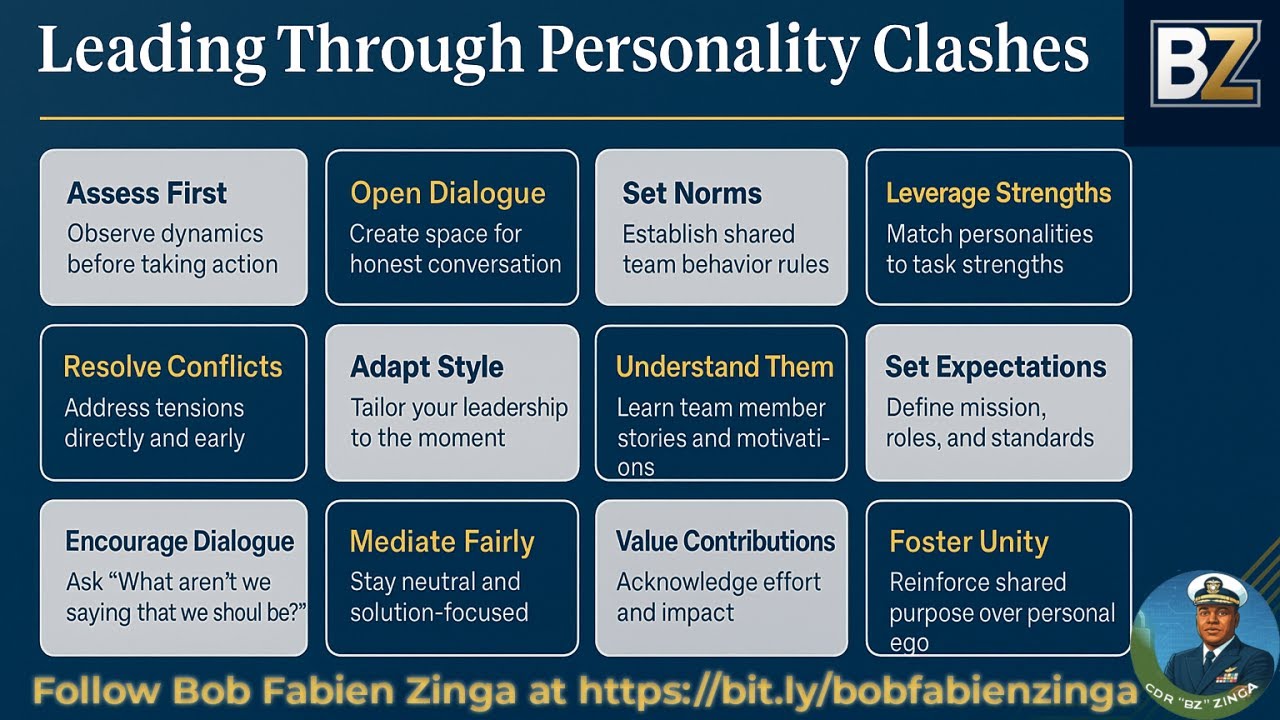
This content was created by Bob Fabien Zinga. This content was uploaded by Bob Fabien Zinga. This is a YouTube live episode (S4:E27: "Leading Through Personality Clashes") — a leadership podcast-style conversation and deep dive led by Bob Fabien Zinga (Coach BZ) with multiple hosts/voices (including an intro by John C. Maxwell and several labeled speakers). Recorded/published July 10, 2025, the episode targets military and high-tech leaders and covers Zinga’s article “Leading Through Personality Clashes: 12 Leadership Moves That Work,” Maxwell’s leadership framework, archetypes of difficult personalities, root causes (stress, unclear roles, founder influence, rapid scaling), practical tactics (12 moves like Assess First, Open Dialogue, Leverage Strengths, etc.), and higher‑order principles (servant leadership, listening, distributed leadership). It’s presented as a live show with audience engagement/Q&A (LinkedIn/YouTube), practical tips, and references to assessments (StrengthsFinder/DiSC) and scripture/leadership quotes.
Chapters
Hi, I'm John Maxwell. When the top companies in the world are looking for trainers, speakers, and coaches, there's one name that stands above the rest, and that's Maxwell Leadership. Our certified team members have gotten proven results for companies all over the globe, and our reputation, I'm proud to say, is second to none. Some of our members have risen to the top of their profession, including the one you're going to meet today. I proudly introduce you to my friend, Bob Fabien Zinga.
Welcome to the Leadership and Success Podcast with your host, Coach BZ. If you need to develop into a better leader, this podcast is for you. If you want to achieve a greater level of success, this podcast is for you. His mentor, Dr. John C. Maxwell, said it best: everything rises and falls on leadership. We hope to inspire you today and provide you with an insight that has the potential to positively impact the trajectory of your life. Welcome to the Leadership and Success Podcast with your host, Coach BZ.
If you need to develop into a better leader, this podcast is for you.
Imagine gaining the leadership skills that could redefine your career. Join Coach BZ on the Leadership and Success Podcast, where each episode delivers practical insights from world-class speakers, military leaders, and industry experts. We dive deep into what matters most: building resilient teams, leading through uncertainty, and navigating complexity with clarity and confidence. Every conversation is crafted for aspiring leaders like you who are ready to grow, lead, and make a lasting impact. Don't miss our powerful live sessions and recent highlights. Michelle Hayward on building diverse, high-performing technical teams. Anne Leslie on leading through global complexity and cybersecurity risk. Ron Carpenter AI exploring faith, resilience, and AI-powered leadership. Colonel Michelle G.I. Gardner-Ins on commanding influence from the battlefield to the boardroom. Chris Robinson on shifting from drift to drive in life and leadership. And Coach Enrique Acosta Gonzalez on mentorship, legacy, and heart-centered leadership. Ready to level up your leadership journey? Tune in on Spotify, Apple, Audible Podcasts, YouTube Live, and LinkedIn Live. Join the movement toward leadership excellence. Listen now and start transforming your success.
Hello everyone, this is Coach Bizzy. Thank you so much for being with me this morning. Today is July 9th, and, uh, we're gonna be talking today about an article I wrote, uh, which is Leading Through Personality Clashes: 12 Leadership Moves That Work. And, uh, in this podcast, we are going to be focusing mainly on 3 things: how to lead strong personality without losing unity— that's very important— and we're going to be talking about the 12 tactical leadership moves every military and tech leader should know. And finally, we're going to be talking about why mindset structure and emotional intelligence matter more than ever before. So if you've been watching me for a while and this podcast is adding value to you, please like the post, engage with the content. Let me know where you are joining us from. If you have a question for me, please type the question in the comment. And by the end of the podcast, I'm gonna come back and I'm gonna be answering all of those questions live here on LinkedIn and on YouTube. And also, if again, this podcast is adding value to you, think of somebody else in your network, your circle of influence, who might benefit from the content of this podcast or my article, and forward the link to them. I would appreciate that so very, very much. Pretty much every single day I write and I produce this podcast because I have you on my mind. I want you to be successful, especially if you are an aspiring leader in the military or in high tech. And I appreciate whatever you can do to kind of spread the word around and increase the impact of this podcast. So with no further ado, I'm going to have my AI agent, Joe and Mary AI, take it from here. And again, type your question in the comment section. And I see you in about 30 minutes or so.
Have you ever, um, found yourself in one of those project meetings? You know, the ones where everything just grinds to a halt? The goals are clear, the task seems straightforward, but there's this like unspoken tension, this friction in the air that feels like it has absolutely nothing to do with the actual work.
Oh, definitely. Or maybe you've been on a team that's packed with talent, I mean, brilliant people, but somehow you just aren't clicking. The whole dynamic feels off, right?
Exactly. It's such a common challenge, isn't it? Because, you know, so often the real problem, the real difficulty in getting anything done together, it isn't the technical stuff. It's almost always about the people involved.
It's a really profound truth. And Dr. John C. Maxwell, who's just a giant in leadership thinking, he nails it with this quote. '90% of the art of living consists of getting along with people you cannot understand.' Wow. And that cuts right to the heart of it. You know why leading really in any field isn't hard? Because the mission's complicated? No, it's hard because of the people, the incredibly diverse, complex, and yeah, sometimes really challenging individuals you're trying to lead.
Mm-hmm.
But that's also what makes it meaningful, right? That human element. It, it turns leadership from just managing tasks into something well, something much deeper.
That really hits home. And that exact challenge, navigating those human dynamics, that's what this whole deep dive is about today. We're focusing on understanding that personality minefield that can pop up in teams, but not just spotting the problems. More importantly, we want to give you the strategies to actually lead through them effectively.
And we're drawing heavily from this really insightful article by Bob Fabien Zinga. It's called A Lead Laid: Leading Through Personality Clashes 12 Leadership Moves That Work.
Yeah, B.Z. Zinga. What's fascinating about his take is his background, isn't it? It's such a unique blend.
It really is.
He's not just looked at this from one perspective. He's been right in the thick of it, leading high-stakes cybersecurity teams in Silicon Valley. You know, that super fast-paced, high-pressure tech world.
Right, where stress is basically the baseline.
Exactly. But then he's also commanded US Navy units all over the globe, We're talking environments where decisions can be life or death, and team cohesion is absolutely paramount.
So he's seen the same human stuff play out in wildly different settings.
Precisely. The same personality clashes, the same friction, just in different uniforms, so to speak. And that dual experience, it gives his insights this incredible weight. It's not just theory from a book. It's like forged in fire, real-world, high-stakes leadership.
Yeah, that really does lend it authority. It shows these human challenges are pretty universal. It doesn't matter if you're in tech or the military. And so our mission today for you listening isn't just to give you a quick overview. We want to dig deep, pull out the practical, actionable strategies from B.Z. Zinga's work, but also connect them to a sort of deeper framework for understanding why people act the way they do.
Right. The goal isn't just reactive damage control for difficult people. That's thinking too small.
Exactly. It's about proactively transforming those challenging dynamics. Turning friction into, well, into cohesive, mission-focused teamwork, maximizing potential, fostering real unity.
It's about unlocking the best in everyone, even when it's tough.
You got it. So, ready to jump in?
Yeah.
Let's unpack this deeply. All right, so let's start with the core problem. Bob Fabien Zinga lays out this fundamental idea that leadership is often hardest not because of the mission, but because of the people.
Yeah, he makes it really clear. Whether you're in a fast-moving tech startup or disciplined military unit, technical skill, that's just table stakes. It's expected. Everyone's supposed to be good at their job.
Right, that's the baseline.
But what makes the difference between, you know, chaos and actual cohesion? What turns talented individuals into a real team that gets stuff done? That's leadership. Effective leadership.
Without it, even the smartest people can just fall apart under pressure.
It's true. And Zinga really highlights why startups specifically are such intense pressure cookers for these personality clashes. Just think about the mix.
Yeah.
You've got crazy long hours, brutal deadlines, and often this constant, like, existential threat of failure looming over everyone. Will we make payroll? Will we get the next funding round?
That's a lot of pressure.
It is. And that relentless pressure, Zinga points out, it doesn't just create stress, it amplifies it. It can make people behave unpredictably, volatile sometimes. Even seem irrational, people under that kind of strain, well, they aren't always their best selves.
It makes so much sense. It's like you said, a pressure cooker. You throw these really passionate, driven people together in this high-stakes environment.
Uh-huh. And that passion, that drive for innovation, it's great, obviously. It's what makes startups exciting. But it can be a double-edged sword.
How so?
Well, it tends to attract people with really intense personalities, sometimes challenging ones, people who are deeply committed, maybe a bit uncompromising, strong-willed. And the risk, as Zinga warns, is that without really proactive, intentional leadership guiding that energy, those challenging behaviors can quickly poison the culture, derail morale.
So it's not just unpleasant, it can actually sink the company.
Absolutely. Burnout, infighting, people leaving. It's a direct threat to survival if it's not managed.
Okay, so navigating this minefield, as Zinga calls it, he identifies some common archetypes of challenging personalities he saw a lot in Silicon Valley. And as he describes them, you can probably picture someone you know, maybe even yourself on a bad day.
Huh. Yeah, probably. Recognizing these patterns is definitely the first step. All right.
First up, the negator.
Ah, yes, the negator.
This is the person who just seems to shoot down every idea. They don't really offer anything constructive. They just kill the momentum. Imagine you're brainstorming, ideas are flying, and every single one gets hit with, That won't work, or we tried that, or impossible. And crucially, no alternative suggestion, just negativity.
It's soul-crushing, isn't it? Especially for innovation. They just suck the energy right out of the room. A black hole for enthusiasm. Totally.
Okay, next, the controller.
The micromanager. Wants to be in on every detail, hoards information like it's gold, and hates delegating.
Yeah. Picture the person who needs to be CC'd on every email. Holds on to vital client info or bottlenecks decisions because they just can't trust anyone else to do it right.
It's incredibly disempowering for the team. It stifles efficiency, sure, but it also stops people from growing, takes away their autonomy.
And then there's the drama king or queen.
Oh boy. Yeah. These folks seem to thrive on conflict. Like negativity is their fuel, right?
They take a tiny disagreement and blow it way out of proportion. Maybe they gossip constantly, spread rumors, or just seem to enjoy creating this atmosphere of tension. In crisis.
It's exhausting to be around. They drain all the positive energy. They basically manufacture chaos.
Definitely. Okay, who's next? The know-it-all.
Ah, the person who dismisses feedback and shuts down collaboration because, well, they already know everything.
They have to be the smartest one in the room. Always interrupting, rejecting any data or idea that doesn't align with their own.
Even if the data is solid?
Exactly. It makes people feel Unheard, undervalued, right? And it kills open discussion, kills innovation. You need open minds for creativity.
Yeah.
And they slam that door shut.
Yep. Tough one.
And maybe the trickiest, the passive-aggressive.
Ooh, yeah. These are subtle. No direct confrontation. Instead, it's sabotage through silence or sarcasm or just procrastination.
Like they agree to do something in a meeting, big smile, then just forget. Or they make those undermining comments with a sweet tone. And you're left wondering, "Did they just insult me?" Precisely.
And it's damaging because it's hard to pin down. It just slowly erodes trust and accountability, like a quiet leak.
Wow, these are definitely recognizable.
And Zinga is very clear. Letting these behaviors run rampant, it erodes trust, increases burnout, and threatens organizational viability. This isn't just about annoyance; it's about serious risk to the business.
Yeah. And there's another layer too. Calvin D. Scott's comment in the source material adds the prima donna.
Ah, yes, the "I'm bigger than the team" type. "I'm the smartest person here, don't question me." That self-centered mindset.
And Scott points out, it's especially toxic if it comes from leadership itself.
That's the crucial part. Scott says these mindsets trickle down. If the leader acts like an individualist, putting themselves above the team, that sets the tone for everyone. It fosters a "me first" culture instead of unity.
And then what happens?
Cracks appear. Cohesion disappears. And as Scott puts it, when the storm hits, when things get tough, challenges arise, the whole thing falls apart because everyone's looking out for themselves, not working together.
That's powerful. He argues that's why many startups really fail. Not bad products, but leadership that couldn't build a real team.
Exactly. It puts the focus squarely on internal dynamics.
Okay, so Zinga doesn't just list these types. Yeah. He digs into why startups in particular seem to, well, breed these personalities and this friction. It's not random, right?
There are root causes. The first one is pretty obvious. High stress environments. We touched on this. That pressure cooker effect just magnifies everything. People under stress, they react, they lash out, withdraw, get controlling. It's almost physiological.
Makes sense.
One of undefined roles. This is huge in fast-growing companies. Roles shift, responsibilities are unclear. Nobody knows exactly who owns what, leading to turf wars, tension. People try to carve out their space, maybe step on toes, hoard tasks because they're insecure or unclear. It's a recipe for conflict.
Okay. That rings true.
Then there's the impact of founder-led culture. Founders pour everything into their company, right? Their personality becomes part of the company's DNA.
For better or worse.
Exactly. As Zinga puts it, founders' blind spots become cultural blind spots. If the founder avoids conflict, maybe the whole company learns to sweep things under the rug. If they micromanage, that becomes the norm.
So their traits get baked into the system.
Pretty much. And finally, rapid scaling. When a company grows exponentially fast, communication and culture often can't keep up. What worked for 10 people breaks down completely with 100 or 500.
Leading to fractured teams, misunderstandings.
Widespread miscommunication. Yeah, things fall through the cracks. So understanding these root causes, the stress, the ambiguity, the founder's influence, the scaling pains, that's key. It lets leaders move beyond just reacting to bad behavior and start building systems and cultures that prevent it.
Right. Tackling the source, not just the symptom.
Exactly. And understanding that foundation, the why behind the friction, sets us up perfectly for the next part, the game plan.
Okay.
BZ Zinga credits a lot of his leadership philosophy here to his mentor, the great Dr. John C. Maxwell. Maxwell's framework provides the strategy, the blueprint for navigating these challenges.
Ah, so this is where the how-to comes in. Here's where it gets really interesting.
Definitely. Maxwell's core idea isn't just theory; it's a playbook based on precision and empathy. And the central "Zinga" highlights is simple but powerful: "To lead difficult people successfully, I must know them and develop a game plan." So, no winging it.
Intentionality is key.
Absolutely. It's about moving past labeling someone as "difficult" and actually committing to understanding them. What makes them tick? What are their hopes, fears, motivations? It requires deliberate effort.
And Maxwell breaks this down into practical actions, right? Like the first one, lead according to their dream. What does that mean in practice?
It means looking beyond their job description. What are their deeper aspirations? What do they really want to achieve personally and professionally? If you can tap into that, their dream, you unlock huge potential.
How?
Because you can align their personal why with the team's mission. It creates a much deeper level of engagement than just showing up for a paycheck. You're connecting to what drives them.
Okay, I see. So, know their dreams, then what?
Coach according to their weakness. Now, this isn't about criticism or making them feel bad. It's the opposite. Right. It's about spotting specific growth areas and offering targeted support. Helping them improve. You're turning a potential liability into a development opportunity.
Showing you're invested in their growth.
Exactly. It builds trust, makes them more willing to be vulnerable and learn. You're helping them become better.
Makes sense. What's next in the framework?
Mentor according to their potential. This is about looking ahead, seeing beyond their current performance to what they could become.
Seeing their future capabilities.
Right. Recognizing untapped talents. When you mentor based on potential, not just present reality, you foster long-term growth and deep loyalty. You're painting a picture of their future. And helping them step into it. You become a partner in their journey.
I like that, partnering in their journey.
Then crucially, delegate according to their strengths. This is real leadership artistry, assigning tasks that naturally leverage what someone is good at, what comes easily to them.
Putting people where they'll shine.
Precisely. They're more confident, more engaged, and way more productive. Zinga mentions tools like StrengthsFinder or DiSC assessments here.
Can you quickly explain those?
Sure. StrengthsFinder helps identify your top innate talents. Things like Achiever, Strategic, Empathy. DiSC looks at behavioral styles, Dominance, Influence, Steadiness, Conscientiousness, helping you understand how people prefer to communicate and work.
So using data to make smarter assignments.
Exactly. It's about putting the right players in the right positions, making the most of everyone's natural gifts.
Got it. And the last piece of Maxwell's framework?
This one's critical for handling clashes. Relate according to their temperament or personality. Basically, adapt your style.
One size doesn't fit all.
Not at all. If you try to lead everyone the same way, you'll clash with some, miss others completely. You need to adjust. Understand if someone's an introvert who needs space, an extrovert who thrives on interaction, an analyst who needs data.
And then interact with them in a way that works for them.
Yes, it fosters much better understanding, connection, rapport. It's about meeting people where they are, communicatively speaking.
Maxwell really drives this home with an analogy, right? The quarterback one.
He does. He likens great leadership to a quarterback calling the right plays based on both the situation and the strengths of your team.
Knowing your players and the game situation.
Exactly. And the implication is pretty stark. Zinga quotes Maxwell saying, mismanaging a team dynamic because we don't understand someone's wiring is not just ineffective, It's a leadership failure.
Wow, that's a strong statement.
It is, but think about it. If you don't know your players, their strengths, weaknesses, how they operate best, how can you possibly lead them effectively? You're just guessing. You need that deep understanding to orchestrate success.
That quarterback analogy makes it so clear. It's not just having talent; it's knowing how to use that talent together.
Precisely.
Which leads us perfectly into BZ Zinga's 12 specific leadership moves. These are the practical plays, the tactical applications of Maxwell's framework.
Right. These are the concrete steps, the actions you can take. And for each one, we'll look at the core insight, a practical tip, and the quote that sums it up. It's a real hands-on playbook.
Okay, let's dive in. Move number 1: Assess first. The insight. Start by understanding the battlefield team dynamics, power structures, and unspoken tension. Why start here?
Because you can't fix what you don't understand. Jumping in with solutions before you've diagnosed the real problem? That's just guesswork. You need data. You need to understand the landscape first. It's like a doctor diagnosing before prescribing.
Makes sense. So the practical tip?
Zinga suggests using one-on-ones, anonymous surveys, and observation before implementing change. It's about triangulation, getting information from different angles.
Not just reacting to one loud complaint.
Exactly. Have private conversations, watch the dynamics in meetings, use surveys for honest, anonymous feedback. Get the full picture. As the quote from Brian Tracy, MBA, says, the more you understand others, the more influence you can have. Understanding is the bedrock of influence. Without assessment, you're flying blind.
Got it. Okay. Move to open dialogue. Insight. Create a safe space where dissent is not punished but welcomed. This is about psychological safety.
Absolutely. If people are scared to speak up, to disagree, to offer a different view, you'll never hear the truth. You'll miss crucial warnings. Brilliant ideas. Innovation dies in fear.
So how do you create that space? The tip.
Zinga offers this fantastic actionable question. Ask regularly, "What aren't we saying that we should be?" Oh, like that. It's proactive. It invites people to surface those hidden tensions, those unspoken concerns before they blow up. It normalizes constructive dissent.
It says, "It's safe to speak truth here." And the quote connects to the feeling behind it.
Yeah, Jim Rohn. Effective communication is 20% what you know and 80% how you feel about what you know. It highlights that trust, that feeling of safety is way more important than just the facts being shared. Emotional intelligence is key.
All right. Number 3, set norms. Insight: teams perform best when behavioral norms are clear and co-created. So clarity prevents conflict.
Pretty much. Ambiguity breeds friction. When everyone knows the rules of engagement, how we talk to each other, give feedback, handle disagreements, and crucially, when they help create those rules, you get ownership. Accountability.
So the tip is about making it explicit.
Yes.
Facilitate a ways we work session to define standards for respect, feedback, and accountability. Get the team together, agree on norms like assume positive intent or focus feedback on behavior, not personality.
Concrete agreements.
Exactly. They become the guardrails. And Peter Drucker's famous quote, culture eats strategy for breakfast, really applies here. A strong culture built on clear norms is more powerful than any strategic plan because it dictates It's not how work actually gets done; it's the operating system.
Okay, 4: Leverage strengths. The insight is about shifting perspective. Personality clashes often reveal complementary strengths waiting to be harnessed. So conflict isn't just bad.
Right, it can be a sign of diverse strengths rubbing against each other. Instead of just seeing a problem, look for the opportunity. How can these different approaches actually work together, create synergy?
Finding the positive potential in the friction. And the tip involves those tools again. Yep.
Use tools like StrengthsFinder or DiSC to assign roles that amplify natural talent. We talked about these— understanding innate talents or behavioral styles lets you put people in roles where they'll naturally excel.
Play to their strengths.
Exactly. Match the task to the talent. It builds confidence, boosts performance. Darren Hardy's quote sums it up. Focus on your strengths. Delegate your weaknesses. It connects right back to Maxwell. You're conducting an orchestra, putting the right instruments in the right hands.
Number 5: Resolve conflicts. Insight.
Mm.
Avoidance is not strategy. Timely, honest conversations can restore alignment. So face it head-on.
You have to.
Letting conflict fester is toxic. It kills morale, productivity, everything. Direct, even if uncomfortable, conversations are essential.
And the tip gives a structure for that: the Fact-Feeling-Forward model.
Yeah, it's a great model. Simple, effective. First, facts—what objectively happened. Stick to specifics. Then, feelings—how did it impact people emotionally? Acknowledge that impact. Validate it. Finally, forward—what concrete steps do we take now? To fix it, prevent it, move on.
Keeps it focused and constructive.
Right. Avoids blame games. And Dennis Waitley's quote frames it well: "Mistakes are painful when they happen, But years later, a collection of mistakes is what is called experience. Conflict, handled well, is a learning opportunity.
It makes the team stronger. Okay. Move 6: Adapt Style. Insight: One-size-fits-all leadership is outdated. Flexibility is the mark of maturity. So leaders need to adjust their approach—
Constantly. Leading everyone the same way just won't work with a diverse team. You'll clash. You'll demotivate. Effective leaders are dynamic.
The tip Makes it concrete. Match your leadership style to the needs of each situation and individual. Give me an example.
Sure. With a new hire, you might need to be very directive, give clear instructions. With a seasoned expert, you'd be more facilitative, give them autonomy, ask questions. It's about knowing what that person needs in that moment.
Got it. And the quote from General Colin Powell.
The best leaders are chameleons with a compass.
Brilliant, right?
Adapt your behavior, your style, the chameleon part, based on the situation and person. But always stay true to your values, your mission, the compass part. Flexible methods, firm principles.
Number 7, understand them. Insight. Behavior is data. Difficult people often mask misunderstood motivations. So look deeper than the surface behavior. Exactly.
Don't just label someone difficult. See their behavior as a clue. What's driving it? What unmet need, fear, or misunderstanding is behind the actions? It's about analysis, not just judgment.
And the tip suggests getting to know their Big Five.
What are those? Zingalists. Personality, natural tendencies, temperament, emotional responses. Heart, core values, what they care about. Relationships, how they connect with others. And dreams, aspirations, purpose.
Wow, that's a holistic view. It is.
It's about really seeing the whole person. And this ties directly back to Maxwell's core idea, which Zinga quotes again, "To lead difficult people successfully, I must know them and develop a game plan. You simply have to know them.
It's foundational." Okay, moving to 8. Set Expectations. Insight: Conflict grows where clarity is absent.
This feels like prevention. It absolutely is. Clear, upfront communication about what's expected prevents so many misunderstandings and disputes later. Ambiguity is conflict's best friend.
So the tip involves using specific tools.
Right. Things like mission briefs, KPIs, or RACI charts to define roles, responsibilities, and authority. A mission brief clarifies the why and the goal. KPIs, key performance indicators, define measurable success. And a RACI chart— Responsible, Accountable, Consulted, Informed— clarifies exactly who does what for each task.
Leaves no room for confusion about roles. Exactly.
Everyone knows their part, who's accountable. It eliminates guesswork. Tony Robbins quote Fits perfectly. Where focus goes, energy flows. Clear expectations channel everyone's energy in the same direction. Less friction, more flow.
Number 9, encourage dialogue. Insight. Contribution is often stifled by fear. Inclusion fuels innovation. Back to psychological safety.
Definitely. Fear kills contribution. If people don't feel safe to speak up, you lose valuable ideas, different perspectives. Inclusion isn't just nice. It's essential for innovation.
And the tip gives ways to actively foster that inclusion.
Yes. Invite junior voices to present, rotate facilitators, and publicly reward engagement. These are concrete actions. Give platforms to quieter people. Don't let the same voices dominate meetings. Celebrate when someone does speak up, especially with a challenging idea.
Making it structurally easier and rewarding participation.
Right. And Dr. Maxwell's quote here is so relevant: "People don't care how much you know until they know how much you care." Showing you genuinely care about hearing all voices is key to unlocking that contribution.
Empathy first. Next, 10, mediate fairly. Insight. Yeah. Impartiality builds credibility. Show you value resolution more than being right. The leader is neutral facilitator. Crucial role.
When conflict erupts, your job isn't to pick sides or prove you're right. It's to guide the parties towards a solution that works for the team and the mission. Your credibility hinges on being seen as fair.
And the tip for doing that.
Separate the person from the issue and focus on shared mission outcomes. Depersonalize it. Shift the focus from who's wrong or whose ego is bruised to what's the problem we need to solve. Keep it objective, tied to the team's goals.
Takes the emotion down a notch. Hopefully. And T.
Harv Eker's quote, "How you do anything is how you do everything," emphasizes consistency. Your fairness in handling one conflict builds trust for all future interactions.
It shows your character. Okay. 11, value contributions. Insight. Huh. Quiet excellence often hides behind loud conflict. Recognition changes that, spotlighting the unsung heroes. Exactly.
It's so easy to overlook the steady, quiet contributors, especially when louder personalities dominate. But failing to acknowledge their work breeds resentment. Recognition is powerful. So the tip is about making recognition a habit.
Yes.
Create rituals of acknowledgment, weekly shoutouts, impact moments. Peer praise. Make it regular. Weave it into the culture. Maybe start meetings with wins. Have a channel for peer-to-peer praise. Make appreciation visible and consistent. It really motivates people, doesn't it? Hugely. Dr. Maxwell again: People rise to the level of praise and fall to the level of neglect. Genuine recognition fuels engagement and commitment. People need to feel seen and valued.
And the final move? 12. Foster unity. Insight. Teams thrive on shared identity and vision, not uniformity. So, unity isn't about everyone being the same.
Not at all. That stifles creativity. True unity is about diverse individuals rallying around a common purpose, a shared identity that embraces their differences but binds them together. How do you build that?
The tip.
Build rituals, team mottos, and cross-functional projects to drive belonging. Create shared experiences—a team lunch, a motto, projects that force collaboration across different groups. These things build connection and shared purpose.
Makes the team more than just a collection of individuals. Exactly.
And Les Brown's quote speaks to this: "Help others achieve their dreams and you will achieve yours." Investing in the team's collective success, helping individuals thrive within that shared vision. That's how you build true unity and achieve your own leadership goals.
Wow. OK, those are 12 really practical, actionable moves grounded in Maxwell's framework. But Zinga goes even deeper. Doesn't he, into the underlying philosophy? He does.
He has this section called Think on These Things, which moves beyond tactics to the mindset, the wisdom behind truly effective leadership. These are more like guiding principles. Applicable to any leader, really. Absolutely. Let's start with peace as a leader's responsibility. He draws from Romans 12:18: If possible, so far as it depends on you, live peaceably with all. So the responsibility lies with the leader. A significant part of it, yes. The insight is that leaders have a duty to actively pursue peace, to set the tone for how conflict is handled.
But that doesn't mean avoiding tough conversations.
No, not at all. It means entering those hard conversations with humility, focusing on the mission's unity, not on winning or protecting your ego. You control your actions, your tone, your fairness. Be the calm center.
So, a reflection point for you listening: where might you be choosing comfort over those courageous peacebuilding talks? When conflict flares up, are you bringing calm authority or are you maybe adding to the heat?
It's a tough question, but essential. Okay, next principle. Sharpening through diversity. Inspired by Proverbs 27:17. As iron sharpens iron, so one person sharpens another. Friction isn't always bad, right? Diversity of thought, style, personality brings friction. Yes, but it also brings refinement. Different perspectives, strong personalities challenging your ideas. That's what sharpens your leadership. If everyone agrees with you all the time, you're not growing.
So leaders should embrace that respectful disagreement, see it as growth.
Exactly. Build a culture where healthy debate is normal, even valued. And this connects perfectly to that great piece of advice from Steve Gurley, the Navy vet who commented on Zinga's article.
Oh yeah. What was that again?
If you think you're having a personality conflict, remember who has the personality and who has the conflict. Huh. That's direct. It's brilliant, though. Such a powerful nudge for self-reflection. Stop blaming the other person's personality and look at your own role. How are you contributing to the conflict?
What's your part? Shifts the focus inward. So for you listening, how do you react to disagreement? Defensively or with curiosity? Who on your team pushes you, challenges you, sharpens that leadership edge? Even if it's uncomfortable.
Then there's the tactical advantage of listening. Based on James 1:9, everyone should be quick to listen, slow to speak, and slow to become angry. Listening is a tactic. Absolutely. It's a strategic advantage. Zinga emphasizes that often emotional intelligence, especially listening, matters more than technical skill.
Why is it so advantageous?
Because teams open up when they feel heard. When people know their voice matters, they contribute more, feel safer. Listening, especially to someone you find difficult, or who disagrees with you, it doesn't mean you agree, but it means you value them enough to truly hear them out.
Builds that crucial psychological safety. So reflect on this. In your last tricky conversation, did you really listen to understand, or were you just waiting to talk? How do you make space for those quieter or dissenting voices? Next up, unity and diversity.
Drawing from 1 Corinthians 12: Even so, the body is not made up of one part, But of many, God has placed the parts just as he wanted them to be. The body metaphor.
So everyone has a purpose. Exactly.
Every single person on your team contributes something unique, even if their style grates on you sometimes. They have a purpose in the body of the team.
So effective leadership is about seeing that purpose.
It's about learning to see the why behind the who. Leading with the awareness that each person, with their unique quirks and talents, is essential to the mission.
Like different body parts, all vital, which challenges us to think whose gifts might you be overlooking because their style is different from yours? Are you leading everyone the same way equally, or are you leading them equitably based on their unique contribution?
Then we have the strength of servant leadership from Philippians 2. Do nothing out of selfish ambition. Rather, in humility, value others above yourselves. Look to the interests of the others.
Driven leadership isn't weakness.
Definitely not. Zinga frames it as mission-driven strength. It's incredibly powerful. And he practices this himself. Yeah, he shares his constant question, "How can I help them succeed?" He argues this approach builds loyalty, transforms culture, and earns trust way faster than just pulling rank. It's about prioritizing the team's needs and growth. It requires real humility.
So for you, how does your leadership show humility in action, not just words? Do your people feel served by you? What's one act of support, maybe even something sacrificial, you could offer a teammate this week to show they genuinely matter?
And the final philosophical point: delegation and distributed leadership. Inspired by Exodus 18, where even Moses needed help. "Select capable men and appoint them as officials." Even Moses couldn't do it all alone. Right. The lesson is clear. You need structure. You need to empower others.
So create distributed leadership and trust others to lead within their strengths. Don't be the bottleneck. Exactly.
Empower people to handle issues, resolve conflicts at their level. Zinga references the Navy's principle of resolving conflict at the lowest possible level. Yeah. Develop leaders around you.
Which makes you ask, are you trying to do too much yourself? Are you developing trusted leaders? And how are you training your team to handle conflicts effectively without escalating everything to you? Okay, we've covered the challenges, the archetypes, the root causes, Maxwell's framework, Zinga's 12 moves, and these deep philosophical principles. Wow. So what does this all mean?
Well, I think what it all boils down to is that leading people, especially through the inevitable friction of different personalities, isn't simple. It's not intuitive for most of us. It takes real work. It requires deep intentionality, a genuine commitment to understanding others, and like we said, a proactive, adaptable game plan. We saw how in places like startups, these interpersonal Issues aren't minor inconveniences. They can literally make or break the whole venture, right?
And I love B.Z. Zinga's concluding thought. It really sums it up. Leadership is earned in the gray zones, the tense meetings, the personality conflicts, the moments when listening matters more than commanding. It really does.
It's not about avoiding the messy stuff. It's about stepping into it with skill, with courage, with a plan.
And bringing it back one last time to Dr. Maxwell's wisdom, that guiding idea Leadership is not about control. It's about understanding. And when I finally understood the people I struggled with most, I found I could lead them best.
That's the whole journey, isn't it? Moving from control to understanding. That's where real influence, real leadership lies. Understanding the human beings you lead.
So as you, our listener, reflect on everything we've unpacked in this deep dive, we want to leave you with some direct challenges inspired by Zinga's questions. Are you truly leading through the personality tensions on your team, or are you maybe just avoiding them, hoping they magically disappear?
Do you have an actual thought-out game plan for those teammates you find most challenging, or are you just reacting defensively or passively in the moment?
And maybe the biggest question: are you actively influencing them, helping them grow, contribute, align with the mission, or are you just sort of managing their presence, wishing they were different? These aren't easy questions. No, definitely not. But remember Zinga's final words of encouragement: you don't have to lead perfectly, but you must lead intentionally. That's the key.
Intentionally. So our challenge to you is this: pick just one thing from today, maybe one of the 12 moves, maybe one of the deeper principles, like listening more actively or seeking to understand someone's Big Five. Just choose one.
Commit to applying it this week. Try it out in a real situation. And then, just observe. See what shifts. See what changes. That's how you continue your own deep dive into becoming a more effective, more intentional leader.
All right, thank you so much for everyone being here. And I see we've had quite a few questions in the comments section on both LinkedIn and YouTube. I'm gonna— first, I want to say thank you to Jeff Catfish Pritchett. Uh, from, uh, Sneed's Ferry, North Carolina. There is also, uh, Jesse Moore. He doesn't say where he's joining from, but he's been adding to this conversation, and I do appreciate that. So what, what I would say, you know, everything about leadership, there is really nothing new. You know, it's as old, I think, as the world is. That's why, uh, in every leadership article I write, I always add a section, think on those things. And a lot of those leadership principles I can go back to old, uh, scripture, right, in the Bible, and, uh, see a lot of those principles outlined. And just like, uh, I told you guys, for this season we have two books for, uh, as a curriculum for season 4 of the Leadership and Success podcast this year. So we have the 21 Irrefutable Laws of Leadership by my mentor John Maxwell. So I hope you already have this, but I also have The Maxwell Leadership Bible. All right. And I am not using this Bible as a religious text or anything like that, but it's to go back to an ancient book and extracting all of the leadership wisdom and principle and applying them today. Right. Because I really believe there is nothing new under the sun. And I believe Jesse kind of alluded to that in one of his comment, there is nothing new here. And that is, that is true. But what's important is not just knowing it in your head, right? Knowing it logically, that's not going to help you very much. What's very important is actually doing it. One of my mentors, I think I mentioned him in the article, T.R. Baker, he used to tell me, right, you don't know anything until you actually do it. Unless I see you do it, you don't know it. You may think you've studied it, you've read it, and but all of that is not knowing. It's just in your brain, but it doesn't do you any good until you actually do it. Another one of my mentors, uh, Tony Robbins, says, right, action, massive action. It's all about action. It's not just what you know, but it's what you do with what you know, right? So, uh, that is why it's important to review this principle and most importantly putting them into practice, because this is how you are going to change. That's how you're going to be able to influence the people around you. Let me see if there is any other question or comments here. Uh, okay, that's, that's all I see. Again, I do, uh, appreciate your feedback and thank you for helping us. Really, my, my heart right, right here. This podcast and the article I write, no, it's not for everybody, but it is for somebody, right? The person I have in mind, my avatar, is the aspiring leader. Especially in the military and especially in high tech, right? It's basically who I used to be 20 years ago, right? I joined the, uh, US Navy at the lowest rank. I was a seaman recruit, and I was able to move up the rank all the way to becoming an O-5, a commander, right? A senior officer in the most powerful navy in the world. And part of what helped me are these leadership principles, which I didn't just read and I didn't just, uh, understand or acquire a bottle here, but I actually put those principles into practice. And that's what I would like to give back to the next generation. So those are really the people I am focused on, right? Some people may not like what I do, which is perfectly fine. Again, this podcast, this content is not for everybody. And I am doing the best I can with everything I have received to now give it back to the next generation. And I do appreciate your help specifically in talking about the content, how we can make it better, and your experience with the content. And some of you are seasoned leaders, what you've already applied in your own life and the results you have seen. Like, for example, I'm going back to one of the comments I saw from Jeff, which I very much appreciate. He says, the KYP part is what I have preached in the past 20 years. I believe knowing your people is the key to every leader. And that is so true. Leadership is about people. People really are your greatest resource, right? But sometimes they can also be the source of your greatest frustration. And being a leader is knowing how to influence each individual, right? You cannot lead everybody exactly the same because people have different motivation, people have different desire, and, and you need to be able to use their strength and minimize their weaknesses, right? And being able to use your team as a whole so that the synergies that you create is much greater than each individual effort individually. And that's called leadership. So it's both, I believe, it's science and art as well. That's why we need to talk more about it and get some clues, some nuggets on how to lead a better life. And I don't think even my mentor, Dr. John C. Maxwell, who's written more than 90 books, almost all of them number one New York Times bestseller. He has so much knowledge and so much wisdom, But nobody ever gets to a point where they feel like, I have arrived, I know everything there is to know. Now, I do have a lot of experience. I've had more than 20 years experience, no, national security in the US Navy, more than 26 experience in high tech, but I don't know everything. So I share what I know, and every day I really want to get better and better and better. That's really the spirit in which I am writing this content and creating this podcast. So I do appreciate your help and your feedback, and I will be back here tomorrow about 6:30 AM Pacific Time, 9:30 AM Eastern Time. And I am looking forward to learning from one another. Like the Bible said, right, iron sharpens iron. And thank you so much for being active today, and we'll leave The biggest lesson, uh, I, I would say from, uh, today is, you know, leading through personality clashes. You know, in leadership you're gonna meet all kinds of people, and that is perfectly fine. And, uh, you just need to, I believe, have great value, number one. And number two, you need to value people, all people, regardless of their race, their gender, where they come from, and all of that. Even see gold, right, in dirt, right? Even people that most people would disregard, I believe there is still something very, very valuable, uh, in those people, and you need to be able to find it. So as a leader, I think you are almost like a gold digger. You are looking for gold in every single area. You are looking for that one thing that is going to motivate somebody who appears to be contradictory to whatever it is the organization is doing, trying to understand them and then trying to elevate them, coach them from their level of weakness to their level of strength. And I think that is important. And then number 3 is to add value to people, which I am hoping my writing and this podcast is doing for you. The last resource I'm going to leave with you toward the end of this article, the first link, I have your leadership self-assessment. If you would take the time to go through this, Know Thyself, I think it's gonna be very, very valuable to you. I go through a lot of leadership self-assessment, and I believe this is important because as a leader, first and foremost, you have to know yourself, right? And then I think it's also important for you to know the members of your team. This way you're gonna know what ticks them, know what is their strength, what is their weaknesses, and how you guys can work together. To maximize the effort of the team, the performance of the team. So take the time to go through them. Many of them, most of them are completely free. Some of them you do have to pay, but I think it is worth it. So I go through a whole lot of leadership self-assessments that might be useful to you. And also, if you know of one that's important or that works for you that's not listed there, please let us know and I will be glad to add it to the list. Okay, that's it for now. Until tomorrow, have a wonderful day. And I really hope that this podcast has added value to you this morning. Until tomorrow, this is Coach BZ. Goodbye.
Thank you for listening to the Leadership and Success Podcast with your host, Coach BZ. If you like what you heard, please subscribe to our channels and come back for more wisdom nuggets on how you may develop into a better leader and achieve greater levels of success. Leadership is the most critical skill. The world will always need leaders to lead others, deploy the next disruptive technology, or execute a business strategy. You may as well decide on counting yourself among the 21st century leaders. See you right here next time on the Leadership and Success Podcast with Coach BZ.
More from Bob

S250:E4🎙️LIVE 🇺🇸America 250: President Barack Obama Leadership, Service, and the Power of Hope






S5:E157🎙️ LIVE with CMD CMSgt Dennis L. Fritz, USAF (Ret.)(Multi Tracks Audio)



S5:E156🎙️ LIVE 🇪🇸 Leadership Lessons from the FIFA World Cup 2026 Champions (Multi Tracks Audio)

S250:E3🎙️ LIVE Leadership Lessons from America’s First Documented Family of African Descent 🇺🇸📖